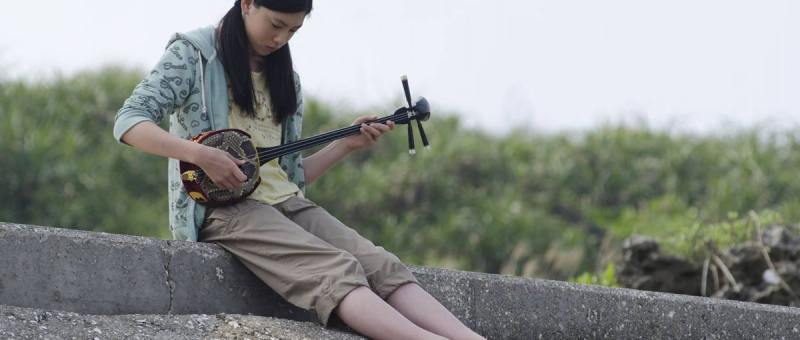
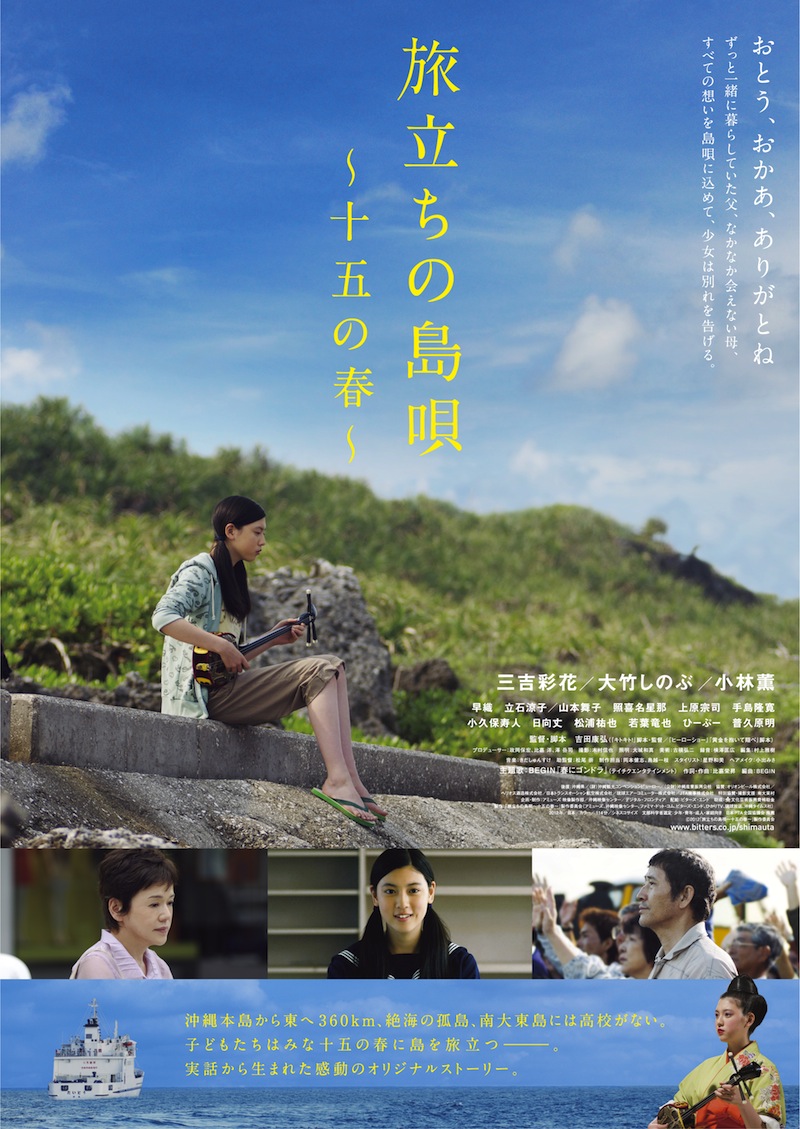
“How many of them will come back?” a man on the shore ominously asks as he watches the young people of his island ship out to pursue their education in the comparatively better equipped capital. Rural depopulation has become a minor theme in recent Japanese cinema, but the situation is arguably all the worse in the outlying islands of Okinawa. As the title of Yasuhiro Yoshida’s Leaving on the 15th Spring (旅立ちの島唄~十五の春~, Tabidachi no Shima Uta: Jugo no Haru) suggests, teens from the small island of Minami Daito (South Daito) must leave at 15 if they want to attend high school because there isn’t one on the island.
That said, there are more kids than you’d expect in young Yuna’s (Ayaka Miyoshi) middle school and it’s more than just a handful who leave the island each spring, many of them choosing to make lives for themselves in the wider world rather than return to their childhood home. On Minami Daito, the main industry is sugarcane but the prospect of Japan joining the TPP trade agreement has many worried that it will soon no longer be viable and with even fewer economic opportunities available many will have no choice other than to abandon the island for good.
We’re often reminded just how far the island is from the Okinawan capital Naha and how difficult it is to get to. To leave, the kids are placed in a kind of cage and lifted onto a larger boat moored by a small jetty. Even to get to the next island Kita Daito (North Daito) it’s some time on a ferry which might not run if the weather is bad. Distance becomes a persistent theme, not just in Yuna’s impending exit but the scattering of her family. When kids leave for high school, a parent often goes with them as Yuna’s mother Akemi (Shinobu Otake) did when it was time for her sister Mina (Saori) to depart. But Mina is now a grown woman married with a child of her own and Akemi has not been back to the island for two years. This forcible separation continues to disrupt familial bonds as couples necessarily grow apart and children begin to choose their own paths in life which often take them away from their parents.
It’s this sense of distance which plays on Yuna’s mind, a kind of countdown starting inside her as she witnesses another girl sing the Okinawa folk song “Abayoi” which means “goodbye” in the local dialect and recounts a young person’s sorrow as they must leave their family and childhood home behind on coming of age. Reminded that she’s next in only a year’s time, Yuna meditates on her past and future while reconsidering her relationships. Abandonment often occurs through a simple lapse in contact. Akemi now rarely phones home while Yuna’s nascent first love with a boy from Kita Daito falters when he abruptly stops calling or returning her letters. Eventually she finds out that despite their pledge to attend the same high school on Naha, he has decided to stay and take over his father’s fishing boat because of his dad’s ill health.
Kenta has realised that his place is Kita Daito and he will remain there the rest of his life while harbouring a degree of resentment that he couldn’t go to high school or pursue his romance with Yuna. He feels their relationship is doomed simply from the fact that they’re from different islands. He won’t leave his, and she likely would not settle on Kita Daito preferring, either a life in the cities or her childhood home. It’s the same for her parents, Akemi deciding that she prefers life in the city and the degree of independence she has there while her father Toshiharu (Kaoru Kobayashi) would not survive off the island. Both of her siblings have already left, Mina returning with her infant daughter apparently on the verge of separating with her husband partly it seems because of the insecurity the separation of her family has left her with, while Yuna’s brother seems to be a harried workaholic with no family life to speak of.
Rather childishly she thinks she can reunite her family and dreams of buying a big house on Naha for them all to live together, adult siblings included, without fully accepting that the relationship between her parents has been gradually worn away leaving them strangers to each other and each desiring different kinds of futures. What she comes to is perhaps an acceptance of the distance in her life, the longing for her island home where she says everyone is one big family, as she finds herself choosing independence. A picturesque vision of Minami Daito and its idyllic landscape along with the traditions of the island including its rich musical culture and Okinawan Sanshin, Yoshida’s gentle drama discovers that “abayoi” is a part of life that can’t be avoided but can be sweet as well as bitter once you’ve learned to accept it.
Trailer (English subtitles)
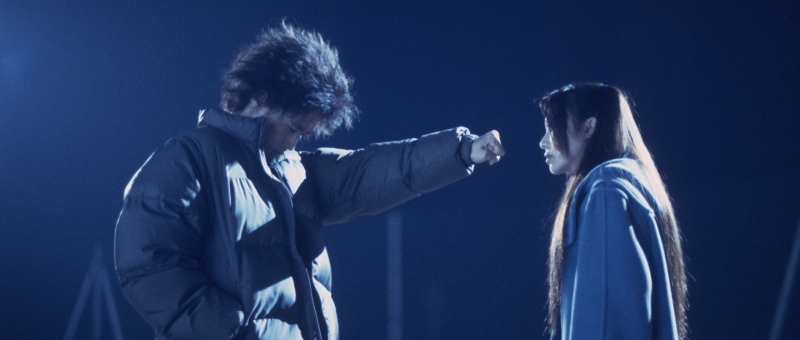

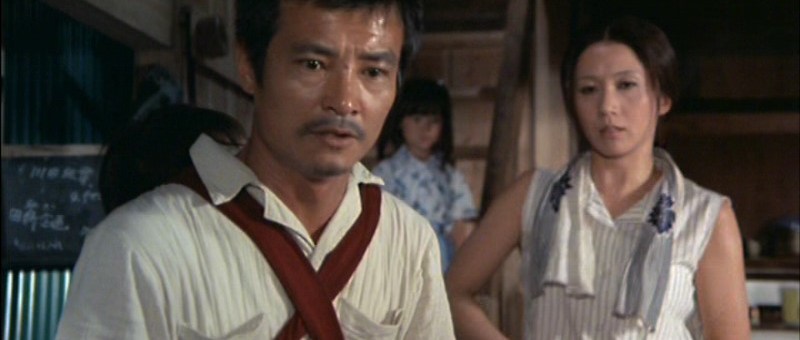






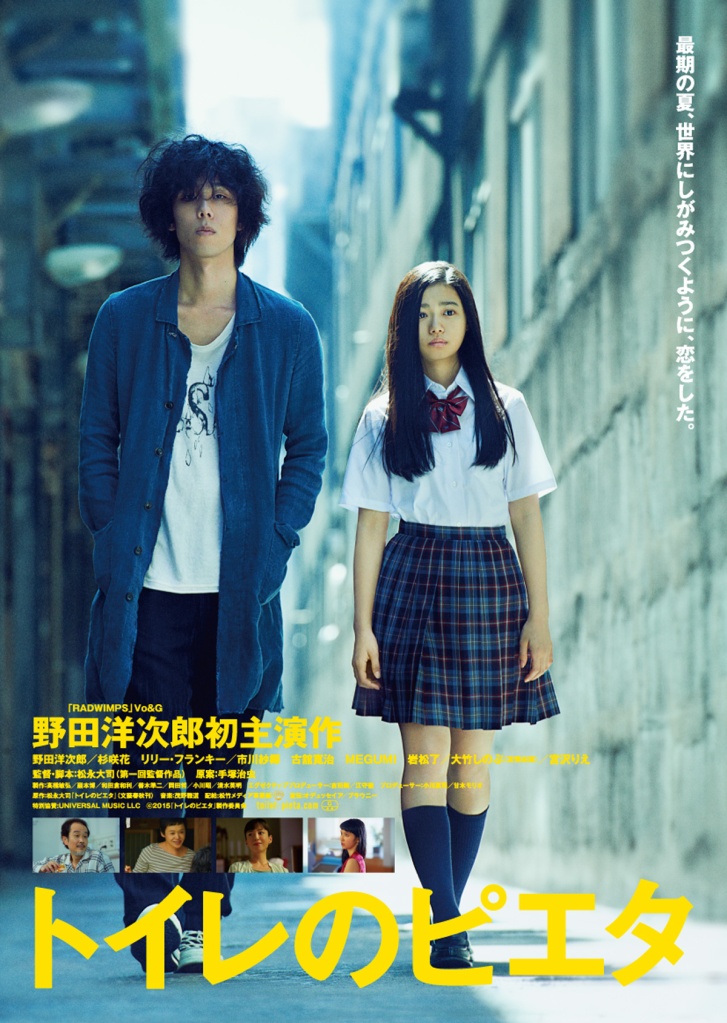 Somewhere near the beginning of Daishi Matsunaga’s debut feature, Pieta in the Toilet (トイレのピエタ, Toire no Pieta), the high rise window washing hero is attempting to school a nervous newbie by “reassuring” him that the worst thing that could happen up here is that you could die. This early attempt at black humour signals Hiroshi’s already aloof and standoffish nature but his fateful remark comes back to haunt him after he is diagnosed with an aggressive and debilitating condition of his own. Noticeably restrained in contrast with the often melodramatic approach of similarly themed mainstream pictures, Pieta in the Toilet is less a contemplation of death than of life, its purpose and its possibilities.
 Windows on Worlds