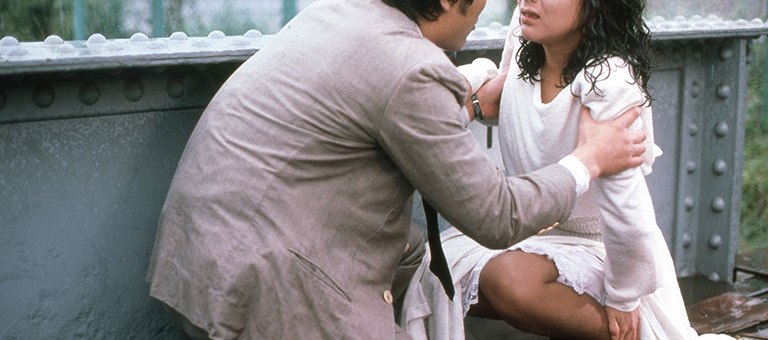
Scent of a Spell (魔性の香り, Toshiharu Ikeda, 1985)

Esaka (Johnny Okura) feels like someone’s watching him. He has this sense of being observed by some otherworldly force along with a generalised feeling of uneasiness. But his paranoia seems to melt away after rescuing a young woman, Akiko (Mari Amachi), whose attempted suicide he witnesses during a rainstorm on his way home. He takes her in and one thing leads to another. For a time, they’re blissfully happy but then something starts to nag at him. Is Akiko really who she claims to be, or a demonic force of monstrous femininity?

It’s this malevolent quality to which the title of Toshiharu Ikeda’s noirish romance Scent of a Spell (魔性の香り, Masho no Kaori) alludes. Esaka is captivated by a hint of mystery and his own white knight syndrome, bewitched by Akiko but also perhaps growing tired of her and fearful of romantic commitment. He has after all been married before and his friend’s comments seems to suggest the cause of marital breakdown may either have been his womanising or his wife’s baseless jealousy. Akiko tells him that she’s on the run from an abusive husband prone to jealous rages and that though she has escaped from Osaka to Tokyo he always manages to track her down. Her sense of being pursued and Esaka’s of being watched seem to perfectly align while he seems to appreciate the fact that she needs him and he is quite literally sheltering her from danger.

Nevertheless, there are cracks in Akiko’s story beginning with the fact the bridge she threw herself off wasn’t the kind to pose a serious risk to life. The drop is only a few feet and though she resolutely refuses to be taken to a hospital because her husband might find her, she may be exaggerating the extent of her injuries. Meanwhile, she seems to have something of a jealous streak becoming irritated when Esaka talks to the proprietress of a local bar, thereafter apparently submitting herself to the attentions of his over-friendly colleague. Perhaps she had a reason to be annoyed given that she didn’t previously know any of these people and he inadvertently excluded her from the conversation, but it’s difficult for Esaka to know if she’s actually being unreasonable or he’s overreacting to a threat to his male pride and autonomy.

It’s this threat to his freedom that’s inflamed when he overhears another man talking to the lady behind the counter at a cafe he regularly goes to about his own girlfriend who is also named “Akiko” written with the character for “autumn”. Though there must be dozens of women with this not all that uncommon name combination in the city, it plants the seed of doubt in him that perhaps his Akiko and the other are the same and she’s two-timing him with this other guy while he’s at work. It also adds to his feeling that she has some kind of malevolent supernatural quality as if she were deliberately targeting lonely men for nefarious reasons. When the man from the cafe is found dead at home having been bludgeoned to death, he can’t help but feel that Akiko must have been involved and possibly intends to harm him too.

Of course, this may just be his fear that she will hurt him emotionally and his growing paranoia is a defence mechanism designed to protect himself against her abandonment or an infringement on his freedom. Or, alternatively, Akiko really is a dangerously crazed and jealous woman and letting her into his life will mean not a moment’s peace until it’s over. Even so, the pair of them discover intimacy in connection in their raw, desperate love making. Every time Esaka’s doubts rise to the surface, Akiko seduces him or he her and he momentarily forgets. In this, the film may have a latent misogyny as a final twist suggests that in the end all women are prone to fits of jealous rage not to mention cunning and trickery directed against each other as much as men who are also, to be fair, faithless liars and cheats. Akiko’s tragic backstory suggests something similar, that she is the inheritor of a legacy of compromised maternity and paternal betrayal. In any case, Esaka is not quite the hero he imagined himself to be either and in the end cannot save Akiko who may also in a way be choosing to sacrifice herself for love of him. Echoing the ending of In a Lonely Place, Ikeda casts their romance as fatalistic tragedy and bathes the noirish closing scenes in a heavenly golden light that suggests true love ends only in futility.


Scent of a Spell is released in the UK on blu-ray 17th February courtesy of Third Window Films.

The Mosquito on the Tenth Floor (十階のモスキート, Yoichi Sai, 1983)

A beaten-down beat cop’s existential crisis progressively deepens after he throws himself into financial ruin to buy a computer in Yoichi Sai’s debut The Mosquito on the Tenth Floor (十階のモスキート, Jikkai no Mosquito). Like Pool Without Water, star Yuya Uchida conceived and co-scripted the film as a vehicle for himself and was apparently inspired by the sight of some blood, his own, on a wall where he’d squashed a mosquito though he also claimed the the 10 in the title is intended to reference the 10 commandments in addition to simply where the unnamed protagonist lives.

The fact that he lives on the 10th and top floor in a building with no lift is symbolic of his dismal circumstances. On the one hand he can rise no higher but on the other is stuck with an inconvenient living situation precisely because of his inability to rise socially. As it transpires the hero, a policeman, joined the force right out of high school with aspirations of rising to the rank of captain but has spent the entirety of his 20-year career manning a police box. He’s repeatedly failed the exam for promotion to lieutenant and realistically speaking is now simply too old to make much further progress. A man of few words, he listens as the other officers who took the exam with him outline the hierarchal structure of the police force while meditating that as a man on the wrong side of 40 his possibilities have decreased and it’s more than likely he’ll be stuck in the police box until he retires. 

His boss later says as much, sympathising with him but also pointing out that a policeman is also a public servant with a role to serve within the community. He is supposed to make people feel safe and contribute to the progress towards a crime-free society, but it’s clear that his life has spiralled out of control precisely because he cannot ally his career goals with the kind of life he wished to lead. His wife divorced him two years ago seemingly because she wanted a greater degree of material comfort and became resentful that he failed to progress in his career and could not move on from the low-salaried position of an ordinary street cop. She now makes a living selling golf club memberships, looking ahead to the oncoming Bubble-era and a society of affluent salarymen which is very much what her new boyfriend seems to be. Meanwhile, she lives in a very nice townhouse with their teenage daughter and constantly hassles the policeman for falling behind with his child support and alimony payments. He’s also racked up a healthy tab at a karaoke bar where he regularly hangs out and has a serious gambling problem with betting on boat races seemingly his only other form of social outlet.

As his daughter and others keep reminding him, the world is changing and his decision to buy a computer after unwisely taking out a payday loan is in part a symbol of his desire to progress into the modern society even if, somewhat ironically, others chastise him for spending what is then a huge amount of money on something they think of a child’s toy. Otherwise an upstanding policeman who irritatedly deflects a colleague’s joke about bribing someone to pass the exam, the policeman finds himself taking out one payday loan to pay another with loansharks constantly ringing him at the police box to remind him he’s behind on his payments. To overcome his sense of powerlessness, he begins by abusing his authority in catching a punk woman shoplifting and arresting her but then taking her back to his flat to play computer bowling and take advantage of her sexually. He later does something similar with a bar hostess, Keiko (Reiko Nakamura), who took him home when he was drunk. Though the encounter begins as rape, Keiko soon gives in and even comes back for more claiming that she’d never done it with a policeman before and it exceeded her expectations which is in many ways reflective social attitudes at the time. Emboldened, he invites danger by raping a female traffic cop, tearing her clothes as she fights back, screams, and cries though she presumably does not report him given the professional and social consequences that may adversely affect her life and career if she chose to. 

His ex-wife Toshie (Kazuko Yoshiyuki) says she’s not even sure if he’s human anymore, and his failed attempt to rape her after his boss reminds him that he advised against getting a divorce in the first place because it would negatively affect his chance of promotion may be a perverse way to prove he is though it obviously backfires. Having failed in every area of his life and with no prospect of ever getting back on track or starting again, he begins to go quietly insane typing rude words into his computer while the constant calls from loansharks take on a mosquito-like buzzing as does his own final wail of despair and powerlessness as he’s brought down by same authority he once served. His aloneness and confusion are palpable when he ventures into the city and discovers his teenage daughter Rie (Kyoko Koizumi) dancing in Harajuku staring at her intently but then walking away having invaded this space reserved for the young. “Police yourself!” one of the Rockabilly guys ironically instructs him on noticing that he’s dropped his ice cream cone, explaining that the police might shut them down if they’re discovered to be using the space irresponsibly by littering. Rie and her friends tell him to get a life, explaining that the world is changing while tapping him for cash he doesn’t have but is too embarrassed to refuse, laying bare the extent to which he and those like him have been left behind by the economic miracle, buzzing around maddeningly in mid-air with safe nowhere safe to land. 


Original trailer (no subtitles)

The Long Darkness (忍ぶ川, Kei Kumai, 1972)

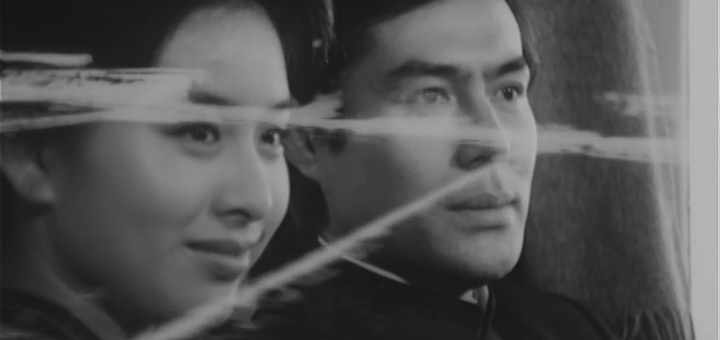
Golden age Japanese cinema is generally resistant to the idea of romance as salvation. There may be a romantic happy ending, lovers uniting despite the mounting odds, but their happiness is often overshadowed by the anxieties of the world in which they live. Adapted from the novel by Tetsuo Miura, Kei Kumai’s post-war romance The Long Darkness (忍ぶ川, Shinobugawa) meanwhile insists that it’s love that will save you in the end as its dejected, insecure heroes find the courage to go on living precisely because of the strength and validation they discover in loving and being loved.

The hero, Tetsuro (Go Kato), feels himself to be cursed, overcome with a sense of shame and anxiety because of the dark shadow that hangs over his once prosperous family. His oldest sister committed suicide for love on his sixth birthday, while another sister then took her own life some time later out of guilt for having contributed to her death. His oldest brother whom he describes as sensitive and eccentric disappeared in grief, while the next oldest took a job at a Tokyo lumber yard and supported him as a student but later disgraced the family by running off with money he’d fraudulently accumulated in the name of opening his own company. Tetsuro is convinced that there is something genetically wrong with the family line and is intensely anxious that it will one day consume him too. 

That might be why he’s unexpectedly bashful for a man of 27 in courting the pretty waitress of a local bar, Shino (Komaki Kurihara), whom he first met while celebrating the graduation of some other students after making a belated return to university. Shino too is carrying her own burdens which lead her to feel unworthy of happiness in that she was raised in the red light district and her family, evacuated to rural Tochigi during the war, is now impoverished and living in a shrine. The proprietress at her restaurant has pressured her into an engagement with a prosperous car salesman whom she doesn’t like but feels unable to refuse on the grounds that he will take care of her sick father. The car salesman tries to rape her so she’ll have to marry him which, as her father points out, does not speak well for his character or the prospect of a happy marriage. Her father is clear, he wants his daughter to be happy and in this age a woman’s happiness does largely depend on the man she marries. He tells her to find a man she loves more than life itself and marry him without a moment’s thought. 

The forces which divide them aren’t so much to do with class, politics, money, or custom but with internalised shame and the deeply held belief that they are “bad” people who do not deserve to be happy. “Can I go on living?” Tetsuro’s only remaining sister tearfully asks him, burdened both by her traumatic family history and by a visual impairment that further convinces her she cannot expect to be a part of regular society and has no prospect of a happy future. He almost turns away after noticing her crying but realises that’s what his absent siblings might have done and resolves to behave differently, reforging his his familial bonds with love and compassion in place of the gloominess and futility that had long overshadowed his family home. Just as Shino’s father had anointed Tetsuro a “good person” he could entrust his daughter to, Tetsuro’s sister and mother affirm that Shino too is “good” and her presence brings light and laughter back into their lives after years of lonely suffering. 

“We’ve spent our whole lives worrying about appearances” Tetsuro declares, “it’s time we stop”. Affirming that her new in-laws are also “all good people”, Shino too admits that she realises the “uselessness” of her old life “never saying what I want or don’t want, going along with everything”, liberated by the transcendent power of love that allows her to overcome her fear and insecurity to claim her own agency, the jingling bells of a farmer’s horse cart echoing from below as if in celebration. Shooting in a classic 4:3 monochrome with occasional intertitles and voiceover, Kumai emphasises the literary quality of the tale spanning the rundown lumberyards of post-war Tokyo to the frozen north of Tetsuro’s frosty home but finally argues for the freedom and possibility to be found in the contemporary era by making an active choice for happiness rather than submitting oneself to a fated misery out of misguided obedience to austere and oppressive social codes. “Everyone’s jealous of you” an old woman cackles catching sight of the newly-wed couple on the train to their new life, and you can well understand why. 


Original trailer (no subtitles)

Boiling Point (3-4X10月, Takeshi Kitano, 1990)

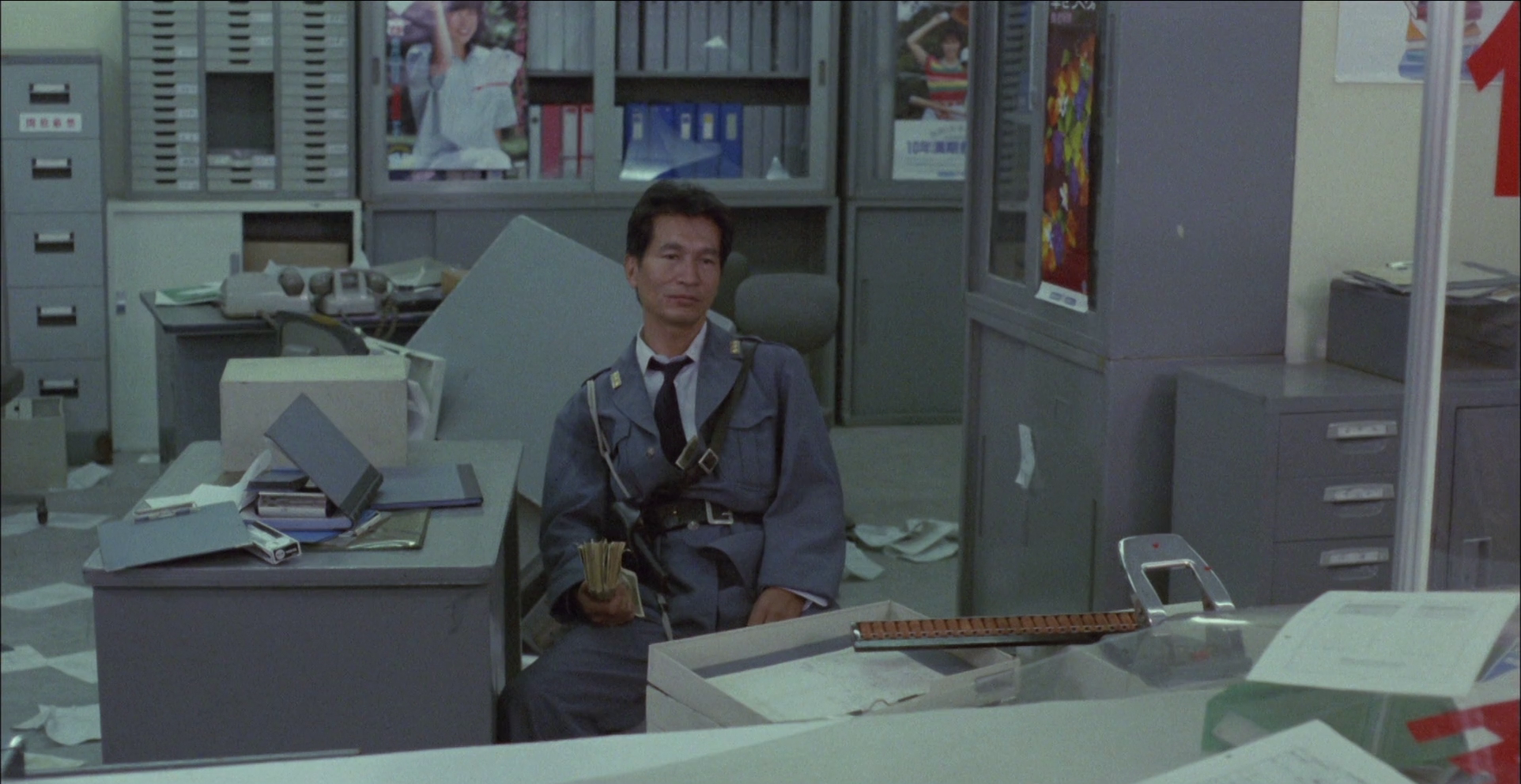
The heroes of Takeshi Kitano’s films are often gentle men, capable of great tenderness but also filled with quietly mounting rage permanently on the brink of explosion. Everyone perhaps has their Boiling Point, the straw that breaks the camel’s back and sends it careering towards a self-destructive attempt at restitution. “Boiling Point”, however, has absolutely nothing to do with the original Japanese title (3-4X10月) which references the score on the board at a baseball game and the originally scheduled month of the film’s release, October (it was later moved up to September making the whole thing even more meaningless). This perverse randomness was apparently another minor win for Kitano who had scored a critical hit with his debut feature Violent Cop but had struggled to convince the team around him to embrace his unconventional vision. Working with greater independence, Kitano minimises camera movement in favour long takes with static camera which perfectly compliment his deadpan sense of the absurd. 

He also relegates himself to a supporting role unseen on screen for over half of the running time. Our hero is small town loser Masaki (Yurei Yanagi) who we first meet hiding in a toilet during an amateur baseball game in which he is desperate to play but strikes out when given the opportunity in the first of many petty humiliations. He has been taken under the wing of the team’s coach, Iguchi (Taka Guadalcanal), a former yakuza attempting to go straight by running a dive bar, and has a part-time job at a petrol station. Masaki perhaps images himself as something greater, as evidenced by his extremely cool motorcycle jacket and bike, but is a dreamer at heart, nervous and tongue-tied, unable to unlock his hidden potential. Even he has a boiling point, however, which is later hit when he gets into an altercation with a teddy boy yakuza at the garage who starts a pointless argument about being kept waiting, pulling the old trick of goading Masaki into fighting back to get leverage over their shop and begin extorting it. Masaki has just got his boss into trouble through losing his cool, but is ironically offered a job by a visiting thug jokingly admiring his fighting prowess. 

Iguchi meanwhile is a man divided, permanently on the brink of boiling over. When some irritating sophisticates “ironically” visit his bar clutching their designer handbags and holding their noses, he’s obliged to be nice to them but he simply can’t. Unable to bear their snotty arrogance, he glasses one of the women on the way back from the bathroom and throws the whole gang out. The yakuza has it seems been reawakened, and though he was reluctant before, he to decides approach his old boss, Otomo (Hisashi Igawa), on Masaki’s behalf. The reception he receives is not as he expected. Iguchi is reminded that he chose the civilian life and being a yakuza isn’t a part-time job, you can’t just pick it back up again when it suits you. Not being able to help Masaki is another small humiliation, one he perhaps intends to overcome through turning violence on an old underling who disrespected him in refusing the customary deference. Predictably, it backfires, you can’t be half a yakuza after all. Iguchi is completely finished, boiling with rage but too humiliated to do much about it other than vow revenge by going to Okinawa to buy a gun in order to put an end to the lot of them. To protect his mentor, an oddly yakuza-esque gesture, Masaki volunteers to go in his stead, dragging his catcher friend Kazuo (Duncan) along for the ride. 

A complicated liminal space, Okinawa is both an enticing holiday destination and source of political contention thanks to the controversial presence of the US military bases. It’s indeed corrupt foreign influences who can provide our guys with guns, but Okinawa is also a place slightly out of time, trapped in the Showa-era past while the rest of Japan has already transitioned to an economically prosperous mid-Bubble Heisei. Consequently, these are Showa-era yakuza with fancy outfits and sunshades hanging out in neon-lit bars with butterflies on the walls. Uehara (Takeshi Kitano) is in the process of being humiliated in front of his gang for supposed embezzlement of collective funds. He too wants a gun to enact his revenge, something which he fantasises about in an eerie and fatalistic flash forward. Before that, however, he’s befriended our guys and taken quite a liking to Kazuo, hinting a latent homosexuality in another example of the unwelcome association of queerness and savagery often seen in yakuza movies. Uehara has a girlfriend but treats her with utter contempt, insisting that she sleep with his underling only to punish her for it afterwards and take over halfway through to rape him. In fact all of his subsequent sexual actions are rapes, his assaults on women cold and mechanical as if purely performative, implying that it is his repressed homosexuality which underpins the sense of humiliation that fuels his violence and his cruelty. 

Unlike Uehara and Iguchi, our guys have not even one foot in the yakuza world and despite their ingenious plan to get the guns on the plane have no idea what they’re going to do with them, marching all the way over to Otomo’s before realising they don’t know anything about the use of firearms with the consequence that they become useless lumps of metal in their hands. They are boys playing gangster out of a misguided ideal of heroic nobility in their desire to avenge Iguchi who by all accounts is still sulking alone at home. This is their greatest and final humiliation, failing as men in front of men. Yet, their friendship perhaps survives, patched up in silence over shared ice lollies. Even so, Masaki is about to boil over, travelling towards a split second moment of fiery self-destruction and misdirected rage. But then Kitano pulls the rug out from under us again. Was this all a dream after all, grim wish-fulfilment from a repressed young man longing to burn out bright, or perhaps a lengthy vision of the kind visited on Uehara which would at least explain Kitano’s many non-sequitur cuts and ellipses? Who can say, but the humiliating sense of impossibility is all too real for those unable to take a swing at life’s many opportunities.


Boiling Point is the second of three films included in the BFI’s Takeshi Kitano Collection blu-ray box set and is accompanied by a new audio commentary by Little White Lies’ David Jenkins, plus a featurette recorded in 2016. The first pressing includes a 44-page booklet featuring a piece on Boiling Point from Mark Schilling, an essay on Violent Cop by Tom Mes, an introduction to Kitano’s career & writing on Sonatine by Jasper Sharp, an archival review by Geoff Andrew, and an appreciation of Beat Takeshi by James-Masaki Ryan.

The Takeshi Kitano Collection is released 29th June while Violent Cop, Boiling Point, and Sonatine will also be available to stream via BFI Player from 27th July as part of BFI Japan.

Original trailer (English subtitles)

Fine, with Occasional Murders (晴れ、ときどき殺人, Kazuyuki Izutsu, 1984)

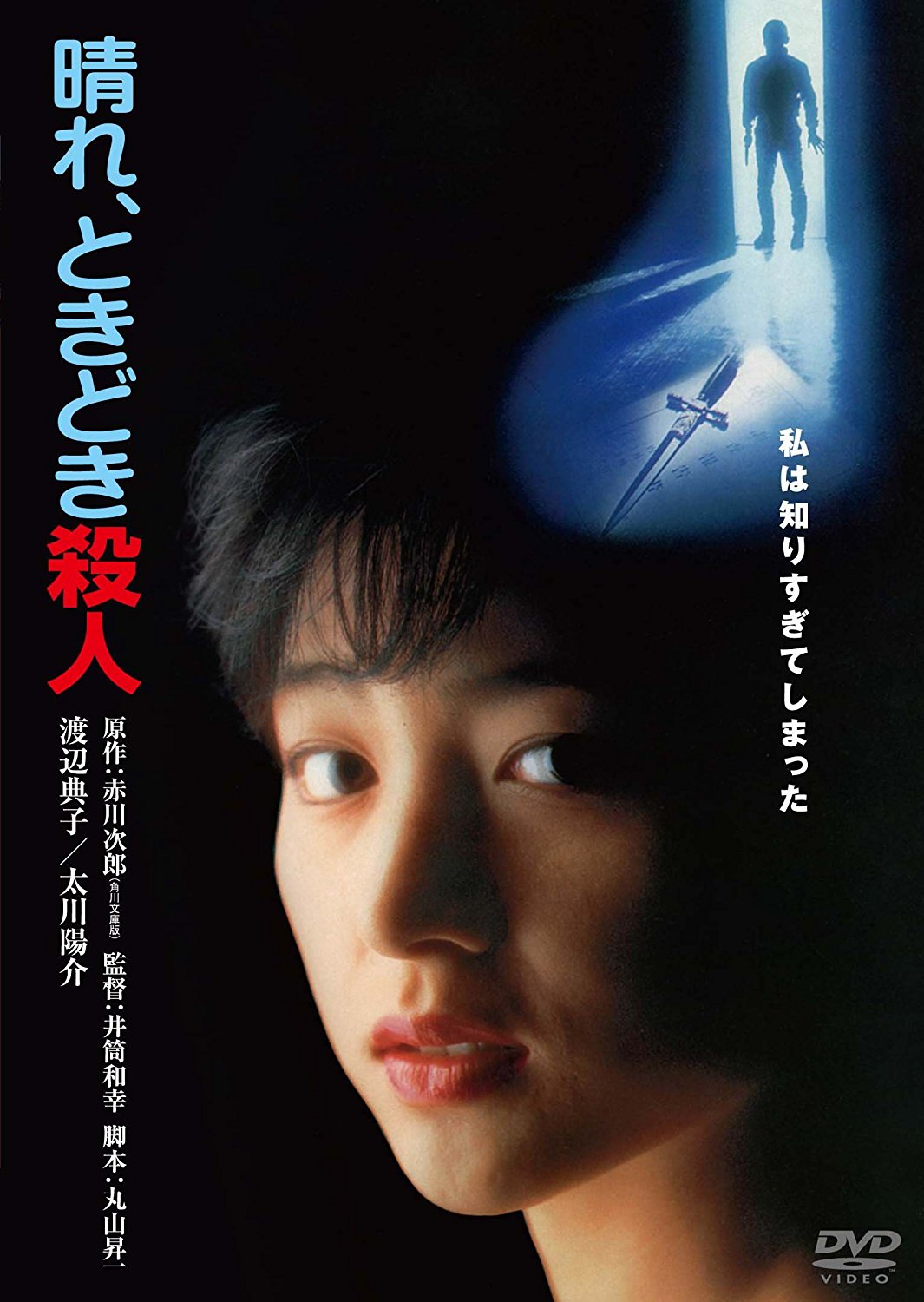
fine with occasional murders posterIn Japan’s ailing late ‘70s cinema market, studios were taking extreme decisions to get the public away from their TV sets and back into movie houses, yet one enterprising would-be media mogul had another idea. Haruki Kadokawa, a man with a publishing house and cinematic ambitions hit on a then innovative marketing strategy which amounted to a perfect storm for his own particular capabilities. Amassing a small stable of idols, he resurrected the studio system to produce a steady stream of youth movies adapting novels he also published and featuring title songs which his idols sang and he released on his record label. Hitting their heyday in the early to mid-1980s, Kadokawa’s idol films are a perfect time capsule of their pre-bubble setting in which, unlike the “seishun eiga” of twenty years before, upperclass young girls solved crimes and defied authority all whilst remaining prim, elegant and innocent. Fine, with Occasional Murders (晴れ、ときどき殺人, Hare, Tokidoki Satsujin) is a prime example of this gentle yet somehow dangerous world as its heroine returns home from studying abroad only to become embroiled in a conspiracy lodged firmly within her own home.

As the film opens, a middle-aged man and woman pay a nighttime visit to the site of a new factory, reminiscing about their youth and the small soap business they started thirty years ago which is now a full scale plastics film. The woman catches sight of someone leaving and stops to wish him goodnight only to suddenly wonder why he’s there in the first place. The reason becomes apparent when she steps forward a little and discovers the body of a young woman lying against her fence post. As if that weren’t worrying enough, factory owner Mrs. Kitazato (Mitsuyo Asaka) then starts getting threatening letters telling her she must go to the police and confirm that an innocent man is the killer or her daughter, Kanako (Noriko Watanabe), studying overseas, will be in danger. Mrs. Kitazato frets and worries but goes along with the killer’s demands to save her daughter only to be confronted with the dead body of the patsy as it lands right at her feet after being thrown from a police station window.

Suffering from a heart condition, Mrs. Kitazato remains unwell until Kanako comes home but then lasts only long enough to impart two important secrets – one being that the man Kanako assumed was her father may not have been, and secondly the whole story with the threatening letters and her belief that they were sent by someone in the family from whom she received a New Year card written in the same handwriting.

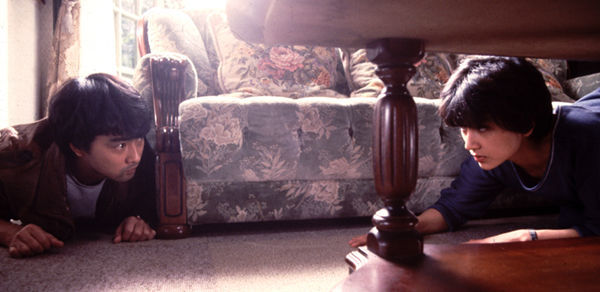
As usual Kanako is left to deal with all of this on her own, though slightly less usually remains within her own family home for the vast majority of the picture. Paid a visit by the police, Kanako comes into contact with their prime suspect in the first murder, Kamimura (Yosuke Tagawa) – a young man who had been a high school friend of the victim and had given her a place to stay while she was trying to escape her career as a hotel hooker. Kamimura becomes Kanako’s innocent love interest as she hides him in the secret room her mother had built behind a dresser in the dining room. Together the pair try to investigate the strange goings on in the Kitazato household whilst also exploring their very different backgrounds. 

Like many of Kadokawa’s idol movies (often adapted from the novels of Jiro Akagawa) the setting is both dark and hopefully innocent as Kanako is burdened with the knowledge that someone close to her is a murderer but faces her situation with cheerful resilience and determination. Whilst pursuing her spiky relationship with Kamimura, she’s also being haunted by the spectre of an arranged marriage to the dreadful son of a business associate, Masahiko (Akihiro Shimizu), who attempts to rape her with her mother’s body still still lying on the bed in the same room, and is also having an affair with their maid, Mari (Mariko Miike). Masahiko is also revealed as a prime suspect in the murders when another body is discovered in the living room with Masahiko standing red handed over it. The murder scenes (and there are more than you’d expect), are nasty, bloody and violent. Despite the innocence of Kanako’s wide open world, misogynistic killers lurk round every corner as do corrupt businessmen, untrustworthy servants, and enemies masquerading as friends.

As darks as it gets, the tone is always one of irony filled with bumbling policemen who form an odd double act in their humorous black and forth, running jokes about hard contact lenses and improbably large sandwiches, and the general whimsy of a young man’s dream of building a real flying bicycle. Despite being one of Kadokawa’s new “Sannin Musume” (alongside Hiroko Yakusushimaru and Tomoyo Harada), Noriko Watanabe played fewer leading roles than her two compatriots. Fine with Occasional Murders (released in the same year as Someday, Someone Will Be Killed), is her first big idol movie lead for which she also sings the theme song which has an almost identical title. She is, however, the archetypal Kadokawa heroine – steadfast, strong, confident, kind, and noble, calmly solving the mystery behind her own mother’s death mere days after losing her, figuring out that poor boys are probably OK, and that awful CEOs and their sons will always be awful. Valuable lessons indeed for increasingly wealthy 1980s teens. 


TV Commercial

And the song itself which has the same title as the movie only the last two characters are read differently – Hare, Tokidoki Kirumi

The Drifting Classroom (漂流教室, Nobuhiko Obayashi, 1987)

Drifting ClassroomNobuhiko Obayashi may have started out as an experimental filmmaker and progressed to a lengthy narrative film career but he remains best known for his “what the hell am I watching?” cult classic Hausu. Aside from his 1983 take on The Girl Who Leapt Through Time, very little of his other work has travelled outside of Japan. In the case of 1987’s The Drifting Classroom (漂流教室, Hyoryu Kyoshitsu), this is doubly surprising firstly because it’s based on a hugely popular manga by the godfather of horror comics Kazuo Umezu and secondly because it’s set in an international school so around 80% of the dialogue is in English.

Obayashi jettisons most of Umezu’s original plot which involves an ordinary Japanese school being suddenly and mysteriously uprooted from its city centre location leaving only a gaping hole to mark its place. This time our hero is Shou – a teenage boy who has recently returned from living in LA and is attending Kobe International School until his Japanese improves enough to get into a normal establishment. Having lived abroad for so long, Shou is a totally Americanised boy with a rebellious, individualistic streak and just wants to hang out with his cool American pals rather than study like his parents want him to do so he can get a foot on the all important ladder of the Japanese educational system. Consequently he argues with his mother and says some very harsh things which leads to her telling him to get out and not to bother coming back – sentiments which both are about to spend the rest of their lives regretting.

Right before taking the register some weird shit goes down and there’s an intense storm which fills most of the school building with sand. Looking out of the windows, everything seems to have become desert. The kids and the two remaining teachers think about what to do and settle on practical things like rationing the food and water left in the school canteen. Back in Kobe, there’s just a giant hole in the ground and a whole lot of confusion….

For some reason, Obayashi decided to set the story in an international school which means that most of the dialogue is in English (though judging by the accents and languages there are some Europeans and students from other parts of Asia around too). This is the single worst decision of the adaptation as the dialogue, which is overly silly to begin with, is offered in stilted, halting tones by its disappointing child actors with the native English speakers not doing very much better than the Japanese kids who are at least trying their best. Perhaps for these reasons (or just out of operational necessities) the film is entirely shot in non-sync sound and the dubbing never quite links up either.

It almost seems as if Obayashi is targeting an overseas audience as his tone is very much indebted to ‘80s kids’ movies with its cast of slightly plucky (sometimes irritatingly so) youngsters trying to solve the mystery of their own disappearance. However, it doesn’t seem as if the film was ever released outside of Japan (where it has never even been released on DVD) despite the presence of one time American star Troy Donohue leaving the strange Americanisms as a sort of exotic plot element with no real resolution.

Though the story seems to be aimed at older children with the usual themes of perseverance in times of adversity and the importance of teamwork and friendship, there are a few scary moments including a psycho style gag where a teacher’s head spins round before dissolving into sand. However, the majority of the special effects are extremely unconvincing resembling an ‘80s kids TV programme with a host of matte paintings, bad green screen, early digital effects and even some tokusatsu style people in rubber suits playing strange cockroach-like monsters. Arguably the best of these is the friendly creature who hangs round with the kids from school and most closely resembles a disgruntled potato with legs (but may actually be giving the most accomplished performance in the entire film).

All of this could have added to the film’s kitsch, “bad movie” vibe but Obabyashi opts to get serious every now and then and ruins everyone’s fun in the process. Weirdly, everyone just seems to accept the “timeslip” argument right away as if that’s a perfectly normal thing that happens every now and then like sinkholes or spontaneous human combustion – there’s even a geologist (?) being interviewed on the news who just says “yes – it is probably a timeslip” when asked to provide some “scientific commentary” on the disappearance of the school children. Completely bizarre but not in a very interesting way, The Drifting Classroom is a misfire on all levels neither making a good adaptation of its source material or an entertaining movie in its own right. Camp classics enthusiasts or Obayashi fanatics only.


The Drifting Classroom was also adapted into a TV drama in 2002 under the title of Long Love Letter which is much better than this movie.

A short scene from the film starring its best character whom I have decided to name “Spuddy” (English dialogue):

http://www.youtube.com/watch?v=g87XmnPjrNw

The Family Game (家族ゲーム, Yoshimitsu Morita, 1983)

TFG_DVD_jk_ol“Why do we have to make such sacrifices for our children?”. It sounds a little cold, doesn’t it, but none the less true. Yoshimitsu Morita’s 1983 social satire The Family Game (家族ゲーム, Kazoku Game) takes that most Japanese of genres, the family drama, and turns it inside out whilst vigorously shaking it to see what else falls from the pockets.

The “ordinary” middle class Numata family consists of the salaryman father Kosuke, the regular housewife mother Chikako and their two sons – older brother Shinichi and younger brother Shigeyuki. Right now the focus of attention is very much on Shigeyuki as he approaches the difficult period of sitting entrance exams for high school. To be frank, Shigeyuki’s prospects are dismal. He ranks near the bottom of the class and though certainly bright has little interest in studying. Therefore, the family have decided to bring in a home tutor to help boost his grades. They’ve already tried several to no avail but have high hopes for Mr. Yoshimoto, a local university student, but little do they know that he’s going to end up teaching each of them a little more than they cared to learn.

Morita breaks down the modern family into its component parts and finds only archetypes representing the kinds of roles which are rigidly enforced by Japan’s conformist society. Let’s start with the “father” who is supposedly the head of the household yet barely has anything at all to do with it. He believes his role is simply to go to work and shout commands which his “family” are supposed to follow unquestioningly. His realm is everything outside the house, everything inside is the responsibility of his wife and he won’t in any way get involved with that. When he has a problem with the kids (and this problem will only be that they aren’t performing to expectation), he will tell his wife and she is expected to take care of it on her own. Of course, his authority is hollow and dependent on his family falling in with his preconceived ideas of their “individual” roles.

The wife, then, is more or less a glorified housekeeper in charge of domestic arrangements and expected to remain within the home. Barked at by her husband and treated like a servant by her own children, her existence is often a fairly miserable one. She remarks that she wishes she’d had her children later – there were so many things so wanted to do that now are denied her because she’s forced to “play the role” that’s expected of her as a wife and mother.

Of the two kids, the older brother, Shinichi, starts the film as the one who plays his pre-ordained role to the level that’s expected of him. He’s a bright boy who studies hard and got into the top high school no problem. As the film goes on and everyone’s obsessed with Shigeyuki, Shinichi’s mask begins to drop as he encounters various typically teenage phenomenons which interfere with his role as over achieving big brother.

Shigeyuki, however, refuses to play the game at all. He just does not care. He loves to get under people’s skin and takes pleasure in annoying or outsmarting them such as when he cons his mother into letting him skip school (his pancreas hurts!) which she lets him do probably knowingly because she’s still playing her role as the worried mother. Finally he only begins to study when he realises it annoys a fellow pupil when his grades improve.

When tutor Yoshimoto enters the picture he tears a great big hole through the centre of this perfect family photo. He starts by behaving very strangely with Mr. Numata by grabbing his hand and calling him “father” whilst leaning in far too close for a casual acquaintance. Similarly when he first meets Shigeyuki he leans right in and then remarks that he has “a cute face”. He proceeds to invade Shigeyuki’s physical space by regularly touching him to a degree which is odd for a teacher/pupil relationship and is almost a prelude to molestation. When Shigeyuki tries to troll him by filling pages of his notebook with the same word over and over again, Yoshimoto reacts coolly before punching him in the face. From now on, when Shigeyuki isn’t pulling his weight, he’ll get a bloody nose.

Gradually Yoshimoto begins to take over the parental roles of the household firstly by instigating the masculine discipline through violence that Mr Numata is never there to deal out as well as offering the original role of teacher/mentor which might ordinarily be found in a grandfather or uncle. Later he usurps the big brother’s place by trying to talk frankly about sex and teaching Shigeyuki how to defend himself against playground bullies which also helps the boy cement a friendship with a sometime rival. Finally, he takes on the maternal mantle too when Mrs Numata asks him to go down to the school and talk to Shigeyuki’s teachers on her behalf. By the time that his original mission is completed he’s well and truly infiltrated the household allowing him to, literally, overturn its sense of stability.

Morita’s screenplay is witty affair full of one liners and humour born of unusual frankness. Family is a fake concept which forces each of its members into predefined roles and is largely divorced from genuine feeling. What matters is the appearance of normality and the acquisition of status – i.e getting into the better university, not so much as a path to success but as a way of avoiding the embarrassment of not getting there. An absurdist social satire, The Family Game is a biting critique of the social mores of the early 1980s which punches a gaping hole through the foundation of traditional Japanese society.