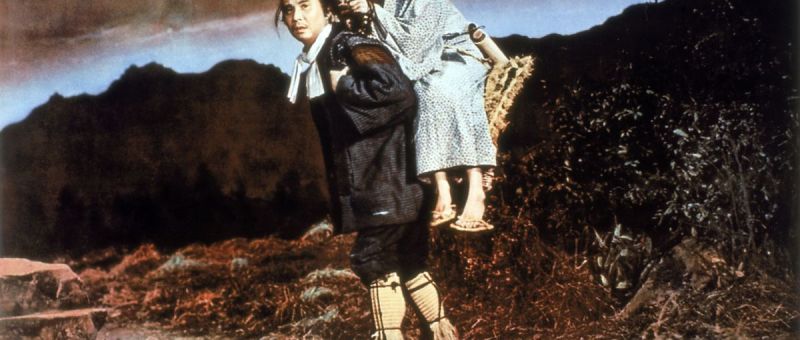
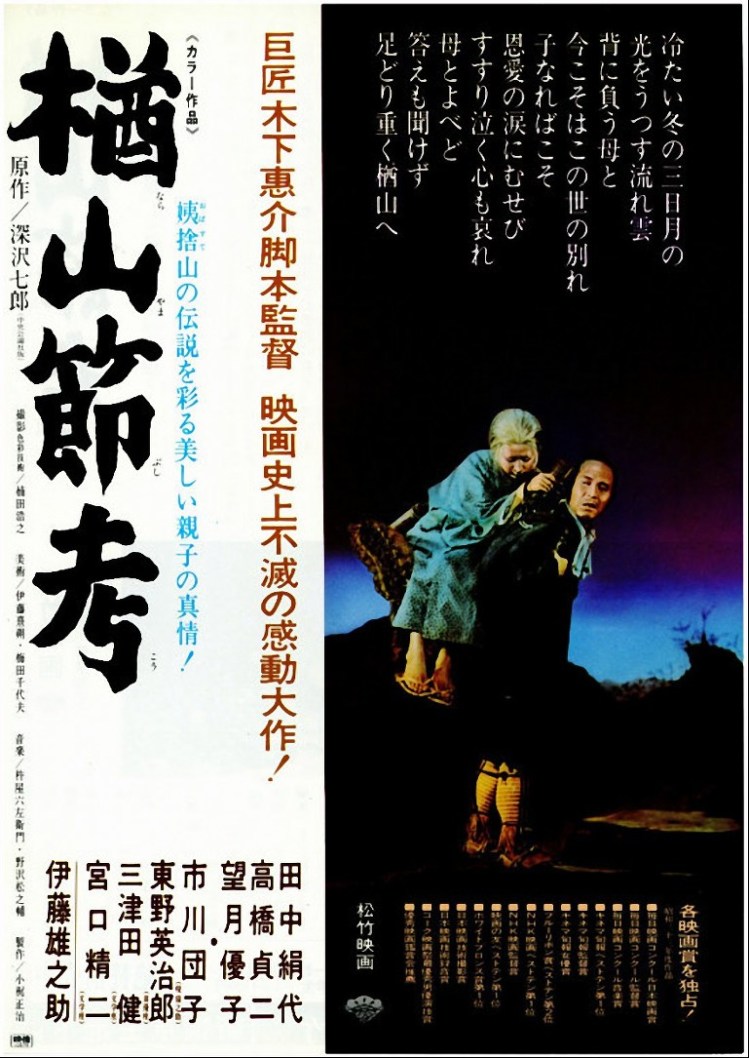
The Ballad of Narayama (楢山節考, Keisuke Kinoshita, 1958)

ballad of narayama kinoshita 1958 posterMany naughty children running low on filial piety have probably been told the folktale about a man who took his son along when he abandoned his senile father on a mountain to die only to have his son later do the same thing to him. In Japan, the mythical practice of “obasute” or “ubasute” is a kind of Logan’s Run equivalent in which elderly people elect to remove themselves from society in order to reduce the burden on the young. The Ballad of Narayama (楢山節考, Narayama-bushi Ko) has, perhaps, taken on an additional degree of pathos in ageing Japan in which many elderly people find themselves metaphorically cast out from a society in which they have become the majority, but the idea of “obasute” is intended to be a lesson to the young to treasure their elders and accept the responsibility to care for those who can no longer care for themselves in the knowledge that they too will one day be old.

Keisuke Kinoshita is sometimes criticised for his supposed sentimentalism but his central concern was always in the redemptive power of the relationships between people, that there is always kindness even in the worst of circumstances and that this is enough for hope to survive. In telling the sorry tale of Narayama in which those of over 70-years-of-age are forced into a ritual suicide by social convention, Kinoshita opts for alienation in deliberately shifting into a theatrical register inspired by kabuki featuring obvious studio sets, stylised action, and traditional narration, but his decision to pull back makes the message all the more painful, as does the insistence on the timelessness of his tale.

Long ago in the distant feudal past, 69-year-old Orin (Kinuyo Tanaka) knows that it will soon be time for her widowed son, Tatsuhei (Teiji Takahashi), to carry her to Narayama where she hopes to die of exposure in the New Year snows. She has made her peace with this, it is the will of the gods and she has no call to disobey. Her son, however, is distraught to think of the time he will be expected to carry his elderly mother to a remote spot in the mountains and leave her there, alone, to die of cold and starvation. When a messenger arrives from Orin’s home village to propose a match for Tatsuhei, a recently widowed woman of exactly the same age – Tama (Yuko Mochizuki), Orin is overjoyed – she can go to Narayama without fear or worry, her son and grandsons will be looked after even after she is gone.

The tradition began because the villages in this region are extremely poor. Tatsuhei and Orin will be enjoying their one and only bowl of white rice for the year in celebration of Bon. Orin’s self-centred grandson Kesakichi (Danko Ichikawa) has made up a horrible song about his grandma in which he criticises her for still having all her own teeth at 70 – implying that, as she is not malnourished enough to have lost them, she must have been greedy and taken more than her fair share of food. Unable to bear such reproach, Orin smashes out her own front teeth to better conform to the conventions of her society and make herself a more acceptable sacrifice to the gods as a good and pious woman.

This early horrific act is perhaps the key in illuminating Kinoshita’s gentle critique of social conformity as a tool of social control – something which had become increasingly apparent during the militarist era. Orin, a kind and decent woman, is herself complicit in this abhorrent custom – her acceptance of it is part of her goodness, a sign of her altruistic self-sacrificing nature, but her own unwillingness to challenge the darker aspects of the society in which she lives leads only to their perpetuation and an ongoing descent into unkindness and cruelty.

Tatsuhei, a good and pious son, cannot reconcile himself to his mother’s fate, while his own son, Kesakichi, openly mocks his grandmother for not going sooner and Kesakichi’s pregnant girlfriend (Keiko Ogasawara) looks on enviously at the extra beans on offer if there were one less mouth to feed. Old and bent, Orin still plays a vital part in her community – she harvests the rice while Kesakichi lounges in trees, and she alone knows the best place to catch trout, a valuable skill in a village where food is scarce. Despite the possibility for disaster, Orin and Tama bond instantly as kindred spirits, both kind people in an often unkind world. It’s to Tama that Orin finally divulges her knowledge – something the village will be poorer for when she is gone, having passed her familial responsibilities to another woman and seen her son happily settled with a perfectly suited second wife.

When Tatsuhei returns, broken, after having performed the dreaded ritual he watches his own cruel son laughing and joking from within their shared home, caring only for himself and his easy pleasures. Tama, equally upset over the loss of Orin with whom she had bonded as mother, tries to comfort her husband but is eventually overcome by the tragedy of life, taking comfort only in the fact that, when they are 70, she and Tatsuhei will climb Narayama together.

Hardship, far from bringing people together in the famous harmony that Japanese society praises itself for, has forced them apart, infected them with a sense of mutual distrust and a them or us mentality. Orin feeds the senile old man cast out from his own unfeeling family, but she also urges him towards making a sacrifice of himself on Narayama, genuinely believing that both of their existences have become inappropriate, a greedy usurpation of time which rightfully now belongs to others. Kinoshita respects Orin for her stoicism and righteousness, but pities her for the cruelty of the world in which she lived and was so powerless to resist that it never occurred to her that she should. There is a painful sensitivity around those who willingly went to their deaths in service of something they believed to be right because their society said it must be so, never daring to consider the ways in which their society may be mistaken.

Heavily stylised and markedly experimental for a mainstream Shochiku melodrama of the late 1950s, Kinoshita’s The Ballad of Narayama is a heartrending tale of transience and inevitability, but it’s also one of the various ways a stringent society erodes the bonds between people. The intense love of Tatsuhei for his mother is destroyed by a terrible custom that no one is brave enough to defy, leaving the family rudderless and the village poorer for having been robbed not only of Orin’s wealth of experience but of her warmth and kindness. Kinoshita ends on an ambiguous image showing us the modern train station which stands on the former village of “Obasute”, demonstrating the passage of time and arrival of “modernity” but also that ancient customs are never quite as “ancient” as they seem.


Scene from near the end of the film (English subtitles)

The Neighbor’s Wife and Mine (マダムと女房, Heinosuke Gosho, 1931)

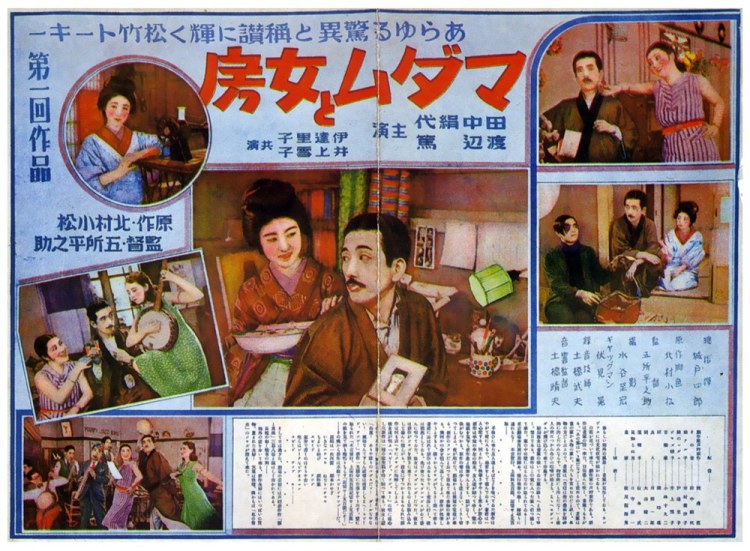
Neighbor's wife and mine flyerThere’s an especial irony in the fact that Japan’s first talkie is essentially all about how annoying sound can be. Directed by Heinosuke Gosho, pioneer of the shomingeki and a longstanding devotee of melancholy comedy, The Neighbor’s Wife and Mine (マダムと女房, Madame to Nyobo) is another in a long line of contemporary farces set in an idealised middle-class world but as much as Gosho goes out of his way to include as much soundplay as humanly possible he never lets the gimmick get the better of him.

Gosho opens with a brief prologue sequence otherwise detached from the main narrative in which down on his luck playwright Shibano (Atsushi Watanabe) gets into an argument with a precious artist busily painting a canvas of the house opposite him and gleefully admiring his own work. The painter likes this spot because of its silent serenity – an atmosphere quickly broken when Shibano struts up, whistling loudly, humming, making conversation. Unfortunately Shibano doesn’t rate the painter’s work and is also non-plussed that he doesn’t know who Shibano, apparently a “famous” playwright, is and doesn’t seem to respect writers as fellow artists anyway. A fight breaks out and all because of some unwanted noise pollution. Eventually the two men end up friends again after bonding in their mutual appreciation of the charms of “madame” (Satoko Date) the woman who lives in the house next to the one Shibano has just decided to rent on a whim with the intention of getting some “peace and quiet” in the countryside to finish his overdue manuscript.

The country is, as it turns out, not as quiet as you’d think. No sooner has Shibano moved in than he’s assailed by noise – mostly from within his own household as he’s a father of two, a little girl of perhaps four or five, and a bawling infant son. He doesn’t help matters by winding up his exhausted wife Kinuyo (Kinuyo Tanaka) by loudly impersonating a distressed cat during the middle of the night but a bigger problem is about to present itself in the form of the Mammy Jazz Band who, led by the woman Shibano was so smitten with after bumping into her during his altercation with the painter, use the house next-door as their rehearsal studio.

The house of Shibano is, apparently, a fairly happy one though long suffering wife and mother Kinuyo has reason enough for exasperation as her husband wastes his time drinking and playing mahjong while the deadline for the manuscript he’s supposed to be writing draws ever closer. In charge of the household finances, Kinuyo is keenly aware the family are low on funds – something presumably not helped by Shibano’s impulsive decision to rent a cottage in the country. He’s left himself a dozen inspirational notes reminding himself that manuscripts don’t write themselves, but still Shibano can’t buckle down. Having come to the country to escape the noise of city life, he finds himself assaulted by a silence differential in dealing first with his noisy children and responsibilities as a father, and then the constant intrusion of unexpected sounds which, in the city, might hardly be noticed against the constant background hum.

Trying everything from plugging his ears to tying a scarf around his head and finally jumping inside a cardboard box, Shibano decides to enlist Kinuyo to tell next-door to keep it down but she, an elegant Japanese wife, would hardly dare to disturb the “peace”. She tells her lazy husband to sort it out himself only to regret her decision when she spots him laughing away with the sophisticated modern woman next-door, drinking in the party atmosphere of her Bohemian home and enjoying a private concert as the “noisy” jazz band rehearse their latest numbers.

Despite his occupation which might imply a little Bohemianism in itself, Shibano is a traditionally minded sort. He may have turned up in swanky hat and pinstripe suit carrying a cane, but in his new home he dresses exclusively in kimono, as does his dutiful wife, who can only trail behind her husband in exasperation offering the occasional barbed comment as her only form of mild resistance. His household demands quietude, but cannot attain it. He is, therefore, naturally led away to the woman next door like a time traveller suddenly given a glimpse of the new and exciting future. The musical repertoire of the Mammy Jazz Band is all about “speed”, they move fast and with no thought to the disturbance they trail through the air around them. They are going somewhere, in contrast to Shibano who has been in a state of inertia for quite sometime.

It is, however, a little sad that it’s “madame” that finally speeds on Shibano rather than his wife and children even if there is nothing improper in their relationship – Madame is not particularly interested in Shibano in anything other than a neighbourly fashion, her people pleasing friendliness and genuine kindness perhaps running in contrast to the conventional depiction of a “modern” woman as Kinuyo later points out in jealousy when she remarks that women like that are all “100% sex delinquents”.

The film’s Japanese title is certainly drawing a contrast between the modern “madame” and the traditionally minded “nyobo” though it comes down on neither side, allowing room for both sorts of women in this rapidly changing society. Shibano maybe a lazy, easily distracted sort of man but he’s knows what’s good for him and when all’s said and done his relationship with his wife is as solid as they come despite their frequent financial woes, childcare spats, and momentary pangs of jealousy or anguish. The family, repaired and in motion once again, finally get their day in the sun enjoying a rare moment of blissful happiness as they break into a chorus of “My Blue Heaven”, positively rupturing the silence with their own joyful voices as they join the “noisy” cavalcade heading towards the exciting “speed era” waiting for them in the future.


Sing My Life (あやしい彼女, Nobuo Mizuta, 2016)

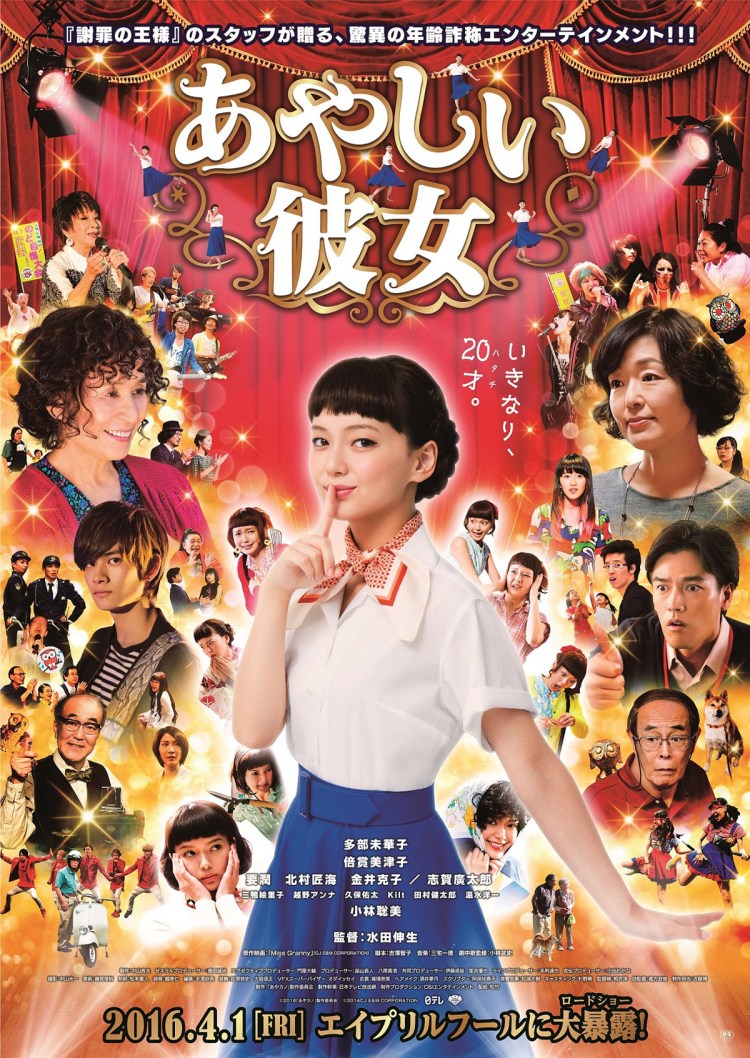
Sing my life posterWhen Miss Granny was released in Korea back in 2014, it became an instant smash hit with remake rights quickly bought by a host of Asian countries and Chinese (20 Once Again), and Vietnamese (Sweet 20) versions already proving popular in their respective nations. Sing My Life (あやしい彼女, Ayashii Kanojo) shifts away from the Korean film’s pervasive misery for a more typically Japanese determination to grin and bear one’s troubles. Structured like a classic musical, Sing My Life may only hint at the hardships of life in post-war Japan, but co-opts the classic “hahamono” for a musical tribute to motherhood in all of its complexities and complications.

Katsu Seyama (Mitsuko Baisho) is a 73-year-old woman who likes to sing and dance her way through life while making a point of haggling over her purchases and boasting loudly about how proud she is of her daughter who is the editor-in-chief of a famous fashion magazine. Her daughter Yukie (Satomi Kobayashi) has, however, unbeknownst to her been demoted in favour of a flashy, younger candidate. After getting caught by an ore ore scam and blaming Yukie for preventing her from doing all the things she wanted to do in life, Katsu runs away from home and finds herself at a strange photo studio from which she emerges as her 20-year-old self (Mikako Tabe). Suddenly given the chance to experience the youth she never knew, Katsu ends up joining her grandson’s punk band as the lead vocalist singing a number of her favourite retro hits in new, modern versions.

Unlike the Korean version, Katsu’s story is less one of resentment at a fall in social status than an ongoing struggle born of constant hardships. A war orphan with childhood friend Jiro (Kotaro Shiga) her only “familial” connection, Katsu has had to fight all her life just to survive. A shotgun wedding was followed immediately by widowhood and a serious illness for her child who she was told would not survive past infancy. Yet unlike the granny of Miss Granny, Katsu is not actively mean as much as she is irritating and occasionally petulant. Loving to boast of the successful career woman daughter she managed to raise alone, Katsu is not above playing the martyr in reminding those around her of everything she sacrificed to make it happen.

A single mother in the ‘60s, Katsu had to work day and night to support herself and her daughter leaving her with a lifelong love of thriftiness and a kind of no-nonsense bluntness that is occasionally (if accidentally) hurtful. In the original Korean version, a widowed mother pours all of her ambition and desires into her son who she hopes will become a successful member of society able to return the favour by supporting her in her old age. Katsu’s child is a girl but has also become a successful career woman and later a single mother herself following a brief marriage followed by divorce. There may be tension in the relationship between the two women, but Katsu’s returned youth provides the opportunity for greater intimacy and a return to the less complicated mother-child relationship of early childhood brokered by greater mutual understanding.

Though Katsu had not revealed any great dream of being a singer, her beautiful voice soon gets her noticed by the music biz and producer Takuto Kobayashi (Jun Kaname) who is sick to the back teeth of soulless teenage idols who lack the life experience to truly connect with the material they’ve been given. Encompassing a host of Showa era hits from the Kyu Sakamoto tune Miagete Goran Yoru no Hoshi wo, to Hibari Misora’s Makkana Taiyo, and the central performance of the depression themed Kanashikute Yarikirenai originated by Folk Crusaders, Sing My Life takes a (slightly) more cheerful run through ‘60s Japan emphasising the fortitude and determination of struggle rather than the misery and hardship of difficult times. Fun and touching, Nobuo Mizuta’s adaptation improves on the Korean version in adding a subtle commentary on the ironic invisibility of the elderly in ageing Japan whilst also refocusing the tale onto a deliberately female perspective, examining how two women from different generations have dealt with a similar problem, and allowing them the opportunity to repair their fractured relationship through a process of mutual understanding.


 Screened as part of the Japan Foundation Touring Film Programme 2018.

Screening again:

  • ICA – 8 February 2018
  • QUAD – 11 February 2018
  • Showroom Cinema – 20 February 2018
  • Firstsite – 25 February 2018
  • Depot – 27 February 2018
  • Phoenix Leicester – 10 March 2018
  • Midlands Arts Centre – 13 March 2018
  • Broadway – 18 March 2018

Original trailer (no subtitles)

Kyu Sakamoto’s Miagete Goran Yoru no Hoshi wo

https://www.youtube.com/watch?v=UDjeVvYXqkY

Hibari Misora & The Blue Comets – Makkana Taiyo

Folk Crusaders – Kanashikute Yarikirenai

A Woman in the Typhoon Area (颱風圏の女, Hideo Oba, 1948)

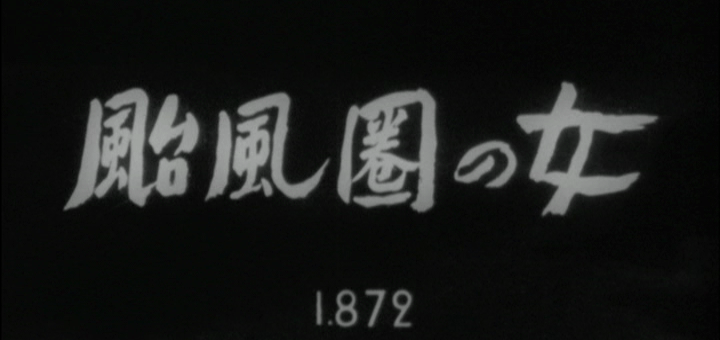
vlcsnap-2017-12-14-23h50m20s302Setsuko Hara acquired the nickname “the eternal virgin” from her fans inspired by the genial ingenue roles she was most associated with especially in her long career with Yasujiro Ozu in which she often played a reluctant daughter finally getting married (though only at the end of the picture). The nickname took on something of an ironic quality after her abrupt retirement from the acting world in which, rather than getting married, she remained single and locked herself away in her quaint little house in Kamakura, refusing all subsequent requests relating to showbiz. Woman in the Typhoon Area (颱風圏の女, Taifuken no Onna) is a rare entry in her filmography in which she plays completely against type (and does so brilliantly) as a damaged, brassy, and sensual woman caught up in a storm of her own as the sole female between a gang of vicious smugglers and a nerdy group of weather scientists marooned on an island by a typhoon.

As the film opens, the smugglers have been spotted by the coastguard and are engaged in a lengthy firefight trying to escape. Eventually they manage to evade government forces, but they’re way off course and running out of fuel while one of their number is also badly injured. Luckily they eventually run into an island which is home to a Japanese weather station. Unfortunately, the weather station has received a telegram from the coastguard and works out who the smugglers are. There isn’t enough fuel or food for the smugglers to steal and escape, but even if there were the approaching typhoon means it would be unwise to try.

The set-up is uncannily close to that of John Huston’s Key Largo, released the same year, though the tiny band of smugglers is nowhere near as intimidating as Edward G. Robinson’s band of thugs, nor are they particularly emblematic of a persistent lingering threat of fascism in the rise of bullies making their way through fear. What the smugglers are is mildly pathetic and intensely self interested. The weather station staff, government officials, are the good guys but they’re also easily cowed by three men (and a sympathetic/indifferent woman) with a single gun. The major conflict is over control of the radio which the smugglers have temporarily broken in fear of someone calling the coastguard. The weathermen want to repair it because it’s imperative they let the surrounding area know that a dangerous typhoon is on the way.

Like many films of the immediate post-war era, the central theme is one of the common good vs selfish interest. The radio operator, Amano (Jun Usami), is determined to act for “the common good” and is confident that he is the sort of person who will do the “right” thing at the right time. The smugglers don’t particularly care if a lot of people end up dying because they weren’t warned about the storm as long as they don’t get caught by the coast guard. For Kijima (So Yamamura), the boss of the smugglers, all that matters is strength – a strong man will never kneel but Amano would kneel if it meant he could get up later and do the right the thing even if it then costs him his life.

Where gangster narratives are often about surrogate families, the band of smugglers actively rejects familial bonds and only maintains cohesion through shared suspicion. Kuriko (Setsuko Hara) is Kijima’s girl, but Kataoka (Isao Yamaguchi) continually goes behind his boss’ back to seduce her finally even attempting rape. Though second mate Yoshii (Eijiro Tono) may seem more loyal, he too holds little love for his boss and will betray him if he thinks Kijima no longer strong enough to rule. Trapped within the claustrophobic environment of the weather station, the gang destroys itself in petty rivalries and long standing suspicions. Kijima was right when he said you couldn’t trust anyone on a ship, but he can’t trust his guys on land either.

The war is an obvious and recurrent theme but Kuriko’s troubles were only exacerbated rather than caused by it. An abandoned child, she recounts eating cold rice with strangers at 11 and it doesn’t take a lot of imagination to figure out what she means when she says she remembers the name of her first man but not his face. Kuriko is a good girl turned bad by persistent social indifference and subsequent trauma experienced as a nurse in frontline field hospitals. She’s distant and embittered, living as a man on ship, dressing in slacks and shirts and chain smoking her life away. Trapped in the station and exposed to the “goodness” of Amano she starts dressing in more feminine fashions and reconsidering her gangster lifestyle. Though she starts to change, helps the weather station to save the locals, it’s clear that it’s already too late for her to save herself other than through a final act of sacrifice in service of a new ideal and an old love.

Only 70 minutes long Woman in the Typhoon Area is a taught, tense character piece which doesn’t quite manage to make the most of its intensely claustrophobic settings but still manages to reinforce its central message of selfishness being bad and altruism good. Hara is a revelation in such an unusual role, stealing each and every scene in steely uncertainty, giving the impression of a woman whose ongoing fall is as much a willing act of self harm as it is a natural consequence of her impossible circumstances.


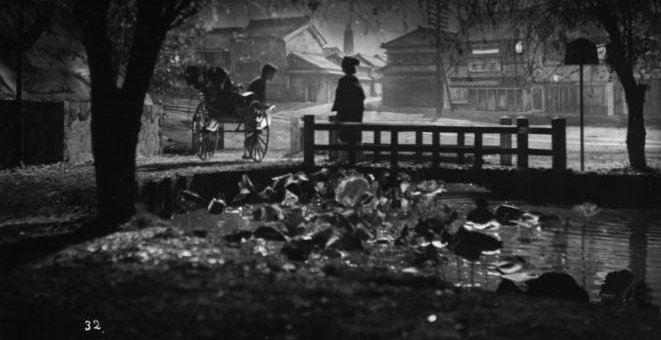
Souls on the Road (路上の霊魂, Minoru Murata, 1921)

vlcsnap-2017-12-09-00h26m35s417Minoru Murata was one of the most important figures in early Japanese cinema but as the majority of his 36 films are lost and he sadly died at the young age of 43 in 1937, his work has largely been over looked outside of scholarly circles. Starting his career as an actor in the “shingeki” movement which aimed to bring modern, naturalist theatre to Japanese stages, Murata first performed in Norimasa Kaeriyama’s “Pure Films” in 1918 before joining Shochiku’s acting school on the recommendation of playwright Kaoru Osanai. The “Pure Film” movement, like the Shingeki movement in theatre, sought to create a new more modern Japanese cinema as opposed to the overly theatrical, kubuki influenced productions of the time. Souls on the Road (路上の霊魂, Rojo no Reikon), an early directorial effort for Murata in which he also stars, was made for Shochiku and is very much influenced by the Pure Film Movement as well as foreign cinema from Europe and America.

The narrative of Souls on the Road is adapted from two foreign literature sources – Gorky’s play The Lower Depths and the German novel Mutter Landstrasse, das Ende einer Jugend by Wilhelm August Schmidtbonn. Influenced by the work of D.W. Griffith, Murata cuts between the stories of four interconnected groups of people – a failed violinist who returns home to his family with a wife and daughter in tow, two escaped convicts hiding out in the woods, the local master and his servants including a young woodcutter played by the director, and a wealthy young girl.

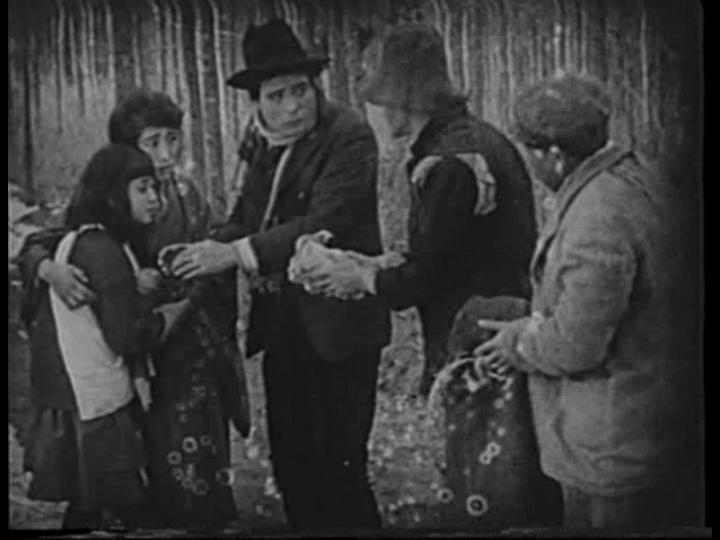
The central drama revolves around the musician who left home under a cloud to become a concert violinist in Tokyo but failed to make a success of himself. Despite having a fiancée at home, Koichiro (Denmei Suzuki) has married a Tokyo woman (Haruko Sawamura) and has a young daughter. Desperate and starving, the trio have made the snowbound journey back to Koichiro’s Hokkaido village largely on foot but Koichiro’s father (Kaoru Osanai) who is the master of a large estate refuses to help him. The former fiancée, Mitsuko (Ryuko Date), who is also Koichiro’s cousin, still lives with the master and is distressed by Koichiro’s return. Battling her own emotional pain, she wants to help Koichiro’s wife and daughter who are obviously in a bad way, but is also conditioned by the need to obey the master’s instructions even when they seem cruel and immoral.

Murata bookends the film with direct quotes – firstly from Gorky’s play and then from the Bible emphasising the need for human compassion. The master’s refusal to help his son is directly contrasted with the fate of the two convicts who cross Koichiro’s path in the forest. The two men originally try to rob Koichiro, but seeing that they too have nothing and the little girl is close to starving, the convicts give up their own food to help them. When they chance upon house they remain conflicted about trying to rob it – they don’t want to end up back in prison and they don’t want to steal but they are also starving and have no other options. The custodian of the house catches them in the act and enacts a sadistic punishment but later changes his mind and decides to help them.

Meanwhile, one of the master’s servants, a boy named Taro (played by director Minoru Murata), runs into the rebellious young mistress of a local estate (Yuriko Hanabusa) who dresses in a sailor suit and gleefully shoots her minder with an air gun to avoid having to go home. The young mistress strikes up a cross class friendship with Taro and invites him to the Christmas party she is organising at her mansion to which pretty much everyone is invited regardless of class origins or backgrounds. The young mistress’ “Christmas Party” might seem incongruous for a rural town in the Japan of 1921 and does indeed take on the trappings of Russian literature with the mummers and balalaika players replaced with traditional Yagibashi dancers, but the party itself seems to have no particular religious dimension as the young mistress dreams of being visited by Santa and a small shot of Mitsuko seeming to pray as Koichiro’s wife and daughter lie freezing in a barn is the only hint of a real presence of Christian thought outside of the overt references in the framing sequences and overall Christianising morality of the film as a whole.

Murata’s signature approach mixes an entrenched naturalism of location shooting and realistic performances with expressionistic techniques. Literally “souls” on the road, Murata introduces as series of ghosts using dissolves and superimpositions as the protagonists are haunted by alternate pasts and futures or even by themselves as Koichiro finds himself interrogated by the hopeful violinist who left with big dreams but has brought his wife and child to the brink of starvation and death from cold in a barn steps away from his childhood home. Somewhat heavy handed in its closing moments as Taro wonders what might have been if the master had been more forgiving and welcomed his son home instead of punishing him for leaving, and the young mistress wonders what might have happened to the convicts if the custodian had not taken pity on them, Souls on the Road is an early visionary masterpiece far ahead of its time which looks forward to a new kind of Japanese cinema.


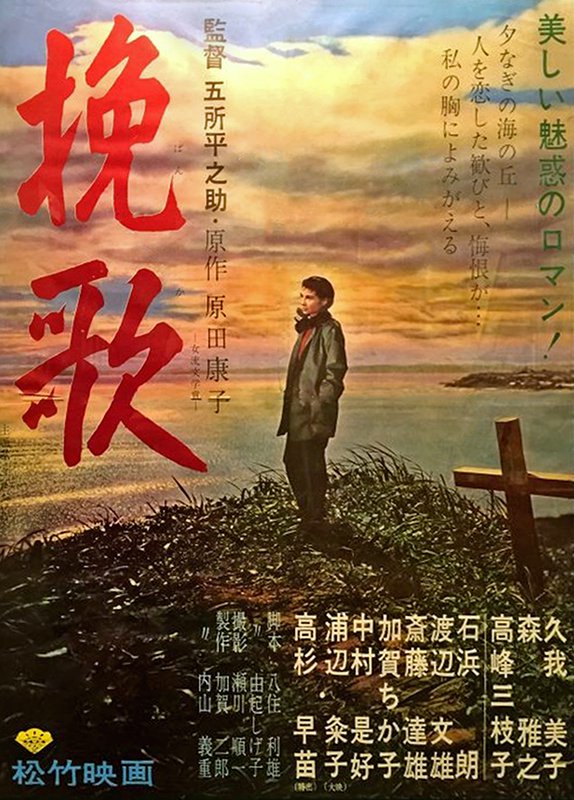
Elegy of the North (挽歌, Heinosuke Gosho, 1957)

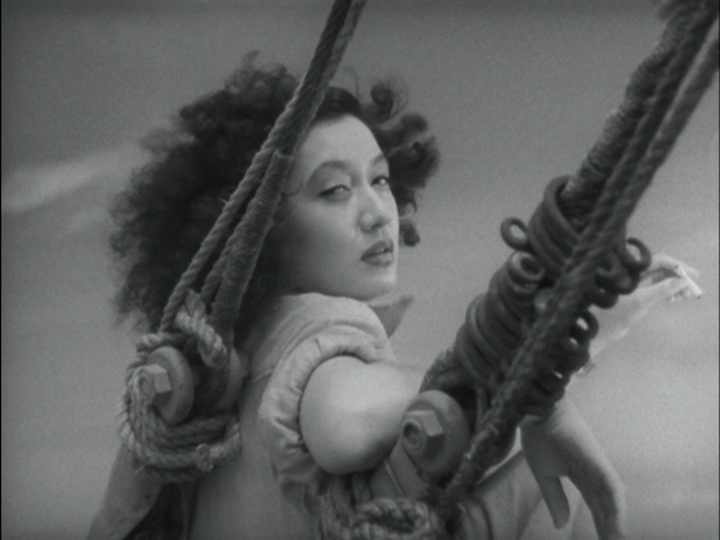
elegy of the north posterHeinosuke Gosho is perhaps among the most neglected Japanese directors of the “golden age”. A pioneer of the “shomingeki”, Gosho’s work is marked by a profound humanism but also a refusal to reduce the complexity of human emotions to the superficially immediate. Elegy of the North (挽歌, Banka) takes him much further in the direction of standard melodrama than he would usually venture, echoing contemporary American or European romantic dramas filled with soaring scores and moments of intense emotion bridged by long periods of restraint and repression. Yet it is also among the most psychologically complex of Gosho’s narratives, telling stories of death and rebirth in place of the usual coming of age and first heartbreak for which the genre is so well loved. In Reiko (Yoshiko Kuga) he presents us with a heroine we can’t be sure we like and certainly are not intended to approve of even as we sympathise with her pain and long for an end to her (often self inflicted) suffering.

Walking along the smoking volcanic soil of frozen Hokkaido, Reiko offers us the first of many voiceovers in which she tells us about her left arm – withered and almost numb due to childhood arthritis. When her withered arm is bitten by a dog, Nellie, owned by a melancholy architect, Katsuragi (Masayuki Mori), she barely feels it but Katsuragi is mortified. “She’s never bitten anyone before”, he tells Reiko by way of explanation, “I’ve never been bitten before”, Reiko fires back but bitten she certainly has been. Captivated by the idea of Katsuragi, she doesn’t immediately take him up on the offer of coming to his house and possibly adopting a puppy but catches sight of him around town and then decides to pay him a visit. He isn’t in, but Akiko (Mieko Takamine), his wife, is. Reiko didn’t want to see Katsuragi’s wife so she makes a speedy escape.

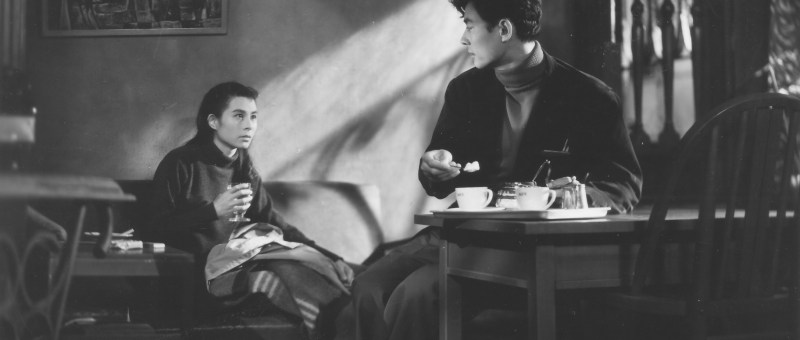
Having caught sight of Akiko, Reiko is equally intrigued. Akiko, as Reiko discovers, is having an (unhappy) affair with a much younger medical student, Tatsumi (Fumio Watanabe). Failing to read the emotional landscape of this sorry scene, Reiko regards this information as a juicy piece of gossip in her ongoing campaign to win over Katsuragi. She spies on the lovers, childishly eavesdropping on them in a local cafe, even suddenly delivering their coffee for them so she can get a proper look at Akiko – not that she really sees her or the distraught look on her face, she merely observes her rival – the wicked woman who has betrayed her beloved Katsuragi.

Reiko is constantly berated by her father and grandmother for her unwomanliness. Compared with the typical Japanese woman of the time and particularly with the stoic yet miserable Akiko, Reiko can certainly be thought unusual. Dressing in androgynous loose trousers, polo neck jumper and overcoat, without makeup and with unkempt hair, her aesthetic is one of rambunctious child or rebellious teenager. Her habit of throwing out awkward, inappropriate questions at first seems like childish ineptness but later seems calculated to unbalance. She is often cruel, perhaps deliberately so, but then remorseful (if only for selfish reasons). Though Reiko seems to feel that it’s her disability that marks her out as an outcast, unfit for marriage or a “normal” life, her family appear much more concerned with her unconventional rejection of femininity in her boldness, masculine dress, and refusal to learn the traditionally feminine crafts of housework and cookery so necessary to becoming the ideal wife.

What Reiko sees in Akiko is an image of her idealised self – beautiful, poised, elegant, and the wife of Katsuragi. As part of her nefarious plan, Reiko decides to “befriend” Akiko while Katsuragi is away on a business trip. What she never expected is that she would come to genuinely care for both Akiko and the couple’s small daughter Kumiko (Etsuko Nakazato), making her position as a potential home wrecker impossible. Reiko’s father blames himself for her unwomanliness, having raised her alone after his wife died, denying her of a maternal influence from whom she would have learned all the essentials of femininity which she now seems to lack. Akiko, a few years older, becomes both friend and surrogate mother – Reiko even begins calling her “Mamma” just as Kumiko does. Akiko’s distant poise begins to thaw when Reiko crawls in through her door one night after contracting pneumonia. Nursing Reiko as a mother would brings the two women closer together but it also unwittingly drives them apart in deepening Reiko’s sense of guilt in being torn between two loves in the knowledge that she must destroy one of them or herself.

Akiko, the tragic heroine of the piece, remains a cypher precisely because of her adherence to the rules of traditional femininity. Reiko is first drawn to her because of her sad smile – something she later brings up again in their fiercely undramatic yet heartrending parting scene as Reiko tries to undo the harm she has just done only for Akiko to mildly reject her by instructing her that she needs to take better care of herself. Her relationship with Katsuragi appears to have floundered and, trapped in a lonely marriage, Akiko has found herself in an emotionally draining entanglement with a younger man whose life she fears she is ruining. Tatsumi, needled, is irritated by Reiko’s buzzing around Akiko, asking her an awkward question of his own in accusing her of being a lesbian, to which Reiko gives one of her infuriately barbed replies with “call it what you want”. Reiko’s intentions probably do not run that way (at least consciously), so much as she longs for the love and affection she missed out on after losing her mother at such a young age. Akiko, however, may see things differently. Her life appears lonely, and her friendship with Reiko, whom she brands “reckless yet somehow cheerful” (again, like an infuriating child), is one of its few bright spots. The betrayal is not so much that Reiko has slept with her husband, but that Reiko has deliberately ruined their friendship by exposing it as a cruel ruse in the most wounding of ways. The last time we see Akiko, she is wearing the necklace that Reiko gave to her – a sure sign that her final decision is, in someway, taken on Reiko’s behalf.

Reiko’s tragedy is that her intense self loathing which she attributes to her withered arm, leads her to suspect each act of kindness is only one of pity and that no one can truly love her, they’re just overcompensating because of her “deformity”. At the beginning of the film she asks herself if her mind is as warped as her body. Her actions are often “warped”, as in she works against herself and ultimately destroys the very thing she wanted most yet there is a kind of settling that occurs through her interactions with Akiko. In the final sequence, Reiko has shed her dowdy, dark coloured, worn trousers and jumpers for an elegant skirt and blouse, and has learned to accommodate a certain level of domesticity. Even if she is merely echoing Akiko, Reiko has at least attempted to move forward in exploring the areas of femininity she had hitherto rejected outright. That it is not to say her “unusual” nature is tamed in favour of conforming to social norms, merely that a side of herself which she had decided to keep locked has been opened up for examination (and may then be rejected with greater self knowledge). Elegy of the North lives up to its name in singing a long and painful song of mourning, but Gosho ends on a note of hopeful, in pained, optimism for his contrary heroine, literally forced to move past the scene of her crime towards a possibly happier future.


Screened at BFI as part of the Women in Japanese Melodrama season.

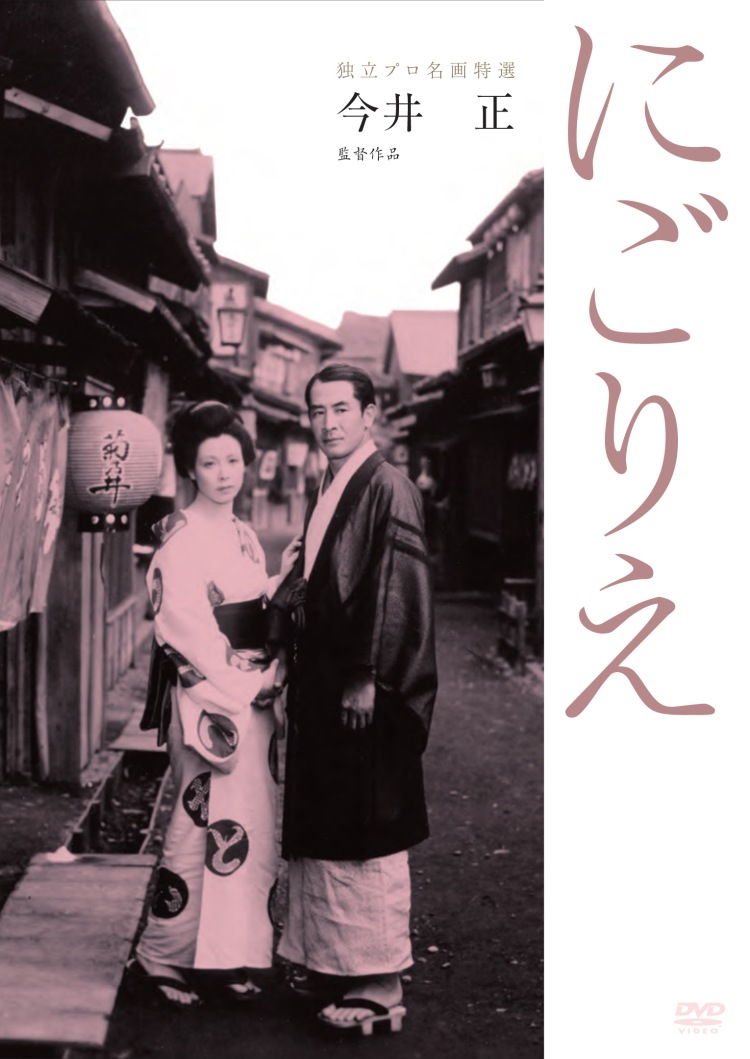
An Inlet of Muddy Water (にごりえ, Tadashi Imai, 1953)

inlet of muddy water dvd coverTadashi Imai was among the greatest directors of the golden age though his name remains far less known than contemporaries Ozu or Mizoguchi. Despite beginning in outright propaganda films during the war, Imai is best remembered as a staunchly left wing director whose films are known for their gritty realism and opposition to oppressive social codes. An Inlet of Muddy Water (にごりえ, Nigorie) very much fits this bill in adapting three stories from Japanese author Ichiyo Higuchi. Higuchi is herself a giant figure of Japanese literature though little of her work has been translated into English. Like Imai’s films, Higuchi’s stories are known for their focus on female suffering and the prevailing social oppression of the late Meiji era which had seen many changes but not all for the better. Higuchi was not a political writer and her work does not attack an uncaring society so much as describe it accurately though her own early death from tuberculosis at only 24 certainly lends weight to the tragedy of her times.

In the first part of the film which is inspired by one of Higuchi’s best known stories, The Thirteenth Night, a young woman returns home to her parents, no longer able to bear living with an emotionally abusive husband. Oseki (Yatsuko Tanami) had been raised an ordinary, lower middle-class girl but, like many a heroine of feudal era literature, caught the eye of a prominent nobleman who determined to marry her despite their class difference. Life is not a fairytale, and so the nobleman quickly tired of his beautiful peasant wife, belittling her lowly status, lack of education, and failure to slot into the elite world he inhabits.

Oseki’s plight elicits ambivalent reactions in each of her parents though they both sympathise with her immensely, if in different ways. Her mother (Akiko Tamura) is heartbroken – having long believed her daughter to be living a blissful life of luxury, she feels terribly guilty not to have known she had been suffering all this time and believes Oseki has done the right thing in leaving. Her father (Ken Mitsuda), however, also feels sad but reacts in practicality, pointing out that to leave her husband now would mean losing her son forever and probably a long, lonely life of penury. He, somewhat coldly, tells her to go back, grin and bear it. Oseki can see his point and considers resigning herself to return if only to look after her son.

On her way home she runs into a childhood friend whom she might have married if things had not turned out the way they did. “Life gets in the way of the things we want to do”, she tells him by of explanation for not staying in touch. Rokunosuke (Hiroshi Akutagawa), once a fine merchant, is now a ragged rickshaw driver, bereaved father, and divorcee. Like Oseki his life is a tragedy of frustration with the added irritant that he and Oseki might have been happy together, rather than independently miserable, if an elite had not suddenly decided to interfere by crossing class lines just because he can rather than out of any genuine feeling.

The callousness of elites is also a theme in the second story, The Last Day of the Year, in which a young maid, Omine (Yoshiko Kuga), works for a wealthy household dominated by a moody, penny pinching mistress whose mistreatment of her staff is more indifference than deliberate scorn. Omine’s uncle, who raised her, has fallen ill. At the beginning of his illness he took out a loan but he’s got no better and still needs to pay it back so he asks Omine to ask the mistress for an advance of the paltry sum of two yen in the hope that his son will be able to enjoy a new year mochi like the other kids. The mistress says yes and then changes her mind, leaving Omine to consider a transgressive act of social justice.

Where The Thirteenth Night and The Last Day of the Year pointed the finger at uncaring elites, Troubled Waters broadens its disdain to the entire world of men in focussing on two women caught on either side of the red light district – Oriki (Chikage Awashima), a geisha stalked by a ruined client, and the client’s wife, Ohatsu (Haruko Sugimura), who endures a life of penury thanks to her husband’s geisha obsession. Oriki’s sad story is recounted to a wealthy patron (So Yamamura) who is more fascinated in learning the secrets of her soul than her kimono, but like many of her age it begins with parental strife, orphanhood and perpetual imprisonment as a geisha wondering what will become of her when her looks fade and she’s no longer number one. She has no control over the men who spend time with her but is worried by Gen (Seiji Miyaguchi) who ruined himself buying her time and now stalks her in and around the inn. Infatuated and obsessed with Oriki, Gen has turned against his noble wife Ohatsu who is working herself to the bone to support the family while Gen has resorted to a life of casual labour but rarely does much of anything at all.

Recalling Higuchi’s famous diary, Imai opens each of the segments with a brief voiceover detailing the inconsequential details of the weather with a world weary, often melancholy tone as the writer laments too much time spent on fiction and resolves to tell the story of the world as it really is. There is no real connection or overarching theme which unites the three stories, save for the continued suffering of women at the hands of men and the society they have devised. Oseki must return to her abusive husband, Omine will continue to work for her heartless mistress, and Ohatsu will have to make do on her own after being so thoroughly let down by her husband. There is no recourse or escape, no path forward that will allow the women to break free of their oppression or even to learn to be free within it. Each of the stories is bleak, ending on a note of resignation and acceptance of one’s fate as terrible as that may be but Imai’s ending is most terrible of all, reminding us that today is simply another day and the heavy atmosphere of dread and oppression is certain to endure as long as we all remain resigned.


Screened at BFI as part of the Women in Japanese Melodrama season.

The Shape of Night (夜の片鱗, Noboru Nakamura, 1964)

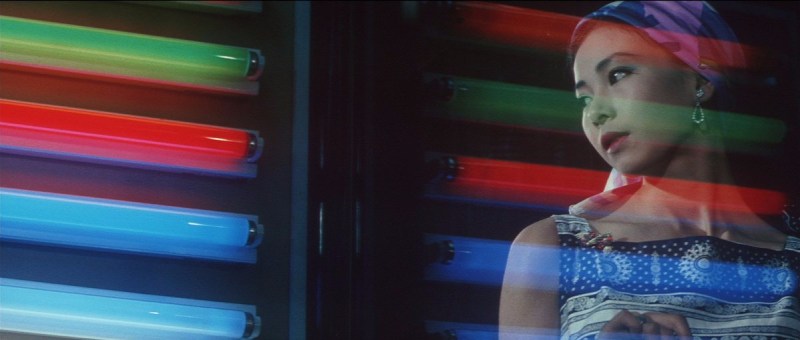
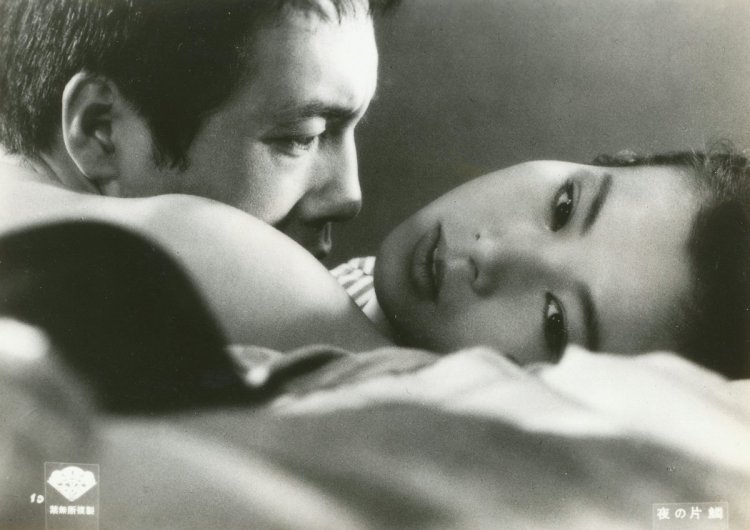
(C) Shochiku 1964Despite having two films nominated for a best foreign language Oscar and a handful of foreign festival hits under his belt, Noboru Nakamura has been largely forgotten by Western film criticism though a centennial retrospective of three of his most well regarded films at Tokyo Filmex in 2013 has helped to revive interest. The Shape of Night (夜の片鱗, Yoru no Henrin), Nakamura’s 1964 Shochiku melodrama focussing on the suffocating life of a young woman pulled into the Tokyo red light district, was one of the three newly restored films featured and was also screened in Berlin and Venice to great acclaim. Making full use of its vibrant colour palate, The Shape of Night paints its city as a constant tormentor filled with artificial light and false promises.

As we meet her, melancholy street walker Yoshie (Miyuki Kuwano) has been trapped in her dead end existence for six years and has lost all hope of living a “normal” life filled with love and happiness. A chance encounter with a supercilious client, Fujii (Keisuke Sonoi), prompts her into a series of recollections in an effort to explain exactly how it was she ended up in such a sorry state. As the eldest daughter of a poor family Yoshie left school early to work in a factory (making those neon tubes you see everywhere) while supplementing her income by working as a barmaid (not a hostess, just a girl behind the bar). Just shy of her 20th birthday, she meets a handsome “salaryman”, Eiji (Mikijiro Hira), who starts coming to the bar regularly to see her. The pair became a couple, and then lovers, and then cohabiters, but Eiji isn’t a “salaryman” so much as a low level gangster with a gambling problem whose street name is “princess”. Continual losses put Eiji in a tight spot with his crew and he begins borrowing money from Yoshie before asking her to prostitute herself to get him out of a hole. Thinking it will just be a one time thing, Yoshie resolves to make a sacrifice for her man but, of course, it wasn’t a one time thing.

Yoshie’s story is a sadly familiar one – an innocent woman duped by a duplicitous man whose empty promises aim to mask his continued fecklessness. Eiji, despite his smart suits and coolly confident attitude, is unlikely to make much of himself in the yakuza world yet is as tied into its hellish system of loyalty and reciprocity as Yoshie is in her non-marriage to the man she thinks she loves. Seeking constant approval, Eiji thinks nothing of living off a woman and his childishly excited smile on re-entering the apartment after Yoshie has sacrificed herself to save his face is a grim reminder of his priorities. When pleading doesn’t work Eiji turns violent, prompting Yoshie to finally consider leaving him but she’s too late – the yakuza world has already got its hooks into her and any attempt to escape will be met with terrifying resistance.

Fujii may seem as if he presents another option for Yoshie, a chance for a better, kinder existence but he too is merely another man trying to tell her how she should live her life. Hypocritical at best (as he freely admits), Fujii pays Yoshie to “ease his sexual urges” but expresses disgust and disapproval of her lifestyle and seeks to “save” her from her life of humiliating immorality, “purifying” her just like the dam he is building is supposed to do to the Sumida river. Fujii’s obvious saviour complex is worrying enough in itself though there is also the additional worry of what his “salvation” may entail if Yoshie decides to make a break from her yakuza chains and run off to the comparative safety of provincial Hokkaido. Fujii may claim to have fallen in love with her, but so did Eiji and who’s to say Fujii’s idea of wedded bliss will be any better than Eiji’s brutal reign as a common law spouse.

The situation is further complicated by Eiji’s gradual shift from a violent, overbearing, abusive boyfriend to a genial figure of gentle domesticity and what that shift later provokes in Yoshie. Rendered physically impotent by an incident during a gang fight, Eiji is literally and figuratively emasculated. Though his sudden inability to satisfy Yoshie originally provokes his jealously, it soon robs him of his violent impulses and turns Eiji into a willing housewife who dutifully does the couple’s washing and prepares the meals much to Yoshie’s consternation. This transformation is what finally kills her love for him, but still Yoshie cannot find it in herself to sever her connection with the man who has been the cause of all her suffering. Not quite hate or loathing, Yoshie’s burned out love has become a burden of care as she finds herself duty bound to look after a man she now believes incapable of looking after himself.

While Yoshie and Eiji sit in a bar one night after “work”, the television plays a report featuring the sad news of the death of a female student at the ANPO demonstrations. Prompting Yoshie to exclaim “what is ANPO anyway?”, the news report lays bare just how isolated her life as become – as all of Tokyo is aflame with with righteous indignation and the streets are filled with the largest protest in living memory, Yoshie is trapped in her tiny neon world which promises so much and delivers so little.

Nakamura makes fantastic use of sound design to capture Yoshie’s interior world – the background music rising over the droning voice of a boring client who hasn’t quite made up his mind, the radio cutting out at intense moments of violence, the terrible clanging of Eiji’s geta on the iron staircase which leads to his flat. Fading into blue dissolves of memory, Nakamura makes a hellish wonderland of nighttime Tokyo whose flashing neon lights, crowded bars and oddly darkened streets turn it into a prison of dubious delights. Finally making a drastic decision, Yoshie attempts to free herself from her burdens and sever the chains which bind her to her misery but in cutting the cord she finds the knots tightening, realising she will never be released from the source of all her suffering.


Screened at BFI as part of the Women in Japanese Melodrama season.

Wedding Ring (婚約指環 (エンゲージリング), Keisuke Kinoshita, 1950)

(c) Shochiku Co., Ltd

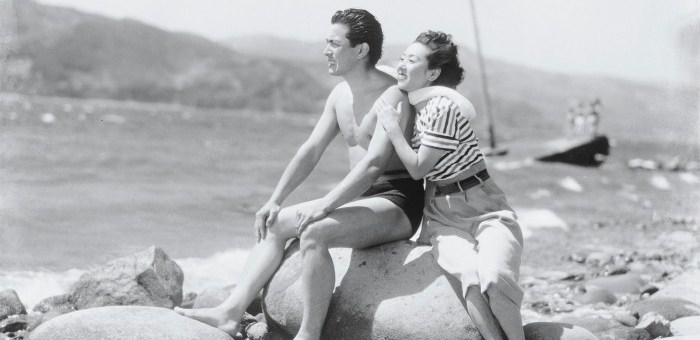
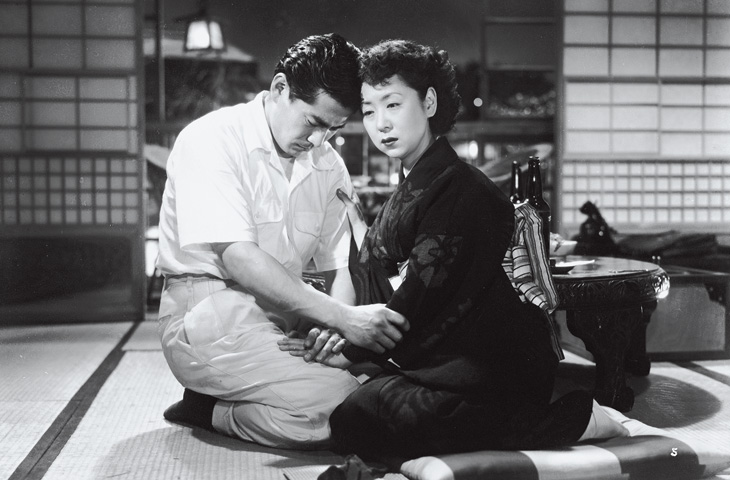
wedding ring still 2Many things have changed in the post-war world, but not everything and even with the new freedoms there are some lines which cannot be crossed. Keisuke Kinoshita made his career considering where these lines are and examining the lives of those who find themselves standing in front of them. Starring the veteran actress Kinuyo Tanaka who also produces the film, and the very young and fresh faced Toshiro Mifune, Wedding Ring (婚約指環 (エンゲージリング), Konyaku Yubiwa (Engagement Ring)) is a classic melodrama filled with forbidden love, repressed passion, and societal constraints but Kinoshita brings to it his characteristic humanity expressing sympathy and understanding for all.

Noriko (Kinuyo Tanaka) has been married seven years but her husband, Michio (Jukichi Uno), was drafted shortly after the wedding and was not repatriated until two years after the war ended. A year after he returned, Michio fell ill and has been on extreme bed rest ever since. After her father-in-law’s retirement and her husband’s illness, running of the family jewellery store fell to Noriko and so she spends the week in Tokyo taking care of business and comes back to the seaside fishing village of Ajiro where Michiro lives for the benefit of his health at the weekends. Consequently, though the couple care for each other, the marriage has never really been given the chance to take hold and they remain more companions or good friends than husband and wife.

Things change when Michio gets a new physician, Dr. Ema (Toshiro Mifune), who literally falls into Noriko’s lap during a packed bus ride from the station. Where Michio is sickly and weak, Ema is physically imposing and in robust health. Ema lives in the peaceful resort town of Atami which is on the train route from Ajiro to Tokyo meaning that Noriko and Ema sometimes wind up on the same train, developing an obvious attraction to each other which they both know to be impossible but cannot bring themselves to abandon.

In many ways Noriko is the archetypal post-war woman – strong and independent she runs the family business singlehandedly and lives alone in the city while her husband remains in the country busying himself with writing poetry. Despite the difficult circumstances, Noriko is not particularly unhappy save being unfulfilled and perhaps craving the physical intimacy her husband can no longer offer her. Her first meeting with Ema brings something in Noriko back to life as she swaps her dowdy, dark coloured suits for looser, more colourful clothing and walks with a new found spring in her step.

This change in his wife has not escaped the attention of Michio who astutely notices that she seems to be “glowing” – a development he silently attributes to the presence of Dr. Ema. Michio does his best not to resent the doctor but internalises a deep seated feeling of guilt and inadequacy as he realises that he can no longer provide what his wife needs and has become an obstacle to her happiness. A sensitive man apparently marked by his wartime experiences, Michio is angry and jealous but also resents himself for feeling that way, deepening his depression and conviction that he is nothing but a burden to his wife who deserves a full marriage with a man who can satisfy all of her needs and desires.

Desire is certainly something Noriko feels as she gazes at Ema’s powerful hands, broad shoulders, and athletic physique. Clasping his sweaty jacket to her breast in desperation eventually gives way to accidentally bold physical contact as hands catch hands and Noriko finds herself caressing Ema’s shoulder as he prepares to dive back into the sea dressed only in his woollen trunks. Ema feels the same attraction but also understands that it cannot be, not least because he is Michio’s physician and has begun to have idle fantasies of being unable to save him, freeing Noriko from her unfulfilling marriage so they can finally be together. Both sensible people, Noriko and Ema are eventually able to discuss their feelings and social responsibilities in a mature fashion, agreeing that they cannot act on their desires even if they find them hard to relinquish.

Rather than wedding ring, the Japanese title of the film more accurately refers to an engagement ring. Noriko’s wedding ring never comes off, but the engagement ring with its large stone comes to represent her shifting allegiances. Discovering the ring abandoned on the dresser, Michio begins to understand he is losing his wife to the strapping young doctor whose healthy, powerful body he cannot help but envy. The camera seeks out Noriko’s hand, with or without the shiny diamond of the engagement ring, quickly signalling the current direction of her desires.

Michio, who cannot give full voice to his emotions, expresses himself through tanka poetry, something which the equally sensitive doctor can also understand and later makes use of himself in communicating the inexpressible delicacy of his feelings to the married woman with whom he has fallen in love. Torn between love and duty, Noriko and Ema battle their mutual passion while Michio battles his sense of self and feelings of ongoing inadequacy but Kinoshita refuses to condemn any of them, rejecting an angry showdown for a nuanced consideration of personal desire versus social responsibility. The conclusion may be conservative, but the journey is not as the trio eventually part friends even if with lingering sadness in accepting the choice that has been made and resolving to move forward in friendship rather than rancour.


Screened at BFI as part of the Women in Japanese Melodrama season.

Opening scene (no subtitles)

Before We Vanish (散歩する侵略者, Kiyoshi Kurosawa, 2017)

©2017 BEFORE WE VANISH FILM PARTNERS

before we vanish posterKiyoshi Kurosawa is getting sentimental in his old age. In Journey to the Shore and Real, brokenhearted, left behind spouses went on long and difficult journeys of grief and salvation. In Before We Vanish (散歩する侵略者, Sanpo Suru Shinryakusha) we receive a visitation that presages our doom but wishes to know us before we go. An alien invasion movie which takes its cues from Invasion of the Body Snatchers and They Live, Kurosawa’s quirky drama is less about the enemy within than the hidden existential threat of a failure to understand oneself. As the Japanese title suggests, these invaders are merely out for a stroll, making time to smell the flowers before the big lawnmower arrives to cut them all down.

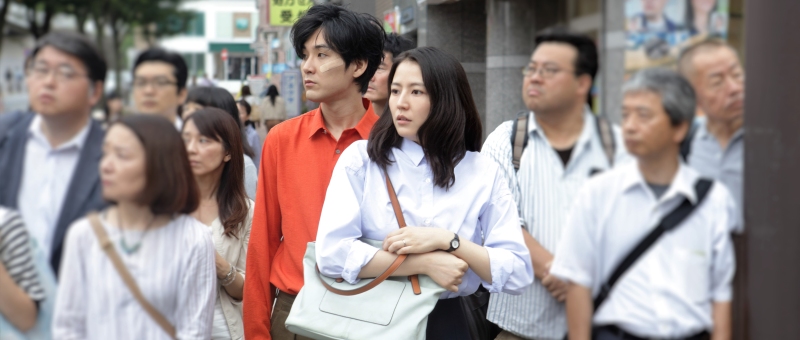
Strange events are afoot in Tokyo. A high school girl wanders home with a pair of goldfish in a plastic bag before brutally murdering her entire family, gazing at the scene of carnage with a beatific smile. Meanwhile, the estranged wife of Shinji Kase (Ryuhei Matsuda), Narumi (Masami Nagasawa), has been sent for to claim her presumably amnesiac husband from a medical facility. Shinji was brought in after wandering the streets cluelessly and seems to have lost certain sections of his memory. The doctor’s diagnosis is uncertain but leans towards some kind of temporary psychotic break or early onset Alzheimer’s. In any case, he is now Narumi’s responsibility, much to her consternation. Across town a down on his luck journalist (Hiroki Hasegawa) covering the brutal family murder finds himself the designated “guide” to another strange young man, Amano (Mahiro Takasugi), who seems to have done something very untoward to his parents.

These three “strangers” are really invaders from outer space – something which they freely confess to anyone who will listen, only everyone assumes they are joking. Exactly why they want to destroy the Earth is never revealed, nor is the the reason for the strange mission undertaken by the three researchers acting as the vanguard for the upcoming invasion. These three have been tasked with a thorough investigation of “humanity” in which they must learn and acquire certain “concepts”. They do this by requiring the subject to visualise their thinking behind a word or phrase and then tapping the head to pinch it causing that concept to be removed from the person’s interior cosmology.

The aliens learn as much from the effect of removing the concept as they do from its explanation. This being Japan, it’s not surprising that the first concept Shinji removes is that of “family” which he takes from Narumi’s younger sister, Asumi (Atsuko Maeda). Asumi had decamped to Narumi’s after an argument with her parents over their railroading her into a mainstream life she doesn’t really want. The removal of the concept of family means Asumi no longer needs to be bound by hollow obligation but her sudden coldness towards her sister immediately invites a series of other questions as to the true nature of their relationship. Similarly, Shinji removes a concept of “possession” from a young man. The young man does not immediately lose understanding of the word, but the concept ceases to be important to him. He is, in a sense, freed from the burden of materialism. Paying an unexpected visit to Narumi’s workplace and meeting her boss who, it seems, has just belittled her work on an important project after she rebuffed his attempt at sexual harassment, Shinji removes his concept of “work” leading him to play aeroplanes all around the office like an overexcited child.

There are positive effects of losing some of these centrally held ideas even if their loss seems tragic or painful on the surface. They are, however, what make us human whether that be attachment to family or an irrational desire to devote all to work and ceaseless acquisition. The final, most elusive concept is that of love – something alien and fascinating to the visitors which they find impossible to harvest due its essentially nebulous nature. Despite being part of a uniform hive mind, the invaders have each developed unique personality traits as a consequence of their “human” lives – the schoolgirl craves violence and destruction, Amano fatherly friendship, and Shinji something close to love with his own “guide” in the form of Narumi whose love for her husband apparently endured despite his betrayal.

Far from the gloomy nihilism of Pulse in which death is eternal loneliness, Before We Vanish suggests that what will survive of us is love. Salvation does, however, require a sacrifice which provokes the film’s romantic conclusion in which the absence of love becomes the “eternal loneliness” promised by Pulse but is tempered by patience and devotion. A gleefully absurdist exploration of the human soul, Before We Vanish finds Kurosawa at his most optimistic affirming the power of the human spirit at its most indestructible.


Screened at the London East Asia Film Festival 2017.

International trailer (English subtitles)