The Actor (俳優  亀岡拓次, Satoko Yokohama, 2016)

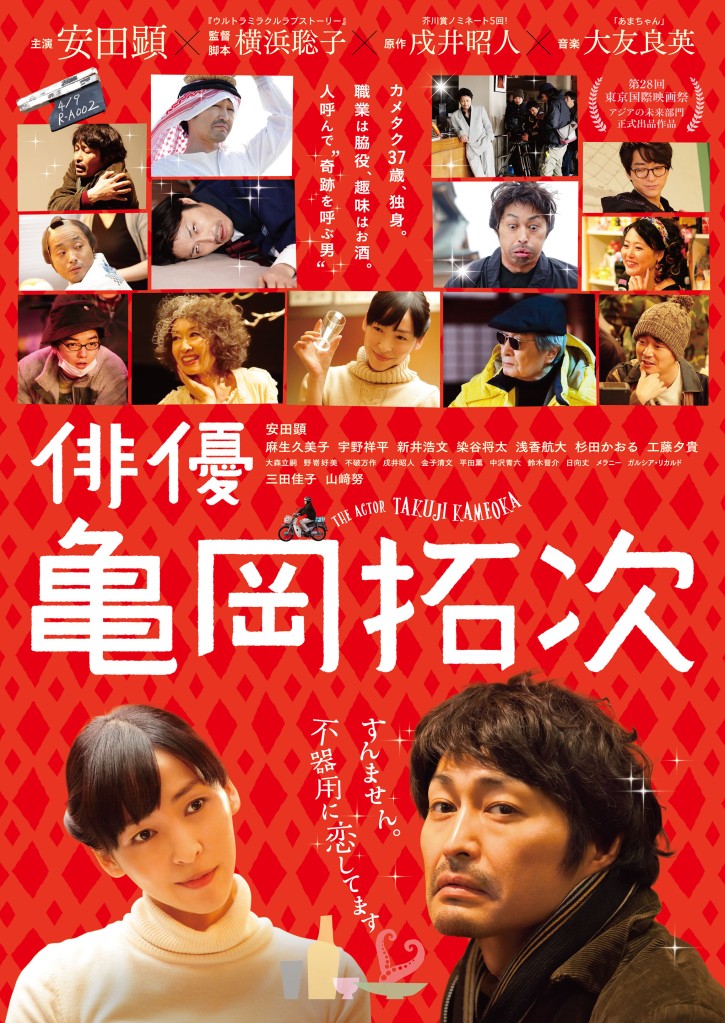
“There are no small parts, only small actors” according to the mantra of the bit part player, but perhaps deep down everyone wants to play the lead. Most jobbing actors will tell you that they’re happy to be working and if you work as much the dejected hero of Satoko Yokohama’s The Actor (俳優  亀岡拓次, Haiyu Kameoka Takuji), you can make a pretty decent living with a little more job security than a big name star whose career will inevitably hit the odd dry spell. Yet, who doesn’t want to at least feel that they’re the lead in their own life story? Spending all your time being other people can make you lose sight of who you really are and live your life with a sense of cinematic romanticism forever at odds with accepted reality. 

Takuji Kameoka (Ken Yasuda) is a classic background actor, turning up in small roles in TV dramas, often playing the villain of the week or appearing as a prominent extra. Meanwhile, his offscreen life seems to be lived in a booze-soaked haze, hanging out in his favourite bar surrounded by similarly dejected middle-aged men or occasionally meeting up with colleagues. Even his agent expects him to be sozzled when she rings to confirm new jobs though to be fair she doesn’t seem too bothered about it. 

Kameoka has perhaps made his peace with the kind of actor he is, but there’s also an inbuilt anxiety in waiting for people to ask what it is he does, knowing that it sounds glamorous and exciting when, to him at least, it’s anything but. Chatting with a pretty young woman, Azumi (Kumiko Aso), working behind a bar in a small town where he’s filming, Kameoka spins her a yarn about being a bowling ball salesman rather than be forced into a conversation about the life of a jobbing actor which might perhaps depress him more. Alone in the bar, the pair of them strike up a rapport over shared sake, but Kameoka forgets that in essence she’s just the same as him – acting, performing her role as the cheerful hostess, keeping him happy to sell more drinks. Later, she tells him that she’s switching roles, “recasting” herself as a good wife and mother, pointing again towards the unavoidable performative quality of conforming to socially defined labels such as “wife”, “mother”, “landlady”, “actor” or “man”. 

Everyone is, to some degree, acting, forced to perform a role in which they may privately feel miscast but are unable to reject. Kameoka is losing sight of who he is and so his life begins to feel increasingly like a movie, obeying narrative logic rather than that of “reality” while he often drifts off into flights of fancy in which he gets to play not the lead but a slightly bigger supporting part, recasts himself as the star of a favourite film, or finds himself momentarily in a film noir. Real or imagined, his directors have nothing but praise for him to the degree that it somehow feels ironic. He’s brought in to show the rookie leads how it’s done, an accidental master at dropping dead on camera, but as the landlady at his local says of another actor on TV, he just doesn’t have that leading man sparkle. Of course, not having that kind of presence is perfect for being a background player but a great shame when he has the talent to succeed, just without the burden of “star quality”. 

Then again, his talent is uncertain. Despite telling his agent that he doesn’t do stage, he agrees to work with a famous actress/director on an avant-garde theatre piece. Though she’s much harder on the young female star, Matsumura (Yoshiko Mita) rarely compliments his acting and eventually advises him that he’s unsuited to stage work because he has “film timing”. Privately, he might agree, but a job’s a job. Ironically enough, the performance that Matsumura failed to bring out in him is vividly brought to life during a very weird audition for a Spanish director who happens to be one of Kameoka’s favourites. He inhabits the role so strongly as to completely become it to the extent that its world rises all around him, but all too soon the audition is over with a simple “that’s great, thank you – we’ll be in touch”. Kameoka even suffers the indignity of crawling under the frozen shutters to exit the building while the next hopeful, a top TV actor he worked with on a previous job, makes his way inside. 

The woman in Kameoka’s audition fantasy is clearly Azumi, something that becomes clearer to him still during another flight of fancy that recasts him as a romantic hero making the grand gesture of a rain soaked dash, motorcycle filmed against rear projection, as he prepares for the inevitable “happy ending”. Reality, however, triumphs once again. Lovelorn, Kameoka declares himself lonely and indeed is always alone, not one of the “main cast” just a “bit player” hanging round until his scene and then moving on to the next project. He waves at women who weren’t waving at him, sympathises with a failed singer turned bar hostess, and celebrates the unexpected marriage of a friend but in a strange sense perhaps misses “himself”, gradually eclipsed by all the roles he plays onscreen and off. “Who are you?”, the Spanish director’s interpreter asks. “Takuji Kameoka, Japanese Actor”, is as good an answer as any. 


Screened as part of the Japan Foundation Touring Film Programme 2020.

Original trailer (English subtitles)

Saint Young Men (聖☆おにいさん, Yuichi Fukuda, 2018)

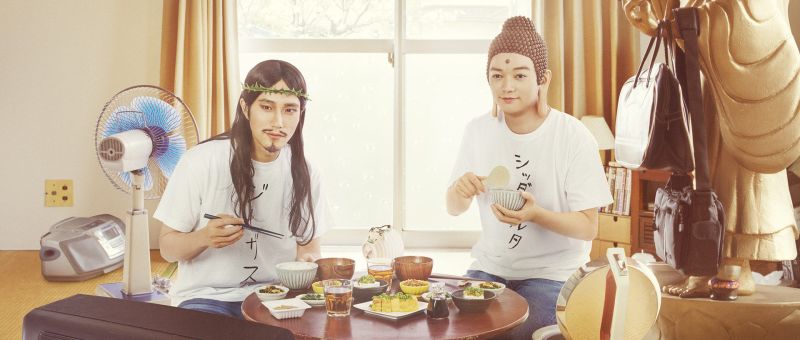
Saint young men posterWhat if Buddha and Jesus were flatmates in modern day Tokyo? Hikaru Nakamura’s much loved manga Saint Young Men (聖☆おにいさん, Saint Oniisan) attempted to find out, casting the two holy beings as conventional manga slackers on “vacation” in the mortal realm, supposedly researching modern Japanese society. A firm favourite with fans, the franchise has already been adapted into a popular anime and now receives the live action treatment from none other than Gintama’s Yuichi Fukuda.

Split into a series of short vignettes mostly featuring only Jesus (Kenichi Matsuyama) and Buddha (Shota Sometani) in their apartment, Saint Young Men first aired as a 10-part web series before being compiled into a 70-minute movie. The central conceit is that Jesus is a cheerful if slightly feckless hippy, while Buddha is the calm and the responsible one making sure he’s well looked after. Perhaps surprisingly, Saint Young Men presents its vision of contemporary Japan from the point of view of the two guys as they explore everyday life, occasionally including explanatory narration from a distant authorial voice which, presumably, contains information widely known to the target audience, such as an explanations of “White Day” – Japan’s secondary Valentines in which men given chocolates are expected to return the favour with gifts three times the cost, and spring festival “Setsubun” in which beans are thrown at people wearing ogre masks to frighten off bad luck.

For the two guys these are fascinating little anthropological details they can get quite excited about despite their thousands of years of existence. On a trip to the convenience store, Jesus is thrilled to think he’s finally “made it” after 2000 years because some high school girls said he looked like Johnny Depp. Buddha goes to see if he looks like someone too, but the girls immediately recognise him as looking “like Buddha” which is both a disappointment and somehow validating. Meanwhile, he laments that the majority of his artistic renderings have only captured him in his “fat period” rather than the handsome figure he currently cuts. 

Bickering like an old married couple, the guys fight about the usual things – money, and the irresponsible use of it. Jesus has a bad habit of buying random stuff he doesn’t need off the internet, causing Buddha to get so annoyed he starts physically glowing and only calms down when Jesus gives him a present, a manga artist’s starter kit. Sadly, Buddha is proved right when Jesus gets bored with his random electric pottery wheel after only a few minutes, but is witness to an unexpected miracle when the clay is magically transformed into bread, turning the wheel into a “bread oven” with which Jesus seems very pleased only to tire of it just as quickly.

Trying to keep their “real” identities secret, the guys are keen to keep their abilities behind closed doors – something Buddha forgets when he hatches on the great idea of levitating to save floor space. Jesus comes home and quickly closes the curtains in case someone thinks they’re some kind of weird cult. The guys consider moving somewhere with a little more room, but discover that even for holy beings it’s almost impossible to find a decent apartment in modern day Tokyo that doesn’t cost the Earth. The primary reason Jesus wanted to move, however, is not so much that the apartment’s a little poky for two full-grown guys, but that the other place was gated which means he won’t be getting bothered by cold calling newspaper sales representatives.

Jesus may be too nice to keep saying no to pushy salesmen, but Buddha has a few unexpected trust issues. Faint from hunger, the guys think about ordering a take away, but Buddha is a strict vegetarian and worries about the chain of communication involved in food preparation. He can only trust that the restaurant follows the instructions he gives them honestly and that the delivery guy won’t do anything weird with the food on his way over. In the end, you just have to have faith, but Buddha is struggling while Jesus is content to let it all hang out. Something similar occurs when earnest Buddha unwisely meditates for hours in the beautiful snow in only his ironic T-shirt and catches a cold with only Jesus to nurse him. Jesus wants to take him to the hospital, but they don’t have insurance and don’t want to risk extortionate medical bills. Jesus’ healing powers apparently don’t work on other holy beings, and so he finds himself healing a bunch of people at the hospital to earn a free visit from a doctor with whom Buddha can only communicate through possession and telepathy.

Obviously very low budget and mostly starring just the two guys with additional appearances from their middle-aged landlady and the confused doctor, Saint Young Men is very much a Fukuda production bearing his familiar hallmark of waiting slightly too long for a joke land, which it often does not. Though seeing all 10 episodes in one go necessarily flags up their essential sameness, they do provide an amusing exploration of slacker life in contemporary Japan with occasional forays into warmhearted cross-cultural exchanges between the serious Buddha and scatterbrained Jesus.


Original trailer (no subtitles)
First Love (初恋, Takashi Miike, 2019)

First love poster 1Taking a deep dive into Showa era nostalgia repurposed for the modern era, Takashi Miike returns to the world of jitsuroku excess with an ironic tale of honour and humanity. Quite literally all about the jingi, First Love (初恋. Hatsukoi) takes a pair of exiled loners betrayed by the older generation, and allows them to escape their sense of futility through simple human connection while the nihilistic gangster underworld slowly implodes all around them.

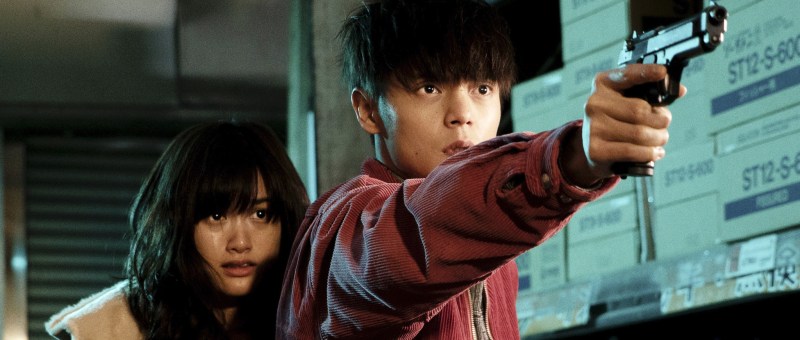
Sullen boxer Leo (Masataka Kubota) is so filled with ennui that nothing really excites him, not even success in the ring. An unexpected KO, however, sends him off to the doctor’s where he is told that he has a possibly inoperable brain tumour and very little time left to live. That is perhaps why he decides to punch a policeman in defence of a young woman running away and desperately pleading for help. Yuri (Sakurako Konishi), known as “Monica” to her captors, was sold to the yakuza by her father and has since become dependent on drugs. Little known to either Leo or Yuri, they are about to become embroiled in a long brewing turf war between the local yakuza and the Chinese Triads engineered by jaded underling Kase (Shota Sometani) who has enlisted rogue policeman Ohtomo (Nao Omori) to help in a plan to steal his gang’s drug supply and have Ohtomo sell it on in the same way he does with “confiscated” narcotics while blaming the whole thing on the Chinese.

Abandoned at birth, Leo is a man who doesn’t know his history and so doesn’t know himself. He tells a reporter that there is no particular reason that he boxes save that he doesn’t know how to do anything else, yet the fighter’s all that remains and “boxer” has become his entire identity. A passing fortune teller advises him that he loses because he only fights for himself and if he truly wants to win he needs to learn to fight for someone else, but Leo is used to being alone and believes he has no need of other people. Knowing he’s going to die means, paradoxically, that he has infinite potential because he has nothing left to lose.

Leo punching out the policeman reawakens in Yuri a memory of her “first love”, a high school classmate who tried to defend her against her abusive father whose ghost still haunts her in drug-fuelled hallucinations. The ultimate proof of the yakuza’s ironic lack of “jingi” or “honour and humanity” when it comes to the treatment of women, Yuri was betrayed first by her father and then by the petty street thug who got her hooked on drugs as a means of control and exploited her body for financial gain.

Ironically enough, it’s a Chinese Triad who proves the ultimate heir to “jingi” having come to Japan because of her love for classic Toei gangster hero Ken Takakura only to discover that kind of nobility is something you only see in the movies. While the yakuza lament that they’re at a disadvantage fighting the Chinese because they don’t need to worry about “honour” as dictated by their code, they are quick enough to scream vengeance when Kase convinces them that it was the Triads who offed their street fixer (Takahiro Miura) to get back at recently released gangster Gondo (Seiyo Uchino) who is the reason that the Triad boss is nicknamed One-Armed-Wang. Gondo and Wang are already on a collision course as representatives of their respective ideologies with Gondo perhaps the last true yakuza standing, faithful to his code to the end.

Sensing his strong sense of jingi, the romantic Triad allows Leo to escape with Yuri as if recognising that neither of them belong in this nihilistic world of pointless and internecine violence. Despite proclaiming that he had no need of other people, it’s Leo’s humanity that eventually saves him as he realises that he was always going to die and rediscovers his true strength through fighting to protect someone else. Yuri, meanwhile, finds the will to live again in making peace with the past and laying old ghosts to rest thanks to Leo’s altruistic decision to protect her. Echoing Fukasaku’s classic crime cycle in its severed heads and funky ‘70s jazz score remixing the iconic theme tune, Miike ups the ante with a series of outlandishly idiosyncratic gags as Kase’s nefarious scheme snowballs into a darkly humorous crescendo of ridiculous brutality, but ultimately rejects the futility of a world without jingi in allowing his pure hearted heroes the possibility of escape, saved rather than consumed by their sense of honour and humanity.


First Love was screened as part of the 2019 BFI London Film Festival.

Original trailer (English subtitles)

To the Ends of the Earth (旅のおわり、世界のはじまり, Kiyoshi Kurosawa, 2019)

To the Ends of the Earth poster 2“It’s like a little journey you can take without going too far from home” a bubbly variety TV presenter announces partway through To the Ends of the Earth (旅のおわり、世界のはじまり, Tabi no Owari Sekai no Hajimari), reporting from a rundown theme park the like of which she claims you hardly ever see in Japan anymore. It might as well encapsulate her life as the host of a TV travel programme directly aimed at people who prefer to take their pleasures vicariously. Kiyoshi Kurosawa’s long career has been, in an odd sense, moving into the light. Where death was once eternal loneliness, he now tells us love is what will save us in the end, if only we overcome our fear of each other.

Yoko (Atsuko Maeda), a 20-something TV “reporter” for a variety show, is an intensely anxious young woman. In her postcards home to her firefighter boyfriend, she tells him that she feels “safe” now that they’ve arrived in a big, modern city, but, somewhat ironically, asks him to try and stay away from dangerous places. Currently shooting in Uzbekistan, she finds herself doubly isolated – both because she is a lone woman travelling with an all male crew, and because she is the star and therefore not included as a part of their team. Though they call her a “reporter”, it’s clear that the temperamental, insensitive director Yoshioka (Shota Sometani) does not value her editorial opinion and sees Yoko more or less as a kind of prop.

When we first meet her, Yoko is being forced to deliver a direct to camera speech from the middle of a “fake lake” which, as she explains, is more like a big puddle created by accident during a Soviet-era irrigation project that didn’t quite go to plan. During the course of the filming, we watch her effortlessly switch between the super “kawaii’ presenter who has to pretend the undercooked food she’s just been handed (that will probably make her ill) is the best meal she’s ever tasted, and the dejected young woman growing ever more resentful about her corrupted authenticity. Nervous and under-confident, she finds herself bullied by the demanding director, feeling as if she’s obliged to put up with whatever he asks her to do even if it compromises her safety.

Later, at the theme park, the owner of the ride Yoko is supposed to “enjoy” expresses concern, firstly claiming that it’s not suitable for women, and then apparently mistaking Yoko for a child. He doesn’t clarify if there’s actually a safety issue, that the ride is calibrated for a certain size and weight and might be dangerous for a slight woman as opposed to a beefy man, but in any case Yoko is made to ride it three times in quick succession. Akin to something they put astronauts and fighter pilots in to prepare them for coping with G-force fluctuation, it is not particularly fun but still Yoko is obliged to giggle like a giddy school girl every time before finally collapsing as if she’s about to go into nervous shock. A few moments later, however, she stands in front of the camera to give another cheerful speech about just how much fun she’s having.

Yet we also see her attempt to fight back against her sense of anxious powerlessness by actively asserting her independence. She leaves her hotel and takes a bus, a complicated affair when she doesn’t speak the language or understand where she’s going, visiting a local bazaar where she attracts not a little attention, some of the saleswomen even attempting to physically grab her in order to sell their wares. She feels the male gaze constantly upon her and though you’ll rarely find a woman who says that skirting round groups of men in darkened alleyways doesn’t make her nervous, there is something about the unfamiliarity of the environment which has Yoko on edge. Men peek in through the windows of the van where she changes costumes to make it look like they were in Uzbekistan longer than they were, and like the ride owner, a fisherman they’d enlisted to help them catch a giant fish grows progressively more irritated, claiming that the fish aren’t coming because they don’t like a woman’s smell.

Exploring the town, Yoko’s mind quietens only when she begins to hear music pouring out of a local opera house. She wanders inside and sits down, envisioning herself on stage performing Ai no Sanka, a Japanese rendering of Edith Piaf’s Hymne à l’amour, but her reverie is cruelly interrupted by a security guard who sends her anxiously reeling away. Another encounter with authority provokes a similar reaction when she’s stopped for filming in a prohibited area but instead of calmly presenting the camera, she panics and runs away. As a sympathetic detective later tells her, if you run from the police they have to chase you, it’s the law. The detective is a little offended. Why was she so afraid of Uzbek policemen? Did they seem excessively mean, what does she know about Uzbeks anyway? If only she’d tried to listen to what they were saying, all of this could have been avoided.

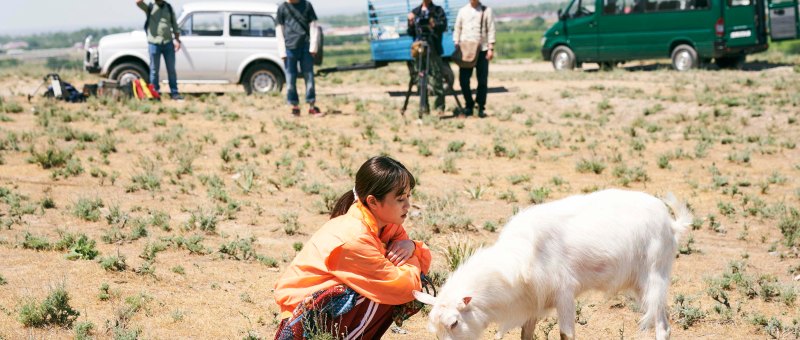
The detective, echoed through sympathetic translator Temur (Adiz Rajabov), avows that if we don’t talk then we’ll never understand each other. Temur became a translator after hearing about the Japanese prisoners of war who built the theatre in which Yoko heard the music, painstakingly crafting rooms dedicated to six areas of a country which had been their enemy. Moved by their generosity, he learned Japanese to give something back. Identifying herself with a captive goat she longed to free from constraint and isolation, Yoko gains confidence from his words. She confesses that she’s preparing to follow her dream of becoming a singer, but worries that she lacks the emotional authenticity required to make the song resonate. Through her cross-cultural adventure, brush with the law, and a personal crisis back home, Yoko begins to realise that the world isn’t such a scary place after all. Yoko sings the song of love, less for the uncommunicative boyfriend she unconvincingly claimed it was her hope to marry, than for herself and for the world, now as open as her heart in the limitless vistas of the Uzbek mountains.


To the Ends of the Earth was screened as part of the 2019 BFI London Film Festival.

Original trailer (English subtitles)

Ai no Sanka as performed by Hibari Misora

https://www.youtube.com/watch?v=0zYBULKBEKc

Stare (シライサン, Hirotaka Adachi, 2019) [Fantasia 2019]

Stare 3If you’re attacked by a bear, the advice is not to run, but to stand your ground before backing away slowly while calmly explaining to the bear that you mean it no harm and would like to go home now. Similar advice will serve you well if you’re unlucky enough to be cursed by “Shirai-san” (シライサン), the vengeful ghost of an all-powerful shamaness who, for some reason, really doesn’t like for people to know her name. One crucial difference, however, is that Shirai-san demands a different kind of respect. She can’t abide deference, and will kill all those who look away from her extremely large eyes.

This three young people learn to their cost after indulging in an ill-advised scary story session in a quiet inn. An oft repeated piece about a creepy wedding photo invites a visiting liquor store delivery boy, Watanabe (Shota Sometani), to recount a tale of pure horror he was told as a boy about a man chased by a strange woman who claimed to know him and wanted to take her revenge for his supposedly knowing her name (which he apparently didn’t until she told it to him). The man tells her to pick on someone else who knows her as “Shirai-san” which is how the story ends, with fingers pointing at the horrified listeners. Of course, it’s just a silly campfire story, but before long all three of the students are dead of supposed heart attacks of such magnitude that they caused their eyes to explode.

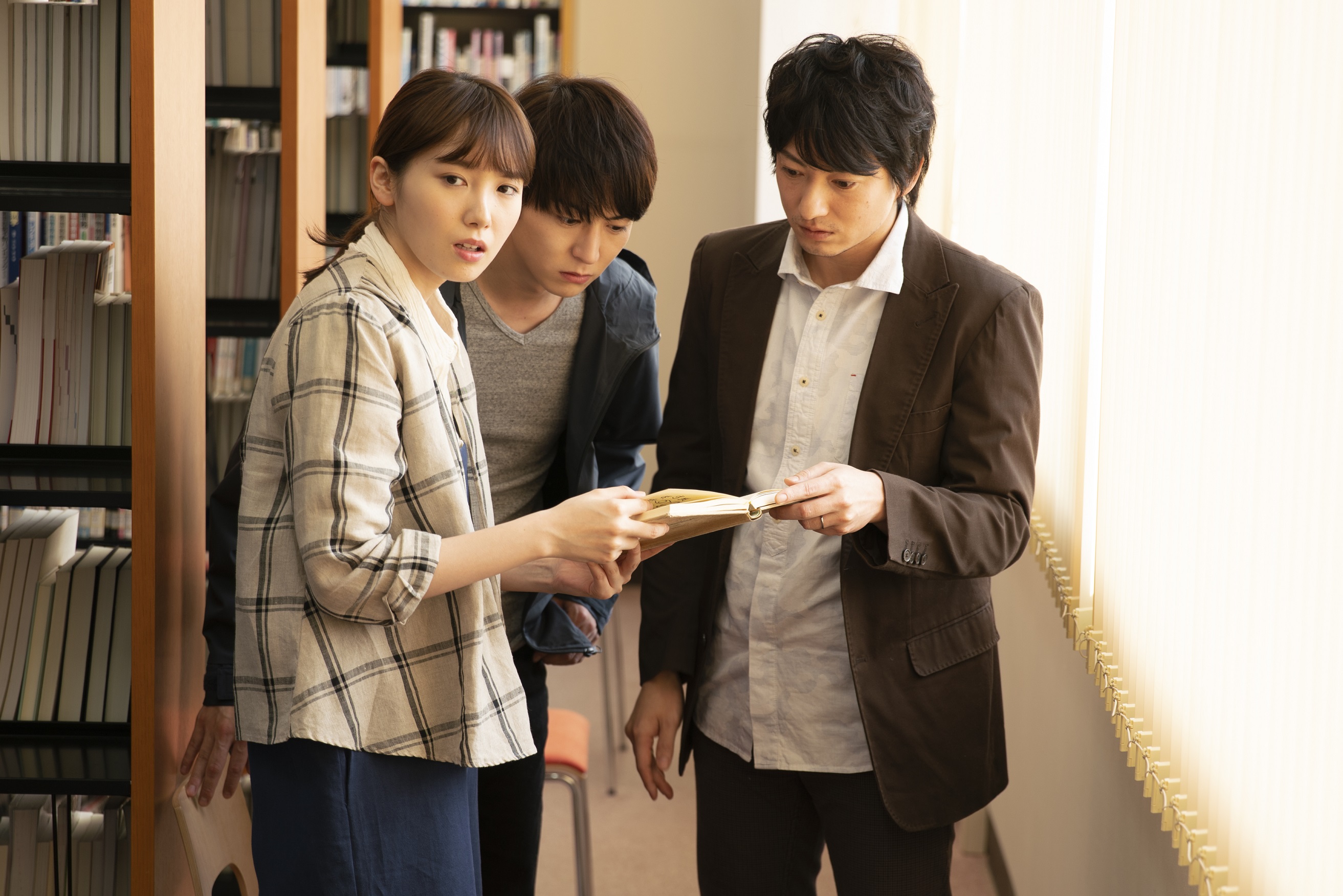
Meanwhile, the left behind – friend Mizuki (Marie Iitoyo), and brother Haruo (Yu Inaba), begin an investigation which will eventually see them too cursed by the figure of Shirai-san. Later they are joined by equally dejected reporter Mamiya (Shugo Oshinari), still grieving for his young daughter killed in a traffic accident some time ago. All modern people, none of the three really believes that their loved ones died because of an ancient curse, but their investigation leads them to just that conclusion, leaving them to ponder how exactly they might be able to survive if not actually break it.

In any case, Shirai-san’s wrath is directed at all those who know her name no matter how they came to learn it. Like many a J-horror ghost, what she feeds on is fear. As Haruo’s father told him, perhaps in cold comfort, there is one upside to death – that by dying you lose your fear of it. Thereby you can come to accept the idea of death and pass peacefully with no need for further anxiety about the end. It’s an ironic statement, but not without its truth. Picking apart the mystery, Mizuki wonders how exactly you might write the name “Shirai”, working under the assumption that it’s the most normal way which means “white well” (白井) only to wonder if it’s not a way of saying “death coming” (死来) rather than actually her name.

Shirai-san might be, in that sense, merely the evocation of mortality, stalking dark corners and striking seemingly at random. One victim thinks they find a way to placate her, that if you can bear to stare her in the eye long enough she will eventually disappear, but you cannot escape “death” by facing it down only meet it with dignity. Our heroes are plagued by visions of the people they’ve lost, haunted by possibly imagined grudges and irresolvable guilt over human failings, the way they fear they may have made people feel or otherwise let them down. Shirai-san plays on their mortal insecurities, luring them to their doom with a mix of relief from suffering and guilt-ridden atonement.

Well known horror maestro Hirotaka Adachi (AKA Otsuichi) injects new vigour into the classic J-horror ghost with Shirai-san seemingly unafraid to strike in broad daylight and public places while her presence is eerily felt in the most tranquil of locations, echoed in the innocent tinkle of bicycle bells. A cruel curse spread by resentment and negativity, Shirai-san’s revenge is one which offers only an ironic escape and remains frustratingly inscrutable even at the very end. Nevertheless, she does, perhaps, come for us all in one way or another. The least you can do is look her in the eye.


Stare was screened as part of the 2019 Fantasia International Film Festival.

Original trailer (English subtitles)

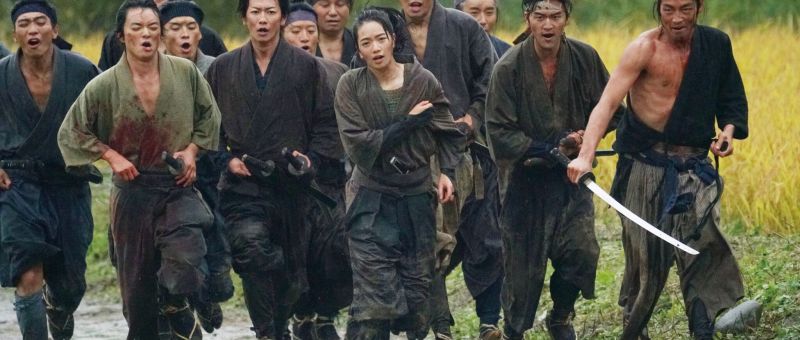
Samurai Marathon (サムライマラソン, Bernard Rose, 2019)

Samurai Marathon posterAfter two and a half centuries of peaceful slumber, Japan was jolted out of its isolation by the arrival of Commodore Perry’s Black Ships. The sudden intrusion proved alarming to most and eventually provoked a new polarisation in feudal society between those who remained loyal to the Shogun and the old ways, and those who thought Japan’s best hope was to modernise as quickly as possible to fend off a foreign invasion if it did eventually arise as many feared it would. Lord Itakura (Hiroki Hasegawa) has a foot in both camps. He has no desire to move against the Shogun, but fears that centuries of peace have made his men soft and complacent. His solution is to institute a “Samurai Marathon”, forcing his retainers to run 36 miles to prepare for a coming battle.

If you’ve spent your life sitting around and occasionally waving a sword at something just to keep your hand in, suddenly trying to run 36 miles might not be the best idea, as many samurai keen to win favour through racing glory discover. There is, however, an additional problem in that, unbeknownst to anyone, samurai accountant Jinnai (Takeru Satoh) is a secret ninja spy for the shogun. Confused by the preparations for the race, he reported that a possible rebellion was in the offing only to bitterly regret his decision on realising Itakura’s anxieties are only related to external, not internal, strife. All of which means, the Shogun’s men are on their way and Itakura’s retainers are sitting ducks.

Helmed by British director Bernard Rose, Samurai Marathon (サムライマラソン) plays out much more like a conventional European historical drama than your average jidaigeki. Where samurai movies with an unusual focus tend to be comedic, Rose opts for a strangely arch tone which is somewhere between po-faced Shakespeareanism and post-modern irony. Rather than the stoical elegance which defines samurai warfare, the violence is real and bloody, if somewhat over the top in the manner of a gory Renaissance painting complete with gasping severed heads and gruesome sprays of dark red blood.

A chronicle of bakumatsu anxiety, the film also takes a much more pro-American perspective than might perhaps be expected, taking the view that the arrival of the Americans heralded in a new era of freedom and the origins of democracy rather than the more ambivalent attitude found in most jidaigeki which tend to focus much more strongly on the divisions within samurai society between those who wanted to modernise and those who just wanted to kick all the foreigners back out again so everything would go back to “normal”. Itakura, like many, is suspicious of foreign influence and the gun-toting, yankee doodle humming Shogunate bodyguard is indeed a villain though it’s Itakura himself who will end up firing a gun as if conceding that the future has arrived and the era of the sword has passed. 

Ramming the point home, Itakura is also forced to concede to the desires of his wilful daughter, Princess Yuki (Nana Komatsu), who wanted to travel and see the world while her society (and conventionally minded though doting father) insisted all there was for her was marriage and a life stuck inside castle walls. Managing to escape and disguising herself by cutting her hair and putting on peasant clothes, Yuki is able to evade detection longer than expected precisely because few people have ever seen her face. She also gets to make use of some of the samurai training she’s received by holding her own out on the road, though it seems improbable that her father would let her ride out alone even if he finally allows her free rein to go where she chooses.

Meanwhile, other ambitious retainers try to use the race to their own advantage though there’s poignant melancholy in one lowly foot soldier’s (Shota Sometani) dreams of being made a samurai considering that in just a few short years the samurai will be no more. The final sepia shift into the present day and a modern marathon may be a stretch, as might the unnecessary final piece of onscreen text informing us that we’ve just watched the origin story for the Japanese marathon, but the main thrust of the narrative seems to be that the samurai were running full pelt into an uncertain future, preparing to surrender their swords at the finish line. An unusual take on the jidaigeki, Samurai Marathon perhaps takes an anachronising view of Bakumatsu chaos in which the samurai themselves recognise the end of their era but finds its feet on the road as its self-interested heroes find common purpose in running home.


Samurai Marathon screens as the opening night gala of the 2019 New York Asian Film Festival on June 28 where actress Nana Komatsu will be in attendance to collect her Screen International Rising Star Asia Award.

Original trailer (no subtitles)

Dawn Wind in My Poncho (ポンチョに夜明けの風はらませて, Satoru Hirohara, 2017)

Dawn Wind in My Poncho posterThe end of high school might signal impending doom for some, but it also provides a valuable opportunity for one last hurrah before surrendering to the demands of the adult world. That’s more or less how the heroes of Satoru Hirohara’s Dawn Wind in My Poncho (ポンチョに夜明けの風はらませて, Poncho ni Yoake no Kaze Haramasete) feel about it as they set off on an impromptu road trip to track down a Peruvian folksinger making his first visit to Japan in 18 years. Youthful irresponsibility and an openness to all things send our boys on a strange odyssey of self discovery in flight of a future that is almost certain to be disappointing.

Right before graduation, Janbo (Yuma Yamoto) and Matahachi (Taiga) are preparing to celebrate their friend Jin (Aoi Nakamura) getting into Uni. Only, Jin didn’t make the grade which has rather put a damper on the occasion. To make matters worse, new driver Matahatchi seems to have scratched the car belonging to Janbo’s dad which they weren’t supposed to be driving in the first place. Trying to fix the problem, they run into dejected idol Ai (Aimi Satsukawa) who dreams of chart success but is being pressured into a gravure career by her agency. Ai manages to upset some delinquents in a convenience store car park, leaving our guys wondering if they should step in but coming to the conclusion it’s not worth it unless the girl is pretty. Nevertheless, they end up driving off with Ai in the back of the car anyway with the delinquents in hot pursuit.

That’s only the beginning of the boys’ adventure, but they can’t go home yet anyway because by the end of the chase they’ve completely destroyed the car and will be extremely dead when Janbo’s dad finds out. Lovingly showing off a picture of his beloved new (secondhand) car, Janbo’s dad tells a young man coming into the bar owned by Matahachi’s single mother that if he works really hard for a very long time, he too could have a car like this. It’s a fairly depressing prospect, but it does seem like there might not be much more out there for these small town guys as they prepare to leave high school behind. Jin was the guys’ bright hope with his university dreams. Janbo is going to work for his dad and Matahachi is looking for a job. All there is to look forward to now is constraint. A boring low pay job with no prospects, followed by marriage, fatherhood, and death.

You can’t blame them for cutting loose, though in essence our guys are mild-mannered sorts well and truly outrun by Ai’s anarchic flight from her own disappointment with her faltering career. Of course, the boys are all interested in her nevertheless only Janbo is facing an embarrassing problem of his own which has him wondering if he’ll ever be able to have a “normal” sex life, marriage, or family. The problem eventually takes him to the “Banana Clinic” which is actually a front very specific sex services but does introduce him to a nice young lady (Junko Abe) who might be able to cure his sense of insecurity if in a roundabout way.

Meanwhile, the guys have blown off the fourth member of their “band” (Shhota Sometani) who is still hanging around waiting for them to turn up for practice ahead of their graduation show. A poignant radio message attached to a song request in which he reveals how lonely he was until some guys invited him to join their band goes unheard by the gang leaving him to gatecrash graduation all alone with an impromptu performance in which he sings about how school was pointless and no one cares about the future, starting a mini riot among the other kids in the process. The trio are still busy with a series of zany adventures as Matahachi tries to convince the guys to come with him on strange quest to hear the elusive folk singer, only latterly explaining to them why exactly this means so much to him. A typically teenage road trip ends up going nowhere in particular, leaving the guys in limbo as they run from their depressing futures towards the last traces freedom far in the distance. Silly, if endearing, Dawn Wind in My Poncho is a strangely sympathetic tale of youthful rebellion towards impending adulthood which ultimately places its faith in the strength of male friendship as the last refuge from a relentlessly conformist society.


Dawn Wind in My Poncho was screened as part of the 2019 Nippon Connection Film Festival.

Original trailer (no subtitles)
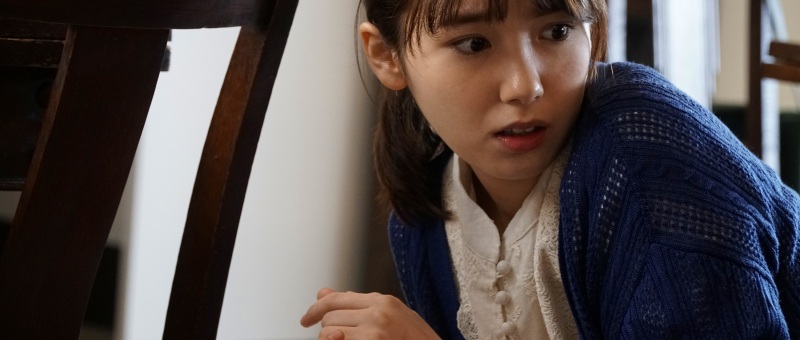
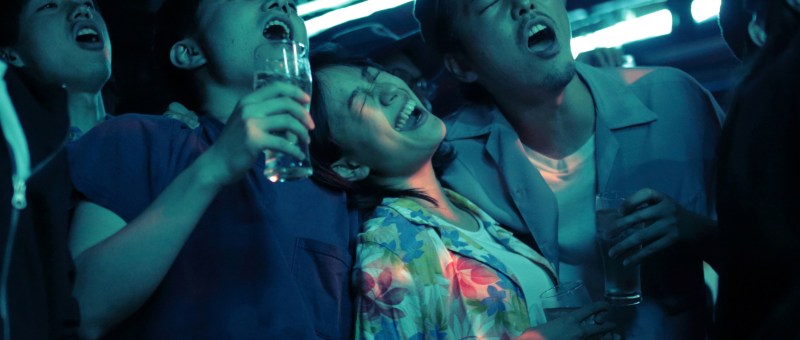
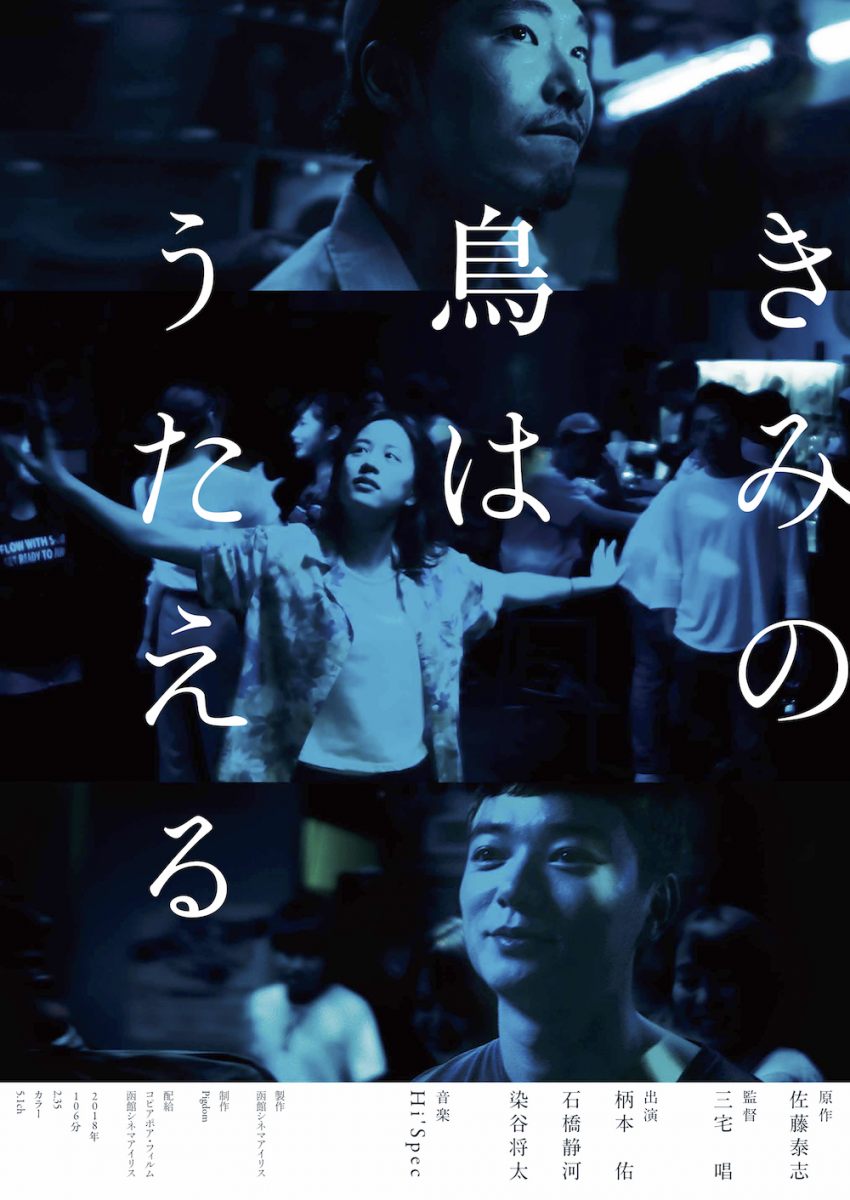
And Your Bird Can Sing (きみの鳥はうたえる, Sho Miyake, 2018)

And Your Bird Can Sing poster 1Yasushi Sato, an author closely associated with the port town of Hakodate who took his own life in 1990, has been enjoying something of a cinematic renaissance in the last few years with adaptations of some of his best known works in The Light Shines Only There, Over the Fence, and Sketches of Kaitan City. And Your Bird Can Sing (きみの鳥はうたえる, Kimi no Tori wa Utaeru), taking its title from the classic Beatles song, was his literary debut and won him a nomination for the prestigious Akutagawa Prize in 1981. Unlike the majority of his output, And Your Bird Can Sing was set in pre-bubble Tokyo but perhaps signals something of a recurring theme in its positioning of awkward romance as a potential way out of urban ennui and existential confusion.

Sho Miyake’s adaptation shifts the action back to Hakodate and the into present day but maintains the awkward triangularity of Sato’s book. The unnamed narrator (Tasuku Emoto), the “Boku” of this “I Novel”, is an apathetic slacker with a part-time job in a book store he can’t really be bothered to go to. After not showing up all day, he wanders past the store at closing time which brings him into contact with co-worker Sachiko (Shizuka Ishibashi) who appears to be leaving with the boss (Masato Hagiwara) but blows him off to come back and flirt with Boku who makes a date with her at a cute bar but falls asleep after getting home and (accidentally) stands her up, drinking all night with his unemployed roommate Shizuo (Shota Sometani) instead. Luckily for Boku, Sachiko forgives him and an awkward romance develops but their relationship becomes still more complicated when Boku introduces Sachiko to Shizuo with whom she proves an instant hit.

This is not, however, the story of an awkward love triangle but the easy fluidity of youth in which unselfishness can prove accidentally destructive. Boku, for all his rejection of conventionality, is more smitten with Sachiko than he’s willing to admit. He counts to 120 waiting for her return, refusing to make a move himself but somehow believing she is choosing him with an odd kind of synchronised telepathy. She pushes forward, he holds back. Boku encourages Shizuo to pursue Sachiko, insisting that she is free to make her choices, and if jealous does his best to hide it. Shizuo, meanwhile, is uncertain. Attracted to Sachiko he sees she prefers Boku but weighs the positivities of being second choice to a man dressing up his fear of intimacy as egalitarianism.

Boku tells us that he wanted the summer to last forever, but in truth his youth is fading. Like Sachiko and Shizuo, he is drifting aimlessly without direction – much to the annoyance of an earnest employee at the store (Tomomitsu Adachi) who prizes rules and order above all else and finds the existence of a man like Boku extremely offensive. Sachiko, meanwhile, has drifted into an affair with her boss who, against the odds, actually seems like a decent guy if one who is perhaps just as lost as our trio and living with no more clarity despite his greater experience. Like Boku, Shizuo too is largely living on alienation as he strenuously resists the fierce love of his admittedly problematic mother (Makiko Watanabe).

“What is love?” one of Sachiko’s seemingly less complicated friends (Ai Yamamoto) asks, “why does everybody lie?”. Everybody is indeed lying, but more to themselves than to others. Fearing rejection they deny their true feelings and bury themselves in temporary, hedonistic pleasures. Boku reveals that he hoped Sachiko and Shizuo would fall in love so that he would get to know a different side to Sachiko through his friend, as if he could hover around them like transparent air. The problem is Boku doesn’t quite want to exist, and what is loving and being loved other than a proof of existence? Sachiko prompts, and she waits, and then she wonders if she should take Boku at his word and settle for Shizuo only for Boku to reach his sudden moment of clarity at summer’s end. A melancholy exploration of youthful ennui and existential anxiety, And Your Bird Can Sing is a beautifully pitched evocation of the eternal summer and the awkward, tentative bonds which finally give it meaning.


And Your Bird Can Sing was screened as part of the 2019 Nippon Connection Film Festival.

Original trailer (English subtitles)

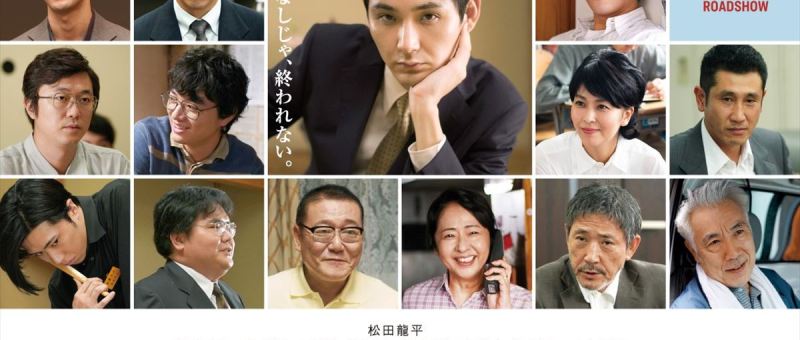
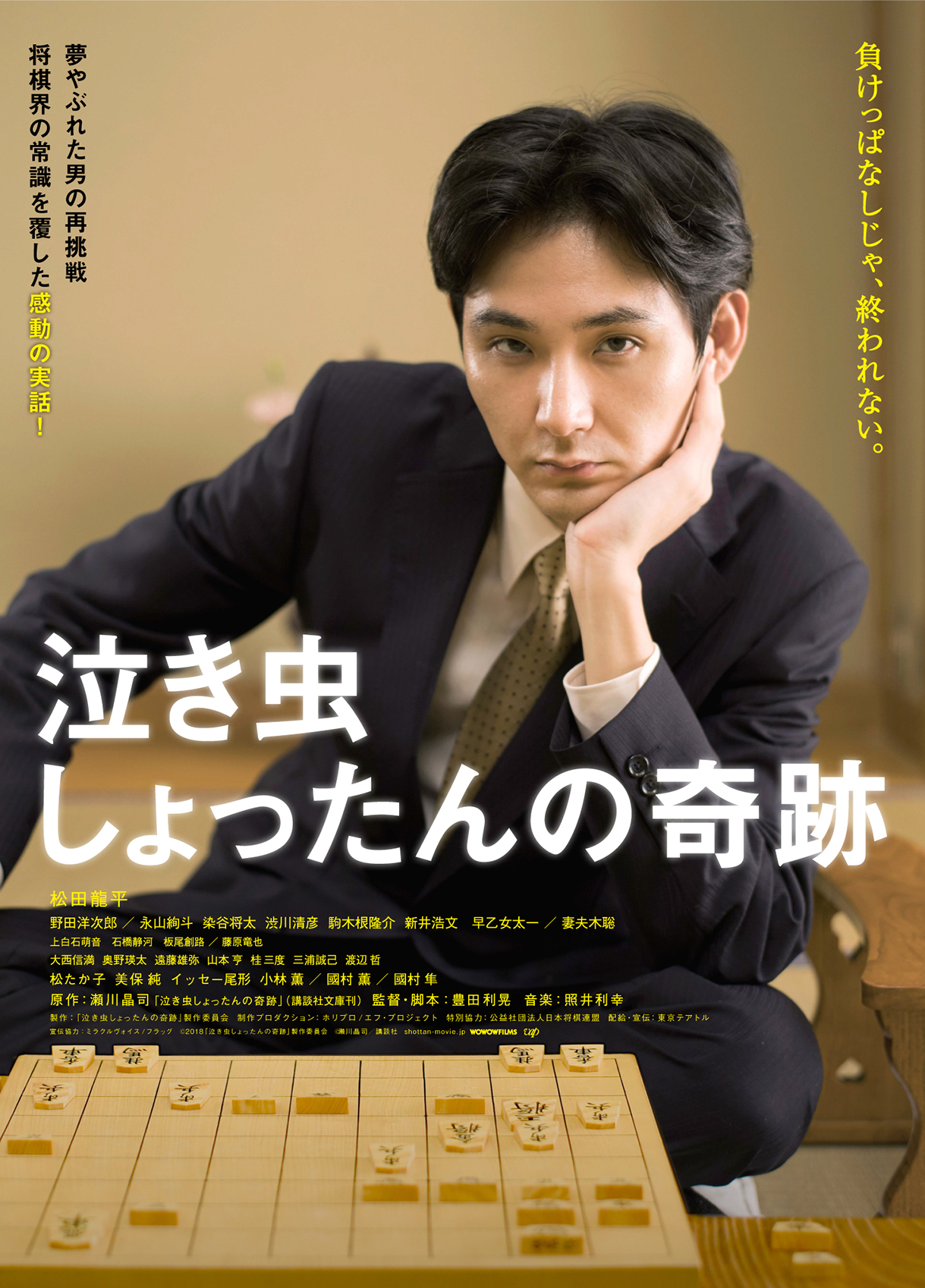
The Miracle of Crybaby Shottan (泣き虫しょったんの奇跡, Toshiaki Toyoda, 2018)

Miracle of Crybaby Shottan poster 1Toshiaki Toyoda burst onto the scene in the late ‘90s with a series of visually stunning expressions of millennial malaise in which the dejected, mostly male, heroes found themselves adrift without hope or purpose in post-bubble Japan. For all their essential nihilism however, Toyoda’s films most often ended with melancholic consolation, or at least a sense of determination in the face of impossibility. Returning after a lengthy hiatus, Toyoda’s adaptation of the autobiography by shogi player Shoji “Shottan” Segawa, The Miracle of Crybaby Shottan (泣き虫しょったんの奇跡, Nakimushi Shottan no Kiseki), finds him in a defiantly hopeful mood as his mild-mannered protagonist discovers that “losing is not the end” and the choice to continue following your dreams even when everything tells you they are no longer achievable is not only legitimate but a moral imperative.

An aspiring Shogi player himself in his youth, Toyoda opens with the young Shoji discovering a love of the game and determining to turn pro. Encouraged by his surprisingly supportive parents who tell him that doing what you love is the most important thing in life, Shoji (Ryuhei Matsuda) devotes himself to mastering his skills forsaking all else. The catch is, that to become a professional shogi player you have to pass through the official association and ascend to the fourth rank before your 26th birthday. Shoji has eight chances to succeed, but in the end he doesn’t make it and is all washed up at 26 with no qualifications or further possibilities seeing as he has essentially “wasted” his adolescence on acquiring skills which are now entirely meaningless.

As his inspirational primary school teacher (Takako Matsu) tells him, however, if you spend time indulging in a passion, no matter what it is, and learn something by it then nothing is ever really wasted. Shoji’s father says the same thing – he wants his son to follow his dreams, though his brother has much more conventional views and often berates him for dedicating himself to shogi when the odds of success are so slim. It may well be “irresponsible”, in one sense at least, to blindly follow a dream to the exclusion of all else, but then again it may also be irresponsible to resentfully throw oneself into the conventionality of salaryman success.

Nevertheless, shogi is a game that drives men mad. Unlike the similarly themed Satoshi: A Move for Tomorrow, also inspired by a real life shogi star, The Miracle of Crybaby Shottan has a classically “happy” ending but is also unafraid to explore the dark sides of the game as young men fail to make the grade, realise they’ve wasted their youths, and retreat into despair and hopelessness. Shoji accepts his fate, internalises his failure, and begins to move on neither hating the game nor loving it, until finally reconnecting with his childhood friend and rediscovering his natural affinity free from ambition or desire.

Another defeated challenger, expressing envy for Shoji’s talent, told him he was quitting because you can’t win if you can’t learn to lose friends and he didn’t want to play that way. Shoji doesn’t really want to play that way either, freely giving up chances to prosper in underhanded ways and genuinely happy for others when they achieve the thing he most wants but cannot get. He does in one sense “give up” in that he accepts he will never play professionally because of the arbitrary rules of the shogi world, but retains his love of the game and eventually achieves “amateur” success at which point he finds himself a figurehead for a campaign targeted squarely at the unfair rigidity of the sport’s governing body.

Shoji’s rebellion finds unexpected support from all quarters as the oppressed masses of Japan rally themselves behind him in protest of the often arcane rules which govern the society. As his teacher told him, just keep doing what you’re doing – it is enough, and it will be OK. Accepting that “losing is not the end” and there are always second chances even after you hit rock bottom and everyone tells you it’s too late, a newly re-energised Shoji is finally able to embrace victory on equal terms carried solely by his pure hearted love of shogi rather than by ambition or resentment. A surprisingly upbeat effort from the usually melancholy director, The Miracle of Crybaby Shottan is a beautifully pitched reminder that it really is never too late, success comes to those who master failure, and being soft hearted is no failing when you’re prepared to devote yourself body and soul to one particular cause.


The Miracle of Crybaby Shottan was screened as part of the 2019 Nippon Connection Film Festival.

International trailer (English subtitles)

Yocho (Foreboding) (予兆 散歩する侵略者, Kiyoshi Kurosawa, 2017)

Yocho posterBefore We Vanish, Kiyoshi Kurosawa’s take on the alien invasion drama, was an oddly romantic affair which made a case for the ineffability of love as the only possible form of human salvation. Meanwhile, cheating on cinema with television, Kurosawa tells us a different story. Yocho (Foreboding) (予兆 散歩する侵略者, Yocho: Sanpo Suru Shinryakusha) was first conceived as a TV drama running as a companion piece to the big screen experience but its canvas is noticeably darker. At heart, we have the same story with a slight variation as a bold wife attempts to save her weak willed husband from alien manipulation, risking all to keep him safe him while the world burns around her. What we see this time is less the enduring power of love as a force for good, than yet another form of human weakness which encourages selfishness and creates a space into which nefarious forces may move.

In contrast to Masami Nagasawa’s conflicted, wounded wife of Before we Vanish, Etsuko (Kaho) is happily married to Tatsuo (Shota Sometani) who works at the local hospital. As she loves her husband so much, Etsuko is quick to realise there’s something not quite right in the way he’s been silently gazing off into space and walking around like a man possessed. Meanwhile, she’s accosted by a friend at work who asks to stay over because she’s too afraid to go home on account of “the ghost”. Eventually Etsuko goes investigating and discovers “the ghost” is really just her friend’s dad only her friend seems to have forgotten all about him and doesn’t quite understand what a “father” is anymore. Fearing the worst, Etsuko arranges to take her to the hospital, which is where she comes into contact with the strange and intimidating Dr. Makabe (Masahiro Higashide).

Dr. Makabe is one of the alien invaders seen in Before We Vanish who have come to Earth on a scouting mission ahead of its destruction. His mission is to steal “concepts” from people’s heads so the aliens can catalogue soon to be extinct humanity. Makabe has recruited Tatsuo to be his guide but this is a very different arrangement to that Shinji makes with his “wife” Narumi. Tatsuo is not so much an interpreter as an informant. His “job” is to select Makabe’s “victims” in return for preferential treatment when the apocalypse arrives. Increasingly conflicted in betraying his own species, Tatsuo is going slowly off the rails while the world disintegrates all around around him.

Etsuko, meanwhile, has a kind of superpower of her own in that she is apparently “immune” to alien interference. They can’t take concepts from her, they can’t manipulate her will, and they can’t break her bond with her beloved (if slightly useless) husband. The power of love still reigns supreme but this time it’s not entirely a good thing as Etsuko, who has the means to resist the evil invaders, focusses on rescuing her one true love rather than defending humanity. Love is her weakness, whereas Tatsuo’s seems to be a low lying resentment of his lack of authority. A showdown with Makabe sees him offer a grim prognosis, as long as humans lust for power there will be no escape.

Makabe, meanwhile, has experienced the opposite revelation to his Before we Vanish counterpart in learning about death and human fear of mortality. Suddenly knowing what it means to die, he understands something of human existence, realising that death is forever beside you. Love maybe be the cure for “eternal loneliness”, but Makabe’s enlightenment is born of fear and darkness rather than human warmth.

Yocho, in a sense, mirrors Before We Vanish but in a darker hue. Etsuko and Tatsuo maybe a “happier” couple than Shinji and Narumi, but Tatsuo has already crossed to the dark side, abandoning his humanity and committing heinous and unthinkable acts on behalf of his alien master out of fear and desire. Makabe, taking Tatsuo to task, points out his weakness in his need for painkilling drugs to overcome the punishment Makabe has handed down for his betrayal. Humans, he says, always choose the comforting lie over the painful truth, swallowing pain killers rather than killing the pain by dealing with its root cause. This is in a way what Etsuko has chosen to do in her quest to save Tatsuo rather than using her skills to resist the alien invasion, though Makabe remains oddly fascinated by her various unusual qualities. Foreboding fills the frame as Etsuko meditates on the various oddities of her world while the skies thunder behind her, sending curtains billowing ominously in the absence of wind. A wounded Makabe ironically remarks that he has “underestimated the power of love”, reminding us that the greatest of human strengths is also its weakness, promising destruction as much as salvation.


Screened at the 20th Udine Far East Film Festival.

Original trailer (English subtitles)

https://www.youtube.com/watch?v=9_vEqvtUdxM