Maru (まる, Naoko Ogigami, 2024)

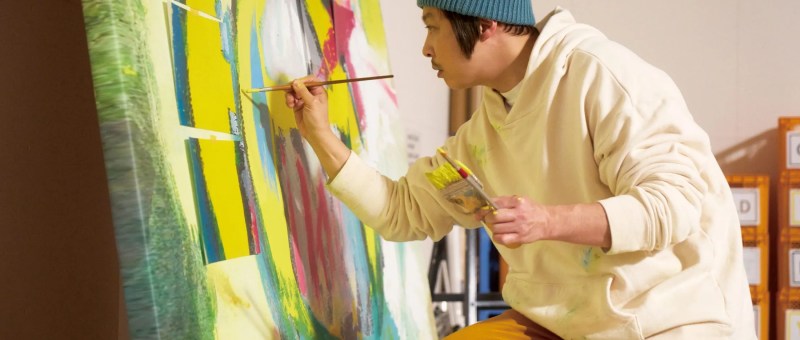
Taken to task by a coworker (Riho Yoshioka) for allowing himself to be exploited as an assistant to an internationally famous artist who views them as little more than tools and takes all the credit for their work, Sawada (Tsuyoshi Domoto) asks if she knows who built Horyu Temple. He has to supply the answer himself, Prince Shotoku. But of course, he didn’t. It wasn’t  as If he drew up the plans or cut the wood with his own hands. 1300 carpenters built it, but no one thinks about them. Only about Prince Shotoku, because he commissioned the work and paid for it. Sawada doesn’t think what he’s doing is all that different, and that times haven’t really changed all that much. Not many people get to make a living doing what they love, so perhaps that’s enough for him. 

But his colleague asks if he sees himself more as a worker than an artist, as if she were unintentionally making a value judgement on the nature of art. The line between artist and artisan maybe so thin as to not exist, but why is it that we think of art which is perceived to have a practical application differently from that which we assume is intended only as a means of self-expression? “What about your own art?” she asks Sawada, but he doesn’t really have a notion of it because he’s been so focussed on earning a living as part of a wider capitalist superstructure in which art too is a commodity. Akimoto (Kotaro Yoshida) is basically running an art sweatshop mass-producing pieces for an international market and operating it like a brand in which everything is released under his own name. When Sawada falls off his bike and breaks his dominant arm, Akimoto simply fires him.

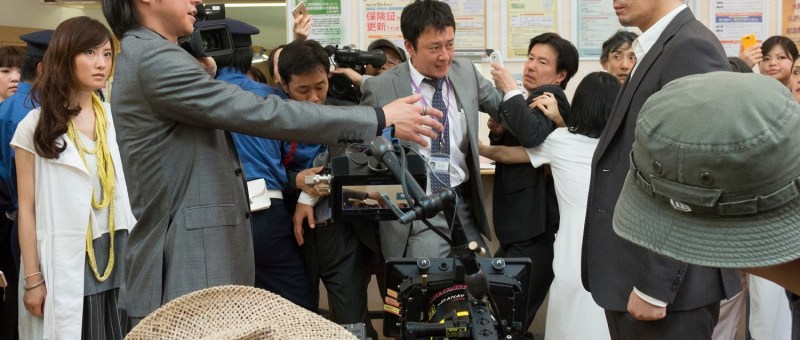
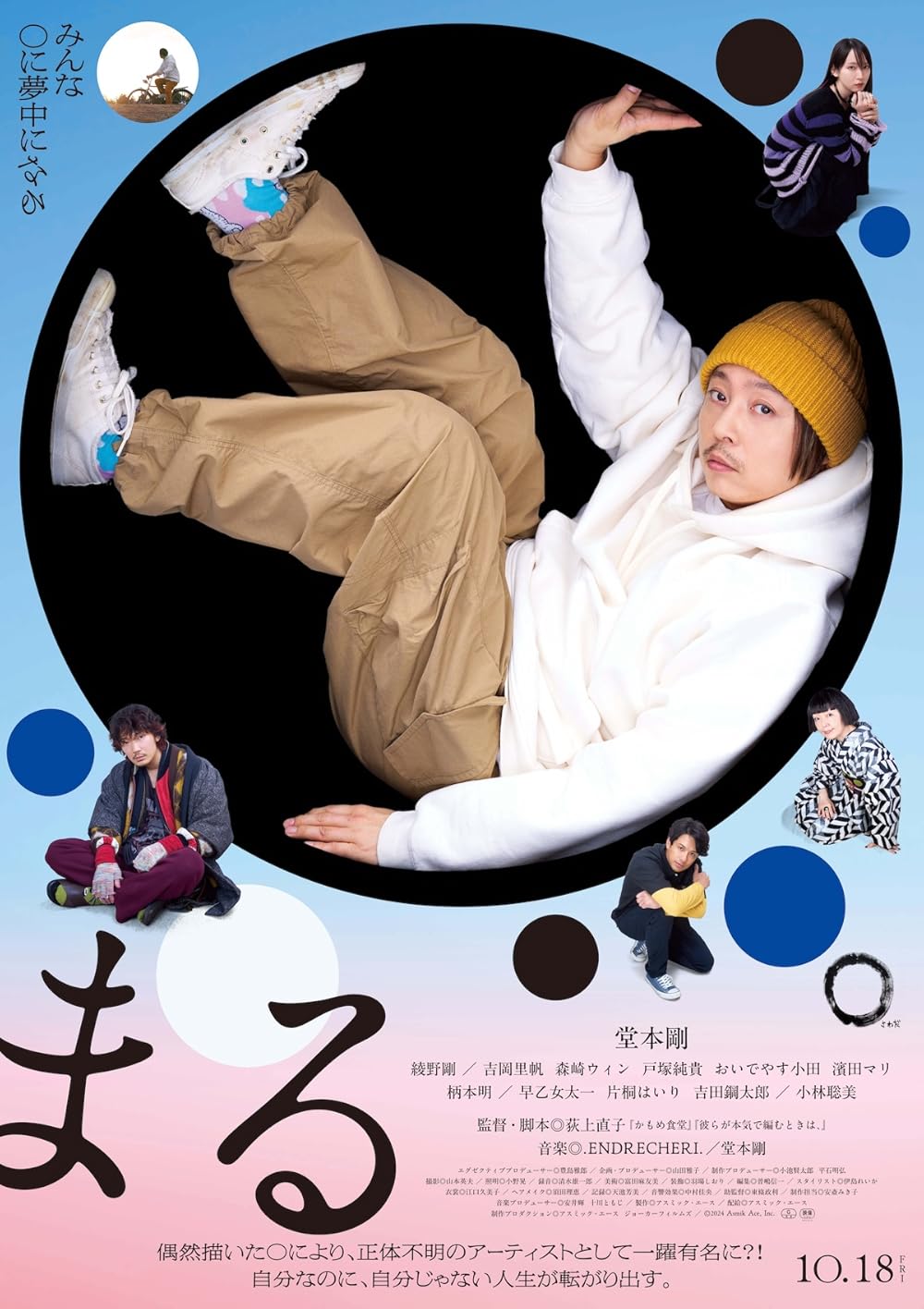
But then, things begin to get strange. Sawada draws some circles with his left hand and includes them with a few things he plans to sell to a second-hand shop where they’re picked up by a strange man who describes himself as a “magician who can’t do magic” and offers him fantastic amounts of money for his work even though all he did was draw a circle. Sawada discovers what he drew is called an “enso” and represents “serene emptiness”, but at the same time others seem to project whatever they want to see in the hole inside while Sawada himself is uncertain what should be there. The magician tells him that his follow-up work is no good because his enso are full of desire in his newfound lust for fame and riches, but at the same time he and his art have also become a commodity and like Akimoto he’s locked into producing more of what people want rather than expressing himself or finding artistic fulfilment. 

His colleague returns to attack him again. Now she criticises him for exploiting art to make money. “Art that’s expensive and just for a few wealthy people isn’t real art,” she says. She sticks to her message that the labour of those like her is being exploited and the world is set up for a few wealthy elites. Their chant of “we want sushi too” might seem flippant, but it represents the world that they’re locked out of. Sawada’s incredibly intense, struggling mangaka neighbour is obsessed with getting sushi too, though there’s plenty of it on the buffet at Sawada’s show which Sawada eyes hungrily. Eventually he’s reduced to grabbing some to eat on his own in a stairwell, signalling his liminal presence within this space. He’s the artist and it’s his show, but he isn’t really part of this world and no one’s really interested in him except when he’s giving mystical quotes as part of his marketing brand. 

The conclusion that he comes to that his art at least should exist for art’s sake. That all he ever wanted to do was paint as a means of being true to himself, only that simple desire has got lost amid the complications of modern life. It’s very hard to draw circles of serenity when you’re living in a rundown apartment block with a worrying subsidence problem and your neighbour screams all night in despair before punching a hole in your wall which you’ll probably have to pay to have fixed. Nevertheless, through Ogigami’s elliptical tale, Sawada does perhaps begin to find a path back to his own art or at least what art means to him which is after all what’s in the middle circle even if all anyone looks at is the edges. 


Maru screened as part of this year’s Camera Japan.

Trailer (no subtitles)
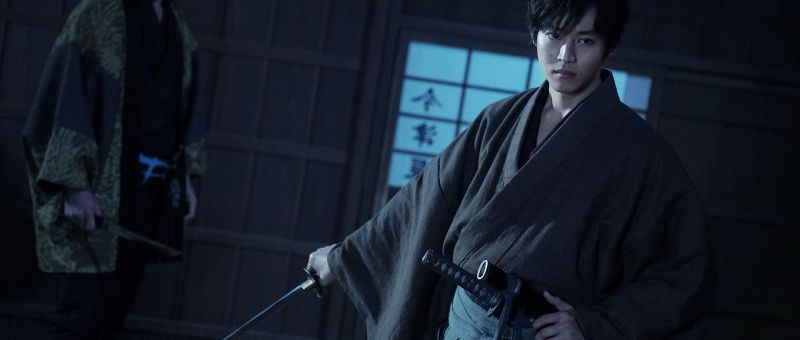
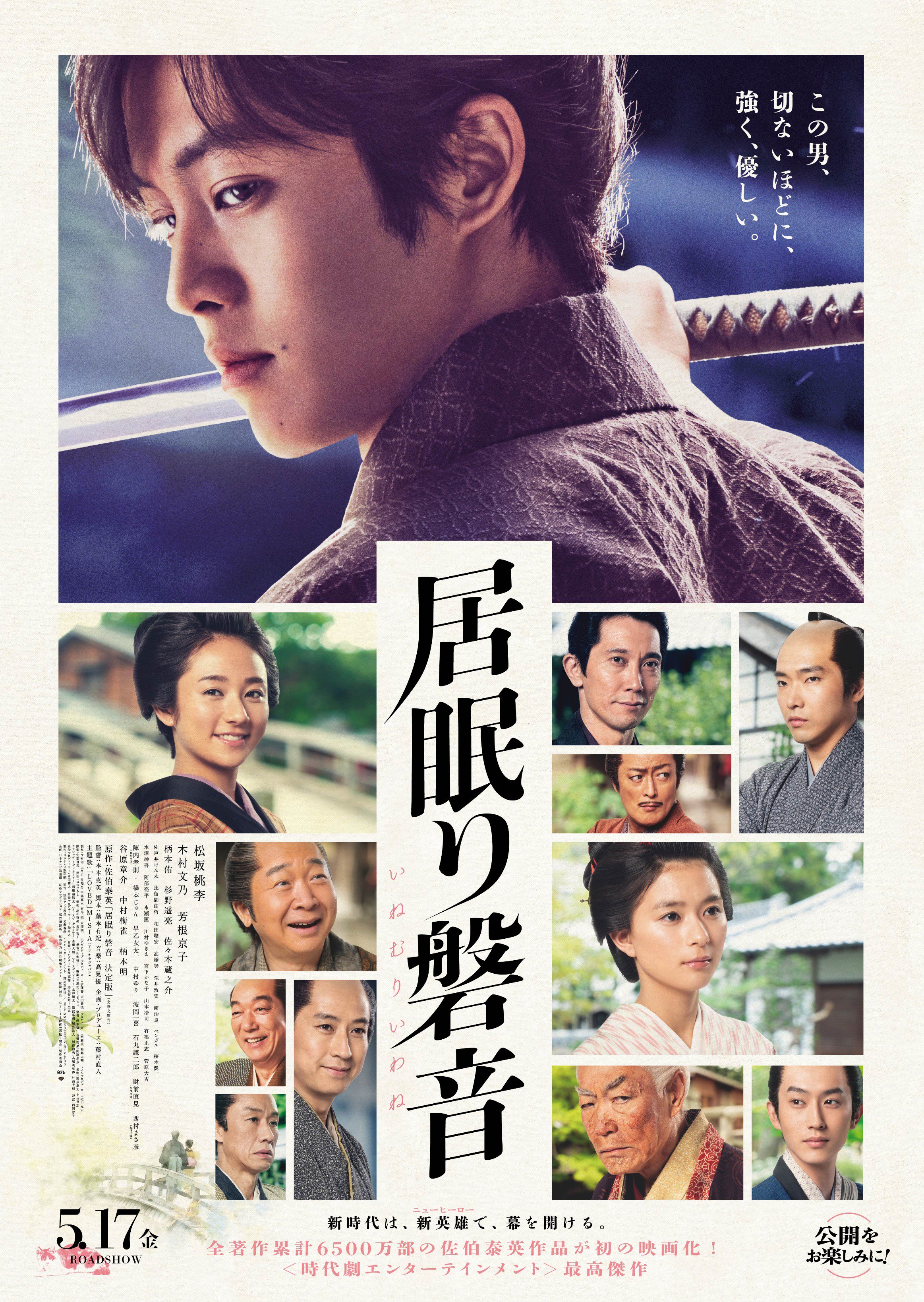
Iwane: Sword of Serenity (居眠り磐音, Katsuhide Motoki, 2019)

The contradictions of the samurai code conspire against one noble-hearted young man in Katsuhide Motoki’s adaptation of the long running series of historical novels by Saeki Yasuhide, Iwane: Sword of Serenity (居眠り磐音, Inemuri Iwane). Yet this truly serene samurai is a stoical sort, learning to bear his pain with fortitude while standing up for justice in an increasingly corrupt Edo where money rules all while an ascendent merchant class continues to challenge the fiercely hierarchical social order. 

Beginning in 1772 which turned out to be a disastrous year, the tale opens as hero Iwane (Tori Matsuzaka) prepares to return home after completing his three year rotation in Edo in the company of childhood friends Kinpei (Tasuku Emoto) and Shinnosuke (Yosuke Sugino). Shinnosuke is in fact married to Kinpei’s sister Mai, while Iwane will himself be married to Kinpei’s other sister Nao immediately on his return so close are they. As Iwane’s father tells him, there are great hopes for these young men that they can “turn our outdated clan around”, but events will conspire against them. Spoiling the happy homecoming, Shinnosuke is accosted by a drunken uncle who convinces him Mai has been unfaithful in his absence with the consequence that he kills her immediately on his return home. Unable to understand this turn of events, Kinpei confronts his friend but eventually kills him, while Iwane is then forced to kill Kinpei after he goes on murderous rampage in revenge for the wrong done to his sister. 

In trying to mediate the case, the argument is put forward that Shinnosuke acted rashly and should have brought his suspicion to the authorities rather than opting for summary execution. The lord however disagrees, condoning Shinnosuke’s actions under the rationale that to do so would have been considered “weak minded” while as Shinnosuke himself had claimed he acted in accordance with the samurai code in which female adultery is illegal and punishable by death. By contrast, he finds Kinpei’s rashness offensive, insisting that he also should have recognised the legitimacy of his sister’s murder and simply left quietly with her body. Having learned the truth in which his childhood friends became victims of clan intrigue, romantic jealousy, and tragic misunderstandings in this Othello-like plot, Shinnosuke and childhood sweetheart Nao are also consumed by the rashness of samurai law each exiled from their clan and cast adrift in Edo-era society. 

Edo-era society is however also itself corrupt. Some months later, Iwane has returned to Edo as a lowly ronin lodging with a kindly old man, Kinbei, who helps him find a job firstly gutting eel then as a bodyguard at a money exchange which has been receiving anonymous threats they assume are from rival broker Awaya who has hatched a nefarious plan to manipulate the currency market to stop the current Shogun introducing a new unit which can be used in both Edo and Kyoto which would understandably cut into his already corrupt business model. Luckily, Imazuya is an honourable man who backs the new currency plan and wants to do the right thing which makes him a perfect fit for Iwane’s innate sense of justice. “You don’t know the way of the merchant” Awaya snaps at him, suggesting both that the samurai are already on their way down as the merchants rise and that his unwillingness to play dirty will be his downfall. Nevertheless, Iwane is the type to adapt quickly, instantly coming up with a way to play Awaya at his own game and kick his destructive amoral capitalism to the curb. 

Meanwhile, he continues to pine for Nao while drawing closer to Kinbei’s earnest daughter Okon (Fumino Kimura). As we discover Nao is also a victim of an intensely patriarchal social order but through the tragedy that befalls them also finds strength and agency making a life changing decision that allows her to become independent while looking after her family if in the knowledge that the childhood romance she shared with Iwane is a thing of the past. Iwane too agrees that he is trapped in a living hell of guilt and grief, yet choosing to go on living anyway as calm and cheerful as he’d ever been while standing up to Edo-era corruption though uncomfortably enough this time against the destabilising influence of the rising merchant class and therefore in contrast to most jidaigeki reinforcing the legitimacy of the samurai order which has paradoxically also ruined his life with its rigid and implacable social codes. In any case, Motoki’s classic chanbara melodrama has a serenity of its own as the cheerfully laidback hero resolves to live his life by a code of his own free of samurai constraint. 


Trailer (no subtitles)

Baian the Assassin, M.D. (Part 1) (仕掛人・藤枝梅安, Shunsaku Kawake, 2023)

A traumatised assassin takes it upon himself to get rid of a few villains on realising there’s something not quite right with his latest contract in Shunsaku Kawake’s classic jidaigeki homage, Baian the Assassin, MD: (Part 1) (仕掛人・藤枝梅安, Shikakenin Fujieda Baian). The titular hero is the protagonist of a series of novels by Shotaro Ikenami which have spawned several previous adaptations on the big and small screens. Produced in celebration of Ikenami’s centenary the film, one of two, harks back to the golden age of period drama if with a more contemporary sensibility. 

Baian (Etsushi Toyokawa) is ostensibly an acupuncturist though by night he uses his needles to kill rather than to heal. Hired to take out the second wife an inn owner, Omino (Yuki Amami), his suspicions are raised on realising that he had also been the assassin who killed the man’s first wife two years earlier. He blames himself in part for having agreed to assassinate a woman in the first place, and remains conflicted even after accepting the job wondering if Omino is next in the firing line or if she was actually the one who had the other woman killed in order to usurp her place. 

The film makes clear from the outset what a difficult place Edo could be for a woman as Baian carries out an assassination on a boatman who had raped a samurai’s wife and then blackmailed her into further sexual favours only for her to hire an assassin and then kill herself confessing all. Omino had apparently been the stepdaughter of a gang leader who sexually abused her and then died leaving her with no support and nowhere to turn except to sex work. Maybe no one could blame her for taking advantage of a besotted client to escape her terrible circumstances though getting rid of his wife would obviously be a different matter. Omon (Miho Kanno), a maid Baian takes a liking to while investigating, admits something similar that as a widow with a young son realistically speaking there is nowhere else that could she work to support him except on the fringes of the sex trade. Then again, as she says the previous mistress was strict but it was because she cared, whereas Omino is just mean and self-interested. She’s fired all the old staff and brought in pretty young women who are quite obviously being expected to entertain their male customers in more direct ways. 

In any case, Baian soon finds himself drawn into a wider series of plots when his friend Hiko (Ainosuke Kataoka), a skewer maker who assassinates people with poison darts, is tasked with taking out first a lascivious carpenter and then a rogue samurai who has supposedly raped and kidnapped the daughter of his lord which obviously turns out not quite to be the case. Rape and kidnap are depressingly common in Edo-era society where it is largely women who suffer under a patriarchal society with intensely oppressive social codes that demand female purity. In a post-credits sequence, we come to understand that Hiko too is seeking vengeance for the death of a woman who killed herself and her child after being raped by bandits. Meanwhile, Baian reveals that he had a mild hatred of women himself born of pain in having been abandoned by his mother who left with another man and took only his sister with her after his father’s death. He had to overcome that resentment in order to fulfil himself as a doctor treating women’s bodies but struggles when he realises that someone involved in the case is closely linked with his own traumatic past and death may be the only way to save them. 

Both he and Hiko end up breaking the assassin’s code but only in defence of justice, which might sound odd considering the nature of their work. Nevertheless, they each have their scruples and don’t like to think of themselves as having been used or inadvertently killed someone who didn’t really deserve it. As Baian puts it, the greatest villains may really be “well-meaning weak cowards” though perhaps corrupt lords can’t really complain about falling victim to their own tactics. With noticeably polished production values and atmospheric cinematography, Kawake pays tribute to classic jidaigeki and eventually sets his heroes back on the road awaiting the next battle for justice in the distinctly unjust feudal era. 


Baian the Assassin, M.D. (Part 1) screened as part of this year’s Camera Japan.

Original trailer (English subtitles)

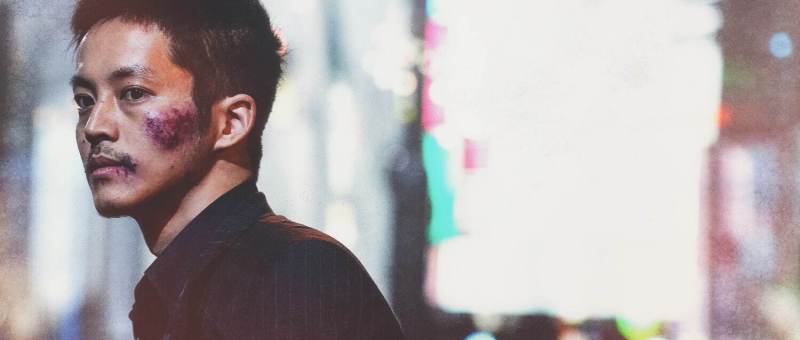
Last of the Wolves (孤狼の血 LEVEL2, Kazuya Shiraishi, 2021)

“The Showa era’s over. We don’t use guns now, business is our battlefield.” a recently released foot soldier is told, finding himself in a whole new world emerging from a not so distant past of turf wars and street scuffles into a late bubble wonderland of besuited corporatised gangsters. Set in 1988, Kazuya Shiraishi’s Blood of Wolves had been about the twilight of post-war gangsterdom forever associated with an era that was literally about to pass. Set three years later in the twilight of the bubble economy and an already established Heisei, Last of the Wolves (孤狼の血 LEVEL2, Koro no chi: Level 2) finds no longer rookie cop Hioka (Tori Matsuzaka) taking on the mantle of his late mentor Ogami, attempting to broker peace by getting uncomfortably close to yakuza. 

At the end of the previous film, Hioka had managed to engineer a truce between rival gangs Odani (with whom he is affiliated), and Irako through pushing top Odani guy Ichinose to take out boss Irako. Three years later, the peace has held and in any case Heisei yakuza no longer take violence to the streets. The release of crazed Irako foot soldier Uebayashi (Ryohei Suzuki), however, threatens to destabilise the local balance of power. Despite mournfully declaring that he doesn’t intend to wind up back in prison, Uebayashi’s first call on release is to the sister of one of his guards whom he rapes and kills in quite gruesome fashion. Hioka is put on the case and partnered with a genial veteran, Seshima (Yoshiko Miyazaki), weirdly excited about investigating a murder at this late stage of his career, but quickly realises that Uebayashi’s recklessness is primed to destroy everything he’s built. 

Having started out a straightlaced rookie, Hioka has fully incorporated the Ogami persona dressing in sharp suits and sunshades, driving a sports car, and hanging out with the Odani guys, while also using his girlfriend’s little brother Chinta (Nijiro Murakami) as a mole in rival gangs. As a cynical reporter points out, however, Ogami was essentially “undercover” in that he understood hobnobbing with yakuza was part of his job and something he did solely to keep civilians safe by preventing another street war. Hioka has started to lose his way, enjoying himself a little too much and already way out of his depth as the fragile peace he’d brokered by less than ethical means begins to crumble beneath his feet. 

Having been in prison, Uebayashi is unaware of the various ways in which the world has changed seeking to return to old school rules of gangsterdom, ironically lecturing his superiors on the absence of jingi (honour and humanity) in their new corporate existence. He’s a monster and a sadist, but his violence is also a result of the horrific abuse he suffered as a child which led to an equally heinous act of revenge while as a member of the ethnic Korean Zainichi community, like Chinta and his siblings, he continually faces discrimination and social oppression. His first act on release is of revenge against the guards who relentlessly tortured him in prison, the murdered woman’s brother confessing that they wrote him up as a model prisoner in the hope he’d be released early so they wouldn’t have to deal with him anymore.  

Yet what Hioka and Uebayashi have in common is that they’re both pawns in a game they were unaware was being played. As it turns out the police corruption Hioka discovered during the previous film did not go away, and in certain senses they liked things the way they were before. Hioka’s truce is very bad for business for a certain subset at least. They might be minded to let a dangerous killer go loose if it disrupts Hioka’s attempt to suppress the criminal underworld to manageable levels. Mimicking the classic jitsuroku, Shiraishi throws in occasional voiceover from an anonymous narrator along with freeze frame and montage while skewing still darker in the levels of depravity among these desperate men fighting over the scraps of a world already in terminal decline even as the bubble seems fit to burst. Shiraishi ends on a note of change with the institution of the organised crime laws which have contributed to the ongoing decline of the yakuza, a relic of the Showa era unfit and unwelcome in the modern society, but also discovers that for good or ill there may yet be wolves in Japan.


Last of the Wolves screened as part of this year’s New York Asian Film Festival.

Teaser trailer (English subtitles)

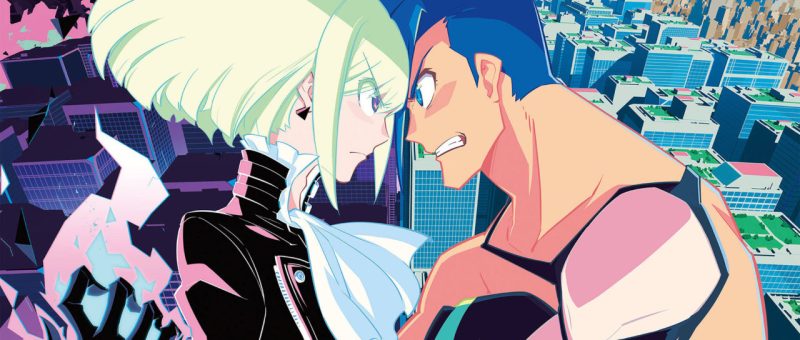
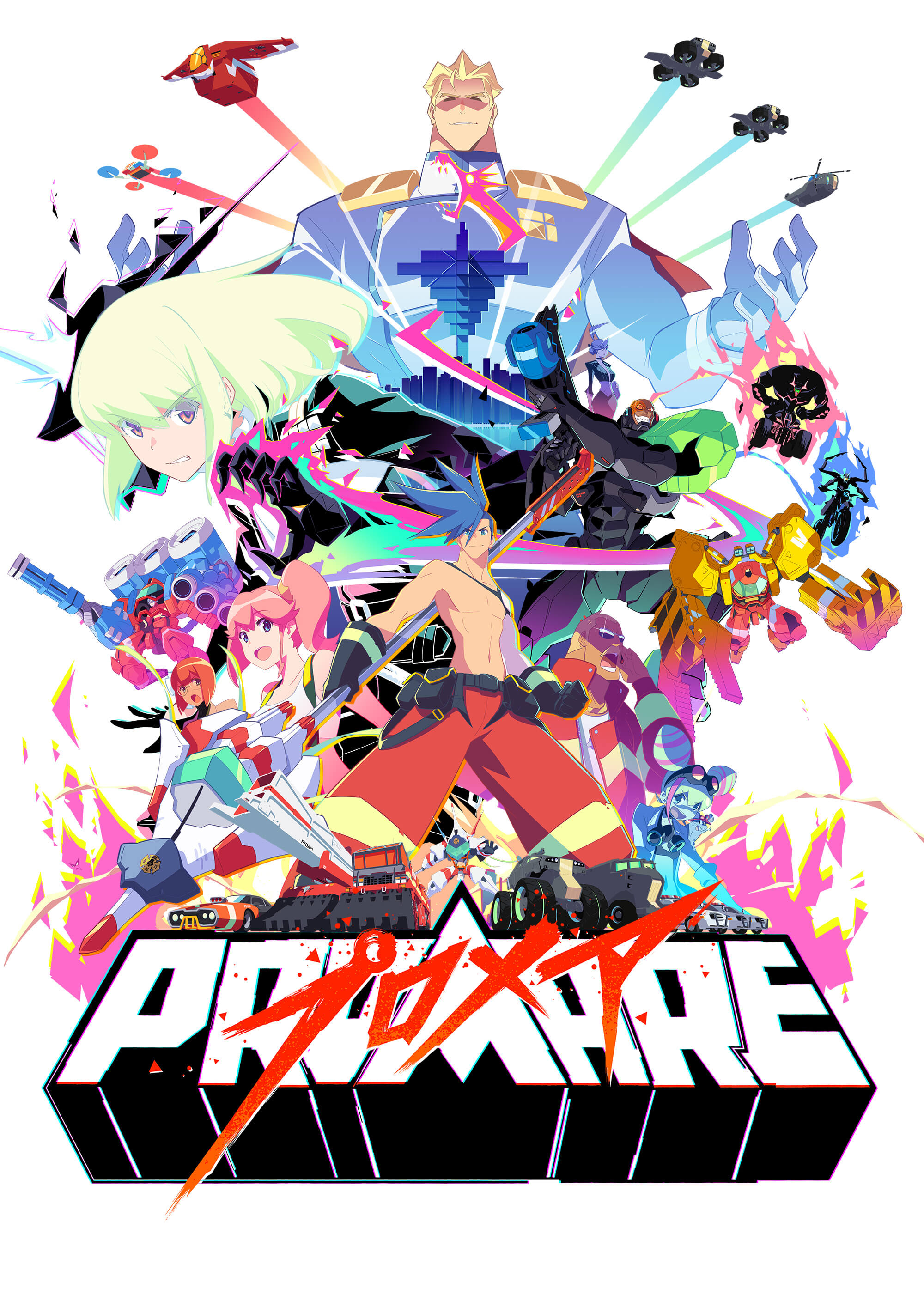
Promare (プロメア, Hiroyuki Imaishi, 2019)

Promare poster 1It’s one of life’s ironies, sometimes the best way to stop a fire is to scorch the earth. The heroes of Studio Trigger’s first theatrical feature co-produced with XFLAG, Promare (プロメア, Puromea), are embodiments of fire and ice – a “mutant” who can shoot flames from his fingertips, and a fireman with a “burning soul”. Yet what they discover is that there is a peculiar power in their innate contradictions, actively harnessing the energy of their opposition to combat a man who thinks nothing of burning the world to save his own skin.

Our hero, Galo (Kenichi Matsuyama), is a firefighter with the Burning Rescue squad who has a talent for cheesy one liners and an overinflated sense of confidence in his own abilities. 30 years previously, the world was plagued by a series of strange incidents of spontaneous combustion later attributed to the “Burnish” phenomenon in which some members of humanity developed a mutation that allowed them to manipulate fire. The danger eventually died down, but the “Burnish” as they came to be known continued to exist in society as a kind of oppressed underclass, viewed with fear and suspicion and largely unable to live “normal” lives even if they wanted to. On a supposedly “routine” job, Galo unexpectedly encounters the leader of the Mad Burnish “terrorist” organisation and determines to bring him in, eventually awarded a medal for his pains.

As might be assumed, however, all is not as it seems. The Burning Rescue squad work for Galo’s mentor, Kray Foresight (Masato Sakai), now the governor and an enormously wealthy, influential man thanks to his advances in scientific firefighting technology. Kray reveals that the Earth is sitting on a volatile layer of magma somehow connected to the existence of the Burnish which threatens to destroy the planet if it cannot be properly controlled. This is a kind of justification for Kray’s ultra hardline stance against the Burnish who are hunted down and captured by the Freeze Force (see what they did there?) simply for living their lives even if they have committed no crimes.

Despite the nature of their work, the Burning Rescue squad are a more progressive bunch. They don’t approve of the social prejudice against the Burnish many of whom are just minding their own business and pose no threat to anyone, nor do they approve of the role the Freeze Force seems to play in their society. Mostly what they care about is stopping fires and making sure people endangered by them are eventually saved. They know that the Freeze Force’s persecution of the Burnish is at best counterproductive and fuelling the kind of resentment that makes them want to burn things. Wandering into the Mad Burnish hideout, Galo sees a different side to their struggle and learns a few home truths about his own side from the dashing rebel leader Lio Fotia (Taichi Saotome).

Burning Rescue and the Mad Burnish ought to be opposing poles but display a curious symmetry in their fierce loyalty to their own and emphasis on team work. Others, meanwhile, think only of themselves, coming up with nefarious plans to let the planet burn and move to a new intergalactic home with a starter stock of the most “valuable” 10,000 humans while everyone else succumbs to the flames. The Burnish become merely fuel, sacrificed for a “greater good” for a “chosen few”.

Galo and Lio think they’re “chosen ones” too, in a sense, but are flatly told that their role in events is really just fortuitous coincidence. Nevertheless, the fate of the world depends on their ability to bridge their differences, harnessing the unique capabilities of fire meeting ice against the forces of cold self-interest. Sometimes the only way to stop a fire is to let it burn out bright, which is what the guys discover in trying to find a way to quell that troublesome magma. Recreating the anarchic spirit of Kill la Kill, Studio Trigger’s first theatrical feature is a colourful riot of post-modern absurdity, but has its heart firmly in the right place with a strong progressive pro-diversity message in which we save the world only by saving each other.


Original trailer (English subtitles)

The Miracle of Crybaby Shottan (泣き虫しょったんの奇跡, Toshiaki Toyoda, 2018)

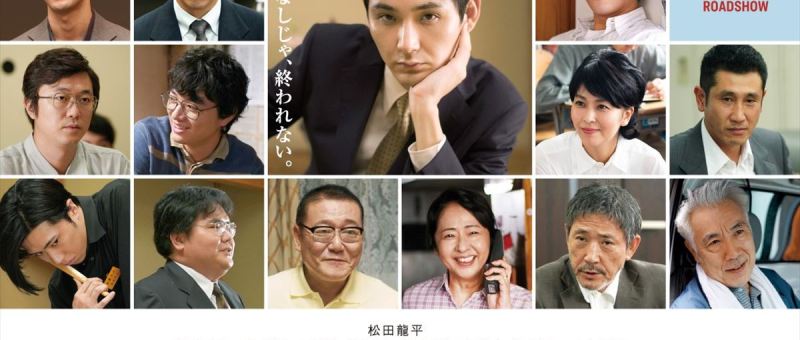
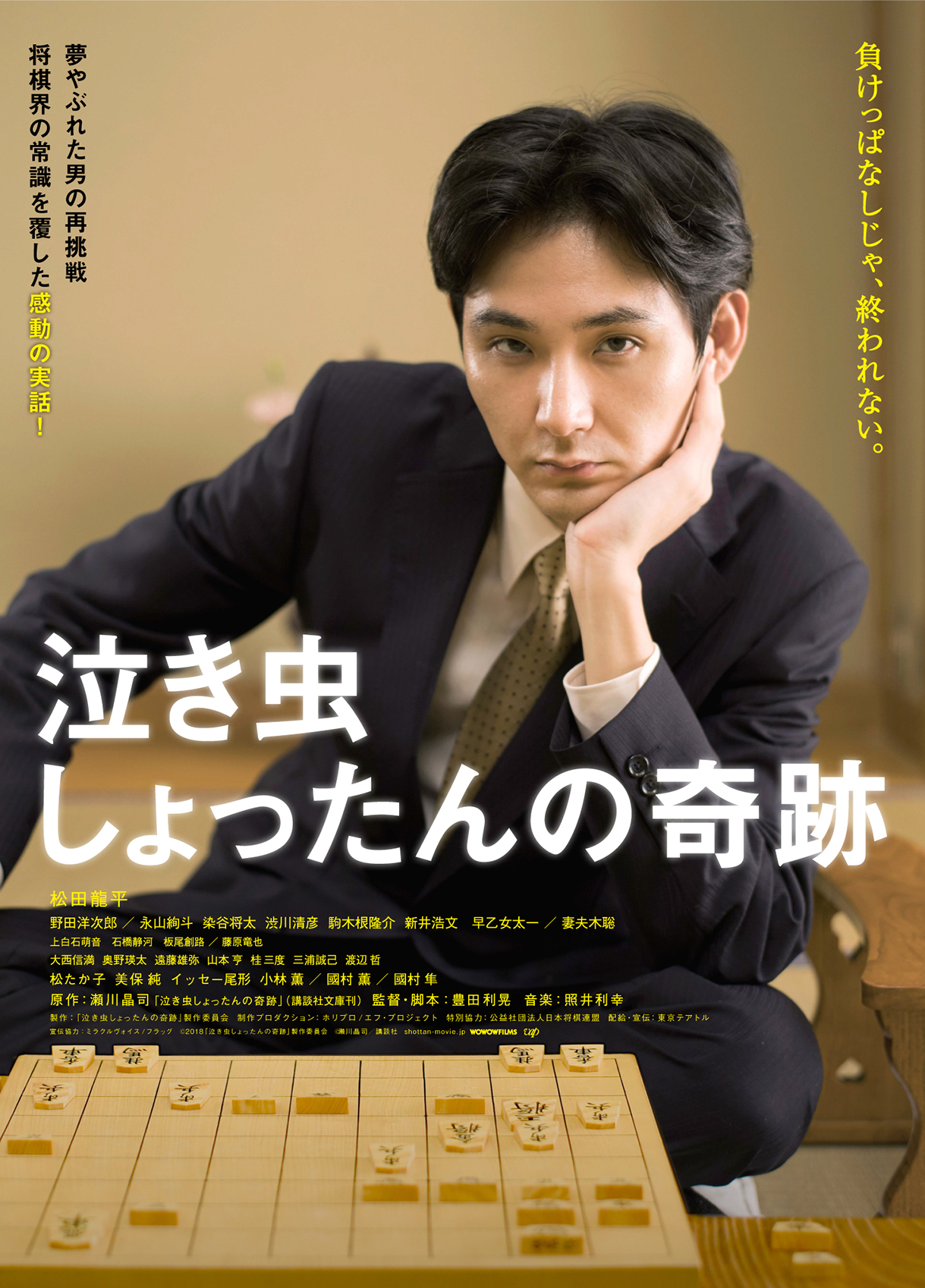
Miracle of Crybaby Shottan poster 1Toshiaki Toyoda burst onto the scene in the late ‘90s with a series of visually stunning expressions of millennial malaise in which the dejected, mostly male, heroes found themselves adrift without hope or purpose in post-bubble Japan. For all their essential nihilism however, Toyoda’s films most often ended with melancholic consolation, or at least a sense of determination in the face of impossibility. Returning after a lengthy hiatus, Toyoda’s adaptation of the autobiography by shogi player Shoji “Shottan” Segawa, The Miracle of Crybaby Shottan (泣き虫しょったんの奇跡, Nakimushi Shottan no Kiseki), finds him in a defiantly hopeful mood as his mild-mannered protagonist discovers that “losing is not the end” and the choice to continue following your dreams even when everything tells you they are no longer achievable is not only legitimate but a moral imperative.

An aspiring Shogi player himself in his youth, Toyoda opens with the young Shoji discovering a love of the game and determining to turn pro. Encouraged by his surprisingly supportive parents who tell him that doing what you love is the most important thing in life, Shoji (Ryuhei Matsuda) devotes himself to mastering his skills forsaking all else. The catch is, that to become a professional shogi player you have to pass through the official association and ascend to the fourth rank before your 26th birthday. Shoji has eight chances to succeed, but in the end he doesn’t make it and is all washed up at 26 with no qualifications or further possibilities seeing as he has essentially “wasted” his adolescence on acquiring skills which are now entirely meaningless.

As his inspirational primary school teacher (Takako Matsu) tells him, however, if you spend time indulging in a passion, no matter what it is, and learn something by it then nothing is ever really wasted. Shoji’s father says the same thing – he wants his son to follow his dreams, though his brother has much more conventional views and often berates him for dedicating himself to shogi when the odds of success are so slim. It may well be “irresponsible”, in one sense at least, to blindly follow a dream to the exclusion of all else, but then again it may also be irresponsible to resentfully throw oneself into the conventionality of salaryman success.

Nevertheless, shogi is a game that drives men mad. Unlike the similarly themed Satoshi: A Move for Tomorrow, also inspired by a real life shogi star, The Miracle of Crybaby Shottan has a classically “happy” ending but is also unafraid to explore the dark sides of the game as young men fail to make the grade, realise they’ve wasted their youths, and retreat into despair and hopelessness. Shoji accepts his fate, internalises his failure, and begins to move on neither hating the game nor loving it, until finally reconnecting with his childhood friend and rediscovering his natural affinity free from ambition or desire.

Another defeated challenger, expressing envy for Shoji’s talent, told him he was quitting because you can’t win if you can’t learn to lose friends and he didn’t want to play that way. Shoji doesn’t really want to play that way either, freely giving up chances to prosper in underhanded ways and genuinely happy for others when they achieve the thing he most wants but cannot get. He does in one sense “give up” in that he accepts he will never play professionally because of the arbitrary rules of the shogi world, but retains his love of the game and eventually achieves “amateur” success at which point he finds himself a figurehead for a campaign targeted squarely at the unfair rigidity of the sport’s governing body.

Shoji’s rebellion finds unexpected support from all quarters as the oppressed masses of Japan rally themselves behind him in protest of the often arcane rules which govern the society. As his teacher told him, just keep doing what you’re doing – it is enough, and it will be OK. Accepting that “losing is not the end” and there are always second chances even after you hit rock bottom and everyone tells you it’s too late, a newly re-energised Shoji is finally able to embrace victory on equal terms carried solely by his pure hearted love of shogi rather than by ambition or resentment. A surprisingly upbeat effort from the usually melancholy director, The Miracle of Crybaby Shottan is a beautifully pitched reminder that it really is never too late, success comes to those who master failure, and being soft hearted is no failing when you’re prepared to devote yourself body and soul to one particular cause.


The Miracle of Crybaby Shottan was screened as part of the 2019 Nippon Connection Film Festival.

International trailer (English subtitles)

Bleach (BLEACH ブリーチ, Shinsuke Sato, 2018)

BL_honpos_setTite Kubo’s Bleach (BLEACH ブリーチ) had the distinction of being one of three phenomenally popular long running manga series (alongside Eiichiro Oda’s One Piece and Masashi Kishimoto’s Naruto) which dominated the industry from the early 2000s until its completion in August 2016. The series spans 74 collected volumes and was also adapted into a successful television anime which itself ran for several seasons and spawned a number of animated movies. It might seem like a no brainer to bring the series to the big screen with a live action adaptation but Bleach is no ordinary manga and the demands of recreating its fearsome world of cruel death gods and huge soul sucking monsters are a daunting prospect. Perfectly placed to tackle such a challenge, director Shinsuke Sato (I am a Hero, Inuyashiki) spent more than a year in post-production working on the CGI and has brought his characteristic finesse to the finely crafted world of Kubo’s Karakura.

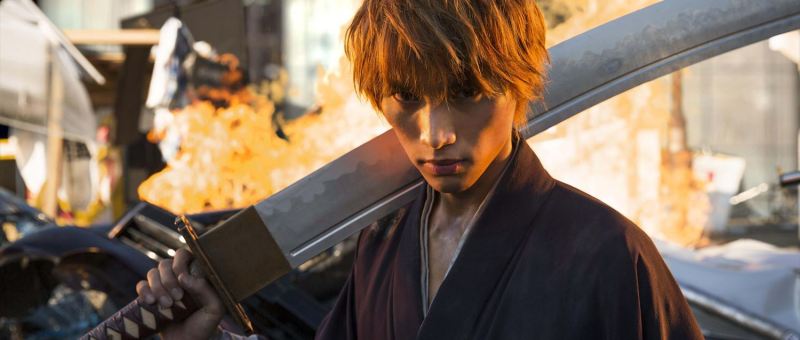
Our hero, Ichigo Kurosaki (Sota Fukushi), is a regular fifteen-year-old high school student, save for his fiery orange hair and the ability to see ghosts. He lives with his relentlessly cheerful father (Yosuke Eguchi) and two cute little sisters but is also nursing guilt and regret over the death of his mother (Masami Nagasawa) who died protecting him from a monster when he was just a child. Feeling disconnected from his family, Ichigo likes to put on a front of bravado – taking on petty punks to teach them a lesson though, in a motif which will be repeated, he only escapes an early encounter unharmed thanks to the intervention of his unusually strong friend, Chad (Yu Koyanagi). Ichigo’s life is changed forever when he finds a strange girl, Rukia (Hana Sugisaki), in his room where she despatches a lingering spirit back its rightful destination of Soul Society. That was not, however, her primary mission and a giant “Hollow” suddenly punches a fist through Ichigo’s living room and scoops up his littlest sister. Rukia does her best to defeat the beast but is seriously wounded. Sensing Ichigo’s high psychic ability, she breaks the rules of her own society and transfers her powers to him but later discovers she gave him too much and is unable to return to Soul Society unless Ichigo ups his Soul Reaper rep to the point he is strong enough to survive giving her powers back.

Loosely speaking Sato adapts the “Soul Reaper Agent” (which is eventually attached to the title during the credits sequence) arc, otherwise known as “Substitute Shinigami”, in which Ichigo gets used to his new life as a Soul Reaper. Condensing Kubo’s considerably lengthy manga to a mere 108 minutes is obviously a difficult exercise necessitating a slight refocussing of Ichigo’s essential character arc as well as that of the feisty Rukia. Sato’s streamlined narrative emphasises Ichigo’s ongoing psychodrama as an adolescent young man attempting to deal with the repressed trauma of his mother’s death and his own feelings of guilt and regret in having unwittingly dragged her into a dangerous situation from which he was unable to protect her. Being “the protector” remains a primary concern of the young Ichigo who withdraws from his family but is determined to protect them from harm. His odd friendship with the similarly conflicted Rukia whose upbringing in the austere surroundings of Soul Society has left her also feeling isolated and friendless (but believing these are both “good” things to be) paradoxically returns him to the real world just he’s turned into an all-powerful monster fighting hero.

Yet the important lesson Ichigo learns is through repeated failures. His mother died saving him, his first fight is ended by a friend, and he is finally redeemed once again by an act of selfless female sacrifice. What Ichigo is supposed to learn, is that he doesn’t always need to be the protector and that being protected is sometimes alright because what’s important is the mutuality of protection, emotional, spiritual, and physical. Meanwhile Rukia, having lost her powers, is perhaps sidelined, rendered both vulnerable and empowered as she becomes Ichigo’s mentor in all things Soul Reaper. This quality of restraint is also how she chooses to make use of her power – something beautifully brought out in Sugisaki’s wonderfully nuanced performance as Rukia’s icy Soul Reaper exterior begins to thaw thanks to her unexpected connection with Ichigo.

Rather than get bogged down in exposition, Sato is content to let the world simply exist with occasional explanations offered in the form of Rukia’s improbably cute rabbit drawings in a motif borrowed from the manga. Sato makes sure to include a number of background players including the strong armed Chad and the lovelorn Orihime (Erina Mano) as well the omniscient shop owner Urahara (Seiichi Tanabe) though their role is strictly to add background colour rather than actively participate in the plot. Despite occasional narrative fudging, Bleach succeeds as a high-octane action blockbuster, by turns slick, ironic, and affecting but always grounded in the real even in excess.


Bleach is currently available to stream worldwide via Netflix.

Original trailer (no subtitles)

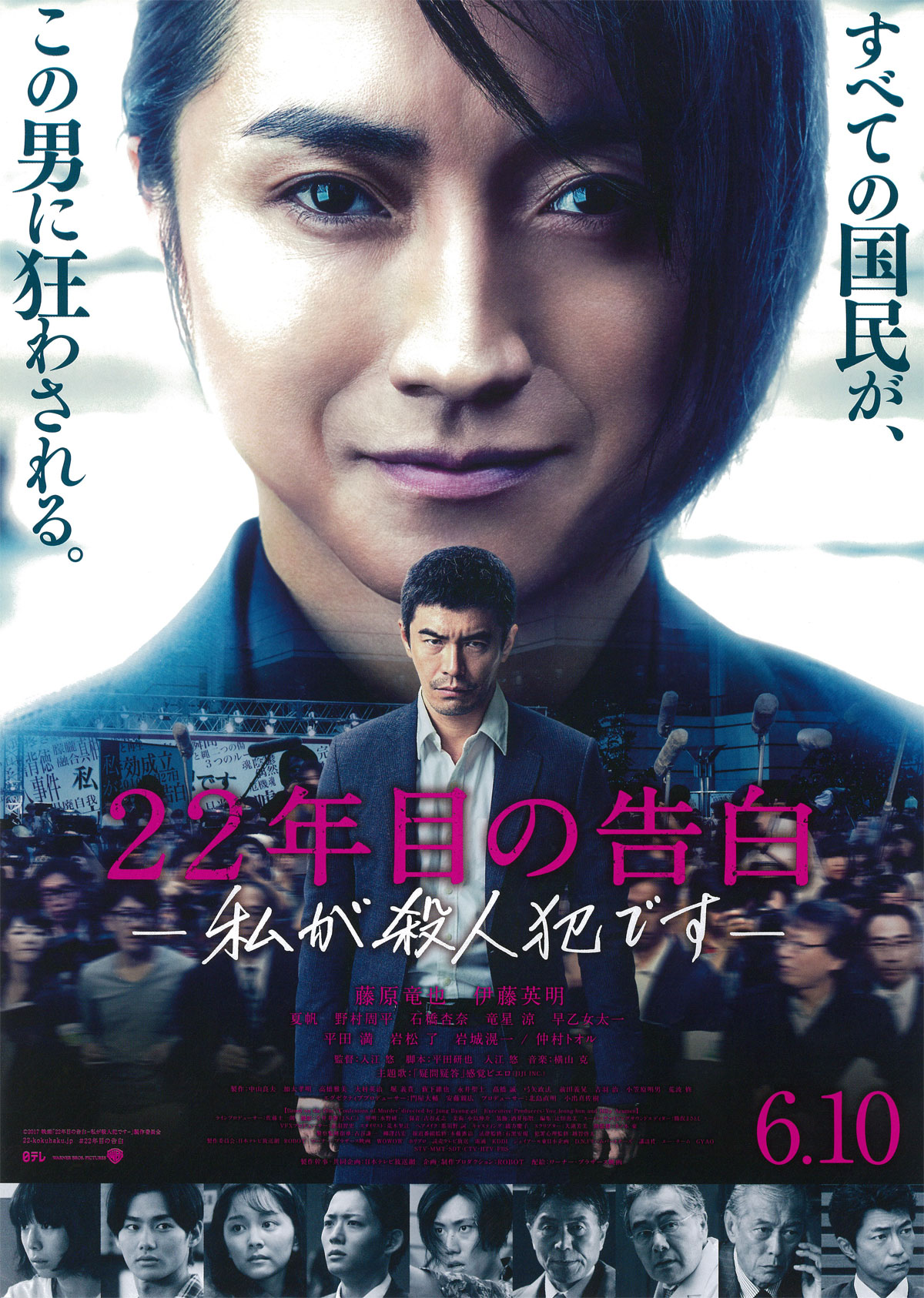
Memoirs of a Murderer (22年目の告白―私が殺人犯です―, Yu Irie, 2017)

Memoirs of a MurdererJung Byung-gil’s Confession of Murder may have been a slightly ridiculous revenge drama, but it had at its heart the necessity of dealing with the traumatic past head on in order to bring an end to a cycle of pain and destruction. Yu Irie retools Jung’s tale of a haunted policeman for a wider examination of the legacy of internalised impotence in the face of unavoidable mass violence – in this case the traumatic year of 1995 marked not only by the devastating Kobe earthquake but also by Japan’s only exposure to an act of large scale terrorism. Persistent feelings of powerlessness and nihilistic despair conspire to push fragile minds towards violence as a misguided kind of revenge against their own sense of insignificance but when a killer, safe in the knowledge that they are immune from prosecution after surviving the statute of limitations for their crimes, attempts to profit from their unusual status, what should a society do?

22 years ago, in early 1995, a spate of mysterious stranglings rocked an already anxious Tokyo. In 2010, Japan removed the statute of limitations on capital crimes such as serial killings, mass killings, child killings, and acts of terror, which had previously stood at 15 years, leaving the perpetrator free of the threat of prosecution by only a matter of seconds. Then, all of a sudden, a book is published claiming to be written by the murderer himself as piece of confessional literature. Sonezaki (Tatsuya Fujiwara), revealing himself as the book’s author at a high profile media event, becomes a pop-culture phenomenon while the victims’ surviving families, and the detective who was in charge of the original case, Makimura (Hideaki Ito), incur only more suffering.

Unlike Jung’s version, Irie avoids action for tense cerebral drama though he maintains the outrageous nature of the original and even adds an additional layer of intrigue to the already loaded narrative. Whereas police in Korean films are universally corrupt, violent, or bumbling, Japanese cops are usually heroes even if occasionally frustrated by the bureaucracy of their organisation or by prevalent social taboos. Makimura falls into hero cop territory as he becomes a defender of the wronged whilst sticking steadfastly to the letter of the law in insisting that the killer be caught and brought to justice by the proper means rather than sinking to his level with a dose of mob justice.

Justice is, however, hard to come by now that, legally speaking, the killer’s crimes are an irrelevance. Sonezaki can literally go on TV and confess and nothing can be done. The media, however, have other ideas. The Japanese press has often been criticised for its toothlessness and tendency towards self-censorship, but maverick newscaster and former war correspondent Sendo (Toru Nakamura) is determined to make trial by media a more positive move than it sounds. He invites Sonezaki on live TV to discuss his book, claiming that it’s the opportunity to get to the truth rather than the viewing figures which has spurred his decision, but many of his colleagues remain skeptical of allowing a self-confessed murderer to peddle his macabre memoirs on what they would like to believe is a respectable news outlet.

The killer forces the loved ones of his victims to watch while he goes about his bloody business, making them feel as powerless as he once did while he remains ascendent and all powerful. It is these feelings of powerlessness and ever present unseen threats born of extensive personal or national traumas which are responsible for producing such heinous crimes and by turns leave behind them only more dark and destructive emotions in the desire for violence returned as revenge. Focussing in more tightly on the despair and survivors guilt which plagues those left behind, Irie opts for a different kind of darkness to his Korean counterpart but refuses to venture so far into it, avowing that the law deserves respect and will ultimately serve the justice all so desperately need. Irie’s artier approach, shifting to grainier 16:9 for the ‘90s sequences, mixing in soundscapes of confusing distortion and TV news stock footage, often works against the outrageous quality of the convoluted narrative and its increasingly over the top revelations, but nevertheless he manages to add something to the Korean original in his instance on violence as sickness spread by fear which can only be cured through the calm and dispassionate application of the law.


Screened as part of the Japan Foundation Touring Film Programme 2018.

Screening again:

  • Showroom Cinema – 22 March 2018
  • Broadway – 23 March 2018
  • Firstsite – 24 March 2018
  • Midlands Arts Centre – 24 March 2018
  • Queen’s Film Theatre – 25 March 2018

Original trailer (English subtitles)

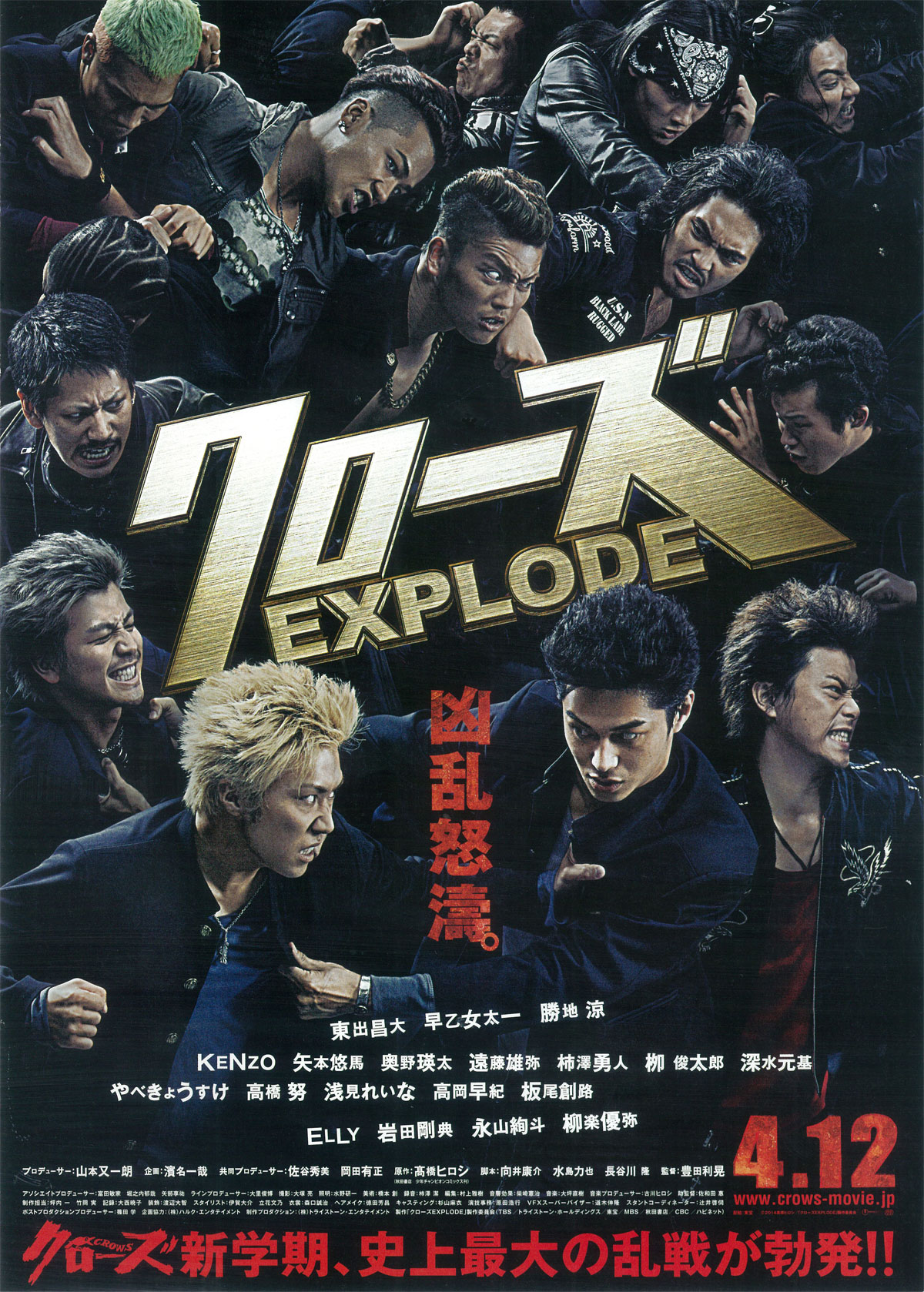
Crows Explode (クローズ EXPLODE, Toshiaki Toyoda, 2014)

crows explodeToshiaki Toyoda made an auteurst name for himself at the tail end of the ‘90s with a series of artfully composed youth dramas centring on male alienation and cultural displacement. Attempting to move beyond the world of adolescent rage by embracing Japan’s most representative genre, the family drama, in the literary adaptation Hanging Garden, Toyoda’s career hit a snag. Despite the film’s favourable reception with critics, a public drugs scandal cost Toyoda his career in Japan’s extremely strict entertainment industry. Since his return to filmmaking in 2009 Toyoda has continued to branch out but 2014’s Crows Explode (クローズ EXPLODE) throws him back into that early world of repressed male energy as internalised rage and frustration produce externalised violence. Picking up the Crows franchise where Takashi Miike left off, Toyoda brings his unique visual sensiblilty to the material, swapping Miike’s irony for something with more grit but losing the deadpan depth of its adolescent posturing in the process.

The old gods have fallen and new ones must rise. Tough guys graduate, but the battlefields of Suzuran High endure eternally. Suzuran is the ultimate in delinquent schools. None of the boys here are under any misapprehension that the adult world holds any promise for them. Many will drop out without completing high school, condemning themselves to a precarious life of continually uncertain, low paid employment, but even those who do manage to leave with a certificate will be heading into another competition to find a steady job in economically straightened times.

That is, those of them who don’t end up in a gang. The thing at Suzuran is that your fate is determined by your fists. Boys roam the halls looking for a fight, each vowing to become the top dog and de facto leader by proving themselves the best and the strongest of the strapping young men all vying for the title. A new challenger arrives in the form of transfer student, Kaburagi (Masahiro Higashide), whose intense energy upsets the dynamic between presumed number one Goura (Yuya Yagira) and his challenger Takagi (Kenzo) but Kagami (Taichi Saotome), the loner son of a fallen yakuza, seems further set to pose a threat in this knife edge environment.

Toyoda has some interesting points to make about the legacy of violence and the importance of father son relationships as each of these young men is reacting in some sense against a father or just his father’s world. Kaburagi, the film’s protagonist, is nursing a deep wound of double abandonment after witnessing his father’s death and then being deposited in a foster home by his sorrowful mother who promises to return for him soon but makes do with occasional visits and monetary gifts. Kaburagi is an angry young man and like many angry young men, he is eager not to become his father – a situation complicated by the fact that his father was a prize fighter who died in the ring.

His “mirror” Kagami, has a similar problem only his father died in a yakuza turf war. A surrogate presents himself in the form of former Suzuran scrapper “Jarhead Ken” (Kyosuke Yabe), now an ex-yakuza helping out at a friend’s second hand car dealership but unable to escape gangland troubles when it emerges Kagami’s clan are intent on acquiring it in order to turn the place into some kind of “entertainment complex”. Ken, a tough guy but soft hearted, has a talent for paternalism which he turns on the fatherless little boy of the car dealership’s owner to whom he teaches the importance of a hefty punch but also of friendship and loyalty.

Miike’s world was a surreal one, inflected with a wry middle aged eye which sees all of this teenage rambunctiousness for the ridiculous posturing it really is. Toyoda’s attempts to be more in the moment, experiencing the adolescent angst with all of its immediate force but unlike his early protagonists the boys of Suzuran are forced to “explode” rendering that central tenet of repressed anger redundant. Externalising the internal war somehow makes it much less interesting as boys trade blows, mindlessly trying to work out a mental struggle which their ill drawn backgrounds will not support.

The environment which the boys inhabit is a grey and hopeless one. Toyoda paints it with his characteristic visual flair, returning to his trademark sequences of slow motion coupled with indie music, but his energy is very different from Miike’s and its more contemplative rhythm never quite gels with the pugilistic fury of the source material even as it gives way to his more expressionistic imagery. The franchise is feeling a little punch drunk by this point, and Toyoda finds it in a particular puddle of teenage malaise. Still, the fists fly and the boys of Suzuran rise and fall as always providing enough self consciously cool action to sustain interest despite the otherwise insubstantial quality.


International trailer (English subtitles)