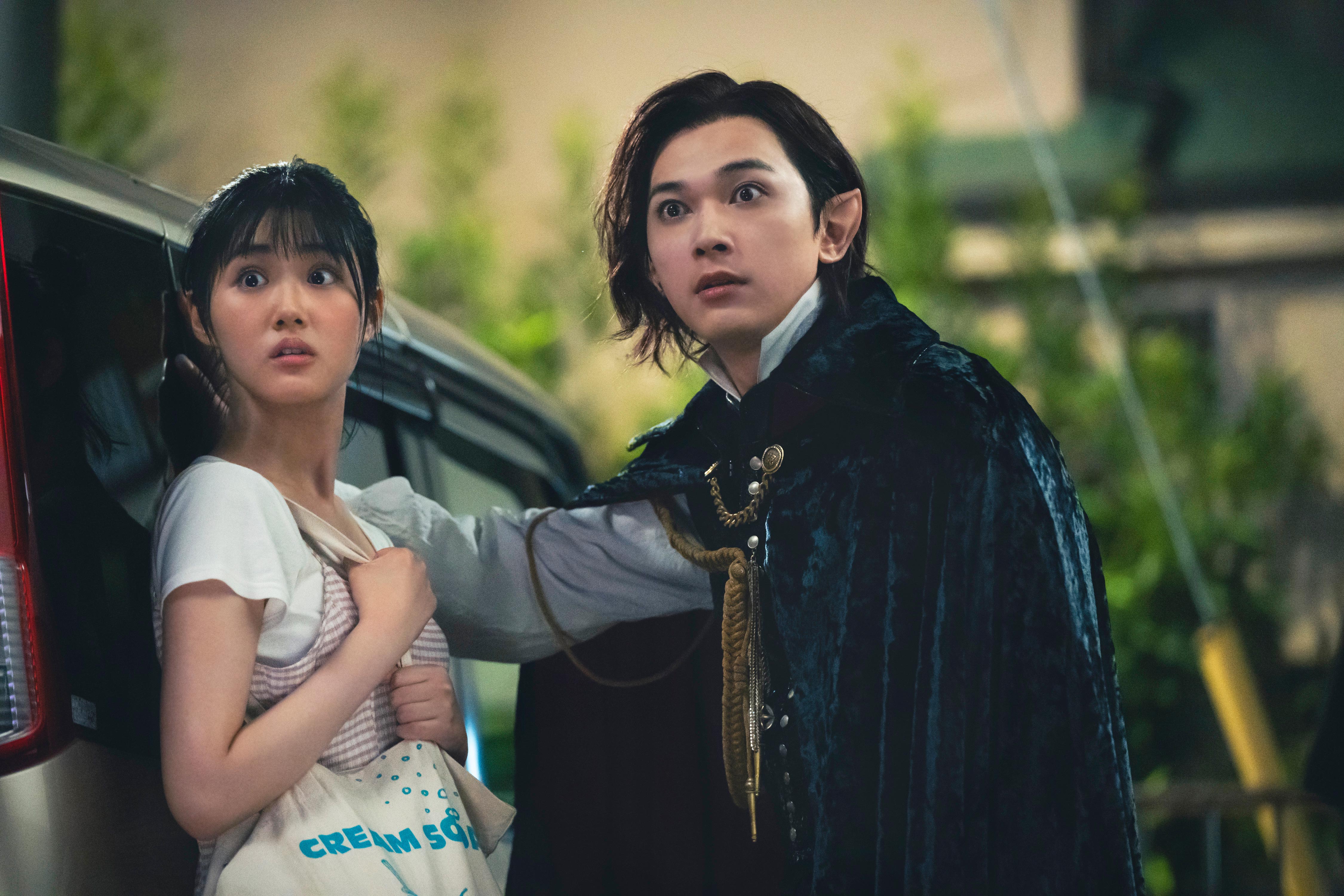
Babanbabanban Vampire (ババンババンバンバンパイア, Shinji Hamasaki, 2025)

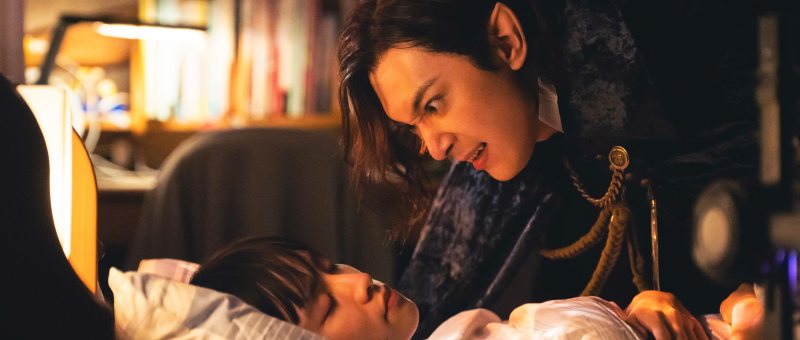
It turns out immortality’s not all it’s cracked up to be in Shinji Hamasaki’s adaptation of the manga by Hiromasa Okujima, Baban Baban Ban Vampire (ババンババンバンバンパイア). At 450 years old, Mori Ranmaru (Ryo Yoshizawa), one-time lover of Oda Nobunaga (Shinichi Tsutsumi), is working as an attendant in a bathhouse in an attempt to, as he says, “live an ordinary life earnestly,” while staving off the darkness of an existence free of the spectre of death. 

Yet, there is an uncomfortable darkness at the centre of this otherwise humorous and ironic tale in that what Mori Ran is actually doing is grooming a child so that he can enjoy him when he judges that he is “ready.” There’s an obviously unpalatable reading of the film that renders it as an allegory for paedophilia, while there’s also an undeniable poignancy in likening the figure of the vampire of that of a gay man in an oppressive society. Mori Ran accosts his victims in dark alleyways and his assignations with other men are necessarily short and secretive. They also result in death, while Mori Ran describes most of his victims as tainted and disgusting as if echoing an internalised sense of self-loathing. He continues to hold up Rihito (Rihito Itagaki) as a figure of innocence and purity because he once saved his life when he was baking in the heat of an usually hot spring when the boy was only five years old. 

Mori Ran’s internalised homophobia is somewhat mirrored in that of the teacher Sakamoto (Shinnosuke Mitsushima) who is also a vampire hunter but bewitched by Mori Ran and longing to be initiated by him, though Mori Ran declines to give him what he sees as a curse. Imbued with a gothic sensibility, Mori Ran believes that humans are beautiful because they die, while vampirism is debased and ugly. He refuses to condemn someone he admires to his own fate which he describes as a kind of inescapable hell in which he is unable to die. He no longer believes in love, though is haunted by his loss of Nobunaga, and sees humans merely as food. 

Nevertheless, it seems he has found purpose in his present life of living with Rihito’s family and working in their bathhouse despite convincing himself that he’s only biding his time until Rihito is ripe for the picking. According to Mori Ran, the sweetest blood belongs to that of 18-year-old male virgins which is why his goal of ensuring that Rihito remains virginal and pure is becoming more difficult now that he has entered adolescence. Much of the comedy derives from Mori Ran’s emotional cluelessness and paranoia on discovering that Rihito has fallen for a girl, Aoi (Nanoka Hara), with whom he had a stereotypical meet cute on his way to his high school entrance ceremony. Knowing that he has to nip this in the bud as soon as possible, he pays a visit to Aoi to warn her off but fails to realise that not only did she barely notice Rihito let alone fall in love with him, but that she is actually obsessed with vampires and is keener on him. 

But then again, there’s something additionally troubling about Rihito’s immediate classification of Mori Ran as a “love rival” in the mistaken belief he’s after Aoi too rather than as someone who should probably be reported to some kind of authority. After all, even if he were not 450 years old but the 25 he claims to be, hanging around exclusively with high schoolers is odd and bordering on inappropriate in itself. Having misunderstood his intentions, Aoi also believes that Mori Ran is waiting for her to be “ready,” in a partial recognition that this is wrong because she’s a child but also prepared to wait for the mysterious vampire without considering the implications of his being interested in a 15-year-old girl if that actually were the case. 

Nevertheless, what Mori Ran discovers is really a different kind of love in his gradual integration into the human world and the the friendships he forms not only with Rihito, but Aoi, her muscular brother Franken (Mandy Sekiguchi) who also has a crush on Mori Ran, and the lovelorn teacher Sakamoto, even if he’s still focused on his mission of keeping Rihito pure so he can drink his blood on his 18th birthday. His attempts to prevent a relationship forming between Rihito and Aoi are all countrerprodcuteive and would like end up bringing them together if it were not for the fact of Aoi’s crush on him of which he remains oblivious. The inherently zany humour of the situation with its series of concentric love triangles along with the warmheartedness of Rihito’s homelife when contrasted with the “mysterious” serial killings on the news cannot completely overcome the unpalatable undercurrent of Mori Ran’s pederastic quest, if glossing over it with admittedly delicious irony and absurdism.


Babanbabanban Vampire screens 27th July as part of this year’s New York Asian Film Festival.

Immersion (忌怪島/きかいじま, Takashi Shimizu, 2023)

Technological anxiety was at the heart of millennial J-horror, but perhaps the more things change the more they stay the same. Takashi Shimizu’s latest ghost story Immersion (忌怪島/きかいじま, Kikaijima) sees a grudge-bearing spirit cross over from the virtual world neatly suggesting we take our monsters with us into our simulacra and to that extent the brave new world is not so new at all. Then again, the hero thinks he desires a private world but paradoxically wants to share it and eventually discovers that what he craves is connection.

Tomohiko (Daigo Nishihata) has accepted a job as a programmer helping to build a new virtual world exactly replicating a remote island. He is greeted by his boss, Ide, in the digital space, but shortly after his arrival discovers that she died some time previously along side a man she may have been experimenting on in a project exploring brain syncronicity. When Tomohiko enters the virtual world he is confronted by strange and dangerous visions which suggest there’s a threatening bug in the system. Soon enough, the data breaks loose and somehow awakens in our world.

What no one knows is how a vengeful ghost got in the machine in the first place, though a shinto priestess later likens the new digital space to the “over there”, a perfect simulacrum of our world existing on another plane where spirits and their victims gather. Then again, it seems the problems are mainly on this side with an old man mocked by children and shunned by society because his mother suffered some kind of mental illness and was filled with a lust that was taboo at the time. The man’s mother is linked to the legend of Imajin, a slave raped by her master whose wife then took against her causing her to become a vengeful spirit who drove people out of their minds.

The purpose of the new world Tomohiko is creating isn’t clear, but it’s certainly very well resourced. The implication seems to be that the virtual is already haunting us and we can’t be sure of what we’re “really” experiencing and what we’ve been primed to experience. Tomohiko increases “the reality” of the virtual space by coding to it to activate “real” sense memories such as the smell of the sea or the feel of the sand. He can’t be sure if he’s the ghost in this world or the other while remaining aloof and diffident, unable to communicate effectively with his teammates. Tamaki, the estranged daughter of the dead man asks him if he doesn’t like people, to which he has no real answer though she replies that she doesn’t really like them either. What he realises is that doesn’t really want a world of solitude, but to be with others though it seems it might not matter whether in a “real” or virtual space.

But in contrast to all this modernity, the island is a traditional community with a strong interest in shamanistic lore and ritual. Tomohiko says he doesn’t really believe in any of that stuff, but is still prepared to go along with the shamaness’ advice in order confine the vengeful spirit to another world even if it means sacrificing the virtual space they are trying to build. Perhaps the message is that this kind of technological advance is dangerous and hubristic, unleashing forces we are ill-equipped to understand and would not be able to quell. As the shaman implies, you have to close the door from this side and not the other, which is a serious problem for the engineers who find themselves struggling to destroy the portal of a Torii gate in both spaces while the ghost continues to wreak watery vengeance.

Shimizu conjures an atmosphere of lurking dread in which digital ghosts haunt us in reflections of the ancient past even as our reality is destabilised by the overlay of the virtual. Tamaki reflects that the island is like a ghost town with few figures on the streets save themselves though they too sometimes appear like lingering spirits. What they discover may be a kind of refuge or escape, but perhaps not in the way we might expect while vengeful ghosts aren’t quite so easy to exorcise as they might once have been.


Immersion screened as part of this year’s London East Asia Film Festival.

Original trailer (no subtitles)

Seven Days War (ぼくらの七日間戦争, Hiroshi Sugawara, 1988)

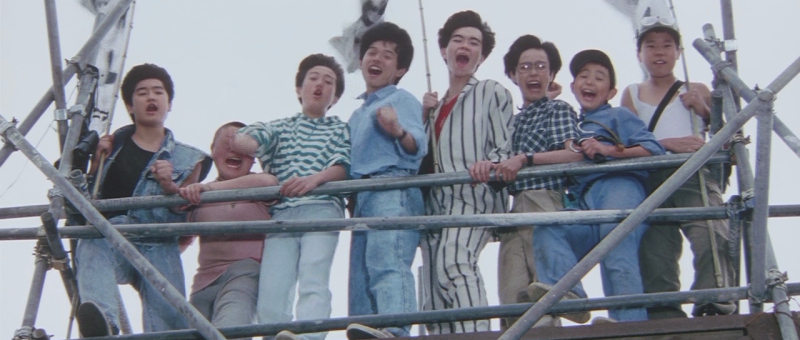
“What’s wrong with a little happiness?” one of the “eight heroes” of Aoba Jr. High Class 1-A asks, retreating from the duplicitous adult world into a teenage paradise. Another Kadokawa teen movie, Seven Days War (ぼくらの七日間戦争, Bokura no Nanoka-kan Senso) adapts the first in a series of Kadokawa novels by Osamu Soda and situates itself very much in the throws of the Bubble era in which the young rail not only against a rigid, conformist society but familial disappointment and the enduring legacy of the authoritarian past. 

According to the principal’s assembly speech, at Aoba Jr. High the motto for the day is “intellect, morality, and physique”. While he’s busy talking, another teacher, Yashiro (Shiro Sano), is patiently going through students’ bags and confiscating things he doesn’t like, even such innocent items as hairbrushes lest they should be used “to attract boys” rather than to maintain one’s appearance as the school would doubtless wish seeing as we later see the same teacher taking a ruler to make sure all the girls’ skirts are at regulation length. A boy late for assembly is also taken to task over his hair, accused of having had a perm and physically dragged towards a water butt by violent P. E teacher Mr. Sakae (Yasuaki Kurata) who later beats another overweight student for not performing well enough on the monkey bars. 

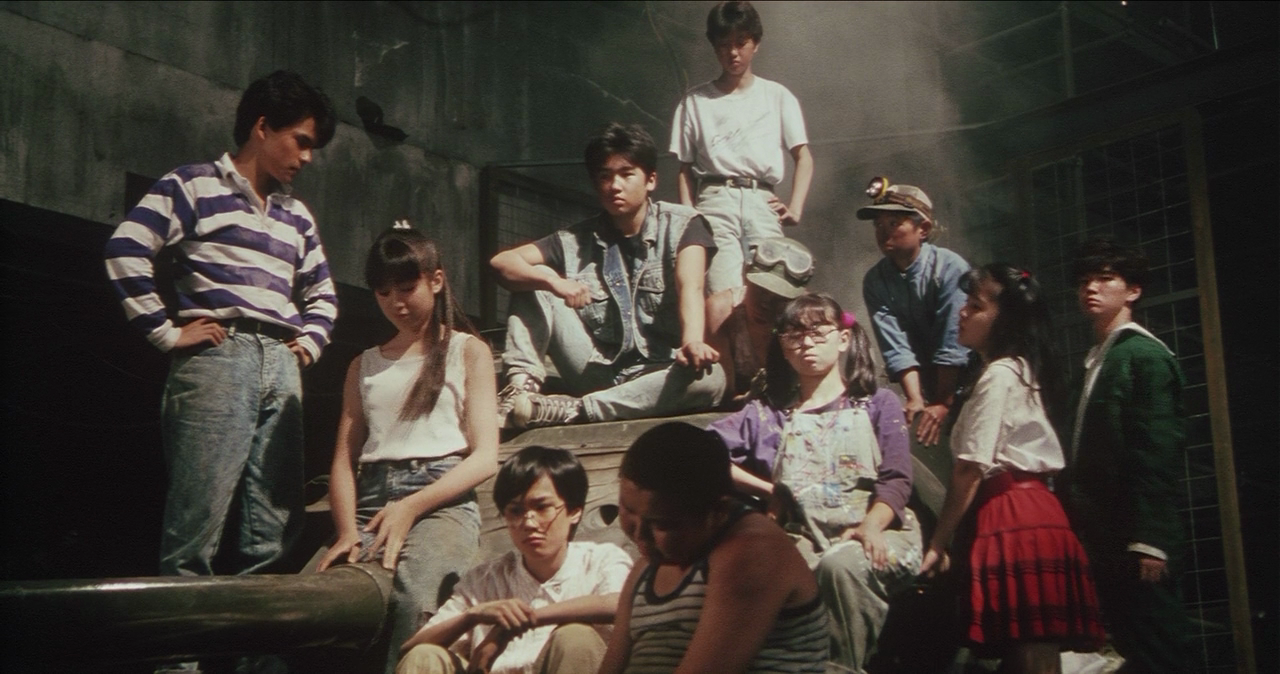
It’s small wonder the kids want to rebel. Eight of the boys in Yashiro’s class suddenly disappear one day, seceding to form their own society hiding out in a disused factory. Discovered and questioned, their only demands are to have the bad teachers fired and for all the students to be treated equally, but as expected their requests fall on deaf ears. Mindful of the school’s reputation, the principal tries to calm the anxious mothers but his underling, Nozawa (Yasuo Daichi), cooly absolves himself of all responsibility insensitively telling the parents that their children’s actions are obviously a reflection of poor parenting rather than a reaction to conditions at the school. 

As crude as that sounds, it’s accidentally echoed in another of the children’s demands in that they reject the idea that “children are robbers of parents’ lives”. Many of them are dealing with some degree of familial discord, often caused by the socio-economic stresses of the Bubble era in which everyone works all the time. The parents of ringleader Eiji (Kenichiro Kikuchi) are always arguing because his father is never around to help out at home, claiming that his golf weekends etc are essential work activities while his mother complains she’s worn out expected to handle the domestic responsibilities all alone. The broody Hiroshi (Toshitada Nabeshima) resents his mother for never being home, forever off working and communicating with him largely through answerphone messages. Nakao (Ken Ohsawa), the most studious of the boys, complains that he doesn’t really like the subjects he’s forced to study and only goes to cram school to please his parents. Hitomi (Rie Miyazawa), a female student who ends up joining the group later, is often left to her own devices with her father away working in Mexico and her mother always off “playing golf” which she seems to suspect is a euphemism for some other activity. 

What the kids want is to be free to be themselves, rejecting the salaryman straitjacket the mainstream world seems to be preparing for them. This being 1988, it goes without saying that the older teachers were children themselves during wartime and the legacy of militarism seems to have endured in their extreme love of order and discipline which has also infected the slightly younger and especially scary Yashiro. The wartime echoes are driven home by the very random find of a WWII tank for some reason hidden in the factory which the kids eventually repurpose and weaponise as part of their resistance, fortifying their hideout with a series of otherwise non-lethal booby traps to keep the authorities out even after the principal orders armed troops in. In the final confrontation, Nozawa turns up wearing a WWII German uniform only to be humiliatingly defeated by one of the gang’s Mousetrap-esque devices. 

Their rebellion, however, remains temporary and goodnatured, culminating in a beautiful fireworks display that has the adults admiring their artistry, while they later appear dressed once again in their school uniforms apparently considering their next revolutionary act. A Bubble-era time capsule, Seven Days War has much in common with other ‘80s kids movies, but positions its contemporary teens at the intersection of the authoritarian past and the consumerist present each of which conspire to rob them of their freedom but in their own way fighting back for their right to be themselves in a still conformist society.


Music video (no subtitles)

Adrift in Tokyo (転々, Satoshi Miki, 2007)

An aimless young man finds unexpected direction while walking the streets of the city with an unlikely father figure in Satoshi Miki’s meandering dramedy Adrift in Tokyo (転々, Tenten). These two men are indeed adrift in more ways than the literal, each without connections and seeking a concrete role in life while attempting to make peace with the past. But like any father and son there comes a time when they must part and their journey does indeed have a destination, one which it seems cannot be altered however much they might wish to delay it.

That Fumiya (Joe Odagiri) is aimless might be assumed from his unruly hair and the fact that he thinks tricolour toothpaste might be enough to jolt him out of his sense of despair but is confirmed by his matter of fact statement that he’s in his eighth year of university where nominally at least he’s studying law. His problem is that he’s amassed massive debts to a loanshark, Fukuhara (Tomokazu Miura), who breaks into his apartment and threatens him by shoving a sock in his mouth before leaving with his ID and driving licence. Fukuhara, however, later decides to make him another offer that he will cancel the debt and even give Fumiya even more money if only he will agree to wander around Tokyo with him for an unspecified time until they reach Kasumigaseki where he intends to hand himself in at police headquarters claiming to have recently murdered his wife. 

Like many things that Fukuhara says, it’s not clear whether or not he has indeed killed his wife though Miki frequently switches back to a scene of a woman who seems to have passed away and has been laid out in bed though she shows no signs of having died violently. Her zany co-workers keep thinking they should check on her seeing as she hasn’t shown up in days but something always distracts them and they end up forgetting about her entirely. The body appears to have been treated with love, hinting that if what Fukuhara says is true and this woman was his wife whom he killed in a fit of passion he has quite clearly thought through his plan of action rather than attempting to flee the scene and is perhaps only delaying the inevitable while walking out some other trauma in the company of Fumiya a surrogate son mirroring the description he gives of taking walks in the company first of his father and then of his wife. 

Fumiya deflects every question and agrees that he hates memories having burned his photo albums before leaving for university. He claims that he has no parents, describing the people who raised him as just that, as his mother and father both abandoned him as a child leaving him in a perpetual state of arrest which is one reason he’s still a student four years after most people have graduated. He never went to the zoo or rode a rollercoaster or called a man dad and seems to think of himself as nothing much of anything at all. Yet the fake can sometimes be more real than the real as he eventually discovers becoming part of an awkward family unit with Fukuhara’s “fake” wife (Kyoko Koizumi) he used to accompany to weddings as a paid guest, just beginning to enjoy being someone’s son when Fukuhara decides he’s reached the end of his road. 

There is a sense that everyone is chasing the ghost of someone else or perhaps even themselves, Fumiya finding shades of the father who abandoned him in career criminal Fukuhara who tells someone else that he once had a son who died in infancy, and seeing something of his mother in fake wife Makiko discovering transitory roots in an unlived imaginary childhood. But then there are also occasions of cosmic irony such as a coin locker bag being full not of money but of bright red daruma dolls and tengu noses, or a rebellious street musician meekly bowing to the police. A repeated gag says you’ll have good luck if you spot iconic actor Ittoku Kishibe out and about in the streets, and perhaps in a way Fumiya does in learning to make peace with his childhood self walking with Fukuhara who also comes to accept his failures as a man, a husband, and perhaps a father too. Filled with zany humour and a warmth underlying its melancholy, Adrift in Tokyo is a meandering journey towards a home in the self and a sense of rootedness in the middle of a sprawling metropolis filled with infinite possibility. 


Adrift in Tokyo is released on blu-ray in the UK on 12th December courtesy of Third Window Films.

Original trailer (English subtitles)

Riverside Mukolitta (川っぺりムコリッタ, Naoko Ogigami, 2021)

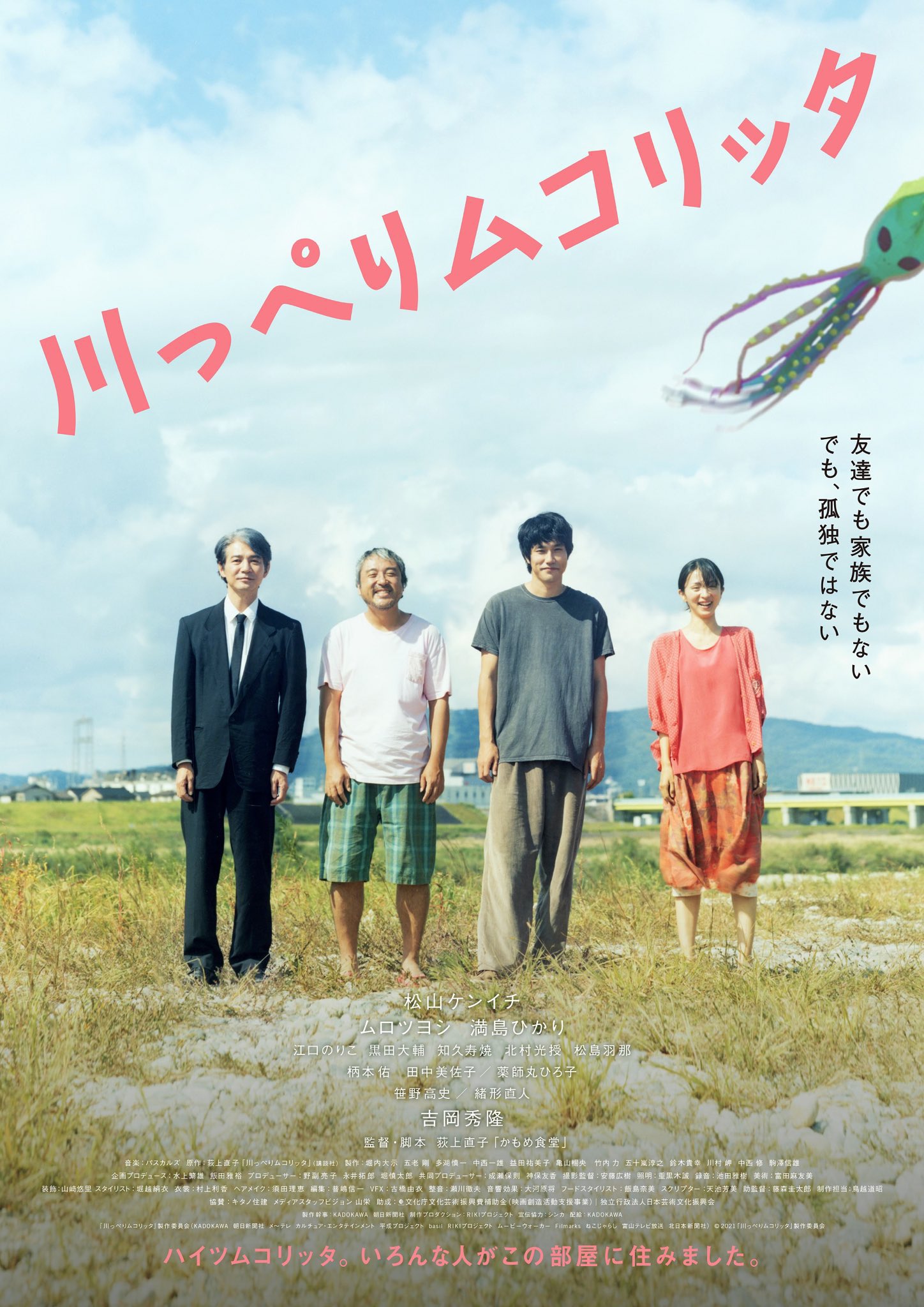
The spectre of death hangs over the protagonists of Naoko Ogigami’s adaptation of her own novel Riverside Mukolitta (川っぺりムコリッタ, Kawapperi Mukolitta) despite the sunniness and serenity of the riverside community where they live. They are each, in their own way, grieving and sometimes even for themselves in fear of a far off lonely death or else wondering what it’s all for and if this persistent suffering is really worth it, but eventually find a kind of solidarity in togetherness that can at least make the unbearable bearable. 

Recently released from prison, Yamada (Kenichi Matsuyama) has been sent to a remote rural village to start again with a job in a fermented squid factory and an apartment in a small row of houses by the river. His landlady Shiori (Hikari Mitsushima), an eccentric young woman with a little girl, assures him that though the building is 50 years old and many have passed through during that time no one has yet died in his unit. His neighbours Mizoguchi (Hidetaka Yoshioka) and his small besuited son Yoichi traipse the local area selling discounted tombstones reminding potential customers that no one lives forever and it might remove some of the burden of living to have your affairs in order for when you die. If all that weren’t enough, the last house in the row is thought to be haunted by an old lady whose ghost sometimes appears to water the flowers so they don’t turn to weed. Arriving home one day, Yamada discovers a letter from the local council letting him know that his estranged father has passed away in a lonely death and his remains are ready to collect at the town hall at his earliest convenience. 

Yamada is a man who keeps himself to himself, clearly ambivalent in trying to adjust to his new life wondering if he really deserves the opportunity to start again and if there’s any point in doing so. Seeing as his parents divorced when he was four and he had no further contact with his father, he is unsure if he wants the responsibility of his ashes which will of course contain additional expense for some kind of funeral. He meditates on the fates of “those who are not thought to exist”, such as the many homeless people who live by the river and are swept away by typhoons, and the elderly who die nameless and alone. When he ventures to the town hall, he discovers an entire room filled unclaimed remains some of which remain anonymous while the sympathetic civil servant (Tasuku Emoto) explains that in general they keep them for a year and then bury them together if no one comes forward to claim them. Aside from the staff members at the crematorium, the civil servant was the only person present at his father’s cremation which at any rate must be quite an emotional burden for him though he is familiar with the case and willing to talk Yamada through his father’s final days. 

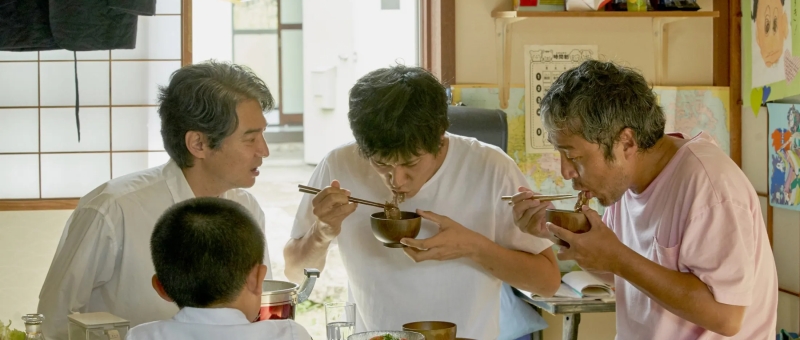
Meanwhile, he’s bamboozled into an awkward friendship with the strange man from next-door (Tsuyoshi Muro) who brands himself a “minimalist” and claims to be self-sufficient in the summer at least with the veg he grows in the garden behind their apartments but insists on using Yamada’s bath because his is broken and he doesn’t have the means to fix it. Giving in to Shimada’s rather aggressive attempts at connection, Yamada comes to feel the power of community in finding acceptance from the other residents in the small row of apartments along with the paternal influence of his boss at the factory and the kindness of an older woman who works there. Yoichi, the tombstone seller’s son, is fond of playing on a junk heap which is in its way a graveyard of forgotten and discarded things from rotary telephones to CRT TVs and broken air conditioners, while he and Shiori’s daughter Kayo try to contact aliens from a purgatorial space where the living and the dead almost co-exist. Taking place at the height of summer during the Bon festival when the mortal world and the other are at their closet, Ogigami’s laidback style gives way to a gentle profundity in the transient nature of existence but also in the small joys and accidental connections that give it meaning. 


Riverside Mukolitta screened as part of this year’s Camera Japan.

Original trailer (no subtitles)

What to Do With the Dead Kaiju? (大怪獣のあとしまつ, Satoshi Miki, 2022) [Fantasia 2022]

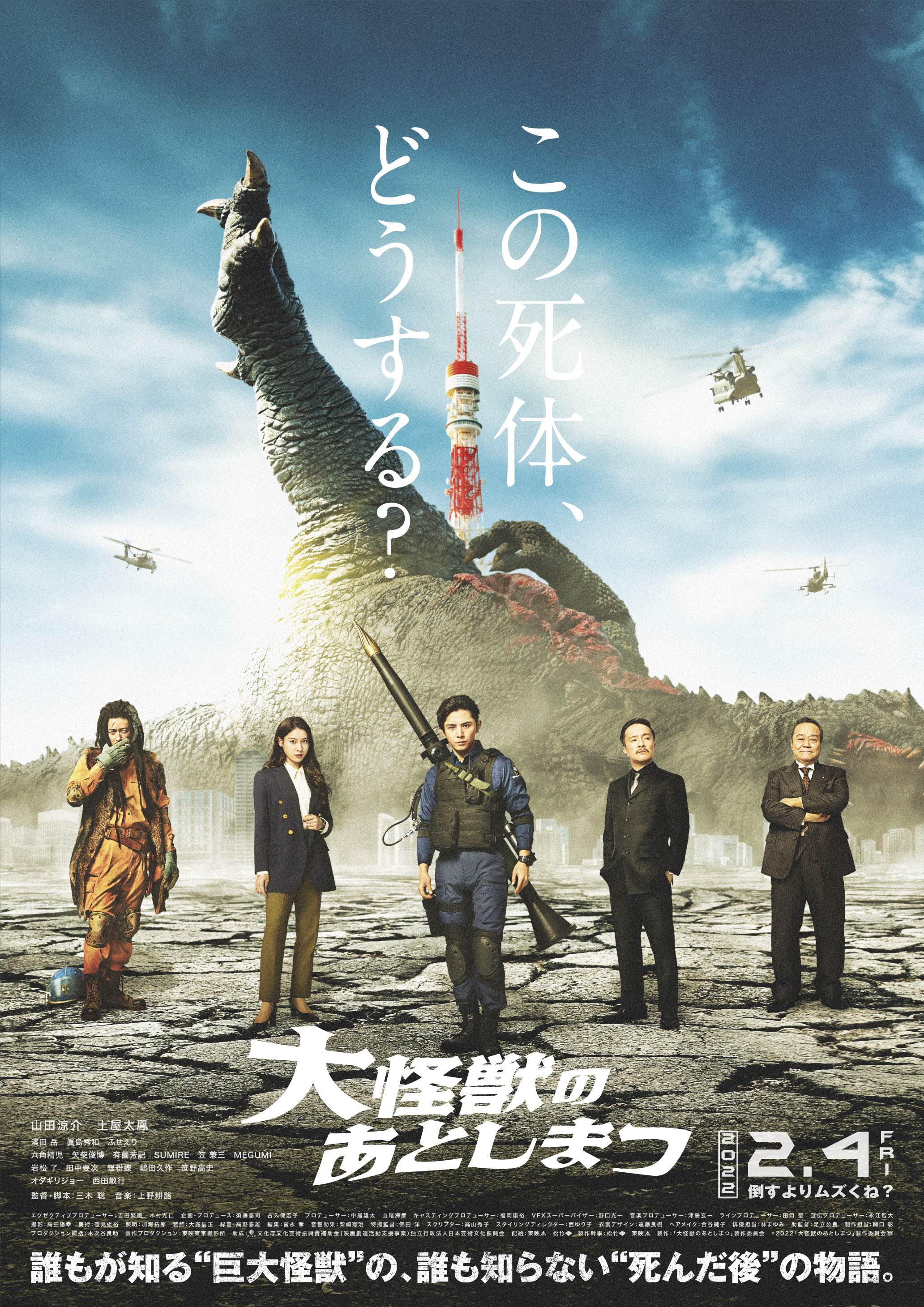
The sudden appearance of a deus ex machina is usually where a story ends. After all, that’s the point. Whatever crisis is in play is suddenly ended without explanation. But what happens then? Satoshi Miki’s What to Do With the Dead Kaiju? (大怪獣のあとしまつ, Daikaiju no Atoshimatsu) steps in to wonder what it is that comes next after a giant monster has been defeated. Someone’s going to have to clean all that up, and in a surprising twist a fair few people are keen to take on the burden. Like Hideaki Anno & Shinji Higuchi’s Shin Godzilla, which the film is on one level at least attempting to parody, Miki’s kaiju comedy is a government satire this time casting shade on the nation’s pandemic response, though with considerably less nuance. 

As the opening onscreen text, a nod to Shin Godzilla, and accompanying voiceover tell us Japan had been plagued by a kaiju but it suddenly died after being engulfed by a mysterious ball of light. While attempting to comedown from the constant state of anxiety under which they’d been living, the prime minister (Toshiyuki Nishida) is at a loss for what to do next especially as no-one really knows if the kaiju corpse is safe. While trying to ascertain whether or not the fallen kaiju might explode, spread dangerous radiation, or present some other kind of threat, government departments start fighting amongst themselves about whose responsibility the clean up effort must be all of them wanting the glory but not the work or expense. 

Some suggest turning the kaiju’s body into a massive tourist attraction and are therefore less keen on anything that involves destroying it while others think it should be preserved and put in a museum. The government has placed the SJF, a militarised science force set up after a terrorist incident, in charge but isn’t listening to much of what they’re saying. Meanwhile, evil moustachioed staffer Amane (Gaku Hamada) is playing his own game behind the scenes which also involves his wife, Yukino (Tao Tsuchiya), who was previously engaged to the leader of the SJF Taskforce, Arata (Ryosuke Yamada), before he abruptly disappeared after being swallowed by a mysterious ball of light three years previously. 

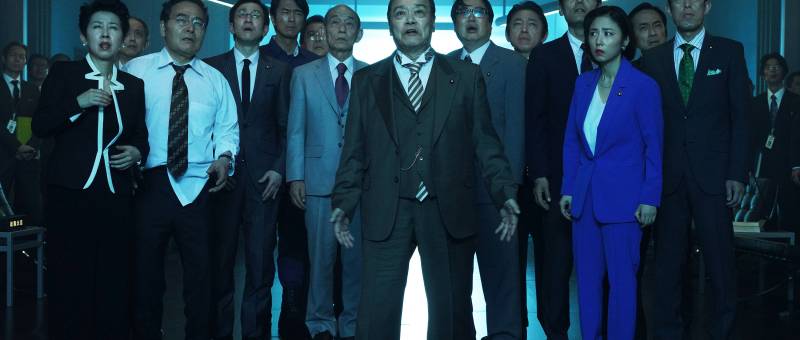
The political satire largely revolves around the indecisive PM, who at one point says he has no control or responsibility for what the other ministers do, and his anarchic cabinet meetings in which politicians run round in circles and insult each other like children. Not exactly subtle, much of the humour is indeed childish and scatological while one minister’s running gag is making sleazy sexist remarks even at one point accidentally playing a saucy video instead of displaying the latest kaiju data on the communal screen. The government experiences a public backlash in deciding to name the kaiju “Hope” which lends an ironic air to its rampage not to mention the necessity of its destruction, while the decision to declare the body safe for political reasons despite knowing it probably isn’t (“protecting the people’s right not to know”) casts shade on the pandemic response among other crises as do the constant refrains about getting back to normal now the crisis is over. 

Then again, there’s something a little uncomfortable going on with the film’s geopolitical perspectives, throwing up an angry politician on the screen with a mangled name who insists that the kaiju originated on their territory and must be returned to them in what seems to be an awkward allusion to Japan’s ongoing territorial disputes with Korea even while it’s suggested that the Americans wouldn’t mind getting their hands on the corpse either for purposes of experimentation and research. On the other hand it also becomes apparent that the Japanese military have deliberately destroyed civilian homes and cost lives in a reckless attempt to stop the kaiju which obviously failed. 

The closing scenes hint we may have been in a slightly different franchise than the one we thought we were dealing with, another deus ex machina suddenly arriving to save the day after the villains almost cause accidental mass destruction. The film’s problem may be that it’s the wrong kind of silly, relying on lowbrow humour while otherwise trying to conform to a blockbuster formula in which the kaiju corpse becomes the new kaiju but the battleground is bureaucracy. Ultimately the film’s prognosis is bleak. Even when the PM has achieved sufficient growth to realise he should make some kind of decision he makes the wrong call leaving everything up to a lone hero while fundamentally failing to come to any conclusion on what to do with a dead kaiju save trying to ensure it does not blow up in his face. 


What to Do With the Dead Kaiju? screened as part of this year’s Fantasia International Film Festival.

Original trailer (English subtitles)

Happy Flight (ハッピーフライト, Shinobu Yaguchi, 2008)

“We’re part of a whole system” the chief mechanic insists with exasperation, irritated with an employee being too thorough, “what if this delays departure?”. Best known for ensemble comedies, of which Happy Flight (ハッピーフライト) is one, Shinobu Yaguchi had originally envisaged a disaster movie only to change tack realising that aircraft accidents really are (thankfully) extremely rare and the backstage workings of an airport might well lead themselves to comedy. Even so, it’s perhaps surprising that sponsor airline ANA who were apparently heavily involved in the project allowed themselves to be seen in a less than perfect light even if their pilots and ground staff do indeed save the day when potential disaster strikes. 

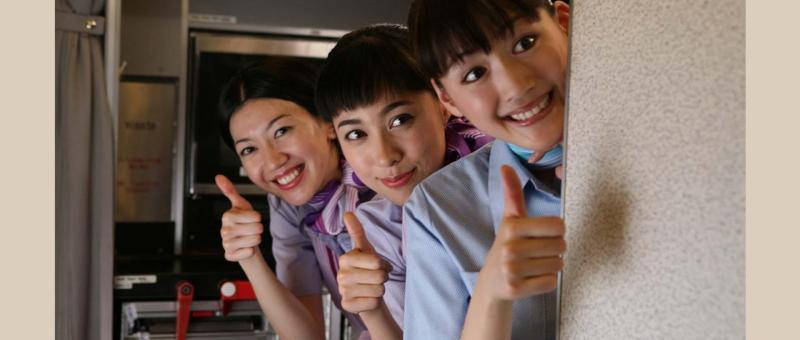
Like any good farce, Yaguchi throws just about every potential problem into one basket beginning with the fact that this flight to Honolulu is the final exam for co-pilot Suzuki (Seiichi Tanabe) who is hoping to earn a promotion to captain though a disastrous performance in the simulator may have dimmed his expectations. It’s also the first flight for chirpy air hostess Etsuko (Haruka Ayase) still harbouring some delusions about the glamour of the flight attendant life while the plane itself is late in and technically speaking needs a couple of repairs though the airline is already a little jumpy about the number of delays impacting their services recently and the chief mechanic thinks some of them can wait. A junior engineer takes it on himself to change a part and incurs the wrath of his boss for taking to long, but is perhaps privately worried he didn’t do it properly and later alarmed when the plane runs into trouble worried that his missing wrench might be the cause. Aside from the pressing typhoon, the other problem is a flock of annoying seagulls normally taken care of by an old man nicknamed “bird guy” who warns them off with a shotgun only today he’s been accosted by the “bird lovers alliance”, while the airport is also surrounded by a bunch of obsessive aviation enthusiasts recording every detail and uploading them online. 

If something can go wrong then it will, as it does when the backup sensors stop working leaving the pilots flying blind, but even before that consumer aviation is first and foremost a customer facing business with the airline concentrating on ensuring that passengers have a good experience so they don’t lose their business to a rival. That’s one reason they’re so paranoid about avoiding delays, but also find themselves dealing with aggressive passengers each intent on receiving individual attention forgetting for a moment that the plane is full of other people who also have needs and demands. Still learning the ropes, Etsuko struggles to understand her place in the machine only to redeem herself later through a little lateral thinking following a culinary disaster while becoming quietly disillusioned with the unexpectedly stressful side of her otherwise glamorous profession. Meanwhile stern purser Reiko (Shinobu Terajima) gives them all a masterclass in deescalating an entitled customer’s rage by stroking his ego with some well-placed psychology. 

This being a comedy it all turns out alright in the end even if Suzuki has undergone something of a baptism of fire and Etsuko has had her eyes opened to the reality of the flight attendant life. Despite everything going wrong at the same time, it goes right when it needs to thanks to the teamwork and dedication of the disparate team from the guys in the air control weather department to the scrambling ground staff arranging meals and accommodation for passengers unable to reach their destination. There’s even the hint of a happy ending for check in supervisor Natsumi (Tomoko Tabata) who was dead set on quitting her job because it doesn’t afford her any opportunities to meet nice guys, while what it does seem to largely contain is fending off the three teenage aeroplane enthusiasts who hang out in arrivals and dealing with various passenger crises. They are indeed all part of whole system, and that’s good and bad in that they all feel under pressure to get planes in the air on time which perhaps encourages them to overvalue efficiency at the cost of safety, but also makes it easier to spring into action in order to fend off a crisis should one occur so that everyone can have a “happy flight” blissfully ignorant of the minor panic under the bonnet of this not so well oiled machine. 


Happy Flight streams until 27th February in several territories as part of Japanese Film Festival Online 2022.

International trailer (English subtitles)

Wife of a Spy (スパイの妻, Kiyoshi Kurosawa, 2020)

“If the times have changed you, couldn’t you have changed the times?” the spy’s wife not unreasonably asks of a man she knew to be good and kind yet has done terrible things, perhaps, as has she, out of a misplaced love. Travelling from death is eternal loneliness to love is our salvation, Kiyoshi Kurosawa’s Wife of a Spy (スパイの妻, Spy no Tsuma), co-scripted by Ryusuke Hamaguchi and Tadashi Nohara, picks up a thread from Before We Vanish TV companion Yocho (Foreboding) to suggest that love can in fact be as destructive as hate in its all encompassing single-mindedness as an ordinary housewife uninterested in politics is caught between her progressive, compassionate and aristocratic husband and a childhood friend with an unrequited crush who has since become an ardent militarist. 

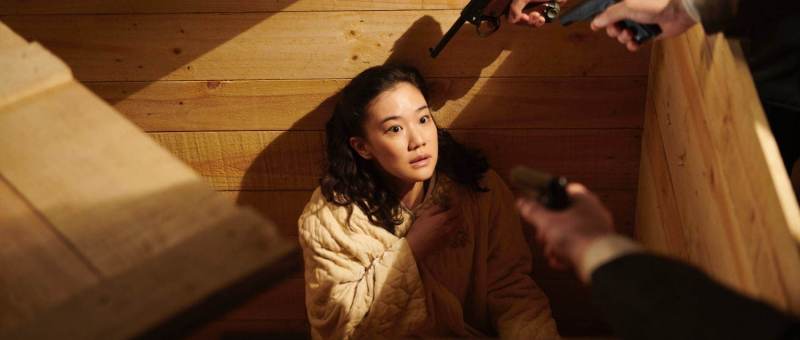
Set in Kobe in 1940, the film opens with a portly British textile merchant, Drummond, dragged from a silk inspection centre by the military police on the suspicion of being a foreign spy. This is appears not to be the case, but as in much of the narrative little is as it seems. The British merchant is a friend and associate of Yusaku Fukuhara (Issey Takahashi), the chairman of a family-owned textile company whose main objection to the idea that Drummond is a spy seems to be that a man of such copious proportions hardly fits his mental image of the word. Yusaku is nevertheless questioned by the local squad leader, Taiji (Masahiro Higashide), who happens to be a childhood friend of his wife Satoko (Yu Aoi), and later risks implication by paying Drummond’s bail. Satoko approves of this decision even if it may be politically unwise, confessing that she thought it “heartless” that Yusaku was messing about making a silent movie in which she starred as a femme fatale spy eventually killed by her lover/rival while his friend was in custody. “You’re always looking so far ahead of me, I feel like a fool” she reflects though as we’ll see she’ll soon be taking him on at his own game, the couple dancing around each other in a deadly waltz of love and betrayal. 

When Yusaku declares that he’s planning to visit Manchuria, partly for adventure and partly on behalf of a doctor friend, Satoko’s main concern is his impending absence though his return brings her little peace. After a woman he and his nephew Fumio (Ryota Bando) had apparently befriended and then brought home is found dead, Satoko makes a dark discovery driven at once by jealousy in Taiji’s vague hints that Yusaku may have been romantically involved with the dead woman, and resentment in realising he is keeping something from her. That something turns out to be his intention to expose the atrocities he witnessed in Manchuria committed by doctors connected to the Kwantung Army. 

Yusaku’s motives for this are rather naive, believing that it will bring the Americans into the war and hasten a Japanese defeat bringing an end to the militarist folly. Nevertheless, the discovery forces the couple into an ideological confrontation, Yusaku insisting that he is a “cosmopolitan” whose allegiance lies in “universal justice” rather to than any nation. To him happiness founded on injustice is an impossibility, while Satoko declares herself able to unsee the inconvenient truth in order to preserve the status quo reasonably pointing out that Yusaku’s “justice” will necessarily result in the deaths of thousands of innocent people. It’s at this point, however, that the tables turn, Satoko setting in motion a series of machinations which at first appear naive and counterproductive but are in fact infinitely ruthless. 

“I’m not afraid of capture or death, I’m only afraid of being separated from you” Satoko insists, willing to burn the world to save her love if also later moved on “seeing” for herself the reality of Japanese abuses in Manchuria. Taking on the role she had played in their silent movie, Satoko becomes the spy revelling in her ruthlessness yet this spy game revolves around the ability to correctly read the emotional lives of others. Having been “warned” by the austere Taiji that she and her husband were too Westernised for the times with their expensive foreign whiskey and international fashions, Satoko puts on kimono in order to curry favour with him hoping to leverage his unrequited love for her. Yusaku meanwhile perhaps banks on something similar, each of them ironically manipulating the apparently conflicted militarist in the conviction that his love is pure and he will therefore continue to protect Satoko, and by extension her husband, as a means of protecting himself. 

Early on, Taiji had confessed to Yusaku that he disliked arresting people which may have been a thinly veiled threat, but also bears out Satoko’s conviction that he is at heart a gentle person though we’ve not long seen him rip out one man’s fingernails in order to present them to another as a warning. Unrequited love has perhaps thrown him into the arms of militarist austerity, hardening his heart while his ardour is sublimated into a misplaced love of country that allows him to justify such heinous acts of inhumanity.  “Hard choices must be made to achieve greet deeds” Satoko herself had said in order to excuse her own act of injustice in sacrificing another man on Yusaku’s behalf, only to later face the same fate in an ironic turn of events either vengeful betrayal or protective act of love depending on how you read the emotional intentions behind them. 

Just as in the silent movie, incongruously scored with a poignant Japanese cover of Jerome Kern & Oscar Hammerstein II’s Make Believe, everyone is playing a role, engaging in an act of deception if only self-directed, yet their act perhaps exposes the truth they were attempting to hide, the spy’s wife becoming the spy but beaten at her own game unable to see the entirety of the board. Commissioned as an 8K feature for a Japanese TV channel, the incongruity of the hyperreal digital photography deepens the sense of the uncanny in the unexpected naturalism of the period setting, a world of constant anxiety with soldiers on the streets and the feeling of being forever watched in the oppressive atmosphere of authoritarian militarism, while standing in strong contrast with the unreality presented by the films within the film both that made by the couple and the brief yet ironic inclusion of Sadao Yamanaka’s Priest of Darkness, another tale of infinite duplicities, given that the director had himself become a casualty of war on the Manchurian front two years previously. Ironically titled, Wife of a Spy situates itself in a state of permanent paranoia in which nothing and no-one is as it seems and love may in its own way be the most destructive force of all while containing within itself the only possible source of salvation no matter its veracity.  


Wife of a Spy  screens on Aug. 27 as part of this year’s Japan Cuts.

International trailer (English subtitles)

Karisome no Koi (“fleeting love”) – Chiyoko Kobayashi (1936)

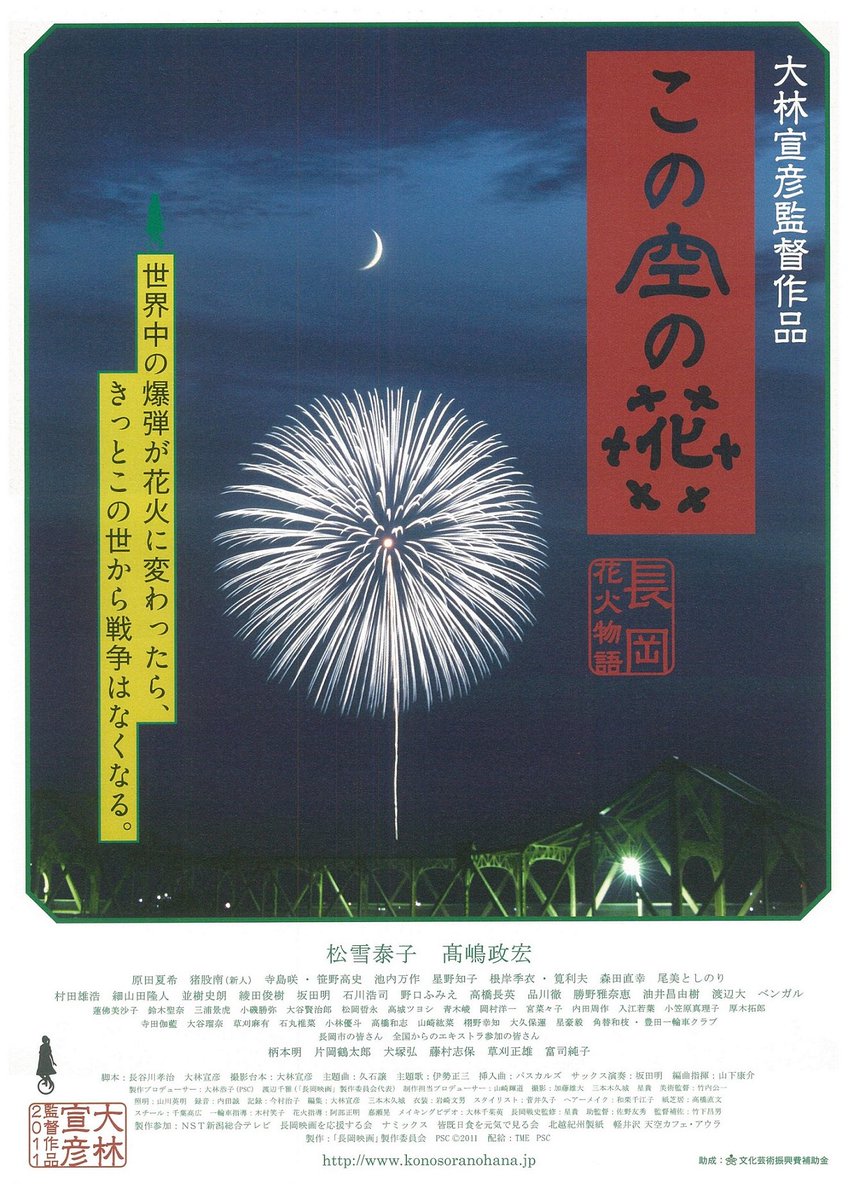
Casting Blossoms to the Sky (この空の花 長岡花火物語, Nobuhiko Obayashi, 2012)

“There’s still time until a war” runs the title of a play for voices at the centre of Nobuhiko Obayashi’s oscillating docudrama, Casting Blossoms to the Sky (この空の花 長岡花火物語, Kono Sora no Hana: Nagaoka Hanabi Monogatari). Asking why when presented with the opportunity to create something beautiful that gives joy and hope to all who witness it mankind chooses death and destruction, Obayashi considers responses to disasters manmade and natural and finds largely kindness and resilience among those determined to avoid the mistakes of the past while building a better tomorrow. 

Set in the immediate wake of the 2011 earthquake and tsunami and inspired by verbatim interviews with local people, Obayashi’s elliptical drama sends an emotionally arrested newspaper reporter to Nagoka having received a letter from an old lover that calls her back into the past. Reiko (Yasuko Matsuyuki) broke up with Katayama (Masahiro Takashima) 18 years previously uttering only the cryptic phrase “we have nothing to do with war”, but travelling through her “wonderland” begins to realise that she and everyone else is in that sense wrong. No one is really entirely unconnected or untouched by the destructive effects of conflict and pretending that it’s nothing to do with you will not in the end protect against it. 

“To the children of the future, from the adults who lived the past” runs the opening title card, making plain a fervent hope to connect the often unknowing younger generations who assume war is nothing to do with them with the traumatic past through the voices of those who directly experienced it. The play to which Reiko is invited is in itself a play for voices, an avant-garde theatre piece inspired by the verbatim speeches of residents of Nagaoka recounting their often harrowing experiences of the war apparently penned by a strange high school girl (Minami Inomata) who rides everywhere on a unicycle. The performance is set to take place in conjunction with the local summer festivals which include a series of fireworks displays commemorating lives lost in the bombing raids and symbolising a spirit of recovery following a destructive local earthquake some years earlier. 

Obayashi draws direct comparison between the natural disasters of earthquake and tsunami, and the manmade disaster of war but discovers that ordinary people often react to them in the same way with a furusato spirit of mutual solidarity and kindness. One of Katayama’s students is a displaced young man from Fukushima who remarks on the kindness he experienced having been taken in by the town of Nagaoka, a kindness he hopes to repay someday when he is finally allowed to return to his own hometown just as the people of Nagaoka have done following kindness shown to them after the earthquake. The discrimination he faces as someone from a town affected by radiation calls back to that experienced by Reiko’s parents who were survivors of the atomic bomb that fell on Nagasaki, a location chosen by pure chance on a whim when poor weather made the primary target unavailable. Among all the horror of the wartime stories Reiko uncovers, there is also selfless heroism such as that of the young man bravely throwing water over those trapped in a burning air raid shelter. 

“If only people made pretty fireworks instead of bombs, there wouldn’t have been any wars” a poet laments drawing a direct line between these two very different uses of the same material, a connection further rammed home by twin visits to a fireworks factory and atomic bomb museum. The “phoenix fireworks” become a fervent prayer, blossoms cast to the sky, in hope of a better, kinder future without the folly of war. “There are adults who think war is necessary” Katayama explains, “but not the children, of course. That’s why it’s up to the children to make peace”. Some may complain that in the rapid economic development of the post-war society something has been lost, but in times of need people are still there for each other forging the furusato spirit in contemporary Japan. Opening with a series of silent-style title cards, Obayashi’s overtly theatrical aesthetics may be comparatively retrained even while incorporating frequent use of animation and surrealist backdrops, but lend an ever poignant quality to this humanist plea for a more compassionate world in which the only explosions in the sky are made of flowers and hope not hate or destruction. 


Casting Blossoms to the Sky streams in the US July 9 – Aug. 6 as part of Japan Society New York’s Tragedies of Youth: Nobuhiko Obayashi’s War Trilogy season in collaboration with KimStim.

Original trailer (English subtitles)

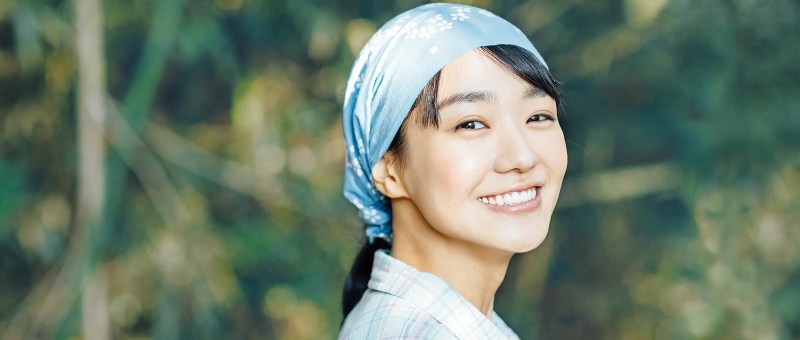
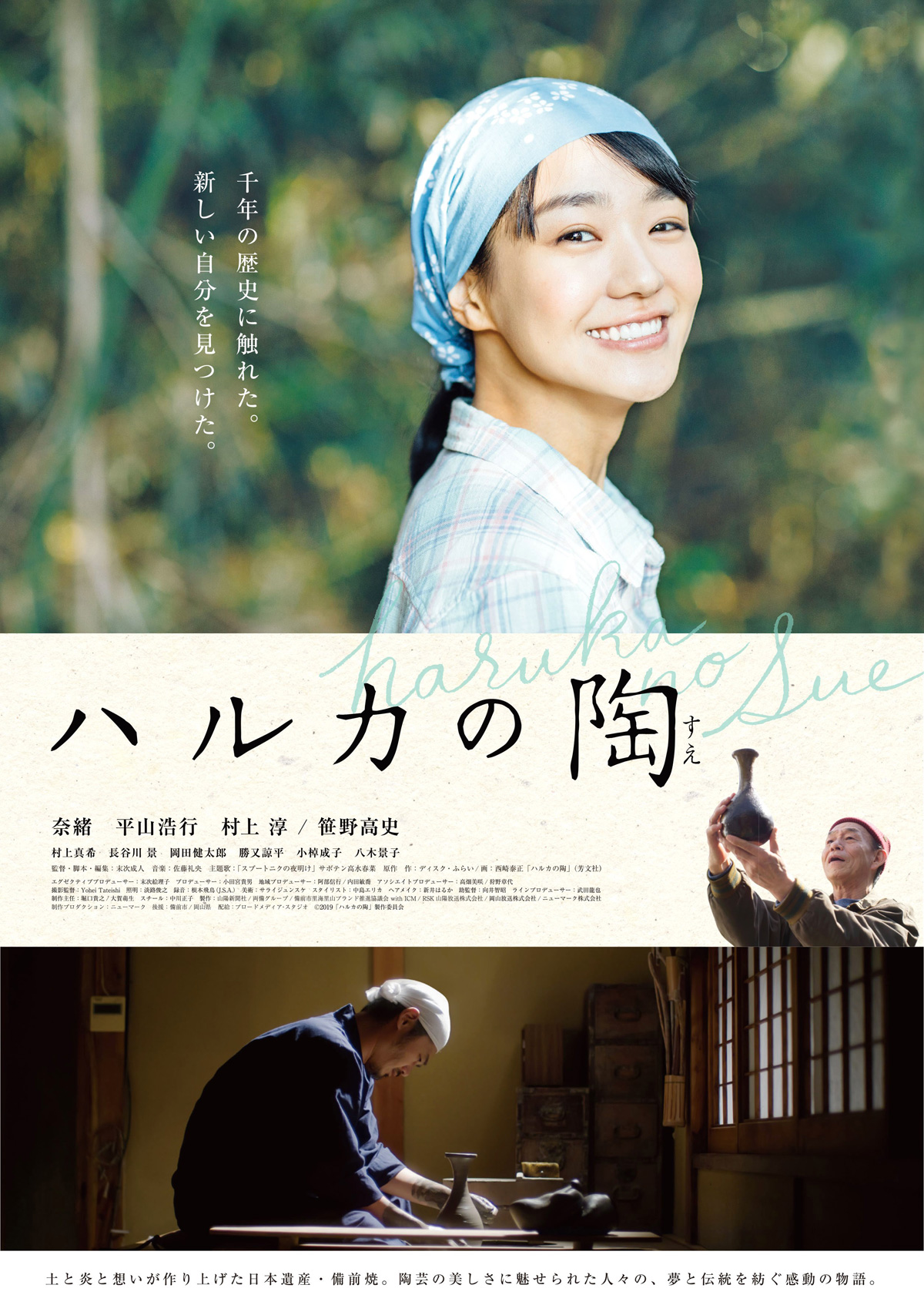
Haruka’s Pottery (ハルカの陶, Naruhito Suetsugu, 2019)

(c)2019 "Haruka's Pottery" Film Partners

“Growth comes only through connecting with others” according to a master craftsman in Naruhito Suetsugu’s manga adaptation Haruka’s Pottery (ハルカの陶, Haruka no Sue). Japanese cinema has a long history of showcasing traditional crafts but this may be the first dedicated to Bizen ware, artisanal pottery which allows one lost young woman to find purpose in her life after being deeply moved by an oversize platter displayed in a department store exhibition. What she discovers, however, is that pottery is not an isolationist art and lives only in practical application which is in its own way impossible without interpersonal connection. 

A 20-something office worker, Haruka (Nao) laments that nothing exciting is ever going to happen to her. She has no dream or particular passion and sees nothing in her future other than an ordinary job and conventional marriage. Dragged into a department store exhibition by her boss who reminds her that she never has plans so she can’t refuse, Haruka is captivated by a large Bizen ware platter and finds herself heading to the library to find out all about this ancient craft. It’s not long before she’s made the decision to quit her job and try to become a potter herself, determined to train with the artist who made the platter, but when she arrives in the Bizen ware capital of Imbe, Okayama, she finds him cold and unresponsive. Only after bonding with an old man, Toujin (Takashi Sasano), who turns out to be a “national treasure” of traditional pottery does she manage to persuade Osamu (Hiroyuki Hirayama), the aloof and grumpy potter, to allow her to stay. 

Talking to Toujin later Haruka reveals that one of the reasons she was so struck by the platter was because her family is small and she’d always dreamed of a big gathering where everyone could eat off the same large plate. Toujin fires the same logic back at Osamu, that subconsciously he made the plate because he’s lonely. It’s not something he would ever use, in fact it’s too big to have much of a practical use at all, it was basically just a kind of beacon to summon someone to him, to express the depths of his solitude. Osamu lost both his parents as a child, his mother to illness and his father (Jun Murakami) to overwork brought on by grief, and has kept himself to himself ever since. He may have become a master potter, but according to Toujin at least he is somewhat lacking as a human which means, in essence, that his art will never progress not to mention that he’ll go on being lonely and resentful all his life if he fails to seize this opportunity to pass on his Bizen ware skills to a willing pupil.

For her part, Haruka is determined to learn and only from Osamu, the man who made the plate. While others in the town which is largely populated by other Bizen ware potters are supportive if somewhat surprised that Osamu has taken on an apprentice, Haruka finds herself at odds with Toujin’s daughter Yoko (Maki Murakami) who, according to her husband, has not exactly had it easy as a female potter. Yoko resents Haruka as an arriviste, unconvinced she’s really serious and assuming she’s another refugee from the city fed up with urban life and looking for something simpler which is to say she’s probably underestimated the commitment required to become a Bizen ware craftsman. Haruka is fond of cheerfully stating that she’ll persevere, but that’s rarely enough for Osamu or for Yoko who’d prefer to see some concrete results. Yet as Toujin had said, it’s as well to connect with as many people as you can and learning something from each of them she begins to grow in confidence, becoming a full part of the Bizen ware community and earning the respect of the other potters. 

As an old lady puts it, Bizen ware is designed to be used. Its harsh corners become soft and round through contact, and the same is true for people too. Having pushed himself too far trying to connect with his late father through their shared art, Osamu too softens assuring Haruka that pottery is not an exact science and it’s OK to fail every now and then as long as you learn something when you do. “The potter must have a strong will and be as unbreakable as the pottery itself” in order to “melt people’s hearts on the spot” Toujin had somewhat paradoxically told her, but Haruka perhaps learns that there’s truth in what he says, falling in love not only with traditional craft but with the small community of craftsmen accepted as one of their own in her unbreakable love for Bizen ware. 


Haruka’s Pottery screened as part of Camera Japan 2020.

Original trailer (no subtitles)