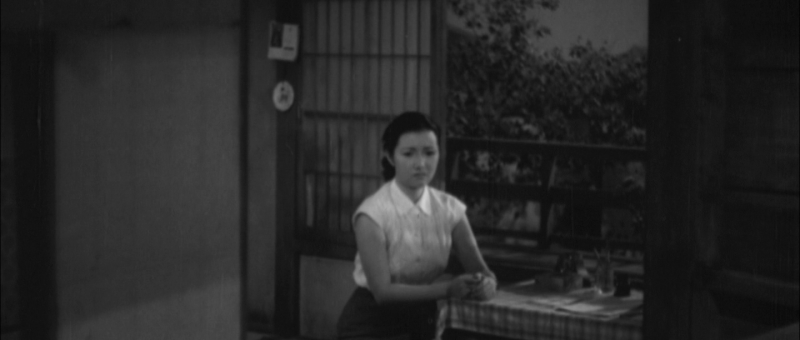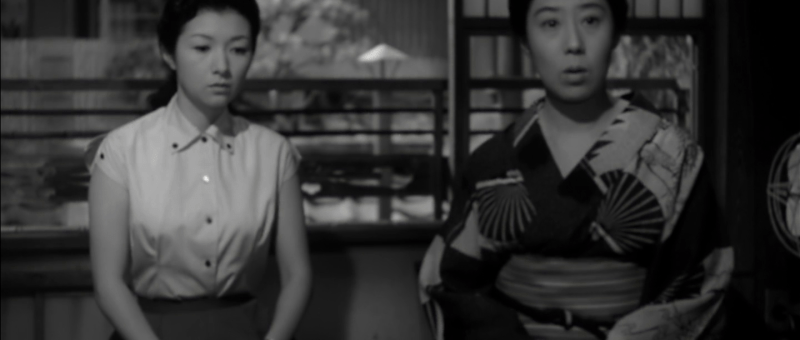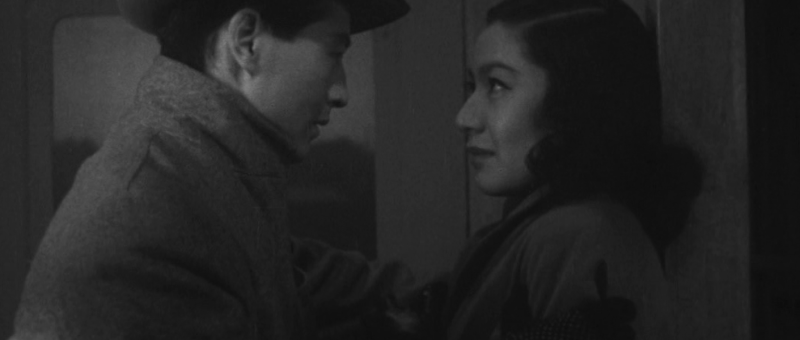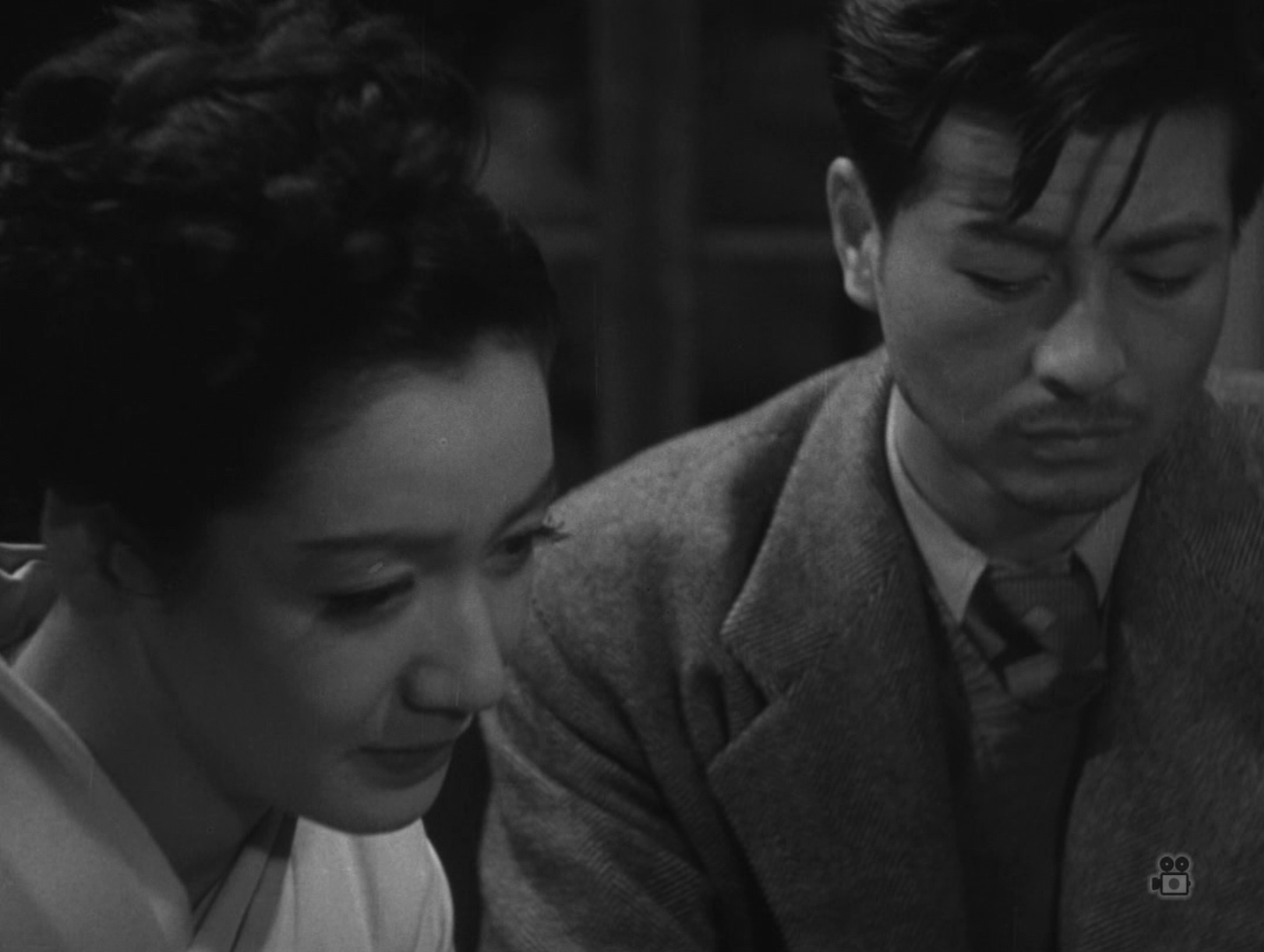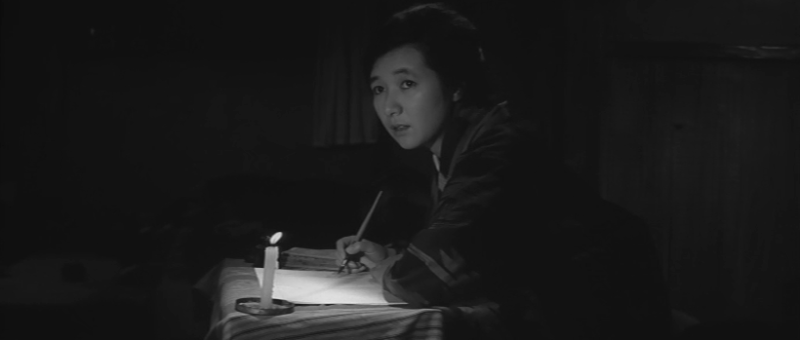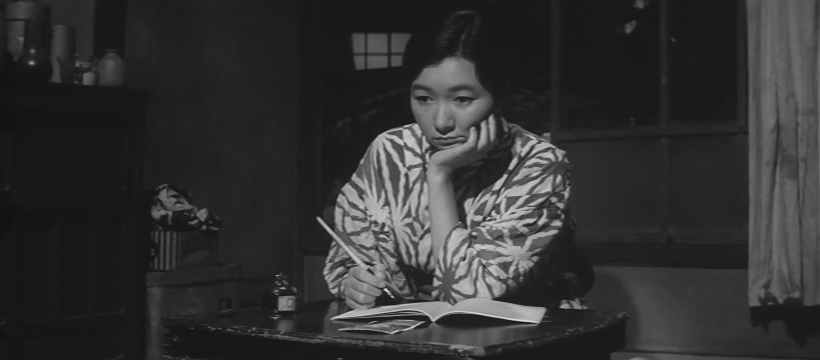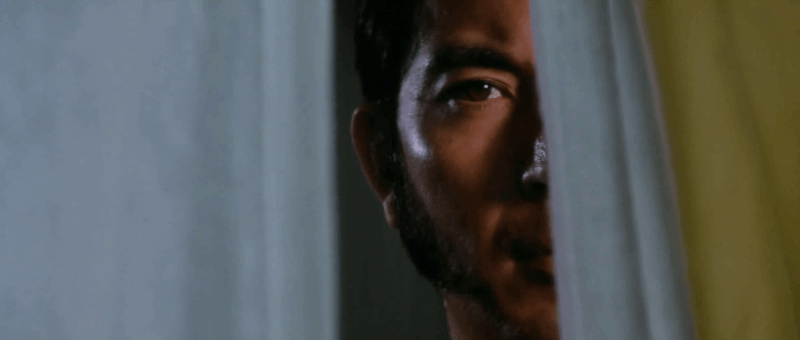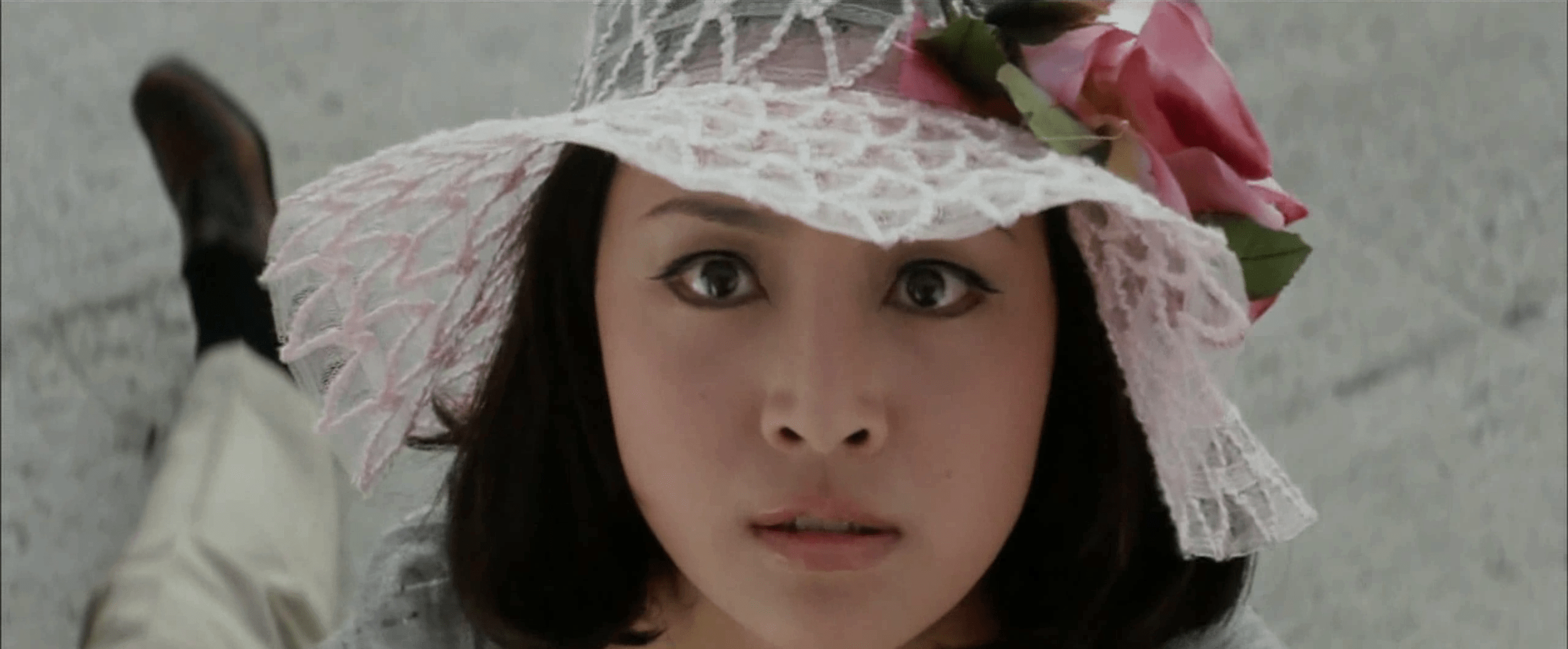
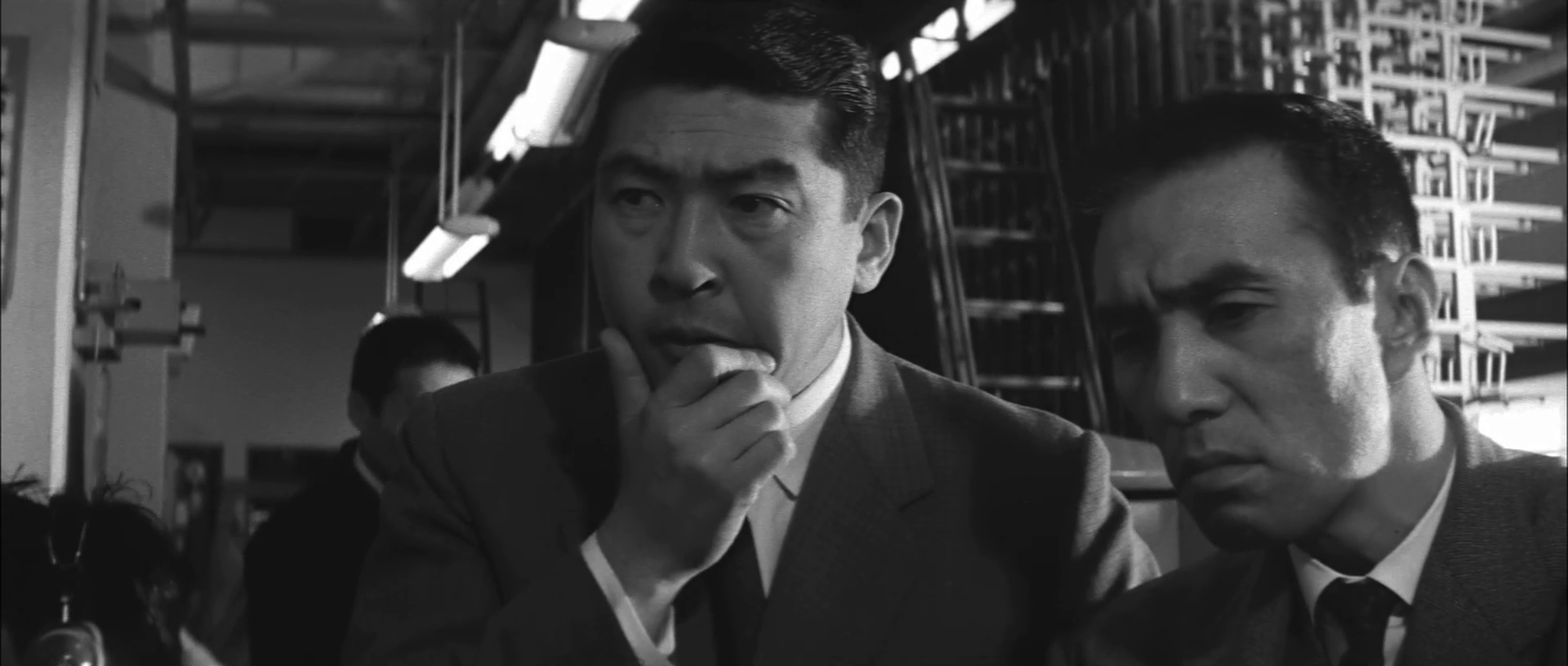
Sanshiro Sugata (姿三四郎, Akira Kurosawa, 1943)

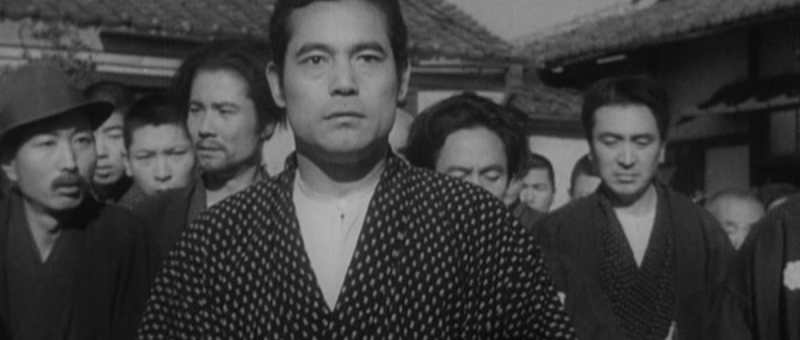
It might seem curious in some ways to make a film about the importance of humanity in martial arts during a time of war, but Akira Kurosawa’s debut feature Sanshiro Sugata (姿三四郎, Sugata Sanshiro) does just this in depicting the hero’s coming of age as a gradual progress towards awakening as he learns to attain control over body and mind through the modern discipline of judo. Based on a novel by Tsuneo Tomita, the film is in many ways a typical martial arts drama in which a young hopeful seeks a master and must eventually face a rival, but lends a note of poetry to the tale which is in other ways perhaps out of keeping with its times. 

The times of the film, however, are late Meiji as demonstrated in the lively opening sequence which ventures into a town in transition where policemen in Western-style uniforms walk the streets alongside townspeople dressed largely in kimono as is the hero, Sanshiro Sugata (Susumu Fujita), who’s come looking for a famous jiujitsu master. Taken on as a pupil, he overhears the master, Momma (Yoshio Kosugi), disparaging a rival, Yano (Denjiro Okochi), who has come up with a new martial art he calls judo which is fast gaining both respect and popularity. Momma thinks it’s all just a branding exercise and Yano’s “judo” is just repackaged jiujitsu, irritated that he seems primed to take a prestigious position as a trainer to the police force which runs its own martial arts contest. Sanshiro goes with them when they attempt to ambush Yano and teach him a lesson only to be easily defeated and humiliatingly thrown in the local river. Sanshiro immediately switches his allegiance, discarding his geta to give Yano a ride home in his rickshaw.

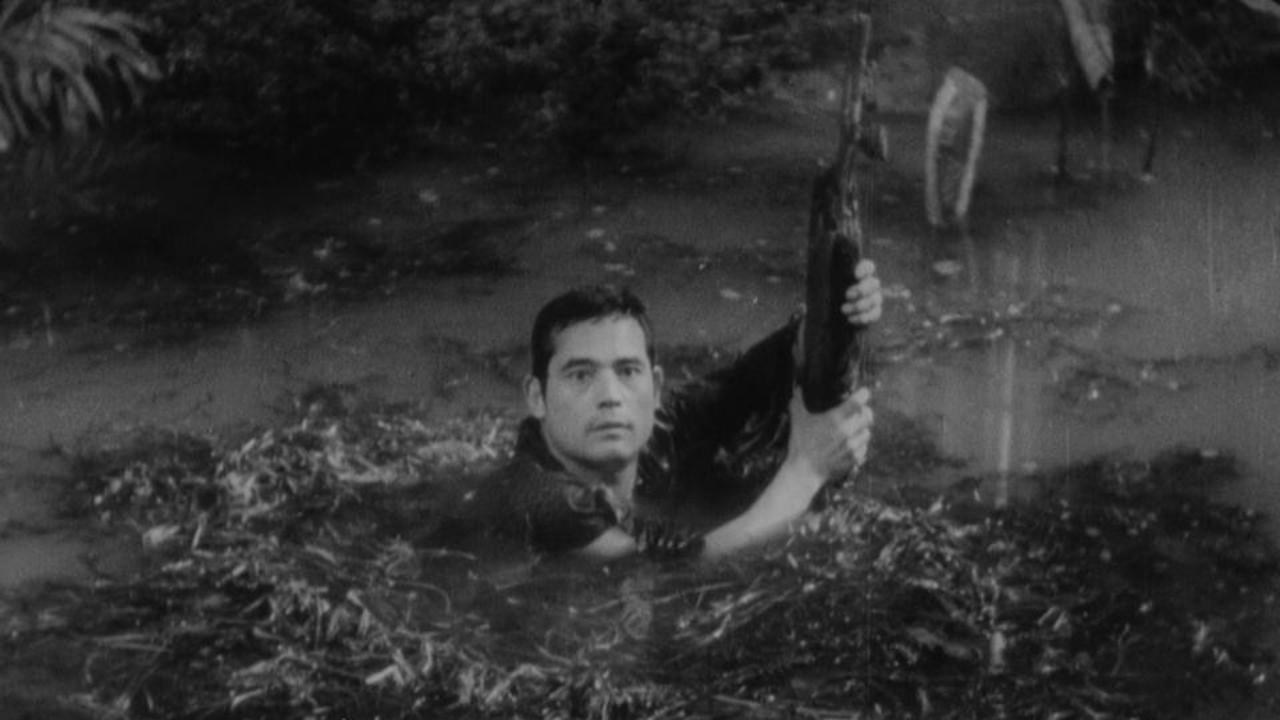
As Yano repeatedly tries to teach Sanshiro, judo is more than a martial arts discipline and places humanity at the centre of everything. This is a difficult lesson for the hot-headed Sanshiro to learn, quickly falling foul of his new master after brawling in the red light district and dramatically throwing himself into the pond. Clinging to a pole, he refuses to get out until Yano forgives him, but in true master fashion Yano merely says that getting out of the pond or not is entirely up to him. It’s while he’s in there, and after a few words from a Buddhist monk, that he witnesses a lotus flower slowing unfolding and achieves a kind of enlightenment that allows him to realise he’s been childish and petulant, finally getting out of the water to submit himself to the rigorous discipline of the martial arts life. 

The flower motif recurs several times, not least being its subversion when antagonist Higaki (Ryunosuke Tsukigata) sprinkles the ash of his cigarette over it. Making his first appearance in dandyish Western dress, Higaki is described as a snake-like villain, his evilness emphasised by his non-Japanese attire in contrast to pretty much everyone else who continues to dress in kimono. Higaki vows that his fight with Sanshiro must be to the death, in part a fight between the nascent art of judo originating in the post-feudal society and the traditional art of jiujitsu, but echoing Sanshiro’s first fight with former master Momma which resulted in his death and plunged the hero into spiritual conflict. He then experiences something similar when realising that he has inadvertently fallen in love with Sayo (Yukiko Todoroki) the pure-hearted daughter of another rival, Murai (Takashi Shimura), who also desires to fight him but as it turns out only in his desire to face a worthy opponent. Sanshiro wants to back away, afraid that he may humiliate or even kill the father of the woman he loves but is brought back to himself by more words from the monk who tells him that he must be as innocent as she is and engage in the fight in a sportsmanlike fashion as a spiritual as well as physical contest. 

This is also to some degree true of his final confrontation with Higaki which too is a confrontation with the evils of the age if less comfortably also satisfying the censors by allowing Higaki to stand in for foreignness in general. Higaki is indeed often accompanied by the sound of the wind which echoes his modernity, the fight taking place in a large windswept field below roiling clouds as the two men grapple despite the advice of their intermediary to call it off before one of them really dies. Higaki does in a sense die a sort of death in that we’re told after the fight he reformed and also managed to find a similar kind of enlightenment to Sanshiro who is then bashful and romantic while heading off on another journey from which he assures Sayo he will soon return. It’s true enough that there doesn’t seem to be much that would appeal to the censors of 1943 save the implied defeat of Western powers and celebration of Japanese martial arts given that humanity is repeatedly emphasised as the core component of judo and that Sanshiro achieves an individual enlightenment rather than finding peace as a member of a team or community, but they did otherwise decide to cut a substantial amount of the film said to contain a love scene and references to alcoholism that they deemed improper. Nevertheless, there are shades of Kurosawa’s later greatness even here in his dramatic composition and expressionistic use of nature to detail one boy’s journey into manhood through the spiritual rather than physical gymnastics of the philosophy of judo. 


Okuni and Gohei (お國と五平, Mikio Naruse, 1952)

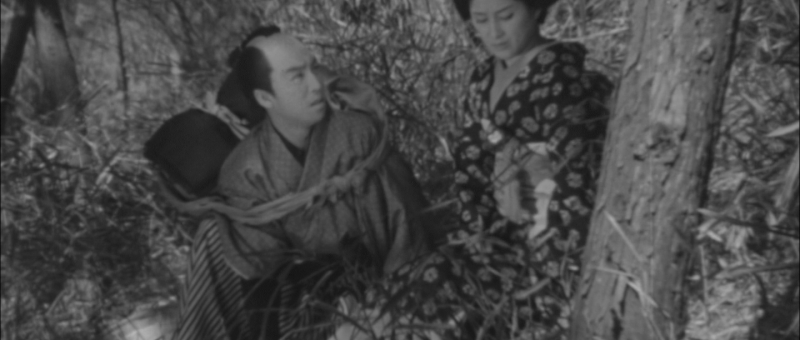
“It’s a rough and difficult road.” The heroes of Mikio Naruse’s Okuni and Gohei (お國と五平, Okuni to Gohei), adapted from a kabuki play by Junichiro Tanizaki, are two displaced between the old world and the possibility of a new one if only they were brave enough to step away from the beaten path. Unbeknownst to them, they are being followed by the man they are seeking whose shakuhachi playing haunts them wherever they go as if taunting them with its presence. 

In this iteration of the tale, Tomonojo (So Yamamura) takes on a slippery quality almost if he were some supernatural devil sent to torment Okuni (Michiyo Kogure) and Gohei (Tomoemon Otani) leading them either towards or away from their salvation or damnation. In Okuni’s flashback, which is obviously coloured with her own nostalgia and regret, he’s a sensitive young man who promised himself in marriage to Okuni. But she is forced to refuse him. Her father rejects Tomonojo because he is without standing or prospects, and instead demands she marry a wellborn man of his choosing, Iori (Jun Tazaki). Iori is then killed in the street, uttering only Tomonojo’s name before he dies. It could then be that this is Tomonojo’s revenge on a society that has rejected him and robbed him of his love, yet the Tomonojo we later meet is much different than this idealised version in Okuni’s memory. He never denies killing Iori and offers no justification for it, but corners Okuni when she’s alone to tell her to free herself by dropping her quest for revenge. He’s also subtly blackmailing her, implying he heard her having sex with her manservant Gohei the previous night and in reality wheedling away pleading for his life.

For her part, Okuni seems torn in her motivations, uncertain whether she’s looking for Tomonojo to reunite with him or kill him, or perhaps is deliberately avoiding finding him at all. She was not married to Iori for very long and he was at the very least an insensitive and emotionally distant husband who spent most of his time at his friend’s house, claiming that it was “boring” to stay home with her. She has no great emotional desire for revenge, but has been told she must accomplish it in order to return to the samurai world, having been condemned to a kind of limbo as the widow of a murdered man. Even so, she has tired of her quest and asks herself what’s to become of them if Tomonojo is already dead. She repeatedly hints to Gohei that they should give up on finding him and on returning home, instead contenting themselves with their life on the road or else find somewhere to settle together in a new world in which a lady and her retainer could live as man and wife.

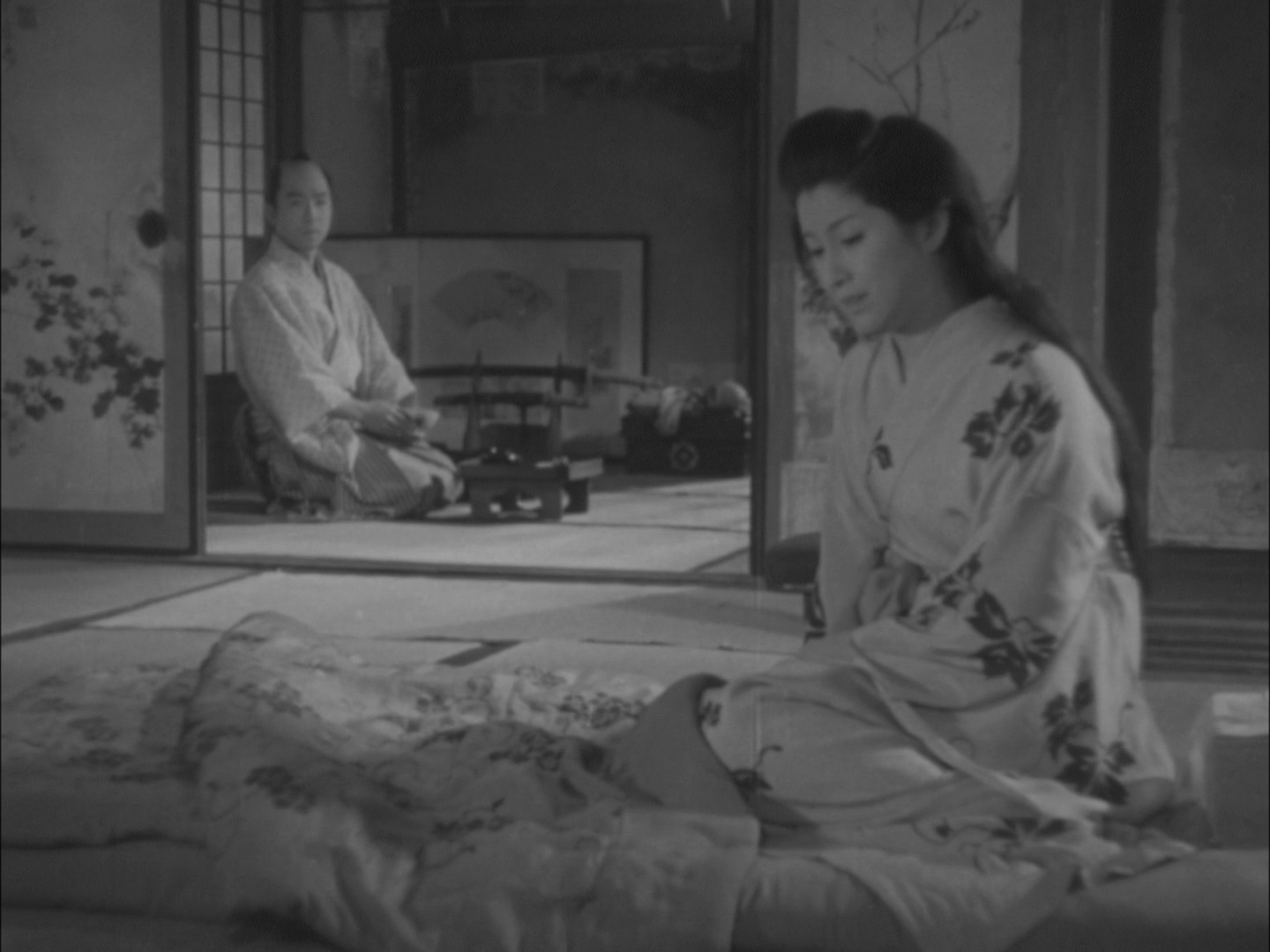
The film is both coy and somewhat transgressive in its depiction of the growing sexual tension between Okuni and Gohei from his taking hold of her injured foot and tender care for her when she falls ill, to the way they draw closer and then instinctively move apart. Passion later gets the better of them and it’s heavily implied that they sleep together, but Gohei instantly regrets it and cannot accept his class transgression. Given this development in their relationship, Okuni asks him to stop calling her “madam” but as she does so she is on one side of the fusuma and he on the other, so they remain in separate rooms divided by the ridge in the tatami. Gohei cannot let go of the old ways and is desperate to complete their quest so that his debt to Iori will be repaid and he can return in glory to be rewarded with position and the esteem of being a true samurai. Even if he tells Okuni that this quest has been his happiness in being on the road with her and knows that killing Tomonojo will end it, he does not turn back.

But the implication is that they can never escape Tomonojo who will, in fact, forever be following them. He taunts the pair with his shakuhachi and visits them in disguise. When they catch up to him, he tries again to convince them to give up their quest and live quietly together in a place free from the constraints of the samurai world, but Gohei cannot do it. Okuni first picks up her dagger and one wonders whether she about to use it on herself, but then turns on Tomonojo though it’s uncertain whether she now does so out of resentment or as revenge of herself for the way Tomonojo has again ruined her life. Just as she was a pawn of her father married off against her will to an indifferent man, she is further imprisoned by patriarchal social codes as Tomonojo needles Gohei that he had slept with her before her marriage. She has in fact already confessed to this to Gohei who transgressed by asking her what exactly Tomonojo was doing with his “shakuhachi” when they were courting, though she did so obliquely in telling him to remember his place and that he should “forget about the past.” Nevertheless she denies it now, but Gohei continues to see her as a “loose” woman with Tomonojo’s words ringing in his ears as a final revenge on the morally compromised lovers.

Their inability to let go of the quest, to do as Okuni suggests and continue on as they are along the rough and difficult path to a more egalitarian future spells their damnation. You can’t go back again. Their “home” is already lost to them. As a pedlar tells the pair along the way, they’ve already been forgotten and the village is filled with other gossip, but now they really have nowhere to go. The message may be for the coming post-occupation era that they shouldn’t try to turn back but keep moving forward into the new Japan or else risk becoming lost in a purgatorial world of confusion like Okuni and Gohei haunted by the choice to betray love for the outdated ideal of samurai honour. Haunted alternately by Tomonojo’s shakuhachi and the words of the villagers who told them they couldn’t be accepted until they fulfilled this quest, they find themselves displaced, unbalanced and uncertain amid the shifting power dynamics of class and gender, their duty and their feelings, but ultimately trapped by their cowardice in their unwillingness to cross the threshold to claim their freedom and happiness.


Lightning (稲妻, Mikio Naruse, 1952)

In many ways despite its matter of fact bleakness, Lightning (稲妻, Inazuma) is among the more optimistic of Mikio Naruse’s films ending on a note of cheerfulness and hope in which the storm has been broken and the heroine seems to have rediscovered a sense a faith in humanity. Yet the attitudes she displays are often contradictory and firmly at odds with the kind of Shitamachi spirit one might find in the films of a director such as Yoji Yamada in films like The Sunshine Girl released a decade later.

The qualities that most define Kiyoko (Hideko Takamine) are, as her mother Osei (Kumeko Urabe) suggests, an inner strength that eludes her older sister Mitsuko (Mitsuko Miura) and a forthrightness that sees her struggle to pursue the kind of life she wants rather than that she is expected to lead. Yet some might see her as snobbish and judgemental, at times attacking her mother for having married four times and given birth to four children each with different fathers. In this she sees a particular moral failing on the part of Osei, but perhaps also expresses a deeper distrust in her mother’s repeated attempts to find stability only through harnessing herself to a man. 

Echoing Takamine’s role in Hideko the Bus Conductor, Kiyoko has a job as a tour guide showing off the sites of bustling Ginza though explaining that this part of the city only really comes alive at night. The job gives her a sense of independence and self-sufficiency a woman in this era is not really permitted to have. Her oldest sister, Nui (Chieko Murata), asks if she contributes to the household but the meeker Mitsuko replies that she wanted to but they told her to save her money instead. In any case, it’s towards marriage that she’s pushed when Nui attempts to play matchmaker brokering an engagement with a 35-year-old baker, Goto (Eitaro Ozawa), who has aspirations of opening a love hotel into which Nui and her feckless husband Ryuzo (Kenzaburo Uemura) have invested. Of course, it turns out that Nui is herself having an affair with the baker who is oily in the extreme and disliked by most of the family though eventually manages to make his way into the beds of two of the sisters.

Kiyoko has little desire to marry and asks her mother if any of her four marriages made her happy, but her mother only says that happiness is not an important concept hinting the hardship she’s faced in her life and that a woman of her generation may have had to put up with a certain of degree dissatisfaction to keep a roof over her head and food on the table. While working on the bus, Kiyoko spots Mitsuko’s husband talking to another woman in the street but decides to say nothing only for him to suddenly die and the woman turn up with a baby asking for financial support. Kiyoko tells her sister that marriage is hell, but she smiles and says Kiyoko will be the exception in an expression of the various ways in which women enforce these arcane social codes against each other despite their own misery. Mitsuko too wants to escape but admits she doesn’t have Kiyoko’s courage which is how she too eventually falls into the clutches of Goto much to her sister’s disappointment. 

There is something undeniably poignant in Kiyoko’s frustrated defiance, looking longingly at the paintings and books of their lodger, a young woman from a more middle-class family working her way through university. Kiyoko says she wants to study too, but her mother shoots her down. She’s already 23, and it’s a little late to be picky about marriage let alone strike out for a more stereotypically middle-class life with a white collar job and nice house in the suburbs. It’s the suburbs though to which she eventually moves, without even bothering to tell any of her family. When the nice landlady asks if she has any she admits she has but also has nothing to do with them, which earns her a confused frown. She later says something similar to the pair of piano-playing siblings who live next-door in a kind of suburban utopia, quite clearly ashamed of her humble Shitamachi roots and family members she sees as common and immodest.

In any case, her admiration of the siblings and obvious attraction to the brother (Jun Negami) who is so much more sensitive and caring than her own (Osamu Maruyama) who appears to use the wartime bullets lodged inside him as an excuse not to move on with his life, suggest that she is still in the end looking for a conventional family only one she sees as more positive (or just posher). Perhaps it’s not so much marriage she rejects but dependency and subjugation, believing a marriage to a man like this might be one more of love and equality than the dissatisfying relationships experienced by her mother and sisters. The expressionistic bolt of lightning which appears during a difficult conversation with her mother is like the breaking of a storm, a kind of letting go in which her resentment begins to melt away and her mother agrees to retreat realising that unlike Mitsuko she can take care of herself and to that extent at least is an independent post-war woman. Ambivalent, but in its way warm and forgiving the film gives Kiyoko permission to embrace her aspiration, defy the social codes which constrain her and seek her own happiness, but also allows her to shed her cynicism in rediscovering a faith in humanity and re-embracing her admittedly imperfect mother all while leaving her behind. 


Flowing (流れる, Mikio Naruse, 1956)

The denizens of a moribund geisha house contemplate visions of independence in post-war Japan Mikio Naruse’s thriving ensemble drama, Flowing (流れる, Nagareru). There is indeed a flowing through the geisha house, a tumble of comings and goings though mostly connected to money which is itself constantly flowing though the for geisha mainly in the wrong direction. Released in the year of Prostitution Prevention Law, the film casts a shadow over the lives of these women who are unwittingly living in their industry’s twilight but asks if it’s really possible for a woman to survive without a man while each of them is in one way or another badly let down by an inconstant lover. 

We’re constantly told that Tsutanoya is the most respectable geisha house in town yet despite its well appointed interiors, it’s clear that business is not good. As the film opens, a young geisha, Namie, is accusing the owner’s daughter Katsuyo (Hideko Takamine) of diddling her on her pay. Katsuyo acts indignant and tries to shift the blame back onto Namie but later admits that the house has indeed been skimming a little more off their wages than was agreed claiming all the geisha houses do it which is probably true but doesn’t make it right. In any case Namie will eventually quit and end up working at “some third rate place” while her uncle (Seiji Miyaguchi) causes problems for proprietress Tsuta (Isuzu Yamada) complaining that Namie was exploited and wanting both the backpay he feels she’s owed and compensation though it seems unlikely any of that money is finding its way back to Namie. Meanwhile the house is a geisha down with only former office worker Nanako (Mariko Okada) and 50-year-old veteran Someka (Haruko Sugimura) on the books.

Despite their financial situation, Tsuta hires a new maid, Rika (Kinuyo Tanaka) who is immediately renamed “Oharu” on her arrival. Oharu is a salt of the Earth type, infinitely capable, maternal, kind and loyal bringing a much needed sense of stability to the ever flowing geisha house while also fascinated by this exotic and arcane world. But then as Tsuta cautions her geisha houses may look glamorous from the outside but the life inside them isn’t always fun. Oharu runs into trouble on her first trip to the grocers when they inform her Tsuta hasn’t paid her tab and they can’t let her add to it until she does. A 45-year-old widow whose only child died a year previously, Oharu is also trying to live an independent life, a conflicted Tsuta struck with wonder at her ability to survive without a man, but may also have struggled, grateful to have been offered the job which others might have declined because of the stigma towards the sex trade as finding employment as a middle-aged woman is near impossible. 

At the film’s conclusion even she may imply it isn’t really possible to live as a woman without some kind of support or losing one’s humanity suggesting that she may return to her husband’s hometown and the family she claims not have gotten along with after learning of Tsuta’s betrayal at the hands of an old friend and former geisha, Ohama (Sumiko Kurishima), who at any rate seems to be living quite well as the proprietress of a restaurant. Traditionally, the profession of geisha was seen as a kind of independence in itself but it’s also one that by its nature is reliant on men. Tsuta is often described as someone who is not able to do anything else yet is highly skilled at music and dance having spent a lifetime in training. Without a patron she is stuck and as we learn she threw hers over to pursue a man she loved but he left her in the lurch having mortgaged the geisha house to invest in his business by taking a loan from her older sister who seems to have a nice sideline as a polite loan shark also having loaned money to Someka. 

The most outwardly cheerful, Someka is in other ways a dark vision of a geisha’s future surviving on nothing but nihilistic hedonism while apparently living with a much younger man who eventually leaves her to marry into another woman’s family. Katsuyo has rejected the geisha life explaining that she is unable to, as Nanaka puts it, say silly things to men in order to earn her keep and is essentially incapable of ingratiating herself with men she doesn’t like. She claims she has no desire to marry, unconvinced that any man would be interested in a geisha’s daughter while certain that for a man marrying into a woman’s family is humiliating while suggesting the same would be true for her. Putting her faith in industry, she buys a sewing machine and sets about figuring out how to use it less because she envisages being able to support herself and her mother through taking in needlework than she just wants to feel as if she’s doing something. 

Meanwhile, Tsuta’s niece Fujiko observes all the comings and goings of the geisha house learning the traditional arts in preparation for a future which will soon be obsolete. In a typically Narusean touch, Tsuta comes to a resolution about her future and envisages a new beginning for herself but is unaware the rug is soon to be pulled from under her by the underhanded capitalist Ohama who plans to turf her out to turn the geisha house into another restaurant. “My days of seeking favours from men are over,” Tsuta admits, not of her own volition but simply understanding that she no longer has access to that kind of independence though in essence surrendering her autonomy in leaving herself to the mercy of Ohama in order to escape her older sister’s control. Someka had laughed raucously at Katsuyo’s insistence that she need not be dependent on a man (and after everything she’s seen why would she want to be?) but the younger woman is undeterred even as we see her struggling, doubting that her efforts will in the end be enough to win her her freedom. Ever the optimist, Tsuta is perhaps doing something similar but even Oharu is considering giving up and going home, too good to survive in the dog eat dog world of the contemporary capital where the flow of currency is the lifeblood of the city implying that perhaps the answer to her question is no, a woman can’t survive alone, nor can she rely on female solidarity, but she’ll have to try anyway because there is no other choice. 


The Wind Blows Twice (風ふたゝび, Shiro Toyoda, 1952)

Struggling with the end of her marriage, a young woman finds herself listless yet considering new possibilities in Shiro Toyoda’s The Wind Blows Twice (風ふたゝび, Kaze Futatabi). Adapted from a serialised novel by Tatsuo Nagai, the title is echoed in a remark from one of two potential suitors that youth is something that can come two or even three times so as long as you remain young at heart. They are each, however, each currently frozen and unable to move forward in the wake of their personal traumas. 

Kanae (Setsuko Hara), it seems, married for love but her husband has apparently been arrested for some kind of corruption. She has severed all ties with him and returned to the house of the uncle and aunt who raised her after her mother’s death where she helps out in their shop. Meanwhile, she learns that her semi-estranged father Seijiro (Ken Mitsuda), a university professor who lives in Sendai and hasn’t been in contact despite his daughter’s difficult circumstances, collapsed on the steps of the local station and is being cared for by a former student, Miyashita (Ryo Ikebe). She travels to look after him and becomes closer to Miyashita, who currently works as an auctioneer and has dreams of becoming a greengrocer, but is perturbed to learn that her father is a suspect in the theft of 10,000 yen from the wallet of a wealthy man, Michihara (So Yamamura), who carelessly left in the toilet and discovered the money missing when he went back to pick it up. Worried that the rumour may damage her father’s career, Kanae goes to apologise and find out what’s going on but Michihara tells her not to worry and it was his own fault anyway but his sudden magnanimity seems suspicious. In any case, Kanae later tells her friend Yoko that Michihara frightened her, also remarking to Miyashita that she felt as if she managed to slip away from him as she made her escape.

Though he later turns out to be sympathetic, Michihara appears as the villain of the piece. He thinks Kanae reminds him of his late wife and intends to ask her to marry him one the seventh anniversary memorial service is concluded. He starts using his wealth and power to gently interfere in her life, setting up a job for her on hearing that she’d been looking for employment and later approaching her father with the idea of investing in his research into the use of fluorides in the production of resin. Despite her initial dislike of him, Kanae goes along with everything and is soon sucked into Michihara’s world while otherwise wilfully oblivious of his feelings for her (which she does not share) and hoping he’ll help her convince Miyashita that he ought to return to science and help her father with his research which would obviously pave the way for them be together romantically.

The problem is that like Kanae Miyashita has become frozen inside, scarred by his wartime experiences and soured on science. Yet just as staying with him restores Kanae’s spirit and encourages her to want to look for work and find purpose in her life, her influence on him reawakens his passion for scientific research only he is less happy about it than she was. The interest that’s sparked in him ironically lies in the frozen north, travelling to Hokkaido to see an old friend and researching how to prevent potatoes from freezing in order to improve people’s quality of life. In essence it seems as if the futures they may want are too different. Now much more cheerful and energetic, Kanae genuinely enjoys her work in broadcasting and is less than keen to give it up and move to rural Hokkaido to help Miyashita study potatoes while secretly hoping she can convince him, with Michihara’s help, to become a respectable academic like her father and live a nice middle class life researching things that are more useful to industry and big business than to regular people.

Miyashita is disinclined to do so. He bounds straight off a train to see her with three day stubble from the journey, only to be disappointed witnessing in her in an elaborate kimono with her hair constrained in traditional style while Michihara is there waiting to see him to discuss a job offer from Seijiro. It’s at this point that he seems to decide his romantic desire for Kanae is most likely futile and she has chosen the rarified world of Michihara rather a rustic and homely life with a man like himself. Of course, this makes it sound as if Kanae doesn’t have much choice at all herself and to an extent she doesn’t or at least she feels backed into a corner while her aunt pressures her to remarry, unbothered to which man but excited about the proposal from Michihara because it means she will enjoy a life of uninterrupted financial comfort.

Having chosen her own suitor and seen things go drastically wrong also increases her aunt’s conviction that she shouldn’t make the same mistake again while she too is perhaps wary of remarrying. In any case. Kanae seems to want work and enjoys her job in broadcasting as much as she’s naturally drawn to Miyashita who brings out in her a greater desire to live while Michihara only seems to want her to be a shadow of his late wife suggesting that to marry a man like that may itself be a kind of death sentence. To that extent, the choice Kanae makes involves a predicable sacrifice, but still in any case it is a choice that she makes for herself to strike out for happiness and fulfilment of her own choosing rather than allow herself to be railroaded by conventionality unable to express her own desires.


A Wanderer’s Notebook (放浪記, Mikio Naruse, 1962)

Many of Mikio Naruse’s most famous films are adapted from the work of Fumiko Hayashi, a pioneering female author who chronicled the life of a working class woman with startling frankness. Yet his dramatisation of her life, A Wanderer’s Notebook (放浪記, Horo-ki), is both a little more reactionary than one might have expected and surprisingly unflattering even in the heroine’s eventual triumph in escaping her poverty through artistry. Even so if perhaps sentimentalising the economically difficult society of the 1920s in emphasising the suffering which gave rise to Hayashi’s art, the film does lay bare the divisions of class and gender that she did to some extent transgress in pursuit of her literary destiny. 

Naruse and his screenwriters Toshiro Ide and Sumie Tanaka bookend the the film with a literal “lonely lane” which the young Fumiko walks with her itinerant salespeople parents. As a small child, she sees her father arrested for a snake oil scam peddling some kind of wondrous lotion, setting up both her disdain for men in general and her determination not to be deceived by them at least unwittingly. She has no formal education but is a voracious reader well versed in the literary culture of the time and intensely resentful of if resigned to her poverty. In the frequent sections of text which litter the screen taken directly from her novels, she details her purchases, wages, and longing for the small luxuries she can in no way afford. 

As an uneducated woman in the 1920s her working opportunities are few. She exasperatedly relates standing in a queue with hundreds of other women waiting for an interview for a company job only to be told they’ll let her know, while her other opportunity involves meeting a theatre director at a station who later takes her to his hotel/office and makes it plain he’s not really interested in her CV. She gets a job at the office of a stockbroker, but lies about being able to do accounts and is flummoxed by double entry bookkeeping getting herself fired on day one. After a brief stint in factory painting toys, she leaves with a friend to become a hostess but is also fired on her first day for getting drunk and being unwilling to ingratiate herself with the boorish men who frequent such establishments. 

Despite her animosity, she is drawn towards men who are callous and self-involved, firstly taking up with a poet and actor who praises her work but turns out to have several “wives” on the go, and then begins living with a broody writer, Fukuchi, who is insecure and violent, resentful at her success in wake of his failure. Perhaps because of her experiences, she seems to resent any hint of kindness though sometimes kind herself, lending money to her friend whose mother is in need and often ready to stand up for others whom she feels are being mistreated. A kindly widower in the boarding house where she lives with her mother, Yasuoka, falls in love with her but she repeatedly rejects him partly as someone suggests because he is not handsome, but mainly because of his goodness and kindness towards her. Nevertheless, he continues to support always ready in her time of need though having accepted that she will never return his feelings or accept his proposal. 

Perhaps her might have liked to have been kinder, but was too wounded by her experiences to permit herself. In any case at the film’s conclusion in which she has achieved success and in fact become wealthy it appears to have made her cold and judgemental. She instructs her maid to send a man away believing he is from a charity set up to help the poor, insisting that the poor must work for industry is the only path out of poverty implying that as she managed it herself those who cannot are simply not applying themselves when she of all people should know how fallacious the sentiment is. As if to bear out the chip on her shoulder, she forces her mother to wear a ridiculous kimono from a bygone era that is heavy for an old woman and makes her feel foolish because of her own mental image of the finery she dreamed of providing her on escaping the persistent hardship of their lives. 

As she says, she’s no interest in the socialist politics espoused by the literary circles in which she later comes to move, pointing out that the poor have no time for waving flags. One of her greatest supporters is himself from a noble family despite his progressive politics and in truth can never really understand the lives of women like Fumiko. He describes her work as like upending a rubbish bin and poking through it with a stick, at once fascinated and repulsed by a frankness he may see as vulgar. At one point he accuses her of writing poverty porn, playing on her humble origins for copy and becoming something of a one note writer. 

In truth, the film is not really based on the novel from which it takes its title but on the play that was adapted from it, while the novel itself was apparently reworked and republished several times in response to reader taste giving rise to a series of questions both about its essential authenticity and what it was that it was attempting to convey. In the film at least, moments after her literary success, Fumiko is challenged by a fellow female writer, Kyoko, who was once her love rival, that she cheated in a contest by failing to submit Kyoko’s entry until after the deadline had passed, though as it seems she would have won anyway. She is occasionally underhanded, perhaps because she feels she has no other choice, but then as we can see there is no particular solidarity between women save the kindly landladies who often let her delay her rent payments. Fumiko feels herself to be alone and her quest is not really for literary success but simply for her next meal, though she feels the slights of the bitchy women and arrogant men who mock her commonness while simultaneously exploiting it as entertainment. 

On the one hand, her success seems to signal a triumph of independence having freed herself from the need to depend on terrible men though she also she seems to have met and married a warmhearted painter who cares for her and supports her work while she has also been able to give her mother the level of comfort they both once dreamed of. Even so, the unavoidable fact that she dies at such a young age implies she’s worked herself into an early grave in a sense punishing her for her rejection of contemporary social norms undercutting her achievements with some regressive moralising while the one thing she still desires, rest, is given to her only in death. In Takamine’s highly stylised performance, as some have implied perhaps intended to mimic the silent screen, Fumiko is at once a carefree young woman who dances and sings and a melancholy fatalist with a self-destructive talent for choosing insecure and self-involved men, but above all else a woman walking a lonely road towards her own fulfilment while searching for a way out of poverty that need not transgress her particular sense of righteousness. 


Original trailer (no subtitles)

The Target of Roses (薔薇の標的, Kiyoshi Nishimura, 1972)

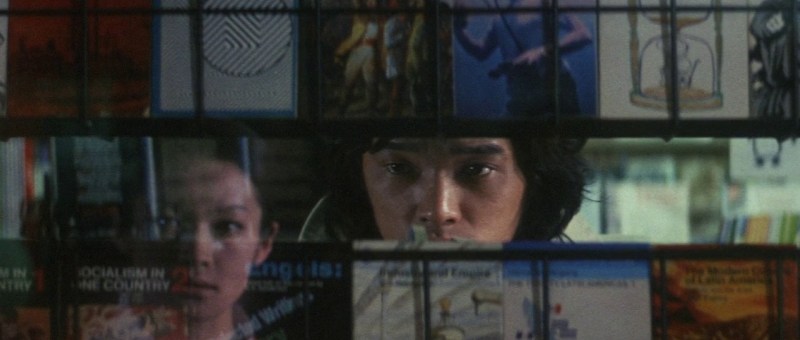
One of a series of internationalist conspiracy thrillers arriving in the early 1970s, Kiyoshi Nishimura’s Target of Roses (薔薇の標的, Bara no Hyoteki, AKA Red Target) finds itself at a particular moment of paranoid anxiety. In the immediate wake of Asama-Sanso, its villains are a band of revolutionaries hiding out in the mountains behind the shield of “New Religion” as they plot the over throw of the state. Yet these villains are not left-wing former student protestors but Nazi holdovers branding themselves as the “Fourth Reich” while insisting that they are not “fascists” but merely trying to create a new world order free of “corrupt governments”. 

The hero, Akira, in keeping with similar roles Yuzo Kayama played in this period, is a former Olympic sharpshooter who fled to America after being implicated in the death of a teammate. You can tell that things haven’t been going well for him by the terrible mutton chops haircut he is forced to wear throughout the film, but his problem seems to be that he has lost all interest in living. That’s one reason he’s recruited by the Fourth Reich’s local leader Tachibana who theorises that Akira is a man who lives for the gun and is good as dead without one. He and his one-eyed associate Nomura (Toby Kadoguchi), a former sharpshooter himself, begin training him with various strange exercises never revealing their true purpose until asking him to shoot a prisoner they’ve tricked into trying to escape from their secret base. Realising the target is human Akira refuses but then changes his mind shooting the man at much closer range as he runs through a forest. 

Meanwhile, foreign photographer Robert (Ralph Jesser) and his assistant Ling Ling (Taiwanese actress Chen Chen) accidentally end up finding the secret camp after becoming lost in the forest, Robert returning later to investigate and take more photos. Akira is then sent to Hong Kong where the pair have travelled to visit the grave of Ling Ling’s brother, a war photographer killed by a landmine in Laos, in order to take out Robert before he exposes their operation in the newspapers. Never asking any questions of his new job, Akira is unexpectedly moved on seeing Ling Ling’s distress over Robert’s body, later striking up a relationship with her when she too becomes a target for the Fourth Reich. 

In a surprising contrast to similar contemporary crime thrillers, Hong Konger Ling Ling represents a kind of innocent beauty as symbolised in her interest in photographing flowers rather than the war zones covered by her brother. At one point she and Akira are even seen tiptoeing on the railway tracks just like innocent lovers only for Akira to then reflect on the sight of an obsolete steam train likening it to himself, abandoned and destined to be torn to pieces. His love for Ling Ling gives him new reason to live, breaking the nihilistic spell which he claims had led him to want to destroy everything. To that extent Tachibana is correct when he says that Akira has no interest in the future of mankind, but he has become determined to preserve the world of two which exists between himself and Ling Ling which leads him to oppose The Fourth Reich, of whose activities he had been previously ignorant. 

It has to be said that Nishimura’s repurposing of Holocaust imagery, the failed “trainees” of the Fourth Reich’s re-education programme driven to vacant madness and piled up on wooden bunk beds later to be gassed and burned on mass funeral pyres, may be a little inappropriate in its accidental flippancy. Nomura’s claim that the Fourth Reich is not a resurrection of fascism is somewhat disingenuous even if they seem to have no other ideology than their weird super soldier brainwashing programme designed to create some kind of new society, later suggesting that the conspiracy already has assets within the Japanese government. Yet Akira is indifferent to fascism, as Tachibana had framed him a man of the gun born only to pull a trigger a function he later uses in order to convince him to destroy himself. Often marred by overly theatrical dialogue rendered in sometimes awkward English which plays much less well than it might in Japanese, Target of Roses remains a little on the pretentious side despite Nishimura’s characteristic artistry but nevertheless embraces its nihilistic philosophy in the vast emptiness of its internecine conclusion. 


The Petrified Forest (化石の森, Masahiro Shinoda, 1973)

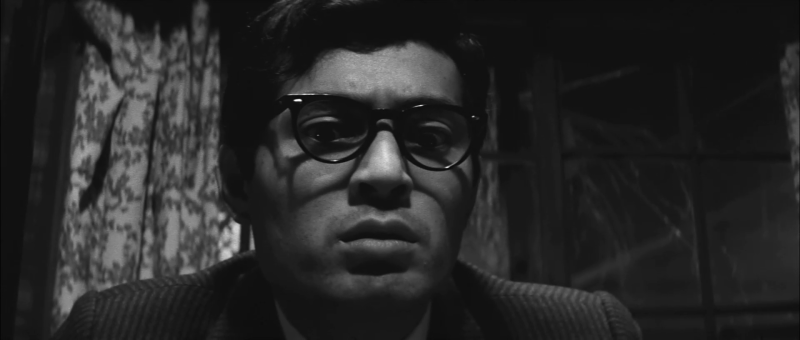
An angst-ridden medical student wrestles with truth and responsibility while drawn into a toxic relationship with a childhood friend and trying to avoid the estranged mother he resents in Masahiro Shinoda’s dread-laden melodrama The Petrified Forest (化石の森, Kaseki no Mori). Based on a novel by Shintaro Ishihara who later became a very conservative mayor of Tokyo and made his name with a series of “Sun Tribe” novels centring on the nihilistic hedonism of wealthy post-war youth, Shinoda’s noirish drama paints contemporary Tokyo as a duplicitous place in which hate is the only possible emotion and self-delusion the only path out of existential loneliness. 

Haruo’s (Kenichi Hagiwara) first conflict, however, is with the medical profession. He objects to the old-fashioned methods of his professor, Miyaji (Torahiko Hamada), who adopts the position of the physician as god only giving his patients the information he thinks they should have rather than the truth. A young boy, Kazuhiko (Masami Horiuchi ), is brought in with an aggressive brain tumour. Given how how quickly it regrows, there is a possibility that the boy cannot be cured while operating will likely mean he will lose his hearing. Though Miyaji knows all of this, he continues to give false reassurance to the boy’s mother, Kikue (Masako Yagi), even after making a snap decision on the table to excise the tumour knowing it will leave him deaf telling her that her son’s hearing might come back in time. Pressed for an answer, Haruo gives her the more honest prognosis that it “might”, “if he’s lucky”, but resents himself for “lying” knowing that Kazuhiko will be deaf all his life and the tumour may still recur. One of the reasons he wants Miyaji to tell the truth is so that the family can accept the situation and start working on the best ways to help Kazuhiko adjust, but Miyaji refuses to explain and in fact threatens to fire him if he won’t do as he’s told.

This resistance to a male authority figure might explain why he identifies so closely with childhood friend Eiko (Sayoko Ninomiya) now in Tokyo working at a barber’s offering male beauty treatments. Eiko is being sexually harassed by her middle-aged boss who is jealous and possessive. At one point she claims that he beat her and locked her up in a cupboard for two days after she told him she had slept with Haruo. The pair agree that he boss needs to die, rebelling against his corrupt and patriarchal authority. ”When you hate you must hate all the way” Haruo insists, explaining that the human race is “petrified”. They can only hate and loathe and lie to themselves in order to bear it. Haruo suggests they’ll eventually come to hate each other, but Eiko is certain that he’s her one exception though as will be revealed hate is eventually where they will end up. 

Fascinated by a high tech pesticide supposedly discovered by the Germans while they were testing poisonous gases but perfected by Japan Pharma, Haruo decides to use it poison to Eiko’s boss suggesting she put it in nail varnish and offer him a manicure. But once the deed is done he finds himself conflicted, unable to live with himself as a murderer which he now is seeing as he was present and applied the gauze soaked in the poison to the boss’ face while “treating” him after he had been “taken ill”. He distances himself from Eiko who irritates him by bringing over her hoover, somehow confused by her intention to move in now that they are married not least by their crime. Eiko, however, allies herself with his estranged mother Tatsuko (Haruko Sugimura) who is desperate to live with Haruo as it turns out by any means possible. 

There is an undeniable whiff of misogyny in the depiction of the two women, Eiko less damsel in distress than wilful manipulator and Tatsuko a classic overbearing mother though one apparently indifferent to her other two children including an apparently doting younger son. Haruo is caught between the two while otherwise drawn to Kikue in part because of her relationship with her son laying bare the apparent mother complex which defines his life as Eiko eventually points out calling him a coward who secretly craves his mother’s approval. Haruo’s resentment towards Tatsuko stems from having caught her with another man, his reaction both sexual jealously and puritanism unable to forgive for the transgression of adultery. Yet history later repeats itself, Kazuhiko who is at that point deaf walking in on Haruo and his mother. Haruo hugs him and covers his eyes only for the boy to later lose his sight and Kikue to go out of her mind wailing that she has destroyed her son through her sexual transgressions. 

Kikue had taken Haruo to a strange cult where she hoped Kazuhiko would be cured though he wouldn’t enter the church and later got into a conversation with the monk who is a former doctor but now believes medicine is a con because it cannot offer you salvation tacitly agreeing with Haruo’s assertion that doctors too are dishonest. This tendency to hate has rendered everyone lonely, Tatsuko’s daughter reminding her that she is lonely too even with her husband and children while Tatsuko later cruelly uses Eiko’s loneliness against her as a tool of manipulation. “Eiko trusted me too much” she explains, her attempt at female solidarity and forging a bond through their shared desire to possess Haruo obviously failing to overcome Tatsuko’s matriarchal machinations. The eerie blue colour of the poison vial, mirrored in the nebuliser forever used by Tatsuko, seems to loom behind them as a reminder of human loathing while mother and son are frequently caught in multiple mirrors in an echo of their duplicity yet in the end as Tatsuko says they share the same sin and it seems Haruo will never really be able to escape the matriarchal net.


Portrait of Hell (地獄変, Shiro Toyoda, 1969)

Asked to paint a vision of heaven, an artist replies that he cannot because he sees it nowhere in this present society. “Over my body and my life, you have absolute authority. But you can never command my artist’s soul,” he spits back at his corrupt lord, but in many ways the lord can command his soul as an artist for he creates the world he reflects for all that he attempts to manipulate him as a man and one he assumes to be far inferior to himself. 

Shiro Toyoda’s adaptation of the classic horror story by Ryunosuke Akutagawa, Portrait of Hell (地獄変, Jigokuhen) opens with a brief voiceover narration that explains that this story takes place almost 1000 years ago in the Heian era when the Fujiwara clan was at the height of its power. But after so long at the top of the tree, the Fujiwara have become both restless and indifferent in their complacency. “The common people live lives of hopeless despair,” the narrator explains outlining the Fujiwara’s inability to govern as even minor natural disasters give rise to famines and corpses litter the streets. Even nobles now live “lives of perpetual dread” having gained a sense of their own impermanence. 

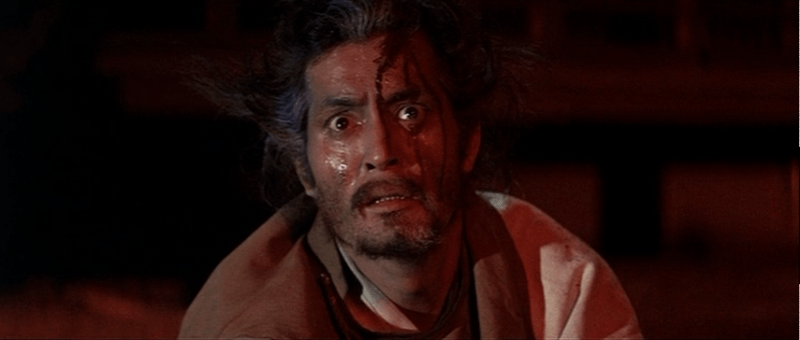
Lord Horikawa (Yorozuya Kinnosuke) is however seemingly oblivious to the suffering of his people. Yoshihide (Tatsuya Nakadai), a Korean painter, tells him that his problem is everyone tells him what he wants to hear (because they fear for their lives) rather than what is actually happening. During the opening sequence, Horikawa had abruptly decided to leave a public celebration. An old man appeals to some of the guards for money, but they roughly beat him and he is later trampled to death by Horikawa’s frightened bull which had become loose during a storm. The old man dies cursing him, exclaiming that “he has treated us like slaves. I have become no better than an animal.” Horikawa had been told that the man used his last dying breath to remark on what an honour it was to be trampled by the lord’s bull. Yoshihide paints a picture that drives a court lady out of her mind featuring the corpse of the old man under a cherry tree that seems so vivid to her that it emanates a stench of death. Horikawa doesn’t like it much either, and its uncanny realism unsettles his mind. He thinks he sees the ghost lying in wait for him in his own bed and orders Yoshihide to dismantle the painting as if that would make the ghost disappear. 

Horikawa believes the “ghost” is a manifestation of Yoshihide’s rage rather than his own guilt or incompetence. Yoshihide certainly does not like the world the lord has made, replying that he has seen hell everywhere in the cities and the villages while there is no heaven to be had which is why he cannot paint it. Yet Yoshihide and the lord are almost perfect mirrors of each other. Yoshihide is also rigid and superior. He prides himself on being Korean, pointing out that the foundations of the court and of modern learning were all brought over by Korean scholars even if Horikawa claims to have “improved” upon them. Yet some of his fellow painters worry that the style their Korean ancestors worked so hard to perfect has been eclipsed by Japanese influence while secretly considering returning to Korea which has now become prosperous unlike the conditions in Japan. 

Horikawa later slips and calls Yoshihide a stupid “foreigner” making plain his contempt despite describing him as the greatest artist of his generation which is why he’s commissioned this piece of art in the first place even though he had described all of his previous pieces “ugly” while objecting to their attempt to show him how rotten his kingdom has become. Yet Horikawa is correct when he says that it’s Yoshihide’s “infernal arrogance” that has provoked his downfall. Having caught his daughter Yoshika (Yoko Naito) with one of his pupils, he locked her in a shed and exclaimed that no other man would have her. If he had not done so, she may never have come to the attentions of the lord and suffered her eventual degradation at his hand, nor would Yoshihide have been so easily manipulated into a obsessive desire to effectively depict the depths of hell. 

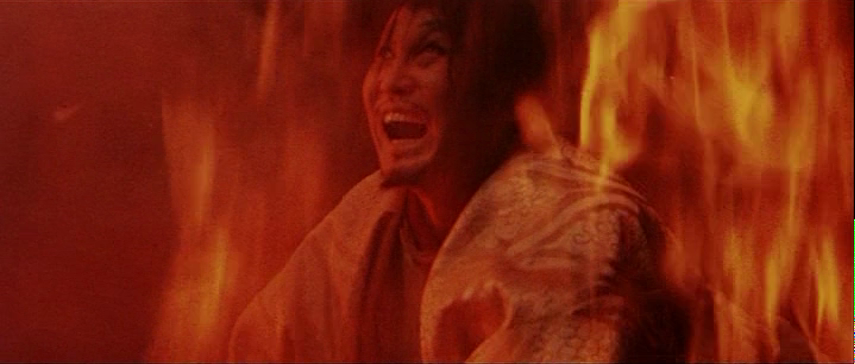
Yoshihide is some kind of method artist who insists he can only paint what he sees. Thus he goes to great lengths to observe hellish cruelty, tying up an apprentice boy in chains and torturing him with snakes, his eyes burning with a fiery intensity. His tragedy is that he comes to realise that the painting reflects not the world but himself. He is hell, hell is here. While his daughter burns, he looks on impassively only to be outdone by her pet monkey who in a gesture of selfless love leaps into the flames. Even so, Horikawa praises the finished painting as a masterpiece, “an impressive depiction of the hell that is our life,” commenting somewhat ironically on the current conditions within his fiefdom. Only latterly does he notice his own role within it, suddenly consumed by his hellishness as if dragged own into the flames despite himself. 

Toyoda shoots in the manner of a classic ghost story, making fantastic use of ghostly effects as Horikawa finds himself haunted by the spirits of those he’s wronged. At times, the screen fills with red light as if soaked in blood or baked in the hellish glow of slow burning flames. He flips between the icy blues of Horikawa’s estate, and the stifling ochre that seems to surround Yoshihide who does after all feed off all this strife rather than seeking to cure it. The two men end up in an impossible game of brinksmanship from which neither can back down, two “arrogant” rivals blindly creating a hell for those around them through their selfishness and vanity. “Life is more hellish than hell itself” runs a final quote from Akutagawa, laying bare the tale’s essential irony in our inability to recognise the hell we create for ourselves and others through our own arrogance and fear.


Beast Alley (けものみち, Eizo Sugawa, 1965)

In the opening title sequence of Eizo Sugawa’s Beast Alley (けものみち, Kemonomichi), a thick blob of inky blackness gradually expands over an aerial view of the city until it obscures it entirely. The title card which then appears is written in plain white, but will reappear at the film’s conclusion this time ashen as if it too had been singed by the deeply ironic flames with which the film ends. Based on a novel Seicho Matsumoto and scripted by The Beast Shall Die’s Yoshio Shirasaka, the film similarly takes an incredibly cynical view of the modern post-war society in which it is revealed the militarists are still basically in charge and presiding over a deeply corrupt social order. 

The big bad, Kito (Eitaro Ozawa), says as much when he states the need for reforming the nation’s “rotten political system” by which he means post-war democracy. Kito made his made his money doing deeply dodgy things in Manchuria in addition to running an exploitative coal mine in Japan. Now mainly bedridden, he basically runs the country as a far-right political fixer working in tandem with big business and the yakuza who have traditionally been big supporters of conservative and nationalist forces. Early on we see one of his underlings negotiating with politicians to ensure that Taiyo Roads will be hired be hired for a large scale construction project planning to put highways all the way through Tokyo. As we later discover, he’s prepared to go to great lengths in order to achieve his goal, going so far as to have a sex worker murdered to implicate the uncooperative CEO of a rival construction film into resigning by threatening to frame him for the crime so they can install their stooge in his position. 

It’s into this world that everywoman Tamiko (Junko Ikeuchi) is drawn while working as a hotel maid at a traditional Japanese inn. Trapped in a bad marriage to a man who is also bedridden yet still attempts to rape her when she returns home to find him in bed with the housekeeper, Tamiko longs for escape and is therefore ripe for the picking when approached by Kotaki (Ryo Ikebe), the manager of an upscale Western hotel, to join him in an unspecified enterprise which will apparently make her very rich. The only catch is that she will have to “get rid” of her “dependent”, which she probably wanted to do anyway, by burning down her house with him inside it. Once she’s done this, there is no turning back for her even if she had not developed complicated feelings for Kotaki who is both her salvation and damnation. 

Tamiko’s husband had failed to give her the comfortable life that he had promised, something which she thinks Kotaki can deliver even if it requires her to become the plaything of Kito whom does she actually seem to like even if aware of the precarity of her position and still in thrall to Kotaki. Leaving the hotel so abruptly was however a strategic error as it arouses the suspicious of (originally) earnest cop Hisatsune (Keiju Kobayashi) who quickly realises that Tamiko set the fire to kill her husband. Though he seemed to be motivated by justice, Hisatsune too is soon corrupted explaining to Tamiko that he has become cynical and jaded. Years of police work have shown him that true criminals know how to break the law and get away with it so he can’t do anything about them, but “good” people, like he implies Tamiko, are pushed into crime by desperation and are easily caught. Tamiko wields her sexuality against him by agreeing to a tryst, though when it doesn’t go to plan he tries blackmail and then rape before she, ironically, manages to escape from his bungled crime. 

Hisatsune’s corruption is gradual and self serving. He starts with suspicion, tailing Tamiko in the interests of justice but also because he desires her, before stumbling on the conspiracy, putting the pieces together, attempting to use them for his own gain and trying to blow a whistle mostly out of resentment. Kito’s reach is all encompassing. Hisatsune is warned off investigating certain aspects of the crime by his senior officers and is then fired on Kito’s instructions for fiddling his expenses after harassing Tamiko. He tries to give his findings to his boss but it goes nowhere and then tries the press but is given the brush off, the editor his reporter friend refers him to gently implying he’s just a crank with an axe to grind. Of course, it turns out that the reporter is already in league with dodgy lawyer Hatano (Yunosuke Ito) who is Kito’s right-hand man. 

The connections between the three men, Kotaki who was once a communist, Hatano, and Kito go back to Manchuria and the corruptions of militarist era which it becomes clear has never really ended. Kito has only one rival and it’s another faction of the conservative ruling party who are probably just waiting for him die. Attempts are made on his life and they don’t go well for those who make them. Even if Hatano hoped to simply inherit an empire he, as he points out, put in much of the work to build he is sorely mistaken while Tamiko may intellectually understand that Kito’s death would place her in a precarious position but carries on regardless. “You never know who will betray you in this world” Kotaki laments, echoing Kito’s later claim that his Buddhist statues are the only ones will never betray him even as sleeps next to a statue of Aizen Myo whom he ironically claims protects mankind from their lust and desire. 

It could be said that desire is Tamiko’s undoing, but as Hisatsune had suggested perhaps you couldn’t blame her for longing to be free of the bedridden husband who had not delivered what he promised her. As she said, she was doing what could to survive even if you’d think she’d know putting on a ring taken from the finger of a murdered woman is akin sealing your own fate. Sugawa shoots with a noirish sense of dread, tracking Tamiko with her coat drawn up around her face as she tries to leave the scene of her crime, and makes the most of his fiery imagery before ending on a note of cynical laughter amid the inescapable hell the of post-war society. 


Original trailer (English subtitles)