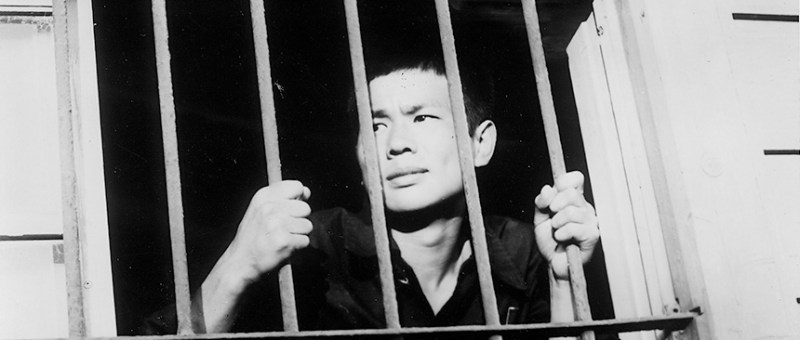
Bad Boys (不良少年, Susumu Hani, 1961)

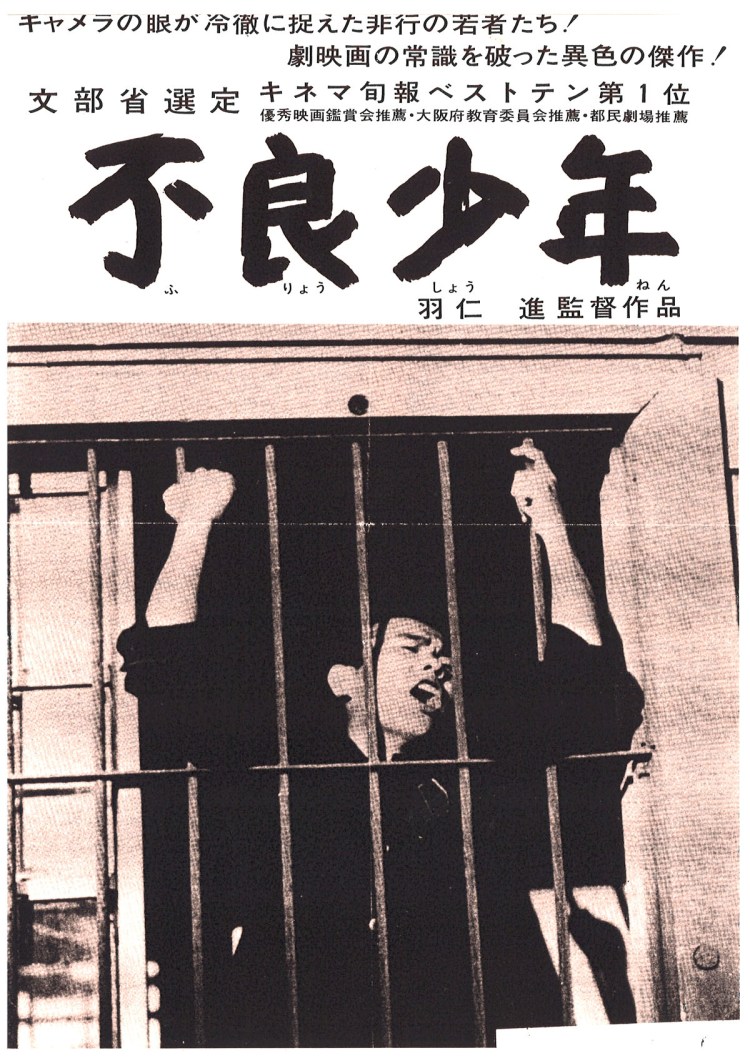
Bad Boys posterIn the mid-1950s, the “Sun Tribe” movies had evoked a series of conflicting reactions in their depictions of the new bright young things of the post-war era who, caught in a period of intense confusion, rejected the future their parents’ had been trying to build while revelling in nihilistic hedonism enabled by the new freedoms. Though the films proved popular with their target audience, they also produced a moral panic in the older generation which saw youth as dangerously out of control and desperately in need of correction. Meanwhile, reform school drama also became something of a recurring motif in the more progressive youth movies put out by Nikkatsu (including one starring Hani’s soon-to-be wife, Sachiko Hidari) which sought to humanise the figure of the “bad boy” by pointing out all the various circumstances which led to his fall from grace.

Susumu Hani’s Bad Boys (不良少年, Furyo Shonen) is often regarded as an important precursor to what might later be termed the “new wave” in its radical departure from the cinematic norm of the times. Loosely inspired by a book titled “Wings that Cannot Fly” which collected the stories of boys who’d been through the same reform school, Hani repurposes the tools of neorealism in his use of non-actors, improvised dialogue, natural light and location shooting, for a hybridised avant-garde “documentary style” which is, in a sense, realer than “real”.

We follow a disaffected young man, Asai (Yukio Yamada), who has been arrested for the aggravated robbery of an upscale Ginza jewellers. Asai, who sadly laments that he has only seen the famously posh neighbourhood from the back of a police van, did indeed commit the crime and could be thought of as the “ringleader” of the group of boys arrested which also includes young men from “good” families who’ve fallen in with a “bad” crowd. Some of the other boys are released when their parents plead for them, but Asai, as we discover, has no parents – his father died in the war when Asai was three and for reasons unexplained he is estranged from his mother. Undergoing a series of psychological tests which prove inconclusive, it’s decided that Asai might benefit from some time in reform school to reflect on his life and hopefully emerge with a better sense of civic responsibility.

Hani’s depiction of the reform school system paints it as an obvious remnant of the militarist or perhaps even feudal past in which discipline and physical strength are the primary virtues. The boys salute, march in file, and are taught to respect authority. Inside the school, natural factions arise with a strictly observed series of hierarchies enforced by violence and intimidation. Asai, a determinedly independent sort, refuses to obey and stands up to the bullies only to suffer defeat. Eventually he becomes the leader of his own faction of similarly oppressed youngsters, but when the time comes he discovers he is all alone once again and unable to break the chain which constrains them in a cycle of fear and violence.

Nevertheless, the failed battle against oppression has an unexpected positive outcome when Asai is moved to another cell. Up to this point, there’s been relatively little sign of positive “reform” on offer – no education, no counselling, no practical advice which might help these young men escape the circumstances which brought them here, but on being moved to the carpentry workshop Asai does at least begin to learn a useful skill as well as mixing with more “serious” boys who can have a laugh together while getting on with work. His attitude seems to relax, he “grows up”, and begins to see a different future only to be abruptly released back onto the same streets no better off than before with only the kind hearted platitudes of the softly spoken social worker to guide him into a “better” tomorrow.

The question remains what sort of men the reform school system was designed to engineer and to what end – a collection of deindividualised authoritarians who stand to attention and salute on demand may not be much of an asset to post-war humanism. Meanwhile, the emphasis on strength and discipline unwittingly reinforces the law of the street where violence rules all and morality is an unaffordable luxury, encouraging the perpetuation of a system of mutual oppressions while ignoring the many and various social issues which make it impossible to escape. Hani wanted to capture the lingering spirit of “totalitarianism” in which even those superficially rebelling against the system obey ancient social codes which restrict their own freedom and exist solely to keep them in their place. In doing so he lays bare the wider hypocrisies of the post-war democratic era which promises freedom but delivers only the same old compromises.


Bad Boys was screened as part of the Japanese Avant-garde and Experimental Film Festival 2018.

DVD release trailer (no subtitles)

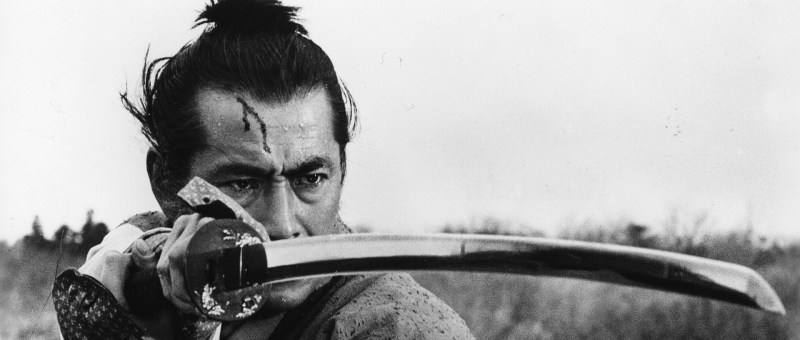
Samurai Rebellion (上意討ち 拝領妻始末, Masaki Kobayashi, 1967)

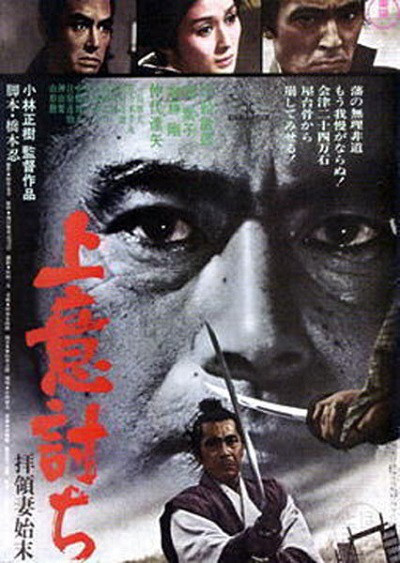
samurai rebellion posterIf Masaki Kobayashi had one overriding concern throughout his relatively short career, it was the place of the individual with an oppressive society. Samurai Rebellion (上意討ち 拝領妻始末, Joi-uchi: Hairyo Tsuma Shimatsu), not quite the crashing chanbara action the title promises, returns to many of the same themes presented in Kobayashi’s earlier Harakiri in its tale of corrupt lords and a vassal who can no longer submit himself to their hypocritical demands. On the film’s original release, distributor Toho added a subtitle to the otherwise stark “Rebellion”, “Hairyo Tsuma Shimatsu”, which means something like “sad story of a bestowed wife” and was intended to help boost attendance among female filmgoers who might be put off by the overly male samurai overtones. The central conflict is that of the ageing samurai Isaburo (Toshiro Mifune), but Kobayashi saves his sympathy for a powerless woman, twice betrayed, and given no means by which to defend herself in a world which values female life cheaply and a woman’s feelings not at all.

Having the misfortune to live in a time of peace, expert swordsman Isaburo has only the one duty of testing out the lord’s new sword (which he will never draw) on a straw dummy. He and his friend Tatewaki (Tatsuya Nakadai) are of a piece – two men whose skills are wasted daily and who find themselves at odds with the often cruel and arbitrary samurai world, refusing to fight each other because the outcome would only cause pain to one or both of their families. Isaburo has two grownup sons and dreams of becoming a grandpa but needs to find a wife for his eldest, Yogoro (Go Kato). He wants to find a woman who is loyal, loving, and kind. As a young man Isaburo was “forced” into marriage and adopted into his wife’s family but has been miserable ever since as his wife, Suga (Michiko Otsuka), is a sharp tongued, unpleasant woman whose only redeeming features are her stoicism and dedication to propriety.

It is then not particularly good news when the local steward turns up one day and informs Isaburo that the lord is getting rid of his mistress and has decided to marry her off to Yogoro. News travels fast and though others may appear jealous of such an “honour”, Isaburo is quietly angry – not only is he being expected to take on “damaged goods” in a woman who’s already born a son to another man, but they won’t even tell him why she’s being sent away, and the one thing he wanted for his son was not to end up in the same miserable position as he did. Nevertheless when Isaburo repeatedly tries to decline the “kind offer”, he is prevented. A suggestion quickly becomes an order, and Yogoro consents to prevent further conflict.

Against the odds, Ichi (Yoko Tsukasa) is everything Isaburo had wanted in a daughter-in-law and even puts up with Suga’s constant unkindness with patience and humility. Eventually she and Yogoro fall deeply in love and have a baby daughter, Tomi, but when the lord’s oldest heir dies and Ichi’s son becomes the next in line, it’s thought inappropriate for her to remain the wife of a mere vassal. Summoned to the castle, Ichi is once again robbed of her child but also of her happiness.

Ichi’s tale truly is a sad one and emblematic of the fates and positions of upperclass women in the feudal world. Having had the misfortune to catch the lord’s eye, Ichi tries to decline when the steward shows up to take her to the castle, reminding him that she is already betrothed. Sure that her fiancé will protect her, Ichi says she’ll go if he agrees never thinking that he would. Betrayed in love, Ichi is sold to the castle to be raped by the elderly Daimyo who views her as little more than a baby making machine and faceless body to do with as he wishes. When she returns from a post-natal trip to the spa and discovers the lord has already taken a new mistress, her anger is not born of jealously but resentment and disgust. This other woman is proud of her “position” at the lord’s side when she should be raging as Ichi is now, at her powerlessness, at the male society which reduces her to an object traded between men, and at the rapacious assault upon her body by a man older than her father.

Isaburo is also raging, but at the cruel and heartless obsession with order and protocol which has defined his short, unhappy life. Having been a model vassal, Isaburo has lived a life hemmed in by these rules but can bear them no longer in their disregard for human feeling or simple integrity. Isaburo says no, and then refuses to budge. Having retired and surrendered control of the household to Yogoro, Isaburo leaves the decision to his son who refuses to surrender his wife and swears to protect her from being subjected to the same cruel treatment as before. The samurai order is not set up for hearing the word “no”, and the actions of Isaburo, Yogoro, and Ichi threaten to bring the entire system crashing down. Love is the dangerous, destabilising, manifestation of personal desire which the system is in place to crush.

Isaburo’s rebellion, as he later says, is not for himself, or for his son and daughter-in-law whose deep love for each other has reawakened the young man in him, but for all whose personal freedom has been constrained by those who misuse their power to foster fear and oppression. Having picked up his sword, Isaburo will not stand down until his voice is heard, fairly, under these same rules that the authority is so keen on enforcing. He does not want revenge, or even to destroy the system, he just wants it to respect him and his right to refuse requests he feels are unjust or improper. Like many of Kobayashi’s heroes, Isaburo’s fate will be an unhappy one but even so he is alive again at last as the fire of rebellion rekindles his youthful heart. Those caught within the system from the venal stewards and greedy vassals to the selfish lords suddenly terrified the Shogun will discover their mass misconduct are dead men walking, sublimating their better natures in favour of creating the facade of obedience and conformity whilst manipulating those same rules for their own ends, yet the central trio, meeting their ends with defiance, are finally free.


Available with English subtitles on R1 DVD from Criterion Collection.

Original trailer (English subtitles – poor quality)

Alone Across the Pacific (太平洋ひとりぼっち, Kon Ichikawa, 1963)

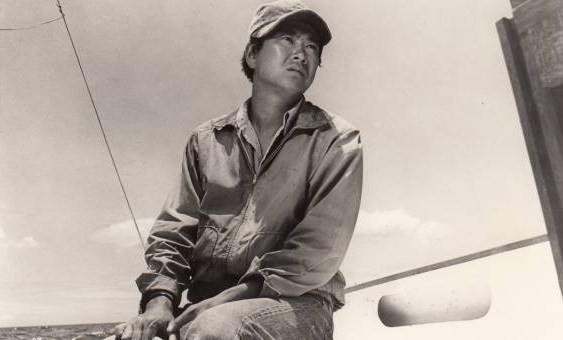
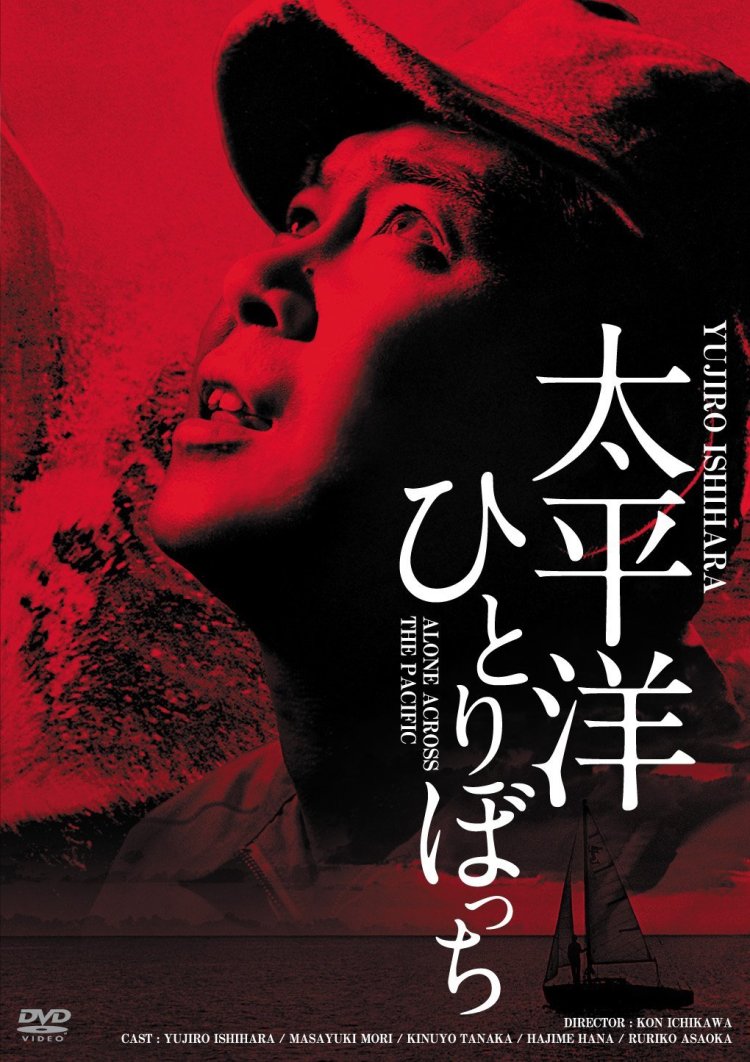
Alone Across the PacficKon Ichikawa made two sorts of movies – the funny ones and the not so funny ones. Despite the seriousness of the title, Alone Across the Pacific (太平洋ひとりぼっち, Taiheiyo hitori-botchi) is one of the funny ones. Like many of Ichikawa’s heroes, Horie is a man who defies convention and longs for escape from the constraining forces of his society yet is unable to fully detach himself from its cultural norms. Based on the real life travelogue of solo sailor Kenichi Horie, Alone Across the Pacific is less the story of a man battling the elements, than a cheerful tale of a man battling himself in a floating isolation tank bound for the “land of the free”.

Kenichi (Yujiro Ishihara) is a strange man. He has few friends (aside from the family dog, Pearl) and is obsessed with the idea of running away to sea. Inspired by the tales of other intrepid sailors, his dream is to sail all alone across the Pacific Ocean from Osaka to San Fransisco. Despite the fact that it is illegal for small boats to leave Japanese waters (and that he is too impatient to wait for his passport to come through), Kenichi has custom made his own yacht, one without an engine, and has set off on his longed for voyage under the cover of darkness.

Rather than filming Kenichi’s journey naturalistically, Ichikawa opts for an adventurer’s tale as Kenichi provides an ironic voice over detailing some of his naive failings as a rookie sailor undertaking such a daunting mission. Each of Kenichi’s crises links back to a memory from his shore life, reminding us why he’s on this journey in the first place. Kenichi’s struggles are the same as many a young man in post-war Japan and, in fact, many of those previously played by the poster boy for youthful rebellion, Yujiro Ishihara.  Unwilling to live a life hemmed in by the predetermined path of a job for life, wife, children and total social conformity, Kenichi longs to be free of his cultural baggage by abandoning his civility during a long process of isolation therapy free of overbearing fathers, fretting mothers, indifferent sisters and a generally noisy world.

Kenichi’s father (Masayuki Mori) is the very personification of authority, berating his son for his fecklessness and pointless obsession with sailing – a sport a working class boy like Kenichi can barely afford. Kenichi’s determination to achieve his goal sees him leave school early, take a job in his father’s workshop only to quit suddenly for a more lucrative one delivering luggage for a travel agents, and quitting that too to work full time on his boat. While his father huffs and puffs his mother (Kinuyo Tanaka) worries, hoping her mad son won’t really go through with it but knowing that he will.

When Kenichi finally reaches San Fransisco, he’s assaulted by congratulatory voices from all directions. Towed into harbour by a motor boat, Kenichi first has to deal with mundane problems like the customs patrol wanting to know if he’s got any fruit left on the boat before a crowd gathers to shake his hand asking where he’s come from and why, what he wants to do now, and praising him for his daring feat of solo sailing glory. In Japan however, things are different. Dragged out for an interview by the press, Kenichi’s worried mother avows that she’s just happy to know her son is safe while his father bows deeply and reassures everyone that he will absolutely put a stop to any such random acts of individualism his wayward son may attempt in the future. 

Kenichi evades the twin pulls of his mother’s apron strings and his father’s handcuffs by taking off alone but even at sea he’s never free of his cultural programming, checking the wide empty ocean before removing his clothes and then stepping back down into the cabin to finish the job. Kenichi’s failure to acquire a passport is an ironic one seeing as part of what he’s running from is being Japanese but even as his quest is one for self determination it is also intensely selfish and self involved. In this Kenichi commits the ultimate act of individualism, caring nothing for the thoughts and feelings of others in the all encompassing need to achieve his goal. Kenichi may have found a home at sea, but on land he’s caged once again, a prisoner both of social conformity and his own need to defy it.


Available on R2 DVD from Eureka Masters of Cinema.

Original trailer (no subtitles)

Illusion of Blood (四谷怪談, AKA Yotsuya Kaidan, Shiro Toyoda, 1965)

vlcsnap-2017-07-01-00h50m36s347Shiro Toyoda, despite being among the most successful directors of Japan’s golden age, is also among the most neglected when it comes to overseas exposure. Best known for literary adaptations, Toyoda’s laid back lensing and elegant restraint have perhaps attracted less attention than some of his flashier contemporaries but he was often at his best in allowing his material to take centre stage. Though his trademark style might not necessarily lend itself well to horror, Toyoda had made other successful forays into the genre before being tasked with directing yet another take on the classic ghost story Yotsuya Kaidan (四谷怪談) but, hampered by poor production values and an overly simplistic script, Toyoda never succeeds in capturing the deep-seated dread which defines the tale of maddening ambition followed by ruinous guilt.
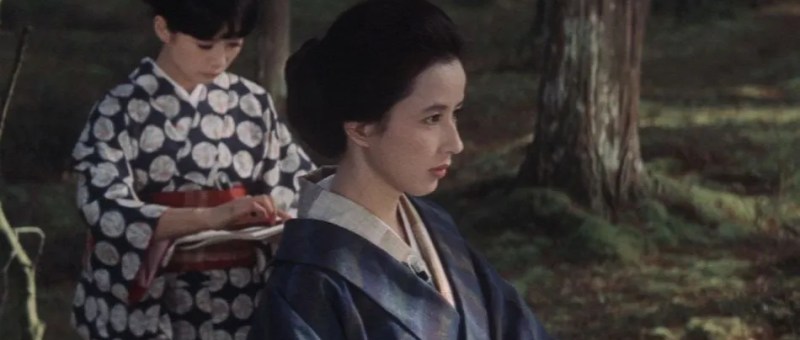
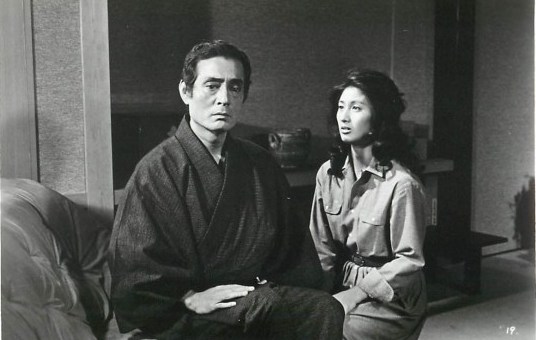
As usual, Iemon (Tatsuya Nakadai) is a disenfranchised samurai contemplating selling his sword due to his extreme poverty. Iemon had been married to a woman he loved, Oiwa (Mariko Okada), whose father called her home when Iemon lost his lord and therefore his income. Oiwa’s father is also in financial difficulty and Iemon has now discovered that he has been prostituting Oiwa’s sister, Osode (Junko Ikeuchi), and plans a similar fate for Oiwa.

Still in love with his wife, Iemon decides that his precious sword is not just for show and determines to take what he wants by force. Murdering Oiwa’s father, Iemon teams up with another reprobate, Naosuke (Kanzaburo Nakamura), who is in love with Osode and means to kill her estranged fiancee. Framing Osode’s lover Yoshimichi (Mikijiro Hira) as the killer, Iemon resumes his life with Oiwa who subsequently bears their child but as his poverty and lowly status continue Iemon remains frustrated. When a better offer arrives to marry into a wealthier family, Iemon makes a drastic decision in the name of living well.

The themes are those familiar to the classic tale as Iemon’s all consuming need to restore himself to his rightful position ruins everything positive in his life. Tatsuya Nakadai’s Iemon is among the less kind interpretations as even his original claims of romantic distress over the loss of his wife ring more of wounded pride and a desire for possession rather than a broken heart. Selling one’s sword is the final step for a samurai – it is literally selling one’s soul. Iemon’s ultimate decision not to is both an indicator of his inability to let go of his samurai past and his violent intentions as the fury of rebellion is already burning within him.

Iemon defines his quest as a desire to find “place worth living in”, but he is incapable of attuning himself to the world around him, constantly working against himself as he tries to forge a way forward. Oiwa’s desires are left largely unexplored despite the valiant efforts of Mariko Okada saddled with an underwritten part, but hers is an existence largely defined by love and duty, pulled between a husband and a father. Unaware that Iemon was responsible for her father’s death, Oiwa is happy to be reunited with him and expects that he will honour her father by enacting vengeance. Only too late does she begin to wonder what her changeable husband’s intentions really are.

An amoral man in an amoral world, Iemon’s machinations buy him nothing. Haunted by the vengeful spirit of the wife he betrayed, Iemon cannot enjoy the life he’d always wanted after purchasing it with blood, fear, and treachery. Despite the odd presence of disturbing imagery from hands in water butts to ghostly presences, Toyoda never quite achieves the level of claustrophobic inevitability on which the tale is founded. Hampered by poor production values, shooting on obvious stage sets with dull costuming and a run of the mill script, Illusion of Blood has a depressingly unambitious atmosphere content to simply retell the classic tale with the minimum of fuss. Only the final scenes offer any of Toyoda’s formal beauty as Okada appears under the cherry blossoms to offer the gloomy message that there is no true happiness and her husband’s quest has been a vain one. Achieving her vengeance even whilst Iemon affirms his intention to keep fighting right until the end, Oiwa leaves like the melancholy ghost of eternal regret but it’s all too little too late to make Illusion of Blood anything more than a middling adaptation of the classic ghost story.


With Beauty and Sorrow (美しさと哀しみと, Masahiro Shinoda, 1965)

with beauty and sorrwMasahiro Shinoda, a consumate stylist, allies himself to Japan’s premier literary impressionist Yasunari Kawabata in an adaptation that the author felt among the best of his works. With Beauty and Sorrow (美しさと哀しみと, Utsukushisa to Kanashimi to), as its title perhaps implies, examines painful stories of love as they become ever more complicated and intertwined throughout the course of a life. The sins of the father are eventually visited on his son, but the interest here is less the fatalism of retribution as the author protagonist might frame it than the power of jealousy and its fiery determination to destroy all in a quest for self possession.

Middle-aged author Oki (So Yamamura) is making a trip to Kyoto in order to hear the New Year bells but whilst there he wants to reconnect with someone very dear to him whom he has not seen for a long time. 15 years previously, Oki, already around 40 and married with a young son, had an ill advised affair with 16 year old Otoko (Kaoru Yachigusa). Oki’s indiscretion was discovered after Otoko fell pregnant and gave birth to an infant who sadly died after just a few months provoking Otoko’s own suicide attempt. Oki turned the traumatic events into a best selling novel which made his name and has not seen Otoko during the intervening years. Now a successful painter, Otoko has remained unmarried, still traumatised by her youthful experiences, and is currently in a relationship with a female student, Keiko (Mariko Kaga).

Keiko, a beautiful though strange young woman, will be the cause of much of the sorrow resulting from Oki’s decision to visit Otoko after all these years. Angry on her lover’s behalf, Keiko takes it upon herself to exact revenge for the wrong which was done to Otoko at such a young age, ignoring her lover’s pleas to leave the situation well alone.

Perhaps surprisingly, Shinoda avoids the temptation to retain Oki’s central viewpoint by attempting to survey the various threads which bind and contain each of the protagonists, locked into a complex system of love, jealously, pain and obsession. Oki sows the seeds of his own downfall in his improper relationship with a teenager over twenty years younger than himself whom he has no intention of marrying seeing as he is already married and even has a child. Little is said about the original affair save for the effect it had both on Otoko and on Oki’s marriage which endures to the present time even though it appears Oki continues to pursue other women outside of the home. Not only does Oki turn his scandalous love life into a best selling novel, but he makes his wife, Fumiko (Misako Watanabe), type it up for him, forcing her to read each and every painful detail of his relations with another woman.

During the writing of the novel, Fumiko begins to become ill, depressed and listless, but not out of suffering or disgust – what she feels is jealousy but of a literary kind. Fumiko laments that Oki has written an entire book about Otoko, but never thought to write one for her. Even if depicted as some kind of harridan or vengeful, shrewish woman, Fumiko wanted to be Oki’s muse and was denied. Otoko, by contrast never wanted anything of the sort and has lived quietly and independently ever since her traumatic teenage love affair with a married, older, artist. Her feelings, complicated as they may be, are the motivation for the actions of her obsessive lover, Keiko, determined on taking “revenge” for pain Otoko is not entirely certain she feels. Keiko’s jealously has been roused by Oki’s return and the possibility that it may reawaken Otoko’s youthful romantic yearnings. Unwilling to surrender her beloved to another, she sets about destroying that which may come between them, perfectly willing to destroy both herself and the woman she claims to love in the process.

Oki is, after all, a novelist and therefore apt to ascribe a kind of narrative to his life which may ignore its more ordinary baseness. His equally sensitive son, Taichiro (Kei Yamamoto), brings up the subject of Princess Kazu and the glass panel and lock of hair which were discovered with her body and muses on whether these belonged to her husband, as is said, or her “true love” as seems to be suggested by the evidence at hand. Loves true and false are played off against each other but the forces at play are less grand romances than petty lusts and obsessions. Keiko wants to own her lover absolutely but her games of revenge cause Otoko only more pain and take her further away from that which she most loves towards the film’s dark and ambiguous conclusion in which the innocent are made to suffer for other people’s transgressions.

Otoko’s suffering is largely ignored by all concerned though it’s clear that the loss of her child is a deep wellspring of pain which has become the dominant force in her life. Misused and abandoned, Otoko has sought only quietness and solitude living independently and without the need for male contact. Keiko, whilst crying out that she hates men and is going to destroy the family of the man who has destroyed her lover, acts only out of selfishness, refusing to see how far her actions are wounding the woman she loves even as she sets out to make a weapon of her beauty and turn it on the male sex.

Shinoda films with his characteristic aesthetics adopting a position of slight distance as his protagonists gaze at reflections of themselves and talk through mirrors yet refuse the kind of introspection which a novelist like Oki would be expected to project. A final moment of high drama is offered in a series of freeze frames, as if the emotions are too big and complex to be understood as a whole but can only be grasped in painful fragments snatched from among the resultant chaos. With Beauty and Sorrow conjures the idea of nobility in romance, enhanced by the inevitability of its failure, but for all of its aesthetic pleasures and enduring sadness this is not the elegant coolness of romantic tragedy but the painful heat of love scorned as it festers and corrupts, spreading nothing other than pollution and decay.


Original trailer (no subtitles, NSFW)

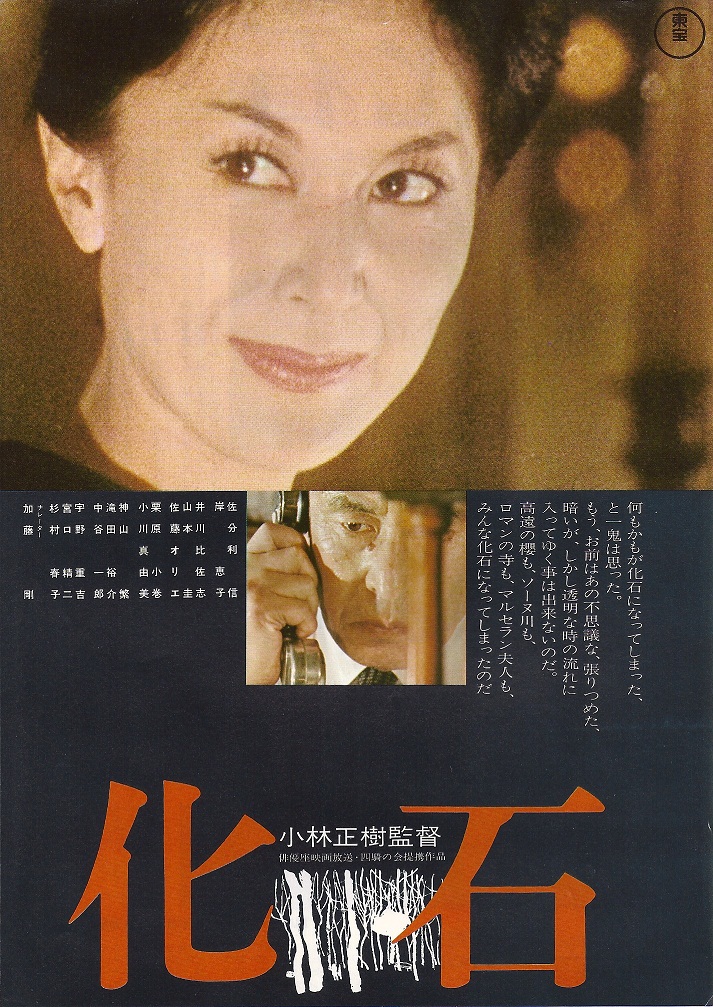
The Fossil (化石, Masaki Kobayashi, 1975)

fossilThroughout Masaki Kobayashi’s relatively short career, his overriding concern was the place of the conscientious individual within a corrupt society. Perhaps most clearly seen in his magnum opus, The Human Condition, Kobayashi’s humanist ethos was one of rigid integrity in which society’s faults must be spoken and addressed in service of creating a better, fairer world. As might be expected, his often raw, angry social critiques were not always what studios were looking for, especially heading into the “difficult” 1970s which saw mainstream production houses turning on the sleaze to increase potential box office. Reluctantly, Kobayashi headed to TV on the condition he could retain some of his footage for a feature film. Adapted from the 1965 novel by Yasushi Inoue, The Fossil (化石, Kaseki) revisits many of Kobayashi’s recurrent themes only in a quieter, more contemplative way as an apparently successful man prepares to enter the final stages of his life, wondering if this is all there really is.

Itsuki (Shin Saburi), a selfmade man who hit it big in Japan’s post-war boom town by founding his own construction firm which currently employs over 1000 people, is about to catch a plane to Europe for a trip that’s pleasure disguised as business. As he leaves, his younger daughter informs him he may be about to become a grandfather for the second time after the birth of her niece, though she is worried and is not sure she wanted a child at this precise moment. Brushing aside her nervousness with an odd kind of fatherly warmth, Itsuki seems pleased and states that he hopes it’s a boy this time. Nevertheless he leaves abruptly to catch his plane. During the flight he begins to become depressed, reflecting that since his wife has died and both of his daughters have married and have (or are about to have) children of their own he is now totally alone. Never before has he faced a sensation of such complete existential loneliness, and his arrival in Paris proves far less invigorating than he had originally hoped.

Wandering around with his secretary, Funazu (Hisashi Igawa), who has accompanied him on this “business” trip, Itsuki catches sight of an elegant Japanese woman in a local park and is instantly captivated. Improbably spotting the same woman several times during his stay, Itsuki later discovers that she is the wife of a local dignitary though not universally liked in the Japanese ex-pat community. At this same work dinner where he discusses the merits of Madame Marcelin (Keiko Kishi), Itsuki experiences a severe pain in his abdomen which makes it difficult for him to stand. Feeling no better back at the hotel, Funazu arranges a doctor’s visit for him. The doctors seem to think he should head straight home which Itsuki is not prepared to do but when he masquerades as Funazu on the phone to get the full verdict, he finds out it’s most likely inoperable intestinal cancer and he may only have a year or so to live.

This unexpected – or, perhaps half sensed, news sends him into a numbing cycle of panic and confusion. At this point Itsuki begins his ongoing dialogue with the mysterious woman, arriving in the guise of Madame Marcelin only dressed in the traditional black kimono of mourning. Telling no one, Itsuki embarks on a contemplative journey in preparation for a union with his dark lady in waiting which takes him from the Romanesque churches of the picturesque French countryside back to Japan and the emptiness, or otherwise, of his settled, professionally successful life.

Like the hero of Kurosawa’s similarly themed Ikiru, Itsuki’s profound discovery is that his overwhelming need for personal validation through work has led him to neglect human relationships and may ultimately have been misplaced. On his return to Japan, Itsuki makes the extremely unusual decision to take a day off only to receive a phone call regarding an old friend and former colleague who, coincidentally, has aggressive cancer and has been asking to see him. Not wanting to mention his own illness, Itsuki parts with his friend feeling it may be for the last time but eventually returns for a deeper conversation in which he probes him for his views about his life so far and what he would do if he had, say, another year to live. His friend has come to the same conclusion, that his working life has largely been a waste of time. What he’d do differently he couldn’t rightly say, things are as they are, but if he had more time he’d want to do “good” in the world, make a positive change and live for something greater than himself.

Itsuki isn’t quite as taken with the idea of “goodness” as a life principle, though he does begin to re-examine himself and the way he has treated the people in his life from apologising to the stepmother he failed to bond with as a child to reconnecting with an old army buddy who maybe the closest thing he’s ever had to a “true friendship” – something which the mysterious woman reminded him he’d been missing for a very long time. Meeting Teppei again, Itsuki is introduced to his walls of fossilised coral and all of their millions of years of history frozen into one indivisible moment. Feeling both infinite and infinitesimal, Itsuki is reminded of his immediate post-war moment of survivor’s guilt in which he and his friend agreed that they’ve each been living on borrowed time ever since.

Given a sudden and unexpected chance of reprieve, Itsuki is even more confounded than before. Having made a friend of death, he may now have to learn to live again, even if his mysterious lady reminds him that she will always be with him, even if he can no longer see her. Though he’d wanted nothing more than to live to see the cherry blossoms in the company of the living Madame Marcelin whose vision it was that so captivated him, his old life is one he cannot return to and must be preserved in amber, frozen and perfect like Teppei’s fossilised coral.

Tonally European, perhaps taking inspiration from Death in Venice, and bringing in a Christianising moral viewpoint pitting the values of honest hard work against genuine human feeling, The Fossil is the story of a man realising he has been sentenced to death, as we all have, and makes his peace with it only to learn that perhaps his sentence will be suspended. Yet for a time death was his friend and her absence is a void which cannot be filled. This life, this new life so unexpectedly delivered, must be lived and lived to the full. Itsuki, who had prepared himself to die must now learn to live and to do so in a way which fulfils his own soul. Originally filmed as a 13 part TV series now reduced to three hours and twenty minutes, The Fossil’s only consolation to its medium is in its 4:3 frame which Kobayashi’s unobtrusive style fully embraces with its ominous distance shots, slow zooms and eerie pans backed up by Toru Takemitsu’s sombre score. Kobayashi, who’d given us a career dedicated to railing against the injustices of the system, suddenly gives us the ultimate rebellion – against death itself as a man who’d prepared himself to die must judge the way he’s lived on his own terms, and, finding himself wanting, learn to live in a way which better fits his personal integrity.


Inn of Evil (いのちぼうにふろう, Masaki Kobayashi, 1971)

inn-of-evil“Sometimes it feels good to risk your life for something other people think is stupid”, says one of the leading players of Masaki Kobayashi’s strangely retitled Inn of Evil (いのちぼうにふろう, Inochi Bonifuro), neatly summing up the director’s key philosophy in a few simple words. The original Japanese title “Inochi Bonifuro” means something more like “To Throw One’s Life Away”, which more directly signals the tragic character drama that’s about to unfold. Though it most obviously relates to the decision that this gang of hardened criminals is about to make, the criticism is a wider one as the film stops to ask why it is this group of unusual characters have found themselves living under the roof of the Easy Tavern engaged in benign acts of smuggling during Japan’s isolationist period.
Led by the innkeeper Ikuzo (Kan’emon Nakamura), the Easy Tavern is, effectively, the hideout of a smuggling gang conveniently located on a small island in the middle of a river where they can unload goods from the Dutch boats before shipping them on to Edo. Everything had been running smoothly, but the friendly policeman has been moved on and the new guy seems very straight laced. The gang’s routine existence changes one night when they receive two unexpected visitors – a young man they save from a beating in the street, and a drunk who wanders in looking for sake. The younger man, Tomijiro (Kei Yamamoto), brings a sad story with him in that all of his troubles have been caused by trying to save the woman he loves from being sold to a brothel. Moved by Tomijiro’s innocent ardour, even the most hardhearted residents of the Easy Tavern become determined to help him. Accepting a job everyone had a bad feeling about in order to get the money for Tomijiro to buy back his lady love before it’s too late, the gang’s unusual decision to risk their lives for someone else’s happiness may be the first and last time they ever do so.

The residents of the Easy Tavern have various different backstories, but the thing they all have in common is having been rejected by mainstream society at some point in their lives. The most high profile, Sadashichi (Tatsuya Nakadai), is known as “The Indifferent” which is both apt and slightly ironic. Sullen and cynical, he puts on a show about caring for nothing and no one but, as inn keeper’s daughter Omitsu (Komaki Kurihara) has figured out, it’s more that the opposite it true – he cares too much about everything. Abandoned as a child, Sadashichi’s sad story is that he once thought his saw his mother long after they were separated but killed her because she’d fallen into prostitution. Then again, perhaps it was just a woman who looked like her, or perhaps he made he whole thing up. Coming across a lost baby bird shortly after killing a man, Sadashichi is determined to look after it but is later distressed by the words of the drunk who reminds him that the bird’s mother is probably going crazy with worry. Sadashichi may identify with this lost little bird, but his empathy also extends to Tomijiro’s plight as his plaintive looks and gloomy face prompt him into action, if only to make them go away.

Similarly, the other members including “The Living Buddha” – a rabidly bisexual former monk thrown out of his temple for his lascivious ways, an effeminate homeless man, a stutterer, and an invalid all have reasons for living outside the law. As the sympathetic inn keeper later tries to explain to a policeman, most of these men are people who’ve faced rejection in one way or another. Craving sympathy, they’ve turned violent and suspicious, pushed away from the very things they wanted most. Far from an Inn of Evil, the Easy Tavern is the only place where these people have been able to find acceptance, building a community of lost souls from those cast out from society at large.

The decision to try and help Tomijiro to rescue his childhood sweetheart, cruelly sold by her selfish and uncaring father, is, in once sense, a selfless one but perhaps also reminds them of all the times they were also betrayed or abandoned and no one came to help. Even knowing the plan is unlikely to end well, the inn keeper is proud of his men’s decision, if they didn’t try to help the girl no one else would. They may be throwing their lives away in a pointless endeavour, but if they don’t at least try then what’s the point in living at all. This more than anything expresses Kobayashi’s constant preoccupation throughout his career in pointing to the essential goodness of those who refuse to simply accept acts of injustice as normal and stand up to oppose them, even if their resistance will produce little or no actual change.

Filming in a crisp black and white, Kobayashi creates an eerie atmosphere aided by Toru Takemitsu’s strangely ethereal score. The world of the The Easy Tavern is a dark one in which cruelty and betrayal lie at every turn and men ruin themselves through thoughtless and reckless decisions, but the best of humanity is to be found among this gang of outlaws who collectively decide it’s world risking their lives for someone else’s love story. Filled with impressive visual imagery including the strange sight of the looming bright white police lanterns and the impressively staged last stand as Sadashichi holds off the troops for Tomijiro to escape, Inn of Evil is a tightly controlled, minutely detailed character drama in which men who’d throw their lives away for nothing find that their sacrifice has not been in vain.


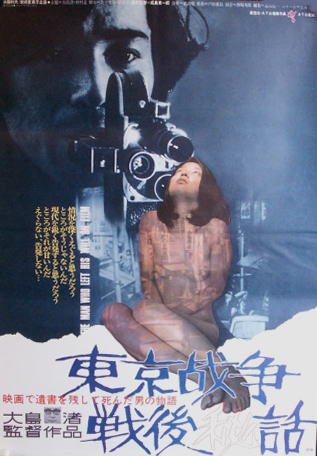
The Man Who Left His Will on Film (東京戰争戦後秘話, Nagisa Oshima, 1970)

man-who-left-his-will-on-filmEvery story is a ghost story in a sense. In every photograph there’s a presence which cannot be seen but is always felt. The filmmaker is a phantom and an enigma, but can we understand the spirit from what we see? Whose viewpoint are seeing, and can we ever separate that subjective vision from the one we create for ourselves within our own minds? The Man Who Left his Will on Film (東京戰争戦後秘話, Tokyo Senso Sengo Hiwa) is an oblique examination of identity but more specifically how that identity is repurposed through cinema as cinema is repurposed as a political weapon.
The film begins with an anarchic scene in which two men argue over use of an 8mm Bolex camera. The man whose voice we can hear is angry with the cameraman who he claims has stolen his camera only to use it for “trivial” street scenes and landscapes whereas he needs it to “capture the struggle” by filming a nearby student protest. Eventually we can verify that there are two men as the protagonist, Motoki (Kazuo Goto), briefly moves in front of the camera in order to try and snatch it away from the filmmaker. The man holding the camera then runs off as breathless, handheld camera takes over. Motoki follows him and we follow Motoki as the scene takes on an ominous quality. The cameraman reappears atop a nearby building before plunging to his death camera in hand. Stunned, Motoki approaches the bloody scene and, noticing the camera is still intact, tries to retrieve it only to be picked up by the police who confiscate the camera as evidence.

Motoki then wakes up back at his left wing commune with his friends eager to know what happened. Strangely, they do not seem to be aware that one of their number has died and are more worried about the police being in control of one of their “means of production”. Even the dead man’s girlfriend, Yasuko (Emiko Iwasaki), begins to doubt the fact that he ever existed at all. Motoki and Yasuko begin investigating the mysterious presence together, chasing their elusive filmmaker and each taking possession of his form on more than one occasion but the question who owns these images, whose identity defines the narrative, proves an elliptical and ethical dilemma.

Oshima, evidently, was no right wing stooge but even if The Man who left His Will on Film takes the world of the student protests as its milieu, it does so to undermine them. Motoki’s comrades view filmmaking as a revolutionary act. They claim to turn the camera into a weapon by using it confront reality, but as Yasuko later admits much of this is a rationalisation which allows them to continue a “bourgeois” art form without abandoning their left wing principles. The cadre members spout marxist dogma and argue about who has the highest political consciousness, but all they ever do is film the ongoing struggle. Their fight is empty, their vision blank.

Notably, the first of several arguments over dogma relates to “ownership” of the camera itself and whether Motoki and another comrade fought hard enough to retrieve it from the oppressive state. Did Motoki chase after “his” camera, meaning he condones the idea of “private” property which is contrary to the communal nature of the group, or “their” camera which is a revolutionary tool? The camera itself is singular, but the group is plural. This commune is intended to work as a hive mind, the people as one with one vision and one identity but Oshima exposes this as an impossibility. The group is a collective of individuals with different ideas and opinions which do not necessarily conform to a common point of view.

This is further brought out when the camera is retrieved and revealed to contain a collection of seemingly apolitical landscapes and street scenes. The group members are quickly bored with the static shots of everyday subjects, some berating the filmmaker for his “bankrupt” politics and lack of artistry while others vow they must honour their comrade’s struggle by watching the film to its conclusion in order to derive the meaning. The unseen filmmaker has indeed left his “will” on film, not as a testament or embodiment of future policy, but his literal “will”. His individual spirit and vision are contained within the seemingly innocuous shots in a political act of revolutionary individualism. He is the film, the film is him.  His vision dominates, we must accept it or remake it as our own.

Motoki, constantly chasing shadows, attempts to remake the film in the mould of the original filmmaker but unexpectedly encounters aspects of his own life already existing within it. Yasuko’s approach is more proactive. She inserts herself into the film, makes her presence known and refuses to be invisible. She picks up the camera and fights for her place within the frame. Hers is the struggle of the true revolutionary filmmaker, imprinting herself and her vision onto the film.

Where does this leave us? We’re in the film too. We see the film and, in a sense, recreate it in our own minds, recasting ourselves as director and protagonist. We see the film subjectively yet we cannot divorce ourselves from the original vision. Motoki’s venture fails because he only sees the landscapes, whereas Yasuko takes the same images but repossesses them, remaking them in her own image in a true act of cinematic revolution. Yasuko has seized the means of production and overthrown the tyranny of anonymous images in refusing to be constrained by someone else’s will. The camera is a weapon, but it is we who choose what it sees, and in turn what it sees in us.


Original trailer (English subtitles, NSFW)

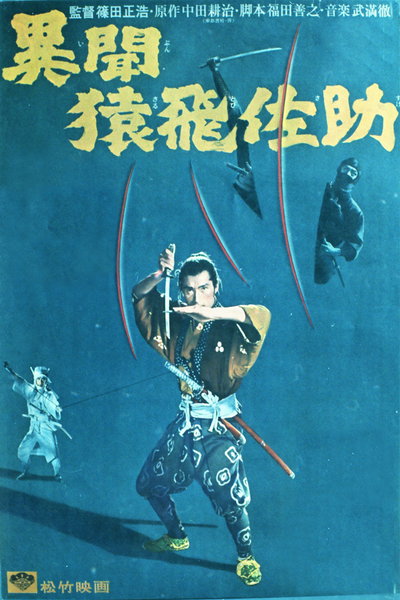
Samurai Spy (異聞猿飛佐助, Masahiro Shinoda, 1965)

samurai-spyNothing is certain these days, so say the protagonists at the centre of Masahiro Shinoda’s whirlwind of intrigue, Samurai Spy (異聞猿飛佐助, Ibun Sarutobi Sasuke). Set 14 years after the battle of Sekigahara which ushered in a long period of peace under the banner of the Tokugawa Shogunate, Samurai Spy effectively imports its contemporary cold war atmosphere to feudal Japan in which warring states continue to vie for power through the use of covert spy networks run from Edo and Osaka respectively. Sides are switched, friends are betrayed, innocents are murdered. The peace is fragile, but is it worth preserving even at such mounting cost?

Our “hero” Sasuke (Koji Takahashi) is a wandering spy for the Sanada clan, nominally part of the Tokugawa though with no strong allegiance to either side. Everywhere he goes he feels hunted, watched by shadowy forces and unseen motivators. After bumping into Mitsuaki (Mutsuhiro Toura), an old comrade who fought alongside him at the Battle of Sekigahara, Sasuke is pulled into the ongoing intrigue as his friend is murdered and he assumed to be the culprit. Things are further complicated when a mysterious woman to whom he had become attached, Okiwa (Misako Watanabe),  is killed in a similar fashion. A political shift is taking place as a high ranking Tokugawa official, Tatewaki (Eiji Okada), is in the process of defecting to the Toyotomi with white cloaked ninja master Takatani (Tetsuro Tanba) (presumably) working against him. Sasuke is charged with trying to sort all of this out but constantly finds himself on shaky ground as everything around him is constantly changing and the air is filled with conspiracy.

Shinoda aims to disorientate. After beginning with a brief historical narration to set the scene including a bloody excerpt from the horrific Battle of Sekigahara (the historical context presumably much more apparent to a Japanese viewer than an overseas one), he jumps forward 14 years and proceeds to give a rundown of the current situation. Quick fire naming and a lack of external context intentionally make it difficult to pin down who is who and which side is which. The opening sequence takes place in darkness with only moonlight and lanterns to light the way, so our players are always cast in shadows, only half visible and unidentifiable. Nothing is as it seems, the world is murky and the people in shadier still.

Sasuke fought at Sekigahara when he was just 15. His true coming of age has been in an era of peace and he is committed to sustaining that peace at all costs rather than return to the bloody, internecine warfare of the past. This stands in contrast to his double dealing friend, Mitsuaki, whose own coming of age was forged by war and so now finds himself at a loose end as warriors are obsolete in an age without war. Nevertheless, Sasuke feels the peace is threatened – all conversations are eventually about conflict, no one thinks about the meaning of death or what it is to be alive. Men like Mitsuaki have decided to live purely for pleasure, wanting nothing more than women and sake, thinking of nothing beyond satisfying their needs, and rarely consider the moral or political dimension of their actions. Mitsuaki’s unexpected degree of self interest accidentally threatens to completely destabilise the status quo, setting off a series of betrayals and counter betrayals in its wake, but all Mitsuaki was thinking about was a how to get paid twice for doing one job.

Navigating this complex network of allegiances and betrayals, Sasuke comes to discover what it is he really wants out of life and what he needs to do to get it. No longer a neutral observer, he has to pick a side and the one he picks that of the wronged. Coming to the aid of the threatened and oppressed, Sasuke adds himself to the list of enemies of the state yet he sees it as his duty to fight against the forces of darkness for a better, fairer world. Of course, he has his personal reasons for revenge but even these are partly born out of a sense of outrage for the injustice done to people who mattered to him.

Yet for all of the real world intrigue and political allegory Samurai Spy is also imbued with an unsettling sense of the absurd. Sasuke is plagued, yet at times assisted, by the almost supernatural Takatani who, incongruously, dresses in a bright white outfit with the fabric of his hood tied up into horns on the front. Appearing as needed along with his more conventionally dressed ninja minions, Takatani seems to float through the air performing strange acts of ninjadom and acting with no firm course of action. Shinoda shoots the battle scenes from odd angles using slow motion to give them a strange kind of power, even in one instance allowing a severed limb to float to the ground. In a nod to the circularity of violence, he even allows the climactic fight to be interrupted and witnessed by a small boy, shocked by what he has seen. The fact that the situation is laid to rest by a forgotten deus ex machina is yet more evidence for the world’s essential leaning towards constructed narrative.

Filled with the fog of war (literally so in places), Samurai Spy dramatises the uncertainties of its environment through the extreme lack of visual clarity. The audience is as disorientated as Sasuke, continually wrong footed and left at a loss as to the true motivations of each of the major players. The atmosphere is palpably intense, as if sitting on a powder keg ready to explode at any spark of conflict. From this viewpoint, it’s impossible to see who is in the right and who the wrong or even if those two ideas are even appropriate ways of thinking about things. Peace stands on a knife edge and, ironically, only survives if robustly defended. Violence is shown up for all of its essential cruelty and senselessness yet it is the only thing which is certain. Sasuke, at least, seems to have made his own peace in one way or another but the world he leaves behind him is far from ready to do the same.


Ran (乱, Akira Kurosawa, 1985)

ran posterAkira Kurosawa is arguably the most internationally well known Japanese director – after all, Seven Samurai is the one “foreign film” everyone who “doesn’t do subtitles” has seen. Though he’s often thought of as being quintessentially Japanese, his fellow countryman often regarded him as too Western in terms of his filming style. They may have a point when you consider that he made three different movies inspired by the works of Shakespeare (The Bad Sleep Well – Hamlet, Throne of Blood – Macbeth, and Ran – King Lear) though in each case it’s clear that “inspired” is very much the right word for these very liberal treatments.

In the case of Ran (乱) – a loose adaptation of King Lear, Kurosawa moves the story to feudal Japan and an ageing king who this time has three sons rather than three daughters. This leaves Hidetora (Tatsuya Nakadai) with a smaller problem than Lear’s though in his original idea of making his eldest son his heir with the other two inheriting smaller roles it’s clear things aren’t going to end well. Just as in the original play, the oldest two sons Taro and Jiro sing their father’s praises with cynical glee but the youngest and most sincere, Saburo, refuses to play this game as his respect for his father is genuine. Unfortunately, Saburo’s honesty sees him banished from his father’s kingdom and his share of responsibility given over to his treacherous brothers. Predictably, neither is satisfied with what they’ve been given and it’s not long before a familial conflict has sparked into a bloody civil war.

How sharper than a serpent’s tooth it is to have a thankless child….Hidetora is not quite as far gone as Lear in Shakespeare’s original text at the beginning of the film yet he is still unable to see that his oldest two sons have placed personal ambition ahead of filial piety. Hidetora was once a fearsome, if cruel, warrior, famous for burning enemy villages and creating peace only through destruction. He’s old now, and tired and so he proposes to hand over the running of the kingdom to his eldest son, yet – he wants to remain the de facto leader until the very end. Of course, that doesn’t sit well with Taro, or more to the point his ambitious wife Lady Kaede. Hidetora is thrown out of Taro’s castle and then also from Jiro’s before all out war erupts between the two leaving him totally isolated – a king without a kingdom.

Hidetora’s true madness begins when he realises not only how little regard his eldest two sons hold for him, but also that his failure to recognise the true nature of the situation has lead to the deaths of the people in his care that have remained loyal to him to the very end. As the enemy begin to engulf the castle, concubines begin helping each other to commit suicide in order to avoid ravishment while others try to escape but are cut down by arrow fire. This is all his own fault – his ruthless cruelty has been filtered down to his two oldest sons who, as he did, will stop at nothing in the pursuit of power. What is a king if not the father of a nation, and as a father he has failed. Neither Taro or Jiro are worthy of the offices afforded to them and lack both basic humanity and the princely power one needs to become the unifying force of a people.

Only too late does Hidetora see the wisdom in Saburo’s words and finally understand that he has alienated the only one of his children that truly loved him. From this point on his madness increases and Nakaidai’s performance becomes increasingly mannered and theatrical as if Hidetora himself is acting in another play which only he can see. Wandering and lonely, the once great king is reduced to the estate of a beggar led only by his fool and sheltered by the ruins of a castle which he himself burned down.

However, as great as Nakadai is (and he always is), he’s very nearly upstaged by the young Mieko Harada as one of the all time great screen villainesses with the Lady Macbeth a-like Lady Kaede. Filled with a vengeful fury, Kaede is unafraid to use every weapon at her disposal to achieve her goal. No sooner is she brought the news of her first plan’s failure in the death of her husband than she’s embarking on a plot to seduce his brother which includes getting him to execute his wife. Vile as Kaede’s actions often are, her desire for revenge is an understandable one when you consider that Hidetora was responsible for the deaths of her family leaving her to become a trophy bride for the son of the man that killed them. Viewed from another angle, it would be easy to sympathise with Kaede’s desire to rid the world of these cruel and tyrannical lords were it not for her insistence on the death of Lady Sue – a woman in exactly the same position as herself whose death would not actually advance her cause very much at all.

Kurosawa films all of this from a distance. We, the audience, almost become the gods he speaks of – the ones who weep for us, watching silent and helpless, unable to save us from ourselves. We see the world for what it is – chaos, horses and men and blood. The battles aren’t glorious, they are frenetic, frightening and ultimately pointless. Though for all that there is a beauty to it too and the sheer scale of the production with its colour coded princes and immense armies is one the like of which we will never see again.

Ran presents us with a prognosis which is even more pessimistic than that of Lear. At the end of Shakespeare’s play, as profoundly tragic as it is, there is at least the glimmer of hope. There is a new, rightful king and the idea that something has been restored. Here there is no such resolution, we are the blind man casting a stick around the edge of a precipice, entirely alone and unable to see the gaping chasm which extends before us into which we may plunge headlong driven only by the chaos in our own hearts. In the end, Kurosawa’s message is not so different from Shakespeare’s – all the weight of this sad time we must obey, speak what we feel, not what we ought to say. Fathers and sons must strive to understand each other, and themselves, lest we fall into the eternal chaos which leads us to build our very own hell here on Earth.


Ran is currently playing in UK cinemas in a brand new 4K restoration courtesy of StudioCanal!