
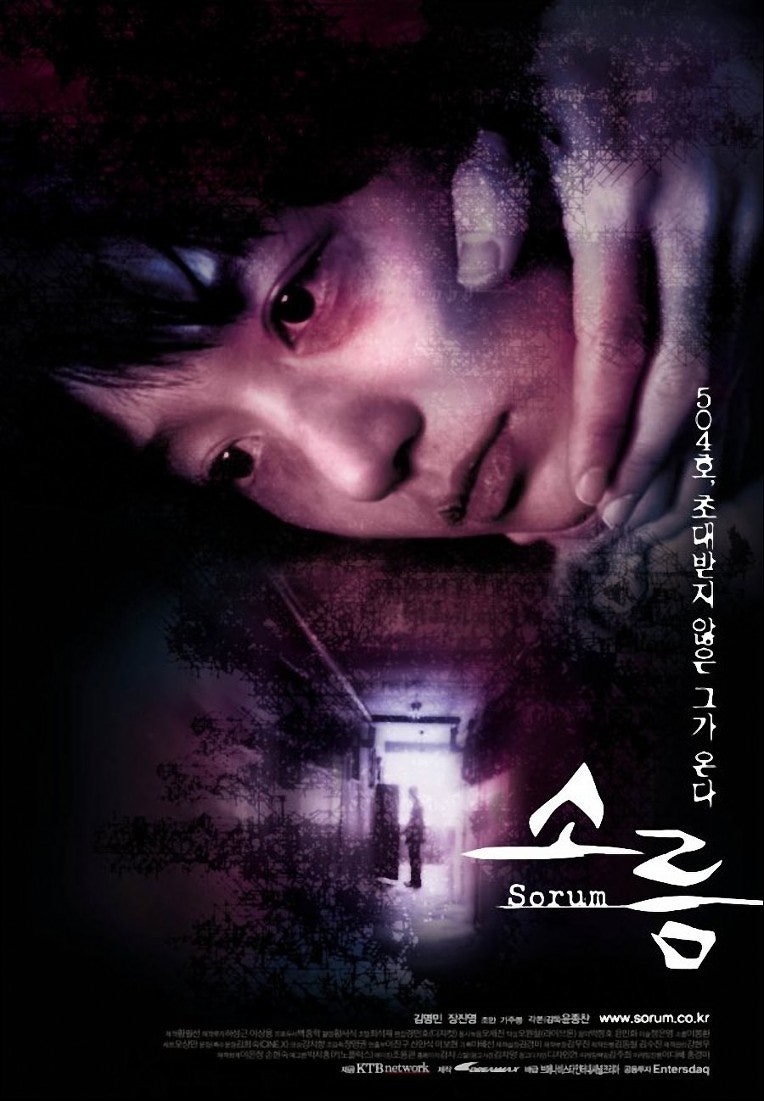
There are different types of ghosts, according to frustrated novelist Lee (Gi Ju-bong) in Yoon Jong-chan’s supernaturally tinged noir, Sorum (소름). Some don’t know they’re dead yet, others possess the bodies of living people. In their own way, the residents of the Migum apartment block all seem to be wandering ghosts themselves, stuck in this place that’s somewhere between life and death that they otherwise seem unable to escape while the building saps the life out of them with its depressing decor and flickering lights.
One might ask themselves why it is that taxi driver Yong-hyeon (Kim Myung-min) has chosen to move in here given that the building is scheduled for demolition. Obviously, the rent is cheap, not least because the previous tenant died in mysterious circumstances, though Yong-hyeon appears to have been unaware of that. Not that it bothers him. For all intents and purposes, he is our hero, a newcomer to this strange and lonely building meeting its ghostly inhabitants for the time. But gradually, we start to wonder about him. Police start sniffing round in connection with the disappearance of a woman said to have embezzled money and borrowed signifiant amounts from friends for no clear purpose. Suspiciously, Yong-hyeon has a bag of women’s jewellery including a ring hidden in his fridge, which would at least have paid a deposit on a nicer apartment if he were able to sell them.
It’s the ring that attracts the attention of his neighbour, Seon-yeong (Jang Jin-young), who is trapped in an abusive relationship with a man who has a gambling problem. Whether driven or drawn here, Yong-hyeon develops a fascination with Seon-yeong that he later finds difficult to categorise. When she appears before him covered in blood, he helps her bury her husband’s body and then enters a sexual relationship with her that is equally ill-defined. Hearing her say that anyone would have done while arguing with her friend and neighbour Eun-soo (Jo An) causes him to doubt her motivations. Perhaps she’d been waiting for an opportunity to kill her husband and merely made use of his attraction to her to help her do it.
But at the same time, there’s a curiously incestuous quality to their relationship in that Seon-yeong is trapped in the inertia of grief having “lost” her son. Yong-hyeon is an orphan who has no place to call home and on some level is in search of a mother, latching on the maternal quality he sees in Seon-yeong. She buys a scarf for him, as a mother might for a son, while he is touched by her bending down to tie his shoelaces, wondering if his mother would have been kind like her had he had one. Their connection is also echoed in the mysterious history of the apartment in which a woman is said to have been murdered by her husband 30 years previously. The couple had a baby who was left alone there and likely would have starved to death if it had not been for a fire which led to his rescue by other residents.
The apartment’s previous tenant, aspiring novelist Gwang-tae, had been investigating the murder as material for a book before he died in mysterious circumstances, apparently the victim of a hyper-localised fire which occurred only in the centre of the room. Gwang-tae had claimed that the apartment was haunted by the ghost of a woman singing a lullaby who insisted her son would soon return. Gwang-tae told his girlfriend Eun-soo, pregnant with their child, that he needed to leave this building or something bad would happen to him, but like everyone else, he found himself unable to. His story then becomes fodder Lee, whose latest attempt to make a literary comeback may not all be his work though he continues to try to write the story we are currently watching by constructing a fanciful narrative around Yong-hyeon and the apartment and then convincing himself that what he’s writing is coming true.
In that sense, he may have an authorial god complex or extreme main character syndrome, while for Yeong-hyeon it’s the opposite. He’s learned to live a carefree life by acting on his impulses and then giving them no more thought. The last thing he wanted to be was the protagonist of this story, though he begins to discover strange and unexpected connections with the building and the tragedy that occurred there 30 years previously. This is the “invisible fear” that Lee proclaims as the high point of his novel, a noirish sense of dread that suddenly reorders an ordinary person’s existence. Yeong-hyeon is no longer someone who exists within the world. The world now exists around him. Lee suggests the ghost in 504 is trying to trap her adult son within this purgatorial space in order to escape her loneliness, just as everyone else is trapped in this building by irresolvable despair. Yeong-hyeon knows he has to get out, but at the same time, where else is there to go? All he can see is the building blinking back at him, refusing to give up its ghosts.

