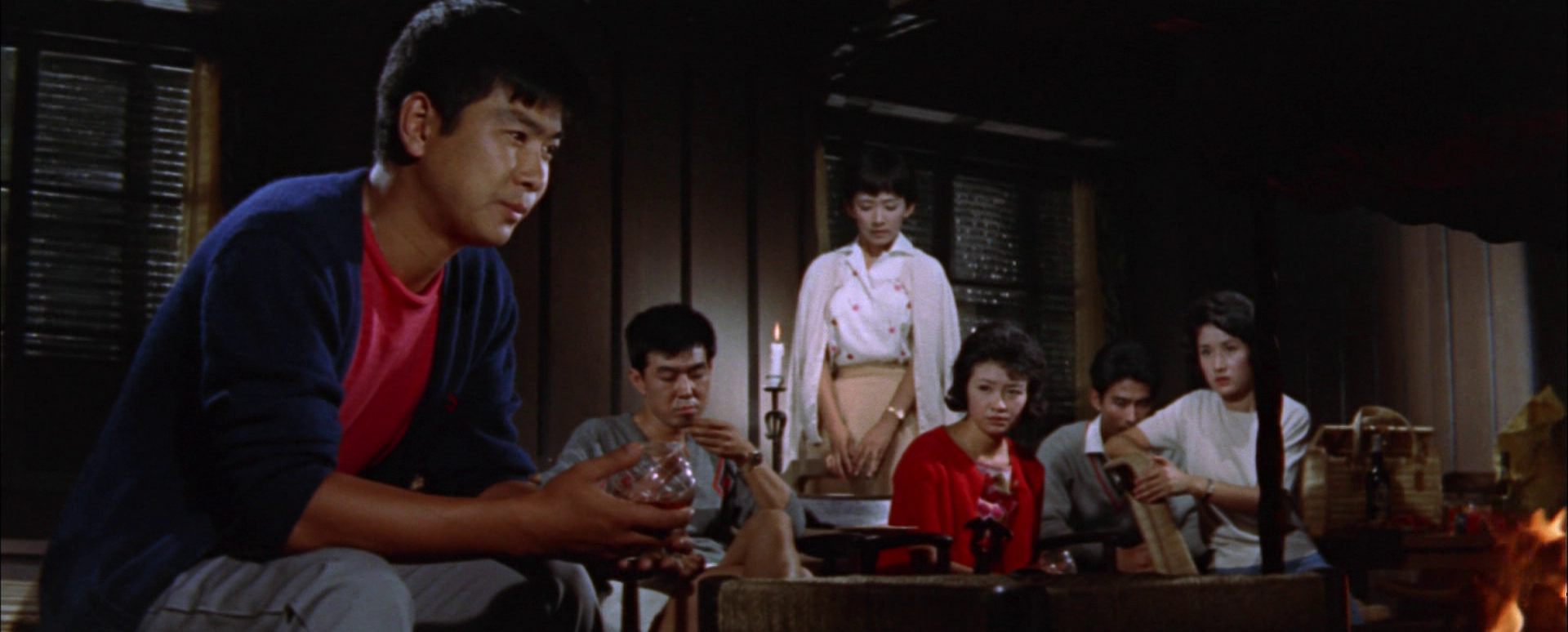
Sanshiro Sugata Part Two (續 姿三四郎, Akira Kurosawa, 1945)

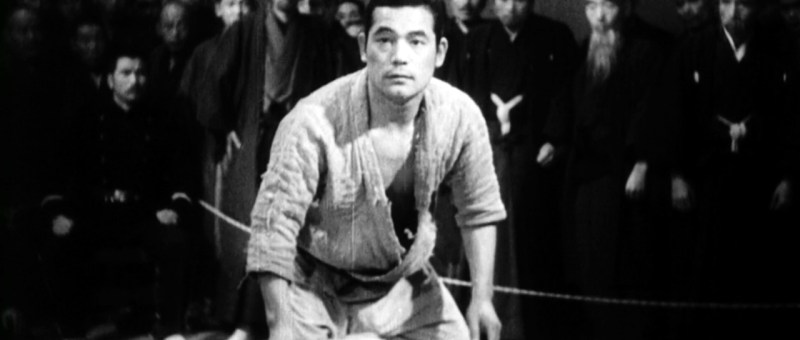
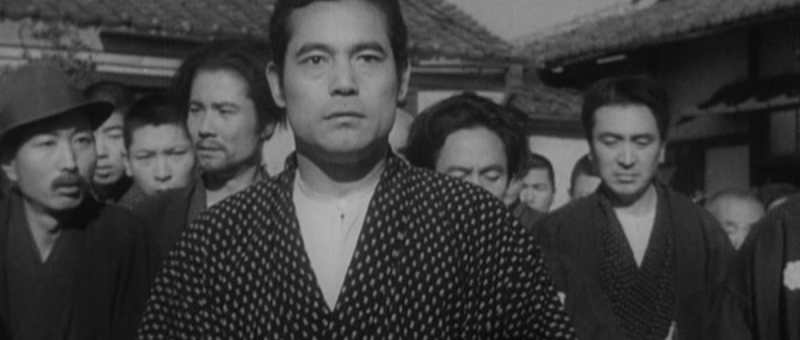
Sanshiro Sugata had not especially pleased the censors who took a scalpel to it, excising a few elements they found problematic, but the film proved popular enough with audiences for the government to commission a sequel. Apparently somewhat reluctantly, Akira Kurosawa returned to the world of Sanshiro Sugata picking up almost in real time two years later with a conflicted Sanshiro (Susumu Fujita) still wandering around Yokohama avoiding the woman he loves whose father may have died due to injuries inflicted on him during his fight with Sanshiro. Yet where the first film had essentially presented a spiritual odyssey through the medium of judo, part two is a much more nakedly propagandistic affair. 

It some ways it’s a little ironic that Sanshiro has almost become a folk hero who stands up for the oppressed Japanese against the looming threat of Western imperialism as mediated through the contest between Japanese martial arts and American boxing. The film opens with a drunken American sailor berating the teenage boy pulling his rickshaw and eventually attacking him only to run into Sanshiro and get a swift hiding. The thankful boy recognises his name and decides that he wants to learn judo too so he can defend himself against external threat, but Sanshiro isn’t sure he should be teaching anyone because he still has a lot to learn and is otherwise unable to escape his guilt over having contributed to the deaths of others through the practice of his art. His internalised shame is only deepened when he’s asked to participate in a spectacle match against a top American boxer and declines only to be told off by the guy who decided to accept. He used to be a jiujitsu champ, but ever since Sanshiro brought about the judo revolution no one cares about jiujitsu anymore and it’s ruined his livelihood. 

There is it seems a degree of shame in fighting for money, but more so in fighting for the entertainment of others. When Sanshiro visits the boxing ring, the sport is depicted as vulgar and primitive. The baying crowd are there largely for blood, riled up by the violent spectacle and eager to see a man in the extremities of a bodily struggle. For Sanshiro, it’s a depressing and offensive sight and to participate in it is to bring shame on Japanese martial arts. Meanwhile, the judo school is also threatened by two thuggish brothers keen to prove the superiority of karate over judo by defeating Sanshiro. They are also brothers of the first film’s villain Higaki who was reformed after his fight with Sanshiro but has since apparently fallen into ill health and listlessness, but so certain that Sanshiro is the only man who can save Japanese martial arts that he gives him the secrets of his brothers’ techniques. 

The final battle mimics that of the first film save taking place amid heavy snow and howling wind. Sanshiro once wins over his opponents through his kindness, taking them into the warm and looking after them until they begin to recover. One of the brothers briefly picks up a meat cleaver before thinking better of it as the two of them grin and admit defeat. Yet Sanshiro’s real battle is indeed against the American imperialists, wilfully breaking Yano’s cardinal rules by deciding to agree to the spectacle fight and easily defeating the American boxer who ends up just passing out from the force of Sanshiro’s aura. The jiujitsu practitioner who seemed to resent him before breaks down in tears and offers his sincere thanks to Sanshiro for standing up for Japan against the Americans.

The contemporary context is clear, this time around judo is much less about spirituality than it is about victory as much as Sanshiro likes to say that it isn’t winning and losing that’s important. Sanshiro becomes the saviour of Japanese martial arts, now endangered by the rising popularity of Western boxing, but also indirectly of the Japanese people in standing up against an encroaching external threat in direct contrast to the slimy Fubiki (Ichiro Sugai), a dandyish interpreter to the Americans forever dressed in foppish suits and seemingly content to do their bidding. “You haven’t changed at all,” Yano scoffs of Sanshiro’s two years of fruitless travelling and it’s clear he still has a lot to learn, putting his romance with the long-suffering Sayo once again “on the back burner”, while remaining true to himself even if not quite the monster the children sing of, a relentlessly honest man and seemingly the lone defender giving hope to an increasingly anxious Japan.
Sanshiro Sugata (姿三四郎, Akira Kurosawa, 1943)

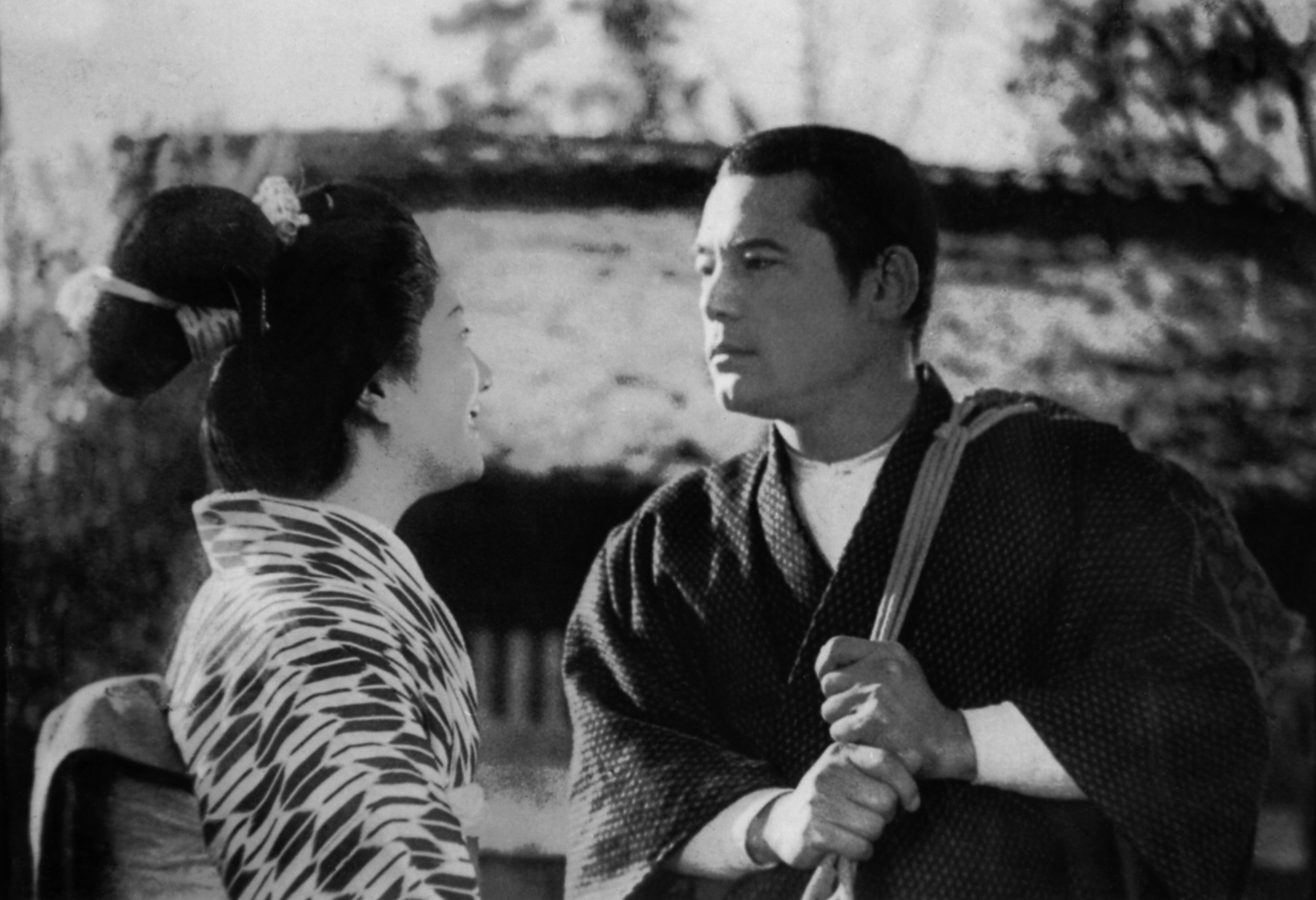
It might seem curious in some ways to make a film about the importance of humanity in martial arts during a time of war, but Akira Kurosawa’s debut feature Sanshiro Sugata (姿三四郎, Sugata Sanshiro) does just this in depicting the hero’s coming of age as a gradual progress towards awakening as he learns to attain control over body and mind through the modern discipline of judo. Based on a novel by Tsuneo Tomita, the film is in many ways a typical martial arts drama in which a young hopeful seeks a master and must eventually face a rival, but lends a note of poetry to the tale which is in other ways perhaps out of keeping with its times. 

The times of the film, however, are late Meiji as demonstrated in the lively opening sequence which ventures into a town in transition where policemen in Western-style uniforms walk the streets alongside townspeople dressed largely in kimono as is the hero, Sanshiro Sugata (Susumu Fujita), who’s come looking for a famous jiujitsu master. Taken on as a pupil, he overhears the master, Momma (Yoshio Kosugi), disparaging a rival, Yano (Denjiro Okochi), who has come up with a new martial art he calls judo which is fast gaining both respect and popularity. Momma thinks it’s all just a branding exercise and Yano’s “judo” is just repackaged jiujitsu, irritated that he seems primed to take a prestigious position as a trainer to the police force which runs its own martial arts contest. Sanshiro goes with them when they attempt to ambush Yano and teach him a lesson only to be easily defeated and humiliatingly thrown in the local river. Sanshiro immediately switches his allegiance, discarding his geta to give Yano a ride home in his rickshaw.

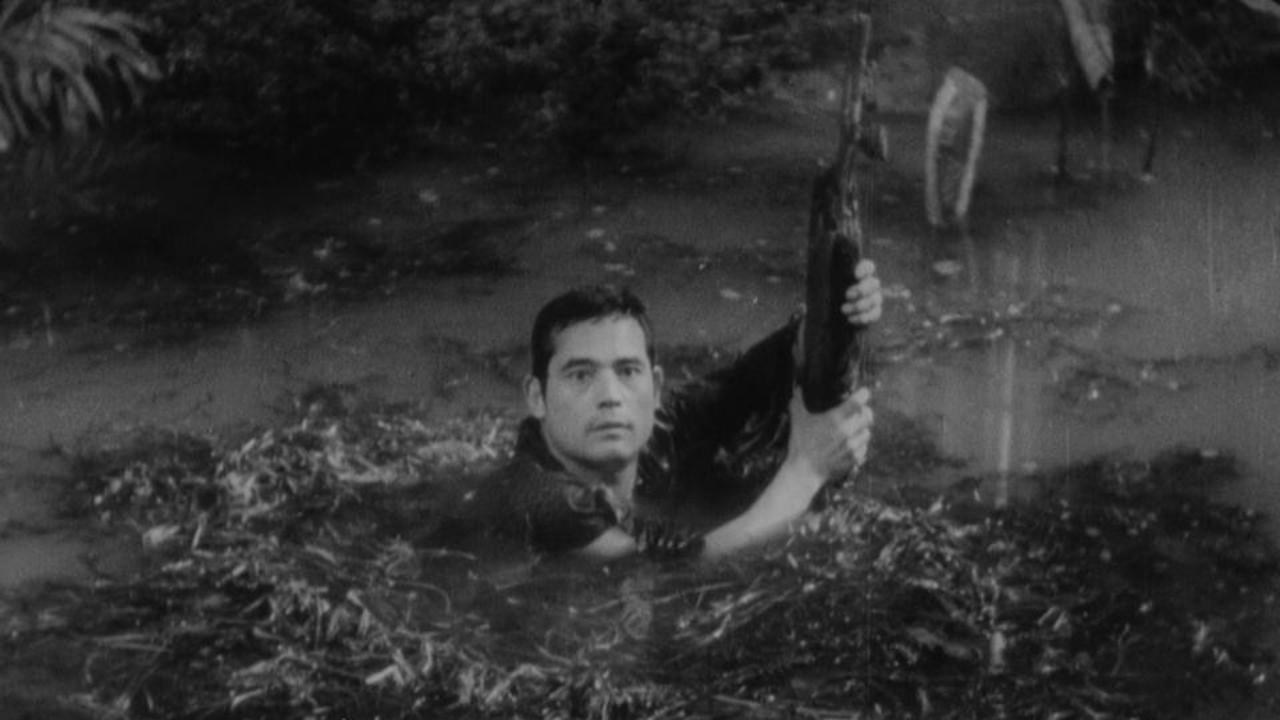
As Yano repeatedly tries to teach Sanshiro, judo is more than a martial arts discipline and places humanity at the centre of everything. This is a difficult lesson for the hot-headed Sanshiro to learn, quickly falling foul of his new master after brawling in the red light district and dramatically throwing himself into the pond. Clinging to a pole, he refuses to get out until Yano forgives him, but in true master fashion Yano merely says that getting out of the pond or not is entirely up to him. It’s while he’s in there, and after a few words from a Buddhist monk, that he witnesses a lotus flower slowing unfolding and achieves a kind of enlightenment that allows him to realise he’s been childish and petulant, finally getting out of the water to submit himself to the rigorous discipline of the martial arts life. 

The flower motif recurs several times, not least being its subversion when antagonist Higaki (Ryunosuke Tsukigata) sprinkles the ash of his cigarette over it. Making his first appearance in dandyish Western dress, Higaki is described as a snake-like villain, his evilness emphasised by his non-Japanese attire in contrast to pretty much everyone else who continues to dress in kimono. Higaki vows that his fight with Sanshiro must be to the death, in part a fight between the nascent art of judo originating in the post-feudal society and the traditional art of jiujitsu, but echoing Sanshiro’s first fight with former master Momma which resulted in his death and plunged the hero into spiritual conflict. He then experiences something similar when realising that he has inadvertently fallen in love with Sayo (Yukiko Todoroki) the pure-hearted daughter of another rival, Murai (Takashi Shimura), who also desires to fight him but as it turns out only in his desire to face a worthy opponent. Sanshiro wants to back away, afraid that he may humiliate or even kill the father of the woman he loves but is brought back to himself by more words from the monk who tells him that he must be as innocent as she is and engage in the fight in a sportsmanlike fashion as a spiritual as well as physical contest. 

This is also to some degree true of his final confrontation with Higaki which too is a confrontation with the evils of the age if less comfortably also satisfying the censors by allowing Higaki to stand in for foreignness in general. Higaki is indeed often accompanied by the sound of the wind which echoes his modernity, the fight taking place in a large windswept field below roiling clouds as the two men grapple despite the advice of their intermediary to call it off before one of them really dies. Higaki does in a sense die a sort of death in that we’re told after the fight he reformed and also managed to find a similar kind of enlightenment to Sanshiro who is then bashful and romantic while heading off on another journey from which he assures Sayo he will soon return. It’s true enough that there doesn’t seem to be much that would appeal to the censors of 1943 save the implied defeat of Western powers and celebration of Japanese martial arts given that humanity is repeatedly emphasised as the core component of judo and that Sanshiro achieves an individual enlightenment rather than finding peace as a member of a team or community, but they did otherwise decide to cut a substantial amount of the film said to contain a love scene and references to alcoholism that they deemed improper. Nevertheless, there are shades of Kurosawa’s later greatness even here in his dramatic composition and expressionistic use of nature to detail one boy’s journey into manhood through the spiritual rather than physical gymnastics of the philosophy of judo. 


That Guy and I (あいつと私, Ko Nakahira, 1961)

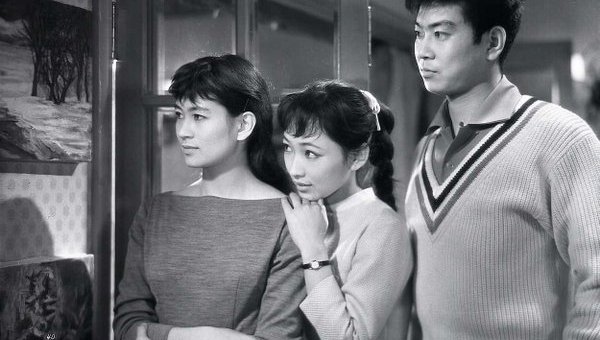
Likely intended as a slightly silly student rom-com, Ko Nakahira’s That Guy and I (あいつと私, Aitsu to Watashi) captures a sense of the changing gender roles and sexual mores of the early 1960s, if through a very male and at times even middle-aged lens. Adapted from a serialised novel by Yojiro Ishizaka and set amid the ANPO protests of 1960, the film is narrated by its heroine, a very ordinary young woman from a typical, moderately wealthy middle-class family, as she struggles with her attraction to a fabulously wealthy young man who pretends to be a boor but is actually a nice guy and unexpected feminist.

One of a new generation of women attending university with a prospect of independence, Keiko’s (Izumi Ashikawa) horizons seem to be broadening. She’s not exactly conservative and openly jokes about sex and dating with her friends, but is quite settled with her life, not particularly wanting anything more than she already has. Her psychology tutor highlights the problem of social inequality in their school that she had already raised in her opening voiceover in remarking that the rich kids all have cars and can drive themselves to school, while others are having to work to support themselves while they study. When he asks how much pocket money they all get, some are outraged and keen to stress they don’t get any help at all, but Keiko reveals that her parents actually give her a healthy allowance. It’s just that she has no real urge to spend it, so it’s been mounting up quietly in a desk drawer in her childhood bedroom while she still lives at home close to the university.

Saburo (Yujiro Ishihara), by contrast, boasts that he gets more than some people’s monthly wage as an allowance from his mother and blows it on drink, gambling, strip clubs and sex workers. It’s this last point that scandalises the female students who are all shocked and disapproving, even going so far as to ask the teacher to throw Saburo out because they don’t feel comfortable sharing a space with a man like that. The teacher also says he’s disappointed and wishes Saburo hadn’t added the last bit, only for Saburo to call him a hypocrite because sex work was legal in his day and he simply doesn’t believe that he’s never paid for sex. Most of the other boys join in on Saburo’s side, insisting that no man sees any problem with visiting sex workers which they regard as a natural right because the male sex drive is driven by “uncontrollable forces”.

But then there’s something unexpected that occurs among the female students in that some of them are obviously attracted by this very rough form of masculinity. “I’d rather have a wild beast than a meek sheep,” one intones, but nevertheless goes to join the group of girls confronting Saburo at the pool in the hope of gaining an apology for the offence he caused them. They’ve since found out that he probably made it up anyway, which is ironic because he claimed he’d only spoken the truth when they asked him to leave, but that’s somehow even worse because it means he said it deliberately to upset them. The upshot of it all is that Saburo ends up in the pool and is then forced to borrow some of the girls’ clothes while his dry off, signalling his awkward positioning between traditional masculinity and femininity in that he’s otherwise surprisingly sympathetic of women and makes sure to look out for them but in a way that encourages their independence and is never patronising. 

That might, in one way, be because of his unusual upbringing which is far more modern and bohemian than Keiko’s and in the beginning, at least, quite confusing for her. Saburo’s mother Motoko (Yukiko Todoroki) is a famous entrepreneur with a beauty shop empire. She writes her name in Western order and uses katakana for her first name which makes look foreign and therefore exciting and sophisticated even though it obviously isn’t. It was Saburo’s mild-mannered father who gave up his career in insurance to raise him, while his mother apparently blows off steam through numerous affairs. His father occasionally gets upset about this and the pair go through a charade of him leaving her while she professes her love for him, which seems to have a sexual dimension in itself. Perhaps this has given Saburo an alternative view of romantic relationships, though we also later discover that he was subject to what we’d now see as a form of sexual abuse as a teenager when his mother got a young but still adult woman, Michiko (Misako Watanabe), to essentially give him practical lessons in sex and satisfy his teenage urges, only he thought it was an organic romantic relationship and feels more than anything else emotionally betrayed. 

But then again, the film has a very of its time and defiantly male view of rape which is dealt with in a fairly flippant manner. Keiko rings her mother to tell her she’s realised that the reason she didn’t like the idea of her being at the ANPO protests was because she feared she’d be raped, which is at any rate an odd conversation to be having. Her mother asks her what her virginity has to do with ANPO, which is a fair question, but also implies that it’s not so much the physical and psychological harm of sexual assault that bothers her mother but the shame of premarital sex. One of the girls who goes to the protest, Ayako (Shigako Shimegi), is actually raped by the two boys she went with who deliberately plied her with alcohol and took her to a hotel knowing that she trusted them, but her roommate, who had a crush on one of the boys, immediately turns against her. Sadako (Kazuko Yoshiyuki), the most political of the students, calls her a slut who parades herself in front of men and says Ayako must have led them on. Only Keiko takes her side, walking her to the bath and waiting outside for her while admitting that she has conflicted thoughts about Saburo. She throws things at him to shoo him away, feeling that his presence as a man is inappropriate and not wanting him to see Ayako in this moment of vulnerability, but also she admits to herself because she’d be jealous and doesn’t want him to see a naked woman that isn’t her.

Something similar happens when she finds out about Saburo’s past and is jealous and resentful of Michiko, irrationally angry with Saburo, and on another level protective of him knowing that happened when he was a teenager was wrong. After she runs out into the rain and the pair argue about it, Saburo forces a kiss on her which, again, Keiko seems like in a show of robust manliness. Saburo is though also protective and sympathetic towards Ayako, insisting that that the way for her to move past her rape is to ensure she becomes financially independent and successful so that she can see it as just something unpleasant that happened to her rather than something that ruined her life or makes her unworthy of another man’s love. He even helps her to do that by getting her a job at his mother’s company. 

Saburo’s mother Motoko, meanwhile, gives Keiko some frank advice in disclosing the secrets of her life and Saburo’s birth. Even when Saburo suddenly announces their engagement without actually asking her, Keiko does not merely swoon but reflects that she’s got to have a proper think before actually agreeing which she is still free to do or not. Nevertheless, the film seems to have hit on a contradiction in redefining masculinity as both tough and soft. Keiko is despite herself attracted to Saburo’s forcefulness, but also his chivalrous nature and awkward kindness, his fair-mindedness and care, and recognition of women as actual human beings with interior lives and a right to independence. Nakahira may be a little less surreal than usual, but leans heavily into absurdity, on the one hand acknowledging the somewhat superficial quality of these privileged students’ lives in having them confront a band of angry rural workers and half-heartedly take part in the ANPO demonstrations without much thought to what they’re for or what they mean, but, in the end, characterises them as merely ordinary, slightly lost amid the rapid changes of the post-war society but otherwise cheerful and looking ahead to a bright future stretching out in front of them.


Trailer (no subtitles)

Temptation (誘惑, Ko Nakahira, 1957)

Ko Nakahira made his name with the seminal Sun Tribe movie Crazed Fruit, a nihilistic tale of bored, affluent post-war youth. Released a year later, Temptation (Yuwaku), adapted from a novel by Sei Ito, is in some ways its inverse pitting a melancholy widower harping on dreams of lost love against his relentlessly practical daughter for whom “Sex is life. Art is money” but finding in the end perhaps more commonality than difference save for the fact the youth of today may have no real dreams to betray. 

Now 55 years old, Sugimoto (Koreya Senda) is the proprietor of the Sugimoto Dried Goods store in upscale Ginza. Father to an only daughter, Hideko, now that his wife has passed away he finds himself carried back towards the past and is planning to turn the upstairs space in the store into a small gallery. For her part Hideko (Sachiko Hidari) and her coterie of artist friends are hoping to convince him to allow them to exhibit in the gallery for cheap, but he, slightly more conservative in his old age, views them all as low class Bohemians and fails to understand why Hideko hangs out with them in the first place. He has, it seems, an internal conflict symbolised by the beret he’s taken to wearing in which he is unable to let go of the broken dreams of his youth when he was a struggling artist forced to give up his first love, Eiko (Izumi Ashikawa), because he had no money or prospects while she eventually consented to an arranged marriage.  

The world of 1931 being very different, Sugimoto and Eiko never did anything beyond holding hands (later a key plot point), though in her parting letter she laments that she regrets not having let him kiss her and mildly berates him for not having been more forceful. A slightly uncomfortable sentiment, but diffidence seems to be the force defining Sugimoto’s life. At the store he finds himself dissatisfied with his senior salesgirl Junko (Misako Watanabe) whose brusque manner with customers and refusal to wear makeup he fears are harming sales, but is unable to say anything until his rather half-hearted attempt to talk to her provokes a mutual misunderstanding, he thinking she may be anxious about being fired and she wondering if he’s about to make a proposal. 

For unclear reasons, Junko seems to have a crush on Sugimoto, something which becomes a minor problem when he also becomes a target for Kotoko (Yukiko Todoroki), a middle-aged woman/insurance agent from Hideko’s floral arrangement class. Privy to their interior monologues, we can hear the two women squaring off against each other, Junko complaining that Kotoko is “meddling, talkative, and fat”, while Kotoko fires back that Junko wears “no makeup at all and is so stuck up” as they glare at each other through the shop window. Yet it’s not Sugimoto who eventually provokes a change in Junko, but another eccentric, struggling artist, Sohei (Shoji Yasui), who bluntly tells her that she is pretty and so should put some makeup on to bring it out. 

Junko later characterises this intervention as an act of salvation that sees her re-embrace her femininity, not only wearing makeup and having her hair styled but beginning to talk warmly with customers, improving the business but ironically giving Sugimoto the mistaken idea her friendly new demeanour may be partly for his benefit. For his part, Sohei, an unkempt artist suffering a seemingly permanent lice infestation, claims not to have cared very much about money or possessions which led him to accidentally abuse the generosity of his artist friends but has now been awakened, it seems, to a kind of consumerist mentality thanks to the interest of Junko and recognition of his art when some of Sugimoto’s old friends (well known artists Taro Okamoto, Seiji Togo, and critic Kimihide Tokudaiji) praise his paintings on seeing them in the gallery leading to them fetching a high price from prominent collectors. 

“The value of a work of art hinges on whether or not it sells” one of Hideko’s friends points out while she adds “We should be proud that art is profitable”, a sentiment that hugely offends Shohei (Ryoji Hayama), the beret-wearing leader of another artist circle the gang enlist to help them pay for the rental of the gallery. Though he concedes to Hideko’s argument that her father’s gallery is a business enterprise, not a charity, Shohei is somewhat horrified by the casual equation of art and commerce, shocked that the girls view their flower arranging as a practical more than an aesthetic skill. Still, in another irony it turns out that his talent is for business rather than art, shrewdly steering Sohei’s success rather than his own when it’s clear his work is the standout in the gallery. Just like Sugimoto had, he eventually resolves to give up his artistic dreams after falling in love with Hideko, planning to marry into her family and take over the Sugimoto store. She meanwhile, had described him as not good marriage material, “no poor painters for me, only rich men” but is apparently in favour of his selling out if only in that it ironically makes him more himself. 

As we discover there are more than a few reasons besides the beret that Sugimoto keeps feeling Shohei reminds him of someone else even as he finds himself wary of him, pointlessly trying to set Hideko up with someone more “suitable” just as she makes a point of inviting a series of alternative widowed, middle-aged ladies to the gallery opening not so much because she particularly objects to Kotoko but she’s worried her dad might get bamboozled into something without properly surveying his options. While Sugimoto remains maudlin and filled with regret though perhaps putting the past aside through a symbolic act of closure, the youngsters are cheerfully cynical, practical in the way the older generation are always telling them to be but are perhaps disappointed in them for not having dreams or aspirations beyond those of claiming or maintaining or their chosen status in life. “Art is money” Hideko is fond of saying, and it’s true enough in so much as money is an art and the one which seems at least to have captivated the post-war generation eagerly awaiting the advent of the consumerist revolution. 


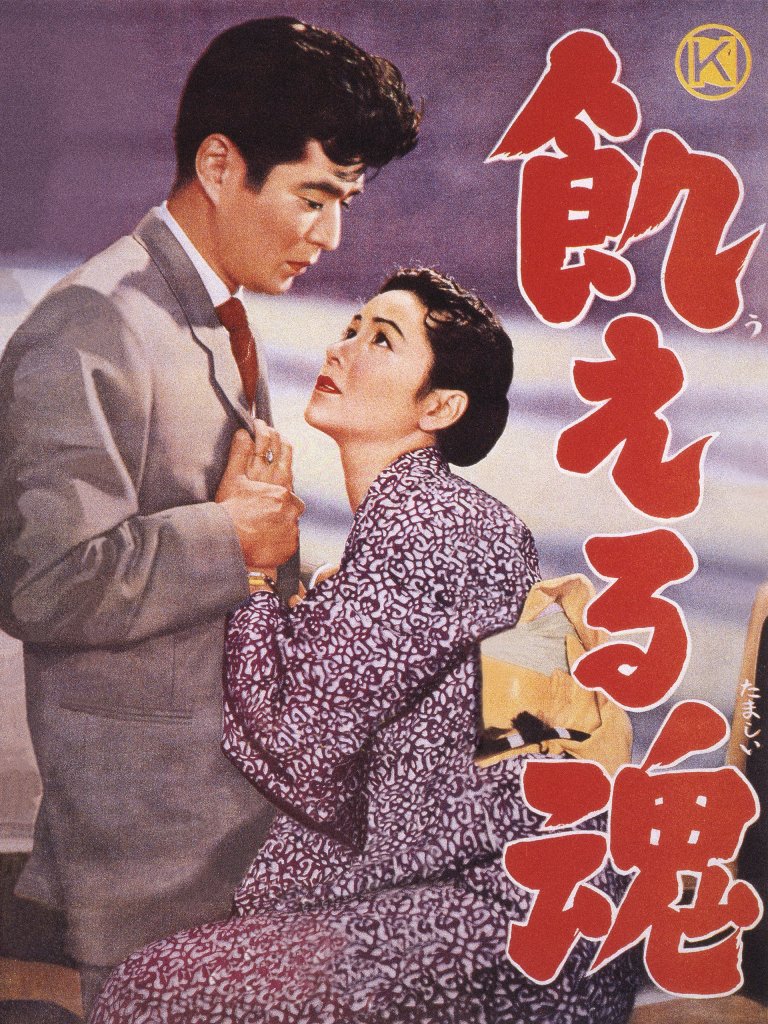
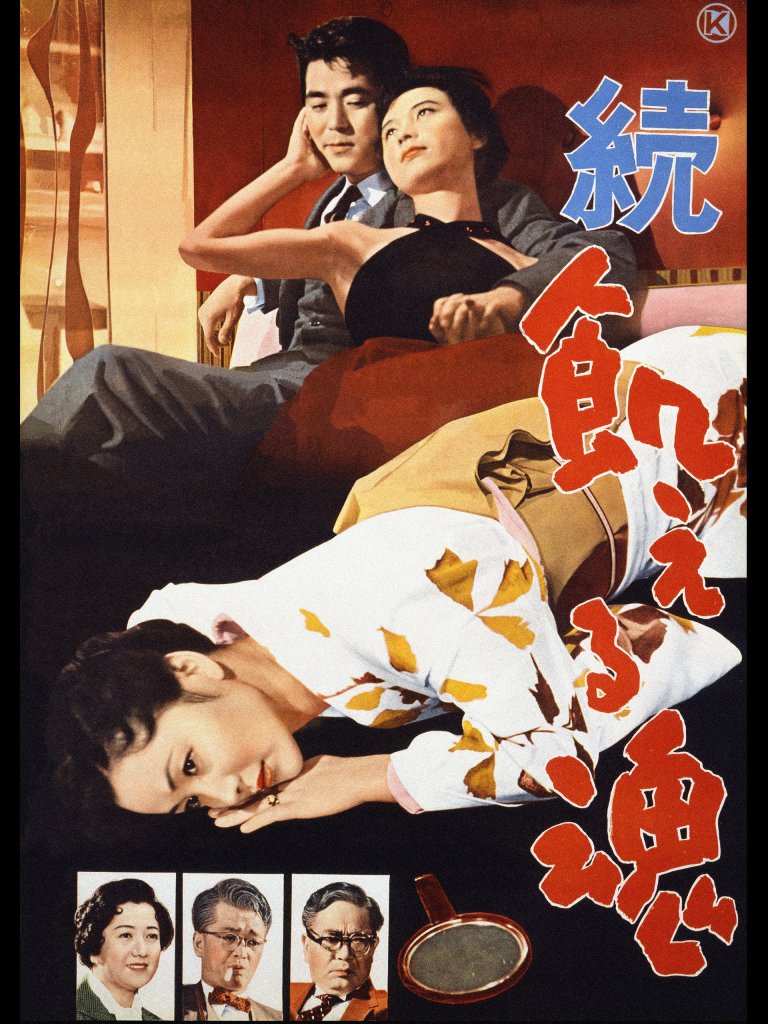
Hungry Soul / Hungry Soul, Part II (飢える魂 / 続・飢える魂, Yuzo Kawashima, 1956)

When you think of the family drama, you think of a young woman getting married and that her marriage is an unambiguously good and righteous thing despite the pain it may bring to her parents who will obviously miss her yet must comfort themselves that they’ve done everything right. In melodrama, however, we get quite a different picture of the “modern” marriage in which it is not quite so unambiguously good or righteous but a patriarchal trap enabled by a kind of gaslighting which tells women that suffering is the natural condition of life and that they should wear their unhappiness as a badge of honour.  

Nowhere does this seem truer than in the films of Yuzo Kawashima who in general takes quite a dim view of romance as a path to freedom and finds his heroines struggling to escape outdated social codes to seize their own freedom. Hungry Soul (飢える魂, Ueru Tamashii) finds one still comparatively young woman and another middle-aged discovering that they want more out of life than their society thinks a woman is supposed to have but continuing to wrestle with themselves over whether or not they have the right to pursue their personal happiness in a rigidly conservative society. 

Reiko (Yoko Minamida), a woman in her early 30s, married Shiba (Isamu Kosugi), 23 years her senior, 10 years previously apparently out of a mix of youthful naivety and post-war desperation. Shiba has supported her financially and apparently enabled her brother’s career, but it’s clear that he thinks of her as little more than a glorified housemaid, treating her with utter contempt even in public. He makes her carry her own bags at the station rather than wait for a porter and forces her to accompany him on business trips where he shows her off to colleagues and then retires her to the hotel with nothing to do all day. Tyrannised, Reiko has been been raised to be obedient and does her best to be a good wife, but Shiba repeatedly reminds her that he bought her while openly talking about his relationships with other women even at one point bringing a geisha home with him while Reiko cringes in the front seat next to the driver. 

Perhaps what she’s learning is that obedience is not an unambiguously good quality, but still she struggles to let go of the necessity of measuring up to the standards of social propriety. When Shiba unwittingly introduces her to handsome politician Tachibana (Tatsuya Mihashi), her accidental attraction to him awakens her to all the ways her married life is a hell of disappointment. Shiba reminds her that he keeps her in comfort, little understanding that she may hunger for something more than the material, while Reiko realises that she may starve to death for lack of love but has been conditioned to think that a woman’s emotional needs are not only unimportant but entirely taboo. 

Mayumi (Yukiko Todoroki), meanwhile, has known love but feels obliged to live on the memory of her late husband and fulfil herself only though caring for her two teenage children. To do that, paradoxically, she has seized her independence as a working woman with a job in real estate, later hoping to manage a ryokan traditional style hotel, only for her children to resent her perceived rejection of motherhood in favour of individual fulfilment. “School is for people who have two parents” her son tells her, threatening to move out into a dorm, while her daughter at one point considers suicide simply because she suspects her mother may be sleeping with her late father’s best friend. 

In Reiko’s case, her desire for liberation is kickstarted by a hunger for love, though as we later realise Tachibana is also perhaps looking to break with the past and with conventional male behaviour in that he has been a womanising playboy involved in relationships with women from the red light district which to him were always casual while they, like Reiko and Mayumi, longed for more. Mayumi’s relationship with Shimozuma (Shiro Osaka), by contrast, is complicated by the fact he is married to a woman with a long-term illness, though what he craves (besides Mayumi herself for whom he seems to have been carrying a torch for many years) is a conventional family home, jokingly chiding Mayumi that her interest in business may be making her less “womanly”.  

Both women try, and fail, to break free of patriarchal control to claim their own agency, discovering that romance is not the best way to find freedom. Despite her love for and possibly misplaced faith in Tachibana, Reiko is both too brutalised by her abusive husband and constrained by the taboo of being a woman ending a marriage for another man to definitively escape Shiba’s control. Mayumi, meanwhile, is shamed by the reflection of herself in her children’s eyes and motivated to reassume her maternity but does so also as a way of rejecting easy romantic fulfilment in the hope of discovering more of herself as a middle-aged woman embracing all the freedom that might offer while her children, though grateful to have her return to them, are also chastened and guilty in having realised that their mother is a woman too and ultimately they just want her to be happy. As often in Kawashima, no one quite gets what they wanted, but they do at least find a kind of resolution. Their souls may still be hungry, but their appetites have returned and there is the promise of future fulfilment if still tempered by the restrictions of a cruelly repressive society.


Hungry Soul opening (no subtitles)

Hungry Soul, Part II opening (no subtitles)

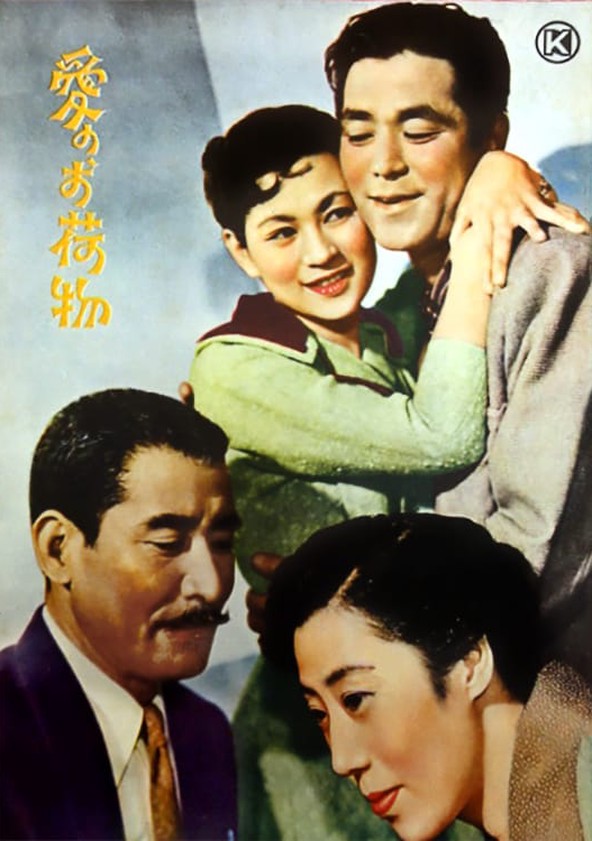
Burden of Love (愛のお荷物, Yuzo Kawashima, 1955)

Two decades into the new century, Japanese society finds itself gripped by a population crisis. Supposedly “sexless”, young people constrained by a stagnant economy and a series of outdated social conventions have increasingly turned away from marriage and children to the extent that the birth rate is currently at the lowest it’s ever been. How strange it is then to revisit Yuzo Kawashima’s baby boom paranoia comedy Burden of Love (愛のお荷物, Ai no Onimotsu) in which the very same anxieties now expressed for the declining population are expressed for its reverse – that it will damage the economy, that it is the result of a moral decline, and that society as we know it is on the brink of destruction. 

All of these arguments are made by the Minister for Health, Araki (So Yamamura), as he tries to chair a committee meeting put together to find a solution to the baby boom crisis. The government policy he’s putting his name to is a birth control advocacy programme coupled with greater education to discourage couples from having so many children. Some object on the grounds that encouraging the use of birth control will inevitably lead to promiscuity and sexual abandon, which is why Araki’s government intends to limit its use only to married couples to be used for proper family planning. A feminist politician challenges him again, first citing the go forth and multiply bits from the bible to imply she objects to birth control on religious grounds only to trap Araki by reminding him that that is exactly what the government encouraged people to do during the wartime years. She thinks limiting birth control to married couples is little more than thinly veiled morality policing which will fail to help those really in need, suggesting that if this is the road they want to go down perhaps they should think about relaxing abortion laws so that those who become pregnant without the means to raise a child will have another option. Predictably, Araki is not quite in favour, but takes her point. In any case, events in his personal life are about to overtake him. 

The first crisis is that his son, Jotaro (Tatsuya Mihashi), is in a secret relationship with Araki’s secretary Saeko (Mie Kitahara), who has now become pregnant and is quite smug about it because Jotaro will finally have to sort things out with his family so they can marry. There are several reasons why he’s been dragging his feet: firstly, Saeko is a very good secretary and it’s customary for women to stop working when they marry (though as we later find out Jotaro is a progressive type who has no intention of stopping Saeko working if she wants to even after they marry and have children), secondly, his mother Ranko (Yukiko Todoroki) and younger sister Sakura (Tomoko Ko) are old fashioned and may feel marrying a secretary is beneath him, and thirdly he’s just a lackadaisical sort who doesn’t get round to things unless someone gives him a push. Sakura has an additional concern in that she’s engaged to an upperclass dandy from Kyoto (Frankie Sakai) and worries his family might object if they know that Jotaro has undergone a shotgun wedding to someone from the “servant class”. Araki’s oldest daughter, Kazuko (Emiko Azuma), is happily married to a gynaecologist (Yoshifumi Tajima) but ironically has been unable to conceive after six years of marriage. All of which is capped by the intense irony that his own wife at the age of 48 may be expecting a late baby of their own. 

The press is going to have a field day. Araki, for all his faults, is a surprisingly progressive guy, a moderate in the conservative party but one who, worryingly, doesn’t seem to believe in much of what he says as a minister of government, merely doing what it is he thinks he’s supposed to do. It’s perhaps this level of hypocrisy that Jotaro so roundly rejects, insisting he wants neither a career in the family’s pharmaceuticals company (which, it’s worth saying, also produces the birth control Araki’s policy seeks to promote), or a career in politics, and insists on being his own man. Tinkering with various bits of modern technology, he eventually gets a job in research and development of cheap TV sets, signalling his allegiance to the new all while dressing in kimono to visit kabuki clubs with Saeko. Saeko too is a modern woman – she speaks several languages and has a university degree, supporting herself independently even though she is “only” secretary albeit to a cabinet minister. Sakura, a more traditional sort, originally looks down her for being all those things, but later comes to a kind of admiration especially when she finds herself in need of advice from another modern woman. Jotaro’s mother, however, only comes around when she hires a detective who discovers Saeko might be posh after all. 

“Children have their own worlds to live in” one of Araki’s grownup kids later emphases, unwilling to rely their father for money or career advancement, they want to make their own way in the world. Jotaro, a kind man and something of a socialist, wonders if they shouldn’t be using some of this money the government has earmarked for defence on social welfare, suggesting perhaps that’s the best way to deal with the population crisis rather than pointlessly trying to police desire. Burden of Love was released in 1955, which is immediately before Japan instituted its anti-prostitution law doing away with the Akasen system that existed under the American occupation. Araki goes to visit an establishment in the red light district and declares himself horrified, but is unable to come up with a good solution when the women working there point out that they support entire families who will starve without their income. He may have a point that the pimp’s identification of himself as a social worker is disingenuous because he profits from the exploitation of women, but Araki’s later visit to a tavern staffed by geisha raises a series of questions about a continuing double standard. 

Araki exposes his own privilege when he tells Jotaro that he’d do anything for a single slice of bread before he’d ever do “that”, which is ignoring the fact that it’s very unlikely he’d ever have to consider it. Araki’s father, himself a retired politician, is also a fairly progressive sort who actively gets involved in the kids’ nefarious plans to get around their parents so they can marry the people the want when they want to marry them, while Araki remains largely preoccupied with his political position, even suggesting to his wife, despite what he said in the committee meeting, that she get an abortion to spare him the embarrassment caused by increasing the population while proposing a series of population control policies. Ranko is distraught because to her the child is the product of their love, even if to Araki it is also a “burden”, but being a traditional sort thinks first of her husband and is minded to do as he says. The younger generation think and feel differently. They want to make decisions for themselves, not just about what they do but who they love and how they live. The lesson is perhaps that this isn’t something to be overly worried about. Children are the “burden” of love, but we carry them together, and it’s a happier society that is content to figure it out rather than trying  to pointlessly police forces beyond its control. 


Original trailer (no subtitles)

Suzaki Paradise: Red Light (洲崎パラダイス 赤信号, Yuzo Kawashima, 1956)

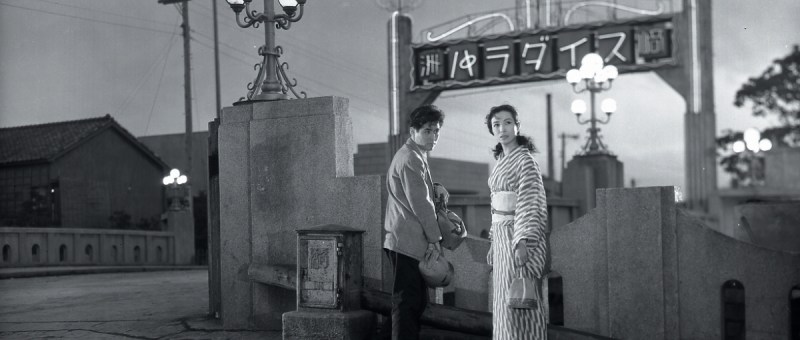
Suzaki paradise posterBy 1956, things were beginning to look up. Post-war privation was receding into the distance with the consumerist future already on the horizon, but as much as there were possibilities for some others found themselves floundering, unable to find direction in a world of constant change. Yuzo Kawashima’s Suzaki Paradise: Red Light (洲崎パラダイス 赤信号, Susaki Paradise: Akashingo)* was released in the same year that the anti-prostitution law came into force forever changing the face of the red light district and like its heroes finds itself hovering on a precipice caught between an old world the new.

Lovers Tsutae (Michiyo Aratama) and Yoshiji (Tatsuya Mihashi) have found themselves at a crossroads, or more accurately on a bridge, unsure whether to go forward, or back, or some other place entirely. Tsutae is disappointed in Yoshiji, expecting him as the man to have some kind of plan, while he is a little resentful of her fortitude and tendency to take the lead. Yoshiji grows maudlin and moody, berating himself for his failure of manhood, a failing for which Tsutae has little sympathy. Fed up with him, she runs off and catches a bus. He chases her, and they both get off at Susaki, home to a famous red light district. Yoshiji isn’t happy with this development, worried that Tsutae will cross the bridge and fall back into her “old self”, perhaps hinting at the kind of life she lived before. Luckily for them, Tsutae spots a help wanted sign at a tiny bar firmly on this side of the river. The landlady, Otoku (Yukiko Todoroki), is a kind woman raising her two sons alone, but is wary of handing the job to a woman the like of Tsutae. As she tells her, no one stays here long, most just see it as a stepping stone, a place where they can acclimatise themselves to the idea of crossing the bridge into the ironically named “Susaki Paradise”.   

Once you cross the bridge, most seem to say, you never really cross back. Later we learn that Tsutae is from the other side of the water and seemingly forever trying to escape her past though mostly through trying to attach herself to a man she thinks can carry her out it. Yoshiji seems to be aware that Tsutae is a former sex worker and is desperate to prevent her returning to her previous occupation, worried that he’ll lose her if she does or perhaps just unfairly judgemental. Likewise, we learn that he lost his job through some kind of impropriety, perhaps committed trying to keep Tsutae with him. Each of them is in one way or another trapped by patriarchal social codes, Tsutae believing that the only way she can save herself is by finding the right man to save her, and Yoshiji increasingly resentful for not living up to the male ideal. He can’t keep his woman, can’t provide for or protect her, most pressingly he cannot find a job but is also proud, shamed by the idea of accepting low paid manual work. He feels belittled and humiliated and is embittered by it.

Tsutae meanwhile takes to Otoku’s bar like a duck to water, quickly bringing in a host of male custom while bonding with the cheerful owner of a radio shop in nearby electronics centre Kanda, Ochiai (Seizaburo Kawazu). Otoku manages to find a job for Yoshiji delivering soba noodles in a local restaurant which he decides to take despite his intense resentment and wounded male pride. Ironically enough, the name of the soba restaurant is “Damasare-ya” which sounds like “tricked”, explaining why he might be reluctant to take the job, but the biggest problem is that he can’t trust Tsutae and is always paranoid about her meeting men in the bar or deciding to cross the bridge in his absence. Eventually, Ochiai offers to make Tsutae his mistress and provide a flat for her in Kanda, leaving her with a choice – “love”, if that’s what it is, with the feckless and jealous Yoshiji, or perfectly pleasant yet transactional comfort with Ochiai. Yoshiji, meanwhile, attracts the attentions of an earnest waitress in the soba noodle restaurant (Izumi Ashikawa) who seems to support his attachment to Tsutae but is also rooting for him to get over himself and live an honest life of hard work by knuckling down at his new job.

Yet that post-war restlessness won’t seem to let either of them go. Once you fall, you fall and it may not be possible to climb back up, or at least not without the right person to help keep you from slipping back down. Otoku has managed to keep a steady hand on the tiller, apparently waiting, we’re told, for the return of her husband who ran off with a woman from the red light district four years previously. The red light district, like toxic masculinity, cuts both ways and you’ll pay a heavy price for crossing the bridge. “People had better live honestly” a middle-aged man avows after having apparently seen the error of his ways, but it’s easier said than done.

When their worlds come crashing down, Tsutae and Yoshiji find themselves right back where they started, hovering on the bridge. “We have to live until we die” Tsutae once said, dismissing any fears we might have had that the pair might jump, but their course is both set and not. Now chastened, Tsutae’s decision to take a step back is both a reflection on the failure of her Susaki experiment, and also perhaps a mild concession to patriarchal social norms as she actively assumes the submissive role, affirming that she will follow Yoshiji’s lead while he reassumes his masculinity by finally taking charge. No longer quite so liminal they move on, another pair of floating clouds, perhaps more at home with who they are and can never be, but with no clear destination in sight.


*The reading of this place name is “Susaki” but the film has become more commonly known under the title “Suzaki Paradise”

Currently streaming on Mubi as part of an ongoing Yuzo Kawashima retrospective.

Title sequence (no subtitles)

A Slope in the Sun (陽のあたる坂道, Tomotaka Tasaka, 1958)

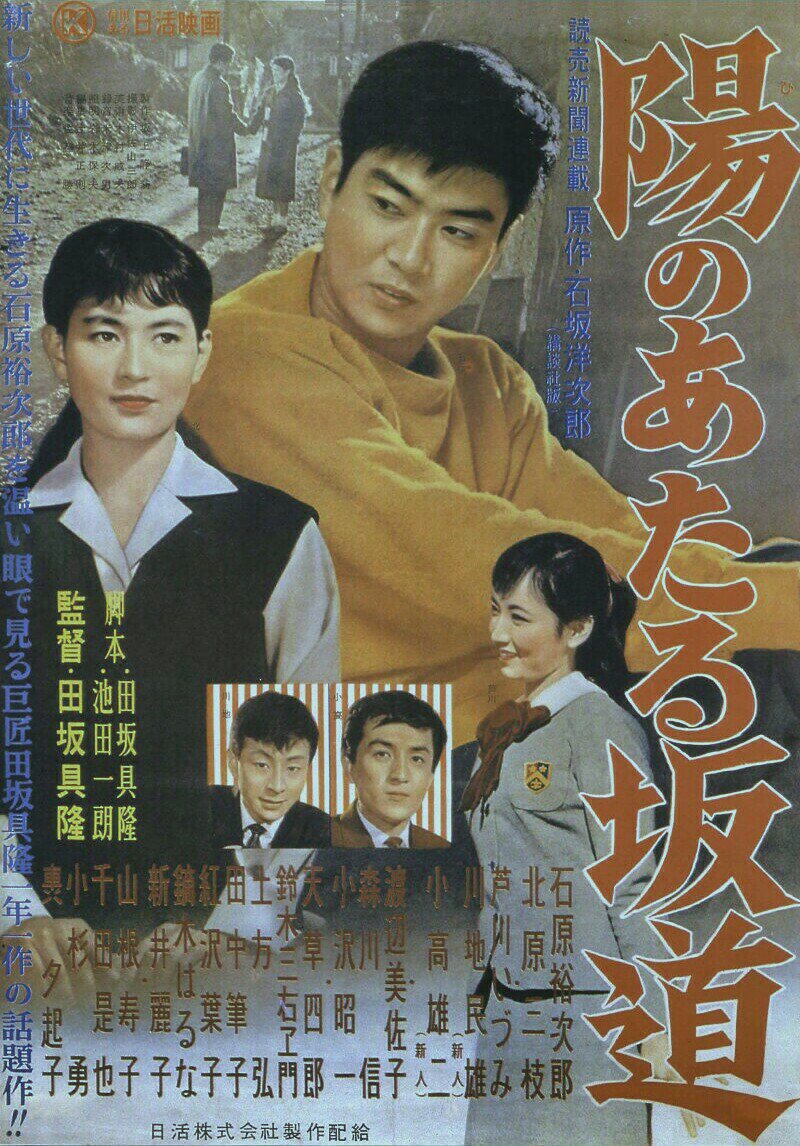
Slope in the sun posterYujiro Ishihara had become the face of the “Sun Tribe” movement thanks to roles inspired by his brother Shintaro’s novels including the seminal Crazed Fruit in which he starred opposite his later wife, Mie Kitahara. Tomotaka Tasaka’s A Slope in the Sun (陽のあたる坂道, Hi no Ataru Sakamichi), adapted from the novel by Yojiro Ishizaka, is a much less frenetic affair than Nakahira’s famously intense youth drama, but retains the Sun Tribe’s world of purposeless youth whose inherited wealth has driven them to a life of listless ennui. Like Crazed Fruit, Slope in the Sun is the story of two brothers chasing the same girl, only this time one looks bad and is really good, while the other looks good but is really no good at all.

Beginning on the titular sun beaten slope, the film opens with a young woman, Takako (Mie Kitahara), entering the frame as she searches for an address on a piece of paper she is carrying. She finds the house – a large Western-style mansion, but is prevented from entering by a young man who mistakes her for a saleswoman and instructs her to use the tradesman’s entrance. The young man, Shinji (Yujiro Ishihara), continues to taunt her with lewd language before poking at her breast. Takako tries to leave but is persuaded to come inside to meet the lady of the house and the young woman, Kumiko (Izumi Ashikawa), whom she has come to tutor.

The Tashiro household is a strange one. There are three almost grown up children – oldest brother Yukichi (Yuji Odaka) who is a medical student, middle brother Shinji who is a painter, and the youngest daughter Kumiko who is approaching the end of high school and is a little over sensitive about a mild limp which is the consequence of a childhood accident. Takako nearly turns the job down when she realises that the family want less a teacher to help with Kumiko’s studies, than a kind of big sister to help her navigate her way into the adult world, but eventually warms to the Tashiros and decides to give it a go. A college student in need of money, Takako is currently living in a boarding house where she is friends with the older lady next door, Tomiko Takagi (Hisako Yamane), and her 18 year old musician son Tamio (Tamio Kawachi).

In contrast to the earlier Sun Tribe films, A Slope in the Sun is much more subdued though it does maintain an upperclass atmosphere filled with bored young people who struggle to find purpose in their lives through having no particular economic or social worries thanks to the protective cushioning of their wealth. The central issue is a common one to the familial melodrama – middle child Shinji has always felt disconnected from his family and has discovered that the woman who raised him is not his birth mother. He wants to know the truth of his family history but is also a kinder soul than his outward behaviour may suggest and does not want to hurt anyone or risk destroying the otherwise pleasant enough family life he enjoys as a Tashiro.

As expected coincidences abound though the truth is obvious seconds after Takako tells someone the name of her new employer causing them to gasp and draw pale with shock. It seems that everyone in the family already knew that Shinji is only a half brother except Shinji himself – their overcompensation in treating him kindly was the initial tipoff for his suspicions, but this question of blood relation turns out to have a surprising dimension. Oldest brother Yukichi is, outwardly, the model son – handsome, clever, gentlemanly, but on closer inspection his veneer of respectability turns out to be just that. The boys’ mother, Midori (Yukiko Todoroki), knows this well and partly blames herself for allowing Shinji to take the blame for a childhood accident rather than forcing her own son to confess. For all his seeming goodness, Yukichi is an amoral coward, womaniser, and habitual liar whereas there’s a kind of honesty in Shinji’s lewd speech and even in his own lies which he indulges partly out of a sense of smug superiority, as Midori puts it, but also because of the inferiority complex which has marred his life as he feels himself somehow lesser than either of his siblings.

Takako vacillates between the two brothers, taken in by the manipulative Yukichi but strangely drawn to the provocative Shinji. Unlike Nikkatsu’s other youth films, Slope in the Sun ends on a note of happy resolution rather than nihilistic suffering as each member of the family is encouraged to embrace their true natures, putting secrets to one side, and becoming closer in the process. Tanaka’s approach is a more classical one than Nikkatu’s usual fare, making use of silent cinema-style closeups and dissolves but veers towards the avant-garde in a brief flashback sequence offered in dreamlike widescreen. Despite the jazz clubs and subplots about misused geishas, this is a more innocent world than the post-war melodrama would usually allow, finding space for happiness and forgiveness in each of the conflicted protagonists once they each agree to submit themselves to the truth and meet the world with openness and positivity.


Victory Song (必勝歌, Masahiro Makino, Kenji Mizoguchi, Hiroshi Shimizu, Tomotaka Tasaka, Tatsuo Osone, Koichi Takagi, Tetsuo Ichikawa, 1945)

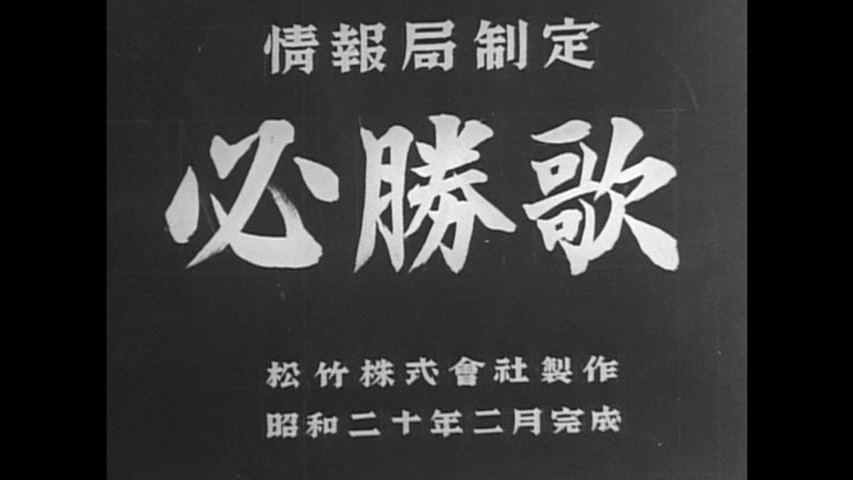
vlcsnap-2017-08-01-00h21m20s082Completed in 1945, Victory Song (必勝歌, Hisshoka) is a strangely optimistic title for this full on propaganda effort intended to show how ordinary people were still working hard for the Emperor and refusing to read the writing on the wall. Like all propaganda films it is supposed to reinforce the views of the ruling regime, encourage conformity, and raise morale yet there are also tiny background hints of ongoing suffering which must be endured. Composed of 13 parts, Victory Song pictures the lives of ordinary people from all walks of life though all, of course, in some way connected with the military or the war effort more generally. Seven directors worked on the film – Masahiro Makino, Kenji Mizoguchi, Hiroshi Shimizu, Tomotaka Tasaka, Tatsuo Osone, Koichi Takagi, and Tetsuo Ichikawa, and it appears to have been a speedy production, made for little money though starring some of the studio’s biggest stars in smallish roles.
The first scenes make plain the propagandistic intentions by starting in 660BC with a pledge of protection for the descendants of Amaterasu – ancestral mother goddess of Japan. Flash forward to 1941 and her sons are doing their best. Stock footage gives way to soldiers in the Asian jungle, taking a brief respite from the fighting to console each other with thoughts of home which is presumably where most of these small stories of resilience come from.

The soldiers appear to come from all backgrounds, the youngest of them seeming to be just a young boy whose strongest memory of home is his mother’s face. They chat cheerfully about their hometowns, never betraying any sense of fear, boredom or fatigue but the commander suddenly announces that they’re all “going home” until the next attack – taking a brief voyage of memory back to the motherland.

Within this framing sequence, the ordinary people of Japan go about their ordinary lives with cheerful forbearance. A young man cares for his parents after his older brother has given his life for the Emperor, serving on the home front by working himself so hard there’s a danger of going overboard and rendering himself out of action. His father argues that as long as everyone in Japan works as hard as they can, they can never be defeated. Community comes to the rescue again when a train gets stuck in the snow and the entire village gets out of bed to free it.

While the adults are giving it their all, the children are preparing to become fine subjects of the Emperor, training their minds and bodies to be of the most use whilst singing patriotic songs and performing military drills. Another segment finds the children praising their parents for their bravery, playing and roughhousing like any children would, but a hint of darkness emerges when a group of boys plays at war with their toy aeroplane. One little boy, Yuichi, has applied for the young pilots school without talking it over with his parents because he didn’t want them to be sad about him going away. His father, at least, is proud of him but upset at not being consulted. Practically measuring him up for the uniform, Yuichi’s father marvels at all the “young pilots” in the village – a chilling note seeing as none of these boys can be more than ten years old.

While the men go to war the women are at home waiting. Another persistent question relates to the fate of unmarried women – a positive motion for an arranged engagement is disrupted by the receipt of a draft card, prompting the male side to suggest they call the whole thing off. The woman, however, points out that every young man is in this position and she doesn’t see the point in expecting the worst. Life must go on, women must get married, and men must go to war. All of these things must be accepted without thinking too hard about it or there will be nothing for these gallant men to come home to.

The difficulties of wartime life extend to the fear and destruction of air raids, though a news report of the fire bombing of Tokyo reminds us that it could all have been much worse if it weren’t for the valiant efforts of the pilots and ground based defence forces keeping the threat from the skies at a minimum. Other reports detail dive bombing of hospital convoys while the wounded die happily knowing they’ve done their duty. Likewise the “special attack squad” prepare to meet their fates with stoicism and determination while their relatives are treated with especial esteem.

Interspersed with the vignettes and stock footage there are songs and dances bringing both entertainment and inspiration. The final message is one of resilience and unity, that Japan stands together to defend its ancient homeland in devotion to its Emperor, but then such a message would hardly be necessarily if the situation were brighter. Brief allusions are made to rationing, to the destruction and constant loss of life but these are all things which must be born for the glorious future. There is, however, much more stock put in remaining positive than there is in trying to deny the ongoing desperation. As propaganda films go, this one may backfire but does perhaps shine a light on the unspoken anxieties of ordinary people facing an extraordinary situation.


Final scenes including the “Victory Song” itself

https://www.youtube.com/watch?v=MmJAaU8sJuo

Red Pier (赤い波止場, Toshio Masuda, 1958)

Snapshot-2016-01-24 at 11_01_43 PM-1747507265Loosely inspired by Julian Duvivier’s 1937 gangster movie Pépé le Moko, Toshio Masuda’s Red Pier (赤い波止場, Akai Hatoba) was designed as a vehicle for Nikkatsu’s rising star of the time, Yujiro Ishihara – later to become the icon of the Sun Tribe generation. On paper it sounds like a fairly conventional plot – young turk of a gangster comes to town to off a guy, sees said guy killed in an “accident”, and shrugs it off as one of life’s little ironies only to accidentally become acquainted with and fall head over heals for the dead guy’s sister. So far, so film noir yet Masuda adds enough of his own characteristic touches to keep things interesting.

“Jiro the Lefty” (Yujiro Ishihara) is a sharp looking petty yakuza type in a bright white suit and sunglasses. Another of Japan’s post-war abandoned street kids, he found a home in a gang and has never known anything one could call a “normal” way of life. Other than his obvious talent with a gun, he has a cheerful and ironic personality that has him even almost respected by the police and is generally well liked in the area.

Early on Jiro rescues a little boy from almost being hit by a car and later when playing the harmonica for him gets hit by a thunderbolt of love when catching sight of the boy’s aunt, Keiko (Mie Kitahara). This causes him several problems at once: to begin with, she’s the sister of the guy he saw get hit by a crane and she doesn’t seem to know her brother was a gangster, two – Keiko is obviously of a much higher social class and a little out of his reach even if he managed to go straight, three – he can’t go straight, he doesn’t know how to do anything else, four – Mami, his current nightclub dancer “girlfriend” who’s invested a little more in the relationship than he has. Actually this is only the start of a long list of problems Jiro has to deal with, he just doesn’t know about them yet.

The story is set around the docks of Kobe where the living is hard and life is cheap. The local policeman is a fairly laid-back, ironic chap who’s made an odd sort of friendship with Jiro wherein he doesn’t really want to see anything too bad happen to him. He can see this thing with Keiko is not a very good idea and is constantly lurking in the shadows trying to control the situation as much as he can. Jiro, doesn’t know it yet but his own guys are out to get him too and after one of his sworn brothers ends up paying the price for Jiro’s rising profile in the yakuza world, he finds himself on the run from pretty much everyone.

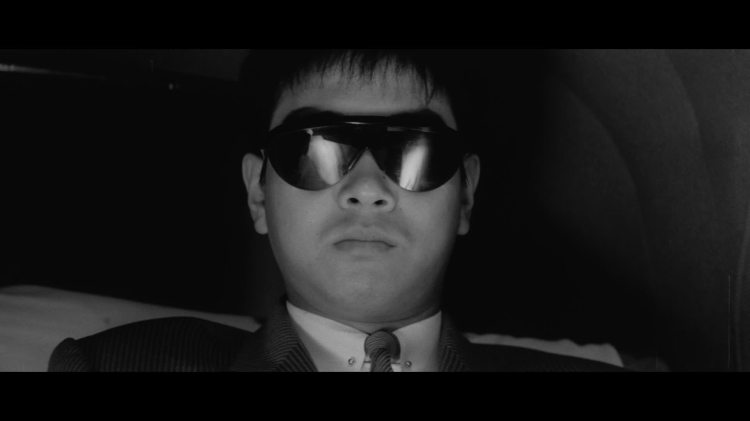
This sounds like quite a complicated set up but Masuda manages to martial everything into a coherent order and even adds a hearty dose of realistic emotion too. As far as the aesthetic goes, Masuda takes his cues from American film noir with harsh lighting and canted angles all employed to show us the crookedness of this underground world but he also makes sure to add occasional touches of artistic flair such as the light bouncing off Jiro’s sunglasses during a night time cab ride or the sheer shock on Ishihara’s face as he first sees Keiko framed against the bright sunshine of Kobe’s harbour.

The too noble for his own good gangster who wants to go straight but knows he has a crooked heart – it’s an old story, but a good one. Red Pier pushes a lot of these ideas to the max but handles them well and adds a traditional “crime doesn’t pay” ending which is both endlessly sad and completely appropriate at the same time. You can’t help feel for Jiro and his small scale existential crisis in which the reluctant gangster wants to jump ship for more peaceful climes but can’t for both personal and societal reasons. Red Pier may not be the best Masuda/Ishihara collaboration but it is certainly an excellent example of everything its genre has to offer.


Red Pier is the Second film included in Arrow’s Nikkatsu Diamond Guys Vol. 1 collection.

http://www.youtube.com/watch?v=JppZs7c9AIY