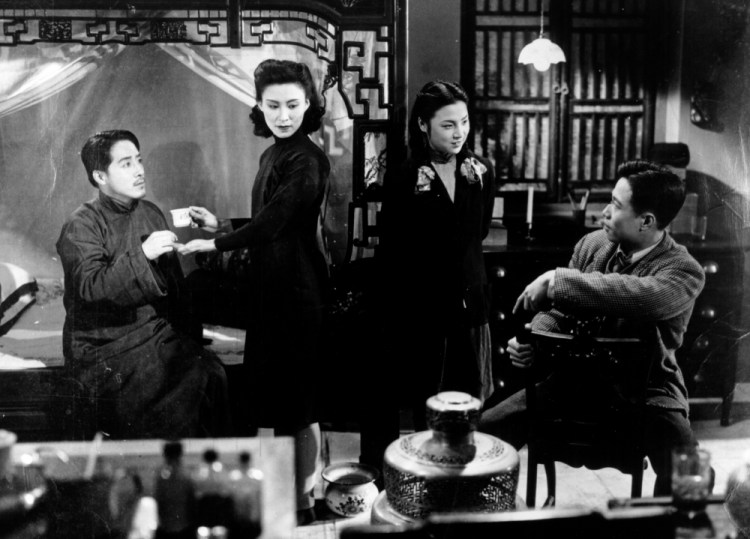
Spring in a Small Town (小城之春, Fei Mu, 1948)

spring-in-a-small-town-1948-001-two-couples-in-the-householdReview of this Chinese lost classic up at UK Anime Network


Fei Mu’s Spring in a Small Town is often regarded as one of the great lost masterpieces of Chinese cinema. Completed in 1948, it stands on the borderline of China’s transformation into a communist state and ultimately paid the price for its “questionable” politics (or, indeed, lack of them). Fei like many at the time relocated to Hong Kong where he set up a production company but sadly died not long after at just 44 years of age and Spring in a Small Town became his final film. Based on a short story by Li Tianji, the film is a complex portrait of frustrated hopes and failed marriages against the backdrop of a society in rapid change.

Yuwen is a married woman who lives for her daily errands which take her out of the decaying house she shares with her invalid husband and his school aged younger sister. Her one pleasure in life is the solitary walk she’s accustomed to take along the ruined wall which leads into town. Her husband, Liyan, believes himself to be suffering from tuberculosis and confines himself to what remains of their estate and its once fine garden. The house is little more than rubble in places and bears the heavy scars of the war years on its un-repaired exteriors. One day, an old friend of Liyan’s, Zhang – a doctor, comes to visit. Unbeknownst to anyone, Zhang and Yuwen grew up in the same village and were, in fact, childhood sweethearts until time and circumstance forced them apart.

Shot through with Chekhovian melancholy resignation (but perhaps without his trademark sense of humour), Spring in a Small Town is a tightly wound character drama which uses the plight of its characters to deliver a much wider message. Yuwen narrates her inner life for us (a stylish device which anticipates the technique coming into its prime nearly twenty years later in the French New Wave), giving voice to thoughts that could never be expressed directly. Her unhappiness is the first thing that strikes the viewer along with the decayed grandeur of her surroundings. Having become more nurse than wife to a husband that she never loved, Yuwen has resigned herself to a life of morning walks and embroidery devoid of all stimulation. Zhang’s unexpected re-entry into her life spells both doom and salvation. Liyan suspects nothing and even sees Zhang as a potential match for his sixteen year old sister, Xiang! Zhang’s arrival threatens to throw a hand grenade into this delicately balanced yet unhappy household with long buried emotions slowly working their way to the surface.

Fei keeps the tension up by keeping a tight lid on the repressed emotions of the time. What could so easily have become an overwrought melodrama retains its emotional power precisely because of its naturalistic restraint. Spring in a Small Town has been described as “the Chinese Brief Encounter” and it certainly shares something of that film’s powerful emotional manoeuvring pushed through with a level of reserve many would consider typically British. Both films also resolutely reinforce the prevailing social order of the day where duty conquers all and properness comes before personal happiness. However, where Brief Encounter ends on a note of melancholic restoration, Spring in a Small Town dares to be a little more upbeat (if still just as melancholic) with a sense that spring may really have returned to these four people after a long and hard winter. The frost has finally thawed and new life can begin again.

It’s not completely clear what exactly the new regime found problematic about Spring in a Small Town though it’s certainly a long way from socialist realist cinema. The world it depicts is an upper class one with not a little sorrow over the decline of this once noble house and fretting about its legacy neither of which gel very well with communist party guidelines. Otherwise the film is fairly apolitical which would render it a little frivolous from their point of view but far from trivial in ours. Enormously influential since its rediscovery by the Fifth Generation filmmakers in 1980s, Spring in a Small Town is a gloriously melancholic character study that deserves to finally take its rightful place alongside finest romantic dramas the golden age of cinema has to offer.
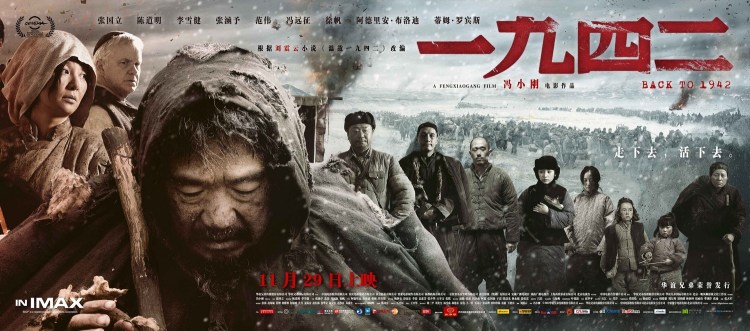
Back to 1942 (一九四二, Feng Xiaogang, 2012)

back-to-1942-poster08Review of this (slightly stodgy) war time starvation drama up at UK Anime Network.


Feng Xiaogang might not exactly be a household name in the West but at home he’s one of China’s most bankable directors. Dubbed the Chinese Spielberg (perhaps a little reductively) he made his name with a series of crowd pleasing comedy films that had audiences queuing ‘round the block in expectation. In recent years, he’s moved away from the comedy genre in favour of big budget, Hollywood style dramas centred around historical events like the 1976 Tangshan Earthquake in Aftershock or the Civil War themed Assembly. Back to 1942 sees him step back even further in time to one of China’s great hidden tragedies, the great Henan famine of 1942.

In 1942 China was in a precarious political position as it faced the ongoing Japanese incursion and came under increasing pressure to align itself with Japan’s enemies as part of the wider global conflict. A serious drought could not have come at a worse time as ever dwindling resources were pulled in several directions at once. The story here concerns the landlord, Fan, who had originally a sizeable grain store set aside to feed his family and retainers. However, after his village is raided by bandits he too is forced to travel westwards in hope of finding better supplies. Along with his wife, pregnant daughter-in-law, daughter and servant as well as another family from the village he faces increasing hardship as he tries to find food to survive. Meanwhile an American journalist employed by TIME magazine has got wind of the story and is trying to get something done about it but to no avail. The government has the war effort as its top priority – what does it matter if a few peasants die as long as the army remains well fed.

Politically speaking, you can get away with talking about ‘unpleasant’ historical events assuming that they happened before the communist revolution. The finger here is pointed quite squarely at Chang Kai-shek and his nationalist government who are portrayed not only as unfeeling and self interested but also as ineffectual when it comes to the business of conducting war with the Japanese. Indeed, at once point Chang suggests simply ceding Henan to the Japanese rather go to the expense of defending this barren stretch of land. Though it is clear he is aware of the extent of the famine, he does little about it until eventually sending “emergency supplies” to “the disaster area” to try and alleviate the damage to his reputation and diplomatic relations with other powers when news of the famine finally reaches them after the conflict. Though the local governor appears genuinely concerned and does his best to get help for the starving people (even if it’s only to alleviate the ridiculous burdens placed on them to supply grain for the army even though there is none) he is hamstrung by the top heavy hierarchical system.

No help is going to come from the government for Fan and his family. They might have been bigwigs once but now they’re in the same boat as everyone else – forced on a virtual death march through the arid land desperately trying to find anywhere that will yield to them the resources to survive. Bodies litter the landscape as the weaker succumb to starvation, donkeys and pack horses are eaten and finally wives and children are bought and sold in the hope of surviving a few hours more. Make no bones about it, Back to 1942 is almost two and a half hours of pure misery as one tragic yet inevitable event follows on the next. Unfortunately, Feng has laid the gloom on a little thick in this understandably bleak tale. The tone never wavers and somehow the constant nature of its sorrows fail to engage as they take on a sadly predictable air. Despite the obvious potential of the story, there’s precious little actual drama and the performances fail to capture the audience’s sympathies as Fan & Co. forced into increasingly degrading acts trying to ensure their own survival.

However, Back to 1942 was an expensive production and you can see all of that money on screen as the battle and action sequences rival those of any Hollywood blockbuster. Whatever reservations there may be with the plotting, it always looks good and you could never accuse it of skimping out on its production design. The only minor criticism may be that the performances of non-Chinese actors feel significantly under rehearsed with Tim Robbins’ priest being the obvious example as he struggles with a strange accent and unclear position in the narrative. Adrien Brody fares better as the idealistic reporter but still fails to convince. The film doesn’t quite seem to know where to put itself when it comes both to the role of religion and of other powers active in China at this time and though neither of those ideas are at the forefront of this film, they muddy the waters in ways other than intended by the filmmaker.
An often beautifully photographed film Back to 1942 is also a cold one and given its depressing subject matter something of a chore. The famine that struck the Henan region in 1942 and subsequent (non) reaction to it from the powers at be is indeed something that should be addressed and brought to light in the modern world but perhaps it doesn’t need to be in such a blunt fashion. The film is long, and wearing but ultimately fails to connect with the viewer in a non cynical way making its drawn out proceedings a little on the tedious side for most viewers. Those with a taste for sentimental melodramas with high production values may find a lot to enjoy with Back to 1942 but those who prefer a more nuanced drama will likely leave disappointed.


The Grandmasters – Full length trailer!


Ladies and Gentlemen! Today is a miraculous day for it seems Wong Kar Wai may actually have  finished a film. Wong has been working on The Grandmasters for some years during in which time we’ve had two films starring Donnie Yen among others to have dealt with the life of Ip Man – the man who taught Bruce Lee. Numerous problems and delays have seen the production of this film constantly in flux with release dates slipping over a period of years yet the film now seems to have a fairly solid date for its Chinese release – 18th December 2012. Assuming all goes well (and the film really, actually is finished) Chinese viewers at least will finally get to see Wong Kar Wai’s latest collaboration with frequent leading actor Tony Leung. Of course even if this date is kept to there’s no predicting when we will finally be able to see this in the West (well, the Anglophone world) but happily it is a matter of when rather than if Wong’s version of this now familiar tale will finally hit our shores. The trailer at least looks spectacular so if that’s anything to go on The Grandmasters could be something very special indeed.