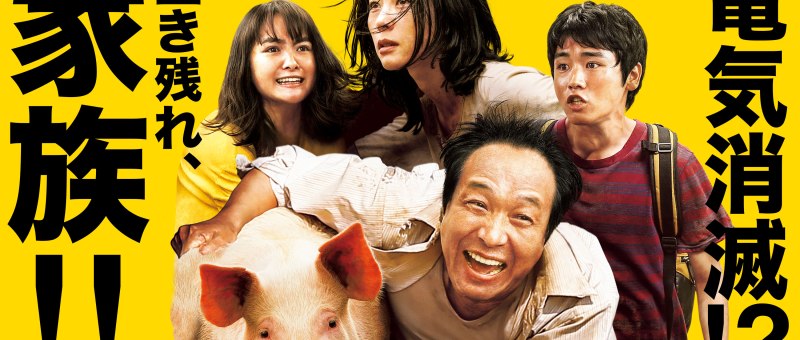
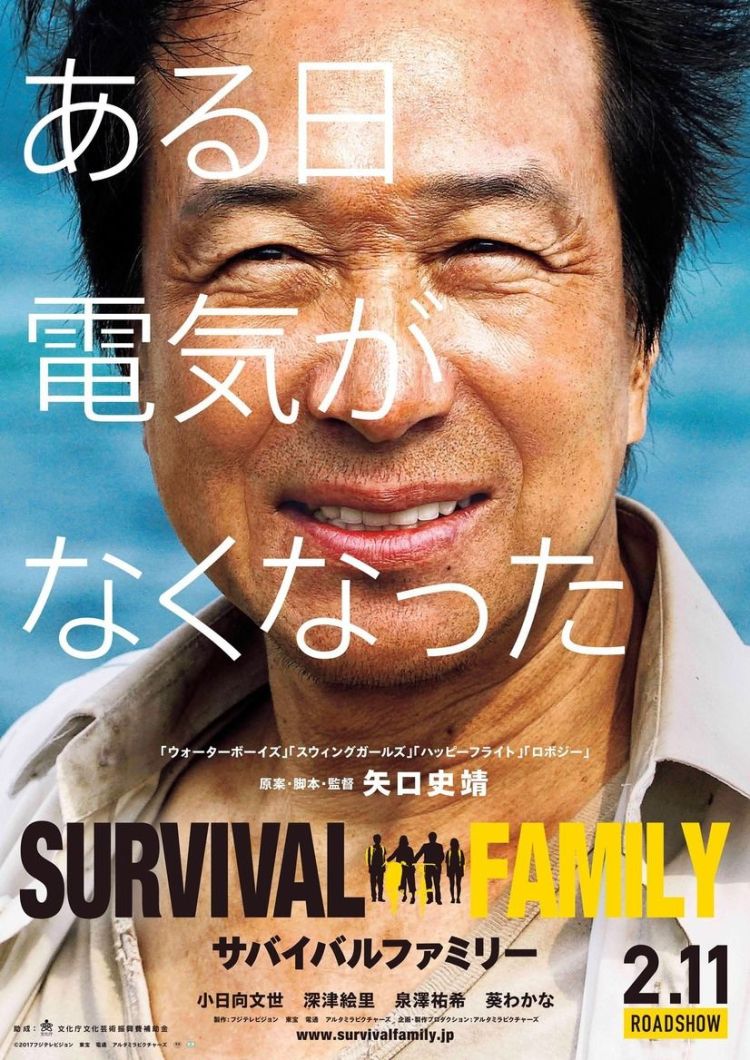
 Modern life is full of conveniences, but perhaps they come at a price. Shinobu Yaguchi has made something of a career out of showing the various ways nice people can come together to overcome their problems, but as the problem in Survival Family (サバイバルファミリー) is post-apocalyptic dystopia, being nice might not be the best way to solve it. Nevertheless, the Suzukis can’t help trying as they deal with the cracks already present in their relationships whilst trying to figure out a way to survive in the new, post-electric world.
Receiving a package from grandpa fills the Suzukis with horror more than gratitude. Mum Mitsue (Eri Fukatsu) can’t bring herself to cut the head off a fish and the sight of the giant bug that crawls out of the lettuce is just too much to bear. Her teenage daughter, Yui (Wakana Aoi), is not very excited either, tapping her smartphone with her fake nails, while her son Kenji (Yuki Izumisawa) spends all his time alone in his room with headphones permanently attached. Mr. Suzuki, Yoshiyuki (Fumiyo Kohinata) – the family patriarch, is a typical salaryman, obsessed with work and often in bed early.
All that changes one day when Yoshiyuki’s alarm clock does not go off. There’s been a power outage – nothing works, not the TV, not the phone, not even the tower block’s elevator. Being the salaryman champ he is, Yoshiyuki tries to make it into to work in other ways but the power’s out across the city and there’s nothing to be done. Everyone is sure the power will come back on soon, but days pass with the consequences only increasing as supermarket shelves become bare and water frighteningly scarce. After his boss decides to take his chances in the mountains and a neighbour dies as a direct result of the ongoing power shortage, Yoshihyuki decides to take the family on the road to find Mitsue’s country bumpkin father in the hope that he will have a better idea of how to survive this brave new world.
Yaguchi is quick to remind us all of the ways electricity defines our lives, even if we’ve begun to forget them. Not only is it a question of mobile phones being out and lifts being out of order, but gas appliances are also electric ignition as are the pumps which drive the water system. So used to the constant stream of electricity, no one quite realises what its absence means hence Yoshiyuki’s big idea is to get a plane from Haneda airport. Ridiculous as it may seem, he’s not the only one to have underestimated the part electricity plays in flight and the aviation industry as the airport is swamped by people trying to escape the rapidly disintegrating city. Credit cards no longer work leading to long checkout lines as the old ladies with their abacuses make a startling return to checkouts while bemused shoppers attempt to use the ATM machine to get more cash.
Cash itself still has worth, at least for a time. Eventually the barter system takes over as food and water become top price commodities. A very flash looking man tries to trade genuine Rolex gold watch and later the keys to his Maserati for food but is roundly informed that none of his hard won prizes is worth anything in this new back to basics era. Thanks to Mitsue’s housewife skills of frugality and haggling, the family are able to get themselves a small stockplie of resources but find themselves tested when the less fortunate ask them for help.
The crisis brings out both the best and the worst in humanity. As the family make their escape from the city on a series of bicycles, they pass a succession of salesmen all upping the price of bottled water by 100% each time. Profiteering is rife as the unscrupulous procure ordinary foodstuffs to be sold for vast amounts of money. Yet the Suzukis rarely find themselves on the wrong side of trickery and even encounter a few kindly souls willing to help them on their journey such as a gang of cycle wear clad survival experts and a very forgiving farmer who takes the family in when they help themselves to one of his escaped pigs (a sequence which allows Yaguchi to go on another Swing Girls-style pig chase only without the slo-mo and classical music).
Forced to reconnect, the family become closer, gradually coming to know and accept each other whilst finding new and unknown talents. Living simply and harmoniously has its charms, ones that don’t necessarily need to disappear if the power ever comes back on. The only certainty is that you can’t survive alone, and who can you count on if you can’t count on family?
Screened as the opening night movie of the Udine Far East Film Festival 2017.
Original trailer (English subtitles)
 Placed between
  1969. Man lands on the moon, the cold war is in full swing, and Star Trek is cancelled prompting a mass write-in campaign from devoted sci-fi enthusiasts across America. The tide was also turning politically as the aforementioned TV series’ utopianism came to gain ground among liberal thinking people who rose up to oppose war, racial discrimination and sexism. It was in this year that Godzilla creators Ishiro Honda and Eiji Tsuburaya brought their talents to America with a very contemporary take on science fiction in Latitude Zero (緯度0大作戦, Ido Zero Daisakusen). Starring Hollywood legend Joseph Cotten, Latitude Zero gives Jules Verne a new look for the ‘60s filled with solid gold hotpants and bulletproof spray tan.
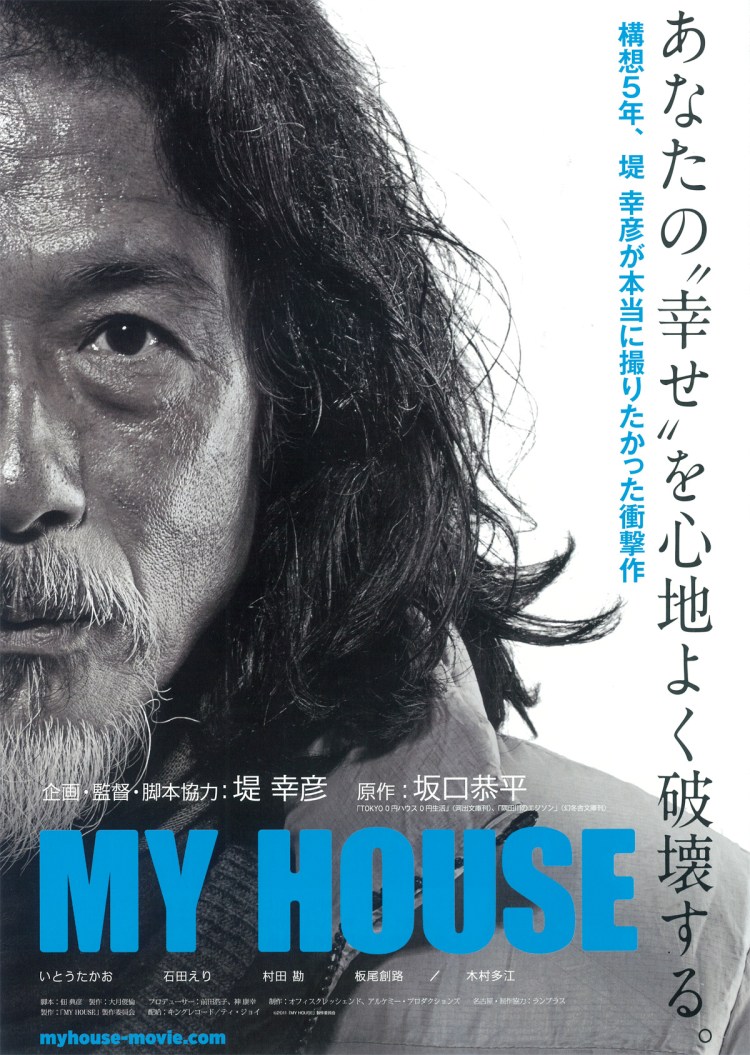 Yukihiko Tsutsumi has made some of the most popular films at the Japanese box office yet his name might not be one that’s instantly familiar to filmgoers. Tsutsumi has become a top level creator of mainstream blockbusters, often inspired by established franchises such as TV drama or manga. Skilled in many genres from the epic sci-fi of Twentieth Century Boys to the mysterious comedy of Trick and the action of SPEC, Tsutsumi’s consumate abilities have taken on an anonymous quality as the franchise takes centre stage which makes this indie leaning black and white exploration of the lives of a group of homeless people in Nagoya all the more surprising.
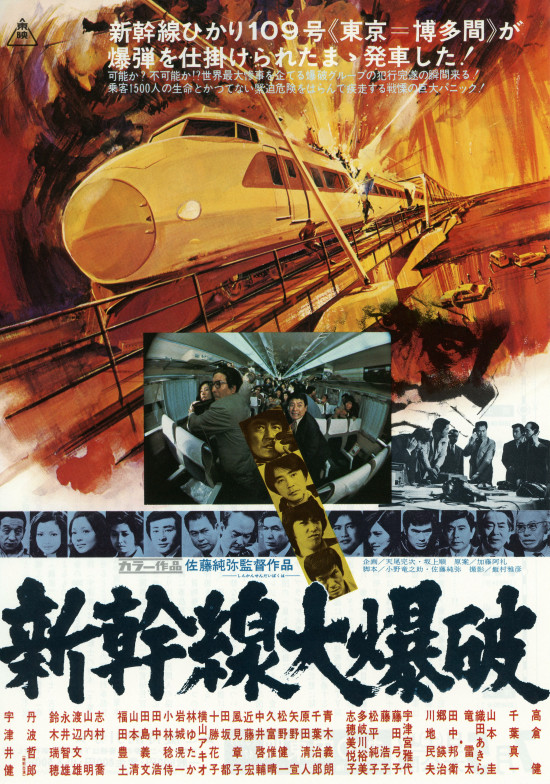 For one reason or another, the 1970s gave rise to a wave of disaster movies as Earthquakes devastated cities, high rise buildings caught fire, and ocean liners capsized. Japan wanted in on the action and so set about constructing its own culturally specific crisis movie. The central idea behind The Bullet Train (新幹線大爆破, Shinkansen Daibakuha) may well sound familiar as it was reappropriated for the 1994 smash hit and ongoing pop culture phenomenon Speed, but even if de Bont’s finely tuned rollercoaster was not exactly devoid of subversive political commentary The Bullet Train takes things one step further.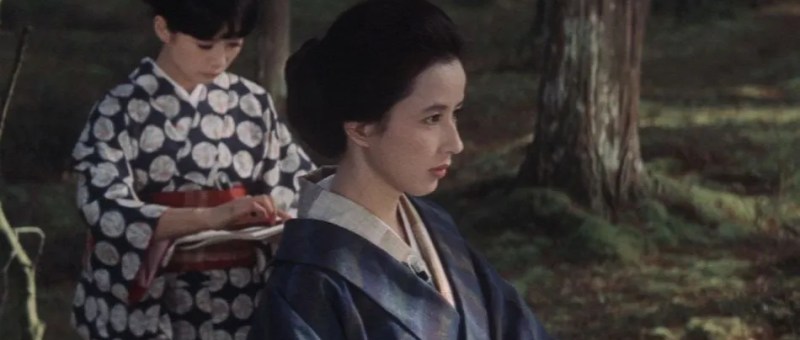

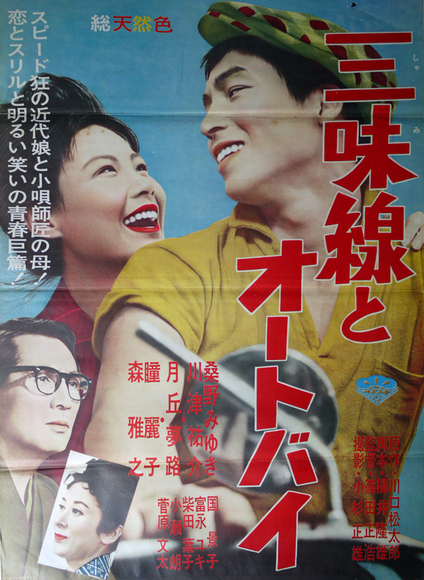 Masahiro Shinoda’s first film for Shochiku,
 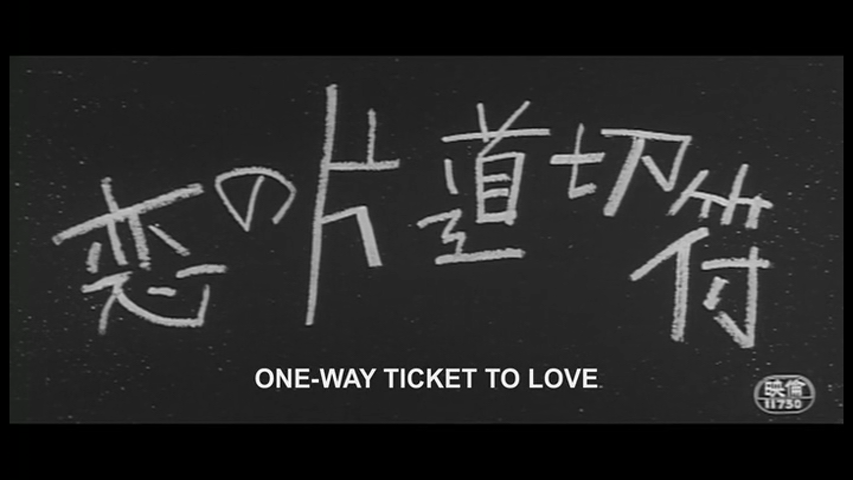 Although Masahiro Shinoda has long been admitted into the pantheon of Japanese New Wave masters, he is mostly remembered only for his 1969 adaptation of a Chikamatsu play, Double Suicide. Less overtly political than many of his contemporaries during the heady years of protest and rebellion, Shinoda was a consummate stylist whose films aimed to dazzle with visual flair or often to deliberately disorientate with their worlds of constant uncertainty. Like so many of the directors who would go on to form what would retrospectively become known as the Japanese New Wave, Shinoda also started out as a junior AD, in this case at Shochiku where he felt himself stifled by the studio’s famously safe, inoffensive approach to filmmaking.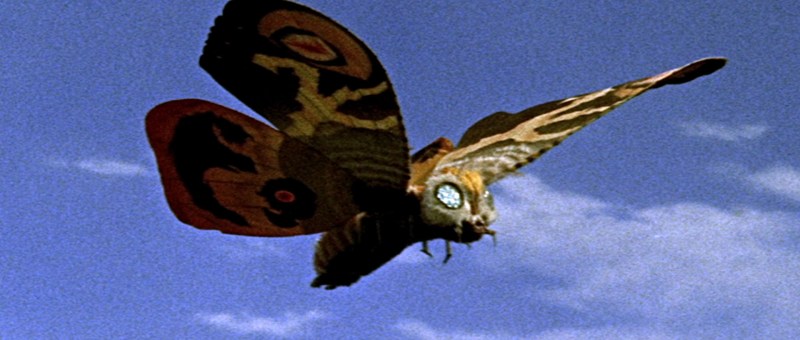
 Japan’s kaiju movies have an interesting relationship with their monstrous protagonists. Godzilla, while causing mass devastation and terror, can hardly be blamed for its actions. Humans polluted its world with all powerful nuclear weapons, woke it up, and then responded harshly to its attempts to complain. Godzilla is only ever Godzilla, acting naturally without malevolence, merely trying to live alongside destructive forces. No creature in the Toho canon embodies this theme better than Godzilla’s sometime foe, Mothra. Released in 1961, Mothra does not abandon the genre’s anti-nuclear stance, but steps away from it slightly to examine another great 20th century taboo – colonialism and the exploitation both of nature and of native peoples. Weighty themes aside, Mothra is also among the most family friendly of the Toho tokusatsu movies in its broadly comic approach starring well known comedian Frankie Sakai.
 Ishiro Honda returns to outer space after The Mysterians with another dose of alien paranoia in the SFX heavy Battle in Outer Space (宇宙大戦争, Uchu Daisenso). Where many other films of the period had a much more ambivalent attitude to scientific endeavour, Battle in Outer Space paints the science guys as the thin white line that stands between us and annihilation by invading forces wielding superior technology. Far from the force which destroys us, science is our salvation and the skill we must improve in order to defend ourselves from hitherto unknown threats.
