Dong-ju: The Portrait of a Poet (동주, Lee Joon-ik, 2016)

2016-03-12-1457751627-4889573

Lee Joon-ik’s previous film, The Throne, was a big budget period affair examining the well known story of tragic prince Sado who was, in a sense, murdered by his own nation as personified by his father, the king, for failing to bow to a tyrannous regime. Lee’s followup, Dong-ju: The Portrait of a Poet, charts a similarly melancholy path in its exploration of the life and times of its titular wordsmith, unhappily born into an age of anti-intellectual fervour with only the desire to write verses. Yet another of the recent films to address the Korea’s colonial history, Dong-ju, like its hero, may be the most contemplative as it raises a number of questions not only about the nature of resistance but also of its intrinsic values.

Growing up in a Korean religious settlement in Manchuria, Dong-ju (Kang Ha-neul) and his cousin Mong-gyu (Park Jung-min) have been largely cushioned from the effects of the Japanese occupation, but are aware it’s only a matter of time before their village loses its special status and is swallowed by the powers that be. Both boys have literary aspirations with the more bombastic Mong-gyu opting for prose and the dreamier Dong-ju committed to the far less well received world of poetry. Firm friends as they are, literary rivalry aside, each is bound for a different course as Mong-gyu becomes increasingly involved with the independence movement whereas Dong-ju’s rebellion remains largely on the page.

After travelling to Japan as students, both Dong-ju and Mong-gyu are arrested for insurrection and incarcerated in the notorious Fukuoka Prison where they are used as human subjects for experimentation. Regularly dosed with mysterious injections which blister the skin and weaken the constitution, neither lives long enough to see the return of their nation’s sovereignty just a few weeks later with Japan’s defeat at the end of the war.

Beginning with Dong-ju’s prison interrogation, the film is largely told through flashback as it follows the course of Dong-ju’s life from his adolescence in the village to domestic university and finally to Japan where he faces constant threat as an alien Korean in the land of the oppressor. Both he and Mong-gyu are committed to the idea that conscientious literature can change the world, even founding a student magazine dedicated to progressive texts. Mong-gyu, however, does not place the same faith in the art of poetry as does his friend, and eventually decides to head to China to join the left-wing arm of the Resistance movement in exile, only to become disillusioned with their extreme tactics.

Despite his loss of faith in Communist ideology, Mong-gyu remains committed to the idea of direct action and the eventual ushering in of the egalitarian revolution preceded by the expulsion of the Japanese. Far from opposing the draft of Korean students into the Japanese army, Mong-gyu plans to harness it to fill the army with capable, trained fifth columnists who will use the skills they learn in a foreign army to retake their homeland. After a brush with the ruling regime, Dong-ju tries to join the more active side of the resistance alongside his friend but is rebuffed. Mong-gyu knows his friend is not a born soldier and is much more valuable as a poet than on the front lines.

Dong-ju’s poetry is often not overtly political, anti-Japanese, or even anti-colonialist, but it is written in Korean – a daring act of political resistance in itself. During this era, Japanese was the dominant language, used in all official institutions and most schools (Dong-ju and Mong-gyu’s excluded because of its special religious status). One of the problems Dong-ju faces during his interrogation is that he delayed adopting a Japanese name much longer than was wise and subsequently continued to disseminate literature in Korean. When language is suppressed and nationhood denied to the extent that even names have been erased, what other means is there to reclaim an identity other than literature, and of literature what more powerful than poetry?

Dong-ju’s resistance to the brutalisation of of an oppressive regime is entirely internal. He writes in his native language about the things which matter, of his loneliness and youthful anxiety much of which is born of the uncertainty of his times. During his interrogation he is forced to sign a confession of his “crimes”, which he does, but with equal amounts of pride and shame as he wonders if his commitment to literature was time well spent when his comrades were dying in the streets. Was it responsible of him to commit himself to poetry rather than to medicine with all of its more immediately humanitarian benefits, or should he have thrown away the pen for the gun and joined the combatants in the armed struggle?

Mong-gyu, by contrast, feels only shame when he signs his papers which amount to a list of failed manifesto promises. Yes, he did plan all of these things but realised none of them, placing the lives of his friends in jeopardy as his did so. Perhaps he, like Dong-ju, should have agitated for social change through culture, rather than trying to fight an empire using only the empire’s cast offs.

There are no real answers to these questions, Korea regained its independence thanks to the collapse of the Japanese overseas empire rather than armed insurrection or the gradual enlightenment of the citizenry. Both men are left with a lingering sense of shame and impotence at having been unable to accomplish more in their cruelly shortened lives. Yet as for Dong-ju, there is rebellion enough in his poetry which bares all of his own soul as he suffered the torment of a poet forbidden from poetry, writing in a language proscribed by those that would seek to destroy the essence of his culture.

Filming in a crisp, washed out black and white, Lee imbues his world with a sense of melancholy and lost potential as two young men find themselves at the mercy of their times, fighting for their own independence as distinct from that of their nation but once again being denied. A necessarily sombre film unafraid to acknowledge the darkest edges of the colonial period, Dong-ju: The Portrait of a Poet is a celebration of the enduring power of the poetic form as exemplified by Dong-ju’s beautifully heartbreaking lines.


Reviewed at the 2016 London Korean Film Festival.

Original trailer (no subtitles)

Helpless (화차, Byun Young-joo, 2012)

121003-006_1211020310103Review of Byun Young-joo’s Helpless (화차, Hwacha) first published by UK Anime Network

Can you ever really know another person? Everything you think you know about the people closest to you is founded on your own desire to believe what they’ve told you is the fundamental truth about themselves, yet you’ll never receive direct proof one way or the other. Byun Young-joo’s Helpless is based on Miyuki Miyabe’s popular novel Kasha (available in an English translation by Alfred Birnbaum under the title All She Was Worth) which literally means “fiery chariot” and is the name given to a subset of yokai who feed on the corpses of those who have died after accumulating evil deeds, which may tell you something about the direction this story is headed. After his fiancée suddenly disappears, one man discovers the woman he loved was not who she claimed to be, but perhaps also discovers that she was exactly who he thought she was all along.

Mun-ho (Lee Sun-kyun) and Seon-young (Kim Min-hee) are newly engaged and on their way to deliver a wedding invite to his parents in person. They seem bubbly and excited, still cheerful in the middle of a long car journey. It’s doubly surprising therefore when Mun-ho returns to the car after stopping at a service station to find that Seon-young has disappeared. Seon-young is not answering her phone and has left her umbrella behind despite the pouring rain which only leaves Mun-ho feeling increasingly concerned. His only clue is her distinctive hair clip lying on the floor of the petrol station toilet. Reporting his fiancée’s disappearance to the police, Mun-ho is more or less fobbed off as they come to the obvious conclusion that the couple must have argued and Seon-young has simply left him, as is her right. Confused, hurt, and worried Mun-ho turns to his old friend, Jong-geun (Cho Seong-ha), a recently disgraced ex-policeman, to help him understand what exactly has happened to the woman he thought he loved.

Mun-ho, helpless as the title, has no idea what might have transpired – has she been abducted? Was she in trouble, was someone after her? Did she simply get cold feet as the policemen suggested? A trip to Seon-young’s apartment reveals the place has been pretty thoroughly turned over leaving little trace behind, the entire apartment has even been swept for fingerprints in chillingly methodical fashion. Another clue comes from a close friend who’d been looking into the couple’s finances and found some improprieties in Seon-young’s past which he’s surprised she wouldn’t have mentioned. Perhaps she was embarrassed or ashamed of her credit history, but running out onto the motorway in the pouring rain without even stopping to pick up an umbrella seems like a massive overreaction for such an ordinary transgression.

What transpires is a tale of identity theft, vicious loan sharks, parental neglect, and the increasingly lonely, disconnected society which opens doors for the predatory. Usurious loans become an ironic recurring theme as they ruin lives left, right and centre. Following the financial crash, a father takes out a loan from gangsters to support his business but promptly goes missing. His wife is so distraught that she becomes too depressed to care for their daughter who ends up in a catholic orphanage. Gangsters have their own rules, the debt passes to the girl, young as she is, who is then forced to pay in non-monetary services until she finally escapes only to discover the torment is not yet over. Meanwhile, another woman takes out a series of loans to cover credit card debt and is forced to declare bankruptcy, left only with a lingering sense of shame towards her ailing mother who then dies in a freak accident leaving her a windfall inheritance which she uses to buy a fancy headstone for the woman she was never able to look after whilst still alive.

The original identity theft is only made possible by this fracturing of traditional communities in favour of impersonal city life. Nobody really knows anybody anymore – Seon-young had claimed to have no family and no close friends so there was no one to vouch for her. Many other young women are in similar positions, orphaned and unmarried, living in urban isolation with only work colleagues to wonder where they’ve got to should they not arrive at the office one day. Loneliness and boredom leave the door wide open for opportunists seeking to exploit such weaknesses for their own various gains.

Byun hints that something is wrong right away by switching to anxious, canted and strange angles filled with oddly cramped compositions. The eerie score enhances the feeling of impending doom as Mun-ho continues to dig into Seong-young’s past, finding confusion and reversals each way he looks. Seong-young was not who she claimed to be, and her tragic past traumas can in no way excuse her later conduct, but even if Mun-ho’s faith in her was not justified, there is a kind of pureness in his unwavering love which adds to the ongoing tragedy. Mun-ho fell in love with the woman Seong-young would have been if life had not been so cruel, and perhaps that part of her loved him too, but life is cruel and now it’s too late. An intriguingly plotted, relentlessly tense thriller Helpless will make you question everything you ever thought you knew about your nearest and dearest, but it is worth remembering that there are some questions it is better not to ask.


Reviewed at the 2016 London Korean Film Festival.

International trailer (English subtitles)

Bloom in the Moonlight (わが愛の譜 滝廉太郎物語, Shinichiro Sawai, 1993)

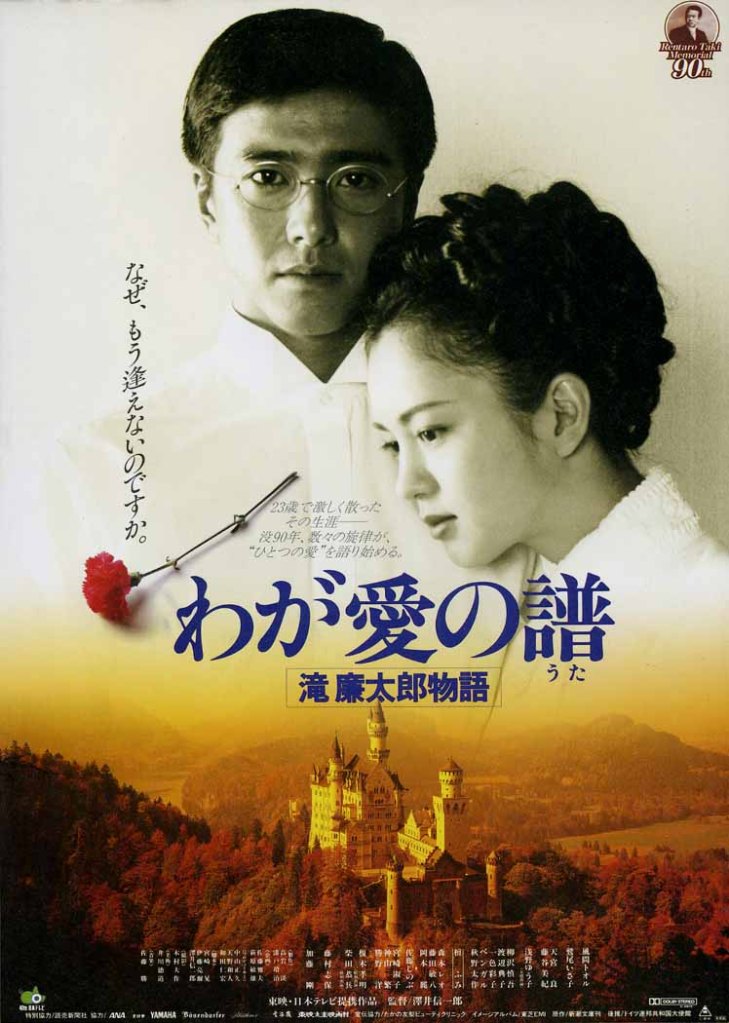
bloom-in-the-moonlightAll those songs and rhymes you learnt as a child, somehow it’s strange to think that someone must have written them once, they seem to just exist independently. In Japan, the name behind many of these familiar tunes is Rentaro Taki – the first composer to set Japanese lyrics to European style “classical” music. It’s important to remember that even classical music was once contemporary, and along with the opening up of the nation during the Meiji era came a desire to engage with the “high culture” of other developed nations. The Tokyo Music School was founded in 1887 and Taki graduated from it just four years later in 1901. However, his career was to be a short one as his health gradually declined until he passed away of tuberculosis at just 23 years old. Bloom in the Moonlight (わが愛の譜 滝廉太郎物語, Waga Ai no Uta: Taki Rentaro Monogatari), also the title of one of his most well known and poignant songs, is the story of his musical career but also of the history of early classic music in Japan as the country found itself in a moment of extreme cultural shift.
Defying his father’s wishes and travelling to Tokyo to pursue a musical education, Rentaro Taki (Toru Kazama) becomes fascinated by the piano and is determined to become a high level pianist. Even knowing how hard it is to conquer the instrument and that many of his contemporaries have been studying since early childhood, Rentaro refuses to lose heart and pushes himself to become the best piano player that he can possibly be. Always a sickly child, Rentaro’s intense devotion to his instrument begins to threaten his health but his ambition knows no limit. The purpose of the school leans more towards the study and dissemination of Western music among ordinary people but soon Rentaro and some of his fellow pupils grow tired of the idea that their role is that of teachers and scholars and begin composing their own work. Rentaro’s songs become what is really the first kind of modern folk music, marrying the European classical music of the foreign elites and the more egalitarian, everyman quality of the accompanying lyrics to create a new kind of Japanese music.

The tale is narrated at times by a fellow pupil, Yuki Nakano (Isako Washio), who encounters Rentaro at the same time as he encounters the piano. The star pupil at the school and sister of an already internationally famous concert pianist, Yuki is nevertheless insecure about her own skills. Rentaro quickly surpasses her though the two become close and eventually a source of mutual inspiration. Adding to the melancholy nature of the tale, Yuki falls in love with Rentaro and his musical intensity but the pair are separated when she is selected as one of the first pupils to be sent abroad to learn from the classical music masters in Germany. A year later, Rentaro is also permitted to go and the pair are briefly reunited but it will be for the last time as Rentaro’s illness intensifies and brings an early end to his musical career.

Times being what they are, Rentaro and Yuki are denied the possibility of pursuing a romance, adding to the theme of poignancy and missed opportunities running through the film. Indeed, the final piece Rentaro composes and which he is still working on right up to the end is for Yuki and is titled “Regret”. Dedicating himself to music above all else, Rentaro leaves behind him a musical legacy but still, as one of his songs puts it, longs for the “brightness of bygone days”.

Rentaro was from a wealthy family, and even if his father did not approve of his decision to study music, he continued to support him even whilst worrying about his constant ill health. Many of his fellow pupils were not so lucky including his good friend Suzuki (Ryo Amamiya) who is forced to leave the school when his father becomes ill leaving him responsible for each of his siblings. Eventually Suzuki is able to return to the world of music as a teacher, playing Rentaro’s folk songs for the local village children and helping to make his friend’s work some of the most well known in Japan.

Little is seen outside of the rarefied world of wealthy students and their internationally focussed cultural pursuits but at times the other world is allowed to slink in, particularly in the case of an inn girl who is charged with looking after Rentaro during one of his periods of convalescence. The girl, Fumi (Miki Fujitani), also becomes fascinated with Rentaro’s intense love music but any attachment on her part can only lead to tragedy. All else aside, Rentaro is the oldest son of a wealthy family and not seriously considering a formal arrangement with someone like Fumi. Eventually she will be sold off as a concubine to a wealthy man, there are no better options for her even in the bright new Meiji era.

As in much of his other work, Sawai neatly avoids the more sentimental elements of the story even if melodrama is a necessary part of its appeal. Bloom in the Moonlight is among his more straightforward efforts sticking to the prestige picture approach without any of the stranger or more expressive sequences which often crop up in films such as W’s Tragedy or Maison Ikkoku. As a neutral biopic, the treatment of its subject is at times superficial, skipping other interesting details of Rentaro Taki’s life such as his late conversion to Christianity preferring to focus on the tragic love story which becomes the genesis of his final, unfinished work. Nevertheless, Bloom in the Midnight succeeds in telling the sad story of a musical genius who poured all of his intensity into a few short years leaving a body of work behind him likely to outlive us all.


Rentaro Taki’s songs are still very popular today and if you’ve spent any time at all watching Japanese films you will definitely have heard them.

One of the most recognisable – Hana

And one of the most well known – Kojo no Tsuki (with footage from Throne of Blood!)


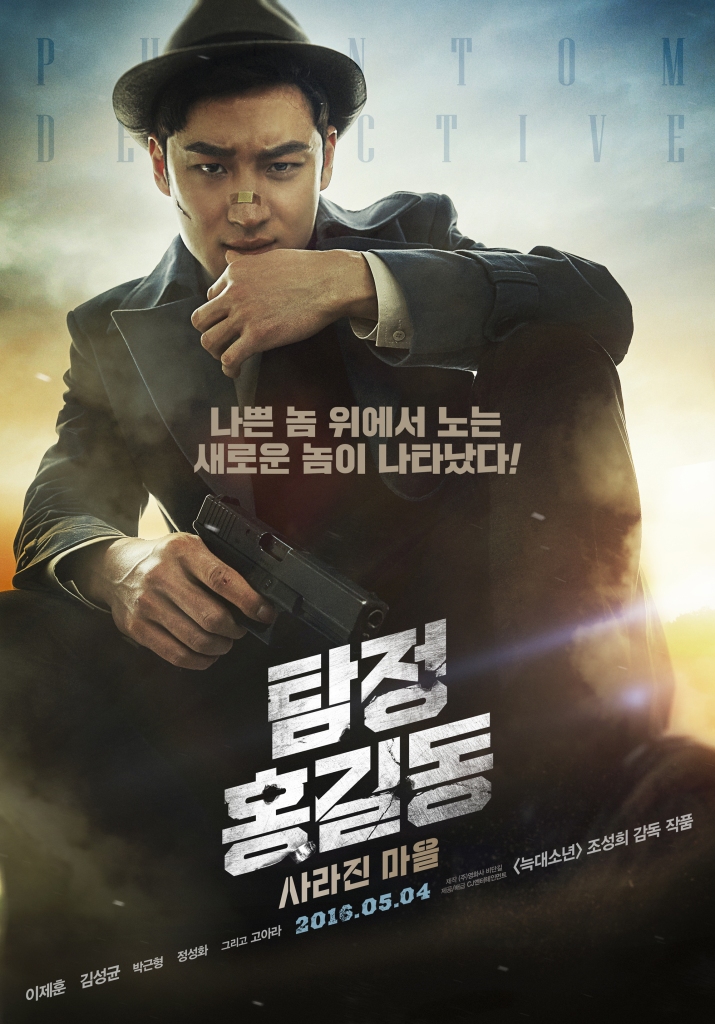
The Phantom Detective (탐정 홍길동: 사라진 마을, Jo Sung-hee, 2016)

su0mhpqReview of Jo Sung-hee’s The Phantom Detective (탐정 홍길동: 사라진 마을, Tamjung Honggildong: Sarajin Maeul) first published by UK Anime Network.

Comic books and film noir are, in many ways, a match made in heaven. Tough guys lurking in the shadows, larger than life villains and an ever present sense of the strangeness of criminality, lend themselves particularly well to the extremes of both genres which is why the combination is not exactly an uncommon one. In The Phantom Detective , director Jo Sung-hee adds an extra layer of meta textuality in naming the amnesiac hero Hong Gil-dong which is both the Korean “John Doe” and the name of a legendary Robin Hood figure from the 16th century. Like his namesake, this Hong Gil-dong is a preternaturally gifted detective with a faultless memory and an almost supernatural ability to stay ahead of the game, but he’s also a classic film noir hero with a damaged past and hollow heart…

In an alternate 1980s Korea, Hong Gil-dong (Lee Je-hoon) is an ace detective about to break a trafficking ring, which is righteous enough, but he also has another motive – these men may be able to offer him a clue to tracking down a target he’s been chasing for over 20 years. A one eyed man, Kim Byung-duk (Park Geun-hyung), contributed to Gil-dong’s origin story by murdering his mother right in front of him. At least, he thinks so – Gil-dong can’t remember anything about that day save for the visions he sees in his nightmares. In fact, he doesn’t even know his real name or who he really is.

When he finally gets to Byung-duk’s location, Gil-dong discovers he’s already been kidnapped by someone else leaving his two young granddaughters, Dong-yi (Roh Jeong-eui) and Mal-soon (Kim Ha-na), all alone. Taking off with the kids in tow, Gil-dong vows to track down “grandpa” but still has revenge in his heart. As the investigation progresses Gil-dong finds himself getting involved with the strange residents of a tiny town who may be about to fall victim to a dastardly doomsday plan engineered by a shady cult leader…

Ever since his mother’s death, Gil-dong has been unable to sleep thanks to constant nightmares and has lost the capacity for fear and empathy (qualities which serve him well in his line of work). Fiendishly clever, Gil-dong also has a sweet tooth and a sarcastic personality but despite his protestations, usually does the just thing when comes down to a straight choice. Byung-duk’s adorable granddaughters pose something of a problem for him as he begins to warm to their straightforward earnestness, yet his revenge rests in killing their beloved grandfather to avenge his mother’s death. The kids quickly take to Gil-dong, for some reason believing in his essential goodness. Dong-yi follows him around like a deputy detective, meticulously noting everything down in her notebook, whereas Mal-soon has figured out Gil-dong’s talent for deception but hilariously almost blows the gang’s cover on several occasions through her total lack of investigatory acumen.

Through investigating his lead on Byung-duk, Gil-dong hopes to recover his own memories of his early life and the mother he only remembers in his nightmares. The path he finds himself on is a dark one leading straight towards a powerful cult populated by fascism fetish sociopaths. Sure that the “New World is Coming”, the cult have planned a large scale event which threatens the lives of most of the residents of a small, strange town. Now Gil-dong has several reasons to get to the bottom of this long standing mystery ranging from his own desire for answers and revenge to saving the lives of these ordinary people and making sure no one else comes under threat.

Taking inspiration from the comic book world, The Phantom Detective makes use of highly saturated color schemes and deliberately artificial looking backgrounds. Though the approach remains bright and colourful for much of the film which adds to its slightly surreal atmosphere, there’s still ample room for noir with faces cast in shadow, light striking glasses so as to eerily block out the eyes, and Gil-dong’s classic detective outfit and occasional weary voiceover. The pulpy plot doesn’t worry too much about internal consistency, but blusters along well enough on its own even if coasting on Gil-dong’s wisecracking tough guy antics as he unexpectedly bonds with the two plucky little girls temporarily in his care. Cute and funny but also filled with innovative action sequences, The Phantom Detective acts as a worthy secondary origin story for its titular hero whose return will be eagerly awaited!


Reviewed at the 2016 London Korean Film Festival.

International trailer (English subtitles)

Blue Lake Woman (青い沼の女, Akio Jissoji, 1986)

vlcsnap-2016-11-15-01h56m08s744Akio Jissoji had a wide ranging career which encompassed everything from the Buddhist trilogy of avant-garde films he made for ATG to the Ultraman TV show. Post-ATG, he found himself increasingly working in television but aside from the children’s special effects heavy TV series, Jissoji also made time for a number of small screen movies including Blue Lake Woman (青い沼の女, Aoi Numa no Onna), an adaptation of a classic story from Japan’s master of the ghost story, Kyoka Izumi. Unsettling and filled with surrealist imagery, Blue Lake Woman makes few concessions to the small screen other than in its slightly lower production values.

Successful artist Nagare had a serious following out with one of his oldest friends five years ago and is so rather stunned to receive an invitation to his wedding. Nagare had been invited to paint the portrait of Takigawa’s father and then asked to stay at his home for an extended period whilst Takigawa travelled in Europe buying art. Tokigawa’s father was old and frail and therefore retired to an annex each night at 8pm leaving Nagare entirely alone in the house alongside Takigawa’s wife, Mizue. The inevitable occurs when the lonely and neglected Mizue falls for the handsome painter but the romance turns dark when she talks Nagare into a double suicide at Blue Lake. Mizue drowns herself but Nagare survives only to be rescued and confined to a mental hospital.

Now five years later Takigawa wants to forget (if not quite forgive) the past and start again with a new wife by his side. The funny thing is wife number two, Ameko, is the spitting image of Mizue. When Takigawa once again asks him to stay alone in the house with his new wife whilst he jets off to America, Nagare begins to wonder exactly what’s going on. Staying at the house a second time, Nagare finds himself haunted by the ghost of the woman who died for him, but whose sacrifice he ultimately rejected. Mizue seems to want him to come to her at the bottom of Blue Lake, but Nagare still lacks the courage to take his own life, if not the inclination. Thinking of Mizue but inevitably becoming closer to Ameko, Nagare is trapped between the living and the dead but it turns out there may be more than supernatural intrigue to his darkly romantic adventures.

Jissoji creates an oppressive and creepy atmosphere for the woodland mansion noisy with the sound of a hundred ticking clocks, filled with shadows and shot from odd angles. Nagare begins to dream strange dreams in which Mizue comes to him, leaving watery footprints and her signature comb behind her to indicate that her presence is not limited to the dream world. Complaining that she’s “alive” beneath the mud next to Blue Lake where she’s cold and lonely, Mizue waits for him to make good on his promise and join her there. Nagare remains unsure if this Mizue is a manifestation of her grudge towards him, or simply a manifestation of his own guilt in allowing her to die alone.

Trapped in Vertigo-esque conundrum torn between the living Ameko and the dead Mizue, Nagare
finds himself in an impossible position unable to clearly distinguish between the two women, at one point physically attacking Ameko believing her to be Mizue’s ghost. It remains unclear if the resemblance between Mizue and Ameko is real or a figment of Nagare’s imagination prompted by both women’s position as Takigawa’s wife and by their watery names (“mizue” literally meaning “water picture” and “Ameko” “rain child”) both of which lead him straight back to Blue Lake. If it’s death Nagare is chasing rather than either women or friendship, he is ultimately unable to follow through on his desires all the while protesting that it’s “desire” which holds him among the living.

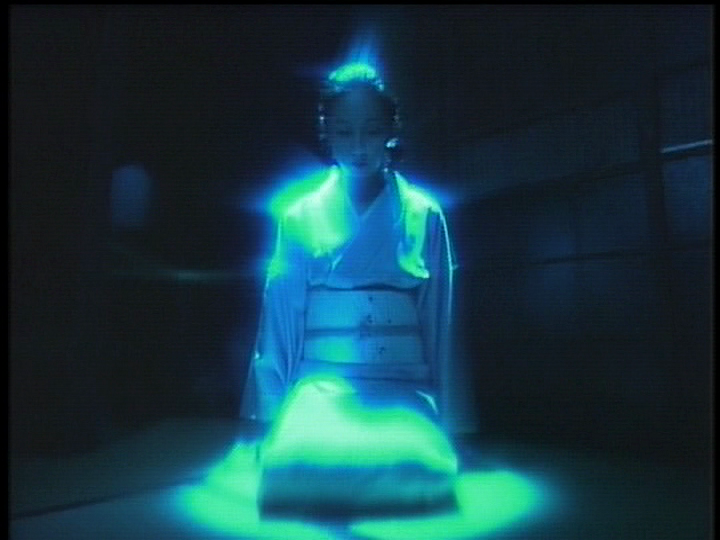
The supernatural elements are emphasised and undercut by turns as Nagare discovers their may be a more solid, real world cause for the strange events plaguing him. Still, the past continues to haunt Nagare in one form or another leaving unexplained and half remembered events to linger in his memory, rendering his reality continually unstable. As her name suggests, the ghostly Mizue is always shown in a hazy, watery blue, radiating waves of unease designed to pull Nagare back to the failure of his love suicide and at least as far as his art life in concerned, there’s part of him always submerged beneath the waters of Blue Lake. Even if not quite reaching big screen standards, Blue Lake Woman displays high production values for a 1980s television special anchored by naturalistic performances and innovative camera technique. Filled with Jissoji’s idiosyncratic surrealist imagery, Blue Lake Woman is a haunting, gothic ghost story which refuses to give up on its supernatural chills even whilst proffering a more rational explanation for all of its strange goings on.


The Beast Must Die (野獣死すべし, Toru Murakawa, 1980)

LP Soundrack record cover

Yusaku Matsuda was the action icon of the ‘70s, well known for his counter cultural, rebellious performances as maverick detectives or unlucky criminals. By the early 1980s he was ready to shed his action star image for more challenging character roles as his performances for Yoshimitsu Morita in The Family Game and Sorekara or in Seijun Suzuki’s Kagero-za demonstrate. The Beast Must Die (野獣死すべし, Yaju Shisubeshi, AKA Beast to Die) is among his earliest attempts to break out of the action movie cage and reunites him with director Toru Murakawa with whom he’d previously worked on Resurrection of the Golden Wolf also adapted from a novel by the author of The Beast Must Die, Haruhiko Oyabu. A strange and surreal experience which owes a large amount to the  “New Hollywood” movement of the previous decade, The Beast Must Die also represents a possible new direction for its all powerful producer, Haruki Kadokawa, in making space for smaller, art house inspired mainstream films.

Shedding 25 pounds and having four of his molars removed to play the role, Matsuda inhabits the figure of former war zone photo journalist Kazuhiro Date whose experiences have reduced him to state of living death. After getting into a fight with a policeman he seems to know, Date kills him, steals his gun, and heads to a local casino where he goes on a shooting rampage and takes off with the takings. Date, now working as a translator, does not seem to need or even want the money though if he had a particular grudge against the casino or the men who gather there the reasons are far from clear.

Remaining inscrutable, Date spends much of his time alone at home listening to classical music. Attending a concert, he runs into a woman he used to know who seems to have fond feelings for him, but Date is being pulled in another direction as his experiences in war zones have left him with a need for release through physical violence. Eventually meeting up with a similarly disaffected young man, Date plans an odd kind of revenge in robbing a local bank for, again, unclear motives, finally executing the last parts of himself clinging onto the world of order and humanity once and for all.

Throughout the film Date recites a kind of poem, almost a him to his demon of violence in which he speaks of loneliness and of a faith only in his own rage. Later, in one of his increasingly crazed speeches to his only disciple, Date recounts the first time he killed a man – no longer a mere observer in someone else’s war, now a transgressor himself taking a life to save his own. The violence begins to excite him, he claims to have “surpassed god” in his bloodlust, entering an ecstatic state which places him above mere mortals. A bullet, he says, stops time in that it alters a course of events which was fated to continue. A life ends, and with it all of that time which should have elapsed is dissolved in the ultimate act of theft and destruction. His acts of violence are “beautiful demonic moments” available only to those who have rejected the world of law.

Murakawa allows Matsuda to carry the film with a characteristically intense, near silent performance of a man driven mad by continued exposure to human cruelty. Hiding out in Date’s elegant apartment, Matsuda moves oddly, beast-like, his baseness contrasting perfectly with the classical music which momentarily calms his world. Mixing in stock footage of contemporary war zones, Murakawa makes plain the effect of this ongoing violence on Date’s psyche as the sound of helicopters and gunfire resounds within his own head. The imagery becomes increasingly surreal culminating in the moment of consecration for Date’s pupil in which he finally murders his girlfriend while she furiously performs flamenco during an dramatic thunderstorm. Date is, to borrow a phrase, no longer human, any last remnants of human feeling are extinguished in his decision to kill the only possibility of salvation during the bank robbery.

Anchored by Matsuda’s powerful presence, The Beast Must Die is a fascinating, if often incomprehensible, experience filled with surreal imagery and an ever present sense of dread. Its world is one of neo noir, the darkness and modern jazz score adding to a sense of alienation which contrasts with the brightness and elegance of the classical music world. At the end of his transformation, there is only one destination left to Date though his path there is a strange one. Fittingly enough for a tale which began with with darkness we exit through blinding white light.


There’s also another adaptation of this novel from 1959 starring Tatsuya Nakadai which I’d love to see but doesn’t seem to be available on DVD even without subtitles. This film has a selection of English language titles but I’ve used The Beast Must Die as this is the one which appears on Kadokawa’s 4K restoration blu-ray release (sadly Japanese subtitles ony).

Original trailer (no subtitles)

Actress (映画女優, Kon Ichikawa, 1987)

actressKon Ichikawa was born in 1915, just four years later than the subject of his 1989 film Actress (映画女優, Eiga Joyu) which uses the pre-directorial career of one of Japanese cinema’s most respected actresses, Kinuyo Tanaka, to explore the development of Japanese cinema itself. Tanaka was born in poverty in 1909 and worked as a jobbing film actress before being “discovered” by Hiroshi Shimizu and becoming one of Shochiku’s most bankable stars. The script is co-written by Kaneto Shindo who was fairly close to the action as an assistant under Kenji Mizoguchi at Shochiku in the ‘40s before being drafted into the war. A commemorative exercise marking the tenth anniversary of Tanaka’s death from a brain tumour in 1977, Ichikawa’s film never quite escapes from the biopic straightjacket and only gives a superficial picture of its star but seems content to revel in the nostalgia of a, by then, forgotten golden age.

The film begins with the young Tanaka awaiting a visit from her mentor, Hiroshi Shimizu (Toru Watanabe), whom her family are keen to thank for bringing them all to Tokyo away from their life of hardship. Although everyone is very happy for Tanaka’s success, there is shadow hanging over the party in the form of missing oldest brother Ryosuke who went on the run to avoid the draft and has not been heard of since.

Shimizu gives Tanaka (Sayuri Yoshinaga) her first roles at Shochiku where she becomes a contract player but is put out when another director, Heinosuke Gosho (Kiichi Nakai), wants to give her a leading role. Overruled by studio bosses, Shimizu becomes increasingly jealous of Tanaka’s career – a situation which is further complicated by the couple’s growing romantic entanglement which sees them living together in an unofficial marriage allowing Tanaka to continue acting. However, Shimizu continues to meddle in Tanaka’s professional life whilst also continuing his hard drinking, womanising playboy lifestyle. The couple eventually divorce but reunite from time to time on the film set.

Vowing never to marry again, the rest of Tanaka’s life is dedicated to acting and sees her working with some of the best directors of the age including Ozu (Shigemitsu Ogi) and later Mizoguchi (Bunta Sugawara). It is Tanaka’s professional and personal relationship with Mizoguchi which occupies the second half of the film. Judging by the first experience on the now lost Woman of Osaka in 1940, you wouldn’t think the two would ever wish to work together again though they eventually completed fifteen films together over the next fifteen years.

Mizoguchi’s process is completely different from any other Tanaka had worked with. Rather than meeting to rehearse and discuss the work, Mizoguchi abruptly sends her a lifetime’s supply of books about bunraku and changes the script that she has painstakingly committed to memory with on set rewrites communicated via a large blackboard he expects the actors to read from. Exasperated, Tanaka finally asks him for actual direction but he coldly states that she’s the actress and her acting is not part of his job description. Mizoguchi and Tanaka are very different people but each driven and ambitious so their frequent locking of horns produces a fiercely creative collaboration in which each was able to find worth even if it was frequently difficult.

The film ends around the time of Life of Oharu which would mark the final time the pair would work together. In terms of the film’s narrative, this unspoken development is foreshadowed by the idea that the two artists are heading in different directions but in the real world the reasons are a little less clear. Tanaka became the second woman to direct a feature film with Love Letters in 1953 which was even featured at Cannes, but for reasons unknown Mizoguchi attempted to block her access to the Director’s Guild of Japan, effectively ending both their friendship and any professional relationship. Ironically enough, Actress seems to imply that Tanaka’s desire to direct may have been inspired by Mizoguchi and his all powerful on set status prompting her to wonder how he does it, and, perhaps how she could do it too.

Ichikawa weaves the history of Japan through its cinema into the narrative to recount the changing tastes of the eras as naturalism came in and out of fashion and Japanese films began to experience international as well as domestic acclaim. Skipping huge portions of time to focus on the two directors – Shimizu and Mizoguchi, Ichikawa avoids mentioning Tanaka’s post-war visit to America which had a profound impact on her later career, not only in what she learned there but also in the extremely hostile reception she received on returning home. The main takeaway from his depiction of Tanaka is a woman ahead of her time, independent and headstrong, willing to work hard to achieve the things she wanted to achieve even if flying in the face of social convention though it makes no particular judgement on her character other than in her success as an actress.

Taking on the conceit of being a film about film, Ichikawa’s sets are theatrical, creating a deliberately artificial, half unreal world. This also extends into the scriptwriting which is extremely talky and more like a stage play than film, offering pointed, long stretches of monologuing which are already far away from the more naturalistic approach of early talking cinema. Characters have improbable, exposition filled conversations in which they each tell each other things they already know for the audience’s benefit – an effect which enhances the overall theatricality, but does draw attention to itself and eventually becomes wearing. Ichikawa’s picture of Tanaka is one of steely determination and of a woman ahead of her time, but even if Actress proves less than enlightening regarding its subject it does help to shed some light on both classic Japanese cinema and that of the late 1980s.


Original trailer (traditional Chinese subs only)

Asura: The City of Madness (아수라, Kim Sung-soo, 2016)

asura-poster

Review of Kim Sung-soo’s Asura: The City of Madness first published by UK Anime Network.


Abandon all hope, ye who enter here. It’s a shame the title City of Violence was already taken, Asura: The City of Madness (아수라, Asura) is a place of chaos in which carnage has become currency. Re-teaming with actor Jung Woo-sung fifteen years after Musa the Warrior, Kim Sung-soo’s Asura: The City of Madness is, at heart, B-movie pulp steeped in the hardboiled world of tough guys walking alone through the darkness, but even if film noir’s cynicism is out in force, there’s precious little of its essentially chivalrous mentality to be found in this fiercely amoral universe.

World weary policeman Han (Jung Woo-sung) has been moonlighting as the “gun-dog” of corrupt crime boss mayor, Park (Hwang Jung-min), and soon plans on quitting the legitimate force to work for city hall full time. After helping Park “relocate” an inconvenient witness, Han runs into a problem when another policeman turns up and promptly gets killed, drawing unwanted attention to his shady second job. This also brings him into contact with a righteous prosecutor, Kim (Kwak Do-won), who claims to be hellbent on exposing Park’s not quite legal operations and ousting him from power in the hope of a less corrupt regime emerging. Despite his lofty claims, Kim’s methods are little different from Park’s. Han soon finds himself caught in the middle of a legal cold war as he tries to play both sides one against the other but slowly finds neither worth betraying.

The film’s title, Asura, is inspired by the creatures from Indian mythology who are imbued with immense supernatural power yet consumed by negative emotion, relentlessly battling each other in a quest for material rather than spiritual gain. The very male world of Annam is no different as men trade blows like money and wear their wealth on their faces. There are no good guys in Annam, each is involved in a desperate fight to survive in which none can afford luxuries such as pity or morality. Han emerges as the film’s “hero” not out of any kind of nobility or a desire to do good, but simply in being the least actively bad. Able to see the world for what it is – a hell of chaos and cruelty, Han is, perhaps, the best man his environment allows him to be but this same knowledge eats away at him from the inside as he’s forced to act in a way which betrays his own sense of righteousness.

Annam is a world founded on chaos. The forces which are supposed to represent order are the very ones which perpetuate a state of instability. The police are universally corrupt, either working for themselves or in the pay of larger outside forces, and the municipal authorities are under the control of Park – a vicious, mobbed up, sociopath. Prosecutor Kim who claims to represent the resistance against this cosmology of corruption is not what he seems and is, in fact, another part of the system, willing to resort to blackmail, torture, and trickery in order to achieve his vainglorious goal. Yet for all that, the force that rules is mere chance – the most meaningful deaths occur accidentally, the result of shoddy construction work and high testosterone or in the indecision of betrayal. Death is an inevitability for all living creatures, but these men are, in a sense, already dead, living without love, without honour, and without pity.

Kim Sung-soo makes a point of portraying violence in all of its visceral reality as bones crack and blood flows with sickening vitality. The film is extreme in its representation of what could be termed ordinary violence as men engage as equals in hand to hand combat until the machetes and hacksaws come out to combat the shootout finale, complete with the Korean hallmark corridor fight.

Beautifully shot with a neo-noir aesthetic of the nighttime, neon lit city filled with crime ridden back alleys, Asura: The City of Madness is a grimy, hardboiled tale of internecine violence fuelled by corruption and self serving compliance. The ‘80s style lowkey synth score adds a note of anxiety to the proceedings, hinting towards an almost supernatural presence in this strange city populated by the walking dead and morally bankrupt. An epic of “unheroic” bloodshed, Asura: The City of Violence presents a world which thrives on pain where men ease their suffering by transferring it to others. Bleak and nihilistic in the extreme, this is the hard edge of pulpy B-movie noir in which the men in the shadows wish they were as dark as the city streets, but find themselves imprisoned within a series of private hells which are entirely of their own making.


Reviewed at the 2016 London Korean Film Festival.

International trailer (English subtitles)

Injured Angels (傷だらけの天使, Junji Sakamoto, 1997)

injured-angelsDespite having started his career in the action field with the boxing film Dotsuitarunen and an entry in the New Battles Without Honour and Humanity series, Junji Sakamoto has increasingly moved into gentler, socially conscious films including the Thai set Children of the Dark and the Toei 60th Anniversary prestige picture A Chorus of Angels. Injured Angels (傷だらけの天使, Kizudarake no Tenshi) marries both of aspects of his career but leans towards the softer side as it finds genial private detective Mitsuru (Etsushi Toyokawa) accepting a request from a dying man to ensure the safe passage of his young son to the boy’s mother in Northern Japan.

Reluctantly taking on an assignment to question the last remaining tenant of an office block, Mitsuru discovers the man inside already mortally wounded. During their conversation, the man offers him all the money he has left to take his young son to his estranged wife, currently living in a small town in the North of Japan. Mitsuru doesn’t really want this kind of hassle but feels sorry for the man and his son and eventually decides to make sure the boy, Hotaru, gets to someone who can take of him. The pair set off on a kind of road trip eventually joined by Mitsuru’s partner Hisashi (Claude Maki) meeting friends old and new along the way.

Inspired by the 1970s TV series of the same title, Injured Angels adopts an oddly jokey tone throughout as Mitsuru has various strange adventures whilst trying to guide a small child to someone willing to take him in. At one stage, the film goes off on a long and improbable tangent in which Mitsuru runs into an old friend who is currently wearing a lucha libre mask “for work”. The pair then board the bus with the wrestlers before Mitsuru himself ends up in the ring. Though fun, the sequence has little to do with the ongoing plot other than adding to the already absurd atmosphere.

Predictably, when Mitsuru reaches the address he’s been given, Hotaru’s mother has already moved on but even when they eventually find her, the reaction is not the one you’d expect. Soon to be married again, Hotaru’s mother (Kimiko Yo) is not keen to resume custody of her son (or rather, her husband to be has no desire to raise another man’s child and even goes so far as to use physical violence on Mitsuru to show the strength of his feeling). Hotaru starts to grow attached to the two detectives who are probably giving him the most normal kind of family life that he has known for a very longtime. The guys seem to know they can’t keep him indefinitely and are intent on finding another relative but the mini family they’ve formed may be painful to break up.

While all of this is going on, Mitsuru also has a series of meetings with a woman from Tokyo, Eiko (Tomoyo Harada), who keeps bumping into him. Though an obvious attraction develops, Eiko is also fleeing her own kind of trouble and the pair seem content to leave things up to fate and possible drinks in Tokyo at an unspecified point in time, but this oddly integrated plot strand fails to have a real impact within the narrative as a whole. It does, however, add to Mitsuru’s ongoing existential dilemma as he begins to reexamine his life and relationships after bonding with Hotaru. Ultimately he opts for asking his partner, Hiasashi, to move in with him when they get back to Tokyo but at the same time Mitsuru seems to know he may be headed for another destination entirely.

This tonal strangeness is a serious weakness where would expect a more nihilistic atmosphere as Mitsuru’s journey begins to take shape but the inconsequential humour and mildly absurdist approach continues right until the anticlimactic ending. Perhaps feeling a need to recreate the feeling of the TV series, Sakamoto fails to reconcile these differing levels of seriousness into a convincing whole in allowing for the kind of light and breezy action in which everything is definitely going to be OK by next week’s episode. For what’s actually a look at neglected, abandoned children coupled with intense friendships and romantic dilemmas, the bouncy, ridiculous tone is an odd fit and robs the piece of its dramatic weight. Nevertheless, despite the structural problems, Injured Angels is often a fairly enjoyable, if odd, character drama even it ultimately fails to amount to very much as a whole.


Original trailer (no subtitles)

https://www.youtube.com/watch?v=9rbcjFtONGQ

A Violent Prosecutor (검사외전, Lee Il-hyeong, 2016)

112997_47166_106Review of Lee Il-hyeong’s A Violent Prosecutor first published by UK Anime Network.


Police brutality is something of a hot button issue at the moment, so it’s a little disconcerting to see a film like A Violent Prosecutor (검사외전, Geomsawejeon) casting a rogue cop with a penchant for forced confessions as its hero. Then again, the theme plays into the obvious retro charm on offer and the film does, at least, make it plain that violence should have no place in law enforcement. The debut feature from director Lee Il-Hyeong, A Violent Prosecutor has a distinctly ‘70s vibe from its quirky credits sequence to the carefully managed tone which manages to be both serious and not at the same time.

Hwang Jung-min plays hardline prosecutor Byun Jae-wook, feared more than respected because of his willingness (or perhaps eagerness?) to indulge in physical violence in the name of justice. Already known as a trouble maker, Byun’s maverick status is an exploitable weakness and so when he kicks up a fuss trying to expose an obvious cover up, he’s framed for wrongful death after a witness dies in police custody.

Sent to prison among many of the men he helped to put there, Byun quickly finds his feet by providing free legal advice to the guards. Five years later, Byun has become the one of the prison’s top dogs but he’s still intent on clearing his name and nailing the guys who did this to him. Enter suave conman Chi-won (Gang Dong-won) and Byun sees an opening…

Aside from Byun’s problematic approach to his work, he’s definitely one of the good guys as justice, politics, and business have all come together in a whirlwind of mutually beneficial corruption. The whole mess begins during an environmental protest against an industrial complex which is about to be built right next to a bird sanctuary. The evil corporate bozos don’t want any delays so they pay a bunch of gangsters to infiltrate the protest and start a riot to make the environmentalists look like crazed, violent, loonies. Unsurprisingly, public opinion about the development improves following the unpleasant actions of the protestors. The police were just supposed to go along with this (police in Korean films never seem very interested in solving crimes after all), but Byun is different, he smells a rat and he’s not going to roll over and let powerful corporations abuse justice.

Unfortunately, his dedication is not matched by his colleagues who are more interested in their own careers than abstract concepts like truth or justice. Receiving pressure from above and realising Byun can’t be talked down, they decide to take drastic action. One of Byun’s bosses, Kang (Kim Eung-soo), later decides to move into politics, having solidified support through this alliance with the money guys, and is then interested in nothing other than his own success – lying, cheating, and smiling his way to the top. Corruption stemming from the power of monied corporations has become a constant theme in recent Korean cinema and A Violent Prosecutor makes good use of its cinematic background even if treating the subject matter in a necessarily light way.

Essentially, A Violent Prosecutor is a buddy comedy in which the two guys at the centre are kept apart for much of the film. Byun uses his hard won legal knowledge to fight his way out of prison by playing by the book, learning the error of his ways in the process. More often than not, he’s the straight man to Chi-won’s constant scamming as the charming conman comes up with one zany scheme after another trying to keep himself out of trouble whilst also helping Byun enact his plan of revenge. Actor Gang Dong-won is on fine form as the slippery but somehow loveable Chi-won whose main line of work is scamming chaebol daughters out of their inheritances by convincing them he’s a Korean-American Penn State business school graduate, peppering his speech with Americanisms but clueless when challenged on his English. He also deserves bonus points for subverting the “escape from prison dressed as a guard” trope by trying to escape from a corridor full of thugs by blending in with the very men sent to capture him.

Ending in a spectacular, if ridiculous, courtroom finale in which Byun defends himself by forcing a confession in a new, more acceptable way, A Violent Prosecutor delivers the necessary “justice” to all who seek it. Byun learns the error of his ways and accepts that his own violence was at least partly to blame for the way the situation developed, but also ensures that he gets justice for everyone else so that the rich and powerful can’t be allowed to ride roughshod over the people with no one to defend them. A smart buddy comedy, A Violent Prosecutor isn’t exactly the exploitative action fest the title seems to promise but is undoubtedly influenced by the bad cop movies of the ‘70s and excels at finding humour even in the strangest of places.


Reviewed at the 2016 London Korean Film Festival.

Original trailer (English Subtitles)

https://www.youtube.com/watch?v=_Cb-tYIsESg