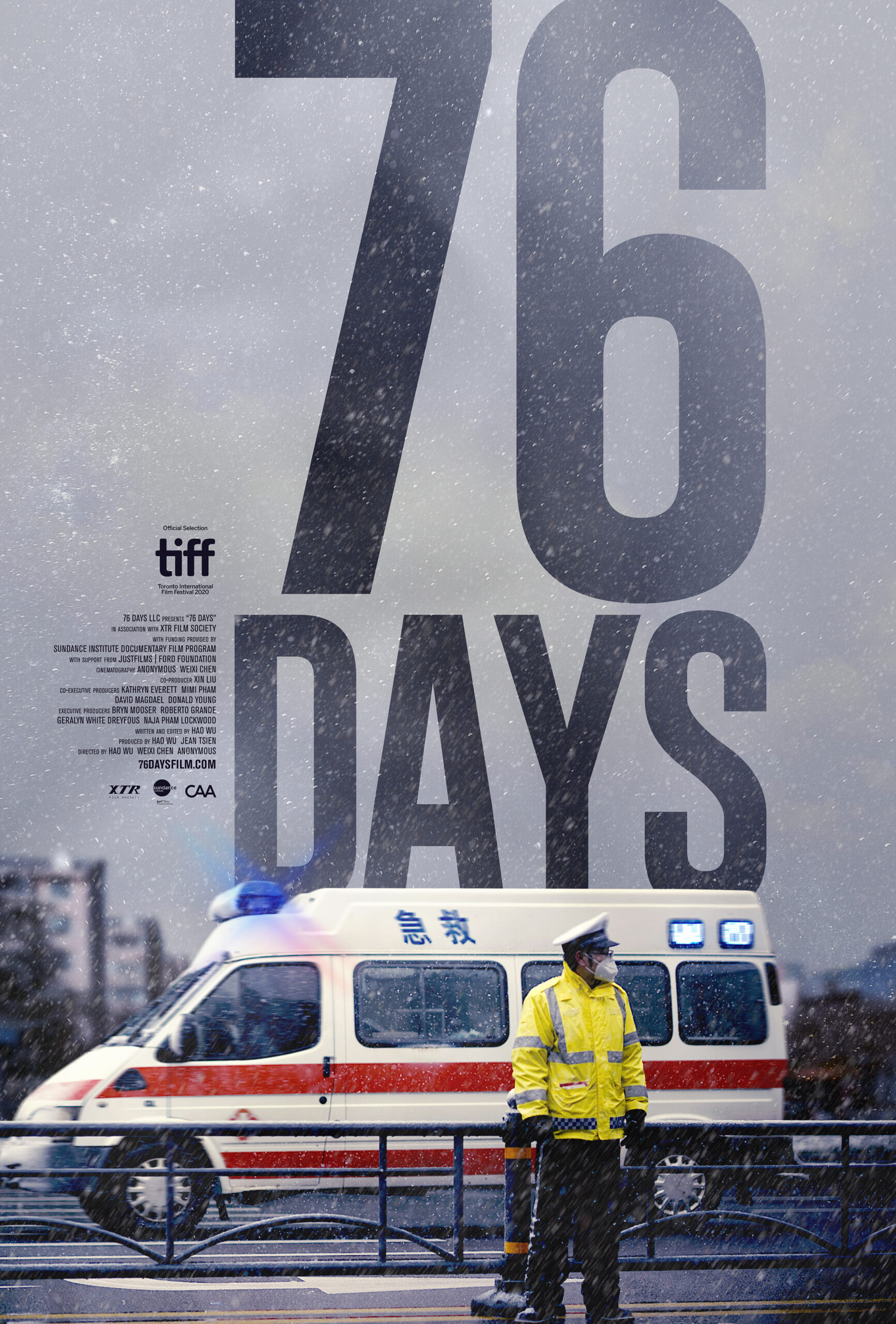
Love You Forever (我在时间尽头等你, Yoyo Yao Tingting, 2020)

“Don’t overthink it. It’s fiction” the hero of Yoyo Yao Tingting’s tearjerking romance Love You Forever (我在时间尽头等你, Wǒ Zài Shíjiān Jìntóu Děng Nǐ) advises the heroine, attempting to keep his secret right until the very end. Inspired by Zheng Zhi’s novel, the original Chinese title translates to the more poetic “I’ll wait for you at the end of time”, hinting at the central, sci-fi-inflected romantic tragedy in which the hero finds himself selflessly sacrificing his years on Earth to fulfil the dreams of the woman he loves. 

Describing himself as a man who does not exist because there are no memories of him in this world, Lin Ge (Lee Hong-chi) is writing a memoir as a way of recapturing the past. He tells us of his lifelong love for Qiu Qian (Li Yitong), a woman he first met when they were both children in the summer of 1991 shortly after his mother had passed away from illness. Lin Ge describes her dancing like sunshine piercing through the thick clouds, a force which has illuminated his life. Trying to retrieve her lost marble from a pond, he discovers a mysterious clock which inspires their childish games all through that golden summer, yet at summer’s end they are cruelly separated when Qiu Qian moves away. At 17 he meets her again and she playfully pretends not to remember him, later embarking on a tentative teenage romance only for Qiu Qian to be hit by a car and killed on her way home from a birthday date. Activated by his tears, the mysterious clock sends Lin Ge back in time, or more accurately into a parallel universe where he is able to prevent the accident and save her life but only at the cost of his existence. This time Qiu Qian really doesn’t remember him because he never existed. Not even his father (Fan Wei) knows him, and he seems to have aged a good decade which in itself presents a barrier to possible romance. 

There’s something of a poignant metaphor in Lin Ge’s intense desire to crawl back inside his memories by writing them down, neatly laying out the various timelines of his life which he has willingly sacrificed to save Qiu Qian resigned to the fact that, in the final version, she will never know him. Later, she asks him how he knows the woman in his novel would be happy with the future he has engineered for her in which he is a deliberate absence but Lin Ge has no answer for her. The Qiu Qian that we see has achieved her dreams of becoming a prima ballerina with the Shanghai ballet, but she is perhaps unfulfilled aware there’s something missing in her life. About to leave the stage, she’s engaged to an old school friend, Huang (Chao Zhang), who is distant and controlling, actively discouraging Qiu Qian from continuing to dance after they marry and emigrate to America reminding her that she’ll have “more important things to think about” once she’s his wife. Lin Ge, meanwhile, now appearing as a man around 60, has taken a job as a caretaker at the theatre where he watches over Qiu Qian from the wings only for her to discover his memoir and become intrigued by its similarities to her own life. 

“The fate is destined, you will use up your time” an Eastern European fortune teller cautions Lin Ge after realising there’s something not quite right with Qiu Qian’s lifelines, “Don’t change the fate again, otherwise everything will become tragic”. Conflicted in her dance career, Qiu Qian reflects that had she known how it would turn out she’s not sure if she would have pursed her dreams, but Lin Ge, perhaps talking more for himself, affirms that of course she would. Even knowing how it would end, he’d do it all again for the brief moments of happiness he spent with Qiu Qian, “it only counts when we’re by each other’s side” as it says in the diary. Fate, however, keeps conspiring against him even as Qiu Qian undergoes her own parallel quest to solve the mystery of their love story in reverse. A poetic meditation on the lover’s exile, selflessness, the power of memory, and the indelible connection of a fated love, Love You Forever is genuinely romantic in all senses of the word even in its inescapable melancholy for those who pledge to love until the end of time.


Love You Forever is currently on release in UK cinemas courtesy of Cine Asia.

UK release trailer (English subtitles)

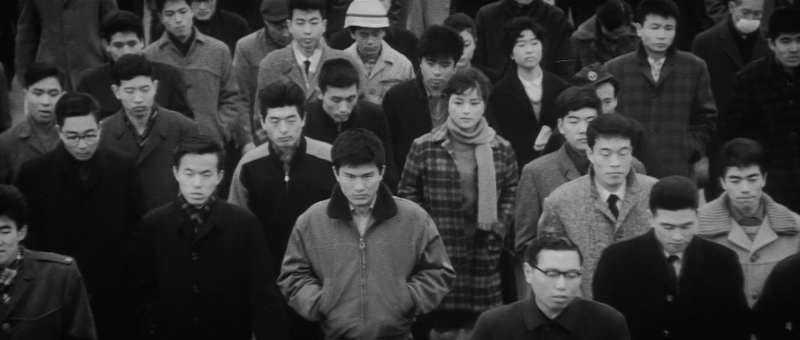
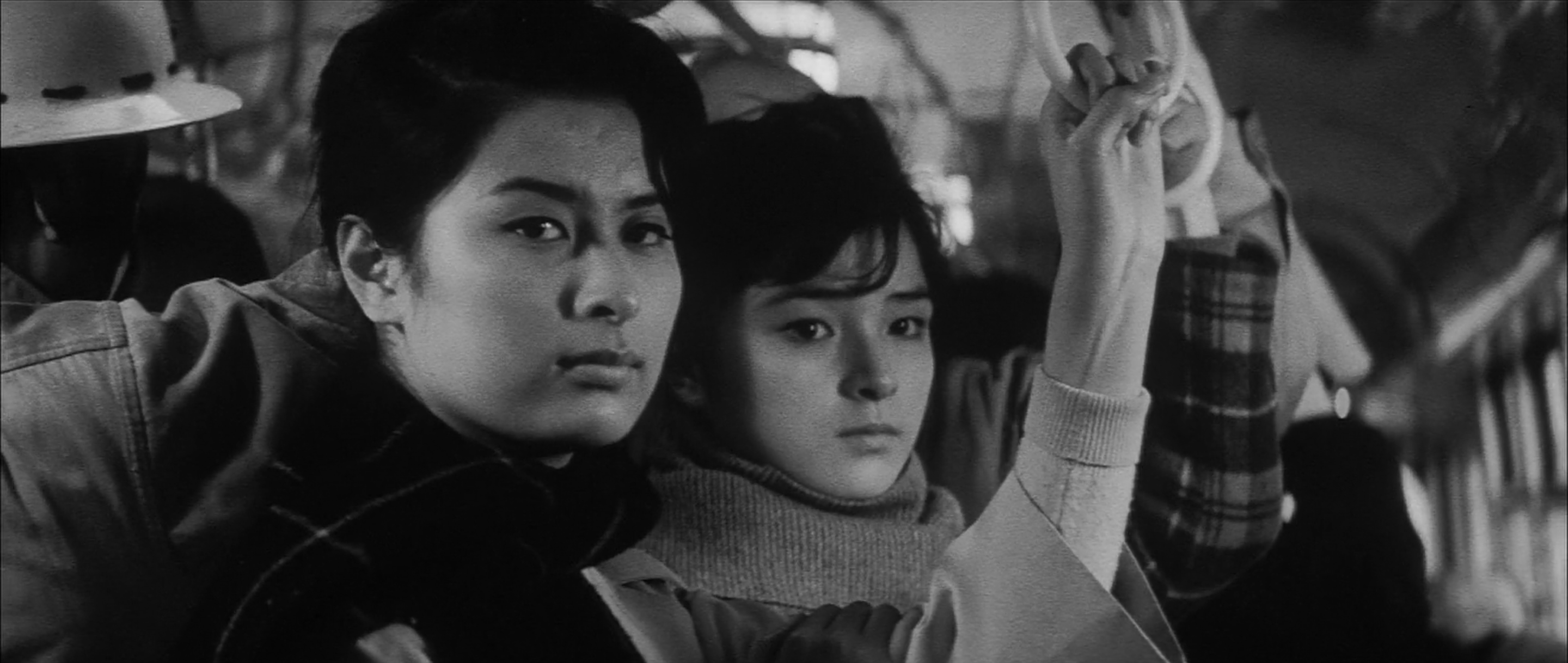
Escape from Japan (日本脱出, Kiju Yoshida, 1964)

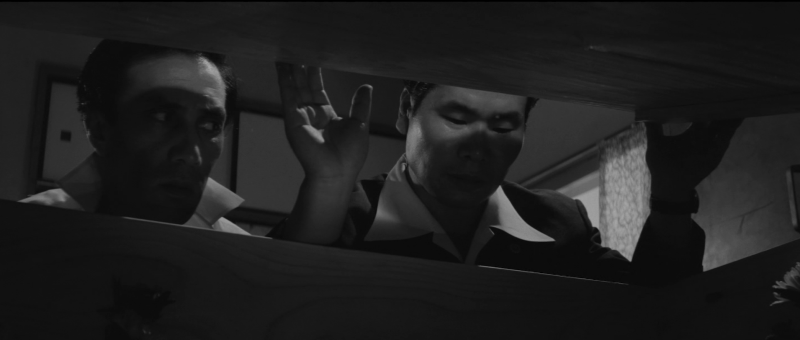
Like many directors of his generation, Kiju (Yoshishige) Yoshida began his career at Shochiku working on the studio’s characteristically inoffensive fare before being promoted as one of their youth voices through which they hoped to capture a similar audience to that attracted by Nikkatsu’s Sun Tribe movies. Yoshida’s films may have spoken to youth but they were perhaps not quite what the studio was looking for nor the kinds of projects that he really wanted to work on, which is one reason why 1964’s Escape from Japan (日本脱出, Nihon Dasshutsu), an anarchic B-movie crime thriller of intense paranoia all maddening angles and claustrophobic composition, was his last for Shochiku, the final straw being their decision to change the ending without telling him and release the film while he was away on honeymoon. 

Set very much in the present, the film opens with a young man miming to American jazz which turns out to be part of the floor show being performed by the band on the stage below for whom he is a reluctant roadie. Tatsuo (Yasushi Suzuki) dreams of going to America to rediscover “real jazz” and subsequently bring it back to Japan. He has the strange idea that America is a true meritocracy where his talent will be recognised, unlike Japan where it is impossible for him to succeed because he is not particularly good looking or possessed of “star quality”. Feeling himself indebted to the band’s drug-addled drummer Takashi (Kyosuke Machida) for helping him get the roadie gig with the false promise of becoming a singer, Tatsuo agrees to help him commit an elaborate robbery of the “turkish bath” (low level sex services and precursor to the modern “soaplands”) where his girlfriend Yasue (Miyuki Kuwano) works. Only it all goes wrong. The guys kill a policeman during the escape, and the other hotheaded member of the gang becomes convinced that Yasue may talk now that they’ve got involved with murder so they should finish her off too by forcing her to take an overdose of sleeping pills. 

Absolutely everyone is desperate to escape Japan for various different reasons. Tatsuo because of his obsession with American jazz and the freedom it represents to him coupled with the sense of impotence he feels in an oppressive society which refuses to recognise his talent because he doesn’t look the part. He jokes with his next-door neighbour, a sex worker who has redecorated her apartment in anticipation of impressing the tourists arriving for the Olympics, that he envies women and wishes he could find a “sponsor” to take him to the States, but later can offer only the explanation that Japan doesn’t interest him when probed over why he was so desperate to leave. 

“Korea or anywhere else, it’s better than Japan” Yasue later adds, consoling Tatsuo as she informs him that their escape plan won’t work because all of the US military planes are being diverted to Korea to bring in extra help for the Olympics. Bundled into a van filled with chicken carcases as a potential stowaway, he discovers another escapee – a Korean trying to go “home”, or rather to the North (presumably having missed out on the post-war “repatriation” programs) where he claims there are lots of opportunities for young people only to lose his temper when Tatsuo explains that he wants to become a jazz singer. He doesn’t want decadent wastrels in his communist paradise and would rather Tatsuo not mess up his country. Yet they are each already dependent on the Americans even for their escape, making use of military corruption networks and getting Yasue’s friend’s GI squeeze into trouble through exposing his black-marketeering. 

Tatsuo and Yasue find they have more in common than they first thought, both “deceived” by those like Takashi who turned out to be a feckless married man and father-to-be risking not only his own future but that of his unborn child solely to fuel his escapist drug habit (which was perhaps the reason for the lengthy hospital stay from which he had just returned). Yasue was just trying to save up enough money to open a hairdresser’s in her hometown, but Takashi told her he was a “famous jazz drummer” and presumably sold her the same kind of empty dreams as he did Tatsuo. Giving up on her own future, realising that even in America the sex trade is all that’s waiting for her, Yasue tries to engineer Tatsuo’s escape but he, traumatised by his crimes, descends further into crazed paranoia, eventually finding himself right in the middle of the Olympics opening ceremony. This is event is supposed to put Japan back on the map as a rehabilitated modern nation, but perhaps all it’s doing is creating an elaborate smokescreen to disguise all the reasons a man like Tatsuo and a woman like Yasue might want to be just about anywhere else. Yoshida seems unimpressed with the modern nation and its awkward relationship with the Americans, perhaps a controversial point in the immediate run up to the games. Shochiku neutered his attempt to depict a man driven to madness by the impossibilities of his times, but a sense of that madness remains as Tatsuo finds himself on the run and eventually suspended neither here nor there, trapped in a perpetual limbo of frustration and futility.


Original trailer (no subtitles)

I WeirDO (怪胎, Liao Ming-Yi, 2020) [Fantasia 2020]

Being in love can be a little like a sickness, but what happens when the spell wears off? A meditation on fatal attraction syndrome and the duplicitous delusions of “normality’, Liao Ming-Yi’s charming romance I WeirDo (怪胎, Guàitāi) arrives at the most opportune moment in which we’re all “weirdos” now, stuck at home obsessively washing our hands and dutifully remaining “alert” as we disinfect everything we see. Liao’s PPE-clad heroes find love in shared anxiety, but happiness is the enemy of fear and the things that brought you together may in the end drive you apart.

Chen Po-ching (Austin Lin Bo-hong) is somehow able to afford a spacious two-level home working as a full-time literary translator despite the fact it takes him ages because he’s unable to type. A sufferer of severe OCD, he lives by strict routine and is deathly afraid of germs. For most of his life he simply remains at home, but on the 15th of every month he dons full body PPE and braves the outside to pay his bills, do his shopping, and visit a doctor he hopes can help him beat the condition but only gives him mysterious medication which doesn’t seem to make much difference. His life changes one particular 15th when he spots a woman dressed much like himself who is also headed to the supermarket where she shoplifts a bar of chocolate and buys up the remaining stocks of his favourite disinfectant. Chen Ching (Nikki Hsieh Hsin-Ying), as she later gives her name, approaches him to make sure he’s not going to dob her in about the chocolate which she doesn’t even like, it’s just a compulsion. She suffers from OCD too along with a skin allergy that means she’s not supposed to spend a lot of time outdoors. 

Love eventually blossoms. Ching opens up Po-ching’s world, conspiratorially involving him in her shoplifting and inviting him to visit her at work as a life model for a drawing class where she’s asked to pose like a fallen angel with broken wings. They go on weird “dates” taking germ challenges like eating at tiny eateries with questionable hygiene standards and picking up rubbish before Po-ching realises that going “out” so much is placing a strain on Ching’s health so he proposes she move in with him. Luckily she’s an ace typist so she can help with his work as well as the intensive cleaning regime he already has in place. What they’ve made is a blissful world of two, isolated from the confusing pollution of regular society. But paradise can also be a cage, and it’s natural enough to long for freedom. Before long a problematic pigeon and a loitering lizard have them each pondering life in the outside.  

Opening in a boxy, claustrophobic square, Liao eventually swaps narrators and switches to a comparatively open widescreen as horizons quite literally expand, a development which introduces, ironically, a new but distinctly unhelpful anxiety into a relationship both apparently hoped would be unchanging. The couple’s OCD struggles become a stand-in for the giddy obsession of new love as they cocoon themselves happily within their romantic bubble only for the magic to inevitably begin wearing off. Despite all they have in common, the pair have an ideological mismatch. She actively craves their difference, believing OCD is a gift that allows them to lead unique lives, but he secretly yearns for “normality”, to be cured and become a “normal” person living a “normal” life. She’s for staying in, he’s for going out. “Why do we have to be the weirdos?” Ching asks Po-ching seconds after revealing suicidal tendencies. He tells her he’s never given it too much thought. His OCD simply is, it can’t be changed, so he just accepted it. But change, which is of course what they most fear, eventually comes, paradoxically because when you’re “happy” and you feel accepted perhaps you don’t need so much obsessive control over your life. 

Liao undercuts the darker side of a life ruled by intense anxiety through whimsical production design adding a touch of fairytale glamour to the sad romance of the two similarly named protagonists falling in love in an uncertain world. Shot entirely on iPhone, the cinematography is unexpectedly rich and innovative, handsome even in its immediacy and like the protagonists embracing its limitations with wit and charm. Perfectly tailored for the post-corona world, I WeirDo wants to ask us if love can survive our fear of change or if our intense need for control over our lives robs us of the ability to live, if being “normal” is worth the price of love, and if there’s really anything wrong with being a “weirdo” especially if you find someone to be a weirdo with. Po-ching and Ching are still figuring it out, but aren’t we all even in these admittedly strange times? 


I WeirDO streamed as part of this year’s online edition of Fantasia International Film Festival.

Original trailer (English subtitles)

Immortal Love (永遠の人, Keisuke Kinoshita, 1961)

Patriarchal feudalism destroys not only the life of an innocent young woman but all of those around her in Keisuke Kinoshita’s embittered romantic melodrama Immortal Love (永遠の人, Eien no Hito). Scored to the impassioned beat of an incongruous flamenco and spanning almost thirty years of turbulent history from the tightening years of militarism to Anpo protests, Immortal Love finds its heroine imprisoned by the system within which she was raised but determining to free her children from the legacy of feudalism even while knowing that she traps herself in her intense resentment towards her husband and everything he represents. 

Heibei (Tatsuya Nakadai), the wealthy son of the village chief, returns home from military service in Manchuria after sustaining an injury that will leave him walking with crutches for the rest of his life. Though his father tells him that his is an honourable discharge and has organised a small parade complete with flag waving and a band to greet him, it’s obvious that Heibei feels ashamed to have returned home wounded and is unhappy that his father has made such a fuss. He’s doubly unhappy at his welcome home party on hearing the gossip that local beauty Sadako (Hideko Takamine) is in love with farmer’s son Takashi (Keiji Sada) to whom Heibei has always felt inferior, something which is only exacerbated by the fact Takashi is also at the front and apparently acquitting himself well. Cruelly calling her over, he tells Sadako that he met Takashi at a field hospital but that he was about to go off to a big battle so could very well be dead. 

Heibei’s true feelings, if you could call them that, remain unclear. Later, justifying himself, he claims that he really did care for Sadako and that all of his subsequent “immoral” acts were committed out of a love he was ill equipped to express, but that first night at the party it seems obvious that he only wants her because he knows she is Takashi’s. He tries to assault her when she is massaging his wounded leg, attempts to court her, and then finally resorts to rape with the help of his father who keeps Sadako’s dad occupied by forcing him to drink sake as his guest while making veiled threats about the status of his tenancy. Heibei had made a formal proposal which Sadako was about to turn down, further humiliating him, despite the pressure he’d piled on by threatening to throw Takashi’s brother off his land and potentially kicking her family off theirs too. By raping her and tricking her father into agreeing to the marriage he forces her to accept, wielding his feudal privilege like a weapon. 

Shortly before the marriage, Takashi returns on leave, a heroic soldier painted in glory. He too is resentful and heartbroken to learn that Sadako is to marry to Heibei, eventually hearing the truth of it from his brother. Sadako tries to kill herself rather than be forced into marriage with her rapist, and avoids seeing Takashi in thinking she is now “impure” and can no longer be his wife. Takashi assures her she is wrong, and that even if Heibei thinks he has “stolen” her in taking her by force, he can simply take her back. He proposes they elope, but fails to turn up, leaving Sadako standing sadly at the roadside until her father arrives with a letter explaining that Takashi has reconsidered and advises her to accept a life of material comfort as Heibei’s wife rather than one of hardship with him. 

Forced to marry the man who raped her, Sadako lives in quiet resentment, bearing three children the first of which she struggles to love because he is the result of the rape which condemned her to her present life of misery. Years later, Sadako learns that Takashi married too when his wife Tomoko (Nobuko Otowa) is evacuated to the village to stay with his brother. Heibei, ever cruel, offers Tomoko a job as a household servant, revelling in the idea that Takashi’s first love and current wife are both under his roof, telling her all about their strange romantic history and setting her at odds with Sadako whom she too resents knowing that her husband has never loved her because he can’t give up on his first love. A twisted bond arises between Heibei and Tomoko, united in resentment of Takashi and Sadako, but Heibei eventually tries to rape her too, once again trying to take what Takashi has, or possibly destroy it.  

Despite her despair and loathing for her husband, Sadako tries to rise above it and always makes a point of treating Tomoko with respect and kindness even when she is cruel. Later on the road, she tells her not to worry, that what she grieves isn’t Takashi but the life she lived before. Heibei is perhaps also a victim of the system, his masculinity undermined by his brash father while his sense of inferiority is exacerbated by his disability, but he is also innately cruel and selfish. There’s strange perversion in the act of healing which closes the film in that it forces Sadako to ask for an apology from Heibei, the man who raped her and ruined her life, for using his abuse as an “excuse” to go on hating him all these long years. Heibei characteristically paints himself as the victim, branding Sadako a cold and unfeeling woman, wondering who will look after him now that he has been abandoned by all his children. He tells her that his feelings were sincere even if his acts were immoral, implicitly blaming her for the abuse that he inflicted, but Sadako merely accuses him of romanticising the past in trying to justify this internecine bid for vengeance that ruined the lives of at least four people as a frustrated love story. 

“You and I may never be reconciled until one of us dies” Heibei admits, while Sadako tearfully tells a dying Takashi that it’s not too late for her to try to be happy. Tomoko was able to reconcile with her son and apparently lived out the last of her days in contentment. Naoko (Yukiko Fuji), Sadako’s daughter, eventually married Takashi’s son Yutaka (Akira Ishihama), breaking with the past both in rejecting the feudal class structure within which she was raised in marrying a working class man, and the patriarchal in ignoring her cruel father’s authority. A kind of healing has been achieved, freeing the younger generation from the cursed family legacy which claims that their ancestral wealth was gained by a literal betrayal of thousands of peasant farmers at the time of the siege of Osaka in 1615. The corruption of the war and a culture of hypermasculinty is visited on Sadako in the violent trauma of the rape, an event which echoes through not only her life but perhaps her children’s too. It is not she who should be asking for forgiveness, but she does perhaps begin to find it in herself, in making a kind of peace with the past which at least cuts the cord, allowing the younger generation to escape the net of feudal oppression for a brighter, freer, post-war future.


Immortal Love is available to stream in the US via the Criterion Channel.

Original trailer (no subtitles)

Inferno of Torture (徳川いれずみ師:責め地獄, Teruo Ishii, 1969)

“There’s no hope for us anymore” cries the hero, redeeming himself with one last act of humanity before allowing himself to be consumed by the flames of Edo-era barbarity. Another tale of feudal exploitation, Teruo Ishii’s Inferno of Torture (徳川いれずみ師:責め地獄, Tokugawa Irezumi-shi: Seme Jigoku) opens with an otherwise unrelated scene of female crucifixion followed by an elaborate beheading, presenting both of these events with a degree of historical authenticity they do not perhaps possess. Nevertheless, his central tale which turns out to be less about two women than two men, turns on the exploitation of female bodies, subtly suggesting that the modern society is itself founded on female exploitation. 

Though dropping the portmanteau structure frequently employed in the Joys of Torture series, Ishii returns from the prologue with the end of the first arc in which the presumed heroine, Yumi (Yumiko Katayama), makes a stealthy visit to a ghostly cemetery in which she trashes the grave of a man named Genzo (Shinichiro Hayashi), digs him up and dismembers his body to retrieve a key we later see him swallow which she hopes will unlock her womanhood currently imprisoned by an ornate chastity belt, only the key doesn’t fit. 

Flashing back again, we see Yumi forced into sex work in payment of a debt and imprisoned in a labyrinthine brothel which specialises in bondage and torture under the guidance of lesbian madam Oryu* (Mieko Fujimoto) and her samurai fixer Samejima (Haruo Tanaka). The brothel’s USP is in its tattooed women which neatly leads us into the main narrative as Yumi’s body becomes a battleground contested by two men, top tattoo artists in search of the perfect canvas in order to win, ironically, the hand of their master’s pure and innocent daughter Osuzu (Masumi Tachibana). 

Horihide (Teruo Yoshida) and Osuzu are in love, but the dark and brooding Horitatsu (Asao Koike) is determined to frustrate his rival’s desires by becoming the successor to Osuzu’s dying father, the tattooist Horigoro. The “hori” which prefixes each of the men’s names relates to the process of tattooing and comes from the verb to chisel, hinting at the way they prick and channel their desires into the canvas which is human skin. Horihide is our “hero”, described by Horigoro as the light to Horitatsu’s dark, Horitatsu currently making more of an impact with his designs of violent intensity, but each of them is in a very real way content to use and exploit the bodies of women without their full consent in order to practice their art. It is essentially an act of violence if not of “torture”. 

Meanwhile, Oryu and Samejima are profiting off their “merchandise” more directly in participating in the trafficking of tattooed ladies to lecherous foreigners displaying an early fetishisation of Asian women. This being late Edo, Japan is still in its isolationist period in which fraternising with foreigners was illegal which is why the action eventually takes us to Nagasaki and the Dutch trading port of Dejima, here presented as a nexus of corruption, where Samejima and Oryu prove themselves very much in league with foreign powers dealing with powerful businessman Clayton (Yusuf Hoffman), despite his name apparently a Dutchman, and his Chinese associates. Like Nikkatsu’s borderless action films of the ‘50s and ‘60s, Inferno of Torture indulges in an unpleasant Sinophobia which culminates in a chase through a crowded Chinese wet market in which we catch sight of dogs hanging bound ready for the slaughter in similar poses to those of the women in the brothel, not to mention thrusting snakes, before being confronted by a basket full of adorable puppies presumably headed for a dark destination, while we finally rediscover Hidetatsu collapsed in an opium den after being forcibly addicted by Oryu as a means of control. 

“This is a house of horrors” the Chinese gang leader tells a group of women bought by Samejima from a prison and promised a life of wealth and ease as geisha catering to high class clients. It’s difficult to tell if Ishii is critiquing Edo-era misogyny or that of the present day, or merely revelling in it with increasingly perverse scenes of sexual violence and degradation which continually imply that women have no role or value outside of reflecting the desires of men while those who try to claim their own agency are brutally put down by an inherently misogynistic, patriarchal society. After a Count of Monte Cristo-esque subplot in which Horihide is framed for murder but escapes to plot his revenge, the psychedelic final showdown returns us to the tattooists’ artistic face off as they again weaponise female bodies to embody their own ambitions, Horihide turning a blameless young woman into an iridescent peacock to get back at her father. Nevertheless, he finally reassumes his humanity in ending his mission of vengeance before it takes more innocent lives while accepting that he may now be too corrupted to return to his former life. Elegantly composed often unconsciously recalling the keyhole in Yumi’s chastity belt as it imprisons women within the peephole of the frame, Inferno of Torture ends exactly as it began, with a scene of grim and ironic punishment in which the female form is itself obliterated. 


Inferno of Torture is available on blu-ray from Arrow Video in a set which also includes an in-depth commentary from Tom Mes discussing the treatment of the various actresses involved with the series, Ishii, and Toei in general; Jasper Sharp’s Miskatonic lecture Erotic Grotesque Nonsense & the Foundations of Japan’s Cult Counterculture; and a booklet featuring new writing by Chris D.

Original trailer (no subtitles)

*This character’s name is rendered as “Oryu” in the subtitles but “Otatsu” (different ways of reading the same character which means “dragon”) in the accompanying booklet.

Bad Girl (非行少女, Kirio Urayama, 1963)

“It’s all because of poverty” according to the not-quite hero of Kirio Urayama’s Bad Girl (非行少女, Hiko shojo), and he’s right to an extent but then again not. Following his factory tale Cupola, Where the Furnaces Glow, Urayama shifts further into social realism, exploring small-town life at a midpoint in the post-war era in which the economic prosperity which was beginning to take root in a Tokyo about to host the Olympic Games had not yet been evenly distributed. The titular “bad girl” of the title is no Nikkatsu delinquent, merely a lonely young woman undermined by parental neglect and societal disdain who scandalously smokes, drinks, and steals the things she could never hope to afford. 

Wakae (Masako Izumi) claims she does these things in part because she hates her step-mother (Sumie Sasaki) whom she blames for her own mother’s death after returning from the hospital to tell her father that her mother had died only to find him with another woman. Emotionally neglected, she spends her time in bars enjoying the attentions of men without perhaps understanding the dangers. It’s in trying to escape two young toughs who think they haven’t got what they paid for when they took her to the cinema that Wakae runs into childhood friend Saburo (Mitsuo Hamada), recently returned from Tokyo after the factory he was working at went bust. Now 21, Saburo has a little education and was hoping for an office job but discovers that positions are generally open only to new graduates and is advised that his best option is to work for his brother (Asao Koike) with whom he does not get on. 

Where his brother is currently running for political office on a conservative ticket, Saburo is of a more liberal, progressive outlook, thinking back on the divisions in the town caused by protests against an American artillery test site which once occupied the local beach. He is extremely concerned that Wakae has been skipping school and is keen to help her study, even giving her money to help pay the fees as well as buying her a fashionable skirt to replace the worn through trousers which left her too ashamed to go. Unfortunately, Wakae loses the money after she’s accosted by a delinquent boy who tries to press her into sex work, leaving her both unable to attend school and embarrassed to see Saburo who is the only one encouraging her to think that she is worth something and can have a bright future. 

Poverty is in itself only one problem, the wider one being that everyone has already decided that Wakae is “bad girl” and that bad girls aren’t worth anything. Her disinterested father (Jun Hamamura) and stepmother are content to send her to her aunt who wants to make her a geisha, reinforcing an image of herself as somehow unfit for regular society and suited only to sex work. After losing Saburo’s money, she tries to rob the school but is caught by a caretaker who feigns sympathy but later offers her money for sex and then tells everyone that she tried it on with him so he wouldn’t turn her in. This coupled with a misunderstanding that she frittered away the money he gave her for the fees makes even Saburo lose faith in her, convincing him that they must have some time apart after he agrees to take a job on the chicken farm of a family friend to get away from his brother’s conservative authoritarianism. 

After accidentally setting fire to a chicken coop, Wakae is sent to a home for troubled children which turns out to be perhaps the best thing for her. Although she does not immediately bond with some of the other residents, she finds there what she never had at home – a supportive family, while the couple who run the facility do their best to instil confidence by teaching her skills that will allow her to reintegrate into regular society. Even there, however, members of the board are primed to write her off as a lost cause, just another “bad girl” not worth the effort. Only the head of the facility argues the problem is that no one’s ever given her a chance and if no one ever does then she’ll never have the opportunity to prove them wrong. 

Meanwhile, many of the other girls find themselves in the same position. Wakae’s friend Tomiko (Shizuka Yoshida) who ran away when she discovered that her parents were going to sell her, believes her future is hopeless because she’ll never be able to escape the “bad girl” label, but given courage by her time at the centre Wakae is able to tell her to stay strong, because you’ll never know if you don’t try. Wakae becomes an uncomfortable standard-bearer for the others, her eventual graduation another sign of hope but also perhaps a burden in knowing that if she fails to capitalise on her success she will only deepen their sense of despair. 

Yet her path forward begins to take her away from Saburo who makes a late night, romantic visit to the centre to apologise and tell her he’ll be waiting for her when she gets out. After a crisis of his own in which he too commits a crime in an attempt to buy a better future only to return beaten both literally and spiritually, Saburo has perhaps given in, agreed to work for his ultraconservative brother and bought his line of earnest hard work as the only path towards salvation. Wakae decides to take a promising job offer in Osaka and to leave without saying goodbye in case Saburo tries to convince her to stay local. That’s something he eventually tries to do in a last minute station dash, leaving Wakae torn and confused, enduring a public breakdown in a train station cafe literally stuck between one place and another. 

Saburo had complained that his problem was that he didn’t know what to do, confused by the volatile post-war society. Rather than a source of salvation he becomes a feckless suitor who can offer only a vague ideal of “love”, unable to protect Wakae and perhaps selfishly holding her back. As she tells him, she has made her decision, but ironically lacks agency. Her destiny is still to an extent in Saburo’s hands in his desire either to trap or free her. Meanwhile, there is also something insidiously uncomfortable in the fact that the only way to escape her “bad girl” image is by becoming economically productive, redeeming herself through honest hard work, while the desire to reject the label so totally also tacitly reinforces the idea of there being such a thing as a “bad girl” and that “bad girls” are worthless. Perhaps Saburo’s brother wins after all in his aspirational conservatism and its insistence on properness and industry. Nevertheless, Urayama leaves Wakae in a better place than we found her, given the confidence to pursue an individual destiny in the knowledge that she is not worthless, is deserving of love and happiness, and has a place to which to return as she makes her way into a promising post-war future.


Baby : The Secret Diary of A Mom To Be (Baby復仇記, Luk Yee-sum, 2019) [Fantasia 2020]

“You’re finally a mom just like us!” a supportive friend exclaims in Luk Yee-sum’s pregnancy comedy Baby: The Secret Diary of a Mom to Be (Baby復仇記), “women are destined to be moms, that makes your life perfect”. A humorous take on maternal anxiety, Luk’s otherwise warm and empathetic screenplay cannot help but feel slightly out of touch in its wilfully mixed messages, as evidenced in the total lack of irony in the above statements. While the heroine is encouraged to have it all, her existence is still defined by the ability to bear children, all her other achievements apparently meaningless should she “fail” to become a mother while the choice not to is so invalid as not even to be considered. 

In her early 30s, Carmen (Dada Chan Ching) is a high-flying career woman who has elected not to have children with her basketball player husband, Oscar (Kevin Chu Kam-yin). She’s just been (verbally) offered a big promotion managing a new office in Vietnam, while her circle of friends are all housewives and mothers. Carmen had in any case believed that she would not be able to have a child due to suffering with polycystic ovary syndrome, but the discovery that she may be expecting could not have come at a worse time especially as her overbearing mother-in-law Margaret (Candice Yu On-on) has hired a weird maternity coach (Tam Yuk-ying) to help Carmen fulfil her purpose in life by providing a grandchild. She considers taking an abortion pill without telling Oscar about the baby but when he finds out by accident they decide to go through with the pregnancy. 

Of course, that means Vietnam is off. According to her boss they wanted someone “right away” and so sent a colleague instead. “Maybe you’ll think differently after your baby is born” the boss adds, not quite suggesting her career’s over but definitely implying her prospects have been significantly reduced. Meanwhile, the other women in the office no longer seem to take her seriously. Everyone is telling her to take things easy, leave the heavy work to the young ones, as if she’s just biding her time to motherhood and an early retirement from the employment scene. 

Carmen’s anxieties are in many way in regards to the ways her life will change along with the impending loss of freedom and independence. She resents the baby for messing up her career plans, while fearing that she’s being asked to abandon her own hopes and desires in order to become someone’s mum rather than just someone. It doesn’t help that Margaret has already more or less taken over, wielding both her economic advantage and her position as grandma-in-waiting to exert control over Carmen’s living situation. She moves maternity coach Tam into the couple’s home, the pair of them boxing up her evening attire and designer shoes as things a mother no longer needs without bothering to ask her, literally ripping away the vestiges of her old life while refusing her any kind of autonomy. 

Yet her reluctance is reframed as childhood trauma in dysfunctional relationships with her own mother who was apparently largely absent playing mahjong, and a nun at her school who was perhaps a surrogate maternal figure she was unfairly ripped away from when her mother ran out of money for the fees and she had to leave. Carmen’s lack of desire for motherhood is then framed as a kind of illness that must be cured so her life will “perfect”, the implication being that the free choice not to have children is not valid, only a corruption of the feminine ideal born of failed maternity. By paying a visit to Sister Cheung and then to her mother (who remains off screen) she can “repair” her problematic attitude, eventually submitting herself entirely to Margaret’s maternal authority in recognising that her overbearing caring also comes from a place of love and kindness even as it reinforces conservative social codes. 

In a surprising role reversal, meanwhile, Oscar adopts the position of the trophy husband whose career ambitions are perhaps unfairly dismissed by Carmen who has the better prospects for offering financial security. With impending fatherhood on the horizon he tries to assert his masculinity in looking for a steady job but soon realises he has no real skills for the workplace and is later inducted into a strange dad’s club which provides odd jobs and a place for harried fathers to hang out playing video games in escape from their stressful family man lives. A kind and patient man Oscar is perhaps understandably irritated when Carmen ironically snaps at him that he should give up his career ambitions to facilitate hers but later signals his willingness to become a househusband which reinforces the broadly positive have it all message while problematically continuing the narrative that a woman’s fulfilment is found only in motherhood and without it her life is incomplete. 

Nevertheless, Baby: Secret Diary of a Mom to Be has its charms in its empathetic examination of maternal anxiety while highlighting if not quite condemning the costs of living in a patriarchal society. Carmen’s “happily married” friends each have problems of their own they’re afraid to share lest it damage the image of familial bliss they’ve been keen to cultivate. Their secret unhappiness is strangely never a factor in Carmen’s decision making, nor is the quest for that ideal ever critiqued despite Carmen’s eventual success in finally having it all. Still despite its mixed messaging and subtly conservative overtones, Luk’s sophisticated dialogue and quirky sensibility lend a sense of fun and irony to a sometimes dark exploration of impending parenthood.


Baby : The Secret Diary of A Mom To Be streams in Canada from 20th August to 2nd September as part of this year’s online edition of Fantasia International Film Festival.

Original trailer (English / Traditional Chinese subtitles)

Monster SeaFood Wars (三大怪獣グルメ, Minoru Kawasaki, 2020) [Fantasia 2020]

Ever wondered what happens to a fallen kaiju? After Godzilla and friends have ransacked the city, there’s certainly a lot of cleaning up to do but disposing of kaiju corpses isn’t something your average monster movie gives a lot of thought to. According to Monster SeaFood Wars (三大怪獣グルメ, San Daikaiju Gourmet), there’s surprisingly good eating to be had in monster meat and when it comes to taking down a giant squid, perhaps it’s better to ask a chef rather than a scientist or the boffins from the Ministry of Defence. 

Switching between documentary sequences featuring talking heads looking back on the bizarre events and the events themselves, Monster SeaFood Wars follows scientist/sushi shop heir Yuta (Keisuke Ueda) who accidentally unleashes three giant kaiju on the city of Tokyo after he’s knocked off his bike while delivering some prize seafood to the local temple as an offering. In addition to being the heir to a sushi shop, Yuta is also a scientist apparently obsessed with giant monsters which he describes as “cute” and had been working on a serum, Setap Z, to turn ordinary foodstuffs giant in order to end world hunger. Before you know it, angry octopus Takolla and his frenemy Ikalla are on the rampage through the city. 

Of course, Yuta is the prime suspect which is perhaps why he somewhat arrogantly describes himself as the “biggest victim” while reluctantly agreeing to help out SMAT, Seafood Monster Attack Team, as they try to figure out how to mitigate the effect of Setap Z and stop the kaiju assault but is further irritated by being denied a spot on the team as a full member. Meanwhile, he’s also facing off against rival scientist Hikoma (Yuya Asato) who impresses with an obvious idea, vinegar, while charming Yuta’s childhood friend and unrequited crush Nana (Ayano Christie Yoshida) who now works for the Ministry of Defence and has only contempt for the weirdo monster geek. 

Yuta’s plan had been to let Takolla and Ikalla duke it out, assuming Takolla would win and then they’d somehow lure him into a giant octopus trap. Hikoma meanwhile suggests giant rice vinegar cannons, regular missiles already having proved ineffective against the sea creatures’ springy flesh. Hikoma’s plan would have worked, had it not been for the sudden and unexpected return of Kanilla whose hard shell protects him against the corrosive effects of the vinegar. During the fight, however, some of Takolla’s tentacles are chopped off, chunks of meaty white flesh falling to the ground as SMAT commander Hibiki (Ryo Kinomoto) unconsciously licks his lips. 

While very much a classic kaiju movie, Monster SeaFood Wars has its tongue firmly in its cheek, scaling back on the monster-fighting action for some gentle satire as the gang find they just can’t resist the urge find out what kaiju tastes like. The answer is surprisingly good, with the effect that kaiju meat becomes the latest culinary trend. “Forget bubble tea” one commentator says, monstrous squid is where it’s at. The TV news also comes in for a kicking with its placard unveiling confirming the kaiju’s name as well as a state of the nation address from an Abe-esque PM using the crisis to further his quest to “take back Japan” while speaking in a distinctly squeaky voice.

Meanwhile, drunk salarymen complain about their exploitative working conditions, joking that they’d need to be eight-armed octopuses to get through the amount of work expected of them only for Takolla to appear out of nowhere and slap them down seconds after they’ve made a few inappropriate remarks to some passing young ladies. Aside from the kaiju, the big bad does seem to be pervasive sexism with Ministry of Defence employee Nana often relegated to little more than eye candy and eventually the subject of an offensive bet between the icy Yuta and slick Hikoma whose equally sexist cheesy lines actually seem to impress her. 

Yuta, however, gets the chance to redeem himself by revealing that the really did make the formula to help starving people in Africa rather than just because he actively wanted to usher in the great kaiju apocalypse, owning his legacy as the son of a sushi shop while his best friend Niima (Shojiro Yokoi) has a few surprises of his own up his sleeve which prove that the best person to have at a giant octopus is a skilled chef. Of course Setap Z turns out to cause a few additional problems, accidentally spreading itself around after hitting the mosquito population, while it seems the villain is not quite done with their desire to misuse the serum, hinting at a possible sequel. A humorous but never mocking take on the classic tokusatsu, Monster SeaFood Wars pits culinary science against the giant monster threat and discovers that all you need to save the world is a good cook.


Monster SeaFood Wars streams in Canada from 20th August to 2nd September as part of this year’s online edition of Fantasia International Film Festival.

Original trailer (no subtitles)

Sheep Without a Shepherd (误杀, Sam Quah Boon Lip, 2019)

“Sheep are happy as long as they have grass to graze, they don’t care if you shear their wool” according to a vox popped farmer in the ironically titled Sheep Without a Shepherd (误杀, Wùshā). Inspired by the Indian film Drishyam, the Mandarin title of Malaysian director Sam Quah’s Chinese remake is simply “manslaughter”, but as the English title perhaps implies if ironically Quah circumvents the censors to issue an oblique broadside to oppressive authoritarianism largely by setting the film in Thailand. 

As the film opens, affable Chinese-Thai IT and internet business owner Weijie (Xiao Yang) is chatting about his favourite thing, movies, with the regulars at his usual haunt, a restaurant run by Uncle Song. Meanwhile, Song tells him about the latest local gossip, the murder of a man who’d recently won the lottery, which is why corrupt cop Sangkun (Shih Ming-Shuai) has been hanging around but not actually doing much investigating. It’s rumoured that hotshot female police chief Laoorn (Joan Chen), who has a fearsome reputation for being able to solve any case, is going to take over. She eventually does just that, fabricating evidence to push the suspect into confessing. Her tactics may be underhanded and unethical, but at the end of the day, as she points out, it doesn’t really matter. She wasn’t framing anyone and isn’t intending to submit the evidence in court, she correctly solved the crime and exerted psychological pressure to trick the suspect into thinking she had something she didn’t so he’d know the game was up. 

“As long as you are not scared, they can’t do anything” Weijie tells his daughter, reminding her that fear is the only leverage of those like Laoorn when they have no real evidence. Unfortunately for him, he’s become involved with the disappearance of Laoorn’s odious son Suchat (Bian Tian Yang) who, we discover, drugged and raped Weijie’s teenage daughter Pingping (Audrey Hui) during an excursion for bright high schoolers, going so far as to film the whole thing in order to blackmail her into providing further sexual favours. Pingping had been keen to go on the trip, somewhat snobbishly looking down on her lower-class family and seeing it as a networking opportunity to make elite friends. She is perhaps the film uncomfortably implies being punished for her unfilial elitism, but eventually finds the courage to tell her mother Ayu (Tan Zhuo) what happened. Ayu accompanies her to the rendezvous with Suchat and confronts him but he is unrepentant, reminding them that his mother is the police chief and his father a politician so he can do as he pleases before trying to force himself on Ayu at which point Pingping hits him with a hoe and knocks him out. Believing that he’s dead, Ayu buries the body with a recently interred family friend and waits for her husband to come home from a business trip repairing the internet in a hotel the next town over. He eventually returns early, worried that he couldn’t get though on the phone because youngest daughter Anan (Zhang Xiran) had left the receiver off the hook. 

A decent and kind man, well liked by everyone, all Weijie wants is to protect his family. What’s done is done, all he can do is try to mitigate it by utilising all his movie knowledge to change the narrative so that they are merely implicated in the crime rather than active suspects. In this, the mini-feud with useless cop Sangkun actually works in his favour. An earlier episode had him offer some advice gleaned from movies to an old man whose grandson had been assaulted by Suchat. Sangkun was in the process of pressuring him to accept a payoff to drop the charges (most of which he’d have pocked for himself). Another business owner privy to the incident apparently reported him anonymously and was attacked in the street only for Weijie to come to his rescue and be accused of assaulting a police officer. It’s very easy for him to claim that Sangkun is trying to frame him out of pettiness, and very easy for people to believe him because that’s exactly something Sangkun would do. 

Sangkun is the embodiment of casual abuse of power. He doesn’t care about serving the people or protecting the vulnerable, he is only interested in validating himself through authority. Laoorn is not quite the same, but she too is an aspect of the all-powerful state as she marshals all her resources against Weijie, an ordinary husband and father, against whom she has no hard evidence only her much vaunted intuition. She will stop at nothing to find out what’s happened to her son, while Weijie is determined to do everything in his power to protect his family. Laoorn underestimates him, as Pingping had, because he is a poor orphan with no education, only later realising that he is clever and resourceful even if he’s pinched his defence strategy from a lifetime of watching crime movies. The pair are engaged in a perfectly matched battled of wits, but only one of them has the power of the state behind her and a gradual erosion of civil rights to allow her to wield it against a personal enemy. 

Filming in Thailand, Quah has a much freer hand to broach the subject of official corruption even if it’s quite obvious that he’s making a point about the overreach of the Chinese state rather than that of Thailand. Weijie’s plight eventually sparks a large scale riot that spreads throughout the country as the populace declares itself thoroughly fed up with the Sangkuns of the world, not to mention the Laoorns or her mayoral candidate husband Dutpon (Philip Keung Ho-Man) who is almost entirely absent from the crisis because all he cares about is the election even if it’s a minor inconvenience not to have his family on show at hustings. Dutpon’s disinterested authoritarian parenting coupled with Laoorn’s indulgence and willingness to enable her son’s crimes through covering them up is perhaps blamed for the “monstrous” young man Suchat was becoming, himself standing in for a generation of wealthy, pampered sons of elites raised with improper boundaries who think they can do as they please because they are somehow above the normal morality. “Good parents” Weijie and Ayu meanwhile find themselves at the mercy of a corrupt faux-aristocracy, abused by Suchat and then rendered powerless in the face of an authoritarian regime. 

Weijie, however, rejects his powerlessness in an attempt to think himself out of the cage in which he finds himself imprisoned. A perfectly plotted psychological thriller, Sheep Without a Shepherd ironically satirises the much cited claim of authoritarians that humanity flounders without a leader as the populace begins to fight back against its toxic relationship with those in power. Nevertheless, its admittedly compassionate and humanitarian conclusion cannot help but feel like an overt concession to the Mainland censors’ requirement that crime can never pay and all transgressions must be owned (even if not directly by those who are literally guilty). Ultimately, however, Weijie redeems himself in the eyes of his daughter, and in doing so subtly reinforces the anti-authoritarian message in instructing Pingping never to be afraid of anything again, freeing her from the oppressive leverage of fear which itself constitutes authoritarianism.


Sheep Without a Shepherd opens in UK cinemas on 21st August courtesy of Cine Asia.

UK release trailer (English / Simplified Chinese subtitles)

Crazy Samurai Musashi (狂武蔵, Yuji Shimomura, 2020) [Fantasia 2020]

Action star Tak Sakaguchi rose to fame in Ryuhei Kitamura’s low budget zombie movie Versus, thereafter starring in a series of similarly pitched splatter and exploitation films as well as appearing in long running tokusatsu series Kamen Rider and making his own directorial debut with manga adaptation Be a Man! Samurai School in 2008. Much to fans’ disappointment, Sakaguchi announced his retirement as a performer in 2013, but has since made several high profile returns to the big screen including Yuji Shimomura’s Re:Born in which he played a former JSDF elite soldier living quietly in the countryside until an old enemy tracked him down. 

Again emerging from semi-retirement, Crazy Samurai Musashi (狂武蔵, Kurui Musashi) sees Sakaguchi reunite with Shimomura to play the most famous of legendary samurai Miyamoto Musashi in an all out action fest including a 77-minute one cut assault during which he singlehandedly kills 588 men. Unsurprisingly light on dialogue, the film credits Sion Sono with original concept and Atsuki Tomori with screenplay who do at least add a little context which frames this, to an extent, as a tale of merciless samurai hypocrisy and the fallacy of “honour” as a code for living. 

As the film opens, a small boy stares in wonder at a white butterfly before being reminded that he has, as the head of this clan, apparently challenged the great Miyamoto Musashi to a duel in revenge for his murder of two of their previous leaders. Affable retainer Chusuke (Kenta Yamazaki) tells the boy not to worry, he’s not going to let anything happen to him, but stops short of explaining that he’s really just a kind of bait. Nevertheless, Chusuke has his reservations about their plan. After all, it’s not very befitting of a samurai’s honour to challenge someone to a private duel but invite 400 retainers to the surprise party. 400 against one seems faintly ridiculous. It might even be embarrassing if anyone else finds out, but then as the priest (Yosuke Saito) says you can just kill them too. In any case, while Chusuke is talking to the priest and the mercenaries are busy arguing with the retainers, Miyamoto Musashi sneaks through the perimeter and fells the small boy who is technically the “leader” of the clan with one flying sword blow, kickstarting a scene of utter carnage as he attempts to fight his way out of the compound.   

“How many more?” Musashi asks in exasperation during a momentary pause, later doing a few calculations. He thought there’d be about 70, but it feels like he’s killed a few more than that. True to form, the samurai warriors largely follow the protocols of honour. They fight one-on-on, and only at the end does anyone attempt to attack Musashi from behind. He makes swift work of them, taking each man out with maximum economy, occasionally challenged by complete randomers who apparently aren’t even part of the clan, they just really don’t like him. Though necessarily repetitive, Shimomura’s innovative, non-stop fight choreography follows a realtime, broadly naturalistic logic in which duels are generally brutish and short. Musashi begins to tire as he continues to fight for his life, taking brief breaks for water, food, and existential questioning, before heading back into the fray. 

“Duty? Honour? Who gives a crap? I just wanna win” he later says in what is simultaneously a rejection and an embodiment of the samurai code. “I’ll die one day anyway” Musashi chuckles to himself before rejoining the fight, wilfully embracing the nihilism of the samurai existence that allowed him to kill a child without thinking twice. Chusuke failed to protect his honour, or save his clan, his earnestness perhaps betrayed by his mentor’s underhandedness in unwisely hiring vast numbers of mercenaries and sending his own unprepared students, many of whom simply flee (a wise decision), to face off against an unstoppable killing machine. Paradoxically, Miyamoto Musashi will survive because he doesn’t care about playing fair, he may not even care about surviving, all he wants is to win. “A kid who knows nothing of war”, Chusuke’s stubborn insistence on illusionary samurai honour will lead only to more suffering and violence while all Musashi can do is sigh in resignation and ready his sword. 


Crazy Samurai Musashi streams in Canada from 20th August to 2nd September as part of this year’s online edition of Fantasia International Film Festival.

International trailer (English subtitles)