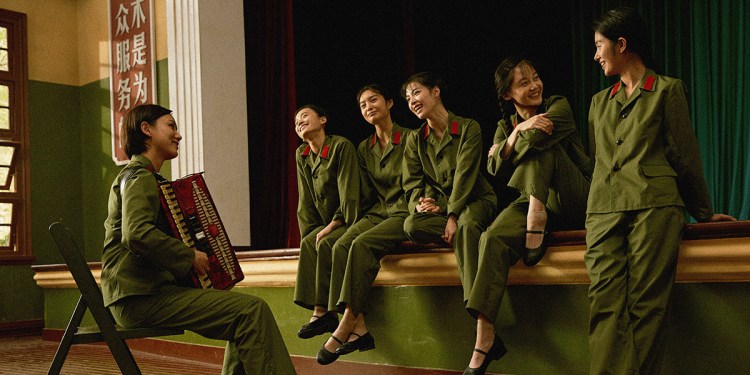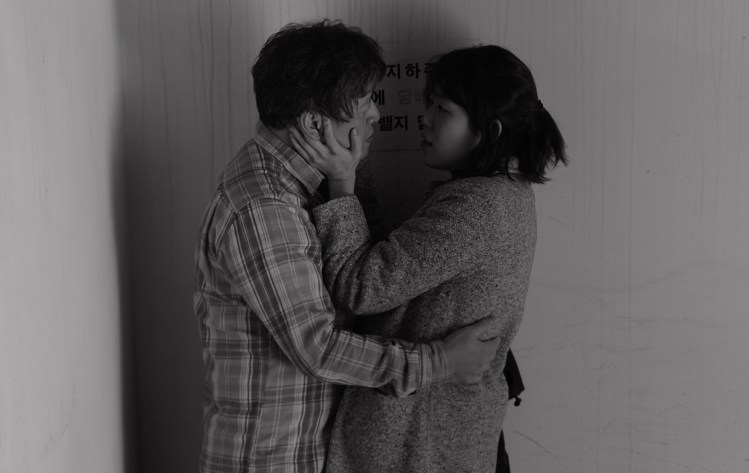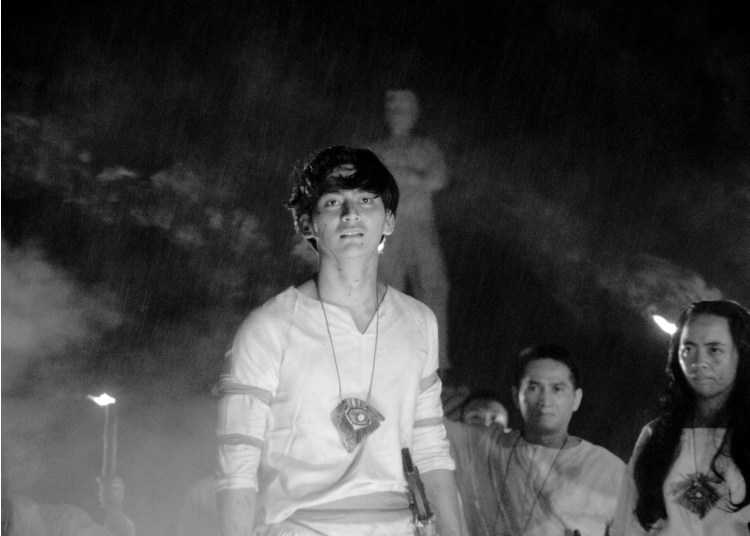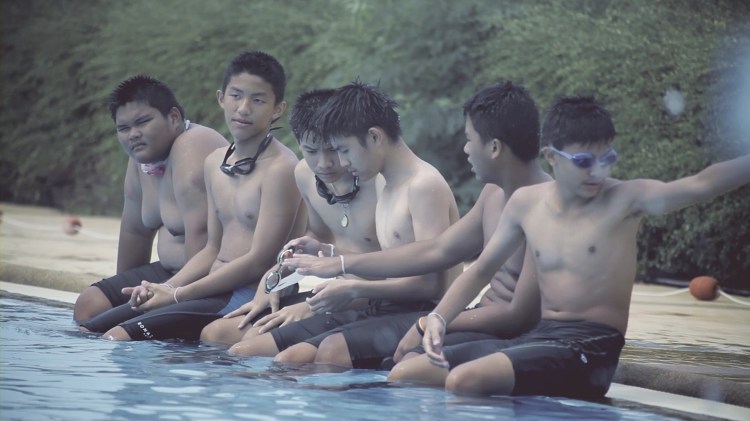
A Slope in the Sun (陽のあたる坂道, Tomotaka Tasaka, 1958)

Slope in the sun posterYujiro Ishihara had become the face of the “Sun Tribe” movement thanks to roles inspired by his brother Shintaro’s novels including the seminal Crazed Fruit in which he starred opposite his later wife, Mie Kitahara. Tomotaka Tasaka’s A Slope in the Sun (陽のあたる坂道, Hi no Ataru Sakamichi), adapted from the novel by Yojiro Ishizaka, is a much less frenetic affair than Nakahira’s famously intense youth drama, but retains the Sun Tribe’s world of purposeless youth whose inherited wealth has driven them to a life of listless ennui. Like Crazed Fruit, Slope in the Sun is the story of two brothers chasing the same girl, only this time one looks bad and is really good, while the other looks good but is really no good at all.

Beginning on the titular sun beaten slope, the film opens with a young woman, Takako (Mie Kitahara), entering the frame as she searches for an address on a piece of paper she is carrying. She finds the house – a large Western-style mansion, but is prevented from entering by a young man who mistakes her for a saleswoman and instructs her to use the tradesman’s entrance. The young man, Shinji (Yujiro Ishihara), continues to taunt her with lewd language before poking at her breast. Takako tries to leave but is persuaded to come inside to meet the lady of the house and the young woman, Kumiko (Izumi Ashikawa), whom she has come to tutor.

The Tashiro household is a strange one. There are three almost grown up children – oldest brother Yukichi (Yuji Odaka) who is a medical student, middle brother Shinji who is a painter, and the youngest daughter Kumiko who is approaching the end of high school and is a little over sensitive about a mild limp which is the consequence of a childhood accident. Takako nearly turns the job down when she realises that the family want less a teacher to help with Kumiko’s studies, than a kind of big sister to help her navigate her way into the adult world, but eventually warms to the Tashiros and decides to give it a go. A college student in need of money, Takako is currently living in a boarding house where she is friends with the older lady next door, Tomiko Takagi (Hisako Yamane), and her 18 year old musician son Tamio (Tamio Kawachi).

In contrast to the earlier Sun Tribe films, A Slope in the Sun is much more subdued though it does maintain an upperclass atmosphere filled with bored young people who struggle to find purpose in their lives through having no particular economic or social worries thanks to the protective cushioning of their wealth. The central issue is a common one to the familial melodrama – middle child Shinji has always felt disconnected from his family and has discovered that the woman who raised him is not his birth mother. He wants to know the truth of his family history but is also a kinder soul than his outward behaviour may suggest and does not want to hurt anyone or risk destroying the otherwise pleasant enough family life he enjoys as a Tashiro.

As expected coincidences abound though the truth is obvious seconds after Takako tells someone the name of her new employer causing them to gasp and draw pale with shock. It seems that everyone in the family already knew that Shinji is only a half brother except Shinji himself – their overcompensation in treating him kindly was the initial tipoff for his suspicions, but this question of blood relation turns out to have a surprising dimension. Oldest brother Yukichi is, outwardly, the model son – handsome, clever, gentlemanly, but on closer inspection his veneer of respectability turns out to be just that. The boys’ mother, Midori (Yukiko Todoroki), knows this well and partly blames herself for allowing Shinji to take the blame for a childhood accident rather than forcing her own son to confess. For all his seeming goodness, Yukichi is an amoral coward, womaniser, and habitual liar whereas there’s a kind of honesty in Shinji’s lewd speech and even in his own lies which he indulges partly out of a sense of smug superiority, as Midori puts it, but also because of the inferiority complex which has marred his life as he feels himself somehow lesser than either of his siblings.

Takako vacillates between the two brothers, taken in by the manipulative Yukichi but strangely drawn to the provocative Shinji. Unlike Nikkatsu’s other youth films, Slope in the Sun ends on a note of happy resolution rather than nihilistic suffering as each member of the family is encouraged to embrace their true natures, putting secrets to one side, and becoming closer in the process. Tanaka’s approach is a more classical one than Nikkatu’s usual fare, making use of silent cinema-style closeups and dissolves but veers towards the avant-garde in a brief flashback sequence offered in dreamlike widescreen. Despite the jazz clubs and subplots about misused geishas, this is a more innocent world than the post-war melodrama would usually allow, finding space for happiness and forgiveness in each of the conflicted protagonists once they each agree to submit themselves to the truth and meet the world with openness and positivity.


Farewell Rabaul (さらばラバウル, Ishiro Honda, 1954)

Farewell Rabaul dvd coverReleased in 1954, Farewell Rabaul (さらばラバウル, Saraba Rabaul) was the last in a string of war films directed by Ishiro Honda for Toho immediately before the mega hit Godzilla redefined his career and turned him into a director of science fiction and special effects movies. Like the later tokusatsu classics, Honda worked alongside Eiji Tsuburaya to craft the film’s effects which are largely used to recreate the epic dogfights taking place over the island as the airmen and ground crew come to terms with the imminent arrival of American forces. Though he takes care to show the bravery and determination of the Japanese pilots, Honda’s attitudes to the war and the government who waged it are not so kind.

Late into the conflict, at an outpost in the Papa New Guinean city of Rabaul, ace pilot Captain Wakabayashi (Ryo Ikebe) leads a rapidly depleting squad of airmen trying to defend Japanese forces from American air attacks. Known as “Devil” Wakabayashi, he rules with an iron fist – taking issue with men who spend their time in local bars and pointedly refusing to send rescue craft for crashed pilots. Ruthless and cold as he seems, the war is starting to get to Wakabayashi and his resolve crumbles when faced with a gracious American POW and the attentions of a kindly nurse, Komatsu (Mariko Okada).

Honda keeps the action to a minimum, preferring to focus on the life within the military base. Though the effects on the local population are not much addressed, the opening scenes take place in a bar in which Papa New Guinean women dance to tribal drums while Japanese military personnel drink and watch. The waitresses are largely Japanese women dressed in kimono, though it seems the exoticism of local girl Kim (Akemi Negishi), dancing barefoot with flowers in her hair, is the main draw. Eventually Kim falls in love with a Japanese soldier and the two plan to flee but fate always gets in the way.

Wakabayashi, rechristened the “Devil” by Kim – a nickname which seems to stick, objects to his men blowing off steam in the bar for purely practical reasons – he needs them at top form for an upcoming mission and a hungover pilot could be a risk to the entire squad. Walking around looking sullen and refusing to explain himself, it’s no wonder Wakabayashi is unpopular with some of the men even if his skills are widely recognised. Asked to send a rescue squad for a lost pilot, Wakabayashi’s reply is a flat no with no further details offered. Only when a junior officer interjects during a briefing does he offer his reasoning – the crash site is in enemy territory and it’s too risky to send more men in to fetch one pilot who is probably already dead. His reasoning is sound and probably the correct command decision but the cutting coldness with which he delivers his judgement does little to assuage his reputation as a heartless misanthrope.

This is, however, not quite the case. When an extremely young member of his squad is shot down Wakabayashi shouts out to him, trying to advise the rookie on ways to control the aircraft but all to no avail. The pilot cannot bail out as Japanese pilots, particularly those flying the featherweight 0 fighters, are not equipped with parachutes. This is brought up again when a downed American pilot is brought in as a POW. The journalist attached to the unit is able to speak fluent English and interprets for Wakabayashi and the others as the American gives them an improbably frank analysis of Japanese airborne warfare. He tells them that the Americans were once afraid of the 0s and their high speed manoeuvring but have figured out their weaknesses. In the hands of a skilled pilot, the 0 is a powerful weapon but in unskilled hands it’s a liability – its lightweight form makes it easy pickings when the pilot does not know how to fly defensively. If it weren’t for this fighter they call “Devil” they’d be picking them off with ease. The lack of parachutes came as a surprise to the Americans. The 0s need to be as light as possible, but no one could believe that the Japanese government valued life so cheaply that they’d send a man up there with no way down. That’s why, the American says, they will win – no government so unwilling to look after its own could ever expect to.

The senselessness of it all eventually gets to Wakabayshi, even leading him to reverse his original stance and proceed into enemy territory to rescue a fallen comrade himself. He is, however, wounded, his plane damaged, and his friend doesn’t make it. Rabaul falls, and its hero falls with it in a turn which is both melancholy and defiant. Honda refuses to glorify the destruction but ends on a note of sadness, reprising the titular song sung by the women aboard a boat they hope will take them home but that, like everything else, remains so hopelessly uncertain.


The Blue Sky Maiden (青空娘, Yasuzo Masumura, 1957)

blue sky maiden dvd coverYasuzo Masumura is generally remembered for dark, erotic and disturbing explorations of human behaviour but the early part of his career was marked by a more hopeful innocence and a less cynical yet still cutting humour. His debut, Kisses, was very much in the mould of the youth movie of the day but its themes were both more innocent and more controversial as a boy and girl bond after running into each other at the prison where both of their parents are serving time. Marked by darkness as it is, the worldview of Kisses is much kinder than Masumura would later allow as the pair of lovers seem to shake off their respective concerns to embrace the youthful joy and boundless freedom young love can offer.

The Blue Sky Maiden (青空娘, Aozora Musume), Masumura’s second film, does something similar but with added bite. Working for the first time with actress Ayako Wakao who would later become something of a muse, Masumura takes a typical melodrama storyline – the returned illegitimate child treated as a poor relation by her own “family”, and turns it into a genial comedy in which Wakao’s charming heroine shines brightly despite the often cruel and heartless treatment she receives. As far as the family drama goes, the genre was still in its heyday and the family unit itself fairly unquestioned yet as Masumura shows times were changing and perhaps the family is not the bedrock it initially seems to be.

18 year old Yuko (Ayako Wakao) stands at the gates of adulthood. Taking a last photo in school uniform with her high school friends as they prepare for graduation, Yuko expresses her nervousness about being sent to Tokyo to live with the family of a father she barely knows while her friends worry about getting married or getting stuck in their tiny village all alone respectively. Tragedy strikes when the girls’ teacher arrives on a bicycle and informs them that Yuko’s grandmother has been taken ill. On her death bed, the grandmother reveals the reason Yuko is the only one of her father’s four children to be raised in the country is not a concern for her health, but that she is illegitimate. Yuko’s father, unhappy in his marriage, fell in love with his secretary (Kuniko Miyake) who later gave birth to Yuko, but he was already married with two children and so Yuko’s mother went to Manchuria leaving her to be raised in secret in the country.

Having nowhere else to go, Yuko arrives at her father’s large Western style house to be greeted coldly by her half-siblings, and treated as a maid by her still angry step-mother while her father (Kinzo Shin) is away on business. It has to be said that this model middle class family are an extremely unpleasant bunch. Step-mother Tatsuko (Sadako Sawamura) is shrewish and embittered while oldest daughter Teruko (Noriko Hodaka) spends all her time chasing wealthy boyfriends (but failing to win them because she’s just as mean as her mother). The oldest brother (Yuji Shinagawa) idles away in a hipster jazz band while the youngest boy, Hiroshi (Yukihiko Iwatare), is rude and boisterous but later bonds with his new big sister when she is the only one to really bother interacting with him.

The Ono household has always been an unhappy one. Yuko’s father married his wife after being bamboozled into it by an overbearing boss trying to offload his difficult daughter. Feeling trapped and avoiding going home he fell in love with a kind woman at work, had an affair, and wanted to marry her but wasn’t strong enough to break off not only from his unwanted family but also from his career in pursuing personal happiness. By Masumura’s logic, it’s this failure to follow one’s heart which has poisoned the Ono family ruining not only the lives of Tatsuko and the children who have no respect for their father or capacity for real human feeling (as Yuko later tells them), but also that of Yuko’s poor mother  whose life has been one of constant suffering after being unfairly jettisoned by a man who was bold enough to have an affair, but not to defy social conventions and leave an unhappy home.

Yuko herself, however, refuses to allow her life to be ruined by the failings of others. Looking up at the bright blue sky with her teacher (Kenji Sugawara), she learns to create her own stretch of heaven if only in her own mind. Though others might have fought and complained at being forced into the role of maid in what is her own family home, Yuko bears her new circumstances with stoicism and good humour. Thanks to her kindness and enthusiasm, the family maid, Yae (Chocho Miyako), is quickly on her side and if Teruko’s latest target, Hirooka (Keizo Kawasaki) starts to prefer the “new servant girl” his defection is completely understandable. Unlike later Masumura heroines, Yuko’s “revenge” is total yet constructive. She refuses to be cowed by unkindness, remains pure hearted in the face of cruelty, and resolves to find her own happiness and encourage others to do the same. With a few cutting words offered kindly, Yuko gets to the heart of the Onos, essentially reminding her father that all of this unhappiness is his own fault – he made his bed 20 years ago, now he needs to lie it and be a full-time husband and father to the family of lonely misfits he created in the absence of love.

Light and bright and colourful, The Blue Sky Maiden is among Masumura’s more cheerful films, not least because it does seem to believe that true happiness is possible. Yuko does not so much defy social convention as ignore it. She lives openly and without rancour or regret. She takes things as she finds them and people (aside from the Onos) are good to her because she is good to them. Though Masumura’s later work would become increasingly dark and melancholy, Yuko bears out many of his most central themes in her steadfast claim to her own individuality and equally steadfast commitment to enabling the happiness of others in defiance of prevailing social codes.


The Villainess (악녀, Jung Byung-gil, 2017)

the villainess korean posterVengeance is a doubled edged sword, it cannot help but wound the wielder. The heroine of Jung Byung-gil’s ironically titled The Villainess (악녀, Aknyeo) has more to be revenged of than even she knows. Yes, the narrative beats are familiar and Jung has clearly drawn inspiration from Luc Besson’s seminal hit woman movie La Femme Nikita as well as the long history of female revenge films from Lady Snowblood to Kill Bill, but he does it with style and style is always hard to argue with. A new kind of action cinema, The Villainess makes a performer of its camera, darting frantically like an animal on the run and then drifting listlessly between dreamlike visions of half remembered traumas. Jung remains firmly in B-movie territory but owns it, unafraid to embrace the genre’s more extreme qualities and all the better for it.

When we first meet Sook-hee (Kim Ok-vin), we are Sook-hee. Jung opens with a lengthy (seeming) one take POV shot of an assassin fearlessly taking down untold numbers of bad guys in a tightly controlled corridor battle before we are suddenly ejected from her head when it connects with a mirror. Sook-hee has come here for revenge, though we don’t know that yet. Leaping from an upper window and landing heroically in an alleyway below, Sook-hee is taken into custody by a shady government organisation intent on turning her into a sleeper assassin. She is uniquely qualified for the task but has lost all hope and longs only for death. The revelation that she is pregnant gives her a reason to keep on living, as does the promise of her new mentor, Kwon-sook (Kim Seo-Hyung), who assures her ten years of service will buy a lifetime of comfort and freedom both for herself and the young life inside her.

Of course, it is not that simple. Jung gradually reveals Sook-hee’s backstory through brief flashbacks and lengthier evidence gathering sequences but her story is one of constant abandonment, adoption, betrayal, and vengeance. As if she could ever have forgotten them, the seminal images of Sook-hee’s life are frequently thrown back at her – an innocent girl witnessing the bloody death of her father, the eyes of the dying gazing back at something they once loved, games of death and of salvation. Sook-hee has been used and misused by men all her life, traded for jewels, and tricked into a murder of the self as sheds her skins to transform from frightened child to heartless killer, loyal wife, and loving mother. Swapping one master for another she is lied to and manipulated, denied her own identity in service of someone else’s ideals.

Ironically enough the prize which is dangled in front of Sook-hee’s eyes is nothing more than the prospect of a “normal life”, free from crime, killing, and fractured identities. As elliptical as the film itself, Sook-hee’s adult life is an ongoing quest to regain what was taken from her in childhood. A “normal life” is what’s offered to her by each of her respective masters but none of them has the capability, and only one the will, to give it to her. There can be no normal life for Sook-hee, reduced as she is from a name to an epithet. A villainess – no longer a woman, merely a faceless archetype, a grudge bearing revenger with dead eyes and an icy heart.

When Sook-hee performs in her strangely meta, Hedda Gabler inspired play, she remarks that she and the (presumably) long lost lover to whom she is speaking can no longer exist in the same space, in order for one to live the other must die. This line has an obvious correlation in the narrative but Sook-hee isn’t just speaking of her unseen enemy but of her own dualities. Only one Sook-hee can survive, but so many Sook-hees have died already starting with the lost little girl offered salvation in the barrel of the gun. Beginnings become endings, and endings become beginnings, but whether The Villainess is the story of a woman assuming her true identity or being subsumed by it, Sook-hee remains where she’s always been – alone and encircled by men with guns whose infinite authority she is perpetually unable to evade.


The Villainess was screened at FrightFest 2017 and will also be screened as the final Teaser for the upcoming London Korean Film Festival at Regent Street Cinema on 11th September ahead of a limited cinema outing and October DVD/blu-ray release from Arrow Video.

International trailer (dialogue free, English captions)

BLAME! (ブラム!, Hiroyuki Seshita, 2017)

blame posterCities. The pinnacle of human achievement and an almost living monument to civilisation. Does the same principle of human collective settlement also relate to the digital realm or will increasing interconnectedness eventually destroy everything we’ve built? Following their landmark CGI adaptation of Tsutomu Nihei’s Knights of Sidonia, Polygon Pictures return to source by adapting the author’s debut work BLAME! into a feature length animated movie. Like Sidonia, BLAME! (ブラム!) takes place many years after a climactic event has led to the fall of human civilisation – an event so long in the past as to have become mere myth to the small number of humans still clinging on to life in a now inhospitable terrain, but BLAME!’s dystopia is very much one created by man, losing control of its technology in its ever advancing hubris.

As the young girl who offers the opening monologue tells us, no one knows how all of this happened. Once, a long time ago, humans lived in a city but a virus came and they lost the ability to communicate with the environment in which they lived. The city began to grow, and the “Safeguard” system decided that humans were “illegal immigrants” in their own land. The exterminators swooped in to wipe them out but a small band of humans has managed to survive a few hundred years in a kind of safe zone protected by a perimeter wall the city’s systems are prevented from monitoring.

The rapid expansion of the city has also meant a reduction in vegetation and the surviving humans are running low on food. An intrepid team of children ventures out into the wasteland in search of sustenance, but they’re spotted and targeted for elimination. A mysterious figure appears on the horizon and saves them. The man calls himself a “human” and is disappointed to realise none of the children are carriers of the “Net Terminal Gene” which he is seeking. Killy (Takahiro Sakurai) claims that the Net Terminal Gene will enable the humans to take back control of the city’s systems, halt the excessive building program and call off the Safeguard attack dogs.

Killy’s appearance brings new hope to the villagers, trapped within their perimeter stronghold but facing the prospect of staying and starving or taking their chances with Safeguard. Concentrating on action rather than philosophising little time is given over to considering how humanity lives though it’s certainly puzzling that there is so little reaction when the band of children returns home much depleted in numbers. Indeed, aside from Pops (Kazuhiro Yamaji), the de facto leader of the community, no other “adults” appear.

Using Killy as a kind of deflective shield, the gang press on until they find an abandoned robot, Cibo (Kana Hanazawa), who tells them about an “Automated Factory” in which she can generate both an abundant food source and a synthetic tablet which will allow them to get back into the city’s systems. What ensues is a deadly firefight as the system fights back. Cibo pleads with The Authority in the digital realm while Killy and the villagers hold back the forces of order with firepower from the outside.

Killy remains a man of few words, his language dulled through inactivity and his expression inscrutable, but the villagers, perhaps lulled into a false sense of security thanks to long years of isolation, never question his motives or reliability. Likewise, Cibo clearly knows more than she lets on but offers the only lead so far on a way back to a less precarious way of life. Killy’s sudden appearance becomes a mythic event, a point of transition in the history of the post-apocalyptic world, but also seems to be without resolution as the closing coda implies.

Like Sidonia, the animation quality is at times variable but often excels in its highly detailed backgrounds, allowing production design to smooth over any narrative gaps. What BLAME! lacks in terms of plot and character complexity it makes up for in world building though it is difficult to ignore the feeling of the loss born of condensing something far larger into an easily digestible whole. Nevertheless, BLAME! does what it sets out to do with quiet brilliance in detailing what might be the first of many adventures of the wanderer known as Killy as he explores a world ruined beyond repair looking for the key to unlock a brighter future.


Netflix trailer (Japanese with English subtitles/captions)

Love in the Mud (泥だらけの純情, Sokichi Tomimoto, 1977)

Love in the Mud posterJapanese youth cinema was in a strange place by the late 1970s. Angsty seishun eiga had gone out with Nikkatsu’s move into Roman Porno and the artier, angry youth films coming out through ATG were probably not much for a teen audience. The Kadokawa idol movie was only a few years away but until then, films like Love in the Mud (泥だらけの純情, Dorodarake no Junjo) arrived to plug the gap. Based on a novella by Shinji Fujiwara which had been previously adapted by Ko Nakahira in 1963 in a version starring Sayuri Yoshinaga and Mitsuo Hamada, Love in the Mud is a classic tale of poor boy meets rich girl and ends in a predictably hopeless way but in deep contrast to the prevailing culture of the time, the film takes the “junjo” or “purity” in its title literally in its innocent chasteness.

As the camera pans over a rapidly developing city, it settles on a bright red, flashy sports car being driven by Mami (Momoe Yamaguchi), the daughter of the Japanese Ambassador to Spain, with her friend sitting cheerfully in the passenger seat. Disaster strikes when the pair are run off the road by a biker gang who taunt them from outside the car, threatening rape and robbery. Luckily for them another gangster turns up, beats up the bad guys and saves the girls but alarm bells should have been ringing when he asks Mami to step out of the car and “thank him properly”. Mami, stupidly, does what she’s told and the girls are hijacked by gangsters round two. When they reach the shady place the gangsters are planning to have their wicked way with them, a third wave of gangster appears, disapproves of the goon’s intentions and heroically fights them off. However, the girls’ saviour is stabbed in the stomach and then later stabs and kills the leader of the aggressors.

The noble gangster, Jiro (Tomokazu Miura), tells the girls to run – which they do, but somehow Mami can’t quite bring herself leave him. A thoroughly middle-class girl, Mami is at university studying English literature but her dream is to open a hat shop in Paris and she spends most of her spare time working with a hat designer. In the absence of her father, Mami’s uncle (Ko Nishimura) has been looking after her but is the classic upperclass male who thinks the hat stuff is just a hobby and what Mami needs is a good husband as soon as possible. Accordingly he’s set her up with a pleasant enough business contact he hopes will both support Mami in the manner to which she’s been accustomed and his business dealings too.

Your average teenage girl might not be in such an extreme situation as young Mami, but most can certainly sympathise with her lack of agency. The life her uncle has planned for her is not what she wants but more than that, she’s acutely aware of being denied a choice in her future. She may be rich, but she’s never been free. Jiro, by contrast, grew up poor in tragic family circumstances and enjoys his own kind of freedom even if he feels himself constrained by his social class and lack of opportunities following a life in care with no real education. Not actually a yakuza but a gambler and petty punk living on the fringes of the underworld, Jiro has been content to live a meaningless life of empty gains but as his rescuing of Mami and her friend shows, he has a kind heart which extends to delivering presents to the daughter of a melancholy bar hostess currently living in an orphanage.

Jiro’s nobility is of a true and pure kind. After Mami comes forward to testify in Jiro’s defence, she tries to strike up a friendship but Jiro rebuffs her. He’s too smart not to know posh girl and poor boy never ends well, but then they do have a real connection which proves hard to kill. Their social differences are made apparent when Mami makes the naive decision to invite Jiro to a party at her fancy mansion. He buys a nice suit and an expensive necklace as a present, but Mami’s nanny doesn’t want to let him in and when Mami introduces Jiro to her uncle he whips out a checkbook causing Jiro to leave enraged. Nevertheless Mami chases Jiro through the shadier parts of Shinjuku, taking her first taste of gyoza, frequenting underground nightclubs and mahjong parlours, and swapping her elegant outfits for the casual jeans and T-shirts of Jiro’s world.

While all of this is going on, Jiro is also embroiled in the gang trouble which started with the stabbing in the beginning. A “friend”, almost, of the local policeman, it’s not surprising suspicion falls on Jiro and he faces a bleak future if he chooses to remain in Shinjuku. The courtship of the pair is a stuttering, nervous affair in which the emboldened Mami chases Jiro whose sense of honour teaches him to try and avoid her all the while he too is smitten. This is, however, a chaste and innocent love. Jiro and Mami spend a night together gazing at the moon but all they do is talk and the climax of the romance is met firstly with an innocent hug, and then a troubling slap from Jiro which is designed to show the depth his love in his desire to push Mami away, rather than anything more explicit.

A tragic tale of love across the class divide, Love in the Mud indulges the worst aspects of its genre in the fetishisation of doomed romance and extreme dedication the idea of “pure” emotion. The force that keeps Jiro and Mami apart, rather than entrenched social mores and differing forms of oppression is a kind of fatalistic pessimism which says the only true love is death. Perhaps too innocent and too chaste, Love in the Mud never earns its melodramatic ending but does what it needs to in appealing to its teenage target audience, neatly anticipating the genial edginess of the idol movie but failing to move much beyond capturing its moment as a snapshot of late ’70s youth culture.


Original trailer (no subtitles)


Plastic Love Story (プラスチック・ラブ・ストーリー, Ryutaro Nakagawa, 2014)

plastic love story posterFake plastic love, in the words of Radiohead – it wears you out. For three young women in contemporary Japan each seeking an identity through romantic connection, plastic love will have to do, for a time at least. Ryutaro Nakagawa’s indie feature Plastic Love Story (プラスチック・ラブ・ストーリー) is, in essence, anything but romantic as its three heroines veer dangerously between life and death, each lost, lonely, and lovelorn as they search for the pathways to lead them into a settled adulthood. For all of its gentle coming of age qualities, Plastic Love Story is a dark tale in which release is found only through loss, shared pain, and finally sacrifice.

Office lady Eri (Mai Sakata) is about to quit her job as she believes herself to be pregnant. A common occurrence even in modern Japan, though Eri’s case is less usual because she is not married. After confronting the probable father who wants nothing to do with it or her, Eri becomes fixated on a middle school classmate whom she feels was the last person to really understand her.

Meanwhile, high school girl Rina (Manami Takahashi) has a difficult home life with a flighty mother and distressed father. She dreamed of becoming a ballerina but since a leg injury put paid to her dancing dreams, Rina has tried to fill the void left by parental absence and early disappointment by hooking up with a string of useless boyfriends.

Kanae (Yumi Yamawaki), by contrast, is also a high school girl but sullen and depressed. A childhood trauma involving the death of her younger brother who had learning difficulties which was quickly followed by the death of her mother, has left her with an ongoing sense of guilt and hopelessness. Rejecting an erstwhile suitor from school, Kanae develops an odd relationship with a disturbed, suicidal young man currently in her doctor father’s care.

Each of the three women is in some way damaged, attempting to deal with extreme trauma and doing it all alone. Though they do not know each other and never meet, there are strange connections which bind them in their shared sufferings and inability to escape their oppressive environments. Eri’s loneliness is longstanding, leading her to attempt suicide as a schoolgirl at which point she was saved by the kindly attentions of another loner, Yasu, whom she has come to regard as a kind of absent soulmate. Yasu, in a trope which is repeated in all three stories, has since committed suicide but has left behind a series of videotapes through which, his sister says, he was able to make himself understood as he never could without a camera in his hand. The tapes centre on another high school classmate who seems to have been Yasu’s first (unrequited) love. Watching the videos forces Eri to face facts about her non-existent middle school romance and eventually helps her exorcise the ghost of her lonely teenage self.

Rina and Kanae are not quite so lucky, a little way behind on the path and each required to make a sacrifice of their potential mates in order to achieve what Eri achieves though her unattainable soulmate has already passed on. Rina’s life has been one of subservient neediness as she finds herself trapped in unfulfilling relationships with boys who see her only as a sex object. In fact, one of them actually describes her as a “toilet”, but all Rina says she wants is a “normal” relationship which starts as friends and gradually becomes something more. The janitor at her university has an intense crush on her which Rina originally rebuffs but every insane demand she makes of him, the janitor fulfils making more than a few sacrifices of his own.

Kanae’s relationship with the equally guilt ridden, suicidal young man at her father’s surgery is even less positive than Rina’s manipulative romance as the pair bond through their shared self loathing in feeling responsible for the deaths of people close to them whom they feel they did not try hard enough to save. Leaving aside the fact that the man is in his twenties and Kanae still a schoolgirl, the relationship is an intentionally doomed one. Kanae does not seek love but only an end to loneliness, avowing that no one has enough happiness to save someone else but that someday she plans to go faraway and learn to love herself once again.

Taking a turn for the poetic, Nakagawa has each of the women dance happily as they learn to let go of the objects which have bound them, smiling less painfully and walking with a little more lightness. Three expressions of womanhood, they exclaim that now they know love, they know beauty, they know solitude. The path that leads them here is dark, littered with bodies of those they have lost or have sacrificed in order to enact their own happiness. Plastic does not only imply something “fake” or engineered, but something soft and pliable, which is to say it can be moulded for good or ill. These plastic loves have soon turned rotten, but perhaps there is hope for a better future for each of these women for having come through them, even if their escape was not without cost.


Original trailer (English subtitles)

Once Upon a Time (三生三世十里桃花, Zhao Xiaoding & Anthony LaMolinara, 2017)

once upon a time posterTang Qi’s popular online novel Three Lives Three Worlds, Ten Miles Peach Blossoms (三生三世十里桃花, Sān Shēng Sānshì Shílǐ Táohuā) has already been adapted into a phenomenally popular TV drama spanning 58 episodes but the big budget, blockbuster adaptation by Zhang Yimou’s regular cinematographer Zhao Xiaoding making his directorial debut in a co-production with Anthony LaMolinara, thinks it can make do with just 110 minutes. Retitled Once Upon a Time in an obvious nod to the film’s attempt to blend classic Western fairytales by way of Disney with traditional Chinese mythology, Zhao’s approach is a (mostly) family friendly one complete with superfluous CGI characters and a kind of essential innocence in its emotional landscape. Yet it also falls into the traps of many a Chinese fantasy blockbuster in its convoluted, confusing narrative, over reliance on CGI visuals, and host of pretty but bland leading players.

A blindfolded woman bids her lover goodbye as she falls through a storm before landing softly in a beautiful orchard covered in peach blossom to be woken by a friend who tells her she had just been asleep. The woman says she remembers nothing but feels as if she’s been inside a dream. He tells her to let it go, in her dream world she lived a very sad life and it’s better not to remember.

As it turns out the woman is the queen of this realm, Bai Qian (Liu Yifei). She spends her days alternating between frolicking with mystical forest creatures like your average Disney princess (only with less singing) and drinking so heavily she passes out. In fact, drinking is pretty much her only hobby and her general demeanour is moodiness born of being sad over something she does not remember. Technically speaking, she’s been engaged to a mysterious prince from an undersea kingdom for quite sometime but has no desire to marry, firstly out of the aforementioned sadness, but also out of a preference for independence, and the fact that the prince is apparently 70,000 years younger than she is and she thinks it’s inappropriate. Nevertheless, she goes (blindfolded due to a problem with her oversensitive eyes) and meets Ye Hua (Yang Yang) and his son Ah Li (Peng Zisu) who immediately recognise her as “Su Su” – the boy’s mother who died 300 years ago.

Though Once Upon a Time is based on a fairly recent novel and draws much of its inspiration from Western fairytales, some familiarity with Chinese mythology will undoubtedly help. Bai Qian is apt to suddenly morph into a white nine tailed fox while her friend Zhe Yan (Luo Jin) is a glowing, fiery phoenix of the battlefield and though the gods possess a number of surprising powers from the ability to spontaneously generate fire or chop vegetables in mid-air, they fight the way any mortal would only with much more destructive effects.

At heart, apt phrase as that is, Once Upon a Time is an epic love story in which two souls wait and search for each other through eons, pushing and probing for recognition all while failing to grasp that which seems to exist between them. The title of the novel is almost a spoiler in itself as it details the passage through three worlds and three lives which has brought Bai Qian and Ye Hua to this particular impasse of awkward, screwball romance. A repeated phrase between the lovers, the Ten Miles of Peach Blossom is a byword for excess – what is the point of ten miles of peach blossoms, when a single petal is enough? Ye Hua affirms he’s found his petal already, though she refuses to come down from her tree. Bai Qian is the obstinate one, pining for a lost love and, perhaps, one she doesn’t remember but there are things Ye Hua has hidden from himself too.

As much about identities in flux eventually settling in love, Once Upon a Time also has its standard fairytale tropes from the “ugly” sisters at the beginning to the wicked step-mother stand in Su Jin (Li Chun) and her machinations to get rid of Su Su/Bai Qian by means of her wicked white tiger. Bai Qian and Ye Hua must come to know all of themselves before recognising their opposing number, seeing straight through the fog of love to its shining core. Despite the depth of its ideas, Once Upon a Time fails to move beyond its fairytale setting, caught between the bright and colorful world of a peach blossom orchard filled with adorable woodland creatures, and the darkness of the woman who lives inside it, slowly killing herself with drink to blot out the inability to remember long buried pain. Intermittently charming, Once Upon a Time is among the better fantasy films emerging from mainland China in recent times but unlike its forgetful lovers never quite manages to recover its heart.


Currently on limited release in UK cinemas.

Original trailer (English subtitles)

Composition Class (綴方教室, Kajiro Yamamoto, 1938)

composition class posterChildren’s essay classes can yield unexpected revelations but sometimes it’s the tragedy behind the humour which catches the attention rather than a unique way of describing a situation not fully understood. Composition Class (綴方教室, Tsuzurikata Kyoshitsu) has something in common with the later Korean classic Sorrow Even Up in Heaven or even the more temporally proximate Tuition in drawing inspiration from the diaries of school age children but predictably it’s far less bleak in outlook. Though young Masako (nicknamed Maako) has her share of problems, her troubles are met with characteristic cheerfulness and a determination to carry on no matter what.

In a small town in North East Tokyo, 1938, Masako Toyoda (Hideko Takamine) lives with her parents and her two brothers in a humble home her family can barely afford. Disaster strikes when dad gets a letter from the court which he can’t read – Masako usually reads for him but letters from the court are still too difficult for a preteen schoolgirl. The family are behind on their rent and have heard that someone is trying to buy up the area with other families also facing possible eviction. Bright though she is, Masako might have to give up school and find a job as a maid while the family moves to stay with relatives who own a shoe shop. Luckily, none of that happens because the note was only about a rent increase (on the rent that haven’t paid for months).

The second crisis occurs when Masako’s teacher is taken with the essays she’s writing in class which are so real and honest that they espouse all the values he wants to teach the children. Around this time, the lady from next door, Reiko’s mother Kimiko, is leaving town (and her husband) and so gives away some her breeding rabbits as pets believing that a nice girl like Masako will be sure to take care of them and that they could use the extra money from selling the babies. Kimiko, thinking Masako is out of earshot, remarks that she was going to give some of the rabbits to the local bigwigs, the Umemotos, but even if they’re wealthy, they aren’t very nice and she wouldn’t like to think of her rabbits not being looked after. Masako naively records this minor detail in one of her essays which the teacher then sells to a local magazine. The Umemotos find out and aren’t happy which is a problem because dad gets most of his work through Mr. Umemoto who has a stranglehold on the local economy.

Through Masako’s diary and child’s eye view of the world, Kaijiro Yamamoto paints an oddly relaxed picture of depression era privation as the Toyodas endure their penury with stoicism and a belief the bad times will sometime end. Masako and her family have it a little better than some, but when bad weather puts an end to dad’s tinsmithing business and he’s forced into the precarious life of a day labourer things go from bad to worse. Now out of work more than in, the family are reliant on rice coupons to get by and spend one miserable New Year’s with no money for the first week of January when the biting cold makes it impossible to go out and forage for food. Masako writes of her embarrassment the first time her mother sent her to the shop with coupons and that she eventually got used to it, save for one occasion she ran into friends and had to quickly cover by saying she’d bought rice bran rather than collecting the rice dole. Like Masako, dad is a good natured soul though he’s also fond of drinking and is often let down or tricked out of his money, even being cheated out of his bicycle which he needs to keep working.

Sadness is all around from the man next door who’s so poor he doesn’t even have money for sake to the dejected Kimiko who eventually returns pale, drawn, and barely recognisable only to find her husband remarried to a much younger woman. Though Masako is a bright girl with a talent for writing her future is already limited. At one low point, her mother seems excited about the idea of selling Masako off to a geisha house where she will at least be fed, have pretty clothes, and maybe make a good match with the sort of man who marries former geishas. Needless to say, Masako is not very enthusiastic, and neither is her teacher who pledges to save her from such an unpleasant fate but luckily it never comes to that. Other girls will be going on to high school and university, but Masako counts herself lucky to have got a job in the local factory which will provide a steady income for her family. Though it’s a shame Masako is denied the same opportunities as the other girls because of her family’s poverty, she does at least pledge to keep writing even as she marches happily towards work and a (possibly) brighter future.


A Man and a Woman (남과 여, Lee Yoon-ki, 2016)

A man and a woman postetSome memories are better when forgotten, according to the heroine of A Man and a Woman (남과 여, Namgwa Yeo) – the latest romantic melodrama from Lee Yoon-ki. The title, deceptively simple as it is, makes plain Lee’s intention to reduce this melancholy love story to a universal level in which two people who share a deep and genuine connection choose to sever it rather than break with social convention and/or incur the additional risks of ongoing entanglement. An elongated Brief Encounter, the ballad of Sang-min and Ki-hong is a strangely old fashioned one in which unhappiness appears to be the ideal choice and a satisfied life an indulgent luxury.

Sang-min (Jeon Do-yeon) has brought her almost teenage son to Finland for treatment at a special needs school. Dropping him off for a school trip, Sang-min gets cold feet and tries to insist on accompanying the boy, only to be roundly refused by the carers. In the car park she runs into another Korean – Ki-hong (Gong Yoo) has been living in Finland for a couple of years and his young daughter attends the school to help with depression. Sang-min presses Ki-hong for information about where the camp is and eventually he offers to drive her. Predictably, they get caught in a snowstorm and have to stay overnight. A visit to a woodland sauna the next day leads to an intimate encounter but as soon as they arrive back in the city, the pair part ways without even exchanging names.

So begins the sad ballad of Sang-min and Ki-hong which eventually takes them back to Seoul where they resume their affair, putting each of their families at risk. Both parties are married already but each desperately lonely in very ordinary ways. Sang-min is a highflying CEO of a small fashion line but also shoulders most of the responsibility of looking after her son who needs a lot of extra help to cope with his autism. Her husband is rational and distant; the marriage is not unhappy but perhaps emotionally unfulfilling. Ki-hong’s marriage is also under strain as his wife has ongoing mental health issues leaving him to look after their equally distressed daughter whilst also pursing a career as an architect. 

The snowbound, silent forests of Finland are an appropriate point for the start of the affair, echoing the couple’s frozen, interior blankness. Sang-min has a pre-occupation with time in Helsinki which she abandons in Seoul, less because of a literal return to the alternation of light and darkness than a inner feeling of it passing at a more predictable rate. In Finland she wanted to know everything, in Seoul she decides perhaps it’s better not to know. Ki-hong, by contrast, is a vague sort of person in both places. Yet their instant connection is real and deep. They echo each other, repeating their shared phrases and sharing something to which they cannot give a name.

Though living in more permissive times, the love of Sang-min and Ki-hong remains impossible despite the ongoing unhappiness of their married lives. Sang-min looks on enviously at her younger sister who is dallying in marrying her American boyfriend. Her sister tells her she wants what Sang-min has – to be “happily” married, entirely unaware of Sang-min’s loneliness and dissatisfaction. Ki-hong’s moribund marriage is difficult enough but the spark has already gone – his wife tells him she feels like a patient, the subject of Ki-hong’s dutiful devotion rather than a woman who is loved by the man with whom she shares her life. Despite all of this the idea of leaving their unhappy situations to find happiness in each other is never a real possibility for either Sang-min or Ki-hong who each remain trapped both by adherence to social conventions and a lingering reluctance to fully commit.

The forces which keep them apart are less societal than personal, an unwillingness to embrace the possibility of happiness or perhaps a sense that it is not something which is permitted to them. Times have moved on since Alec and Laura said goodbye to each other in a station cafe, unspoken emotion filling the room as a busybody inserts herself into a private world about to end. There is no particular reason why Sang-min and Ki-hong cannot be happy, yet they each eventually choose not to be. Frosty indeed, this is a love which is apparently best relegated to memory, untainted by time and eternally pure. Beautifully photographed and heartbreakingly bleak, A Man and a Woman is a sad story of refused connection in which love is a risk too great for two lonely souls.


Original trailer (English subtitles)