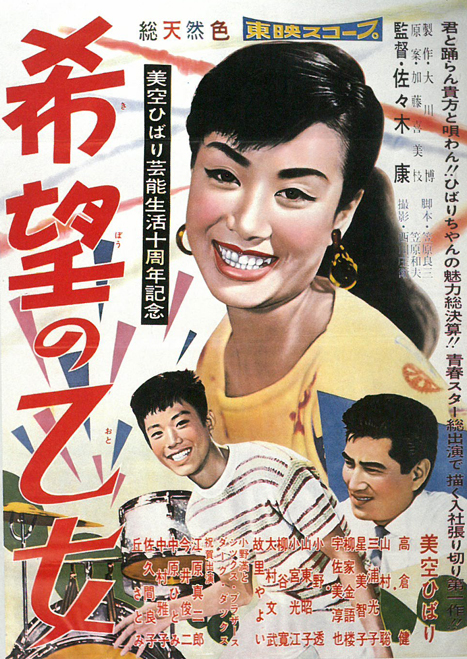
 Another vehicle for post-war singing star Hibari Misora, With a Song in her Heart (希望の乙女, Kibo no Otome) was created in celebration of the tenth anniversary of her showbiz debut. As such, it has a much higher song to drama ratio than some of her other efforts and mixes fantasy production numbers with band scenes as Hibari takes centre stage playing a young woman from the country who comes to the city in the hopes of becoming a singing star.
After beginning with a rural, almost cowboy-style number in which Hibari appears as the well dressed lady of the manor, Sayuri, riding her horse across the wide pastureland, the action quickly moves to the city when Sayuri’s mentor finally convinces her uncle that her future lies in showbiz and not an early marriage as he had envisioned. However, once she gets there she finds her potential tutor extremely unwilling to fulfil his promise to take her on. After winning him over, she quickly makes friends with the locals who also want the singing teacher to become the leader of a band they’ve formed in the hopes of raising some money to build a proper children’s playground to stop them playing in dirty ditch land nearby which is a well known health hazard. Soon enough the band takes off but there’s more trouble ahead for Hibari and co. as they are betrayed by those closest to them.
Working as a celebration of Hibari’s career so far With a Song on Her Heart is filled with excuses for Hibari to sing both as a music student and band vocalist as well as fantasy production numbers some of which are even bigger on dance than on song. The plot is quite simple but there is a lot of it, in contrast to other films of this kind, as Hibari sets about healing the grief stricken heart of her bandleader and fulfilling the hopes of the ordinary people turned musicians through the power of song. The romance element is a light one and not the focus of the film but bears mentioning as Hibari’s love interest is played by Ken Takakura – the archetypical star of the yakuza movie who was to marry fellow singing sensation (and frequent Hibari Misora co-star) Chiemi Eri the following year.
Despite its nature as a celebratory project, With a Song in Her Heart doesn’t quite meet the high production standards of other Misora starring films. Shot in colour and in 2.35:1, the majority of the film is studio bound (often very obviously so) with simple sets and a straightforward directing style. Nevertheless, even if it fails to impress on a technical level, With a Song in Her Heart knows what it’s about and so it makes sure to fill its relatively short duration with as many songs as possible, light romance and a cheerful atmosphere of people coming together to try and solve a social problem through spreading love and joy in the form of music. The musical styles are unusually varied embracing Hibari Misora’s regular ballads as well as mixing in world influences from mariachi to african drums with a strong big band jazz undercurrent.The overall feeling is one of goodnatured wholesomeness and even if low on impact With a Song on Her Heart is a decent showcase for Hibari Misora’s talents as she celebrates her tenth year in the business at the age of only 21.
 If you’re going on the run you might as well do it in style. Wait, that’s terrible advice isn’t it? Perhaps there’s something to be said for planning a cunning double bluff by becoming so flamboyant that everyone starts ignoring you out of a mild sense of embarrassment but that’s quite a risk for someone whose original gamble has so obviously gone massively wrong. An adaptation of a manga, Katsuhito Ishii’s debut feature Sharkskin Man and Peach Hip Girl (鮫肌男と桃尻女, Samehada Otoko to Momojiri Onna) follows a mysterious criminal trying to head off the gang he just stole a bunch of money from whilst also accompanying a strange young girl, also on the run but from her perverted, hotel owning “uncle” who has also sent an equally eccentric hitman after the absconding pair with instructions to bring her back.
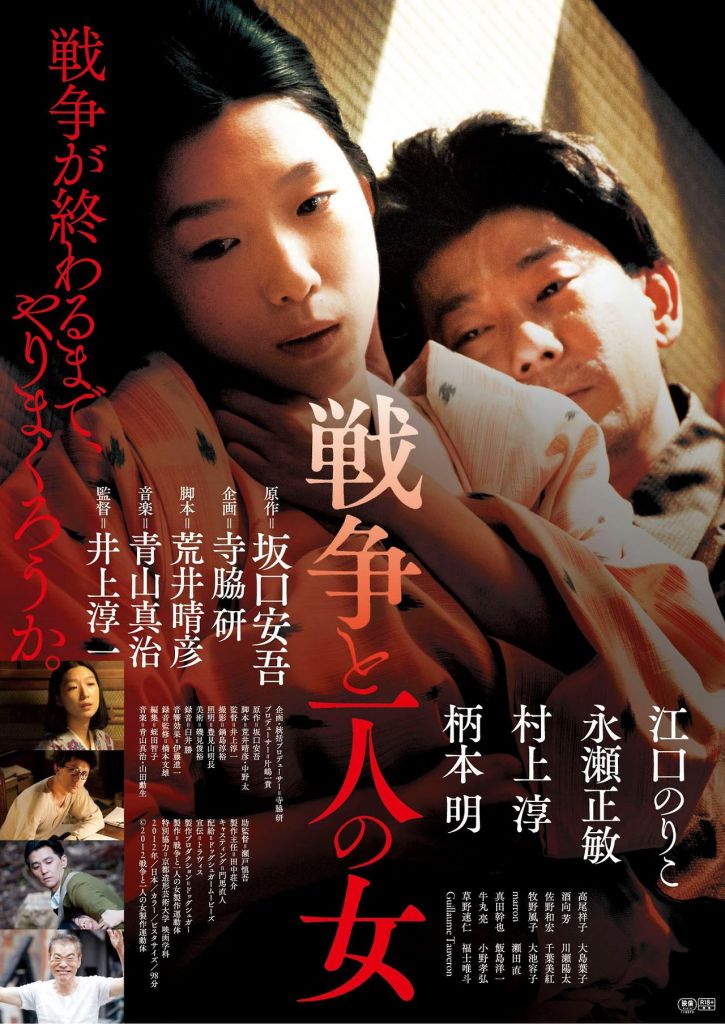 Junichi Inoue is better known as a screenwriter and frequent collaborator of avant-garde/pink film provocateur Koji Wakamatsu. A Woman and a War (戦争と一人の女, Senso to Hitori no Onna) marks his first time in the director’s chair and finds him working with someone else’s script but staying firmly within the pink genre. Adapted from a contemporary novel by Ango Sakaguchi published in 1946, A Woman and a War is an intense look at domestic female suffering during a time generalised chaos.
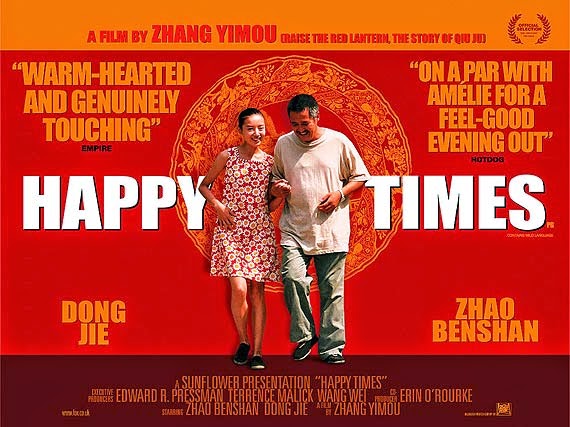 Possibly the most successful of China’s Fifth Generation filmmakers, Zhang Yimou is not particularly known for his sense of humour though Happy Times (幸福时光, Xìngfú Shíguāng) is nothing is not drenched in irony. Less directly aimed at social criticism, Happy Times takes a sideswipe at modern culture with its increasing consumerism, lack of empathy, and relentless progress yet it also finds good hearted people coming together to help each other through even if they do it in slightly less than ideal ways.
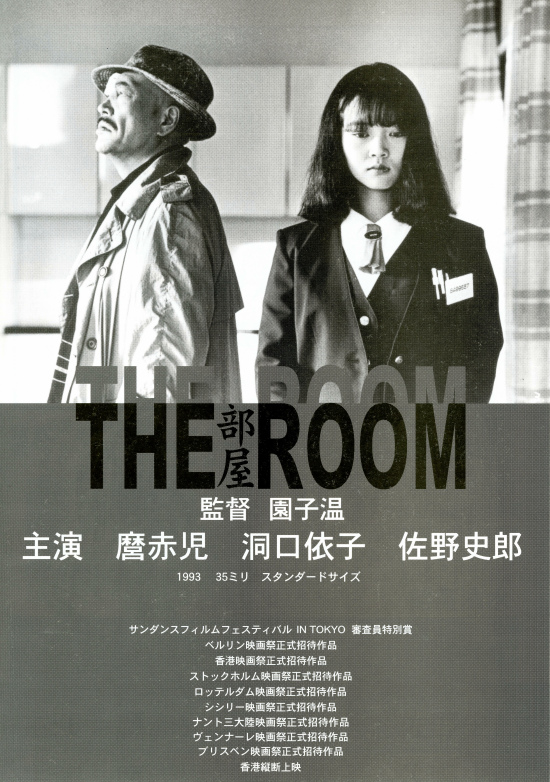 Though the later work of Sion Sono is often noted for its cinematic excess, his earlier career saw him embracing the art of minimalism. The Room (部屋, Heya) finds him in the realms of existentialist noir as a grumpy hitman whiles away his remaining time in the search for the perfect apartment guided only by a detached estate agent.
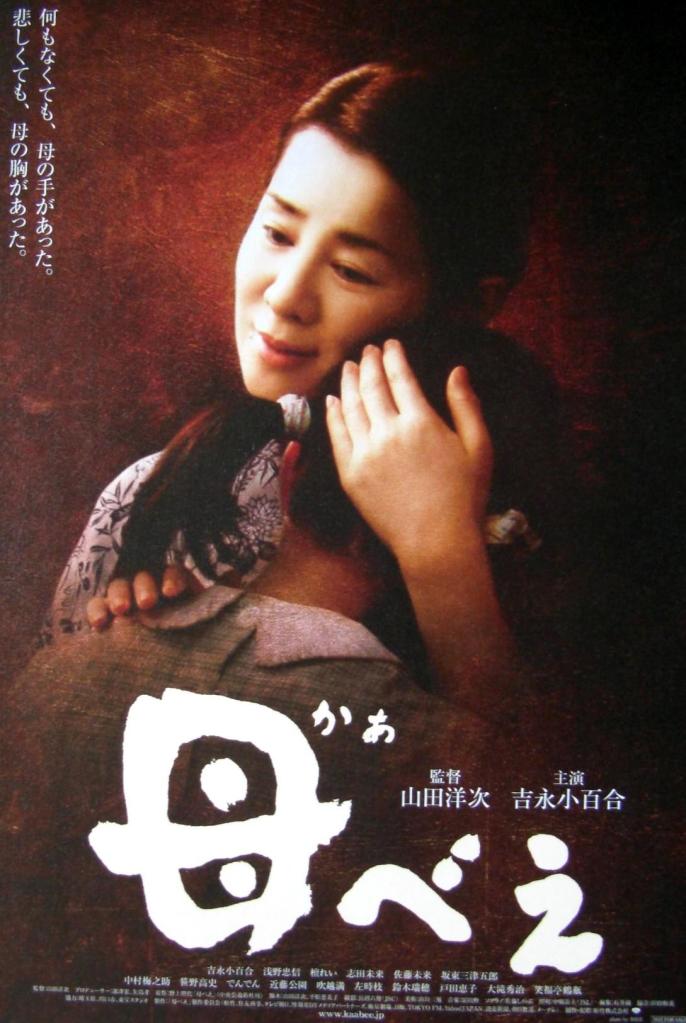 Yoji Yamada’s films have an almost Pavlovian effect in that they send even the most hard hearted of viewers out for tissues even before the title screen has landed. Kabei (母べえ), based on the real life memoirs of script supervisor and frequent Kurosawa collaborator Teruyo Nogami, is a scathing indictment of war, militarism and the madness of nationalist fervour masquerading as a “hahamono”. As such it is engineered to break the hearts of the world, both in its tale of a self sacrificing mother slowly losing everything through no fault of her own but still doing her best for her daughters, and in the crushing inevitably of its ever increasing tragedy.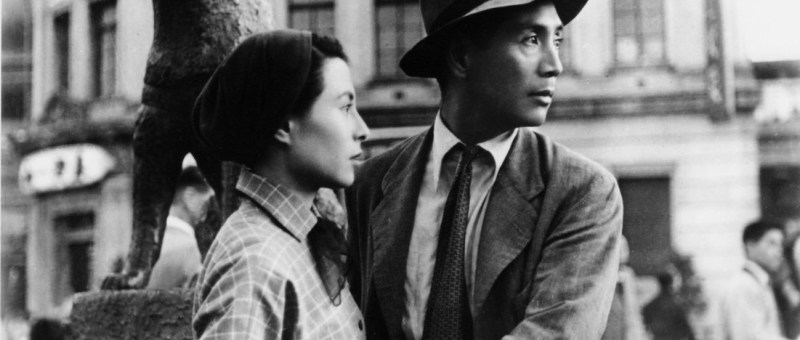
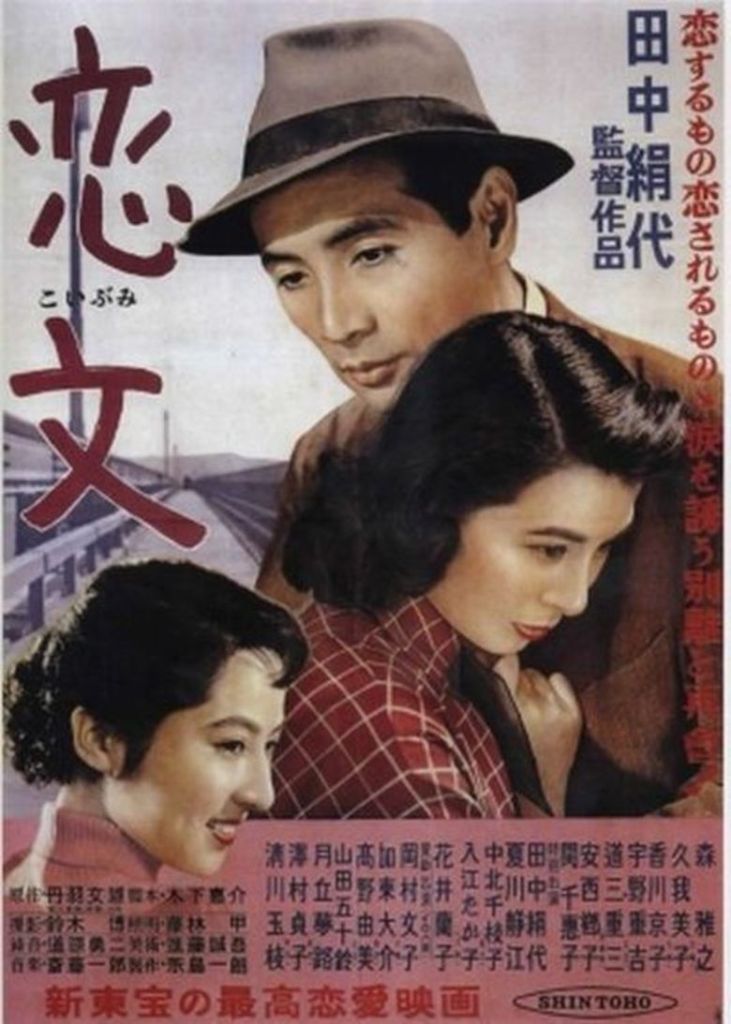 Kinuyo Tanaka was one of the most successful actresses of the pre-war years well known for her work with celebrated director Kenji Mizoguchi including several of his most critically acclaimed works such as Sansho the Bailiff, Ugetsu, and The Life of Oharu. However, post-war Japan was a very different place and Tanaka had a different kind of ambition. With 1953’s Love Letter (恋文, Koibumi) she became Japan’s second ever female feature film director, though her working and personal relationship with Mizoguchi ended when he attempted to block her access to the Director’s Guild of Japan. No one quite knows why he did this and he tried to go back on it later but the damage was done, Tanaka never forgave him for this very public betrayal. Whatever Mizoguchi may have been thinking, he was very wrong indeed – Tanaka’s first venture behind the camera is an extraordinarily interesting one which is not only a technically solid production but actively seeks a new kind of Japanese cinema.
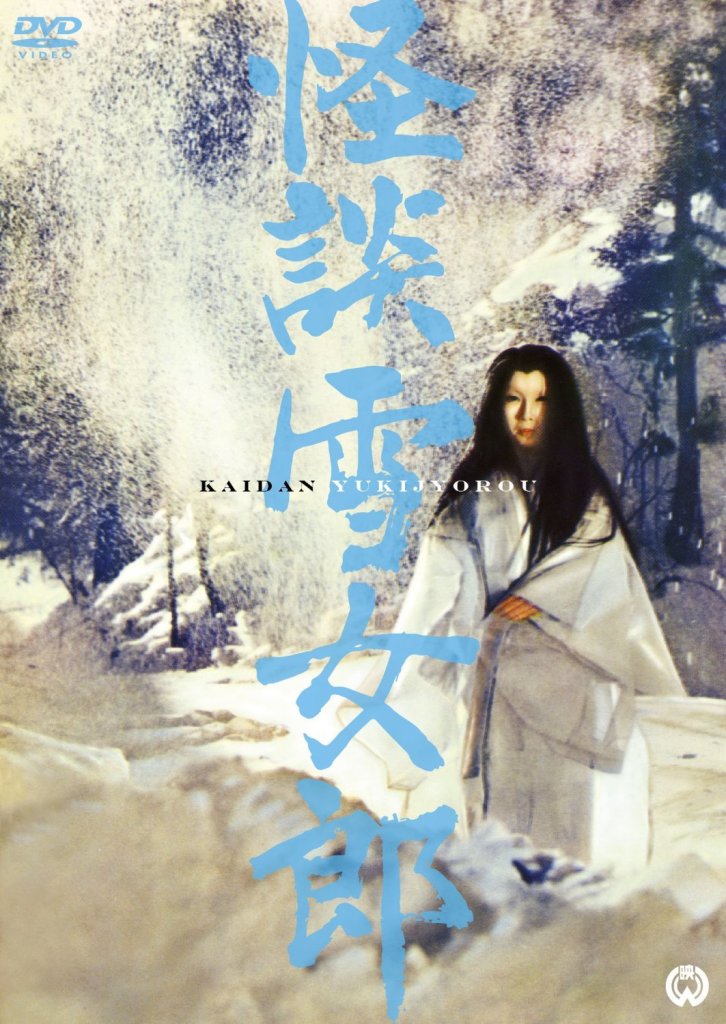 The Snow Woman is one of the most popular figures of Japanese folklore. Though the legend begins as a terrifying tale of an evil spirit casting dominion over the snow lands and freezing to death any men she happens to find intruding on her territory, the tale suddenly changes track and far from celebrating human victory over supernatural malevolence, ultimately forces us to reconsider everything we know and see the Snow Woman as the final victim in her own story. Previously brought the screen by Masaki Kobayashi as part of his
  Every once in a while an artist emerges whose work is so far ahead of its time that the audience of the day is unwilling to accept but generations to come will finally recognise for the achievement it represents. So it is for Sharaku – a young man whose abilities and ambitions are ruthlessly manipulated by those around him for their own gain. Brought to the screen by veteran new wave director Masahiro Shinoda, Sharaku (写楽) is an attempt to throw some light on the life of this mysterious historical figure who comes to symbolise, in many ways, the turbulence of his era.
 Windows on Worlds