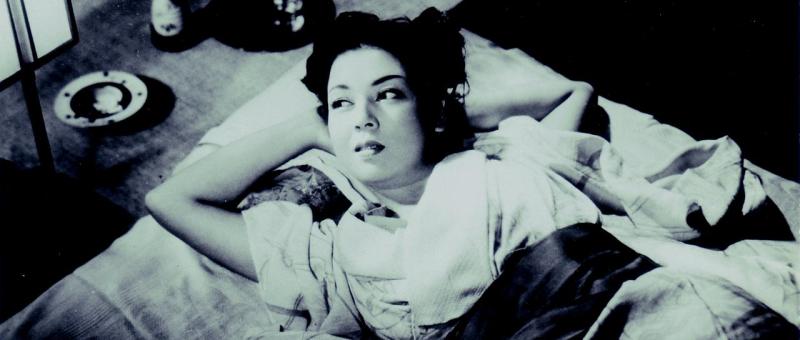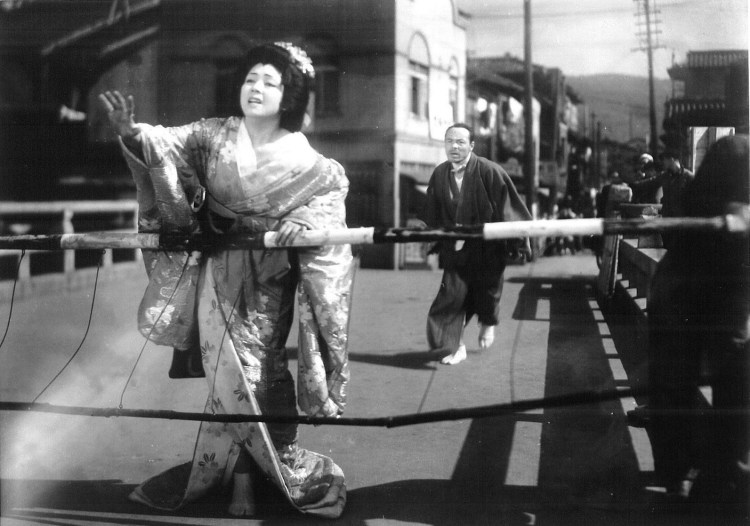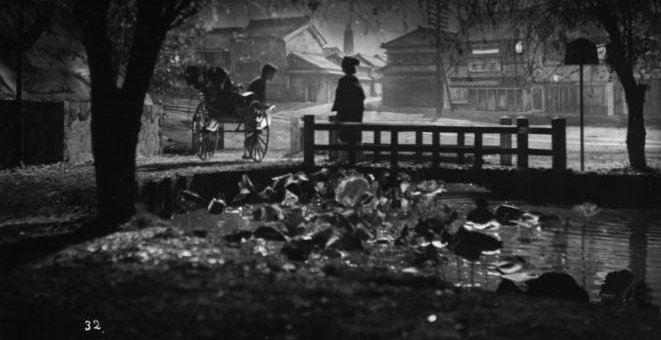
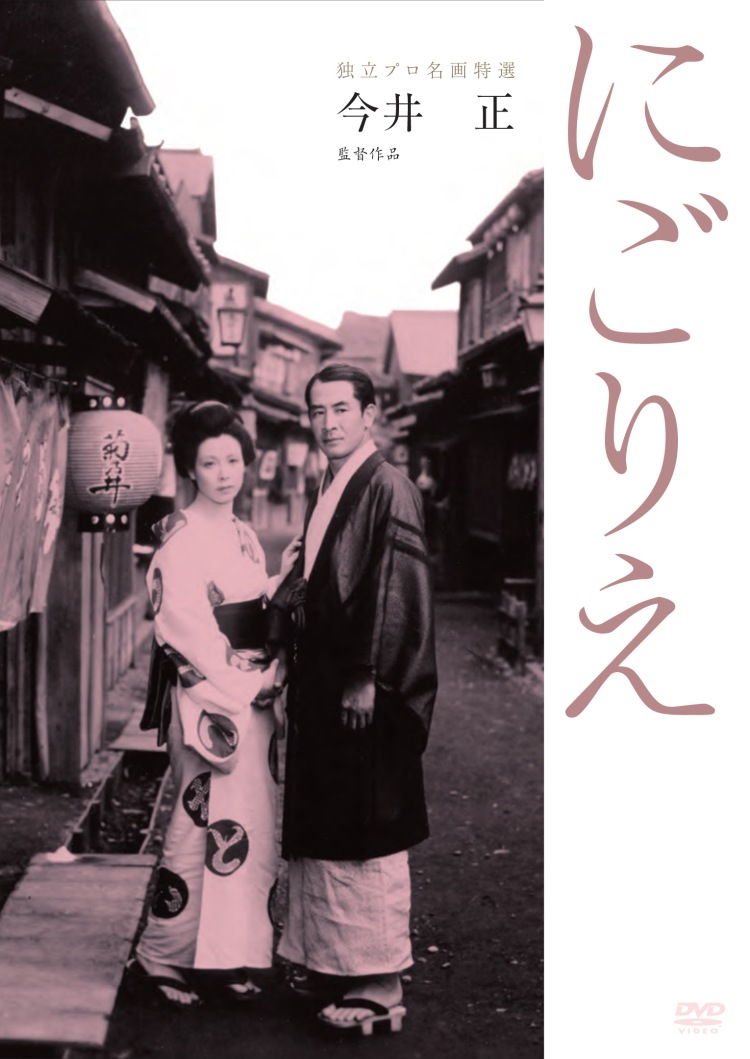
An Inlet of Muddy Water (にごりえ, Tadashi Imai, 1953)

inlet of muddy water dvd coverTadashi Imai was among the greatest directors of the golden age though his name remains far less known than contemporaries Ozu or Mizoguchi. Despite beginning in outright propaganda films during the war, Imai is best remembered as a staunchly left wing director whose films are known for their gritty realism and opposition to oppressive social codes. An Inlet of Muddy Water (にごりえ, Nigorie) very much fits this bill in adapting three stories from Japanese author Ichiyo Higuchi. Higuchi is herself a giant figure of Japanese literature though little of her work has been translated into English. Like Imai’s films, Higuchi’s stories are known for their focus on female suffering and the prevailing social oppression of the late Meiji era which had seen many changes but not all for the better. Higuchi was not a political writer and her work does not attack an uncaring society so much as describe it accurately though her own early death from tuberculosis at only 24 certainly lends weight to the tragedy of her times.

In the first part of the film which is inspired by one of Higuchi’s best known stories, The Thirteenth Night, a young woman returns home to her parents, no longer able to bear living with an emotionally abusive husband. Oseki (Yatsuko Tanami) had been raised an ordinary, lower middle-class girl but, like many a heroine of feudal era literature, caught the eye of a prominent nobleman who determined to marry her despite their class difference. Life is not a fairytale, and so the nobleman quickly tired of his beautiful peasant wife, belittling her lowly status, lack of education, and failure to slot into the elite world he inhabits.

Oseki’s plight elicits ambivalent reactions in each of her parents though they both sympathise with her immensely, if in different ways. Her mother (Akiko Tamura) is heartbroken – having long believed her daughter to be living a blissful life of luxury, she feels terribly guilty not to have known she had been suffering all this time and believes Oseki has done the right thing in leaving. Her father (Ken Mitsuda), however, also feels sad but reacts in practicality, pointing out that to leave her husband now would mean losing her son forever and probably a long, lonely life of penury. He, somewhat coldly, tells her to go back, grin and bear it. Oseki can see his point and considers resigning herself to return if only to look after her son.

On her way home she runs into a childhood friend whom she might have married if things had not turned out the way they did. “Life gets in the way of the things we want to do”, she tells him by of explanation for not staying in touch. Rokunosuke (Hiroshi Akutagawa), once a fine merchant, is now a ragged rickshaw driver, bereaved father, and divorcee. Like Oseki his life is a tragedy of frustration with the added irritant that he and Oseki might have been happy together, rather than independently miserable, if an elite had not suddenly decided to interfere by crossing class lines just because he can rather than out of any genuine feeling.

The callousness of elites is also a theme in the second story, The Last Day of the Year, in which a young maid, Omine (Yoshiko Kuga), works for a wealthy household dominated by a moody, penny pinching mistress whose mistreatment of her staff is more indifference than deliberate scorn. Omine’s uncle, who raised her, has fallen ill. At the beginning of his illness he took out a loan but he’s got no better and still needs to pay it back so he asks Omine to ask the mistress for an advance of the paltry sum of two yen in the hope that his son will be able to enjoy a new year mochi like the other kids. The mistress says yes and then changes her mind, leaving Omine to consider a transgressive act of social justice.

Where The Thirteenth Night and The Last Day of the Year pointed the finger at uncaring elites, Troubled Waters broadens its disdain to the entire world of men in focussing on two women caught on either side of the red light district – Oriki (Chikage Awashima), a geisha stalked by a ruined client, and the client’s wife, Ohatsu (Haruko Sugimura), who endures a life of penury thanks to her husband’s geisha obsession. Oriki’s sad story is recounted to a wealthy patron (So Yamamura) who is more fascinated in learning the secrets of her soul than her kimono, but like many of her age it begins with parental strife, orphanhood and perpetual imprisonment as a geisha wondering what will become of her when her looks fade and she’s no longer number one. She has no control over the men who spend time with her but is worried by Gen (Seiji Miyaguchi) who ruined himself buying her time and now stalks her in and around the inn. Infatuated and obsessed with Oriki, Gen has turned against his noble wife Ohatsu who is working herself to the bone to support the family while Gen has resorted to a life of casual labour but rarely does much of anything at all.

Recalling Higuchi’s famous diary, Imai opens each of the segments with a brief voiceover detailing the inconsequential details of the weather with a world weary, often melancholy tone as the writer laments too much time spent on fiction and resolves to tell the story of the world as it really is. There is no real connection or overarching theme which unites the three stories, save for the continued suffering of women at the hands of men and the society they have devised. Oseki must return to her abusive husband, Omine will continue to work for her heartless mistress, and Ohatsu will have to make do on her own after being so thoroughly let down by her husband. There is no recourse or escape, no path forward that will allow the women to break free of their oppression or even to learn to be free within it. Each of the stories is bleak, ending on a note of resignation and acceptance of one’s fate as terrible as that may be but Imai’s ending is most terrible of all, reminding us that today is simply another day and the heavy atmosphere of dread and oppression is certain to endure as long as we all remain resigned.


Screened at BFI as part of the Women in Japanese Melodrama season.
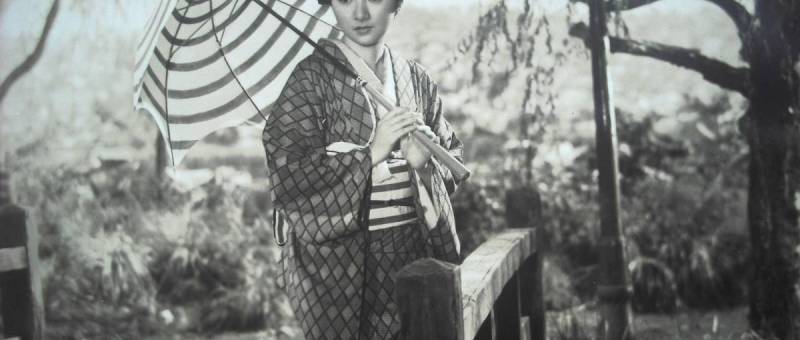
Wild Geese (雁, AKA The Mistress, Shiro Toyoda, 1953)

(C) Daiei, 1953In the extreme turbulence of the immediate post-war period, it’s not surprising that Japan looked back to the last time it was confronted with such confusion and upheaval for clues as to how to move forward from its current state of shocked inertia. The heroine of Shiro Toyoda’s adaptation of the Ogai Mori novel, Wild Geese (雁, Gan, AKA The Mistress), finds herself at a similar crossroads to the women of the 1950s, caught between tradition and modernity as they embrace the new freedoms but remain constrained by a conservative society. Toyoda, well known for his adaptations of great literature, makes a few key changes to Mori’s novel in effect placing a Showa era heroine in a recognisably “Meiji” world.

The Japan of the 1880s is one of extreme contrast and rapidly unfolding modernity. Having finally opened its doors to the outside world, the nation is in a big hurry to “catch up” to those it sees as its equals on the world stage. Consequently, Western thoughts and values are flooding into the country, bringing both good and ill. Arranged marriages are still common and Otama (Hideko Takamine) has been married once but the marriage has failed – she was deceived, the man she married already had a wife and child. Still, having lived with a man as his wife, Otama is considered “damaged” goods and will find it difficult to make a good match in the future (especially given the whiff of scandal from being involved in an illegitimate marriage with a bigamist).

When a matchmaker (Choko Iida) arrives with a potential husband it proves hard to turn down but the matchmaker is not quite on the level. Suezo (Eijiro Tono), she says, is a recently widowed man with a young child who is in need of a new wife but cannot marry again immediately for propriety’s sake. Otama will be his mistress and then in due course his wife. However, the matchmaker is an unscrupulous woman who has spun Otama a yarn in the hope of getting her debt written off by getting the shady loanshark she owes money to a pretty young woman to have some fun with.

The position Otama finds herself in is one of impossibility. A woman cannot survive alone in the Meiji era and its lingering concessions to feudalism. For a woman as poor and lowly as Otama whose marriage prospects are slim there are few options available. Otama’s neighbour (Kuniko Miyake) has managed to carve out a life for herself as a single woman through teaching sewing classes but such opportunities are few and far between, as Otama is warned when she considers following her example. The “arrangement” with Suezo may not seem too bad on the surface – he looks after her and her father, has set her up in a house, and treats her well even if his behaviour leans toward the possessive. Despite confessing to her father that she feels trapped and miserable, humiliated on learning she has been ostracised as the mistress of a married loanshark, Otama finds little sympathy as her father declares himself “very happy” and councils her against leaving because he has no desire to return to a life of poverty, remaining selfishly indifferent to his daughter’s suffering.

Resigned to her fate, Otama does her best to adapt to her new life but remains as trapped within Suezo’s house as the caged bird he presents her with “for company”. Jealous and fearing that his wife will find out about the affair, Suezo’s preference is for Otama to stay indoors waiting for him to call. His visits are routine and perfunctory. Handing the maid a few coins to go to the public bath, Suezo signals his intentions in the least romantic of ways, pausing only to lock the garden gate.

Catching sight of an earnest student who passes by everyday at 4, Otama begins to dream of something better. The student, Okada (Hiroshi Akutagawa), is a source of fascination for all the young women in the neighbourhood but he too is instantly captivated when he glimpses the beautiful Otama trapped behind the bar-like slats of Suzeo’s love nest. Adding a touch of biblical intrigue, it is a snake which eventually leads to their meeting but no matter how deep the connection this is a love destined to fail – Otama is the kept woman of a loanshark, and Okada is a medical student with international ambitions. They inhabit different worlds and, as his friend (Jukichi Uno) puts it, this is still the Meiji era, the times will not allow it.

Nevertheless, even if her brief infatuation seems doomed, the mere act of wanting something else provokes a shift in Otama’s way of thinking. This act of fierce individualism which prompts her to defy the dominant male forces in her life whose selfish choices have caused her nothing but misery would normally be severely punished in the name of preserving social harmony but Otama’s epiphany is different. The opening title card reminded us that this was a time wild geese still flew in the skies above Tokyo. It seems to imply that birds no longer fly here, that there is no true freedom or possibility for flight in the modern age of Showa, but Otama is a woman trapped in the cage of Meiji suddenly realising that the doors have been open all along. Her choices amount to a humiliating yet materially comfortable life of subjugation, or the path of individualistic freedom in embracing her true desires. Her dream of true love rescue may have been shattered, but Otama’s heart, at least, is finally free from the twin cages of social and patriarchal oppression.


Screened at BFI as part of the Women in Japanese Melodrama season.
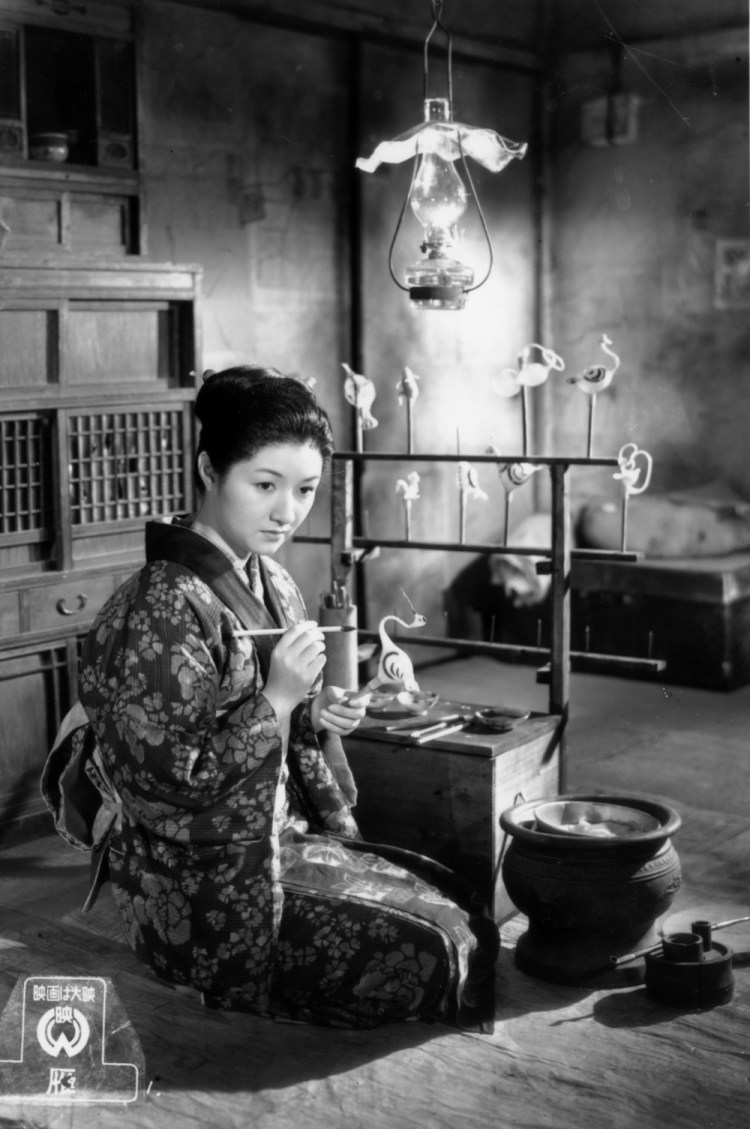
Clothes of Deception (偽れる盛装, Kozaburo Yoshimura, 1951)

「偽れる盛装」(C)KADOKAWA1951

「偽れる盛装」(C)KADOKAWA1951Japan at a crossroads. East/West, past/future becomes a conflict between Kyoto and Tokyo in Yoshimura’s exploration of two women pulled in surprisingly contradictory directions in the new post-war world, Clothes of Deception (偽れる盛装, Itsuwareru Seiso). Working from a script by Kaneto Shindo, Yoshimura frames his tale as one of progress and resistance but the divisions are not as simple as they first seem. Machiko Kyo turns in another wonderfully nuanced performance as a Kyoto geisha trapped by the unchanging nature of her city yet yearning for an end to its slavish devotion to tradition.

Kumicho (Machiko Kyo) is the daughter of a longstanding geisha house currently operated by her mother. Though working as a geisha, Kumicho is not universally popular with the older generation thanks to her money first attitude which sees her prioritise earnings potential through having an unlimited number of clients rather than relying on a single patron. Kumicho is tough where geishas are generally soft and accommodating. She doesn’t take orders or nonsense from anyone, not least her push over of a mother.

Kumicho’s sister, Taeko (Yasuko Fujita), is not involved in the geisha trade and has a regular office job in the local tourist office. Unlike Kumicho, Taeko is mild mannered and reserved, dressing in regular Western fashions and travelling everywhere by bicycle. Taeko is engaged to a colleague, Koji (Keiju Kobayashi), who just happens to be the adopted son of another geisha house run by a woman with a long standing grudge against her mother.

Kyoto, a former capital, is famous for its historical qualities – a living museum to old-time Japan, but as a friend visiting from Tokyo points out perhaps that’s not altogether a good thing. Unlike Tokyo, Kyoto escaped much of the wartime destruction allowing it to be seen as a symbol of cultural resilience but lack of destruction also robs of it the chance for rebirth. History has survived, but so have lots of “tired old ideas”, according to Taeko’s friend Yukiko who urges her to forget the stagnant city and head for pastures new in Tokyo where the exciting post-war future is already underway.

Those old fashioned ideas are embodied within the rigid codes of the geisha world which Kumicho, on the surface the more traditional of the sisters but in actuality less so, has been breaking. Kumicho cares about money and she cares about survival which has made her unsentimental. Despite being involved in the “traditional” Kyoto occupation with all of its elegance and complicated ritual, Kumicho is a modernist who secretly hates the trade and holds each of her customers in deep contempt. Thus she thinks her mother, Kiku (Hisako Takihana), is a soft touch for continuing to bankroll the feckless son of her former lover, but is as heartbroken as anyone when one of the geishas becomes gravely ill. Kumicho’s manner maybe brash and brassy but her heart is as warm as her mother’s who continues to visit the widow of her former patron and makes sure the sickly geisha is cared for properly without resenting either the costs involved or the loss of earnings.

Taeko’s engagement to Koji opens up old wounds and exposes the less genial side of geishadom in the grudge bearing rivalry of Kiku and Koji’s mother Chiyo (Chieko Murata). Chiyo tries to put the kibosh on Taeko’s marriage as a way of getting back at Kiku, claiming that Taeko simply isn’t good enough for her son, but her authority is also dependent on those tired old ideas of hierarchy and filial piety. Koji, an adopted child, feels himself beholden to his mother’s needs in having been raised exclusively to fulfil them and vacillates in indecision regarding his marriage. Spineless and cowardly, Koji cannot find the strength to tell his mother no but also refuses to definitively break things off with Taeko.

Younger than Kumicho and a part of the “modern” world thanks to her regular office job in the tourist office, Taeko is comparatively more socially conservative reacting with horror when the increasingly strained Koji makes desperate, aggressive advances towards her whilst refusing to confirm his intention to marry against his mother’s wishes. Taeko and Koji have imprisoned themselves within Kyoto’s oppressive system of social codes in refusing to seize their chance of individual happiness and stride forward into the bright future being offered everywhere else except in the unchanging city.

Kumicho’s machinations eventually land her in hot water when an obsessed client ruins himself and then turns violent, demonstrating the less publicised dangerous side of life in the geisha trade. Kyoto, with all of its elegant refinement, can still be a place of rancour and regret where decades old grudges and more recent resentments threaten to disturb the peace. Kumicho’s innovations have shown up the geisha trade for what it is through her thoroughly unsentimental seduce and discard philosophy but she is, if nothing else, essentially truthful in her “modern” desire to call a spade a spade. The old ways are changing, though perhaps not fast enough. Kyoto, with its rigidity and stagnation is eventually rejected as Kumicho, unable to extricate herself, makes sure that her sister is first in line for all the opportunities the new world has to offer – by sending her to Tokyo, the capital of the future.


Screened at BFI as part of the Women in Japanese Melodrama season.

Wedding Ring (婚約指環 (エンゲージリング), Keisuke Kinoshita, 1950)

(c) Shochiku Co., Ltd

wedding ring still 2Many things have changed in the post-war world, but not everything and even with the new freedoms there are some lines which cannot be crossed. Keisuke Kinoshita made his career considering where these lines are and examining the lives of those who find themselves standing in front of them. Starring the veteran actress Kinuyo Tanaka who also produces the film, and the very young and fresh faced Toshiro Mifune, Wedding Ring (婚約指環 (エンゲージリング), Konyaku Yubiwa (Engagement Ring)) is a classic melodrama filled with forbidden love, repressed passion, and societal constraints but Kinoshita brings to it his characteristic humanity expressing sympathy and understanding for all.

Noriko (Kinuyo Tanaka) has been married seven years but her husband, Michio (Jukichi Uno), was drafted shortly after the wedding and was not repatriated until two years after the war ended. A year after he returned, Michio fell ill and has been on extreme bed rest ever since. After her father-in-law’s retirement and her husband’s illness, running of the family jewellery store fell to Noriko and so she spends the week in Tokyo taking care of business and comes back to the seaside fishing village of Ajiro where Michiro lives for the benefit of his health at the weekends. Consequently, though the couple care for each other, the marriage has never really been given the chance to take hold and they remain more companions or good friends than husband and wife.

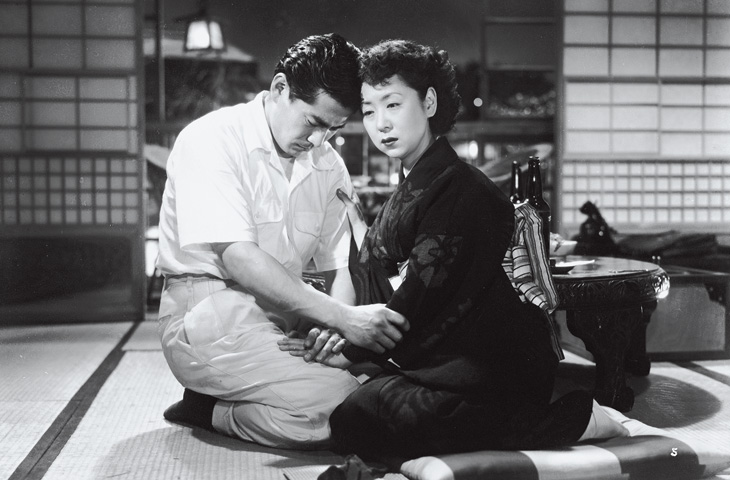
Things change when Michio gets a new physician, Dr. Ema (Toshiro Mifune), who literally falls into Noriko’s lap during a packed bus ride from the station. Where Michio is sickly and weak, Ema is physically imposing and in robust health. Ema lives in the peaceful resort town of Atami which is on the train route from Ajiro to Tokyo meaning that Noriko and Ema sometimes wind up on the same train, developing an obvious attraction to each other which they both know to be impossible but cannot bring themselves to abandon.

In many ways Noriko is the archetypal post-war woman – strong and independent she runs the family business singlehandedly and lives alone in the city while her husband remains in the country busying himself with writing poetry. Despite the difficult circumstances, Noriko is not particularly unhappy save being unfulfilled and perhaps craving the physical intimacy her husband can no longer offer her. Her first meeting with Ema brings something in Noriko back to life as she swaps her dowdy, dark coloured suits for looser, more colourful clothing and walks with a new found spring in her step.

This change in his wife has not escaped the attention of Michio who astutely notices that she seems to be “glowing” – a development he silently attributes to the presence of Dr. Ema. Michio does his best not to resent the doctor but internalises a deep seated feeling of guilt and inadequacy as he realises that he can no longer provide what his wife needs and has become an obstacle to her happiness. A sensitive man apparently marked by his wartime experiences, Michio is angry and jealous but also resents himself for feeling that way, deepening his depression and conviction that he is nothing but a burden to his wife who deserves a full marriage with a man who can satisfy all of her needs and desires.

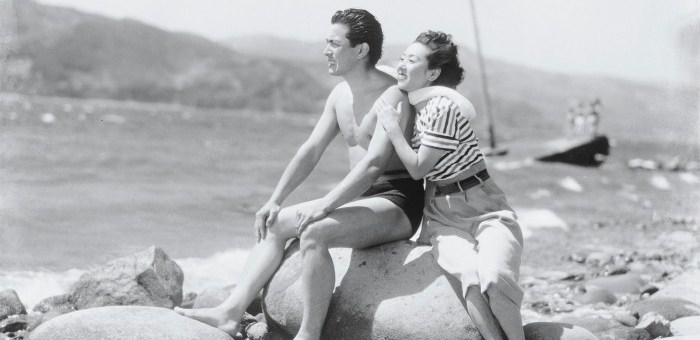
Desire is certainly something Noriko feels as she gazes at Ema’s powerful hands, broad shoulders, and athletic physique. Clasping his sweaty jacket to her breast in desperation eventually gives way to accidentally bold physical contact as hands catch hands and Noriko finds herself caressing Ema’s shoulder as he prepares to dive back into the sea dressed only in his woollen trunks. Ema feels the same attraction but also understands that it cannot be, not least because he is Michio’s physician and has begun to have idle fantasies of being unable to save him, freeing Noriko from her unfulfilling marriage so they can finally be together. Both sensible people, Noriko and Ema are eventually able to discuss their feelings and social responsibilities in a mature fashion, agreeing that they cannot act on their desires even if they find them hard to relinquish.

Rather than wedding ring, the Japanese title of the film more accurately refers to an engagement ring. Noriko’s wedding ring never comes off, but the engagement ring with its large stone comes to represent her shifting allegiances. Discovering the ring abandoned on the dresser, Michio begins to understand he is losing his wife to the strapping young doctor whose healthy, powerful body he cannot help but envy. The camera seeks out Noriko’s hand, with or without the shiny diamond of the engagement ring, quickly signalling the current direction of her desires.

Michio, who cannot give full voice to his emotions, expresses himself through tanka poetry, something which the equally sensitive doctor can also understand and later makes use of himself in communicating the inexpressible delicacy of his feelings to the married woman with whom he has fallen in love. Torn between love and duty, Noriko and Ema battle their mutual passion while Michio battles his sense of self and feelings of ongoing inadequacy but Kinoshita refuses to condemn any of them, rejecting an angry showdown for a nuanced consideration of personal desire versus social responsibility. The conclusion may be conservative, but the journey is not as the trio eventually part friends even if with lingering sadness in accepting the choice that has been made and resolving to move forward in friendship rather than rancour.


Screened at BFI as part of the Women in Japanese Melodrama season.

Opening scene (no subtitles)

Kokoro (こころ, Kon Ichikawa, 1955)

kokoro coverAmong the most well-regarded of his works, Natsume Soseki’s Kokoro (こころ) is a deeply felt mediation on guilt, repression, atonement, and despair as well as an examination of life on a temporal threshold. Kon Ichikawa’s long career would be marked by literary adaptations both of classics and genre fiction but even among these Kokoro is something of an exception, marshalling all of his skills bar his trademark irony in a melancholy tale of loneliness, self loathing, and the destructive effects self-destruction on those caught in the cross fire.

Ichikawa opens in media res as Nobuchi (Masayuki Mori) and his wife, Shizu (Michiyo Aratama), appear to have had an argument. She darns angrily while he paces and eventually seems to relent on his decision not to let her accompany him to the grave of a mutual friend, Kaji (Tatsuya Mihashi), who died when Nobuchi was still a student. Eventually Nobuchi goes alone but is disturbed in the graveyard by the approach of an enthusiastic young university student, Hioki (Shoji Yasui), who has been redirected by Shizu after turning up to ask to borrow some books. Nobuchi is not really in the mood to talk but the two men chat, eventually sharing a drink together in the local bar before Nobuchi abruptly returns home, pausing only to invite Hioki to visit another time for the books he wanted to borrow.

Though the marriage of Nobuchi and Shizu may seem to be a model one, their lives together are mostly performance. Nobuchi is a melancholy, gloomy man who does not work and lives the life of a scholar, living off family money. The household is not wealthy but they are able to afford one maid and live in reasonable comfort. They have no children and, it seems, the marriage may be one of companionship rather than passion.

On their first meeting Nobuchi refuses to tell Hioki the reason why he is the way he is, but decides he must explain and that Hioki is the only person he can unburden himself to. Badly let down by those who should have had his best interests at heart at a young age, Nobuchi has learned not to trust, believes that love is a “sin”, and that he is unworthy of any kind of personal happiness or fulfilment. As a young man, Nobuchi did something completely unforgivable for the most selfish (and fiendishly complicated) of reasons and his best friend, Kaji, later died as a direct result.

Where Nobuchi is cynical, Kaji is ascetic and closed off but sincere in his Buddhist practice. Nobuchi’s actions are not only hurtful in their deliberate betrayal, but amount to a slow implosion of Kaji’s entire spiritual universe. Having been tempted away from his religious beliefs by irrepressible desire, Kaji’s path to spiritual fulfilment has been severed and his path to other kinds of happiness blocked by Nobuchi’s own panicked act of personal betrayal. Unable to reconcile his cowardly, cruel actions which have, in a sense, broken Kaji’s “heart”, Nobuchi resolves to deny himself the life he stole from his friend, committing himself to a living death defined by the absence of physical love, desire, or success.

Hioki first meets Nobuchi when he sees him attempt to walk into the sea and saves him from drowning. Immediately drawn to him, Hioki believes he and the man he calls “sensei” share the same kind of existential loneliness. His eagerness to forge a friendship with the older, aloof scholar may seem strange but Ichikawa is keen to build on a much disputed subtext of the original novel in Nobuchi’s possible repressed homosexuality. Hioki steps into the space vacated by Kaji which has been empty the last 15 years as the sort of man who might understand Nobuchi’s “heart”.

Shizu attempts to ask the question directly, both about Nobuchi’s relationship with Kaji whose name she is forbidden to mention and to new friend Hioki whom she fears maybe taking Kaji’s place in her husband’s affections. Pleading that she just wants to understand his “heart”, Shizu tries to get some clarification on the empty hell that is her married life, but Nobuchi’s heart is firmly closed to her and she’s shut out once again.

On hearing of the death of the Emperor Meiji, Nobuchi’s gloom descends still further as he feels himself to be a man who’s outlived his age. At one point, long before, he pushes Kaji on his spiritual weaknesses prompting him to admit he doesn’t know whether to go forward or back. Nobuchi, cynical and perceptive, points out that there likely is no back even if you wanted to go there. Taking the teacher/student relationship to its natural conclusion, Nobuchi’s final testament in which he confesses the circumstances which have led to his spiritual death is intended only for Hioki in the hope that the younger man can learn from his mistakes and prepare himself to step forward into the bright new age where Nobuchi fears to tread. Once again his actions are selfish in the extreme, but there is something universally understood in Nobuchi’s particular pain and the steps he takes to ease it.


Previously available on DVD from Eureka, now sadly OOP.

Scene from midway through the film

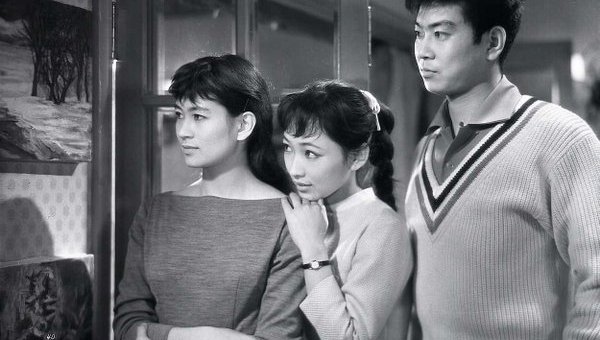
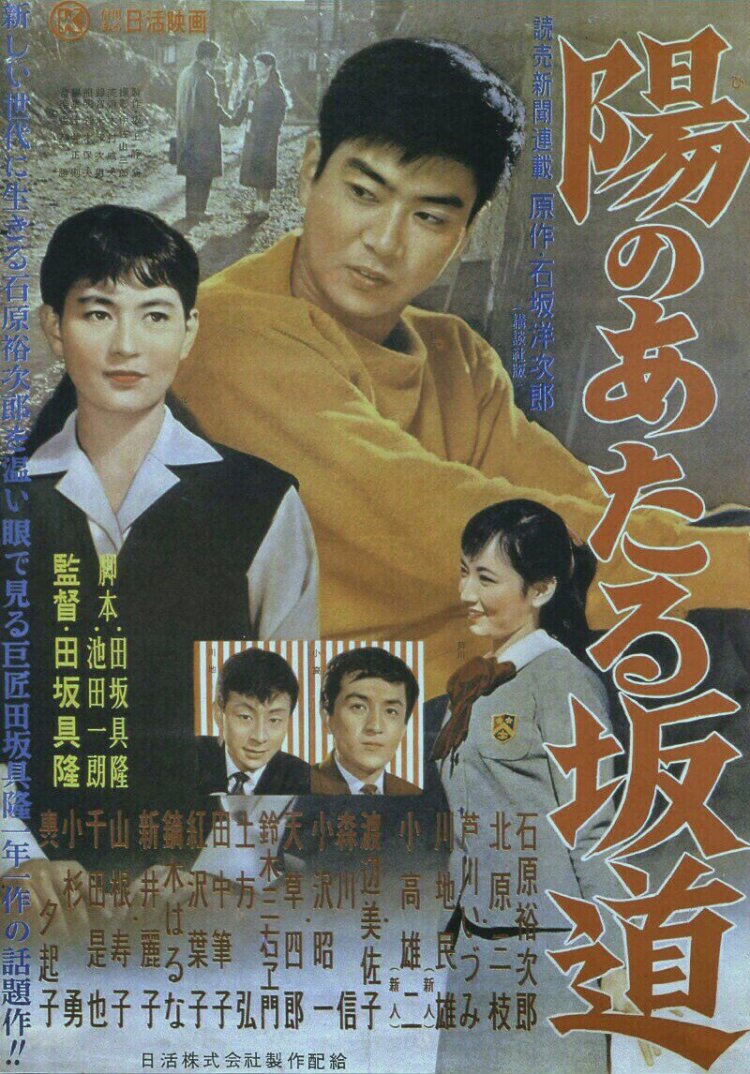
A Slope in the Sun (陽のあたる坂道, Tomotaka Tasaka, 1958)

Slope in the sun posterYujiro Ishihara had become the face of the “Sun Tribe” movement thanks to roles inspired by his brother Shintaro’s novels including the seminal Crazed Fruit in which he starred opposite his later wife, Mie Kitahara. Tomotaka Tasaka’s A Slope in the Sun (陽のあたる坂道, Hi no Ataru Sakamichi), adapted from the novel by Yojiro Ishizaka, is a much less frenetic affair than Nakahira’s famously intense youth drama, but retains the Sun Tribe’s world of purposeless youth whose inherited wealth has driven them to a life of listless ennui. Like Crazed Fruit, Slope in the Sun is the story of two brothers chasing the same girl, only this time one looks bad and is really good, while the other looks good but is really no good at all.

Beginning on the titular sun beaten slope, the film opens with a young woman, Takako (Mie Kitahara), entering the frame as she searches for an address on a piece of paper she is carrying. She finds the house – a large Western-style mansion, but is prevented from entering by a young man who mistakes her for a saleswoman and instructs her to use the tradesman’s entrance. The young man, Shinji (Yujiro Ishihara), continues to taunt her with lewd language before poking at her breast. Takako tries to leave but is persuaded to come inside to meet the lady of the house and the young woman, Kumiko (Izumi Ashikawa), whom she has come to tutor.

The Tashiro household is a strange one. There are three almost grown up children – oldest brother Yukichi (Yuji Odaka) who is a medical student, middle brother Shinji who is a painter, and the youngest daughter Kumiko who is approaching the end of high school and is a little over sensitive about a mild limp which is the consequence of a childhood accident. Takako nearly turns the job down when she realises that the family want less a teacher to help with Kumiko’s studies, than a kind of big sister to help her navigate her way into the adult world, but eventually warms to the Tashiros and decides to give it a go. A college student in need of money, Takako is currently living in a boarding house where she is friends with the older lady next door, Tomiko Takagi (Hisako Yamane), and her 18 year old musician son Tamio (Tamio Kawachi).

In contrast to the earlier Sun Tribe films, A Slope in the Sun is much more subdued though it does maintain an upperclass atmosphere filled with bored young people who struggle to find purpose in their lives through having no particular economic or social worries thanks to the protective cushioning of their wealth. The central issue is a common one to the familial melodrama – middle child Shinji has always felt disconnected from his family and has discovered that the woman who raised him is not his birth mother. He wants to know the truth of his family history but is also a kinder soul than his outward behaviour may suggest and does not want to hurt anyone or risk destroying the otherwise pleasant enough family life he enjoys as a Tashiro.

As expected coincidences abound though the truth is obvious seconds after Takako tells someone the name of her new employer causing them to gasp and draw pale with shock. It seems that everyone in the family already knew that Shinji is only a half brother except Shinji himself – their overcompensation in treating him kindly was the initial tipoff for his suspicions, but this question of blood relation turns out to have a surprising dimension. Oldest brother Yukichi is, outwardly, the model son – handsome, clever, gentlemanly, but on closer inspection his veneer of respectability turns out to be just that. The boys’ mother, Midori (Yukiko Todoroki), knows this well and partly blames herself for allowing Shinji to take the blame for a childhood accident rather than forcing her own son to confess. For all his seeming goodness, Yukichi is an amoral coward, womaniser, and habitual liar whereas there’s a kind of honesty in Shinji’s lewd speech and even in his own lies which he indulges partly out of a sense of smug superiority, as Midori puts it, but also because of the inferiority complex which has marred his life as he feels himself somehow lesser than either of his siblings.

Takako vacillates between the two brothers, taken in by the manipulative Yukichi but strangely drawn to the provocative Shinji. Unlike Nikkatsu’s other youth films, Slope in the Sun ends on a note of happy resolution rather than nihilistic suffering as each member of the family is encouraged to embrace their true natures, putting secrets to one side, and becoming closer in the process. Tanaka’s approach is a more classical one than Nikkatu’s usual fare, making use of silent cinema-style closeups and dissolves but veers towards the avant-garde in a brief flashback sequence offered in dreamlike widescreen. Despite the jazz clubs and subplots about misused geishas, this is a more innocent world than the post-war melodrama would usually allow, finding space for happiness and forgiveness in each of the conflicted protagonists once they each agree to submit themselves to the truth and meet the world with openness and positivity.


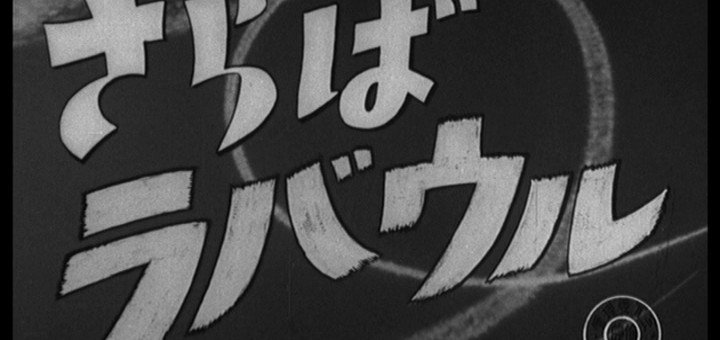
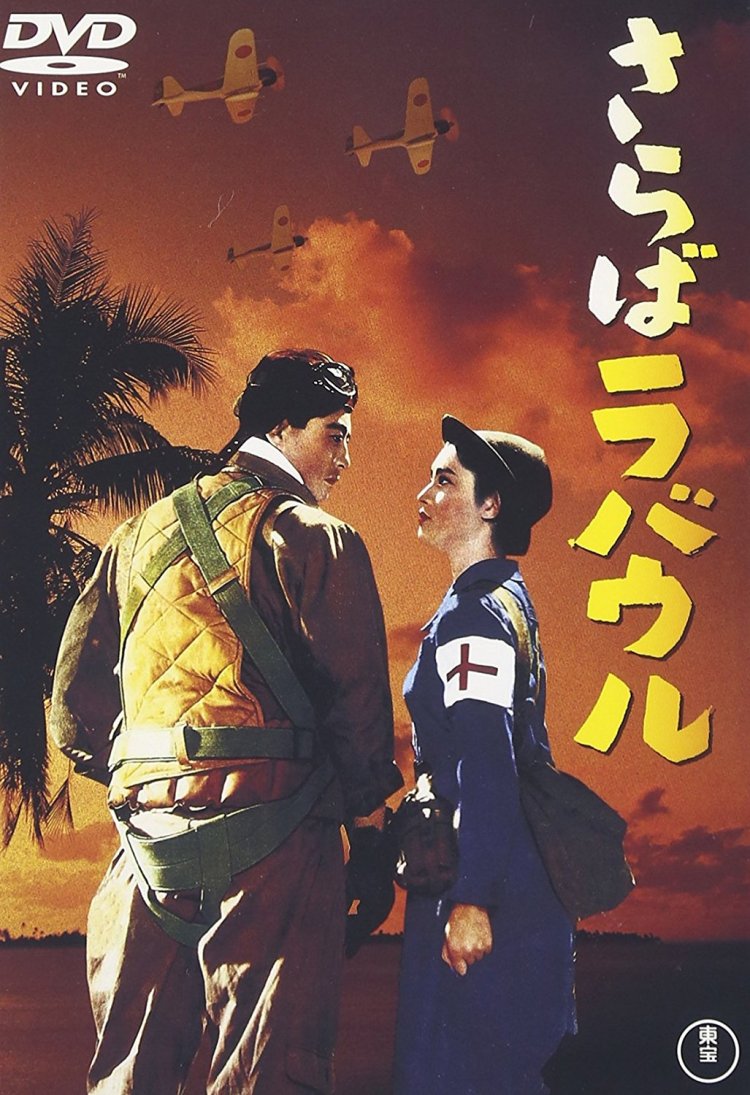
Farewell Rabaul (さらばラバウル, Ishiro Honda, 1954)

Farewell Rabaul dvd coverReleased in 1954, Farewell Rabaul (さらばラバウル, Saraba Rabaul) was the last in a string of war films directed by Ishiro Honda for Toho immediately before the mega hit Godzilla redefined his career and turned him into a director of science fiction and special effects movies. Like the later tokusatsu classics, Honda worked alongside Eiji Tsuburaya to craft the film’s effects which are largely used to recreate the epic dogfights taking place over the island as the airmen and ground crew come to terms with the imminent arrival of American forces. Though he takes care to show the bravery and determination of the Japanese pilots, Honda’s attitudes to the war and the government who waged it are not so kind.

Late into the conflict, at an outpost in the Papa New Guinean city of Rabaul, ace pilot Captain Wakabayashi (Ryo Ikebe) leads a rapidly depleting squad of airmen trying to defend Japanese forces from American air attacks. Known as “Devil” Wakabayashi, he rules with an iron fist – taking issue with men who spend their time in local bars and pointedly refusing to send rescue craft for crashed pilots. Ruthless and cold as he seems, the war is starting to get to Wakabayashi and his resolve crumbles when faced with a gracious American POW and the attentions of a kindly nurse, Komatsu (Mariko Okada).

Honda keeps the action to a minimum, preferring to focus on the life within the military base. Though the effects on the local population are not much addressed, the opening scenes take place in a bar in which Papa New Guinean women dance to tribal drums while Japanese military personnel drink and watch. The waitresses are largely Japanese women dressed in kimono, though it seems the exoticism of local girl Kim (Akemi Negishi), dancing barefoot with flowers in her hair, is the main draw. Eventually Kim falls in love with a Japanese soldier and the two plan to flee but fate always gets in the way.

Wakabayashi, rechristened the “Devil” by Kim – a nickname which seems to stick, objects to his men blowing off steam in the bar for purely practical reasons – he needs them at top form for an upcoming mission and a hungover pilot could be a risk to the entire squad. Walking around looking sullen and refusing to explain himself, it’s no wonder Wakabayashi is unpopular with some of the men even if his skills are widely recognised. Asked to send a rescue squad for a lost pilot, Wakabayashi’s reply is a flat no with no further details offered. Only when a junior officer interjects during a briefing does he offer his reasoning – the crash site is in enemy territory and it’s too risky to send more men in to fetch one pilot who is probably already dead. His reasoning is sound and probably the correct command decision but the cutting coldness with which he delivers his judgement does little to assuage his reputation as a heartless misanthrope.

This is, however, not quite the case. When an extremely young member of his squad is shot down Wakabayashi shouts out to him, trying to advise the rookie on ways to control the aircraft but all to no avail. The pilot cannot bail out as Japanese pilots, particularly those flying the featherweight 0 fighters, are not equipped with parachutes. This is brought up again when a downed American pilot is brought in as a POW. The journalist attached to the unit is able to speak fluent English and interprets for Wakabayashi and the others as the American gives them an improbably frank analysis of Japanese airborne warfare. He tells them that the Americans were once afraid of the 0s and their high speed manoeuvring but have figured out their weaknesses. In the hands of a skilled pilot, the 0 is a powerful weapon but in unskilled hands it’s a liability – its lightweight form makes it easy pickings when the pilot does not know how to fly defensively. If it weren’t for this fighter they call “Devil” they’d be picking them off with ease. The lack of parachutes came as a surprise to the Americans. The 0s need to be as light as possible, but no one could believe that the Japanese government valued life so cheaply that they’d send a man up there with no way down. That’s why, the American says, they will win – no government so unwilling to look after its own could ever expect to.

The senselessness of it all eventually gets to Wakabayshi, even leading him to reverse his original stance and proceed into enemy territory to rescue a fallen comrade himself. He is, however, wounded, his plane damaged, and his friend doesn’t make it. Rabaul falls, and its hero falls with it in a turn which is both melancholy and defiant. Honda refuses to glorify the destruction but ends on a note of sadness, reprising the titular song sung by the women aboard a boat they hope will take them home but that, like everything else, remains so hopelessly uncertain.


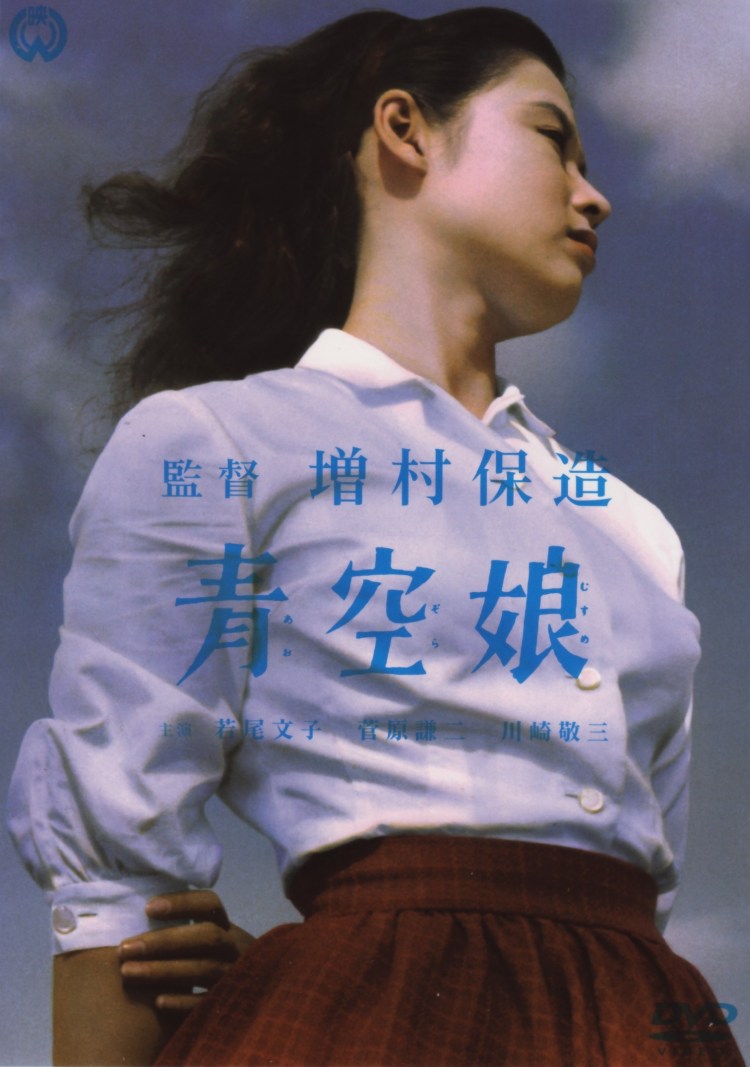
The Blue Sky Maiden (青空娘, Yasuzo Masumura, 1957)

blue sky maiden dvd coverYasuzo Masumura is generally remembered for dark, erotic and disturbing explorations of human behaviour but the early part of his career was marked by a more hopeful innocence and a less cynical yet still cutting humour. His debut, Kisses, was very much in the mould of the youth movie of the day but its themes were both more innocent and more controversial as a boy and girl bond after running into each other at the prison where both of their parents are serving time. Marked by darkness as it is, the worldview of Kisses is much kinder than Masumura would later allow as the pair of lovers seem to shake off their respective concerns to embrace the youthful joy and boundless freedom young love can offer.

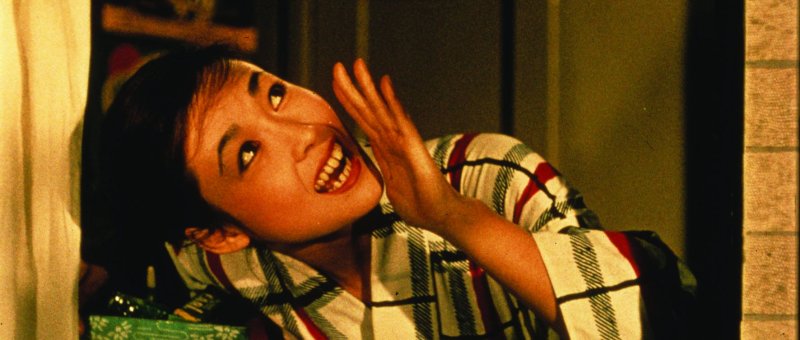
The Blue Sky Maiden (青空娘, Aozora Musume), Masumura’s second film, does something similar but with added bite. Working for the first time with actress Ayako Wakao who would later become something of a muse, Masumura takes a typical melodrama storyline – the returned illegitimate child treated as a poor relation by her own “family”, and turns it into a genial comedy in which Wakao’s charming heroine shines brightly despite the often cruel and heartless treatment she receives. As far as the family drama goes, the genre was still in its heyday and the family unit itself fairly unquestioned yet as Masumura shows times were changing and perhaps the family is not the bedrock it initially seems to be.

18 year old Yuko (Ayako Wakao) stands at the gates of adulthood. Taking a last photo in school uniform with her high school friends as they prepare for graduation, Yuko expresses her nervousness about being sent to Tokyo to live with the family of a father she barely knows while her friends worry about getting married or getting stuck in their tiny village all alone respectively. Tragedy strikes when the girls’ teacher arrives on a bicycle and informs them that Yuko’s grandmother has been taken ill. On her death bed, the grandmother reveals the reason Yuko is the only one of her father’s four children to be raised in the country is not a concern for her health, but that she is illegitimate. Yuko’s father, unhappy in his marriage, fell in love with his secretary (Kuniko Miyake) who later gave birth to Yuko, but he was already married with two children and so Yuko’s mother went to Manchuria leaving her to be raised in secret in the country.

Having nowhere else to go, Yuko arrives at her father’s large Western style house to be greeted coldly by her half-siblings, and treated as a maid by her still angry step-mother while her father (Kinzo Shin) is away on business. It has to be said that this model middle class family are an extremely unpleasant bunch. Step-mother Tatsuko (Sadako Sawamura) is shrewish and embittered while oldest daughter Teruko (Noriko Hodaka) spends all her time chasing wealthy boyfriends (but failing to win them because she’s just as mean as her mother). The oldest brother (Yuji Shinagawa) idles away in a hipster jazz band while the youngest boy, Hiroshi (Yukihiko Iwatare), is rude and boisterous but later bonds with his new big sister when she is the only one to really bother interacting with him.

The Ono household has always been an unhappy one. Yuko’s father married his wife after being bamboozled into it by an overbearing boss trying to offload his difficult daughter. Feeling trapped and avoiding going home he fell in love with a kind woman at work, had an affair, and wanted to marry her but wasn’t strong enough to break off not only from his unwanted family but also from his career in pursuing personal happiness. By Masumura’s logic, it’s this failure to follow one’s heart which has poisoned the Ono family ruining not only the lives of Tatsuko and the children who have no respect for their father or capacity for real human feeling (as Yuko later tells them), but also that of Yuko’s poor mother  whose life has been one of constant suffering after being unfairly jettisoned by a man who was bold enough to have an affair, but not to defy social conventions and leave an unhappy home.

Yuko herself, however, refuses to allow her life to be ruined by the failings of others. Looking up at the bright blue sky with her teacher (Kenji Sugawara), she learns to create her own stretch of heaven if only in her own mind. Though others might have fought and complained at being forced into the role of maid in what is her own family home, Yuko bears her new circumstances with stoicism and good humour. Thanks to her kindness and enthusiasm, the family maid, Yae (Chocho Miyako), is quickly on her side and if Teruko’s latest target, Hirooka (Keizo Kawasaki) starts to prefer the “new servant girl” his defection is completely understandable. Unlike later Masumura heroines, Yuko’s “revenge” is total yet constructive. She refuses to be cowed by unkindness, remains pure hearted in the face of cruelty, and resolves to find her own happiness and encourage others to do the same. With a few cutting words offered kindly, Yuko gets to the heart of the Onos, essentially reminding her father that all of this unhappiness is his own fault – he made his bed 20 years ago, now he needs to lie it and be a full-time husband and father to the family of lonely misfits he created in the absence of love.

Light and bright and colourful, The Blue Sky Maiden is among Masumura’s more cheerful films, not least because it does seem to believe that true happiness is possible. Yuko does not so much defy social convention as ignore it. She lives openly and without rancour or regret. She takes things as she finds them and people (aside from the Onos) are good to her because she is good to them. Though Masumura’s later work would become increasingly dark and melancholy, Yuko bears out many of his most central themes in her steadfast claim to her own individuality and equally steadfast commitment to enabling the happiness of others in defiance of prevailing social codes.


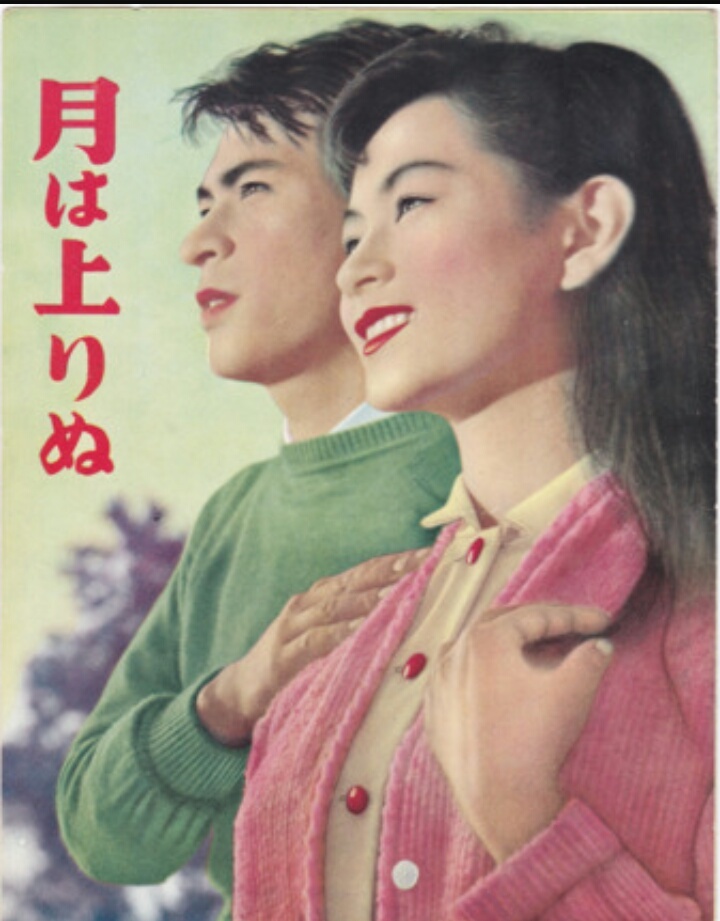
The Moon Has Risen (月は上りぬ, Kinuyo Tanaka, 1955)

the moon has risen bookletOne of the most celebrated actresses of the 1930s, Kinuyo Tanaka’s post-war career took a couple of unexpected turns. In 1949, she was one of a small number of performers sent to tour America as a cultural ambassador but the reception upon her return was anything but welcoming as her old fans openly criticised her “Americanised” ways. In the same year, she ended her long standing contract with Shochiku to go freelance which meant she could pick and choose her projects from across a wider field of directors and actors she wanted to work with. What she wanted, however, was somewhat unheard of – she wanted to direct. The second woman to ever helm a feature film in Japan, Kinuyo Tanaka made her behind the camera debut in 1953 with the extremely impressive melodrama Love Letter which was penned by the ever supportive Keisuke Kinoshita. Tanaka’s directing career was almost derailed by her good friend and long time collaborator Kenji Mizoguchi who, for reasons which remain unclear, attempted to block her acceptance into the directors guild of Japan (ending their working relationship in the process), but after eventually joining Nikkatsu as a director she was able to begin work on her second film – The Moon Has Risen (月は上りぬ, Tsuki wa Noborinu), ironically enough scripted buy Shochiku stalwart Yasujiro Ozu.

In the classic Ozu mould, The Moon Has Risen is a family drama but Tanaka pulls the focus a little to home in on the central three sisters. Cared for by widowed patriarch Mokichi (Chishu Ryu), the Asai family consists of widowed oldest sister Chizuru (Hisako Yamane), reserved middle sister Ayako (Yoko Sugi), and the exuberant youngest sister Setsuko (Mie Kitahara) who is in a kind of relationship with the currently out of work intellectual, Shoji (Shoji Yasui). When an old school friend of Shoji’s, Amamiya (Ko Mishima), pays a surprise visit whilst he’s in the area to take a look at a broadcast tower, Setsuko sees it as an opportunity to set him up with her shy sister Ayako once Amamiya makes a few wistful remarks about remembering her from their school days.

The first part of the film stays firmly in the realms of comedy as Setsuko sets her plan in motion. She and Shoji do everything they can to find out whether there is any romantic possibility between the pair – baiting Amamiya to come to a non-existent clandestine meeting and then timing him to see how long he’ll wait before giving up, and convincing each of them that the other has something very important to say which can only be said under the romantic light of a full moon. Youthful as she is Setsuko’s plans largely backfire but then the moonlight gets inside them and something shifts.

The courtship of Ayako and Amamiya is quiet and restrained. They keep their romance a secret, communicating with each other through secret codes leading to poignant passages from the Manyoshu – the oldest existing collection of Japanese poetry, which everyone in the family is desperate to figure out but can’t quite get to grips with. Chizuru can’t decide if this painfully innocent path to romantic connection is very old fashioned or very modern but it certainly captures something of the cultural shift of post-war society – the marriage is “arranged” in a sense with Setsuko as a matchmaker but it’s also self determined as Ayako and Amamiya come to recognise their mutual feelings for each other, embrace their love match, and make their own independent decisions to marry.

Modern girl Setsuko has also made a proactive decision in her attachment to Shoji but their shared matchmaking quest eventually drives a wedge between them. As she later puts it, they spent so long worrying about Ayako that they forgot all about worrying about themselves. Shoji’s problem is a common one in being both out of work and soft hearted as he proves when he finds a job but decides to recommend a needier friend for it instead. A blazing row nearly threatens to end things but, again, the pair rely on gentle, well meaning advice from their elders and eventually realise they’re about to make themselves miserable in a fit of pigheadedness.

Though Tanaka mimics the veteran director with iconic Ozu-inspired compositions and frequent use of pillow shots, her emotional canvas is more direct than her mentor’s stoical resignation. Steering clear of Ozu’s trademark tatami mat view and preference for direct to camera speech, Tanaka’s lensing is shier and avoids faces altogether to focus on the physical. She lingers on clasped hands, or on uncertain feet, as they hug the ground unwilling to stay or go. Having ignored her for most of the film, Tanaka turns back to Chizuru whose lonely widowhood seems like a forgone conclusion, as her eyes brim with tears on hearing her perceptive father’s acknowledgement of a possible new suitor.

Mokichi’s inevitable loneliness is background rather than foreground as his daughters take centerstage, leaving him to wonder why young people prefer the “dusty, dirty Tokyo”, to his peaceful Nara but in any case he remains perfectly content for each of them to find their own path to wherever it is they’re supposed to be. In her attempt to film Ozu’s script with Ozu’s camera, The Moon has Risen may seem like a step backwards for Tanaka following the more inventive Love Letter but even while working within such constraints she manages outdo the master in her essential emotional immediacy and well observed depiction of lives and loves post-war women.


It’s Not Her Sin (그 여자의 죄가 아니다 , Shin Sang-ok, 1959)

it's not her sinIt’s Not Her Sin (그 여자의 죄가 아니다, Geu yeoja-ui joega anida) is, in contrast to its title, nowhere near as dark or salacious as the harsher end of female melodramas coming out of Hollywood in the 1950s. It’s not exactly clear to which of the central heroines the title refers, nor is it clear which “sin” it seeks to deny, but neither of the two women in question are “bad” even if they have each transgressed in some way. Drawing inspiration from the murkiness of a film noir world, Shin Sang-ok adapts the popular novel by Austrian author Gina Kaus by way of a previous French adaptation, Conflit. Shin sets his tale in contemporary Korea, caught in a moment of transition as the nation, still rebuilding after a prolonged period of war and instability, prepares to move onto the global stage while social attitudes are also in shift, but only up to a point.

Two women argue on the steps of the Office of Foreign Affairs. One dresses in traditional Hanbok and the other Western clothing. The traditionally dressed woman, Seong-hi (Ju Jeung-ryu), is desperate to stop the other woman, Yeong-suk (Choi Eun-hee) from going inside and doing something that will apparently “ruin” her. Yeong-suk does not listen. She turns her back on Seong-hi and climbs the stairs. They argue argue again and a gun falls out of Seong-hi’s bag. Losing her mind in panic, Seong-hi shoots Yeong-suk, thinking only of stopping her getting any further with her mysterious mission.

A conversation with the prosecutor reveals that Seong-hi is married to a respected diplomat and so the case is of national, rather than just personal, interest. The case will hit the papers, and it will run because it’s also very messy. Yeong-suk is Seong-hi’s adopted sister. So, what has happened between these three people – Yeong-suk, Seong-hi, and the respected diplomat Baek? The prosecutor thinks he’s got it all worked out though his theory really is the stuff of cheap melodrama. He thinks Seong-hi has probably been having an affair with Yeong-suk’s boyfriend, Yeong-suk found out and planned to tell her husband, Seong-hi panics and shoots. That does not, however, explain why the recovering Yeong-suk has forgiven Seong-hi unconditionally and does not want to pursue prosecution, or why the two women embrace each other warmly when the prosecutor engineers a meeting.

The relationship between the two women is close and filled with mutual respect and affection – there really is only one thing which could come between them and it isn’t a man. The secret, such as it is, is an obvious one and a frequent theme of maternal melodramas. The prosecutor, who seems to regard evidence as an optional extra, accidentally stumbles over a clue when he probes Baek about the status of his marriage. The couple have been married eight years and have only one son, which the prosecutor finds odd even given that Baek has spent much of the marriage living abroad. He imagines this as a possible indication that the marriage is unhappy, that Seong-hi is lonely, and that she might, then, have been engaging in illicit affairs which may result in blackmail and eventually murder.

All very fanciful, but the truth is more ordinary. Both Seong-hi and Yeong-suk are prisoners and victims of their social standing and responsibilities. Seong-hi is constrained in her marriage, her difficulty conceiving a child has affected her self esteem and faith in her husband. Yeong-suk, by contrast finds herself in a difficult position after being betrayed in love, misused and let down by an unscrupulous man. Her “muddy” past leads her to fear that she may not deserve a happy life with her new love, and that he too may leave if she reveals her own secret to him. The two women are left with no one else to rely on but each other and are then bound by the additional burden of a secret which they must protect at all costs, only to see their relationship placed under greater strain by its result.

Unlike many a Korean melodrama, It’s not Her Sin has a broadly happy, if bittersweet, conclusion in which the friendship between the two women is restored but also broken as one is forever exiled from her own family. In keeping with the title Shin refuses to condemn either woman, sympathising with their plight as they’re manipulated by circumstances beyond their control and oppressed by a very male world which forces them into making their illicit bargain in the first place. Beautifully played by leads Choi Eun-hee and Ju Jeung-ryu, It’s not Her Sin is, like all good melodramas, a chronicle of its times in its depiction of female friendship as the last bastion of defence against an unfair world.


Screened at the Korean Cultural Centre London. Also available to stream via the Korean Film Archive’s YouTube Channel.