
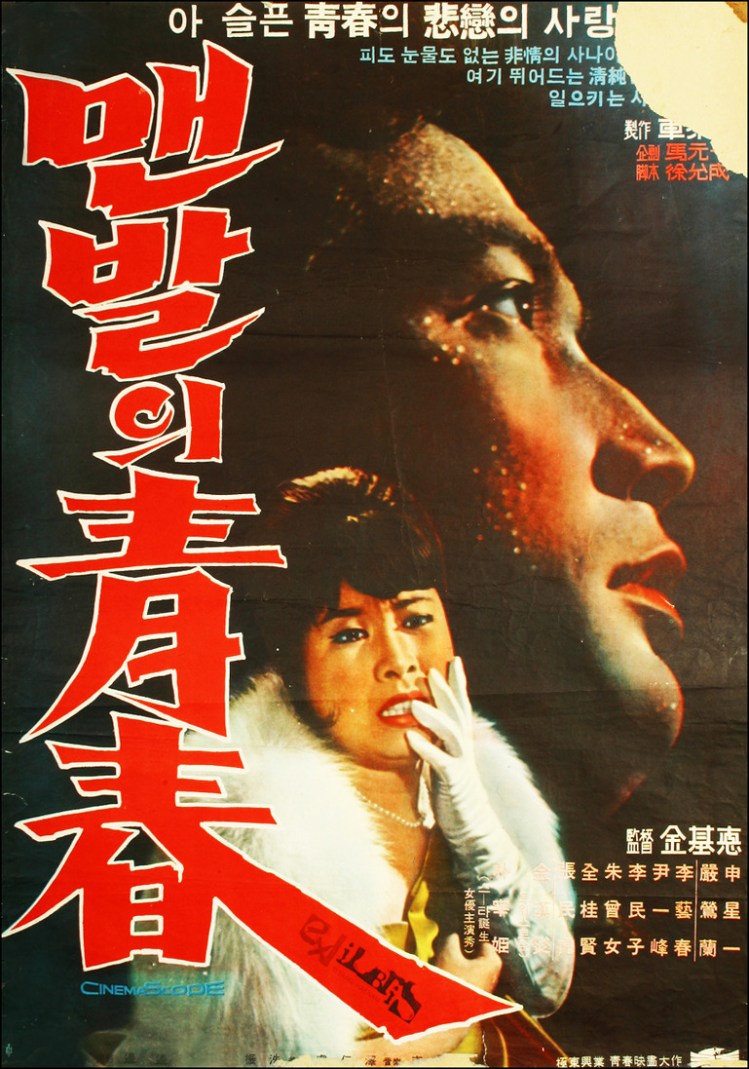
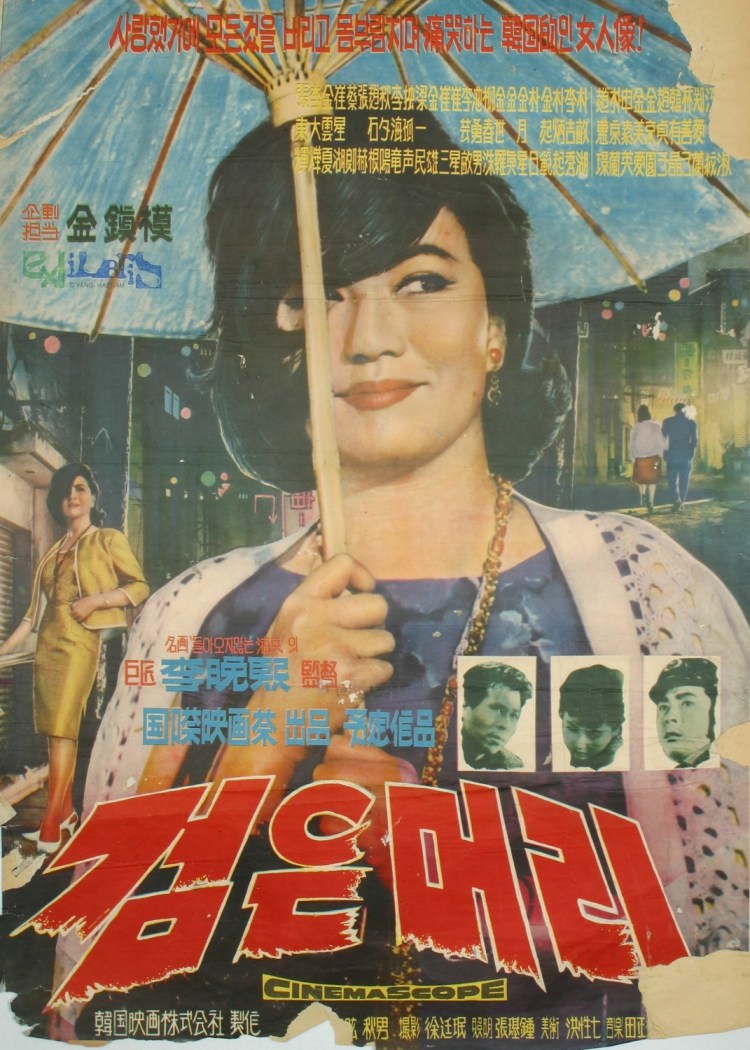
 The “Seishun Eiga” or youth movie had long been a staple of Japanese cinema by the time the short-lived “Sun Tribe” movement took hold in the mid-1950s, but, for understandable reasons, it did not make its way to Korea until a decade or so later. When it comes to so called “adolescent films”, Kim Ki-duk’s 1964 Barefooted Youth (맨발의 청춘, Maenbaleui cheongchun) is hard to beat. The film had, in fact, been filtered through Japanese cinema as its star Shin Seong-il – then riding high as a youth idol and wanting to star in as many youth movies as he could before his era came to an end, had seen Ko Nakahira’s Dorodarake no Junjo which starred ’50s idol Sayuri Yoshinaga alongside her frequent co-star Mitsuo Harada in a tragic tale of love across the class divide (this enduring story was later remade in 1977 with another idol, Momoe Yamaguchi, as the female lead). Shin was keen to star in a remake of Dorodake no Junjo and petitioned his studio to set it up. The plot of Kim’s version is almost identical and was widely seen as a deceitful remake at the time of its release, but that’s not to say it failed to speak of a certain kind of hopelessness among the young people of Korea battling valiantly against an unforgiving society.
Petty gang errand boy Du-su (Shin Seong-il) has been sent on an important mission to deliver some smuggled watches to a fence. On his way out, his boss reminds him not to get into unnecessary fights and risk being late for this very important date. Du-su ignores him and comes to the defence of two nervous middle-class girls in the middle of being mugged by thugs of a different nature. One of the other thugs has a knife and stabs Du-su in the stomach, causing him to drop the prosthetic arm he’s been wearing “as a joke” as well as one of the watches. Turning the knife back on the attacker, Du-su gets away and eventually delivers the goods.
This event profoundly alters Du-su’s future prospects, firstly because he’s brought himself to the attention of the police and also risked putting them on the gang’s trail if the police have picked up the missing watch and discovered it’s a smuggled Hong Kong knock off that might be connected to Du-su. Secondly, the woman Du-su saved, an Ambassador’s daughter called Johanna (Um Aing-ran), is overly grateful and quickly becomes attached to him.
Johanna is everything Du-su is not – wealthy, cultured, elegant, and religious. Her world could not be more different than Du-su’s yet there is an inescapable bond that exists between them. Unlike many class difference love stories, both parties move closer towards the centre, trying out the other’s world and finding it different but perhaps not impossible. After their first few hours together when Johanna finds her way to Du-su’s run down flat in a lower class neighbourhood, Du-su puts on a Beethoven record at his local club (much to the consternation of the other patrons) and orders himself a glass of juice, while Johanna swaps her usual bible based bedtime reading material for an English language boxing magazine and takes her first swigs of whisky directly from the bottle.
However, trying out the other world for real does not go as well – Du-su, having overdone it with a formal tail coat, falls asleep at a concert, while Johanna finds it difficult to adjust to the rowdiness of the boxing ring. When Johanna finally takes Du-su home, hoping her mother will help him find an honest job so he can go straight, his presence is met with horror and a meal with a hoped for ally goes about as wrong as it possibly could, exposing Du-su’s lack of sophistication as he picks up a steak to eat with his hands (not being confident with a knife and fork), and then spills water all over the hostess who points out his lack of employable skills.
Trapped on all sides – by the gangsters worried he’ll expose them, by his origins as the son of a prostitute and a man who died in jail, and by the general lack of opportunities for poor boys in economically straightened 1960s Korea, Du-su has nowhere left to go. Johanna is also trapped, in a sense, by a prospective arranged marriage and an overbearing but well meaning mother determined to send her abroad to save her from her reckless amour fou. Du-su, facing prison and life in a gang, and Johanna facing losing love for respectability, have hit an impasse. Having managed to transcend their class differences on a personal level, they see no way they can ever be together and if they cannot be together in life then they see no option but to escape from a world which has no place for them.
The economic inequality and enduring inviability of their love is signalled in the closing scenes in which Johanna’s funeral procession is several miles long with flowers and hearses and a crowd of mourners dressed in white. Meanwhile, Du-su’s body, barefoot and covered by a sheet on the back of a cart being pulled by his grief-stricken friend, is unattended. Not only could they not be together in life, they are forever separated even in death. As in the title of the Japanese film (taken directly from the book which inspired it), it is the lovers’ “purity” which comes to define them and adds extra poignancy to their fate. Du-su and Johanna share a single kiss but Kim obscures it from view, photographing the pair through a window pane in which the crossbars once again divide them. When the bodies are discovered, the first question that is asked is if they had had sex before they died – the answer is a resounding “no”, to which the man replies “good, I’m glad” though he is not especially referring to the poetry of their chastity in death but some kind of pointless and retrospective moral judgement on the “illicit” quality of their relationship.
Unlike the respective Japanese versions which tend to pivot around the leading actress (here Shin is the star, but both the actresses in the 1963 and 1977 versions were the headliners) Barefooted Youth tilts towards Du-su who literally becomes the “barefooted youth” of the title on his funeral cart, causing his friend (whose feelings are perhaps more than those of brotherhood) to remove his own shoes and place them on Du-su’s icy feet, trudging through the snow in his socks remarking that Du-su’s burial is witness to a greater and warmer love than the superficial flashiness of Johanna’s procession. Having resented Johanna for taking his friend away, he now respects her for joining him in death. The tragic end of these two young people is not only a romantic tale of doomed love, but an indictment of an unforgiving society in which social inequality, entrenched social codes, and the rigidity of the older generation have destroyed youth’s expectations of a brighter future. Du-su’s final advice to his friend is to live his life to the fullest and die without without regrets while he dreams only of being like a white crane flying in the blue sky, a pure soul enduring in eternity.
Available to watch on the Korean Film Archive’s YouTube channel and as part of the Kim Ki-duk DVD box set.
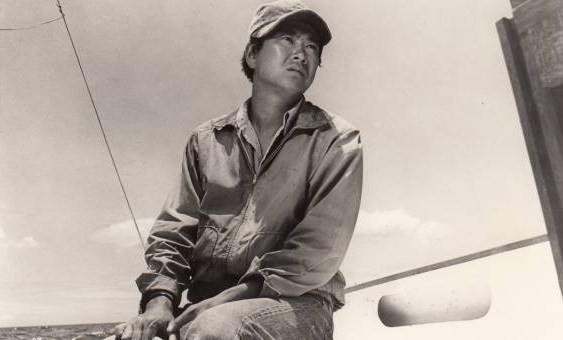


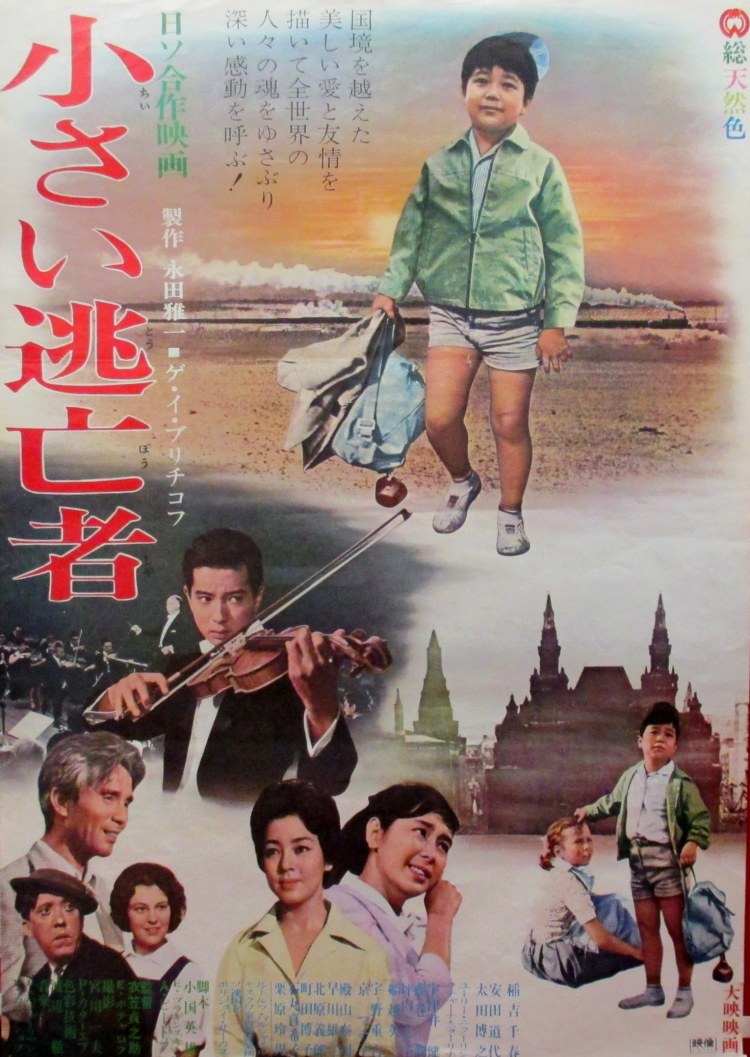 Teinosuke Kinugasa maybe best known for his avant-garde masterpiece The page of Madness even if his subsequent work leant towards a more commercial direction. His final film is just as unusual, though perhaps for different reason. In 1966, Kinugasa co-directed The Little Runaway (小さい逃亡者, Chiisai Tobosha) with Russian director Eduard Bocharov in the first of such collaborations ever created. Truth be told, aside from the geographical proximity, the Japan of 1966 could not be more different from its Soviet counterpart as the Eastern block remained mired in the “cold war” while Japan raced ahead towards its very own, capitalist, economic miracle. Perhaps looking at both sides with kind eyes, The Little Runaway has its heart in the right place with its messages of the universality of human goodness and endurance but broadly makes a success of them if failing to disguise the obvious propaganda gloss.
