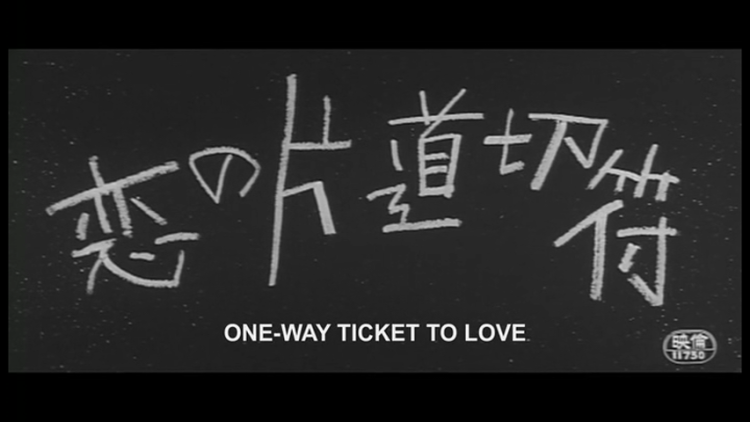
One-Way Ticket to Love (恋の片道切符, Masahiro Shinoda, 1960)

vlcsnap-2017-04-14-00h33m57s991Although Masahiro Shinoda has long been admitted into the pantheon of Japanese New Wave masters, he is mostly remembered only for his 1969 adaptation of a Chikamatsu play, Double Suicide. Less overtly political than many of his contemporaries during the heady years of protest and rebellion, Shinoda was a consummate stylist whose films aimed to dazzle with visual flair or often to deliberately disorientate with their worlds of constant uncertainty. Like so many of the directors who would go on to form what would retrospectively become known as the Japanese New Wave, Shinoda also started out as a junior AD, in this case at Shochiku where he felt himself stifled by the studio’s famously safe, inoffensive approach to filmmaking.

By the late ‘60s that approach was itself failing and so the studio began to take a few chances on new young directors including Shinoda who was afforded the opportunity to script and direct his first feature – One-way Ticket to Love (恋の片道切符, Koi no katamichi kippu). Studio mandated programme picture as it was, Shinoda still had to play by some of the rules – notably that the title song which is a Japanese cover of the 1959 Neil Sedaka hit needed to feature prominently. Shinoda does indeed showcase the song throughout the film though he also paints a dark and unforgiving picture of the burgeoning talent management industry whilst sympathising with those trapped in the underworld to which the effects of growing economic prosperity have yet to trickle down.

Down on his luck 20 year old alto-sax player Kenji Shirai (Kazuya Kosaka) has resorted to hanging around stations in Tokyo alongside a host of other unemployed artists trying to get picked up for a job and having little success. His luck changes when a young female talent fixer, Miss Yoshinaga (Yachiyo Otori), finds herself in need of an alto sax player with immediate effect. Kenji is elated to find work but somewhat troubled when the club is abruptly raided, giving him a taste of the precariousness of the underground club scene. Nevertheless, Yoshinaga hands him a card and tells him to come to her office tomorrow in case she has any more work for him.

On his way home, Kenji comes across a distressed woman crying her heart out dangerously near a high bridge. Fearing she is about to commit suicide, Kenji comforts her and then takes her home for the night before introducing her to Yoshinaga the next day in the hope that she may also have work for a young woman – she does, but as a nudie dancer. Mitsuko (Noriko Maki) reluctantly takes the job leaving Kenji conflicted but there’s more drama in both of their lives to come in the form of “The Japanese Elvis” Ueno (Masaaki Hirao), Mitsuko’s married ex-boyfriend Tajima, and an errant pistol belonging to Kenji’s petty yakuza roommate.

Although Shinoda was less noticeably political than many of the other directors of the time, his sympathy remains with those who feels themselves to be oppressed or have in someway been cast aside by an unforgiving world. Kenji in particular feels himself to be just such a person, remarking that the world is a cruel place in which people look after their own interests and are prepared to use and discard those less fortunate in order to get what they want. Describing himself and Mitsuko as nothing more than offerings fit for burning on the altar that is the post-war economy, Kenji’s sense of hopelessness is palpable. Despite having acted to rescue Mitsuko from her suicidal contemplation, he feels powerless to help her in any other way and honestly tells her so each time she comes to him for comfort or assistance. Though his earnestness has an honest quality in its determination not to deceive, it also has an air of cowardice as he refuses to even discourage the woman he loves from doing something he knows she will regret because he has already decided that resistance is futile.

Mitsuko, by contrast, finds herself entirely without agency. Betrayed by the man she loved on discovering that he was already married and had been stringing her along, she finds it difficult to adjust to living life alone. Consequently she finds herself wooed by the big idol star of the day, Ueno, and then swept into a studio scam in which the pair are tricked into a sexual relationship with dire consequences for both. Ueno, who sings the all important title song at several points throughout the film, might be in a more comfortable position than Kenji but he is no more free. The studio’s prime cash cow, Ueno is pimped out to his hoards of screaming teenage girls and denied anything like a private life outside of studio control. As the latest dancer at the club, Mitsuko is assured that she’s going out there a rookie and coming back a star but her fate, along with Ueno’s, is entirely in the hands of the managers who can make or break a career at will.

If the interpersonal drama fails to convince, Shinoda makes up for it with unusually dynamic and interesting cinematography much more like the youth movies Nikkatsu were making at the time than the usual Shochiku stateliness. Looking much more like the European New Wave, Shinoda makes fantastic use of tracking shots and unusual framing to draw attention to the isolation of his protagonists. The club set finale featuring the title song is a masterclass in tension as Kenji roams around the audience, caught among the crowd of screaming girls before pausing for an up close contemplation of Ueno which leads him to his final decision. A programme picture, but one in which Shinoda declared his stylistic intentions if not his scripting prowess. One-way Ticket to Love dazzles with visual flair but never captivates on anything other than a superficial level as its story of love frustrated by social inequality and controlling authority fails to deliver on the melancholy promise of the title.


Final sequence featuring the title song by Masaaki Hirao (English subtitles)
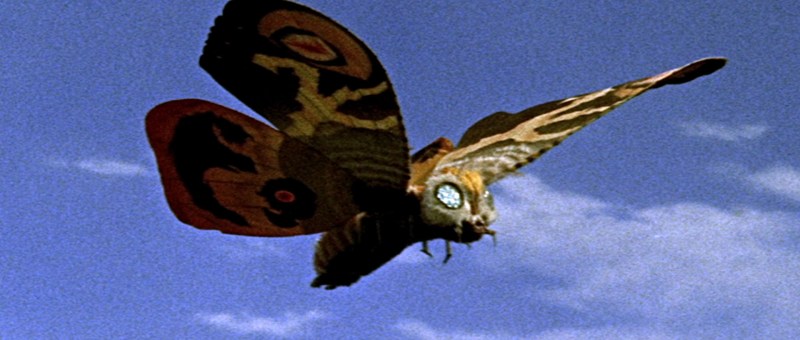
Mothra (モスラ, Ishiro Honda, 1961)

mothra-poster.jpgJapan’s kaiju movies have an interesting relationship with their monstrous protagonists. Godzilla, while causing mass devastation and terror, can hardly be blamed for its actions. Humans polluted its world with all powerful nuclear weapons, woke it up, and then responded harshly to its attempts to complain. Godzilla is only ever Godzilla, acting naturally without malevolence, merely trying to live alongside destructive forces. No creature in the Toho canon embodies this theme better than Godzilla’s sometime foe, Mothra. Released in 1961, Mothra does not abandon the genre’s anti-nuclear stance, but steps away from it slightly to examine another great 20th century taboo – colonialism and the exploitation both of nature and of native peoples. Weighty themes aside, Mothra is also among the most family friendly of the Toho tokusatsu movies in its broadly comic approach starring well known comedian Frankie Sakai.
When a naval vessel is caught up in a typhoon and wrecked, the crew is thought lost but against the odds a small number of survivors is discovered in a radiation heavy area previously thought to be uninhabited. The rescued men claim they owe their existence to a strange new species of mini-humans living deep in the forest. This is an awkward discovery because the islands had recently been used for testing nuclear weapons and have been ruled permanently uninhabitable. The government of the country which conducted the tests, Rolisica, orders an investigation and teams up with a group of Japanese scientists to verify the claims.

Of course, the original story of the survivors was already a media sensation and so intrepid “snapping turtle” reporter Zen (Frankie Sakai) and his photographer Michi (Kyoko Kagawa) are hot on the trail. Zen is something of an embarrassment to his bosses but manages to bamboozle his way into the scientific expedition by stowing away on their boat and then putting on one of their hazmat suits to blend in before anyone notices him. Linguist Chujo (Hiroshi Koizumi) gets himself into trouble but is saved by two little people of the island who communicate in an oddly choral language. Unfortunately, the Rolisicans, led by Captain Nelson (Jerry Ito), decide the helpful little creatures are useful “samples” and intend to kidnap them to experiment on. Refusing to give up despite the protestations of the Japanese contingent, Nelson only agrees to release the pair when the male islanders surround them and start banging drums in an intimidating manner.

The colonial narrative is clear as the Rolisicans never stop to consider the islanders as living creatures but only as an exploitable resource. Nelson heads back later and scoops up the two little ladies (committing colonial genocide in the process) but on his return to Japan his intentions are less scientific than financial as he immediately begins putting his new conquests on show. The island ladies (played by the twins from the popular group The Peanuts, Yumi and Emi Ito) are installed in a floating mini carriage and dropped on stage where they are forced to sing and dance for an appreciative audience in attendance to gorp.

Zen and Michi may be members of the problematic press who’ve dubbed the kidnapped islanders the “Tiny Beauties” and helped Nelson achieve his goals but they stand squarely behind the pair and, along with linguist Chujo and his little brother Shinji (Masamitsu Tayama), continue to work on a way to rescue the Tiny Beauties and send them home. The Tiny Beauties, however, aren’t particularly worried because they know “Mothra” is coming to save them, though they feel a bit sad for Japan and especially for the nice people like Zen, Michi,  Chujo, and Shinji because Mothra doesn’t know right from wrong or have much thought process at all. 100% goal orientated, Mothra’s only concern is that two of its charges are in trouble and need rescuing. It will stop at nothing to retrieve them and bring them home no matter what obstacles may be standing in the way.

The island people worship Mothra like a god though with oddly Christian imagery of crosses and bells. Like many of Toho’s other “monsters” it is neither good or bad, in a sense, but simply exists as it is. Its purpose is to defend its people, which it does to the best of its ability. It has no desire to attack or destroy, but simply to protect and defend. The villain is humanity, or more precisely Rolisica whose colonial exploits have a dark and tyrannical quality as they try to insist the islands are uninhabited despite the evidence and then set about exploiting the resources with no thought to the islanders’ wellbeing. The Japanese are broadly the good guys who very much do not approve of the Rolisicans’ actions but they are also the people buying the tickets to see the Tiny Beauties and putting them on the front pages of the newspapers. Nevertheless, things can only conclude happily when people start respecting other nations on an equal footing and accepting the validity of their rights and beliefs even if they include giant marauding moth gods.


Original trailer (no subtitles)

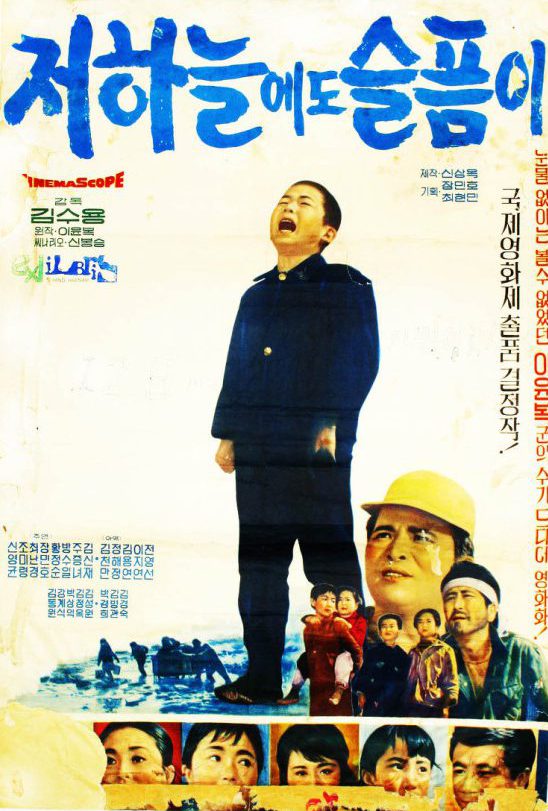
Sorrow Even Up in Heaven (저 하늘에도 슬픔이, Kim Soo-yong, 1965)

It’s a sorry enough tale to hear that many silent classics no longer exist, regarded only as disposable entertainment and only latterly collected into archives and preserved as valuable film history, but in the case of South Korea even mid and late 20th century films are unavailable thanks to the country’s turbulent political history. Though often listed among the greats of 1960s Korean cinema, Sorrow Even Up in Heaven (저 하늘에도 슬픔이, Jeo Haneuledo Seulpeumi) was presumed lost until a Mandarin subtitled print was discovered in an archive in Taiwan. Now given a full restoration by the Korean Film Archive, Kim’s tale of societal indifference to childhood poverty has finally been returned to its rightful place in cinema history but, as Kim’s own attempt to remake the film 20 years later bears out, how much has really changed?
11 year old Yun-bok has been forced out of his home and into a makeshift hovel near the river thanks to his gambling addicted invalid father’s inability to look after his four now destitute children. Yun-bok likes to narrate his life as a kind of letter to his absent mother who seems to have abandoned the family for unclear reasons possibly related to her husband’s drinking and gambling problem. Attending school as normal in an attempt to work hard and get an education so he can take care of the family in an adult world, Yun-bok, along with his younger sister Sun-na, spends his free time selling sticks of gum in the streets to try and earn enough money to feed everyone before his father drinks and gambles it all away.

Despite his obviously difficult circumstances, Yun-bok remains steadfast in his desire to stick by his family and take care of his siblings. Berated by the teacher for arriving late, Yun-bok finds an ally in a schoolmate who just wants to help even though many of the others shun him because of his raggedy clothes and lice infested hair. Eventually a teacher notices Yun-bok’s distress and urges him to write his struggles in a diary – which he does much as he’d been narrating his days in his imagined conversations with his mother. Moved by Yun-bok’s heartending descriptions of his life on the starvation line, the teacher manages to get the diaries to the newspapers who begin publishing them as a public interest column but just when it looks as if things maybe looking up for the family, Yun-bok loses heart and hops a freight train to look for Sun-na who has run away from home after an argument.

Korea in the 1960s was a difficult place, still bearing the scars of both WWII and the Korean War not to mention the resultant political turmoil. Nevertheless, by 1965 things had begun to pick up as seen in the flip side to Yun-bok’s sorry state of affairs – the various bars and drinking establishments he manages to work his way into in order to sell a few more sticks of gum. These places are filled with the sound of popular music where affluent young couples dance The Twist and salarymen in dark suits cement their business relationships over drinks. For some, everything is going fine but a concerted effort is being made to unsee the kind of unpleasantness which lurks below growing economic prosperity as manifested by 11 year old boys somehow responsible for the maintenance of a family of five.

As one teacher puts it, you can’t break the mirror because you don’t like what you see. Though there are some willing to help Yun-bok (at least to an extent) including his school friend who comes from a well to do family only too glad to set some food aside for Yun-bok and his siblings, out in the real world he finds only other desperate people willing to stoop to theft and violence against a child for nothing more than a few pennies. Many of these episodes are distressing as Yun-bok has his shoeshine kit stolen by an older boy or is violently beaten by a grown man at the harbour but the most serious occurs in the city when he is accused of pickpocketing by some louts who kidnap him and strip him naked for otherwise unclear reasons.

Though Sorrow Even Up in Heaven has a broadly positive ending as Yun-bok’s circumstances seem set to improve thanks to his accidental fame, Kim is quick to point out that there are many Yun-boks out there who can’t all become media sensations. Like many child heroes of classic Korean cinema, Yun-bok remains morally good – the idea of theft occurs to him but he remembers his teacher saying that everything will work out as long as his heart is pure, and his only transgression lies in spending a few pennies on himself to get something to eat and thereby work harder for his family (and for this he pays a heavy price). Even so his circumstances are portrayed in a naturalistic rather than melodramatic fashion neatly undercutting the inherent sentimentality of the material. Though Kim’s approach is closer to neorealism in the early scenes, he mixes in touches of magical realism with the ghostly appearances of Yun-bok’s mother which, alongside impressive montage and superimposition sequences, lend Yun-bok’s story an elevated cinematic quality. Remade several times over the last forty years, Sorrow Even up in Heaven remains sadly timeless in its depiction of an earnest young boy who knows only kindness and honesty even while those around him remain wilfully indifferent or actively cruel in the face of his continued suffering.


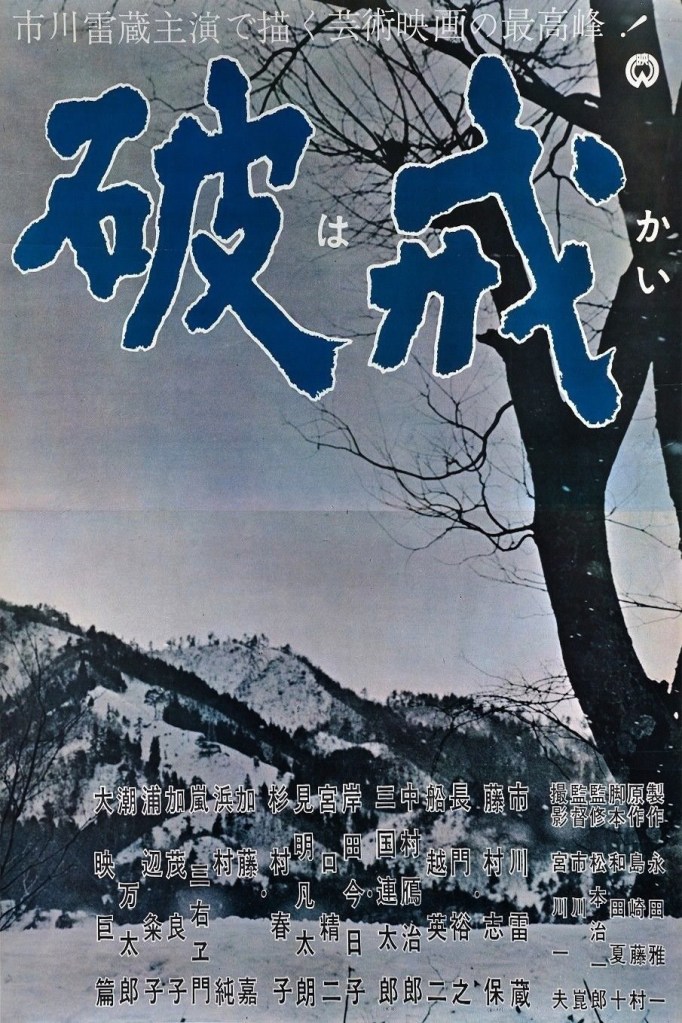
The Outcast (破戒, AKA The Broken Commandment, Kon Ichikawa, 1962)

Kon Ichikawa’s approach to critiquing his society was often laced with a delicious slice of biting irony but he puts sarcasm to one side for this all too rare attempt to address the uncomfortable subject of Japan’s hidden underclass – the burakumin. The term itself simply means “people who live in hamlets” but from feudal times onwards it came to denote the kinds of people with whom others did not want to associate – notably those whose occupations dealt in some way with death from executioners and undertakers, to butchers and leatherworkers. Though outright discrimination against such people was outlawed during the Meiji restoration, social stigma and informal harassment remained common with some lingering tendency remaining even today.

The Outcast (破戒, Hakai), adapted from the book by Toson Shimazaki (known as The Broken Commandment in English) is the story of a young man of burakumin lineage who has to hide his true identity in order to live a normal life in the Japan of 1904. Segawa’s father, formerly a village elder, sent his son away to live with his brother and his wife in a distant town where they could better hide their burakumin status to enjoy a better standard of life. Sadly, Segawa’s father dies after being trampled by a recalcitrant bull never seeing his son again and leaving him with the solemn commandment to live as a regular person, never revealing his connection with the burakumin world.

This debt to his father’s sacrifice creates a conflict in the heart of the young and idealistic Segawa (Raizo Ichikawa). Forced to listen to the casual racism all around him and unable to offer any kind of resistance, Segawa has become interested in the writings of a polemical political figure, Rentaro Inoko (Rentaro Mikuni), who has begun to write passionate political treatises advocating for burakumin rights. When Inoko turns up in Segawa’s town, he finds himself a new father figure and political mentor but continues to feel constrained by the debt of honour to his father’s sacrifice and is unable to confess his own burakumin heritage even to Inoko.

The world Segawa lives in is a conservative and stratified one in which old superstitions hold true even whilst hypocritical authorities use and abuse the trust placed in them. Inoko falls foul of local politics after he discovers a politician has married a wealthy burakumin woman solely for her money and is planning to expose him at a political rally. This same politician has already threatened to blackmail Segawa who continues to deny all knowledge of any burakumin related activities whilst failing to quell the eventual gossip surrounding Segawa’s lineage. The gossip causes problems at the school where Segawa had held a prestigious teaching position as the headmaster and school board fear the reaction of the parents. Though the people at the temple where Segawa takes refuge after growing tired of the racist inn owners in town are broadly supportive of the burakumin, the priest there has his own problems after having made a clumsy pass at his adopted daughter, Shio (Shiho Fujimura) – the daughter of a drunken teacher sacked by the school in order to avoid paying him a proper pension. At every turn the forces of authority are universally corrupt, selfish and venal, leaving no safe direction for a possible revolution of social justice to begin.

This is Segawa’s central conflict. After his experiences with Inoko, Segawa begins to want to follow in his footsteps, living out and proud as a burakumin and full time activist for burakumin rights. However, this would be undoing everything for which his father sacrificed so much. Talking things over with Inoko’s non-burakumin wife, Segawa is also presented with a third way – reveal his burakumin heritage and attempt to live honestly as an ordinary person, changing hearts and minds simply through leading a life among many other lives. This option seems attractive, especially as Segawa has fallen in love and would like to lead an ordinary life with a wife and family, but his youthful idealism is hungry for a greater, faster change than the one which will be born through simple integration. Despite the warnings of Inoko’s wife who believes change will occur not through activism but through the passage of time, Segawa decides his future lies in advancing the burakumin cause in the wider world.

When Segawa does choose to reveal himself, he finds that there is far more sympathy and support than he would ever have expected. A woman he has come to love wants to stay by his side, his previously hostile friend rethinks his entire approach to life and apologises, and even the children in his class convince their parents that their teacher is a good and a kind man regardless of whatever arbitrary social distinction may have been passed to him through an accident of birth. Segawa’s conflicted soul speaks not only for the burakumin but for all hidden and oppressed peoples who have been forced to keep a side of themselves entirely secret, faced with either living a lie in the mainstream world or being confined to life within their own community. His choice is one of either capitulation and collaboration, or resistance which amounts to a sacrifice of his own potential happiness in the hope that it will bring about liberation for other similarly oppressed people.

Scripted again by Natto Wada, The Outcast takes a slightly clumsy, didactic approach filled with long, theatrical speeches but does ultimately prove moving and inspiring in advocating for the fair treatment of these long maligned people as well as others facing similar discrimination in an unforgiving world. As a treatise on identity and rigid social attitudes, the film has lost none of its power or urgency even forty years later in a world in which progress has undoubtedly been made even if there are still distances to go.


Aimless Bullet (오발탄, AKA Obaltan, Yu Hyun-mok, 1961)

Post-war cinema took many forms. In Korea there was initial cause for celebration but, shortly after the end of the Japanese colonial era, Korea went back to war, with itself. While neighbouring countries and much of the world were engaged in rebuilding or reforming their societies, Korea found itself under the corrupt and authoritarian rule of Syngman Rhee who oversaw the traumatic conflict which is technically still ongoing if on an eternal hiatus. Yu Hyun-mok’s masterwork Aimless Bullet (오발탄, Obaltan) takes place eight years after the truce was signed, shortly after mass student demonstrations led to Rhee’s unseating which was followed by a short period of parliamentary democracy under Yun Posun ending with the military coup led by Park Chung-hee and a quarter century of military dictatorship. Of course, Yu could not know what would come but his vision is anything but hopeful. Aimless Bullets all, this is an entire nation left reeling with no signposts to guide the way and no possible destination to hope for. All there is here is tragedy, misery, and inevitable suffering with no possibility of respite.
Nominal head of the family Cheolho (Kim Jin-kyu) has an OK job as an accountant but still he can’t make ends meet and his small family consisting of his wife, two children, war hero younger brother Yeongho (Choi Moo-ryong), unmarried sister Myeongsuk (Seo Ae-ja), and senile mother with wartime PTSD lives in a makeshift hovel in the middle of a fetid slum. Yeongho may have distinguished himself on the battlefield, but now the war is over society can’t find a use for him and so he remains jobless and another drain on his brother’s resources. In many ways he was one of the lucky ones, returning from the war with physical and mental scars but no permanent impairments. Myeongsuk’s former fiancé was not so lucky and requires the use of crutches to get around leading him to reject the woman he loves in the belief that he will never be anything more than a burden to all around him.

Cheolho suffers with a persistent toothache which he refuses to get treatment for despite the constant urging from his colleagues because he cannot in good conscience consider spending the money on himself when he has so many people with so many different needs to take care of. His toothache is not just a toothache but a manifestation of the unending torment of life in this ruined city defined by despair, madness, and cruelty.

The film begins with broken glass – a motif which will be repeated throughout as the structural integrity of this makeshift environment is repeatedly tested and repeatedly fails. A group of former soldiers is drinking in a bar, each lamenting their sorry progress in the post-war world. Yeongho remarks that he feels like a broken bowl – something used up and ready for the scrap heap. The country he fought so hard to protect has no place for him now the fighting is done. After such a long time searching for work, Yeongho is finally offered a promising job by an old flame currently working as an actress in the fledgling film industry, but the part they’ve offered him is that of a war veteran with similar scarring to his own. The studio want realism and casually ask him to remove his shirt and show off the traces of bullet holes on his side which is a step too far for Yeongho who objects to his wartime service being “exploited” in such a mercenary way. Insulted and not wanting to dishonour the memories of his fallen comrades Yeongho storms out only to later reconsider and realise he may have been foolish to turn down such a promising opportunity despite his indignation.

It isn’t just bowls and glass which end up shattered but dreams too as love lies bleeding in a land of permanent despair. Yeongho seems like something of a ladies’ man but re-encountering a kindly nurse he met at the front he begins to feel another life is possible. This particular dream is complicated by the presence of a disturbed neighbour who has also fallen in love with the nurse and stops by late at night to read her poetry despite the fact that she has taken to waving a gun to scare him off.

Cheolho has committed himself to living honestly, even if it means his family suffers. Yeongho is beginning to wonder if his philosophy is worth suffering for, why should they have to keep living like this when they could abandon conventional morality and humanitarian concerns and become rich through immoral means. Myeongsuk, abandoned by the love of her life and unable to find work, has fallen into prostitution, another effect of the ongoing American military presence. Yeongho, having lost all hope, makes a drastic decision of his own but one which is destined to be as ill fated as each of his other dreams, hollow and unfulfillable as they are.

Experiencing a moment of selfish indulgence born of total despair, Cheolho finally gets his tooth seen to. Actually he asks the dentist to just pull all his teeth right now but medical ethics suggest that’s not a good idea. Ignoring the dentist’s advice, Cheolho roams the streets of the city before stopping into another dental clinic for more “treatment”. Dazed and bloody he steps into a taxi but confuses his drivers by changing his mind on destinations from the morgue to the hospital to the police station. The Aimless Bullet of the title, as the cabbie calls him, Cheolho can only echo the words of his senile mother, “let’s go”, even if he has no idea where. Earlier in the film another character has the same dilemma and frames it as a joke – ask a dying man where he’s going, he says, and he’ll tell you he doesn’t know. There is nowhere for Cheolho to go. His road is blocked, his meter running. Korea is directionless and lost, a desolate land of broken bowls and ruined hearts too tired to keep moving even if there were any destination available.

So relentlessly bleak, it’s little wonder that the film ran into censorship problems which eventually saw it pulled from cinema screens. Legend has it censors objected to the frequent refrains of “let’s go” from the bedridden mother which they interpreted as “let’s go to North Korea” as opposed to the “just let us die” which seems to be the much darker message implied by her later talk of sheep and green pastures. Everything here is broken, caged, ruined. There is no way out or possibility of salvation in this life or any other. Lasting only a few seconds, the film’s most shocking moment passes with little to no reaction as Yeongho, on the run from the police, dashes past the body of a woman who has hanged herself with her crying baby still tied to her back. Yeongho, and presumably the police chasing him, ignore both the body and the wailing of the child in their self obsessed propulsion forwards. A warning – but one which is heeded only too late.


Short scene from the film (English subtitles)

Aimless Bullet is available on English subtitled region free blu-ray courtesy of the Korean Film Archive but you can currently watch the HD restoration version of the film in its entirety legally and for free via the Korean Film Archive’s YouTube channel. (You may have to sign in and “confirm” you’re a grown up.)

An Autumn Afternoon (秋刀魚の味, Yasujiro Ozu, 1962)

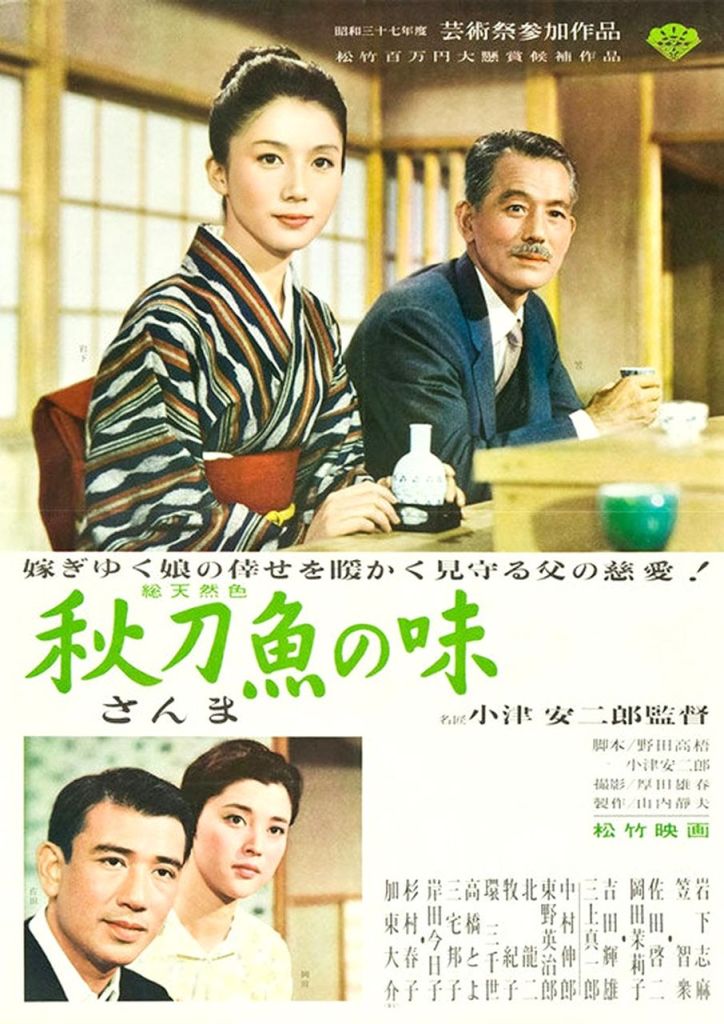
an-autumn-afternoonAn Autumn Afternoon (秋刀魚の味, Sanma no Aji) was to be Ozu’s final work. This was however more by accident than design – despite serious illness Ozu intended to continue working and had even left a few notes relating to a follow up project which was destined never to be completed. Even if not exactly intended to become the final point of a thirty-five year career, An Autumn Afternoon is an apt place to end, neatly revisiting the director’s key concerns and starring some of his most frequent collaborators.
Returning to the world of Late Spring, An Autumn Afternoon once again stars Chishu Ryu as an ageing father, Shuhei, though this time one with three children – the oldest, a son, married and left home, the middle one a daughter not yet married at 24, and the youngest boy still a student living at home. Michiko (Shima Iwashita), like Noriko, is devoted to the family home and has no immediate plans to marry despite the urgings of her father’s good friend who has already picked out a good prospect for an arranged marriage.

Shuhei had been content with this arrangement, after all as a 50-something man of 1962 he’s in need of someone to look after him and likes having his daughter around the house. A class reunion with some of his friends and an old teacher begins to change his mind when “The Gourd” (as the boys liked to call him) speaks somewhat unkindly of his unmarried, middle-aged daughter, later regretting that he acted selfishly in turning down marriage proposals which came her way because he wanted to keep her at home for his own upkeep. Taking the extraordinarily drunk The Gourd home, Shuhei and his friend encounter the daughter for themselves (as played by frequent Ozu collaborator Haruko Sugimura) and find her just as embittered and shrewish as The Gourd had implied. What they don’t see are her tears of heartbroken frustration at being left all alone to deal with this hopeless case of her dead drunk, elderly father.

At the end of the film, following the inevitable marriage, Shuehei retreats to a friendly bar just as the father of Late Spring had done before him though this time he goes there alone, not wanting to return to his now much quieter home before time. Whilst there the mama-san (Kyoko Kishida) for whom Shuhei has developed a fondness as something about her reminds him of his late wife, notices his attire and asks if he’s just been to a funeral. “Something like that”, he replies. Shuehei is being a little maudlin and self indulgent but what he says is almost true – he has, in a sense, lost a daughter though the Japanese way of doing things does not quite allow for the rejoinder of gaining a son.

All of this is to be expected, it is the best outcome. Time moves on and the baton passes from one generation to the next, one family is broken so that another may be created. Ozu revisited this universally tragic element of the life cycle several times throughout his career and even echoes himself in the final shots as Chishu Ryu sits with his back to the camera, less visibly shaken than in Late Spring but no less bereft. What Ozu gives us next is not the image of transience in the ebbs and flows of a stormy sea, but a parade of emptiness in which Michiko is ever present in her absence. Shuehei is not alone, he has his younger son Kazuo, but the house is now a soulless and colourless place filled with uninhabited rooms and mirrors with nothing to reflect.

In the end, life is defined by this final loneliness as children depart, setting off on a path which has to be entirely their own. The Gourd laments that he is all alone despite having, in part, destroyed his child’s chances of personal happiness in order to maintain his own, but Shuhei and his friends are also left to reflect on the same problem as fathers who’ve each successfully married off daughters only to find themselves rendered obsolete in the new family order. The times have changed, but they have not changed in this. Shuhei is left alone with his memories of youth, trying to bully his sadness into submission by humming a popular military march from his wartime glory days but the pleasures of the past are always hollow and melancholy, at best a mirage and at worst quicksand.

Ozu maintains his trademark style, mixing humour with wistful sorrow, resigned to the inherent sadness of life but determined to find the warmth there too. His sympathies, however, have shifted as he reserves a little of his bite for the modern young couple as exemplified by Shuehei’s oldest son, Koichi (Keiji Sada), and his wife (Mariko Okada) whose concerns are material (refrigerators, vacuum cleaners, handbags and golf clubs) rather than existential as they struggle to attain the “aspirational” quality of life the burgeoning post-war boom promises and have to rely on frequent “loans” from Shuehei to maintain it. The world moves on apace and leaves old sailors behind, alone and adrift on seas now much quieter than they have ever been but the peace and solitude is the sign of a life well lived and in a strange way its reward as the time slips by unhurriedly and only as painful as it needs to be.


Original trailer (no subtitles)

3 Seconds Before Explosion (爆破3秒前, Motomu Ida, 1967)

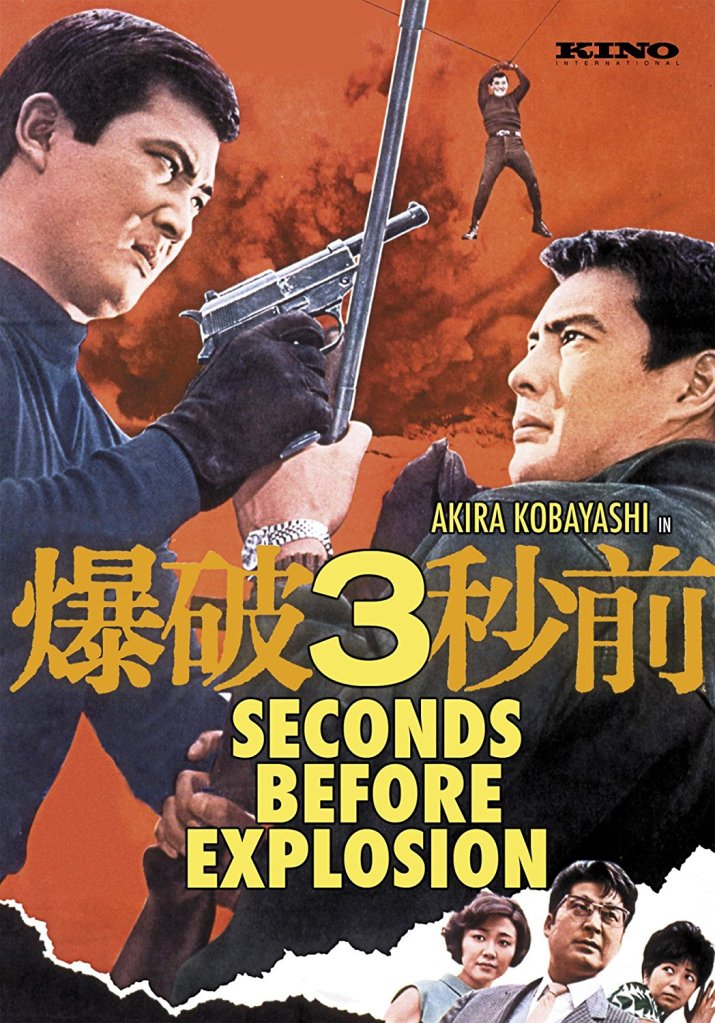
three-minutes-before-explosionIf Nikkatsu Action movies had a ringtone it would probably just be “BANG!” but nevertheless you’ll have to wait more than three rings for the Kaboom! in the admittedly cartoonish slice of typically frivolous B-movie thrills that is 3 Seconds Before Explosion (爆破3秒前, Bakuha 3-byo Mae). Once again based on a novel by Japan’s master of the hard boiled Haruhiko Oyabu, 3 Seconds Before Explosion is among his sillier works though lesser known director Motomu Ida never takes as much delight in making mischief as his studio mate Seijun Suzuki. What he does do is make use of Diamond Guy Akira Kobayashi’s boyish earnestness to keep things running along nicely even if he’s out of the picture for much of the action.
Like most of the more outlandish Nikkatsu action fests, 3 Seconds Before Explosion has a complicated relationship with narrative but we begin with former boxer Yabuki (Akira Kobayashi) in the middle of being brainwashed with flashing lights and high pitched noises until he agrees to become a shady government (?) assassin. Perhaps in an effort to save our sanities too, he relents and his first job is ensuring some jewels which were stolen during in the war don’t get into the hands of an evil nazi who will presumably be wanting them for evil nazi business. Anyway, Yabuki does his ninja stuff and thinks he’s tracked the jewels down but runs into a former colleague, Yamawaki (Hideki Takahashi), who is working for a businessman who already has the jewels and wants to keep them. Yamawaki quit being a super spy because he fell in love, which Yabuki thinks is a bit lame but still knows his friend has right stuff and would rather not have to kill him or anything.

Somewhere between the less serious yakuza/gang movies Nikkatsu were making in the late ’60s and a spy spoof, 3 Seconds Before Explosion has its fair share of oddness from strangled dogs to the mini Chinese theme in which one of the henchmen, Yang, wanders around in traditional Chinese garb while another girl at the club enjoys flirting in Mandarin for no apparent reason. It also goes without saying that the evil Nazi is played by an American spouting unconvincing German whilst chewing the scenery to a pulp. Realism is not where we are, but there’s something a little old fashioned about the way Ida chooses to stage his weirdness even if the film is filled with crazy contemporary youth touches such as in the achingly hip Club Casba.

The interpersonal drama comes as Yabuki and Yamawaki face off about their life choices much more than the case at hand. Yamawaki grew tired of the spy life and decided to leave it behind for his lady love, only to get mixed up in all of these petty gangster shenanigans. Still, if he can keep Yabuki away from the jewels until the time limit he’ll be free forever. Nothing is really said about Yabuki’s brainwashing at the beginning of the film, but Yamawaki’s choice does seem to prompt him into a consideration of his own lifestyle. That said, life as a government assassin doesn’t seem so bad – Yabuki doesn’t even really kill people much, just spends his life sneaking into places and leaping heroically between rooftops whilst making use of clever gadgets to evade his foes. The gangsters, however, are pretty evil and keep killing people after claiming to let them go which offends Yabuki’s sense of honour.

Yabuki may not kill, but the film does seem to make a point of killing off all the female characters in case they get in the way of the manly stuff like fighting and making bombs. An innocent kidnapped secretary who had nothing to do with anything is machine gunned down, another girl is murdered by the evil Nazi, and a final one gets marched into a mine field by her boyfriend before returning for revenge and getting unceremoniously taken down anyway. To lose one woman is careless but to kill off (all) three in a short time seems a step too far or perhaps too “realistic” for this otherwise cartoonish approach to violence.

Lacking the visual flair of other Nikkatsu efforts, 3 Seconds to Explosion is never as exciting as its title promises. Despite the athletic displays of the slightly bulkier Kobayashi, there’s a kind of clumsiness to the action and a straightforwardness in approach which does not gel with the ridiculousness of the premise. On lower end of Nikkatsu’s B-movie output, 3 Seconds to Explosion does not stint on the silliness but could do with enjoying itself a little more rather than trying to corral its non-sensical plot into something with serious intent.


Flora on the Sand (砂の上の植物群, Ko Nakahira, 1964)

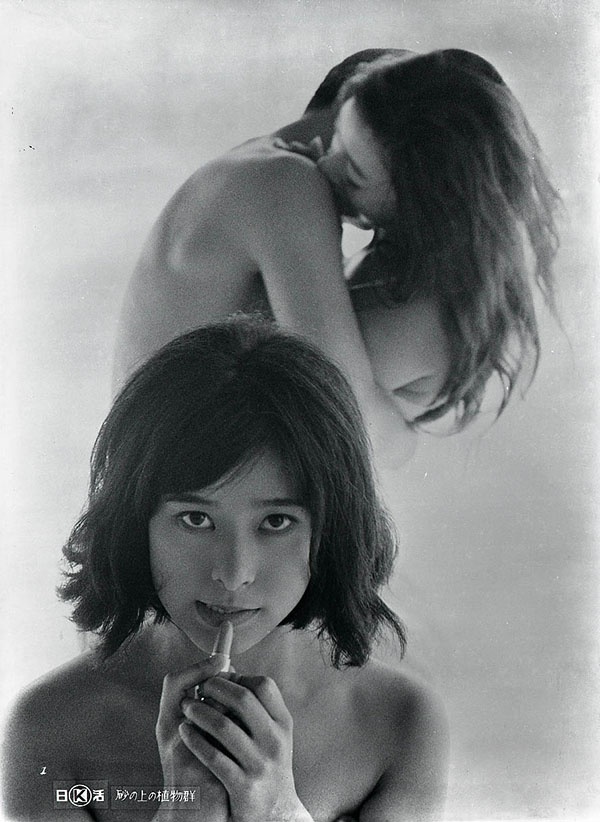
© 1964 Nikkatsu CorporationDespite being among the directors who helped to usher in what would later be called the Japanese New Wave, Ko Nakahira remains in relative obscurity with only his landmark movie of the Sun Tribe era, Crazed Fruit, widely seen abroad. Like the other directors of his generation Nakahira served his time in the studio system working on impersonal commercial projects but by 1964 which saw the release of another of his most well regarded films Only on Mondays, Nakahira had begun to give free reign to experimentation much to the studio boss’ chagrin. Flora on the Sand (砂の上の植物群, Suna no Ue no Shokubutsu-gun), adapted from the novel by Junnosuke Yoshiyuki, puts an absurd, surreal twist on the oft revisited salaryman midlife crisis as its conflicted hero muses on the legacy of his womanising father while indulging in a strange ménage à trois with two sisters, one of whom to he comes to believe he may also be related to.
After a brief prologue in which our hero, cosmetics salesman Ichiro Igi (Noboru Nakaya), imagines a scenario for a novel in which a dying husband becomes so jealous of the man that may succeed him in his wife’s life that he sets about plotting to make her the weapon of that very man’s destruction, Igi heads to his regular barber and longtime family friend where he takes the time to probe him about his late father’s womanising habits. Igi’s father died young at only 34 for years of age, three years younger than the age Igi is now. His father’s spitting image, Igi cannot help seeing him everywhere he goes and feels unable to evade his ongoing influence, almost as if he were possessed by his father’s (un)departed spirit.

The major preoccupation Igi has is that his wife (Yukiko Shimazaki) may have slept with his father before they were married while she was just a teenager. The barber tells him he’s pretty sure not, but Igi cannot let the idea go and repeatedly brings it up with his wife, creating discord in the family home. Meeting a precocious schoolgirl at the Marine Tower one evening, Igi finds himself taking her to a hotel and deflowering her even though she begins to resist him at the last minute. The girl, Akiko (Mieko Nishio), then makes a strange request of him – she wants Igi to seduce and “hurt” her older sister Kyoko (Kazuko Inano) whose sanctimonious attitude she can no longer stand. Igi does indeed visit the bar where Kyoko works as a hostess and embarks on an intense affair with her but Akiko’s pleas to “hurt” her sister are complicated by Kyoko’s masochistic tendencies and Igi’s descent into a kind of madness.

Beginning with the painting by Paul Klee which gives the film its name, Nakahira asks us to imagine what would happen if a large dash of red were suddenly to appear, disrupting the comforting harmony of Klee’s perfectly matched colours. The discomforting redness does dutifully appear as strangely shaped squares on the canvas but the symbolic value of the colour is felt throughout the black and white narrative from the dark stain of Akiko’s broken maidenhead to the affectation of her lipstick and constant references to red seas and suns.

Though Igi’s world may have seemed just as perfectly ordered as Klee’s painting from the outside, his constant preoccupations with his father become the disruptive influence which leads to all of the redness later leaking in. Haunted by his father as he is, seeing his face everywhere from train windows to the barber shop mirror, Igi’s attempt at a plot for a murder mystery takes on a strangely Oedipal quality as we begin to wonder if it’s his father rather than Igi himself who has assumed the role of the “protagonist”, leaving a time bomb for his wayward son, the inheritor of his woman, just as Igi laid out in his prologue. Bizarre reality or another symptom of Igi’s increasingly fractured mind, the plot seems likely to succeed at least in a sense as Igi declines into a dishevelled mess, prone to hallucinations and uncertain visions.

Nakahira gives us several of these as Igi panics and struggles with a key only to open a door into bright white light and nothingness or another in which he and Kyoko dine in an empty restaurant which is suddenly filled with the noisy chatter of other diners. Strange touches such as the German beerhall with a Spanish guitarist, or the odd peepshow in which Igi and his two friends take on the appearance of demons or impassive Buddhist statues thanks to the light reflected into their eyes, add to the unbalanced atmosphere as do the frequent closeups of lips and hands, and the symbolic value of seeds never meant to be planted which nevertheless flower at an unintended moment. Shooting in black and white, Nakahira begins with a colour sequence featuring the abstract artwork with occasional flashes of colour as well as voice over and occasional intertitle-style captions adding to the absurdist atmosphere.

A surreal and complex psychological exploration of sex, power, obsession, identity, and legacy Flora on the Sand finds Nakahira flexing his experimental mussels for a drama rife with ambiguity and strangeness. Sadly this brand of innovation was not entirely welcome at Nikkatsu head offices and so he found himself left out in the cold eventually ending up in Hong Kong making action movies for Shaw Brothers. Despite some later success at international festivals, Nakahira’s work remains sadly neglected but the unusual degree of sophistication and almost playful atmosphere seen in Flora on the Sand make him worthy of attention as more than just an almost was of the rising New Wave.


Screened as part of the Japan Foundation Touring Film Programme 2017.

Homebound (歸路 / 귀로, Lee Man-hee, 1967)

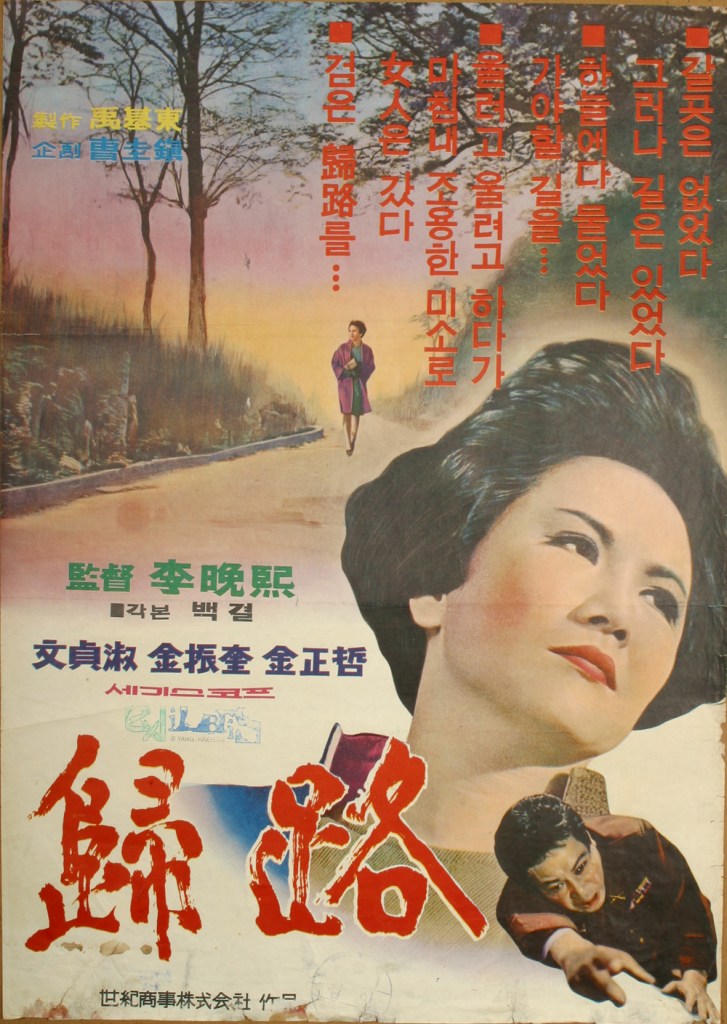
homeboundLee Man-hee was one of the most prolific and high profile filmmakers of Korea’s golden age until his untimely death at the age of 43 in 1975. Like many directors of the era he had his fare share of struggles with the censorship regime enduring more than most when he was arrested for contravention of the code with his 1965 film Seven Female POWs and later decided to shelve an entire project in 1968’s A Day Off rather than tailor it to the concerns of the day. For these reasons it’s not difficult to read a political message into Lee’s 1967 tale of the (im)possibility of escape from a moribund marriage, Homebound (歸路 / 귀로, Gwiro). Like her country, Ji-yoen finds herself at a crossroads in the battle scarred post-war world which asks her to choose between a life of miserable servitude in fulfilment of her duty or one of accepting the painfulness of public disapproval in choosing to strike out for a happier future.
For fourteen years, Ji-yeon (Moon Jeong-suk) has been more caretaker than wife to her paralysed war hero husband, Dong-u (Kim Jin-gyu), who is so absorbed in his own sense of impotence that he has almost come to resent the extreme sacrifice he feels his wife has made for him. Dong-u is now a writer earning his living through serialised newspaper stories which at least affords Ji-yoen the opportunity of frequent trips into the city to deliver his manuscripts and meet with the publishers.

As it happens, the novel Dong-u is currently writing has a meta-dimension in that it’s extremely close to his own life. The ongoing story of a paralysed writer and his “saintly” wife who endures all hardships to stay at her husband’s side has proved popular with readers but now the editor is minded to warn Ji-yoen that some are becoming bored with the wife’s unrealistic goodness. They want something more human, he says, that sort of devotedness is nothing short of dull. Offended (the editor is almost talking about her real life, after all), Ji-yeon storms out leaving her bag behind. A young reporter, Gang Uk (Kim Jeong-cheol), runs out after her and becomes instantly smitten. This fateful meeting will lead to a number of subsequent ones but like the heroine of the story the jury is out on whether Ji-yeon should leave her embittered husband for a better life with a younger man, or accept the vow she made as his wife and stay by his side no matter how unhappy it will ultimately make her.

Ji-yeon’s life is undoubtedly a difficult one despite her frequent protestations that she’s happy with her husband and could never love anyone else. Dong-u is forever trapped in the past, dreaming of his military glory and unable to accept his new life to move forward into the increasingly modern world. An early scene sees Ji-yeon deliver a letter congratulating him on the fourteenth anniversary of his wartime service. Dong-u asks Ji-yeon to help him into his uniform after which he puts on a recording of a parade and attempts to stand and salute only to immediately fall over, leading to a brief flashback of the battlefield as Ji-yeon cowers to the side, only later lifting the needle to end the ordeal.

Trapped within his own history, Dong-u berates himself for his physical failings in being unable to be a “full” husband to his self sacrificing wife. The couple have separate bedrooms and share no particular intimacy, barely even friends let alone husband and wife. Dong-u’s bitterness is all encompassing, claiming to be in regret of a sacrifice he feels has been made on his behalf which only brings him additional guilt for destroying his wife’s future happiness as the childless wife of a paralysed man. This same internalised frustration leads him to treat Ji-yeon coldly in intense resentment for the way in which she forces him to feel all of these negative emotions.

Receiving affection only from the family dog, few would blame Ji-yeon if she did find herself a way out through romance. Even Dong-u’s sister who confronts Ji-yeon after catching sight of her with Gang Uk expresses sympathy for her situation, but urges the couple to divorce in order to prevent greater suffering further down the line. Ji-yeon is torn between her uncertain feelings for Gang Uk and her duty as a wife to her husband. At one point, Ji-yeon asks a question about who in the world is the most unfortunate only to answer that it is the person who can neither be respected or hated. She can’t bear the idea of being the woman who abandoned her disabled husband for a younger man, but neither can she endure untold years of respect as his devoted wife trapped in that lonely, claustrophobic house forever.

Torn between modernity in the form of her young lover, and tradition in the form of her embittered former soldier, Ji-yeon is in a similar dilemma to her nation as she looks out at a transformed Seoul standing ready to strike out onto the world stage only to return home to her dark and dingy Incheon cottage which almost seems to exist in the never was of fourteen years before. Her final decision is an ambiguous one, paralysed in indecision as she longs for forward movement but is terrified to accept it. Lee’s film is subtle and subversive, not least in its social messages which lean towards individual freedom and happiness over duty bound tradition even whilst suggesting that those two ideals may be impossible to achieve. Shot in a crisp black and white, Homebound is a study in alienation with its claustrophobic angles and wide sweeping shots of the prospering city which seems to warn that those caught between the past and the future are likely to find themselves crushed by fear and memory in equal measure.


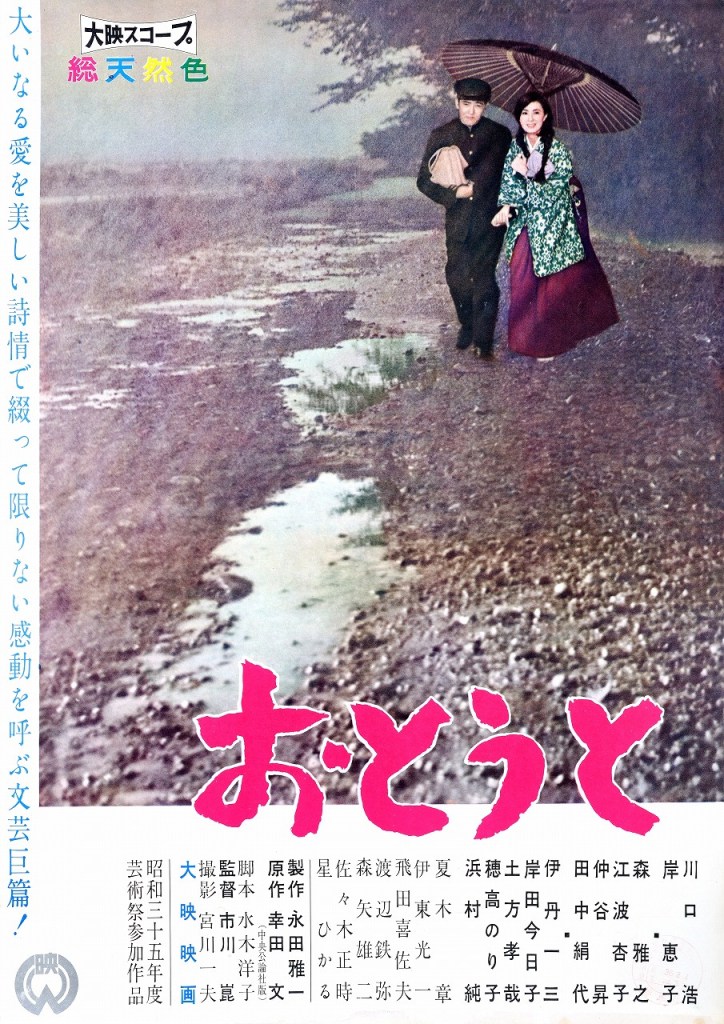
Her Brother (おとうと, Kon Ichikawa, 1960)

ototoPerhaps oddly for a director of his generation, Kon Ichikawa is not particularly known for family drama yet his 1960 effort, Her Brother (おとうと, Ototo), draws strongly on this genre albeit with Ichikawa’s trademark irony. A Taisho era tale based on an autobiographically inspired novel by Aya Koda, Her Brother is the story of a sister’s unconditional love but also of a woman who is, in some ways, forced to sacrifice herself for her family precisely because of their ongoing emotional neglect.

Oldest daughter Gen (Keiko Kishi) is still in school though she’s more or less running the household seeing as her invalid step-mother (Kinuyo Tanaka) spends most of her time bedridden with rheumatism and the rest of it pontificating about religion and listening to her poisonous friend (Kyoko Kishida) who likes to stir up trouble in this already difficult family environment. Gen’s father (Masayuki Mori) is a well known writer who needs a lot of quiet time for his work. As fathers go he’s very laid back and content to think his kids will be OK because they’re his kids, which isn’t to say he doesn’t care but he’s not exactly present most of the time. It’s no surprise then that care of the family’s youngest, Hekiro (Hiroshi Kawaguchi), has largely fallen to his sister. Where Gen is naturally responsible and practically minded, Hekiro is reckless and always in search of adventure. Eventually this lands him in trouble when he gets involved with a bad crowd but whatever his family might have been feeling towards him, everything changes once they discover that he’s facing a serious illness.

Because of the family’s odd arrangement, Gen has become almost a maternal figure towards Hekiro despite only being a couple of years older than he is. In fact, the pair have an almost comically childish physical fight at one point which is quite undignified considering their ages, especially when it involves staining their tatami mat floor with a puddle of bright red ink. Gen does her best but like her father she more often than not lets Hekiro off the hook by bailing him out, much of the time with her own rather than her father’s money. Not having the kind of authority a parent, uncle, or aunt might have all she can really do is ask him to think about behaving better, but Hekiro constantly pushes the boundaries to get a more concrete form of attention than his sister’s well meaning attempts to help are able to provide.

Hekiro’s stunts  eventually threaten to pull his sister into his darkening world, especially when a man claiming to be a detective starts more or less stalking Gen before pulling her into a shrine on the pretext of talking about her brother’s case before trying to have his wicked way with her. Luckily Gen is saved by a flock of geese cunningly released by some of her brother’s friends which gives her enough time to escape and finally get rid of the odious little man.

Similarly, Hekiro deliberately introduces his sister to the local pool hall. Though Gen seems to enjoy the game and is even good at it, she quickly realises she’s been brought as a sort of guarantor for her brother’s mounting debts. Add in other expensive and dangerous hobbies like his boat habit (he can’t swim) and it’s not surprising everyone’s had enough of Hekiro before he’s even left school. When he has an accident which results in the death of a horse (again, very expensive), it does at least lead him to reflect on the negative effect his actions can have on those around him, even if all he wanted and continues to want is an escape from his boring and miserable family life.

Even Hekiro’s illness fails to arouse very much in the way of concern from his well meaning father and grumpy step-mother who is hellbent on marrying Gen off against her wishes. Gen is, again, the only one to nurse Hekiro in hospital, managing the household as well as looking after her brother on his sickbed. When the illness becomes more serious it provides a last opportunity for the family members to bond and make amends for the various ways they’ve failed each other. The step-mother’s visit is not as altruistic as it seems when it transpires she’s only really come to “convert” Hekiro to her religion, but she begins to feel something more for him on believing that Jesus has already saved him thanks to his outwardly calm and polite manner. The final irony is that the idealised family is only born as it is destroyed, Gen puts her pinny back on and takes the reins from her stepmother who is presumably headed straight back to bed.

Gen’s devotion can’t save her brother either from himself or his fate and it may even be the end of her too. Vowing never to marry and rising from her own sickbed stopping only to instruct her stepmother to rest, she’s very clearly chosen her path even if Ichikawa’s camera and musical cues seem to find the ironic comedy of the situation rather than the sadness of her possibly tragic plight. Ichikawa and his cinematographer invented a whole new technique for this picture – the bleach bypass, which appropriately robs the environment of its vibrancy, dulling even bright colours with a sort of heavy leaded effect perfectly reflecting Hekiro’s increasingly depressed mindset as he reflects on being someone who has no firm anchor or place to feel at home. A strange, comically melancholic piece, Her Brother is a characteristically sideways swipe at the family drama from the master of irony though one which does not altogether escape his taste for the sentimental.


Original trailer (not subtitles)