Crime Hunter: Bullets of Rage (クライムハンター 怒りの銃弾, Toshimichi Ohkawa, 1989)

Home video may still have been in a nascent and chaotic stage of development when Toei video executive Tatsu Yoshida began conducting customer research in video rental stores, but what he discovered shocked him. Customers were maxing out their five video allowance and watching them all the same evening. How did they have time for that, he wondered. The answer was that they were watching them all on fast forward to cut out the boring bits, like the story and exposition. It was this that gave him the idea to create “movies that will not be fast forwarded,” chiefly because they had already been excised of anything “inessential”.

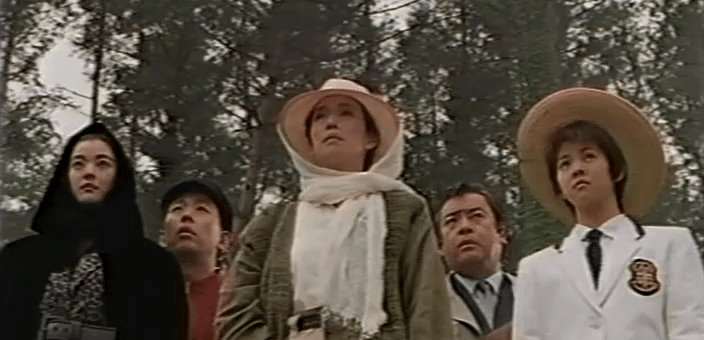
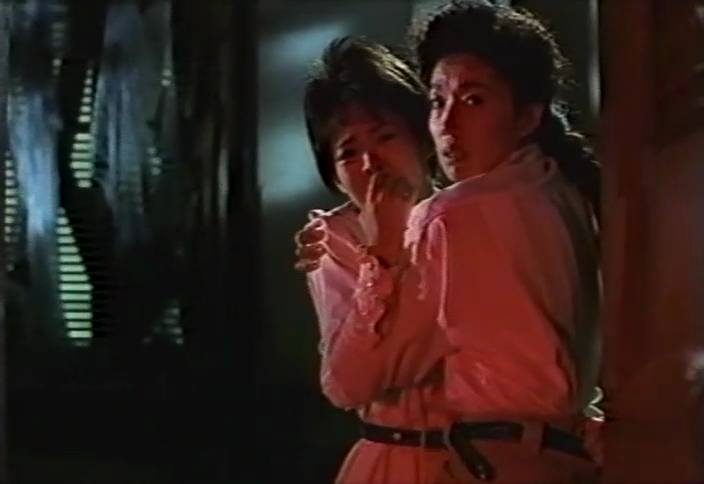
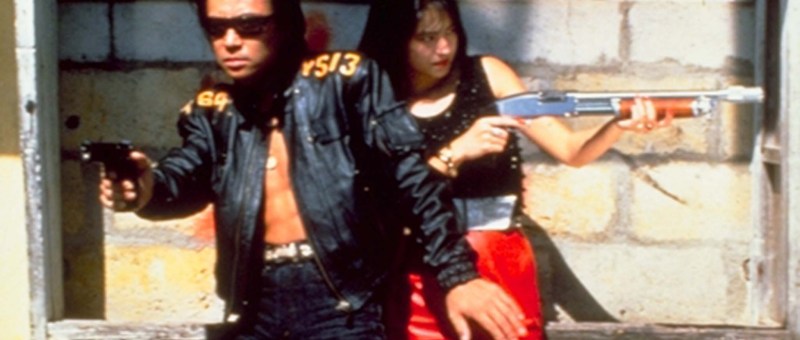
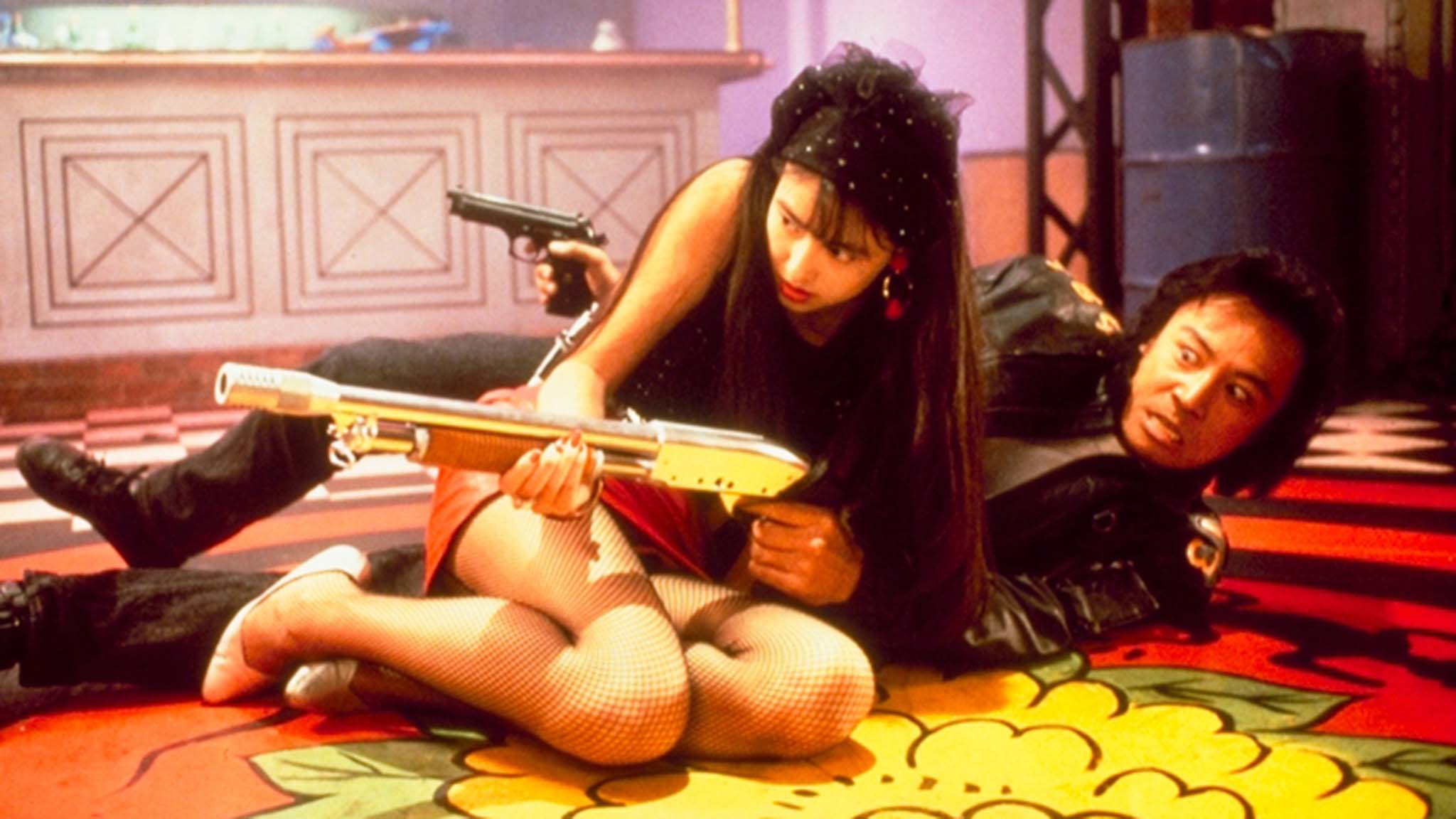
Only an hour in length, 1989’s Crime Hunter: Bullets of Rage (クライムハンター 怒りの銃弾, Crime Hunter: Ikari no Judan) was the first in Toei’s new V-Cinema range and was indeed made to conform to these aims. Consequently, it focuses mainly on action with minimal narrative and relies on genre archetypes to help the plot move along. In that, it owes something to Nikkatsu’s borderless action films in taking place in Little Tokyo (largely filmed in Okinawa) though otherwise in a world that’s recognisably Japanese despite the English-language police radio and Japanese-American names like that of fugitive criminal Bruce Sawamura (Seiji Matano) and Joe “Joker” Kawamura (Masanori Sera), the cop who’s trying to track him down but only as a means to an end in his quest to avenge the death of his partner, Ahiru (Riki Takeuchi). We can tell that Ahiru’s not going to last long in this film because we’re told quite quickly that he’s been invited to the chief’s daughter’s birthday party and is seen as a potential suitor, while after apprehending Bruce he complains that his mother bought him the shirt that’s now been stained. 

Joker’s attachment to Ahiru goes a little beyond that of a mere partner as he hands back his badge to pursue revenge while picking up the empty packet of pop-corn Ahiru had been eating and placing it over his heart. The film seems to owe a lot to contemporary Hong Kong action films and Heroic Bloodshed such as A Better Tomorrow, and it’s apparent that this almost homoerotic relationship between the men has taken the place of heteronormative romance. The female star, Lily (Minako Tanaka), is (nominally at least) at nun which makes her romantically unavailable to Joker or indeed to Bruce while in some senses she represents opposition because her cause is at odds with Joker’s. While they temporarily align in wanting to find Bruce, Joker wants information that will lead him to the identity of his partner’s killer, while for Lily he’s the endgame because she wants to get back the money he stole from the donation box at her church. 

This whole narrative strand doesn’t make a lot of sense in that Lily says she accidentally told Bruce about the donations after having too much to drink at a party with her non-nun girlfriends, which is strange behaviour for a bride of Christ. Now she feels like retrieving the money is her responsibility, though Joker isn’t really interested in that. What he discovers is further kinship with the fugitive Bruce on realising that they’ve both become victims of a corrupt police force. The opening police radio broadcast implies that Little Tokyo has become an oppressive police state in which the threat of drugs and gangs is being used to control people while cops like Joker have been given blanket permission to aim at the head of suspected criminals as they do while arresting Bruce. Joker had thought that the guys who attacked them were Bruce’s men breaking him out or otherwise trying to steal the money off him, only to later realise they were actually corrupt police. 

But really not much of that matters in comparison to the increasing outlandishness as Lily transitions from wimple-wearing bad ass sister to a nightclub dancer femme fatale in fishnets infiltrating the Cathay Tiger gang with expertly crafted dance routines. Former mercenary Bruce similarly boasts and improbably impressive arsenal of grenade launchers and machine guns before arriving at the depressing environment of a disused industrial complex for the nihilistic showdown in which Joker realises there is no way to right this world of corruption and that he and Bruce weren’t so different in each being controlled and defined by an oppressive society in which there are no happy endings even for heroes.
The Killer (喋血雙雄, John Woo, 1989)

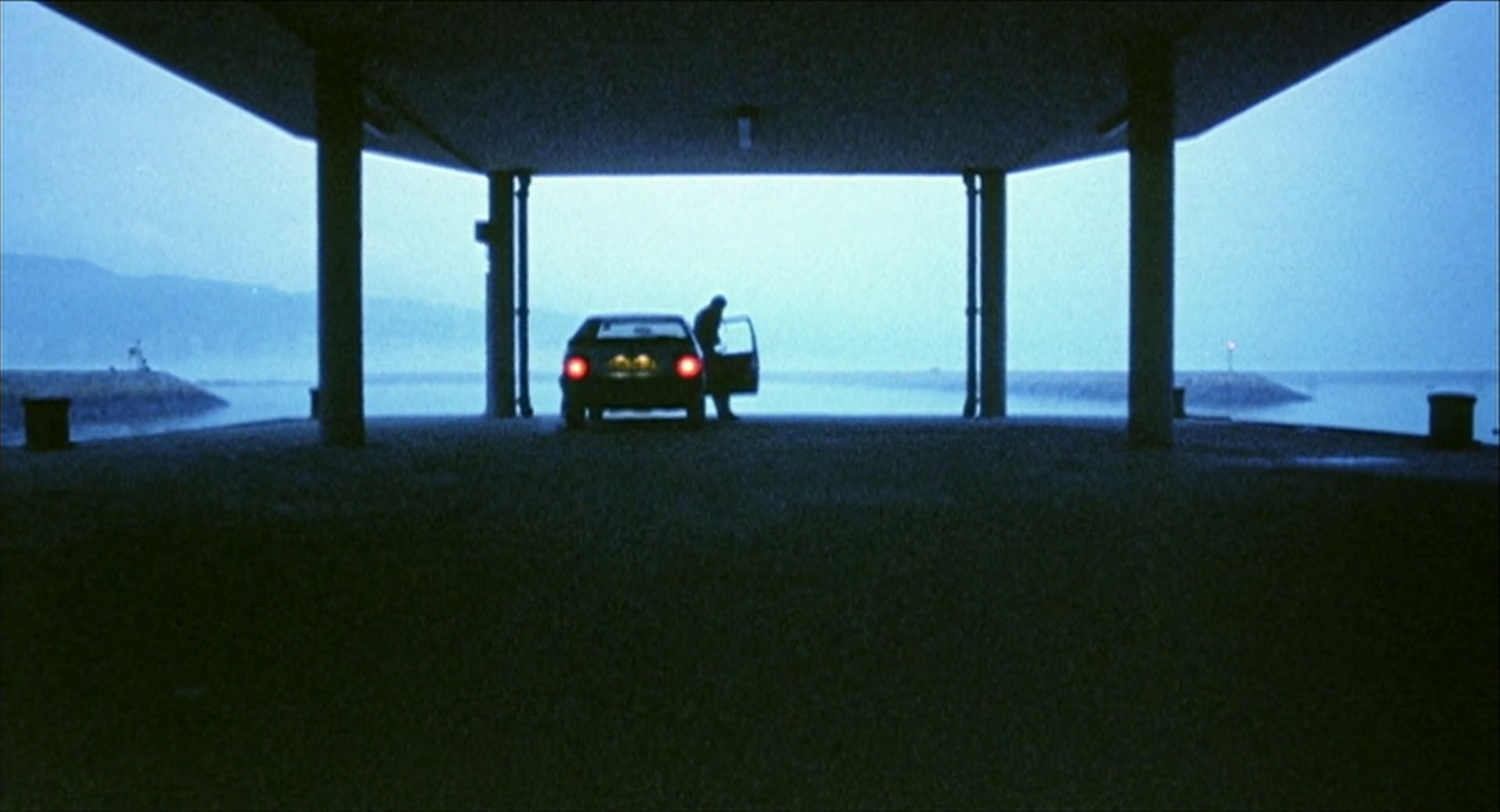
“We’re outmoded characters,” a dying man laments, having previously advanced that “nostalgia is one of our saving graces.” The heroes of The Killer (喋血雙雄) are indeed remnants of an earlier time, out of place amid the modern city and adhering to a code that has long since fallen by the wayside. “Our world is changing so fast,” hitman Jeff (Chow Yun-fat) exclaims of a Hong Kong hurtling not only towards the Handover but an increasingly amoral capitalism in which friendship and brotherhood no longer have any currency.

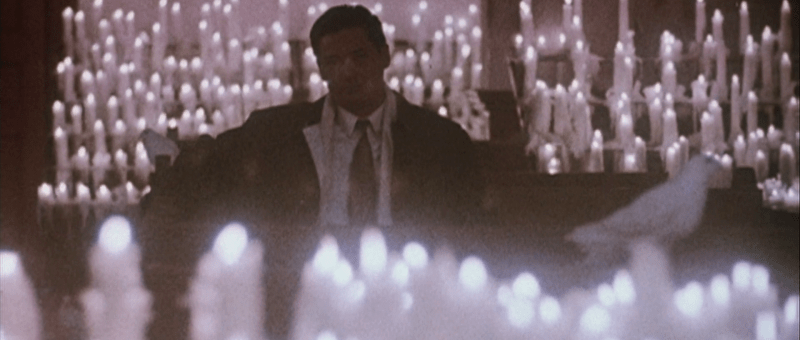
We can tell this straightaway from the fact that the man who ordered the hit on the drug lord Jeff took out at the dragon boat races was his own nephew, Weng (Shing Fui-on). To tie up loose ends, Weng also sends his own hitmen to take out Jeff, who can’t be sure if his handler and best friend Sidney (Chu Kong) is involved in the plot to knock him off. Later in the film, Inspector Li (Danny Lee) asks what Jeff will do if Sidney betrays him, but he merely says that he will still treat him as a friend because he has been good to him in the past. Jeff says this in an abandoned church, echoing not only the codes of jianghu brotherhood now largely absent in the contemporary society but Christianising notions of forgiveness and acceptance. 

Jeff claims that he isn’t a religious man but appreciates the tranquillity of the disused chapel. Inspector Li meanwhile is often pictured next a statue of the Buddhist god of war and dressed in black in opposition to Jeff’s white, but what emerges is that the two men are effectively the same and somewhat interchangeable. Jennie (Sally Yeh), the nightclub singer Jeff accidentally blinded during a a chaotic hit and subsequently falls in love with, first mistakes Li for Jeff while Woo also pictures him sitting in Jeff’s chair and pulling a gun on his partner in much the same way Jeff cooly dispatched an assassin sent by Weng. Chang had told Li that he looked exactly like what he was, an undercover policeman, which is obviously a problem, but Jeff remarks that he is a “very unusual cop,”while Li agrees he’s a very unusual killer. 

In some senses, Li will also become the killer of the film’s title in the closing moments, a man who believes in justice but is not himself believed and knows that there will be no real justice for a man like Weng. Both men share a code which is essentially the same, a more primal kind of morality largely incompatible with the modern society and in many ways rightly so. Li even says that Jeff does not look like a killer, that there’s something “heroic” about him, and that his eyes are full of passion as if he had a dream. His words have a kind of irony to them, but Jeff does indeed have a dream in the desire to gain redemption for himself by restoring Jennie’s eyesight, which is the reason for his last big job having now been reformed by her no longer believing that the people he killed deserved to die but that everyone has a right to live.

Despite the triangular relationship with Jennie, there is an undeniably homoerotic tension in the connection between Li and Jeff even if they are also two sides of the same coin. They train their guns on each other and lock eyes, but unexpectedly find a kindred spirit in a man who should be an enemy. “The only person who really knows me turns out to be a cop,” Jeff chuckles but has an equally deep relationship with handler Sidney just as Li has with parter Chang (Kenneth Tsang) while the homosociality that defines their world is subverted by Weng who simply shoots his own underling when he becomes inconvenient to him. 

Both Li and Jeff are effectively men left with “no way out” and “nowhere to go” because their code of brotherhood is no longer understood by the contemporary society. Jennie’s progressive loss of sight also echoes their dwindling futures as if the light were going out of their world long before Woo shatters the statue of the Virgin Mary and unleashes the doves of futility inside the no longer quite so tranquil church that becomes the final resting place of manly honour and brotherly love. “Perhaps we are too nostalgic,” Jeff sighs but nostalgia is indeed his saving grace in a world in which honour and friendship exist only in a mythologised past or may never have really existed at all.


Trailer (no subtitles)

Raffles Hotel (ラッフルズホテル, Ryu Murakami, 1989)

An actress gradually dissolves into her own image while wandering around Singapore in search of lost love in Ryu Murakami’s adaptation of his own novel, Raffles Hotel (ラッフルズホテル). Ryu Murakami may generally be more associated with the extreme revolving around transgressive sex and violence, yet like its namesake the film is a more elegant affair indulging in its own sense of mystery tinged with a melancholy eeriness in its heroine’s apparent instability. 

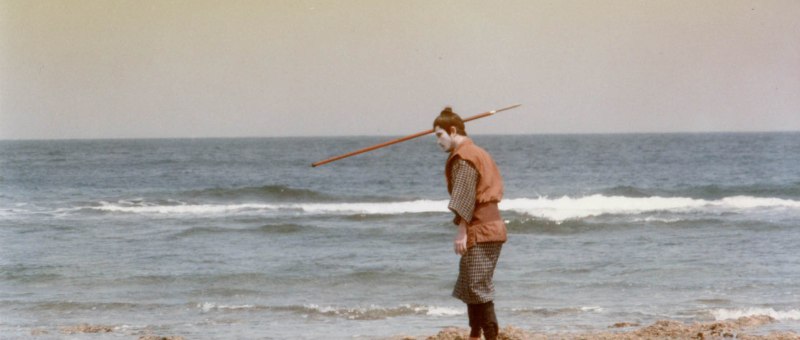
Moeko (Miwako Fujitani) later admits that she is no longer an actress, and therefore no longer quite herself uncertain who it is she’s meant to be. In one sense perhaps that’s why she’s come to Singapore though in another it’s someone else she’s looking for though to begin with we may think she’s there to escape him, and it could be that too. “Maybe I’d feel better if he were,” she muses when her tour guide, Yuki (Masahiro Motoki), explains that there are no Japanese people near the gravestones she’s just been looking at trying to assure her that the man she’s seeking is not dead. She thinks she sees him everywhere, dropped into typical Singaporean scenes appearing as a durian seller or a man restoring a church while more literally haunted by the spectre of a friend who apparently died in Vietnam while covering the war. Kariya (Jinpachi Nezu) later tells her that he can’t forget the jungle while she asks to be taken there with him and travels to a mountain lodge where they hunt wild game with a crossbow. 

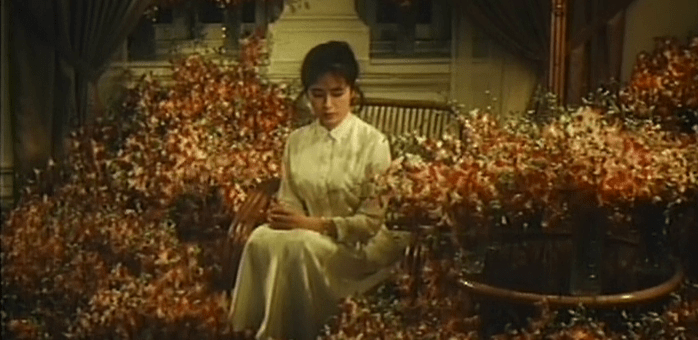
Yuki first becomes worried about her when her hotel room is filled with orchids she claims are from Kariya only to discover she ordered them herself when the orchid house contacts the hotel to complain that the bill has not been paid. Even so, she continues to believe they are from the man she’s looking for, even going so far as to thank him for them as if unable to process the gap between her realities. We often see her looking at photos from her photo shoots, while she later complains to Kariya that she wants to laugh when she wants to laugh and cry when she wants to cry as if making plain her disconnection with her self and desire to reassert her own identity over those she is forced to assume as an actress. 

This abstraction may also explain her words to Kariya that the sky is full of stars but that they are distant from each other and therefore the sky is only make-believe as if the image of Moeko that we see is only an illusion we’ve patched together from the various components available to us. It speaks of her alienation and loneliness, two qualities only deepened by her presence in an unfamiliar culture where she cannot speak the language. Acting as her guide, Yuki describes her as a polar opposite to his Singaporean girlfriend (Fawn Wong), the daughter of a wealthy family who is bold and confident, unafraid to chase her desires be they dancing or “Japanese hoods” as her father describes them. 

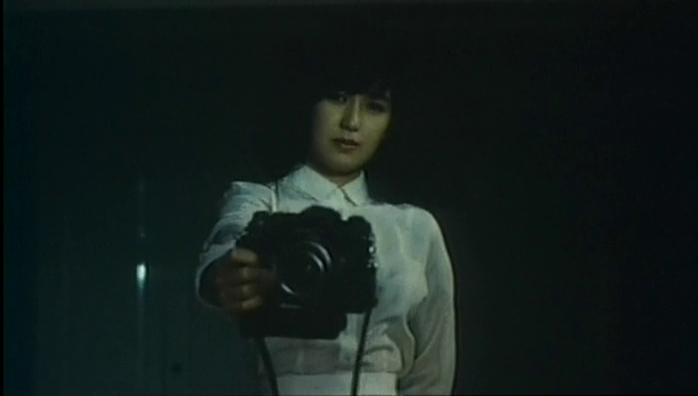
Murakami semi-exoticises Singapore if at times ironically in homing in on the portraits of famous authors in the bar and a man who always seems to be banging away on a typewriter. He sends Moeko all around the island and follows her as she takes in tourist sights, tries durian, and watches Chinese opera but lends an eerie quality to her place within the hotel implying finally that her room has in a way swallowed her as her name is added to the list of famous people who have stayed there even as she remarks that she feels as if the ceiling fan has become sentient in its movement. In any case, the camera is something that she both fears and craves as it both gives and takes her identity. She tries to pick it up herself but points it without looking, finally asking Kariya to take her picture only to find herself becoming one with her image just as Kariya is reduced to shadow as if her very essence had dissipated into the atmosphere as symbolised in a swimming pool full of orchids. “Lost in a fantasy” she may be, but so are we, led astray by a vision of a woman we can never really see. 


Circus Boys (二十世紀少年読本, Kaizo Hayashi, 1989)

“There’s bad cheating and good cheating,” according to a little boy who will later become “a magician of words and juggler of lies,” in Kaizo Hayashi’s ethereal fable, Circus Boys (二十世紀少年読本, Nijisseiki shonen Dokuhon). Set in early showa, though the early showa of memory in which many other times intertwine, the film positions the transient site of a circus tent as a roving home for all who need it or are seeking escape from the increasingly heightened atmosphere of the early 1930s. Yet where one of the titular boys chooses to stay and earnestly protect this embattled utopia, his brother chooses to leave and seek his fortune in the outside world.

In fact, it’s Jinta (Hiroshi Mikami) who first becomes preoccupied with their precarious position realising that they’ve been hired to look cute riding the elephant, Hanako, but will soon age out of their allotted role and if they can’t master some other kind of circus trick there may no be a place for them in the big tent. For this reason he’s been training in secret with the idea that he can pass off the skills he’s perfected as innate “talent” so the circus will want to keep him on. Wataru (Jian Xiu), his brother, doesn’t quite approve of his plan. After all, aren’t they essentially tricking the people at the circus into thinking they’re something they’re not? But Jinta assures him it’s like “magic,” the kind that will allow them to stay in their circus home which later comes to seem a place of mysticism or perhaps make-believe on its own.

Thus Wataru walks a fine line. His name means “to cross over,” but he never does. He tries to walk the tightrope before he’s ready and is unbalanced by a storm. Jinta breaks his fall, but also in the process his own ankle. Along with it go his dreams. His foot never heals, and he’ll never fly the trapeze with Wataru like he planned though he keeps his injury a secret from his brother. While Wataru flies with new girl Maria (Michiru Akiyoshi), Jinta becomes a clown, a position he’d previously looked down on and later leaves the circus altogether using his talent for magic and performance to become a snake oil salesman tricking what appear largely to be poor farming communities into buying things like miracle soap and coal that burns for a whole month. This is clearly bad cheating, though he tries to convince himself it’s not while essentially remaking the world around him through his lies. 

But he retains his integrity in other ways. After being press-ganged into a yakuza-like guild of street pedlars, he gently excuses himself when invited to dine with a boss and confronted by an odd situation in which his wife has purchased another young woman to be his “plaything.” In a comment on contemporary patriarchal norms, the young woman is referred to as “Omocha,” which literally means “toy,” but also sounds a like a woman’s name because it begins with the character “O” which was used as a polite prefix for female names until the practice faded out after the war. The boss of course treats her like a doll, and even the wife refers to her as an “erotic instrument” she got as a way of managing her husband’s sexual appetites fearing he’d otherwise be seeing sex workers and bring a sexually transmitted disease into their home (and also possibly because she simply doesn’t want to sleep with herself any more than she has to). Referred to only as Omocha the woman has almost no agency and finds a kindred spirit in Jinta (whose name contains the character for “humanity”) because like him she also escapes the hardships of the world through lies and fantasy. “Can two lies make one big truth?” Jinta muses, breaking the codes of Guild as he prepares to rescue another man’s plaything, only it may be more like she rescues him. 

Meanwhile, Wataru tries to save the circus even after their ringmaster dies with visions of Jinta on his mind. They plan a wall of death to bring back the crowds, but Wataru’s plan backfires with tragic consequences and it becomes clear he can’t protect their circus family even if it brings back veteran trapeze artists Koji (Yukio Yamato) and Yoshiko (Maki Ishikawa) who agree there’s no other place for them out in the big wide world. The sense of the circus as a safe space was echoed on Maria’s arrival when Jinta had cruelly said she looked a little foreign with the ringmaster assuring her that in here they’re all artists and do not classify people in terms of their race, appearance or nationality. Its unreality, however, is reinforced by the constant backing of Wataru’s shadowplay which sometimes shows things the way people wish they were rather than the way they are. Omocha is later seen holding one of these puppets just as she and Jinta decide to die to free themselves of this hellish existence before Jinta’s surrogate brother figure Hiroshi (Shiro Sano) is forced to kill them for breaking the rules of the guild.

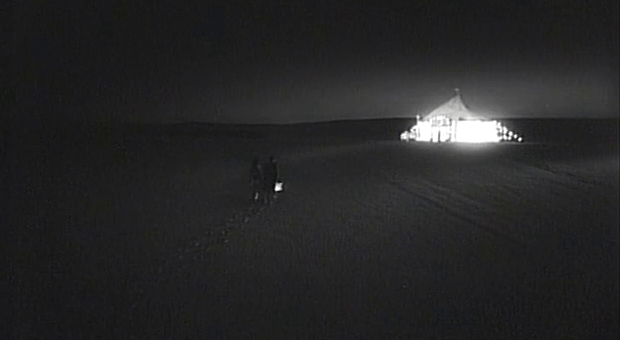
In the ambiguities of the final sequence, we might ask ourselves if they are actually dead and the glowing circus tent they see on the horizon is a path to the afterlife or a kind of heaven represented by the utopia to be found inside it. Then again, perhaps Jinta is merely rediscovering the way home, a prodigal son who now understands he already had a place to belong and there is a place to which he can return. The Great Crescent Circus is now the Sun & Crescent Circus, reflecting the way the two boys inhabit the world like and dark, idealism and cynicism, but comprise two parts of one complete whole. Hayashi waxes self-referential, playfully including a reference to his first film in that the movie playing at the cinema Jinta passes is The Eternal Mystery with Black Mask on his way to rescue Bellflower while indulging in an intense nostalgia for a lost world of travelling shows and hidden magic. Shooting in a beautifully balanced monochrome, he lights on scenes of heart-stopping beauty that are somehow poignant and filled with melancholy but ends with a moment of resolution in which, one way or another, Jinta reaches the promised land as he said with magic.


Circus Boys screens 12th October at Japan Society New York.

No Life King (ノーライフキング, Jun Ichikawa, 1989)

Taking place at the tail end of the Bubble era and on the eve of a technological revolution, Jun Ichikawa’s No Life King (ノーライフキング) in many ways anticipates the world we have today in which much of our communication has already become digitised. The cult-like speech of the next-gen guru who pops up towards the film’s conclusion may have eerie ring to it, but he has a kind of point in his talk of “new children” who will become “new adults” in a new digital world that was then only just becoming a reality. 

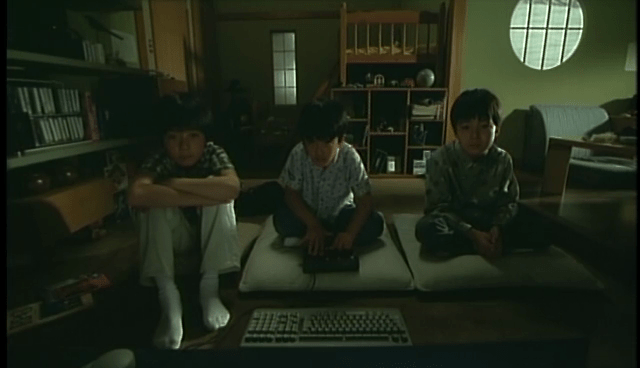
As someone later says, “the problem is not video games” though many seem to assume it is. The hero, Makoto (Ryo Takayama), whose name means “truth”, is one of a group of five boys obsessed with Nintendo console gaming. A game series known as Life King has become so popular that hundreds of youngsters camped out all night waiting for the release of the fourth instalment. The only problem is that the game seems to be unbeatable, and Makoto’s young friends begin to hear rumours that some of the cartridges are “cursed” with an alternate “No Life King” version that means death for players who cannot finish the game. 

The “curse” reflects a confusion that is beginning to emerge over what is “real” and what is “virtual” in an era of rapid technological development. The kids begin to worry that if you die in the game you die for real, while otherwise becoming obsessed with all kinds of urban legends relating to mysterious deaths and conspiracy theories such as that of the actor who plays tokusatsu hero Pris secretly being dead and that all the collectible Pris pencil erasers you can get from gachapon machines are cursed with the resentment he felt as he died. Some would be keen to dismiss this kind of thing as silly things kids say, but then Makoto’s mother also suggests that cakes from the bakery the family of his classmate Noriko owns are “cursed” as customers have been coming down with food poisoning after eating them. According to the guru’s assistant Mizuta (Neko Saito), the rumours are having a serious economic impact and have led to delays in product launches and construction projects in addition to provoking a politician’s resignation. 

Then again, the film seems to wonder if it’s the Bubble-era economy which is the enemy. While Makoto plays video games on his own but chats to his friends doing the same thing via telephone headset, his mother often works late into the night staring at a computer screen in their home. Makoto attends a summer cram school where all of the work is done via computers linked via a primitive version of the internet. The teacher is present but cannot actually see any of the children and they can’t see him. Questions are asked and answered via the interface rather than directly, though the computer network of cram school students does eventually allow Makoto to get in touch with other “new children” who are just as worried about the cursed game as he and his friends are while the adults respond by taking their consoles away which of course denies them the ability to lift the curse by beating the game. 

The “curse” itself may symbolise mortality, though obviously the children will still someday die regardless of whether they beat Life King IV because life itself is an unwinnable game. “The problem is…” the opening text crawl explains, “the battle has begun. It is unlikely to end until you die.” The same words are uttered by Makoto’s principle only he substitutes “video games” for the second part of the sentence before dramatically falling backwards just like the stricken king of the game while Makoto and the other kids are lined up almost identically to the ranks of soldiers amassed in front of him. This moment of symmetry links back to a line from the guru Akiyuki Mori who hints at a new world in which life and death exist simultaneously. It is this new world that “new children” must learn to adapt to as they grow with technology.

“It’s scary, but we’ll die if we can’t lift the curse” Makoto tells one of his online buddies and eventually becomes an accidental folk hero with the other kids looking to him to free them by beating the game. Graffiti tags go up all over the city reading, “hang in there, Makoto”, while he becomes preoccupied by the nature of the “real” as related to him by Mori and his assistant Mizuta who begin to view him as something like a prophet or at least the first of the “new children” to enter the “new real” in which the distinction between the “real” and “virtual” has disappeared. Fearing for his mortality, Makoto saves himself in the digital space by writing a bio and saving it to floppy disc much as a hero who died in the game was immortalised in stone so that no one would ever forget that he existed. 

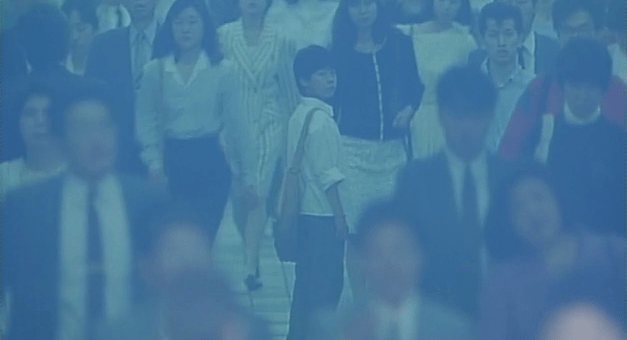
By the film’s conclusion, “real life” has become a kind of game as evidenced by the advice of Makoto’s cram school tutor that he try and raise his score by 20 points to increase his chances of getting into a higher level institution. The mysterious boy somewhere on another computer tells him to go and look around outside at which point he wanders through the contemporary city and sees it with new eyes. “It is all real” he concedes, catching sight of Mori and his assistants in the crowd just as we start to wonder if this really is “reality’ after all. Then again, perhaps the best lesson the boys learn is from one of their grandfathers who simply “kept living until he died”. Ichikawa captures a sense of technological anxiety in the uncanny eeriness of the “real” world around the boys but is perhaps less pessimistic about the new age that awaits them in the solidarity that exists between the “new children” despite the seeming indifference of the adults incapable of understanding the anxiety that engulfs them.


All About Ah-Long (阿郎的故事, Johnnie To, 1989)

“Don’t ever make mistakes, you’ll never get a second chance!” warns the hero of Johnnie To’s melancholy male melodrama, All About Ah-Long (阿郎的故事). Ah-Long is indeed a man who’s made mistakes, mistakes he fears can never be corrected that have removed all possibility of his redemption only to be presented with new hope through a chance encounter and to have that hope eventually smashed by the cruel hand of fate. 

A former motorcycle racer, Ah-Long (Chow Yun-fat) has a job driving a truck at a quarry and lives in a tiny two room apartment sharing a bed with his 10-year-old son, Porky (Huang Kun-Hsuen). A fateful introduction from an old friend, Dragon (Ng Man-tat), accidentally reunites him with former girlfriend Por Por (Sylvia Chang), now calling herself Sylvia having become a successful ad executive after moving to the US following the couple’s acrimonious breakup while Ah-Long, badly injured in a motorcycle crash, ended up spending some time in prison. Sylvia’s class conscious mother had not approved of the relationship and in fact told her that the baby had died to convince her to move abroad. Discovering that Porky is alive, she begins to want him back planning to take him with her when she returns the to the US in the company of her fiancé Patrick (Alan Yu Ka-Lun). 

The situation may be somewhat reminiscent of the then recent Kramer vs Kramer but the parameters of the dilemma are different. Sylvia did not wilfully abandon her child nor is she being asked to choose between motherhood and personal fulfilment though as we later discover the traumatic circumstances of Porky’s birth have left her unable to bear any more children meaning that Porky is the only possibility of her reclaiming her maternity. Her request is in its own way selfish, considering her own feelings over Porky’s in suggesting they remove him from his home and everything he’s known while disrupting the clearly very close relationship between Ah-Long and his son. There is also something uncomfortable in the mediation of her love as she showers Porky with expensive gifts Ah-Long could never hope to provide, almost as if she were trying to buy him or at least tempt him away from wholesome working class Hong Kong towards consumerist paradise in the US hinting at the new international possibilities of a future outside of the post-Handover nation. Emptying his bank account, Ah-Long buys the puppy in a pet store window that Porky had doted on, but the boy barely reacts too busy playing with the new desktop computer Sylvia has set up for him in addition to tidying the apartment and making soup while Ah-Long was out. 

Through flashback we realise that Ah-Long was womanising bad boy, drunk and abusive, but has apparently seen the error of his ways humbled by his accident and matured by fatherhood now apparently reformed and dedicated solely to Porky’s upbringing. All he wants for him is a comfortable life and he knows that Sylvia can give that to him even if it means leaving Ah-Long behind alone in Hong Kong. While Sylvia’s fiancé Patrick claims not to care about her past but becomes increasingly controlling and paranoid, unwilling to accept Porky and insistent that they adopt a child of their own while resentful of her relationship with Ah-Long, Ah-Long continues to dream of a traditional family reunion with Porky showing the former lovers how to walk together during a parents’ three-legged race at the school sports day. 

Yet there is always a degree of distance between the one-time couple. To opens the film with the camera looking up at a pair of high rise buildings as it sinks to street level and then rises finding first Ah-Long’s moped and then the tiny apartment he shares with Porky. The camera pulls up again to catch the name of the swanky hotel where Sylvia is staying, a captivated Porky mystified by the elegant glass elevators rising inside, while Sylvia can hardly bear the literal rollercoaster ride at a local theme park the implication being that she can no longer bear the ups and downs of a life like Ah-Long’s while Porky may not be able to ascend to her life of middle-class stability. The promise of a life of comfort threatens to break the bond between father and son, the question becoming whether it is selfish of Ah-Long to prioritise their emotional bond in a life of wholesome poverty rather than sacrifice himself in allowing Sylvia to take Porky with her back to affluent if emotionally empty America. 

Even so, it begins to seem as if the pair may reach a form of equilibrium that places them on a similar level as Sylvia rejects the overbearing Patrick and leaves a door open for the reunion of the traditional family with a reformed Ah-Long who has learned the error of his ways and done his best to make amends. In true To fashion, however, fate has other ideas. Ah-Long sees his longed for dream in front of him and rides fast towards it only to be denied as if the universe had suddenly refused to grant him his redemption. The bleak conclusion perhaps implies that there really are no second chances for men like Ah-Long no matter how much they want them, while the peculiar contradictions of pre-Handover Hong Kong preclude such ordinary visions of happiness as could be found in familial reunification. 


Trailer (no subtitles)

You’ll Fall For Me (君は僕をスキになる, Takayoshi Watanabe, 1989)

Two mismatched friends find themselves caught up in an ironic love square in Takayoshi Watanabe’s infinitely charming Christmas rom-com, You’ll Fall for Me (君は僕をスキになる, Kimi wa Boku wo Suki ni Naru). A bubble-era nonsense comedy filled with surreal humour and zany gags along with genuine heart, the film pits friendship against love but not only of the romantic kind as the two women each consider acts of selflessness in knowing that pursuing, or preventing the other from pursuing, their romantic destiny will necessarily cause each of them pain. 

Beginning in the summer the film opens with a bizarre incident in which mousy pudding-obsessed librarian Tomoko (Yuki Saito) thinks she sees her neighbour across the way, Chika (Kuniko Yamada), jump off the roof of a nearby building only it turns out to be a strange practical joke. Chika certainly has a flair for the dramatic along with an unusual personality that has made her something of an outcast at her office job while even her friendship with Tomoko seems somewhat one-sided with her constant refrains of “you’re my best friend!” which are generally met by a blunt reply from Tomoko of “we’re not friends”. In any case, Chika’s current dilemma is that she doesn’t have a date lined up for Christmas Eve and thinks she’s jinxed because she always seems to get dumped right before the big day, while Tomoko is rather shy and it seems had no expectations of getting a boyfriend anyway. 

Their prospective suitors are a couple of salarymen, the feckless son of a CEO, Kyosuke (Masaya Kato), and his nerdy best friend Junpei (Senri Oe) who like Tomoko is a spectacles wearer. The pair have a typical meet cute when they bump into each other at a crossing and knock each other’s glasses off, each ending up with the wrong pair and not realising until it’s too late. Meanwhile, at the office, Kyosuke is being pressured by his father (Jo Shishido) to embrace adult responsibility and meet a prospective candidate for an arranged marriage who looks suspiciously like Chika though Kyosuke never looks at the photo. To get him off his back, he says he’s dating a woman from the company. Because he’s just that popular, a stage event is organised at which Kyosuke is supposed to announce who it is he has his eye on but he scandalises just about everyone by naming Chika who wasn’t really in the running. 

In the opening scenes, however, the guys had been indulging in a bit of 80s excess dribbling champagne from a helicopter some of which had rained down on Tomoko as if anointing her from above. She ends up having a second meet cute, this time with Kyosuke, who accidentally hypnotises her to think she’s a dog leading her to then attack him. A similar thing happens to Chika who is looked after by Junpei after having too much to drink on a date with Kyosuke at a nightclub where Tomoko had also agreed to go on an awkward date with Junpei. Inconveniently, the entirely mismatched Kyosuke ends up falling for the mousy charms of Tomoko who at this point doesn’t know that he’s “dating” Chika.

While the film presents an interesting picture of women in the workplace at the height of the bubble era, it also subtly undermines the prevailing consumerist culture of the age while preserving the romanticisation of Christmas. They two women each want to find a boyfriend to spend Christmas Eve with partly for reasons of social status and partly because they are simply quite lonely, Chika in particular very invested in her friendship with Tomoko while she, much more introverted, seems continually exasperated but despite herself allows Chika to dominate her existence. After becoming aware of their romantic conflict, the two women end up spending Christmas Eve together at a nice restaurant prioritising friendship over romance until one of them realises the other is unhappy and after discovering a note from their suitor asking them to meet in a local park chooses to spend the rest of the evening alone so her friend can go get her man. 

Then again, there’s a clear idea that Tomoko in particular is undergoing a kind of transformation signalling her shift away from Junpei by deciding to get contacts, putting on lipstick, and dressing in a slightly less mousy fashion while Chika’s attempt to become the sort of woman that Kyosuke would date by dressing and acting more like the other women in the office largely backfires. Meanwhile Kyosuke and Junpei are also changing, Kyosuke giving up his womanising ways and becoming more serious in his pursuit of Tomoko while Junpei comes to appreciate the vulnerable force of nature that is Chika. The film takes its title from Kyosuke’s attempt at hypnotising Tomoko into falling in love with him only to find that he’s the one who’s fallen under her spell as they move towards the anticipated Christmas Eve climax accompanied by the now classic song by Tatsuro Yamashita. Faced with the choice, the women do indeed choose friendship over love but discover that it isn’t really a choice at all because they both just want their friend to be happy even if it means a lonely Christmas for themselves as the ironic role reversal of the closing coda makes clear.


Original trailer (no subtitles)

Tatsuro Yamashita – Christmas Eve

Sweet Home (スウィートホーム, Kiyoshi Kurosawa, 1989)

A documentary film crew hoping to discover long-hidden frescos by an artist with a tragic history find themselves on a quest to resurrect the traditional family in unlikely horror comedy Sweet Home (スウィートホーム). Written and directed by Kiyoshi Kurosawa, the film shares many of the hallmarks of his later career in his preoccupation with what lurks in the shadows, yet produced by Juzo Itami who also stars and apparently reshot some scenes himself it also mines a deep seam of ironic humour harking back to classic serials and contemporary kids adventures in the same way as Hiruko the Goblin among others would do just a few years later. 

This strain of irony is perceptible in the opening scenes in which producer Akiko (Nobuko Miyamoto) appears in an elegant ’40s-style outfit more in keeping with an archeological dig than a haunted house adventure, her later attire strongly recalling that seen in Indiana Jones. The gang are waiting by their military-style jeep seemingly in the middle of a sandstorm while chief producer Kazuo (Shingo Yamashiro) is busy at the municipal office trying to get permission to enter the Mamiya Mansion which has been shut up for the last 30 years since the death of legendary artist Ichiro Mamiya who is the subject of their documentary. A diffident man as his daughter jokes, Kazuo finds it difficult to make headway until a slightly more cynical employee takes over the negotiations and hands over the key with the rationale that they’ll either find out the house isn’t haunted after all in which case they can turn it into a museum, or that they’ll get some tidy publicity out of the horrifying deaths of all concerned. 

A western-style gothic mansion, the house is itself as imposing as it is ominous even without swirling mists or hovering gloom. Once inside the crew find what they’re looking for, a beautiful fresco with the title “home sweet home” painted in a corner. All we’re told about Ichiro is that he died in the house, but when all is said and done he, like Kazuo, is not terribly important and it is not his death which has cursed the mansion but that of his wife. The sweet home the couple had dreamed of was coming to fruition with the long-awaited birth of a child whose life was to inspire frescos on the remaining walls only tragedy struck. As a toddler the child somehow climbed into the furnace and was burnt alive when his unknowing mother ignited it. She then went mad, kidnapping other children and apparently burning them so her child would not be lonely before eventually throwing herself in too.

Perhaps uncomfortably, Sweet Home leans in to the kind of maternal questioning common to the genre as it considers the formation of a new family in the awkward romance between the shy widower Kazuo who has brought his teenage daughter Emi (Nokko) along on the job, and capable producer Akiko who is repeatedly questioned about marriage, children, and the reasons she currently has neither of them. Keying in to the terror of the house, Emi reveals that as she grows older the memories of her birth mother begin to fade to the extent that she can barely make out her outline, envisioning her merely as an indistinct light. She is prepared to accept Akiko as second mother, offering her the dress which her own mother used to wear only for Akiko to diffidently refuse on the grounds that the dress should be worn by Emi as her mother would have wanted perhaps hinting at the way Emi often treats her father as a clueless child in need of mothering himself. 

Nevertheless, it’s the dress of maternity that Akiko must finally put on in order to claim the maternal space in venturing back into the haunted house in order to save Emi from becoming another playmate for Mrs Mamiya’s child. Rather than Kazuo, who proves rather ineffectual, she is guided by a weird old man, Yamamura (Juzo Itami), from the petrol station who apparently knows all about fighting ghosts but bluntly tells her she has no chance of success because she is not a mother herself and cannot understand the pain of a mother who has lost a child nor the magnetic pull between a childless mother and motherless child. In order to defeat the vengeful spirit, Akiko must fully embrace the role of the mother, easing the spirit’s pain with maternal compassion in returning to her what was lost. Her child restored to her, the spirit takes on the appearance of the Holy Mother ascending to Heaven bathed in golden light lifting the shadowy gloom that cursed the house. 

Even so there is something insidious in the fact that as Yamamura says if you attempt to fight shadow with light all you get is more of the same, the crew trapped in the house with no means of defence against the encroaching darkness. This unknown, shadowy sense of threat, of being swallowed by darkness, is a key harbinger of a Kurosawa’s signature style as well as a clear evocation of the gothic dread focused on the house with the ironic failure of the “sweet home” dream which is in essence what Akiko, Kazuo, and an Emi are chasing as they try to escape the haunted mansion. Ironically enough, Sweet Home has become best remembered for fathering a video game which eventually led to the Resident Evil series while Kurosawa himself has all but rejected the film claiming Itami’s later interventions undercut his directorial vision. Featuring effects work by Dick Smith, the horror is visceral and disturbing at one point a man’s face melting, his skin slipping from his bones, while the score is cheerfully whimsical in keeping with the absurd lightness of tone that recalls classic teen adventures before heading into the fable-like conclusion in which Akiko must wrest her surrogate child from a vengeful spirit through maternal exchange. Having served its purpose the mansion implodes, freeing not only the spirits trapped inside but the new family now freed of the weight of traditional mores to embrace their new connection founded on love and empathy rather than duty or convention.


Original trailer (no subtitles)

Untamagiru (ウンタマギルー, Go Takamine, 1989)

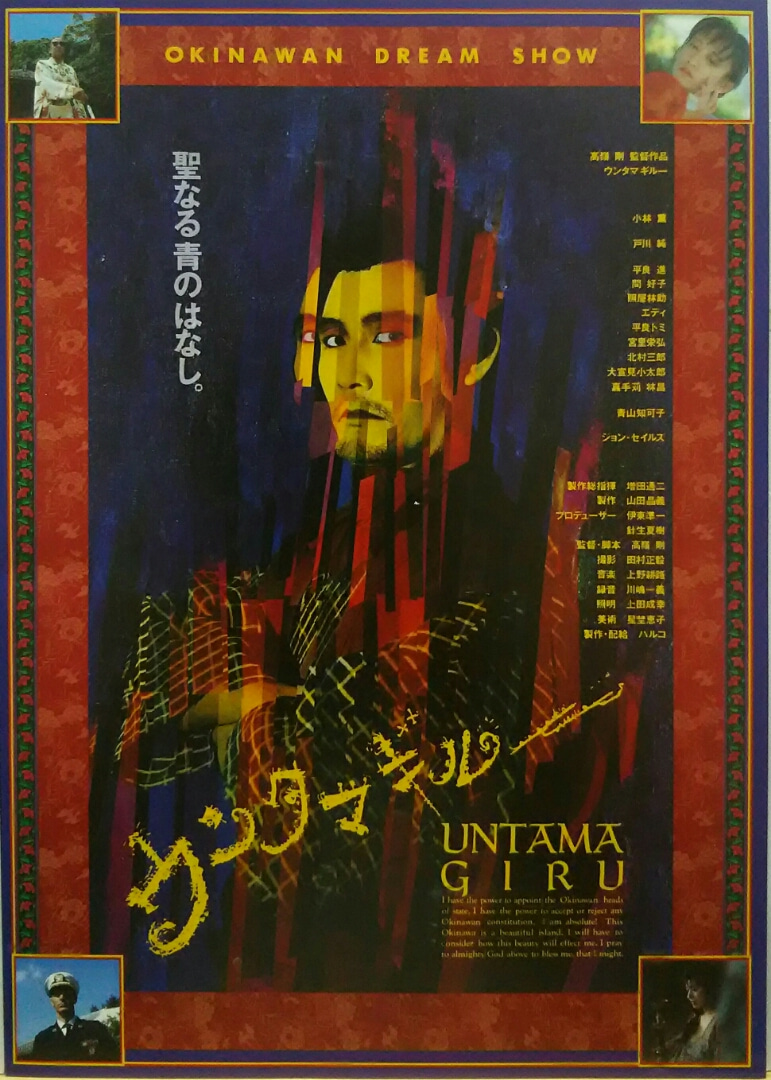
“My country is not part of America or Japan! I am a child of Ryukyu!” the hero of Go Takamine’s musical fable Untamagiru ( ウンタマギルー) finds himself shouting after having unexpectedly acquired godlike powers and used them to aid the Independence Movement. Apparently inspired by a legendary local figure, Takamine’s quasi-musical like his earlier Paradise View finds the Okinawan islands at a turning point considering three possible futures: to maintain the status quo under American rule, to return to Japanese sovereignty, or finally to acquire their independence though the last of these seems to be nothing more than an idealistic pipe dream. 

Takamine begins and ends with the same scene changing only the location and the identity of a key player while the hero, Giru (Kaoru Kobayashi), drives a tiny truck in a small circle to turn the grinder that presses the sugarcane. Giru is however mainly casting looks at Mare (Chikako Aoyama), the voluptuous daughter of his taskmaster boss Nishibaru, as she languishes under a small shelter smoking pigweed from a shisha pipe. Giru later finds the courage to ask her to accompany him to a beach party, which she does, the pair sneaking off to a secluded cove near the forest where they make love. The problem is that, as Giru discovers, Mare is actually an anthropomorphised pig that Nishibaru was raising as a wife for the Forest God so now Nishibaru has it in for him. Framed for starting a fire at the plantation he’s encouraged to flee to the forest by his sister, Chiru (Jun Togawa), who has a knack for animal dream divination, and is aided by a tree spirit whose child he once saved who grants him special demi-god powers that enable him to survive the curse which otherwise falls on all who sleep with Mare. 

It’s these new powers which give Giru a new sense of possibility allowing him to become a kind of Robin Hood playing both sides off against each other from the middle of the forest, pinching meat from Japanese companies and redistributing it to the local community, and pilfering weaponry from the American bases to give to the independence movement. The two sides are represented in the two respective bosses, the blind and castrated Nishibaru, and the American commissioner Kamajisar who as Chiru puts it cares for animals more than people but is also seen injecting himself with the blood of dogs and pigs. “I am absolute” Kamajisar insists, claiming that Okinawa is a possession of the American military pointing out that 90% of the population feels themselves to be different from the Japanese while simultaneously describing the possibility of independence as nothing more than a fairytale. 

Yet Untamagiru comes to represent the face of rebellion, resisting not just political oppression but social and economic in targeting Japanese businesses and redistributing their goods to the local poor becoming a folk hero in the process. Not everyone is as immediately happy about this, the owner of the brothel where his sister works asking him to stop giving money to the poor because their business can’t cope with the sudden demand while she personally looks down on their new clientele and fears they’re damaging her upscale brand. Even so even Untamagiru eventually falls victim to his own hubris, struck down while ironically enough agreeing to play himself in a traditional stage performance inspired by his life and deeds leaving only the idea of himself behind as a kind of talisman for those who had in him found a sense of hope and possibility. 

Then again could all of this have been a dream? “Poor people are terrible, aren’t they? They’ll even try to steal the end of people’s dreams” turncoat Utou chides Giru on catching him napping assuming that he dreams of Mare though her words have a degree of sense to them in the elliptical passage of time in which we move from one “dream” to another just as Okinawa itself shifts between two states, two different rulers, and finds itself in the middle once again driving round in circles looking at something it wants but can’t have and in the end it seems may be destroyed out of spite. A magical realist fable filled with its own strangeness in its dream divinations, ethereal forest deities, shapeshifting pigs, and the constant refrains of the barbershop band who narrate the whole show with caustic wit through traditional Okinawan musical performance Takamine’s oneiric tale ends in symbolic apocalypse, “From now on Okinawa is Japan”. 


Untamagiru screens at Japan Society New York May 21 at 7pm as part of Visions of Okinawa: Cinematic Reflections

Black Rain (黒い雨, Shohei Imamura, 1989)

Caught in a moment of transition, post-war Japan struggles to free itself from the lingering feudal legacy and the trauma of the immediate past in Shohei Imamura’s contemplative adaptation of the novel by Masuji Ibuse, Black Rain (黒い雨, Kuroi Ame). As many things change others stay the same, the Shizuma family burdened not only by the anxiety of a ghostly illness symptomless until it isn’t and the unfair prejudice of a wounded society, but the pressure of outdated patriarchal social codes along with a sense of filial failure in the inability to protect their ancestral estate. 

Imamura opens on the fateful morning the atomic bomb struck Hiroshima, voiceovers from 20-year-old niece Yasuko (Yoshiko Tanaka) and her uncle Shigematsu (Kazuo Kitamura), a soldier severing at a factory in the city, detailing what they were doing on that very ordinary day. What unfolds is a scene of hell, the train Shigematsu is riding on blown apart while he crawls free and tries to look for his wife, Shigeko (Kazuo Kitamura), packing up their house preparing for evacuation, eventually reuniting with Yasuko who had come into town to find them. Hoping to get to the factory, they make their way past charred and hideously warped bodies, a woman cradling her carbonised infant, a little boy overjoyed to have found his big brother only to go unrecognised because his face is melted away while skin hangs painfully from his forearms and fingertips. The brother only accepts him after checking his belt which has somehow miraculously survived. The trio eventually make it to comparative safety at the factory with relatively few injuries, only later learning of the implications of having been in such close proximity to the blast. 

Jumping ahead five years, the Shizumas are living quite comfortably in their ancestral home on a mountain estate largely spared the post-war agricultural land reforms because of its location, though Shigematsu attributes his mother’s dementia to an inability to accept the changing times not only their loss of a semi-aristocratic status but the essential failure of having proved unable to protect their ancestral lands. His immediate problem is however the marriage of the now 25-year-old Yasuko. We see him triumphantly leave a doctor’s office with a certificate stating that Yasuko is in good health he hopes will reassure her current suitor’s family in the face of persistent rumours that she too was a direct victim of the “flash”, rather than an indirect victim simply of the rain which Shigematsu mistakenly believes to have been less dangerous. 

At 25 this is Yasuko’s last chance, she’s aged out of the arranged marriage market. She has also had a promising job offer from the local post office but is minded to turn it down in the hopes of being married. Taking the post office job may be the most sensible option, but it also seems like defeat, an acceptance that she is unfit for marriage and a clear sign that Shigematsu and Shigeko have failed in their patriarchal duties to ensure that Yasuko finds a good husband and will be well looked after for the rest of her life. In this age, it is difficult for a woman to support herself alone even leaving aside the social stigma of being an unmarried woman. A marriage is therefore also a job, and the families fear one Yasuko may not be able to perform if as the rumours suggest her exposure to radiation may have left her unable to bear children. The situation is further complicated seeing as Shigematsu and Shigeko were not able to have children of their own, and with Yasuko’s mother Kiyoko having died young Yasuko is the last of the Shizuma line even if she technically may not bear their name. 

Lost in old memories and mistaking Yasuko for her mother, grandma (Hisako Hara) may have it right when she tells her not to marry for marriage only leads to death. Yet in an odd way, Yasuko’s liminal status perhaps grants her the right to turn away from these old-fashioned patriarchal expectations in making her own decision not marry even if she orients herself back towards the filial in requesting to stay with the aunt and uncle who raised her in order to care for them should they suddenly begin to experience symptoms of their exposure to “the flash”. Shigematsu continues to treat the notion of radiation sickness with an almost supernatural mentality, convinced that having seen the light or not is all that matters constantly trying to provide evidence that Yasuko was not there when the bomb went off while ignoring her exposure to the black rain which fell afterwards even while himself filled with the anxiety of not knowing if he may someday become ill even if he and Shigeko are in otherwise good health. 

He watches friends with secondary exposure become ill and die before him, recalling being asked to read sutras for the dead in the aftermath of the bomb though feeling himself unqualified, while some in the village perhaps jokingly accuse them of playing on their status as bomb victims as if they are merely lazy rather than actively sick. Meanwhile, across the way a young man with intense PTSD suffers flashbacks every time he hears an engine running and is compelled to throw himself in front of it as if it were an enemy tank. Yuichi (Keisuke Ishida) is ironically enough “a veteran of the suicide squad”, otherwise alright if fragile spending his days carving Buddhist Jizo statues may of which have grotesque, anguished expressions in contrast to the comforting, almost cute faces such statues usually bear. Just as the wider society distances itself from the survivors of the bomb, so they reject men like Yuichi. When Yuichi’s mother comes to propose an unlikely marriage between the two lonely youngsters who have become close after bonding through their shared anxieties, Shigematsu is offended, resenting the implication that they must believe Yasuko is a poor catch if daring to suggest she marry a man of a lower social class who is also in need of assistance in living with his mental illness. 

Yet her marriage continues to weigh heavily on Shigeko’s mind, feeling as if she has failed the Shizuma family in being unable to provide an heir and subsequently failing to secure a match for Yasuko. It is perhaps this anxiety that finally makes her ill, taking strange medicines provided by a dubious Shinto priestess who tells her it’s all her own fault for not being able to visit Kiyoko’s grave because someone has to stay at home to look after grandma. Only Shigematsu sees the writing on the wall, advising Yasuko that after grandma dies she should sell the estate and take the money as her dowry freeing her from the feudal and familial legacy and giving her permission to move into the modern post-war future even as she begins to doubt that the future has a place for her. 

Shooting in black and white and in a much more classical style than that which is found in his other work, Imamura adopts the aesthetics of Golden Age cinema to comment on the contemporary era now perhaps feeling itself sufficiently distanced from the toxicity of wartime trauma, suggesting that the entire society is in a sense soaked in black rain its inability to confront the recent past a poison slowly eating away at its foundations. “An unjust peace is better than a just war” Shigematsu is fond of saying, quoting Cicero dismayed by the heated geopolitical debates he hears on the radio he uses to set the clock, his friend dying without ever really understanding why the bomb was dropped, why on Hiroshima, why at that particular moment. Imamura denies us closure too, leaving on a note of anxiety if tempered with an all but forlorn hope for signs of a miracle on the horizon that the sickness can be healed and a better world will someday arrive.


Black Rain screens at the BFI on 28th December as part of BFI Japan and is also available on blu-ray as part of Arrow’s Imamura boxset or to stream in the UK via Arrow Player