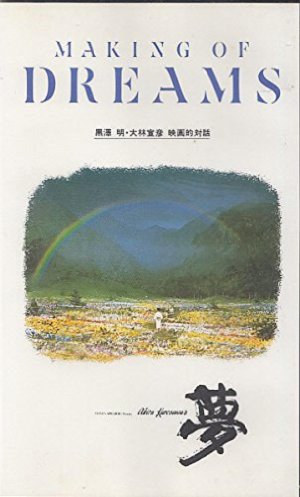
Making of “Dreams” ( 夢 黒澤明・大林宣彦映画的対話, Nobuhiko Obayashi, 1990)

making-of-dreamsYou might think there could be no more diametrically opposed directors than Akira Kurosawa – best known for his naturalistic (by jidaigeki standards anyway) three hour epic Seven Samurai, and Nobuhiko Obayashi whose madcap, psychedelic, horror musical Hausu continues to over shadow a far less strange career than might be expected. However, Dreams is a major aberration in Kurosawa’s back catalogue, eschewing his more straightforwardly conventional approach for an exercise in surrealist social commentary inspired by classic noh theatre traditions. Obayashi was also on hand in an ancillary capacity, capturing the making of a late Kurosawa classic. This is no mere “making of”, as the opening crawl makes clear, but an in depth examination of Kurosawa’s career to date conducted director to director with reverence and sensitivity for a veteran talent.
Broadly moving through the film chronologically, Obayashi includes a decent amount of typical “behind the scenes” footage from the first episode in which the young I unwisely peeps on a solemn fox wedding, right through the to classic turn from Chishu Ryu as a wise old man living a natural life in harmony with the rhythms of the Earth. The footage is captured on a selection of video cameras typical of the time with all of their low grade resolution though they often capture unexpected sides of the production process. On set, Kurosawa is a genial if sometimes exacting presence, taking the time to apologise after speaking a little too harshly to a child actor, thanking his crew for waiting around so long in the cold, and reminding them to take care travelling home on the icy roads.

Where the film differs from the general “making of” DVD extras is in the typical Obayashi touches in the presentation of his material which is assembled from over 190 hours of footage and runs half an hour longer than the film itself. Obayashi is very keen to showcase Kurosawa’s artistic storyboards, often contrasting the illustrations either with the raw live footage or completed film by means of super imposition or split screen. Later he also adds in animatic storyboard manipulation, overlapping with the completed footage similarly bleached into a manga-esque black and white outline. Obayashi then spins the other way with an even more meta approach by incorporating classic cinematic references as in the opening and closing of the iris, classic Kurosawa side and horizontal wipes, and setting Kurosawa’s meeting with a foreign director inside the frame of a film negative itself. Neatly moving from a concept drawing to placing the finished image within that same panel, Obayashi takes us from thought to realisation by means of a simple yet effective visual technique.

The second biggest draw is in the intercut footage from a long discussion between the two directors in which Obayashi interviews Kurosawa about his long career and working methods. Illuminating his ideas of Dreams in particular Kurosawa states his intentions to chart the course of a life very similar to his own, but also emphasises what he feels has become the central theme of his work – humanity and its refusal to choose the path of happiness. Obayashi also raises the sometimes controversial topic of the position of women in Kurosawa’s cinema which is often said to be overly masculine. Kurosawa semi-rejects this view of his work, but admits that early criticism left him less willing to engage with women’s stories. After casting Setsuko Hara in No Regrets for Our Youth, her character was frequently criticised as being “unwomanly”, or appearing too masculine in her behaviour. A claim Kurosawa rejects, but this unwillingness to accept the existence of “strong” women from critics looking for reflections of their own world view seemingly put him off the idea of attempting to capture women’s stories, lacking the confidence to do so properly.

Moving from black and white to colour and using montages and super impositions, Obayashi re-orders and re-imagines his recollections just as van Gogh does his world through his paintings in one of the film’s most elaborate sequences. “Making of Dreams” therefore becomes a much more interesting title than it first appears, not only detailing a “making of” this particular film but all films in so far as a film is a dream. A meeting of minds in more ways than one, Obayashi’s film demonstrates his reverence and affection for the veteran director but his contribution amounts to more than a simple exchange of views and experiences in a mutually illuminating commentary on the careers of these essentially very different artists.


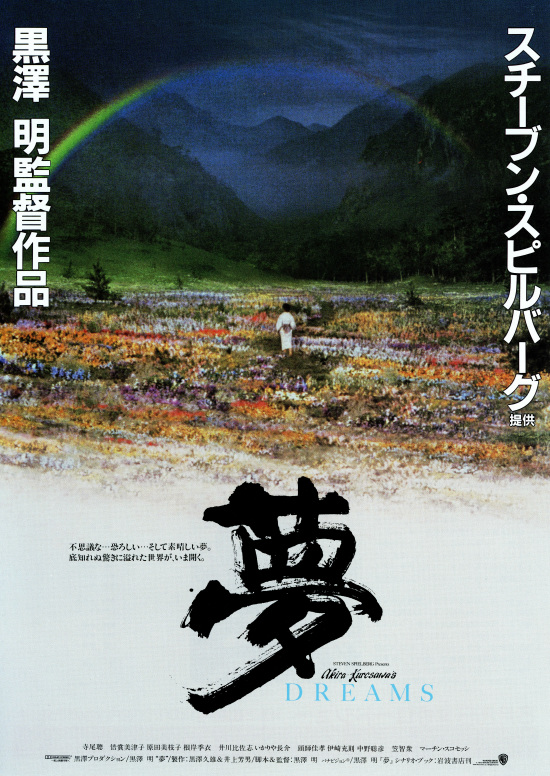
Dreams (夢, Akira Kurosawa, 1990)

dreamsDespite a long and hugely successful career which saw him feted as the man who’d put Japanese cinema on the international map, Akira Kurosawa’s fortunes took a tumble in the late ‘60s with an ill fated attempt to break into Hollywood. Tora! Tora! Tora! was to be a landmark film collaboration detailing the attack on Pearl Harbour from both the American and Japanese sides with Kurosawa directing the Japanese half, and an American director handling the English language content. However, the American director was not someone the prestigious caliber of David Lean as Kurosawa had hoped and his script was constantly picked apart and reduced.

When filming finally began, Kurosawa was fired and replaced with the younger and (then) less internationally regarded Kinji Fukasaku and Toshio Masuda. The film was an unmitigated failure which proved hugely embarrassing to Kurosawa, not least because it exposed improprieties within his own company. Other than the low budget Dodesukaden, Kurosawa continued to find it difficult to secure funding for the sort of films he wanted to make and in 1971 attempted suicide, thankfully unsuccessfully, but subsequently retreated into domestic life leaving a large question mark over his future career in cinema.

American directors who’d been inspired by his golden age work including George Lucas and Martin Scorsese were keen to coax Kurosawa back into the director’s chair, helping to fund and promote his two biggest ‘80s efforts – Ran, and Kagemusha, both large scale, epic jidaigeki more along the line of Seven Samurai than the arthouse leaning smaller scale of his contemporary pictures. The success of these two films and the assistance of Steven Spielberg, allowed him to move in a radically different direction for his next film. Dreams (夢, Yume) is an aberration in Kurosawa’s back catalogue, a collection of thematically linked vignettes featuring surreal, ethereal, noh theatre inspired imagery, it was unlike anything the director had attempted before and a far cry away from the often straightforward naturalism which marked his career up to this point.

Inspired by Kurosawa’s own dreams from childhood to the present day, Dreams is divided into eight different chapters beginning with a solemn wedding and ending in a joyous funeral. Each of the segments takes on a different tone and aesthetic, but lays bare many of the themes which had recurred throughout Kurosawa’s career – namely, man’s relationship with the natural world, and its constant need to tear itself apart all in the name of progress.

Casting his central protagonist simply as “I”, Kurosawa begins with an exact recreation of his childhood home and a little boy who disobeys his mother in leaving the house during a spell of sun streaked rain. Weather like this is perfect for a “kitsune” wedding, only fox spirits do not like their rituals to be witnessed by humans and punishment is extreme if caught, still, the boy has to know. His fate is echoed in the second story in which the still young I is lured to the spot where his family’s orchard once stood to be berated by the spirits of the now departed peach blossoms in the guise of the traditional dolls given to little girls at the Hina Matsuri festival. The spirits are upset with the boy, who starts crying, but not, as the spirits originally think because he’s mourning all of the peaches he’ll never eat but because he truly loved the this place and knows he’ll never see the glory of the full orchard in bloom ever again.

The spirits recognise his grief and contritely agree to put on a display of magic for him so that he may experience the beauty of peach trees in full blossom one last time. However, the illusion is soon over and the boy is left among the stumps where his beloved trees once stood. Later, the adult I finds himself in a monstrous nuclear apocalypse which has now become much harder to watch as the Ishiro Honda inspired horror of the situation has turned mount Fuji and the surrounding sky entirely red with no escape from the invisible radioactive poison. Quickly followed by I traipsing through a dark and arid land in which giant mutant dandelion provide the only sign of life aside from the remnants of post-apocalyptic humanity reduced to devouring itself in scenes worthy of Bruegel, these sequences paint the price of untapped progress as humans burn their world all the while claiming to improve it.

Humans are, in a sense, at war with nature as with themselves. The Tunnel sees an older I return from the war to encounter first an aggressive dog and then the ghosts of men he knew who didn’t make it home. Apologising that he survived and they didn’t, I contrives to send the blue faced ghosts back into the darkness of the tunnel while he himself is plagued by the barking, grenade bearing dog outside. The mountaineers of the blizzard sequence are engaged in a similar battle, albeit a more straightforwardly naturalistic one of human endurance pitted against the sheer force of the natural world. That is, until the natural becomes supernatural in the sudden appearance of the Snow Woman which the mountaineer manages to best in his resilience to the wind and cold.

The better qualities of humanity are to be found in the idyllic closing tale which takes place in a village lost to time. Here there is no electric, no violence, no crime. People live simply, and they die when they’re supposed to, leaving the world in celebration of a life well lived rather than in regret. People, says the old man, are too obsessed with convenience. All those scientists wasting their lives inventing things which only make people miserable as they tinker around trying to “improve” the unimprovable. As the young I says, he could buy himself as many peaches as he wanted, but where can you buy a full orchard in bloom?

Of course, Kurosawa doesn’t let himself off the hook either as the middle aged I finds himself sucked into a van Gogh painting, wandering through the great master’s works until meeting the man himself (played by Martin Scorsese making a rare cameo in another director’s film) who transforms his world through his unique perception but finds himself erased by it as his art consumes him to the point of madness. I wanders back through van Gogh’s landscapes, now broken down to their component parts before eventually extricating himself and arriving back in the gallery as a mere spectator. Even if the work destroyed its creator through its maddening imperfection it lives on, speaking for him and about him as well about a hundred other things for an eternity.

For all of the fear and despair, there is hope – in humanity’s capacity for endurance as in the Blizzard, in its compassion as in The Tunnel, and in its appreciation for the natural world as in The Peach Orchard alongside its need to re-envision its environment through the glorious imperfection of art. There is the hope that mankind may choose to live in The Village of the Water Mills rather than the hellish post apocalyptic world of fear and greed, however small and slim that hope maybe. Creating a living painting filled with hyperreal colour and a misty dreaminess, Kurosawa’s Dreams, like all dreams, speak not only of the past but of the future, not only of what has been but what may come. Equal parts despair and love, Kurosawa’s vision is bleak yet filled with hope and the intense belief in art as a redemptive, creative force countering humanity’s innate capacity for self destruction.


Original international trailer (irritating English language voiceover only)

Pornostar (ポルノスター, AKA Tokyo Rampage, Toshiaki Toyoda, 1998)

pornostarLooking back, at least to those of us of a certain age, the late ‘90s seem like a kind of golden era, largely free from the economic and political strife of the current world, but the cinema of that time is filled with the anxiety of the young – particularly in Japan, still mired in the wake of the post-bubble depression. Toshiaki Toyoda’s Pornostar (ポルノスター, retitled Tokyo Rampage for the US release) (not quite what it sounds like), is just such a story. Its protagonist, Arano (Chihara Junia, unnamed until the closing credits), stalks angrily through the busy city streets which remain as indifferent to him as he is to them. Though his wandering appears to have no especial purpose, Arano seethes with barely suppressed rage, nursing sharpened daggers waiting to plunge into the hearts of “unnecessary” yakuza.

After taking the early morning train into the city, the grey light of dawn gradually brightening as the streets fill with people busying themselves about their business, Arano walks around angrily bumping into anyone who happens to be in his path but nary a one of them even looks back at him before continuing onwards, zombie like, towards their destination. We then cut across town to another crossing where non-yakuza club boss Kamijo (Onimaru) also bumps into someone but stops to make sure the offending person realises the disrespect they’ve just shown him. The film will, in many ways, turn on the interaction of these two men who take a very different approach to a series of common problems. Anti-yakuza avenger meets anti-yakuza appeaser – their war will always be a zero sum game, but then, neither of them are very interested in winning it anyway.

If Arano and Kamijo represent the male forces of chaos and violence mixed with cowardice and self interest, the third axis turns on one of Kamijo’s escorts who is determined to travel to Fiji for “The Summer of Love” in 1999 (presumably the 30th anniversary celebration for a bygone era of hippiedom). Alice (Rin Ozawa) presents a possible point of departure for Arano as she temporarily takes charge, co-opting the boom box which is used to conceal the all important drugs and attempting to repurpose its darkness to find her own light only to crash and burn. The other female force in the film in a neat piece of symmetry mirroring the Arano/Kamijo dynamic is a destructive counter to Alice’s creative instincts. The unnamed woman mostly known for a tattoo across her chest which reads 5-Star Pussycat (Leona Hirota), acts like some kind of avenging angel with a purpose as unclear as Arano’s as she runs around the city taking out yakuza here, there, and everywhere.

The film’s title is, apparently, an obscure attempt at pairing the sleazy nature of the Shibuya environment with Arano’s oscillating, lonely planet existence. No reason is given for Arano’s intense loathing for yakuza whom he describes as “unnecessary” throughout the film (not unfairly, it has to be said), but vengeance seems to have become his entire reason for living. Allied with the knife in the film’s complex symbolic imagery, Arano becomes the personification of death, chaos, and violence as he almost ceases to exist as a person so turned inward and delusional has his mind become. Kamijo, by contrast, is a weaker figure yet no less linked with death through his constant references to his father’s grave. Given his close ties to his mother, it may be fairer to say that if Arano is a man already dead then Kamijo is one not yet born. Always on the threshold, Kamijo refuses the yakuza joining ceremony but continues to behave like a gangster even whilst rejecting the act of killing. Arano and Kamijo are locked in their perfect symmetry, a complementary pair forming one fully fleshed whole, but their union is inevitably a destructive one, unable to find a constructive purpose in their nihilistic world of violence and betrayal.

Similarly, Arano also rejects the possibility of salvation offered by Alice and her idealised Fijian paradise. Trying and failing to ride Alice’s skateboard even as she attempts to physically guide him, Arano cannot let go of his destructive cycle of violence in order to participate in her revolution of love, allowing her empty skateboard to roll away from them as symbol of their unattainable dreams. Alice may be the film’s only winner as, even if she too suffers and fails to break out of the constraining underworld environment, she remains free to fight for freedom, gliding away on her skateboard bound for love.

Though sometimes a little too obscure or displaying a slight incompleteness of thought, Pornostar is an accomplished narrative debut from Toyoda which addresses several of his ongoing concerns. Told with surrealist flair in its strange set pieces where knives fall from the sky or a girl dances madly in a dingy night club, Pornostar is a stylish piece marrying slo-motion and loud music with frenetic violence and the total absence of sound. A dispassionate tale of youth on fire but burning itself from the inside out, Pornostar is less a chronicle of its times than a lament for the aimlessness of the young, locked out of mainstream society and into a mind consuming itself through unresolved frustration.


Available now in the UK as part of Third Window Films’ Toshiaki Toyoda: The Early Years box set.

Opening scene (no subtitles)

Future Memories: Last Christmas (未来の想い出 Last Christmas, Yoshimitsu Morita, 1992)

b27a8478bde0a2deBased on the contemporary manga by the legendary Fujiko F. Fujio (Doraemon), Future Memories: Last Christmas (未来の想い出 Last Christmas, Mirai no Omoide: Last Christmas) is neither quiet as science fiction or romantically focussed as the title suggests yet perhaps reflects the mood of its 1992 release in which a generation of young people most probably would also have liked to travel back in time ten years just like the film’s heroines. Another up to the minute effort from the prolific Yoshimitsu Morita, Future Memories: Last Christmas is among his most inconsequential works, displaying much less of his experimental tinkering or stylistic variations, but is, perhaps a guide its traumatic, post-bubble era.

After a short segment set in 1971 in which one of our two heroines, Yuko Nando (Misa Shimizu), tells her classmates of her dream to become a best selling children’s author, we flash forward to 1981 where Yuko is a struggling artist unable to find success with her publishing company. A decade later, Christmas 1991, Yuko seems to have made little progress and despondently finds herself bonding with a mysterious woman offering a fortune telling service at the side of the road.

Ginko Kanae’s (Shizuka Kudo) life also seems to have spiralled downwards since 1981. A career as an office lady led to a fateful party after which another girl ended up going home with the guy she liked, and then she ended up being rebound married to the second choice salaryman she wound up with. Hence she’s reading fortunes on a less than busy side street at Christmas. The two women bond and swap phone numbers, but tragedy is about to befall them both as Yuko has a heart attack and dies at an office golf outing and Ginko has an accident on the way back from attending Yuko’s funeral. Never fear, the two women are soon cast back to 1981 with the next ten years of memories intact to help them make “better” choices and hopefully save their futures from ruin.

1992 was the start of a difficult era for Japan, the collapse of the bubble economy left behind it not just financial instability and social uncertainty, but a lingering feeling of foolishness and betrayal among those who’d been promised so much during the bubble years only to have the rug cruelly pulled from under them. It’s not surprising that many people of around Yuko and Ginko’s ages may have liked to travel back to 1981 and either relive the boom years or try and prevent the resultant tragedies from occurring. Unsurprisingly, the pair’s first pass at a do over sees them striving for conventional success, using their future knowledge to their advantage – Yuko by appropriating the idea of a popular 1991 manga to become an award winning artist, and Ginko becoming a financial guru. Both women come to feel conflicted about their “dishonest” choices which see them prosper unfairly, ironically robbing them of the chance to succeed as individuals in their own right and fulfil their own potential in the way they had always wanted to.

After each die at the same point and in the same way once again despite their financial successes, they get a second go, now with twenty years of hindsight to help them work out what’s really important. This time each chooses a path filled with more individual expression and the expectation of happiness. Romance is the name of the game as both women vow to spend more time with the men they love. However, having been through this once before Yuko and Ginko also have an expectation that their time will end once again in December 1991, meaning they feel conflicted about making a life with lovers they’ll be leaving behind. Gradually each starts to wonder if their fates are really as sealed as they fear them to be, or if they’ve been given this chance to start again precisely so that they can change their futures for the better.

In 1992, the idea that everything doesn’t have to be as gloomy as it seems might have been an important one, even more so than it is now. In the original timeline, Yuko and Ginko were, like many in the post-bubble world, victims of circumstance rather than people who’d actively made poor choices and the lessons which they learn are also those of their generation. Financial success is not everything, particularly if it’s gained in a “dishonest” way. More than changing their fates, Yuko and Ginko must first learn how to be happy which lies in self realisation, fulfilled potential, and, ironically, that their fate doesn’t matter so long as they live happily in the now.

Morita’s approach is again a timely one, filled with the music of the era (including a cover version of the title song from previous Morita hit, Main Theme), stock footage, and a curiously retro, nostalgia filled approach for a period that was only a decade earlier. Dissolves, slow motion and double exposures are his concessions to the sci-fi themes, but what he’s really interested in is capturing the essence of the era more so than crafting an emotionally affecting piece. Necessarily of its time, Future Memories: Last Christmas is among Morita’s weaker efforts but does serve to shine a light on early ‘90s pop culture as it found itself in a moment of profound self reflection.


Original trailer (no subtitles but lots of Christmas Cheer…and…Wham)

Bloom in the Moonlight (わが愛の譜 滝廉太郎物語, Shinichiro Sawai, 1993)

bloom-in-the-moonlightAll those songs and rhymes you learnt as a child, somehow it’s strange to think that someone must have written them once, they seem to just exist independently. In Japan, the name behind many of these familiar tunes is Rentaro Taki – the first composer to set Japanese lyrics to European style “classical” music. It’s important to remember that even classical music was once contemporary, and along with the opening up of the nation during the Meiji era came a desire to engage with the “high culture” of other developed nations. The Tokyo Music School was founded in 1887 and Taki graduated from it just four years later in 1901. However, his career was to be a short one as his health gradually declined until he passed away of tuberculosis at just 23 years old. Bloom in the Moonlight (わが愛の譜 滝廉太郎物語, Waga Ai no Uta: Taki Rentaro Monogatari), also the title of one of his most well known and poignant songs, is the story of his musical career but also of the history of early classic music in Japan as the country found itself in a moment of extreme cultural shift.

Defying his father’s wishes and travelling to Tokyo to pursue a musical education, Rentaro Taki (Toru Kazama) becomes fascinated by the piano and is determined to become a high level pianist. Even knowing how hard it is to conquer the instrument and that many of his contemporaries have been studying since early childhood, Rentaro refuses to lose heart and pushes himself to become the best piano player that he can possibly be. Always a sickly child, Rentaro’s intense devotion to his instrument begins to threaten his health but his ambition knows no limit. The purpose of the school leans more towards the study and dissemination of Western music among ordinary people but soon Rentaro and some of his fellow pupils grow tired of the idea that their role is that of teachers and scholars and begin composing their own work. Rentaro’s songs become what is really the first kind of modern folk music, marrying the European classical music of the foreign elites and the more egalitarian, everyman quality of the accompanying lyrics to create a new kind of Japanese music.

The tale is narrated at times by a fellow pupil, Yuki Nakano (Isako Washio), who encounters Rentaro at the same time as he encounters the piano. The star pupil at the school and sister of an already internationally famous concert pianist, Yuki is nevertheless insecure about her own skills. Rentaro quickly surpasses her though the two become close and eventually a source of mutual inspiration. Adding to the melancholy nature of the tale, Yuki falls in love with Rentaro and his musical intensity but the pair are separated when she is selected as one of the first pupils to be sent abroad to learn from the classical music masters in Germany. A year later, Rentaro is also permitted to go and the pair are briefly reunited but it will be for the last time as Rentaro’s illness intensifies and brings an early end to his musical career.

Times being what they are, Rentaro and Yuki are denied the possibility of pursuing a romance, adding to the theme of poignancy and missed opportunities running through the film. Indeed, the final piece Rentaro composes and which he is still working on right up to the end is for Yuki and is titled “Regret”. Dedicating himself to music above all else, Rentaro leaves behind him a musical legacy but still, as one of his songs puts it, longs for the “brightness of bygone days”.

Rentaro was from a wealthy family, and even if his father did not approve of his decision to study music, he continued to support him even whilst worrying about his constant ill health. Many of his fellow pupils were not so lucky including his good friend Suzuki (Ryo Amamiya) who is forced to leave the school when his father becomes ill leaving him responsible for each of his siblings. Eventually Suzuki is able to return to the world of music as a teacher, playing Rentaro’s folk songs for the local village children and helping to make his friend’s work some of the most well known in Japan.

Little is seen outside of the rarefied world of wealthy students and their internationally focussed cultural pursuits but at times the other world is allowed to slink in, particularly in the case of an inn girl who is charged with looking after Rentaro during one of his periods of convalescence. The girl, Fumi (Miki Fujitani), also becomes fascinated with Rentaro’s intense love music but any attachment on her part can only lead to tragedy. All else aside, Rentaro is the oldest son of a wealthy family and not seriously considering a formal arrangement with someone like Fumi. Eventually she will be sold off as a concubine to a wealthy man, there are no better options for her even in the bright new Meiji era.

As in much of his other work, Sawai neatly avoids the more sentimental elements of the story even if melodrama is a necessary part of its appeal. Bloom in the Moonlight is among his more straightforward efforts sticking to the prestige picture approach without any of the stranger or more expressive sequences which often crop up in films such as W’s Tragedy or Maison Ikkoku. As a neutral biopic, the treatment of its subject is at times superficial, skipping other interesting details of Rentaro Taki’s life such as his late conversion to Christianity preferring to focus on the tragic love story which becomes the genesis of his final, unfinished work. Nevertheless, Bloom in the Midnight succeeds in telling the sad story of a musical genius who poured all of his intensity into a few short years leaving a body of work behind him likely to outlive us all.


Rentaro Taki’s songs are still very popular today and if you’ve spent any time at all watching Japanese films you will definitely have heard them.

One of the most recognisable – Hana

And one of the most well known – Kojo no Tsuki (with footage from Throne of Blood!)


Injured Angels (傷だらけの天使, Junji Sakamoto, 1997)

injured-angelsDespite having started his career in the action field with the boxing film Dotsuitarunen and an entry in the New Battles Without Honour and Humanity series, Junji Sakamoto has increasingly moved into gentler, socially conscious films including the Thai set Children of the Dark and the Toei 60th Anniversary prestige picture A Chorus of Angels. Injured Angels (傷だらけの天使, Kizudarake no Tenshi) marries both of aspects of his career but leans towards the softer side as it finds genial private detective Mitsuru (Etsushi Toyokawa) accepting a request from a dying man to ensure the safe passage of his young son to the boy’s mother in Northern Japan.

Reluctantly taking on an assignment to question the last remaining tenant of an office block, Mitsuru discovers the man inside already mortally wounded. During their conversation, the man offers him all the money he has left to take his young son to his estranged wife, currently living in a small town in the North of Japan. Mitsuru doesn’t really want this kind of hassle but feels sorry for the man and his son and eventually decides to make sure the boy, Hotaru, gets to someone who can take of him. The pair set off on a kind of road trip eventually joined by Mitsuru’s partner Hisashi (Claude Maki) meeting friends old and new along the way.

Inspired by the 1970s TV series of the same title, Injured Angels adopts an oddly jokey tone throughout as Mitsuru has various strange adventures whilst trying to guide a small child to someone willing to take him in. At one stage, the film goes off on a long and improbable tangent in which Mitsuru runs into an old friend who is currently wearing a lucha libre mask “for work”. The pair then board the bus with the wrestlers before Mitsuru himself ends up in the ring. Though fun, the sequence has little to do with the ongoing plot other than adding to the already absurd atmosphere.

Predictably, when Mitsuru reaches the address he’s been given, Hotaru’s mother has already moved on but even when they eventually find her, the reaction is not the one you’d expect. Soon to be married again, Hotaru’s mother (Kimiko Yo) is not keen to resume custody of her son (or rather, her husband to be has no desire to raise another man’s child and even goes so far as to use physical violence on Mitsuru to show the strength of his feeling). Hotaru starts to grow attached to the two detectives who are probably giving him the most normal kind of family life that he has known for a very longtime. The guys seem to know they can’t keep him indefinitely and are intent on finding another relative but the mini family they’ve formed may be painful to break up.

While all of this is going on, Mitsuru also has a series of meetings with a woman from Tokyo, Eiko (Tomoyo Harada), who keeps bumping into him. Though an obvious attraction develops, Eiko is also fleeing her own kind of trouble and the pair seem content to leave things up to fate and possible drinks in Tokyo at an unspecified point in time, but this oddly integrated plot strand fails to have a real impact within the narrative as a whole. It does, however, add to Mitsuru’s ongoing existential dilemma as he begins to reexamine his life and relationships after bonding with Hotaru. Ultimately he opts for asking his partner, Hiasashi, to move in with him when they get back to Tokyo but at the same time Mitsuru seems to know he may be headed for another destination entirely.

This tonal strangeness is a serious weakness where would expect a more nihilistic atmosphere as Mitsuru’s journey begins to take shape but the inconsequential humour and mildly absurdist approach continues right until the anticlimactic ending. Perhaps feeling a need to recreate the feeling of the TV series, Sakamoto fails to reconcile these differing levels of seriousness into a convincing whole in allowing for the kind of light and breezy action in which everything is definitely going to be OK by next week’s episode. For what’s actually a look at neglected, abandoned children coupled with intense friendships and romantic dilemmas, the bouncy, ridiculous tone is an odd fit and robs the piece of its dramatic weight. Nevertheless, despite the structural problems, Injured Angels is often a fairly enjoyable, if odd, character drama even it ultimately fails to amount to very much as a whole.


Original trailer (no subtitles)

Kids Return (キッズ リタ-ン, Takeshi Kitano, 1996)

kids-returnReview of Kitano’s Kids Return first published by UK Anime Network.


Kids Return (キッズ リタ-ン), completed in 1996, marks Kitano’s return to filmmaking after the serious motorcycle accident which almost claimed his life and has continued to have long term effects both personally and in terms of his career. Once again he remains firmly behind the camera but displays a more contemplative, nostalgic approach than had been present in much of his previous work. The tale of two delinquent slackers in small town Japan, Kids Return has an obvious autobiographical quality and even if the future looks bleak, Shinji (Masanobu Ando) and Masaru (Ken Kaneko), like Kitano himself, are not beaten yet.

Beginning with a sequence of the older Shinji delivering rice and sharing a melancholy reunion with school friend Masaru, Kitano then hops back to their carefree school days of slacking off and intermittently trolling the entire institution. Masaru is the leader of the pair, loud mouthed and violent, always trying to big himself up, while Shinji is the classic sidekick – always following dutifully behind and lost without his friend’s leadership. Their paths diverge when Masaru decides to join a boxing club after someone he’d bullied and extorted money from hires a boxer to get revenge on him. Masaru is hopeless in the ring and lacks the dedication it would take to become a serious althete but Shinji shows promise, eventually knocking Masaru out after being forced into a humiliating duel. Masaru ends up joining the yakuza gang which hangs out in his favourite ramen joint and quickly rises through the ranks. Though both boys look to be going somewhere along their chosen paths, they each squander their given advantages through a series of poor decisions and eventually find themselves right back where they started.

Shinji and Masaru are typical of many young men of their generation and social class. They “go to school” but rarely attend lessons and are often to be found riding their bike around the playground or pranking the other students such as in a particularly elaborate plot where they dangle a stick figure of a teacher down from the roof to the classroom window below, joyfully erecting the “penis” they’ve given it by attaching a torch to the middle section complete with wire brush hair and cotton balls. Such tricks may seem like innocent, juvenile behaviour but a more serious side emerges when an obnoxious teacher’s car is set on fire.

The teachers at the school have already written the boys off as not worth saving. Always referring to them as “the morons”, the school seems reluctant to actually expel the pair and has come to view them as amusing inconveniences more than anything else. None of the teachers is interested in reaching out to Shinji or Masaru and, in fact, they appear to be a cynical bunch with no real interest in the children in their care. At the end of the school year the teachers begin discussing their progress and reveal that only a handful of students will be going to university (and only one to a public, rather than private institution) and that those who are have largely achieved it through their own steam. The education system has nothing to offer these students who have already been judged unworthy of advancement and is in no way interested in providing any kind of pastoral care or social support.

Shinji and Masaru are expected to find their own paths, but the film posits that this idea of total, individual freedom of the modern era is at the root of their problems because it leaves them with too many choices and no clear direction. Failed by education, the pair must find new ways to move forward but the opportunities on offer are not exactly appealing. Masaru, the loud mouth of the pair, ends up on the obvious path of the disaffected young man by joining a gang and finding for himself the familial comradeship of the criminal brotherhood rather than that of a traditional family.

Shinji’s path looks more solid as he begins to train as a serious athlete, honing his skills and perfecting his physique. He is, however, still unable to take control of his own life and repeatedly looks for more dominant male role models to follow. This might have worked out OK for him if he’d stuck with the paternal influence of the coaches, but Shinji is easily led and falls under the influence of an embittered older boxer, Hayashi, who is full of bad advice. Under Hayashi’s tutelage, Shinji learns illegal moves and that he can still drink and eat what he likes because you can just throw it all up again afterwards. When even that doesn’t work, Hayashi begins giving him diet pills which exemplify the quick fix approach he’s taking with his life. Needless to say, his training suffers and his previously promising career is soon on the rocks.

It’s not just the two guys either. Their shy friend with crush on the cafe girl leaves school and gets a good job as a salesman but the aggressive boss makes his working life a misery leading him to take a stand with a colleague and quit to become a taxi driver. No good at that either, he experiences exactly the same treatment and is now unable to earn enough money to support both himself and his wife. In fact, the only success story is the manzai standup comedy duo which Masaru mocked in the beginning. Knowing exactly what they wanted to do and working hard to get there, the pair have built a career and an audience through steadfastly sticking to their guns and refusing to listen to the naysayers. If you have direction, progress is possible, but for Shinji and Masaru who have no strong calling the future is a maze of uncertainties.

The kids have returned, not quite as men but in the first flush of failure, ready to start again. When Shinji asks Masaru if it’s really all over for them already, he tells him not to be silly – it hasn’t even started yet. The town goes on as normal, unchanging, kids goof off lessons and melancholy people waste time over coffee. Perhaps nothing will change for Masaru and Shinji and their aimless days of drifting from one thing to the next, looking for guidance and finding none, will continue but there’s fight in them yet and the possibility remains for them to find their way, as difficult as it may prove to be.


Out now on blu-ray (in the UK) from Third Window Films.

Original trailer (no subtitles)

A Scene at the Sea (あの夏、いちばん静かな海, Takeshi Kitano, 1991)

scene-at-the-seaReview of Takeshi Kitano’s A Scene at the Sea – first published by UK Anime Network.


Takeshi Kitano’s third feature, A Scene at the Sea (あの夏、いちばん静かな海, Ano natsu, Ichiban Shizukana Umi), is about as much of a departure as it is possible to make from his first two films. Not only does Kitano not star, but he eschews his focus on down and dirty, grimy crime thrillers in favour of a poetic tale about a boy who falls in love with the sea. Largely told without dialogue, A Scene at the Sea is Kitano in one of his more contemplative moods as he creates an existential fable of one man’s search to find his place.

Shigeru (Claude Maki) has a dull and unfulfilling life as a dustman, endlessly staring out over the beautifully blue seas of his harbour town as if searching the horizon for some kind of destiny. His luck changes when he finds an old broken surfboard on one of his rounds and manages to repair it. Lacking the proper equipment, Shigeru takes to the seas to indulge his new sport after stripping down to his pants and T-shirt while his girlfriend Takako (Hiroko Oshima) watches him from the sands, lovingly folding his clothes as she waits for him. Over time Shigeru’s love for surfing begins to pull him away both from Takako and from his everyday life on land as he starts skipping work to spend more time riding the waves.

Shigeru is deaf and mute and his girlfriend Takako is more or less silent too, hence the overall lack of dialogue in the film though words are not especially necessary in their relationship. Shigeru is constantly isolated from all social groups (aside from his friendship with Takako) whether it be his inability to join in with workplace banter or the rejection of the snobbish surfers who laugh at his original attempts on the board whilst also grudgingly praising his determination to brave the cold seas without even a wet suit. Though he also had a kind of ally in his partner for dust round, the only person to try and help Shigeru is the owner of a surf shop who sees potential in him and convinces Shigeru to enter a competition. However, at the competition itself there is no one to help him participate – Shigeru misses his opportunity to surf because he can’t hear them call his name. The surf shop owner berates the other surfers for not helping Shigeru, but they continue to ignore him even after he’s been semi-admitted to the group.

Shigeru perseveres despite his lack of ability and paucity of equipment to hone his skills and quickly become a competent surfer. As his obsession with the sea deepens he moves further and further away from Takako. The sea becomes his lover and the surfing a kind of congress or quest for conquest in his new romance. Takako can forgive this growing need for the ocean, but finds herself hurt when she catches Shigeru peeling another girl’s oranges (not a euphemism). Kitano employs another of his beautifully composed long shots to show us Takako wordlessly approaching the pair, who after all are only sitting together on a beach, before stopping indecisively and leaving again without being seen.

The Japanese title of the film, Ano Natsu, Ichiban Shizukana Umi, translates as “That Summer, the Quietist of Seas” which is a little ironic given that calm seas are good for sailors but the opposite of what a surfer needs. The tinge of nostalgic melancholy is clearer here and it’s more obvious that we’re dealing with the remembrance of a past summer, taken from a specific viewpoint, rather than something which is occurring in real time in the present. This may explain some of Kitano’s stranger repeated imagery such as the footballers who never play football and more lyrical, less linear approach to narrative.

Kitano may be in a maudlin mood, but he still injects some of his trademark dark humour notably in the pair of hangers on who follow Shigeru into the world of surfing but spend much of their time bickering about whose turn it is on their shared surfboard, as well as brief appearance from frequent Kitano star Susumu Terajima as a van driver who picks a fight with the police (and loses). Still, A Scene at the Sea is a melancholic vista of a boy lost among the waves, looking for a home on the water. A beautiful, if sad, summer story, Kitano’s third feature is one of his most romantic (in the wider sense) and bears testimony to his talent for crafting intensely moving cinematic poetry.


Original trailer (no subtitles)

The Eel (うなぎ, Shohei Imamura, 1997)

The EelDirector Shohei Imamura once stated that he liked “messy” films. Interested in the lower half of the body and in the lower half of society, Imamura continued to point his camera into the awkward creases of human nature well into his 70s when his 16th feature, The Eel (うなぎ, Unagi), earned him his second Palme d’Or. Based on a novel by Akira Yoshimura, The Eel is about as messy as they come.

Mild-mannered salary man Yamashita (Kouji Yakusho) receives a handwritten letter filled with beautiful calligraphy delivering the ugly message that his wife has been entertaining another man whilst he enjoys his weekly all night fishing trips. Confused at first, the note begins to work its way into Yamashita’s psyche and so he decides to leave his next fishing trip a little earlier than usual. Peeping through the keyhole, he finds his beloved wife enjoying energetic, passion filled sex with another man. Drawing a knife from a nearby shelf, he enters the room and attacks the pair killing the woman but letting the lover get away.

Yamashita immediately and with perfect calmness turns himself in at the local police station, still covered in his wife’s blood and carrying the murder weapon. Released on a two year probationary period after eight years in jail, there is no one to meet Yamashita when he comes out and so he remains under the guardianship of a Buddhist priest in a nearby town. Accompanied by his only friend, a pet eel, Yamashita takes possession of a local disused barbershop and sets about trying to rebuild his life.

Things change when Yamashita comes across an unconscious woman lying in the grass while he’s out looking for things to feed his eel. The strange thing is, this woman looks exactly like his wife. Eventually, Keiko (Misa Shimizu) recovers and comes to work with Yamashita in his new enterprise but as the pair grow closer the spectres of both of their troubled pasts begin to intrude.

As the small town residents of Yamashita’s new home often remark, Yamashita is a strange man. His deepest relationship is with his eel which the prison guards, who seem quite well disposed towards him, allowed him to keep in the prison pond even though pets are not generally allowed. When asked why he likes his eel so much, Yamshita replies that the eel listens to him and doesn’t tell him the things he does not wish to hear. Like Yamashita, the eel is isolated inside his tank, content to absent himself from interacting with other creatures, both protected and constrained by transparent walls.

After his release from prison, Yamashita begins to reflect on his crime which he doesn’t so much regret but has no desire to repeat. His other double arrives in the form of fellow inmate and double murderer Tamasaki (Akira Emoto) who keeps trying to convince Yamashita that he is living dishonestly by not having visited his wife’s grave or read sutras for her. Though Yamashita pays no heed to most of his advice which is more self-pity and anger than any real concern for Yamashita’s soul, some things begin to get to him, most notably that perhaps the fateful letter never existed at all and is nothing more than the manifestation of Yamashita’s jealous rage.

Though the film presents everything that happens to Yamashita as “real”, his state of mind is continually uncertain. Not only is the provenance of the letter doubted, he doubts the existence of Keiko because she looks (to him at least) like the returned ghost of the woman he killed, and even the final confrontational arguments with Tamasaki take on an unreal quality, as if Yamashita were arguing with himself rather than another man who also represents his own worst qualities – impulsivity, violence, self doubt and insecurity. The film is so deeply embedded in Yamashita’s subjective viewpoint that almost nothing can be taken at face value.

Yamashita is, in a sense, trapped in a hall of mirrors as his own faults are reflected back at him through the people that he meets. Keiko, rather than being physically murdered by a jealous lover, attempted to take her own life after being misused by a faithless (married) man. Her past troubles are, in some ways, the inverse of Yamashita’s as she finds herself at the mercy of dark forces but internalises rather than externalises her own anger. Cheerful and outgoing, she quickly turns Yamshita’s barbershop into a warm and welcoming place which the local community takes to its heart.

Yamashita, however, remains as closed off as ever though he does strike up something of a relationship with a lonely young man who wants to use his barber’s pole to try and call aliens. When Yamashita asks him what he’s going to do if the aliens actually come, the young man replies that he wants to make friends with them. Yamashita astutely remarks that the young man’s desire to meet aliens is down to a failure to connect with people from his own planet – an idea which the young man equally fairly throws back at him. Perhaps out of fear rather than atonement, Yamashita exiles himself from the world at large though gradually through continued exposure to the genial townsfolk and Keiko’s deep seated faith in him, he does begin to swim towards the surface.

Imamura adopts his usual, slightly ironic tone to lighten this otherwise heavy tale allowing the occasional comic set piece to shine through. Yakusho delivers another characteristically nuanced performance as this entirely unformed man, unsure of reality and trapped in a spiral of self doubt and confusion. His original crime of passion is at once chilling in its calmness but also messy and violent as he gives in to animalistic rage. After showing us a street lamp glowing an ominous red, Imamura steeps us in blood as his camera becomes progressively more stained making it impossible to forget the shocking betrayal of this unexpected violence.

Yamashita remarks at one point that he died that day alongside his wife. The Eel is a story of rebirth as its protagonists begin to swim towards the shore in support of each other, though like the titular marine creature there is no guarantee that they will make there alive. Yamashita is a cold blooded murderer and creature of suppressed rage yet Imamura is not interested in moral judgements as much as he is in the messier sides of human nature. A chance offering of redemption for the unredeemable, The Eel offers hope for the hopeless in a world filled with goodhearted eccentrics where all faults are forgivable once they are understood.


Original trailer (no subtitles)

Swimming Upstream (バタアシ金魚, Joji Matsuoka, 1990)

Swimming UpstreamSometimes love makes you do crazy things. Some people find themselves accomplishing previously unattainable feats powered only by the sheer force of romance. Unfortunately for the hero of Swimming Upstream (バタアシ金魚, Bataashi Kingyo), Joji’s Matsuoka’s adaptation of Minetaro Mochizuki’s manga, the task he sets for himself is a very lofty one indeed and may actually require him to abandon his love to complete it. Then again, the object of his affections shows little signs of reciprocation in any case.

Love found Kaoru (Michitaka Tsutsui) with a bucket of water. That is, he was hanging around one day when swimsuited beauty Sonoko (Saki Takaoka) soaked him by mistake but far from being annoyed, Kaoru falls in love at first sight and begins to pursue the star of the swim team even if she remains resolutely cold towards him. Kaoru immediately joins up just to be close to her even though he is actually afraid of water and does not know how to swim. Nevertheless he sets himself the task of becoming an olympic swimmer and bringing home a gold medal for his lady love. Needless to day, Sonoko is still not very interested in him.

Assisted by a strange old lady of swimming coach in sporting matters, and with an unlikely ally in Sonoko’s mother when it comes to romance, Kaoru works hard at his twin goals but makes little progress with either. His world is briefly shattered when he spots Sonoko arm in arm with the school’s star swimmer and he also faces a romantic dilemma in the form of his friend Pu whose motorbike he keeps borrowing to try and impress Sonoko despite the fact that Pu obviously has a crush on him. Nevertheless, Kaoru is undeterred until, that is, Sonoko’s actions convince him he may be doing more harm than good.

Matusoka’s film is most clearly concerned with recreating the contemporary high school summer for the presumed target audience of teenagers. Though it loosely adapts a classic sports movie romance format with Kaoru giving it his all in training, it stops short of the triumphant underdog trope as Kaoru never achieves the kind of sporting success one would expect. Though he quickly learns to swim and makes some progress, Kaoru retains a lingering fear of the water and is among the very weakest at the club. Still deluding himself with his Olympian dream, Kaoru even attempts to challenge the champion swimmer of another team (played by a very young Tadanobu Asano in his first film role) in a race for the rights to Kaoru. Needless to say, nothing goes his way.

If duelling over the “rights” to a girl seems like an old fashioned idea, Swimming Upstream is a very old fashioned film in terms of its sexual politics. The film stars popular idol Saki Takaoka as the unattainable Sonoko but is told very much from Kaoru’s point of view in which Sonoko is something to be won rather than another human being with independent will. Sonoko’s behaviour often is hard to categorise but, to borrow a term from the film’s manga roots, could easily be described as tsundere wherein she consistently rejects Kaoru’s advances before warming up to the idea just as he’s beginning to cool off. There may a fine line between persistence and and inappropriate behaviour but Kaoru’s level of devotion is the kind that straddles it. The teenage audience of 1990, however, may have seen things a little differently than that of today.

The audience of 1990 would doubtless also have been shocked by Sonoko’s rebellious lack of compliance with regular social norms. Far from the docile, cute, obedient and polite aura of the traditionally perfect girl next door in which idol movies specialise, Sonoko throws angry looks at everyone and talks back to her mother with extremely harsh words (though her mother wisely refuses to be shocked by them). In fact Sonoko is universally awful to everyone to the extent that it later seems that even one of her closest friends does not actually like her very much, but the worse she gets the more Kaoru refuses to be dissuaded.

Matsuoka mostly chooses to keep things simple with a light hearted, summery atmosphere primed to appeal to his audience of youngsters. Though intended as an innocent romance, contemporary audiences may read more darkness into the relentless war between the icy Sonoko and determined Kaoru but the adolescent intensity of young love does at least ring true. Caught between the quirkiness of its general tone and the heaviness of its themes, Swimming Upstream flounders in making its central connection work, rendering its overworked metaphor of a finale less than successful but does offer strong performances from both of its central stars.


Clip (no subtitles)