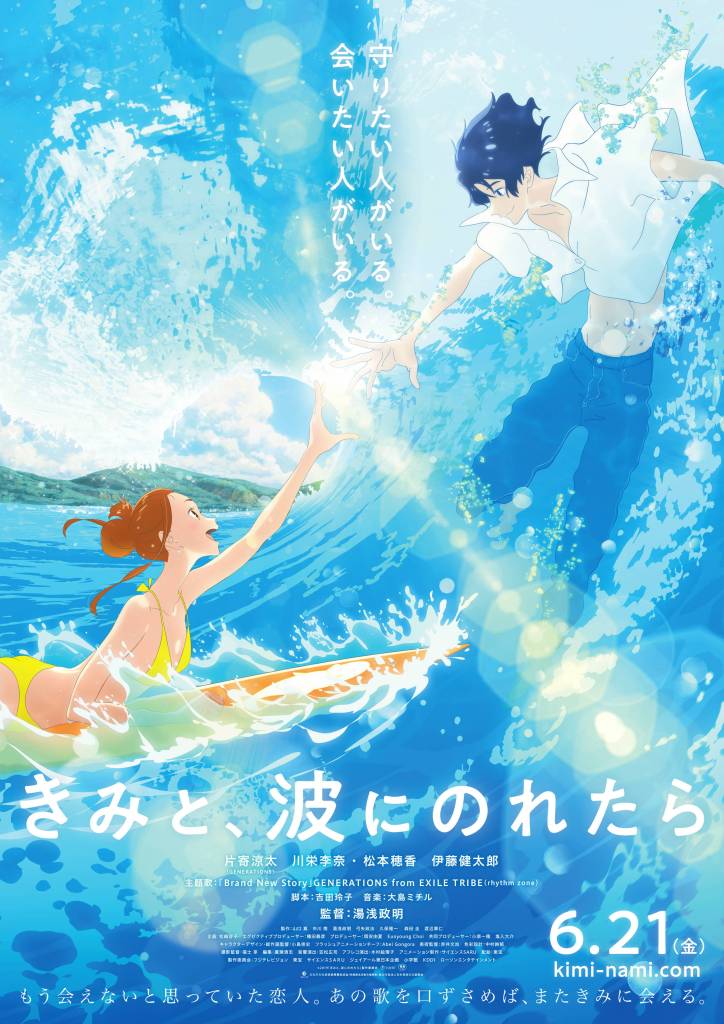
Ride Your Wave (きみと、波にのれたら, Masaaki Yuasa, 2019)

“The next wave is already on the horizon waiting for you to catch it” according to the heroine of Masaaki Yuasa’s uncharacteristically uncomplicated Ride Your Wave (きみと、波にのれたら, Kimi to, Nami ni Noretara) offering words of comfort to her dejected soon-to-be boyfriend over his continuing failure to master the surfboard. It’s advice she struggles to follow herself, however, after she’s blown off course by unexpected tragedy. Yet, nothing’s ever really as off course as you think it is and the waves she must learn to ride are her own and hers alone. 

Oceanography student Hinako (Rina Kawaei) is something of a mess. She’s moved out on her own to study at university in Chiba, but is struggling with the transition to adult life, unable to unpack her things or cook herself a decent dinner. Nevertheless, she’s become a “hero” to dashing fireman Minato (Ryota Katayose) who watches her bravely ride the waves from the roof of the fire station. The pair finally meet when some irresponsible students have an impromptu fireworks party that ends up setting fire to Hinako’s building, leaving her marooned on the roof cradling her surfboard at which point she’s rescued by Minato heroically appearing in a cherrypicker. She offers to teach him to surf, they go for coffee, and eventually fall hopelessly in love. Their romance, however, is cut short when Minato heads to the beach alone in stormy seas and drowns trying to save a jet skier who’s got into trouble. Unable to deal with the grief, Hinako avoids the sea altogether but begins to believe she is seeing Minato in every watery surface and can in fact summon him by singing their favourite song. 

Fellow firefighter Wasabi (Kentaro Ito), himself a little in love with the formerly fearless Hinako, tries to jolt her out of her “delusion” by asking how this could have happened to her, once so brave and independent now filled with grief and anxiety. Minato, whose name literally means “harbour”, had promised to protect her, staying by her side forever. Faced with her first serious relationship going far too well, Hinako identified a potential problem in her possible over reliance on her extremely capable boyfriend, preferring to wait until she was able to ride the waves alone before taking the next step. Minato wanted the same thing, encouraging her growth while providing a “safe harbour”, but his sudden absence has left her afraid to move forward and unwilling to leave the land. 

Delusion or not, Hinako clings to her lost love, carrying around “Minato” in a tiny flask of water or filling up an inflatable porpoise and walking it all around town to the constant consternation of the locals. What she learns, on one level, is that she has to learn to save herself, but also that in doing so she can help to save others. Learning something about Minato’s past and the reasons which eventually led to him becoming a fireman persuade her that she ought to use whatever skills she has for the common good. Meanwhile, the lovelorn Wasabi learns something similar after reconnecting with Minato’s spiky sister Youko (Honoka Matsumoto) who was once a shut-in refusing to go to school where her rather abrasive manner made her an outcast but found a new strength in self-acceptance on hearing Wasabi declare that just being herself was good enough for him. 

Youko decides to pick up her brother’s dream of opening an artisanal coffeeshop, which is nice but also a little shortsighted in that it does not allow her to pursue a dream that’s entirely her own other than through finding the courage to embrace the risk of romance. Likewise, Hinako and Wasabi are largely carried along in Minato’s wake, but nevertheless make unambiguously good decisions in choosing to dedicate their lives to helping others, accepting that that’s often less about grand heroic gestures than it is about small moments of connection. Hinako realises that she has to let go of the past, however painful, for Minato’s good as well as her own, while finding her sea legs to take her into a more promising future. After all, the waves keep coming. Minato recedes into the great confluence of life, while Hinako gains the courage to ride the waves alone, no longer afraid to leave the shore but in search of new horizons. 


Screened as part of the Japan Foundation Touring Film Programme 2020.

UK Trailer (English subtitles)
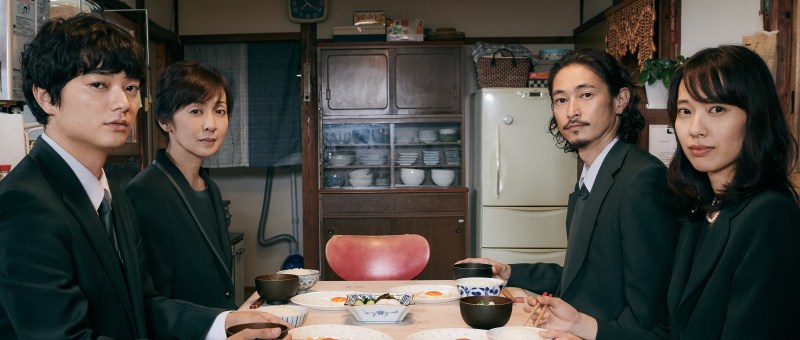
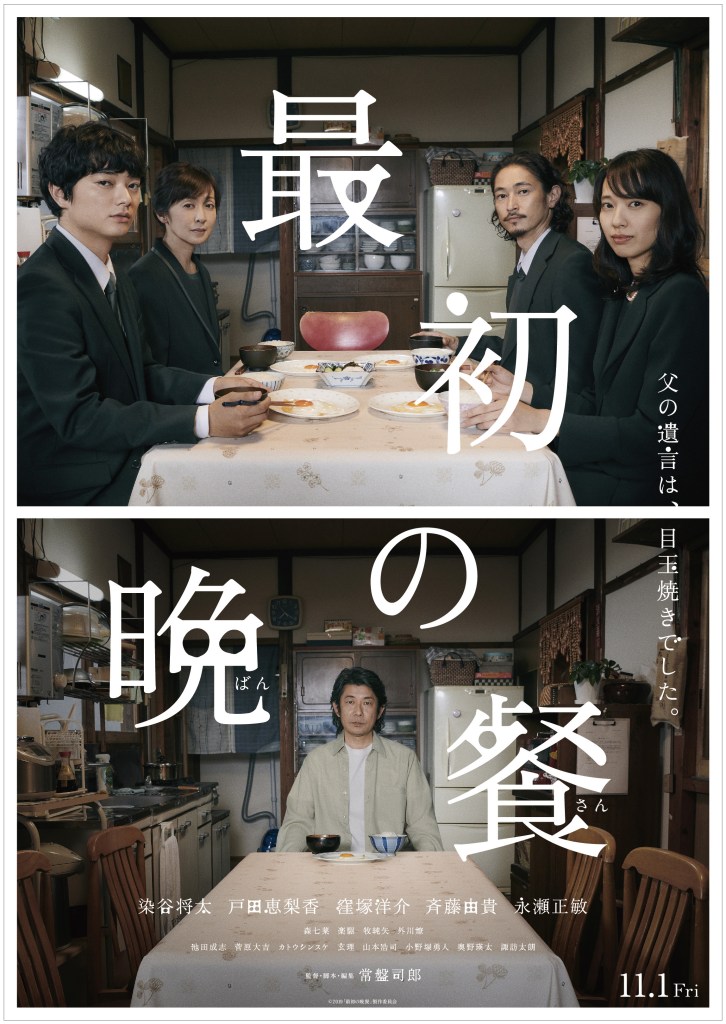
The First Supper (最初の晩餐, Shiro Tokiwa, 2019)

“Family” – what does it mean? The concept itself has been under examination for some time, at least as far as the “family drama” goes, but Shiro Tokiwa’s The First Supper (最初の晩餐, Saisho no Bansan) has it more positive than most as its somewhat emotionally distant hero begins to piece his back together and rediscover his place within it. He does so largely through the Proustian power of food as his lonely step-mother does her best to unite the family by reviving warm memories of the various meals they shared together. 

Yet, as Rintaro (Junya Maki / Shota Sometani), a Tokyo-based freelance photographer grappling with the art/commerce divide, is insensitively told at his father’s funeral, his is not an “ordinary” family. That would be (partly) because it was a blended one. Rintaro and his sister Miyako (Nana Mori / Erika Toda) were being brought up by their single father, Hitoshi (Masatoshi Nagase), their mother having apparently left the family, before he brought Akiko (Yuki Saito) and her teenage son Shun (Raiku / Yosuke Kubozuka) to live with them. As a grown man, Rintaro still claims not to be able to understand what his father was thinking, why he wanted to start a “new” family by bringing Akiko and Shun into their home, especially as it led to him giving up his lifelong love of mountaineering to get a steady job in a factory. It never seems to occur to him that perhaps his father simply fell in love again and wanted to share his life with a woman who loved him, becoming a father figure to her teenage son in welcoming an expansion to their family. 

There is, perhaps, still a resistance to the entire idea of blended families or even remarriages especially in the more conservative countryside. Dealing with an offensive uncle, Rintaro fires back that this kind of thing is perfectly normal and no kind of issue at all in Tokyo, so he’s not sure what the problem is but it’s clear that there is still a degree of disapproval of Hitoshi and Akiko’s union even 20 years later. Part of that might be to do with the circumstances of their meeting which we later discover had their share of moral ambiguity. That central secret, and the ones which spur off it, is the reason that Rintaro has never quite been able to put his family together, while Miyako, married at a young age and now the mother of two daughters, is experiencing a degree of marital strife with her mild-mannered husband (Shinsuke Kato) who accuses her of cheating with an old classmate at a reunion. 

Akiko stuns them all by abruptly announcing that she’s cancelled the caterers for the wake and is planning to cook herself, serving up a selection of dishes one wouldn’t usually expect at a funeral but which she claims are taken directly from Hitoshi’s will and each reflect a particular memory of their life together as a family. There is a gaping hole, however, in that we don’t see Shun. “Why should he come?” Miyako replies to Rintaro’s questions, “He’s an outsider here”. A rather cold cut-off for a step-brother, even one you haven’t seen in a long time, and a partial negation of the idea of families not bound by blood even if it’s snapped partly out of hurt. 

While Miyako struggles to reconcile herself to her place within her new family and her decision to form it, Rintaro chats on the phone to his sympathetic girlfriend, Rie (Hyunri), who has, perhaps surprisingly, not accompanied him on this emotionally difficult occasion. The problem seems to be, however, that he’s told her not to come even though she’d have liked to be there and it doesn’t seem as if anyone would have objected. An agent ringing him at a spectacularly bad time to tell him he hasn’t won a competition is forced to reveal, in the nicest possible way, that he narrowly lost out because his pictures are “cold”, he has no affection for his subjects and it shows. He remains diffident in his relationship with Rie because he hasn’t worked out this whole family thing for himself and is worried he simply doesn’t know how to fit into one. 

Through re-experiencing his childhood through the meals shared with his father, Rintaro begins to regain a sense of belonging, discovering what it was that lay at the heart of his family drama and why it eventually led to a painful breakup. Before all that, however, they’d been happy. Trying to quell a spat between Miyako and Shun over different kinds of miso soup not long after they moved in, Akiko declares that from now on she’s only making one, “blended”, kind for everyone though the choice is theirs whether or not they choose to eat it. Truths are shared, new understandings are reached, and the family is in some sense restored. Their childhoods explained, Miyako and Rintaro begin see a path forwards towards a happy family life of their own while taking their bittersweet memories with them, no longer burdened by anxious insecurity but strengthened by a new sense of belonging that has nothing to do with blood.


The First Supper screens in New York on Feb. 16 as part of this year’s New York Asian Film Festival Winter Showcase.

Original trailer (no subtitles)

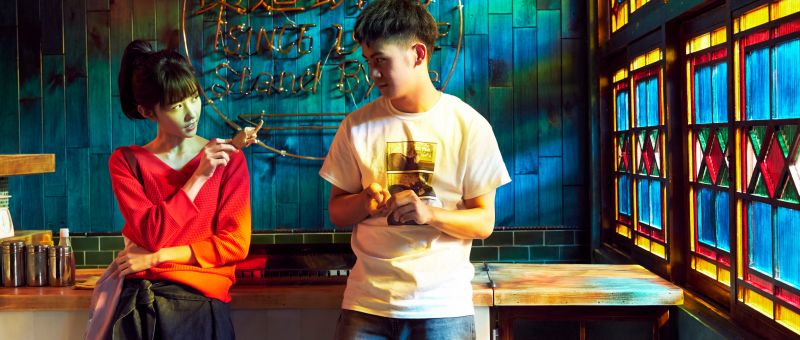
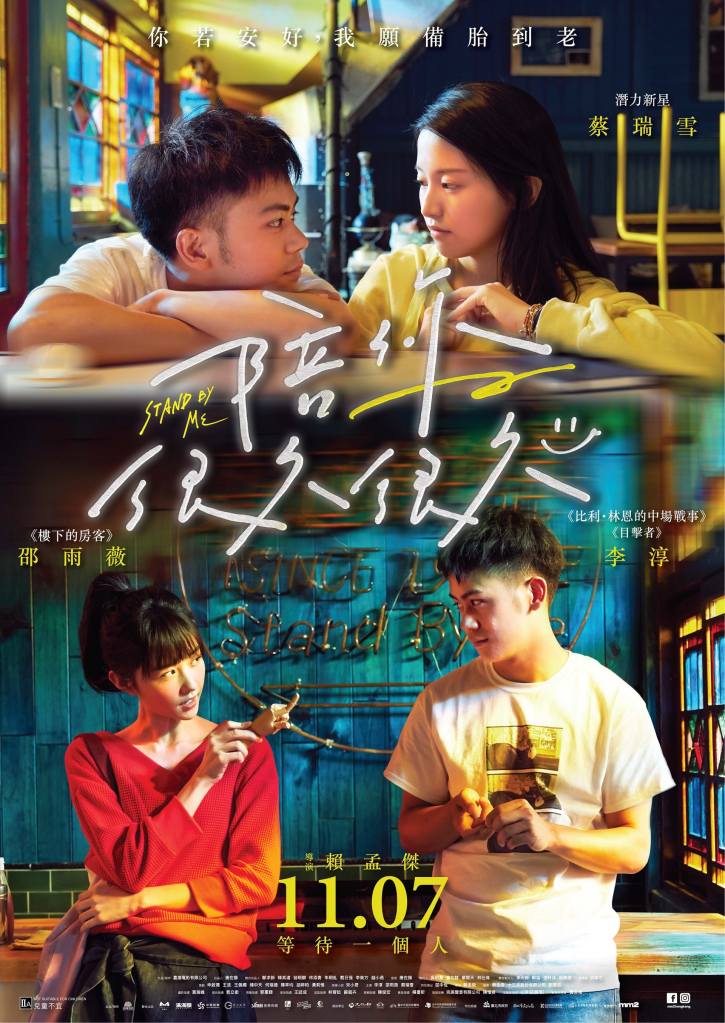
Stand By Me (陪你很久很久, Lai Meng-jie, 2019)

“Teenage days we all need a romance that hurts” exclaims a rejected teen, too shy to declare her crush directly but trying to achieve a kind of closure by literally shouting it from the rooftops in Lai Meng-jie’s charming teenage rom-com, Stand By Me (陪你很久很久, Péi Nǐ Hěn Jiǔ Hěn Jiǔ). For Jiu-Bing (Mason Lee), however, his romance has gone on a little longer than just his teenage years. He’s been silently in love with Bo-he (Ivy Shao Yu-Wei) since he was 12, but their relationship has remained at the innocent level of childhood friendship. Nevertheless, all of his subsequent decisions have been taken with one aim in mind, being at Bo-he’s side to protect her. Now that they’re grown, he’ll have to come to terms with the fact that their relationship is inevitably going to have to change in one way or another. 

As with most youngsters, those changes arrive as they set off for university (he’s enrolled in the same one as her for that reason alone). No matter how close you are, it can be quite claustrophobic having someone buzzing around you all day and Bo-he is beginning to get fed up with Jiu-Bing’s continuing immaturity. He’s promised to “protect” her, but often ends up in trouble himself and needs her to rescue him. It’s Bo-he that finds him a place to stay after he accidentally blows up his new student dorm and gets kicked out, only it turns out to be half of a teenage girl’s bedroom above a family bakery, rented out by high schooler Xia-Tian (Tsai Jui-Hsueh) without her father’s (Chu Chung-heng) permission as an enterprising way to get a little more pocket money. Meanwhile, Bo-he has fallen for a handsome, heroic classmate, Mai-zi (Edison Song Bai-Wai), who is, in every stereotypical way, the perfect man. 

In an ironic twist, Jiu-Bing’s part-time job is as a “pacer”, supporting other runners as they make their way towards the finish line but eventually dropping back himself. He takes pride in being there for people, protecting and encouraging them, but still struggles to accept the fact that his chosen role inevitably means he’ll spend his life celebrating the successes of others rather than his own. Jiu-Bing eventually has this fact thrown in his face when a romantic rival describes him as nothing more than a rebound guy, implying that Bo-he only sees him as a fallback she can rely on when some other boy breaks her heart but will never really want to be with in the long term. 

On one level, Jiu-Bing is fine with that. He really does just want Bo-he to be happy even if it’s with someone else, but still struggles with the decision of whether to speak his feelings out loud and risk ruining their friendship or keep silent and live with the pain of being just her friend forever. As one of his eccentrically nerdy friends puts it, companionship is the “dark matter” that supports a relationship, but the jury’s still out on whether companionship alone is enough to go the distance. Meanwhile, he remains entirely oblivious to the fact that Xia-Tian is beginning to develop feelings for him that place her in exactly the same place as he is with Bo-he. Maybe he just thinks of Xia-Tian as a crazy little sister, and maybe Bo-he just thinks of him as a troublesome little brother who will always need looking after despite his constant protestations that all he wants is to be able to “protect” her. 

What Jiu-Bing learns however is that being a pacer is no bad thing. It’s much better to run with someone than to run alone, but there are times when you just need to set a pace for yourself so you can figure out how far you can run. There are more ways to love than just the romantic, though maybe that’ll come in time but perhaps not from the direction you’d expected. “Being heard and accepted is nothing we can decide” Xia-Tian adds, and what is teenage romance other than coming to an acceptance that sometimes you love people who don’t love you back? But then sometimes they do, and if you never say anything you’ll never know. Jiu-Bing has some growing up to do, and a few decisions to make so he can figure out where it is he ought to be – supporting from the sidelines or waiting with flowers near the podium. Either way, Lai Meng-Jie’s charming teenage rom-com is a refreshingly progressive take on the genre which allows it’s “nice guy” hero to find solace in the authenticity of his generosity while its heroine embraces her own sense of agency entirely independent of her romantic destiny. 


Stand By Me screens at Chicago’s Gene Siskel Film Center on Feb. 17 where the full lineup for the upcoming 10th season of Asian Pop-Up Cinema will also be unveiled. Director Lai Meng-jie will be in attendance for an introduction and post-screening Q&A.

Original trailer (English/Traditional Chinese subtitles)

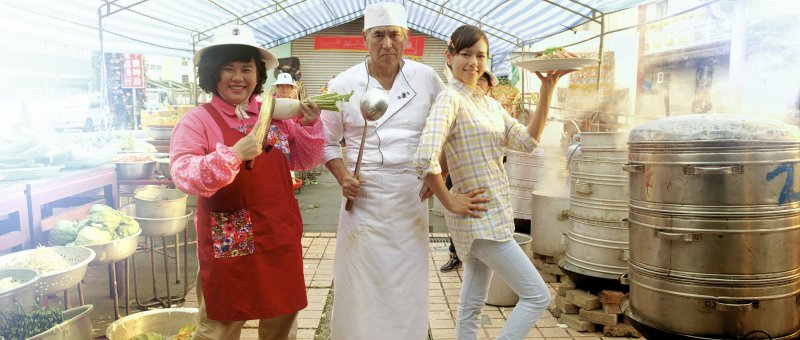
Zone Pro Site: The Moveable Feast (總舖師, Chen Yu-hsun, 2013)

In these high speed days, it’s sometimes difficult to remember that “cooking means something” or at least it should do according to “Doctor Gourmet” Hai (Tony Yang). A warm tribute to the Taiwanese tradition of bandoh outdoor banquets, Zone Pro Site: The Moveable Feast (總舖師, Zǒng Pù Shī) positions the figure of the chef as a kind of conduit bridging the gap between people through the art of well cooked food. Heroine Wan (Kimi Hsia Yu-chiao), however, thoroughly rejected the ambitions of her top chef father and determined on a life in the city with her heart set on becoming a famous model, actress, and celebrity. 

Life in Taipei is however hard. Career success is hard to come by and duplicity lurks round every corner. Wan learns this to her cost when two shady guys turn up on the pretext of delivering a birthday cake only to explain to her that her boyfriend, whose loans she’s unwisely co-signed, has skipped town and left her with the bill. Confused and afraid, Wan decides to skip town herself, planning to head back to her hometown and ask her mother for help. What she discovers however is that her mother is on the run too after losing the family restaurant partly through her subpar cooking skills which could never match those of her late husband, and partly through the betrayal of his apprentice who poached all their best customers and set up on his own. Despite being “in hiding”, the only way Puffy (Lin Mei-hsiu) has been able to make ends meet is by putting on an impromptu dance show in the central square to promote her small noodle stall. Luckily for them both, Wan makes a chance encounter on the train with a nice young man, Hai, who turns out to be a “Doctor Gourmet” specialising in “fixing” failing restaurants.

His arrival comes at just the right moment as Wan and her mother get a visit from potential clients – a sweet older couple who first met 50 years previously at a wedding catered not by Wan’s father Master Fly Spirit, but by his now departed mentor. Wan’s mother was going to turn the request down because neither she nor Wan know how to make the traditional dishes the couple are looking for, but Wan makes an impromptu decision to try and make their wedding dreams come true, warning them that it might take a little extra time and not quite match up to their romantic expectations. 

Wan’s problem is that she always hated her family’s restaurant. She resented the heat and the smell and the grease, often placing an empty box over her head and retreating into a fantasy world to escape the chaos. Her father wanted her to take over, leaving her a notebook filled with his recipes which was unfortunately stolen by a homeless man who mugged her at the station, but she was dead set on escape and becoming a “someone” in the city. Unlike her mother, however, she has real talent for cooking and is equally skilled at using her good looks and sweet nature to get things done. Soon after her arrival at the noodle stand, she’s already got herself a gang of geeky groupies calling themselves “Animals on Call” who are ready to do pretty much anything she asks of them. 

That comes in handy when Puffy persuades her to enter a national cooking competition where her rival is none other than Tsai, the apprentice who betrayed them, backed up another famous ex-chef Master Ghost Head (Hsi Hsiang) who has a fiery temper and spent some time in prison which might be why he still dresses like an ultra cool motorcycle guy from the ‘70s. There were apparently three great masters, the other being the eccentric  Master Silly Mortal (Wu Nien-jen) who is later discovered living in a subway tunnel where he keeps the art of bandoh alive through a literal underground restaurant where his regulars bring him a selection of ingredients before sitting down to enjoy a communal meal. It’s Silly Mortal whose food is said to evoke human feelings who guides Wan towards a series of epiphanies about the nature of “traditional” food. According to him, there are no rules about what goes together, and having a “traditional” heart is really about embracing the true nature of bandoh. Only by having a heart full of joy can you make good food. 

Equally eccentric in some respects, Hai takes a back seat after reminding Wan that cooking is really a way of sending a coded message to its intended target. The two goons eventually join the team, working together earnestly to prepare for the biggest banquet of all which is both the old couple’s wedding celebration and the competition’s finale. Master Ghost Spirit talks about taking the “grief” out of meat through fine cutting, while Master Silly Mortal is all about putting positive emotions in, but the missing piece of the puzzle is Master Fly Spirit who sends his final message to Wan only after death as she rediscovers him through his recipes. Not quite giving up on her celebrity career, Wan embraces her inner chef, happy with the idea of making lunchboxes to sell at the station with her new friends and family rather than chasing money through oddly nihilistic cuisine as Tsai had done. In the end, it’s all about joy and togetherness, sharing tasty food in the open air where anyone and everyone is welcome to bring whatever they have to the table.


Zone Pro Site: The Moveable Feast screens in New York on Feb. 16 as part of this year’s New York Asian Film Festival Winter Showcase.

International trailer (English subtitles)
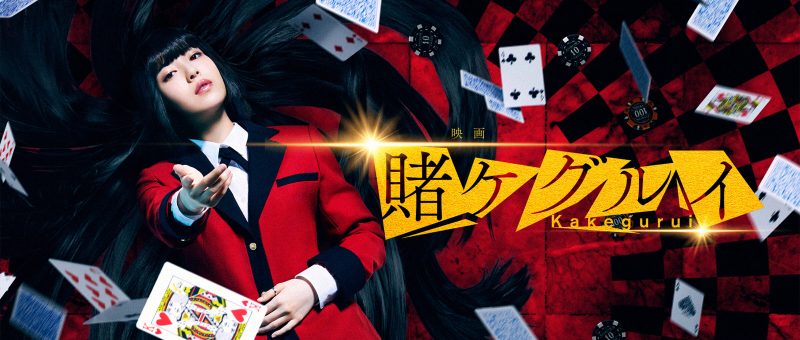
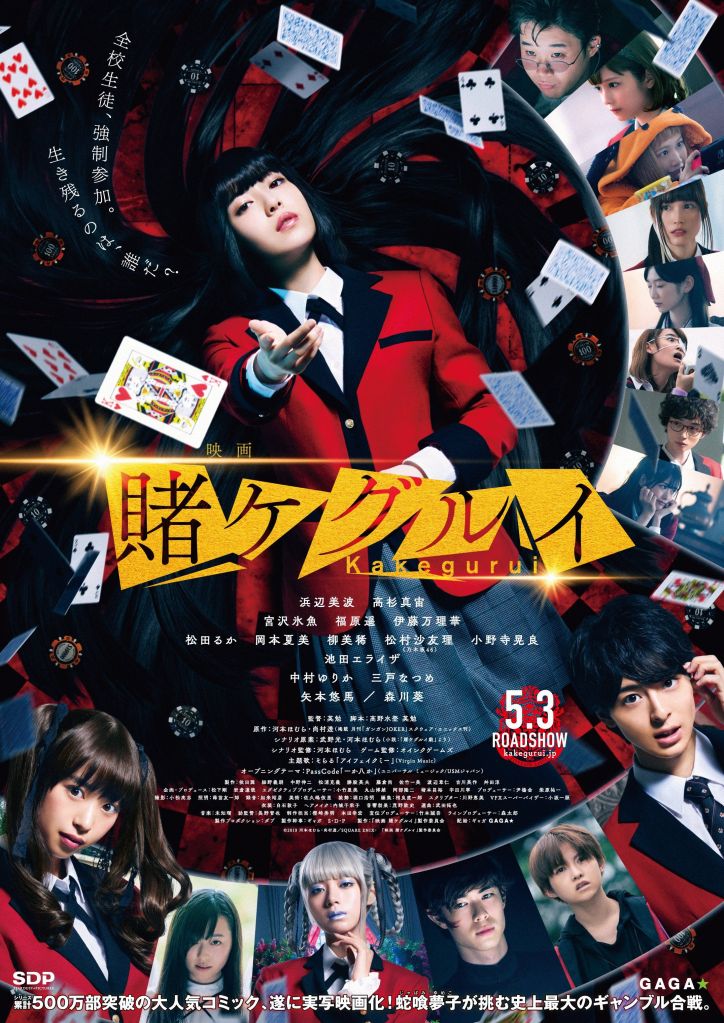
Kakegurui (映画 賭ケグルイ, Tsutomu Hanabusa, 2019)

Gambling, the ultimate act of faith or the height of anarchic genius? Based on the hit manga which has already been adapted as a popular TV anime, Kakegurui (映画 賭ケグルイ) is the sequel to two seasons of a live action TV drama set in a school where hierarchy is decided not by grades or by fists, but by prowess at the gaming tables. Those who lose so badly they bankrupt themselves become a kind of subhuman underclass, tied up like dogs and routinely humiliated, while the Student Council becomes a stand in for an oppressive social order ruling over all and enforcing the law with an iron hand. 

Into this high stress environment walks Yumeko Jabami (Minami Hamabe), a transfer student to the elite Hyakkaou Private Academy determined to bend its rules to her own advantage. Meanwhile, Student Council President Kirari Momobami (Elaiza Ikeda) is forced to deal with a new and unexpected threat – The Village, a small cult made up of students who have rejected the system, dropped out to live a hippy lifestyle in the grounds, and refuse to participate in “meaningless” games of chance. Their priest-like leader, Amane Murasame (Hio Miyazawa), once beat Kirari at cards becoming something like a god of gambling, but lost his zeal for the game after losing the only thing he ever cared about. 

Where he opposes the system passively yet pointedly, Yumeko rebels in her own, fiercely individualistic way by superficially conforming, becoming a top gambler, but only because she is exercising a free choice to do so. She plays for kicks alone, and generally wins because she isn’t stressed enough about losing to let it bother her. This individualist streak makes her a hidden threat against Kirari, but one that might in itself be an interesting gamble for the infinitely bored Student Council President. 

While Yumeko’s individualism threatens to unbalance the system, The Village presents a collectivist threat, agitating wholesale revolution and an end to the oppressive rule of the Student Council which renders losers inhuman. Yet there’s an essential irony in The Village’s creepy monotony that stands in stark contrast to Yumeko’s seeming conformity but insistence on her own freedom. Your life’s your own, she later explains, it’s annoying if people try to manipulate it. In this instance she’s talking not about the “life plans” handed out by the Student Council, but the egotistical desire to “save” the lives of others without considering if they want them saved or if you’re merely infringing on their personal freedom in attempting to make choices for them based entirely on your own value system. 

Murasame perhaps bet something he shouldn’t have and technically won, but ended up losing anyway which is what has made him turn against gambling. Yumeko, meanwhile, believes that the only way to be truly free to entrust yourself to luck and destiny. That is, however, somewhat disingenuous, because what Yumeko excels at is mind games, essentially manipulating those around her in order to win. Yumeko plays players, not cards, and is rarely played herself. Unlike Murasame’s righthand woman Arukibi (Haruka Fukuhara), she doesn’t care that much what people think. Arukibi, meanwhile, is desperate for approval and is playing her own game just to get someone’s attention which makes her a volatile, if easily manipulated, opponent.

Essentially, Murasame wants freedom outside of the system where Yumeko has found it within, but her philosophy is perhaps the more dangerous in that it proposes total freedom that has no regard for the systems of governance. Then again, maybe this is all a long con to get better cakes in the cafeteria, merely gaming the system rather than actively undermining it. Nevertheless, for Yumeko life is risk, rebelling against an oppressive social order through the anarchic individualism of living by “chance”. Living in a society as highly regimented as this is a high stakes game, but you can’t win if you don’t play, and you need to play smart. That’s the peculiar irony of life at Hyakkaou Private Academy where the Student Council literally owns your future but you can win it back by playing them at their own game. Bet your life, win your freedom Yumeko seems to say but she still makes sure to bring cake for everyone, not just the “winners” or the privileged few. 


Screened as part of the Japan Foundation Touring Film Programme 2020.

International trailer (English subtitles)

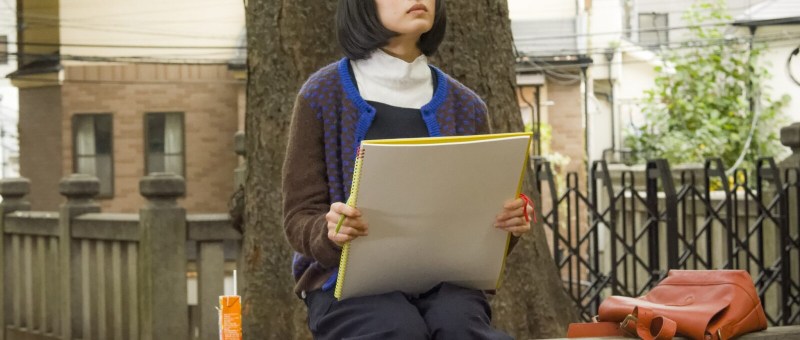
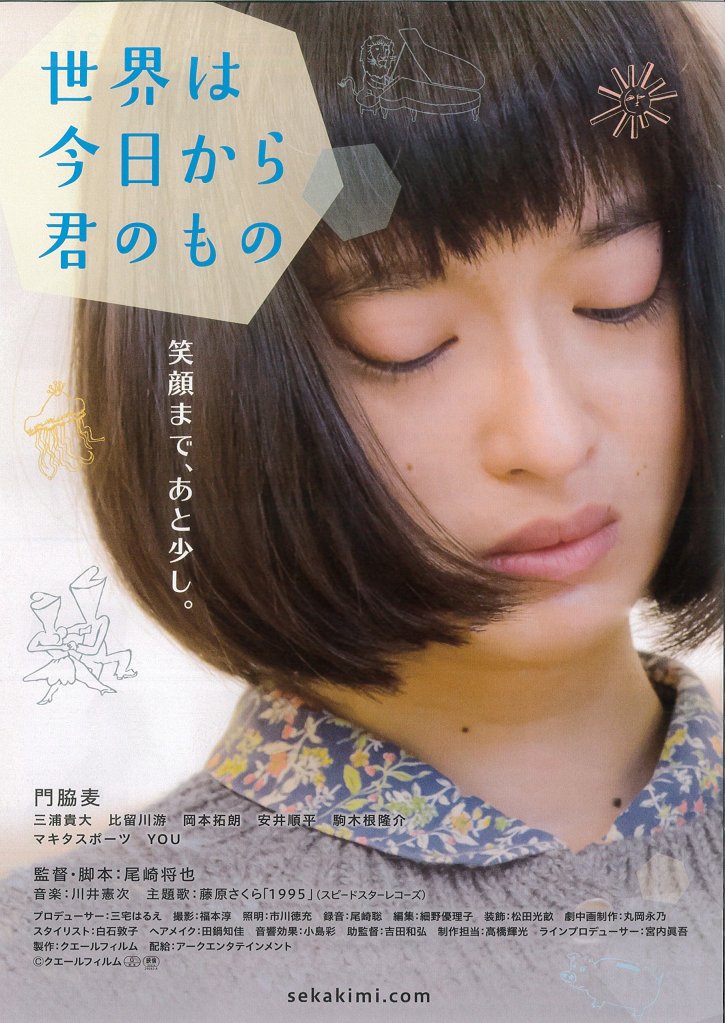
Her Sketchbook (世界は今日から君のもの, Masaya Ozaki, 2017)

Many young people struggle to find their place in the world, but for young Mami who largely just wants to be left alone, the struggle is all the greater. Less a hikikomori drama than a tale of destructive parenting and buried talents, Her Sketchbook (世界は今日から君のもの, Sekai wa Kyou kara Kimi no Mono) charts the gradual blossoming of a young woman who begins to take root after finding the right environment in which to thrive, encouraged by others who take the time to see and appreciate her for who she is rather than all they fear she’s not. 

A shut-in since dropping out of middle school, Mami (Mugi Kadowaki) has recently taken a factory job but is laid off after a little misadventure at the seaside leaves her with an injury that prevents her from strenuous labour. Her father Eisuke (Makita Sports), recently made redundant himself, is worried for her future and wants her get out more so he sets her up with a job that seems ideal, testing games for bugs at a software company. It’s there that she crosses paths with harried project manager Ryotaro (Takahiro Miura) who is getting fed up with the artistic temperament of his usual character designer. He drops a sketch covered in markup notes and she tries to hand it back to him but is too shy and ends up taking it home where she diligently corrects it according to his instructions and mails the revised illustration to the address on the bottom, trying to make up for her failure in being unable to approach him in person. The new drawing is exactly what Ryotaro had envisioned, but he has no idea who the mystery illustrator is. Nevertheless, he decides to start mailing additional requests to the unfamiliar email address. 

Eisuke thinks he’s doing the best for his daughter, but even he in unguarded moments describes her as odd and a failure. He had no idea that she had any kind of “talent”, believing she was just sitting in her room twiddling her thumbs. But for Mami, the discovery of her boxes of illustrations is something of a mixed blessing. She’s glad people seem to be pleased, but partially resents the new attention and quickly realises that they’ve misunderstood her capabilities. She’s good at mimicking the style of others and correcting proofs according to instructions, but struggles when asked to come up with ideas of her own. 

That struggle is essentially a mental block on being able to see herself. Always a little “different”, Mami never fit in at school and while her father fretted that she wasn’t making friends, her mother (You) was content to let her be. Unfortunately that wasn’t because she accepted her daughter for who she was and wanted to support her, but that she knowingly or otherwise used her difference against her as a reason to keep her close. Now having left the family for unclear reasons, Mami’s mother remains possessive and domineering, never missing an opportunity to undermine her daughter’s sense of confidence or to remind her that she doesn’t belong in regular society. Mami’s struggle is, in that sense, to break free of her mother’s toxic parenting and reject her view of her as someone who is entirely unable to lead a normal life as independent adult. 

Essentially infantalised, Mami finds herself learning adult life lessons at an accelerated pace but also battling unhelpful attempts to exploit and misuse her hikikomori past. A sleazy public servant who threatens to assault Mami after bringing home her drunken friend from a bar convinces her to appear at a panel he’s running on the hikikomori phenomenon but completely ignores everything she tells him, trying to twist her words to suit his own hypotheses in presenting her as someone who has successfully reintegrated into mainstream society. He wants her to say that she took the factory job to help out after her dad was laid off, but really she took it because his being home all day was quite annoying so she got a job to avoid him. The public servant simply isn’t listening, but a shy little girl in the back is and finally knows there’s nothing wrong with her and she’s not alone. 

What gives Mami the courage to move forward is the gentle encouragement of her new friends who never treat her as if she’s weird or incapable and are prepared to be patient while she finds her footing. Just like the flower in the flip book she draws while waiting for inspiration, Mami blossoms after finding the right environment in which to thrive, gaining confidence from other people’s confidence in her but resolving to take things one step at a time, harnessing her newfound talent to claim a space for herself in a world opening up before her.  


Screened as part of the Japan Foundation Touring Film Programme 2020.

International trailer (English subtitles)
The House Where the Mermaid Sleeps (人魚の眠る家, Yukihiko Tsutsumi, 2018)

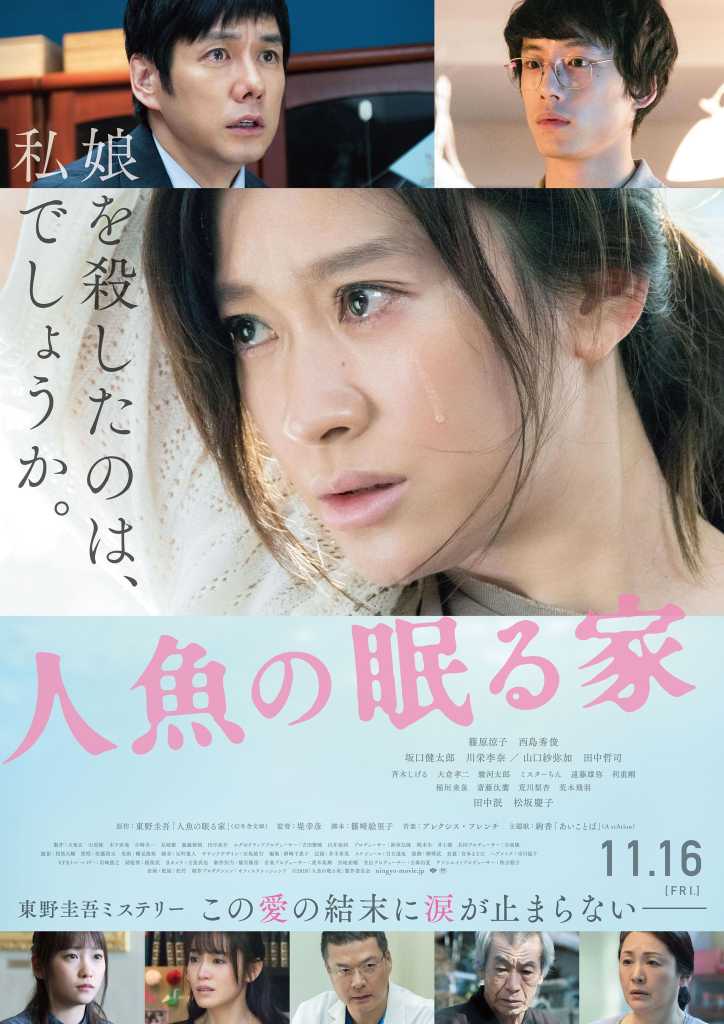
In most countries, the legal and medical definitions of death centre on activity in the brain. In Japan, however, death is only said to have occurred once the heart stops beating. The bereaved parents at the centre of The House Where the Mermaid Sleeps (人魚の眠る家, Ningyo no Nemuru Ie), adapted from the novel by Keigo Higashino, are presented with the most terrible of choices. They must accept that their daughter, Mizuho, will not recover, but are asked to decide whether she is declared brain dead now so that her organs can be used for transplantation, or wait for her heart to stop beating in a few months’ time at most. As their daughter was only six years old, they’d never discussed anything like this with her but come to the conclusion that she’d want to help other children if she could. Only when they come to say goodbye, Mizuho grasps her mother’s hand giving her possibly false hope that the doctor’s assurances that she is brain dead and will never wake up are mistaken. 

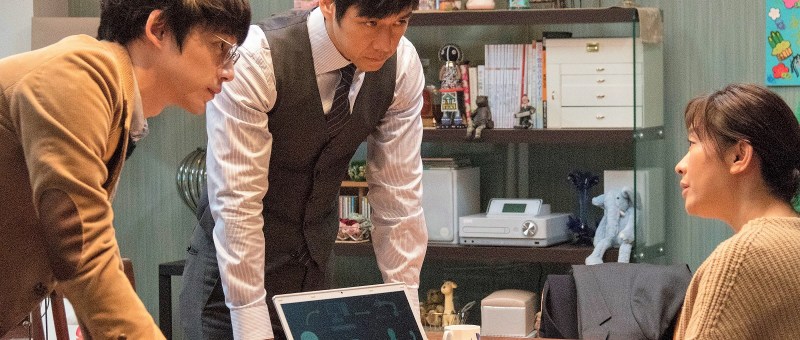
The situation is further complicated by the fact that the Harimas were in the middle of a messy divorce when they got the news that Mizuho had been involved in an accident at a swimming pool. Kazumasa (Hidetoshi Nishijima), Mizuho’s father, is the CEO of a tech firm specialising in cutting edge medical technology mostly geared towards making the lives of people with disabilities easier. He does therefore have a special interest in his daughter’s condition and is willing to explore scientific solutions where most might simply accept the doctor’s first opinion. His wife, Kaoruko, meanwhile has a deep-seated faith that her daughter is still present if asleep and will one day wake up. 

It so happens that one of Kazuma’s researchers (Kentaro Sakaguchi) specialises in a new kind of technology which hopes to restore motor function through artificial nerve signals controlled by computers and electromagnetic pulses. He hatches on the idea of using the technology to improve his daughter’s quality of life by letting her “exercise” to maintain muscle strength, but despite the excellent results it achieves in terms of her health, it takes them to a dark place. Muscle training might be one thing, but having Mizuho make meaningful gestures is another. They don’t mean to, but they’re manipulating her body as if she were a puppet, even forcing her to smile without her consent. 

Kazumasa starts to wonder if he’s gone too far. Seeing his daughter’s face move with no emotion behind it only proves to him that she is no longer alive. Meanwhile, he comes across another parent raising money to send his daughter to America for a life saving heart transplant and begins to feel guilty that perhaps his decision was selfish. The father of the other girl sympathises with him and confides that they can’t bring themselves to pray for a donor because they know it’s the same as praying for another child’s death, but Kazumasa can’t help feeling he’s partly responsible because he made the choice to artificially prolong his daughter’s life but now realises that she is little more than a living a doll. 

This is something brought home to him by Kaoruko’s increasing desire to show their daughter off. Her decision to take her to their son Ikuo’s elementary school entrance ceremony instantly causes trouble with the other parents who feign politeness but are obviously uncomfortable while the children waste no time in ostracising Ikuo because of his “creepy” sister. Kazumasa privately wonders if Kaoruko’s devotion has turned dark, if she’s somehow begun to enjoy this new closeness with her daughter to the exclusion of all else and has lost the power of rational thought. He can’t know however that perhaps she’s coming to the same conclusion as him, but it finding it much harder to accept that they might have made a mistake and all their interventions are only causing Mizuho additional suffering.

What’s best for Mizuho, however, is something that sometimes gets forgotten in the ongoing debate about the moral choices of her parents and relatives. Kazumasa’s colleagues accuse of him of misappropriation in monopolising a key researcher, hinting again at the “selfishness” of his decision to expend so much energy on treating someone whom many believe to be without hope when there are many more in need. The researcher in turn accuses Kazumasa of “jealousy” believing that he has displaced him as an “artificial” father working closely with Kaoruko in caring for their daughter. The “life” in the balance is not so much Mizuho’s but that of the traditional family which is perhaps in a sense reborn in rediscovering the blinding love that they shared for each other which will of course never fade. What they learn is to love unselfishly, that love is sometimes letting go, but also that even in endings there is a kind of continuity in the shared gift of life and the goodness left behind even after the most unbearable of losses.


Screened as part of the Japan Foundation Touring Film Programme 2020.

Original trailer (English subtitles)

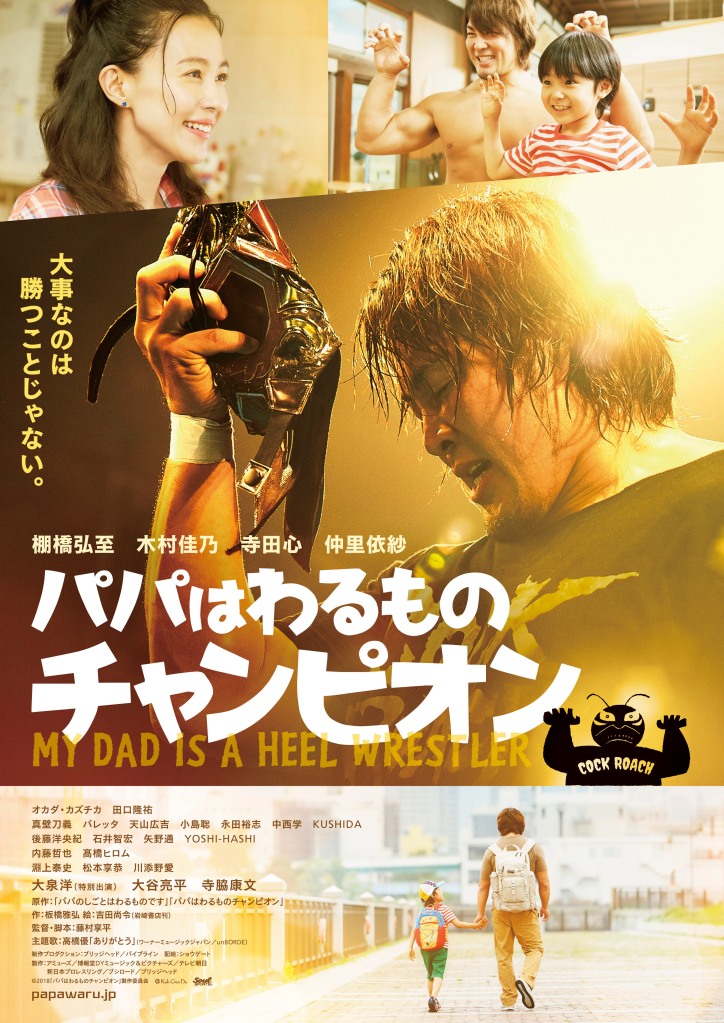
My Dad is a Heel Wrestler (パパはわるものチャンピオン, Kyohei Fujimura, 2018)

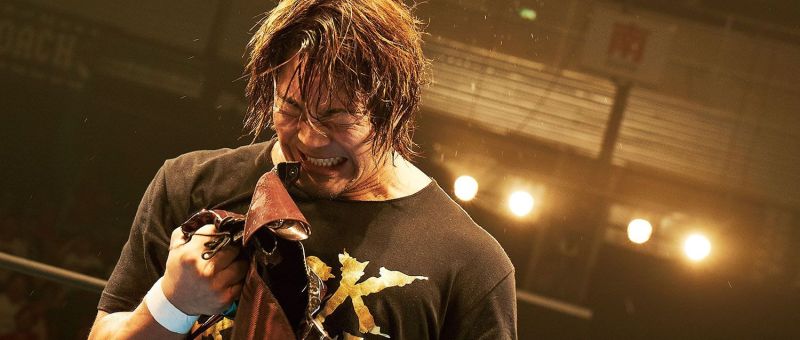
“Your job embarrasses me” little Shota (Kokoro Terada) coldly tells his actually quite lovely father, slowly closing the door on his well meaning attempt at connection. Self evident from the title, My Dad is a Heel Wrestler (パパはわるものチャンピオン, Papa wa Warumono Champion), Shota’s dad Takashi (real life wrestler Hiroshi Tanahashi) is a former champ reduced to playing the “heel”, a masked villain fans love to hate whose signature move is comic relief. Like all little boys, Shota really looked up to his father and wanted to be just like him, and so he gets a dose of paternal disappointment a little earlier than expected in realising that he is in a sense a professional loser with a degree of internalised shame regarding his failure to get back in the ring under his own identity. 

10 years previously, just before 9-year-old Shota was born, Takashi was a champion but a knee injury cost him his career. To stay in the game and provide for his family, he decided to become a heel as a temporary measure until he was well enough to return to being a “face”. A decade later however he’s still “Cockroach Mask” working with “Bluebottle” as a comedy villain known for pulling all sorts of unscrupulous tricks like using “Roach Spray” on his opponents or extracting gadgets from a Doraemon-esque interdimensional portal in the shape of a garbage can. Ashamed of himself, Takashi has avoided telling Shota what exactly it is he does for a living, promising that he’ll explain everything when he’s older. 

But Shota’s at the age when everyone at school is boasting about their dads and it’s niggling at him that he doesn’t really know, especially when one of his friends jumps to the conclusion he must be a yakuza. Determined to find out, Shota does some detective work and secretly follows him, only to wind up surrounded by beefy guys backstage at the ring. Bumping into a wrestling obsessive classmate (Maharu Nemoto) there with her father (Yasushi Fuchikami), Shota is horrified to realise his dad’s that jerk that everyone hates so when she somehow jumps to the conclusion that his dad’s her idol, reigning champ Dragon George (real life wrestler Kazuchika Okada), he doesn’t bother to correct her. 

The irony is, Takashi is a genuinely nice guy. He’s desperate to make it to Shota’s parents’ morning at school, but misses it because he stops on the way to help an old lady who was struggling with her shopping. When the kids are asked to compose a speech about their dreams for the future, Shota says that he wants to get big and strong like his dad in the hope that being big will also make him kind. Shota, however, is still too young to understand the way that wrestling works. He only sees his dad degrade himself, do “bad” things to win, and act in an underhanded, dishonourable way that is completely at odds with his offstage personality. Yet as much as it is that he’s disappointed to think his dad’s a “loser”, the real cause of his resentment is seeing that he’s not being true to himself. Shota’s mother tells him that wrestling is Takashi’s passion, but he pointedly asks her if his dream was being a heel, which it obviously wasn’t. 

While Shota picks up on his dad’s internalised sense of shame over the failure to achieve his dreams, he indulges in a little subterfuge himself in keeping up the pretence that his father is not the hated Cockroach Mask but the universally loved Dragon George. Failing to clear up the misunderstanding makes him an unexpected class hero, but it also unbalances the social hierarchy with snooty rich kid and all-round popular boy Yuta irritated at Shota stealing his thunder. When some of his friends start to doubt his story, it’s not the fact that Takashi is Cockroach Mask that upsets them only that Shota lied. Having a pro wrestler dad is cool in itself, he didn’t need to worry about what people would think and he shouldn’t have anyway because he should have stuck by his father rather than rejecting him completely and changing his dream to boring salaryman like the odious Yuta. 

Takashi, meanwhile, needs to think through why he’s doing a job that he’s essentially ashamed of. Bluebottle, his partner, who entered the trade as a heel and loves the strange thrill of being booed by the crowd, is offended at his insinuation that being a heel is somehow embarrassing. Michiko (Riisa Naka), an eccentric journalist and wrestling obsessive, tries to explain to Shota that the heel is an essential part of the game – you can’t have a fight without a villain after all, but Takashi still wants to be the face and regain his rightful place as a champion. He can’t let go of past glory and struggles to accept that there are new ways to win. “Wrestling’s not about winning or losing, it’s a way of life” an exasperated Michiko tells her editor (Yo Oizumi), trying to get him interested in the soap opera drama by way of investment in Takashi’s struggle. You don’t have to win, all you have to do is keep getting back up and make sure you put on a good show. Shota figures out that just because his dad’s a “bad guy” doesn’t make him a bad person, while Takashi figures out the only way to be the champ is to embrace his inner roach. Turns out, what wrestling’s all about is authenticity, just not quite in the way you were expecting it. 


Screened as part of the Japan Foundation Touring Film Programme 2020.

Hong Kong release trailer (English/Traditional Chinese subtitles)

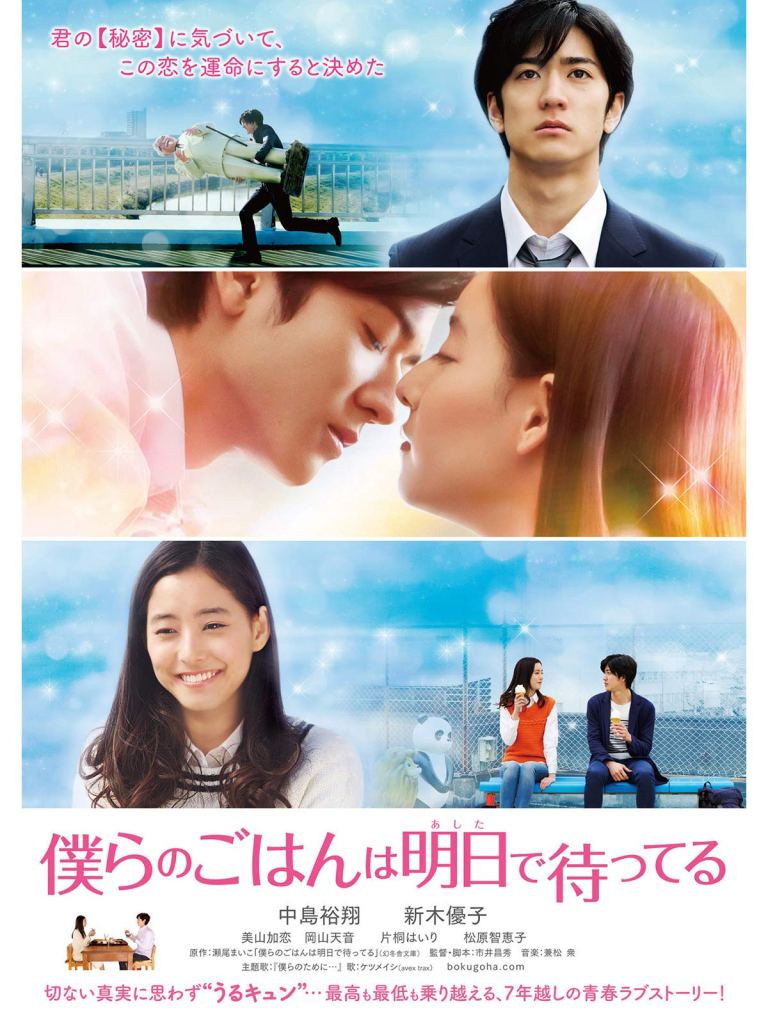
Our Meal For Tomorrow (僕らのごはんは明日で待ってる, Masahide Ichii, 2017)

Eat, drink, and be merry, as they say, for tomorrow we may be gone. The hero of Masahide Ichii’s Our Meal for Tomorrow (僕らのごはんは明日で待ってる, Bokura no Gohan wa Ashita de Matteru) has committed himself to the first of those, is still too young to be much interested in the second, and is resolutely failing at the third. Somewhat gloomy and introverted, he has decided on a course of self-isolation, convinced that it’s better not to get attached because all attachment ends in heartbreak, but a life without sensation is barely a life at all and in the end all you can do is live while you’re alive taking your pleasure where you can. 

Young Ryota (Yuto Nakajima) is a dreamy high school boy with his head in the clouds. Bamboozled into participation in a sack race relay with pretty classmate Koharu (Yuko Araki) he approaches the matter in characteristically analytical fashion, eventually realising that he, taller and stronger (physically at least), will have to take the lead if they are to move forward. Off the track, however, that’s a lesson he finds difficult to learn. After their victory, Koharu stuns Ryota by confessing that she asked him to join her in the sack race precisely because she has a crush on him. He panics and apparently turns her down, but eventually reconsiders.

Their romance continues in typical high school fashion, only strengthening as they prepare to move on to new stages in their lives in heading off to uni while idly dreaming of an imagined future with the family they will forge together as adults. There is however a shadow hanging over their love. The reason Ryota is so brooding and contemplative is because he’s reeling over the death of his older brother from an illness, something he tries to “discuss” (or more accurately monologue) with Koharu but she abruptly cuts him off because she has more important things to do than listen to a long sad story she feels she already understands. He, meanwhile, never quite thinks to ask her very much about her life outside of him and is both hurt and slightly resentful when she casually mentions that she’s had her share of loss too which is why she’s so keen to start a family of her own. 

Ryota may be the contemplative sort, but he’s also the type that likes to talk out loud about his feelings without feeling the need to hold anything back. Koharu meanwhile is precisely the opposite. She might be upfront about what she wants and direct in stating her desires, but she’s also resolutely uncurious, dislikes talking about “unpleasant” things, and is content to let the mystery linger where Ryota wants to know absolutely everything (but without actually asking any questions). Taking a (solo) holiday, he finds himself alone among a gaggle of middle-aged women taking a break from their husbands who explain to him that small secrecies are an entirely normal and in fact essential element of a healthy relationship. Without them, their lives would not be possible.

It was a quest for self knowledge, however, which took him to Thailand. Ironically, he went “alone” but as part of a tour group, whereas Koharu took the opportunity to go to Australia and hunt gemstones entirely by herself only to be confronted by a sense of loneliness in wanting to turn to someone with whom to share the moment but finding no one there. In sync to a point, they are still not quite ready to act as one, Koharu confessing that it’s undoubtedly easier to do things on your own, laying bare the shyness that unpins her deceptively outgoing personality in her fear of the awkwardness that comes with shared intimacy. 

That intimacy is something Ryota craves but also fears. He’s afraid of getting attached, she’s afraid of getting bored. Ryota compares his fear of falling in love to the sense of emptiness one feels when a movie ends, or perhaps the act of enjoying a beautifully cooked steak but knowing that the meal will all too soon be over. Koharu points out that a never ending steak would be a hellish nightmare, implying that it’s better to just enjoy the steak until you’re full and then be thankful for a delicious meal. That’s something she too finds hard to accept, however, when she discovers that her dreams of a picture perfect family may be impossible to achieve. She pulls away, isolating herself, nobly trying to spare Ryota the pain of witnessing her suffering. An old lady (Hairi Katagiri) advises him to be foolish in love, make an uncharacteristically grand gesture. The future may not be quite the way you pictured it, but that’s no reason you can’t be happy with what you have while you have it. No one knows what may come. Savour the moment while the moment lasts, everything else is for another day.


Screened as part of the Japan Foundation Touring Film Programme 2020.

Original trailer (no subtitles)

The Actor (俳優  亀岡拓次, Satoko Yokohama, 2016)

“There are no small parts, only small actors” according to the mantra of the bit part player, but perhaps deep down everyone wants to play the lead. Most jobbing actors will tell you that they’re happy to be working and if you work as much the dejected hero of Satoko Yokohama’s The Actor (俳優  亀岡拓次, Haiyu Kameoka Takuji), you can make a pretty decent living with a little more job security than a big name star whose career will inevitably hit the odd dry spell. Yet, who doesn’t want to at least feel that they’re the lead in their own life story? Spending all your time being other people can make you lose sight of who you really are and live your life with a sense of cinematic romanticism forever at odds with accepted reality. 

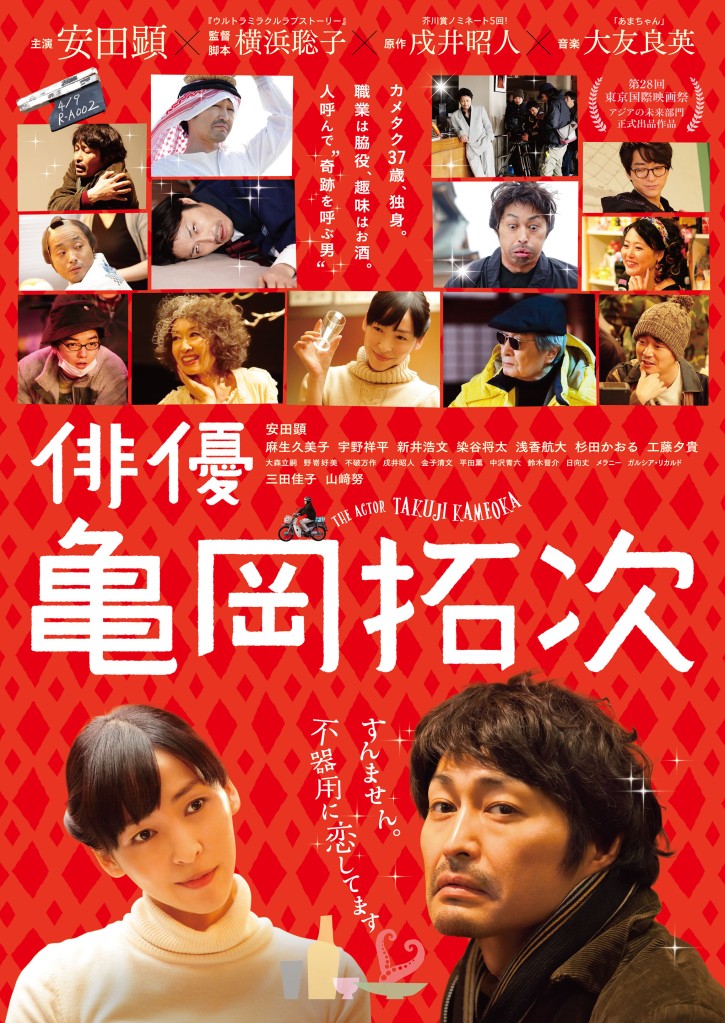
Takuji Kameoka (Ken Yasuda) is a classic background actor, turning up in small roles in TV dramas, often playing the villain of the week or appearing as a prominent extra. Meanwhile, his offscreen life seems to be lived in a booze-soaked haze, hanging out in his favourite bar surrounded by similarly dejected middle-aged men or occasionally meeting up with colleagues. Even his agent expects him to be sozzled when she rings to confirm new jobs though to be fair she doesn’t seem too bothered about it. 

Kameoka has perhaps made his peace with the kind of actor he is, but there’s also an inbuilt anxiety in waiting for people to ask what it is he does, knowing that it sounds glamorous and exciting when, to him at least, it’s anything but. Chatting with a pretty young woman, Azumi (Kumiko Aso), working behind a bar in a small town where he’s filming, Kameoka spins her a yarn about being a bowling ball salesman rather than be forced into a conversation about the life of a jobbing actor which might perhaps depress him more. Alone in the bar, the pair of them strike up a rapport over shared sake, but Kameoka forgets that in essence she’s just the same as him – acting, performing her role as the cheerful hostess, keeping him happy to sell more drinks. Later, she tells him that she’s switching roles, “recasting” herself as a good wife and mother, pointing again towards the unavoidable performative quality of conforming to socially defined labels such as “wife”, “mother”, “landlady”, “actor” or “man”. 

Everyone is, to some degree, acting, forced to perform a role in which they may privately feel miscast but are unable to reject. Kameoka is losing sight of who he is and so his life begins to feel increasingly like a movie, obeying narrative logic rather than that of “reality” while he often drifts off into flights of fancy in which he gets to play not the lead but a slightly bigger supporting part, recasts himself as the star of a favourite film, or finds himself momentarily in a film noir. Real or imagined, his directors have nothing but praise for him to the degree that it somehow feels ironic. He’s brought in to show the rookie leads how it’s done, an accidental master at dropping dead on camera, but as the landlady at his local says of another actor on TV, he just doesn’t have that leading man sparkle. Of course, not having that kind of presence is perfect for being a background player but a great shame when he has the talent to succeed, just without the burden of “star quality”. 

Then again, his talent is uncertain. Despite telling his agent that he doesn’t do stage, he agrees to work with a famous actress/director on an avant-garde theatre piece. Though she’s much harder on the young female star, Matsumura (Yoshiko Mita) rarely compliments his acting and eventually advises him that he’s unsuited to stage work because he has “film timing”. Privately, he might agree, but a job’s a job. Ironically enough, the performance that Matsumura failed to bring out in him is vividly brought to life during a very weird audition for a Spanish director who happens to be one of Kameoka’s favourites. He inhabits the role so strongly as to completely become it to the extent that its world rises all around him, but all too soon the audition is over with a simple “that’s great, thank you – we’ll be in touch”. Kameoka even suffers the indignity of crawling under the frozen shutters to exit the building while the next hopeful, a top TV actor he worked with on a previous job, makes his way inside. 

The woman in Kameoka’s audition fantasy is clearly Azumi, something that becomes clearer to him still during another flight of fancy that recasts him as a romantic hero making the grand gesture of a rain soaked dash, motorcycle filmed against rear projection, as he prepares for the inevitable “happy ending”. Reality, however, triumphs once again. Lovelorn, Kameoka declares himself lonely and indeed is always alone, not one of the “main cast” just a “bit player” hanging round until his scene and then moving on to the next project. He waves at women who weren’t waving at him, sympathises with a failed singer turned bar hostess, and celebrates the unexpected marriage of a friend but in a strange sense perhaps misses “himself”, gradually eclipsed by all the roles he plays onscreen and off. “Who are you?”, the Spanish director’s interpreter asks. “Takuji Kameoka, Japanese Actor”, is as good an answer as any. 


Screened as part of the Japan Foundation Touring Film Programme 2020.

Original trailer (English subtitles)