 In this brand new, post truth world where spin rules all, it’s important to look on the bright side and recognise the enormous positive power of the lie. 2015’s April Fools (エイプリルフールズ) is suddenly seeming just as prophetic as the machinations of the weird old woman buried at its centre seeing as its central message is “who cares about the truth so long as everyone (pretends) to be happy in the end?”. A dangerous message to be sure though perhaps there is something to be said about forgiving those who’ve misled you after understanding their reasoning. Or, then again, maybe not.
Juggling seven stories April Fools is never as successful at weaving them into a coherent whole as other similarly structured efforts but begins with an intriguing Star Wars style scroll regarding alien sleeper agents who can apparently go home now because they’ve accomplished everything they came for. Changing track, pregnant snack addict Ayumi (Erika Toda) decides to ring the still unknowing father of her child after witnessing an improbable reunion on TV only he’s in bed with someone else and assumes her call is a weird practical joke. Overhearing that he’s just arrived at a restaurant for a lunch date, Ayumi takes matters into her own hands and marches over there, eventually taking the entire place hostage. Meanwhile an older couple are having a harmless holiday pretending to be royalty and a grizzled gangster has “kidnapped” a teenage girl only to give her a nice day out at the fun fair. Oh, and the hikkikomori from the beginning who’s fallen for the whole alien thing has made a total fool of himself at school by taking out his bully, kissing his crush goodbye and racing up to the roof to try and hitch a lift from the mothership.
Importing this weird European tradition to Japan, the creative team have only incorporated parts of it in that they don’t call time on jokes at noon and it’s less about practical shenanigans and elaborate set ups than it is about wholesale lying which is frustrated by this famous non-holiday apparently created in celebration of it. All of the protagonists are lying about something quite fundamental and usually to themselves more than anyone else but at least their April Fools adventures will help them to realise these basic inner truths.
Then again some of these revelations backfire, such as in the slightly misjudged minor segment concerning two college friends who are repeatedly kicked out of restaurants before they can get anything to eat. One decides to “prank” his friend with an April Fools confession of love, only to find that his friend really is gay and is in love with him. Awkward is not the word, but then an April Fools declaration of love is about the worst kind of cruel there is and is never funny anyway, nor is the casual homophobia involved in this entire skit but that’s another story.
In fact, most of the other people are aware they’re being lied to, but are going along with it for various reasons, some hoping that the liars will spontaneously reform and apologise or explain their actions. Ayumi, who is shy and isolated by nature, always knew her handsome doctor suitor was probably not all he seemed to be but is still disappointed to be proved right, only be perhaps be proved wrong again in the end. Convinced to take a chance on an unwise romance by an older colleague who explains to her that many miracles begin with lies, Ayumi is angry with herself as much as with her lying Casanova of a baby daddy, and also feels guilty about an incredibly sight deception of her own. As in many of the other stories, now that everyone has figured out the real, important, truths about themselves and about the situation, they can excuse all of the lying. Sensible or not? The choice is yours.
Despite coming from the team who created some very funny TV dramas including Legal High, the comedy of April Fools never quite hits its stride. Weak jokes backed up with slapstick humour giving way to sentimentality as the “good reasons” for the avoidance of truth are revealed don’t exactly whip up the farcical frenzy which the premiss implies. The point may very well be that we’re the April Fools going along with this, but even so its difficult to admire a film which pushes the “lying is good” mantra right to the end rather than neatly undercutting it. Still, there is enough zany humour to make April Fools not a complete waste of time, even if it doesn’t make as much of its original inspiration as might be hoped.
Original trailer (English subtitles)
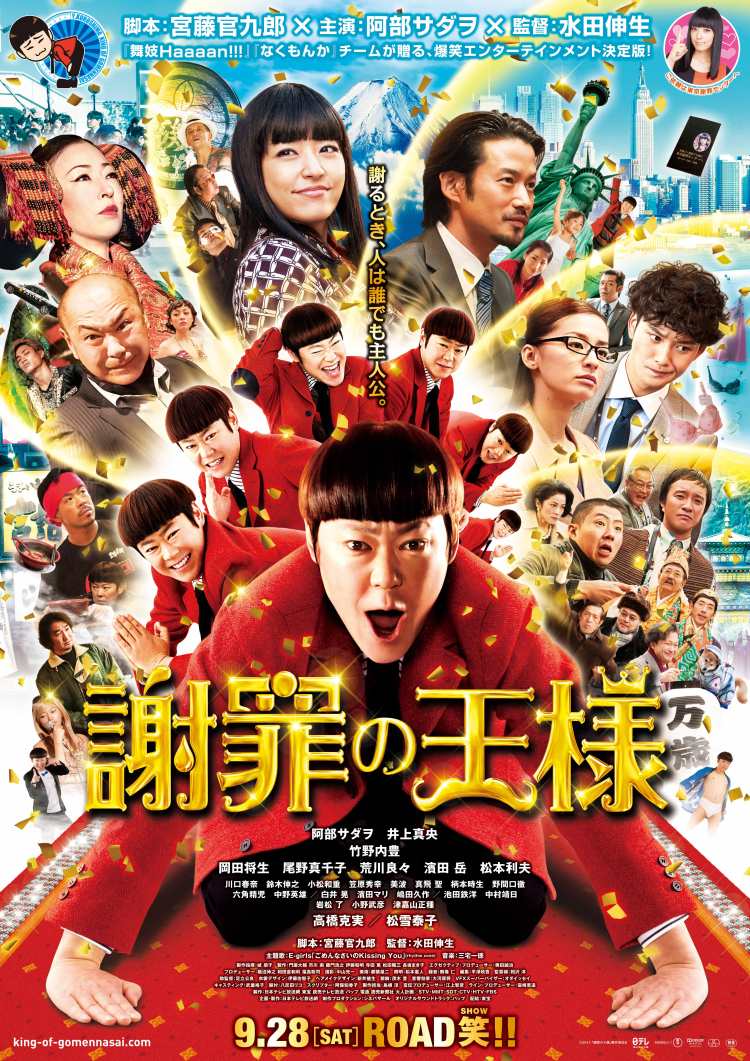 There are few things in life which cannot at least be improved by a full and frank apology. Sometimes that apology will need to go beyond a simple, if heart felt, “I’m Sorry” to truly make amends but as long as there’s a genuine desire to make things right, it can be done. Some people do, however, need help in navigating this complex series of culturally defined rituals which is where the enterprising hero of Nobuo Mizuta’s The Apology King (謝罪の王様, Shazai no Ousama), Ryoro Kurojima (Sadao Abe), comes in. As head of the Tokyo Apology Centre, Kurojima is on hand to save the needy who find themselves requiring extrication from all kinds of sticky situations such as accidentally getting sold into prostitution by the yakuza or causing small diplomatic incidents with a tiny yet very angry foreign country.
 Lav Diaz is many things but he’s not especially known for his brevity. Elegy to the Visitor From the Revolution (Elehiya Sa Dumalaw Mula Sa Himagsikan) is something of a departure in that regard as it runs a scant eighty minutes but is, nevertheless, imbued with the director’s constant themes of loss, melancholy and despair conveyed across a tripartite structure peopled by three very different yet interconnected sets of characters. To say “only” eighty minutes long, yet Elegy to the Visitor From the Revolution first began as a one minute short, intended to form a part of Nikalexis.MOV – an omnibus dedicated to the memory of film critics Alexis Tioseco and Nika Bohinc tragically killed during a home invasion. Diaz’ film, however, outgrew its origins to become a stand alone feature in its own right.
 One of the very earliest films to address female same sex love in Korea, Ashamed (yes, really, but not quite – we’ll get to this later, 창피해, Changpihae, retitled Life is Peachy for US release) had a lot riding on it. Perhaps too much, but does at least manage to outline a convincing, refreshingly ordinary failed love romance even if hampered by a heavy handed structuring device and a lack of chemistry between its leading ladies.
 Japan has never quite got the zombie movie. That’s not to say they haven’t tried, from the arty Miss Zombie to the splatter leaning exploitation fare of Helldriver, zombies have never been far from the scene even if they looked and behaved a littler differently than their American cousins. Shinsuke Sato’s adaptation of Kengo Hanazawa’s manga I Am a Hero (アイアムアヒーロー) is unapologetically married to the Romero universe even if filtered through 28 Days Later and, perhaps more importantly, Shaun of the Dead. These “ZQN” jerk and scuttle like the monsters you always feared were in the darkness, but as much as the undead threat lingers with outstretched hands of dread, Sato mines the situation for all the humour on offer creating that rarest of beasts – a horror comedy that’s both scary and funny but crucially also weighty enough to prove emotionally effective.
 Terra Formars – Terror for Mars? It’s all about terror in the quest for terra and reform in Takashi Miike’s bug hunt extravaganza adaptation of Yu Sasuga and Kenichi Tachibana’s manga. In fact, much of the plot is more or less the same as Aliens, but our motley crew is not a crack team of space marines headed by a recently awoken from stasis super survivor who proves unexpectedly dextrous in a robotic forklift exoskeleton, but a collection of human “bugs”, parasitical criminals who’ve each been made an offer they can’t refuse. High budget and boasting a starry cast, Terra Formars (テラフォーマーズ) definitely falls into the throwaway Miike category and proves curiously dull despite its ridiculous set up, but then if you happen to be into bugs there’s really a lot to like here.
 Trains! They seem to be the latest big thing in Chinese cinema, but at least Railroad Tigers (铁道飞虎, Tiědào Fēi Hǔ) has more rolling stock on offer than the disappointingly CGI enhanced effort which formed the finale of
 If there is a frequent criticism directed at the always bankable director Yoji Yamada, it’s that his approach is one which continues to value the past over the future. Recent years have seen him looking back, literally, in terms of both themes and style with remakes of films by two Japanese masters – Ozu in his Tokyo Story homage Tokyo Family, and Kon Ichikawa in Her Brother. While he chose to update both of those pieces for the modern day, 2008’s
 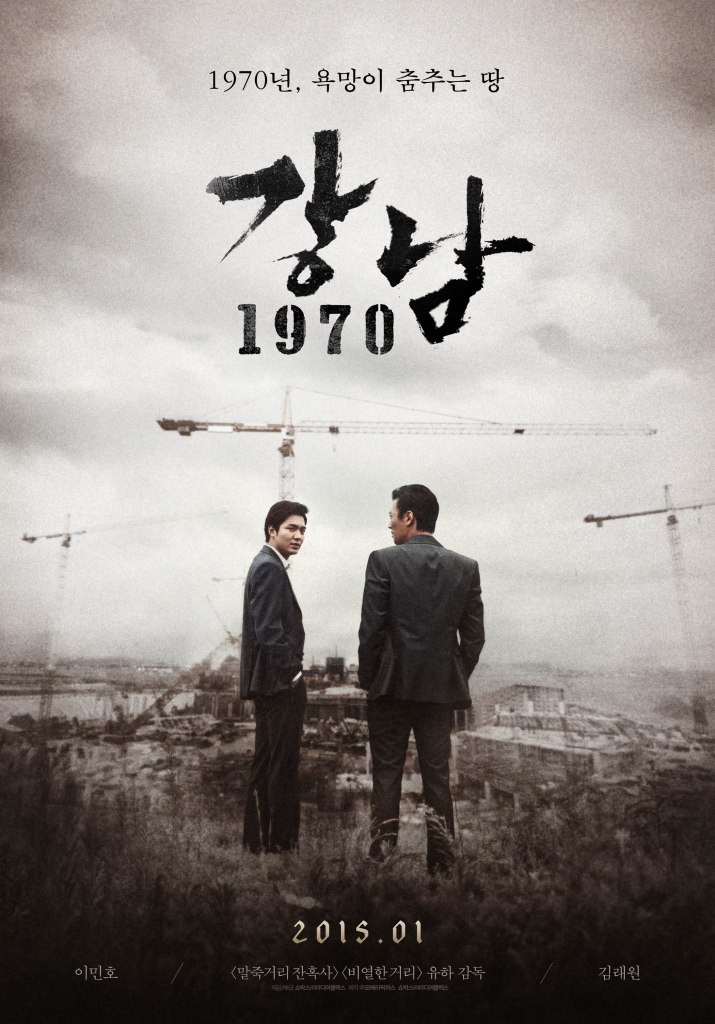 Yoo ha takes us back to the 1970s for some Gangnam Blues (강남 1970, Gangnam 1970) in a sorry tale of fatherless men caught up in dangerous times of ambition and avarice, very much at the bottom of the heap and about to be eclipsed by the “new world” currently under construction. Back then, Gangnam really was all just fields, owned by farmers soon to be cheated out of their ancestral lands by enterprising gangsters engaged in a complicated series of land grab manoeuvres, anticipating the eventual expansion of the bursting at the seams capital. Far from the shining city of today, Gangnam was a wasteland frontier town, the sort of place where a man can make a name for himself trading on his wits and his fists alone.
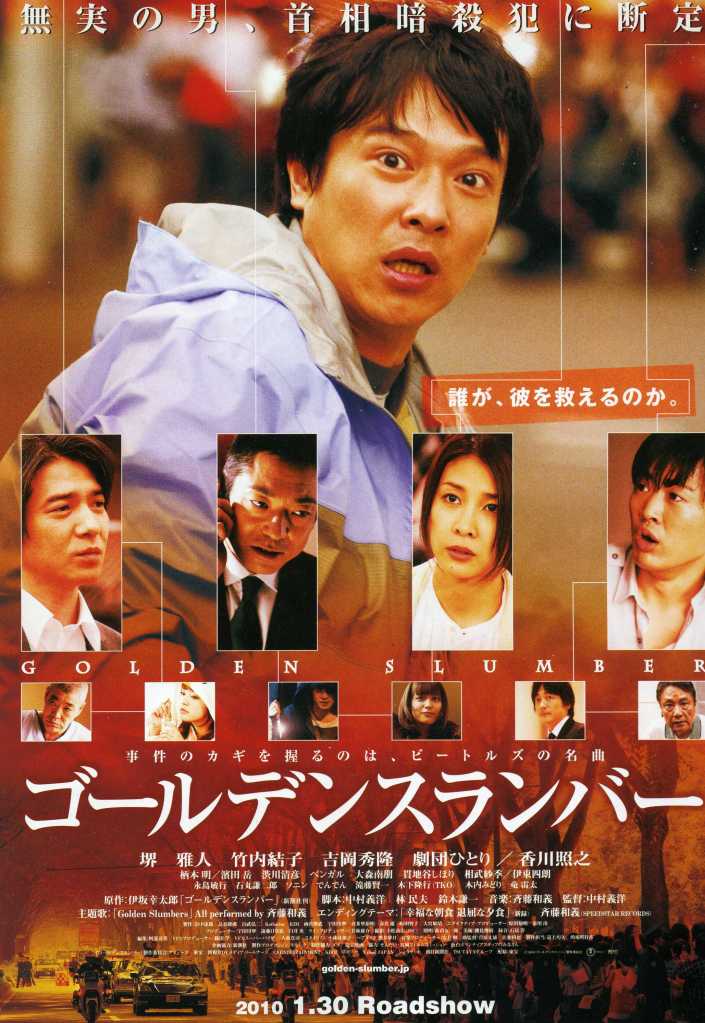 Yoshihiro Nakamura has made a name for himself as a master of fiendishly intricate, warm and quirky mysteries in which seemingly random events each radiate out from a single interconnected focus point. Golden Slumber (ゴールデンスランバー), like
  Windows on Worlds