Petty Romance (쩨쩨한 로맨스, Kim Jung-hoon, 2010)

petty-romanceKorea is quite good at rom-coms. Consequently they make quite a lot of them and as the standard is comparatively high you have to admire the versatility on offer. Korean romantic comedies are, however, also a little more conservative,  coy even, than those from outside of Asia which makes Petty Romance (쩨쩨한 로맨스,  Jjae Jjae Han Romaenseu) something of an exception in its desire to veer in a more risqué direction. He’s too introverted, she’s too aggressive – they need each other to take the edges off, it’s a familiar story but one that works quite well. Petty Romance does not attempt to bring anything new to the usual formula but does make the most of its leads’ well honed chemistry whilst keeping the melodrama to a minimum.

Manhwa artist Jeong Bae (Lee Sun-kyun) is not having much success with his latest project. In fact, his publishing house has been using his submitted drafts as scrap paper. He’s also got a problem in that a gallery owning friend of his late father has been the caretaker of a precious painting left to him in his father’s will but now wants to call in a loan or sell it to get the money back and so Jeong bae is in desperate need of fast cash.

Across town, Da-rim (Choi Kang-hee) has managed to bag a writing gig on her friend’s woman’s magazine but finds herself out of her depth working on a sex advice column when she has no direct experience of love or dating. Given the axe by her friend and living with her moody twin brother to whom she owes money, Da-rim is also in need of something to sink her teeth in to.

When a friend of Bae’s lets him know about a new competition with a $100,000 cash prize it sounds like just what he needs. The only snag is the competition is for “adult” manhwa which has not generally been Bae’s thing. Taking his editor’s advice, Bae decides to work with a writer but most of his interviewees are not exactly what he’s looking for. Da-rim with her “experience” in translation and publishing, as well as her unusual forthrightness concerning the subject matter very much fits the bill.

Kim doesn’t waste much time in getting the two together though their love/hate relationship is a definite slow boil as both Bae and Da-rim spend most of their partnership playing each other to try and get the upper hand. Bae’s trouble, according to his editor, is a talent for action but a failure with narrative – hence the need for a writer. Da-rim, by contrast, has altogether too much imagination coupled with the kind of arrogance which masks insecurity. Having blagged her way into the job, Da-rim spends most of her time ensuring that she’s in a superior position to Bae so that he will have to do most of the work while she enjoys freshly made coffee ordered to distract him from the fact that she has no idea what she’s doing.

Despite coming up with a promising storyline about a sex obsessed female assassin, Da-rim’s naivety is palpable in her attempts to come up with a suitably “adult” atmosphere. Disney-esque scenarios of handsome princes and desert islands, even if spiced up (in the most innocent of ways), isn’t quite striking the tone for the kind of prize winning raunchy manga that the pair are aiming for. Pushed further, Da-rim’s extrapolations from “research” are so unrealistic as to set Bae’s alarm bells ringing but offered with such insistence as to have him momentarily doubt himself.

Kim makes good use of manhwa as a visual device allowing him to include slightly more erotic content than usual in a Korean romantic comedy in an entirely “safe” way. Refreshingly he keeps the usual plot devices to a minimum though there is the “sibling mistaken for lover”, “mistimed job offer,” and “aggressive rival” to contend with, even if the major barriers are entirely centred around the personalities of the protagonists who are each fairly self involved in their own particular ways. Despite making good use of the chemistry generated by previous collaborators Lee Sun-kyun and Choi Kang-hee, Petty Romance lives up to its name in providing enough low-key drama to keep rom-com fans happy but never quite moves beyond the confines of its genre.


Available to stream on Mubi (UK) until 15th March 2017 courtesy of Terracotta Distribution.

Original trailer (English subtitles)
Nagasaki: Memories of My Son (母と暮せば, Yoji Yamada, 2015)

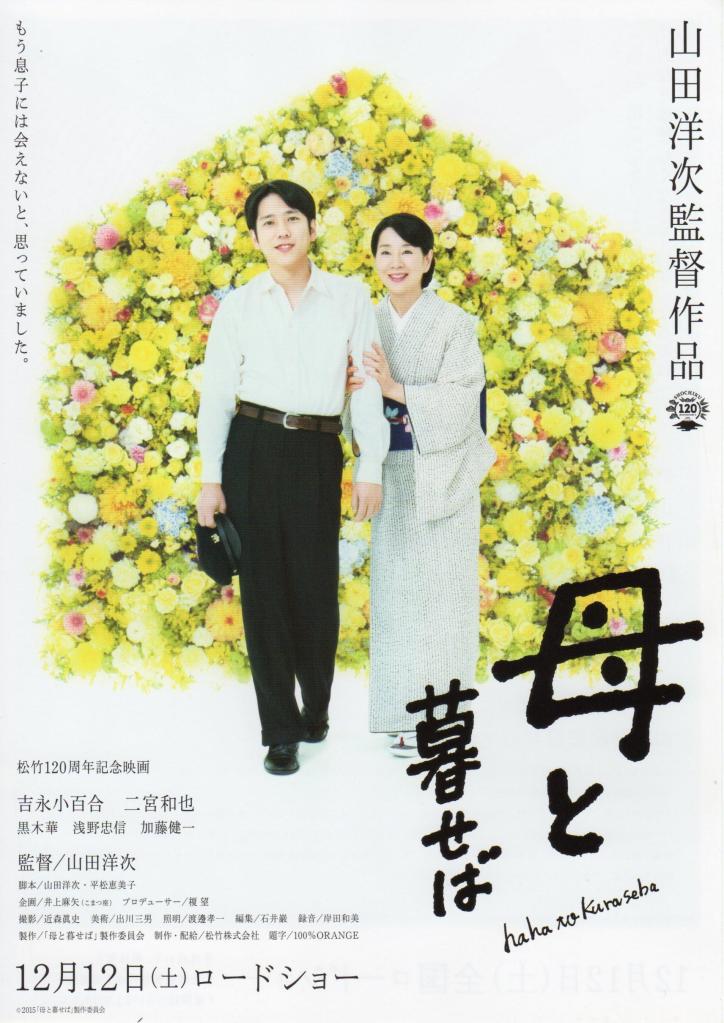
nagasaki-memories-of-my-sonAfter such a long and successful career, Yoji Yamada has perhaps earned the right to a little retrospection. Offering a smattering of cinematic throwbacks in homages to both Yasujiro Ozu and Kon Ichikawa, Yamada then turned his attention to the years of militarism and warfare in the tales of a struggling mother, Kabei, and a young a woman finding herself a haven from the ongoing political storm inside The Little House. Nagasaki: Memories of My Son (母と暮せば, Haha to Kuraseba) unites both of these impulses in its examination of maternal grief set amidst the mass tragedy of the atomic bomb and in the obvious reference hidden inside Japanese title (another Yamada trend) to the 2004 Kazuo Kuroki film The Face of Jizo (父と暮せば, Chichi to Kuroseba), itself based on a play by Hisashi Inoe. Whereas the young woman of Hiroshima found herself literally haunted by the image of her father to the extent that she was unable to continue living in the present, the mother at the centre of Nagasaki is approaching the end of her life but only now, three years after the bombing, is she ready to allow the idea of her son’s death to cement itself within her mind.
Nobuko’s (Sayuri Yoshinaga) son Koji (Kazunari Ninomiya) left as normal on that fateful morning, in a hurry as always, leaping onto the outside of a crowded bus that would take him to the university for a lecture on anatomy. That was three years ago and now it’s August again but in the absence of a body Nobuko has never been able to accept the death of her son, despite the picture on the altar and the two previous trips she’s made to the family grave on this date along with Koji’s girlfriend, Machiko (Haru Kuroki). Finally, Nobuko is beginning to feel it’s time to accept the inevitable, that her son is not lost somewhere and unable to find his way home but in some other world. This grudging acceptance of Koji’s death is the thing which returns him to her as the prodigal son suddenly appears one evening in spirit form to reminisce with his mother about the carefree pre-war days.

Kazunari Ninomiya’s Koji is, appropriately enough, a larger than life presence. A cheerful chatterbox, Koji blusters in to his old family home with the same kind of amusing energy he’d always lent it, laughing raucously to his mother’s polite but strange under the circumstances greeting of “have you been well?”. Reminiscences generally lean towards happier times but each time Koji becomes upset he suddenly disappears again, leaving his mother alone with all her sorrows. Nobuko lost both her sons to the war and her husband to TB and so she is quite alone now save for the kindhearted attentions of Machiko who continues to stop by and help her with house work or just keep her company.

The two women share an intense bond in their shared grief. Almost like mother and daughter Nobuko and Machiko help each other to bear the weight of their loneliness in the wake of such overwhelming tragedy. However, Nobuko is beginning to feel guilty in monopolising the life of this young woman who might have been her daughter-in-law or the mother of her grandchildren by now if things were different. Can she really ask her to sacrifice the rest of her life to a memory? Machiko swears that she has no desire to ever marry, preferring to remain loyal to her true love. “Shanghai Uncle” a black marketeer who brings Nobuko all the hard to find items not available through the normal channels, offers to set up an arranged marriage for the young woman but Nobuko is quick to turn it down on her behalf. In this new age of democracy, she says, young women ought to have the right to choose their own path whatever that may be. Nobuko respects Machiko’s choice, but after talking things over with Koji, urges her to consider letting the past go and honouring Koji’s memory by living fully while there is still time.

Interestingly enough, Machiko’s potential suitor, Kuroda – an injured war veteran and fellow teacher at the school where she teaches, is played by Tadanobu Asano who also played the shy researcher who began to reawaken the heart of the daughter at the centre of The Face of Jizo, Mitsue. Mitsue’s problem was more obviously one of survivor’s guilt, literally haunted by the friendly spirit of her genial father who continually urges her to embrace this last opportunity for happiness, to go on living even whilst others can’t. Nobuko’s journey is almost the reverse as she, essentially, attempts to cleave herself away from her life by ensuring Machiko is taken care of and knows that she has nothing to feel guilty about in seeking happiness even if it can’t be with Koji.

Despite the innovative opening sequence featuring the cockpit and targeting system of the plane which eventually dropped the bomb and the chilling effects sequence as it takes hold, Yamada then reverts to a kind of classical stateliness which is never as effective as Kuroki’s eerie magical realism. Adding in the Christian imagery associated with Nagasaki, the film takes a turn for the mawkish during the final sequence which descends into a series of heavenly cliches from fluffy white clouds to angelic choirs. Warm and melancholy, Nagasaki: Memories of My Son is a poignant exploration of life in the aftermath of preventable tragedy but one which also makes the case for moving on, honouring the legacy of the past with a life lived richly and to the full.


Original trailer (English subtitles)

Mourning Recipe (四十九日のレシピ, Yuki Tanada, 2013)

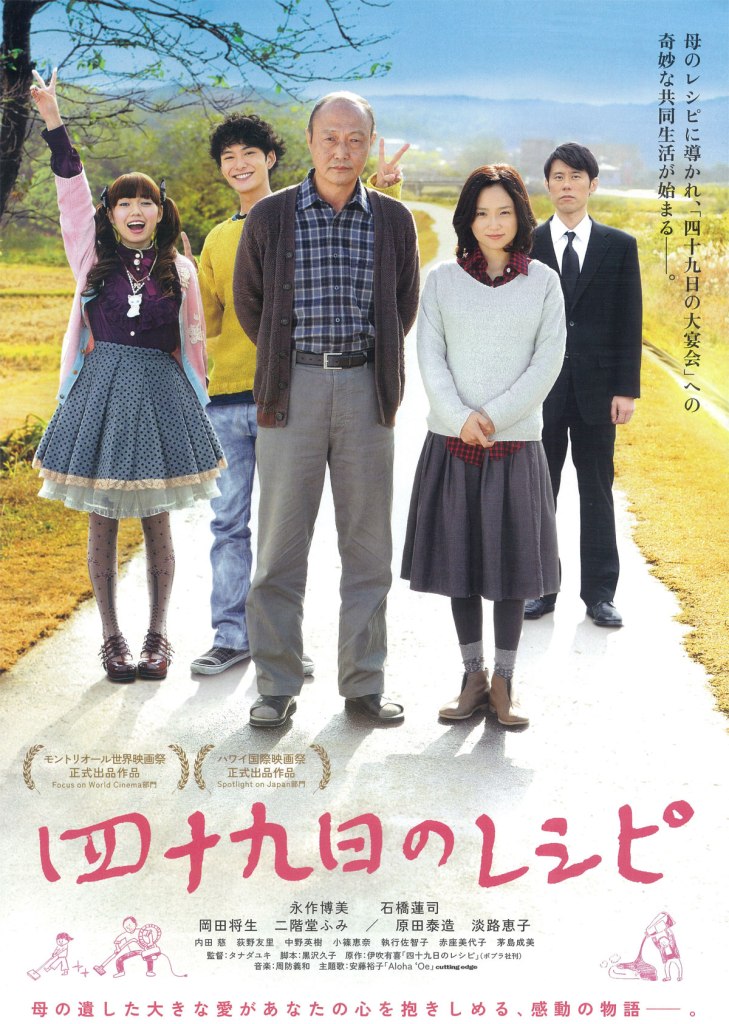
mourning-recipeWhen everything goes wrong you go home, but Yuriko, the protagonist of Yuki Tanada’s adaptation of Yuki Ibuki’s novel might feel justified in wondering if she’s made a series of huge mistakes considering the strange situation she now finds herself in. Far from the schmaltzy cooking movie the title might suggest, Mourning Recipe (四十九日のレシピ, Shijuukunichi no Recipe) is a trail of breadcrumbs left by the recently deceased family matriarch, still thinking of others before herself as she tries to help everyone move on after she is no longer there to guide them. Approaching the often difficult circumstances with her characteristic warmth and compassion, Tanada takes what could have become a trite treatise on the healing power of grief into a nuanced character study as each of the left behind now has to seek their own path in deciding how to live the rest of their lives.
Beginning in pitch darkness, housewife Yuriko (Hiromi Nagasaku) answers the phone to the voice of another woman requesting that she separate from her husband who is apparently the father of her unborn child. This double sting hits Yuriko hardest as the couple had been trying for a baby for quite sometime with little success. Thinking a divorce is for the best, Yuriko packs her bags, leaves the papers and her ring on the table, and heads for her father’s house. When she gets there she finds an oddly bubbly young girl, Imoto (Fumi Nikaido), washing her father’s back. Apparently, Imoto has been charged with looking after the house during the 49 day mourning period for Yuriko’s step-mother, Otomi – the upcoming memorial service something Yuriko had forgotten all about in the midst of her personal crisis. When Imoto presents the pair with a book that Otomi illustrated before she died listing everything they should do to prepare for the big party she wants everyone to enjoy rather than solemnly chanting sutras for her 49th day memorial, it prompts Yuriko and her father into a reconsideration of themselves, their pasts and futures, and who exactly should be making those decisions for them.

Yuriko’s position may seem like a straightforward one, betrayed by her husband her decision to leave seems inevitable but it’s complicated by the intricate web of duties and obligations Yuriko feels herself to be a part of. Reconsidering various turning points of her life, Yuriko makes plain that her marriage to the mild mannered salaryman Hiroyuki (Taizo Harada) had been under considerable strain due to the couple’s difficulty conceiving a child. Owing to the intense pressure placed on women to bear children, Yuriko internalises a sense of shame at having failed in this most basic of wifely tasks, leading her husband (she believes) to replace her with a model more fit for purpose. This point of view is rammed home by Yuriko’s insensitive aunt who continues to interrogate her about her lack of children and encourage her to return home to her husband and fix the problem rather than “giving up” and settling for the “shameful” option of divorce as young people are want to do. Aunt Tamako (Keiko Awaji) also points out that neither of her daughters bothered with university or work or any of that nonsense and now have fulfilled their duties by bearing bright and bonny grandchildren with no trouble at all. Heartbroken and blaming herself, Yuriko has to listen to the ongoing lecture whilst keeping her composure right until its gloomy conclusion.

Motherhood becomes the film’s biggest theme as mothers, non-mothers, and bad mothers swirl around the childless Yuriko, still trying to find her place in the world if the path society seems determined to set her on has been well and truly blocked off. Yuriko’s biological mother died when she was only little but happily her father fell in love with and married Otomi – a truly good woman who, like Yuriko, had no children of her own, but lived her life trying to make a difference and help other people to be happy. Little Yuriko didn’t always see it that way and found it difficult to bond with her new mother, settling for the nickname “Okka” – a combination of Otomi’s name and the word for mother, rather than straightforward “mum”.

Reinvestigating Otomi’s life in order to plan for her 49th day memorial, Yuriko truly gets to know her step-mother for the first time, discovering just how big of a difference she made in the lives of those around her. Imoto is just one of the young people Otomi went out on a limb for volunteering at a local rehabilitation centre for young people experiencing problems with addition. She then introduces them to a young Brazilian/Japanese migrant (Masaki Okada) who found himself feeling all alone in a foreign land until Otomi handed him the keys to her car and insisted he get out and about and meet new people. Otomi might not have had children of her own, but she became a mother to the world, reaching out and helping those who most needed it, becoming the springboard so that they could fly far away from her happier and healthier than before.

In learning from Otomi’s book, Yuriko regains her sense of self and a desire to find her purpose, knowing that the ability to bear children is not the be all and end all of a woman’s existence. Indeed even if a woman can give birth to a child, that’s not to say she’ll be a good mother as Imoto points out in reference to the toxic relationship she has with hers which feeds back into the insensitive way Hiroyuki’s mistress talks about her plans in front of her young son.

Given all of these epiphanies and mini realisations, Yuriko’s final decision may seem like an odd one, sending her back into a conservative world bound by all of the same duties and obligations the film spent so long undermining. Nevertheless, Yuriko emerges from her 49 days of mourning with a better understanding of herself and the way she should be living her life. Filled with wit and warm humour, Mourning Recipe neatly skirts its melodramatic nature to present a genuinely moving examination of the true nature of family, motherhood, and the necessity of individual freedom. Otomi’s final springboard action was for the ones she left behind, even if, once again, she won’t be able to see them fly.


Original trailer (English subtitles)

Midori: The Camellia Girl (少女椿, TORICO, 2016)

camelia-girlPicking up on the well entrenched penny dreadful trope of the tragic flower seller the Shoujo Tsubaki or “Camellia Girl” became a stock character in the early Showa era rival of the Kamishibai street theatre movement. Like her European equivalent, the Shoujo Tsubaki was typically a lower class innocent who finds herself first thrown into the degrading profession of selling flowers on the street and then cast down even further by being sold to a travelling freakshow revue. This particular version of the story is best known thanks to the infamous 1984 ero-guro manga by Suehiro Maruo, Mr. Arashi’s Amazing Freak Show. Very definitely living up to its name, Maruo’s manga is beautifully drawn evocation of its 1930s counterculture genesis – something which the creator of the book’s anime adaptation took to heart when screening his indie animation. Midori, an indie animation project by Hiroshi Harada, was screened only as part of a wider avant-garde event encompassing a freak show circus and cabaret revue worthy of any ‘30s underground scene.
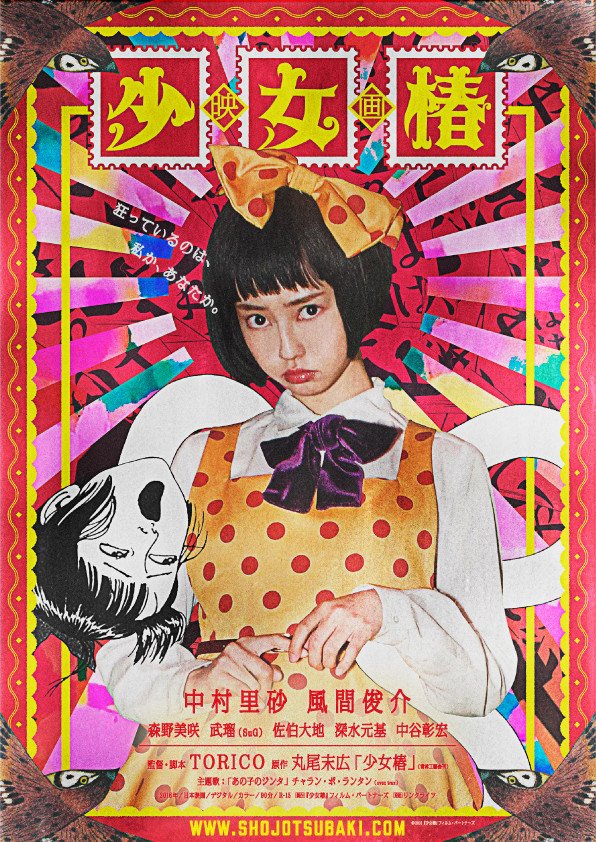
The 2016 live action adaptation from fashion designer TORICO, Midori: The Camellia Girl (少女椿, Shojo Tsubaki) doesn’t quite take things so far but does its best to put a modern spin on the original work’s decidedly Weimar aesthetic. Fourteen year old Midori (Risa Nakamura) narrates the tale as she suffers at the hands of the freaks and performers who form the community she has become a less than willing member of. After her father ran off and her mother died, Midori’s activities as a seller of paper camellias came to an end when she joined a circus troupe but rather than a warm community of outcasts Midori finds herself amongst a bitchy collection of kinky sex obsessed perverts who force her to become their personal domestic servant. Enduring cruel and frightening behaviour culminating in a rape by a performer with a bandaged face, Midori has begun to consider suicide as her only means of escape but when the circus receives a new employee in the form of “Western” style magician Mr. Wonder (Shunsuke Kazama), Midori’s fortunes begin to brighten.

Thankfully, given some of the things she’s forced to endure, Midori is played by 27 year old model Risa Nakamura in her first film role. The world of the freak show is undoubtedly a hellish one as Midori’s compatriots view her as the company kicking bag. Her biggest problem is the effeminate gay showman, Kanabun (Takeru), who actively enjoys tormenting her even going so far as to kick her pet puppies to death and feed them to her in a stew. This being a fairly incestuous environment, everyone is having sex with everyone else all the time which is not an ideal environment for a dreamy and sheltered fourteen year old. After witnessing a number of strange sexual practices including eyeball licking and an odd ménage à trois, Midori is unceremoniously raped by the bandaged man whose wrappings wind up around her own face. Mr. Wonder is the only one to show her any kind of kindness and perhaps begins to earn her love but his attentions have a possessive and controlling dimension which make this far from an uncomplicated romance even aside from Midori’s relative youth.

TORICO takes a page from Mina Ninagawa’s book in painting her tale in bright, kaleidoscopic colours. Not a naturalistic recreation of early Showa decadence, Midori: The Camelia Girl evokes the spirit of the period with its surreal atmosphere and outlandish costuming. Midori dresses in the bright and innocent clothes of a little girl making her look something like a cartoon heroine though her sunniness contrasts nicely with the sometimes muted dinginess of the street performer world. Accompanied by jaunty, accordion led gypsy jazz, TORICO also makes use of animated sequences and occasional effects to capture the bizarre goings on at the heart of the story and Midori’s frequent retreats into fantasy to escape them. Every bit as strange and surreal as might be hoped, Midori: The Cameila Girl only infrequently allows the encroaching darkness of militarism to penetrate its kitschy world but the threat is ever present as this collection of misfits attempts to survive outside of the mainstream, even if their attempts to do so reject the idea of community in favour of a constant series of betrayals and manipulations.


Original trailer (no subtitles, NSFW)

Lacuna (醉后一夜, Derek Tsang & Jimmy Wan, 2012)

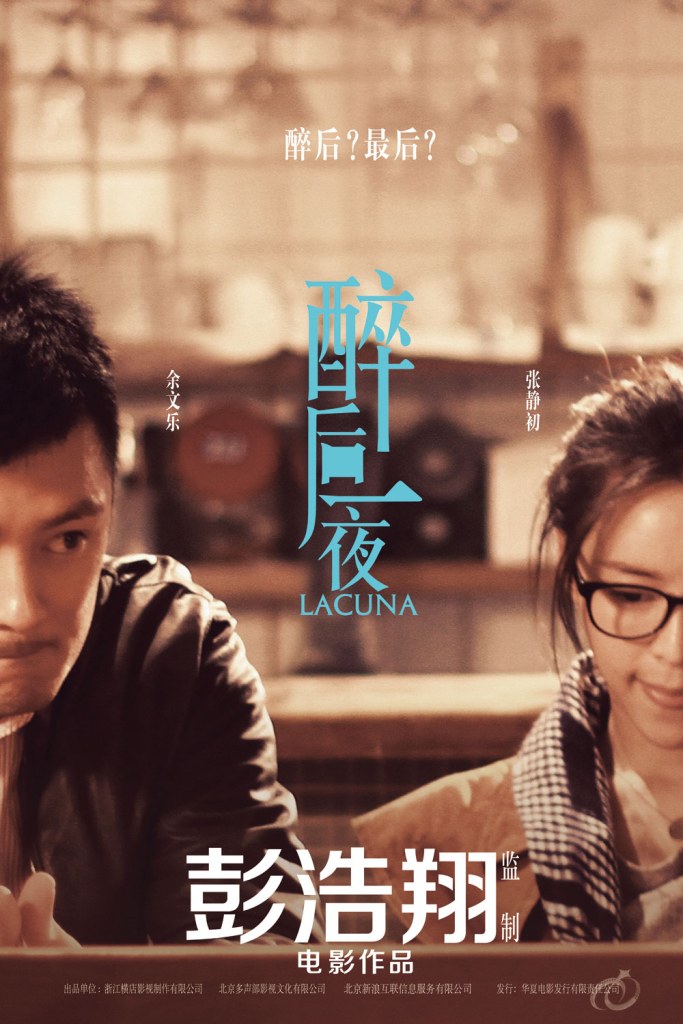
lacunaWaking up in a strange place with absolutely no recollection of how you got there is bad enough. Waking up next to a total stranger is another degree of awkward. Waking up not in someone else’s apartment but in a department store furniture showroom is another kind of problem entirely (let’s hope the CCTV cameras were on the blink, eh?). This improbable situation is exactly what has befallen two lonely Beijinger’s in Derek Tsang and Jimmy Wan’s elegantly constructed romantic comedy meets procedural, Lacuna (醉后一夜, Zuì Hòu Yīyè). An extreme number of unexpected events is required to bring these two perfectly matched souls together, but the love gods were smiling on this particular night and, once the booze has worn off, romance looks set to bloom .
Shen Wei (Shawn Yue) and Tong Xin (Zhang Jingchu) wake up undressed and with their arms around each other, but with no recollection of what exactly led them to this position. Awkwardly dressing and getting ready to part ways as quickly as possible, the pair are stunned to realise they’re trapped in a department store. Things get weirder when Shen Wei gets back to his hotel room to find it full of passed out revellers before arriving at work where his co-workers have a lot of questions about the previous night’s activities which seem to have been live blogged on the Weibo account of a well known actress.

Meanwhile, Tong Xin has returned home to feed her cat, but remembers she was carrying a large amount of money that her boss wanted her to give to a woman in a bar, and she can’t remember what happened to it. Shen Wei has also forgotten where he parked his car but a more serious problem occurs when he’s contacted by the police who are very keen for both Shen Wei and his “girlfriend” to come and pick up the “pet” they were so keen to find the night before. Luckily Tong Xin’s Weibo account is linked on the photos so he manages to get in touch with her in the hope that she can help him figure out what on earth happened last night.

Rom-coms thrive on coincidences, but luckily for Shen Wei and Tong Xin, the stars have aligned to allow them to find each other in midst of the busy Beijing nightlife despite the fact that neither of them seem the type to be particular frequenters of it. Both are, in different ways, a little lost. Shen Wei is a mild mannered Hong Konger slightly adrift in the mainland capital, whereas Tong Xin has just gone through a (seemingly amicable but perhaps painful) breakup and is also at a crisis point in her unsatisfying career which has her playing errand girl to a hack director with a scandal hanging over his head in the form of a affair gone sour with the aforementioned Weibo-ing actress – Qiqi (Mia Yam).

An anonymous night of passion is an out of character surprise for both of these otherwise straight laced, serious minded city dwellers. Both hugely embarrassed and a little bit stunned, reconnecting was never a likely prospect. Forced to get together to try and figure out their respective problems resulting from the previous night’s activities, the pair get the chance to relive their initial whirlwind romance, perhaps leading to something deeper and more substantial than just a mad one night stand. Gradually piecing together the details including random lamas and licking bull frogs with gangsters, it’s clear the pair have shared a very strange night together though its conclusion in a romantic “dream” apartment helped to showcase bashful Shen Wei’s romantic side and if all of this really does go somewhere they’ll have a heck of a story to tell the grandkids.

The “lacuna” in the their memories wasn’t the only thing missing in their lives, though it has helped each to perhaps find something to plug some of those empty spaces. Both Shen Wei and Tong Xin are left looking for something literal, but also seeking something less tangible which may have just found them thanks to the improbable coincidence of both “enjoying” an out of character night of heavy drinking, brought together by their mutual inability to hold their drink. Elegantly photographed with its series of disparate locations from upscale nightclubs to grungy dive bars and dusty construction sites, Lacuna’s whimsical approach somehow makes all of this craziness seem perfectly plausible adding to the sweet and heartfelt tone and restoring faith in playful, genuine romance even in a busy and increasingly disconnected capital.


Original trailer (no subtitles)

Lady Maiko (舞妓はレディ, Masayuki Suo, 2014)

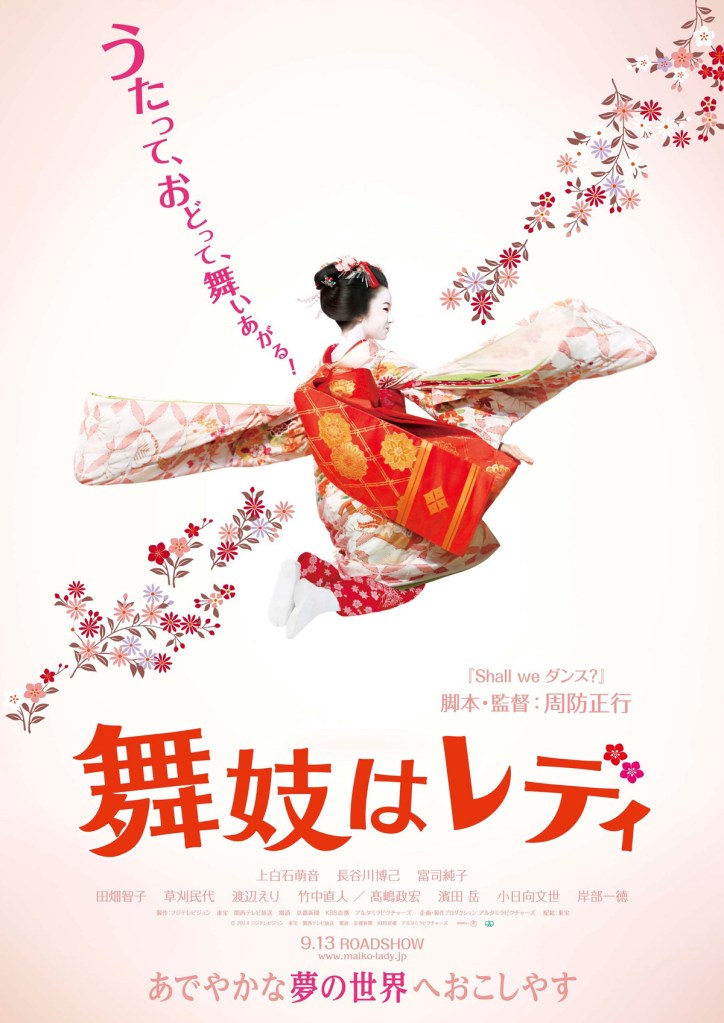
lady-maikoWhen Japan does musicals, even Hollywood style musicals, it tends to go for the backstage variety or a kind of hybrid form in which the idol/singing star protagonist gets a few snazzy numbers which somehow blur into the real world. Masayuki Suo’s previous big hit, Shall We Dance, took its title from the classic Rodgers and Hammerstein song featured in the King and I but it’s Lerner and Loewe he turns to for an American style song and dance fiesta relocating My Fair Lady to the world of Kyoto geisha, Lady Maiko (舞妓はレディ, Maiko wa Lady) . My Fair Lady was itself inspired by Shaw’s Pygmalion though replaces much of its class conscious, feminist questioning with genial romance. Suo’s take leans the same way but suffers somewhat in the inefficacy of its half hearted love story seeing as its heroine is only 15 years old.
Country bumpkin Haruko (Mone Kamishiraishi) arrives in the elegant Kyoto geisha quarters with only one hope – to become a maiko! However, despite the scarcity of young girls wanting to train, Haruko’s hopes are dashed by the head geisha who finds it impossible to understand anything she’s saying thanks to her extraordinarily rare accent which is an odd mix of north and south country dialects. Luckily for her, a linguistics professor who has an unhealthy obsession with rare dialectical forms overhears her speech patterns and is instantly fascinated. Striking up a bet with another tea house patron, Kyono (Hiroki Hasegawa) takes on the challenge of training Haruko to master the elegant Kyoto geisha accent in just six months.

The teahouses and the culture which goes with them are a part of the old world just barely hanging on in the bright new modern era. Haruko first became infatuated with all things maiko thanks to an online blog kept by the teahouse’s only current star, Momoko (Tomoko Tabata) – the daughter of the proprietor still only a maiko at age thirty precisely because of the lack of candidates to succeed her. Despite this intrusion of the modern, the way of the geisha remains essentially the same as it has for centuries with all of the unfairness and exploitation it entails. Hence, most of the women working in the teahouses are part-timers brought in for big events with only rudimentary training and even those who have spent a significant amount of time learning their craft lament that they don’t get paid a real salary and even their kimono and accessories technically belong to the teahouse.

Despite being on the fringes of the sex trade, as the professor’s assistant takes care to warn Haruko, there’s still something glamorous about the the arcane teahouse world bound up in ancient traditions and complicated rituals of elegance. Haruko faces a steep learning curve as a clumsy country girl who doesn’t even know how to sit “seiza” without her legs going numb. Learning to speak like a Kyoto native may be the least of her worries seeing as she has to learn how to dress in kimono, play a taiko drum and shamisen, and perform the traditional dances to perfection.

This is a musical after all and so the maiko dance routines eventually give way to more conventional choreography and large scale broadway numbers. The title song is particularly catchy and resurfaces at several points though the score as a whole is cheerful and inventive, incorporating a classic broadway sound with modern twist fused with the traditional music of the teahouse. Naoto Takenaka makes a typically creepy appearance displaying a fine voice for a comic number dedicated to the art of being a male maid to a geisha house but the big set piece is reserved for a comic take on the “Rain in Spain” in which the linguistics professor oddly wonders where all the water goes when it’s “pissing it down in Kyoto”. Unfortunately much of this revolves around linguistic jokes which are impossible to translate though the scene as a whole does its job well enough in introducing us to Haruko’s travails in the world of elocution. Other routines featuring the backstories of some of the minor characters also have a pleasantly retro quality inspired by period cinema complete with painted backdrops and old fashioned studio bound cinematography.

Though charming enough, Haruko’s progress is perhaps too conventional to move Lady Maiko far beyond the realms of cheerful fluff. Though Suo wisely keeps the romance to a minimum, Haruko’s growing feelings for the professor as well as a possible connection with his assistant are a little uncomfortable given her youth and the age differences involved even if the professor remains completely unaware. Unlike the source material Haruko’s passage is otherwise presented without complication (save for brief forays into the darkside of the geisha trade) as the country girl makes good, achieving her goals through hard work, perseverance, and the support of the community. In the end it’s all just far too nice, but then that’s not such a bad problem to have and there are enough pretty dance routines and warmhearted comedy to charm even the most jaded of viewers.


Screened as part of the Japan Foundation Touring Film Programme 2017.

Original trailer (no subtitles)

Someone’s Xylophone (だれかの木琴, Yoichi Higashi, 2016)

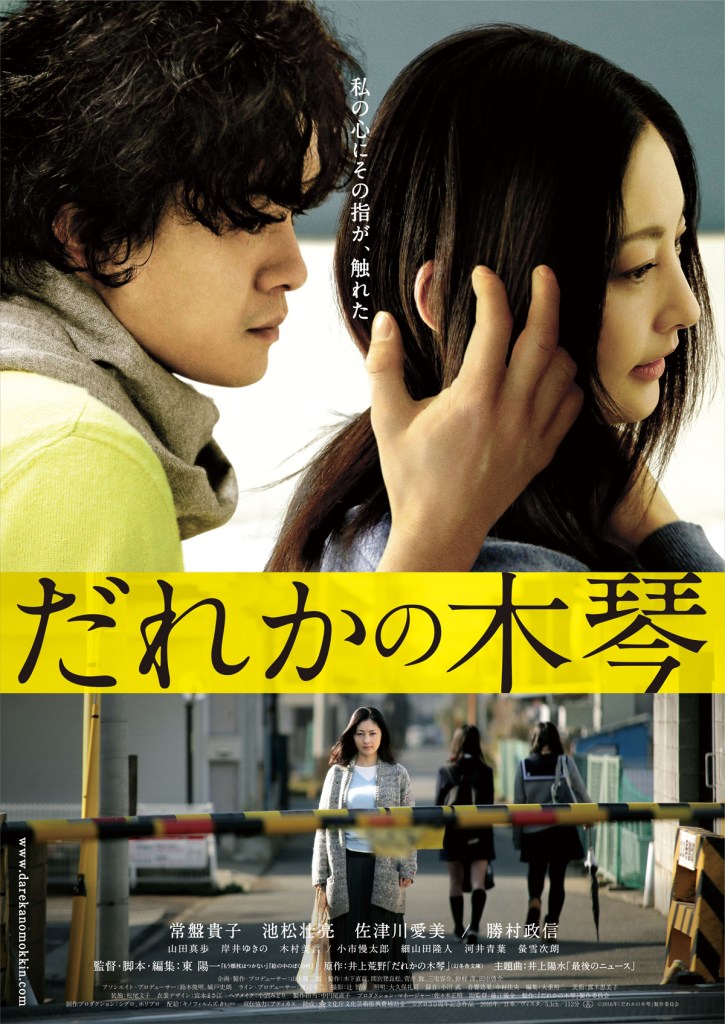
someones-xylophoneYoichi Higashi has had a long and varied career, deliberately rejecting a particular style or home genre which is one reason he’s never become quite as well known internationally as some of his contemporaries. This slightly anonymous quality serves the veteran director well in his adaptation of Arane Inoue’s novel which takes a long hard look at those living lives of quiet desperation in modern Japan. Though sometimes filled with a strange sense of dread, the world of Someone’s Xylophone (だれかの木琴, Dareka no Mokkin) is a gentle and forgiving one in which people are basically good though driven to the brink by loneliness and disconnection.
Middle aged housewife Sayoko (Takako Tokiwa) has just moved into a new area with her security alarm salesman husband, Kotaro (Masanobu Katsumura), and teenage daughter, Kanna (Mikoto Kimura). By all appearances the home seems to be a happy one, and the atmosphere is pleasant, if ordinary. Even so, stopping into an upscale salon one day Sayoko gets a haircut from the very good looking and warm hearted hairdresser Kaito (Sosuke Ikematsu). Hoping for repeat business Kaito gives her a business card and she reciprocates with one of her own so that she can be added to the mailing list. After some awkward chitchat, she leaves but when she gets a typical “thank you for visiting, please come again” text message, Sayoko makes the unusual decision to reply. Not wanting to seem rude, Kaito continues the strange text correspondence but Sayoko’s growing interest in the good looking young man, and later even in his girlfriend, soon crosses the line from harmless fixation to inappropriate obsession, threatening to derail her otherwise “normal” happy family life.

Higashi begins the film with a naturalistic sequence travelling from early morning light to bright sunshine as Kaito takes his bike out for a ride before returning to make breakfast for his still sleeping girlfriend, Yui (Aimi Satsukawa) – a model/store assistant at the upscale Lolita brand Baby the Stars Shine Bright. Accompanied by a thrumming, modern jazz funk soundtrack, these scenes reflect the film’s baseline reality. Kaito and Yui may live in the real world, to a point at least, whereas Sayoko has her head in the clouds and almost lives there too. A middle aged housewife, her life has begun to lose its purpose now that her daughter is almost grown and needs her much less than she ever has before. Though Sayoko and her husband appear to have a good relationship, she seems to want something more – bored with his caresses and long since past the point where there is nothing left to talk about.

The delivery of a new bed prompts a very particular fantasy of being fondled by both men at the same time though what exactly she wants from Kaito remains unclear. If her original decision to reply to a standard confirmation email could be dismissed as friendly innocence, sending a picture of your new bed to someone you just met is decidedly strange. Nevertheless, Kaito feels the need to keep replying even once it becomes clear that Sayoko has also tracked down his apartment and seems intent on further infiltrating his life. When she takes the decision to visit Yui at her work (the brand is not one which ordinarily caters to women of Sayoko’s age), the younger woman starts to get worried and eventually takes some direct action of her own.

Sayoko remains something of a cypher, a woman who can’t seem to figure herself out. The xylophone of the title refers to a dream or vision she has of a girl in far off window banging away at the instrument but never quite getting the tune – eventually she realises the girl is her, still trying to find her inner rhythm all these years later. Kotaro, by contrast, seems to have more worldly anxieties despite his outwardly calm and kindly manner. When his daughter asks him if they really need the security system they have at home he tells her about a long unsolved family murder before explaining that it just makes him feel safer when he can’t be there in person to protect his wife and daughter. Kanna, a bright child, points out that more threat is posed by accidents in the home than by intruders – to which Kotaro is forced to agree, lamenting that there is no alarm system to prevent a domestic accident. Thus when Kanna calls him to say that there has been an “incident” at home, the metaphor is an apt one – nobody was looking, and now everything’s falling apart.

Despite the expectation for grand scenes or bloody violence, Someone’s Xylophone consistently refuses to follow the signposted direction preferring a more adult resolution born of self reflection and mutual understanding. A subplot involving a very particular young man who comes to the salon solely for female contact hints at a darker path for unresolved loneliness and repressed emotion, but even if Sayoko and Kotaro make ill advised decisions in search of closeness their sojourns in alternate realities ultimately allow them to rediscover their mutual universe (for a time, at least). The xylophone finally plays out a recognisable tune as a more settled Sayoko fantasises about a phantom blanket rather than an illicit ménage à trois but whether this craving for warmth will provoke a similar crisis as the need for passion remains to be seen.


Screened as part of the Japan Foundation Touring Film Programme 2017.

Original trailer (no subtitles)

A Stitch of Life (繕い裁つ人, Yukiko Mishima, 2015)

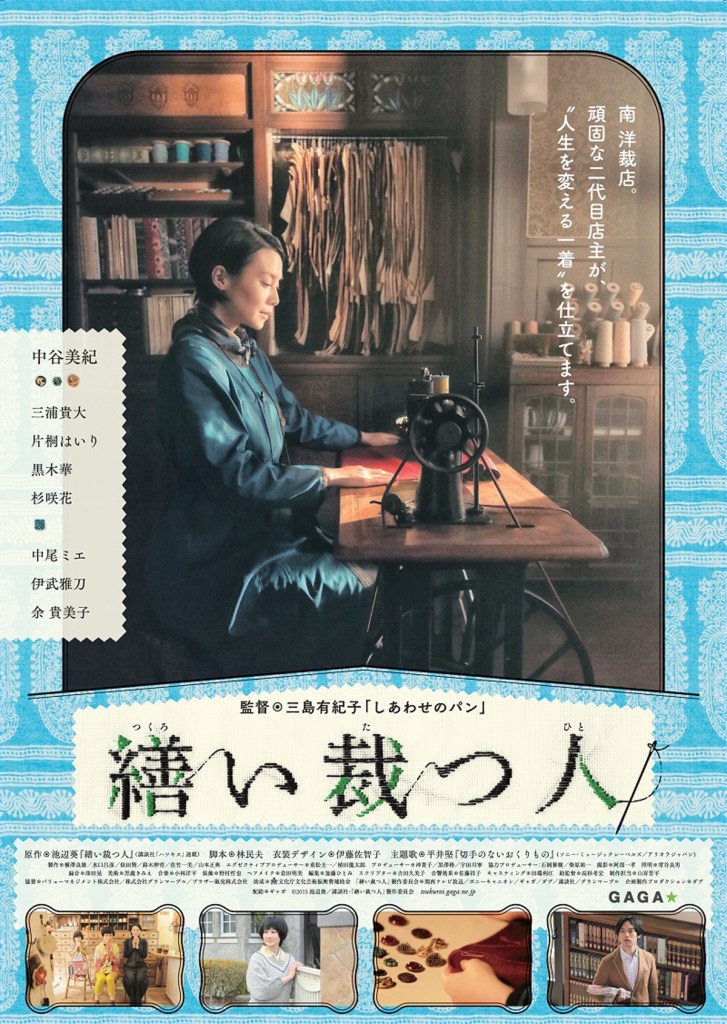
stitch-of-lifeTradition vs modernity is not so much of theme in Japanese cinema as an ever present trope. The characters at the centre of Yukiko Mishima’s adaptation of Aoi Ikebe’s manga, A Stitch of Life (繕い裁つ人, Tsukuroi Tatsu Hito), might as well be frozen in amber, so determined are they to continuing living in the same old way despite whatever personal need for change they may be feeling. The arrival of an unexpected visitor from what might as well be the future begins to loosen some of the perfectly executed stitches which have kept the heroine’s heart constrained all this time but this is less a romance than a gentle blossoming as love of craftsmanship comes to the fore and an artist begins to realise that moving forward does not necessarily entail a betrayal of the past.
Ichie Minami (Miki Nakatani) has taken over the tailoring business started by her grandmother, using her grandmother’s vintage treadle sewing machine and mostly occupying her time by making alterations on her grandmother’s existing patterns. To make ends meet, she’s also been reproducing some of her grandmother’s designs for sale at a local shop which brings her to the attention of department store employee and fashion enthusiast Fujii (Takahiro Miura) who has the idea of getting Ichie to work on some new items for a branded fashion line. Ichie, however, is devoted to her grandmother’s legacy and has committed herself to continuing the work her grandmother started with no deviation from the current model. Undeterred, Fujii continues to visit Ichie while she works, reaching even deeper levels of understanding both of her craft and of her person. Something inside Ichie begins to move too, but the pull back to the past is a strong one and it takes more than just courage to decide to finally embrace all of your hopes and dreams.

When Fujii hands the portfolio pitch he’s designed to his boss at the department store she loves the clothes and exclaims that the person who made them must be nice too, to which Fujii sheepishly admits that Ichie is more like a stubborn old man. Rigid in her habits and a little standoffish, perhaps even austere, Ichie does indeed seem harsh and unforgiving. Yet the irony is that her work requires the opposite of her. The clothes Ichie makes, and those her grandmother made before her, are perfectly tailored to the person in question, not just in terms of their measurements but designed to bring out each person’s personality, to help them become more of themselves and live a little happier in beautifully made outfits. Thus, Ichie must look closely at each person she meets in order to understand them fully and arrange her craft in perfect symbiosis with their individual needs. Perhaps for this reason Ichie finds her solitary time listening to the rhythmical beat of the sewing machine particularly relaxing, but the shop remains somewhere the local people gather in search of something more than just a simple hem repair.

Ichie’s grandmother sought to create clothes that could be worn for a lifetime, remaining long after both she and the person they were made for have disappeared. This approach may seem odd from a modern perspective of wash and wear disposable clothing intended to be replaced in a matter of months, but the idea here was never about the fashionable but one of engineering personal happiness through attire. The clothes make the man, in a sense, but the man also makes the clothes. As she made her alterations, Ichie’s grandmother recorded the various goings on in her customers’ lives in her notebook, allowing the clothes themselves to become the story of someone’s life. As Ichie’s former teacher puts it when trying to explain the art of making tea, it takes more than just heart – it takes experience, and care, and dedication. Ichie’s grandmother was meticulous – a trait which her granddaughter has inherited, with every stitch perfectly placed, each hem perfectly straight, and garment perfectly tailored for its intended wearer.

Ichie may keep herself contained for good reason, but now and then something else comes through such as a love of truly giant cheesecakes or a sudden bout of worry on being asked to craft a funeral dress for a good friend, but Fujii’s gentle prodding does indeed lead her towards a period of self reflection on what exactly it is she wants to do with her grandmother’s legacy. A cynical person might regard the annual “soirees” Ichie’s grandmother began in the small town as an excuse to get people to buy an outfit they’ll only wear once a year but the event, like the clothes, becomes an occasion for the artifice which lays bare the truth. Eventually, her grandmother’s gentle spell works on Ichie too (with a little help from Fujii) as the love of the craft of tailoring helps her to become herself, cast off her grandmother’s shadow whilst honouring her legacy, and learn to take pleasure in doing the things which only she can do.


Screened as part of the Japan Foundation Touring Film Programme 2017.

Original trailer (no subtitles)

The Mohican Comes Home (モヒカン故郷に帰る, Shuichi Okita, 2016)

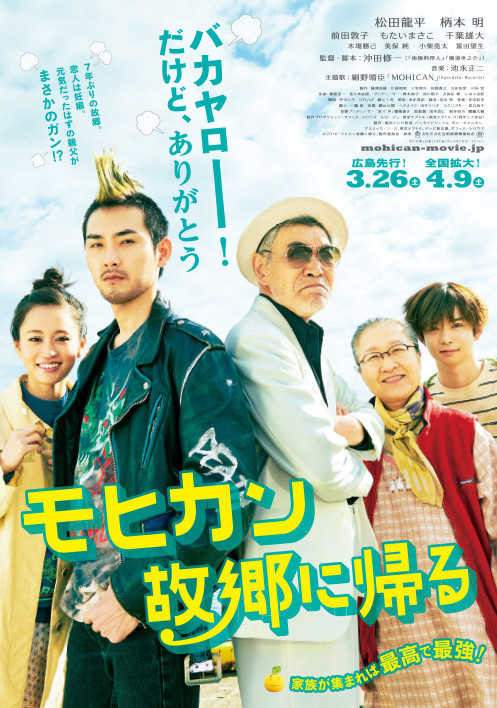
mohican-comes-homeJapan may be famous for its family dramas, but there is a significant substrain of these warm and gentle comedies which sees a prodigal child return to their childhood home either to rediscover some lost aspect of themselves or realise that they no longer belong in the place which raised them. Shuichi Okita’s The Mohican Comes Home (モヒカン故郷に帰る, Mohican Kokyo ni Kaeru) includes an obvious reference in its title to Keisuke Kinoshita’s colourful 1954 escapade Carmen Comes Home which cast legendary actress Hideko Takamine somewhat against type as a ditsy airhead show girl eager to show off all her city sophistications to the rural backwater she abruptly ran out of some years before. Like Carmen, the hero of Mohican Comes Home makes an unexpected trip to visit his family in the picturesque Hiroshima island village where he grew up only to find not very much has changed but an equally unexpected tragedy prompts him into a wider consideration of his past and future as he faces life’s two extremes in the very same moment.
Eikichi (Ryuhei Matsuda) left his island home some years ago for the bright lights of Tokyo where he fronts a punk band by the name of Grim Reapers. The band has some moderate underground success, but the guys are getting old for the punk scene and finding themselves with real world responsibilities from healthcare costs to the prospects of supporting wives and children. Eikichi, sporting a prominent bleached mohawk, feels this more than most as he’s soon to become a father and is intending to marry his pregnant girlfriend, Yuka (Atsuko Maeda), if only he had the money. He’s been promising to take his future wife to meet his parents for some time but so far they’ve never actually made the trip.

This time, things are different and so Eikichi makes a shocking return after seven years only to wander in during an awkward scene as his mother and younger brother try to manoeuvre his drunken father into a more convenient position whilst protecting his precious white suit from alcohol born ruin. Eikichi’s family own the village liquor store but his father’s passion is for music and he also coaches the local middle school band. A devotee of legendary Hiroshima born superstar Eikichi Yazawa, Osamu (Akira Emoto) insists the kids play his favourite tune ad nauseam to much eye rolling from the youngsters forced to associate themselves with such an uncool and old fashioned song.

Eikichi’s homecoming has not got off to the best start, especially after his father begins to sober up and recommends a hair cut and real job, both of which Eikichi resolutely refuses. Things take a more serious turn when Osamu realises his son is being financially supported by his girlfriend whom he has also got pregnant but is not yet married to. Experiencing extreme moral outrage at his responsibility shirking son, Osamu chases him around the table in what appears to be a scene often repeated during Eikichi’s childhood but the situation soon ends in an unexpected way foreshadowing Osamu’s decline into ill health.

Deciding to stay a little longer than intended, Eikichi and Yuka blend into the family home trying to help mother Haruko (Masako Motai) and boomerang younger brother Koji (Yudai Chiba) adjust while Osamu is in the hospital. The contrast between town and country, traditional and modern is never far from view whether in Yuka’s kindhearted decision to finish off preparing the family dinner though she has to consult a youtube video to find out how to gut fish, or in her astonishment at the very ordinary way in which her future in-laws met (i.e. simple propinquity). While the women begin to bond over their shared concern for their men as Haruko decides to teach Yuka some home style tips and tricks, Eikichi and his father spar with each other warmly as Eikichi takes charge of a band rehearsal and allows them to let loose on the much hated song with an energised punk fuelled twist.

Despite a strained relationship with his father, Eikichi is a good person who also wants to offer some kind of comfort to the old man in his final days. Going to great lengths to track down a particular pizza Osamu suddenly requests (the last time he ate pizza was on his 60th birthday) or eventually pretending to be Yazawa himself whom Osamu is very proud to have made eye contact with during a Tokyo concert in 1977, Eikichi comes to a kind of understanding of the man his father was as well as the man he is. Full of warm, naturalistic humour giving way to two elaborately constructed set pieces, The Mohican Comes Home is a typically well observed family drama from Okita which neatly undercuts its essentially melancholy set up with a layer of stoical perseverance.


Screened as part of the Japan Foundation Touring Film Programme 2017.

Original trailer (no subtitles)

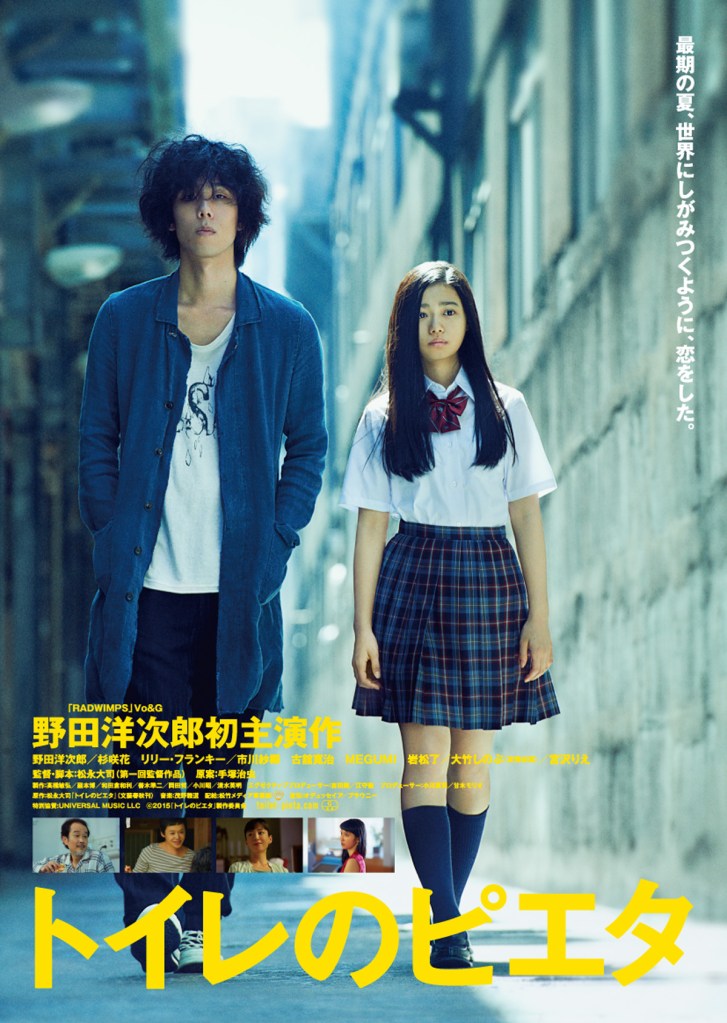
Pieta in the Toilet (トイレのピエタ, Daishi Matsunaga, 2015)

pieta-in-the-toiletSomewhere near the beginning of Daishi Matsunaga’s debut feature, Pieta in the Toilet (トイレのピエタ, Toire no Pieta), the high rise window washing hero is attempting to school a nervous newbie by “reassuring” him that the worst thing that could happen up here is that you could die. This early attempt at black humour signals Hiroshi’s already aloof and standoffish nature but his fateful remark comes back to haunt him after he is diagnosed with an aggressive and debilitating condition of his own. Noticeably restrained in contrast with the often melodramatic approach of similarly themed mainstream pictures, Pieta in the Toilet is less a contemplation of death than of life, its purpose and its possibilities.

Having left his country home for Tokyo to become a painter, Hiroshi (Yojiro Noda) has become a bitter man, wilfully drowning in his own broken dreams. A chance encounter with an old flame, Satstuki (Saya Ichikawa), further deepens Hiroshi’s sense of inadequacy – she is about to open a solo exhibition in the very building which Hiroshi is currently engaged in washing the windows of. After having so sarcastically made fun of his new colleague’s fear of the rig, it’s Hiroshi who finds himself collapsing on the job and requiring medical treatment.

Seeing as the hospital have requested he bring a family member along with him for the results of the examination, it’s probably not good news. Not wanting to involve his parents, Hiroshi persuades Satsuki to masquerade as his younger sister only to restart an old argument in the waiting room prompting his former love to remember why they aren’t together anymore and hightail it out of there. Spotting a high school girl arguing with a salaryman she says has torn her uniform, Hiroshi decides to offer the job to her. Mai (Hana Sugisaki) plays her part to perfection but the news is even worse than he’d feared – aggressive stomach cancer requiring immediate hospitalisation and sustained chemotherapy if he is to have any chance at all of surviving more than a couple of months at most.

Prior to his illness, Hiroshi is a difficult man, permanently grumpy and irritated as if carrying a great sense of injustice. Despite several different voices reminding him that he had talent, Hiroshi has given up drawing in the belief that his artistic career was always doomed to failure. Intent on punishing himself for just not being good enough to succeed, Hiroshi’s decision to make window washing his career signals his lack of personal ambition, content to simply keep existing while a silent rage bubbles under the surface.

After the original failed reconnection with Satsuki who, we later discover, has moved in another direction using her society connections to advance her career in a way of which Hiroshi does not approve, Hiroshi’s illness brings him into contact with a number of people who each do their bit to reopen his heart. The most important of these is the feisty high school girl, Mai, who refuses to simply disappear from Hiroshi’s life after the awkward bonding experience of being present at the cancer diagnosis of a total stranger. As angry and defeated as Hiroshi, Mai’s difficult homelife has brought her untold suffering but unlike the brooding painter, hers in an externalised rage which sends her reeling into the world, looking for reaction and recognition rather than the introspective craving for disappointment and indifference which marks Hiroshi’s approach to his internalised sense of inadequacy.

Hiroshi’s hospital stay produces twin motivators from both ends of the spectrum in the form of an older man in the next bed, Yokota (Lily Franky), who enjoys taking photographs (especially of pretty girls), and a terminally ill little boy who remains cheerful, polite and friendly despite Hiroshi’s rather rude attempt to shake him off. It’s on a visit to the hospital chapel with the boy, Takuto (Riku Sawada), and his mother (Rie Miyazawa) that Hiroshi first comes across the statue of the pieta which inspires his ultimate, life affirming act which sees him turn the smallest room of the house into a new Sistine Chapel with a large scale installation recasting Mai as Mary, arms outstretched ready to receive her sorrowful burden.

Hiroshi’s life had been mere existence but reaching an acceptance of its end forces him into a process of more positive self reflection and a desire to leave something more permanent behind. Inspired by a few words found on the final page of the diary kept by the godfather of manga, Osamu Tezuka, himself battling stomach cancer at the time, Pieta in the Toilet puts art at the core of life as Hiroshi picks up his paint brush, Yokota his camera (albeit with slightly less than artful intentions), and Takuto his painstakingly collected colour-in heroes. Necessarily melancholy yet somehow life affirming Pieta in the Toilet offers a nuanced though no less powerful contemplation of life, death and art in which each gives meaning to the other, ensuring the richness of a life fully lived.


Screened as part of the Japan Foundation Touring Film Programme 2017.

Original trailer (English subtitles)