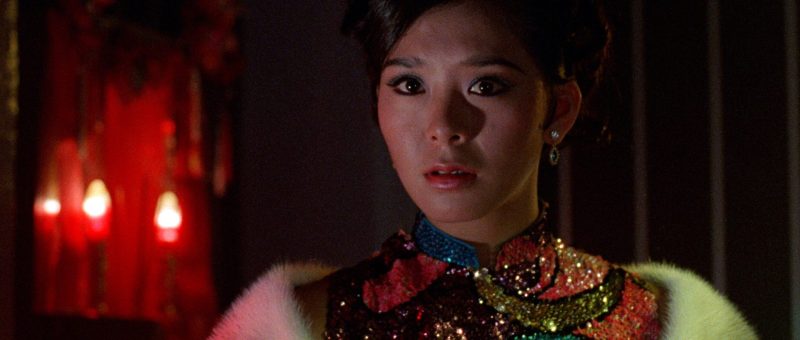
Angie Chen’s response to The World of Suzie Wong, My Name Ain’t Suzie (花街時代) opens in the present day with its heroine apparently a gothic mystery, a Miss Havisham-style recluse and ghost of old Hong Kong trapped within the apartment of a legendary madam from old Shanghai. This conception of her turns out to be something of a myth in itself, as accidental witness to history Dick recounts to a young man working as a delivery boy (Jacky Yeung Tak-Ngai) for his ever evolving chip shop that she is actually still a wildly successful restauranteur and fixture in the local nightclub scene.
This small enclave of Wan Chai, however, seems to have become a kind of ghost town having been largely abandoned as the American sailors who were once its main clientele stopped coming after the twin waves of the Korean and Vietnam Wars. Shui Mei (Pat Ha Man-Jik) now owns this block which signals her eventual mastery over the world in which she lives, if also her loneliness and isolation, occasionally staying in Miss Xiao’s (Angela Yu Chien) old apartment as if unable to let go of the irresolvable past. Her story is then, at least in part, a chronicle of the nation’s own post-war history as she successfully adapts to the times, yet retains a sense of melancholy nostalgia for an older Hong Kong which is fast disappearing as the Handover looms closer.
Indeed, Shui Mei’s life begins in an impoverished fishing village which is set a stir by the return of Monroe, a seemingly glamorous woman dressed in the latest fashions and handing out sticks of gum to the awestruck locals. Sex work is seen as a pathway out of poverty and towards the new modern society that Monroe represents. Having been raped by three local boys, it is also in a way Shui Mei’s means of rejecting her victimisation and asserting full ownership over her body even if, in other ways, she is exploited by brothel owner Miss Xiao, herself an exile who fled to Hong Kong from the formerly glamorous and sophisticated international centre that was Shanghai.
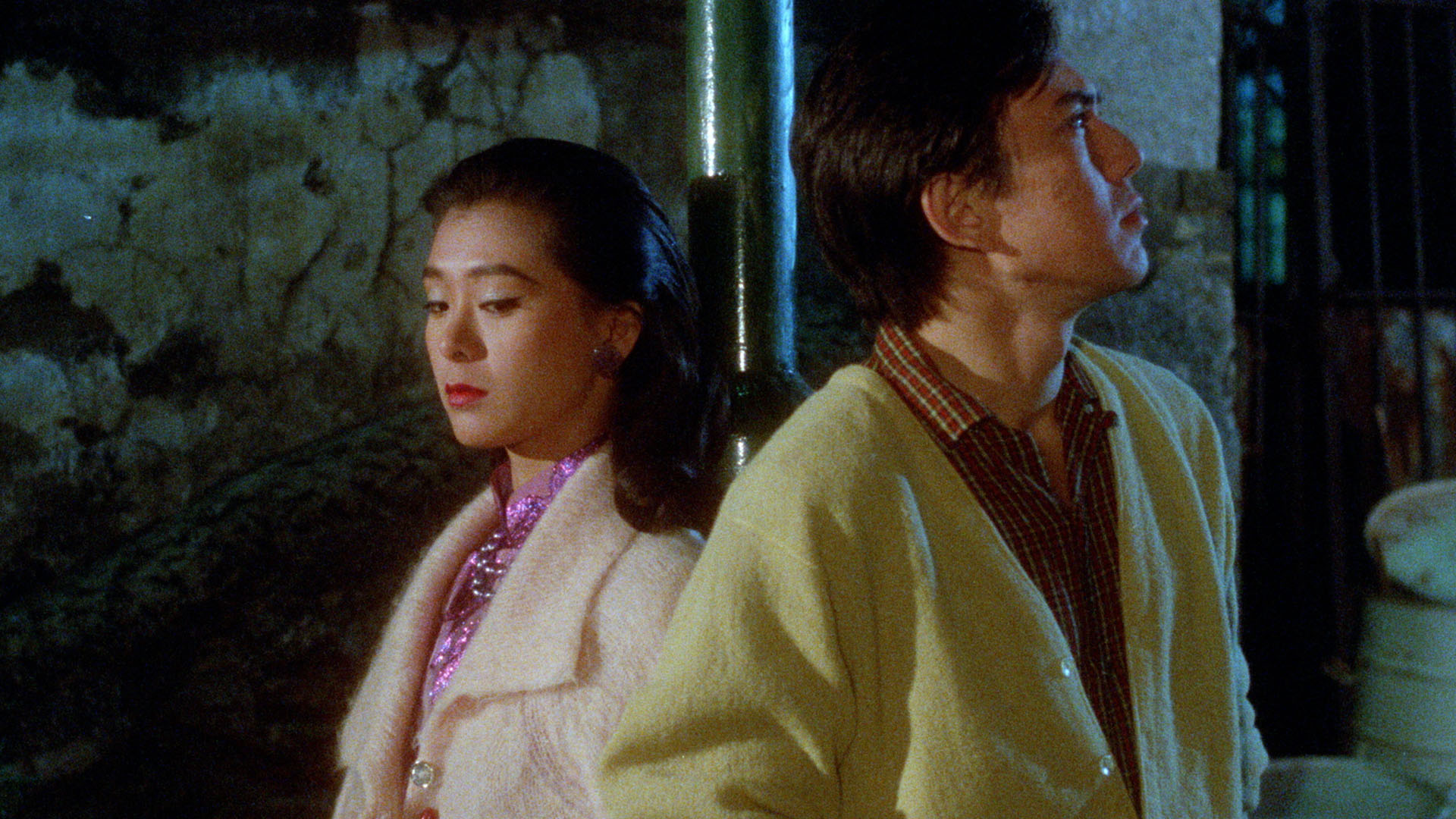
While working as a bar girl in Wan Chai, Shui Mei falls for Miss Xiao’s adopted son, Jimmy, on whom she has a quasi-incestuous fixation. Rather than casting an actor already under contract to Shaw Brothers, Chen cast a then unknown Anthony Wong, billed under the name Anthony Perry, through extensive auditions largely for the similarities he shared with the role. Like Jimmy, Wong was abandoned as a small child by his father, a British colonial official who already had a wife and children in the UK with whom he later emigrated to Australia. Jimmy’s idolisation of Hollywood icon James Dean and desperate search for his biological father, an American seaman, are symbolic of the search for cultural identity in a Hong Kong caught between a series of colonial influences while denied the kind of mastery over itself that Shui Mei eventually achieves.
Shui Mei’s relationship with Jimmy causes a rift with Miss Xiao that leads to her exile from Wan Chai, though Jimmy proves to be a faithless lover. After years of boasting of the revenge he’ll take for his mother’s suicide when he finds his father, Jimmy is seduced by promises of American wealth and comfort and accepts his invitation to return with him to the US, callously abandoning Shui Mei. Years later, when he returns with his two young sons, he has become in some ways very much Americanised. He complains that his first wife lacked a strong work ethic while having adopted an orientalist idea of the submissive hometown wife who will work hard in his business and raise his children. Though still resentful over her abandonment, Shui Mei harbours a lingering desire to rekindle the romance of her youth only to be cruelly disillusioned. Jimmy has forgotten her. He has not come back for Shui Mei, but is clearly in the market for a much younger woman, eventually marrying one of Shui Mei’s proteges at the bar she has opened in another part of the city after saving money made through temporarily working as a streetwalker.
This does, however, reinforce the idea that Shui Mei cannot rely on a man to save her but only on herself and female solidarity. When her new bar is targeted by triads, she enters a partnership with Sister Ying (Deanie Ip Tak-Han), the former wife of a gang boss who has pull in the underworld and a habit of chasing off gangsters with meat cleavers. Though the relationship is heavily implied as both a romantic and business partnership of equals, Shui Mei does not quite accept its validity due its same sex nature and wonders if she can really stay with Ying forever while tempted by the prospect of a more conventional, heterosexual union with Jimmy along with an easy life in America having run herself ragged creating a business empire and suffering the physical affects of a violent triad attack.
Though the end of her story may seem sad, Dick explains to his young delivery boy that Shui Mei refused to be beaten and got back up again each time she was knocked down, which perhaps provides a more positive prognosis in the shadow of the Handover. In one sense, she may have become a ghost of old Hong Kong as her silhouette now appears at Miss Xiao’s window, but may otherwise have avoided her fate. Despite their falling-out, an ageing Shui Mei returned to care for Miss Xiao who unlike her had been left behind by changing times, abandoned by all including her adopted son Jimmy who returns only after her death following many years of estrangement. Though Shui Mei may be consumed by an irresolvable nostalgia, like the nation itself she has progressed from her life in the impoverished fishing village to become an economic powerhouse while achieving total mastery over herself as an independent woman.
My Name Ain’t Suzie screened as part of Hong Kong Film Fest UK.
Trailer (English subtitles)

