Summer of Ubume (姑獲鳥の夏, Akio Jissoji, 2005)

Summer of the UbumeAkio Jissoji has one of the most diverse filmographies of any director to date. In a career that also encompasses the landmark tokusatsu franchise Ultraman and a large selection of children’s TV, Jissoji made his mark as an avant-garde director through his three Buddhist themed art films for ATG. Summer of Ubume (姑獲鳥の夏, Ubume no Natsu) is a relatively late effort and finds Jissoji adapting a supernatural mystery novel penned by Natsuhiko Kyogoku neatly marrying most of his central concerns into one complex detective story.

Freelance writer Tatsumi Sekiguchi (Masatoshi Nagase) and occult expert Kyogokudo (Shinichi Tsutsumi) become intrigued by the bizarre story of a woman who has apparently been pregnant for twenty months. If that weren’t enough weirdness, the woman’s husband also went missing a year ago and now her sister has approached the pair hoping they can investigate and figure out what’s really going on. Unbeknownst to him, Sekiguchi has a longstanding connection with several of the people involved and himself plays a role in the central mystery. Demons foreign and domestic, past trauma, infanticide and multiple personality disorder are just some of the possible solutions but as Kyogokudo is keen to remind us, there is nothing in this world that is truly strange.

The mystery conceit takes the form of a classic European style detective story complete witha drawing room based finale in which each of our potential suspects is assembled for Kyogokudo so that he can deliver his final lecture and tick them all off the list as he goes along. The tale takes place in the summer of 1952 and so the spectre of Japan’s wartime past, as well as its growing future, both have a part to play in solving this extremely complex crime. The original supernatural question concerns two otherworldly entities which have become conflated – the Chinese Kokakucho which abducts children, and the Japanese Ubume which offers its child to passersby. Needless to say, the answer to all of our questions lies firmly within our own world and is in no small part the result of relentless cruelty masked as tradition.

The opening scene includes a lengthy discussion between Kyogokudo an Sekiguchi debating the nature of reality. We only experience the world as we perceive it, seeing and unseeing at will. Everybody, to an extent, sees what they need to see, therefore, memory proves an unreliable narrator when it comes to recalling facts which may run contrary to the already prepared narrative.

Jissoji brings his trademark surrealist approach to the material which largely consists of interconnecting flashbacks often intercut with other dreamlike imagery. Filming with odd angles and unusual camera movements, Jissoji makes the the regular world a destabilising place as the strange mystery takes hold. The canted angles and direct to camera approach also add to a slight hardboiled theme which creeps in around the otherwise European detective drama though this mystery is much more about solving a series of puzzles than navigating the dangerously dark world of the noir. That said this is a very bleak tale which, for all its frog faced children weirdness, has some extremely unpleasant human behaviour at its roots.

Supernatural investigator Kyogokudo quickly dispenses with the demonic in favour of the natural but the solutions to this extremely complicated set of mysteries are anything but simple. Making space for the original novel’s author to show up as a travelling picture storyteller with some Shigeru Mizuki inspired illustrations on his easel, Summer of Ubume is not entirely devoid of whimsy but its deliberately arch tone is one which it manages to make work with its already bizarre set up. The enemy is the unburied past, or more precisely the unacknowledged past which generates its own series of ghosts and phantasms, always lurking in the background and creating havoc wherever they go. Occasionally confusing, Summer of Ubume is a fascinating supernatural mystery which takes its cues much more from European detective stories and gothic adventure than from supernatural horror or fantastical ghost story.


Natsuhiko Kyogoku’s source novel is available in an English translation by Alexander O. Smith (published by Vertical in the US).

Original trailer (no subs):
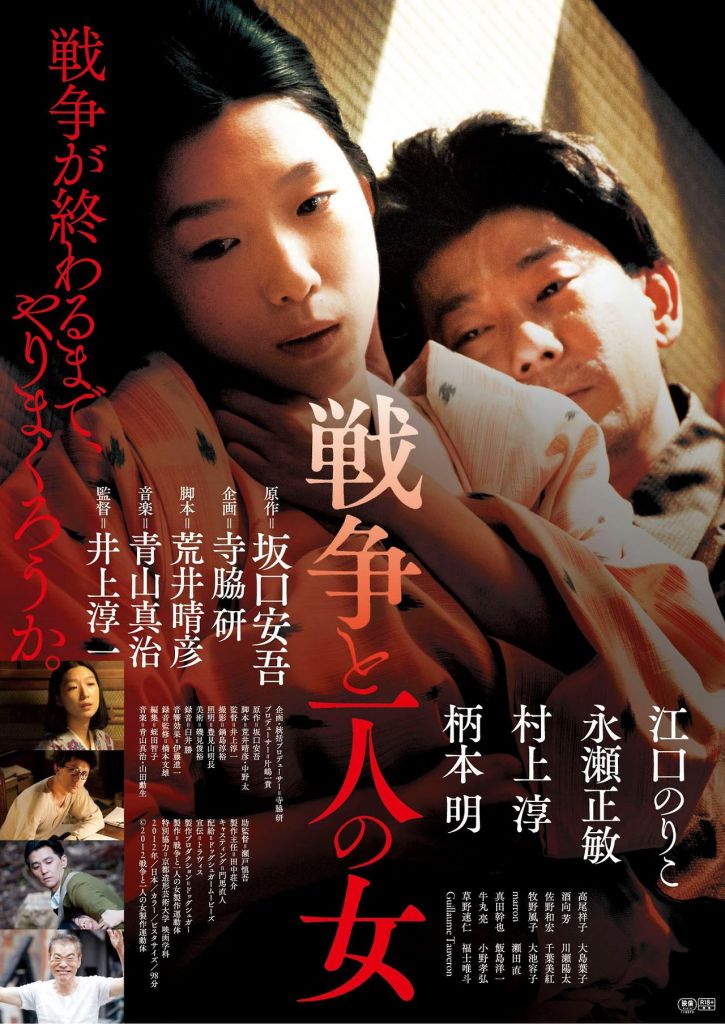
A Woman and a War (戦争と一人の女, Junichi Inoue, 2013)

a-woman-and-warJunichi Inoue is better known as a screenwriter and frequent collaborator of avant-garde/pink film provocateur Koji Wakamatsu. A Woman and a War (戦争と一人の女, Senso to Hitori no Onna) marks his first time in the director’s chair and finds him working with someone else’s script but staying firmly within the pink genre. Adapted from a contemporary novel by Ango Sakaguchi published in 1946, A Woman and a War is an intense look at domestic female suffering during a time generalised chaos.
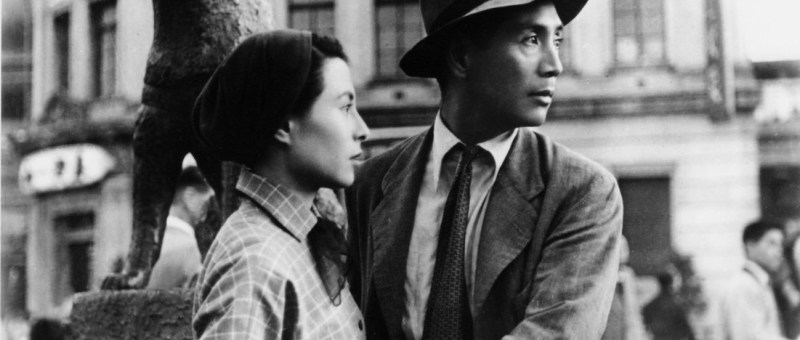
The unnamed “Woman” (Noriko Eguchi) is a former prostitute, sold to a brothel by her father as a child, now working as a bar hostess. Times being what they are, she decides there’s no future in bar work and wants to get married. Accordingly, she finds herself moving in with a moody novelist who frequents the bar, Nomura (Masatoshi Nagase). The woman becomes Nomura’s “wife”, but the relationship is strained as she finds it difficult to derive pleasure from sex and he is of a nihilistic mindset, convinced that Japan is about to lose the war. Nomura promises to live with her until the war’s end, at which time he assumes the country will cease to exist taking him with it.

Running parallel to this is the story of recently demobbed soldier and drinker at Woman’s bar, Ohira (Jun Murakami). Having lost an arm in the war, Ohira has been “lucky”, in a sense, and been sent home early. However, he has a wife and young son he’s been away from so long that they’re virtual strangers from each other. Ohira is not the man who went away to fight, he’s embittered and angry. Unable to enjoy normal relations with his wife, he finds himself aroused after failing to rescue a woman being gang raped by thugs which he then watches after being tied up while the men finish their business. After this, he despatches his family to the comparative safety of his wife’s parents and embarks on a career of violence, rape and murder.

Despite nominally being the story of the Woman, A Woman and a War has an unbalanced tripartite structure split between the three central characters. Of the three, Nomura’s story is the least explored but then is also the most clichéd in its familiar over sensitive novelist takes hack jobs and abuses all available substances to block out his crushing depression trope. Though the story ought to belong to Woman, she is often eclipsed by Ohira’s extreme descent into violent misogyny though in actuality these two strands dovetail into each other as Woman’s story is also one of continued exploitation.

This stems back well before the war as she was, in a sense, betrayed by her father when he sold her supposedly in desperation but apparently drank the money he got for her rather than using it to feed the rest of the family. Having spent so long in the brothel her body has become nothing more than a tool to her – something to be well maintained and then traded as a commodity. After her relationship with Nomura ends, Woman finds herself once again working as a prostitute – first at a facility set up for the American military, and then as a streetwalker targeting foreign servicemen. Eventually her path crosses with that of Ohira which results in the uncomfortable realisation that she too can only reach climax through violence.

Ohira is so deeply scarred by his wartime experiences that he has a compulsion to reenact them through random acts of sexual violence on unsuspecting women. The events he recounts from Manchuria are truly horrifying but he has an uncomfortable point when he repeats that the difference between what he did in the war and what he’s doing now is that between a medal and a death sentence. The people he killed in China weren’t soldiers or those who threatened his life, they were innocent civilians no different from the women he lured into the forests of Japan, so how was it right then and wrong now? The other uncomfortable fact is that Ohira is both perpetrator and victim of the wider war, a symbol of its cannibalistic whirlwind of destruction, the effects of which continue in perpetuity.

Coming as he does from the pink film world, Inoue adopts a detached frankness when it comes to sex. However, in keeping with the film’s themes there is an abundance of sexualised violence against women which, though every bit as unpleasant as it’s intended to be, does at times feel gratuitous. It’s also an unfortunate fact that there is a lot of gratuitous female nudity in the film but absolutely no male – at one point Woman bares her genitals to the open air and urges Nomura to do the same but the camera cuts to a rear shot as though embarrassed. In an interview with Diva Review Inoue admits he regrets the way this was handled and states it’s largely down to having bigger name actors in the two central roles, but in addition to deviating from the otherwise naturalistic intentions of the film, it also presents him with a set of thematic problems which undercut his central intentions.

However, A Woman and a War is one of the few (recent) films to seriously look at the traumatic afterlife of the war both on those who served and those who stayed at home using sexuality as a curiously reflective prism. A Woman and a War is a super low budget film and, in truth, looks it, though does make an attempt to do the best it can with what it has. The performances of the three leads are also each strong though something of the film’s tone never quite coalesces beyond the persistent unpleasantness into something more deeply probing. Troubling, concerning, and disturbing, A Woman and a War is a much needed look at this murky and often avoided area but one that finds it impossible to escape its own exploitative nature.


Original trailer (English subtitles):

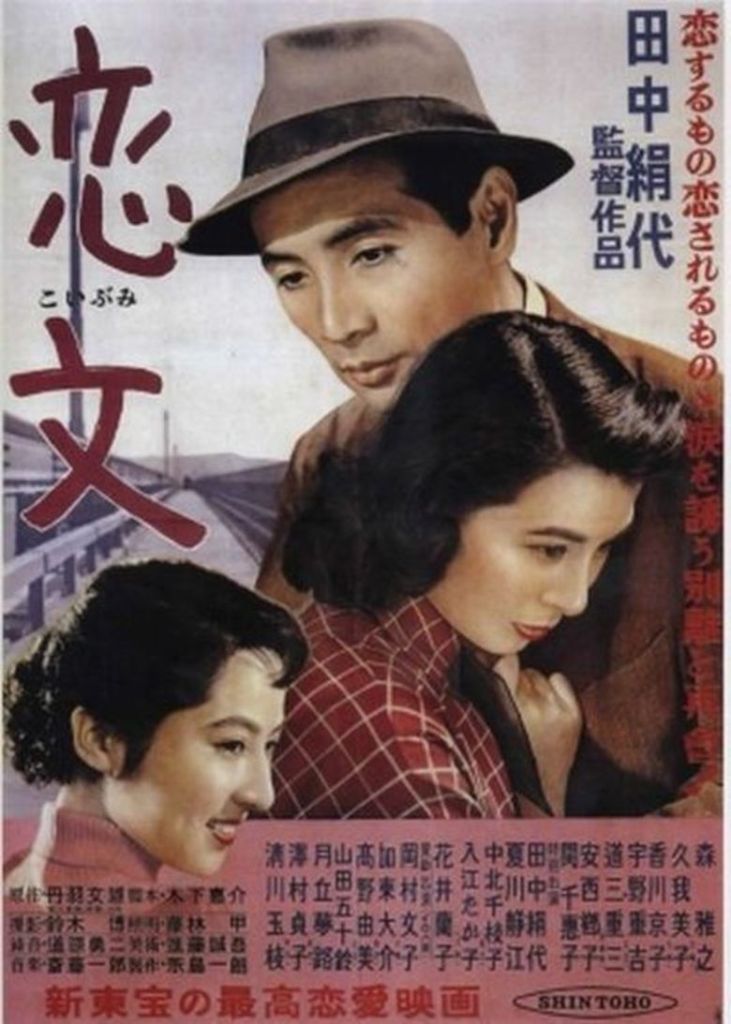
Love Letter (恋文, Kinuyo Tanaka, 1953)

Love-Letter-1953-film-images-d67cf443-345f-409e-9cdb-26f20177f50Kinuyo Tanaka was one of the most successful actresses of the pre-war years well known for her work with celebrated director Kenji Mizoguchi including several of his most critically acclaimed works such as Sansho the Bailiff, Ugetsu, and The Life of Oharu. However, post-war Japan was a very different place and Tanaka had a different kind of ambition. With 1953’s Love Letter (恋文, Koibumi) she became Japan’s second ever female feature film director, though her working and personal relationship with Mizoguchi ended when he attempted to block her access to the Director’s Guild of Japan. No one quite knows why he did this and he tried to go back on it later but the damage was done, Tanaka never forgave him for this very public betrayal. Whatever Mizoguchi may have been thinking, he was very wrong indeed – Tanaka’s first venture behind the camera is an extraordinarily interesting one which is not only a technically solid production but actively seeks a new kind of Japanese cinema.
Based on the novel by Fumio Niwa and scripted by another of Tanaka’s frequent collaborators Keisuke Kinoshita, Love Letter takes place around 1950 just as the post-war chaos was beginning to settle down allowing individual trauma to come to the surface for the very first time. Our “hero” is Reikichi Mayumi (Masayuki Mori) – a melancholy naval veteran living with his brother Hiroshi (Juzo Dosan) and eking out a living as a translator of French literature. He spends his days hanging round train stations looking for a familiar face and constantly rereading a letter from his childhood sweetheart which informs him that, against her own wishes, she is shortly to be married to someone else. Michiko is apparently now a war widow, but despite his best efforts Reikichi has not been able to find her since being repatriated.

One day he runs into an old naval friend, Yamaji (Jukichi Uno), who has an interesting job. He drafts love letters in English and French from Japanese girls to the faithless foreigners who have abandoned them and returned home. Yamaji has developed an affection for some of these desperate women and tries to help them as much as he can with fatherly advice as he writes heartrending messages designed to get that guilt cash rolling back to Japan. Reikichi is not as well disposed the girls who he feels have sold themselves to the enemy but soon begins working there too. One fateful day, he hears a familiar voice.

Whereas you might expect this to be the end of a conventional movie, it’s only really the beginning. After a desperate chase to the train station Reikichi catches up with Michiko (Yoshiko Kuga) in a beautifully filmed, emotionally powerful scene which frames them both in a closing train door, momentarily eclipsed as it moves away. However, the elation soon fades as Reikichi’s rather backward thinking kicks in and he dwells on the reason Michiko was in the shop in the first place. After having longed for her, searching endlessly for five years, he can’t bring himself to accept this Michiko who he sees as “polluted” by her relations with an American soldier. He says some extremely cruel, and in fact unforgivable, things which Michiko accepts with a deeply internalised sense of guilt and shame. It looks as if the long awaited romantic reunion is not to take place after all.

Tanaka’s point of view is about as progressive as it was possible to be, but there is an ongoing conflict in the film in regards to its portrayal of the post-war “pan-pan” phenomenon. Great pains are taken to separate Michiko from the ranks of other desperate women who found themselves reliant on the occupying forces for their survival. Michiko became the mistress of an American man, bearing and losing his child, and though she wonders herself if it makes a difference that it was one American man and not several, the film definitely thinks it does. Later on she meets a group of women who are more obviously prostitutes and former friends whom she tries to avoid but the attitude to these women is far less sympathetic. At once we’re told that we shouldn’t judge Michiko for having done what she needed to do to survive, but we are being invited to judge these other women, all the while being reminded that Michiko is not like them.

Reikichi, however, is firmly painted as being in the wrong especially when compared to his cheerfully pragmatic brother and down to earth friend. Everybody tells him he’s being unreasonable and attempting to punish himself by also punishing Michiko for a series of things that are no one’s fault, but Reikichi persists in his oddly romanticised, absolutist way of thinking. It is he who will need to change, become less rigid and more empathetic but there is still the idea that Michiko’s past is something to be “forgiven”, and therefore a pre-determined view that she has acted in a morally incorrect way and is paying for it now.

Interestingly, Tanaka undermines the film’s inherently melodramatic quality by choosing to end on a note of ambiguous anxiety. A decision seems to have been reached, yet it is a tentative one and there will be difficulties along the way. This is new and different world, filled with broken and damaged people. A better one is possible but won’t happen with a heartfelt apology over a hospital bed, it will require a long process of mutual understanding and empathy though the wounds themselves may never be entirely healed. Tanaka’s debut is a daring wonder filmed with true visual flair and an unusual degree of assuredness. A sympathetic look at the bubbling trauma of the post-war environment, Love Letter approaches its subjects with extreme sensitivity and the hope that love and forgiveness are possible, but they will require hard work and a willingness to embrace them.


The first Japanese feature film to be directed by a woman was completed by Tazuko Sakane in 1936. Mizoguchi actually gave her a start in the industry and she was able to keep working during in the war by making documentaries as part of the Manchurian Film Association. Once the war ended she was barred from further directorial opportunites because she didn’t have a university degree and returned to continuity and editing roles at Shochiku until she retired in 1962, never making another feature film. Kinuyo Tanaka was a little luckier in this regard and was able to make a few more features becoming the first woman able to have a career in film directing through she also continued acting in other people’s films and on television until the 1970s.

Hanging Garden (空中庭園, Toshiaki Toyoda, 2005)

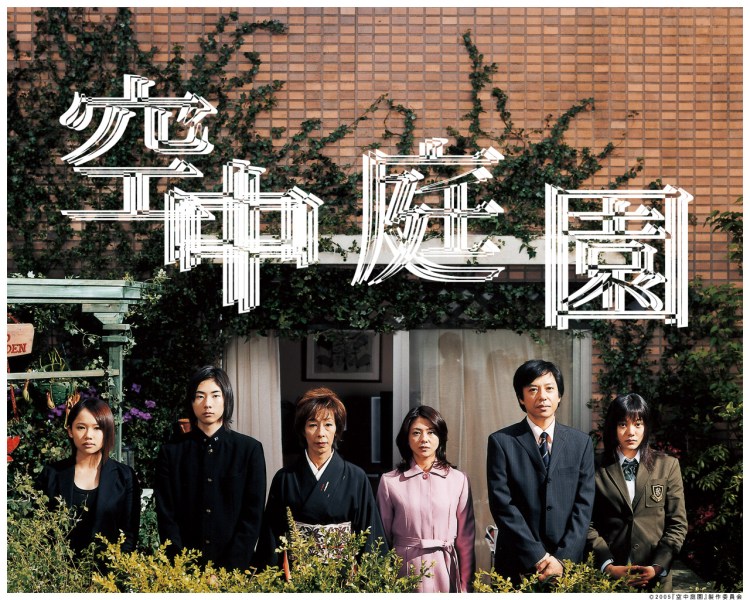
hanging gardenIf you wake up one morning and decide you don’t like the world you’re living in, can you simply remake it by imagining it differently? The world of Hanging Garden (空中庭園, Kuchu Teien), based on the novel by Mitsuyo Kakuta, is a carefully constructed simulacrum – a place that is founded on total honesty yet is sustained by the willingness of its citizens to support and propagate the lies at its foundation. This is The Family Game 2.0 or, once more with feeling.

The Kobayashis have one rule – they keep no secrets and no subject is taboo. We can see they take this approach to life seriously when daughter Mana asks her mother about the circumstances of her conception and receives an honest and frank reply. However, this “pretence” of honesty is exactly that – a superficial manifestation of an idea intended to maintain control rather than foster liberty. Each of the family keeps their secrets close be it extra marital affairs, past trauma, or just dissatisfaction with the state of current society. The very idea which binds them together also keeps them forever apart, divided by the charade of unity.

Toyoda crafts his metaphors well. The hanging garden of the title belongs to the matriarch, Eriko, who has created an elegant garden space on the cramped balcony of their small flat on a housing estate. Her swinging hanging baskets give the film its odd sense of off kilter sway as the camera swirls and swoops unsteadily like a rudderless ship adrift at sea. Eriko is carefully rebuilding her world in manner more to her liking, pruning her rosebushes with intense precision both metaphorically and literally.

Eriko’s intense control freakery stems back to her childhood and strained relationship with her currently hospitalised mother, Sacchan. Sacchan is one feisty grandma who may not share Eriko’s tenet of total honesty but nevertheless is inclined to tell it like it is. The central tragedy here is of maternal misconnection, a mother and daughter who refuse to be honest with each other. An encounter with Eriko’s older brother who seems to have an equally difficult relationship with Sacchan makes this plain. However, facing a health crisis and aware of reaching the final stages of her life Sacchan is also in a reflective mood and reveals that she’s recently begun dreaming her memories – revising and improving them as she goes to the point that she’s no longer sure how much of her recollection is how she would have liked things to have been rather than how they really were.

Son Ko is also interested in imagined worlds only more of the technological kind where he’s created a virtual version of his real life on his computer. Something of a dreamer, he wonders if the designers of the tower block deliberately made all the windows face south so that they’d get more sunlight and people would feel happier but he’s quickly shot down with the prosaic explanation that it’s all to do with drying laundry. He’s the only one who tries to explain to his mother that her intense need for “honesty” is, ironically, just another way of avoiding reality but then everyone already knew that – it’s the final truth that underpins the value system which has defined each of their lives.

However, where the family at the centre of The Family Game is shown to be hollow, the Kobayashis’ willingness to go along with this crazy self determined cosmology is driven by genuine feeling. Father Takeshi may be having affairs all over the place and even lying to his boss to facilitate them, but he wouldn’t have stayed at all if it truly meant nothing to him. Eriko plays manipulative goddess, micromanaging the fate of this tiny nation state since its inception with a keen and calculating eye but it’s all in the service of creating for herself something which she’d always felt she’d been denied – unconditional familial love, something which she also seeks to pass on to her children as the ultimate revenge on her mother whom she believes to have been cold and unfeeling.

As useful a tool as honesty may be, Sacchan may have a point towards the end when she says you take your most important secrets with you to the grave. Some things lose their power once you speak them aloud, too much honesty only focuses attention on the self and is apt to make those secretive who would seek to be open. Hanging Garden is a rich and nuanced exploration of human relationships, the shifting nature of memory, and the importance of personal privacy coupled with the veneer of authenticity which makes life in a civil society possible. Take away a man’s life lie you take away his happiness – hanging gardens never take root, but they bloom all the same.


Fish on Land (セイジ -陸の魚-, Yusuke Iseya, 2012)

fish on landYusuke Iseya is a rather unusual presence in the Japanese movie scene. After studying filmmaking in New York and finishing a Master’s in Fine Arts in Tokyo, he first worked as model before breaking into the acting world with several high profile roles for internationally renowned auteur Hirokazu Koreeda. Since then he’s gone on to work with many of Japan’s most prominent directors before making his own directorial debut with 2002’s Kakuto. Fish on Land (セイジ -陸の魚-, Seiji – Riku no Sakana), his second feature, is a more wistful effort which belongs to the cinema of memory as an older man looks back on a youthful summer which he claimed to have forgotten yet obviously left quite a deep mark on his still adolescent soul.

The unnamed narrator begins his tale as a disheartened salary man who tells us that his days simply pass monotonously. He no longer feels contentment but neither does he feel discomfort. Making an awkward phone call to a woman we assume is his wife, he reveals that a project has come up that he simply cannot ignore – one which takes him back to a particular summer he passed as a young man in which he encountered a lost soul and perhaps lost some of his own, too.

In the summer of 1990, the narrator was just about to graduate university and had already secured a job. Taking the final opportunity to indulge some wanderlust, he takes off riding his pedal bike across the country. However, after he gets knocked over and is taken to a local bar for some first aid treatment by its classically sad mama-san, he decides to stay and is given the nickname of “traveller” by the regulars at House 475. It’s here that he meets the titular Seiji – a cynical man with unusual presence which seems to inspire both admiration and exasperation in the small group of people who’ve come to regard the bar as a home from home.

Despite its genial, summery quality, the bar is home to several kinds of sorrow. Shoko, it turns out has her own reasons for her sadness and her relationship with Seiji is often a complicated one. It’s she who describes Seiji as a fish on land – completely at odds with his environment and entirely unable to live in the world or get along with his fellow humans. Carrying deep seated scars from his past, Seiji, she claims, is unable to feel joy so long he knows someone (anyone, anywhere) is suffering. Or, more to the point, he feels so intensely guilty that he will not allow himself to be happy and has, in some senses, given up living in this world in favour of his own filled with melancholy loneliness.

Indeed, the friendly grandfather from next-door remarks that Seiji sees things far too clearly and that’s why he’s given in to despair. According to him, our human defence against the powerlessness and fear inherent in being alive is simply becoming inured. Our insensitivity saves us, but men like Seiji feel too much and are unable to bear it. On the rare occasion Seiji smiles, it’s often to do with the little girl who lives next-door, Ritsuko, but tragedy is about to come crashing in, changing lives forever and shattering grandpa’s faith in the god he previously said granted us our lack of clarity to help us cope with life’s harshness. Seiji’s reaction is an extreme one, filled with a poetic weight that is difficult for those around him to understand but at the same time perfectly in keeping with his world view.

Framing sequence aside, Iseya opts for an interesting, slightly non-linear structure in which scenes jostle like memories, slightly disordered, sometimes repeated from a different angle and with greater insight. The framing sequence itself proves the least successful aspect of the film as it fails to marry itself to the implications of the central narrative and anchor its final scene to provide the necessary weight.

Mirai Moriayama imbues the unnamed narrator with an appropriate level of passivity whilst Hideyoshi Nishijima mirrors him with an equal and opposing force of presence which is by turns mysterious, intriguing, and occasionally threatening yet filled with vulnerability. Supporting roles are also well drawn notably by Hirofumi Arai’s local boy left behind and Kiyohiko Shibukawa’s up and coming businessman about to blow out of the small town for bubble era Tokyo, as well as the damaged bar owner Shoko played by Nae Yuki whose disintegration is slowed by Seiji’s presence but still very much in evidence.

If Fish on Land has a weakness, it’s that the invading dark forces it presents feel like a cruel, absurd, visitation on this otherwise idyllic place yet perhaps that’s entirely the point. Life is full of unpredictable cruelties which have to be accommodated no matter how difficult they may be to bear. Men like Seiji are carrying a heavy burden, one which was given to them when their arms were too weak to hold it, but still, you keep on living. Beautifully photographed, intricately plotted and rich with both character and philosophical detail Seiji: Fish on Land proves another interesting effort from Iseya who doubtless has even more to offer in the future.


Unsubtitled trailer:

The Shiinomi School (しいのみ学園, Hiroshi Shimizu, 1955)

vlcsnap-2016-07-09-01h53m10s460Hiroshi Shimizu is well known as one of the best directors of children in the history of Japanese cinema, equalled only by the contemporary director Hirokazu Koreeda. The Shiinomi School (しいのみ学園, Shiinomi Gakuen) is one of the primary examples of his genius as it takes on the controversial themes of the place of the disabled in society and especially how children and their parents can come to terms with the many difficulties they now face.
The Yamamotos are a happy family with two sons. However, their elation at the birth of their first child soon turned to tragedy as the boy became seriously ill with polio. Times being what they were, the treatment is not completely effective and although their son thankfully survived, he did so with a lamed leg. Now an older child, Yudo walks with a crutch and is constantly left out or bullied by his fellow children. After their second son, Teruhiko, also contracts the disease and is left even more seriously affected than his brother, the Yamamotos decide to open a school for survivors of polio where they can play together, learning how to live with the effects of the disease, free of the stigma which plagues them in their everyday lives.

Yudo just wants to play baseball and the other kids tell him he can if he brings a catcher’s mitt of his own but when he does they take it away from him and use it themselves while he sits and sadly watches them play. When his dad arrives and tries to tell them off, the kids form a mob and all leave together, fake limping as they go. Children are monsters, and often far less forgiving of difference than their adult counterparts (though it has to be said that the parents of other children are hardly blameless here). It’s not surprising that Mr. Yamamoto would want to protect his son by taking him out of this harsh environment where he’s constantly reminded of his disability and a target for the other kids’ cruel games.

The Shiinomi School may be at odds with modern thinking, but its heart is definitely in the right place. The Yamamotos are operating from a humanist perspective – they want to provide a place which helps the children to grow up strong and independent, fully able to cope with their various disabilities, where they can also escape the extreme prejudice which infects society in general. This prejudice is best brought out not by Yudo’s treatment by the other boys, but by the sad case of Tetsuo whose father had so little idea what to do with him that he used to tie him to a pole. Tetsuo’s dad has since remarried and his new wife has no intention of looking after a disabled child so they’ve brought him to Shiinomi with the intention of abandoning him there. Mr. Yamamoto is shocked and originally refuses to take the boy in protest at the idea of a father who wouldn’t want to try and do everything for his son, but eventually reconsiders when he thinks about what the boy is going back to.

Unintentionally segregating the children has some benefits in the short term but there are those who may feel that it sends a message that the problem is with the children and not with the society which rejects them. Perhaps by giving these children a happy childhood and protecting them from the cruelty of others it’s also leaving them unprepared to deal with that same cruelty once they come of age. In any case Shimizu shoots with his trademark humanity, valiantly showing the children singing loudly and learning to enjoy their lives despite their many hardships. From tiny acorns mighty oaks do grow, the Yamamotos want nothing more than to raise these children in love and acceptance and, if the final scene of the children walking down the lane alone with a song on their lips is anything to go by, you could say their efforts have been richly rewarded.


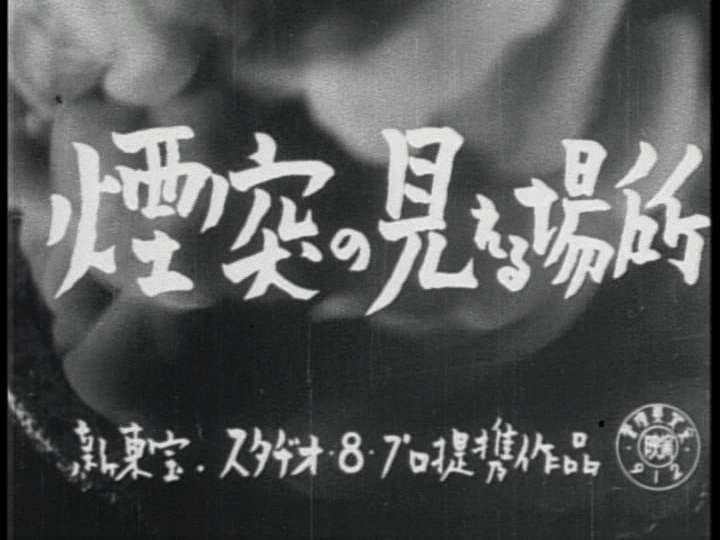
Where Chimneys are Seen (煙突の見える場所, Heinosuke Gosho, 1953)

vlcsnap-2016-07-07-01h01m06s792Where Chimneys are Seen (煙突の見える場所, Entotsu no Mieru Basho) is widely regarded as on of the most important films of the immediate post-war era, yet it remains little seen outside of Japan and very little of the work of its director, Heinosuke Gosho, has ever been released in English speaking territories. Like much of Gosho’s filmography, Where Chimneys are Seen devotes itself to exploring the everyday lives of ordinary people, in this case a married couple and their two upstairs lodgers each trying to survive in precarious economic circumstances whilst also coming to terms with the traumatic recent past.
Ryukichi Ogata (Ken Uehara) is our primary narrator, introducing us to his humble circumstances and, for the moment, happy home. He’s married to a cheerful and kindly woman, Hiroko (Kinuyo Tanaka), who was widowed during the war, and the couple rent out their upstairs to a man, Kenzo (Hiroshi Akutagawa), and a woman, Senko (Hideko Takamine) , who aren’t a couple but each rent a room separately. They’re desperately poor, so much so that they have complicated measures in place to try and avoid having any children – a luxury which they can in no way contemplate. However, unbeknownst to Ryukichi, Hiroko has taken on a part-time job outside the home by working at the bicycle races. He’s upset by this because he resents feeling as if his wife has been hiding things from him, though his pride is wounded too. The worry planted in his mind by the idea of not knowing everything there is to know about his wife’s past is brought to the fore when a baby is suddenly abandoned on their doorstep with a note claiming to be from Hiroko’s first husband which states this is “her” child and she ought to look after it from now on.

The titular “magic” chimneys belong to a large scale factory and, in truth, there are four of them, but depending on where you stand they blend into each other, increasing or decreasing in number. This rundown, backwater town is a three chimney sort of place – not quite rock bottom, but almost. All anyone can think about is trying to keep their head above the water and food on the table. Upstairs lodger Senko works as a public announcer in the shopping district along with another woman who has a rather different approach to life and is in some kind of compensatory relationship with a businessman whom she’s apparently going to marry. Senko is a little upset about this, possibly envious, but at any rate is going to lose a friend at work and in a way she doesn’t entirely approve of. At one point she declares that she envies the baby in one sense – children are allowed to cry whenever they want and make as much noise as they please, but adults are expected to grin and bear it no matter how painful it might be.

Kenzo, by contrast, is a government official in that he’s a kind of bailiff trying to enforce taxation fines and threatening to seize the property of those that can’t pay. This kind of work contrasts strongly with his sense of social justice as he can see that most of the people he visits just don’t have the means to pay but do have plenty of other problems of their own, what good will it serve turning them out onto the streets? Predictably he’s developed a bit of a crush on Senko though given both of their dire financial circumstances, he’s afraid to pursue it. His need for “justice” sends him out on a quest to track down Hiroko’s former husband and find out what’s really going on though his investigation takes far longer than expected and soon begins to depress him. When eventually uncovered, the facts of the matter shock and upset, leaving Kenzo wishing that he’d never bothered in the first place.

Having gone to so much trouble to avoid having children (they have a very prominently marked calendar hanging on the wall), that Ryukichi and Hiroko should be saddled with an abandoned child is especially ironic though the baby serves as more than a physical burden, becoming a manifestation of a hitherto buried past. Both of the women in the film have suffered heavily in the war. Hiroko lost her entire family and was reduced to stealing scraps of discarded food behind the evacuation centre. After losing everything she came to resent the whole of humanity for becoming involved in this senseless war and just wanted to live alone, but came to feel a life of mere subsistence was not worth living. She got herself a new family register and started again planning not to look back. She didn’t tell Ryukichi much about her former life because she wanted to forget it, it was painful to her.

Senko had similar experiences, losing family members in extremely cruel ways leaving her with a degree of resistance to forming new bonds. The baby, perhaps a temporary visitor, perhaps not, forces them to reconsider their choices, reawakening an emotional connection that had been severed due to the war’s hardships. The past is quite literally visited upon them, but how they decide to deal with it is very much a matter for the present. In the end, this extreme stress test on the various relationships of the central characters proves effective as their bonds eventually strengthen rather than break.

Using the four chimneys as an effective, if occasionally overworked, metaphor, Gosho remains resolutely non-judgemental, reminding us that things often look very different depending on where you stand. Everybody here is struggling, but everyone is trying to survive. If the film has a central message, it’s that you have to let the past go. The “right time” may never come, so you just have to make the best of things now. Happiness is fragile, but possible, if only you can learn to accept the various compromises which necessarily accompany it.


W’s Tragedy (Wの悲劇, Shinichiro Sawai, 1984)

W's TragedyHiroko Yakushimaru was one of the biggest idols of the 1980s. After starring in Shinji Somai’s Sailor Suit and Machine Gun, she went on to become one of Kadokawa’s tentpole stars in vehicles such as Detective Story and Main Theme but she hit her artistic stride in 1984’s W’s Tragedy (Wの悲劇, W no Higeki) which earned her her first Blue Ribbon award for Best Actress. Inspired by the 1982 novel of the same name by Shizuko Natsuki (translated into English under the title Murder at Mt. Fuji), Sawai’s film radically diverges from its source material as the central murder mystery takes place on stage but eerily begins to mirror real life events.
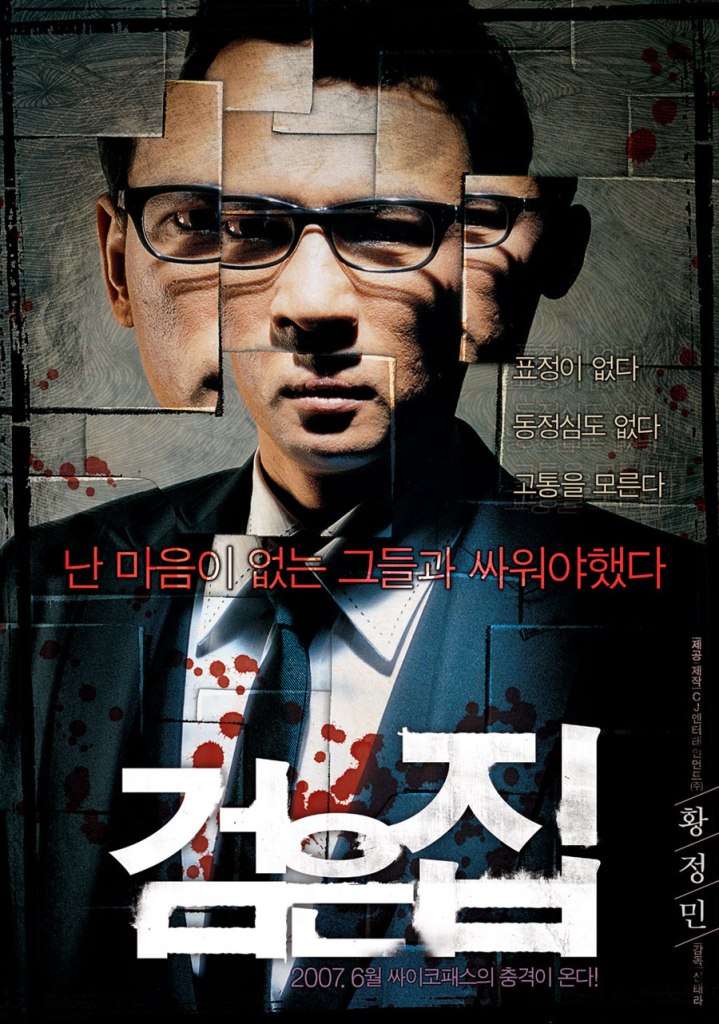
Shizuka Mita (Hiroko Yakushimaru) is an aspiring young actress desperate to find her place in the spotlight. After spending the night with her teacher, she wanders home through a park and begins monologuing her life on the stage of an outdoor amphitheatre. Unbeknownst to her, a young man was sleeping on one of the rear benches and wakes up to applaud her performance. Despite her hostility towards him, Akio perseveres in getting Shizuka’s attention and the two eventually develop a tentative relationship.

Shizuka’s acting school offers its pupils the opportunity to star in a full scale production with established stars of the stage as part of their training and this year’s play is based on the recent novel, W’s Tragedy, which centres around a murder in an aristocratic family. Shikuza is desperate to win the leading role of Mako who claims to have murdered her grandfather after he tried to assault her. Losing out in the original auditions process but winning a small role which also comes with some backstage craft experience, Shizuka begins to lose heart. However, after building up a relationship with the star actress in the show, Shizuka is offered the opportunity to displace her rival through underhanded means but just how far is she willing to go for stardom and what will it all mean if and when she gets it?

Taking its cues from All About Eve, W’s Tragedy, reconfigured as a vehicle for Yakushimaru, becomes more about dualities as Shizuka effectively splits into two different “selves” – the young and innocent girl dreaming of a life on the stage, and the insecure, ambitious student willing to sacrifice anything to get there. Though clearly conflicted, Shizuka easily gives in to dubious suggestions that will earn her what she wants though not perhaps in the way that she wanted it. Her rival is shown to be a very competent actress who has also sacrificed parts of herself to attain the position that Shizuka so covets though it’s the older actress, Sho, who is the first to lament the fate of the displaced former leading lady even if she adopts a casualty of war ethos about the whole entrprise.

Shizuka gives the best performance of her life at a press conference held when she replaces the other actress in the show as she lies through her teeth to reinforce the fake story she and Sho have concocted together to their mutual benefit. Taking the brunt of a scandal just as Mako tries to take responsibility for a crime in the play, Shizuka becomes rather than performs an entirely different persona as she gives a heartfelt account of a passionate love affair with a married man that belongs to someone else entirely. Taken to task by Akio who doesn’t know the story is fake but has come to despise this manipulative side of the acting profession, Shizuka begins to wonder who she really is underneath all of the lies, scheming, and performance.

Though the directing style is generally straightforward and in keeping with Kadokawa’s mainstream idol movies of the time, Sawai adds in a few interesting flourishes which often pay homage to similarly themed Western movies such as an overtly All About Eve moment with Shizuoka taking to the stage and reciting the lead role when she thinks no one’s looking. A strange shot near the end takes place during the play but has been constructed entirely for our benefit as Shizuka looks at her reflection on a pane of glass. The audience would not be able to pick up on this ghostly effect of the two Shizukas – the stage persona and the shade of the innocent girl dreaming of the spotlight, but the effect itself is a perfect evocation of the ever present theme of duality.

Very much of its time and bearing most of the hallmarks of the classic Kadokawa idol movie, W’s Tragedy is, in many ways, the evocation of another era. However, it does provide a plum leading role for its star and an interesting meditation on the nature of acting as a profession as well as the double standards and hypocritical judgements inherent to the running of the entertainment industry.  Though less explosive than the later Perfect Blue with which it shares a few common themes, W’s Tragedy provides another set of mirrors into the nature of stardom, identity, and the price of success.


Unsubbed trailer (look out for a brief cameo from the late Yukio Ninagawa):

And here’s a clip of Hiroko Yakushimaru singing the title song at her 30 year anniversary concert back in 2013:

Black House (검은집, Shin Terra, 2007)

Black House (korea)Yusuke Kishi’s Black House source novel was previously adapted by Yoshimitsu Morita in its native Japan back in 1999, but eight years later the tale made its way to Korea by way of director Shin Terra who opts for a much more straightforward approach than Morita’s characteristically bizarre take. Sold as K-horror, the tone is closer to nasty thriller only giving way to classic slasher action in the final stretch. In eschewing Morita’s idiosyncratic tendency to insert himself into the material, Shin crafts a more mainstream aesthetic, but loses the various layers of social and psychological commentary that went with it.
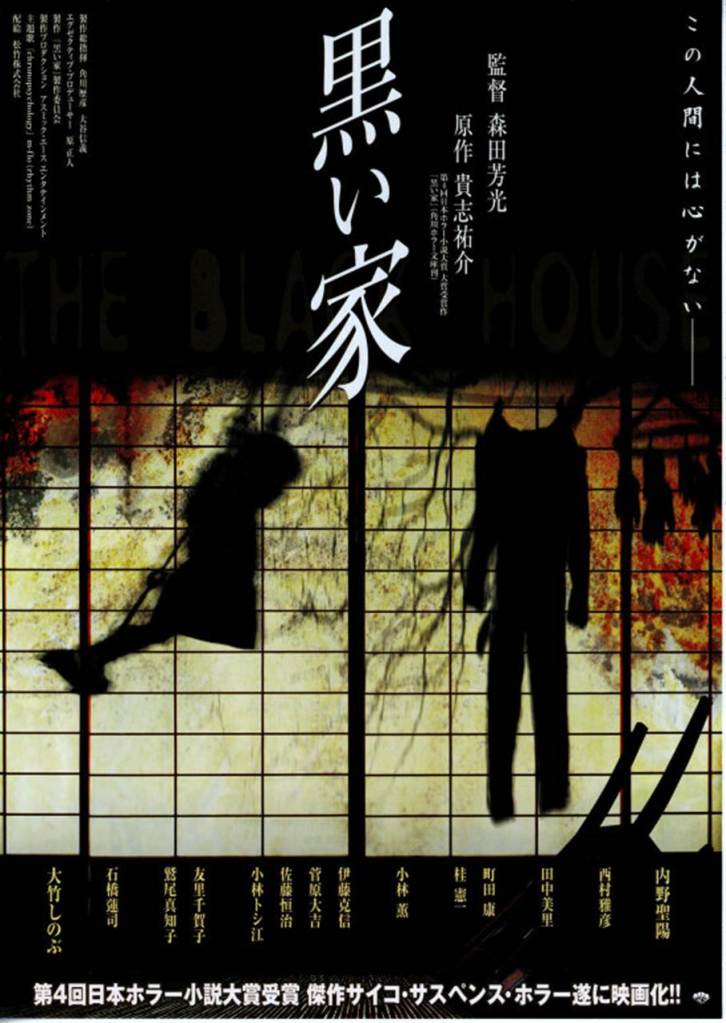
Juno (Hwang Jung-min) is a mild mannered insurance clerk, new on the job and extremely naive. His first case involves a visit to a hospital with his boss to visit a persistent claimant whom they believe is deliberately scamming the system and possibly with the hospital’s help. In many ways, Juno is an innocent, he believed in insurance as a safety net and a power for social good so he’s shocked that anyone would deliberately manipulate the rules in this way – particularly when he discovers some people will go so far as to deliberately maim themselves just to claim on their insurance policies.

Not long after he starts working at the company, Juno gets a strange phone call from a man asking if insurance policies pay out in case of suicide. It’s possible, Juno says – he’ll need to check the policy to make sure. Suddenly worried the person he’s talking to is in a dark place, he starts trying to dissuade him from the idea of taking his own life and unwisely gives a lot of first hand advice despite the highlighted section in his employee guide cautioning him never to reveal personal information to clients. Soon enough, a client has asked for him personally to go out to their remote house and chat about a policy. When he gets there he receives a nasty surprise as the man’s young son has apparently hanged himself in the back room. Appalled, Juno waits to greet the police but becomes convinced the man has deliberately killed the boy, who was his step-son, to get the payout on his life insurance.

Juno refuses the claim but Choong-bae, the claimant, won’t give up and starts coming to the office everyday to ask for his money. Choong-bae is a scary looking guy and frightens most of the other staff with his vacant staring. He also has an insurance policy on his wife leading Juno to fear that she is next but his decision to try and alert her to her husband’s plans will prove a mistaken one, drawing him into the web of a dangerous and psychopathic serial killer.

Shin’s adaptation is most likely closer to the original novel but he is far less interested in the psychological or social implications than Morita was. There is no explanation offered for the actions of the killer though the childhood sequences with their reliance on dreams and hearsay remain intact, only with lesser impact. The question of insurance fraud and scamsters, people so desperate for money that they will literally sacrifice an arm or a leg, only exists as background and isn’t presented as a societal problem so much as just something that happens because there are some shameless people out there who would rather play the system than do an honest days work. Juno has also been given his own tragic backstory which tries to play him off as a mirror of the killer though somehow this never quite works and Juno’s own flashbacks are overplayed.

Beginning as a slow burn thriller where Juno plays the nervous, softhearted neophyte as yet uninured to the murkiness of the insurance world, Black House (검은집, Geomeun Jip) takes a huge detour during the final third which sends it into slasher territory when Juno decides to travel to the titular Black House, alone, during the middle of the night, because the police won’t listen to him and there are people in danger. When he gets there he finds a veritable house of horrors with body parts and nooses hanging from the ceiling, blood and carnage everywhere. Then it’s a straightforward fight to the death as Juno faces off against the psychopathic terror despite his nervous disposition culminating in some unexpectedly gory business with a key.

Like most slasher movies, Black House has several endings and finishes on a note of uncertainty but it never quite manages to make its sudden descent into violence work in its favour. Lacking the depth of Morita’s adaptation, Shin’s Black House may have stronger genre influences but with nothing to back them up all that remains at the end is a darker than usual serial killer tale with mild slasher tendencies. A decent enough mainstream thriller, Black House has a lot to offer despite stumbling in its final third but nevertheless lacks a distinctive element to mark it out from similarly themed genre efforts of recent times.


Unsubbed trailer:

The Black House (黒い家, Yoshimitsu Morita, 1999)

black house posterYoshimitsu Morita, though committed to commercial filmmaking, also enjoyed trying on different kinds of directorial hats from from purveyor of smart social satires to teen idol movies, high art literary adaptations and just about everything else in-between. It’s no surprise then that at the height of the J-horror boom, he too got in on the action with an adaptation of Yusuke Kishi’s novel of the same name, The Black House (黒い家, Kuroi Ie). Though tagged as “J-horror” you’ll find no long haired ghosts here and, in fact, barely anything supernatural as the true horror on show is the slow descent into madness taking place inside the protagonist’s mind.

Wakatsuki (Masaaki Uchino) is a nice young man with a good job investigating claims at an insurance office. Unfortunately, this gives him a slightly dim view of humanity as he comes into contact with scamsters and even people willing to maim themselves just so that they can claim on their policies. One day, he receives a strange phone call from a woman who wants to know if her insurance policy will pay out in case of suicide. Wakatsuki, slightly panicked, tells her that it really depends on the circumstances and, jumping to the conclusion she plans to kill herself, urges her to get help and talk things over with someone before doing anything rash.

The next thing he knows, Wakatsuki is despatched to her house to sort things out whereupon he makes an extremely gruesome discovery – the woman’s son, though only a child, has hanged himself in the back room. Obviously extremely shocked and distressed, Wakatsuki heads home with the nagging suspicion that Sachiko (Shinobu Ootake) and her husband Komoda (Masahiko Nishimura) have done something truly dreadful. The couple take turns coming into the office to find out what’s taking so long with their claim and gradually the situation begins to spiral desperately out of control.

Always one for irony,  Morita’s tone varies widely here. There’s an oddly Twin Peaks-like vibe with the jolly jazz score giving way to synths at moments of high tension, not to mention the run down industrial town setting. If that weren’t enough Lynchery, there’s even a moment where a severed hand is found in a patch of grass, crawling with ants just like the ear found by Jeffrey at the beginning of Blue Velvet. Morita seems to be telling us not to take any of this too seriously yet his subjects include parents harming or even murdering their children to claim on an insurance policy as well as bloody violence and dismemberment of corpses.

In fact, the insurance guys don’t spend too long trying to figure out if the boy actually killed himself but Wakatsuki becomes preoccupied by the idea the husband, Komoda, is behind the whole thing (the boy was only his step-son after all) and will now try and kill his wife to claim her insurance too. The couple are certainly both very strange people and the insurance company also have a problem as the policy was signed off on during a campaign drive in which a now dismissed employee made use of a personal connection to try and meet her unrealistic quota. Wakatsuki eventually engages an equally eccentric psychology professor who takes him out on a weird nighttime odyssey to a seedy strip club where he expounds on a epidemic of psychopathy among the younger generation. Even Wakatsuki’s girlfriend, Megumi, has some off the wall ideas based on an essay Sachiko wrote in elementary school (though actually Megumi’s view has some merit).

Things hit a more conventional note from this point on landing us with a familiar slasher villain who begins stalking Wakatsuki, even trashing his apartment before kidnapping his girlfriend and keeping her prisoner in the “Black House”. Wakatsuki heads to the den of evil by himself in the dark (in true horror movie fashion) where he finds a whole bunch of other dismembered corpses (and a few other surprises). He might think he can put his troubles behind him after this extremely traumatic incident, but this is still a horror movie so the killer gets away to strike again by throwing a bright yellow bowling ball at his head through the office toilet window.

Morita is not being serious at all, even for a second, but somehow he still manages to create an oddly threatening atmosphere of suspense despite the extremely weird things which are going on. He creates a complex set of visual cues from the recurring sunflower motif repeated on Sachiko’s shirt to the glistening yellow bowling ball, goldfish (in a toilet bowl if not a percolator), repeated sounds of cockroaches and old fashioned reel printers, and even the green glow from both old fashioned computer systems and the company’s insurance documents. Undoubtedly bizarre, The Black House is mind bending psychological-horror-movie-cum-Freudian-slasher that is primed for both head scratching puzzlement and confused chuckling as Morita has a lot of fun messing with our senses.