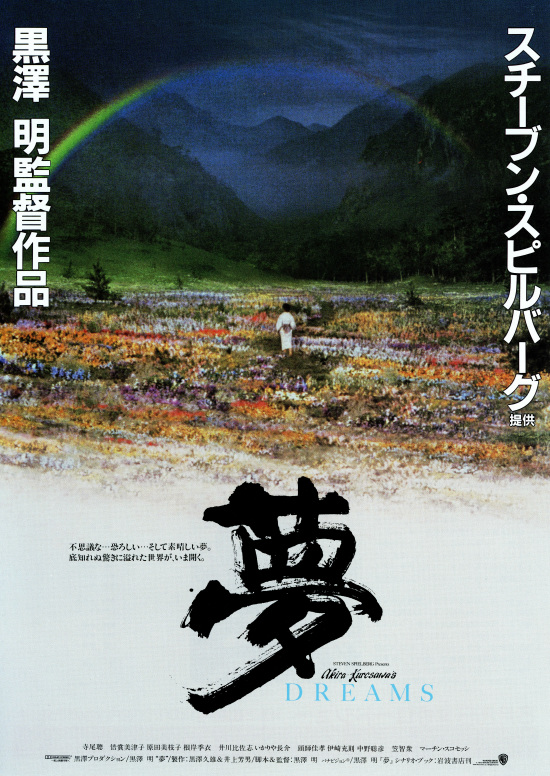
Dreams (夢, Akira Kurosawa, 1990)

dreamsDespite a long and hugely successful career which saw him feted as the man who’d put Japanese cinema on the international map, Akira Kurosawa’s fortunes took a tumble in the late ‘60s with an ill fated attempt to break into Hollywood. Tora! Tora! Tora! was to be a landmark film collaboration detailing the attack on Pearl Harbour from both the American and Japanese sides with Kurosawa directing the Japanese half, and an American director handling the English language content. However, the American director was not someone the prestigious caliber of David Lean as Kurosawa had hoped and his script was constantly picked apart and reduced.

When filming finally began, Kurosawa was fired and replaced with the younger and (then) less internationally regarded Kinji Fukasaku and Toshio Masuda. The film was an unmitigated failure which proved hugely embarrassing to Kurosawa, not least because it exposed improprieties within his own company. Other than the low budget Dodesukaden, Kurosawa continued to find it difficult to secure funding for the sort of films he wanted to make and in 1971 attempted suicide, thankfully unsuccessfully, but subsequently retreated into domestic life leaving a large question mark over his future career in cinema.

American directors who’d been inspired by his golden age work including George Lucas and Martin Scorsese were keen to coax Kurosawa back into the director’s chair, helping to fund and promote his two biggest ‘80s efforts – Ran, and Kagemusha, both large scale, epic jidaigeki more along the line of Seven Samurai than the arthouse leaning smaller scale of his contemporary pictures. The success of these two films and the assistance of Steven Spielberg, allowed him to move in a radically different direction for his next film. Dreams (夢, Yume) is an aberration in Kurosawa’s back catalogue, a collection of thematically linked vignettes featuring surreal, ethereal, noh theatre inspired imagery, it was unlike anything the director had attempted before and a far cry away from the often straightforward naturalism which marked his career up to this point.

Inspired by Kurosawa’s own dreams from childhood to the present day, Dreams is divided into eight different chapters beginning with a solemn wedding and ending in a joyous funeral. Each of the segments takes on a different tone and aesthetic, but lays bare many of the themes which had recurred throughout Kurosawa’s career – namely, man’s relationship with the natural world, and its constant need to tear itself apart all in the name of progress.

Casting his central protagonist simply as “I”, Kurosawa begins with an exact recreation of his childhood home and a little boy who disobeys his mother in leaving the house during a spell of sun streaked rain. Weather like this is perfect for a “kitsune” wedding, only fox spirits do not like their rituals to be witnessed by humans and punishment is extreme if caught, still, the boy has to know. His fate is echoed in the second story in which the still young I is lured to the spot where his family’s orchard once stood to be berated by the spirits of the now departed peach blossoms in the guise of the traditional dolls given to little girls at the Hina Matsuri festival. The spirits are upset with the boy, who starts crying, but not, as the spirits originally think because he’s mourning all of the peaches he’ll never eat but because he truly loved the this place and knows he’ll never see the glory of the full orchard in bloom ever again.

The spirits recognise his grief and contritely agree to put on a display of magic for him so that he may experience the beauty of peach trees in full blossom one last time. However, the illusion is soon over and the boy is left among the stumps where his beloved trees once stood. Later, the adult I finds himself in a monstrous nuclear apocalypse which has now become much harder to watch as the Ishiro Honda inspired horror of the situation has turned mount Fuji and the surrounding sky entirely red with no escape from the invisible radioactive poison. Quickly followed by I traipsing through a dark and arid land in which giant mutant dandelion provide the only sign of life aside from the remnants of post-apocalyptic humanity reduced to devouring itself in scenes worthy of Bruegel, these sequences paint the price of untapped progress as humans burn their world all the while claiming to improve it.

Humans are, in a sense, at war with nature as with themselves. The Tunnel sees an older I return from the war to encounter first an aggressive dog and then the ghosts of men he knew who didn’t make it home. Apologising that he survived and they didn’t, I contrives to send the blue faced ghosts back into the darkness of the tunnel while he himself is plagued by the barking, grenade bearing dog outside. The mountaineers of the blizzard sequence are engaged in a similar battle, albeit a more straightforwardly naturalistic one of human endurance pitted against the sheer force of the natural world. That is, until the natural becomes supernatural in the sudden appearance of the Snow Woman which the mountaineer manages to best in his resilience to the wind and cold.

The better qualities of humanity are to be found in the idyllic closing tale which takes place in a village lost to time. Here there is no electric, no violence, no crime. People live simply, and they die when they’re supposed to, leaving the world in celebration of a life well lived rather than in regret. People, says the old man, are too obsessed with convenience. All those scientists wasting their lives inventing things which only make people miserable as they tinker around trying to “improve” the unimprovable. As the young I says, he could buy himself as many peaches as he wanted, but where can you buy a full orchard in bloom?

Of course, Kurosawa doesn’t let himself off the hook either as the middle aged I finds himself sucked into a van Gogh painting, wandering through the great master’s works until meeting the man himself (played by Martin Scorsese making a rare cameo in another director’s film) who transforms his world through his unique perception but finds himself erased by it as his art consumes him to the point of madness. I wanders back through van Gogh’s landscapes, now broken down to their component parts before eventually extricating himself and arriving back in the gallery as a mere spectator. Even if the work destroyed its creator through its maddening imperfection it lives on, speaking for him and about him as well about a hundred other things for an eternity.

For all of the fear and despair, there is hope – in humanity’s capacity for endurance as in the Blizzard, in its compassion as in The Tunnel, and in its appreciation for the natural world as in The Peach Orchard alongside its need to re-envision its environment through the glorious imperfection of art. There is the hope that mankind may choose to live in The Village of the Water Mills rather than the hellish post apocalyptic world of fear and greed, however small and slim that hope maybe. Creating a living painting filled with hyperreal colour and a misty dreaminess, Kurosawa’s Dreams, like all dreams, speak not only of the past but of the future, not only of what has been but what may come. Equal parts despair and love, Kurosawa’s vision is bleak yet filled with hope and the intense belief in art as a redemptive, creative force countering humanity’s innate capacity for self destruction.


Original international trailer (irritating English language voiceover only)

Introspection Tower (みかへりの塔, Hiroshi Shimizu, 1941)

vlcsnap-2016-12-10-01h34m55s187Shimizu, strenuously avoiding comment on the current situation, retreats entirely from urban society for this 1941 effort, Introspection Tower (みかへりの塔, Mikaheri no Tou). Set entirely within the confines of a progressive reformatory for troubled children, the film does, however, praise the virtues popular at the time from self discipline to community mindedness and the ability to put the individual to one side in order for the group to prosper. These qualities are, of course, common to both the extreme left and extreme right and Shimizu is walking a tightrope here, strung up over a great chasm of political thought, but as usual he does so with a broad smile whilst sticking to his humanist values all the way.
Introspection Tower opens with a tour being given to a group of women guided by one of the teachers (Chishu Ryu) in which he outlines the qualities of the school. There are no high walls or barbed wire fences, the front gate remains open at all times for the children to feel free within their new environment so they can learn to want to stay until they can be reintegrated into society. The school is run like mini commune with several houses segregated by sex and headed by a teacher and a female guardian – usually his wife, though the female houses also have a female teacher. The kids spend time in conventional education in the morning followed up with physical activity and vocational training in the afternoons to help them find work later in life. Parents are welcome to visit and also encouraged to write letters (notably, all of these kids seem to be able to read and write, at least to a degree). The kids also take care of the housework amongst themselves so they learn life skills like cooking and cleaning, again meant to help them as they return to regular society.

Rather than a straightforward narrative, Shimizu concentrates on the general life of the school with particular interest in four difficult pupils – new arrival Tamiko (Yuiko Nomura), a naughty upperclass girl who has difficulty learning to muck in with everyone else, Yoshio (Jun Yokoyama, formerly known as Bakudan Kozo) who likes get into fights, Masao (Norio Otsuka) who has his head in the clouds, and Nobu who can’t seem to get on with his stepmother no matter how hard she tries. Several times the kids get fed up with their reform school lives and try to escape, only to be brought back with their tails between their legs and, being children, they are apt to fight, grouse and get upset over nothing.

Perhaps unusual given Shimizu’s reputation the film is not exclusively told from the point of view of the kids but also looks at the often difficult lives of the adults who’ve dedicated their entire existences to caring for them. Each of the teachers and guardians is fully committed to looking after the children and trying to teach them how to be functioning members of society, living with kindness and responsibility. The house leaders are referred to as “mother” and “father” and the kids are intended to think of the other residents as siblings as if they’re all part of one big well functioning family. Discipline is carried out through self reflection, penance, and apology as the offending child is encouraged to realise why the way they’ve behaved is unacceptable and why they should avoid acting in that way in the future. Endlessly patient and giving, the adults’ lives are not easy ones as a female teacher finds herself snapping and hitting a pupil while another couple wonder if they’re really making that much difference when the children continue to misbehave.

About half way through, one naughty boy causes a huge problem by temporarily draining the well which is the school’s only source of water. Faced with a number of serious issues, the teachers decide to try channelling a riverbed from the nearby lake down to the school but they obviously don’t have money to pay for it. You can see where this is going and it’s certainly the most problematic aspect of the film as these young children are suddenly expected to do the strenuous, sometimes dangerous, work of physically carving a channel in the land with shovels and pick axes. Intended to sell the virtues of togetherness and responsibility, the river construction is, in essence, the forced labour of imprisoned minors who are given no rights to refuse, are not compensated for their efforts, and are children who are not equipped to handle this physically taxing work. Shimizu films the sequence like some kind of Soviet propaganda film as the axes rise and fall rhythmically as a hymn to the beauty of physical labour, but this particular celebration of the strength of the group over the individual is very difficult to take at face value.

Whatever Shimizu intended with the river building sequence, several of the pupils earn their freedom through taking part in it, supposedly reformed by hard work and community. Their “graduation” ceremony involves them reading poems and inspirational phrases aloud as a tribute to the school, but Shimizu neatly undercuts the happily ever after image with the presence of an older boy who has returned to visit. Regarding the school as his home, he has nowhere else to go and it quickly transpires he’s lost yet another job. Even when things seem to be going well, people find out he was in a reform school and it all falls apart. No matter how good the efforts of the teachers, the kids will face constant stigma and internalised shame for the rest of their lives making reintegration into society a difficult prospect. Nevertheless, Shimizu does seem to want to believe the school can do some good in looking after these troubled children who often come from difficult family circumstances.

An odd, confused effort from Shimizu, Introspection Tower still does its best to emphasise his humanist philosophy in the broadly progressive approach of the school which truly is dedicated to to teaching these children how to live in the Japan of the day without getting into trouble. The tone is one of good humour mixed with Shimizu’s naturalistic approach to filming children which shows them for all of the complicated young people they really are, deriving both great comedy and heartrending drama from their comic escapades and melancholy backstories. Making fantastic use of location shooting once again with an approach closer to his silent work than his talkies, Shimizu’s return to the world of progressive education is a strange and occasionally problematic one which is at times hard to read but, worryingly enough, seems to have its heart in the right place.


Children in the Wind (風の中の子供, Hiroshi Shimizu, 1937)

vlcsnap-2016-12-06-23h27m52s218It would be a mistake to say that Hiroshi Shimizu made “children’s films” in that his work is not particularly intended for younger audiences though it often takes their point of view. This is certainly true of one of his most well known pieces, Children in the Wind (風の中の子供, Kaze no Naka no Kodomo), which is told entirely from the perspective of the two young boys who suddenly find themselves thrown into an entirely different world when their father is framed for embezzlement and arrested.  Encompassing Shimizu’s constant themes of injustice, compassion and resilience, Children in the Wind is one of his kindest films, if perhaps one of his lightest.
Brothers Zenta (Masao Hayama) and Sampei (Bakudan Kozo) live a fairly comfortable life in a small town with their accountancy clerk father (Reikichi Kawamura) and doting mother (Mitsuko Yoshikawa). Older brother Zenta is the stereotypically good boy who studies hard, gets good grades, and causes no trouble. Sampei, by contrast, is a handful. Running out of the house to play Tarzan with the other neighbourhood kids even though he’d promised his mother he’d stay home to study to improve his awful performance at school, Sampei is the loveable rascal that no one quite knows what to do with. Despite their mother’s protestations, the boys’ father is content to let Sampei run riot for now, he’s only young after all.

When their father is accused of embezzling company funds, sacked, and later arrested, the boys’ world begins to crumble. The other kids won’t play with them anymore, their dad isn’t home, and their mother is worrying about money now that her husband has lost his job. Sampei is packed off to an uncle’s while Zenta stays behind to try and get a job to help out. Unfortunately, Sampei does not take well to his new environment and starts misbehaving even more than usual by disappearing up trees, riding a bucket down a river, running off to meet kappa, and even trying to run away with the circus!

All of this is told more or less from Sampei’s point view meaning that the facts of his father’s case recede into the background while Sampei’s worry and confusion comes to the fore. Having been in the office to deliver his father’s lunch when the coup occurred, Sampei can tell something awful has happened and tries to comfort his dad by closing all the blinds to block out the nosy kids’ faces peeking in from outside, and grabbing his father’s hat to get him to come home. Reassuring his dad that it’s all fine because he can just start a better company of his own, Sampei puts a childishly brave face on things while his ashen faced father walks home in silence. Of course, because Sampei is a child, no one explains to him exactly what’s happened, so no one explains it to us either, but we can perhaps infer a little more from the adults’ passing conversation than the still innocent Sampei.

The boys’ relationship with their father is one of the film’s warmest elements as, in contrast to the stereotypically austere salaryman dad, he delights in playing with his children, even breaking off from worrying about his impending doom by launching into a game of sumo. Sampei and Zenta know their father couldn’t have really done anything bad, so they aren’t really worried and though they miss him, they are sure he’ll be home soon. It’s not until fairly late on that they start to realise the gravity of the situation and how difficult things are for their mother, but once they do they become determined to support her too.

This being a (happy) Shimizu film, the injustice is finally undone and everything goes back to normal which what all children always want. Children, more than adults, are apt to forget quickly and so it’s not long before the other neighbourhood kids start responding to Sampei’s Tarzan call once again. In a typically nice touch, Sampei even invites his arch rival, Kinta – the son of the man who framed his dad for embezzlement in the first place, to come and see the approaching circus with him. A final gesture of reconciliation signals the end to hostilities as a possibly life changing event becomes a humorous summer interlude in the boys’ early lives. Warm and lighthearted, Children in the Wind is perhaps not as cutting or incisive as some of Shimizu’s more socially conscious efforts, but is filled with his characteristic compassionate humanism in its childlike certainty in justice and the willingness to forgive and forget.


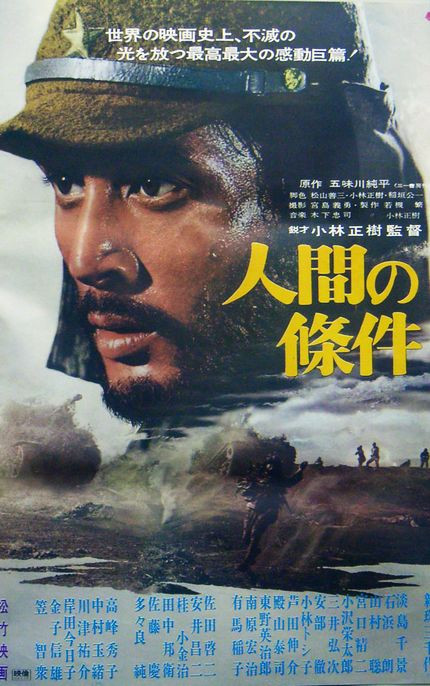
The Human Condition (人間の條件, Masaki Kobayashi, 1959-61)

human-condition

Review of Masaki Kobayashi’s magnum opus The Human Condition (人間の條件, Ningen no Joken) first published by UK Anime Network


If Masaki Kobayashi had an overriding concern throughout his career, it was the place of the conflicted soul within an immoral society. Nowhere is this better articulated than in his masterwork – the nine and a half hour epic, The Human Condition. Adapted from a novel by Junpei Gomikawa, Kobayashi’s film also mirrors his own wartime experiences which saw him conscripted into the army and sent to Manchuria where he was accounted a good soldier, but chose to mark his resistance to the war effort by repeatedly refusing all promotions above the rank of Private. Kaji, by contrast, essentially sells his soul to the devil in return for a military exemption so that he can marry his girlfriend free of the guilt that comes with dragging her into his uncertain future. At this point Kaji can still kid himself into thinking he can change the system from within but to do so means compromising himself even further.

The first of three acts, No Greater Love, takes place in Manchuria during the Japanese expansion where Kaji is working for a Japanese steel company. Fully aware that the company is using forced and exploitative labour, Kaji has been tasked with increasing productivity and has written a comprehensive report indicating that introducing better working conditions would positively affect efficiency as there would be less absenteeism and fewer sickness related gaps in the line. His boss is impressed and presents him with an offer of promotion managing a mine in the North. Kaji is conflicted but ultimately decides to accept as the post comes with a certificate of military exemption so he can finally marry his girlfriend, Michiko. However, his progressive ideals largely fall on deaf ears.

Road to Eternity finds him in the army where his left leaning ideas are even less appreciated than they were at the mine. Asked to train recruits, Kaji once again enacts a progressive approach which takes physical reinforcement out of the process and focusses on building bonds between men but his final battle comes too early leaving his team dangerously exposed. Kaji is briefly reunited with Michiko who has made a perilous journey to visit him but neither of the pair knows when or if they will see each other again.

The concluding part, A Soldier’s Prayer, finds a defeated Kaji wandering the arid land of Northern Manchuria on a desperate quest south with only the thought of getting back home to Michiko keeping him going. Eventually he is taken prisoner by Soviet forces but far from the people’s paradise he’d come to believe in, the Russians are just as unforgiving as his own Japanese. In the army he was a “filthy red” but now he’s a “fascist samurai”.

As much as Kaji is “good” man filled with humanistic ideals, he is also an incredibly flawed central presence. Already compromised by working for the steel company in Manchuria in the first place fully knowing the way the company behaves in China, his decision to take the mining job is an act of self interest in which he trades a little more of his integrity for military exemption and a marriage license. Needless to say, the head honchos at the mine who’ve been at the coal face all along do not take kindly to this baby faced suit from head office suddenly showing up and telling them they’ve been doing everything wrong. Far from listening to their experiences and arguing his point, Kaji attempts to simply overrule the mining staff taking little account of the already in place complex inter-office politics. This creates a series of radiating factions, most of whom side with Kaji’s rival and have come to view the cruel treatment of workers as a sort of office perk.

The complicity only deepens as Kaji becomes ever more a part of the machine. Kaji feels distraught after he loses his temper and strikes a subordinate, but before long he’s physically whipping a crowd of starving men in an attempt to stop them killing themselves through overeating. His biggest crisis comes when a number of Chinese prisoners are caught trying to escape and Kaji is unable to help them after specifically guaranteeing nobody would be killed. Forced to watch the botched execution of a brave man who refused to capitulate even at the end, Kaji is forced to acknowledge his own role in the deaths of these men, his complicity in the ongoing system of abuse, and his complete powerlessness to effect any kind of change in attitudes among the imperialist diehards all around him.

Kobayashi pulls no punches when it comes to examining the recent past. The steel company is built entirely on the exploitation of local workers who are progressively stripped of their humanity, whipped and beaten, starved and humiliated. The situation is only made worse when Kaji is forced to accept a number of “special labourers” from the military police. Tagged as prisoners of war, these men are not soldiers but displaced locals from Northern villages razed by Japanese troops. The train they arrive on is worse than a cattle truck and some of the men are already dead of heat, thirst, and starvation. The others pour out, zombie-like, searching desperately for food and water. Kaji is further compromised when the head of the mine has a plan of his own to subdue the men which involves procuring a number of comfort women which Kaji eventually does even if the entire process makes him sick. This is where the system has brought him – effectively to the level of a people trafficker, pimping vulnerable women to enslaved men.

Kaji comes to believe in a better life across the border where people are treated like human beings but anyone who’s read ahead in the textbooks will know this doesn’t work out for him either. Equally scathing about the left as of the right, The Human Condition has very little good to say about people, especially when people begin to act as a group. Even Kaji himself who has so many high ideals is brought low precisely because of his self-centred didacticism which makes it impossible for him to take other people’s views into account. With his faith well and truly smashed, Kaji has only the vague image of Michiko to cling to. Even so, he trudges on alone through the snowy landscape, deluded by hope, still dreaming of home. Trudging on endlessly, driven only by blind faith, perhaps that’s the best definition of the human condition that can be offered. A brutal exercise in soul searching, The Human Condition is not always even certain that it finds one but still retains the desire to believe in something better, however little in evidence it may be.


Trailers for each of the three parts (English subtitles)

https://www.youtube.com/watch?v=IpkKFLC2zvA

https://www.youtube.com/watch?v=Hpr_75YYX1o

https://www.youtube.com/watch?v=9uRym7Yd_bg


Star Athlete (花形選手, Hiroshi Shimizu, 1937)

vlcsnap-2016-09-23-01h52m32s055Japan in 1937 – film is propaganda, yet Hiroshi Shimizu once again does what he needs to do in managing to pay mere lip service to his studio’s aims. Star Athlete (花形選手, Hanagata senshu) is, ostensibly, a college comedy in which a group of university students debate the merits of physical vs cerebral strength and the place of the individual within the group yet it resolutely refuses to give in to the prevailing narrative of the day that those who cannot or will not conform must be left behind.

Seki (Shuji Sano) is the star of the athletics club and shares a friendly rivalry with his best friend Tani (Chishu Ryu). Tani likes to train relentlessly but Seki thinks that winning is the most important thing and perhaps it’s better to be adequately rested to compete at full strength. While the two of them are arguing about the best way to be productive, their two friends prefer to settle the matter by sleeping. The bulk of the action takes place as the guys take part in a military training exercise which takes the form of a long country march requiring an overnight stay in a distant town. The interpersonal drama deepens as Seki develops an interest in a local girl who may or may not be a prostitute, casting him into disrepute with his teammates though he’s ultimately saved by Tani (in an unconventional way).

Far from the austere and didactic nature of many similarly themed films, Shimizu allows his work to remain playful and even a little slapsticky towards the end. These are boys playing at war, splashing through lakes and waving guns around but it’s all fun to them. Their NCO maybe taking things much more seriously but none of these men is actively anticipating that this is a real experience meant to prepare them for the battlefield, just a kind of fun camping trip that they’re obliged to go on as part of their studies. The second half of the trip in which the NCO comes up with a scenario that they’re attempting to rout a number of survivors from a previous battle can’t help but seem ridiculous when their “enemies” are just local townspeople trying to go about their regular business but now frightened thinking the students are out for revenge for ruining their fun the night before.

That said, the boys do pick up some female interest in the form of a gaggle of young women who are all very taken with their fine uniforms. The women continue to track them on their way with a little of their interest returned from the young men (who are forbidden to fraternise). Singing propaganda songs as they go, the troupe also inspires a group of young boys hanging about in the village who try to join in, taken in by Tani’s mocking chant of “winning is the best” and forming a mini column of their own. After this (retrospectively) worrying development which points out the easy spread of patriotic militarism, the most overtly pro-military segment comes right at the end with an odd kind of celebration for one of the men who has received his draft card and will presumably be heading out to Manchuria and a situation which will have little in common with the pleasant boy scout antics of the previous few days.

Physical prowess is the ultimate social marker and Seki leads the pack yet, when he gets himself into trouble, his NCO reminds him that “even stars must obey the rules” and threatens to expel him though relents after Tani takes the opportunity to offer a long overdue sock to the jaw which repairs the boys’ friendship and prevents Seki being thrown out of the group. Seki’s individuality is well and truly squashed in favour of group unity though Shimizu spares us a little of his time to also point out the sorrow of the young woman from the inn, left entirely alone, excluded from all groups as the students leave.

Employing the same ghostly, elliptical technique of forward marching dissolves to advance along the roadway that proved so effective during Mr. Thank you, Shimizu makes great use of location shooting to follow the young men on the march. Though the final scene is once again a humorous one as the two sleepyheaded lazybones attempt to keep pace with the front runners, the preceding scene is another of Shimizu’s favourite sequences of people walking along a road and disappearing below a hill, singing as they go. However, rather than the cheerful, hopeful atmosphere this conveyed in Shiinomi School there is a feeling of foreboding in watching these uniformed boys march away singing, never to reappear. Shimizu casts the “training exercise” as a silly adolescent game in which women and children are allowed to mockingly join in, but he also undercuts the irony with a subtle layer of discomfort that speaks of a disquiet about the road that these young men are marching on, headlong towards an uncertain future.


The Golden Demon (金色夜叉, Hiroshi Shimizu, 1937)

vlcsnap-2016-09-22-02h33m21s455Perhaps best known for his work with children, Hiroshi Shimizu changes tack for his 1937 adaptation of the oft filmed Ozaki Koyo short story The Golden Demon (金色夜叉, Konjiki Yasha) which is notable for featuring none at all – of the literal kind at least. A story of love and money, The Golden Demon has many questions to ask not least among them who is the most selfish when it comes to a frustrated romance.
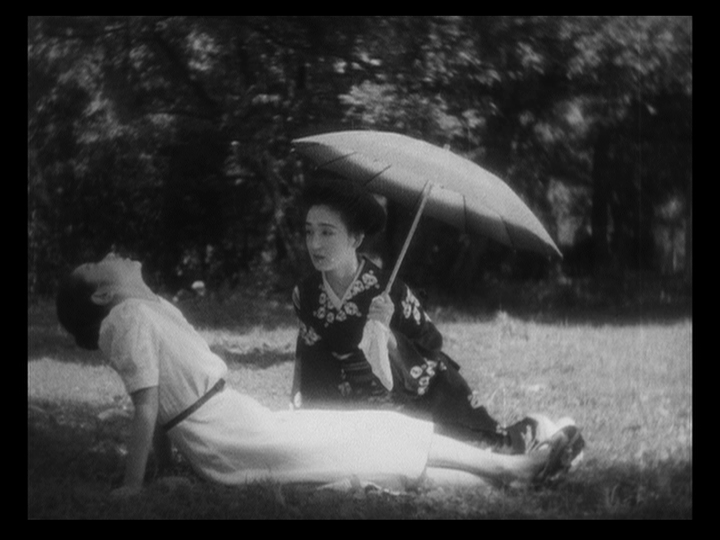
Poor relation Kanichi (Daijiro Natsukawa) is a university student living with friends of his deceased father. He and the daughter of the family which took him in, Miya (Hiroko Kawasaki), have grown up together and formed an emotional attachment they each believed would naturally lead to marriage. However, Miya has received a proposal from a wealthy gentlemen which her cash strapped father is strongly advising her to accept. Though she loves Kanichi deeply, Miya is torn – both by a feeling of duty to marry well and keep her parents in comfort, and by a fear of leaving her middle-class lifestyle for a life of uncertain poverty with the still studying Kanichi.

When she ultimately agrees to the arranged marriage, Kanichi becomes angry and accuses Miya of placing monetary concerns over true feeling. Disappearing from Miya’s life entirely, Kanichi determines to destroy himself in a vicious quest for revenge. Abandoning his idealistic, progressive concerns, Kanichi becomes a heartless money lender with a plan to one day amass a great fortune only to throw it in the face of his former love. When Miya’s husband, Tomiyama (Toshiaki Konoe), appears at his door apparently fallen on hard times, Kanichi’s plan looks set for success.

In true Shimizu fashion, he remains non-judgemental of his characters save for that of the elderly money lender who, when questioned by his son, offers a series of flimsy justifications for his line of work which his son brands dirty and disgraceful. The money lender points out that he’s only operating a business – he never attempts to hide his terms so customers know they will pay a heavy price for the loans, and thereafter the decision is their own. When his son points out how selfish a point of view that is and that all he’s doing is exploiting the desperation of vulnerable people, he’s told that he reads to many books and should learn to live in the “real world”. If Shimizu wants to criticise anything at all (even obliquely, this is 1937), it’s this “real world” thinking which legitimises the selfishness of those who seek to profit from the misfortune of others.

The same money lender has a somewhat strained relationship with his equally cynical wife. After she complains about his complaint about how much makeup she’s putting on “to go to a temple”, he tells her that his jealously proves he loves her. She’s a precious object that he’s afraid of losing to another man. To him all is about possession. Kanichi, who once thought himself so different is more or less the same as he refuses to think about why exactly Miya has made the decision she has, or even allow her the right to make that decision. Obviously broken hearted, he decides to abandon emotion all together as “you can’t trust the human heart.” He even attempts to enact the final terms of the usurious loans on the contracts of some of his university friends who, just as he was with Miya, are unable to understand how he could be so cruel to those he was once so close to. Even Tomiyama, who had hitherto looked after Miya as a husband should finally exclaims “I can’t love you without money” as if in a tacit acceptance of the fact that he essentially bought her, obtaining her duty and service but not, perhaps, her heart.

In contrast some of Shimizu’s other work he focusses much more on Kanichi’s moral meandering than on Miya’s suffering but she herself pays a heavy price throughout. In sacrificing her love for Kanichi and a chance at a self directed future in agreeing to the arranged marriage, Miya ultimately chose to familial duty over romantic feeling. Having grown up in comfort, a degree of fear may have also influenced her decision but the choice has broken her own heart just as much as Kanichi’s. Guilt and a regret threaten to frustrate her new married life even though she does her best to become the ideal wife. Miya searches for Kanichi to obtain his forgiveness but Kanichi is nowhere to be found.

The eventual reunion is one of chilling coldness and repressed emotions which causes only more pain for everyone involved. Neatly avoiding melodrama, Shimizu opts for a more realistic solution in which everyone realises the error of their ways. Kanichi perseveres in his desire for vengeance yet leaves feeling like “the stupidest man in the world”, pausing only to offer a few words of parting encouragement to Miya if stopping short of forgiveness (or an apology which she is most likely owed if only for the previous ten minutes of cruelty). The past remains the past and must be accepted as such, yet there is at least a glimmer of hope for Kanichi whose abortive plan of revenge may have reawakened within him the very thing he’d been trying to bury even if the future for Miya seems nowhere near as certain.


Carmen Comes Home (カルメン故郷に帰る, Keisuke Kinoshita, 1951)

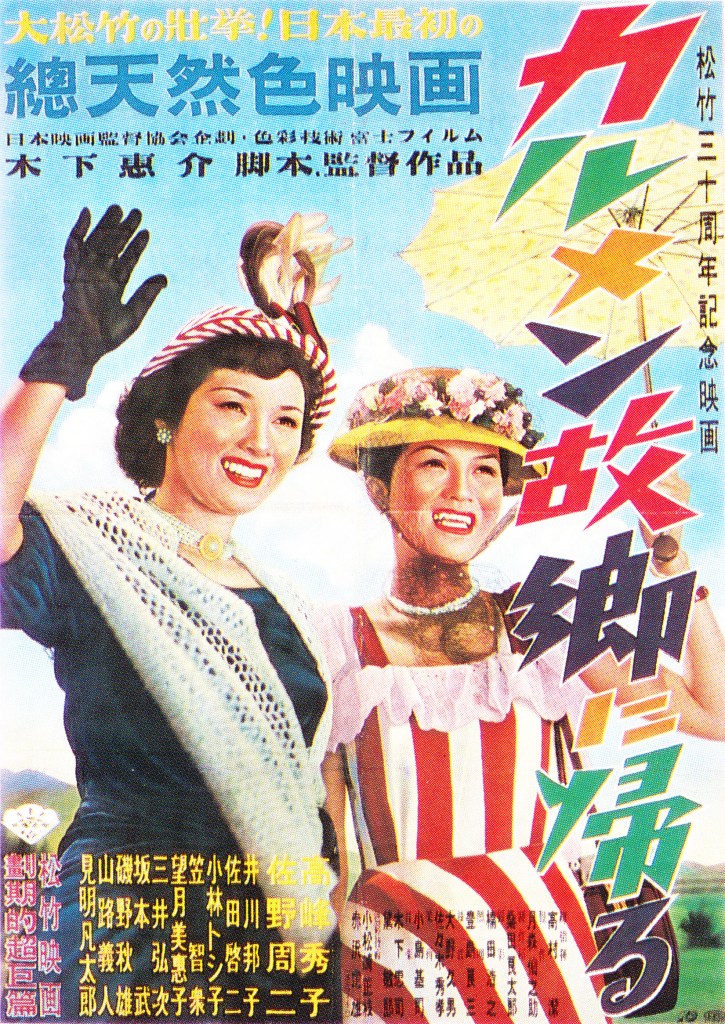
Carmen Comes HomeShochiku was doing pretty well in 1951. Accordingly they could afford to splash out a little in their 30th anniversary year in commissioning the first ever full colour film to be shot in Japan, Carmen Comes Home (カルメン故郷に帰る, Carmen Kokyou ni Kaeru). For this landmark project they chose trusted director Keisuke Kinoshita and opted to use the home grown Fujicolor which has a much more saturated look than the film stocks favoured by overseas studios or those which would become more common in Japan such as Eastman Colour or Agfa. Fujicolour also had a lot of optimum condition requirements including the necessity of shooting outdoors, and so we find ourselves visiting a picturesque mountain village along with a showgirl runaway on her first visit home hoping to show off what a success she’s made for herself in the city.
Famous Tokyo showgirl “Lily Carmen” (Hideko Takamine) was once plain old Kin from the cow farm. When the family receives a letter written in grand style and signed with Kin’s stage name explaining she’ll be coming to visit, her sister may be excited but her father has much more mixed emotions. When Carmen comes home she does so like she’s on a victory parade. Wearing her Westernised, colourful outfits fashionable in the city but like something from outer space here, Carmen becomes the show but oddly seems uncomfortable with the predictable amount of attention she’s getting around town. The presence of Carmen and her equally pretty friend, Maya (Toshiko Kobayashi), threatens to destabilise this otherwise peaceful mountain village but just what sort of chaos can two beautiful women really create over the period of a few days?

The villagers react to Carmen’s return with a series of ambivalent emotions. Of course, they’re glad to see their own girl back, especially as she’s been so successful in the city, but this Carmen is not the same as the Kin who ran away. Slightly in awe of all this visiting urban sophistication, the villagers are also scandalised by Carmen’s modern attitudes to fashion and vulgar behaviour. Striding around the village like as it were a tourist attraction and she a visiting monarch, Carmen chews gum, breaks in to song at random and dances happily in her underwear on the green mountain hillsides.

The village is smallish community but fiercely proud of their local traditions. Many of the residents are happy to think that a “great artist” of the pedigree of Lily Carmen could have been born in their little village. In fact, this tiny settlement is something of a crucible for artistic talent and the extremely pompous school headmaster has a bee in his bonnet about bringing forth the future of Japan through cultural education. However, not quite all of the residents are so liberal and many live in fear of a feudalistic money lender named Maruju (Koji Mitsui) who runs the local transportation business (such as it is) but makes most of his money out of issuing exorbitant loans to desperate local people. Recently, he’s pointlessly repossessed an organ from the home of a man who was blinded during the war.

The headmaster is very keen for Carmen to come and bring some of her city sophistication back to the village, but no one has actually asked what kind of “art” Carmen is involved in. After a lot of chat from Carmen about how seriously she takes her work, people start wondering about this cutting edge performance art that their homegirl has apparently surrendered her life to. As if it weren’t obvious from her name, Carmen is a burlesque dancer. Quite a good, high grade burlesque dancer and, in fact, an artist, but essentially a stripper who really does take it all off in the end. Ever the enterprising businessman, Maruju decides to put on a show which he advertises with a big cart bearing the slogan “wild dancing by nude beauties” plastered on the side.

Needless to say this does not go down well with pompous headmaster and his plan to create a great city of highbrow artists. Striding straight over to talk to Carmen’s father Shoichi who’s only just got up from a few days in bed after Carmen’s last embarrassing faux pas, the principal intends to talk Carmen and her friend out of their scheduled performance. Her father, however, has a surprising reaction. He had an inkling what kind of life his runaway daughter must have been living. Shoichi put much of Carmen’s lack of acumen down to being kicked in the head by a cow as a child and realised it would be hard for her to find “respectable” work. He doesn’t want to see her “indecent” show and thinks the professor shouldn’t go either, but also thinks that if she’s good at it and it makes her happy then maybe that’s OK. After all, if it was that bad they wouldn’t allow it in the city and whatever’s good enough for the city ought to be good enough for the mountains. The headmaster, momentary stunned, is now confused and wondering if stopping the performance is an infringement on Carmen’s human rights.

Kinoshita refuses to take a side, he shows the ridiculousness of both the isolated villagers and the sophisticated city dwellers to great comic effect. Hideko Takamine is something of a revelation, cast completely against type as a bubbly, airhead showgirl. As is true with a lot of early colour films, or even a lot of early talkies, Carmen Comes Home has a built in gimmick and doesn’t really worry about doing very much beyond it. As such it keeps things light and bright and breezy, emphasising its high contrast colour palate every step of the way. A gentle comedy of manners as small town comforts rival big city liberalism with the obvious trade offs involved on either side, Carmen Comes Home might lack the substance of some of Kinoshita’s other work but makes up for it with general sunniness and effortlessly timeless humour.


Original trailer(s) (no subtitles):

https://www.youtube.com/watch?v=-2zwkGWPejQ

Ornamental Hairpin (簪, Hiroshi Shimizu, 1941)

ornamental hair pinShimizu goes on holiday! Again! Actually, when you think about it going on holiday is always inherently sad because just like everything else holidays end and you have to return to whatever it was that made you want to go on holiday in the place only with the painful reminder that a more cheerful world exists and you’re no longer in it. That rather depressing preamble out of the way, it’s time to join the temporary residents of a small hot springs resort in the picturesque countryside where a mislaid hairpin is about to kickstart a series of mini epiphanies in the diverse collection of guests.

We arrive at the inn in the company of Emi (Kinuyo Tanaka) and her friend Okiku (Hiroko Kawasaki) on a brief visit from the city. The inn is very full right now with a festival in town and everybody seems to want a massage! Another guest, the extremely grumpy professor Katae (Tatsuo Saito), is put out that the tour groups are sapping all the hotel’s resources and complains vociferously to his go partner who is staying at the inn with his two grandsons Jiro and Taro. Other guests at the inn include a mild mannered husband and his wife, Mr. (Shinichi Himori) and Mrs. (Hideko Mimura) Hiroyasu, and a recuperating soldier, Mr. Nanmura  (Chishu Ryu). Eventually the tour groups go home taking Emi and Okiku with them, but Emi discovers she’s left her ornamental hairpin behind and sends a letter offering to pay for the return postage if anyone should find it.

Mr. Nanmura finds it in his foot one day as he’s enjoying the hot springs and even though he’s not that bothered about it, complaining expert Professor Katae can’t make enough of a fuss about the supposedly shoddy conditions at the hotel. When the hotel owners write to Emi and explain to her what’s happened she jumps straight on a train to apologise in person.

Nanmura had actually been quite happy about getting skewered by the pin. He says he found it “poetic”, as if the atmosphere of the place had penetrated deeply into his skin. The supposedly learned Katae doesn’t quite understand the soldier’s poetic leanings and starts debating whether the owner of the pin will be pretty or not, as if that would make a difference to the soldier’s romantic construction of events. Emi is indeed very beautiful, through perhaps a little sad and obviously contrite about the pin. Everyone in the inn is quite invested in witnessing a true love miracle between the bizarrely crippled soldier and the wounded beauty from Tokyo.

Once again the inn is a constructed world, a safe haven far away from the trouble and strife which exists outside it. The guests indulge themselves in the tranquil atmosphere taking in the beautiful scenery and killing time on otherwise trivial pursuits which occasionally include projecting a kind of narrative on their new found friends. The two boys, totally bored by this deliberately unstimulating environment, turn everything into a competition – even cheering on their grandfather as snores along side the equally noisy professor with the result that pretty much no one else is getting any sleep. Later they help the injured soldier recover with a set of endurance games which see him trying to walk unaided from one tree to another and eventually across a bridge.

Further comic relief is provided by the Hiroyasus with the husband being the sort of mild-mannered man who has no idea what he actually thinks so he just goes along with everything everyone says (and later checks with his wife who has the ultimate authority). Hiroyasu often defers to the professor whose authoritative tone gets things done for him though he is in fact an extremely self centred prig who just loves to complain out of a desperate need to be validated. He’s the loudest snorer of all and is keeping everyone awake yet he constantly complains about the noise of the other guests and is quick to shout at the inn keeper when he can’t get a massage because they’ve been booked by the visiting tour groups the very presence of which also annoys him. Eventually he gets so grumpy he just goes home which is probably a win/win for everyone.

But what of Emi herself? She too is escaping from something. The loss of the ornamental hair pin and its rediscovery leading her to the inn and perhaps to Nanmura has pushed her into a further consideration of her life in Tokyo. She doesn’t want to go back, this brief respite has been too pleasant and she wishes it could go on like this forever, though she knows, of course, that it can’t. She doesn’t know what she’s going to do now, but at least while she stops at the inn the sun will light the way. This is 1941, Nanmura will probably be going back to the war, the future is uncertain for everyone, but in here everything is beautiful, calm, safe. It’s just a shame it can’t last.


Ornamental Hairpin (簪, Kanzashi) is the fourth and final film in Criterion’s Eclipse Series 15: Travels with Hiroshi Shimizu box set.

Clip of one of Nanmura’s “trials” (no subtitles):

https://www.youtube.com/watch?v=WojtILzbaBk

I Want to Be a Shellfish (私は貝になりたい, Shinobu Hashimoto, 1959)

shellfishAfter Japan was defeated and later occupied by the Americans, there came the painstaking exercise of examining what exactly had happened during the conflict and assessing is who, if anyone, could be held accountable for any wrongdoing. The so called “war criminals” were divided into classes according to the severity of their crimes with Tojo himself at the top who eventually paid with his life. However, many of the men who were given the same Class A rating were just rank and file soldiers who had been “following orders”, often because they feared for their own lives if they refused. The debut directorial effort from writer Shinobu Hashimoto who provided scripts for some of Akira Kurosawa’s most famous works, I Want to be a Shellfish (私は貝になりたい, Watashi wa Kai ni Naritai), examines just one of these tragically absurd cases.
Barber Shimizu has finally started to make headway in his very own shop where he lives happily with his wife and son when he’s unexpectedly drafted into the army towards the end of the war. Unused to heavy physical labour and a fairly gentle man, he doesn’t take well to the soldier’s life and gets himself into trouble with his C/O. Stationed near Tokyo, Shimizu’s squad is charged with searching for a pair of US airmen thought to have bailed out after their plane was hit by anti-aircraft fire during a bombing raid over the city. When they eventually find the pilots, both have already died of their injuries.

At this point Shimizu’s captain makes a cruel and rash decision – rather than sending the bodies back to HQ or burying them there, he decides to use them as target practice for his raw recruits. When ordered to pick out the two weakest soldiers, the NCO picks Shimizu and another man, Takita, who are then ordered to bayonet the corpses to prove what fine soldiers they have become. Though they both fail the first time the captain berates them until they finally comply.

The war ends and Shimizu goes home to his family only to receive a knock on the door from the war crimes commission who drag him off to Tokyo for trial. The trial itself is a farce, Shimizu is charged with executing a prisoner of war – the fact the pilots were both dead when found and therefore were never executed and were never even prisoners is never revealed by anyone. Finally classified as a Class A War Criminal, Shimizu is sentenced to death for having stabbed a corpse.

It goes without saying that, yes, terrible crimes were committed during the war and some of them deliberately and wilfully. However, in Shimizu’s case his crime is an absurd one. Though the way in which his superiors have treated the fallen soldiers of their enemies is far from humane, Shimizu has committed no murder and was just following the orders of his superiors. Improper as it may have been, it hardly warrants the loss of his own life and that he’s being placed in the same category as members of execution squads and those who wilfully participated in crimes against civilians is more than a little disproportionate.

Perhaps the most controversial element of the film is that Shimizu seems to have been denied a fair trial. To those who can understand both languages, or even just from the subtitles provided for the translation of the American prosecutor’s questions, it’s obvious that the way in which his questioning is being conducted is far from ideal. The translation gap between the two languages is immense and leads to a series of misunderstandings which in no way aid Shimizu’s case.

It’s also clear that the panel in charge of the trial have very little understanding of how the Japanese military works and how this might differ from American military law. Shimizu is repeatedly questioned about how he feels about the order he was given – a strange question given that the idea of not following an order is not one which immediately presents itself. Shimizu repeats the credo he was taught that an order from his C/O is the same as one coming directly from the Emperor. However, when translated, the prosecutor infers that Shimizu thinks his order came from the Emperor himself and stupidly asks if Shimizu actually met the Emperor in person. Likewise, they ask why he didn’t simply refuse to follow the order and when he replies that he believed he would be shot, they ask why he didn’t ask to be referred to a military court which is just not something that would have been reasonably feasible for a Japanese soldier in this sort of situation.

The fact that the soldiers were already dead to begin with is never even mentioned, by anyone. The highest ranking officer who ordered the search is held responsible even though his orders were to bring the men in alive. Shimizu’s captain has since killed himself, conveniently, leaving everyone else to take the fall for his inhumane decision.

At the end of the film as Shimizu is faced with saying goodbye to a world which has dealt him nothing but hardship other than the wife and son he will be forced to leave behind, Shimizu utters the film’s title. He wishes he were a shellfish buried deep at the bottom of the ocean far from humans and their capacity for cruelty. No poverty, no draft, no war, no absurd trials – free from this world of torment. A lament for the little guy paying the price for world gone mad, I Want to be a Shellfish is a bleak and tragic tale which is filled with universal quality of melancholic absurdity which continues into its heartbreaking final moments.


Bonus trivia – Frankie Sakai (more usually seen as a singer or in comedic roles) also played Shimizu the previous year in an enormously successful TV drama. This story has in fact been filmed several times, most recently as a feature film in 2008 and was inspired by the book by Tetsutaro Kato who was sentenced to death as a war criminal though later had his sentence commuted and was released for “good behaviour” in 1952 (but may not have been quite as innocent as poor old Shimizu).


Sorekara (それから, AKA And Then, Yoshimitsu Morita, 1985)

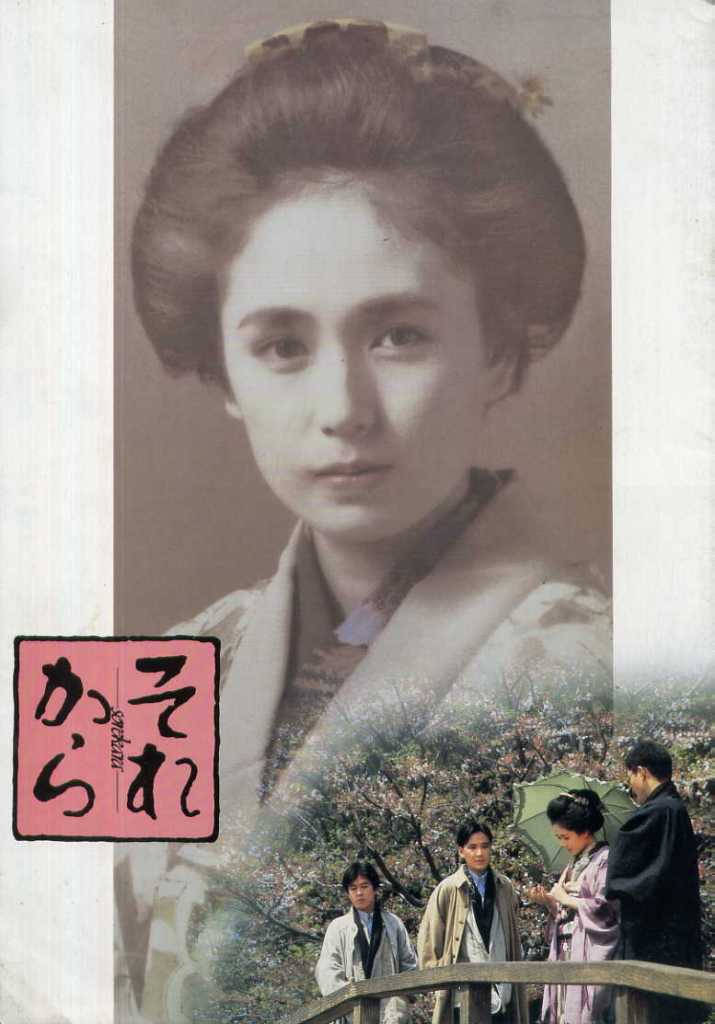
Sorekara PosterYoshimitsu Morita had a long and varied career (even if it was packed into a relatively short time) which encompassed throwaway teen idol dramas and award winning art house movies but even so tackling one of the great novels by one of Japan’s most highly regarded authors might be thought an unusual move. Like a lot of his work, Natsume Soseki’s Sorekara (And Then…) deals with the massive culture clash which reverberated through Japan during the late Meiji era and, once again, he uses the idea of frustrated romance to explore the way in which the past and future often work against each other.

Daisuke (Yusaku Matsuda) is a youngish man approaching early middle age. Thirty years old and a “gentleman” of leisure, he lives in a world of perpetual ennui where he even has to hold his hand to his chest to check that his heart is indeed still beating. His days might have gone on aimlessly had it not been for the unexpected return of an old friend from university, Hiraoka (Kaoru Kobayashi), who has been dismissed from his job following a series of problems with his superiors which has also landed him with a considerable debt to repay and no prospects of further employment. Adding to his sorrows, Hiraoka and his wife, Michiyo (Miwako Fujitani), have recently lost their infant child and have been told that due to Michiyo’s poor health they may not be able to have any more. Daisuke wants to help them, but he’s also facing a lot of pressure from his family to accept an arranged marriage which will further his father and brother’s prospects and is becoming conscious of the relative lack of freedom his life of dependent idleness entails.

Men of Daisuke’s era have perhaps had it hardest coming of age during a period of massive social change which is incomprehensible to the older generation. He’s a well educated man, an intellectual, who can speak several languages and is given to introspective contemplation, but he’s also inherited the worst of European classism as he’s come to believe that working for money is beneath his dignity as a gentleman. He’s completely unable to identify with his friend who needs to work to eat and enjoys none of the various safety nets which are provided by his own wealth and privilege. Nevertheless, he does want to try and help Hiraoka and is dismayed to discover just how little power he has do anything for him.

Hiraoka and Daisuke were part of a group of friends at university which also included another boy who, sadly, died of an illness and his sister – Michiyo, who eventually married Hiraoka. At the time, Daisuke himself had fallen in love with Michiyo but out of a misconceived idea of “chivalry” – another unnecessary adoption of European romanticism, he stepped aside in favour of his friend. This has proved to be a disaster all round and Michiyo and Hiraoka are trapped in an unhappy union which has made Michiyo physically weak and caused Hiraoka to spend the money he should be using to pay back his massive debts on drink and geisha so he can avoid going home. Daisuke’s adherence to a code of morality which is more affectation than anything else is shown up to be cowardice, another way of avoiding adulthood, as he uses his intellectual ideas to mask what is really a fear of rejection.

Daisuke later comes to believe what he did in not acknowledging his own feelings towards Michiyo was “a crime against nature”. He now finds himself at another crossroads as he faces the choice between conforming to the rigidity of his upperclass life in marrying the woman his father has chosen for him and continuing to be financially dependent, or embracing his individuality and striking out on his own to finally claim the woman he’s always loved (and, tragically, has always loved him). In choosing to make a life with Michiyo, Daisuke would be taking several transgressive actions – firstly acting against his own self image by entering the world of working men and secondly by stealing a married woman away from her husband which is no simple matter in the still relatively conservative Meiji era society.

Ultimately, the film is much more a story of Daisuke’s journey of self realisation than it is a melodrama with a love triangle at its centre though Sorekora certainly embraces these aspects too. Morita opts for a more classical tone here with a number of long, unbroken takes and static camera shots yet he also affects a strange, dreamlike tone in which the present and the past seem to co-exist, each drifting one into the other. He intercuts scenes which echo the film’s ending into the main body of the action as well as showing us the early days of Daisuke and Michiyo’s unresolved romantic connection which is poignantly brought out by an experimental technique in which the foreground appears almost like a freeze frame while the rain carries on falling behind them. At certain points there are also some surreal sequences in which Daisuke is travelling on a train but is surrounded by fellow passengers who suddenly each pull out a large sparkler or another where a gaggle of men all dressed just like him are crowded into the the other end of the train and looking at the moon through the open roof of the carriage.

A prestige picture, but one with a healthy dose of strangeness, Sorekara is an inexpressibly sad film full of the tragedy of wasted time and the regret that comes with not having acted in way which satisfies your authentic self. In order to live a life that’s true to himself Daisuke must finally learn to risk losing everything but the film’s ambiguous ending may ask whether the cost of following your heart may not be too heavy a one to pay.


Unsubtitled trailer: