Super Express (黒の超特急, Yasuzo Masumura, 1964)

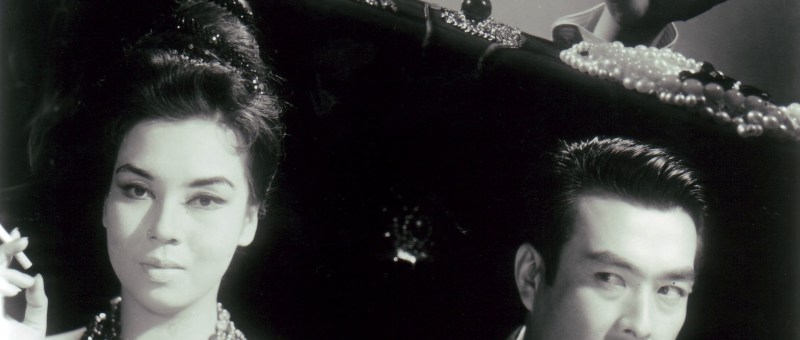
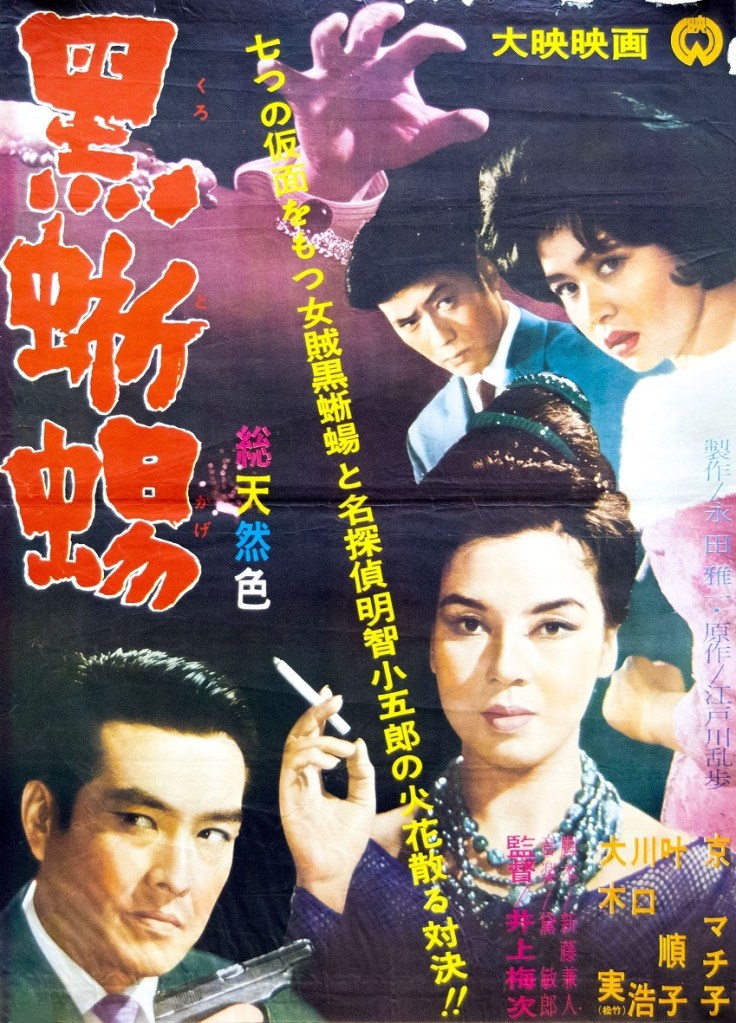
By 1964, Japan had returned to the world stage and was beginning to enter a new age of modernity as symbolised by the completion of the Shinkansen “bullet train” high speed rail network opened in time for the Tokyo Olympic Games. Behind the scenes, however, many were still trying to pull themselves free of post-war privation while others feared that the promised age of plenty had provoked a moral decline giving rise to widespread exploitation and rampant criminality. Yasuzo Masumura’s “Black” Super Express (黒の超特急, Kuro no Chotokkyu) was the last in a series of “Black” films (which also included the earlier Black Test Car) produced by Daiei in the mid-‘60s which exposed the seedy underbelly of the modern economy through tales of shady corporate shenanigans. Though in this case the hero finds himself in difficultly largely because of bad luck and his own poor judgement, he eventually exposes the cronyism and corruption which seem set to engulf the modern society. 

As the film opens, shady businessman Nakae (Daisuke Kato) approaches local real estate agent Kikyo (Jiro Tamiya) with an unusual business proposition. It seems that someone wants to build a factory on a large stretch of land currently owned by a number of farmers and other small concerns. Nakae wants to buy it up, but he’s afraid he won’t get a good price as an outsider and wants Kikyo to handle things on the ground. Kikyo is a little confused by Nakae’s intention to offer a significant sum of money to the farmers while proposing a sizeable commission to him, but eventually decides to go along with it. Everything goes to plan – it’s a not a scam, the farmers get their money, and everyone’s happy. Everyone except Kikyo, that is, who loses everything playing the stock market. It’s then he’s contacted by a disgruntled farmer who realises he might have been able to get more because it turns out the land wasn’t purchased for a factory, but for a second line on the Shinkansen. Nakae took their land and sold it on to the government at huge profit. 

Kikyo is extremely pissed off even though he was originally happy with the money he received and the reasons he lost it are nothing at all to do with Nakae. He gets straight on a train (not a Shinkansen) to Tokyo to confront him, but only gets the brush off and an offer of token hush money when Nakae realises Kikyo could cause a problem, something he is apparently keen to do because he starts connecting the dots between the elegant young woman he saw delivering envelopes to Nakae and a senior executive at the rail office. 

Needless to say, Nakae is a totally immoral, not quite conman chancer with the gift of the gab. He approached Kikyo with the job because he’d done his research and knew he’d take the bait. Kikyo already had a failed business behind him and desperately wanted to succeed. In the end he’d find it too difficult to resist the temptation of such a big contract even if he had his doubts, and his greed might prevent him asking too many questions. What Nakae didn’t bank on, however, was the depth of his resentment when he realised he’d been used and then cheated. 

“Large corporations are the new Daimyo” Kikyo tells his later accomplice, Yoko (Yukiko Fuji), Nakae’s former squeeze. He quit his salaryman job because he wanted to be his own boss, but feels like the world has pulled away from people like him, forever denying them a ticket on the Shinkansen, allowing them only to ride the now ironically named “super express”. Yoko feels something similar. She’s refused marriage after coming to the conclusion that men can’t be relied on – her father died in an accident when she was 11 after which her now bedridden mother raised her alone by working as a maid, and an ill-advised “affair” with a married university professor who took advantage of her naivety only further convinced her that she’s better off a free agent. Yoko wants total independence and the opportunity to start a business of her own, which is why she agreed to team up with Nakae to become the mistress of her boss at the rail company, Zaitsu (Eiji Funakoshi), who’d taken a liking to her and is the classic sad middle-aged salaryman with a wife suffering from TB he’d long since grown apart from. 

“There’s nothing more important than life” Nakae later grimly admits, trying to save his own skin, but it’s too little too late. Previously, he’d claimed he was “ready to commit any crime for money”, but mainly thrived on sadistic machinations setting up complex blackmail plots lined with little bombs he could set off if and when the occasion called. Kikyo takes him on at his own game, blackmailing the blackmailer, never really intending to expose the corruption only to parasitically profit from it. What he discovers is there was a much higher price to be paid than he realised because Nakae was only ever a middle man. The people at the top of the tree won’t want to pay at all and they think they don’t have to because “peasants” are expendable. Eventually turning to the police, he finds himself thanked for his service but is forced to admit that he only really wanted the money until he realised how far others were willing to go to get it. Spotting the shiny new Shinkansen rocketing past his widow seat on the super express, all he can do is lower the blind and try to get some sleep. 


An Actor’s Revenge (雪之丞変化, Kon Ichikawa, 1963)

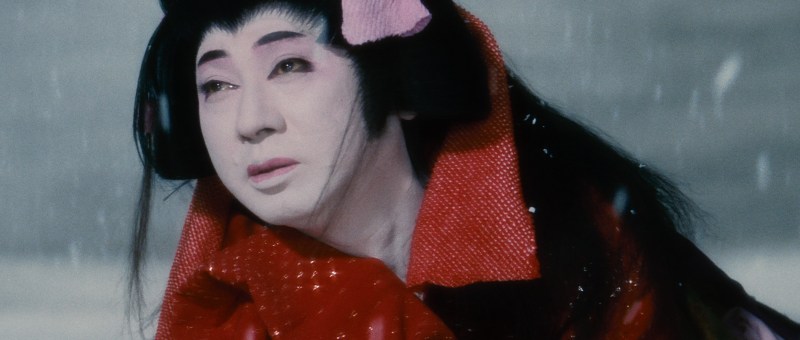
An Actor's Revenge blu-ray cover“Revenge is difficult even for an actor” our secret observer tells us, watching quietly from the rooftops like a spectator at a play. In celebration of his 300th screen appearance, Kazuo Hasegawa stars once again as vengeful onnagata Yukinojo in another version of An Actor’s Revenge (雪之丞変化, Yukinojo Henge), this time directed by Kon Ichikawa with a script written by his wife, Natto Wada, which was itself based on the earlier film with minor adaptations. Recasting the scope frame for the Kabuki stage, Ichikawa shows us a maddening world of theatricality, defined by artifice and governed by the rules of narrative determinism.

Orphaned after his parents were driven to suicide, Yukinojo (Kazuo Hasegawa) was taken in by an actor at a young age and trained as an “onnagata” – an actor specialising in female roles on the kabuki stage where women were forbidden to tread. Years later Yukinojo is one of the most popular actors of the age and lives more or less as a woman on stage and off. Having brought his Osakan theatre company to the Edo capital he finally sees his chance for revenge against the trio of corrupt and ambitious merchants who conspired to ruin his father for personal gain. He is, however, conflicted – not in his desire for vengeance but in the strain it continues to place on his mental state as well as the moral corruption need for it provokes.

Despite his feminine appearance, Yukinojo is regarded as male and most assume that his (volitional) romantic attachments will be with women. His gender ambiguity is, however, a problem for some such as the spiky pickpocket Ohatsu (Fujiko Yamamoto) who describes him as “creepy” in being neither male nor female. Then again, Ohatsu’s gender presentation is also atypical in that though she dresses and acts as a woman, most regard her as inappropriately masculine in the independence and authority which make it possible for her to act as the leader of a gang of street thieves. Lamenting her tomboyishness, some of her minions make the suggestion common in these kinds of films that Ohatsu will rediscover her femininity on falling in love (with a man). Despite her supposed hatred of men, Ohatsu finds herself falling for Yukinojo possibly precisely because of his gender ambiguity in that she is in some sense permitted to fall in love with him as a woman because he is a man.

Meanwhile, Yumitaro (also played by Kazuo Hasegawa) – another street thief only a much more egalitarian one, has no desire for women and has also developed some kind of fascination with Yukinojo as man who presents as female. Yukinojo is remarkably uninterested in Ohatsu, but seems drawn both to the mysterious Yumitaro and to the pawn in his revenge plot, lady Namiji (Ayako Wakao). The daughter of Dobe (Ganjiro Nakamura), the ambitious lord who orchestrated the plot against Yukinojo’s father, who has sold her to the Shogun as a concubine in order to buy influence, Namiji develops a deep fascination with the feminine actor which is then manipulated both by Yukinojo who plans to break her heart solely to get at Dobe, and by Dobe who intends to indulge her fascination in order to persuade her to return to the Shogun. Namiji is entirely innocent and effectively powerless. Involving her in the plot weighs on Yukinojo’s conscience but he refuses to look back, preparing to sacrifice her solely in order to a strike blow towards her father.

Meanwhile, chaos reigns in Edo as the corruption of the ruling elite provokes a rebellion by the ordinary people fed up with their persistent profiteering. This too Yukinojo harnesses as a part of his plot, setting his greedy merchants one against the other as they weigh up the benefits of making themselves look good to the people and the Shogun through engineering a crash in the price of rice by dumping the stocks they’ve been hoarding. The theatrical world and the “real” begin to overlap as Yukinojo performs the ghosts of his parents to bring the merchants’ crimes home to them, but his revenge plot has devastating and unforeseen consequences which perhaps begin to eat away at his carefully crafted chameleonism. Possessing no true identity of his own, Yukinojo passes into legend, retreating back to his natural home of the stage the shadow of an avenger disappearing over the horizon.


Original trailer (no subtitles)

Elegant Beast (しとやかな獣, Yuzo Kawashima, 1962)

elegant-beast-poster-2.jpgBy 1962 the Japanese economy had begun to improve and with the Olympics on the horizon the nation was beginning to look forward towards hoped for prosperity rather than back towards the intense suffering that had defined the post-war era. There would be, however, a kind of reckoning to be had if not quite yet. Yuzo Kawashima’s Elegant Beast (しとやかな獣, Shitoyakana Kemono) is perhaps among the first to start asking questions about what the legacy of the immediate aftermath of the war might be. It may have been impossible to survive with one’s integrity entirely intact, but how should one proceed now that there is less need to be so self serving, calculating, and cruel when there is more food on the table?
The Maedas may not be the best people to ask. Carrying the scars of their poverty, they have made a “comfortable” life for themselves in a cramped flat on the fifth floor of an ordinary walk-up apartment building. When we first meet them, dad Tokizo (Yunosuke Ito) and mum Yoshino (Hisano Yamaoka) are having a furious tidying up because they’ll shortly be receiving visitors, only unlike most they’re quickly trying to scuzz up the apartment so that they look sufficiently humble. When their guests arrive, it turns out to be the boss of their only son Minoru (Manamitsu Kawabata) who has come along with one of the artists he represents and his accountant, to have a word about possible embezzlement. Tokizo and Yoshino outdo themselves with humility, pointing out the simplicity of their surroundings, and appear offended that their son is being accused of thievery but of course in reality they know all about it and are willing accomplices in his scheming. Tokizo hasn’t had a steady job since coming back from the war and the entire family is supported by the kids with the remainder of their income coming from daughter Tomoko (Yuko Hamada) who has become the mistress of a famous author (Kyu Sazanka).

Universally unrepentant, cracks start to appear in the Maedas’ morally dubious existence when they begin to realise that Minoru is not quite on the level. He’s only been giving them a portion of the money he’s been stealing – something they can understand and perhaps even admire, if it were not that he’s given most of it to a lover to fund her hotel business. The surprise twist is that the lover is none other than the accountant at the company Minoru had been working for, Yukie (Ayako Wakao), who is a widow with a 5-year-old son (which is to say, not Minoru’s usual type). Now that the hotel is fully funded and the scam has been exposed, Yukie feels there’s no more need to associate herself with lowly punks like Minoru and draws the affair to a businesslike conclusion.

Yukie is, perhaps, the “elegant beast” of the title. Refined, seemingly sweet and innocent, she inspires trust and affection. The slightest suspicions are unlikely to fall on her – something she well knows and is prepared to use to her advantage, along with her sex appeal and, ironically, reduced desirability in the marriage stakes as a widow with a child. Yukie has her dreams and they are ordinary enough. She wants a peaceful, stable life in economic comfort alone with her son. She does not want to remarry and means to be independent which necessarily means industrious. Thus she needs to get her hotel business off the ground as quickly as possible. She needed money, a lot of money, much more than she could get “honestly” but she didn’t want to dirty herself with crime and so she used the tools at her disposal, making her “weakness” a strength as she later puts it. Using her womanliness as a weapon against venal men, she convinced them to ruin themselves on her behalf and thereafter resolved to put the past behind her.

The past is, however, difficult to forget. “Your mind still wears an old fashioned coat”, the quip happy Minoru tells his father as he laments the new society’s tolerance for youthful ebullience and reluctance to forgive the wartime generation for even its most recent transgressions. As much as they resent her, there is perhaps a grudging admiration for a woman like Yukie who has managed to outsmart them all while, technically at least, remaining on the right side of the law. Tomoko, on the other hand, seems to be losing out in playing much the same game by the old rules. Essentially pimped out by her dad, she’s damned herself by becoming the mistress of one man who is becoming rather bored of her family’s obvious attempts to bleed him dry, rather than fleecing several at the same time and bending them to her will as Yukie has managed to do. Old fashioned thinking won’t get you far in this world. The Maedas, however, seem to be out of ideas.

In the closing moments, they may ponder abandoning their hard-won apartment, believing that there’s always trouble brewing in the big city and the clean country air may be what they really need to thrive but, it’s clear that this insular claustrophobic environment filled with peep holes and tiny imprisoning windows will be near impossible to escape. Tokizo hasn’t left the apartment for the entire picture. A woman ascends the stairs, walking purposefully towards a future of her own making, while the Maedas remain locked inside unable to escape the painful legacy of post-war poverty for the bright, if no more ethical, lights of a consumerist future dancing quietly on the horizon.


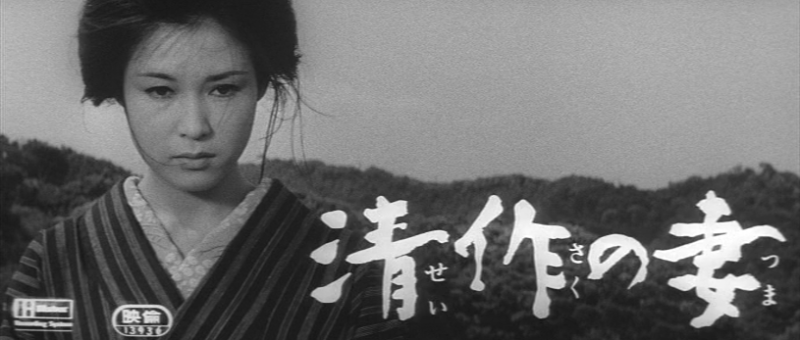
Seisaku’s Wife (清作の妻, Yasuzo Masumura, 1965)

Seisaku's wife posterFor Yasuzo Masumura, sexuality is both freedom and constraint but also the ultimate act of social rebellion. Seisaku’s Wife (清作の妻, Seisaku no Tsuma), set in late Meiji as Japan prepares for the possibility of war with Russia, finds its melancholy heroine a defiant outcast as she first abandons her cruel, conformist society for empty independence and then reclaims her sense of self only through a love deemed inappropriate by those around her. The seeds of militarism are already being sown and breaking the programming is hard but transgressive acts of love can, it seems, overcome persistent societal oppression.

Okane (Ayako Wakao), our heroine, was sold as a bride to a much older man (Taiji Tonoyama) at 17 to provide for her parents. Three years later she views her husband, a wealthy kimono merchant, with contempt – as does much of the local area where he is derided as a sex crazed pervert. Luckily for her, Okane’s husband eventually dies leaving her a small sum of money while his extended family would rather she absent herself as quickly as possible to minimise embarrassment. Her father now too passed away, she and her mother (Tamae Kiyokawa) return to their home village which they were chased out of some years previously for their massive debts, but are now resented by their former neighbours for their seeming wealth and aloofness. Okane, traumatised by her experiences and having lost the will to live, barely interacts with the villagers who regard her as arrogant and haughty, and has been ostracised as a result.

The situation begins to change with the return of Seisaku (Takahiro Tamura) – the village’s bright hope. Seisaku had been away doing his military service and has come back with order and discipline on his mind. Now believing that the villagers are lazy and frivolous he has brought back with him a bell he had forged himself which he hooks to a nearby tree and bangs early in the morning to “awaken” them lest they sleep in rather than hasten to their fields. As might be anticipated, the villagers find this quite irritating but respect Seisaku too much to stop him and so find themselves going along with his new brand of militarist austerity. Meanwhile Okane is the only one to refuse the call, wasting no time in telling Seisaku that she has no intention of following his “orders” and his assumption that she should is in itself offensive.

Seisaku is intrigued rather than offended and finds himself attracted to Okane despite the villagers’ obvious animosity towards her. Convincing her that his feelings are real, the pair drift into an intense sexual relationship which eventually sees the model soldier Seisaku make a transgressive choice of his own in rejecting his longstanding betrothal to a village girl in favour of marrying Okane without the approval of his conservative mother and sister. Holed up together in Okane’s remote farmland shack, they remove themselves as much as possible from village life in an insular, obsessive world of their own.

Okane, rejected because of her past as the kept woman of a wealthy man (something over which she herself was powerless and means never to be powerless again), in turn rejects the village after having lost all faith in human relationships except perhaps that with her mother whose cruel treatment at the hands of her father she both identified with and resented. Intensely lonely, she subsumes herself entirely into her love for Seisaku, eventually trying to rebuild bridges in the village in order to strengthen their relationship but finding herself rejected once again by Seisaku’s austere mother even if his sister begins to come around. Meanwhile, the spectre of the war hovers on the horizon. Seisaku, as hopelessly in love with Okane as he is, is still the model soldier in his heart and unwilling to abandon his proto-militarist ideology which tells him that dying in service of the nation is man’s highest calling.

Having abandoned such obvious brainwashing to claim her independence, Okane struggles to convince Seisaku he should do the same. She clings to him and pleads, begging him not to leave her behind alone while he resolves to go off to battle and a glorious death. The village men too regard failure to die on the battlefield as a disgrace but send their sons away with cheers and celebration. Facing the possibility her dream of love may die, Okane takes drastic action to ensure its survival but does so at an ironic cost which sees her separated from her love possibly forever. Seisaku, meanwhile, angry and resentful, begins to understand something of Okane’s life when branded a coward and traitor by his former friends, no longer the model soldier but an outcast himself. Having suffered her fate, he begins to let go of his rage in favour compassionate understanding, allowing his love to triumph over his hate as he strives to forgive the woman who has both trapped and helped him to free himself from the oppressive ideology which turned him into an unthinking “model soldier” who wilfully abandoned his freedom in favour of internalised conventionality.

Freed from didactic social brainwashing, the pair are then in a sense imprisoned by their individualistic freedom, forced to isolate themselves within a bubble of love and mutual dependence but with a new hope for the future for which they now plan even while acknowledging that they cannot know what will come of it save that they will face it together. They can no longer live within the conservative society, but must form their own new world within it in which they can be fully free and express their freedom through their love. Melancholy but tranquil, Masumura ends on an uncharacteristically hopeful note which implies that love, though violent and transgressive, can be an effective weapon against destructive militarist ideology and the folly of war through a warmer path towards compassionate freedom.


Original trailer (no subtitles)

https://www.youtube.com/watch?v=ZBfptg9w7qk

Nakano Spy School (陸軍中野学校, Yasuzo Masumura, 1966)

Nakano Spy School posterFor Yasuzo Masumura, freedom and individuality were often elusive concepts in a society as rigidly conformist as Japan’s even in the increasingly liberal post-war era. Casting an eye back almost 30 years, 1966’s Nakano Spy School (陸軍中野学校, Rikugun Nakano Gakko) stopped to ask what it took to make young men and women abandon their sense of self in order to become faceless warriors for cause in which it was extremely difficult to believe. Masumura described his spy story not as a critique of militarism but of the naivety of youth, carried away by misguided passions and essentially seduced by a corrupted sense of romantic heroism.

In October 1938, reservist Jiro Miyoshi (Raizo Ichikawa) has been putting off marriage to his fiancée Yukiko (Mayumi Ogawa) until he’s completed his obligatory two years of military service overseas. At the mercy of his times, he’s suddenly given a new and mysterious assignment as one of the first recruits to the Nakano Spy School – the first military intelligence training school in Japan. He tells his family that he’ll be away for an unspecified period of time but unbeknownst to him, entering the spy school will require a complete erasure of his original identity. Miyoshi will cease to exist, and Shiina will take his place.

Masumura paints the spy school with a hint of absurdist camp clearly inspired by James Bond as the recruits take lessons in ridiculous gadgetry, safecracking, and the erotic arts while learning to act like gentlemen even if not exactly born to the manor. What he’s most interested in, however, is how these fiercely intelligent and brave young men were convinced to abandon their identities in order to serve an abstract cause like country. The answer he finds, surprisingly, is “passion”. Jiro is among the first to question the rationale of their would-be-spymaster who tells them that their role will be indispensable in Japan’s ongoing activities in Asia in order to “liberate” to continent from European imperialists. An exasperated recruit points out that Japan’s main aim is colonisation which doesn’t quite square with Lieutenant Kusanagi’s (Daisuke Kato) depiction of them as revolutionary insurrectionists. Kusanagi agrees but offers only the justification that he set the school up against the army’s wishes because he knew things had to change. He doesn’t quite claim to be anti-militarist despite his insistence that a spy’s greatest weapon is empathy, but appeals to a sense of righteousness rather than loyalty in winning hearts and minds.

A strange, avuncular man, Lieutenant Kusanagi is an odd fit for the militarist crowd. A former spy himself, his entire conception of spyhood seems to be informed by European romance which is why he trains his guys to become suave gentlemen who know how to be charming at dances and manipulate feminine affection in order to facilitate their missions. Nevertheless, despite his affiliation he appears to be a basically good, noble hearted man who cares deeply for the men under his command even in the knowledge that he is training them for a precarious existence in which many of them will die young. He asks them to abandon not only their presents but their futures and they do it, not for Japan but for this very good, very earnest man who has earned their respect and whose dream they wish to realise even at the costs of their lives.

Jiro is only too quick to forget about Yukiko after throwing his lot in with Kusanagi. Yukiko, however, is frantic and leaves her job working for a British trading company to become a typist with the army in the hope of hearing news of him. Her position in the office obviously makes her a top asset for British intelligence by whom she eventually recruited. Her former boss, who turns out to be a high ranking spy, tells her that Jiro is dead – executed for speaking out against the war, and that her real enemy is none other than the Japanese army whose iron militarist grip is slowly destroying her nation.

Like Jiro, Yukiko is recruited through “passion” only this time out of anger and revenge, hastening the fall of those she believes responsible for the death of the man she loves. The irony is cruel. Jiro is presented with a choice – on discovering that Yukiko is a mole, he could choose to save the woman he loves but risk losing the chance to take down the operative that is running her. His original choice is to do nothing, allow events to take their course and absolve himself of responsibility even in the knowledge that if caught Yukiko will face extreme cruelty at the hands of the military police. He never considers rescue. Only a conversation with the kindly, remorseful Kusanagi leads him towards a “kinder” solution which is in itself a kind of spiritual suicide.

It is this question that Masumura wants to ask, what force is so strong that it could make a young man wilfully destroy his humanity in its service? The answer isn’t patriotism, it’s a kind of misplaced love and the passionate earnestness of a good man who himself is working for a misguided cause in which he believes totally. Jiro does not sacrifice himself for Japan, he sacrifices himself for Kusanagi because Kusanagi is good and he is young and naive enough to be swayed by goodness and passion alone. It is not militarism which seduces Jiro, but the misuse of his youthful idealism and absolute faith in the righteousness of one man who convinced him that he too was good and could act only in goodness.


Original trailer (no subtitles)

https://youtu.be/x6enjRLiTk0

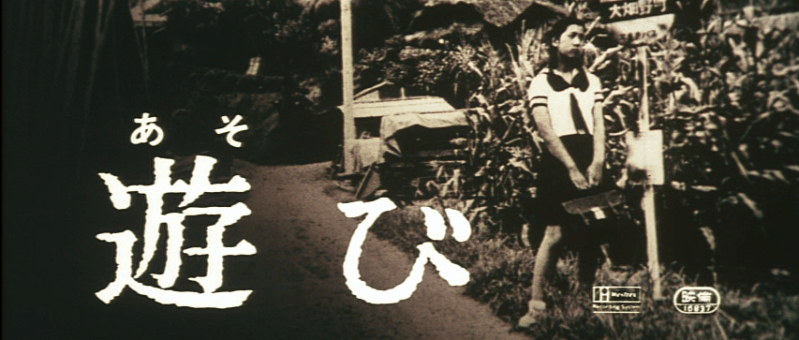
Play (遊び, Yasuzo Masumura, 1971)

5a4a5621a8387Yasuzo Masumura is most often associated with the eroticism and grotesquery which marked the middle part of his career, but his beginnings as a regular studio director at Daiei are a more cheerful affair even if darker in tone and with additional bite. His debut, 1957’s Kisses, was an unusual youth drama for the time – an innocent romance between a naive boy and girl who meet when each of their parents is languishing in jail. Far from the tragic conclusion of Ko Nakahira’s Crazed Fruit, Masumura offers his youngsters a degree of hope and the possibility, at least, of a happy ending. Daiei would go bust in 1971, and so it’s a minor irony that Masumura would revisit a similar theme towards the end of his tenure at the studio. Play (遊び, Asobi, AKA Play With Fire / Games), inspired by Akiyuki Nosaka’s novel, is another tale of youthful romance threatened by a harsh society, but this time around Masumura is not quite so hopeful.

A 16 year old (unnamed) girl has become the main breadwinner for her mother and bedridden older sister following the death of her father, formerly a violent drunk. Having had to leave school, she has a full-time job at an electronics factory where she lives in the company dorm along with a number of other female employees, most of whom are a few years older than she is. The girl is an earnest sort, she resents her mother’s constant pestering of her for money, but she sends her pay checks home keeping only enough to keep herself fed and clothed.

When an older woman, Yoshiko, who works as a “hostess” in one of the local cabaret bars comes to visit, she does so dressed to the nines with a handsome man sporting fancy sunglasses and porting a selection of upscale cakes. Yoshiko sells the virtues of life in the clubs, talking about the money to be made by having fun while the naive gaggle of young women remain in awe of her confidence, poise, and fancy haircut. In desperate need of money, the girl considers Yoshiko’s suggestion which is what brings her into contact with the (unnamed) boy (Masaaki Daimon).

The boy is 18 and pretends to be more worldly wise than he really is. He offers to show the girl around the cabaret scene, though he discourages her from working there. Taking her out and around town, the boy charms the girl though he has a dark and ulterior motive. The boy is a petty yakuza for a gang whose main stock in trade is pulling girls off the street and raping them for reasons of both blackmail and forced prostitution.

Owing to her young age and bad experience with her father who was often drunk and violent, the girl has steered clear of men. The other girls make fun of her for not having a boyfriend, not wearing make up, and for being “good” in sending all her money home. The girl isn’t really interested in the same kind of fun loving life as the more jaded of the factory girls – especially when she sees them roll in drunk boasting about the bruises on their skin from a night of debauchery, or even staggering back crying with a dress torn to shreds after being violently assaulted (perhaps by the same kind of yakuza thugs that will shortly target her). Despite the harshness of her life, she remains naive and innocent, concerned for her mother and invalid sister who have only her to depend on.

The boy is in a similar situation, though far less keen to confess it. Also let down by a drunken, promiscuous mother, he’s found himself in a gang desperate for the approval of his new “big brother”. Though he reacts with horror to the gang’s main stock in trade, he does not try to stop it even if he stops short of rape himself, but continues to assist in trapping the girls whilst fully aware of what will happen to them.

Coming from a harsh world, the boy has never met anyone as earnest or as naive as the girl and her goodness starts to reawaken something in him. Likewise, the girl, unaware of the boy’s true purpose, has never met anyone that was so immediately nice to her – her fear of men and alcohol dissipates as she (mistakenly, or perhaps not) believes she has met someone truly good and kind who only wants to help her. The girl does not belong in the boy’s world of sleazy clubs and youth haunts but bears them well enough for him. The boy recognises the incongruity and takes her somewhere else, still conflicted in his true purpose of delivering her to the dingy love hotel where his boss conducts his illicit trade.

The boy and the girl are innocents corrupted by their environments. Let down by irresponsible parenting (perhaps also a symptom of the difficulties of the society they live in), the pair remain trapped, dreaming of freedom and happiness but seeing no way of finding them. Deciding to make a break for it, leave their respective disappointing families far behind, the boy and the girl sail away. Their boat is full of holes, but they refuse to be beaten, committing to forge ahead together they swim towards the sea and an uncertain but hopeful future.


Title sequence (no subtitles)

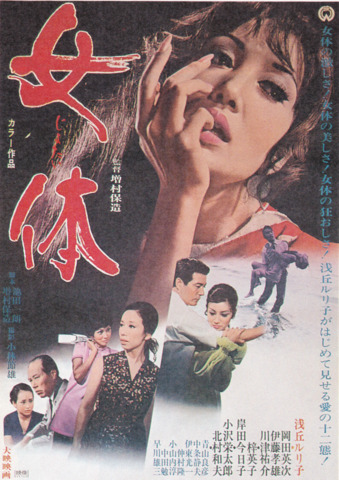
Vixen (女体, Yasuzo Masumura, 1969)

Vixen poster“Freedom for the masses!” cry the student protestors outside the claustrophobic environment of a corrupt educational institution at the heart of Yasuzo Masumura’s Vixen (女体, Jotai – lit. “a woman’s body”). While they cry for freedom, one young “liberated” woman finds she’s anything but free even in the throws of her liberation. Possessed of little power, she has a need to find herself a white knight but no sooner has she got him than she begins to long for new conquests, trapped in a destructive cycle of sex and violence. Subverting his own ideas of sex as liberation, Masumura reconfigures lust as a trap in the form of a siren song sung by a lonely young woman unable to find her place in the complicated post-war landscape.

Michi (Ruriko Asaoka), a modern young woman, has a brief episode of fondling an office chair while waiting to see the chairman of a university. Proudly showing off the bruises on her thighs, she accuses the chairman’s son of rape. Despite the evidence, Michi’s accusation is undermined by her mercenary behaviour which does not tally with that expected in such difficult situations. She’s come alone, flirts with the chairman’s secretary Nobuyuki (Eiji Okada), and is quick to talk money. Questioned at home the chairman’s son admits everything but thinks it’s no big deal because that’s just “how it’s done these days”. The chairman, worried more for his reputation which is already under strain given the widespread student protest movement, thinks paying Michi off is the best thing to do but there’s a disagreement over the amount. Nobuyuki’s wife Akie (Kyoko Kishida), sister of the accused and daughter of the chairman, only wants to give Michi half of the two million she’s asked for. Nobuyuki gives her the full amount anyway behind his wife’s back, winning Michi’s eternal admiration for his considerate treatment. Unwisely visiting her hotel room, Nobuyuki develops a dangerous fascination with the alluring young woman and embarks on a passionate, ill-advised affair.

Michi is, in many ways, the archetypal post-war woman. Orphaned at a young age she was raised by a grandmother in a small fishing village and has been living with another relative whilst working as a waitress in his ramen restaurant after coming to the city. She’s grown up in a more liberal era, has a “positive” attitude to sex, and lives outside of the “traditional” path for “respectable” young women of early marriage and continued monogamy. As someone later puts it, women like Michi are two a penny now that the economy is getting back on its feet – they live alone in the city, aren’t interested in marriage and value their independence. Michi, however, is more or less the opposite of this “new” kind of woman. Independence is something that frightens her beyond all else. She cannot survive without a man, does not want or know how to live alone as a “single” woman and uses her sex appeal in order to manipulate men into staying by her side to look after her. Sex is not what she craves so much as security, but security also frightens her and so each time she’s made one conquest she latches on to the next gallant young man who shows her any sign of kindness or courtesy.

Indeed, all Michi thinks she has to offer is her body – the “Jotai” of the title. Perhaps hinting at some past trauma in speaking of the roughneck fishermen that frequented her grandmother’s ramen shop, fatherless Michi says she’s chased men in her dreams since childhood, seeking new tastes and new sensations. She wishes she could find one man and stick with him because the chase and the longing cause her nothing but pain, but her need will not let her be. Asked what she will do when her appeal fades (as it inevitably will), Michi has no other plan than drinking herself into oblivion. “I’m a woman,” she says, “what is there for me to do but love?”. Quite far from the idea of the “liberated”, independent woman spoken of before who has learned to make her own way in the new “freedoms” promised by increased economic prosperity.

This false idea of liberality is one which originally attracts Nobuyuki. A straight laced salaryman working for his corrupt father-in-law and often doing his dirty work for him against his batter judgement, Nobuyuki has sacrificed his individual freedom for the rewards his society offers those who play by the rules. Also a war orphan, Nobuyuki sacrificed his youth to raise his younger sister (now preparing to marry herself), and has a comfortable, middle-class life with an austere if loving wife. Having worked his way into their upperclass world, Nobuyuki feels he doesn’t quite belong, something always nagging at him prevents Nobuyuki from fully committing to his drone-like life of pleasant conformity. A mad infatuation with Michi, an irritating child woman at the best of times, is an excuse to go all out in escaping the oppression of his conventional life but it’s not one with long term stability and his life with Michi is unlikely to offer him the freedom he had originally envisaged.

Later, Michi makes a play for the man Nobuyuki’s sister is set to marry. Akizuki (Takao Ito) is not like Nobuyuki – he’s a post-war man but one with definite ambitions and goals, each element of his life is a product of considered choices. As anyone would who took the time to really think about it, he’s turning Michi down, but for some reason he continues to help her placing a wedge between himself and his fiancée. This way of living – the considered, ordered, boring but pleasant life is directly contrasted with the chaotic, destructive, and perhaps exciting one that is offered by Michi, and the dull life is winning. Michi is miserable, and her self destruction is primed to drag any “nice” young man into her wake along with any other woman associated with him. Nobuyuki is left with a choice but it turns out not to be so binary as might be assumed. Personal freedom, if it is to be found, is not found in abandonment either to another person or to a job or way of life, but in the realisation that choice exists and can be exercised, freely, by all.


Wild Geese (雁, AKA The Mistress, Shiro Toyoda, 1953)

(C) Daiei, 1953In the extreme turbulence of the immediate post-war period, it’s not surprising that Japan looked back to the last time it was confronted with such confusion and upheaval for clues as to how to move forward from its current state of shocked inertia. The heroine of Shiro Toyoda’s adaptation of the Ogai Mori novel, Wild Geese (雁, Gan, AKA The Mistress), finds herself at a similar crossroads to the women of the 1950s, caught between tradition and modernity as they embrace the new freedoms but remain constrained by a conservative society. Toyoda, well known for his adaptations of great literature, makes a few key changes to Mori’s novel in effect placing a Showa era heroine in a recognisably “Meiji” world.

The Japan of the 1880s is one of extreme contrast and rapidly unfolding modernity. Having finally opened its doors to the outside world, the nation is in a big hurry to “catch up” to those it sees as its equals on the world stage. Consequently, Western thoughts and values are flooding into the country, bringing both good and ill. Arranged marriages are still common and Otama (Hideko Takamine) has been married once but the marriage has failed – she was deceived, the man she married already had a wife and child. Still, having lived with a man as his wife, Otama is considered “damaged” goods and will find it difficult to make a good match in the future (especially given the whiff of scandal from being involved in an illegitimate marriage with a bigamist).

When a matchmaker (Choko Iida) arrives with a potential husband it proves hard to turn down but the matchmaker is not quite on the level. Suezo (Eijiro Tono), she says, is a recently widowed man with a young child who is in need of a new wife but cannot marry again immediately for propriety’s sake. Otama will be his mistress and then in due course his wife. However, the matchmaker is an unscrupulous woman who has spun Otama a yarn in the hope of getting her debt written off by getting the shady loanshark she owes money to a pretty young woman to have some fun with.

The position Otama finds herself in is one of impossibility. A woman cannot survive alone in the Meiji era and its lingering concessions to feudalism. For a woman as poor and lowly as Otama whose marriage prospects are slim there are few options available. Otama’s neighbour (Kuniko Miyake) has managed to carve out a life for herself as a single woman through teaching sewing classes but such opportunities are few and far between, as Otama is warned when she considers following her example. The “arrangement” with Suezo may not seem too bad on the surface – he looks after her and her father, has set her up in a house, and treats her well even if his behaviour leans toward the possessive. Despite confessing to her father that she feels trapped and miserable, humiliated on learning she has been ostracised as the mistress of a married loanshark, Otama finds little sympathy as her father declares himself “very happy” and councils her against leaving because he has no desire to return to a life of poverty, remaining selfishly indifferent to his daughter’s suffering.

Resigned to her fate, Otama does her best to adapt to her new life but remains as trapped within Suezo’s house as the caged bird he presents her with “for company”. Jealous and fearing that his wife will find out about the affair, Suezo’s preference is for Otama to stay indoors waiting for him to call. His visits are routine and perfunctory. Handing the maid a few coins to go to the public bath, Suezo signals his intentions in the least romantic of ways, pausing only to lock the garden gate.

Catching sight of an earnest student who passes by everyday at 4, Otama begins to dream of something better. The student, Okada (Hiroshi Akutagawa), is a source of fascination for all the young women in the neighbourhood but he too is instantly captivated when he glimpses the beautiful Otama trapped behind the bar-like slats of Suzeo’s love nest. Adding a touch of biblical intrigue, it is a snake which eventually leads to their meeting but no matter how deep the connection this is a love destined to fail – Otama is the kept woman of a loanshark, and Okada is a medical student with international ambitions. They inhabit different worlds and, as his friend (Jukichi Uno) puts it, this is still the Meiji era, the times will not allow it.

Nevertheless, even if her brief infatuation seems doomed, the mere act of wanting something else provokes a shift in Otama’s way of thinking. This act of fierce individualism which prompts her to defy the dominant male forces in her life whose selfish choices have caused her nothing but misery would normally be severely punished in the name of preserving social harmony but Otama’s epiphany is different. The opening title card reminded us that this was a time wild geese still flew in the skies above Tokyo. It seems to imply that birds no longer fly here, that there is no true freedom or possibility for flight in the modern age of Showa, but Otama is a woman trapped in the cage of Meiji suddenly realising that the doors have been open all along. Her choices amount to a humiliating yet materially comfortable life of subjugation, or the path of individualistic freedom in embracing her true desires. Her dream of true love rescue may have been shattered, but Otama’s heart, at least, is finally free from the twin cages of social and patriarchal oppression.


Screened at BFI as part of the Women in Japanese Melodrama season.

Clothes of Deception (偽れる盛装, Kozaburo Yoshimura, 1951)

「偽れる盛装」(C)KADOKAWA1951

「偽れる盛装」(C)KADOKAWA1951Japan at a crossroads. East/West, past/future becomes a conflict between Kyoto and Tokyo in Yoshimura’s exploration of two women pulled in surprisingly contradictory directions in the new post-war world, Clothes of Deception (偽れる盛装, Itsuwareru Seiso). Working from a script by Kaneto Shindo, Yoshimura frames his tale as one of progress and resistance but the divisions are not as simple as they first seem. Machiko Kyo turns in another wonderfully nuanced performance as a Kyoto geisha trapped by the unchanging nature of her city yet yearning for an end to its slavish devotion to tradition.

Kumicho (Machiko Kyo) is the daughter of a longstanding geisha house currently operated by her mother. Though working as a geisha, Kumicho is not universally popular with the older generation thanks to her money first attitude which sees her prioritise earnings potential through having an unlimited number of clients rather than relying on a single patron. Kumicho is tough where geishas are generally soft and accommodating. She doesn’t take orders or nonsense from anyone, not least her push over of a mother.

Kumicho’s sister, Taeko (Yasuko Fujita), is not involved in the geisha trade and has a regular office job in the local tourist office. Unlike Kumicho, Taeko is mild mannered and reserved, dressing in regular Western fashions and travelling everywhere by bicycle. Taeko is engaged to a colleague, Koji (Keiju Kobayashi), who just happens to be the adopted son of another geisha house run by a woman with a long standing grudge against her mother.

Kyoto, a former capital, is famous for its historical qualities – a living museum to old-time Japan, but as a friend visiting from Tokyo points out perhaps that’s not altogether a good thing. Unlike Tokyo, Kyoto escaped much of the wartime destruction allowing it to be seen as a symbol of cultural resilience but lack of destruction also robs of it the chance for rebirth. History has survived, but so have lots of “tired old ideas”, according to Taeko’s friend Yukiko who urges her to forget the stagnant city and head for pastures new in Tokyo where the exciting post-war future is already underway.

Those old fashioned ideas are embodied within the rigid codes of the geisha world which Kumicho, on the surface the more traditional of the sisters but in actuality less so, has been breaking. Kumicho cares about money and she cares about survival which has made her unsentimental. Despite being involved in the “traditional” Kyoto occupation with all of its elegance and complicated ritual, Kumicho is a modernist who secretly hates the trade and holds each of her customers in deep contempt. Thus she thinks her mother, Kiku (Hisako Takihana), is a soft touch for continuing to bankroll the feckless son of her former lover, but is as heartbroken as anyone when one of the geishas becomes gravely ill. Kumicho’s manner maybe brash and brassy but her heart is as warm as her mother’s who continues to visit the widow of her former patron and makes sure the sickly geisha is cared for properly without resenting either the costs involved or the loss of earnings.

Taeko’s engagement to Koji opens up old wounds and exposes the less genial side of geishadom in the grudge bearing rivalry of Kiku and Koji’s mother Chiyo (Chieko Murata). Chiyo tries to put the kibosh on Taeko’s marriage as a way of getting back at Kiku, claiming that Taeko simply isn’t good enough for her son, but her authority is also dependent on those tired old ideas of hierarchy and filial piety. Koji, an adopted child, feels himself beholden to his mother’s needs in having been raised exclusively to fulfil them and vacillates in indecision regarding his marriage. Spineless and cowardly, Koji cannot find the strength to tell his mother no but also refuses to definitively break things off with Taeko.

Younger than Kumicho and a part of the “modern” world thanks to her regular office job in the tourist office, Taeko is comparatively more socially conservative reacting with horror when the increasingly strained Koji makes desperate, aggressive advances towards her whilst refusing to confirm his intention to marry against his mother’s wishes. Taeko and Koji have imprisoned themselves within Kyoto’s oppressive system of social codes in refusing to seize their chance of individual happiness and stride forward into the bright future being offered everywhere else except in the unchanging city.

Kumicho’s machinations eventually land her in hot water when an obsessed client ruins himself and then turns violent, demonstrating the less publicised dangerous side of life in the geisha trade. Kyoto, with all of its elegant refinement, can still be a place of rancour and regret where decades old grudges and more recent resentments threaten to disturb the peace. Kumicho’s innovations have shown up the geisha trade for what it is through her thoroughly unsentimental seduce and discard philosophy but she is, if nothing else, essentially truthful in her “modern” desire to call a spade a spade. The old ways are changing, though perhaps not fast enough. Kyoto, with its rigidity and stagnation is eventually rejected as Kumicho, unable to extricate herself, makes sure that her sister is first in line for all the opportunities the new world has to offer – by sending her to Tokyo, the capital of the future.


Screened at BFI as part of the Women in Japanese Melodrama season.

Freezing Point (氷点, Satsuo Yamamoto, 1966)

freezing point posterRevenge is a dish best served cold, so they say, but just how cold can you go before your own heart freezes over? Based on a novel by Ayako Miura, Freezing Point (氷点, Hyoten) is a somewhat unusual family drama centring on parental responsibility, familial love, and the necessity of forgiveness following betrayal and tragedy. Maintaining Miura’s characteristic Hokkaido setting with its appropriately snowbound vistas, Yamamoto sidesteps the author’s Christianising viewpoint whilst embracing her views on the nature of sin and the innocence of children.

Ophthalmologist Keizo (Eiji Funakoshi) returns home one day to find his wife, Natsue (Ayako Wakao), playing the piano, seemingly in a kind of self involved rapture. The maid has taken their son, Toru, out, and their daughter, Ruriko, is supposedly playing outside. Only, she isn’t – Ruriko has gone missing. Some time later they find the little girl’s body at the riverside, apparently strangled. The killer is caught and commits suicide in prison. Natsue has a breakdown and spends some time in a hospital but on her release Keizo decides to adopt a baby to help her recover from losing Ruriko.

More exactly, Keizo is torn between altruistic, humanist values and a deep and cruel desire for revenge on the wife he believes neglected their daughter while she entertained a lover at home. Keizo’s plan is to adopt the now orphaned baby girl of the man who murdered his daughter both as a way of proving himself a good, forgiving person and of getting his own back on his wife by forcing her to raise a murderer’s child, only revealing the truth once she has come to love it like her own.

Natsue’s heart truly is broken by the death of her daughter. It’s not exactly unusual for small children to be playing outside in ‘60s Japan – in this Natsue is not at fault. Here is the first grain of “sin” – there was indeed someone else in the house that day, another doctor from Keizo’s hospital, Murai (Mikio Narita). What exactly happened is not clear but Keizo is convinced the pair have been having an affair for some time and assumes his wife had asked the maid to take their son out and put Ruriko outside so that her lover could visit unseen. Natsue is also unable to bear any more children due to complications with a previous pregnancy and Keizo seems to think she gave herself free reign in having an affair seeing as there could be no “consequences”. Keizo’s “revenge” is as much about his betrayal as a husband as it is resentment in holding his wife responsible for the death of their daughter even though, as another friend points out, unexpected, random events occur all the time and this one was no one’s fault but the killer’s.

Parenthood, or more specifically motherhood, becomes a persistent theme as Natsue becomes pre-occupied with being a “good mother”. Time moves on and the baby, Yoko (Michiyo Okusu billed here as Michiyo Yasuda), grows up only for Natsue to discover the truth by accident after she finds a letter Keizo had written to a friend in which he expresses his inability to love Yoko knowing what she is. Yoko is not and cannot be responsible for her father’s crime but its effects are visited on her as she is branded a “murderer’s child” or a carrier of “murderous genes”. Once Natsue knows the truth the relationship changes and becomes one of artificial game playing as she and Keizo tiptoe around the issue, each unwilling to give the other the satisfaction of knowing that the game is up. Yoko realises she must be an adopted child but remains cheerful, kind, and innocent, not wanting to be a burden to the family to which she is desperate to belong.

Matters come to a head when Yoko approaches adulthood. Brother Toru (Kei Yamamoto), overhearing his parents’ ugly argument, discovers Yoko is not his blood sister and develops complicated, inappropriate romantic feelings for her (feelings which his mother almost wants to encourage if only as a kind of revenge against Keizo). Meanwhile, he also brings home a university friend, Kitahara (Masahiko Tsugawa), as a possible suitor for her and way out of this dead end tragic love story. Natsue tries to put an end to this by literally getting in the middle of it – cutting off the correspondence between Yoko and Kitahara before trying it on with him herself either as a way of frightening him off completely or positioning herself as a direct rival to her adopted daughter. Rival she already is in the eyes of her son, and also perhaps those of Keizo whose eyes linger on the daughter he couldn’t force himself to love a little too long in realising she is no longer a child and no blood relation. Thus it comes as a relief to him when a family friend offers to make Yoko her heir, paying for a college education or foreign travel if those are things Yoko would like to do.

Yoko, however, wants nothing more than to stay with her family forevermore. This is a common sentiment from a daughter in a family drama, one which usually changes when an appropriate marriage partner is found, but it means more for Yoko whose single concern is feeling unwanted by her parents whilst also feeling grateful to them for taking her in. Her romance with Kitahara provokes a revelation which leaves her feeling internally destroyed. A classically “good” person, she did not want to see any “bad” in herself but now finds out her birth father committed a heinous, senseless crime against people she loves. This, she says, is the freezing point of her heart. Realising that “sin” is everywhere and even if it hadn’t been her father there would be other instances of wrongdoing somewhere in her lineage she feels as if her heart is frozen, her spirit killed, and she can no longer continue.

Of course, there are more revelations to come provoked by yet another tragedy which threatens to bring the whole thing full circle. Nobody expected or intended this as a result of their own petty desires for revenge, but then all they really thought about was themselves and the way they’d been slighted. Keizo asked his doctor friend who facilitated his adoption whether there existed two people in the world who’d be able to love the child of the man who’d killed their own. His friend is sure such people do exist (though it turns out he had his own solution to this particular problem), but Keizo’s desires are less about trying to prove himself one of them than exacting the most painful kind of emotional wound on a wife he feels has humiliated him. This family is a fraud and the only “innocent” member is the adopted daughter whose capacity for goodness they have in part destroyed. Bleak, probing, and extremely uncomfortable, Yamamoto’s adaptation of Miura’s novel is an artfully composed dissection of family values, such as they are, in the post-war world.