The Moon in the Hidden Woods (숲에 숨은 달, Takahiro Umehara, 2018) [Fantasia 2019]

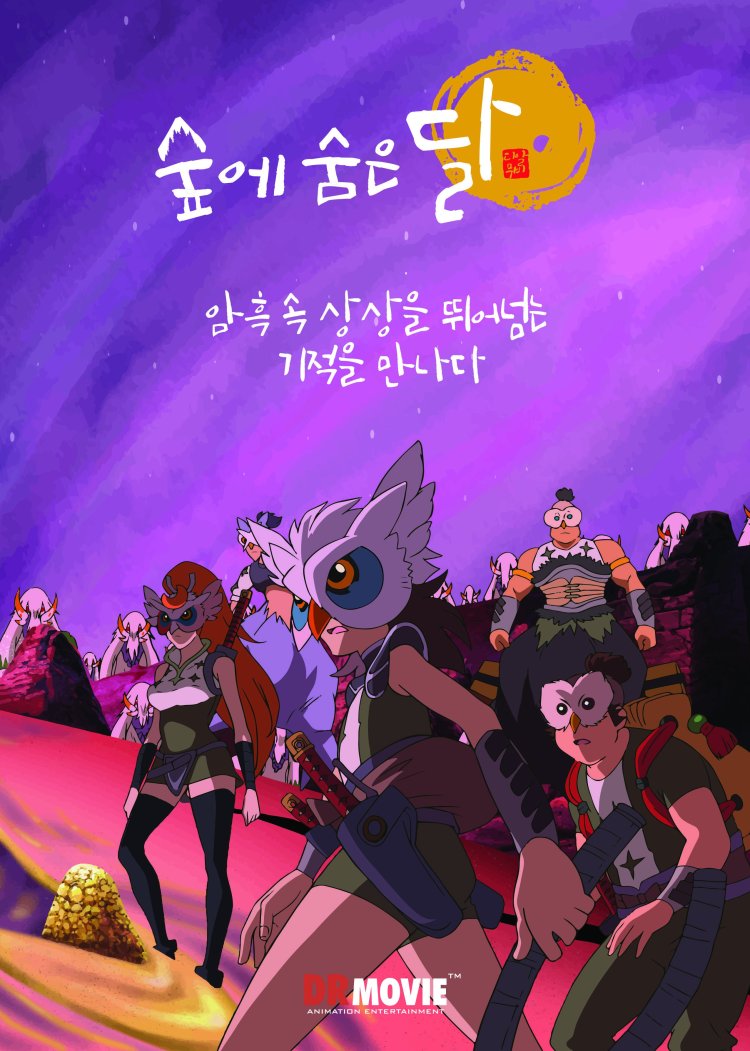
The Moon in the Hidden Woods posterNight is dark, but when you have the moon to light the way there is always the hope of a better tomorrow. When all hope is gone, how are you supposed go on? For a small group of villagers, the answer is to do the best they can, staving off the darkness with determination and guile. Directed by Japan’s Takahiro Umehara making his directorial debut, The Moon in the Hidden Woods (숲에 숨은 달, sup-e sum-eun dal) is a story about learning how to survive the darkness but also an oblique allegory about authoritarian corruption and the power that comes with embracing your essential identity. 

As the wise old granny tells us at the beginning, long ago the Moon watched over the villagers, protecting them from the terror of night, but then it suddenly disappeared. A terrifying monster, Muju, wrapped the night sky in red, devouring misfortunes and sending fearsome minions to plague mankind. Warriors set out to look for the Moon, but none returned. Meanwhile others learned how to profit from the new world and saw no need for a return to the past until gradually people forgot there had ever been a Moon to begin with.

One such profiteer was the evil Count Tar, who is determined to marry the Princess Navillera very much against her will. Escaping to the city, Navillera finds herself coming to the rescue of a musical trio caught up in an unfair competition to win some mystic water to use in their harvest festival, and making use of her telepathic super powers and natural musical ability at the same time. The Nova Folk Band are a small group of illegal meteor hunters from the village who are more interested in survival than they are in intrigue, but are nevertheless some of the only people still looking for the Moon. In any case, they end up taking Navillera with them as they flee, not quite believing that she is a princess and the intended bride of their tyrannical ruler.

While in the village, Navillera gets a crash course in class conflict, never having left the palace before and spent her entire life in a lavish comfort she assumed was available to all. This quickly puts her into conflict with musician Janggu who deeply resents the “spoiled” entitlement that sees her asking for extravagant luxuries like meat, fruit, and honey, while being entirely unused to farm work. She does, however, try her best even mucking in with the other villagers where she can but is obviously unable to contribute to the same degree given that she has never had to do a day’s work in all her life. Meanwhile, as Janggu points out, the gang have gone out hunting meteors full in the knowledge that it’s illegal because they need them to survive. The princess objects to their reckless lawbreaking, affirming that the kingdom will protect them with ore only for Janggu to point out an ore is worth half the year’s harvest and the only reason you’re not allowed to hunt meteors is so that the unscrupulous powers that be can sell you an alternative and thereby keep a grip on their power by keeping the poor in their place. Suddenly, Muju isn’t looking so much like a scary red monster but an eerie metaphor for late stage capitalism.

Meanwhile, the Navillera is also busy trying to escape an oppression she wasn’t even quite aware of in her attempt to reject the intentions of Tar. Through her time in the village, Navillera begins to lose heart, fearing that her cosseted life has left her powerless without skills or talents. What she discovers, however, is that she has a natural ability for dance that finds a perfect home in the cheerful village where such things are praised and becomes the key both to restoring her essential identity and defeating Muju to rediscover the Moon.

In opposition to the “nothingness” that Muju represents, Navillera draws strength from the camaraderie of the villagers as they adopt her as one of their own, urging her not to give in and marry the evil Tar but to join them in their rebellion, choosing the “path of life” as the joyous music of the villagers finally breaks the stronghold of Muju’s austerity. Finally seeing the light of a better tomorrow, the villagers look back on the past with stoical eyes, recognising that mankind’s greed gave rise to Muju and resolving to forgive those who were merely weak rather than actively evil in order to live on in the light of a new world. A perfect blend of Korean fantasy and Nausicaa-esque steampunk, The Moon in the Hidden Woods is a cheerful ode to the importance of hope and the pure joy of musical expression in a sometimes harsh existence.


The Moon in the Hidden Woods was screened as part of the 2019 Fantasia International Film Festival.

International trailer (English/korean/Japanese captions)

Money (돈, Park Noo-ri, 2019) [Fantasia 2019]

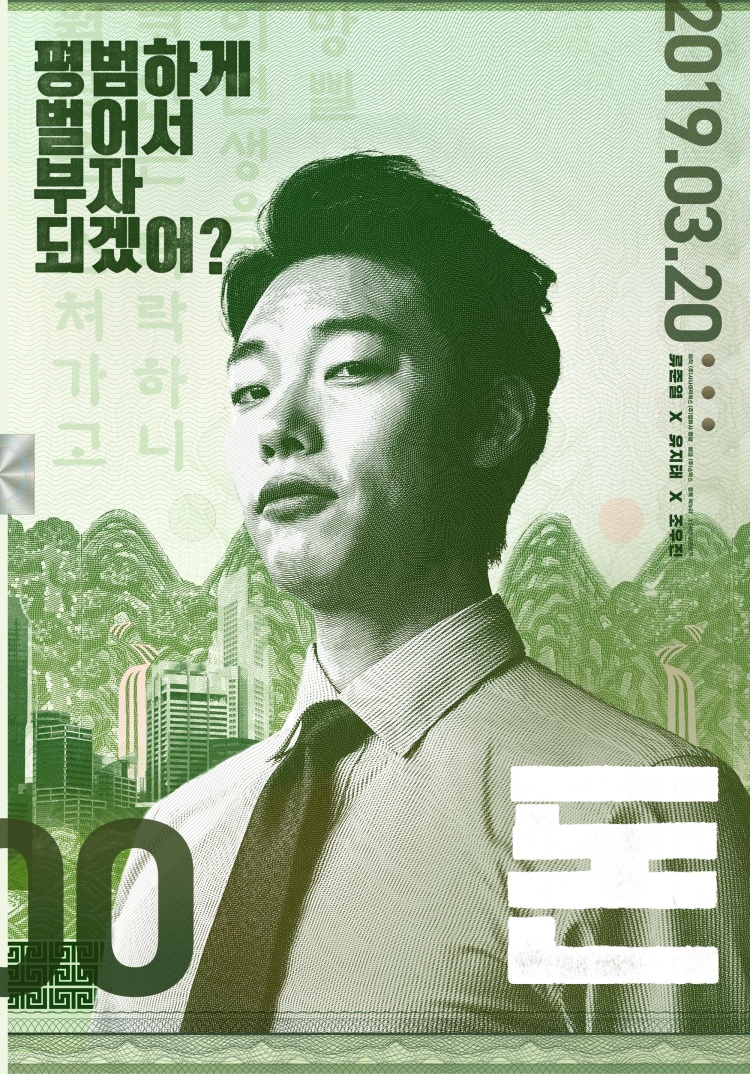
money poster 1“Could you ask him something for me,” the beleaguered yet victorious protagonist of Park Noo-ri’s Money (돈, Don) eventually asks, “what was he going to use the money for?”. Wealth is, quite literally it seems, a numbers game for the villainous Ticket (Yoo Ji-tae) whose favourite hobby is destabilising the global stock market just for kicks. As for Cho Il-hyun (Ryu Jun-yeol), well, he just wanted to get rich, but where does getting rich get you in the end? There’s only so much money you can spend and being rich can make you lonely in ways you might not expect.

Unlike most of his fellow brokers, Cho Il-hyun is an ordinary lad from the country. His parents own a small raspberry farm and he didn’t graduate from an elite university or benefit from good connections, yet somehow he’s here and determined to make a success of himself. In fact, his only selling point is that he’s committed the registration numbers of all the firms on the company books to memory, and his ongoing nervousness and inferiority complex is making it hard for him to pick up the job. A semi-serious rookie mistake lands the team in a hole and costs everyone their bonuses, which is when veteran broker Yoon (Kim Min-Jae) steps in to offer Il-hyun a way out through connecting him with a shady middle-man named “The Ticket” who can set him up with some killer deals to get him back on the board.

Il-hyun isn’t stupid and he knows this isn’t quite on the level, but he’s desperate to get into the elite financial world and willing to cheat to make it happen. As might be expected his new found “success” quickly goes to his head as he “invests” in swanky apartments and luxury accessories, while his sweet and humble teacher girlfriend eventually dumps him after he starts showering her with expensive gifts and acting like an entitled elitist. It’s not until some of his fellow brokers who also seem to have ties to Ticket start dying in mysterious circumstances that Il-hyun begins to wonder if he might be in over his head.

Unlike other similarly themed financial thrillers, it’s not the effects of stock market manipulation on ordinary people which eventually wake Il-hyun up from his ultra capitalist dream (those are are never even referenced save a brief reflective shot at the end), but cold hard self-interest as he finally realises he is just a patsy Ticket can easily stub out when he’s done with him. Yoon only hooked him up in the first place because he knew he’d be desperate to take the bait in order to avoid repeated workplace humiliation and probably being let go at the end of his probationary period. What he’s chasing isn’t just “money” but esteem and access to the elite high life that a poor boy from a raspberry farm might have assumed entirely out of his reach.

It’s difficult to escape the note of class-based resentment in Il-hyun’s sneering instruction to his mother that she should “stop living in poverty” when she has the audacity to try and offer him some homemade chicken soup from ancient Tupperware, and it’s largely a sense of inferiority which drives him when he eventually decides to take his revenge on the omnipotent Ticket. Yet there’s a strangely co-dependent bond between the two men which becomes increasingly difficult pin down as they wilfully dance around each other.

The world of high finance is, unfortunately, a very male and homosocial one in which business is often conducted in night-clubs and massage parlours surrounded by pretty women. There is only one female broker on Il-hyun’s team. The guys refer to her as “Barbie” and gossip about how exactly she might have got to her position while she also becomes a kind of trophy conquest for Il-hyun as he climbs the corporate ladder. Meanwhile, there is also an inescapably homoerotic component to Il-hyun’s business dealings which sees him flirt and then enjoy a holiday (b)romance with a Korean-American hedge fund manager (Daniel Henney) he meets at a bar in the Bahamas, and wilfully strip off in front of Ticket ostensibly to prove he isn’t wearing a wire while dogged financial crimes investigator Ji-cheol (Jo Woo-jin) stalks him with the fury of a jilted lover.

Obsessed with “winning” in one sense or another, Il-hyun does not so much redeem himself as simply emerge victorious (though possibly at great cost). Even his late in the game make up with Chaebol best friend Woo-sung (Kim Jae-young), who actually turns out to be thoroughly decent and principled (perhaps because unlike Il-hyun he was born with wealth, status, and a good name and so does not need to care about acquiring them), is mostly self-interest rather than born of genuine feeling. In answer to some of Il-hyun’s early qualms, Ticket tells him that in finance the border between legal and illegal is murky at best and it may in fact be “immoral” not to exploit it. What Il-hyun wanted wasn’t so much “money” but what it represents – freedom, the freedom from “labour” and from from the anxiety of poverty. Life is long and there are plenty of things to enjoy, he exclaims at the height of his superficial success, but the party can only last so long. What was the money for? Who knows. Really, it’s beside the point.


Money was screened as part of the 2019 Fantasia International Film Festival.

International trailer (English subtitles)

Kingdom (キングダム, Shinsuke Sato, 2019) [Fantasia 2019]

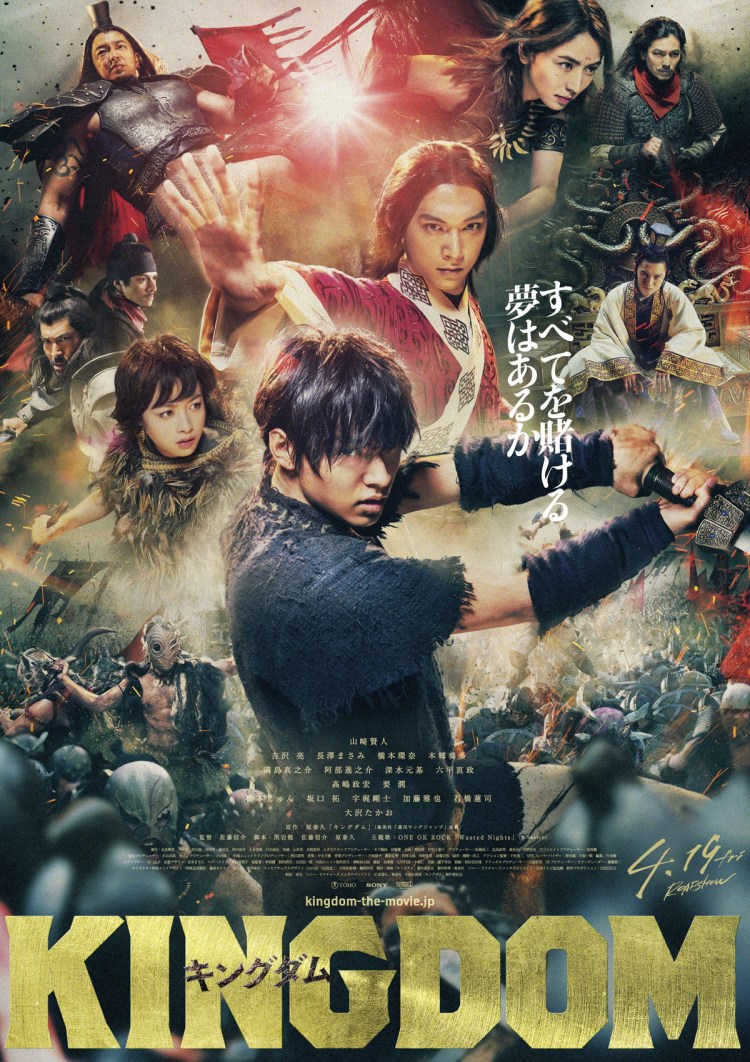
Kingdom poster 1The class war arrives in feudal China via modern Japan in Shinsuke Sato’s big budget adaptation of the wuxia-inspired manga by Yasuhisa Hara, Kingdom (キングダム). Set in China’s Warring States period, Kingdom offers a surprisingly progressive message, if mildly tempered by a failure to tackle the system in its entirety, in which the oppressed (which in this case includes the king) rise up against sneering aristocracy fuelled mostly by righteousness and fierce defence of the right to dream.

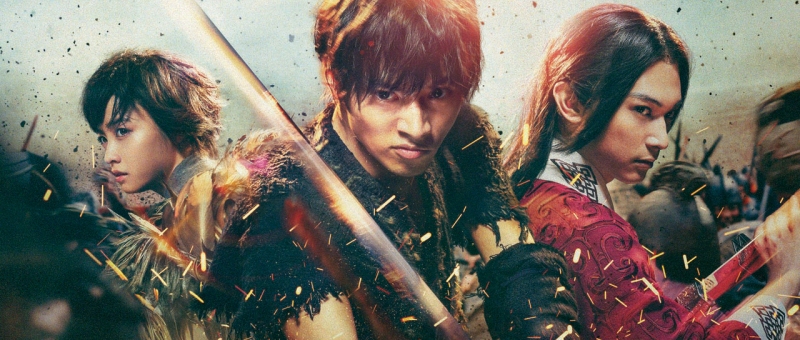
The tale begins with a fateful meeting between enslaved war orphans Piao (Ryo Yoshizawa) and Xin (Kento Yamazaki) on a small farm somewhere in rural China. The boys, realising there is no way out of their enslavement save the sword, commit themselves to perfecting their martial arts with the ultimate goal of becoming the world’s greatest generals. Their intense bond is broken when a mysterious man, Lord Chang . Wen Jun (Masahiro Takashima), appears and offers Piao a job at the palace. Though he agonises over leaving his brother behind, Piao seizes his destiny little knowing he has been hired not quite so much for his sword skills as for his resemblance to weakened king Ying Zheng (also played by Ryo Yoshizawa). Sometime later, Piao returns close to death, entrusting Xin with an important mission – go to Ying Zheng and seek his own destiny by restoring rightful rule.

The two boys are about as oppressed as it’s possible to be – orphaned slaves with no prospect of improving their condition save the one they’ve already decided on, fighting in a war. This doesn’t quite explain how they can release themselves from the farm, but Xin’s eventual flight, in which his master does not attempt to stop him, might suggest the first hurdle is not as big as it seems. In any case, Xin finds an unlikely ally in Ying Zheng who has been deposed from the throne by his younger brother for not being royal enough because his birth was illegitimate and his mother was a dancer.

Of course, Ying Zheng’s intention to regain his “rightful” throne is in defence of a necessarily unequal social order, but it’s also a blow against the kind of elitism which mark’s his brother Cheng Jiao’s (Kanata Hongo) philosophy. Cheng Jiao believes that he is the most rightful king because his blood is the most royal. He looks down on Ying Zheng as low born, and has no respect for his subjects or the lower orders. “A peasant in fine clothes is still a peasant” one of his minions intones to intimidate an opponent, but someone with a sword is still someone with a sword no matter their circumstances of birth and provided you have access to acquire one, perhaps swordsmanship is a truly egalitarian art given that it largely depends on how well you wield a blade. Eventually, Ying Zheng makes an ally of another oppressed people – the mountain dwellers subjugated, and previously betrayed, by the powers that be who lend their strength to toppling a corrupt power structure in order to restore something like peace and balance to the land.

Indeed, asked to give a brief manifesto speech, Ying Zheng cooly declares that he aims to create a unified China by eliminating borders and therefore the need for war. Insisting that when a king picks up a sword it ought to be in service of his people, he makes the case for a borderless world, little caring that, as his general points out, history may brand him a tyrant. Nevertheless, he remains a “puppet king” whose status is dependent on the loyalty of key general Wang Yi (Takao Ohsawa) with whom true power lies. Wang Yi, as we later find out seems to be a “good” person who used his troops to protect the innocent and ensure no civilians were harmed during the chaos of the insurrection but he does indeed wield dangerously vast power for just one man. Meanwhile, Ying Zheng may reject the primacy of blood, but does dare to claim his birthright as an oldest son and is of course acting in service of an inherently oppressive system even if he means to make minor improvements towards the kind of meritocracy that allows men like Xin to embrace the power of their dreams.

The power of dreams is indeed the key. Though Cheng Jiao’s hardline mercenary may sneer that “dreams are bullshit” and deny a slave like Xin’s right to have one at all, to men like Xin dreams are all they have. As he says, they get you back on your feet when everything else seems hopeless. Learning that Piao achieved his dream even if it was only for a few moments gives him the strength to pursue his own in service not just of himself but his brother, friends, and kingdom.

Appropriating the aesthetics of wuxia may prove problematic for some, but like many Japanese manga with international settings, Kingdom’s mechanics are essentially home grown which is perhaps why Sato heavily leans on Kurosawa’s legacy, possibly overusing the distinctive side wipe and giving his heroine a look echoing that from Hidden Fortress while other influences seem to feed back from Star Wars in the strangely cute masked mountain elders and gleaming golden armour of bad ass warrior queen Yang Duan He (Masami Nagasawa). A surprisingly positive, perhaps ironically bold plea for a borderless world and if not actual equality at least a friendly kind of egalitarian nobility, Kingdom hands victory to those who fight hardest for their right to dream while subtly advocating for their right to rebel against an inherently unjust social order in order to claim it. 


Kingdom was screened as part of the 2019 Fantasia International Film Festival. It will also be screened in US cinemas from Aug. 16 courtesy of Funimation.

International trailer (English subtitles)

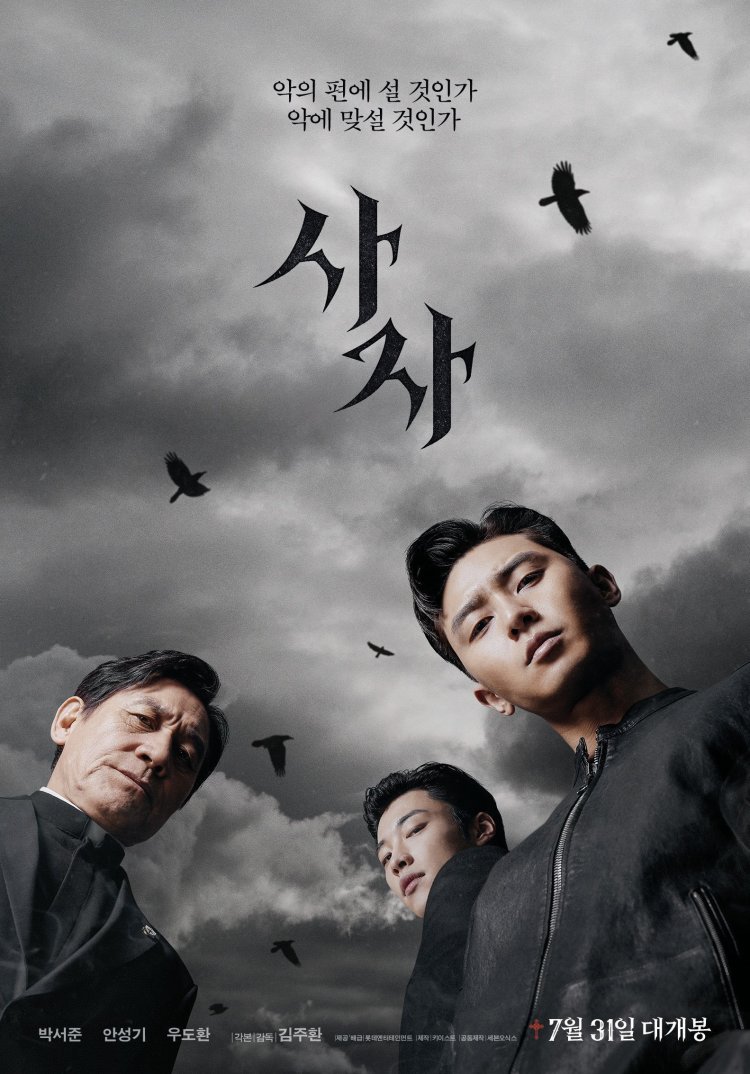
The Divine Fury (사자, Kim Joo-hwan, 2019) [Fantasia 2019]

Divine fury poster 1“If you have faith you have nothing to fear” the veteran priest explains to his protege in Kim Joo-hwan’s The Divine Fury (사자 Saja). The hero is not quite so sure. A tale of grief and resentment, The Divine Fury revels in supernatural dread, but makes plain that the origins of evil lie in the human heart and that it’s a failure to forgive that invites the darkness in.

A brief prologue introduces us to the young Yong-hu whose mother passed away shortly after he was born. His doting dad leaves him at home alone at nights while he works as a regular beat cop. Unfortunately Yong-hu’s earnest father is killed one evening by a rogue driver, leaving the boy orphaned and alone. Though his dad had been careful to take him to church and explain to him about the power of prayer, Yong-hu feels distraught and betrayed by a god who refused to listen and took his dad anyway even though he prayed as hard as he could. Vowing never to set foot in a church again, Yong-hu refuses to believe in anything at all.

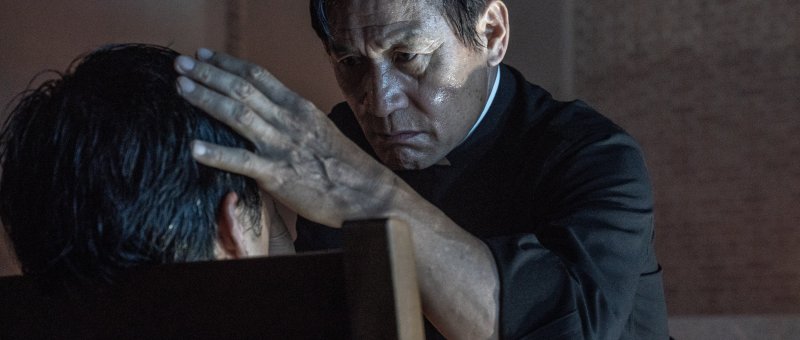
20 years later, he’s a world famous MMA star with vengeance on his mind. Plagued by voices telling him to go back and take revenge on the priest who told him everything would be OK, Yong-hu (Park Seo-joon) buries himself in violence and superficial pleasures. Everything changes on the flight back from an international bout when Yong-hu has a dream of his father in which he grabs a cross and wakes up with stigmata on his right hand. When doctors can’t explain his strange injury which refuses to heal, he turns to a shaman who tells him that he is rife with demonic energy and is only protected by the shining goodness of his father’s wedding ring which he still wears on a cord around his neck. Perhaps surprisingly, the shaman advises him to follow the cross and go to a church at a certain time where a man will help him. The man turns out to be father Ahn (Ahn Sung-ki) – a Vatican-based exorcist currently in the middle of a case so difficult it’s sent his assistant running for the hills in terror.

Anyone who knows anything about exorcism in the movies knows you need an old priest and a young priest. Ahn is more or less resigned to working alone, exorcism is no longer cool with the youngsters it seems, but nevertheless remains keen to court the enigmatic Yong-hu and his all powerful demon banishing hand. Yong-hu, however, remains reluctant. He doesn’t believe in God and resents the old priest as a symbol of all that’s betrayed him. Gradually he begins to warm to Ahn, seeing in him a kind of goodness as he selflessly battles the forces of evil and releases the tormented from their supernatural oppressors even if it might take longer to help them escape their darkness. Meanwhile he continues to hunt the “Dark Bishop” who feeds on fear and negativity in order to secure his own immortality.

Ahn is fond of saying that there’s a reason for every torment and that it’s all part of God’s grand plan. As far as the film goes, he may very well be correct at least in providing the mechanism for Yong-hu’s eventual path towards re-embracing his faith. Still missing his father and nurturing intense hurt and resentment, Yong-hu invited the darkness in, beginning to hate where he should have learned to forgive. As Ahn tells him, you can’t hate something you never loved which might explain why the darkness has never been able to fully consume him. Still battling his father’s absence, Yong-hu remains doubly conflicted, falling into an easy paternal rhythm with the older man yet also resenting him both as a potential father figure primed to betray and as a symbol of the Church in whom no he longer trusts.

Kim shifts away from the comedic banter which made Midnight Runners such an unexpected treat for something more melancholy as his heroes ponder the wages of grief and the demands of responsibility. Cynical, Yong-hu forgot his father’s ghostly instructions to him to grow up to be a good person who helps others and stands up to those who harm the weak (like demons) but eventually comes to reconnect with his dad’s essential goodness when realising that he’s been guided onto a unique path as an MMA star with a magic demon vanquishing fist. Having conquered the evil inside him and accepted his father’s legacy, Yong-hu is ready to take on the forces of darkness with a divine fury of his own while saving the souls of those in peril from threats both earthly and supernatural.


The Divine Fury was screened as part of the 2019 Fantasia International Film Festival. It will also be released in cinemas across the US and Canada courtesy of Well Go USA from Aug. 16.

International trailer (English subtitles)

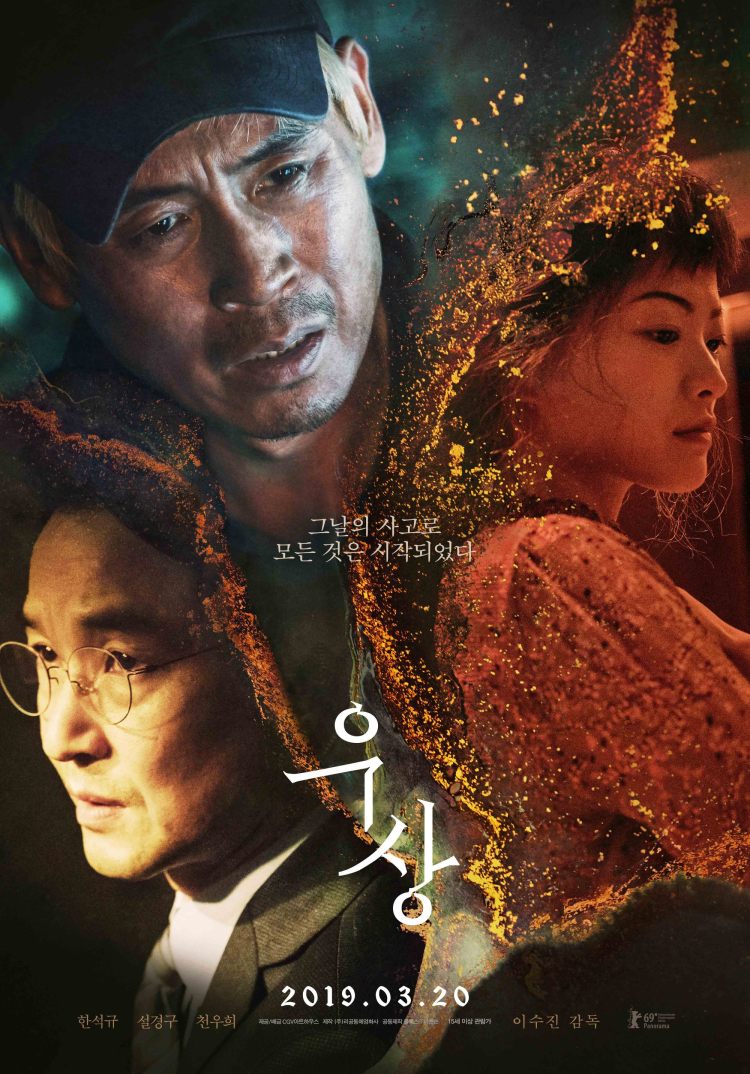
Idol (우상, Lee Su-jin, 2019) [Fantasia 2019]

Idol poster 1“Getting others to trust something is more important, not what they choose to believe” advises a cynical politician a little way into Lee Su-jin’s Idol (우상, Woosang). Image is indeed everything. Who are you more likely to believe – the slick, seemingly upstanding politician who’s done everything “right”, or an ageing, inarticulate aircon repairman with bleach blond hair? Two fathers go to bat for their sons, if in very different ways, but only one can emerge “victorious” in their strangely symmetrical endeavours.

Lee opens with a voice-over taken from a speech later in the film belonging to bereaved father Yoo (Sol Kyung-gu) in which he confesses that as his son Bu-nam (Lee Woo-hyun), who had severe learning difficulties, grew older, he found himself having to masturbate him to prevent him harming himself trying to calm his sexual urges. Yoo’s words play over his opposite number’s return home from a research trip to Japan. Koo (Han Suk-kyu) is a politician and former herbalist with a special interest in nuclear power. Ambitious, he spends much of his time travelling for business while his wife (Kang Mal-geum) cares for their wayward adolescent son, Johan (Jo Byung-gyu). A panicked text message warning that Johan has got himself into trouble again gets ignored, but when he arrives home Koo knows he has to act. Johan has knocked someone over and rather than take them to hospital, he’s brought the body back home.

A series of quick calculations tells him that the “best” option is for Johan to turn himself in, despite his wife’s insistence that they simply get rid of the body. He drives the corpse back to the scene and dumps it, gets rid of the original car, and then drives his son to the police station before expressing contrition in front of the cameras. That would have been that if it weren’t for Yoo’s dogged determination to find out what happened to his boy, and the fact that Bu-nam’s “wife” Ryeon-hwa (Chun Woo-hee), an undocumented former sex worker from China, managed to escape meaning there are loose ends Koo knows he needs to tie up.

“This rotting smell” Ryeon-hwa exclaims on putting a number of things together. There is something undoubtedly corrupt in Koo’s superficially smooth world of neatly pressed suits and sharp haircuts. Stagnant water swells around him, along with a murky swirl of blood, as he contemplates the best way out of his present predicament. Everything here is stained, marked, or scarred as if hinting at the darkness beneath gradually seeping through.

Yoo, meanwhile, perhaps knows he lives in a “dirty” world and though he never claims to be completely clean himself, is fully aware of the implications of his actions. A widowed father, he tried to do the best for his disabled son. He offered him relief in ways others would find perverse in a strange gesture of fatherly love, finally deciding to get him a wife in the hope of putting an end to such degradation for them both only to regret his decision when he realises Bu-nam may not have died if he’d just stayed home. Koo, meanwhile, tries less to protect his son than himself, weighing up that the boy will most likely get a slap on the wrist and he’ll come out of it looking better because he behaved “honestly” and in line with the law. To get elected he will stop at nothing to preserve the image of properness, even if it means he must get his hands “dirty”.

In that essential ruthlessness, he may have something in common with the jaded Ryeon-hwa whose sister warns Yoo not to trust her because “her nature is different”. Like Koo, she has done terrible things but done them to survive rather than to prosper. Her marriage to Bu-nam might seem like no prize, but it was better than the life she was leaving behind and, crucially, a guaranteed path to Korean citizenship assuming Yoo eventually filled in the marriage papers properly.

Yoo just wants “justice”, but ruthless men like Koo who care about little other than image are not about to let him get it, which is why he finds himself trotted out as a superficial ally to bolster Koo’s appearance at the polls in return for Ryeon-hwa’s “assured” safety. In the end, all Koo’s scheming blows up in his face, but, Lee seems to say, the image always survives and men like Koo know how to spin it to their advantage while men like Yoo will always be at the mercy of the system. A bleak, often confusing, noirish thriller, Idol plunges a knife deep into the heart of societal corruption but finds that truth often matters less than the semblance of it in a society which idolises the superficial.


Idol was screened as part of the 2019 Fantasia International Film Festival.

International trailer (English subtitles)

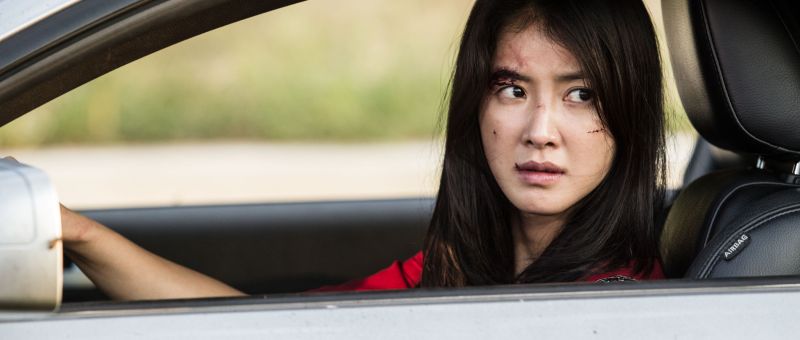
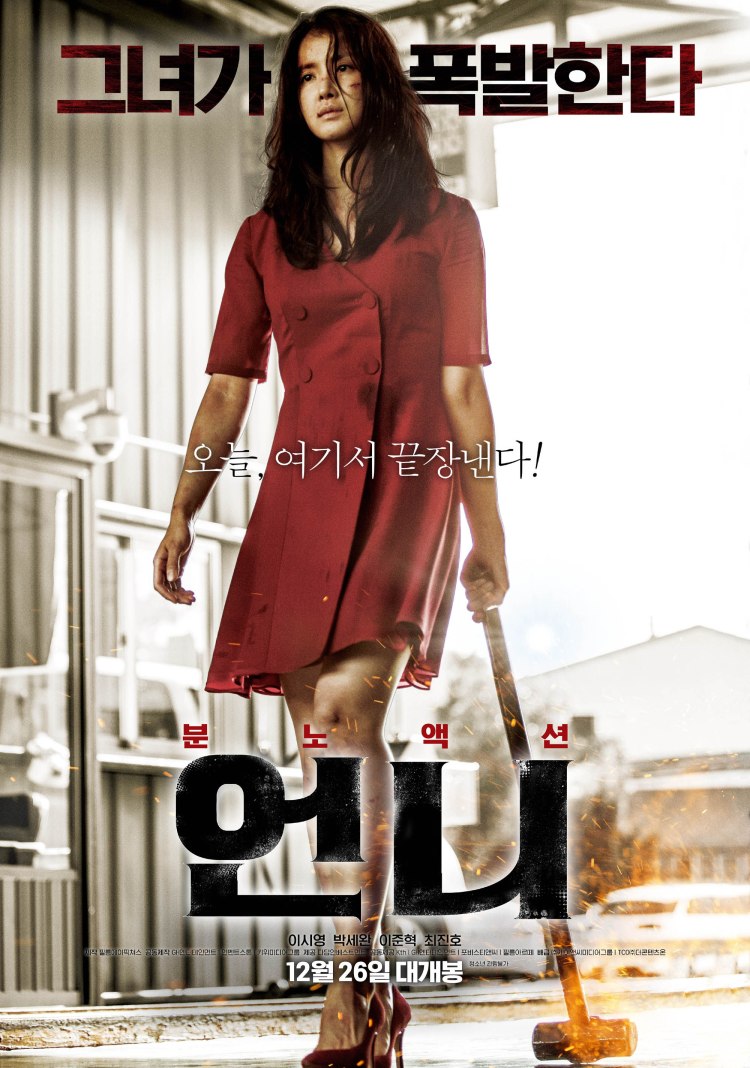
No Mercy (언니, Lim Kyoung-tack, 2019) [Fantasia 2019]

No Mercy poster 2Sad as it is, there will always be those who prey on the vulnerable. Even sadder is the way the world seems to reward them. There can be No Mercy (언니, Eonni) for the wicked, however, in Lim Kyoung-tack’s old school B-movie. Though tastefully appointed, Lim’s action drama harks back to the exploitation movies of old as its lady in red cuts through a host of sleazy misogynists, hoping to rescue her little sister from a life of lifetime of cruelty and abuse at the hands of unscrupulous men.

When we first meet her, In-ae (Lee Si-young) is being released from prison with no one waiting. She is, however, ecstatic to be reunited with her little sister Eun-hye (Park Se-wan) who has mild learning difficulties. In-ae misinterprets Eun-hye’s reluctance to go to school as the normal teenage rebellion, little realising that her sister is being mercilessly bullied by delinquents who have already passed her on to their sleazy friends. Forced to participate in a scam to lure salarymen to hotels then rob/blackmail them, Eun-hye just wants to go home but ends up being kidnapped by an amoral gangster they mistakenly target.

Worried when Eun-hye doesn’t return home or answer her phone, In-ae puts on the pretty red dress and shoes she bought her and goes out looking, quickly realising that something quite untoward has befallen her sister. In this situation she does what anyone would do – call the police, but the police won’t help. Teenage girls run away and usually they come back on their own, the policeman’s logic says, little caring that Eun-hye is a vulnerable teen and In-ae has evidence to suggest she has been kidnapped by thugs. If In-ae wants her sister back, she’ll have to go get her herself. Which is exactly what she does.

A full throttle action fest, there’s little point trying to pretend that No Mercy has serious intentions but it does, in true exploitation movie fashion, highlight a series of pressing social concerns, chief among them Eun-hye’s constant misuse at the hands of unscrupulous men who regard her disability as an excuse to do what they like with her on the grounds that she almost certainly cannot tell on them and is unable to resist. Molested by convenience store owners, photographers, mechanics, and finally an all powerful politician, Eun-hye silently bears all while longing to go home to her sister. In-ae, meanwhile, a talented martial artist, ended up in prison for going too far trying to protect her. Now that she’s out, she can’t find a job thanks to the stigma surrounding her conviction and worries about what’s been going on in the 18 months she’s been away.

Aside from being misused by sleazy men Eun-hye is also targeted by those like the delinquent girls in her class who think it’s OK to mock and humiliate her because she’s somehow “less” than they are. Aside from In-ae, no one seems to consider that Eun-hye is a real person with her own hopes and desires, they only see her as a strange and inconvenient girl. This kind of mentality is itself informed by the hierarchal society and sense of superiority it allows some to assume. Eun-hye finds herself passed to the sleazy politician by those hoping to curry favour. He in turn regards his right to rape her as proof of his status, that his position makes him untouchable and entitled to break the strongest of taboos without fear of repercussions.

Of course, In-ae isn’t having any of that. She wants her sister back, yes. But she also wants to teach these awful men a lesson so they stop treating women like identical faceless objects while perhaps showing other women they don’t need to let the guys get away with this. Giving them a taste of their own medicine, In-ae puts her martial arts skills to good use as she plows on running after Eun-hye while dragged back into the past despite herself. In-ae has no mercy for those who exploit the vulnerable, or for hypocrites, or for the self involved. All she wants to get her sister home and safe and she’ll do whatever it takes to make that happen. A charmingly retro B-movie throwback, No Mercy revels in its sense of anarchic violence as its enraged heroine takes her revenge against an unjust society while protecting what is most precious to her.


No Mercy was screened as part of the 2019 Fantasia International Film Festival.

International trailer (English subtitles)

The Gangster, The Cop, The Devil (악인전, Lee Won-tae, 2019) [Fantasia 2019]

81745_1000“Two bad guys will catch the worst man” according to irritated gangster Jang Dong-su (Ma Dong-seok) in Lee Won-tae’s The Gangster, The Cop, The Devil (악인전, Akinjeon). He doesn’t quite know how right he is, even as he forms an unlikely alliance with a maverick cop himself highly irritated because his lazy colleagues won’t listen to his theory that a spate of unsolved murders are the work of a serial killer. More alike than they’d care to admit, the two “bad guys” team up to do what they have to do in order to make the killing stop but at what price?

A vicious killer (Kim Sung-kyu) has developed a habit of rear-ending solo drivers on lonely roads, stabbing them repeatedly and then leaving them for dead. Maverick cop Tae-seok (Kim Mu-yeol) has become convinced that the killings were carried out by the same perpetrator and that they have not yet been identified as a “serial killer” partly because the crimes took place in different districts and there is insufficient co-operation between precincts, and partly because his colleagues think serial killers are something you see in American movies. His superiors just want to close cases, they aren’t particularly concerned with upholding justice or protecting the innocent and so Tae-seok starts thinking outside of the box when he hears that the killer’s latest target was none other than top mob boss Jang Dong-su.

Dong-su got rear-ended after running an errand to have a word with a wayward underling, Hur (Yoo Jae-myung), who has forgotten his place. The killer made a serious mistake going after Dong-su who is a big, handy kind of guy and therefore manages to fend him off, even wounding him in the shoulder despite being badly injured himself. Though the obvious conclusion is that Hur sent someone after him, Dong-su is unconvinced seeing as he had never seen his assailant before and is pretty sure he’s not a member of the gangster underworld. Still, he’s very annoying because a gangster only has power in being respected and right now Dong-su looks a fool. If he wants to get his “professional” life back on track, he needs to get his revenge but to do that he’ll have to cross the floor and work with law enforcement, temporarily teaming up with rogue cop Tae-seok whose heart is in the right place even if he’s not averse to bending the rules.

One of the things which most bothers Tae-seok about amoral killer “K” is that, unlike most serial killers, he kills indiscriminately and purely for pleasure. He has no “type” and generally goes up against those most likely to fight back, unlike your average pattern killer who targets the vulnerable. Like Tae-seok and Dong-su, he is however quite annoyed – this time because someone has “framed” him for a murder he didn’t commit in order to further their own ends. Hugely overconfident and cooly psychopathic, he sits in the dock and asks what makes his crimes different than the state’s if the state is fixing to execute him without proper evidence. Pointedly looking at law enforcement, he affirms that the real villains are those who commit crime with kind faces (say what you like, but at least K looks the part).

When it comes to Tae-seok he might have a point. Conspiring with Dong-su to “kill him with law”, Tae-seok gleefully manipulates the system while giving Dong-su tacit permission to take his revenge as long as “justice” has been properly served. K doesn’t believe in anything, Tae-seok believes in a particular kind of “justice” if not quite in the law, while Dong-su mourns the sense of self-belief that allows you to rule the roost as an all powerful gangster. The three men are a perfect storm, each angry, each resentful, each vowing a particular kind of revenge against the forces which constrain them be they corrupt and lazy superiors, gangsterland disrespect, or the “injustice” of being accused of a crime you did not commit but not being properly credited for the ones you did. Bathed in a garish neon, Lee’s anti-buddy-cop drama embraces its noirish sense of fractured morality with barely suppressed glee as its similarly conflicted heroes pursue their violent destinies, true to their own but dragged to hell all the same.


The Gangster, The Cop, The Devil was screened as part of the 2019 Fantasia International Film Festival.

International trailer (English subtitles)

House of Hummingbird (벌새, Kim Bora, 2019) [Fantasia 2019]

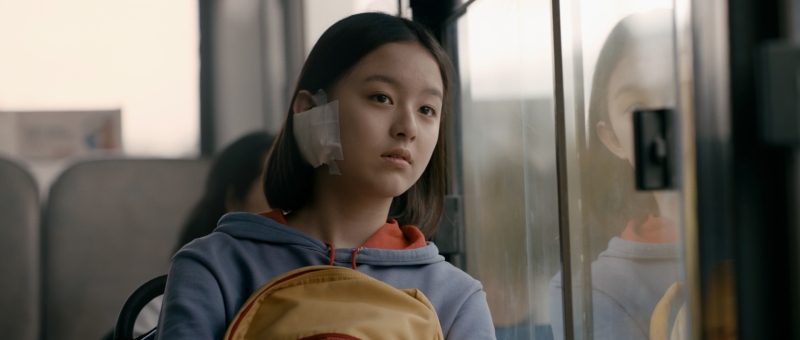
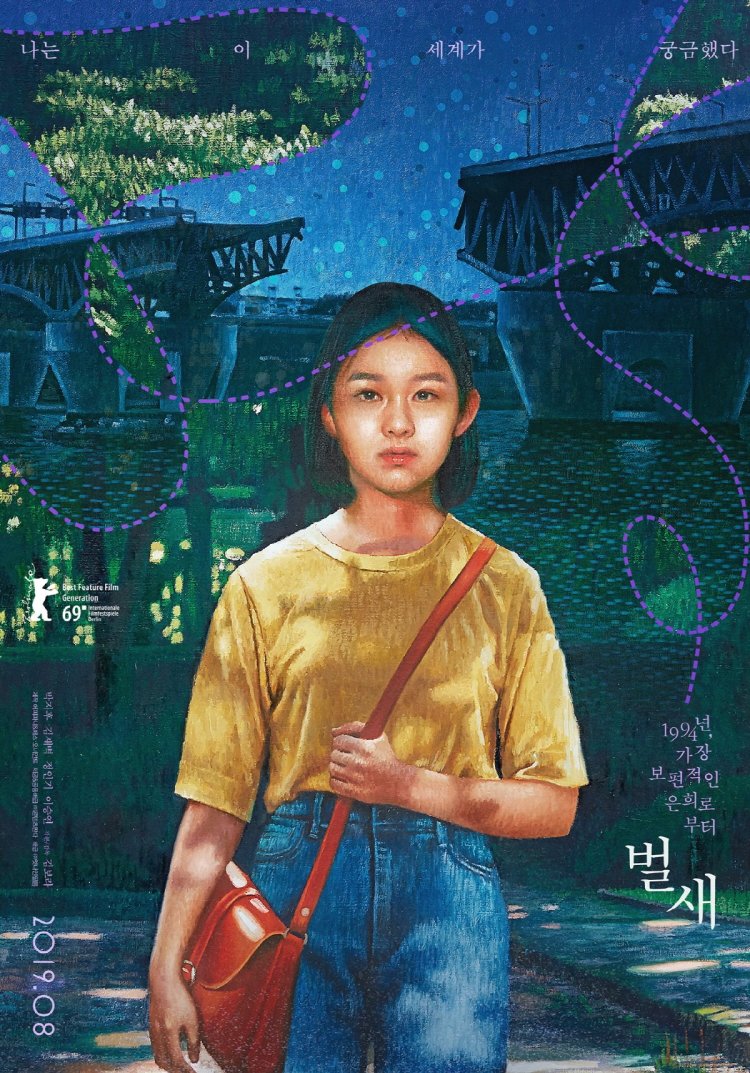
House of hummingbird poster 1“The world is fascinating and beautiful” the teenage protagonist of Kim Bora’s House of Hummingbird (벌새, Beolsae) is told in an especially poignant letter recited in the film’s closing moments. It’s a lesson that she’s longing to learn, but finds few willing to teach her in a society whipping itself up into a frenzy of aspiration perhaps at the cost of true human connection. A chronicle of one surprisingly traumatic summer in the newly democratised Korea of 1994, Kim’s film charts its heroine’s gradual progress towards a kind of self acceptance with a melancholy ease as she begins to find her own way despite the toxicity of the world all around her.

14-year-old Eun-hee (Park Ji-hu) is one of three siblings living in a cramped apartment with her harried, emotionally distant parents who run a small rice cake shop. A mediocre, disinterested student she falls asleep at school where the other kids cruelly exclaim that dozy girls like her never make it to college and are destined only to become housemaids to the “successful” adults they assume they’ll be. Meanwhile, Eun-hee’s hardline dad (Jung In-gi) makes her go to Chinese cram school where she “studies” along with her best friend, Ji-suk (Park Seo-yun), spending most of their lesson time making fun of the teacher in hastily written notes.

Previously purposeless, her world begins to widen when the Chinese teacher abruptly quits and is replaced by the infinitely cool, enigmatic university student Young-ji (Kim Sae-byuk) whom she first glimpsed smoking a melancholy cigarette by an open window on the stairs. Strangely captivated by this “odd” young woman, Eun-hee suddenly has the urge to study, especially as Young-ji turns out to be unique among the adults that she knows in that she seems to genuinely care about her and is interested in hearing all about her troubles, which, as we will find out are many.

In the mid-90s, Korea was a newly democratised and rapidly modernising society keen to claim its place on the economic world stage. Where Eun-hee’s parents are defeated, disappointed figures, they want better for their children in the new society but struggle as to how to get it for them. Eun-hee’s mother (Lee Seung-yeon), as we find out from her dejected brother, was bright but had to leave school to pay for his tuition (a promise he seems to think he has not fulfilled). Consequently, the parents are convinced “education” is the way out but fail to realise that their obsession with academic grades is slowly destroying their family home. While Eun-hee is sullen and withdrawn, pushed out by her rowdy family, her older brother’s exam stress often turns violent and her sister skips school to go clubbing in an attempt to escape adolescent anxiety.

Even when Eun-hee discovers a lump on the side of her neck, her mother sends her off to the doctor’s alone though he can’t actually treat her without parental consent which Eun-hee fears they won’t get round to giving. Though they visit her once, they don’t bother to pick her up from an extended stay in hospital and are not home when she returns. Not even an accusation of shoplifting rouses them from their busyness. Eun-hee’s father rudely tells the shopkeeper to stop bothering him and call the police, causing the shopkeeper to feel so sorry for her that he lets her go.

Meanwhile, Eun-hee looks for intimacy in other places. She tries innocent teenage romance with a feckless but good-looking boy, Ji-wan (Jeong Yun-seo), whom truth be told she perhaps likes more as an abstract idea than in himself. The unexpected gift of a bright red rose from a bashful girl (Seol Hye-in) sends her thoughts in another direction but leaves her more confused than ever when that too betrays. Through it all she idolises the mysterious figure of Young-ji with whom she seems to share some kind of affinity and the sense of connection so painfully absent in her frenetic family home.

Eun-hee’s difficult path towards an acceptance of adulthood mirrors that of her nation, finding itself in one particularly traumatic summer marked by a dangerous sense of anxiety in the end of eras as the North’s Kim Il-sung passes away, provoking fears of a disturbance in carefully won political equilibrium. Meanwhile, a literal bridge collapse threatens to destroy Eun-hee’s new path towards maturity once and for all, taking her only source of solace with it. Yet what she learns is that though bad things happen, good things happen too and there are always new people to share them with. She may feel herself to be alone, lost in a confusing landscape and uniquely indifferent to her nation’s relentless pursuit of consumerist success, but she does finally perhaps have herself and new hope for the future found in the security of her own hands.


House of Hummingbird was screened as part of the 2019 Fantasia International Film Festival.

Festival trailer (English subtitles)

Stare (シライサン, Hirotaka Adachi, 2019) [Fantasia 2019]

Stare 3If you’re attacked by a bear, the advice is not to run, but to stand your ground before backing away slowly while calmly explaining to the bear that you mean it no harm and would like to go home now. Similar advice will serve you well if you’re unlucky enough to be cursed by “Shirai-san” (シライサン), the vengeful ghost of an all-powerful shamaness who, for some reason, really doesn’t like for people to know her name. One crucial difference, however, is that Shirai-san demands a different kind of respect. She can’t abide deference, and will kill all those who look away from her extremely large eyes.

This three young people learn to their cost after indulging in an ill-advised scary story session in a quiet inn. An oft repeated piece about a creepy wedding photo invites a visiting liquor store delivery boy, Watanabe (Shota Sometani), to recount a tale of pure horror he was told as a boy about a man chased by a strange woman who claimed to know him and wanted to take her revenge for his supposedly knowing her name (which he apparently didn’t until she told it to him). The man tells her to pick on someone else who knows her as “Shirai-san” which is how the story ends, with fingers pointing at the horrified listeners. Of course, it’s just a silly campfire story, but before long all three of the students are dead of supposed heart attacks of such magnitude that they caused their eyes to explode.

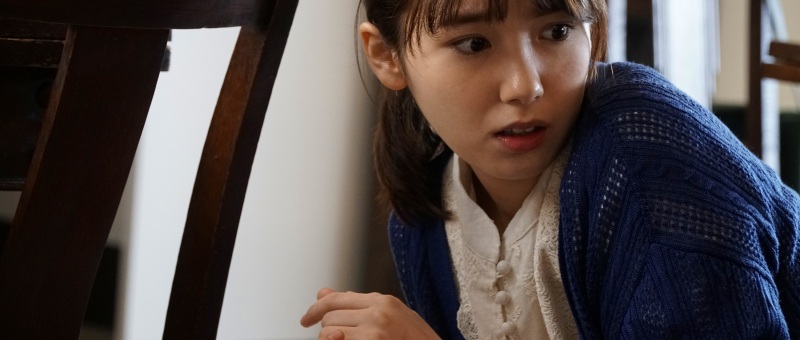
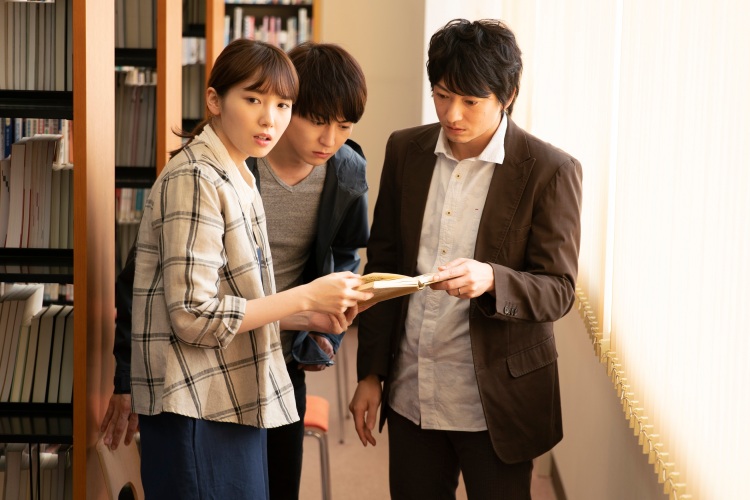
Meanwhile, the left behind – friend Mizuki (Marie Iitoyo), and brother Haruo (Yu Inaba), begin an investigation which will eventually see them too cursed by the figure of Shirai-san. Later they are joined by equally dejected reporter Mamiya (Shugo Oshinari), still grieving for his young daughter killed in a traffic accident some time ago. All modern people, none of the three really believes that their loved ones died because of an ancient curse, but their investigation leads them to just that conclusion, leaving them to ponder how exactly they might be able to survive if not actually break it.

In any case, Shirai-san’s wrath is directed at all those who know her name no matter how they came to learn it. Like many a J-horror ghost, what she feeds on is fear. As Haruo’s father told him, perhaps in cold comfort, there is one upside to death – that by dying you lose your fear of it. Thereby you can come to accept the idea of death and pass peacefully with no need for further anxiety about the end. It’s an ironic statement, but not without its truth. Picking apart the mystery, Mizuki wonders how exactly you might write the name “Shirai”, working under the assumption that it’s the most normal way which means “white well” (白井) only to wonder if it’s not a way of saying “death coming” (死来) rather than actually her name.

Shirai-san might be, in that sense, merely the evocation of mortality, stalking dark corners and striking seemingly at random. One victim thinks they find a way to placate her, that if you can bear to stare her in the eye long enough she will eventually disappear, but you cannot escape “death” by facing it down only meet it with dignity. Our heroes are plagued by visions of the people they’ve lost, haunted by possibly imagined grudges and irresolvable guilt over human failings, the way they fear they may have made people feel or otherwise let them down. Shirai-san plays on their mortal insecurities, luring them to their doom with a mix of relief from suffering and guilt-ridden atonement.

Well known horror maestro Hirotaka Adachi (AKA Otsuichi) injects new vigour into the classic J-horror ghost with Shirai-san seemingly unafraid to strike in broad daylight and public places while her presence is eerily felt in the most tranquil of locations, echoed in the innocent tinkle of bicycle bells. A cruel curse spread by resentment and negativity, Shirai-san’s revenge is one which offers only an ironic escape and remains frustratingly inscrutable even at the very end. Nevertheless, she does, perhaps, come for us all in one way or another. The least you can do is look her in the eye.


Stare was screened as part of the 2019 Fantasia International Film Festival.

Original trailer (English subtitles)

Ode to Nothing (Oda Sa Wala, Dwein Ruedas Baltazar, 2018) [Fantasia 2019]

Ode to Nothing poster 3“Maybe it would be better if I just disappeared rather than physically be here but feel invisible all the time” the lonely heroine of Dwein Ruedas Baltazar’s Ode to Nothing (Oda sa wala) sadly laments to her only source of comfort, a semi-embalmed corpse. A melancholy meditation on the living death that is existential loneliness, Ode to Nothing takes its alienated heroine on a journey of hope and disappointment as she rediscovers a sense of joy in living only through befriending death. 

43-year-old Sonya (Marietta Subong, AKA Pokwang) lives alone with her elderly father (Joonee Gamboa) to whom she barely speaks in a large Spanish-style house which doubles as a moribund funeral home. Short on custom, Sonya’s only frequent visitor is sinister loanshark Theodore (Dido de la Paz) who currently holds the deeds to the house while she struggles to make the interest payments. Meanwhile, she spends her days gazing out of open windows, waiting for the handsome young taho seller to arrive, and listening to an ancient cassette tape of Chinese folksong Mo Li Hua.

The stillness of her life is ruptured late one night when a couple of men arrive with the fresh corpse of an old woman, seemingly having run her over and not wanting the bother of taking her to a hospital seeing as she is already dead. Sonya is dubious. She doesn’t want any trouble either, but needs the money and the custom and so she agrees to take the woman in and see if anyone claims her. No one does, and soon enough the corpse has become a new presence in Sonya’s life and home. She begins to confide in it, dresses it in her mother’s old clothes, and sits it at the dinner table where her father too indulges the illusion, finally talking to her once again as if the family had really been restored.

In an odd way, the corpse guides Sonya back to life. No longer so sullen, her funeral parlour finally attracts some customers while she begins to dress more cheerfully, even dancing and skipping along to Mo Li Hua with girlish enthusiasm. “As you get older, you have more reason to do the things you were too afraid to do when you were younger” she explains to the corpse, outlining a brief overture she just made to Elmer (Anthony Falcon), the taho vendor, whose grandfather she also saw off around three years ago after which Elmer took over the taho vending business.

Taho is perhaps the perfect encapsulation of Sonya’s newfound hopes, wholesome sweetness and easy comfort. The blandness of off-white silken tofu mixed with the gentle colouring of the amibal syrup and sago pearls, like the Jasmine flower of the folksong, seem to symbolise the brief moments of possible happiness in an otherwise dull existence but even within her increasing sense of positivity she perhaps knows her rekindled desire for Elmer and for life is likely go answered. In any case, she falls into the corpse’s lap as if it really were her mother, attributing to it a supernatural power that keeps the corpses flowing and beckons both life and death to her lonely home.

As in any good fairy tale, however, you have to be careful what you wish for. Sonya gets what she wanted, but not at all in the way she wanted it. The corpse betrays her, leaving her bereft once again and entombed inside her own funeral home with the feeling that there is only one way out. Baltazar shoots in 4:3 with the rounded corners of nostalgic 16mm, but the frame cannot help but recall the small window on the surface of a coffin, as if we were peeking in on her still life from some other plane. Sonya is, in many ways, already dead, trapped in a moribund and hopeless world where even the fragmentary past is being slowly taken away from her – the broken cassette tape, the rapidly depleting furniture, Elmer’s crushing absence. She confesses that she’s afraid of the dark and of being alone, tired enough of her resignation to abandonment to embrace a corpse which can, of course, never leave you. It can, however, disappoint as all false idols will. A melancholy exploration of loneliness, defeat, and despair, Baltazar’s whimsical drama is a haunting ode to emptiness but one that clings sadly to life and hope even as the night draws in.


Ode to Nothing was screened as part of the 2019 Fantasia International Film Festival.

Original trailer (English subtitles)

Mo Li Hua