

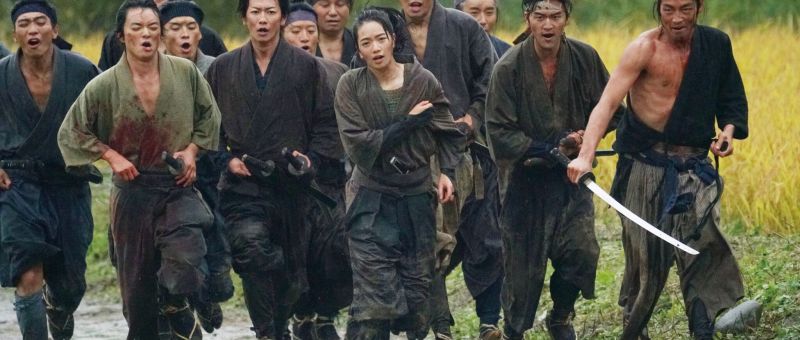
A former assassin is drawn back into the light when an old colleague is framed for the murder of a small family in Isao Yukisada’s adaptation of Kyo Nagaura’s pulp novel, Revolver Lily (リボルバー・リリー). Set in the Taisho era, the film finds Japan at a crossroads amid an atmosphere of rising militarism in what is still a very poor country trying to change its fortunes through imperialism while those like Yuri (Haruka Ayase) attempt to stave off the oncoming apocalypse of war.
Though Yuri (whose name means “lily” in Japanese) had been part of a spy ring in Taiwan and trained to further Japan’s interest through political assassinations, she evidently came to see the error of her ways when the group was betrayed and an attack on their hideout led to personal tragedy. Since then, she’s lived as a well-to-do owner of a geisha house apparently under her own name which somewhat conflicts with the idea that she is simultaneously on an international most wanted list. In any case, she’s swept back into action when one of her former comrades, Kunimatsu, is accused of murdering the family of a man named Hosomi who is apparently on the run while militarists also seem to be intent on finding his teenage son Shinta (Jinsei Hamura).
Shinta, who was born with a lame leg which would presumably rule him out for military service, later becomes a kind of symbol of Japan as a more enlightened nation that no longer sees the need to use violence in order to advance its own interests. His father, Hosomi, had apparently done a series of dodgy deals with the military and then run off with all the money which is why they want to find him. It later turns out that he took the money not so much out of greed as that he was trying to turn the tide by growing the country economically in the hope that there would no longer be the need for imperialistic conquest.
Yet the money becomes a means of setting the army and the navy against each other in an increasingly straitened Japan in which neither feels they have the proper finding to pursue their ambitions. Constant references are made to the devastating economic impact of the 1923 earthquake, yet the authorities spend increasing amounts of money on waging war and there seem to be increasing numbers of soldiers on the streets. The army, in general, are depicted as loutish thugs with little on their side except brute force, while the navy in their pristine white uniforms are backroom plotters and always one step ahead.
But there is obviously a giant irony at the heart of the film in that as Yuri declares at the end, “fighting protest nothing,” having just taken out most of the Tokyo garrison in an effort to protect Shinta so that he can be preserved as a symbol of a new pacifist Japan. Though she tries to avoid mortally wounding anyone, Yuri is still prepared to use violence in order to combat it while the fact that merely fight on the side of capitalism suggests that there is, in fact, already a war going on between competing visions of the nation’s future which are both destined to come to pass. Capitalism, too, however, has its rough edges as symbolised by the grinning yakuza boss (Jiro Sato) who boasts of being “a man you can trust” but is only really ever on the side of greed and power.
Yuri, meanwhile, seems to be reawakened by her latest mission. She tells her assailant who accuses her of living in a state of nihilistic limbo, that she has made a choice a live which also symbolically aligns her with the new future opposed to the death cult that is militarism. Nevertheless, history tells us that whatever promises are made the militarists will win and the people will suffer. Yuri, however, continues fighting for peace with the film making full use of Haruka Ayase’s growing stature as an action star following on from franchises such as Caution, Hazardous Wife as Yuri effortlessly takes out huge numbers of army goons assisted by her female comrades. The closing scenes hint at further adventures for Yuri amid the vibrant Taisho-era setting taking on the forces of militarism with impeccable style and elegance.
Revolver LILY is available digitally in US from 27th January courtesy of Well Go USA.


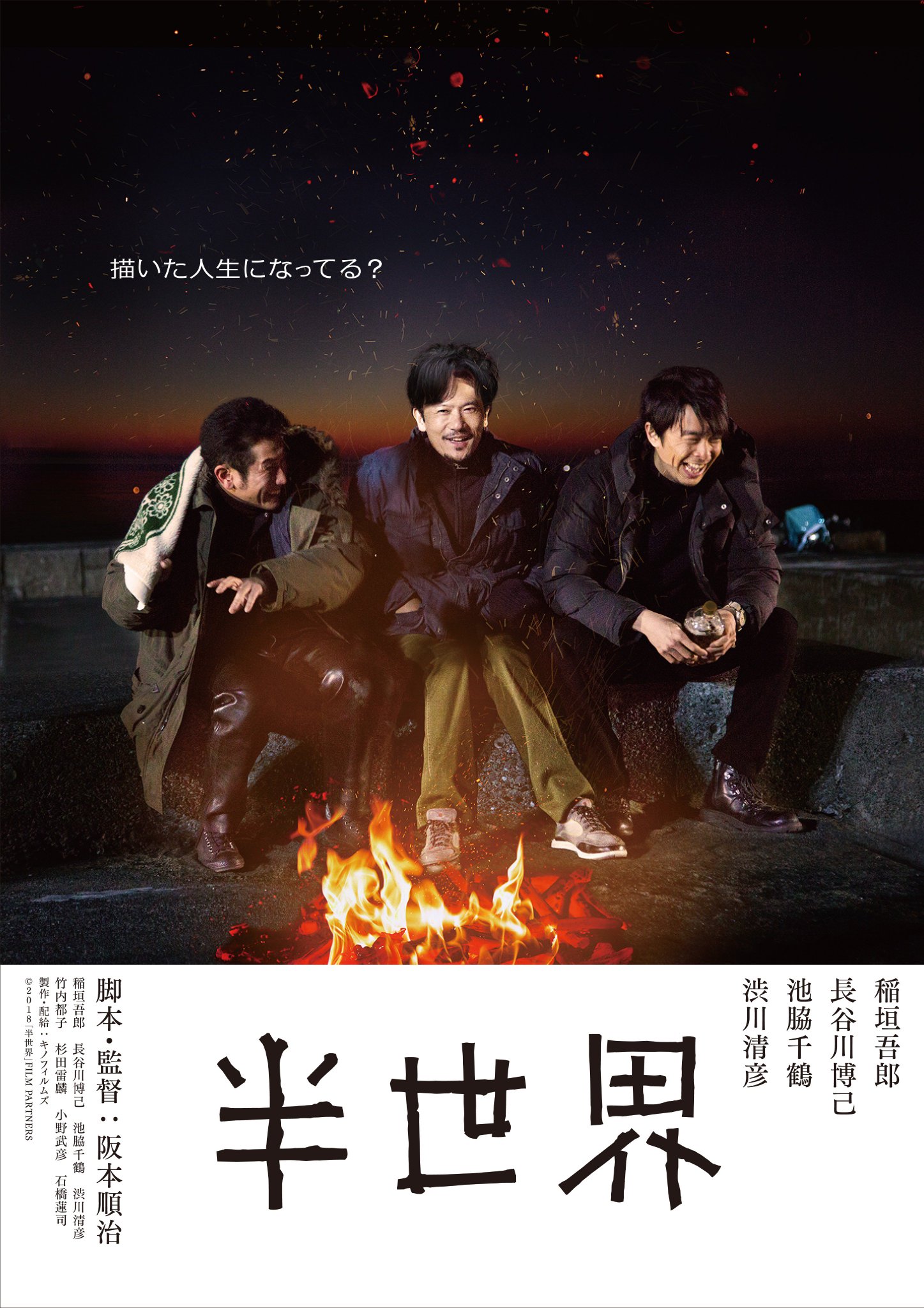


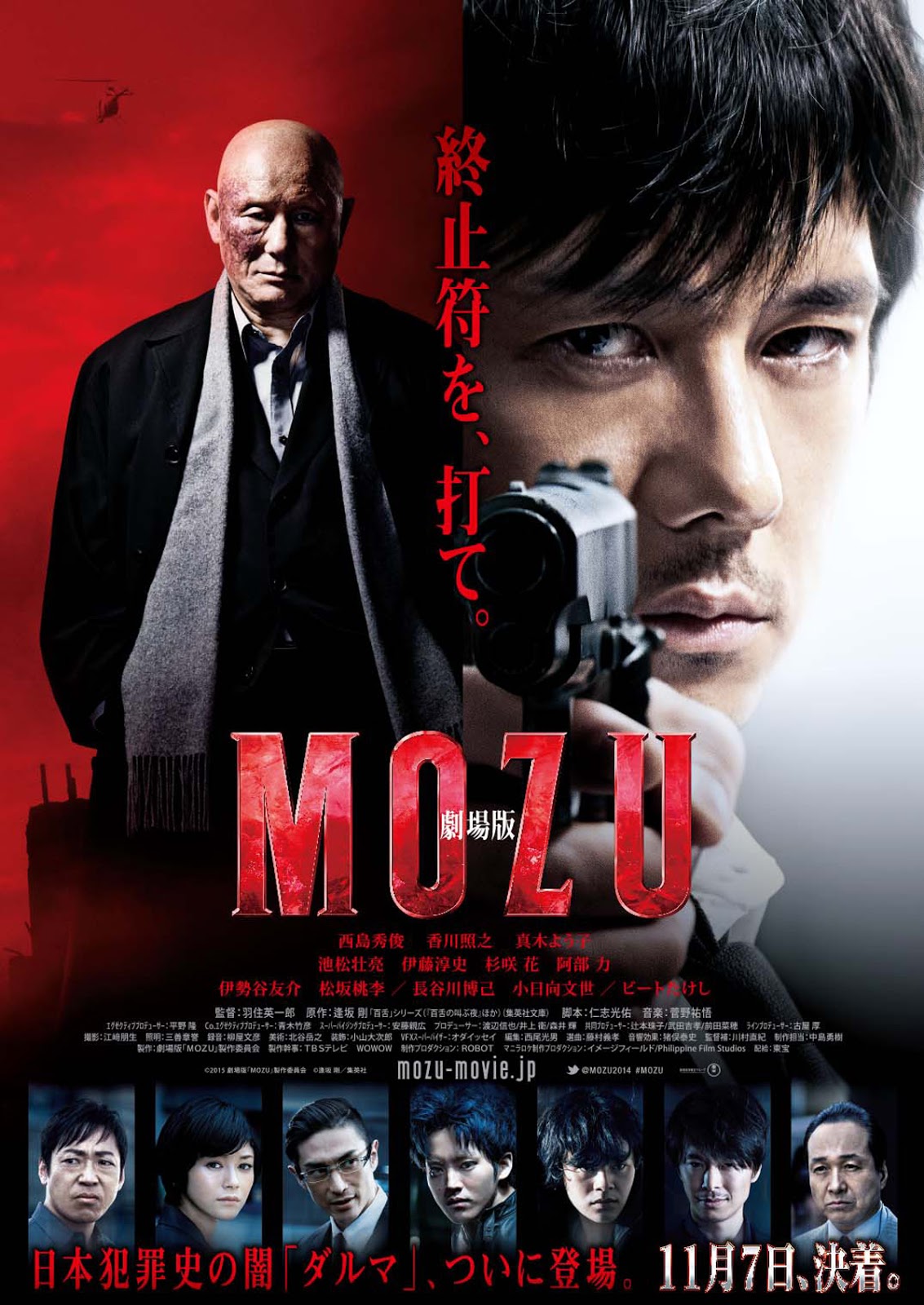 The criticism levelled most often against Japanese cinema is its readiness to send established franchises to the big screen. Manga adaptations make up a significant proportion of mainstream films, but most adaptations are constructed from scratch for maximum accessibility to a general audience – sometimes to the irritation of the franchise’s fans. When it comes to the cinematic instalments of popular TV shows the question is more difficult but most attempt to make some concession to those who are not familiar with the already established universe. Mozu (劇場版MOZU) does not do this. It makes no attempt to recap or explain itself, it simply continues from the end of the second series of the TV drama in which the “Mozu” or shrike of the title was resolved leaving the shady spectre of “Daruma” hanging for the inevitable conclusion.
 When Japan does musicals, even Hollywood style musicals, it tends to go for the backstage variety or a kind of hybrid form in which the idol/singing star protagonist gets a few snazzy numbers which somehow blur into the real world. Masayuki Suo’s previous big hit, Shall We Dance, took its title from the classic Rodgers and Hammerstein song featured in the King and I but it’s Lerner and Loewe he turns to for an American style song and dance fiesta relocating My Fair Lady to the world of Kyoto geisha, Lady Maiko (舞妓はレディ, Maiko wa Lady) . My Fair Lady was itself inspired by Shaw’s Pygmalion though replaces much of its class conscious, feminist questioning with genial romance. Suo’s take leans the same way but suffers somewhat in the inefficacy of its half hearted love story seeing as its heroine is only 15 years old.
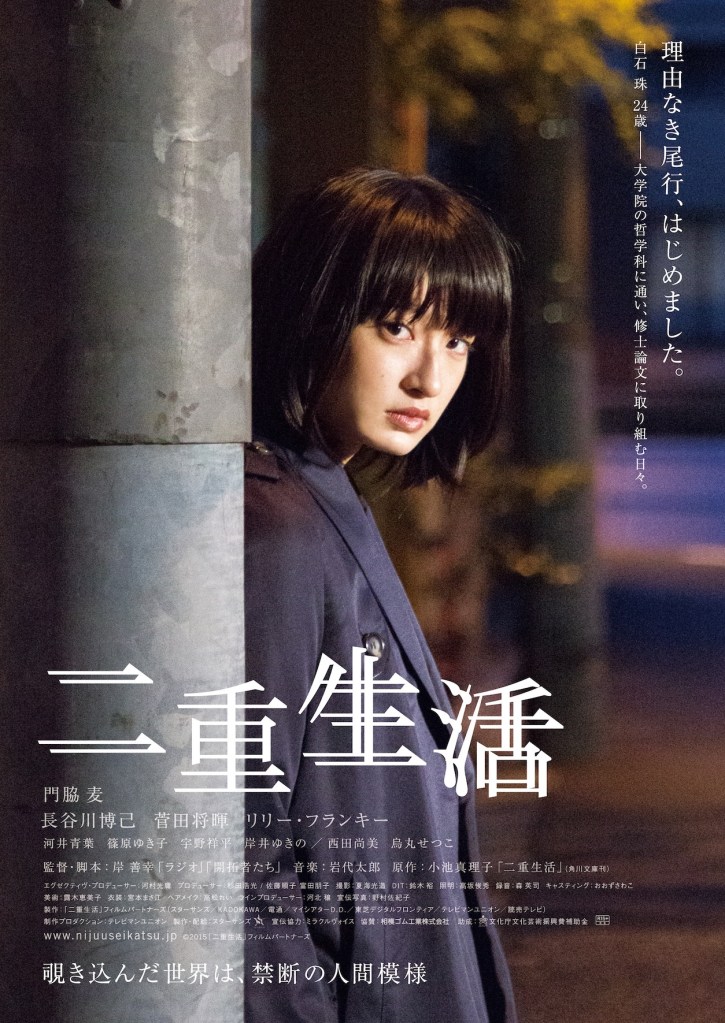 A Double Life (二重生活, Nijyuu Seikatsu ), the debut feature from director Yoshiyuki Kishi adapted from Mariko Koike’s novel, could easily be subtitled “a defence of stalking with indifference”. As a philosophical experiment in itself, it recasts us as the voyeur, watching her watching him, following our oblivious heroine as she becomes increasingly obsessed with the act of observance. Taking into account the constant watchfulness of modern society, A Double Life has some serious questions to ask not only of the nature of existence but of the increasing connectedness and its counterpart of isolation, the disconnect between the image and reality, and how much the hidden facets of people’s lives define their essential personality.

 Originating as an ongoing manga series by Akiko Higashimura which was also later adapted into a popular TV anime, Princess Jellyfish adopts a slightly unusual focus as it homes in on the sometimes underrepresented female otaku.
 Windows on Worlds