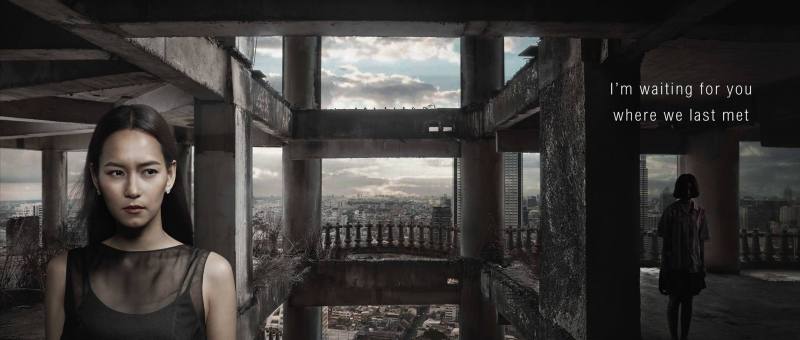
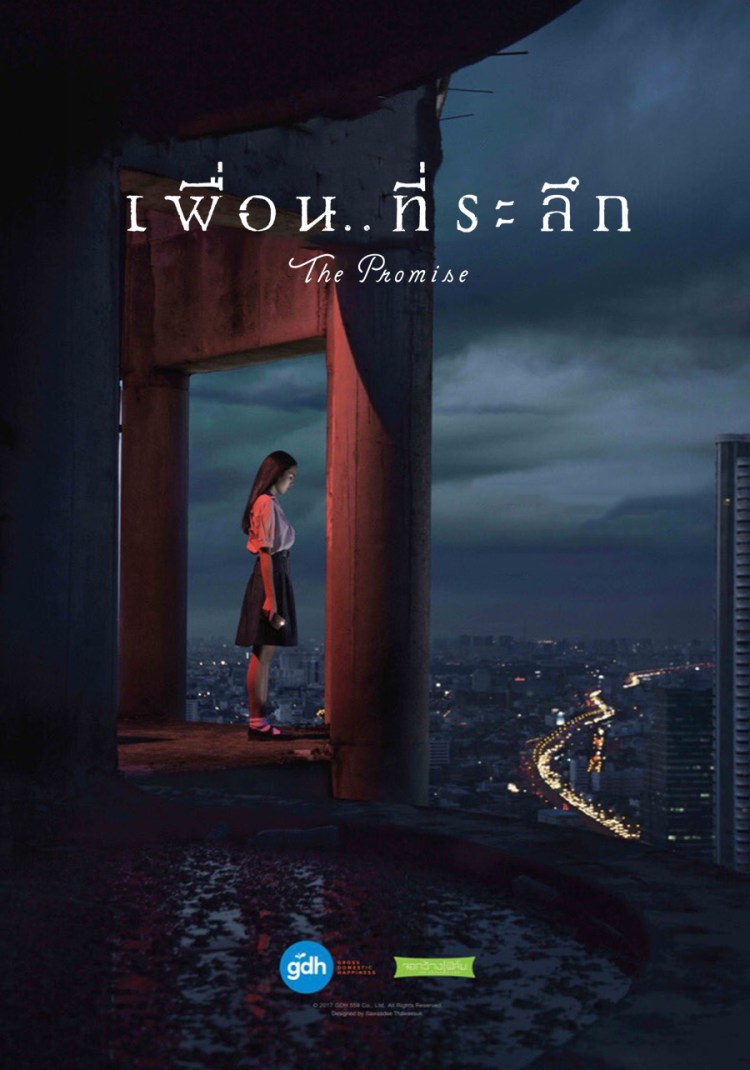
The Promise (เพื่อน..ที่ระลึก, Sophon Sakdaphisit, 2017)

The Promise Thai 2018 poster20 years on the Asian financial crisis continues to loom large over the region’s cinema, providing fertile ground for extreme acts of transgression born of desperation in the wake of such a speedy decline. Sophon Sakdaphisit’s ghost story The Promise (เพื่อน..ที่ระลึก, Puen Tee Raluek) places the financial crisis at its centre in its cyclical tales of betrayed youth who find themselves paying heavily for their parents’ mistakes through no fault of their own. Yet there is a fault involved in the betraying of a sacred promise between two vulnerable young people made half in jest in a fit of pique but provoking tragic consequences all the same. Sometimes lonely death chases the young too, trapping them in solitary limbo growing ever more resentful of their heinous betrayal.

In 1997, Ib (Panisara Rikulsurakan) and Boum (Thunyaphat Pattarateerachaicharoen) are best friends. Daughters of wealthy industrialists making an ill fated move into real estate with the building of a luxury tower block destined never to be completed, Boum and Ib may have been separated by being sent to different schools, but they spend all of their free time together, often hiding out on the construction site fantasising about sharing an apartment there and listening to sad songs on Ib’s ever present Discman.

When the crisis hits and their fathers are ruined, the girls pay the price. Not only are they left feeling betrayed and humiliated in being so abruptly ejected from their privileged world of mansions and horse riding, but also suffer at the hands of the fathers they now despite – Ib more literally as she is physically beaten by her strung out, frustrated dad. Already depressed, Ib talks ominously about a gun her mother has hidden in fear her father may use it to kill himself. When Boum falls out with her mum, she gives the go ahead for a double suicide but can’t go through with it after watching the twitching body of her friend, lying in a pool of blood after firing a bullet up through her chin.

20 years later, Boum (Numthip Jongrachatawiboon) is a successful industrialist herself, apparently having taken over her father’s company and turned it around. The economy is, however, once again in a precarious position and Boum’s business is floundering thanks to a set back on a high profile project. The idea is floated to finish the tower left incomplete by the ’97 crisis to which Boum reluctantly agrees. Meanwhile, Boum’s daughter Bell (Apichaya Thongkham) is about to turn 15 – the same age as she was when she agreed to die with Ib, and has recently started sleepwalking in ominous fashion.

Sophon Sakdaphisit neatly compares and contrasts the teenagers of 20 years ago and those of today and finds them not altogether different. In 1997, Boum and Ib keep in touch with pagers and visit photo sticker booths in the mall, splitting earphones to listen to a Discman while they take solitary refuge at the top of a half completed tower. In 2017, Bell never sees her friend in person but keeps in touch via video messaging, posting photos on instagram, and sending each other songs over instant messenger. Yet Bell, in an ominous touch, still graffitis walls to make her presence felt just as her mother had done even if she fetishises the retro tech of her mother’s youth, picking up an abandoned pager just because it looks “cool”.

In 2017, the now widowed Boum appears to have no close friends though her relationship with her daughter is tight and loving. A “modern” woman, Boum dismisses the idea that a malevolent spirit could be behind her daughter’s increasingly strange behaviour but finds it hard to argue with the CCTV footage which seems almost filled with the invisible presence of something dark and angry. Realising that the circumstances have converged to bring her teenage trauma back to haunt her – Ib’s suicide, the tower, her daughter’s impending birthday, Boum is terrified that Ib has come back to claim what she was promised and plans to take her daughter in her place in revenge for her betrayal all those years ago.

Bell is made to pay the price for her mother’s mistakes, as she and Ib were made to pay for their fathers’. Motivated by intense maternal love, Boum nevertheless is quick to bring other people’s children into the chain of suffering when she forces a terrified little boy who has the ability to see ghosts to help her locate the frightening vision of her late friend as she darts all over the dank and spooky tower block, threatening the financial security of his family all of whom work for her company and are dependent on her for their livelihoods.

In order to move forward, Boum needs to address her longstanding feelings of guilt regarding her broken promise – the suicide was, after all, her idea even if she was never really serious and after witnessing her friend die in such a violent way, she simply ran away and left her there all alone and bleeding. Yet rather than attempting to keep her original promise Boum makes a new one with her imperilled daughter – that she will keep on living, no matter what. The slightly clumsy message being that commitment to forward motion is the only way to leave the past behind, accepting your feelings of guilt and regret but learning to let them go and the ghosts dissipate. Sophon Sakdaphisit makes use of the notorious, believed haunted Bangkok tower to create an eerie, supernaturally charged atmosphere of malevolence but the ghosts are in a sense very real, recalling the turbulence of two decades past in which fear and hysteria ruled and young lives were cut short by a nihilistic despair that even friendship could not ease.


Screened at the 20th Udine Far East Film Festival.

International trailer (English subtitles)

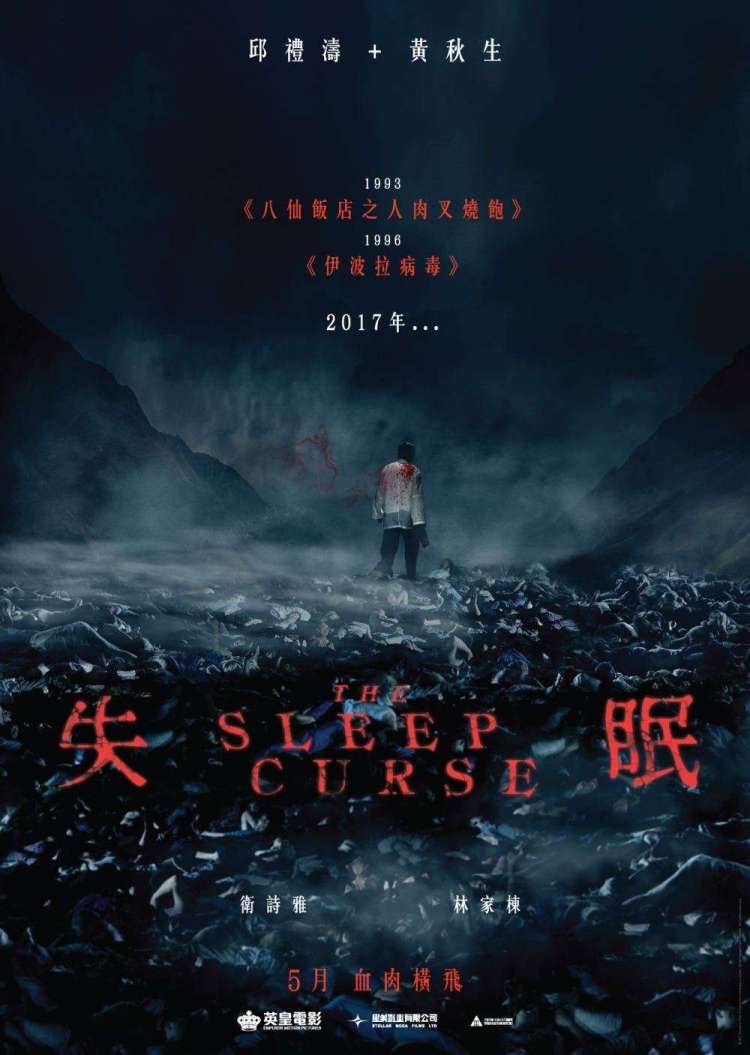
The Sleep Curse (失眠, Herman Yau, 2017)

sleep curse posterInsomnia can be like a curse, a yearning for sleep that yields no rest and paints the days with a lingering greyness but the regular kind of sleeplessness rarely has consequences as extreme as those experienced by the beleaguered protagonists of Herman Yau’s The Sleep Curse (失眠). Historical trauma and cultural memories continue to haunt the present, the refusal to lay the dead to rest giving rise to a hundred hungry ghosts all asking for recognition and some gesture of atonement from those that have come later. Yau’s film touches on some thorny, even taboo areas but doing so in the context of a Category III horror extravaganza that eventually descends into a bloodbath of perverse depravity might even push poor taste too far.

In 1990, a Malaysian Chinese grandfather celebrates his birthday and then develops chronic insomnia which eventually drives him insane, murderous, and suicidal. Meanwhile, abrasive professor Lam Sik-ka (Anthony Wong) is hard at work on a controversial research programme to discover a way for people to live without the need for sleep. His latest grant application has just been turned down because the university can’t see the benefit in his research and claim his methods are unethical. Sik-ka is, therefore, even happier than might be thought to reunite with a former girlfriend, Monique (Jojo Goh), who is the granddaughter of the Malaysian Chinese grandpa and suffers from a rare sleep disorder herself. It’s not for herself she’s approaching Sik-ka though, but for her brother.

For unrelated reasons, Sik-ka is also anxious to lay his own father’s ghost to rest by visiting a Taoist priest to help him remember what happened to his dad back in 1943. What ensues is two lengthy flashbacks to occupied Hong Kong in which Sik-ka’s father, Sing (also played by Wong), is coerced into collaborating with the Japanese when it is discovered that he was raised in Japan and has fluent command of the language. While Sing’s capitulation is guilt-ridden and born of fear for himself and his family, another turncoat, Chow Fok (Gordon Lam), has embraced his role as an active participant in Japanese rule, rounding up girls for the local “comfort station” which he himself runs.

The Japanese are an easy target, but Yau has his sights set on the evils of collaboration and his eye is particularly unforgiving. Sik-ka’s father is repeatedly described as a “good man”, though often by those seeking to justify his less good actions. The film acknowledges the difficulty of Sing’s position as a single father desperate to protect his son and mother yet fearing that one wrong move or unwise refusal may get them all killed. He does good where he can – helping a small number of young comfort women to escape, but finds that his “good” deed provokes only more harm when 40 are required to take the place of four escaped. Sing saves one of twins, “awarded” to him in place of a wife by the lecherous Japanese Colonel, but finds himself the subject of a curse by her supernaturally endowed sister who casts her evil eye upon all those who have wronged her.

This particular plot development makes little sense seeing as Sing is the one thing between her sister and the fate worse than death that she has just endured. Nevertheless, the vengeful ghost of a betrayed woman follows one generation to the next in her quest for retribution, remaining unseen and unremembered by those who should avenge her. Given the sensitivity of the issues, which maybe more pronounced in territories further North than Hong Kong, it is perhaps in poor taste to make them the centre of an exploitation leaning Category III horror film, offering only the message that the unresolved past will eventually consume the children who inherit only past trauma from their guilt ridden (or unrepentant) forebears.

Yau begins in the mode of tame absurdity as Sik-ka calmly breaks into a morgue for an impromptu bit of brain theft (later shoving his loot into a hollowed out durian fruit to hide his crime), but descends into blood soaked depravity in the increasingly strange final reel. Genuinely outrageous, though also incoherent, The Sleep Curse should provoke nightmares enough with its shocking, gore filled finale but may also leave a sour taste in the mouth.


Original trailer (Cantonese with English subtitles – contains intense gore/violence!)

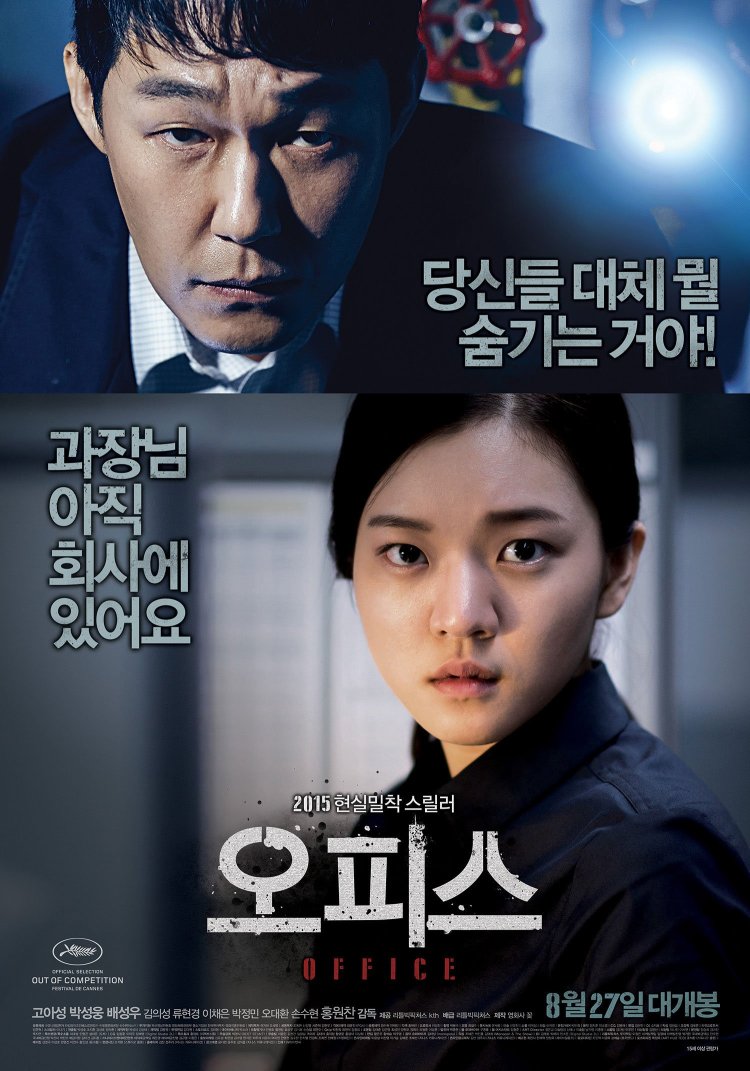
Office (오피스, Hong Won-chan, 2015)

office posterThe pressure cooker society threatens to explode in Hong Won-chan’s Office (오피스). The writer of recent genre hits The Chaser and The Yellow Sea, Hong has long experience of examining those living on the edge but in his directorial debut he takes things one step further in depicting an entire society running to keep up with itself, furiously chasing its own tail with barely suppressed rage. Not so much survival of the fittest as survival of the least scrupulous, the world of Office is the one in which the mad become the most sane, escaping the constraints of corporate oppression through social revenge but taking the innocent along with them.

Salaryman Byun-guk (Bae Seong-woo) has the soulless eyes of one whose dreams have already died. Dejectedly he sits alone at a coffee shop before cramming himself into the commuter train home where he sits, silently, among his busy family. They wonder why he hasn’t changed out of his suit, shed his corporate persona for his familial one, but when Byung-guk gets up he returns brandishing a hammer which he then, as if in a trance, uses to bludgeon to death his loving wife, disabled son, and senile mother.

Byun-guk flees the scene of crime and is loose somewhere in the city. The police search his office for clues but his colleagues have already come up with their unified version of events, keeping the company out of it by claiming that they all loved Byun-guk and are shocked that he could have done something so horrifying. Meanwhile, intern Mi-rae (Go Ah-sung), who regarded Byun-guk as her only friend in the office, is upset but perhaps not quite so shocked. Excluded from the interoffice cliquery, no one has thought to brief Mi-rae on the party line leaving her a prime target for police inspector Choi (Park Sung-woong).

Byun-guk and Mi-rae are two of a piece – members of the upright and hardworking lower classes who have done everything right but somehow have never been accepted by their peers. Mi-rae, an ordinary girl from Gwangju who worked to lose her accent in her teens dreaming of the high life in Seoul, is shy and mousy but works hard – harder than anyone, to prove herself worthy of Seoul’s unrealistic demands. Her colleagues, privileged, confident, and also harried, do not forgive her for this. They find her earnestness “creepy”, her desire to succeed “suspicious”. Cruelly taken down a peg or two by a colleague taking out her own frustrations on the office nobody, another tries to comfort her with some advice – don’t try so hard, you make us all look bad and we wonder what your need is hiding. Mi-rae isn’t really hiding anything save her slowly fragmenting mental state and the overwhelming need to be accepted to a club that, in truth, is not open to people like her who value their integrity and still believe deep down that working hard and being honest are the only paths to true success.

Korean society, it seems, has become a giant chain of screaming. Byun-guk has been repeatedly passed over for promotion despite being the most reliable employee in the office but his ineffectual boss is overly wedded to the shouting school of business management. Faced with results he doesn’t like, Byun-guk’s boss picks someone to shout at to make them better but offers no further guidance. Railing at the police for not doing their job as if screaming will some how provoke major results even outside of the office, the boss can’t know that police also have their own chain of screaming and Choi has his own boss already taking care of that side of things, demanding results rather than truth or justice.

The meek are taking their inheritance ahead of schedule, but their revenge is born both of societal corruption and rejection. People like Byun-guk and Mi-rae, who are quiet, honest, kind but perhaps not good with people, become the bugs in a system which simultaneously holds them up as essential cogs. Those who cannot just pretend, grease the wheels with superficial social niceties, and accepted their place in the chain of screaming in order to climb further up it are condemned to wander idly around its lower levels going quietly mad until, perhaps, the system crushes them or else collapses.


International trailer (English subtitles)
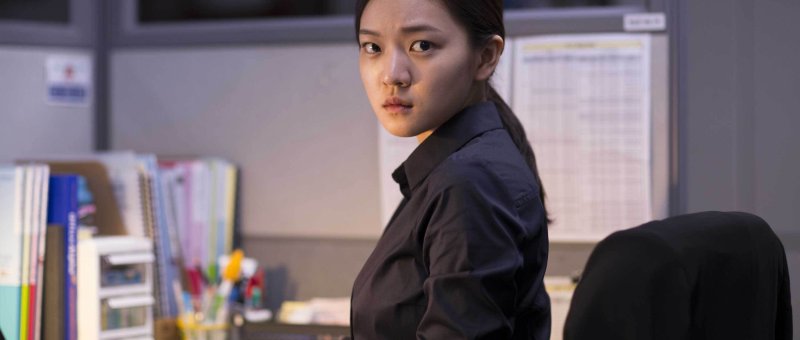
The Mimic (장산범, Huh Jung, 2017)

The mimic posterFears of changeling children and their propensity to become cuckoos in the nest is a mainstay of folklore horror, but in recent times the creepy kid has crept his way in from the cold as the current monster of choice. The Mimic (장산범, Jangsanbum), though apparently completed some time earlier, has a few superficial similarities to Na’s The Wailing in its use of powerful, ancient myths and shamanic lore to conjure its particular brand of evil. If Na’s film was sometimes criticised for its obtuse ambiguity Huh has the opposite problem in failing to properly support his internal mythology with an appropriate level of consistency.

Hee-yeon (Yum Jung-ah) packs up her life including husband (Park Hyuk-kwon), mother-in-law (Heo Jin) suffering with dementia, little girl Jun-hee (Jang Liu) and a box of painful memories and moves to Mount Jang – her mother-in-law’s hometown. The move is intended to help the family put the past behind them and move on after Hee-yeon’s son disappeared without trace five years previously, but it’s not long before Hee-yeon is catching sight of small boys in ragged clothes on the streets around Mount Jang and convincing herself she’s seen her little boy despite the distance from the place where he disappeared and that he’d now be five years older than the version she has stored in her memory.

With Hee-yeon’s mental state already strained, she runs into trouble when a pair of earnest children arrive hoping one of the dogs in the kennel facility the family are running might be their missing puppy. It isn’t but their search leads them to a creepy walled up cave where they’re attacked by a malevolent entity. While her husband is helping the children and investigating the cave, Hee-yeon comes across a strange little girl (Shin Rin-ah), apparently lost, and dressed in an old fashioned velvet dress with a lace collar. The girl disappears while the Hee-yeon and her husband are busy with the police but later turns up at the couple’s home and worms her way inside, eventually claiming that her name is Jun-hee too, just like Hee-yeon’s daughter.

The central conceit is that the malevolent entity existing around Mount Jang mimics the voices of (usually dead) loved ones in order to convince its victims to surrender themselves voluntarily. Huh sets up Hee-yeon’s mental instability early on as she nervously guzzles pills to help her regain her grip on reality, but there after abandons it, never questioning the real existence of threat or Hee-yong’s relationship to the little girl whom she at times strangely believes to be her son. The little girl remains a typically creepy kid, originally mute and then mimicking Jun-hee but apparently unthreatening in and of herself. The cuts and bruises across the little girl’s back might explain her silence with her immediate adoption of a Jun-hee persona a kind of rejection of her original personality, but the film has already lost interest in rational explanations.

Hee-yeon, despite a degree of distance towards her daughter, immediately takes to the little girl, bringing her into the house with an intention to keep her despite her husband’s reservations. The desire to save this lost little girl is, of course, a kind of reaction to the loss of her son whom she seems to see in the little girl even without her supernatural gift of mimicry. Hee-yeon blames herself for the unknown fate of her little boy who disappeared after she left him with her mother-in-law (already suffering with dementia) in a busy foodcourt. Granny may have more clues, but if she has they’re irretrievably locked inside her fracturing mind. Having grown up in the surrounding area and being aware of the legends since childhood, granny is also a good person to ask about the strange goings on – only no one does because they assume she is not mentally stable. Hence when she alone knows to cover up mirrors and is suspicious of the little girl, everyone thinks it’s the dementia talking.

Symbolically the choice which is presented is between past and future, life and death, in the knowledge that the two are mutually exclusive. The liminal space of the cave becomes its own purgatorial courtroom in which Hee-yeon, and the other victims, must decide for themselves who or what they believe and which sort of existence they wish to embrace. For Hee-yeon her trial involves the abandonment of another child as a final goodbye to her long absent son, pulling at her fragile maternity and testing each and every aspect of it (though not, perhaps, that related to her remaining daughter who seems to have been temporarily forgotten). Huh makes fantastic use of soundscapes and intriguing use of mirrors, but even the high quality photography and committed performances can’t quite overcome the hollowness of his mythology, robbing his dark fairytale of its essential power.


Screened at London Korean Film Festival 2017. Also screening at Showroom Cinema, Sheffield, 15 November 2017, 8.30 pm

International trailer (English subtitles)
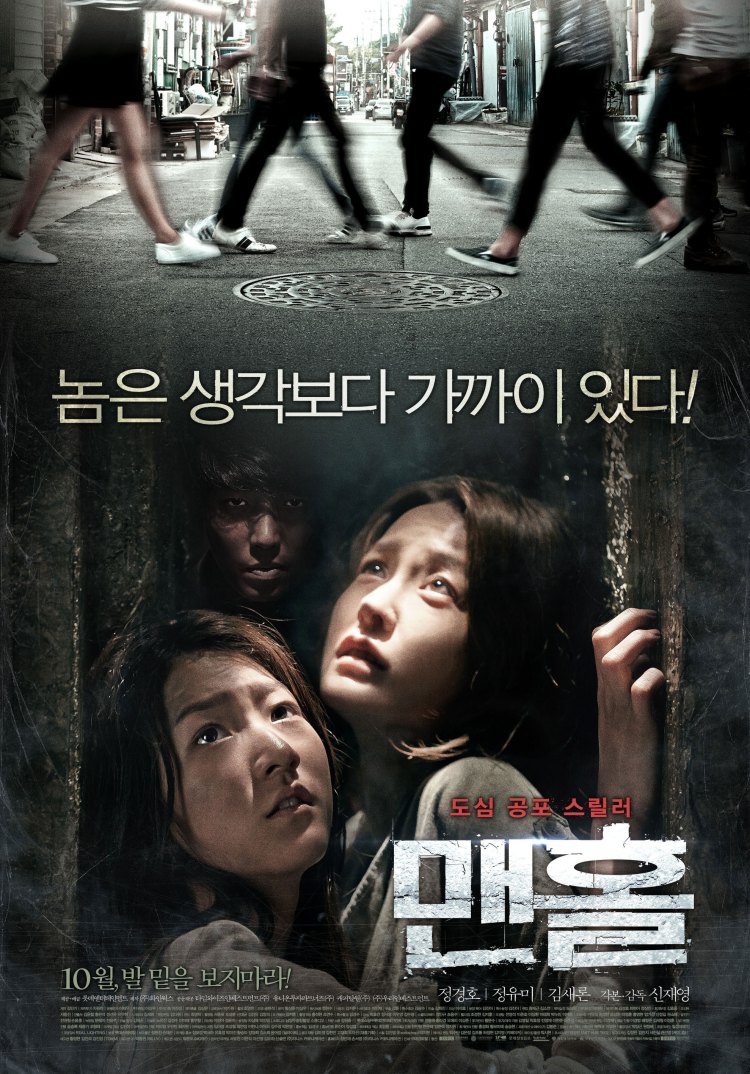
Manhole (맨홀, Shin Jae-young, 2014)

manhole posterFinding the sinister in the commonplace is the key to creating a chilling horror experience, but “finding” it is the key. Attempting to graft something untoward onto a place it can’t take hold is more likely to raise eyebrows than hair or goosebumps. The creators of Korean horror exercise Manhole (맨홀) have decided to make those ubiquitous round discs the subject of their enquiries. They are kind of worrying really aren’t they? Where do they go, what are they for? Only the municipal authorities really know. In this case they go to the lair of a weird serial killer who lives in the shadows and occasionally pulls in pretty girls from above like one of those itazura bank cats after your loose change.

Of course, it’s sort of our first victim’s fault because she’s dared to go out late at night on her own and committed the cardinal sin of shouting at her over protective father on the phone shortly before realising she’s wandered into a horror movie by mistake. The lights start flickering, everything goes wavy and then you’re being pulled down a manhole. Not cool.

Anyway, the real story is about two sisters. Yeon-seo (Jung Yu-Mi) is now the sole guardian of Soo-jeong (Kim Sae-Ron) following the death of their parents and also seems to be harbouring some kind of guilt over an accident that left Soo-jeong permanently deaf. Perhaps a little over protective as a consequence, Yeon-seo instructs Soo-jeong to stay in their apartment and wait for her to get back. Soo-jeong, however, is old enough to push the boundaries and ventures out alone to meet her sister on her way home with an umbrella. Unfortunately, she catches sight of the killer along the way and is soon trapped in the sewer like everyone else, apparently. Yeon-soo tries to call the police but they aren’t interested so she has little choice but to track her sister’s phone and journey underground herself. She’s joined (well, they’re there at the same time) by the father of the first victim (Choi Duk-Moon) who happens to be a former policeman, now in possession of a gun stolen from a friend also set to make a fateful descent at a later point.

Manhole is a very confused film. Unable to decide who its protagonist(s) is (are), it meanders freely between its disparate plot strands without ever managing to build coherent connections between them. Though the sisters are posited as the main element of the story, they take quite a long time to arrive and are then frequently sidelined in favour of other ongoing developments. Their story is undoubtedly the most interesting as it presents an unusual plot device in which they remain unable to communicate verbally during their attempts to escape from the sewers and it’s nice to see sign language used so ordinarily in a genre film, yet even their meagre backstory is painted in broad strokes and through flashbacks once again making it difficult to fully connect with them as they battle the threat in the shadows.

The role of the killer, Soo-chul (Jung Kyoung-Ho), is also a difficult one as he is neither protagonist nor generic threat but given a small amount of flashback backstory delivered in monologue to his victims which only serves to make him a frustrating presence. Manhole seems as if it has a point to make about families in that Soo-chul is a damaged child of a broken home, both trying to avenge himself and regain what he’s lost by, in a sense, “recreating” a family through his kidnappings. Frequent glances towards the prominently displayed portrait of the ideal family contrast with the other relationships in the film – Jong-ho and his hunt for his missing daughter, and the bond between the two sisters. Both of these family units are also missing elements – the sisters who’ve lost their parents and Jong-ho as a lone father. Neither of the parental figures in the film is fully able to protect their charges despite appearing controlling and over protective prior to the incident though no particular reason seems to be offered for this other than praising parental sacrifice in allowing both to fight all out to protect those closest to them.

What Manhole tries to be is a chase film, confining itself to the sewer environment as its crazed killer crawls around it like the literal beast in the shadows, cocooning victims in clingfilm and wearing bug-like bright red night vision goggles. Though exciting enough the frequent cutaways and over reliance on shaky cam disrupt the claustrophobic atmosphere as do the stereotypical jump scares and framing which feel as predictable as the final sequence of a video game in which the idea is to dodge the falling axes. Muddled and inexpertly photographed, Manhole is a disappointing genre exercise which even the generally strong performances of its cast can’t mask. Still, hardcore genre fans may find more to admire in the gore stained darkness of the oddly accessible sewer network and its lizard-like psycho killer.


International trailer (English subtitles)
https://www.youtube.com/watch?v=F-OqZSyZ6i8

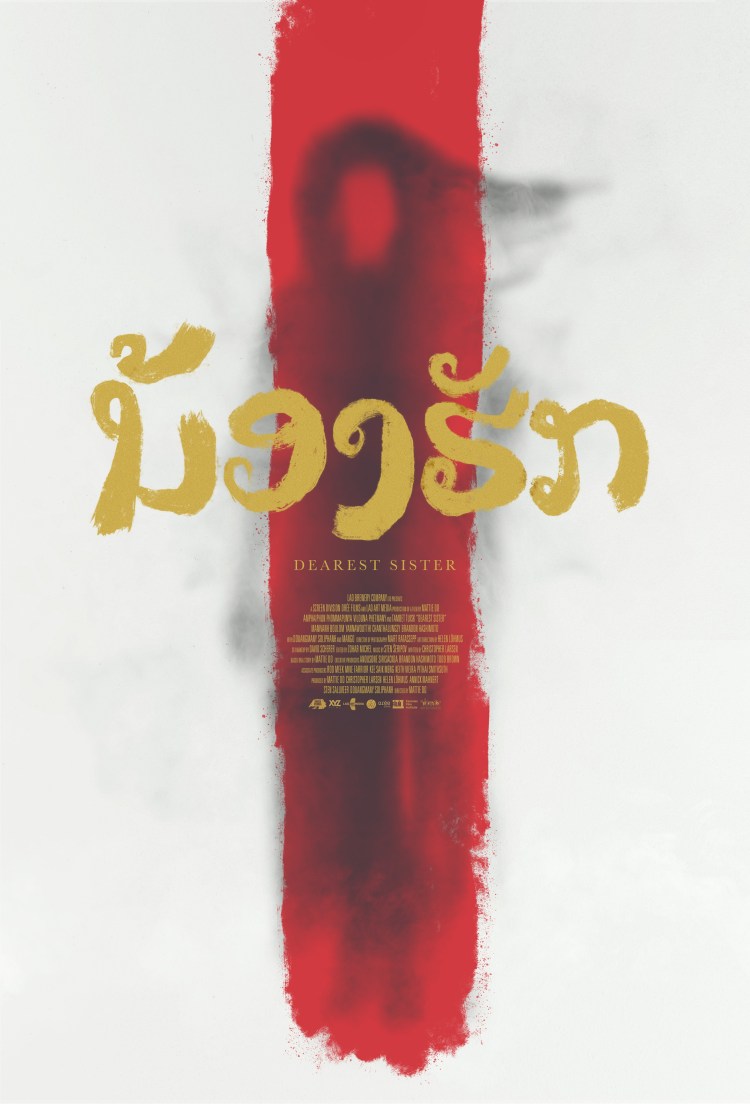
Dearest Sister (ນ້ອງຮັກ, Mattie Do, 2016)

dearest sister posterMarxist countries and horror movies often do not mix. Laos has only a fledgling cinema industry and Mattie Do, returning with her second film Dearest Sister (ນ້ອງຮັກ, Nong hak), is its only female filmmaker even if she finds herself a member of an extremely small group. Set in Laos it may be, but Dearest Sister also has something of the European gothic in its instantly recognisable tale of a good country girl fetching up in the city only to be treated like a poor relation and eventually corrupted by its dubious charms. Dearest Sister is a horror movie but one which places very real fears, albeit ones imbued with superstition, at the forefront of its tragedy.

Nok (Amphaiphun Phommapunya) is a poor girl from the country. She’s been given a good opportunity though one she perhaps would not have sought. She’ll be leaving her village and going to the big city to look after a distant relative whom she has never met. Stopping off at a temple to pray before she leaves, Nok’s boyfriend angrily skulks off, lamenting that she’ll be gone at least a year and will probably have found herself a European husband before the time is up.

When she arrives in the city Nok is met by an impatient European who turns out to be Jakob (Tambet Tuisk), the husband of her mysterious relative, Ana. Nok is to be a kind of paid companion, looking after Ana (Vilouna Phetmany) who is in poor health. Slowly losing her sight, Ana has strange episodes and frightening visions, sometimes injuring herself in a trance state that she will remember nothing of after she wakes up.

This is a land of ghosts but they’re less of the literal than the spiritual kind as Nok and Ana chase spectres of the same dream which continues to elude them both. Ana, it seems, is from a middle class background but her parents are quick enough to touch her husband for money they can use for material pleasures, barely acknowledging Ana’s ongoing health issues. Marrying Jakob perhaps means marrying out as well as up, but it hasn’t brought her the life of freedom she dreamed of even if it has made her more comfortable. Jakob’s behaviour flits between loving husband, impatient spouse, and controlling master as he, at one minute, appears to genuinely worry about his wife’s need for treatment and the next argues with a doctor about medicating her with the kind of drugs you only really hear about on TV.

When Nok arrives in the house she alters the dynamic. If Jakob wanted her to be a kind of human pet, keeping Ana company and perhaps keeping her sane in the process, his plan backfires. The two women are in someway related, though neither of them is aware precisely how (apparently they are distant cousins), but Nok has come there as an employee, not a guest. Caught between two worlds, Nok is not “family” enough to enjoy a free and friendly relationship with Jakob and Ana, but she’s not a servant either as Ana’s constant reminders that they have a maid to take care of the housework bare out. Playing the mistress, Ana is not a cruel harridan but is determined to exert her authority and so servants live outside the main house, while Nok lives “inside” – a key distinction but one which leaves her in a halfway home.

When she first arrives at Ana’s, Nok is an innocent country girl, fully intending to send the money she makes back to her family and rejects another maid’s suggestion of a night on the town because she has a boyfriend waiting for her back in the village. Skimming a small amount of money to pay for credit to use on her broken phone starts Nok off on a journey to the dark side as she gets distracted, misses the bank and buys lottery tickets with the money instead. A simple country girl, Nok does not quite know how to live the high class life (as the titters in a restaurant make her realise when she orders wine but doesn’t know why the waiter doesn’t pour a whole glass) but she wants it anyway.

Nok and Ana were not so different. Nok’s family only seem to ring her to ask where the money is and eventually the village life she’d begun to become nostalgic for seems to have forgotten her already. Tragically both women want the same thing which is to live comfortably, but also with love. Nok’s isolation drives her deeper into a cycle of avarice and resentment, whereas the imposed isolation of Ana’s illness deepens her sense of neurosis and mistrust of her new environment. Eventually greed mingles with dread as both women long to escape their fates but are resigned to the inevitability of their eventual downfall not just heralded by spirits but haunted by a culture.


Streaming in the UK exclusively on Shudder.

Original trailer (English subtitles)

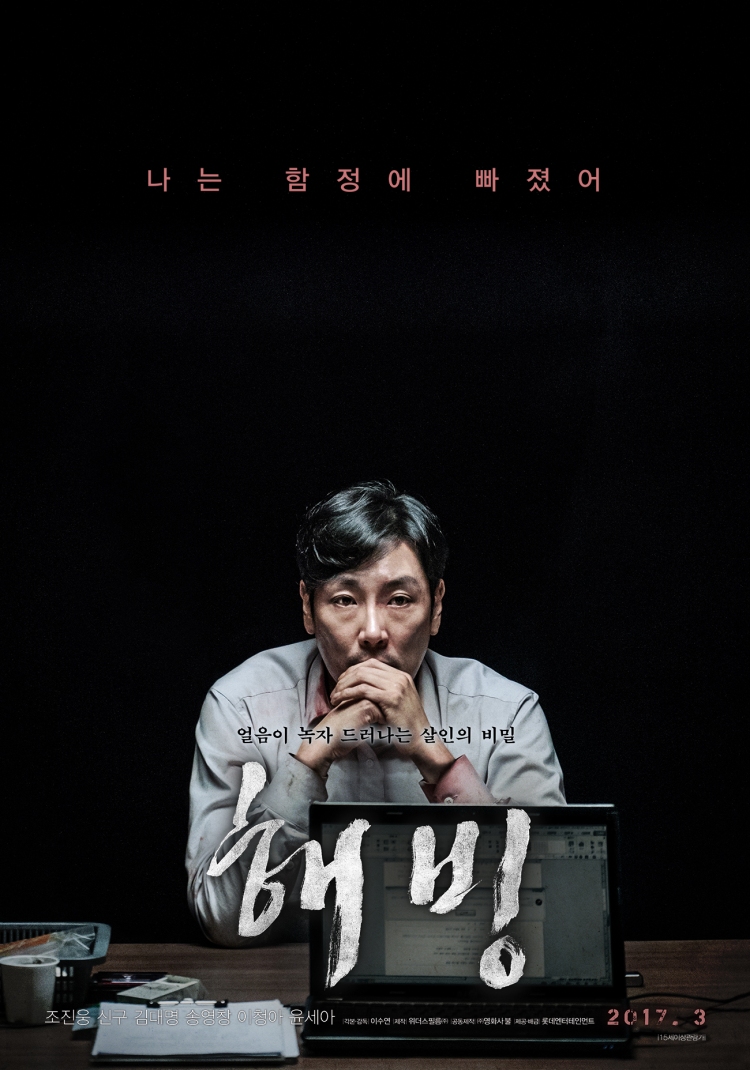
Bluebeard (해빙, Lee Soo-youn, 2017)

bluebeardIf you think you might have moved in above a modern-day Sweeney Todd, what should you do? Lee Soo-youn’s follow-up to 2003’s The Uninvited, Bluebeard (해빙, Haebing), provides a few easy lessons in the wrong way to cope with such an extreme situation as its increasingly confused and incriminated hero becomes convinced that his butcher landlord’s senile father is responsible for a still unsolved spate of serial killings. Rather than move, go to the police, or pretend not to have noticed, self-absorbed doctor Seung-hoon (Cho Jin-woong) drives himself half mad with fear and worry, certain that the strange father and son duo from downstairs have begun to suspect that he suspects.

Seung-hoon has only just moved into this very modest apartment after a recent setback in his career and personal life. Once the owner of an upscale practice in Seoul’s trendy Gangnam (not usually known for its doctor’s surgeries), Seung-hoon is bankrupt, divorced, and working as a colonoscopy specialist in a local clinic which just happens to be situated in a run down industrial town that everyone knows the name of because it’s that place where all those murders happened.

Used to better things, Seung-hoon finds his new job boring and annoying. Though members of staff at the clinic including pretty nurse Mi-yeon (Lee Chung-ah) do their best to make him feel at home, Seung-hoon spends all his time alone staring into space and eating snacks in the treatment room rather than enjoying proper meals with the others in a nearby cafe. Despite being a bookish looking guy, Seung-hoon hasn’t much taste for literature but loves his mystery novels. When his landlord’s family use him as a connection to get the elderly patriarch in for a scan, it sparks a crisis in Seung-hoon’s already strained mind. Midway through the treatment, the old guy starts muttering about dumping body parts in a lake. Is he just senile and dragging something up from the news or a movie, is Seung-hoon’s overactive imagination coupled with a steady stream of grisly police procedurals playing tricks on him, or is this diminished yet creepy old duffer really responsible for a series of brutal killings?

The original Korean title means something like “ice melting” which gives a better indication of Lee’s intentions as long-buried evidence is unearthed by changing weather both mental and physical. Bluebeard, for those who don’t know, is a creepy horror story told to children in which a horrible old man imprisons and then murders all his wives. Seung-hoon’s suspicions are further aroused by the fact that all of the women associated with the guys downstairs seem to disappear. Then again, they are quite strange, so perhaps their wives really did just leave without warning.

Seung-hoon’s wife appears to have left him high and dry preferring to stay behind in the city rather than accompany him to this grim one horse murder town. The couple’s son wants to go to summer camp in Canada but Seung-hoon can’t quite afford it in his present difficulties. Now afraid to go home because of his creepy neighbours, Seung-hoon spends his nights curled up in the office where he accidentally discovers another employee’s morphine pilfering habit. Pushed to the edge, Seung-hoon’s mind starts to crack. Less concerned with the murderer than Seung-hoon’s fracturing mental state, Bluebeard neatly frames its hero whilst blithely wondering if he’s accidentally framing himself. Presented with a series of alternate histories, Seung-hoon’s memories seem increasingly unreliable and his paranoid, irrational behaviour less justifiable. When the ice melts the truth will be exposed, but it looks like it might be a long, cold winter for Seung-hoon.

Lee takes her time but builds an eerie, dread filled atmosphere where everything seems strange, suspect, and frightening. Seung-hoon has already hit rock bottom and may not have been such a great guy in the first place, but his descent into psychotic desperation and terrified paranoia is at the heart of the story which hinges on whether his suspicions are correct or if he’s simply read too many detective novels and has too much time on his hands now that he’s all alone. Anchored by a stand out performance from Cho, Bluebeard is an intricately designed, fascinatingly complex psychological thriller which carries its grimly ironic sense of the absurd right through to the cynical closing coda.


Bluebeard was screened at the 19th Udine Far East Film Festival.

International trailer (English subtitles)

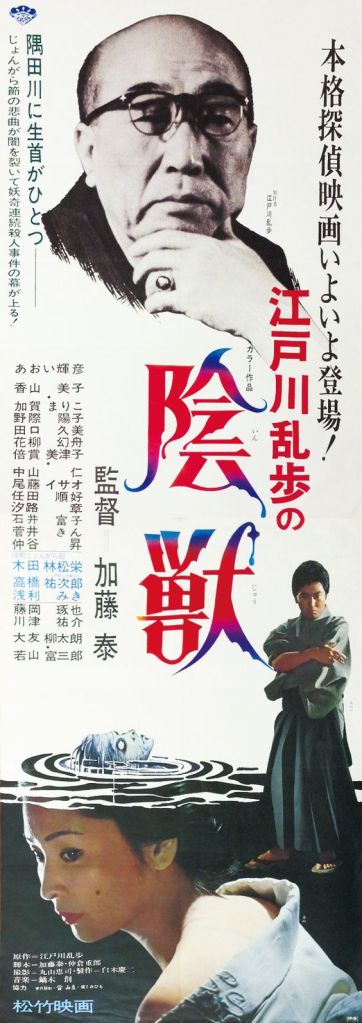
Edogawa Rampo’s Beast in the Shadows ( 江戸川乱歩の陰獣, Tai Kato, 1977)

Edogawa Rampo (a clever allusion to master of the gothic and detective story pioneer Edgar Allan Poe) has provided ample inspiration for many Japanese films from Blind Beast to Horrors of Malformed Men. So synonymous with kinky terror is his name, that it finds itself appended into the title of this 1977 adaptation of his novel Beast in the Shadows (江戸川乱歩の陰獣, Edogawa Rampo no Inju) by veteran director Tai Kato best known for his work in the yakuza genre. Mixing classic European detective intrigue with a more typically Japanese obsession with method over motive, Beast in the Shadows, like much of Edogawa Rampo’s work twists and turns around the idea of atypical sexuality, one side cerebral and another physical as the “Westernised” sadomasochism of the heroine’s husband becomes the driving force of the narrative.
Our hero, Koichiro Samukawa (Teruhiko Aoi), is a best selling author who likes to describe himself as the creator of “serious” mystery novels. In this he contrasts himself favourably with the coming younger generation who rely on sensationalised tricks and twists rather than the intricately plotted, traditionally constructed crime stories which Samukawa prides himself on writing. The particular object of his rage is a recently successful rival, Shundei Oe, who is making quite a splash in literary circles in part due to his mysterious persona. Refusing all in-person contact, Oe’s whereabouts are completely unknown and though he supplies a “real name” at the back of each book, there is great speculation as to who he really is, how he lives, and where he might be.

Down south to supervise a movie shoot based on one of his novels, Samukawa is thrilled to run into a fan – particularly as she’s such a beautiful young woman. Shizuko (Yoshiko Kayama) is the wife of a wealthy businessman, Oyamada, who has recently returned from an extended spell abroad though he doesn’t share her passion for literature even if he brings home such luxuries as fancy European gloves. The relationship moves beyond mutual appreciation when Shizuko asks for Samukawa’s help in investigating a series of threatening letters she’s been receiving from an old boyfriend who may or may not also be stalking her. The real kicker is that the letters purport to be from Shundei Oe – apparently the pen name being used by a man who fell deeply in love with Shizuko when he was a student but couldn’t take no for an answer when his creepy behaviour became too much for the then school girl. Though Samukawa is sure the letters are all talk and commits himself unmasking Oe for the perverted cretin he is, Shizuko’s husband is eventually murdered just as the letters threatened.

Though the final twist is one which most seasoned mystery lovers will have seen coming, Kato keeps the audience on its toes with plenty of intrigue and red herrings as Samukawa attempts to discover the truth behind the death of Shizuko’s husband as well as taking the opportunity to indulge in a little intellectual vanity by unmasking his rival. The movie subplot quickly gets forgotten but Samukawa is also helped/hindered by his publisher, Honda (Tomisaburo Wakayama), who keeps reminding him about the looming deadline for his latest work. The case at hand provides ample distraction for the harried writer whose writer’s block is only made worse by thoughts of Shundei Oe’s growing success and his resentment of this new, sensationalised form of crime novel which seems to be eclipsing his own.

If the way he acts in “real life” is anything to go by, Samukawa’s detective novels owe much to the European tradition but still, there’s a persistent fear of the foreign underlining much of the proceedings despite the heavy presence of Westernised clothing, music and culture which seems to diffuse itself throughout daily life. Shizuko’s husband may have just returned from abroad but it seems he brought back much more with him than some fancy gloves and an elegant English mistress (pointedly named Helen Christie). The English style riding crop in Oyamada’s study is not mere affectation but the cause of the nasty looking wound on Shizuko’s shoulder which first caught Samukawa’s attention. Oyamada’s sadistic tendencies are posited as a credible reason he could himself be masquerading as Oe, getting off on driving his wife half crazy with fear, but his eventual murder would seem to rule that out.

Nevertheless the game is one of pleasure and pain as Samukawa comes to the realisation that he is integral to the plot. Challenged by his literary rival to a game of minds, Samukawa is putting his detective abilities to the test as his rival is writing their latest story in reality rather than on the page. Love, lust, betrayal, violence and tragedy all come together for a classic gothic detective story which looks ahead to noir with its melancholy fatalism yet remains resolutely within the dark and ghoulish world of the gothic potboiler. Kato shoots a prestige picture with the undercurrent of repressed eroticism in his strange low level angles and unusual compositions which bind, tie and constrain the elusive Shizuko within the window panes and doorways of her home. Light levels fluctuate wildly, isolating the haunted protagonists in their supernatural gloom until we hit the expressionism of the theatrical finale which takes place in an entirely red, almost glowing attic space. The atmosphere is one of profound unease as Oe is thought to be perpetually watching, hidden somewhere in the house, out of sight.

The Beast in the Shadows does not just refer to the unseen voyeur but to the repressed eroticism which his actions symbolise and is perhaps brought out in the various sadomasochistic relationships created between each of the protagonists. Then again, where are we in all this – sitting in the dark, watching, undetected, seeing things we had no right to see. Kato takes our own voyeuristic tendencies and serves them back to us with visual flair in a late career masterpiece which perfectly captures Edogawa Rampo’s gothic world of repressed desire and brings it to its cinematic climax as two detectives go head to head in a game so high stakes neither of them quite realised what it was they were playing.


Original trailer (no subtitles, NSFW)

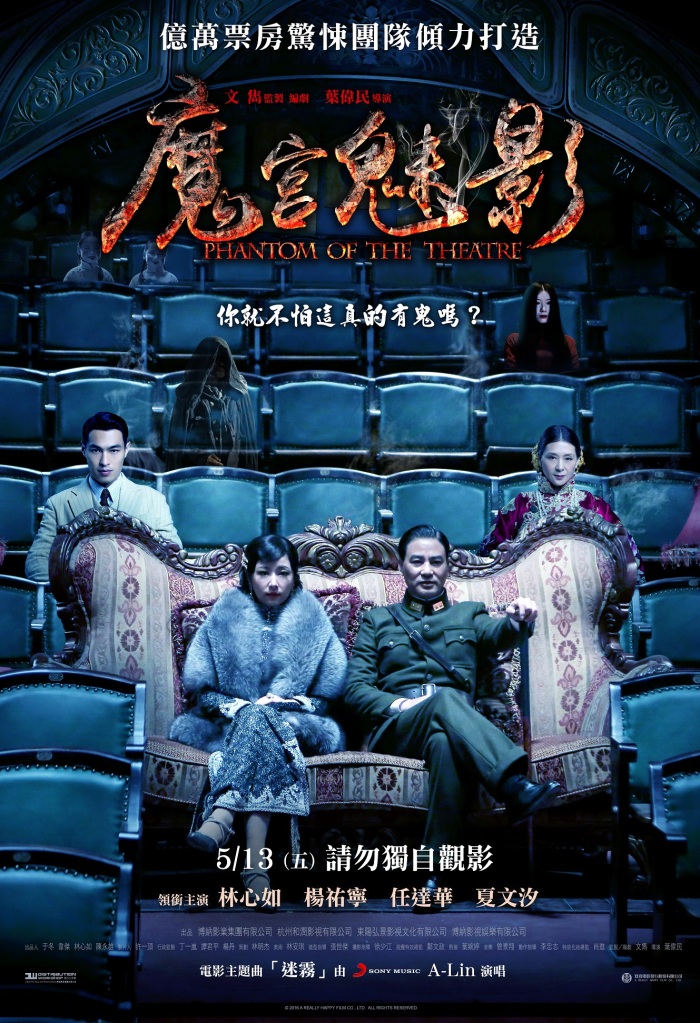
Phantom of the Theatre (魔宫魅影, Raymond Yip Wai-man, 2016)

phantom-of-the-theatreNo ghosts! That’s one of the big rules when it comes to the Chinese censors, but then these “ghosts” are not quite what they seem and belong to the pre-communist era when the people were far less enlightened than they are now. One of the few directors brave enough to tackle horror in China, Raymond Yip Wai-man goes for the gothic in this Phantom of the Opera inspired tale of love and the supernatural set in bohemian ‘30s Shanghai, Phantom of the Theatre (魔宫魅影, Mó Gōng Mèi Yǐng). As expected, the thrills and chills remain mild as the ghostly threat edges closer to its true role as metaphor in a revenge tale that is in perfect keeping with the melodrama inherent in the genre, but the full force of its tragic inevitability gets lost in the miasma of awkward CGI and theatrical artifice.
Shanghai was a swinging, cosmopolitan town in the 1930s. A multicultural melting pot it was both a business centre and a bohemian paradise in which the Chinese film industry flourished. Aspiring film director Gu Weibang (Tony Yang) has just returned from studying in France and is looking for an actress to star in his first project. Attempting to hand his script to the winner of the local awards ceremony, Weibang’s plan is frustrated by some awkward political shenanigans between an older actress, a younger one, and the patron that’s trying to abandon one woman for the other, but Weibang is soon to have more problems on his plate connected to the series of strange deaths which have begun to occur in the “haunted” theatre in which he wants to shoot his upcoming masterpiece.

The mystery element fades relatively quickly as we’re introduced to the very human villain who does, however, behave in an appropriately phantom fashion as he appears and disappears in various locations around the ruined theatre, making use of secret passages and hidden doorways to put his dastardly plan into action. The main thrust of the narrative is the gothic romance between Weibang and his leading actress Meng Si-fan (Ruby Lin) which is complicated both by his existing girlfriend (the pathologist working on the mysterious theatre deaths) and the spectre of the long buried past. The fire which destroyed the theatre 13 years previously resulting in the deaths of a troupe of acrobats lies at the centre of the mystery but places the two lovers on different sides of an unbridgeable divide as powerless bystanders in the newly post feudal world.

Weibang wants to make films about the things people can’t say – an interesting meta comment given that ghosts are still taboo all these years later, but the irony is that film is a seductive dream, a distraction from the reality, a haunted theatre all of its own. Dreams, reality, and cinema begin to overlap as Weibang finds himself playing the leading man and falling for the leading lady in a tragic supernatural romance whilst his creepy setting continues to give up its own ghosts. In the end the only ghosts Weibang and Si-fan will have to deal with are ones of their own pasts. Faced with a final showdown, long buried truths are finally revealed and choices made but the bittersweet ending leaves us on a positive note as those concerned discover the power of forgiveness – that forgiving others is an act of kindness to oneself and revenge little more than the theft of your own life in pointless pursuit of retribution.

Yip places the emphasis on his visuals with a sumptuous, truly gothic aesthetic filled with faded grandeur, Western architecture, and candle lit rooms perfect for suggestive shadows and ghosts which lurk in mirrors. Though occasionally plagued with poor quality CGI and leaning towards theatrical artificiality in its studio bound look, Phantom of the Theatre does succeed in building a generally creepy atmosphere even if failing to reach the giddy heights of China’s finest take on the material so far – A Song at Midnight. Despite the solid visuals, Phantom of the Theatre never achieves the levels of doomladen fatalism and inexorable malevolence which the genre demands nor does it succeed in making its central romance truly matter lending it a slightly underwhelming quality. Still, the impressive visuals and melancholy tone make for a charmingly old fashioned ghost story in which the haunting is all too real.


Original trailer (Mandarin with English/Traditional Chinese subtitles)

https://www.youtube.com/watch?v=tDj7OSpAr5c

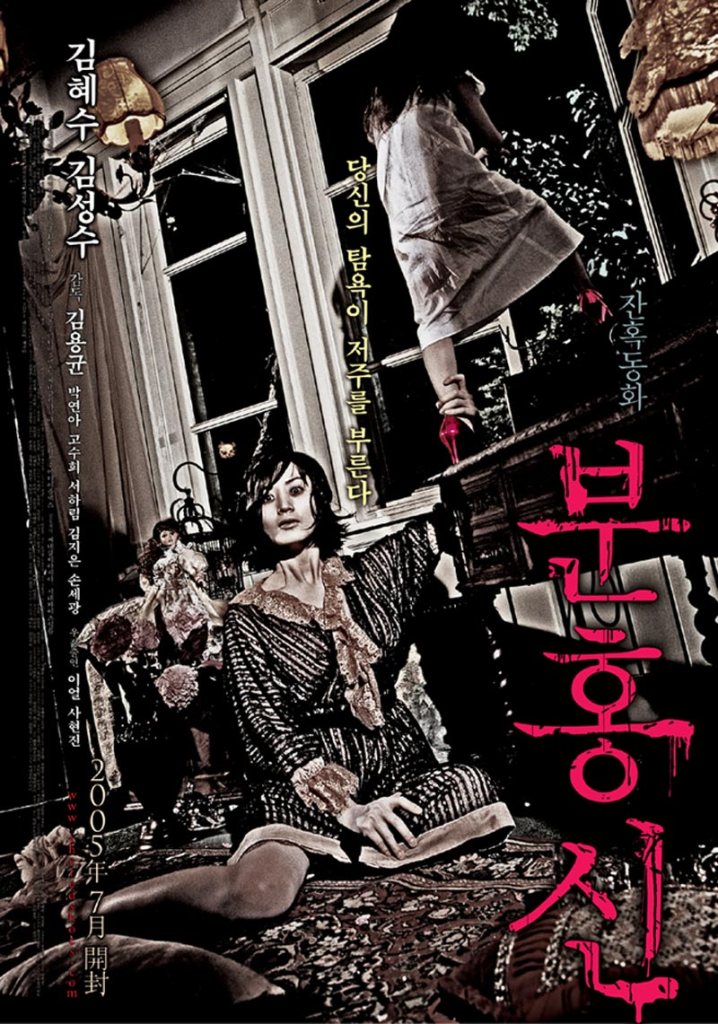
The Red Shoes (분홍신, Kim Yong-gyun, 2005)

the-red-shoesWalk a mile in a man’s shoes, they say, if you really want to understand him. If Kim Yong-gyun’s The Red Shoes (분홍신, Bunhongsin, 2005) is anything to go by, you’d better make sure you ask first and return them to their rightful owner afterwards without fear or covetousness. Loosely based on the classic Hans Christian Andersen tale this Korean take replaces dancing with murder and also mixes in elements from other popular Asian horror movies of the day, most notably Dark Water in its dank and supernaturally tinged dingy apartment setting.

Late one night at a deserted train station in Seoul, a high school girl complains that she’s been waiting ages for her friend to arrive before noticing a pair of hot pink high heels resting incongruously on the platform’s edge. Strangely drawn to them, the girl puts the shoes on only for her friend to turn up and immediately become infatuated with the unexpected footwear herself, suddenly exclaiming that she saw them first. The two fight as the first girl is almost pushed onto the tracks by her friend and all over a random pair of actually quite ugly funny coloured shoes. The eventual winner will come to regret their victory as that night in an otherwise empty train station a teenage girl will loose her footing to a pair of high heels which slowly fill with blood and then disappear leaving only a pair of severed legs behind them.

After this grim opening, we meet another little girl who has definite opinions about her footwear in the form of little Tae-soo who wanted to wear her red shoes to ballet but mum Sun-jae (Kim Hye-soo) says no and they’re already late. Letting Tae-soo learn independence by telling her to make her own way but surreptitiously following her backfires when Tae-soo somehow evades the net leading Sun-jae to head home earlier than expected and discover her husband pleasuring another woman who is also wearing a pair of Sun-jae’s favourite shoes, just to add insult to injury. Next thing you know Sun-jae and Tae-soo have moved into a horrible (but presumably cheap) apartment while they wait for Sun-jae’s new optometrist’s clinic to be finished. It’s all kind of OK, until Sun-jae notices a pair of hot pink high heels all alone on the subway and in obvious need of adoption by a pair of loving feet…

Anyone with a even a passing knowledge of the genre will have figured out the central twist well ahead of time though, strangely, it seems almost irrelevant. The shoes are cursed, but they’re cursed with jealous desire as they both contain the entirety of a scorned woman’s rage and humiliation, and a lingering want for that which has been lost. Spreading like a virus, the shoes pick a host and then target those whom it infects with the need to posses them. This tension manifests itself in odd ways as mother and daughter become rivals in the tug of war over who the rightful owner of the shoes should be. A precocious child, Tae-soo has soon tried on her mother’s new shoes and there after progressed to makeup and pretty dresses. Her mother, rather than using authority or reason to regain her lost treasure, fights with her daughter like a child eventually resorting to violence but with all the force of adulthood. The shoes corrupt even this most innocent and essential of relationships as Sun-jae continues to struggle with maternity as Tae-soo’s overwhelming need to possess the shoes and eclipse her mother’s femininity arrives well ahead of schedule.

Shoes aside, Sun-jae does not seem to be a well woman. Problems with her eyes do not quite explain the flashbacks she’s been experiencing to an apparently traumatic episode in the 1940s in which the shoes seem to feature. She’s also begun having strange waking dreams which involve blood, lots of blood – far more blood than any one body could realistically contain, and bad things happening to Tae-soo. Eventually Sun-jae figures out that the shoes were a bad idea and that there may be other stuff going on in her life that she isn’t exactly aware of, but the extent to which cursed footwear is influencing her behaviour may be open to debate given later (though extremely obvious) revelations.

It just goes to show that misplaced desire can leave you footless and fancy free. Kim does his best to make modern day Seoul a supernaturally scary place, overlaying eerily empty shots of intersections and train stations with gothic infused musical cues whilst having Sun-jae move into the kind of place which only someone trying to disappear would consider. Adding in touches of surrealism from the aesthetically beautiful fantasy sequences to snowing blood, Kim creates the atmosphere of fairy tale whilst allowing for an imbalance of perception in the possibly fracturing mind of his heroine. Despite the often impressive cinematography and strong leading performance from Kim Hye-soo, The Red Shoes never manages to transcend its lack of originality and frequent callbacks to similarly themed genre efforts but nevertheless offers its share of elegantly composed scares even if its internal integrity fails to convince.


Original trailer (English subtitles)