Festival Champ (お祭り野郎 魚河岸の兄弟分, Norifumi Suzuki, 1976)

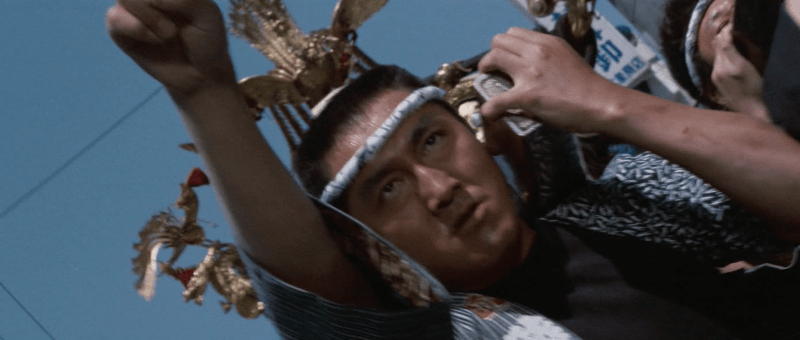
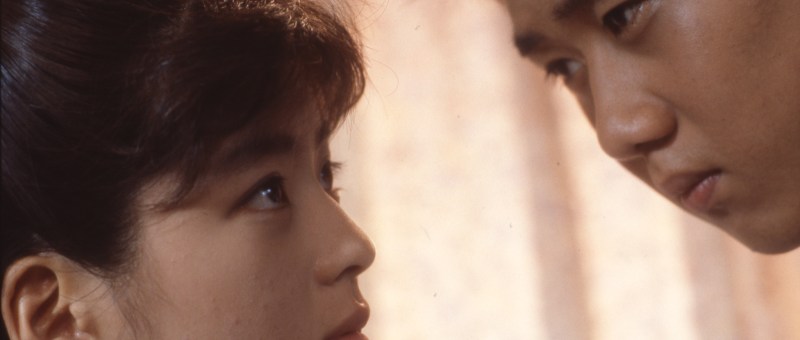
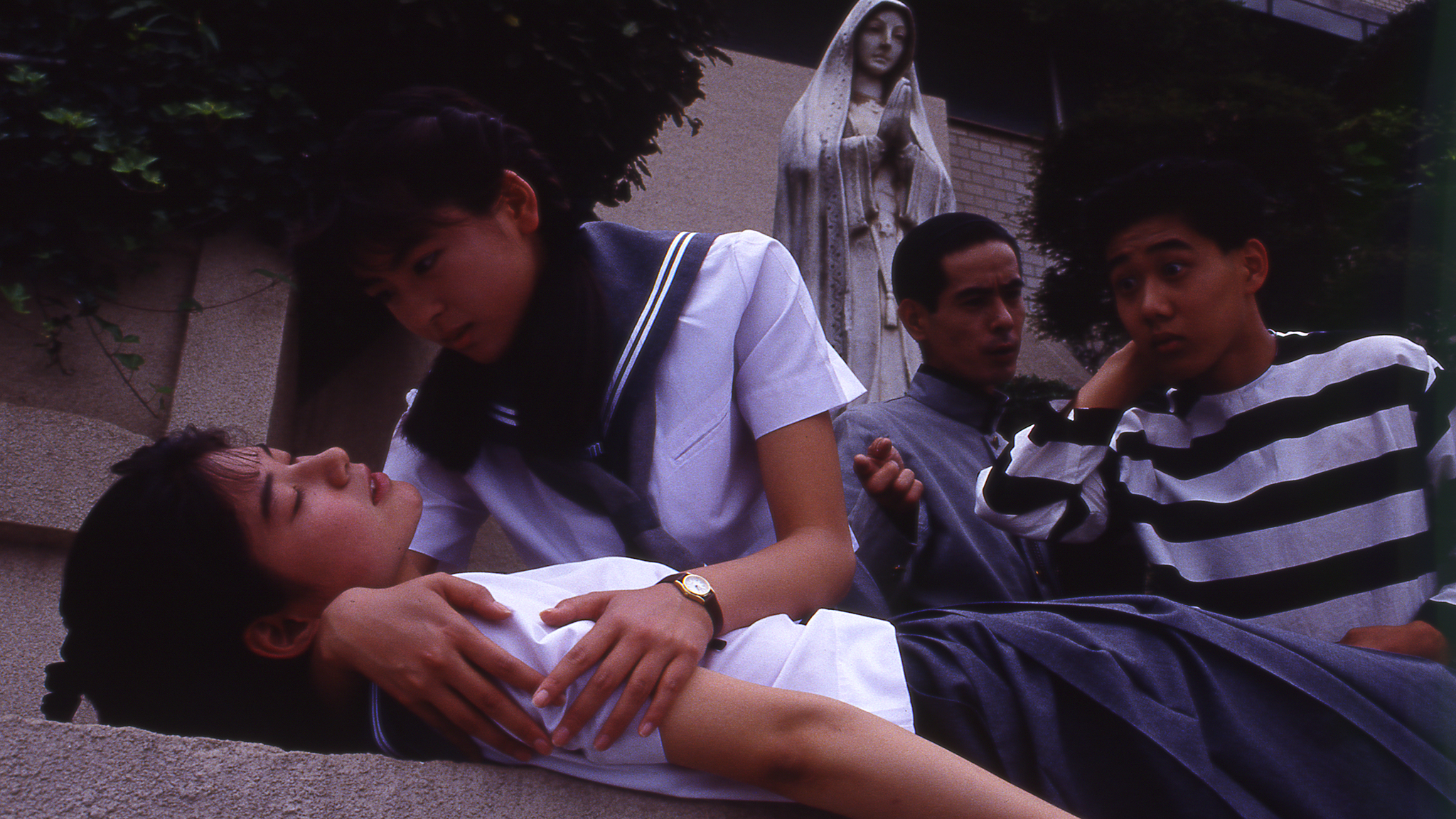
Who doesn’t love a festival? The hero of Norifumi Suzuki’s Festival Champ (お祭り野郎 魚河岸の兄弟分, Omatsuri yaro: Uogashi no Kyodai-bun) loves them so much that he travels all over Japan to help out in places where young men have become thin on the ground thanks to increasing urbanisation and rural depopulation. Following the success of Suzuki’s entries in the Truck Yaro series in 1975 and 1976, the film was part of a new line of comedies and sports movies launched by Toei as well as a vehicle for Hiroki Matsukata who was trying to move on from yakuza movies.

Katsuo (Hiroki Matsukata) is however something of a goodhearted bruiser who is always getting into manly scraps and especially at the festivals he travels to which is a pretty good hook for an ongoing series. But it’s not all that great for his employer who runs a family fishmonger’s at the Uogashi fish market and complains that Katsuo’s always running off and causing trouble. The fish market itself takes on an exoticised quality in the opening sequence which features a voice over from karate queen Etsuko Shihomi, here in a purely dramatic role, who is the daughter of a well-to-do traditional Japanese restaurant and travels there daily by speedboat to pick up the best fresh fish available. Suzuki throws in some documentary-style stock footage and statistics about the market that lend a strangely corporate feel, but then homes in on its capacity as a community hub. Kiyoko says it’s her favourite place precisely because there’s nothing formal about it. Deals are done through body language and you don’t need any kind of resume to work there, everyone’s welcome. 

That may be the implied contrast between Kiyoko’s father, who owns an upscale place and cultivates genuine relationships with local fishermen and brokers, and local boy made good Kurosaki who has supposedly become the CEO of a restaurant chain, itself a symbol of the soulless corporation of ‘70s Japan. Kurosaki rocks up dressed like a yakuza, but everyone treats him as a successful businessman and in part thanks to Katsuo’s boss Zenjiro’s recommendation is eager to make deals with him but predictably he’s running a huge scam that could destroy the local economy. Zenjiro is later faced with the difficult decision of selling his family business to repay all the other fishermen and brokers that have fallen foul of him. 

It’s this societal sense of unfairness that stripper Kumi (Terumi Azuma) hints at when she says she feels “frustrated” and that her long-lost brother Eiji (Toru Emori) probably feels even more frustrated than she does after he slaps her having found out that she’s become a burlesque dancer. As she points out to him, he ran away from home and left her behind with the aunt that was cruel to them so what exactly he expected her to do is a mystery. In the end, it’s his own fault for abandoning her, so he has no leg to stand on in criticising her for the way she’s lived her life. Kumi is well accepted in the local community and walks around in very elegant attire which gives her the air of an “ojosan” or upperclass lady to much greater extent that Kiyoko has in her love of the earthy world of the fish market. The fact that she turns out to be suffering from a tragic terminal illness perhaps only reinforces this sense of unfairness, that the modern world has essentially poisoned her and she can no longer survive in it.

The only things that give her solace are Katsuo and the idea of joining in carrying a shrine festival which would seem to be ways of reconnecting with a more essential Japaneseness. Despite his rowdiness, Katsuo is as she describes him the kindest person she’s ever met and a more positive vision of a still traditional masculinity that looks to protect the community and those around him. He gets into a fight with Eiji, but after exchanging a few blows the men become firm friends, while it’s trying to hook his wimpy friend Kinichi up with a date that brings him to Kumi in the first place. Meanwhile, it seems like Ayuko (Junko Natsu) has a crush on him and despite Zenjiro’s exasperation with Katsuo, everyone expects that he will eventually marry her and take over the family business. 

And so, it’s only a violent, but also quite funny, intervention from Katsuo that can eventually overcome the disruption Kurosaki threatens. Suzuki throws in a lot of his trademark weirdness including all of Zenjiro’s other daughters having fishy names, and a local sex worker who is insatiably aroused by octopuses followed by a gag in which Katsuo is trolled with a suggestive-looking shellfish, but mostly rests on a sense of qualified wholesomeness and community all carried on Katsuo’s broad shoulders as the lone guardian of a more essential Japaneseness otherwise uncorrupted by venal post-war capitalism.


*Norifumi Suzuki’s name is actually “Noribumi” but he has become known as “Norifumi” to English-speaking audiences.

To Trap a Kidnapper (誘拐報道, Shunya Ito, 1982)

One of a number of films released in the early ’80s critical of the police force, To Trap a Kidnapper (誘拐報道, Yukai Hodo) draws inspiration from a real life case of child abduction but suggests that the police largely just get in the way and are only interested in apprehending the culprit rather than ensuring the boy’s safety. In any case, unlike the similarly themed High and Low, the film devotes most of its focus to the kidnapper’s desperation as a man apparently left behind by the rapidly rising tides of prosperity. 

Yet somewhat perversely the film opens with a scene of children playing and seven-year-old Hideyuki (Motoyoshi Wada) getting into trouble for flicking toy discs at his friend and deskmate Kaori (Kaori Takahashi). Hideyuki is then made to stand on his own in the playground as a punishment, though quickly makes things up to Kaori by gifting her the plastic discs he was playing with. Neither of them know it, but the children share a grim connection for it’s Kaori’s father Kazuo (Kenichi Hagiwara) who is responsible for kidnapping Hideyuki on his way home from school in the next town over.

Both Hideyuki and Kaori attend a prestigious private institution but are being raised in very different circumstances. Kazuo was once a successful cafe owner but was swindled out of his business and is now in massive debt to a shady loanshark named Moriyasu who’s sold his promissory note on to a third party debt collector. Hideyuki’s father, Noboru Mitamura (Fujita Okamoto), is a doctor though there’s nothing that suggests the family is anything more than financially comfortable and they aren’t immediately able to get the money together for the ransom. Noboru has to ring round all his friends, family, and random acquaintances begging for emergency loans but without really being able to explain why he needs the money. Just having seen it noted on a school register that Hideyuki’s dad was medical professional Kazuo assumed they’d be a good target for a kidnapping and is in any case resentful of their nice middle class life. 

His wife, Yoshie (Rumiko Koyanagi), is in turn resentful of Kazuo for their reduced circumstances later lamenting that they moved house, swapped their big car for a smaller one and are even going to rehome their dog but if Kazuo is really so deeply in debt, something he had kept from her, then nothing they do really matters because their lives will never improve. What she can’t understand is why Kazuo was so keen on keeping Kaori in a private school that he’d get himself into financial hell rather than make a more pragmatic decision to let her go somewhere else. The obsession perhaps hints at his class anxiety, wanting his daughter to stay in a more resolutely middle class environment otherwise in strong contrast to the hometown he later visits where his elderly mother operates a loom in a moribund fishing village which the youngsters are slowly leaving for jobs in factories in neighbouring towns. 

Perhaps in over his head, it at one point looks like Kazuo is about to dump Hideyuki’s body in the sea only to realise police divers are already searching the area. Despite himself, he begins to care for the boy though doesn’t really know what to do with him. He feeds him bread from convenience stores and keeps him tied up in the boot of his car wrapped in several blankets without really considering the possibility that he may die of cold or hypothermia left outside in the freezing winter. Realising the distraught parents have called in the police despite his warnings not to, he is too afraid to accept the ransom and is therefore at something of an impasse given he can’t very well give up the boy without getting the money.

Meanwhile, as the Japanese title implies the tale is alternately told from the perspective of the reporters at Yomiuri Shinbun who are originally quite annoyed by the police’s request for a news blackout to avoid panicking the kidnapper, suggesting it’s an infringement on their free speech if coming around in the acceptance that a child’s life is at stake. A rookie reporter, Kotaro (Shin Takuma) is involved in a dispute with his fiancée Tomo (Miwako Fujitani) who is having second thoughts because he’s always working while her parents are pressuring her to consider an arranged marriage. Kotaro refuses to write one of the dummy articles they’re putting together in the event that Hideyuki is killed describing it as morbid and irresponsible, but is very involved with the ongoing press investigation which simultaneously seems more rigorous than that of the police and accidentally gets in its way. A “suspicious car” that’s noticed outside a drop sport turns out to belong not to the kidnapper but a reporter on a stakeout wasting the police’s time.

Even they are eventually conflicted, the officer in charge on the ground later letting the Mitamuras leave on their own for the final drop empathising with them as a fellow parent and acknowledging the reason everything keeps going wrong is because the police got involved. Yet his boss orders him to follow them anyway, reminding him that the only job of the police is to catch the culprit seemingly indifferent to whether or not they rescue the hostage unharmed. Their tactics are quite naive, not considering that Kazuo will obviously realise that the Mitamuras are surrounded by undercover officers because they keep using the same ones and it’s odd to keep seeing that couple from the coffee shop everywhere they go. The big break in the case happens by accident just because a couple of traffic cops decide to ask a random car a few questions.

In any case, it’s Kaori who ends up suffering. She and her mother are also victims, unfairly hounded by the press and left with nowhere to go and no-one to turn to having had their lives turned upside down by her father’s desperate decision. He didn’t even know the kids were friends or the effect his actions would have on his daughter. Kazuo hadn’t really thought any of this through but acted only in jealousy and resentment, wanting payback against the Mitamuras for their nice middle class life and his own slice of the pie that he felt had been denied to him. In the end, the only winners are the press who can rejoice in selling their newspapers even if a remorseful Kotaro resents himself for taking a paparazzo photo of Yoshie and Kaori trying to leave town quietly. On seeing his article pasted on pillars at the station, even Tomo starts to change her mind reflecting that if he’s working on a story like this then perhaps working too much isn’t such a dealbreaker after all even if everyone seems to have forgotten about little Hideyuki in the headlong rush to dominate the newsstands by trying to lure a kidnapper into their trap.


Original trailer (no subtitles)

My Small Land (マイスモールランド, Emma Kawawada, 2022) [Fantasia 2022]

Despite the nation’s relative wealth, Japan’s refugee policy is incredibly strict. In 2021, it approved the claims of just 74 asylum seekers which may seem like a small amount but is actually the highest number of people granted asylum since Japan first began recognising refugees in 1982. In fact, only 915 people (as of May 2022) have been granted refugee status in the 40 years since the policy was put in place. For a nation that prides itself on omotenashi, it’s a curiously hostile stance and one which has increasingly come under the spotlight in contemporary cinema with films such as Thomas Ash’s hard-hitting documentary Ushiku exploring the lives of asylum seekers trapped in indefinite detention, Akio Fujimoto’s Passage of Life, and briefly in Nobuhiro Suwa’s Voices in the Wind in which the heroine encounters a welcoming community of Kurdish refugees. 

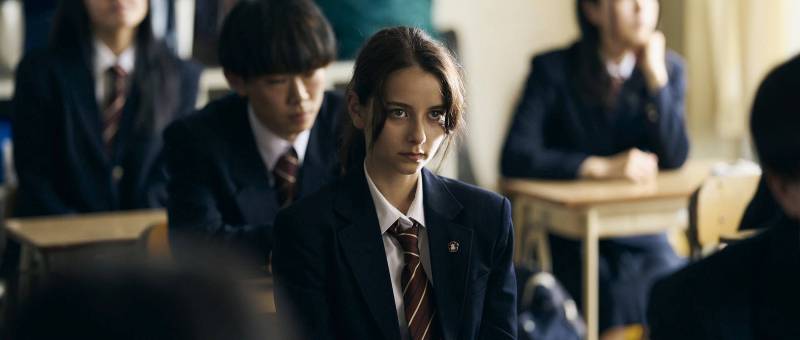
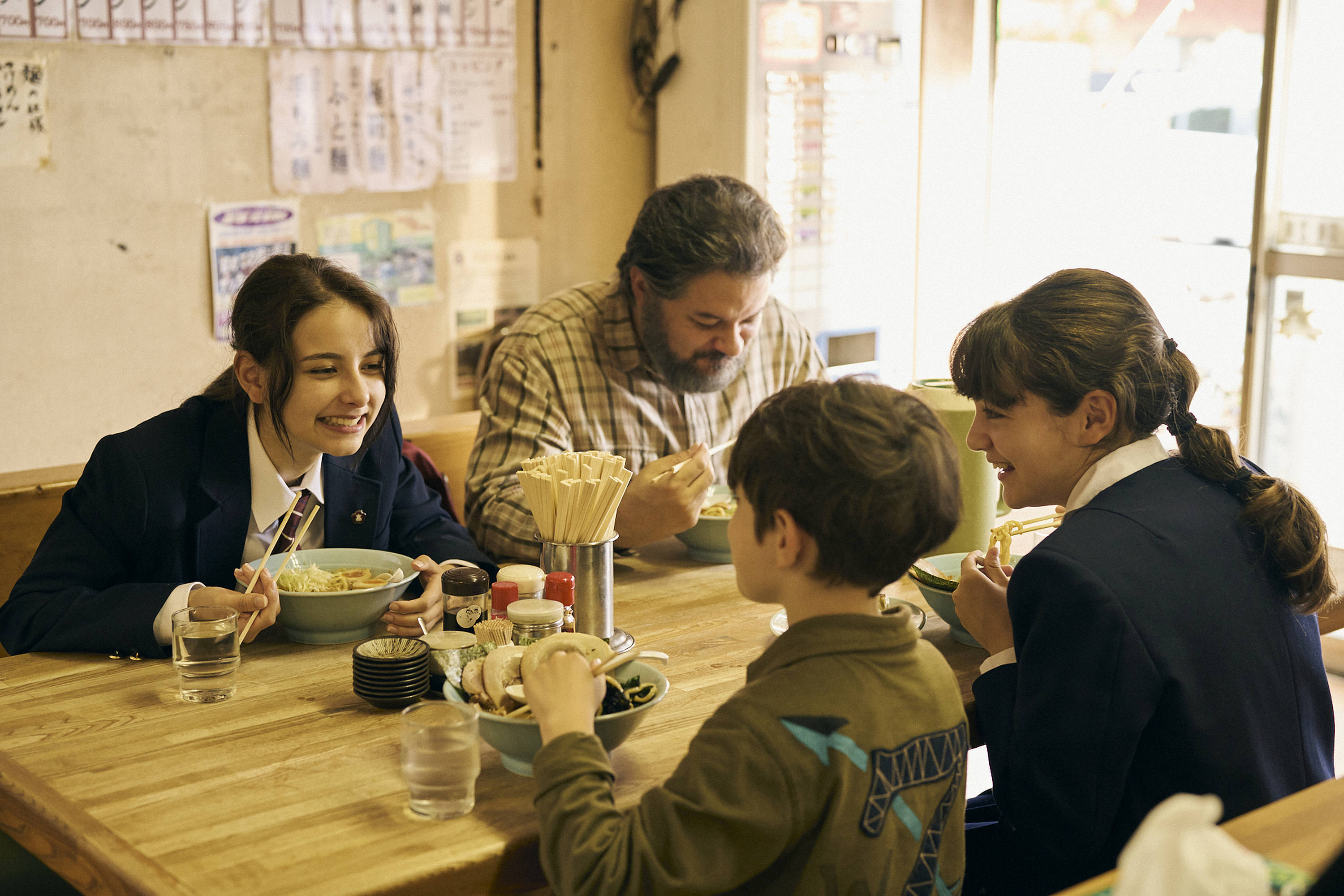
Director Emma Kawawada is not from a refugee background herself but the daughter of a British father and Japanese mother and in her first feature My Small Land (マイスモールランド) explores the themes of cultural dislocation through the eyes of a young Kurdish woman who came to Japan at five years old after her father was persecuted and tortured for his political beliefs in Turkey. In the film’s opening sequence, Sarya (Lina Arashi) is visibility distressed at a community wedding when a well-meaning older woman tells her it’ll be her turn next, her father (played by Arashi’s real father) chipping in that they still have her late mother’s dress for her to wear. She looks down at the red paint on her hand which, as she later explains to convenience store workmate Sota (Daiken Okudaira), is worn by relatives at a wedding but also closely resembles the red sun of the Japanese flag. She tries to scrub to it off, but it won’t come clean and she’s eventually warned about it at work making an excuse rather than attempting to explain. 

In fact, Sarya has most been telling people that she’s German following an incident in primary school in which she wanted to say she was supporting Japan in the World Cup like everyone else but felt awkward about it and said Germany instead leading her classmates to assume that’s where she was from. When she tries to explain to Sota that she’s actually Kurdish, he hasn’t even heard of Kurds before and is confused later given a small lecture by Sarya’s father Mazlum explaining that the Kurds are an ethnic group divided by irrational borders and have no country of their own. His explanation echoes Sarya’s sense of rootlessness as a young woman with no clear homeland torn between two competing cultures. Though she has become an unofficial translator for the Kurdish community and her father keeps them immersed in Kurdish traditions she does not feel completely comfortable stating that she is a Kurd while on another level bothered by the community’s constant joking that she will one day wed construction worker Welat.

Sarya is bright and on track for a scholarship to university in Tokyo hoping to become a primary school teacher in tribute to the teacher who helped her when she first arrived in Japan with no language skills, but all that goes out of the window when Mazlum’s asylum claim is refused and the family lose their visas. Given a provisional release, they are not permitted to work and cannot leave Saitama, the prefecture where they are registered, without permission from the authorities. Saitama is directly adjacent to Tokyo, its borders as arbitrary as any other as demonstrated by the sign halfway along a bridge demarcating its boundaries. This is quite inconvenient for Sarya as her secret part-time job is technically in Tokyo, while it also means she has to explain to Sota why she can’t accompany him to Osaka where he hopes to look at art schools and is now technically working illegally. When Mazlum is caught working his construction job, he is put into indefinite detention and advised by the family’s sympathetic lawyer to reapply for asylum. If he is sent back to Turkey, he will be immediately arrested and his life will be in danger. 

The family’s situation lays bare how vulnerable asylum seekers are in the contemporary society. They are told they can’t work and can’t leave yet are provided no financial support leaving them with little option other than to break the rules or appeal to friends and family, if they have them, for immediate help. Left in charge of her two younger siblings who barely remember any Kurdish and know only Japan, Sarya finds herself resorting to compensated dating, pushed into potentially dangerous ways to earn money now that her route to legal employment has been taken away. Meanwhile, as her father is detained in a kind of “prison” and she has lost her visa, she is viewed as an “illegal” immigrant leading even those who had otherwise been sympathetic towards her such as Sota’s warmhearted mother (Chizuru Ikewaki) distancing themselves from the stigma of illegality. Sota wants to help, but he’s just a teenage boy and is unable to offer much beyond his savings which Sarya is understandably reluctant to accept. Even so, despite the bureaucratic cruelty at its centre, My Small Land has an otherwise hopeful outlook as Sarya begins to find the strength to define her own borders and boundaries while taking care of her family in a sometimes hostile society. 


My Small Land screened as part of this year’s Fantasia International Film Festival.

Original trailer (English subtitles)

Amagi Pass (天城越え, Haruhiko Mimura, 1983)

There’s no statute of limitations on guilt an ageing policeman laments in Haruhiko Mimura’s adaptation of the Seicho Matsumoto mystery, Amagi Pass (天城越え, Amagi-Goe). Co-produced by Yoshitaro Nomura and co-scripted by Tai Kato, Amagi Pass arrives at the tail end of the box office dominance of the prestige whodunnit and like many of its kind hinges on events which took place during the war though in this case the effects are more psychological than literal, hinging on the implications of an age of violence and hyper masculinity coupled with sexual repression and a conservative culture. 

In a voiceover which doesn’t quite open the film, the hero, Kenzo (Mikijiro Hira / Yoichi Ito), as we will later realise him to be, likens himself to that of Kawabata’s Izu Dancer though as he explains he was not a student but the 14-year-old son of a blacksmith with worn out zori on his feet as he attempted to run away from home in the summer of 1940 only to turn back half-way through. In the present day, meanwhile, an elderly detective, Tajima (Tsunehiko Watase), now with a prominent limp, slowly makes his way through the modern world towards a print shop where he orders 300 copies of the case report on the murder of an itinerant labourer in Amagi Pass in June, 1940. A wandering geisha was later charged with the crime but as Tajima explains he does not believe that she was guilty and harbours regrets over his original investigation recognising his own inexperience in overseeing his first big case. 

As so often, the detective’s arrival is a call from the past, forcing Kenzo, now a middle-aged man, to reckon with the traumatic events of his youth. Earlier we had seen him in a doctor’s office where it is implied that something is poisoning him and needs to come out, his illness just as much of a reflection of his trauma as the policeman’s limp. Flashing back to 1940 we find him a young man confused, fatherless but perhaps looking for fatherly guidance from older men such as a strange pedlar he meets on the road who cheekily shows him illustrated pornography, or the wise uncle who eventually tricks him into buying dinner and then leaves. His problems are perhaps confounded by the fact that he lives in an age of hyper masculinity, the zenith of militarism in which other young men are feted with parades as they prepare to fight and die for their country in faraway lands. Yet Kenzo is only 14 in 1940 which means he will most likely be spared but also in a sense emasculated as a lonely boy remaining behind at home. 

He tells the wise man who later tricks him that he’s run away to find his brother who owns a print shop in the city because he hates his provincial life as a blacksmith, but later we realise that the cause is more his difficult relationship with his widowed mother (Kazuko Yoshiyuki) whom, he has recently discovered, is carrying on an affair with his uncle (Ichiro Ogura). Returning home after his roadside betrayal he watches them together from behind a screen, a scene echoed in his voyeuristic observation of the geisha, Hana (Yuko Tanaka), with the labourer plying her trade in order to survive. Described as odd and seemingly mute, the labourer is a figure of conflicted masculinity resented by the other men on the road but also now a symbolic father and object of sexual jealously for the increasingly Oedipal Kenzo whose youthful attraction to the beautiful geisha continues to mirror his complicated relationship with his mother as she tenderly tears up her headscarf to bandage his foot, sore from his ill-fitting zori, while alternately flirting with him. 

Yet his guilt towards her isn’t only in his attraction but in its role in what happened to her next even as she, we can see, protects him, their final parting glance a mix of frustrated maternity and longing that has apparently informed the rest of Kenzo’s life in ways we can never quite grasp. Amagi Pass for him is a barrier between youth and age, one which he has long since crossed while also in a sense forever trapped in the tunnel looking back over his shoulder towards Hana and the labourer now on another side of an unbreachable divide. The policeman comes like messenger from another time, incongruously wandering through a very different Japan just as the bikers in the film’s post-credit sequence speed through the pass, looking to provide closure and perhaps a healing while assuaging his own guilt but finding only accommodation with rather than a cure for the traumatic past. 


Original trailer (no subtitles)

Neither Seicho Matsumoto’s original novel or the film adaptation are directly related to the well-known Sayuri Ishikawa song of the same name released three years later though the lyrics are strangely apt.

Caterpillar (キャタピラー, Koji Wakamatsu, 2010)

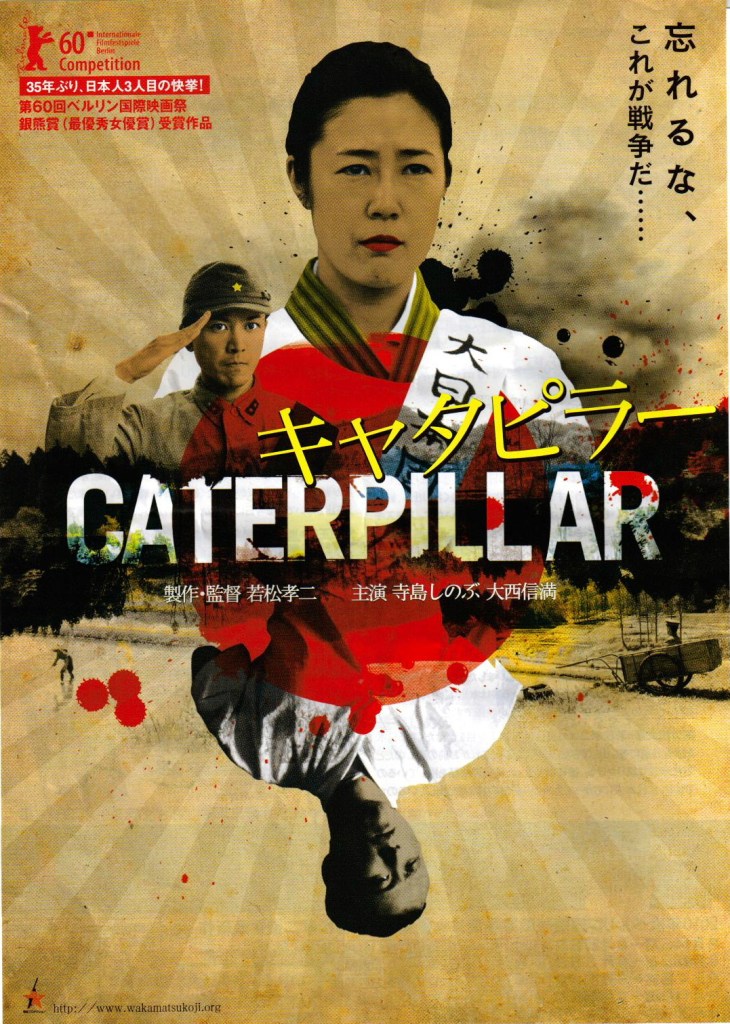
Koji Wakamatsu made his name in the pink genre where artistic flair and political messages mingled with softcore pornography and the rigorous formula of the genre. Wakamatsu rarely abandoned this aspect of his work but in adapting a well known story by Japan’s master of the grotesque Edogawa Rampo, Wakamatsu redefines his key concern as sex becomes currency, a kind of trade and power game between husband and wife. Caterpillar (キャタピラー), aside from its psychological questioning of marital relations, is a clear anti-war rallying call as a small Japanese village finds itself brainwashed into sacrificing its sons for the Emperor, never suspecting all their sacrifices will have been in vain when the war is lost and wounded men only a painful reminder of wartime folly.
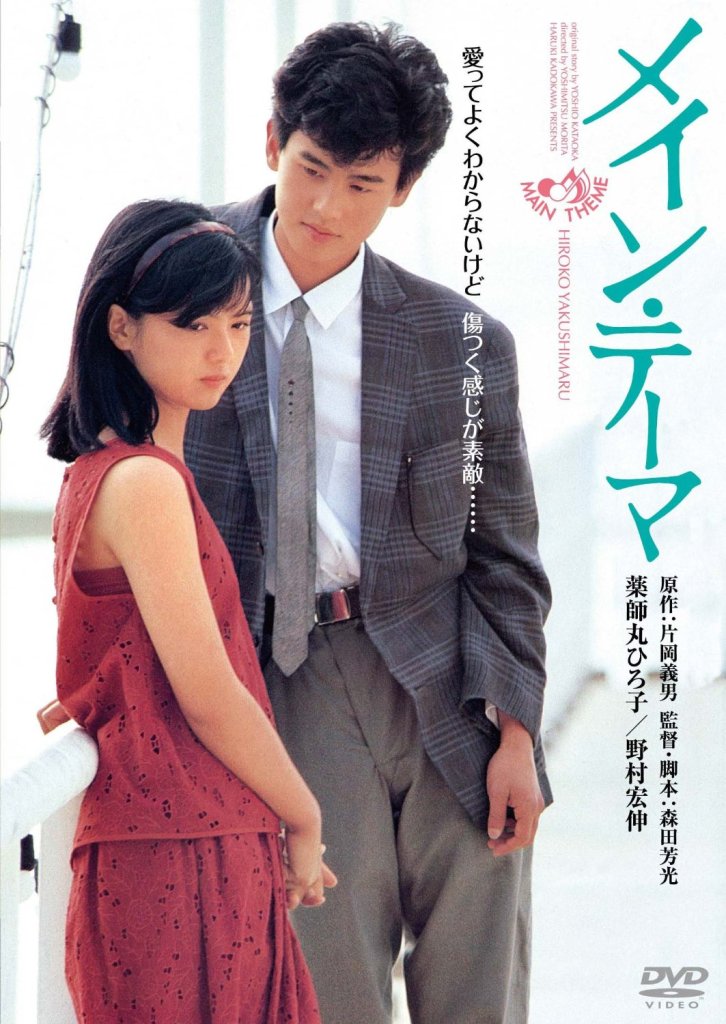
Kyuzo Kurokawa (Shima Onishi) has returned from the war. This makes him luckier than many of the other young men who disappeared from the village over the last few years. His return, however, provokes howls of fear and disbelief from his long suffering wife, Shigeko (Shinobu Terajima), who refuses to believe the creature they’ve brought back from the battlefield is really her husband. Kyuzo has lost all of his limbs, has facial disfigurement from burns, and has also lost his voice and hearing. Sitting across from the remnants of her brother, Shigeko’s sister-in-law remarks that she’s glad they didn’t “send Shigeko back to her family” because she is obviously the one who will have to look after this entirely helpless though apparently conscious battle scarred man.

This being early in the war, the village is in a fury of patriotic zealotry, determined to make Japan glorious again in the name of the Emperor. Far from letting the case of Kyuzo dissuade them from their warlike fervour, his sacrifice becomes a totem. He’s not a man destroyed by war but a “war god” and the pride of the village, a testament to their love and devotion that they would send a son of theirs to war who would return to them even in such a ruined form. Shigeko, quickly getting over her initial revulsion, comes to realise that her husband’s new-found status is also her own. As the wife of the war god, she becomes his voice and mistress in a way she had never been permitted before.

Truth be told, the war did not ruin Kyuzo’s character. The marriage of Kyuzo and Shigeko was never a happy one and perhaps her initial reeling, wailing flight on learning of her husband’s return was more out of fear than disbelief and compassion. Despite a lengthy marriage the couple had no children (perhaps an explanation for that early “sent back” comment), and Kyuzo regularly beat his wife for her failure to bear him a male heir. Now his carer, the roles are reversed as Shigeko babies her defeated husband, lamenting that all he is is urge – sleep, eat, sex. Kyuzo’s needs are animal and definite despite the signs of intelligent communication in his eyes. Shigeko, constrained to satisfy them, bends his need to her own advantage.

Emasculated in a deeper way by Shigeko’s increasing dominance, Kyuzo first attempts to assert himself in resentment at being trotted out to sell the virtues of war in his pristine uniform even as a man destroyed by nationalised violence. Spitting in Shigeko’s face as she dresses him, he attempts to refuse but is powerless to reject her authority. As time wears on and Kyuzo submits to female authority, memories of his atrocities haunt him as the fire which marked his face mingles with the faces of the Chinese women he raped and killed as a brave son of Japan on Manchurian soil.

For Wakamatsu war and sexualised violence are synonymous as the local women train for defending their village by repeatedly penetrating hey bales with long spears crying out patriotic slogans as they go. The flag waving and furore never waver despite the evidence of Kyuzo’s suffering and the numerous young men who will never come home or have done so in square boxes wrapped with white cloth. Only nearing the end is Shigeko left wondering what will become of her war god husband when no one needs a talisman. What will the nation do with these men who’ve sacrificed so much and received nothing in return?

Wakamatsu’s message is an unmistakably anti-war one though the curious inclusion of the executions of the lower class war criminals “hanged by the country they fought to protect” almost undercuts it even if his sympathy lies with those who succumbed to a national madness and have been made to pay a personal price. Kyuzo becomes the literal caterpillar of the title, taunted by Shigeko as he writhes and crawls around, condemned to eternal undulation, but it’s Shigeko who has been in a chrysalis all this time waiting to emerge from the fear and tyranny which has marred her married life into something with more freedom and autonomy – much like a nation waking up and realising that its Emperor is just a man and the long years of suffering nothing more than brainwashed madness.


Original trailer (English subtitles)

Main Theme (メイン・テーマ, Yoshimitsu Morita, 1984)

main themeDespite being one of the most prolific directors of the ‘80s and ‘90s, the work of Yoshimitsu Morita has not often travelled extensively overseas. Though frequently appearing at high profile international film festivals, few of Morita’s films have been released outside of Japan and largely he’s still best remembered for his hugely influential (and oft re-visited) 1983 black comedy, The Family Game. In part, this has to be down to Morita’s own zigzagging career which saw him mixing arthouse aesthetics with more populist projects. Main Theme is definitely in the latter category and is one of the many commercial teen idol vehicles he tackled in the 1980s.

A tale of two intersecting love stories, Main Theme begins with nursery nurse Shibuki getting close to the father of one of her pupils, Omaezaki, who will shortly be transferred to Osaka. Omaezaki also has a long running thing with a cabaret jazz singer, Kayoko, which seems to be a messy situation to begin with. Shibuki then ends up running into magician with a pick-up truck Ken who drives her to Osaka where she’s set to meet up with Omaezaki to become some kind of nanny living with him and his wife. En route, the pair pick up Kayako little knowing of her relationship with Omaezaki. Eventually, everyone ends up in Okinawa where Ken lives and Shibuki has an older sister each hoping to sort out their romantic difficulties under the blue island skies.

Main Theme stars popular idol of the time Hiroko Yakushimaru (star of Sailor Suit and Machine Gun) and is, unsurprisingly, centred around her chart topping song of the same name. A neat, new Japanese arrangement of the classic jazz standard Sway, the song fits neatly into the movie’s soundtrack which also features a number of other jazz hits such as The Man I Love and most notably Bei Mir Bistu Shein (or Shoen, or Shön depending on which version you’re looking at) courtesy of our cabaret singer (and her rivals) but being an ‘80s movie there’s still a bit of pop synth in there too though our central couple do seem to have oddly sophisticated tastes.

Though it is, as it’s intended to be, a teen romantic comedy, Morita tries (not entirely successfully) to put a little more substance into the background by also showing us the unhappy romance of middle-aged jazz singer Kayoko and the non-committal Omaezaki. It seems the pair have had an entailment probably stemming back years, perhaps even before Omaezaki’s marriage. Mrs. Omaezaki is a fairly ditzy and neurotic woman who loves shopping and seems to be more interested in the appearance of things than the reality. The status of the marriage itself is difficult to discern and it’s not quite clear if Omaezaki’s problem is a lack of will to leave his wife or that he’s already “left” and is trying to find a way to support her. In any case, introducing Shibuki, a 19yr old with an obvious crush on him, to the household is not one of his better ideas.

Needless to say, Ken also ends up forming an attraction to the older, melancholy musician who doesn’t seem to know what it is she wants (or knows but chooses to run away from it) leaving us in an odd kind of love square with the couples really each wanting their age appropriate partners but getting distracted by foolish dalliances with age and youth respectively. It does feel as if Morita could have made more of this dramatically interesting idea as Kayoko in particular is drawn in by Ken’s youthful innocence, but this isn’t what the film is for so it remains an intriguing yet perverse addition to the film’s otherwise straightforward narrative.

The “perversity” or strangeness of the film doesn’t end there as Morita has also added a number of quirky, absurd touches to offset the flatness of the teenage love drama. Perhaps because he’s a magician we get these odd flashes of Ken where he’s suddenly got crazy eyebrows (just for one 15 second shot) or crazy hair and there’s another charming scene where he’s pulling artificial flowers out of his suit only to have the magic bouquet suddenly droop as his heart starts to break. In another intriguing trope there’s also a strange illustrated map which lead’s Shibuki to her sister’s house by outlining common scenes from the area and when she gets there the gates are covered in light up ornamental tropical fruits. Add to this that the backing behind Kayoko’s final cabaret reads “Bates Motel Live” and there’s definitely a very strange mind behind the production design on this run of the mill, idol pop pushing rom-com.

Undoubtedly of its time, there is probably a reason Main Theme has not proved a big overseas hit though it seems to have been massively popular at the time and is fondly remembered for nostalgic reasons even if not particularly well regarded today. This is perhaps how the film is best approached – as a monument of its times and as a prime example of the 80s idol dramas studios such as Kadokawa put out to push their inoffensive pop music. However, Morita does add his own quirky touches to the film which does provide its fair share of youthful fun even if it isn’t always successful.


Unsubtitled trailer:

And a more recent version of Hiroko Yakushimaru singing the title song:

The Yakuza Papers Vol. 4: Police Tactics (仁義なき戦い: 頂上作戦, Kinji Fukasaku, 1974)

b0176154_10205690It’s 1963 now and the chaos in the yakuza world is only increasing. However, with the Tokyo olympics only a year away and the economic conditions considerably improved the outlaw life is much less justifiable. The public are becoming increasingly intolerant of yakuza violence and the government is keen to clean up their image before the tourists arrive and so the police finally decide to do something about the organised crime problem. This is bad news for Hirono and his guys who are already still in the middle of their own yakuza style cold war.

Police Tactics (仁義なき戦い: 頂上作戦, Jingi Naki Tatakai: Chojo Sakusen), the fourth in the Yakuza Papers (or Battles Without Honour and Humanity) series, once again places Hirono at the centre of events for much of the film. The cold war from the end of the last film, Proxy War, is still going on with ambitious boss Takeda hosting additional foot soldiers from other areas of the country. However, all these extra guys are quite a drain on his resources and, simply put, it’s going to ruin him if this situation goes on much longer. Yamamori is currently holed up in a safe place and only steps outside to go to the bath house when he’s surrounded by a huge entourage of bodyguards. Added to the gang rivalry which is only growing now as factions split and new families are formed, not to mention all the guys from outside, is the now constant police pressure. Up to now, the police have been either a minor irritation or a soft ally but this time the guys might have finally met their match.

It’s almost twenty years since Hirono settled into the yakuza life. He’s not an old man, but he’s not a young one either. You can no longer explain or excuse any of his actions with the fire of youth – he’s one of the veterans now. However, young men are always young men and even while the older guys try to scheme and come up with a plan the youngsters are all for action. Hirono has always been the one noble gangster. Committed to yakuza ideals, he’s loyal to his bosses and dedicated to taking care of his guys. Hence, there’s no way he’s going to let one of his men take out Yamamori – firstly, after nursing a grudge for 18 years he wants to handle it himself but even if he didn’t he still wouldn’t be able go after Yamamori in anything other than an honourable way. However, now even Hirono says at one point “I don’t give a fucking shit about honour anymore”. At this point you know it’s all over, the one loyal retainer has finally given up.

With the police pressure mounting, the violence on the streets intensifies with even more feats of desperate backstreets warfare. Hirono himself is absent for a lot of the film while he gets picked up by the police on a flimsy pretext. More gangs are introduced, more guys die before you even begin to remember their names. There’s death everywhere yet still more yakuza keep turning up, offering to die for their bosses who will sell them out without a second thought if it buys them ten seconds more in power. The younger generation may not have the trauma of the war to burn through, but they’ve grown up in this world of street gangs and constant violence so it stands to reason that they come to idolise the tough guys and think joining a gang is their one way ticket out of the slums. As they will discover, there is always a heavy price to be paid for ambition and naivety.

The shooting style is pretty much the same as the first few films in the series. Documentary style voice over, hand held camera and freeze frame death shots are the order of the day. Once again we begin and end with the ruined dome reminding us of the price of violence. Police Tactics could almost be the end of the cycle. With the police finally deciding to act, by the end of the film all of the major players are off the streets in one way or another. In the end, all that death and violence amounted to to nothing. As the film reminds us, public order may have been restored (temporarily) but the systems and conditions which lead to violence are still very much in place.


Police Tactics is available on blu-ray in the UK as part of Arrow Video’s Battles Without Honour and Humanity: The Complete Collection box set.