Tokyo Ghoul S (東京喰種 トーキョーグール【S】, Kazuhiko Hiramaki & Takuya Kawasaki, 2019)

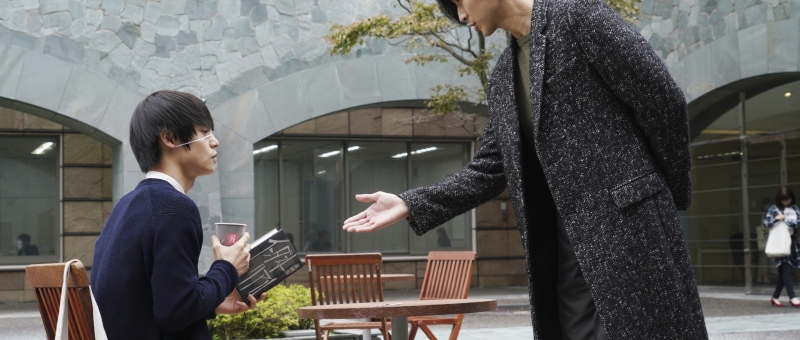
tg2_poster_3校B_ol_6In Tokyo Ghoul, regular university student Ken Kaneki (Masataka Kubota) had to learn to accept the parts of himself he didn’t like in order to become the kind of man he wanted to be. Of course, the situation was more complicated than that faced by most young men because Ken Kaneki’s darkness was born of being seduced by a beautiful woman who turned out to be a “ghoul” – a supernatural being craving human flesh, something he later became himself when they were both injured in a freak accident after which he got some of her organs. The sequel, Tokyo Ghoul S (東京喰種 トーキョーグール【S】) finds him in a more centred place, having accepted his new nature as neither human nor ghoul but a bridge between the two. Now he has a series of different questions to face in trying help others accept themselves in the same way as they too wonder if there are some parts of themselves so dark that if they revealed them they could never be loved.

While Ken goes about his regular student life working part-time at ethical ghoul cafe Anteiku, a ghoul serial killer known as “The Gourmet” (Shota Matsuda) has been making the news after targeting a high profile model (Maggy) whom he stalked and killed simply to taste her heterochromatic eyes. Tsukiyama, as we later learn his name to be, is a dandyish fopp living in a Western-style country house complete with servants who serve him only the finest meals well presented to hide their dark genesis. On catching a whiff of Ken’s unique human/ghoul scent, he knows he must taste him and puts a nefarious plan in motion in order to lure him to a mysterious ghoul-only restaurant where humans are butchered live for show while the clientele salivate over scenes of intense cruelty.

That’s all too much for poor Ken. He can’t understand how anybody could act with so little regard for life. The cafe owner pointedly asks him if he feels pity when looking at the butchered flesh of an animal, which he of course does not. The ghouls feel much the same, humans are their prey – they can’t help what they are, but living under the intense fear of discovery in an obviously hostile world has made them cruel and resentful to the extent that they no longer understand the value of life. The ghouls that Ken knows, the ones which frequent Anteiku, are different. They have resolved to live ethically and respect lives both human and ghoul equally.

Ken’s friend and colleague Touka (Maika Yamamoto), however, is beginning to have her doubts. In the first film we saw her pursue a touching friendship with classmate Yoriko (Nana Mori) whose cooking she made a point of eating solely as a means of connection despite the fact that human food makes her ill. Now she fears she’s doing the wrong thing, that it will only hurt more if her friend finds out her secret and rejects her, or worse that she may put her in danger. Therefore, she counsels Ken to distance himself from his overly cheerful friend Hide (Kai Ogasawara) and the human world in general, threatening that she herself will kill Hide if he discovers that Ken is a ghoul. As expected, Ken ignores her advice but is mildly shaken by it. Deciding to intervene when his sometime enemy Nishiki (Shunya Shiraishi) is being beaten up in the street, he discovers a better future on learning that Nishiki is living with a human woman who knows he is a ghoul, but loves him anyway.

Though Kimi’s (Mai Kiryu) justifications that she can live with the fact her boyfriend kills people and eats them so long as he leaves her friends and family alone is a little worrying, it is a touching example of the film’s positive message that there is no secret so terrible that it means someone can’t be loved. Kimi accepts Nishiki’s nature as a ghoul, aware of the fact he can’t help what he is and that if she had been born a ghoul she would be the same. Touka fears rejection, but on catching sight of her bright red wings Kimi utters the single word “beautiful”, seeing only goodness without fear or hate.

Tsukiyama meanwhile seems to have gone in the opposite direction, pursuing his desires to the point of obsession in a quest for ever greater sensation. He stalks and murders the model to devour her eyes in an especial piece of irony, while his pursuit of Ken takes on an intensely homoerotic quality. Using the same tactics as Tokyo Ghoul‘s Rize, Tsukiyama picks Ken up through bonding over books, invites him to “dinner” and later sends him an invitation accompanied by a single red rose. Despite the romanticism, however, he soon reverts to type in blaming Ken for his actions. “You’re making me this way”, he insists, “take responsibility”, like every abuser ever simultaneously accepting that his behaviour is inappropriate and justifying it as a consequence of someone else’s actions. In the end, Tsukiyama’s illicit desires consume him, while Ken’s act of self-sacrifice once again allows him to be the human/ghoul bridge combatting Tsukiyama’s rapacious cruelty with an open-hearted generosity which pushes Touka to the fore so that she too can learn that peaceful co-existence is possible when there is trust and understanding on both sides.

Nishiki tells Ken his problem is that he’s too nice, but that’s not a bad thing to be because he just might “save somebody someday”. Niceness as a superpower might be an odd message for a movie about flesh eating monsters almost indistinguishable from regular humans, but perhaps that’s what will save us in the end, a generosity of spirit that makes it possible for us each to accept each other’s darkness in acknowledgement of our own. Less stylistically interesting than the first instalment, Tokyo Ghoul S may be a kind of bridge movie in a possible trilogy (a sequel is teased in a brief mid-credits sequence featuring a mysterious character who makes several unexplained appearances throughout the film), but nevertheless does its best to further the Tokyo Ghoul mythology as its hero finds his strength in difference and mutual understanding.


Tokyo Ghoul S screens in the US for three nights only on Sept. 16/18/20 courtesy of Funimation. Check the official website to find out where it’s playing near you!

Original trailer (English subtitles)
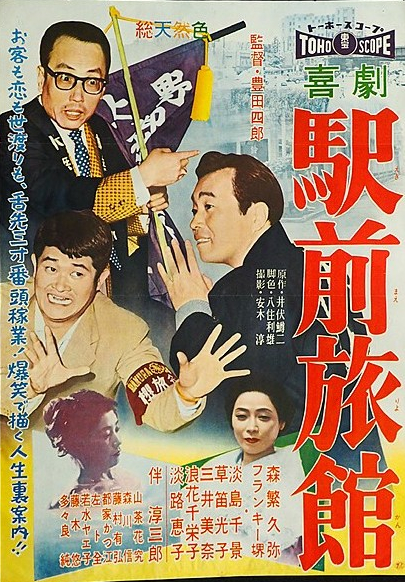
The Hotelman’s Holiday (駅前旅館, Shiro Toyoda, 1958)

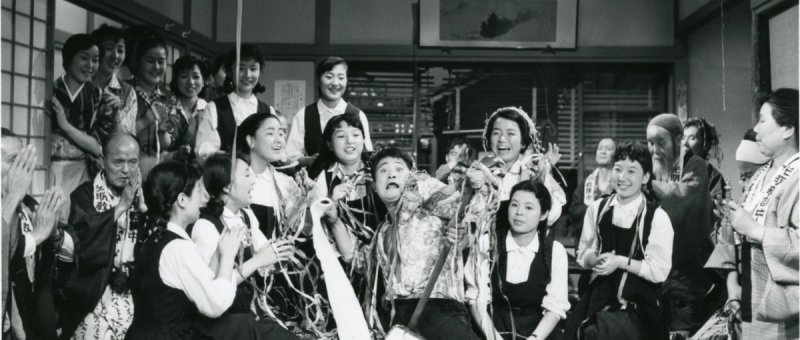
Hotelman's holiday poster 1The post-war world was one rife with trouble. By 1958, however, the horizon was perhaps beginning to brighten which means it was no longer too soon have a good laugh about how awful life could be. Nothing particularly awful happens in Shiro Toyoda’s cheerful comedy The Hotelman’s Holiday (駅前旅館, Ekimae Ryokan), the first in a series of “Ekimae” or “station front” movies produced by Toho, but it does amusingly rip a leaf out of Toei’s book in having its community of feckless hoteliers band together to stand up to greedy yakuza stand-in barkers who are actively destabilising the local economy with their underhanded ways.

Our hero, “born in a maid’s room” Jihei (Hisaya Morishige), is the manager of the Kukimoto inn near Tokyo’s Ueno station. Kukimoto seems to get most of its business from large tour groups, particularly school children on trips to the city and religious organisations, seemingly unperturbed by the area’s then scrappy working class earthiness. The problem is that there are rather a lot of inns in this small area (it is after all near a major rail station) and they’re all competing for the same walk-in guests which means they’re increasingly at the mercy of the local “barkers” who target travellers at points of transit and take them to certain inns in return for commissions. Even so, Jihei himself can often be found outside enticing passersby into the hotel to prove his managerial prowess.

The barkers know their worth and are beginning to get too big for their boots in shifting into the human trafficking business. Not to go into the finer details, the inns have a lot of ladies living on their premises on whom some of their trade relies. The barkers have been tempting the girls from the inns away from their homes and into potentially more lucrative though almost certainly less friendly occupations.

The central drama kicks off when the barkers try to abduct Kukimoto’s maid Okyo (Mina Mitsui) who is saved at the last minute by intellectual student Mannen (Frankie Sakai). Mannen is studying law and working illicitly for several tourist information companies in order to pay his way through college. As such he’s just another of the scrappy young guys trying to forge ahead in the precarious post-war environment. Jihei is, in a sense, pretty much the same. Born in a maid’s room, as he says, he’s very much part of the inn business and is proud to be a manager but also resents his subordinate position to the owner and the way they often treat him like a servant rather than the dependable employee he really is. His position leaves him feeling as if he’s already reached his peak and there is no real future for him other than the status quo. That feeling of futility might be why he, Mannen, and some of the other hotel managers eventually decide that they need to “cleanse” the Ueno Station area of the barker threat.

Their resistance has a pleasantly pithy quality in that it relies on a perfectly peaceful method of putting up banners to encourage customers not to trust the barkers and to approach inns directly. As might be assumed, the barkers aren’t very happy about their business being undermined and immediately begin threatening the Kukimoto inn, whom they assume to be the instigators, with destruction if they do not immediately cease and desist. Jihei thinks he has a solid plan and it does indeed defuse the situation but cannot ultimately rectify it. What it does do is give the inn’s owners the excuse they’ve been looking for to part with him, and Jihei the impetus he perhaps needed to rethink his life.

As Mannen puts it, “our reality is preposterous and absurd”, but we have to go on resisting because “happiness exists even in this world”. The inn managers stand up against the barker oppression in the same way communities stand up against yakuza in Toei’s modern gangster dramas, but like many of anti-gangster narratives, the corruption is so deeply ingrained that it cannot be entirely eliminated, only managed. Thus Jihei, also involved in a series of romantic subplots involving an intense former geisha (Keiko Awaji) and a diffident bar owner (Chikage Awashima), eventually realises that if he cannot change his environment he might be better to leave it, escaping to the sort of place where they still grow barley and travel by cart. Mannen too, their revolution failed, eventually takes off with Okyo to go into business in Osaka, giving up on his imagined future for a more solid present. Meanwhile, chaos rules in Ueno as crowds of travellers pour out of the station towards an uncertain future with only the barkers to guide them.


Original trailer (no subtitles)

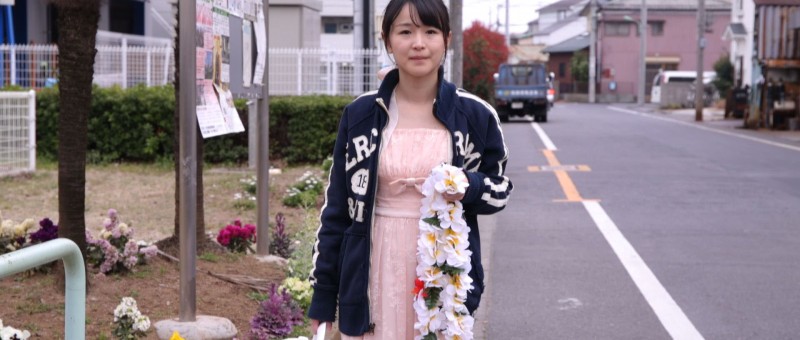
Love and Goodbye and Hawaii (恋とさよならとハワイ, Shingo Matsumura, 2017)

Love and Goodbye and Hawaii poster 1“To end something requires more courage than anything else” the conflicted heroine of Shingo Matsumura’s Love and Goodbye and Hawaii (恋とさよならとハワイ, Koi to Sayonara to Hawaii) is told by her well-meaning ex, but it’s a lesson she’s struggling to learn. Life may very well be a “road made of decisions”, but Rinko (Aya Ayano) doesn’t know how to make them and is rapidly becoming aware that if you don’t hit the relevant dialogue box fast enough they will largely be made for you. Less a tale of romantic confusion, Love and Goodbye and Hawaii is a young woman’s gradual path towards accepting that her attachment to the status quo is as much about the fear of moving forward as it is the pain of faded love.

Office worker Rinko has been living with her graduate student boyfriend Isamu (Kentaro Tamura) for the last three years. To all of their friends, they seem to have the perfect relationship but what no one knows is that, though they continue to live together, the couple broke up some months previously. Seeing as it was Isamu’s apartment in the first place, Rinko plans to move out as soon as she’s saved enough money to find somewhere new in the precarious Tokyo housing market, but then again now that they’re no longer “together” the arrangement has become so comfortable that there’s really no hurry to make a change. Matters come to a head, however, when Rinko discovers that a fellow student at Isamu’s university has taken a liking to him, and it seems he to her.

Despite having been broken up for almost six months, Rinko hasn’t quite accepted that it’s over. She demurs when her friends ask her if she’ll be getting married soon, only latterly admitting that they’ve technically broken up, and explaining that she really has it good now because it was too “heavy” before which is why they fought all the time. Now that there’s “nothing” to fight over and they’ve gone back to being platonic friends it’s all so much easier. Too easy, in fact, which why she isn’t really ready to move on.

Rinko’s unconventional living arrangements seem extremely strange to her friends. “Break up like normal people and never see him again” her friend tells her, offering her a space on the sofa if it’s money that’s the issue. Not that money’s not a problem, but even when well-meaning people offer financial help to end this “weird” situation, Rinko doesn’t really want to take it. She tells her friend that relationships are like driving and you don’t want to jump on the breaks incase they jam and you end up on the skids, but as her perceptive younger sister points out perhaps she just wants to get back together and doesn’t know how to go about it.

Analogies are something Rinko seems to have a taste for, unable to state her feelings plainly in a way others will understand she wraps them up in a more palatable narrative. So it is that she ends up telling her friend’s drunken younger sister that with Isamu she felt like she was CD no other player had worked out how to play. She figured out she liked the sound inside her when she was with him, but time moves on and it feels like she’s still a CD but Isamu is now an iPod and she doesn’t really know what to do with that. What she’s trying to say is that they’ve grown apart, but what she hasn’t quite admitted to herself is that maybe it’s not Isamu that she’s afraid of leaving but the vision of herself as reflected in him.

“Show your real self, put your real feelings out there” the younger woman tells her, but that’s something that doesn’t necessarily get easier with age. Finally gathering the courage, Rinko makes her way back to Isamu for a “serious talk”, only to run into her romantic rival but contrary to expectation the two women find that they have no interest in competition and only wish each other well. Rather than that “serious talk” however, Rinko ends up trying to sort out her romantic dilemma through the familiar medium of a walking race which does at least allow the diffident Isamu to make his feelings plain without actually having to say anything. Sometimes actions are kinder than words, and easier to understand. What Rinko needs to learn is that you can find self acceptance without needing to see it reflected in someone else, and that fear of moving forward is not a good reason for holding back. A quiet and melancholy look at life after love, Love, Goodbye and Hawaii is a gentle ode to the art of moving on with no hard feelings, looking straight ahead.


Original trailer (English subtitles)
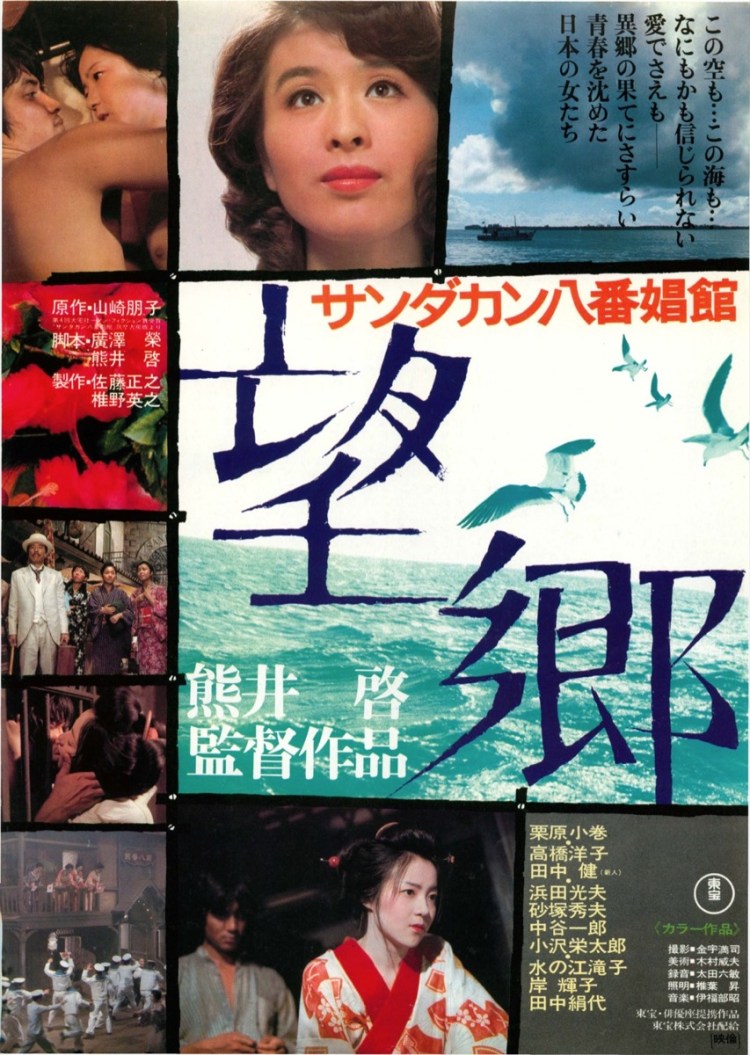
Sandakan No. 8 (サンダカン八番娼館 望郷, Kei Kumai, 1974)

Sandakan 8 posterSome might argue that Japanese cinema has often been reluctant to examine the nation’s traumatic 20th century history with the proper rigour, but even if subtle and coming from unexpected angles there have been many and varied attempts to ask questions about the lingering consequences of feudalism. Sandakan No. 8 (サンダカン八番娼館 望郷, Sandakan Hachiban Shokan: Bokyo), inspired by a true life account of a woman unwittingly sold into sexual slavery as a child at the turn of the century, is not only a condemnation of socially approved people trafficking and its role in building the short-lived Japanese empire but a mild provocation of the contemporary society which refuses to engage with its traumatic past.

In the contemporary era, graduate student Keiko Mitani (Komaki Kurihara) is engaged in researching the “karayuki-san” – Japanese women who were sold into sexual slavery throughout Asia in the early 20th century. Almost forgotten, the karayuki-san are a taboo subject and even those still living in the areas from which women and girls were sent away are unwilling to speak of them. By chance, however, Keiko runs into an old woman in a cafe who speaks with a standard Tokyo accent and tells them that she spent most of her life “abroad”. Quickly realising she doesn’t mean she was a diplomat’s wife, Keiko wonders if the woman might be have been a karayuki-san and delays her return to Tokyo in order to find out.

There is something, it has to be said, ironically exploitative in Keiko’s determination to get the old woman, Osaki (Kinuyo Tanaka), to open up about a subject on which she so obviously does not want to be drawn. A visit to Osaki’s home reveals her to be living in a run-down hovel on the edge of town which is filled with stray cats whom Osaki feeds because “they’re all abandoned, but still they have to live”. Keiko gets herself brownie points by reacting politely to Osaki’s reduced living situation, eventually staying three weeks during which time she gradually teases out Osaki’s sad life story. Finally asking if there wasn’t anything Osaki might have liked to know about her, Keiko’s hypocrisy is fully brought home to her when Osaki admits that no one was more curious about Keiko than she was but that “people have reasons for not confiding in others” and if it’s something you need to ask about then it’s probably something that the other person may not want to share. In any case, Osaki seems to have known Keiko had an ulterior motive but does not regret sharing her story and has no worries about what Keiko might do with it as long as she makes sure to tell the truth.

The truth, in a sense, seems to be something the villagers feel themselves well acquainted with which is why Osaki lives in a shack on the edge of town. Tricked into sexual slavery as a child by an amoral people trafficker who lured her with promises of money to be made overseas, Osaki found herself in Borneo and a prisoner of “Sandakan No. 8” which was one of 10 numbered brothels on the island largely catering to Japanese travellers overseas, facilitating the expansion of the Japanese empire as accidental emissaries and ports of call. When Osaki was a child, Japan was a poor country and it was considered normal to sell one’s daughter in order to feed a family. Working overseas carried with it a kind of cache though no one, except perhaps her brother, seems to be fully aware of what Osaki is going to and she herself has not in any way chosen or consented to become a sex worker. When she eventually returns to Japan, she finds herself unwelcome in her brother’s house, which her money paid for, because of the shame associated with those who have “worked away”. Even 50 years later, she finds herself living alone, all but disowned by her only son, on the outskirts of her childhood village ostracised by the “respectable” townspeople who don’t for a second believe Osaki’s quick introduction of Keiko as her daughter-in-law.

The daughter-in-law deception is only one heartbreaking aspect of the complex relationship between the two women who are each, in a sense, hiding something from the other but end up forming a genuine connection anyway. Intensely lonely and having lived a life filled with suffering, Osaki is willing to pay for company with her story while Keiko is, not quite deliberately, using her loneliness against her in an attempt to earn her trust and get her to reveal her secrets. Nevertheless, Keiko is able to mine a rich and deep seem of 20th century trauma through the tragic story of just one woman which reaches out to hundreds like her some of whom rest in a graveyard in the forests of Borneo with their backs forever to Japan. The enemy is, once again, poverty more than it is patriarchy or even feudalism, a problem less of the essence in the rapidly improving post-war economy, but as Kumai is keen to point out, this system of state sanctioned people trafficking (finally outlawed only once Japan’s status on the world stage began to rise) had far wider implications than it might be thought which still echo into the present day and perhaps beyond if not for the efforts of women like Keiko who do not wish to forget.


Original trailer (no subtitles)

Bright Future (アカルイミライ, Kiyoshi Kurosawa, 2003)

Bright future posterThe cinema of the late ‘90s and early 2000s is one defined by alienated youth kicking back against a stagnant society in which they see no place for themselves now that the dull and conventional salaryman world of their parents can no longer offer security in place of fulfilment. Kiyoshi Kurosawa’s early masterpieces had edged towards the nihilistic, embracing this sense of generational hopelessness but finding perhaps glimmers of possibility in the longing for escape no matter how far off. Bright Future (アカルイミライ, Akarui Mirai), shifting away from the genre fare which had made his name, does something much the same but perhaps even bleaker in its melancholy acceptance of intergenerational disconnection.

Our two heroes, Yuji (Joe Odagiri) and Mamoru (Tadanobu Asano), have workaday jobs at a factory which they find fulfilling only in their emptiness. The guys have found a fan in the factory’s ageing boss, Fujiwara (Takashi Sasano), who begins giving them special jobs and trying to hang out with them while promising a special signing bonus should they agree to become regularised employees. Bonding in their resentment towards men of Fujiwara’s age who romanticise their youth while exercising paternal authority and entitlement, the two hatch their revenge on an unforgiving society through the strange plan to acclimatise their pet jellyfish to life in modern Tokyo.

The jellyfish, closely associated with the ethereal Yuji, becomes a kind of symbol of the “bright future” the two young men fear will elude them. They, like the jellyfish, have tried to acclimatise themselves to living in the otherwise hostile environment of contemporary Tokyo but also accept that the ability to survive may not be enough and it may eventually be necessary to remove oneself from an unforgiving society until such time as it is possible to return.

This or something like it seems to be Mamoru’s key philosophy as the owner of the jellyfish and the chief architect of the “bright future” both men dream of – literally in the case of Yuji who is the idea’s unwilling prophet. Mamoru has, for reasons unknown, decided to take the strangely melancholic Yuji under his wing, eventually entrusting sole custody of the jellyfish to him in an attempt to force him to look after “himself”. In service of this ideal and perhaps of Yuji’s unwilling visions, Mamoru takes more immediate revenge against the literal Fujiwara – murdering his boss and his wife (Marumi Shiraishi) in their well appointed middle-class home (only their small daughter is spared). Yuji interprets this gesture as protective seeing as he himself had found the bodies after wandering into the Fujiwara home with violence on his mind, but misinterprets Mamoru’s intentions for him in disappointing his mentor by insisting that he is prepared to “wait” for him rather than take this cue to step up and take control of his own life’s direction. 

Yuji is indeed, like the majority of heroes in turn of the century Japanese cinema, entirely directionless. He appears to have no surviving family in the older generation, only an exasperated sister who does her best to help but doesn’t know how, attempting to straightjacket him into a salaryman world of conventional success with an office boy job at her understanding company. A strange young man, Yuji has has vivid dreams and a need for control and routine – it’s the closure of the local bowling lanes which sends him round to the Fujiwara’s in a calm yet violent rage while repeatedly losing in a video arcade to his sister’s boyfriend also sends his insecurity into overdrive. He once dreamt of a “bright future” but now sees only darkness. Stepping up onto the roof of a building in which he is learning to find a home, he is forced to admit that despite attempting to look far into the distance he can’t see much of anything at all from where he is right now.

Yet for all his resentment towards men like Fujiwara, it’s a father figure which eventually begins to push him in a more positive direction. Mamoru’s father Shinichiro (Tatsuya Fuji) takes his son’s vulnerable best friend under his wing, giving him a home and a purpose as he begins to teach him how to repair things that might ordinarily be thrown away. Shinichiro’s previous assistant quit because he saw no future in this line of work, but Yuji seems to delight in the repurposing of the previously useless for arcane ends even if his chief contribution is a continuation of his jellyfish experiments. Shinichiro, superficially supportive, cannot understand the obsession with the jellyfish. Attempting to reassure a thwarted Yuji, he asks him what exactly the jellyfish could achieve in a world so resistant to real change yet he also berates him with the impassioned impotence of age in decrying his contemptuous dismissal of the reality which, after all, belongs to men like Shinichiro who will demand respect while offering very little in return.

The jellyfish find they can’t live in Tokyo, but youth adopts a different solution as it runs rampant with out purpose or direction but seemingly delighting in meaningless anarchy. A group of teens Yuji runs into wear identical Che Guevara T-shirts while sporting light-up microphone headsets as they wander round the city kicking cardboard boxes and laughing as they go, like overgrown children with no clear forward path before them. Age and youth seem primed to exist in differing realities, perpetually unable to understand each other while youth struggles to find direction in the absence of parental guidance. Ironic in the extreme, the “bright future” here seems to exist only as a vague hope but, perhaps, the only guiding light in an ever darkening world.


Original trailer (English subtitles)

Apostasy (破戒, Keisuke Kinoshita, 1948)

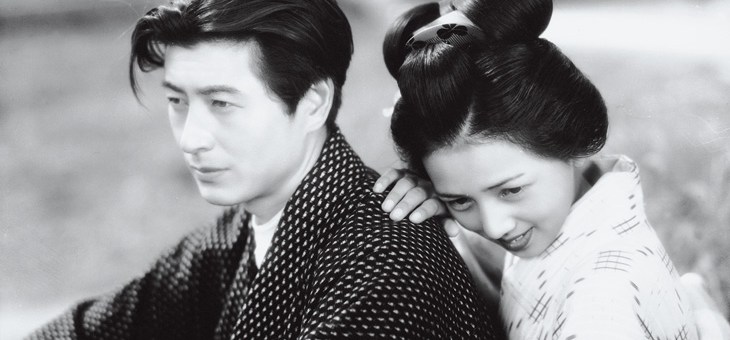
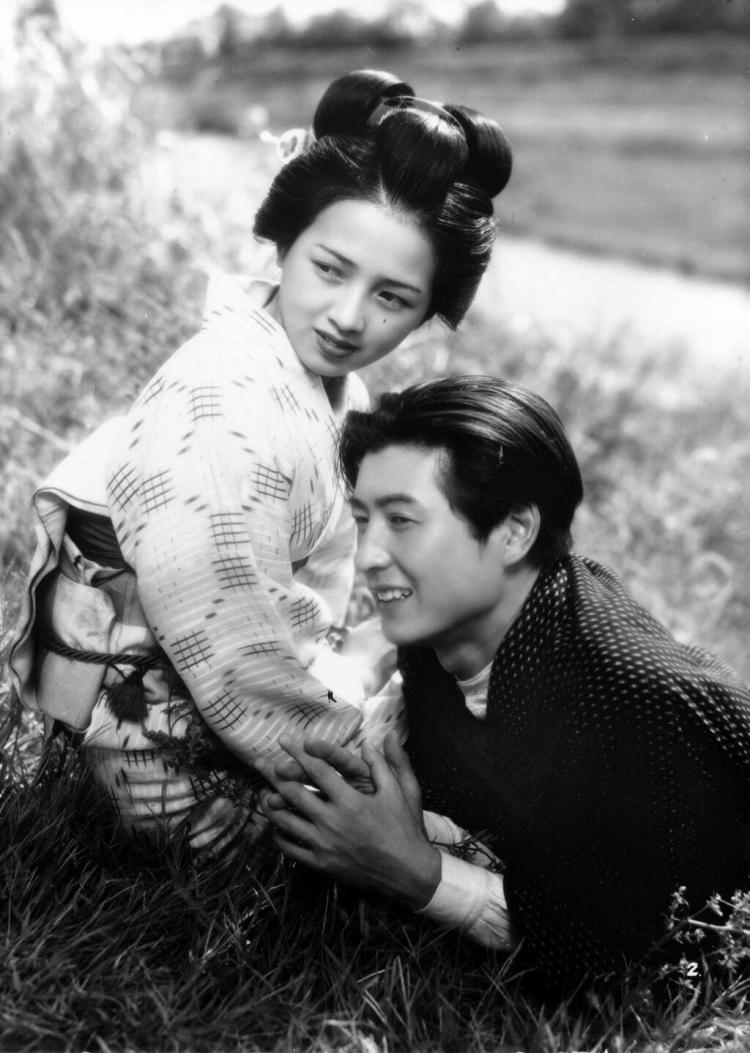
Hakai still 1For all his good hearted humanism and intense belief in the simple power of human goodness, the films of Keisuke Kinoshita can also be surprisingly conservative, most particularly in their attachment to the old, pre-war Japan which they often see as unsullied by the corruption and ugliness of the militarist era. A new constitution film, Kinoshita’s adaptation of the Toson Shimazaki novel The Broken Commandment, The Apostasy (破戒, Hakai), opens with a series of bold titles proclaiming “Freedom and equality”, and “respect for human rights” before breaking into an attack on the persistent feudalism which has managed to survive into the new era along with prejudice and contempt. Zooming back to the missed opportunity of Meiji-era liberation, Kinoshita too remains somewhat ambivalent about the the decline of a social order in a Chekhovian lament for the rise of the petty middleman and the fall of noble aristocracy.

In Meiji 35 (1902), despite the advent of the Meiji Restoration and abolishment of the class system, prejudice against the “burakumin” – untouchable “outcasts” who lived in isolated settlements and (historically) made their living in occupations connected with death, was still very much in existence. This is all too apparent to Segawa (Ryo Ikebe). A bright young man, Segawa’s father sent him out of their village to make something of himself with the solemn promise that he must never reveal his burakumin origins to anyone. The world being as it is, however, Segawa is conflicted especially as he has fallen in love with his mentor’s daughter Oshiho (Yoko Katsuragi) and wonders if it would be fair to marry a non-burakumin woman without telling her truth and live with the threat of discovery forever over their heads.

The Broken Commandment would later be adapted again by Kon Ichikawa whose focus is, perhaps quite surprisingly, very different to that of Kinoshita who, uncharacteristically, chooses to prioritise class concerns over the right to live freely and honestly in a compassionate society. Ichikawa’s adaptation deliberately widens the implications of Segawa’s dilemma, making it plain that he is talking not just about burakumin rights but directly to all oppressed peoples and most particularly to those who feel obliged to keep their true natures a secret in an oppressive and conformist society. Strangely, Kinoshita chooses not to engage with this theme which might otherwise seem tailor made for his persistent concerns if perhaps a little close to home, preferring to focus not on Segawa’s gradual shift into accepting his own identity and hearing the call to activism but on the reactions of the changing world around him which seems to be imploding while besuited upstarts enact their petty revenge on the chastened nobility.

This is most clearly seen in the unfair treatment of Segawa’s mentor and landlord, Kazama (Ichiro Sugai) – a former samurai and until recently the local school teacher. Mere months away from his retirement, Kazama has been instructed to resign so that the school will not need to pay his pension while his position has been taken by a pushy local man with limited education whose sole claim to the job is being of the people. Kazama is understandably resentful but stoic. Segawa’s liberal colleague, Tsuchiya (Jukichi Uno), takes the school board to task for its unreasonableness and underhanded attempt to save money by forcing an old man out of his position with no thought for his 30 years of service. Though Tsuchiya might be broadly in agreement with the changes taking place in Meiji-era society, he too worries about the greedy upstarts usurping privilege rather than seeking to eradicate it.

Stepping back for second, Apostasy is a post-war film designed to echo the egalitarian philosophies of the new constitution drawn up under the American occupation. It is then somewhat subversive that our villains are the Westernised lower middle classes of Meiji-era society who seem to have embraced “modernity” by dressing in suits but refuse to abandon ridiculous ancient prejudices such as that towards burakumin, doubtless because those prejudices largely work out in their favour. It would be tempting to read these prejudices as foreign imports, but that against the burakumin is wholly Japanese and truth be told somewhat backward in contrast to (the kimono’d) Tsuchiya’s forward looking socialist beliefs which superficially at least seem more in keeping with the age.

Yet it is in some senses Segawa himself who struggles to emerge from the feudal yoke. His promise to his father is a sacred vow underlined by loss and sacrifice. He feels it is his duty to live as his father wished, as a “normal” Japanese citizen in success and comfort, but also begins to become acutely aware that to do so may be cowardly and selfish. If he chooses to keep his promise to his father and never reveal himself as a burakumin, he will be complicit with the systems which oppress him and thereby ensure those like him will always be oppressed. His awakening comes, in a sense, from a second father – Inoko (Osamu Takizawa), a burakumin who has come out of the closet and loudly fought for burakumin rights along with the general liberty of all oppressed people. Caught between two fathers and his growing love for Oshiho, Segawa remains lost while one of the suited proto-militarists threatens to out him leaving him floundering in the face of intense social stigma and the possibility that those he loves may turn against him.

Segawa has to free himself or risk becoming like Kazama – a man haunted by the feudal past, as Tsuchiya puts it. Kazama himself is painted in broadly sympathetic terms, forced to endure the melancholy fate of being eclipsed by a Lopakhin-esque member of the insurgent middle-classes, but his prejudice is later exposed despite his original support of Segawa when he notices one of the suits smirking at him and instantly feels humiliated, turning his impotent rage back on the outcast as if his presence further dishonours him as a samurai. Segawa’s aim as a teacher had been to teach his children the power of individual thought, which would seem to be the best weapon against prejudice but his message has been cut off at source thanks to the self-interested school board who have been all to quick to claim the benefits of modernity with none of the responsibility. Resolved to fight for a freer future, Segawa finally accepts his responsibility as a burakumin spokesman in the knowledge that his calling is to educate and that only through education can anything ever change. The lessons of Meiji may have gone unheeded, but the opportunity presents itself again to abandon the feudal past in favour of an egalitarian modernity built on fairness and compassion rather than obligation and oppression.


Titles/opening (no subtitles)

Our House (わたしたちの家, Yui Kiyohara, 2017)

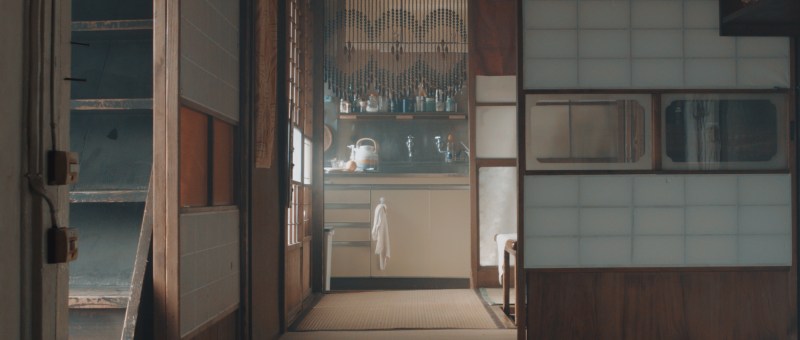
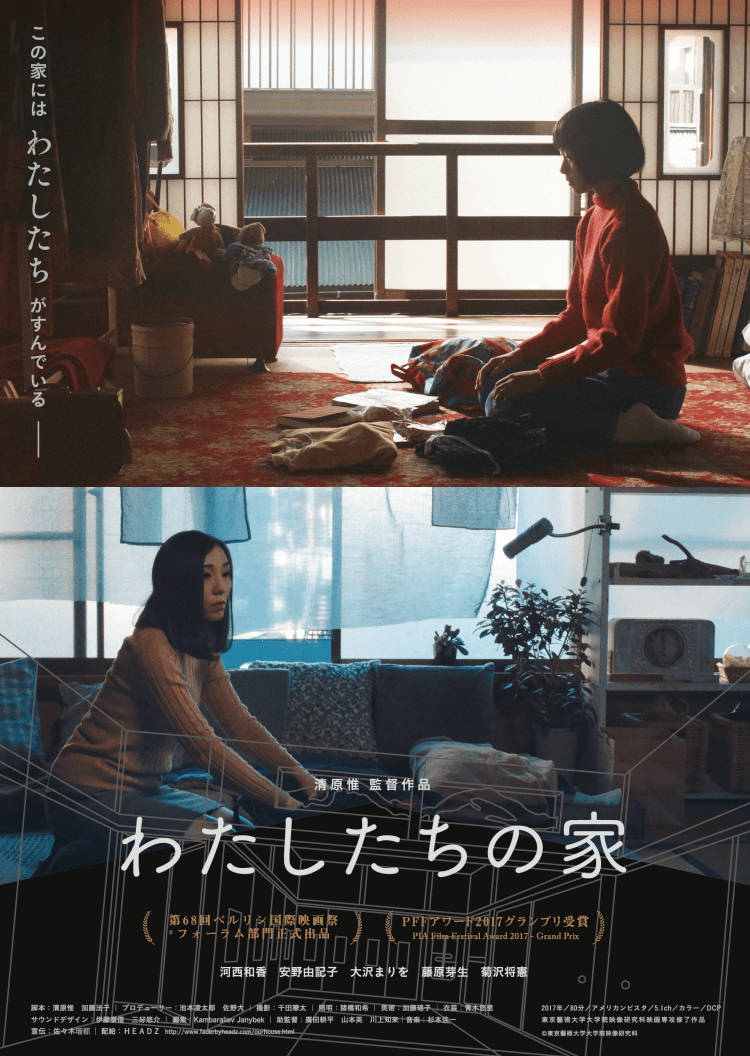
our house posterIs the definition of “space” defined by absence as much as presence? Do we carve out pieces of the world to inhabit, or simply shift into an idea of place which we construct entirely around ourselves? Yui Kiyohara’s feature debut Our House (わたしたちの家, Watashitachi no Ie), completed as part of her graduation project for a masters at Tokyo University of the Arts, hints at the eeriness of a shared existential continuum as four women bridge inter-dimensional connections while living in the “same” two-storey house in Yokohama.

We begin with 14-year-old Seri (Nodoka Kawanishi) dancing cheerfully with a few of her friends presumably on a sleepover wearing incongruously old-fashioned nightgowns like the heroines of a gothic boarding school drama. The fun stops however when Seri thinks she hears a funny noise, half convinced the house is haunted. Her friends tell her it’s all in her mind, but something seems odd and she can’t seem to shake the sense of presence in the house.

Part of that might be because, though Seri’s father appears to have left long ago, she still dwells on his memory and perhaps feels the echo of him in their family home. It may seem particularly poignant to her right now because her mother, Kiriko (Yukiko Yasuno), has found a new man – Takashi (Toshio Furuya), who drives the local rubbish truck. Kiriko wants to get married again, and Seri, entering adolescence herself and playfully teasing her friend about a possible romance, cannot quite accept that her mum’s moved on.

Changing tack, a young woman wakes up on a ferry with seemingly no memory of how she got there or of her previous life aside from her name, Sana (Mariwo Osawa). Another woman on the boat, Toko (Mei Fujiwara), stops to ask if she’s alright and then offers to let her stay at her place, which happens to be an identical house to the one in which Seri and her mum live, until she remembers who she is.

Though Seri’s story has its whimsy, it remains firmly within the realms of the natural while there’s something decidedly odd about the world Toko and Sana inhabit. There is, however, a strange symmetry to their relationships. Both sets of women are keeping things from one another if for slightly different reasons. There are after all secrets which must exist between a teenage girl and her mother, so perhaps Kiriko doesn’t quite discuss her relationship with Takashi with her daughter, and Seri doesn’t talk to her mother about the kinds of things she talks to her friend about, but there are also additional communication difficulties in their shared reluctance to talk about the “ghost” of Seri’s absent father or about Seri’s various anxieties which manifest in her preoccupation with a possible haunting.

With Toko and Sana there is of course the issue of amnesia, but in this case it’s Toko who appears to be keeping secrets in her well concealed paranoia and illicit activities which see her handing over plain envelopes in dingy corridors and asking pointed questions about water pollution. Does she know more about Sana than she lets on, or is Sana perhaps a spy herself faking her amnesia to get close to Toko? In any case, Toko seems to want to keep her around, letting her know she can stay for as long as she wants, but it’s not entirely clear if that’s altogether a good thing or if Toko has more or less kidnapped a friend to keep safely at home. When she recommends drinking from the bottled water in the fridge rather than from the tap, we’re apt to wonder which source it is that might be “polluted”.

In that sense, both environments, hitherto exclusively female spaces, are eventually “polluted” by unexpected male intrusion. The spectre of Seri’s father may be ever present in the home, but it’s Takashi who places a strain on the relationship of mother and daughter, whereas Sana’s coffeeshop buddy Natsuki (Masanori Kikuzawa) sets off Toko’s alarm bells in more ways than one as he simultaneously encourages her to doubt her new friend, become jealous on an emotional level, and then anxious on a professional one as she wonders if Natsuki has befriended Sana to get into the house and look for a mysterious “something” she quickly tells him is no longer there. 

“Things embedded in the mind can never be lost” Toko reassures Sana, but also affirms that “nobody can prove who they are”, which might be true but doesn’t do much to help her identity-shorn friend. Natsuki too, claiming that Sana resembles someone he used to know, describes his old acquaintance as if she were “filled with a light that can’t be seen” perhaps alluding to the hidden depths he could only be aware existed within her but was never permitted to see. Toko says she lives the way she does so that she “won’t be defeated by gravity” but offers no reply when asked if she knows of anyone who has ever successfully defied it.

What we’re left with, is two mutually dependent realities though we’ve no way of knowing if each is located in the same temporal space or if one is past and another future. There’s a curious timelessness to Seri’s innocent world of birthday parties and walking on the beach with a friend, whereas Toko’s odd attire and slightly robotic manner of speaking hint towards a kind of retro futurism. The space, it seems, remains the same. Seri’s aunt, looking around, notices cracks in the walls but admires the house’s resilience prompting Kiriko to describe it as “still healthy”, as if it were a living entity which envelops them rather than a space they shape themselves. Yet the space is what connects them, one location existing at an intersection between two worlds. Events mirror each other, actions begin to have effect on each side though unknowingly. The curious symmetry might go someway to explaining life’s uncanniness, the sense of echoing we all feel on entering a dark and empty room, but it also provides a mechanism for harmony as items find themselves transferred to the place in which they are most needed. The space defines itself, but then perhaps it really is all “our house” – a shared universe in which we remain aware of each other but painfully unable to connect.


Available to stream via Mubi (UK) until Sept. 27.

Original trailer (English subtitles)
Bumpkin Soup (ドレミファ娘の血は騒ぐ, Kiyoshi Kurosawa, 1985)

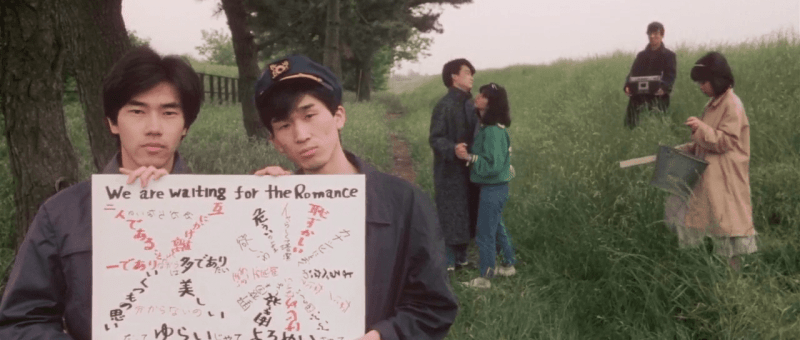
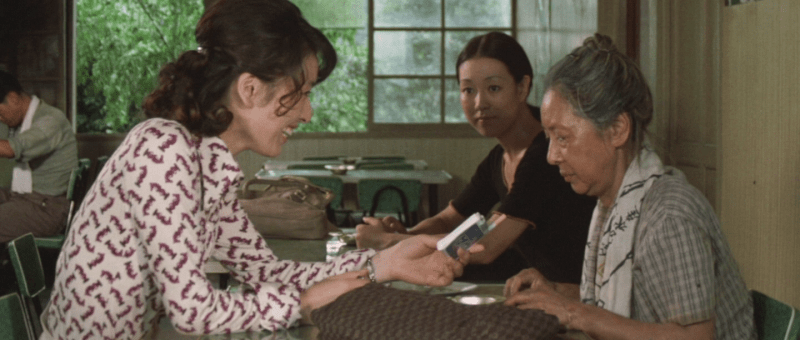
Bumpkin soup posterLike many directors of his generation, Kiyoshi Kurosawa began his career in “pink film” – mainstream softcore pornography produced to a strict formula. His debut had been made for Director’s Company, an independent production house which offered creative freedom to young and aspiring filmmakers. He then tried to move into the studio system by directing for Nikkatsu’s Roman Porno, but the film was rejected for not quite living up to the demands of the genre. Bumpkin Soup (ドレミファ娘の血は騒ぐ, Do-re-mi-fa-musume no Chi wa Sawagu, AKA The Excitement of the Do-Re-Mi-Fa Girl) was then purchased from Nikkatsu and released independently as his second film, earning Kurosawa something of a reputation as a contrarian. Though the film contains its fair share of nudity and strange sexual shenanigans, it is easy to see why it did not fit the Roman Porno remit thanks to its bizarrely absurdist tone and often nonsensical French New Wave-inspired post-modernism.

The film begins with the heroine, Akiko (Yoriko Doguchi), walking into a Tokyo university campus in search of her small-town boyfriend, Yoshioka (Kenso Kato). Yoshioka is not, however, where he said he would be – he rarely turns up to lessons and has been absent from the music club he said he had joined for some time. Determined and undaunted, Akiko continues to look for him, encountering various strange people and events including a psychology professor intent on exploring the depths of shame.

After meeting sexually obsessed female student Emi (Usagi Aso), Akiko remarks that the university campus is like a permanent festival, or perhaps an amusement park. It certainly seems to be some sort of continuous orgy as seen though the eyes of simple country girl Akiko who has, after all, only come here in search of lost love. Carrying around a walkman with a tape featuring Yoshioka’s music, she devotes herself to finding her beau but eventually sniffing him out, discovers that he’s not the man she thought he was. Truth be told, Yoshioka does not seem like much of a catch. A randy college student, he has more or less forgotten all about Akiko while he pursues just about everyone else on campus instead of going to lessons.

Latterly, Akiko comes to the realisation that she thought she was looking for an adventure leading to love, but perhaps what she really wanted was love leading to an adventure. She left the country behind, travelled to the city, transgressed borders and entered the university where she was sure she would find answers but has discovered only more questions. Akiko feels herself at odds with her new environment, unable to understand the strange grammar of the university world where people seem to talk mostly about themselves. She does, however, seem strangely taken with the befuddled professor Hirayama (Juzo Itami) whose attempts to explore the nature of shame are derailed by the “shamelessness” of the modern student.

Hirayama’s big idea is that shame is all a sham. That the custom of hiding the parts of the body we have been taught to be ashamed of is a kind of deception in itself. He hopes that in the future people will live “nakedly” without feeling the need to hide anything at all, or at least that it will be impossible to tell from the outside which parts of themselves someone might be ashamed of. In order to pursue his theories, the professor is currently engaged in experiments to provoke an “extreme shame mutation” – something which his students later undertake alone but are unable to fulfil because their subject, Emi, appears to get off on the very things they considered shameful and embarrassing which, in turn, turns them all on. So in one way a very successful experiment, but in another not. In any case, Hirayama comes to the conclusion that only Akiko, with her innocent country ways, will be capable of showing him true shame which is how she eventually becomes mixed up in his “research”.

Most obviously inspired by mid-career Godard, Kurosawa adopts a post-modern, absurdist approach satirising left-wing student politics and youthful intensity while inserting random moments of song and dance along with explicit (and often odd) sexual  content that was likely still not quite enough to make it worthy of the Roman Porno name. A strange subplot pits the psychology student against a gang of mute performance artists led by a girl banging a bucket with a stick, which eventually leads to the act of nihilistic revolution which closes the film with a lullaby sung by a girl wielding a gun. What does it all mean? That shame is just a tool of social oppression, that one should make one’s own decisions without blindly following “thinkers”, that young people destroy themselves in pointless acts of revolution? Who can say, perhaps it isn’t very important but Kurosawa certainly has his fun while exploring the innocence/experience divide.


The Girl I Loved (わが恋せし乙女, Keisuke Kinoshita, 1946)

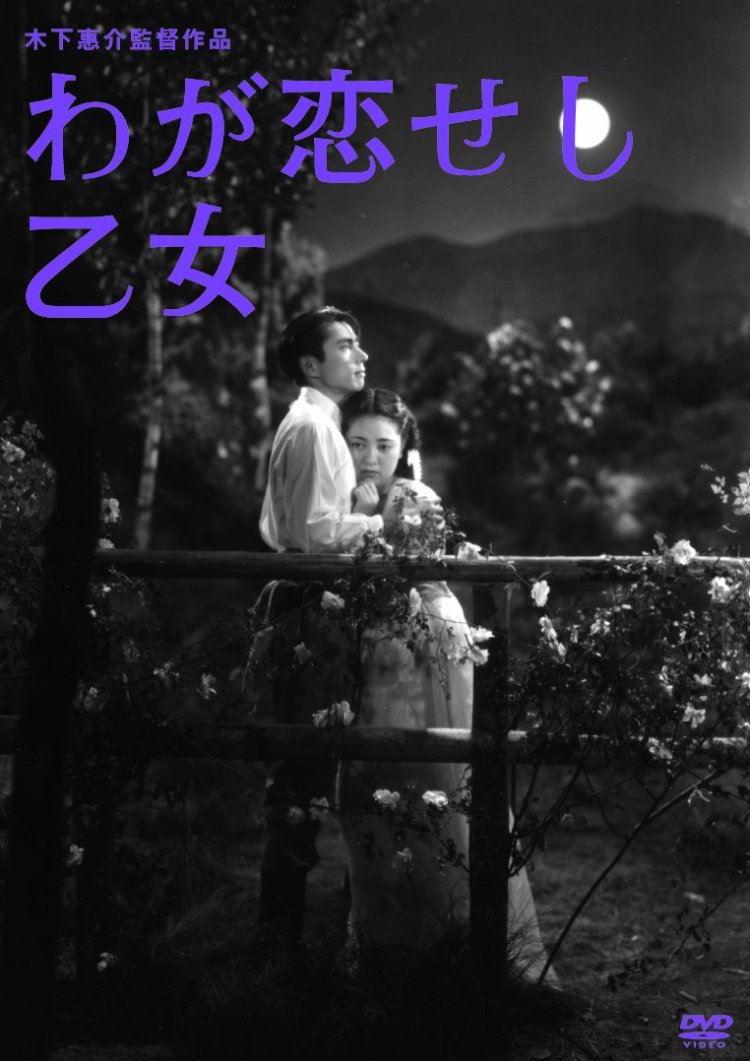
The Girl I loved DVD coverThe post-war era, as confusing and chaotic as it was, offered several choices, among them that to change to course, choose to create a better, kinder world than the one which had led to so much suffering. As always, however, the human temptation is to choose the opposite and allow anger and resentment to make everything even worse than it had been before. Occasionally censured for his sentimentality, Keisuke Kinoshita was perhaps among the more defiantly positive of the post-war humanists whose fierce love human goodness knew no bounds. In The Girl I Loved (わが恋せし乙女, Waga Koiseshi Otome) he puts his ideas to the ultimate test as a young man recently returned from the war must learn to cope with various kinds of disappointment but eventually resolves to take solace in other people’s happiness even at the cost of his own.

The tale begins some years earlier when a baby girl is abandoned in front of the Asama Ranch, her mother apparently having taken her own life by jumping from a nearby cliff. The Asamas are good people and moved by the letter they find with the baby so decide to take her in. Yoshiko (Kuniko Igawa) is raised alongside older brother Jingo (Yasumi Hara) as an adopted sister always aware of her origins but very much a full member of the family.

Flash forward to the present day and Yoshiko has become a beautiful young woman. Jingo has returned from five years of war in perfect physical health, keen to resume his idyllic farm life in the beautiful Japanese countryside. The fact is that Jingo has long been in love with Yoshiko, though the situation is understandably complicated seeing as they were raised as siblings even if there is no blood relation between them. Somehow it seems a perfectly natural idea that the pair will marry and many assume this will be the case. Jingo, however, remains somewhat reticent and afraid to voice his feelings. It seems Yoshiko has something to tell him too and so he dares to hope as they both agree to share their respective secrets after the harvest festival.

At the festival, however, Jingo gets a shock. He sees the way Yoshiko looks at another man and realises that what she wanted to tell him was probably that she had fallen in love with someone else. Shaken and confused, Jingo bites his tongue. He knows to say anything now would only create more pain and suffering for everyone while he alone will suffer if he decides to stay quiet.

Nevertheless the temptation is there. Mr. Noda (Junji Soneda), Yoshiko’s intended, is a quiet man, an intellectual who returned from the war early thanks to injury and still walks with a cane. Yoshiko has been fearful that her family may object to the marriage on the grounds of Noda’s disability – something he has also been aware of and warned her about in explaining the potential hardship she may have to endure as his wife seeing as he is also merely a poor schoolteacher. Jingo could try to refuse her permission to marry, try to force her to marry him instead, or refuse to give his blessing for her to marry anyone at all, but if he did that all he’d be doing is condemning both of them to eternal misery. It would be understandable if he began to resent Noda and most particularly his disability which brought him home from the war early and enabled him to be here to fall in love with Yoshiko while Jingo was away and dreaming of home, but then it could so easily have been the other way around.

In the end, Jingo’s love is selfless and good. What he wants is for Yoshiko to be happy and if being with Noda is what that means then Jingo will not stand in her way no matter how much it may hurt him to stand aside. After all, as Noda says, aren’t they both lucky to be alive in this beautiful place? Having suffered so much, the two men understand how precious life is and know it’s far too short for pettiness or resentment. A quiet, gentle tale The Girl I Loved is a sad story of youthful disappointment in love, but it’s also a kind of melancholy manifesto for the new post-war world built on compassion and understanding as a young man decides to take the noble path in accepting that the girl he loved loves someone else and that’s sad but it’s also happy and if you can learn to rejoice in someone else’s happiness even in the midst of your own pain then perhaps everything will be alright after all.


Titles and opening scene (no subtitles)

The Crimes That Bind (祈りの幕が下りる時, Katsuo Fukuzawa, 2018)

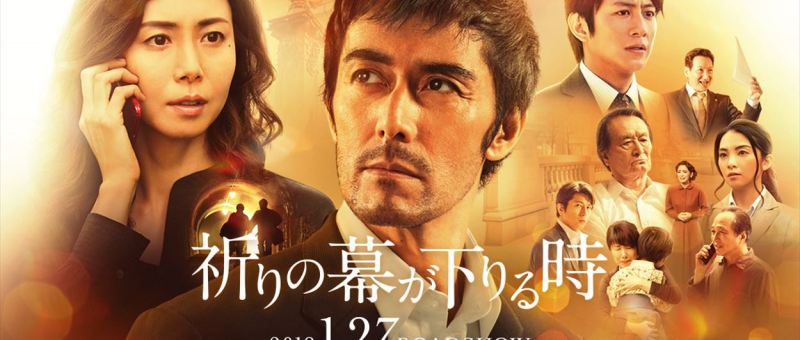
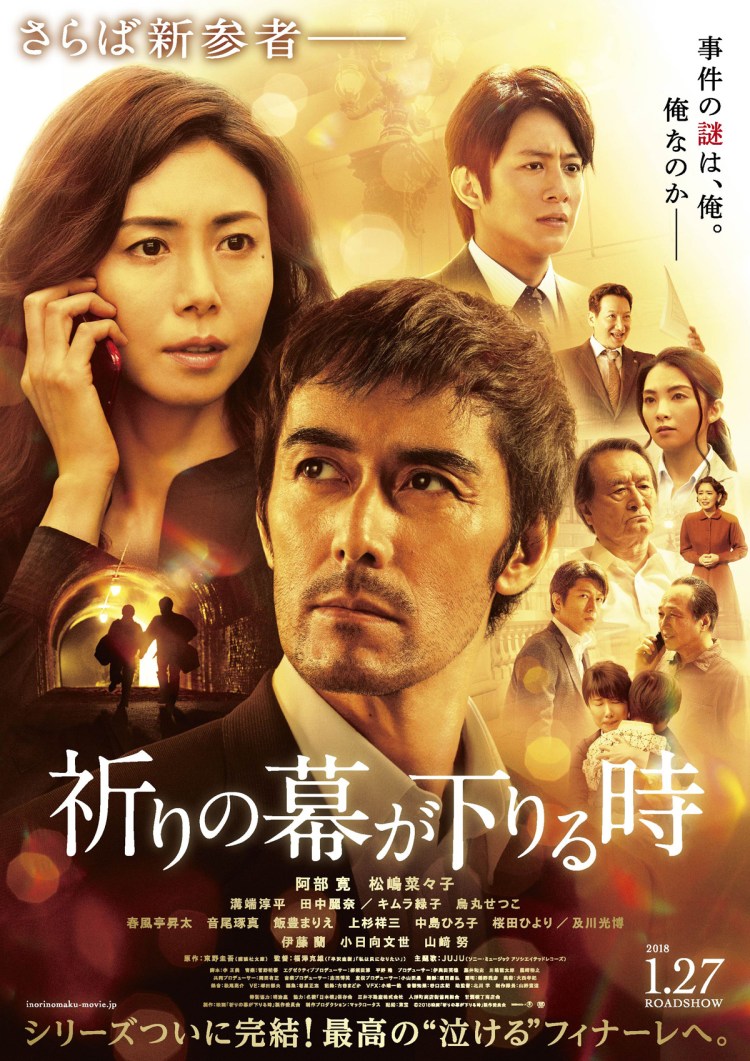
Crimes that bind posterDetective Kyoichiro Kaga has become a familiar screen presence over the last decade or so in a series of films and TV dramas starring popular actor Hiroshi Abe which might make it something of a surprise that The Crimes That Bind (祈りの幕が下りる時, Inori no Maku ga Oriru toki) is, after a fashion, a kind of origin story and touted as the culmination of the long running franchise. Another of prolific author Keigo Higashino’s key detectives, Kaga’s stalking ground has always been Nihonbashi where he has managed to make himself a friendly neighbourhood cop but, as it turns out, dedication is not the only reason he’s refused promotions and transfers to stay in what is, professionally at least, something of a backwater.

In fact, the film begins way back in 1983 when a young woman, Yuriko (Ran Ito), ran away from her husband and son to become a bar hostess in Sendai offering only the explanation that she felt herself unworthy of being a wife and mother. Some years later in 1997, she met a nice man – Watabe, but died of natural causes in 2001 at which point we discover that she is none other than the long lost mother of our master detective whom she abandoned when he was only eight years old. Being a compassionate man, Kyoichiro Kaga is not angry with his mother only sorry he did not get to see her before she passed and eager to meet the man who made her last years a little happier. Only, it appears, Watabe has also disappeared without trace. The only thing the Mama-san at the bar where Yuriko worked can remember about him is that he once said he often went to Nihonbashi. Kaga searches for the next 16 years with no leads, which is when the main case kicks into gear with the discovery of a badly decomposed body of a woman in a rundown Tokyo flat.

Of course, the two cases will turn out to be connected, giving Kaga an opportunity to investigate himself and come to terms with his difficult family circumstances including his strained relationship with his late father whose coldness he blames for driving his mother away. Parents and children will indeed develop into a theme as Kaga digs into why his mother might have done the things she did while also trying to reverse engineer his clues to figure out why he seems to be at the centre of an otherwise completely unrelated case.

Meanwhile, pieces of the puzzle seem to drop into place at random such as the fortuitous discovery of an old woman claiming to have lost her memory so that she can stay in hospital who may or may not be linked to one of the prime suspects – a top theatre director also known to Kaga thanks to a chance encounter some years earlier. In a neat twist, the theatre production she is currently trying to put on is Love Suicides at Sonezaki – a sad tale of young lovers, an adopted son of a merchant and a courtesan, who realise that they have no freedom to pursue their desires and so decide that their only solution is double suicide. The truth that Kaga uncovers leads him in much the same direction only the love at stake is familial rather than romantic and built on the strange filial interplay of the connection between a parent and a child.

It is quite literally “crimes that bind”, but Kaga’s repeated mantra that lies are the shadow of truth, illuminating as much as they conceal, does not quite fit with the incident he has been investigating which largely hinges on coincidences which place him, improbably, at the centre and tip him off to the hidden connections which will crack the case. Which is to say, the solution lies in the killer overplaying their hand (though for reasons unrelated to crime) and thereby undermining their carefully won subterfuge. Torn between solving the murder and exploring Kaga’s melancholy backstory, The Crimes That Bind finds itself falling between two stools even as its twin plot strands begin to dovetail as neatly as one assumes they eventually will, laying bare the central themes of parental sacrifice and belated filial gratitude. Playing best to those already invested in the Kaga franchise, Katsuo Fukuzawa’s adaptation may serve as a fitting conclusion (to this arc at least) but cannot quite overcome its over-reliance on confessional flashback as method of investigation or the improbable qualities of its admittedly twist filled central mystery.


International trailer (English subtitles)