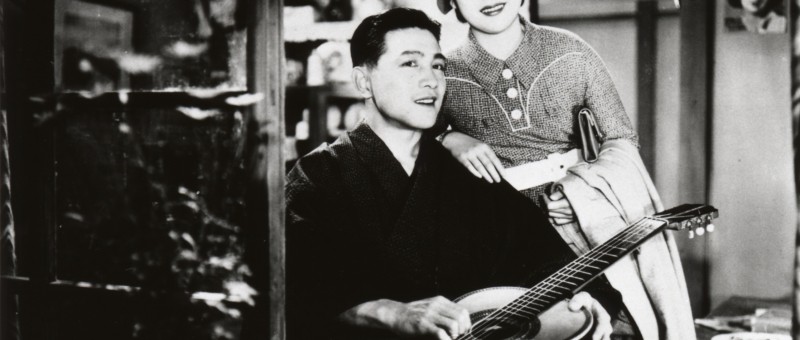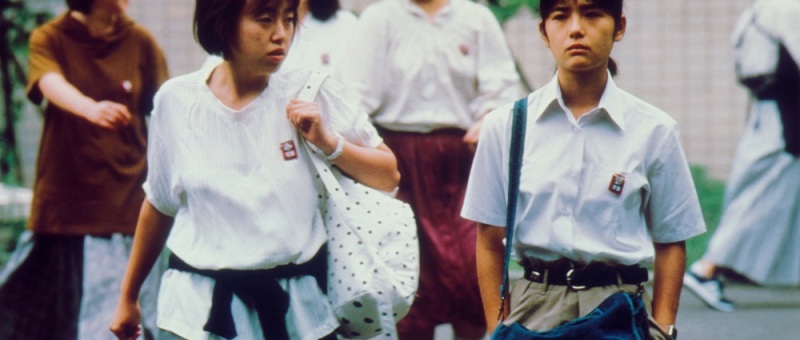
Flowers of Evil (惡の華, Noboru Iguchi, 2019)

Small-town ennui is something familiar to many who’ve found themselves feeling somewhat out of place in the place they’ve always been, but rebellions usually take less obvious forms than the nihilistic rejection of bourgeois respectability enacted by the conflicted hero at the centre of Noboru Iguchi’s Flowers of Evil (惡の華, Aku no Hana). Iguchi is best known as a director of made for export splatter exploitation, so it might come as a surprise to his fans to see him take on the admittedly dark but largely gore-fee adaptation of Shuzo Oshimi’s coming-of-age manga.

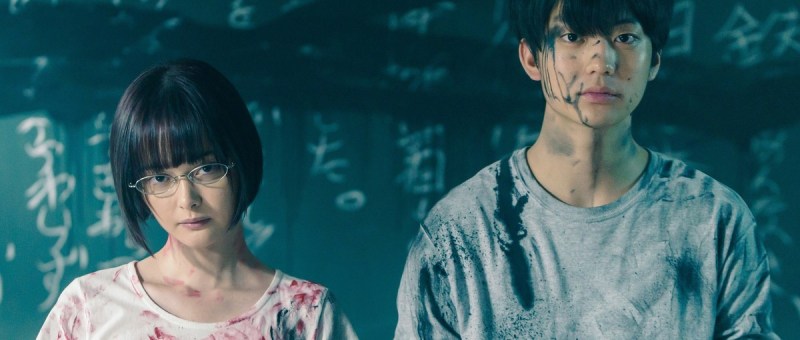
Takao (Kentaro Ito), a “regular” high school boy, likes to read “difficult” books such as the poetry collection by Charles Baudelaire from which the film takes its title. He feels himself somewhat above his surroundings, but superficially conforms to the ordinary world around him. Like many of his classmates, he’s developed an adolescent crush on the school’s prettiest girl, Nanako (Shiori Akita), but unlike his friends views her as his “muse”, a pure and untouchable figure of unspeakable desire. Nipping back to the classroom alone to retrieve a forgotten book, he spots Nanako’s gym bag lying on the floor and cannot resist opening it, burying his face in her clothes. Panicked after hearing someone nearby, he takes the bag home with him.

Everyone immediately knows that a “pervert” is responsible for the theft, they just don’t know who it is. Except for the class’ resident strange girl, Sawa (Tina Tamashiro), who apparently witnessed Takao’s descent into perversion in real time. She makes him a deal – write an essay all about what a big pervert he is and she’ll kept his secret in friendly complicity seeing as she is a kind of “pervert” too. Sawa, who is much more obviously “different” than Takao and completely unafraid of embracing it, is convinced that their town is entirely inhabited by “Shit Bugs”, and they are the only elevated beings. Uncomfortable with her own desire, Sawa’s behaviour becomes increasingly intense when Nanako unexpectedly expresses an interest in Takao, apparently impressed that he was so “upfront with his feelings” and willing to stand up for Sawa when she was accused of being a (but not the) thief.

Takao tells Sawa that he just wants to be “normal”, to be the kind of man Nanako could desire. Just another confused teenage boy, he doesn’t yet know who he is or what he feels and is, in a sense, consumed by the sense of emptiness that comes of lacking self-knowledge. He masks his sense of intellectual inferiority by feigning sophistication, spending his free time in second hand bookshops reading the accepted canon with a typically teenage obsession with death and despair. But as he is later forced to admit, he did so largely in order to feel superior. He doesn’t truly understand much of what he read and lacks the maturity to accept his confusion. Nanako challenges him in more ways than one – by calling him on his wilful repression of his desires, and by confronting him about his obsession with Flowers of Evil, a “difficult” book which try as she might she can’t understand. She doesn’t “get” Baudelaire, and she doesn’t “get” Takao because of it, but Takao doesn’t “get” Takao either because he thinks he’s a book filled with blank pages, that if you open the cover there’s really nothing interesting there, just a giant void of emptiness.

Three years after stealing the gym bag, Takao describes his new environment as infinitely grey as if devoid of any sense of life, whereas the climactic summer is coloured by a vibrant greenery he claims to be equally oppressive. Fed up with small-town life, both Takao and Sawa long for a mythical “beyond” on the other side of the mountains which trap them within the claustrophobic environment of their provincial existence. They kick back against small-town conservatism with childish shows of resistance which culminate in a very public act of self-harm dressed as societal attack, but remain unable and unwilling to address the real cause of their frustration in their adolescent inability to accept that desire itself is not “perverse” or somehow sullying some grand romantic notion of pure and innocent love.

Unable to process his desires, Takao remains unable to progress into adulthood and become, as Sawa later chides him, a “regular human”. Normality is, however, what he eventually chooses, reverting to the anxious bookworm he always was only having moved forward in learning to let something go, whereas Sawa perhaps feels that she has no other option that to accept her own “perversion” and be exiled by it. Takao discovers an internal “beyond” and tries to share it with Sawa, but she is looking for something else and cannot join him in the “regular” world to which he is always going to return. Iguchi dedicates the film to all those who are or were tormented by youth, allowing his tortured hero to find his path towards an integrated selfhood, but resists the temptation to belittle his suffering as he strips himself bare to exorcise the emptiness inside.


Flowers of Evil was screened as part of the 2019 Five Flavours Film Festival.

Original trailer (no subtitles)
Under Your Bed (アンダー・ユア・ベッド, Mari Asato, 2019)

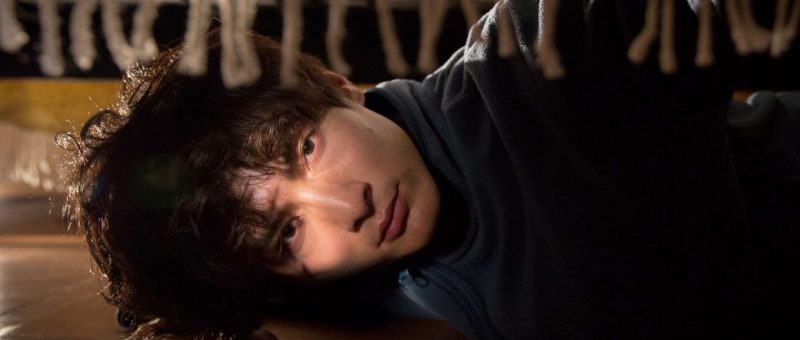
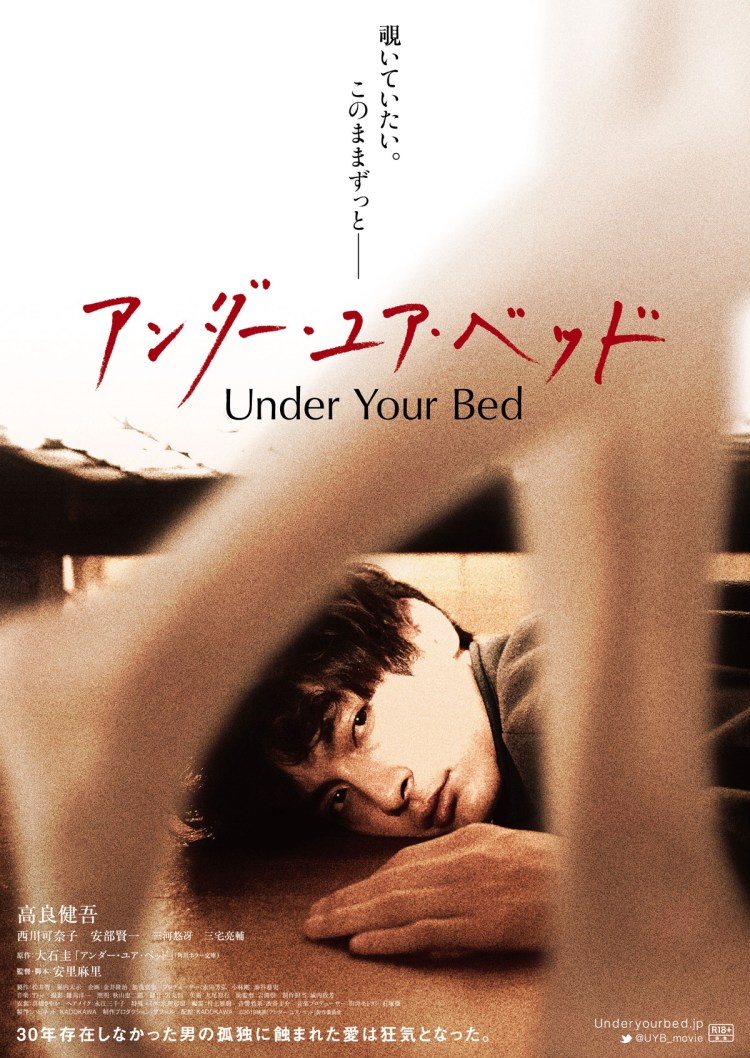
Under Your Bed poster 1Japanese cinema has something of a preoccupation with invisible men, but there’s rarely been as empathetic an exploration of benign alienation as Mari Asato’s Under Your Bed (アンダー・ユア・ベッド). Asato’s lonely stalker is a creep and a voyeur, but his problem is his innate passivity born of defeatism in which he has, despite his tendency to fantasise, already accepted that he lives in a kind of other world unable to touch his fellow humans from whom he remains painfully separated as if by a sheet of invisible glass.

Tropical fish enthusiast Mitsui (Kengo Kora) is one of those people who tend to be forgotten. He doesn’t feature in his high school graduation photo, and nobody, not even his parents, has ever noticed. Harbouring intense feelings of worthlessness linking back to a childhood memory of abandonment after almost dying when his father left him sitting in a hot car, Mitsui has no friends or much of a life to speak of and regards himself as a kind of non-person invisible to others. Longing to be seen, he treasures the precious memory of the only time he has ever heard someone else call his name which occurred 11 years previously when he was a university student.

Mitsui deeply believes that this memory is the only thing that gives his life meaning. Hiring a private eye to track down the woman in question, Chihiro (Kanako Nishikawa), he quits his job and opens a tropical fish store in the town where she lives, apparently now married with a baby. What he discovers, however, is that this Chihiro is quite different from the one of 11 years previously. Hoping to figure out why he begins watching her intensely, swiping a key to the house after she drops into the fish shop by chance and he offers to set her up with a tank full of colourful guppies. What Mitsui eventually discovers is that Chihiro is also living a somewhat invisible life as a victim of domestic violence unable to escape the tyrannical control of her respectable salaryman husband.

Facing a dilemma, Mitsui doesn’t so much want to rescue Chihiro as preserve his peculiar level of access to her even if seeing her subjected to such degrading and inhuman treatment quite obviously disturbs him. Mitsui can’t swoop in and save her because he’d blow his cover and lose the fragile connection to her life he’s convinced himself he has. Never daring to hope he could get her attention through an act of white knight salvation, he nevertheless fantasises about a different version of himself – one that is capable of providing comfort and protection rather than simply sitting and watching while others suffer.

Ironically enough, however, his passive presence seems to make a difference. Shifting to a brief voice over from Chihiro, we discover that the flowers Mitsui has been sending with a card wishing her happiness are the only thing that’s been keeping her going. What some might regard as a cause for concern has given Chihiro strength in proving that there’s someone else out there who cares about her. Yet this change or at least potential restoration also endangers Mitsui’s plan as Chihiro’s growing conviction that she can protect herself, spurred on by the invisible support of the flower sender and others, threatens to dissolve the fragile fantasy world he’s constructed.

Mitsui is forced to wonder if his obsession is equal parts delusion, that perhaps the very events which define his life are part fabrications. His intense conviction that he is a forgettable person is borne out when he realises that Chihiro not only does not recognise him, but apparently does not even remember anything that passed between them 11 years previously. To her, he is probably just a random guy she had coffee with one time, whereas to him she is the woman who changed his life by showing him what true happiness could feel like simply by saying his name. Spotting another invisible person like himself reminds Mitsui what he looks like from the outside and of the potential dangers of those like him when he finds out that the man later went out and stabbed his boss’ wife because she gave everyone except him a holiday souvenir. Yet there is a strange kind of positivity in Matsui’s gentle acceptance of his invisibility. Resenting nothing, it’s not revenge he wants but recognition and though he may eventually figure out that what he really desired was something more, all he needs is the possibility that Chihiro may one day say his name again.

An invisible man, Mitsui longs to “seen” but lives a bug-like existence, hiding in the places no one thinks to look. Proudly telling us that the guppies in his shop are the 34th generation of the guppies his mother once gave him, Mitsui reveals that he flushes the subpar males, with whom he inevitably groups himself, away in order to preserve the beauty of the whole rather than allow it to descend on a path towards mediocrity. Like his beloved fish, Mitsui remains trapped within an invisible tank unable to reach beyond the glass, resigned to looking but not touching. Nevertheless, his presence is eventually felt, unseen but recognised and finally rewarded with a single long-awaited word.


Under Your Bed was screened as part of the 2019 London East Asia Film Festival.

Original trailer (no subtitles)
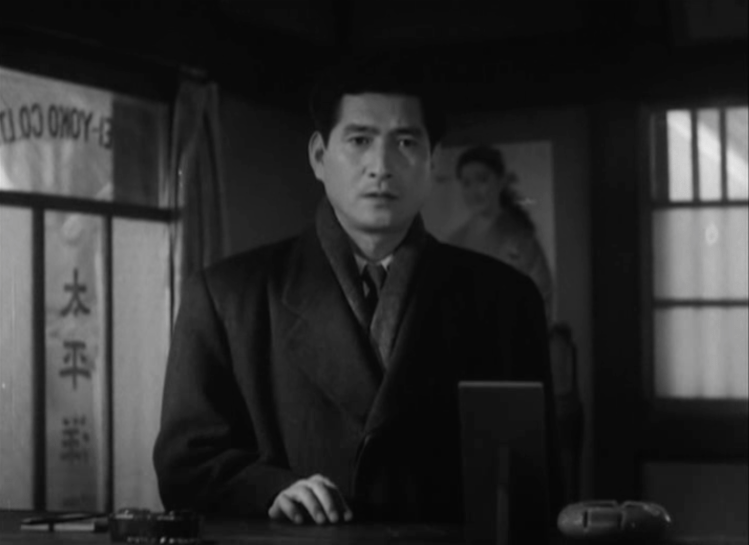
An Inn at Osaka (大阪の宿, Heinosuke Gosho, 1954)

inn at osaka cap 2Heinosuke Gosho may be most closely associated with the Chekhovian interplay between laughter and tears, but what are you to do when life is so unutterably miserable that levity seems almost offensive? By 1954, many might have assumed that society was on the way to recovery, that the promises of the new democracy so proudly affirmed in the post-war constitution would be available to all paving the way for a freer and fairer society. Of course, that wasn’t quite the case and many found themselves trapped on the periphery of the burgeoning economic miracle in which unemployment was high and the bitterness of the times had led many to believe that human decency was a luxury they couldn’t afford.

Made a year after his renowned masterpiece Where Chimneys are Seen, An Inn at Osaka (大阪の宿, Osaka no Yado) is a much less cheerful affair in which suicide and degradation linger permanently on the horizon. The hero, Mita (Shuji Sano), has been exiled from Tokyo, demoted to the Osaka office after slapping his boss in argument over immoral business practices. Much reduced in circumstances, he has been unable to find a lodging house that suits his budget, the local barman lamenting that these days most of the hotels in the area have been co-opted by sex workers. Just at that moment, a dishevelled old man pops up and says he knows of a good place where the rent is reasonable and the innkeeper kind. As you might expect, it turns out that he works there. The innkeeper is his sister and though she is not particularly nice, the place is warm and friendly with three kindly maids – Orika (Mitsuko Mito) who is constantly pressed for money by her no-good husband, Otsugi (Hiroko Kawasaki) who is forced to live apart from her son, and “modern girl” Oyone (Sachiko Hidari) who is much younger and having a fling with the inn’s other longterm resident, Noro (Jun Tatara), a sleazy gentleman who likes to throw his weight around because he co-signed the loan on the hotel.

In one sense, the city of Osaka itself is being painted as a “fall” from sophisticated Tokyo, an earthier place where people do what they have to to survive. This Mita learns to his cost when drunken geisha Uwabami (Nobuko Otowa) picks up his “luxury English-made blanket” and peels off a thread which she burns to expose its smell. Wilier than the innocent Mita she tells him he’s been had, lamenting that it’s “Osaka’s shame” that they wilfully trick people from Tokyo. Mita is irritated, slightly hurt and embarrassed to have been deceived, but affirms that it hasn’t damaged his views on Osaka because in the present society everyone is being cheated by someone somewhere. In any case, he allows himself to be bamboozled by the innkeeper’s brother (Kamatari Fujiwara) into tracking down the teenage girl who sold it to him, Omitsu (Kyoko Anzai), who seems upset, explaining that she bought the blanket in good faith and has been tricked herself. During their visit, Mita notices that they’re in the middle of some sort of shamanistic ritual over the sickbed of her ailing father and feels pity for her but stops short of cancelling the debt there and then.

Not cancelling the debt even though he can see Omitsu never meant to trick him and cannot afford to pay him back, is part of his rather sanctimonious rebellion against the immoralities of the post-war society. He feels wronged and thinks that getting the money back for the blanket will somehow put things right, but like many of his attempts to help those in need it eventually backfires. Mita is a good man, compassionate and honest, but he’s also disappointingly conservative in ways he hasn’t quite realised. Uwabami, who has fallen in love with him, later chides Mita that he is like a star looking down on everything from above. He doesn’t quite understand what she means, failing to grasp that what she’s telling him is that though she can see that he cares, he has a tendency to view himself as somehow “better” than the world around him and lives in silent judgement of those he believes to be fundamentally different from himself.

After a brief argument, Uwabami confesses that she feels trapped and miserable in her impossible geisha existence, just trying to make enough money to survive when too old to ply her trade. She can’t quit because she’s responsible for her whole family – her younger brother has just been laid off from his railway job and his children will go hungry without her money. She provokes Mita a little, chastising him for not caring about her on a human level only for Mita to counter that he likes her but they live in “different worlds”. Disappointed, she laments that she thought they were the same, realising that Mita’s conception of the world is defined by ideas of middle-class respectability and that he views her as occupying a lower order, forever walled off from “decent” people like himself. Though he treats her warmly and regards her as a friend, there can never be anything more between them than that.

Omitsu later shows him something similar. Having scraped together some of the money to pay him back, she arrives at the inn only for Mita to try to refuse it. Otsugi offers her some sewing work for Noro who later takes advantage of her, gossiping with the maids that she was a “bargain”. To make matters worse, Omitsu gets caught on the way out and is berated by the innkeeper for bringing the hotel into disrepute. Mita starts to feel guilty. This is, after all, largely his fault – he pushed her about the blanket out of pettiness and brought her to the inn where she has debased herself to get back the money he took from her. He tries to return it but it’s already too late. “Why do you always insist on being good?” she asks him, partly offended that he won’t take her money because he now thinks it’s tainted by immorality. “I just want to trust in people” he tells her, beginning to realise that his well-meaning gesture is both patronising and futile because if he’d really cared about helping Omitsu, he could have done it before.

Mita is good person, but like everyone else he’s flawed and human. He genuinely wants to help, for the world to be better than it is, but in his goodness allows himself to be self-involved and insensitive. The reason he didn’t get fired from his job even for so great a transgression as slapping the boss, is that his grandfather founded the company. In an effort to break with the past, he decides to sell his grandfather’s expensive French pocket watch, but retains the chain as if unable to definitively sever the connection to his privilege. To prove that he’s done it for symbolic and not financial reasons, he spends the money taking Otsugi and Orika on a day trip to Osaka castle after Orika declines his offer of money of which she is in desperate need.

“Money’s everything, what happened to humanity?” Mita asks himself, still not quite aware of his position within the system. Mita refuses to conform to the demands of the post-war era as exemplified by his boorish boss who sneeringly asks if he’s a “socialist” while dismissing him as an “intellectual” and doing illicit backroom deals to get ahead, but he does so largely passively and with little more than resentment. At his farewell dinner, he reflects that had he not come to Osaka he might have quit his job but now he’s determined to stay and try to make things better. There might be something a little sanctimonious in his new found fire born of living among the poor now he’s on his way back to Tokyo, but he has perhaps awakened to his failings and is resolving to do better.

Meanwhile, the innkeeper finds the strength to break with the odious Noro, but unlike Mita decides to throw herself into the abyss of modernity by turning the hotel in a rent by the hour kind of place complete with Western beds and tacky decor. She too feels there are two kinds of people, refusing Otsugi time off to see her son, barking that “a dog doesn’t forget what it owes its master”, while Otsugi remains powerless, aware she’s entirely out of options as a young widow in the cruel post-war economy. Orika too gives up on changing her life after finding herself unable to separate from her no-good, drunken, violent, husband, while Oyone alone seems excited by the new job possibilities at the inn, and Omitsu, despite having coldly exclaimed that she’d do whatever it takes to survive, throws herself into “honest” work, unable to attend Mita’s leaving do because now her life is one of ceaseless industry which provides her no opportunity for rest. “None of us can say we’re really happy”, Mita laments, “let’s have the dignity to laugh in the face of unhappiness”. Everybody’s tired, everybody’s disappointed and afraid, but they haven’t lost their humanity and when there’s really nothing else, all you can do is laugh. 


Short clip (no subtitles)

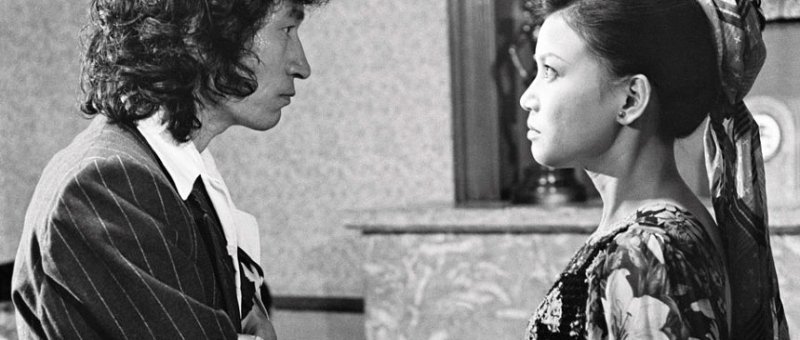
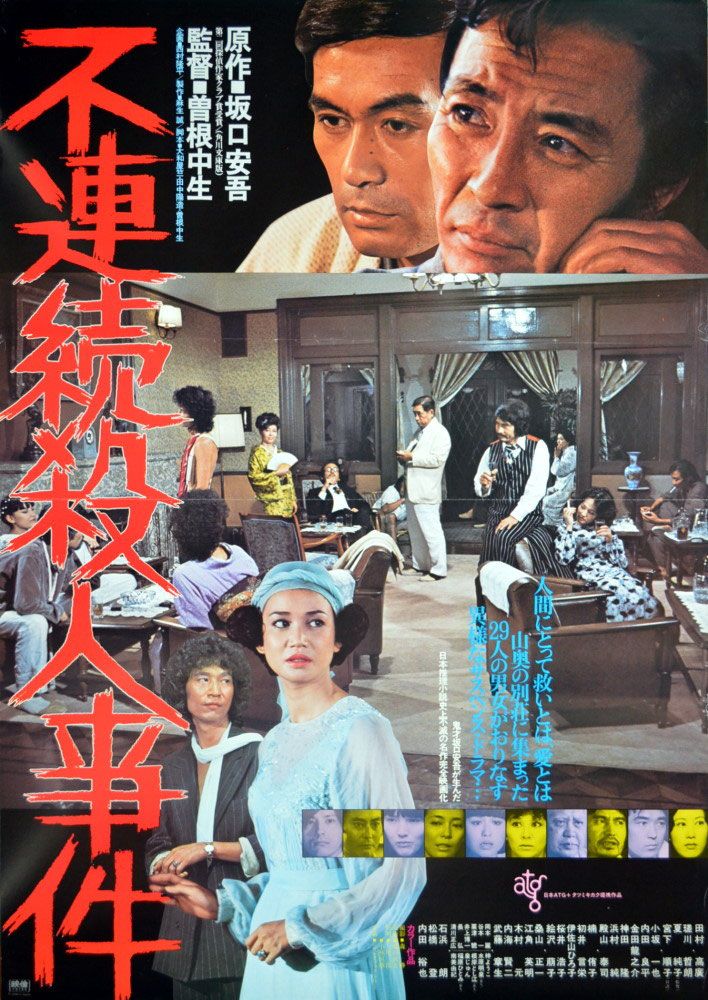
Case of the Disjointed Murder (不連続殺人事件, Chusei Sone, 1977)

Case of the disjointed murders posterJapanese cinema of the 1970s fell hard for the prestige murder mystery. Following the success of The Inugami Family, an early and unexpected hit thanks to Kadokawa’s “innovative” marketing strategy, multi-cast detective dramas dominated the box office for the rest of the decade. Meanwhile, ATG had been known for serious and high-minded avant-garde cinema throughout the 1960s but its brand of left-leaning, politically conscious, arthouse-fare was tantamount to box office poison in the increasingly consumerist post-Asama-Sanso world. ATG’s Kindaichi-centric Death at an Old Mansion, updated to the present day, pre-dated Ichikawa’s series for Toho by a whole year and perhaps signalled their resignation to shifting into the mainstream. By 1977, that transition was perhaps complete with former Nikkatsu Roman Porno director Chusei Sone’s adaptation of a classic serial penned by Ango Sakaguchi, an author of the “Buraiha“ school well known for chronicling post-war aimlessness.

Set in the summer of 1947, Case of the Disjointed Murder (不連続殺人事件, Furenzoku Satsujin Jiken, AKA Unrelated Murder Cases) is a classic country house mystery in which a series of high profile writers are invited to a mansion owned by a wealthy family, the Utagawas. Only, as it turns out, many of the letters of invitation are forgeries or have been doctored so that several unexpected guests have arrived including dissolute artist Doi (Yuya Uchida) whose presence is particularly awkward because he is the former husband of the host Kazuma’s (Tetsuro Sagawa) new wife Ayaka (Junko Natsu). Soon enough, one of the guests is murdered, and then another, and still more, seemingly for no real reason. Amateur detective Kose (Kazuya Kosaka), one of the “unexpected” guests, tries to piece the crime together to prevent its expansion but finds himself outflanked by a lack of material evidence.

Sakaguchi’s original tale ran as a newspaper serial which promised a cash prize for anyone clever enough to identify the murderer(s) before the truth was revealed as it eventually is in true country house mystery fashion with the detective explaining everything in a lengthy monologue while all the interested parties sit around a dinner table. The gamified nature of the serial is perhaps the reason for the large cast of characters comprising of Utagawa family members, the literary house guests, and staff all of whom become mixed up in the ongoing crime drama which Kose comes increasingly to believe is engineered rather than random as it might originally seem.

The “supposed” random chaos of the the “unconnected” murders is a key part of Sakaguchi’s interrogation of post-war anxiety. For a time it seems as if these mostly quite unpleasant people have taken the opportunity of being trapped within a claustrophobic environment to air out their own grievances with each other in an atmosphere already tainted with violence and resentment. Meanwhile, the moral corruption of the Utagawa household continues to come back to haunt them in the sexual transgressions of the late grandfather who apparently fathered several illegitimate children in addition to those from multiple marriages. The half-siblings bring additional strife into the Utagawa home in Kazuma’s incestuous desire for his half-sister Kayoko (Hitomi Fukuhara) who returns his affections and even hopes to marry her brother, while he has also transgressed by “buying” Ayaka from her venal first husband Doi.

As in most Japanese mysteries, however, the motives for murder turn out to be banal – simply monetary greed and seemingly nothing more even if backed up by a peculiar kind of romanticism. Such unbound desire for riches is perhaps another symptom of the precariousness of the post-war world in which individual survival is all in a chaotic environment where financial security is more or less impossible for those not already born into wealth. Kose begins to solve the crimes through the “psychological traces” the killer(s) leave behind, the various ways in which “scenes” are calculated and contrived but fail to entirely mask the truth which lies behind them.

Which is to say that the mechanics behind the killings ultimately become secondary to their psychological import in which Kose analyses superficial relationships to uncover the depths which underpin them and their implications for a conspiracy of crime. This persistent amorality in which human relationships and connections are subverted for personal gain is yet another example of post-war inhumanity in which the corruption of the war has destroyed the “innocence” of pre-modern Japan and provoked nothing more than a moral decline born of a confused anxiety and a generation struggling to adjust itself to a new reality.

Death at an Old Mansion aside, the ‘70s mystery boom had a peculiar obsession with post-war crime in the comparative comfort of the economic miracle. 30 years on, society was perhaps ready to ask more questions about an intensely traumatic moment in time but equally keen to ask what they might say about another anxious moment of social change only opposite in nature. No longer quite so burdened by post-war regret or confusion, some began to wonder if consumerism was as dangerous as poverty for the health of the national soul, but nevertheless seem content to bask in the essential cosiness of a country house mystery in which the detective will always return at the end to offer a full and frank explanation to a roomful of compromised suspects. If only real life were so easy to explain.


Original trailer (no subtitles)

Eternal Heart (不壊の白珠, Hiroshi Shimizu, 1929)

Eternal Heart still 1

Hiroshi Shimizu is most often remembered for his sensitive depictions of childhood, but his career, which spanned more than 160 films many of which are presumed lost, was much more varied than might be assumed. His earliest completely extant feature, 1929’s Eternal Heart (不壊の白珠, Fue no Shiratama, AKA Undying Pearl), is a case in point. Set in the heady days of early Showa long before militarism took hold, Eternal Heart bears early witness to Shimizu’s distrust of romantic solutions as its wounded protagonists are forced to accept that they have lost out in the great game of love and there’s nothing they can do about it except learn to endure their sadness.

The heroine, Toshie (Emiko Yagumo), is an earnest young woman working as a typist. She has developed a crush on a nice young man, Shozo (Minoru Takada), who works at the same company but unfortunately for her, her “modern girl” sister Reiko (Michiko Oikawa) has taken a liking to him too. To Reiko, Shozo is just one of the guys she likes to string along, but to the seriously minded Toshie he’s the only man she’ll ever love. Plucking up the courage, Toshie writes a cryptic note asking to talk to Shozo about something important and has it sent to him in the interoffice mail to avoid the embarrassment of giving it to him directly. In a spectacular case of bad timing, however, she discovers that Shozo has proposed to Reiko. He thinks the letter is about the possible marriage and that perhaps Toshie is worried he’s not a suitable person to become her brother-in-law, never dreaming that Toshie herself meant to declare her love to him. Hugely embarrassed, Toshie does not handle the situation well but agrees to put a good word in with her mother, after all she does think that Shozo is the best of men and so could never speak ill of him.

The marriage is agreed and Toshie tries to make her peace with it, only to have some kind of episode at the wedding party that leaves Shozo feeling guilty, as if he might have somehow alienated his new sister-in-law. Meanwhile, Toshie also receives the solicitous attentions of the company’s boss, Katayama (Arai Atsushi), a middle-aged widower with three children who makes a clumsy pass at her in the coach home but later apologises and embarks on a more appropriate style of courtship.

The irony is that Shozo and Toshie are actually perfectly suited, only he never saw her because he was distracted by her sister’s modern sparkle. It would be easy enough to see the contrast between the two women as one between tradition and modernity, Toshie the perfect exemplification of traditional Japanese values and her sister the avarice of the flapper generation, but the distinction is more nuanced than it might at first seem. Despite her presentation as a “traditional” woman, Toshie is more progressive than her sister in that she has made a free choice to be a working woman and takes her job seriously, quickly becoming irritated by those who don’t, whereas Reiko is never in search of direct independence only of the freedom to move between one man of means and another. Toshie wants real love, but also her independence and perhaps does not feel that one must necessarily conflict with another.

While the relationship between Shozo and Reiko sours as she becomes bored with his niceness and lack of consumerist avarice, Toshie finds herself filled with hostility towards her former object of affection and consenting to date Katayama partly in romantic rebound. Though he eventually turns out to be a little nicer than that first unpleasant incident in the taxi might have suggested, Toshie cannot escape the sense of social inferiority which keeps her in a subordinate position to a man who ought, in her view it seems, to be her equal if they were married. On an abrupt visit to his family home, she finds herself waiting in the hallway where Katayama’s precocious son (Shoichi Kofujita) mistakes her for the new maid, while his daughters and nieces, dressed in the modern style, openly mock her for being a career woman, suggesting that “typist” is a synonym for “loose woman” while Katayama fails to help the situation by countering only that “some of them are decent”. In response, Toshie calmly and confidently reaffirms that she is proud of her job and ashamed of nothing, only for the kids to chime in with a show of banging a keyboard as if it were something that a baby could do for amusement and little more than noisemaking.

Toshie leaves humiliated, but seemingly continues seeing Katayama at least superficially. It’s at this point she re-ecounters Shozo, who now has something important he wants to discuss with her. Having married Reiko believing her to be playful and innocent, Shozo has awoken to her coquetry and figured out she’s been going on drives with the moustachioed man we saw her glare at on the train on her honeymoon. The implication is that Reiko is only dating the other guy, whom she knows to be married with children, because he has a fancy car – something Shozo showed no interest in getting even if he had the money because like Toshie what he wanted was love. Shozo is understandably hurt and angry but wants to reconcile. Toshie vows to help him, overcoming her timidity to head into one of the modern bars frequented by her sister to convince her to come home, which she does but only to collect her things. Reiko claims that it’s Shozo who is being “selfish” for asking about her life before their marriage. In that she might have had a point, but it’s not something Shozo particularly cared about and he is not in that sense jealous only confused and embarrassed. Reiko refuses to accept her role as a wife, but unlike Toshie she never means to be independent and decamps to the home of her married lover, presumably intending to live off him until something better comes along.

In that sense, Reiko’s “modernity” is not so much the problem as her innate selfishness which the modern world perhaps enables. Reiko, amoral, claims her individuality by reserving the right to do as she pleases ignoring both social convention and other people’s feelings. She married Shozo because he was kind of a catch only to grow bored with him and wonder if she might do better. Toshie, meanwhile, nurses her broken heart with as much grace as she can manage, desperately trying to save her sister’s failing marriage in order to preserve Shozo’s happiness more than to avoid the scandal of marital breakdown. Despite his disillusionment with Reiko’s Westernised “modernity” Shozo finds himself considering emigrating to America in order to escape his heartbreak, resolving that a separation would be “socially unacceptable” and hoping that Reiko will continue to live as “Mrs. Narita” at least superficially even in his absence. Toshie loses Shozo twice. Having married her sister there was no longer any way for her be with him other than as a relative, but now she must watch the pearl her sister cast aside sail away from her never to be seen again. United only in heartbreak they part, Toshie selflessly reflecting on Shozo’s sadness rather than her own, but in even in the midst of her disappointment she stands stoically alone, independent and self-possessed like truly “modern” woman.


Tsukigata Hanpeita (月形半平太, Kokichi Uchide, 1952)

Tusgikata Hanpeita still 1In the midst of post-war confusion, Japanese cinema increasingly looked back to Meiji in all of its chaotic possibility in order to ask what went wrong and what lessons it might have for a second kind of revolution as the nation tried to rebuild itself after decades of militarist folly and chastened wartime defeat. “Tsukigata Hanpeita” (月形半平太) is a “legendary” fictional character first imagined for a kabuki play in 1919 who finds himself swept up in Bakumatsu intrigue as he tries, along with daring revolutionaries Sakamoto Ryoma and Katsura Kogoro, to forge an alliance between the clans of Choshu and Satsuma in order to take on the corrupt shogun in defence of the Emperor and foster a new era of peace in an increasingly uncertain world.

When we first meet him, Tsukigata Hanpeita (Utaemon Ichikawa) is on the run from Kyoto-based special police force the Mimawarigumi but also making time for his mistress, Umematsu (Chizuru Kitagawa) – a geisha. This in particular is a problem which has left him dangerously exposed, even the Mimawarigumi leader Okudaira (Joji Kaieda) seems to be aware of the relationship and is apparently not above using it to his advantage. Meanwhile, he’s not only threatened by shogunate defenders, but by his own side – both by those who remain unconvinced by Sakamoto’s (Jotaro Togami) internationalist philosophy, and by those who simply hold a grudge against Satsuma because of a previous conflict and regard Tsukigata as a traitor for daring to talk to them at all. Despite everything, Tsukigata hides in the shadows and commits himself to living, and if necessary dying, to bring about a better world free of shogunate oppression.

Unlike other revolutionary legends, however, Tsukigata’s fervour has not made him cold or cruel even if he must sometimes act in ways which are mysterious and confuse those around him. Meeting a young man on a bridge, he applauds his studious nature, agreeing that “nothing is more important than to understand advanced civilisation”, and is as polite as he could be when the man tells him he has just joined the Mimawarigumi. Rather than attack or berate him, Tsukigata cheerfully wishes the young man well, allowing him the space to see that his present allegiance to the shogunate is perhaps misguided and out of line with his personal beliefs.

Indeed, his compassion extends even to Okudaira – his mortal enemy. Offering his condolences to a grieving Somehachi (Isuzu Yamada), Tsugikata laments that in a better world he and Okudaira may have been friends, that he had no personal grudge against him despite the fact that they clearly lived on different sides of an ideological divide. He could perhaps even harbour a kind of professional respect for him in his dogged defence of his duty for all he believes it to be misguided. “It’s so unfortunate”, he exclaims, “We have to make the world a better place”.

His desire to change the world is what keeps Tsukigata alive. Several times he faces certain death, but declares but he cannot die now with his great work left unfinished. He is not afraid of death and would gladly give his life in the service of his cause, only not just yet. “Would you please spare my life until I change the world?” he begs of someone he fully believes has a right to kill him, eventually winning their support and unexpected allegiance solely through his guileless goodness.

Yet for all that, his moral austerity does at times perhaps cause him problems in giving rise to emotional confusion. So it is that he winds up in an accidental love triangle with the smitten Somehachi – a former geisha turned madam whose patron is none other than Okudaira, and Umematsu an ageing courtesan with whom he has developed a more or less settled relationship. This is clearly the story of Tsukigata Hanpeita, but more than that it’s the story of the three women who support him without whom the revolution may even be impossible. Somehachi, despite her allegiance to Okudaira, has been a longstanding Tsukigata ally several times helping him escape from the oncoming Mimawarigumi, while Umematsu provides him with safe harbour and occasional message carrying services which is where teenage geisha Hinagiku (Hibari Misora) comes in, acting as a revolutionary go-between with deep-seated political passion.

Speaking strongly of female solidarity, the fallout from the love triangle is eventually minimised by the sisterly geishas who later bond in their shared support of Tsukigata and resolve to put past pettiness behind them. Meanwhile, Tsukigata is deceived by male treachery, only to finally receive the message he’s been waiting for which seems to make everything worthwhile. “I can see the dawn of a new era”, he exclaims, “the new era will be peaceful”. Suddenly he’s not just talking of himself anymore, but directly to the post-war era as he begins to see the way out of a “chaotic society” towards a prosperous future in the faces of his friends united in mutual support and the belief that his better world will soon be a reality.


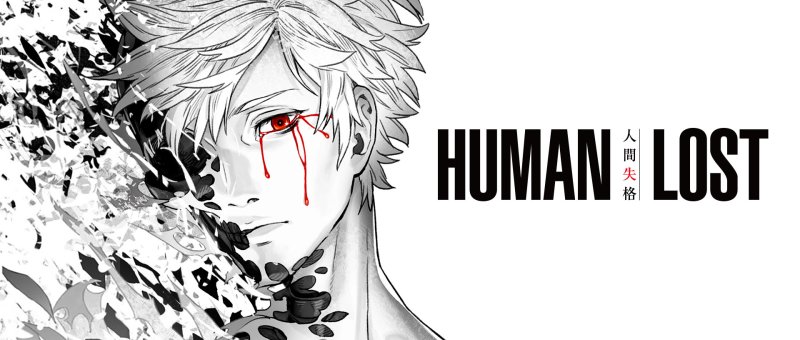
Human Lost (人間失格, Fuminori Kizaki, 2019)

Human lost animeOsamu Dazai’s 1948 masterpiece No Longer Human spins a tale of intense alienation in which a young man unable to connect with the world around him feels himself obliged to put on a mask of buffoonery. Years of trying and failing to fit in eventually take their toll. After meeting a man who turns out to be a bad influence in a painting class, he drifts into a life of dissipation and is committed to a mental institution. After his release, the hero reflects on the harm his actions have caused to others and declares that he is “no longer human”, electing to live a life of isolation rather than risk hurting anyone else.

Human Lost (人間失格, Ningen Shikkaku) is about as loose an adaptation as it’s possible to be, taking only the outlines of Dazai’s original and springing off from the midway point in which the protagonist, Yozo Oba (Mamoru Miyano), is living as a starving, drug addicted artist above a seedy bar. The year is Showa 111 (2036). A series of momentous advances have made natural death a thing of the past and thanks to the S.H.E.L.L. system suffering from disease has been eliminated. However, the future has not been equally distributed and while a cohort of increasingly elderly men and women rule the elite “Inside” as a kind of oligarchy, an oppressed underclass has formed on the outskirts of the city, their “immortal” bodies continually exploited in order to prop up the Inside economy but forever denied the full benefits of system they are prevented from accessing in its entirety.

Meanwhile, those who wilfully disconnect descend into a kind of monstrous barbarity becoming what is known as a “Lost”, a threat to “civilisation” which much be combatted by H.I.L.A.M. – a military organisation which exists to ensure the survival of the S.H.E.L.L. system. When Oba is dragged along by his childhood friend Takeichi (Jun Fukuyama) on a revolutionary raid instigated by the mysterious Masao (Takahiro Sakurai) targeting the Inside, he comes into contact with Yoshiko (Kana Hanazawa) – a young woman who deeply believes in the benefits and possibilities of the S.H.E.L.L. system, convinced that a utopian world in which its benefits are available to all will eventually come to pass.

What ensues is a battle between Yoshiko’s pure hearted idealism, Oba’s despair-fuelled cynicism, and Masao’s embittered nihilism in which he seeks to destroy the S.H.E.L.L. system and “reset” humanity to its original condition. Masao believes that humans need death in order to be human and that its absence from the modern world is an aberration which must be corrected at all costs. He encourages Oba and Takeichi to “take back” their “true form” as a revolutionary act designed to provoke the advent of a saviour who can help him destroy a system he himself created out of love but which later failed him. 

In an ageing society such as Japan’s, it’s impossible to ignore the subtext of a world in which the elderly cling on to power well beyond their right and relegate the young and healthy to a kind of underclass as a consequence. While some humans are “qualified” and afforded special rights, others are labeled as “unqualified” and exist in a kind of underworld locked out from the benefits of a modern society. As Masao points out, those who call themselves “happy” largely do so because of the S.H.E.L.L. system’s programming, while the only truly “free” are those like Oba and Takeichi who wilfully reject it and live a life of suffering.

Of course, Masao exploits them too. He brands Oba his Orpheus, but ironically forgets that the thing everyone knows about Orpheus is that his faith was weak and so he looked back and lost. Yoshiko sacrifices herself for Oba’s potential, further adding to Masao’s awkward metaphor as he declares that “the fate of this woman is to be used”, pushing Oba towards dragging her back from the hell they maybe creating together. Unlike Dazai’s original novel in which the hero is consumed by his sense of otherness and opts for self-exile, Human Lost finds a more positive solution in which Oba commits himself to fighting for Yoshiko’s better world where health and happiness are gifts given to all and not just a privileged few. A mild critique of a hierarchical, inherently unequal society Human Lost makes a passionate plea for idealistic utopianism over introverted despair while suggesting that technological advances set us free only when we share them freely.


Human Lost screens in select US cinemas on Oct. 22 (subtitled) and 23 (dubbed), and in Canada on Nov. 6 (subtitled) and 9 (dubbed) courtesy of Funimation. Check the official website to find out where it’s playing near you!

Original trailer (English subtitles)

Wife! Be Like a Rose! (妻よ薔薇のやうに, Mikio Naruse, 1935)

Wife be like a rose posterIt’s tempting to view the cinema of the 1930s as a gloomy affair, facilitating the rise of militarism and increasingly at mercy of the censors, but the early sound era was nothing if not playful and generously open to international influences. It was also often surprisingly progressive, evidencing the fact that pre-war Japan was also changing or, at least, that there was an appetite for change especially among the young. Mikio Naruse’s delightfully charming (perhaps uncharacteristically so) comedy, Wife! Be Like a Rose! (妻よ薔薇のやうに, Tsuma yo bara no yo ni) dramatises just this change as its modern girl heroine tries to process the definitive end of her parents’ relationship as she prepares to marry.

Kimiko (Sachiko Chiba) has a job in an office which is more or less supporting herself and her mother seeing as her father, Shunsaku (Sadao Maruyama), left the family over 15 years previously and has been living with former geisha with whom he has two other children. Despite his long absence, Kimiko’s mother Etsuko (Toshiko Ito) has continued to pine for her absent husband and makes a little money on the side writing sad love poems for the newspapers. A request to stand as a go between at a wedding, traditionally a role only performed by married women, forces Etsuko to accept that she has been abandoned but the snag is that Kimiko and her boyfriend Seiji (Heihachiro Okawa) want to get married themselves and so his father wants to meet Kimiko’s dad which is obviously a problem.

Despite her “modern girl” appearance, Kimiko has some quite old fashioned ideas. She looks down on her maudlin mother, believing that she’s brought her apparent romantic heartbreak on herself through being a bad wife. Etsuko never seemed very interested in Shunsaku when he was around and never did any of the little wifely things Kimiko thinks a wife ought to do like vacuous chat and helping her husband change out of his work clothes. Kimiko thinks a good wife “acts childish and cajoling, or jealous sometimes, or motherly and protective”, believing that Etsuko knows this and has the ability to play the part of the ideal spouse but refuses to and therefore has only herself to blame. Kimiko’s uncle (Kamatari Fujiwara), however, corrects her. He piles the blame on the irresponsible Shunsaku who ran out on a wife and daughter to shack up with geisha.

Shunsaku, meanwhile, may be irresponsible in one sense, but perhaps it’s equally irresponsible to stay in an unhappy marriage. Now a gold prospector in the mountains, he is poor and unsuccessful but has built a happy family home with a kindly wife and two sweet children. Kimiko’s desire to drag him back to the city is partly practical in that she needs him to be her father so she can marry Seiji, but there’s also a part of her that thinks that her father’s transgression must be corrected by forcing him to resume his paternal role. Unlike Etsuko, however, Oyuki (Yuriko Hanabusa) is the classically “good” wife and Kimiko can’t deny she’s good for her father. Seeing him in the mountains and remembering him at home, Kimiko begins to realise that it would be wrong to take him away from his new family even if she thinks she has the better claim, especially when she finds out that it’s Oyuki who’s been sending her mother maintenance cheques every month for the past few years.

In fact, Oyuki feels so guilty about stealing Shunsaku away that she’s been putting money aside to pay for Kimiko’s wedding/education while keeping her own daughter home from school. Far from the gold digger Kimiko had assumed her to be, she’s been the one supporting the feckless Shunsaku as he pursues his get rich quick dream of gold prospecting. Realising that the pair of them “act in perfect harmony”, Kimiko comes to the conclusion that her father belongs in the mountains but finds her resolve wavering after returning to civilisation. She begins to wish he’d stay and hatches a plan to get her parents back together only to see how out of sync they are after 15 years apart. They swap pleasantries like strangers, and the mild-mannered Shunsaku visibly shrinks in the presence of the shrewish Etsuko who allows her pride to ruin any attempt at reconciliation.

What the modern girl Kimiko discovers is that sometimes things don’t work out like they’re supposed to, and that’s OK. Though it is in one sense a “happy” ending in that it obeys a justice born of human feeling, it’s also a melancholy moment of defeat both for the lovelorn Etsuko who has, as Kimiko says “lost”, and the now resigned Kimiko who harbours a degree of contempt towards her mother for not fighting harder for love. Standing at a crossroads of modernity, Kimiko looks both forward and back. She vows to be a “good wife” but her foundations have been shaken. Is this tragedy, or farce? She asks herself. It’s almost impossible to say.


Bu Su (BU・SU, Jun Ichikawa, 1987)

Busu poster 2Already a well respected and much in demand director of television commercials Jun Ichikawa released his debut feature, Bu Su (BU・SU), in 1987. “Bu Su” is, loosely translated, pejorative slang for a woman who is not considered to be attractive. The closest equivalent, in British English at least, would be something like “a dog”. It’s especially ironic then that the movie was conceived as a vehicle for a popular idol whose success was perhaps dependent on a perception of attractiveness, or at least of “kawaii” innocence. Yasuko Tomita was at that time at the height of her fame having shot to stardom through open audition leading to an award winning role in Aiko 16 Sai. Two years later she starred for Nobuhiko Obayashi, who was originally slated to direct Bu Su, in Miss Lonely, but even in comparison to Obayashi’s melancholy heroines, Bu Su’s Mugiko (Yasuko Tomita) is a particularly moody teen, the “ugliness” here apparently relating to her emotional isolation.

For reasons we never quite understand, Mugiko leaves her island home after a traumatic incident and moves in with her aunt in Tokyo with the intention of becoming a geisha. It seem’s Mugiko’s mother was once a famous geisha herself until she met Mugiko’s late father and left for a more conventional life in the peaceful countryside. Mugiko’s flight then has a peculiarly perverse quality in being both to and from her mother with whom she seems to be on bad terms despite her mother’s obvious affection for her. Unfortunately Mugiko is not a fantastic fit for the world of the geisha, being somewhat innocent and childishly clumsy, not to mention her ongoing grumpiness. Nevertheless, everyone at the geisha house is keen to help her if only out of loyalty to her mother.

At school, meanwhile, Mugiko is nervous and withdrawn, barely audible during her introduction to her new classmates and with her eyes permanently on the floor. Her teacher, taking her aside, adds to the mystery in remarking that she’s certainly been through a lot back in Izu and that she should leave all that behind and try to make a new start. Nevertheless, she remains sullen and isolated, barely speaking to anyone yet perhaps examining the dynamics of the people around her. Maybe that’s why she alone finds the strength to stand up to a popular kid bullying another girl (Yuriko Hirooka) considered to be “plain” with a mean trick teasing a nasty surprise lurking in a box which turns out to be nothing more than a hand mirror.

Mugiko might not be quite sure what it is that’s worrying her, or at least we can’t be sure because we don’t know exactly what happened in Izu, but the rest of her classmates have their own insecurities to deal with from Sakurako’s preoccupation with her perceived lack of looks to boxing enthusiast Tsuda (Masahiro Takashima) who knows he’s not much for studying but is less than convinced of the possibility of living off his fists. What they’re going through is the normal teenage process of figuring themselves out, which they begin to do through the time-honoured fashion of the school cultural festival which is an extra special event this year because it’s the school’s centenary. Goaded into it by the mean popular girl who meant to embarrass her by outing her as a geisha, Mugiko agrees to dance the dance of Yaoya Oshichi who was prepared to burn the world in the hope of meeting her love.

Yaoya Oshichi was burned at the stake for arson, and though Mugiko’s path eventually ends in flames they’re of a much less threatening variety. When she first arrives in Tokyo we see her taking in some of the iconic sights of the city, crossing at Shibuya Scramble and taking a stroll through upscale Ginza before taking a bite out of a fast food hamburger as if she were about to taste some famous local delicacy. When not training with the other geisha we see her wander through the city alone, sullen but also taking pleasure in exploring her new environment. It’s here that we hear the film’s title uttered, crudely, by a sleazy middle-aged man who picks Mugiko up and takes her to a coffeeshop where he embarks on weird chat up lines about the beauty of the local railway before trying to drag her into a love hotel. Luckily, Mugiko manages to get away from him only for the man to shout “busu” after her, implying that he didn’t want her anyway but also that her refusal is in someway arrogant.

By Ichikawa’s logic, Mugiko’s “busu”ness is not because she’s “ugly” but that she’s so sour faced, permanently sulky and angrily keeping a deliberate distance from everyone around her. We see her spikily refuse her mother’s tearful attempt to see her off to the train, and then speak rudely to her on the phone, while remaining aloof from most of the other geishas save her aunt’s daughter, primed to take over the business but unbeknownst to most longing for a more conventional life with a boring salaryman husband. Yet through all of these encounters, some friendlier than others, her heart finally begins to open and she’s no longer so closed off or aloof, eventually able to laugh along with her mother and pithily dismiss her questions with the generic answers that Tokyo is “fun” and yes she’s going to school. Mugiko’s path is certainly a meandering one, taking the scenic route through the charms of bubble era Tokyo, but it has its charms and even if she takes her time she gets there in the end, smiling at last having rediscovered the joys of being alive.


Short clip (Japanese subtitles only)

Dispersed Clouds (わかれ雲, Heinosuke Gosho, 1951)

Heinosuke Gosho made his name before the war as a master of “shomingeki” – often humorous but generally naturalistic portraits of lower middle class life. Becoming synonymous with a Chekhovian mix of laughter and tears later dubbed “Goshoism”, he continued into the post-war era as one of its most prominent humanists, less directly sentimental than Kinoshita but with no less faith in human goodness. Always ahead of the curve, he was among the first Japanese directors to break with the studio system, setting up his own production company (along with director Shiro Toyoda, cameraman Mitsuo Miura, and writers Jun Takami, Junji Kinoshita, and Sumie Tanaka), Studio Eight, after becoming embroiled in the industrial disputes which engulfed Toho in the late ‘40s. Gosho’s participation was apparently more out of a sense of loyalty to his mistreated colleagues than it was political conviction, but in any case he found himself unable to continue working in a system which prevented him from expressing himself to the fullest of his intentions.

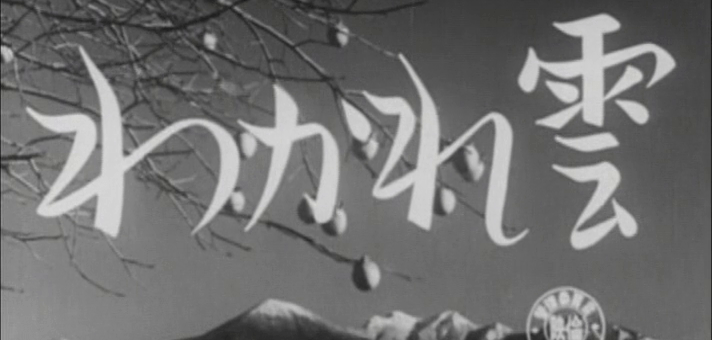
1951’s Dispersed Clouds (わかれ雲, Wakaregumo) was the first film released by Studio Eight, distributed by Shin Toho (the “new Toho” set-up by those same colleagues Gosho had supported in the ‘40s). In a sense it addresses similar themes to other post-war films making use of the familiar “cloud” metaphor, but these clouds are dispersing in more positive directions in that they are wilfully floating away from the traumatic past towards a brighter, more compassionate future, as perhaps was Gosho as he embarked on a new phase of his career.

The heroine, Masako (Keiko Sawamura), is a woman caught between old worlds and new. Very much of the post-war era, she is a university student who intends to work after graduation and values her independence but nevertheless is also looking back towards a childhood she feels she was denied, gradually coming to understand that it was she who denied herself in her resentful mistreatment of her young step-mother in mourning of the birthmother she lost at only six years old. The cloud from which she originally disperses is a group of five fellow students with whom she has gone on a walking holiday exploring rural Japan – an increasingly common pastime in the post-war era but one perhaps still a little unusual for five young women travelling alone. Accompanying her friend into a local photography shop in search of an extra roll of film for her camera, Masako receives the unwanted attentions of the storeowner and makes a speedy escape only to fall ill outside the station and cause the gang to miss their train. Irritated, Masako tells the others to go on without her while she stays in a nearby inn convalescing from what is apparently light pneumonia but also, it has to be admitted, an intense bad mood. 

Masako’s friends are keen to help her, but also exasperated. “You never accept the kindness of others” they lament to her passive aggressive desire not to bother them on their trip, while later plotting how best they can help her seeing as she wouldn’t accept their money if they tried to give to her so she’ll be able to pay for the doctor after they’ve left. They never really consider waiting for Masako to recover, resolving to continue on with their holiday, but do check in on her from time to time from the road with the offer to join them later seemingly open. Meanwhile, they’re all swooning over the improbably handsome country doctor, Minami (Yoichi Numata), who swoops in to treat Masako with a no-nonsense yet caring bedside manner.

Only six years older than Masako, Minami is a certain young man who has found his forward path in life. He has his own small practice which is woefully ill-equipped to cater for the entire town (he can’t admit Masako because he is already overflowing with patients sleeping on the floor), but dreams of building another clinic in an even smaller village further up the mountain where they don’t even have electricity. Despite her friends’ giggling, Masako is in too much of a mood to notice Minami much from her sick bed but later takes a liking to him though mostly in flight when her hated step-mother Tamae (Taeko Fukuda) finally arrives to take her back to Tokyo.

While at the inn, Masako bonds with the kindly maid, Osen (Hiroko Kawasaki), who brought her to there in the first place after noticing her in distress at the station. The innkeeper, who has a flighty modern daughter of her own, is not best pleased that Osen has brought sickness into the house and even less so that it’s a young woman whom she is not convinced is the right kind of clientele (her attitude changes when Tamae arrives laden with expensive gifts). Osen, who lost a husband in the war and daughter in infancy, takes to the young woman with maternal warmth – something which Masako has been seeking ever since losing her birth mother. A woman without a child and a child without a mother easily slip into a familial relationship, but rather than jealous Osen is only sad when she sees how much Tamae is trying and failing in the same role while Masako resolutely rejects her out of nothing more than childish resentment.

Masako, self aware to a point, describes herself as “spoiled, nervous, and selfish” and seems to want to change without knowing how. She tells Minami that she dislikes people in general because they’re all liars and can’t be trusted. Nevertheless, she finds herself hanging around Minami’s clinic in order to avoid Tamae and half convinces herself she is in love with him. An ill-advised five mile hike to the next village to find the earnest young doctor provokes an awkward encounter between the two in which it becomes perfectly obvious that Minami is devoted to his practice, sees Masako only as a patient, and is not really interested in her newfound desire to pursue a deeper union. He tells her, politely, that she is too much trouble and would only be an inconvenience. He doubts that she, a middle-class woman from Tokyo, will be able to adjust to the privations of life in the mountains and is perhaps unconvinced that she has acquired the sufficient maturity to try after just one night of having fun “helping people”.

Masako is not wounded by his words but is enlightened by them on discovering that Minami has lost people too – his brother and friends in the war, but where her childhood loss has made her self-involved and resentful, his grief has made him generous and openhearted. Minami has dedicated himself to the wellbeing of all mankind, which might or might not mean that he has little time for deeper individualised connections, but in any case though she doesn’t realise it herself what Masako is seeking isn’t Minami or a romance but a path back into the world as someone less closed off and unforgiving. Thanks to Osen’s warmth and Minami’s generosity she is able to escape her sense of self-imposed inertia and let her mother go.

Because of this she gives to Osen the precious silver spoon she had treasured as a keepsake from her mother, remarking that she doesn’t need it anymore, while Osen then gives her the rather ironic gift of a spoon case she’d knitted as a present. Though the ending is positive with Masako preparing to leave the transitory space of the mountain town to return to Tokyo “healed”, it is also filled with a quiet anxiety for the older Osen who has, in a sense, been bereaved twice in losing another daughter and being left all alone, knowing that Minami will soon be off to his own bright future. Osen made her new start some time ago after reaching the forward-thinking conclusion that she wasn’t happy with the idea that women must have soft hands. She declares herself happy in a calm sort of way, but is also filled with regrets from the past in having chosen to marry the man chosen for her over the one she loved and finding only unhappiness. Her counselling of Masako not to make the same mistake is perhaps one of the things that sends her, mistakenly, off towards Minami, but unlike the younger woman Osen seems primed to remain in the liminal space of the mountain town unable to leave the past behind in order to move forward in a more positive direction. 

“This world is not so easy” Masako is repeatedly told, but in true Gosho style, it needn’t be so hard if only you learn to live generously with a forgiving heart. The rather mercenary relationship between the innkeeper and her flighty but shrewd daughter is directly contrasted with the innocent yet melancholy one between Osen and Masako, but perhaps neither is really more positive than the other only different. In any case, Osen and Masako, like any parent and child, must eventually part. Masako boards the train into the future smiling brightly, a cloud dispersing from the whole, unburdened by the traumatic past and floating defiantly forward on a path of her own choosing resolved to live for others rather than fixating on her personal pain.