Burden of Love (愛のお荷物, Yuzo Kawashima, 1955)

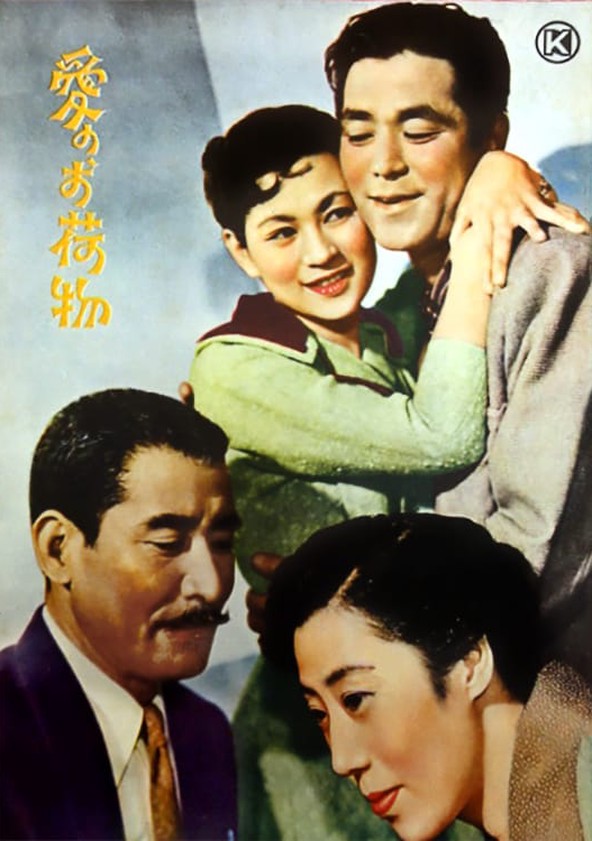
Two decades into the new century, Japanese society finds itself gripped by a population crisis. Supposedly “sexless”, young people constrained by a stagnant economy and a series of outdated social conventions have increasingly turned away from marriage and children to the extent that the birth rate is currently at the lowest it’s ever been. How strange it is then to revisit Yuzo Kawashima’s baby boom paranoia comedy Burden of Love (愛のお荷物, Ai no Onimotsu) in which the very same anxieties now expressed for the declining population are expressed for its reverse – that it will damage the economy, that it is the result of a moral decline, and that society as we know it is on the brink of destruction. 

All of these arguments are made by the Minister for Health, Araki (So Yamamura), as he tries to chair a committee meeting put together to find a solution to the baby boom crisis. The government policy he’s putting his name to is a birth control advocacy programme coupled with greater education to discourage couples from having so many children. Some object on the grounds that encouraging the use of birth control will inevitably lead to promiscuity and sexual abandon, which is why Araki’s government intends to limit its use only to married couples to be used for proper family planning. A feminist politician challenges him again, first citing the go forth and multiply bits from the bible to imply she objects to birth control on religious grounds only to trap Araki by reminding him that that is exactly what the government encouraged people to do during the wartime years. She thinks limiting birth control to married couples is little more than thinly veiled morality policing which will fail to help those really in need, suggesting that if this is the road they want to go down perhaps they should think about relaxing abortion laws so that those who become pregnant without the means to raise a child will have another option. Predictably, Araki is not quite in favour, but takes her point. In any case, events in his personal life are about to overtake him. 

The first crisis is that his son, Jotaro (Tatsuya Mihashi), is in a secret relationship with Araki’s secretary Saeko (Mie Kitahara), who has now become pregnant and is quite smug about it because Jotaro will finally have to sort things out with his family so they can marry. There are several reasons why he’s been dragging his feet: firstly, Saeko is a very good secretary and it’s customary for women to stop working when they marry (though as we later find out Jotaro is a progressive type who has no intention of stopping Saeko working if she wants to even after they marry and have children), secondly, his mother Ranko (Yukiko Todoroki) and younger sister Sakura (Tomoko Ko) are old fashioned and may feel marrying a secretary is beneath him, and thirdly he’s just a lackadaisical sort who doesn’t get round to things unless someone gives him a push. Sakura has an additional concern in that she’s engaged to an upperclass dandy from Kyoto (Frankie Sakai) and worries his family might object if they know that Jotaro has undergone a shotgun wedding to someone from the “servant class”. Araki’s oldest daughter, Kazuko (Emiko Azuma), is happily married to a gynaecologist (Yoshifumi Tajima) but ironically has been unable to conceive after six years of marriage. All of which is capped by the intense irony that his own wife at the age of 48 may be expecting a late baby of their own. 

The press is going to have a field day. Araki, for all his faults, is a surprisingly progressive guy, a moderate in the conservative party but one who, worryingly, doesn’t seem to believe in much of what he says as a minister of government, merely doing what it is he thinks he’s supposed to do. It’s perhaps this level of hypocrisy that Jotaro so roundly rejects, insisting he wants neither a career in the family’s pharmaceuticals company (which, it’s worth saying, also produces the birth control Araki’s policy seeks to promote), or a career in politics, and insists on being his own man. Tinkering with various bits of modern technology, he eventually gets a job in research and development of cheap TV sets, signalling his allegiance to the new all while dressing in kimono to visit kabuki clubs with Saeko. Saeko too is a modern woman – she speaks several languages and has a university degree, supporting herself independently even though she is “only” secretary albeit to a cabinet minister. Sakura, a more traditional sort, originally looks down her for being all those things, but later comes to a kind of admiration especially when she finds herself in need of advice from another modern woman. Jotaro’s mother, however, only comes around when she hires a detective who discovers Saeko might be posh after all. 

“Children have their own worlds to live in” one of Araki’s grownup kids later emphases, unwilling to rely their father for money or career advancement, they want to make their own way in the world. Jotaro, a kind man and something of a socialist, wonders if they shouldn’t be using some of this money the government has earmarked for defence on social welfare, suggesting perhaps that’s the best way to deal with the population crisis rather than pointlessly trying to police desire. Burden of Love was released in 1955, which is immediately before Japan instituted its anti-prostitution law doing away with the Akasen system that existed under the American occupation. Araki goes to visit an establishment in the red light district and declares himself horrified, but is unable to come up with a good solution when the women working there point out that they support entire families who will starve without their income. He may have a point that the pimp’s identification of himself as a social worker is disingenuous because he profits from the exploitation of women, but Araki’s later visit to a tavern staffed by geisha raises a series of questions about a continuing double standard. 

Araki exposes his own privilege when he tells Jotaro that he’d do anything for a single slice of bread before he’d ever do “that”, which is ignoring the fact that it’s very unlikely he’d ever have to consider it. Araki’s father, himself a retired politician, is also a fairly progressive sort who actively gets involved in the kids’ nefarious plans to get around their parents so they can marry the people the want when they want to marry them, while Araki remains largely preoccupied with his political position, even suggesting to his wife, despite what he said in the committee meeting, that she get an abortion to spare him the embarrassment caused by increasing the population while proposing a series of population control policies. Ranko is distraught because to her the child is the product of their love, even if to Araki it is also a “burden”, but being a traditional sort thinks first of her husband and is minded to do as he says. The younger generation think and feel differently. They want to make decisions for themselves, not just about what they do but who they love and how they live. The lesson is perhaps that this isn’t something to be overly worried about. Children are the “burden” of love, but we carry them together, and it’s a happier society that is content to figure it out rather than trying  to pointlessly police forces beyond its control. 


Original trailer (no subtitles)

For Rei (レイのために, Yukari Sakamoto, 2019)

(C)Yukari Sakamoto

Going to university is a prime opportunity to start figuring yourself out, but if you feel a little hollow inside it can often be an uphill battle. The heroine of Yukari Sakamoto’s For Rei (レイのために, Rei no Tame ni) is intensely anxious, somewhat distanced from herself in the unresolved trauma of her parents’ divorce and subsequent loss of contact with her father. University can also be a prime opportunity to reach towards independence, but that necessarily means learning to “let go of the things you don’t like” to chase the things you do while figuring out what the difference between those two things might be. 

Philosophy student Rei finds herself at odds with her classmates, some of whom actively belittle her off the wall contributions for being off the point while the TA offers only the reassurance that she found her words “poetic”, which given the environment she finds herself in might not exactly be high praise. Meanwhile, she’s in a loose relationship with fellow student Nakamura who has a part-time job as a driver he doesn’t much like. As she reveals to her mother, however what’s really bothering her is that she’d like to reconnect with her estranged birth father whom she hasn’t seen since her parents divorced when she was small. Despite her mother’s warnings that her father may only cause her pain, Rei presses ahead and writes a letter, eventually meeting up with him for dinner in a swanky Western restaurant where he orders wine and she coke. 

That comment that so riled her classmate was to do with the nature of perception and its mutual effect on the perceiver. Rei offers that she thinks being looked at is something inherently uncomfortable, that when someone looks at her she wants to look away while looking at someone else can be a cold, abstracted experience. Later, after meeting her father, she returns to the same topic with additional insight, admitting that she was always afraid of being perceived, feeling as if someone was continually watching and waiting for her to mess something up. As much as she feared the gaze, she also felt its pity and wanted to be embraced by it but as she grew she could no longer fit inside as it seemed to grow smaller and recede from her. The sense of loss and distance made her sad, but she is perhaps coming to the realisation that that feeling of disconnection is also a part of growing up as she outsteps the parental gaze to claim her own independent space. That process may necessarily be painful, but it’s her father’s hand on her shoulder that keeps her from moving fully forward as she struggles to separate herself from a half-felt presence. 

Rei’s father, apparently remarried, tries his best to reconnect with his now grown-up daughter but the encounter is unavoidably awkward, belonging both to the past and future as she realises she’s no longer a woman who needs a paternal presence just as she’s made the decision to find one. They chat awkwardly about the intervening years – her feelings of disconnection from her mother’s second family with a step-father and half-sister, and his remarriage, while eventually returning to the past. He never explains why he didn’t keep in contact (though this is sadly normal for divorced fathers in Japan) but is keen to explain that he didn’t leave because of her, only that he and her mother were very young and eventually discovered that they were incompatible, their views on money and family matters apparently entirely different. He didn’t understand her and the distance between them bothered him. 

Like Rei, he couldn’t feel himself inside the gaze and eventually absented himself from it. The reunion seems to have gone well, her father offering to take her mountain climbing, but we somehow feel that they might not meet again. What Rei learns is the power to perceive herself with pity and perhaps let go of the image of her father, a little disappointed in herself to have taken a throwaway comment to heart and remembered it all these years only to garner no reaction on recalling it. Freed from the overbearing gaze, Rei learns to centre her own perception, forgiving both herself and the past, as she steps boldly into a new adult space and sets off into a future of her own choosing.


 For Rei was screened as part of this year’s Osaka Asian Film Festival.

Original trailer (English subtitles)

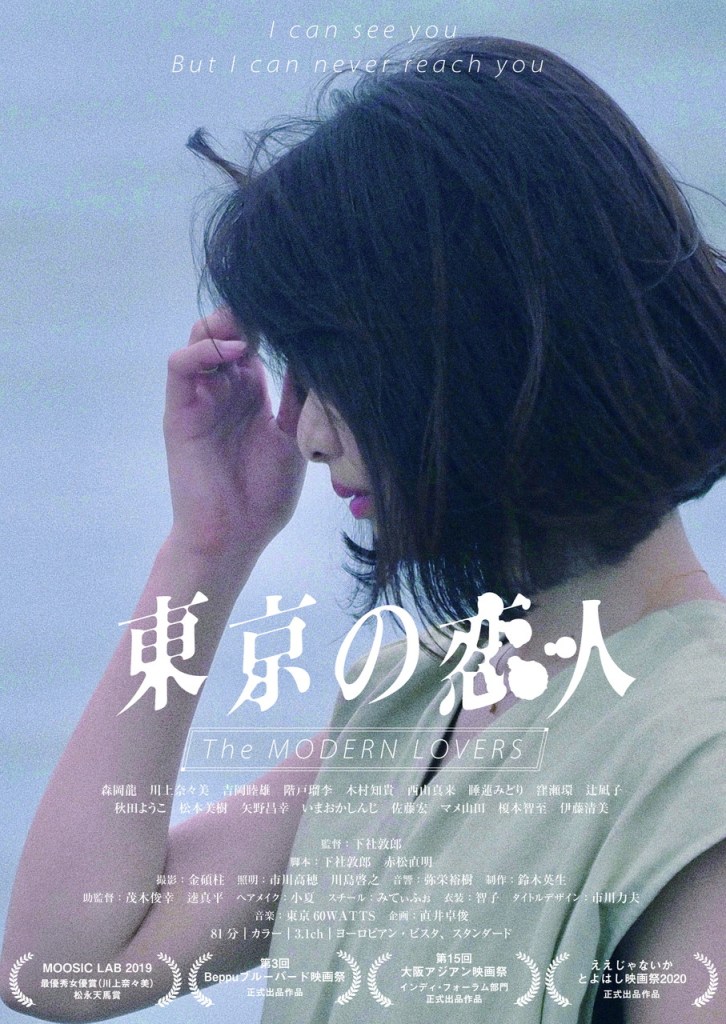
The Modern Lovers (東京の恋人, Atsuro Shimoyashiro, 2019)

Where now the dreams of youth? It may be impossible to escape a regretful middle age, wondering what might have been if only you knew then what you know now, but for the heroes of Atsuro Shimoyashiro’s The Modern Lovers (東京の恋人, Tokyo no Koibito) the pain seems all the more acute. “Today’s the day our youth ends” a brokenhearted woman laments, trying to make peace with her choices but finding that her return to the past may have done more harm than good. 

Tatsuo (Ryu Morioka) is a 31-year-old salaryman, married with a baby on the way and living in provincial Gunma. With the anxiety of impending fatherhood on his mind, he’s surprised to receive a message from his university girlfriend, Marina (Nanami Kawakami), who wants to reconnect. Telling his wife he’s going on a business trip, Tatsuo decides to spend the weekend in Tokyo, staying with another friend from uni before meeting up with Marina for a Sunday in the city reminiscing about old times. 

Like Tatsuo, his old college friend Komazawa (Tomoki Kimura) has long since given up the dream of becoming a filmmaker. A breakdown at 27 has apparently led to a diagnosis of bipolar disorder leaving him unable to hold down a job and dependent on his wife, Seiko (Maki Nishiyama), who supports both him and his step-daughter Shizuko through sex work while Komazawa has become an idle alcoholic. Despite his disappointment, Tatsuo spends the evening bonding with the local bar lady who claims to be able to see the future before leaving early in the morning to meet Marina who suggests revisiting the seaside they went to years before. 

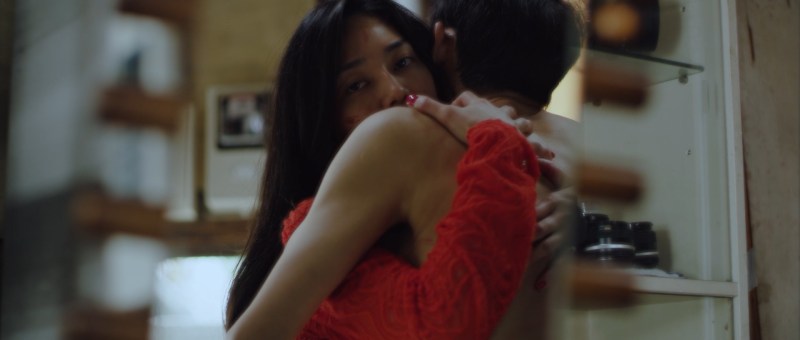
Very much ready to step back into the more innocent past, Tatsuo has brought with him a tape of a song they used to listen to way back when and wastes no time in reassuming the poses of his 20-year-old self, sunshades and all. Marina, by contrast is self-consciously cute but mature, if perhaps sad. Tatsuo starts to tell her that he gave up his filmmaking dreams, married a good woman, and took a regular salaryman job at the family firm, but fails to complete the thought. Marina meanwhile casually remarks that she married a wealthy man but hints that she did so largely for convenience and material comfort rather than love. 

“We never get to marry the woman we love the most” Tatsuo’s strangely boys will be boys brother-in-law (Mutsuo Yoshioka) sighs, commiserating with Tatsuo’s lament for his disappointed youth and failure to make his filmmaking dreams a reality. We discover that an early success in a scriptwriting competition gave him an inflated sense of possibility, and that his desire for success was largely a desire to impress his girlfriend. Wounded male pride in his sense of artistic failure eventually convinced him he had to break things off while she silently cursed him, jokingly sentencing him to 18 years of solitude in a playful reference to a Tai Kato film. Now he realises his foolishness and is filled with regret in having settled for a conventional middle-class life as a husband and father.

Marina, meanwhile, is feeling something much the same in trying to achieve closure on the past before she becomes a mother. After breaking up with Tatsuo, she drifted through nude modelling and ended up the trophy wife of a wealthy man she doesn’t love, pegging her hopes on material comfort and hoping that love will come later. “I’m glad you’re happy now” a bar owner and former Instagram fan tries to congratulate her, but all Marina can do is smile sadly and ask her similarly troubled companion if happy is what she looks.    

“I’m not young anymore, I can’t live for a dream” Tatsuo accepts, but living on a dream is all they’re doing, recalling the time when they were “modern lovers” in Tokyo kidding themselves that they were urban sophisticates when perhaps all they did were the kinds of things unsophisticated suburbanites do like hang out at batting cages and go to barbecue restaurants. It’s too late to turn back now, but the past is a difficult trap to escape and perhaps what they long for is not so much the love cut off in its prime but a return to the possibilities of youth. Meeting again reawakens the desire for something more out of life than life may now have to give them, but this is day that youth ends, hitting the end of the road in a slow car crash of realisation that regret is the price of age.


The Modern Lovers was screened as part of this year’s Osaka Asian Film Festival.

Original trailer (no subtitles)
Retro hit Love You, Tokyo by Akira Kurosawa (not that one!) & Los Primos which recurs frequently throughout the film

Woman of the Photographs (写真の女, Takeshi Kushida, 2020)

(C)PYRAMID FILM

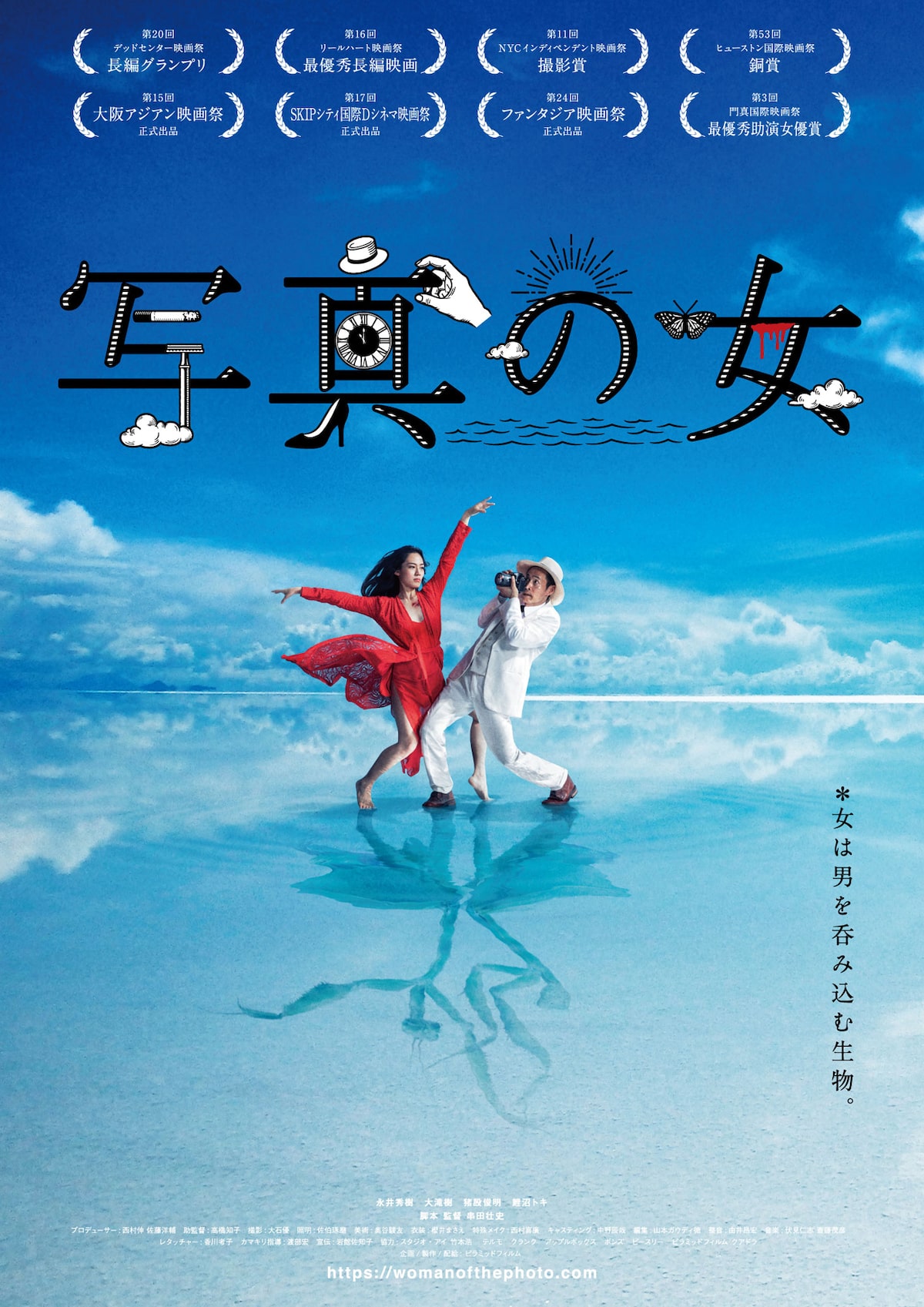
“We can only love ourselves through others’ eyes” according to an increasingly obsessed young woman desperately trying to “fix” her image of herself through retouching her photo. An inverted take on Woman of the Dunes, Woman of the Photographs (写真の女, Shashin no Onna) sees the world of a bug-obsessed photographer with a talent for “improving” on reality disturbed by the arrival of a mysterious dancer who falls from a tree in the forest into his previously ordered existence.  

Kai (Hideki Nagai), a middle-aged man dressed in an old fashioned white suit, operates a small photo studio taking official photos for things like funerals and omiai arranged marriages. As we later find out from his only regular human contact, the funeral director from across the road (Toshiaki Inomata), Kai’s mother died in childbirth and his father opened this shop to support his son. Kai has taken over but has an intense fear of women and lives alone save for his pet praying mantis with whom he regularly eats his preferred dinner of microwave pizza. 

It’s on a regular bug hunting trip that Kai is struck by the beautiful figure of Kyoko (Itsuki Otaki) tumbling out of a nearby tree and causing herself manageable if painful injuries including a nasty gash along her collarbone. Not wanting to go to a hospital, Kyoko gets Kai to take her to a pharmacy and patches herself up, later accompanying him home where he takes some photos of her to post on her Instagram, retouching them to get rid of the traces of wounds. Despite Kai’s silence, she manages to convince him to have dinner with her in a nearby restaurant and later to allow her to stay the night, after which she becomes a more permanent fixture in his life. 

A former dancer now Instagram star, Kyoko originally thinks nothing of getting Kai to clean up her photos to rid them of unsightliness, but is mildly disturbed to watch him do it. In a reverse Dorian Gray effect, Kai must scar the image to repair it, scrubbing away traces of unwanted “reality” in an act which seems to contradict the true nature of photography. “A good lie can make people happy” according to the funeral director who regularly uses Kai’s services to create suitably solemn photos of the suddenly deceased, but Kyoko isn’t so sure. Ever since she asked Kai to soften her reality, her followers have begun to desert her and she’s losing her lucrative sponsorship deals. The apologetic lady from the agency points out that she’s diverging from the “image” her fans expect from her and if she wants to keep them she’ll have to be the Kyoko they want her to be. 

Kyoko doesn’t quite like that, she’d like to be more authentic. Hisako (Toki Koinuma), meanwhile, an unexpected regular to the studio, is of the opposite opinion. In her view, retouching the photo allows her to be more herself, reflect her true essence through manipulating her image. Asking if she hasn’t got things the wrong way round, Kyoko wonders if the men she’s sending them to will be confused or disappointed that the photo and the reality don’t match but Hisako counters her that a man falling in love with her idealised self would only bring her closer to it. The self reflected in the eyes of others is the true self and only through others’ eyes can you find self love, according to Hisakao. Ironically, Kyoko has been looking for something similar through her Instagram success, but begins to resent the extent to which it is changing her, encouraging her to hide the parts of herself others might find ugly in order to gain acceptance. 

Deciding not to retouch the photos, however, has the opposite effect. Her fans love her again, bowled over by her authenticity, but at the same time perhaps she’s engaging in a strange kind of self-exploitation. Her wounds will, after all heal. Could she be tempted into a life of continued self-harm just for likes? Kyoko begins to lose her sense of self, as if she doesn’t quite exist online or off, caught between the “real” and the “ideal”.

Kai, meanwhile, remains silent but also captivated by the conflicted Kyoko. His life has been one of isolation, afraid of female touch and contented only among his insects. Yet like Kyoko he’s learning that scars can be beautiful because wounds are a sign of life. Waking up to connection and desire, he learns a different lesson from the lifecycle of the praying mantis realising that the male’s greatest pleasure lies in surrendering its body so the female can continue in life and creation. He no longer fears being devoured, but honours the true connection of mutual exchange. Inverting the conclusions of Woman of the Dunes, Kai finds himself liberated not by a sense of simplicity in life but by its complication, accepting all the richness it has to offer in joy and pain, engaging in his own strange mating dance as a man with a camera capturing his subject in all of her essential beauty. 


Woman of the Photographs was screened as part of this year’s Osaka Asian Film Festival.

Original trailer (English subtitles)

VIDEOPHOBIA (Daisuke Miyazaki, 2019)

(C)VIDEOPHOBIA PARTNERS

How can you really be sure who you are when your image of self is entirely dependent on external validation? In this brave new age of video technology, none of us are any longer custodians of our own image, we leave impressions of ourselves everywhere we go and most particularly online where anyone and everyone is free to do with them as they please. Intellectually, we all know this already. We use the internet ourselves, not always responsibly, and have become so used to seeing CCTV cameras on every street corner that we no longer register their presence. We live our lives under observation, but even so the realisation that our image has been captured without our knowledge can be a profound violation. 

So it is for Ai (Tomona Hirota), a permanently exhausted young woman who has returned to her Osaka home after failing to make it in Tokyo (or rather, as she points out, Kanagawa). Ai is currently taking acting classes while making ends meet with a side gig as a shopping mall mascot (another masked role). She spends her nights smoking while wearing a face mask and making anonymous connections with strangers via cybersex websites. That is until she goes on a rare night out with some people from acting class and meets a handsome man in a bar (Shugo Oshinari) who tells her that it’s too early for names before taking her back to his improbably swanky apartment for a one night stand. Ai notices that there’s a strange looking camera pointed at them from a nearby shelf but thinks nothing of it, and after rather mechanistic sex clasps hands with her new lover as if an intimate connection has finally been forged. 

It’s therefore a double shock for her when she spots a mysterious video on a porn website which appears to have been shot in the apartment where she spent the previous night. Pressing play her worst fears are confirmed, a sex tape featuring Ai and the guy from the club seems to have been uploaded online. She tries to confront him and is told that the camera is a vintage 8mm model for display purposes only which contains no film and admittedly would be very difficult to process. Confused, she leaves, but is even more disturbed when more videos start appearing online which could not have been taken by the static camera on the shelf. She then discovers that the guy has vanished, the apartment wasn’t even his but is being illegally sublet on Airbnb by a company registered in Indonesia. 

That last piece of info Ai gets after going to the police to whom she gives her name as “Park”. Though the policewoman is sympathetic enough and never directly judges Ai, she’s embarrassed to have to explain that she went home with a guy whose name she still doesn’t know and has no other evidence except the video site. Trying to be reassuring, the policewoman reminds her that there are billions of hours of video already online so the chances of someone seeing hers are extremely small and, in any case, they don’t even think it looks like her in the video anyway. 

Rather than reassured, Ai becomes even less certain. If that isn’t her in the video, then who is she? She takes the police up on their recommendation of a support group but finds it a bizarrely uncanny experience in which each of the other participants tells a near identical story about an ex posting an old photo on social media which contributed to the failure of their present relationship. The support group mirrors her acting class in which an abrasive director instructed them all to take on personas which were the opposite of their own, literally swapping identities. Pushed into a corner, one of the students eventually snapped and attacked the teacher whose intense approach was, according to some, also an act designed to elicit the best performance. 

If we’re all “acting”, and our image is susceptible to theft, then what really can we say constitutes our “identity” in the digital age? The support group is fond of chanting that “You haven’t changed” hinting at an essential presence that exists outside of immediate perception, but everyone in the support group is verging towards some kind of creepy group think defined by “shared” trauma. In the end, Ai resorts to desperate measures, literally taking control of her image by changing it, but can she really be said to have escaped herself and should she even want to? Wearing the face mask eerily reminiscent of Eyes Without a Face, she gazes out of her balcony window and thinks she sees “herself” walk past on the street below. Thanks to the powers of technology we have made division of ourselves, no longer the primary hosts of our own image. 


VIDEOPHOBIA was screened as part of this year’s Osaka Asian Film Festival.

Original trailer (English subtitles)

Good-bye (グッドバイ, Aya Miyazaki, 2020)

“The things you learn as a child stay with you” admits a melancholy nursery teacher, lamenting that perhaps her life would have turned out differently if only her parents hadn’t been so easy going. Most people probably wind up wondering something similar, who they might have been if their parents had or hadn’t made the choices that they made on their behalf, but sooner or later you have to leave childhood behind and take responsibility for yourself. 

That’s the part that the heroine of Aya Miyazaki’s Good-bye (グッドバイ), 20-something Sakura (Mayuko Fukuda), is currently having trouble with, struggling to find a way forward largely because in one sense everything comes too easy for her and life is no kind of challenge. Privately, however, she’s caught in an adolescent dilemma pining for the father who, it seems, has been largely absent from her life since leaving the family when she was small. 

The crunch comes when Sakura abruptly quits yet another boring office job just because it didn’t light her fire. Her mystified friend who can’t really believe someone would just quit their job on a whim in Japan’s competitive employment environment just because it was dull (let alone make a habit of it), suggests she fill in at a daycare centre that another friend has just vacated leaving them in the lurch and with a temporary contract available. Sakura is unconvinced seeing as she has no childcare qualifications, but is persuaded on hearing the facility is “unlicensed” and therefore not fussy. She doesn’t exactly take to it right away, but beginning to bond with the children reminds her of her more innocent self, especially once she encounters the father of one little girl, Ai, who is often the last to get picked up. 

Sakura is taken with Mr. Shindo (Kohei Ikeue) because he looks a little like her dad and also smells of the same brand of cherry-scented cigars that he used to smoke. It also doesn’t help that his family situation closely resembles a mildly traumatic incident from her own childhood in that Ai’s mum seems to be temporarily absent from the family home for unclear reasons. Sakura finds herself playing mother, brushing Ai’s hair and tying it up in pigtails the way her father couldn’t quite master on his own. Running into the pair in the street, she even finds herself cooking dinner for them, giving Ai a few lessons in peeling carrots, while accidentally stepping into the space vacated by another woman and perhaps crossing a line with the extremely awkward Mr. Shindo. 

The encounter does, however, prompt her into a long delayed conversation with her sympathetic mother (Asako Kobayashi) who offers no explanation for why she did what she did, or sees any need to apologise, but is perhaps touched by some of her words which convince her that her daughter needs a final push to help find her place in the world. Prompted by the other teacher at the nursery, Sakura asks her mother why she sent her to all those after school clubs etc, only to be told that she did it because she wanted Sakura to find her passion but though she was good at everything, Sakura always quit after only a few weeks. Her mother wonders if that’s because when everything is easy for you you have no incentive to stick with it and never get the opportunity to become invested. 

That has perhaps been Sakura’s problem, she says goodbye too early before there’s any possibility of getting attached. Bonding with the kids reminds her of the little girl she once was, processing the sudden absence of her mother and the possibility of her familiar world ending. Her mother eventually returned, but perhaps gave her an incomplete sense of security in the feeling that she would never leave her or the house, while her father is of the opinion that the family photo was something best left behind in the family home which was no longer his. In learning to say “good-bye” to Ai, Sakura learns to bid farewell to the little girl she once was, insecure and afraid of rejection. As her mum tries to hint, it’s time for her to find a place of her own, no longer so afraid to stick around past the part where everything seems too easy.


Good-bye screened as part of this year’s Osaka Asian Film Festival.

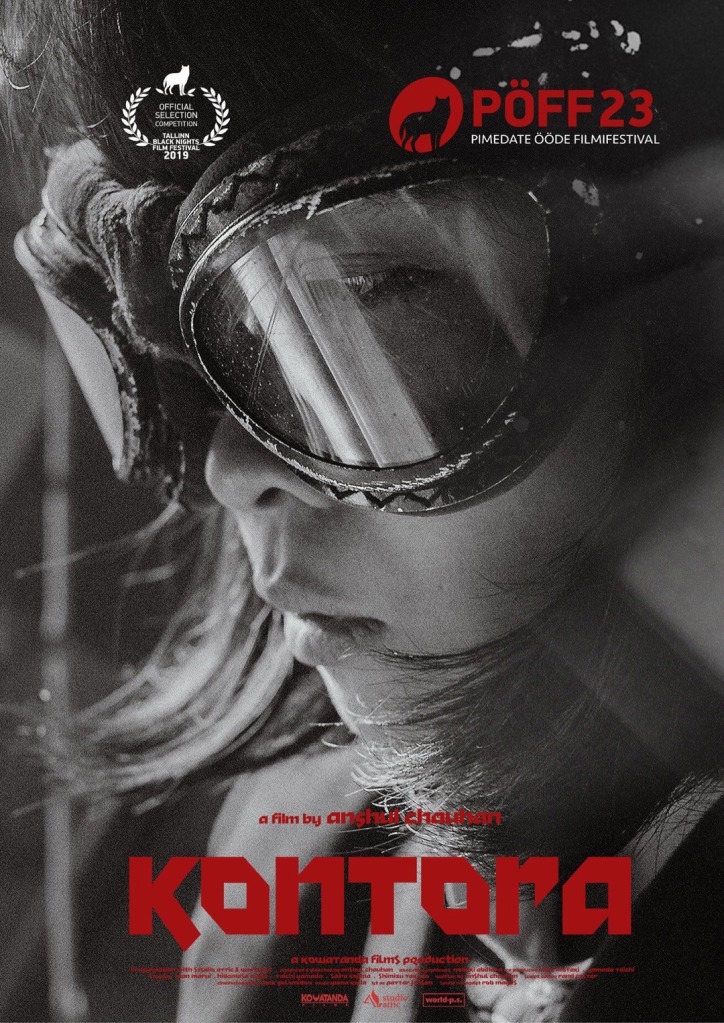
Kontora (コントラ, Anshul Chauhan, 2019)

Copyright © 2020 Kowatanda Films

Life is a series of oppositions, the past conflicting with the future, the young with the old, selfishness with altruism, but without conflict there can be no sense of forward motion. That’s largely where the heroine of Anshul Chauhan’s second feature Kontora (コントラ) has found herself, stuck in a “one horse” town with no sense of excitement, longing for the bright lights of Tokyo while fiercely rejecting her distant father in favour of gentle companionship with her compassionate grandad. It’s not until after he passes away, however, that she begins to realise there were things in his life that he was never able to tell her. 

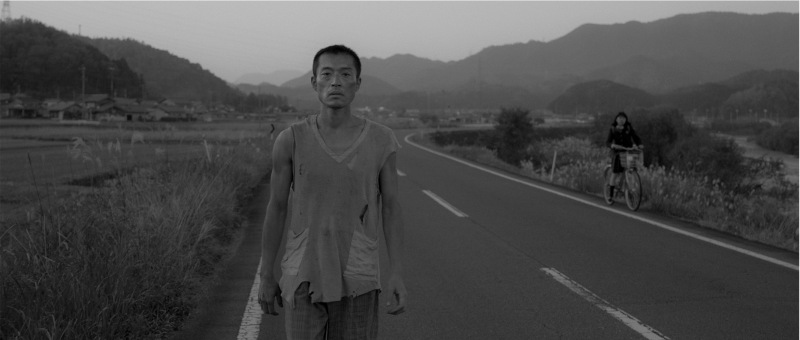
Teenager Sora (Wan Marui), in her final year of high school, discovers this on finding her grandfather’s body. Understandably panicked she looks over the box of World War Two mementos he appeared to have been poring over just before died and hurriedly hides them so her father (Takuzo Shimizu) won’t see. After the funeral she finds herself fondling his old pilot’s helmet and goggles while reading his war diary, filled with beautifully drawn illustrations and terrible memories of torture and privation. Writing such a diary must have been quite a risk, seeing as Sora’s grandfather recounts only fear and dissatisfaction, envious of the young men who failed the draft and got to continue with their student lives while he is lonely and desperate but claims no longer to be able to understand love. For Sora, however, the most important thing is that her grandfather mentions burying his “metal arm” in the forest. She commits herself to finding it, bunking off school to go digging on a nearby mountain. 

Meanwhile, she also begins spotting a strange young man (Hidemasa Mase) around town who is dressed in rags and seemingly can only walk backwards. The man enters her life in a more concrete sense when he literally collides with her father’s car while the pair are returning from a fairly disastrous family dinner over which her father’s cousin Yoshiji (Takuzo Shimizu) had made an inappropriate bid to get him to sell the family home so he could use it to house workers at his factory, even offering to give Sora a job to make sure she’s looked after. Questioned about her future plans, Sora had mentioned hoping to go to Tokyo, which comes as a shock to her dad and is abruptly shutdown by Yoshiji who can’t see what the point in that would be. His own daughter, Haru (Seira Kojima), went to Tokyo to become a dancer but seems to have returned somewhat chastened and now works in his factory, as if proving his point that there is no future for girls like Sora other than shifting straight into small-town life seconds after graduating high school. 

Sora’s dad leaves the gathering drunk and angry, which is why his first thought is abandoning the injured man on the roadside so he won’t have to deal with a drunk driving charge. Sora, however, refuses to abnegate her responsibly and insists on making sure the man is OK, leading to a compromise in which they take him home to monitor overnight. Still unconvinced, Sora’s dad kicks him out in the morning, but Sora chases him down and brings him back, dressing him in grandad’s clothes and stunned when she hears him singing one of grandad’s songs. 

The man’s presence highlights a key difference between Sora and her distant father. Sora is intrigued and unafraid, she tries to talk to the man and is very interested to find out why he only walks backwards but is also accepting of his silence. Her father meanwhile sees only danger. His first thoughts are only to expel the man by whatever means possible, eventually jumping to conclusions born of prejudice that he may have somehow harmed Sora. Sora, meanwhile, jealously keeps the diary to herself, never sharing her newfound quest with her father until forced into the open at which point she tells him that the diary had given her life a sense of purpose that she was reluctant to share with anyone else. Secrets revealed, the rift between father and daughter begins to heal while the mysterious man looks on in silence, perhaps knowing that grandad had other messages to give that are still waiting to be uncovered. 

Strangely, no one seems to stop to consider that grandad may have buried his “metal arm” for good reason, and that it should perhaps stay that way (especially if a heartless arch capitalist like Yoshiji ends up getting his hands on it). Nevertheless, unearthing the buried past begins to solve the mystery of grandad and enable a kind of healing. The man keeps walking round and round in circles, backwards as if walking against the future, caught on a treadmill of repetitive anxieties and unable to move forward. Sora may be at that point herself, stuck in a moment of adolescent confusion unable to step into adulthood and having lost her only guide and confidant. It may be, in some ways, troubling that she finds her direction through embracing a violent past, but there is indeed a moment of healing in two eras meeting which allows time to reassume its proper flow. Ethereal and mysterious, Kontora is both coming-of-age tale and a melancholy fable of griefs both national and personal in which forward motion is possible but only in facing the past head on and waving it goodbye as you turn around to walk towards a more positive future.


Kontora screens on March 12/13 as part of this year’s Osaka Asian Film Festival.

Original trailer (English subtitles)

Tezuka’s Barbara (ばるぼら, Macoto Tezka, 2019)

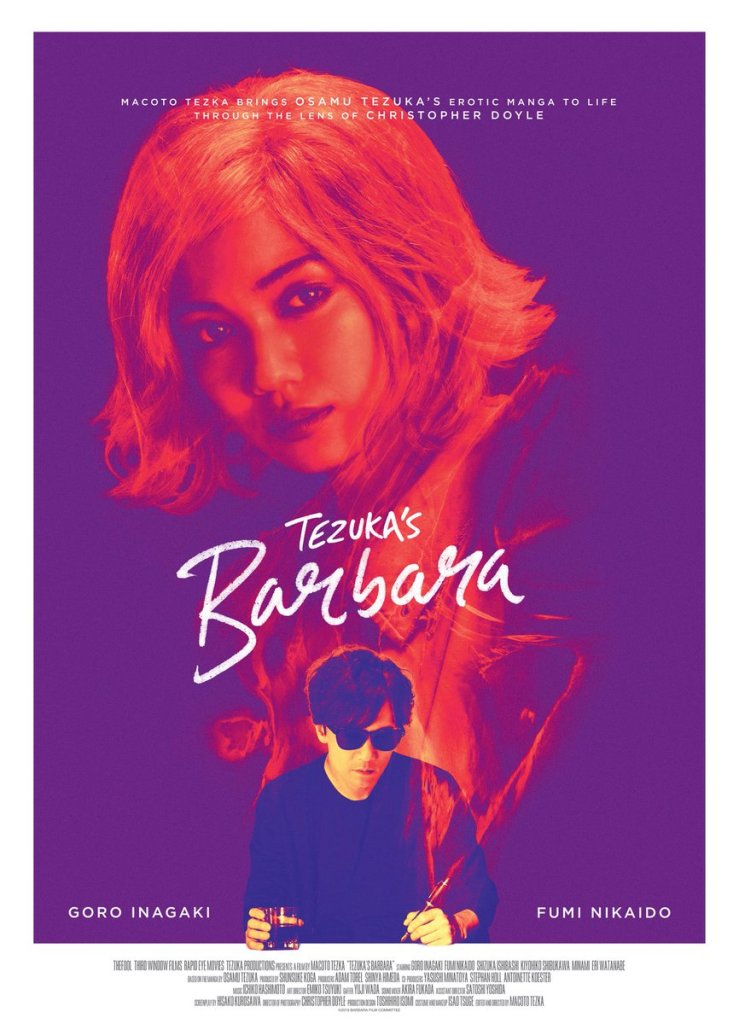
The relationship between an artist and his muse (necessarily “his” in all but a few cases) is at the root of all drama, asking us if creation is necessarily a parasitical act of often unwilling transmutation. Osamu Tezuka’s Barbara (ばるぼら), brought to the screen by his son Macoto Tezka, takes this idea to its natural conclusion while painting the act of creation as a madness in itself. The hero, a blocked writer, describes art as a goddess far out of his reach, but also the cause of man’s downfall, framing his creative impotence in terms of sexual conquest that lend his ongoing crisis an increasingly troubling quality. 

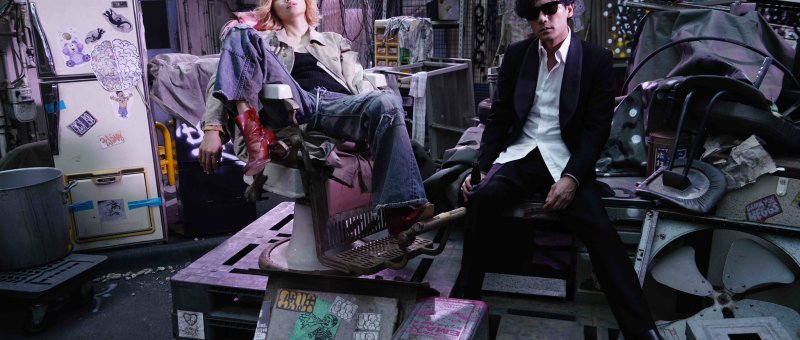
Yousuke Mikura (Goro Inagaki) was once apparently a well regarded novelist but has hit a creative block. While his friends and contemporaries are winning awards and national acclaim, he’s become one of “those” writers busying himself with potboilers and eroticism to mask a creative decline. Passing a young woman collapsed drunk in a subway, something makes him stop and turn back. Surprisingly, she begins quoting romantic French poetry to him, and actually turns out to be, if not quite a “fan”, familiar with his work which she describes as too inoffensive for her taste. Mikura takes her home and invites her to have a shower, but later throws her out when she dares to criticise an embarrassingly bad sex scene he’s in the middle of writing. Nevertheless, he’s hooked. “Barbara” (Fumi Nikaido) becomes a fixture in his life, popping up whenever he needs a creative boost or perhaps saving from himself. 

Strangely, Barbara is in the habit of referring to herself using a first person pronoun almost exclusively used by men, which might invite us to think that perhaps she is just a manifestation of Mikura’s will to art and symbol of his destructive creative drive. He does indeed seem to be a walking cliché of the hardbitten writer, permanently sporting sunshades, drinking vintage whiskey, and listening to jazz while obsessing over the integrity of his art. We’re told that he’s a best-selling author and previously well regarded by the critics, but also that he has perhaps sold out, engaging in a casual relationship with a politician’s daughter and cosying up to a regime he may or may not actually support. He’s beginning to come to the conclusion that he’s a soulless hack and the sense of shame is driving him out of his mind. 

Mikura’s agent Kanako (Shizuka Ishibashi) certainly seems to think he’s having some kind of breakdown, though the jury’s out on whether her attentions towards him are professional, sisterly, or something more. There isn’t much we can be sure of in Mikura’s ever shifting reality, but it does seem a strange touch that even a rockstar writer of the kind he seems to think he is could inspire such popularity, recognised by giggling women wherever he goes yet seemingly sexually frustrated to quite an alarming degree. His world view is an inherently misogynistic one in which all women seem to want him, but he can’t have them. A weird encounter in a dress shop is a case in point, the assistant catching his eye from the window display turning out to be a devotee of his work because of its “mindlessness”, something which annoys Mikura but only causes him to pause as she abruptly strips off for a quickie in the fitting room. Tellingly, the woman turns out to be an inanimate mannequin, literally an empty vessel onto which Mikura can project his fears and desires, which is, perhaps, what all other women, including Barbara, are to him. 

Yet who, or what, is Barbara? Chasing his new “muse”, Mikura finds himself on a dark path through grungy subculture clubs right through to black magic cults, eventually arrested on suspicion of drug use. There is something essentially uncomfortable in his dependency, that he is both consuming and consumed by his creative impulses. Inside another delusion, he imagines himself bitten by potential love interest Shigako (Minami), as if she meant to suck him dry like some kind of vampire succubus, but finds himself doing something much the same to Barbara, stripping her bare, consuming her essence, and regurgitating it as “art”. Either an unwitting critique of the various ways in which women become mere fodder for a man’s creativity, or a meditation on art as madness, Barbara seems to suggest that true artistry is achieved only through masochistic laceration and the sublimation of desire culminating in a strange act of climax that stains the page with ink.  


Tezuka’s Barbara screens in Amsterdam on March 6/7 as part of this year’s CinemAsia Film Festival.

International trailer (English subtitles)

Moonlit Winter (윤희에게, Lim Dae-hyung, 2019)

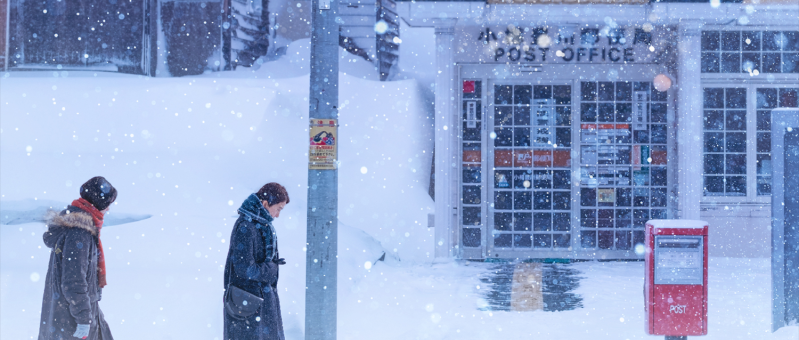
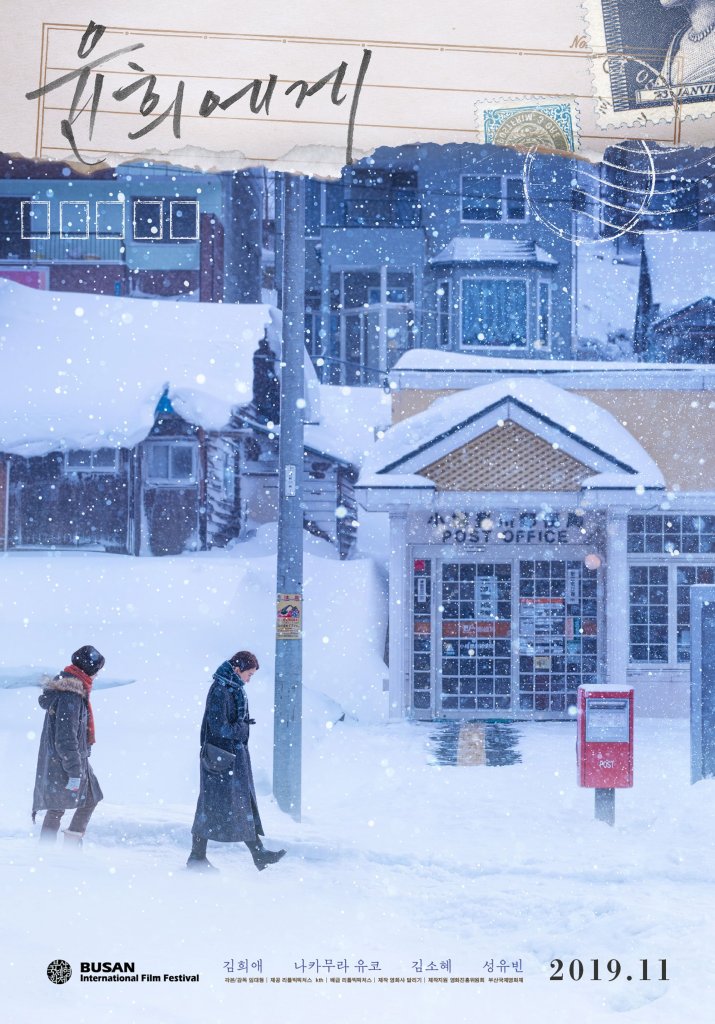
It goes without saying that the world is very different now than it was 20 years ago, but change happens slowly and primarily benefits those who come later rather than those trying to live as it’s happening. The two women at the centre of Lim Dae-hyung’s Moonlit Winter (윤희에게, Yoon-hee-ege) are a case in point, painfully separated and forced into self-isolation born of internalised shame while perhaps filled with unspeakable longing. In a sense, they each live within that moonlit winter, a cold and lonely place yet not without its beauty. 

In Japan, an older woman, Masako (Hana Kino), mails a letter she finds lying around in her niece’s room, unsure if she’s doing the right thing but perhaps hoping for a kind of shift. Presumably, Masako cannot read the contents of the letter as they’re written in Korean (though later read to us in Japanese), and addressed to a “Yoon-hee”. It’s Yoon-hee’s daughter Sae-bom (Kim So-hye), however, who first picks it up and begins to realise, perhaps for the first time, that her rather distant, lonely mother is a woman too with a painful past she knows nothing of. Written with a kind of melancholy finality and the sincerity of a letter never quite intended to be sent, the heartfelt words hint at a past heartbreak in which the author, Jun (Yuko Nakamura), hopes that she won’t make the recipient uncomfortable but felt that she had to write to let her know that she still thinks and dreams of her after all this time. 

Finally receiving the letter, Yoon-hee (Kim Hee-ae) is not “uncomfortable” or at least in the way that Jun had feared she might be. Recently divorced after years of unhappy marriage to a drunken policeman (Yoo Jae-myung), Yoon-hee has a job in a canteen at a factory and lives alone with her teenage daughter who is in the last year of high school and preparing to head off to university in Seoul. Intrigued by the letter, Sae-bom begins to become curious about why her mother is the way she is. She tries asking her uncle, but he’s fantastically unhelpful, and then questioning her father but he only tells her that her mother is the kind of woman who makes others feel lonely. That strikes Sae-bom as ironic because she chose to stay with her mother after her parents’ divorce precisely because she thought she seemed the lonelier.

Jun, meanwhile, is a lonely figure too but perhaps wilfully so. She tells her aunt Masako with whom she’s been living all this time that she chose to come to Japan with her father after her parents split up because he didn’t care about her (hence why she’s always lived with the unmarried aunt), while she was all her mother ever cared about. In retrospect, it sounds as if, as she said in the letter, she ran away, afraid that her mother would notice something in her she did not want to be noticed. Perhaps Masako has noticed something too which is why she sent the letter, though she’d never bring it up directly. A well-meaning though tone deaf and entirely insensitive relative (Sho Yakumaru) tries to use the occasion of her father’s funeral to talk Jun into a blind date with his Korean friend, an offer she flatly refuses but he keeps badgering her anyway. Eventually she stops the car and insists on walking home at which point he realises you probably shouldn’t be matchmaking at a funeral but she cuts him off again, telling him that’s not the reason for her intense annoyance but stopping short of explaining what is. 

Jun has one of those faces, slightly mysterious, pensive as if she’s about to say something important but never actually does. Another woman (Kumi Takiuchi) thinks she recognises that quality in her and edges towards a kind of confession but Jun shuts her down, brutally telling her that the only secret she’s keeping is being half-Korean, advising that if she too has a “secret” she’d best keep it to herself. Even more than Yoon-hee, Jun has lived a life of isolation, too afraid to be her real self and terrified of being seen. 

But for the younger generation things are perhaps different. Sae-bom is at a romantic crossroads of her own, acknowledging that her high school romance may be about to end seeing as nice but bland boyfriend Kyung-soo (Sung Yoo-bin) is not exactly her intellectual equal and cannot accompany her to a university in Seoul. After realising that the sender of the letter is female, Sae-bom seems unfazed, still curious about this hidden part of her mother’s life and rooting for her to find a kind of happiness. In the habit of taking photos (using a camera which turns out to have been a present given to Yoon-hee as an apology from her mother for the family’s belief that there was no point in sending a girl to university) Sae-bom declares that she only photographs beautiful things rather than people, but takes photos of her mother all the time, capturing her at her most mysterious but rarely smiling. Railroaded into a life of conventional success that eventually failed, Yoon-hee has become an empty, directionless shell unable to live her own life while filled with an internalised sense of shame that leaves her feeling guarded and worthless.

Yet through the arrival of the letter she begins to reconnect with her younger self, her repressed desires, and impossible longing for Jun. With the gentle support of a daughter and aunt respectively, the two women begin to rediscover the courage to live, not necessarily in embracing romance, but accepting themselves for who they are and rejecting the sense of shame that has defined each of their lives. The winter may at last be ending and they may not yet have it in them to ask for the stars, but they’ll always have the moon. 


Moonlit Winter screens in Amsterdam on March 6/8 as part of this year’s CinemAsia Film Festival.

Original trailer (English subtitles)

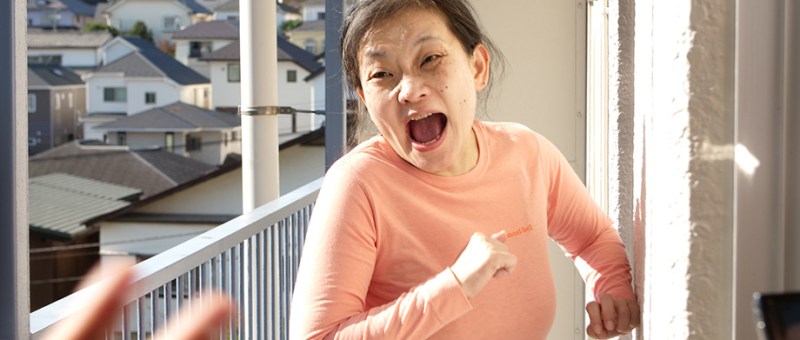
Mrs. Noisy (ミセス・ノイズィ, Chihiro Amano, 2019)

“Cases involving two parties must be viewed from differing angles” according to a lawyer trying to point out why a case that was cast iron days before is now a non-starter. Most of us know it’s a bad idea to judge people on appearances, but few of us have made the leap to acknowledging that it’s wrong to judge people at all, especially when you don’t and can’t know what’s happening in other people’s lives. Being self-involved is hardly a crime, but if it’s a bad quality in a human being it’s an unforgivable sin in a writer, which is why the heroine of Chihiro Amano’s Mrs. Noisy (ミセス・ノイズィ), apparently inspired by an early viral video phenomenon, is struggling to overcome a nasty case of writer’s block. 

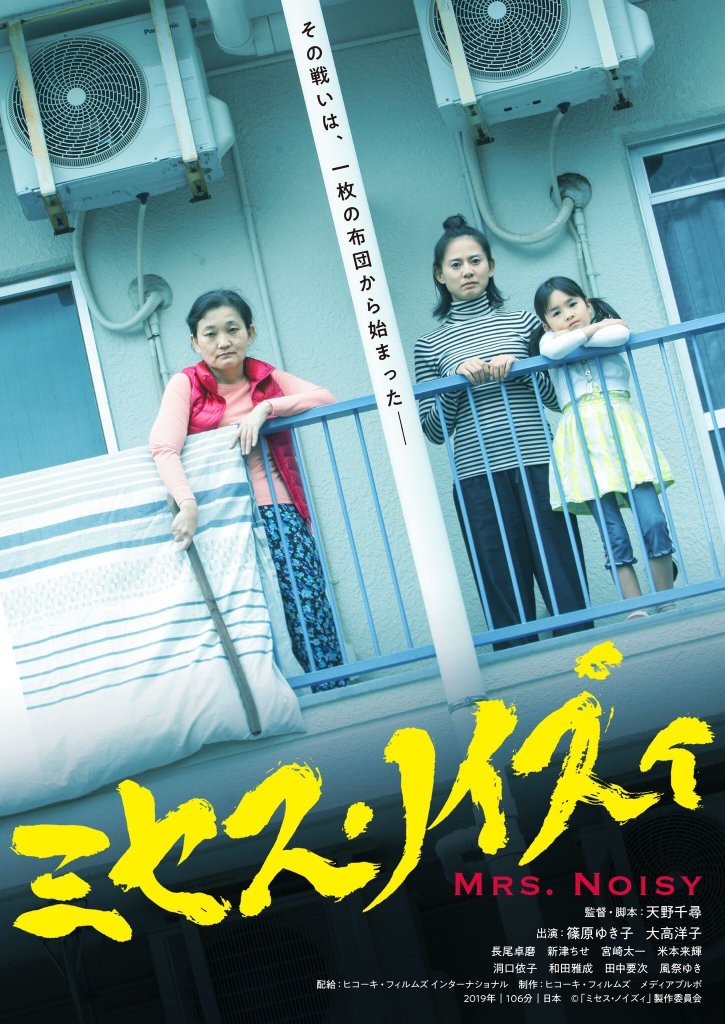
Some years ago, under a pen name, novelist Maki (Yukiko Shinohara) made a name for herself with an award-winning book. After giving birth to her daughter, Nako (Chise Niitsu), she swore motherhood wouldn’t slow her down but six years later she’s published nothing of note. After moving to a new apartment with her freelance musician husband Yuichi (Takuma Nagao), Maki hopes to kick her writing career back into gear but an immediate spanner is thrown in the works by a strange noise early in the morning that turns out to be the old woman next-door furiously beating her futon. Maki asks her to stop, but her impatience only gets her neighbour’s back up and starts an ongoing conflict that only worsens after Nako, feeling neglected by her mother’s dedication to her work, wanders off and the neighbour, Miwako (Yoko Ootaka), accompanies her to the park. 

Later, we’re shown things from Miwako’s point of view and realise that when she said there were “reasons” she was out beating a futon at 6am she was telling the truth. Not only that, she tried to explain but was abruptly cut off by an impatient Maki who was not in the mood to listen. It doesn’t help that the Japanese word for “bugs” also means “ignore”, but many of the upcoming problems could have been resolved with a little more patience and politeness, which is something Maki decided she didn’t need to bother with in deciding not to go around introducing herself to her new neighbours as is the usual custom.  

Likewise, when Yuichi abruptly announces he can’t watch Nako the following day as planned, it’s easy enough to think he’s being unreasonable, letting his wife down and implying his career’s more important than hers, but that rather ignores the fact that his explanation is perfectly reasonable in that freelancers cannot (in contrary to popular opinion) dictate when and where they work, and that he offers to keep Nako occupied that evening instead so Maki can meet her deadline. As time wears on, we start to doubt Maki’s sense of subjectivity, realising that she’s begun to blame all of her problems on the old woman next door whom she doesn’t even really know. 

Of course, there are other conflicts, social and generational differences. To a woman of Miwako’s age, it seems “common sense” for an older woman to look after a little girl who seems lonely, in the same way it seems “common sense” that’s it’s wasteful to throw out perfectly good food just because it’s slightly misshapen, but then the world is not as accepting of “common sense” as it likes to think it is. To Maki, a younger woman not used to living in a tight knit community, it seems inappropriate to take someone else’s child to the park without checking with them first. Admittedly, Nako’s claim that Miwako’s husband (Taiichi Miyazaki) gave her a bath (not quite what happened) also sets alarm bells ringing, as perhaps it should, but again could have been settled with much less acrimony if it weren’t for an unfortunate personality clash between the two women in which Miwako offers some “common sense” advice that Maki herself is to blame for her daughter wandering off, touching a nerve in Maki’s conflicted sense of maternity that sees her cruelly firing back and drawing something of a battle line. 

Perhaps unpredictably, Yuichi sides with Miwako, pointing out that whatever Maki says, the fact remains that Nako wandered off because she felt neglected. Maki’s mother (Yuki Kazamatsuri) tells her that she needs to pay more attention to her husband and family, be more of a “wife” and make an effort with the housework, which sounds like old-fashioned sexism and perhaps it is but there’s also truth in it in that Maki really is only thinking about herself. Her editor too tries to guide her to a self-realisation that will reinvigorate her writing career, but she remains blinkered and obtuse. Maki decides Miwako is a batty old woman, and takes bad advice from her get rich quick cousin (Masanari Wada) to use her as a model for a story which becomes a big hit with a new, younger editor who selects it as a serialised column in a magazine for young people where its snarky mean-spiritedness finds a natural audience. Her cousin even uploads a video of the two women comically fighting on the balcony which goes viral and sends sales through the roof. But the meanness of the new, online world is something which cannot be controlled and can have terrible, unforeseen consequences when ordinary people become the focus of malicious rumour and painful ridicule. 

Even so, Maki takes a long time to see the light. She bristles when her editor tells her that her work is shallow, but fails to understand that the cause of its shallowness is her own unwillingness to engage with the world around her. “Following the surface of things is pointless” he tells her, only by taking the time to understand others can she write with true authenticity. Maki assumed Miwako was a horrible old woman after seeing her swipe offerings from a roadside shrine, only to later realise that she in fact replaces them every day (and perhaps it was her who put those cute little clothes on the statues to keep them warm). You can’t know what’s going on in other people’s lives, but if you don’t take an interest eventually people will stop taking an interest in you. 


Mrs. Noisy screens as the Opening Night movie of this year’s CinemAsia Film Festival on 4th March where the director Chihiro Amano will be in attendance to present the film.