 Before Seijun Suzuki pushed his luck too far with the genre classic Branded to Kill, he bided his time adding his own particular brand of zany absurdism to Nikkatsu’s standard cool guy fights crooks and gets girl formula. Detective Bureau 2-3: Go to Hell Bastards! (探偵事務所23 くたばれ悪党ども, Tantei Jimusho 23: Kutabare Akutodomo) is just one of these efforts. Made around the time of Suzuki’s major turning points such as the similarly named The Bastard, and relatively better known Youth of the Beast, the film follows Nikkatsu’s standard pattern but allows frequent Suzuki leading man and Nikkatsu A-lister Joe Shishido to swan about the place in grand style, effortlessly manipulating everything and everyone to come out on top once again. Filled with snappy dialogue and painted with an irony filled noirish aesthetic, Detective Bureau 2-3 does not care about its plot, and wants you to know you shouldn’t either.
The action kicks off when a low level yakuza, Manabe (Tamio Kawachi), is captured by the police following a bloody turf battle. Manabe isn’t talking, the police can’t hold him much longer, and a bunch of gangsters from all factions are already waiting outside to eliminate him as soon as he’s released. Enter Tajima (Jo Shishido) – private detective and head of Detective Bureau 2-3. Managing to convince his “buddies” in the regular police that he’s exactly the right guy to sort all of this out, Tajima constructs an undercover ID, stages a daring rescue of Manabe, and worms his way into his gang to find out what’s going down in yakuza land. Whilst there he begins romancing the boss’ cold hearted girl and attempting to find out the whereabouts of a cache of stolen weaponry before getting all of the bad guys together in one place so the police can arrest them with maximum efficiency.
Even more so than Suzuki’s other films from the period, Detective Bureau 2-3 moves like a rocket with barely anytime to follow the plot even if there was one. Tajima is like some cartoon hero, half Lupin III and half Top Cat, always landing on his feet or speeding away from danger in a swanky sports car. Even when trapped (along with his love interest) inside a burning basement with no means of escape, he comes up with an ingenious solution to get the all important evidence out there in the hope that his police buddies will come and rescue him. Tajima is the guy you can always rely on to get you out of a fix, even if it gets you into an even bigger fix.
Unexpectedly, Detective Bureau 2-3 also has a mild Christmas theme as the seedy dive bar Tajima and the crooks hang out in attempts to get into the festive spirit. This is a world of gamblers and showgirls where the glamour of the smokescreen underworld undercuts the less savoury aspects the men who people it. Suzuki gives us a fair number of cabaret numbers set against the Christmassy decorations and creates an awkward situation for Tajima as his on and off cabaret star girlfriend threatens to blow his cover, even dragging him up on stage for a pointed duet about useless boyfriends who never keep their promises. Actually that all kind of works for him too because it annoys the boss’ girl, who is definitely starting to at least develop complicated feelings towards him. Trapped with her cruel yet supposedly impotent gang boss boyfriend-cum-jailer, she’s about eight different kinds of frustrated and has been waiting for someone like Tajima to come and set her free (in about eight different ways), so all of this is really going very well for him.
Detective Bureau 2-3: Go to Hell Bastards! is just as zany and frenetic as the title suggests, moving from one bizarre action set piece to another filled with exploding coke bottles and weaponised cement trucks all while Shishido grins wildly and poses in his sharp suit and trench coat. Inconsequential, yes, but Detective Bureau 2-3 never claims to be anything other than cartoonish fun as Shishido and co offer up a series of wacky one liners and breeze through the action with an effortless kind of glee. Filled with Suzuki’s visual flair, Detective Bureau 2-3 is among his lesser efforts but is undeniably good fun and another colourful outing for the increasingly cool Shishido.
Original trailer (no subtitles)
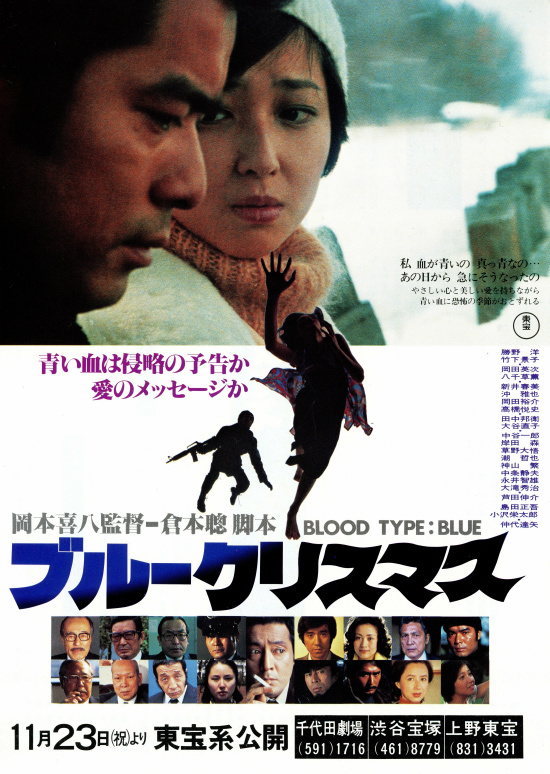 The Christmas movie has fallen out of fashion of late as genial seasonally themed romantic comedies have given way to sci-fi or fantasy blockbusters. Perhaps surprisingly seeing as Christmas in Japan is more akin to Valentine’s Day, the phenomenon has never really taken hold meaning there are a shortage of date worthy movies designed for the festive season. If you were hoping Blue Christmas (ブルークリスマス) might plug this gap with some romantic melodrama, be prepared to find your heart breaking in an entirely different way because this Kichachi Okamoto adaptation of a So Kuramoto novel is a bleak ‘70s conspiracy thriller guaranteed to kill that festive spirit stone dead.
 Based on the contemporary manga by the legendary Fujiko F. Fujio (Doraemon), Future Memories: Last Christmas (未来の想い出 Last Christmas, Mirai no Omoide: Last Christmas) is neither quiet as science fiction or romantically focussed as the title suggests yet perhaps reflects the mood of its 1992 release in which a generation of young people most probably would also have liked to travel back in time ten years just like the film’s heroines. Another up to the minute effort from the prolific Yoshimitsu Morita, Future Memories: Last Christmas is among his most inconsequential works, displaying much less of his experimental tinkering or stylistic variations, but is, perhaps a guide its traumatic, post-bubble era.
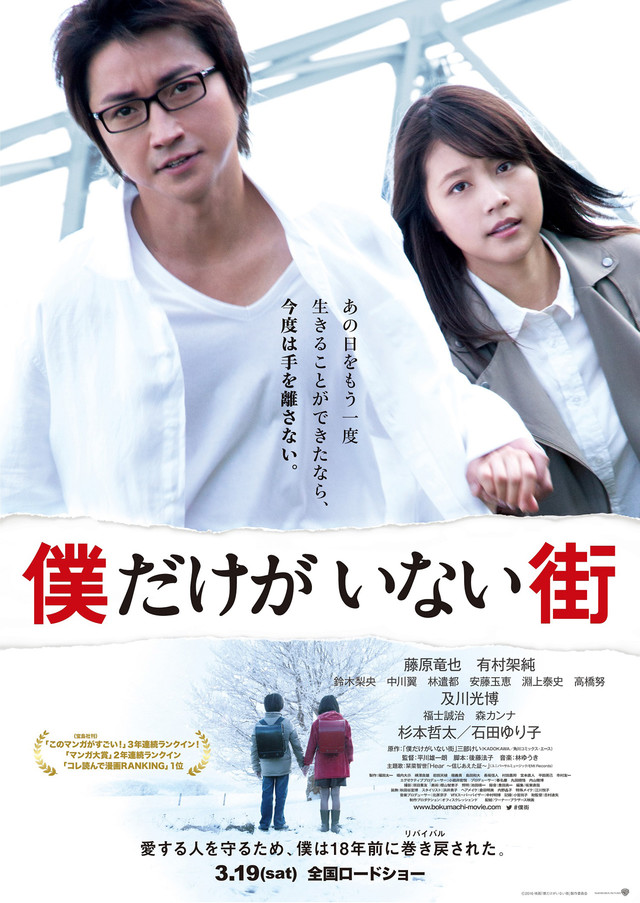 Erased (僕だけがいない街, Boku Dake ga Inai Machi), a best selling manga by Kai Sanbe, has become this year’s big media spectacle with a 12 episode TV anime adaptation and spin-off novel series all preceding the release of this big budget blockbuster movie. Directed by TV drama stalwart Yuichiro Hirakawa, the live action iteration of the admittedly complicated yet ultimately affecting story of a man who decides to sacrifice himself to ensure his friends’ happiness, acquits itself well enough for the most part but changes two crucial details in its concluding section which unwisely undermine its internal logic and make for an unsatisfying conclusion to the ongoing puzzle.
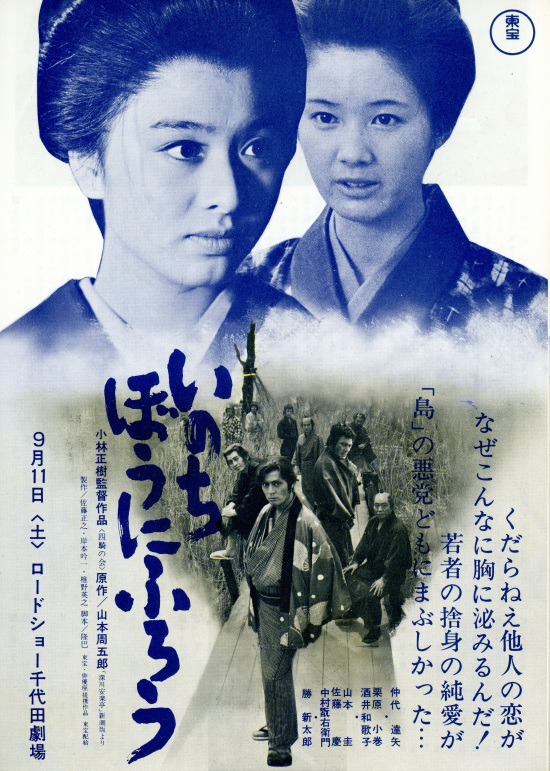 “Sometimes it feels good to risk your life for something other people think is stupid”, says one of the leading players of Masaki Kobayashi’s strangely retitled Inn of Evil (いのちぼうにふろう, Inochi Bonifuro), neatly summing up the director’s key philosophy in a few simple words. The original Japanese title “Inochi Bonifuro” means something more like “To Throw One’s Life Away”, which more directly signals the tragic character drama that’s about to unfold. Though it most obviously relates to the decision that this gang of hardened criminals is about to make, the criticism is a wider one as the film stops to ask why it is this group of unusual characters have found themselves living under the roof of the Easy Tavern engaged in benign acts of smuggling during Japan’s isolationist period.
 When
When  Ogami (Tomisaburo Wakayama) and his son Daigoro (Akihiro Tomikawa) have been following the Demon Way for five films, chasing the elusive Lord Retsudo (Minoru Oki) of the villainous Yagyu clan who was responsible for the murder of Ogami’s wife and his subsequent framing for treason. The Demon Way is never easy, and Ogami has committed himself to following it to its conclusion, but recent encounters have broadened a conflict in his heart as innocents and seekers of justice have died alongside guilty men and cowards. Lone Wolf and Cub: White Heaven in Hell (子連れ狼 地獄へ行くぞ!大五郎, Kozure Okami: Jigoku e Ikuzo! Daigoro) moves him closer to his target but also further deepens his descent into the underworld as he’s forced to confront the wake of his ongoing quest for vengeance.
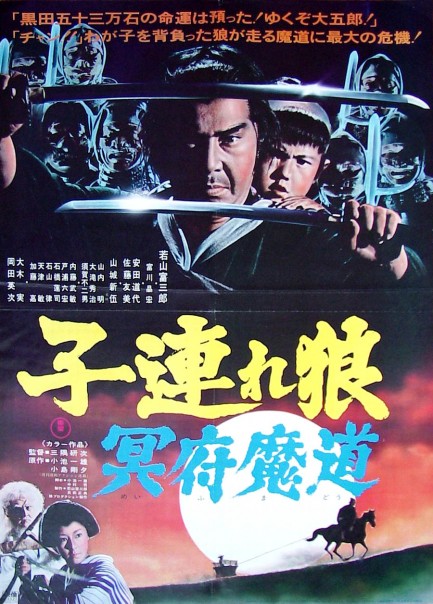 Ogami (Tomisaburo Wakayama), former Shogun executioner now a fugitive in search of justice after being framed for treason by the villainous Yagyu clan who are also responsible for the death of his wife, is still on the Demon’s Way with his young son Daigoro (Akihiro Tomikawa). Five films into this six film cycle, the pair are edging closer to their goal as the evil Lord Retsudo continues to make shadowy appearances at the corners of their world. However, the Demon’s Way carries a heavy toll, littered with corpses of unlucky challengers, the road has, of late, begun to claim the lives of the virtuous along with the venal. Conflicted as he was in his execution of a contract to assassinate the tragic Oyuki in the previous instalment,
 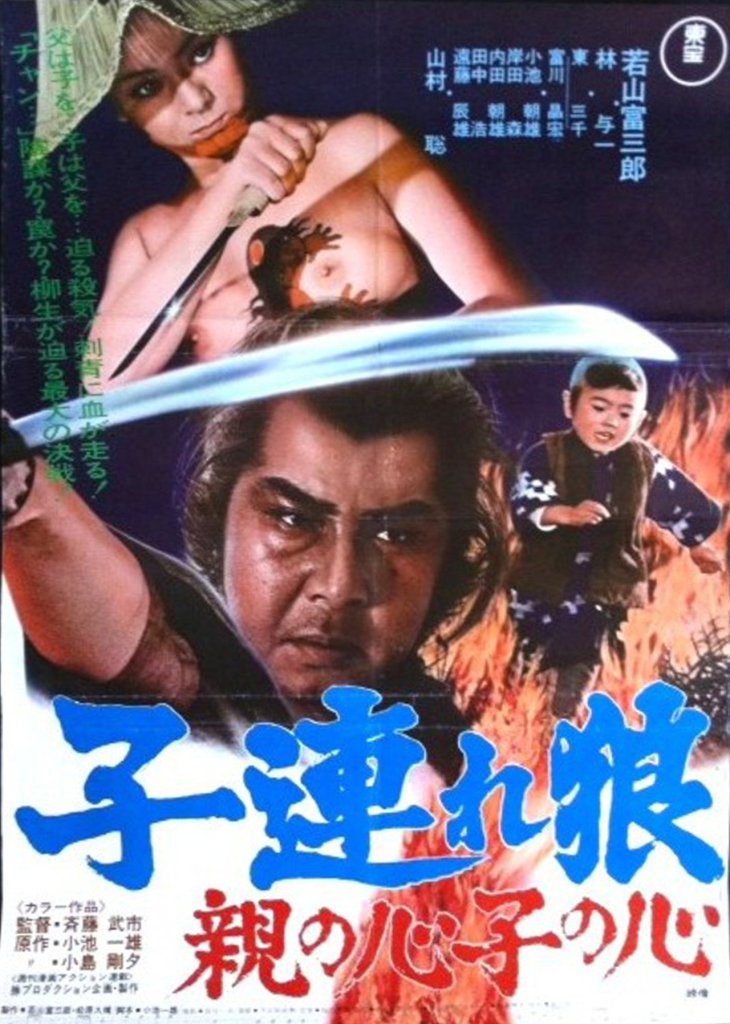 Now four instalments into the Lone Wolf and Cub series, Ogami (Tomisaburo Wakayama) and Daigoro (Akihiro Tomikawa) have been on the road for quite some time, seeking vengeance against the Yagyu clan who framed Ogami for treason, murdered his wife, and stole his prized position as the official Shogun executioner. Lone Wolf and Cub: Baby Cart in Peril (子連れ狼 親の心子の心, Kozure Okami: Oya no Kokoro Ko no Kokoro) is the first in the series not to be directed by Kenji Misumi (though he would return for the following chapter) and the change in approach is very much in evidence as veteran Nikkatsu director Buichi Saito picks up the reins and takes things in a much more active, full on ‘70s exploitation direction. Where
 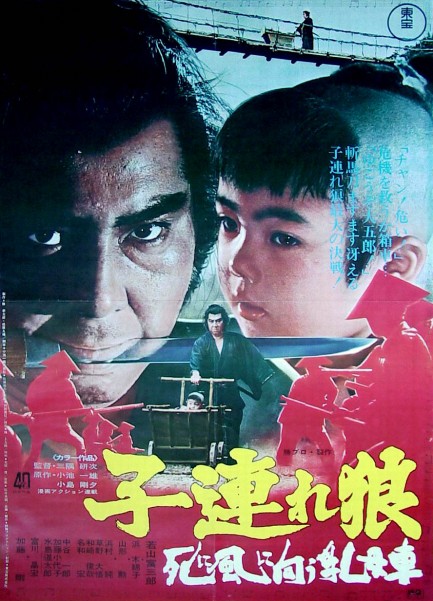 Ogami Itto (Tomisaburo Wakayama) and his (slightly less) young son Daigoro (Akihiro Tomikawa) are going to hell in a baby cart in this third instalment of the six film series, Lone Wolf and Cub: Baby Cart to Hades (子連れ狼 死に風に向う乳母車, Kozure Okami: Shinikazeni Mukau Ubaguruma). The former shogun executioner, framed for treason by the villainous Yagyu clan intent on assuming his position, is still on the “Demon’s Way”, seeking vengeance and the restoration of his clan’s honour with his toddler son safely ensconced within a bamboo cart which also holds its fair share of secrets. In the previous chapter,
  Windows on Worlds