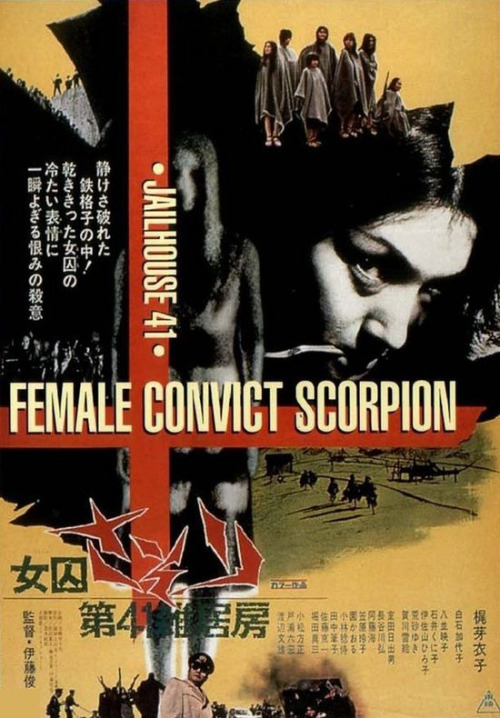
 Female Prisoner Scorpion: Jailhouse 41 (女囚さそり第41雑居房, Joshu Sasori – Dai 41 Zakkyobo) picks up around a year after the end of Female Prisoner #701: Scorpion and finds Matsu (Meiko Kaji) tied up in a dingy prison basement, apparently left bound and in solitary confinement for the entire interval. Once again directed by Shunya Ito, the second instalment in the Female Prisoner Scorpion series is another foray into the women in prison field but Ito resolutely refuses to give in to the exploitative genre norms, overlaying his tale of individualistic rebellion with an arthouse sensibility that has a much wider scope than its ordinary vengeance driven narrative may suggest.
Matsu may have been lying bound and gagged in a dingy underground hole for the best part of a year but today is a special day and sadistic prison warden Goda (Fumio Watanabe) is going to let her out to be shown off in front of a visiting inspector who’s paying a final visit before Goda is promoted to a top job in Tokyo. When Matsu makes a lunge for Goda, the inspector is so afraid that he wets himself, sending the other woman into a frenzy and resulting in a riot. Once again the entirety of the prison is punished, but this time Matsu is singled out for a public punishment gang rape by Goda’s goons. This kind of humiliation is too much for her fellow prisoners who instantly turn on her, but their violence provides an opportunity for escape and before long Matsu is on the run, again.
At the end of the first film, Matsu had accomplished her first round of vengeance – against the man who orchestrated her downfall and the men who secured it, but ultimately she wound up a female prisoner once again. Though Goda may have had her hidden away because of her habitual escapism, Matsu had not given up as we see from her attempts to scrape the floor away with her spoon held tight in her mouth. Barely speaking, Matsu is an unstoppable column of pure rage but an elegant one, supported by her self contained restraint.
Her anger this time is directed towards Goda himself, especially after his despicable organised punishment rape that was designed both to break her own spirit once and for all and also to damage her in the eyes of her fellow inmates who are intended to see her defeated and destroyed. The guards are a stand in for society at large, using sexual dominance and social position to keep their women in line. The visiting prison inspector makes a point of telling Matsu that “they” don’t hate her personally – they’re there for her, to help her “recover” and become a functioning member of society. Which is ironic because Goda does hate her personally as he holds her responsible for the damage to his eye sustained in the previous film. His last act before moving on is one against Mastu – an attempt by the forces of authority to crush her individual rebellion and use their victory as a coercive tool to force others to conform.
In this way, Matsu’s position as a member of a subjugated class is less important than her status as an agitator but these are women who have each suffered at the hands of men. As an extremely theatrical sequence sung in the traditional form informs us, the women who escaped with Matsu committed their crimes out of love or jealousy. Poisoned rivals, dead lovers, even children murdered to get back at their philandering father in some Medea level psychotic rage which ruins the perpetrator even more than the intended victim.
Later while the women are enjoying their brief taste of freedom, one of them is brutally raped and murdered by a troupe of feral men who boast about the wartime atrocities they committed before descending on a lone woman like a pack of rabid dogs. The others take their revenge for their friend, but also for all the women who have met a similar fate inflicted by a male dominated society which sees them as something to be controlled and then made use of, little more that cattle hemmed in and milked until dry.
As in the first film Ito makes use of expressionist techniques and strange angles to give his film a more elevated feeling that might be expected but this time he adds in a surrealist, spiritual dimension as with the old woman who sings the stories of our heroines and then dies only to bury herself in leaves and disappear into the ether, like some forgotten deity of misused women. Likewise, when one of the prisoners is raped and murdered, the men throw her body into a nearby river like an empty beer can but the waterfall behind her suddenly runs with blood as an expression of the violence which pollutes the natural world. A bus suddenly splits in two, separating our subjugated women from the violent men who mentally sentence them, given free reign simply because of their sex. Ironically enough, our last glimpse of of Matsu takes place in the reflection of Goda’s glasses and then in his false eye when she is suddenly rejoined by her compatriots for a triumphant dance of freedom on a city rooftop.
Even stronger than in the original Female Prisoner #701 Scorpion, Jailhouse 41 further advances its ideology of free individuals battling the conformist authority of the state all filtered through the prism of the patriarchy. Matsu’s vengeance is personal, she keeps her distance from the other women who do not seem inclined to band together to oppose the forces which oppress them so much as seek a wary, temporary alliance of necessity, but seeing them all reassembled in spirit at the end brings a larger dimension to Matsu’s victory which now seems much less like solving a practical problem than a deliberate strike at a wall which was solely designed to keep a certain group of people in their place. The jail is broken, all that remains is to choose to escape its restraints.
Original trailer (English subtitles, NSFW/gore)

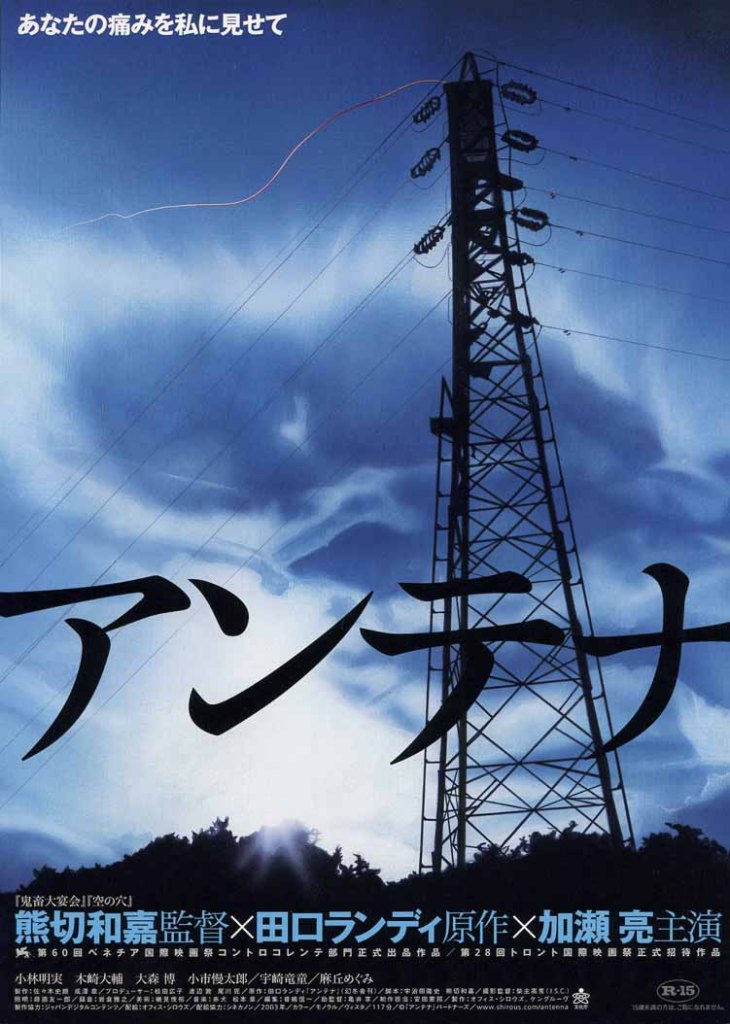 Scarring, both literal and mental, is at the heart of Kazuyoshi Kumakiri’s third feature, Antenna (アンテナ). Though it’s ironic that indentation should be the focus of a film whose title refers to a sensitive protuberance, Kumakiri’s adaptation of a novel by Randy Taguchi is indeed about feeling a way through. Anchored by a standout performance from Ryo Kase, Antenna is a surreal portrait of grief and repressed guilt as a family tragedy threatens to consume all of those left behind.
 Shochiku was doing pretty well in 1951. Accordingly they could afford to splash out a little in their 30th anniversary year in commissioning the first ever full colour film to be shot in Japan, Carmen Comes Home (カルメン故郷に帰る, Carmen Kokyou ni Kaeru). For this landmark project they chose trusted director Keisuke Kinoshita and opted to use the home grown Fujicolor which has a much more saturated look than the film stocks favoured by overseas studios or those which would become more common in Japan such as Eastman Colour or Agfa. Fujicolour also had a lot of optimum condition requirements including the necessity of shooting outdoors, and so we find ourselves visiting a picturesque mountain village along with a showgirl runaway on her first visit home hoping to show off what a success she’s made for herself in the city.
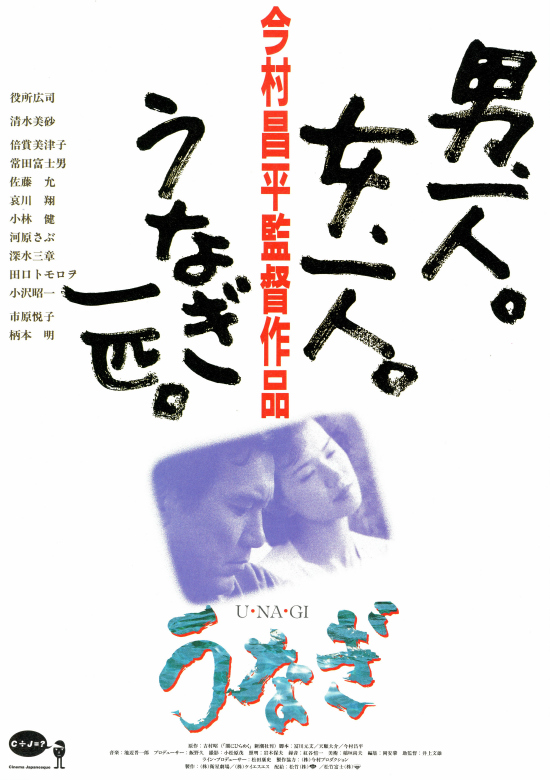 Director Shohei Imamura once stated that he liked “messy” films. Interested in the lower half of the body and in the lower half of society, Imamura continued to point his camera into the awkward creases of human nature well into his 70s when his 16th feature, The Eel (うなぎ, Unagi), earned him his second Palme d’Or. Based on a novel by Akira Yoshimura, The Eel is about as messy as they come.
 Sometimes love makes you do crazy things. Some people find themselves accomplishing previously unattainable feats powered only by the sheer force of romance. Unfortunately for the hero of Swimming Upstream (バタアシ金魚, Bataashi Kingyo), Joji’s Matsuoka’s adaptation of Minetaro Mochizuki’s manga, the task he sets for himself is a very lofty one indeed and may actually require him to abandon his love to complete it. Then again, the object of his affections shows little signs of reciprocation in any case.
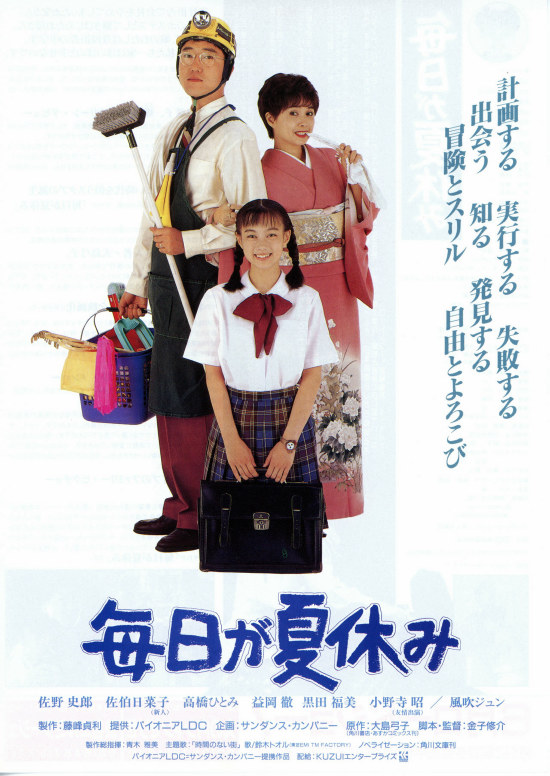 Summer Holiday Everyday – It’s certainly an upbeat way to describe unemployment but then everything is improbably upbeat and cheerful in the always sunny world of Shusuke Kaneko’s adaptation of Yumiko Oshima’s shoujo manga. Published in the mid-bubble era of 1988, Oshima’s world is one in which anything is possible but by the time of the live action movie release in 1994 perhaps this was not so much the case. Nevertheless, Kaneko’s film retains the happy-go-lucky tone and offers note of celebration for the unconventional as a path to success and individual happiness.
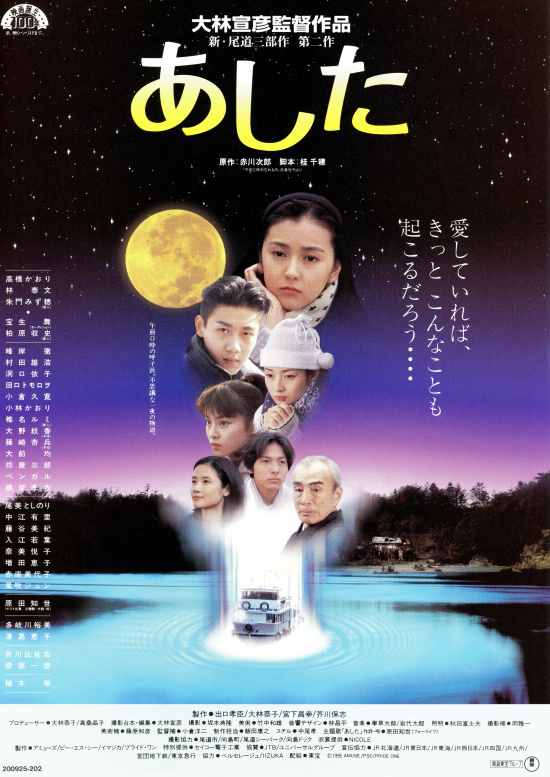 After completing his first “Onomichi Trilogy” in the 1980s, Obayashi returned a decade later for round two with another three films using his picturesque home town as a backdrop. Goodbye For Tomorrow (あした, Ashita) is the second of these, but unlike Chizuko’s Younger Sister or One Summer’s Day which both return to Obayashi’s concern with youth, Goodbye For Tomorrow casts its net a little wider as it explores the grief stricken inertia of a group of people from all ages and backgrounds left behind when a routine ferry journey turns into an unexpected tragedy.
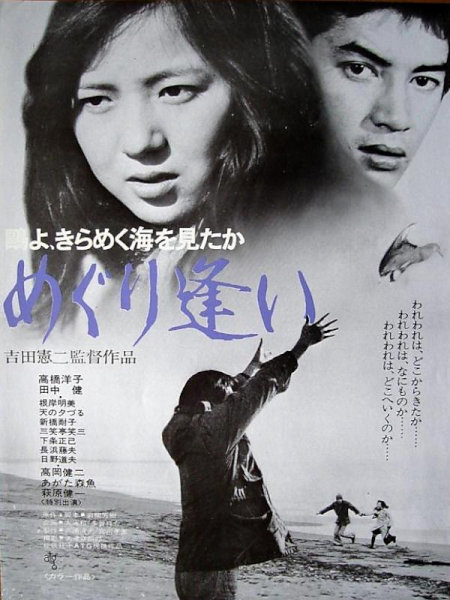 Sparkling seas sound like hopeful things, especially if you’re a majestic seagull flying far above, bathed in perpetual sunshine. But then, perhaps the water below is shining with the shards of broken hopes which float on its surface, is its beauty treacherous or in earnest? So asks the singer of the title song which recurs throughout the film as if to undercut even its brief moments of happiness. There is precious little joy to be found in the lives of the two protagonists of Oh Seagull, Have You Seen the Sparkling Ocean? : An Encounter (鴎よ、きらめく海を見たか めぐり逢い, Kamome yo, Kirameku Umi wo Mitaka: Meguriai), only pain and confusion as they try to rebuild their ruined lives in an uncaring city.
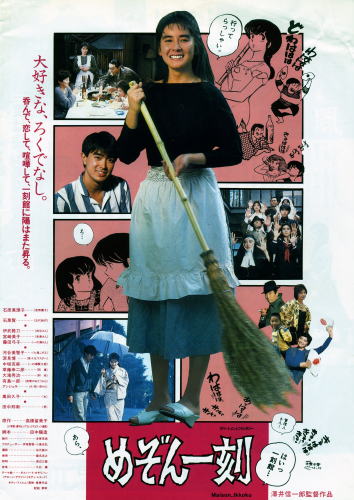 If you’ve always fancied a stay at that inn the
  Windows on Worlds