May 18 (화려한 휴가, Kim Ji-hoon, 2007)

Following the assassination of president Park Chung-hee in 1979, many assumed that democracy would return and that the society would be liberated from its authoritarian past. That did not, however, come to pass. While the government floundered, general Chun Doo-hwan launched a coup that led to nothing other than a second military dictatorship. Citizens continued to press for democratisation and the lifting of the martial law that had been declared in the wake of Park’s death. In order to cement his authoritarian rule, Chun embarked on an oppressive crackdown of resistance activity, actually expanding martial law and sending troops to monitor universities where the majority of protests were taking place.  

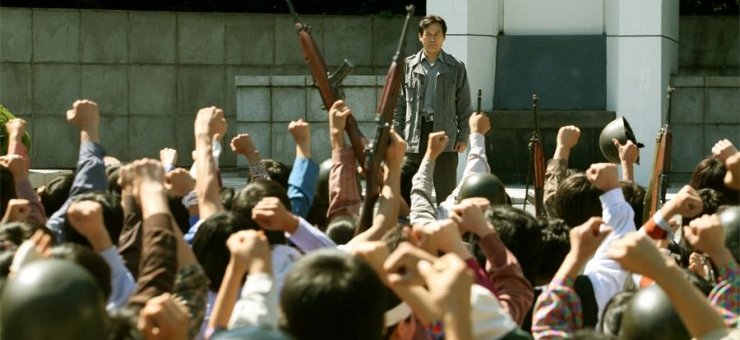
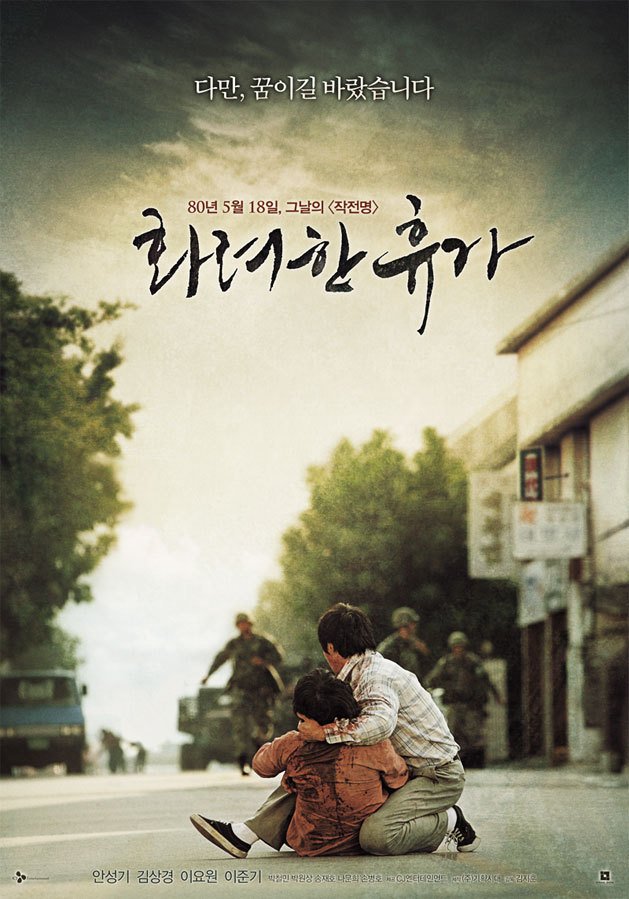
It’s against this backdrop that Kim Ji-hoon’s May 18 (화려한 휴가, Hwaryeohan hyuga) unfolds, so named for the first day of Gwangju Uprising in which citizens of the small provincial city were subject to beatings, torture, rape and murder at the hands of military forces. He opens however with pleasant scenes of the local countryside as taxi driver Min-woo (Kim Sang-kyung) heads back into the city eventually arriving to pick up his younger brother Jin-woo (Lee Joon-gi) from high school and deliver him to the local church. Min-woo also has a crush on mutual friend and fellow attendee, Shin-ae (Lee Yo-won), who works as a nurse at the local hospital. For some reason even though this is a fairly small place, Min-woo also seems to be unaware that Shin-ae is the daughter of his boss Heung-su (Ahn Sung-ki ), a former army captain now retired and running a taxi firm. 

In an attempt to make the political personal, Kim spends the first hour on Min-woo’s awkward romance which by modern standards is quite problematic in that he basically ends up following Shin-ae around and offering to give her free lifts even though she seems annoyed to see him and isn’t keen on him effectively deciding where she doesn’t and doesn’t go. Meanwhile, as he and his brother are orphaned he’s adopted a paternal role towards Jin-woo who is bright and studying hard with the aim of getting into Seoul University to study law while Min-woo most likely had to give up school to drive the taxi so he could support them both. This is also in its way a little uncomfortable in its emphasis on Jin-woo’s bright future which is about to be destroyed by the uprising as if his life is worth more because of all the ruined potential rather than just because he was an ordinary human betrayed by his government and trapped by hellish atrocity. Even so, it hints at a conflict within Min-woo as he wants to keep his brother safe but also has a natural desire to resist injustice and is moved when Jin-woo explains that one of his best friends has been murdered by state violence. 

Then again, the film’s framing is also in a sense reactionary in Jin-woo’s intense offence against being branded as a “rebel” or a “communist” rather refocusing on the fact the military’s actions are inhuman and the their attempt to slur the local people only a means of justification. As the local priest accurately suggests, the military provokes them in order to have an excuse to crack down with extreme prejudice ensuring that there will be no further resistance to increasing authoritarianism. Some army officers begin to ask questions but are quickly shut down by their overzealous commander who claims the North may be on its way to link up with these “communists” and is quite clearly prepared to wipe out the entire town rather than back down and risk a further escalation of their resistance. 

While the soldiers are faceless and implacable, the townspeople are sometimes depicted as naive bumblers with significant time spent on a “loudmouth” comic relief character who is nevertheless one of the first to pick up a gun and join the town’s civilian army led by Heung-su who like the priest is under no illusions and assumes troops will soon storm the town. The comedic tone and melodramatic undercurrent often undercut Kim’s attempts to depict the horror of the massacre even in the irony of their juxtaposition as bullets suddenly rip into a cheerful crowd which had been laughing and joking only seconds before. The closing scenes in which a man refuses to surrender and is killed are framed as heroic but in the end seem futile, as if he’s thrown his life away for no reason. Even so there is something Shin-ae’s loudspeaker pleas to remember the citizens of Gwangju who stayed strong and resisted to the last rather than consent to their oppression even if she is in a sense condemned to be the storyteller bearing the horror of it all alone along with the loss of her own happy future crushed under the boots of violent authoritarianism.


International trailer (English subtitles)
The Singer (소리꾼, Cho Jung-lae, 2020)

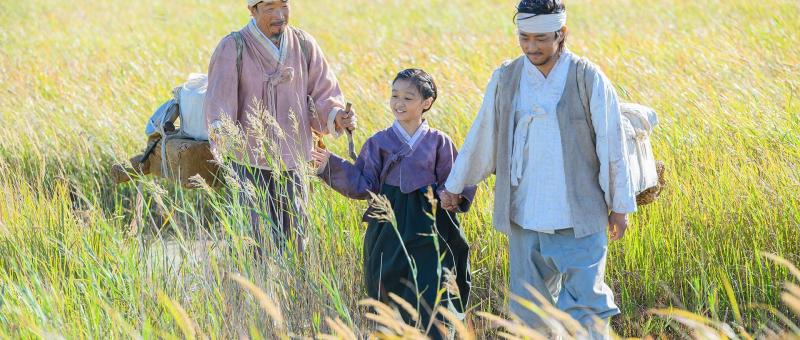
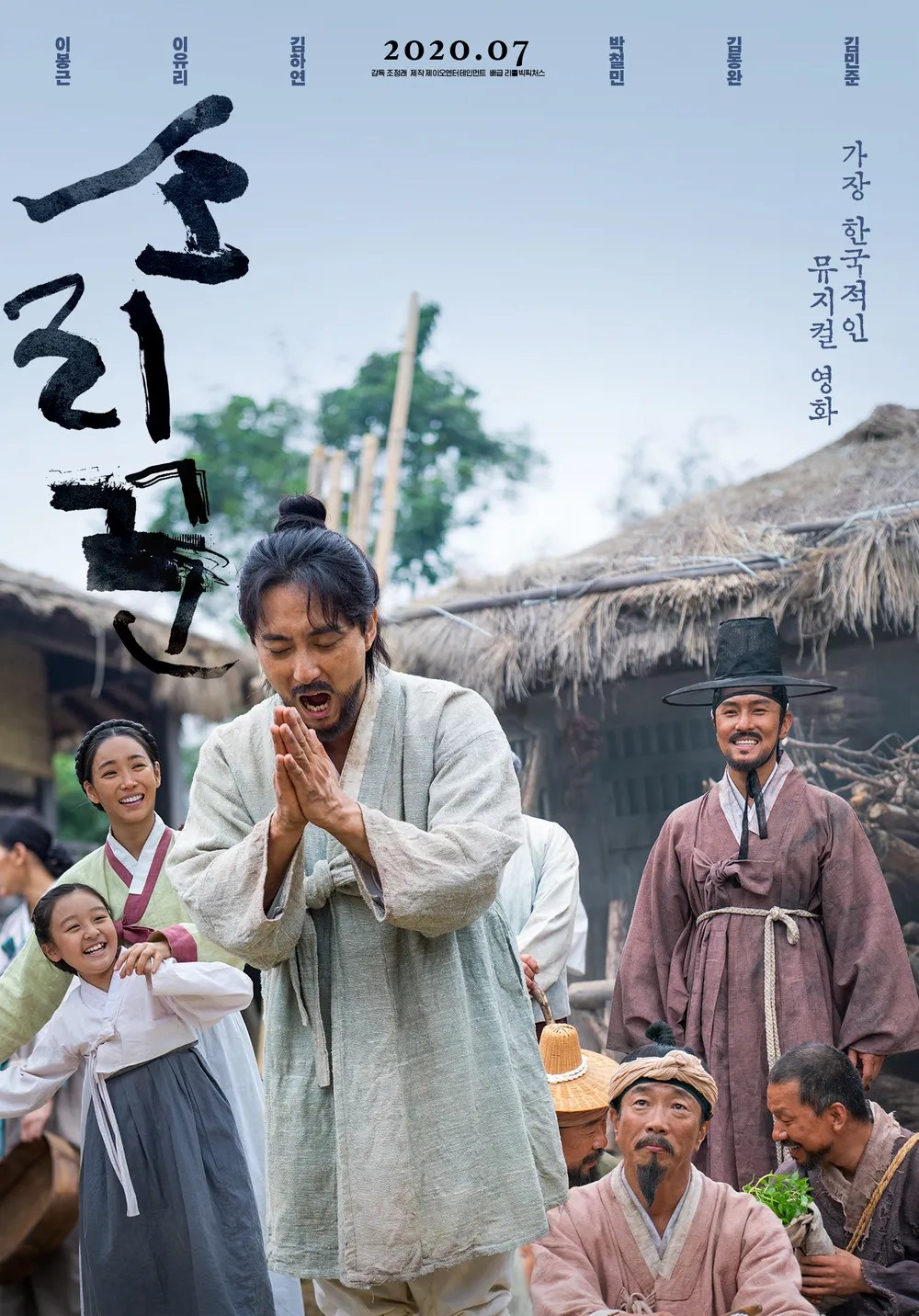
A Pansori singer shames the world into giving him his miracle in Cho Jung-lae’s musical fable, The Singer (소리꾼, Sorikkun). If there’s one thing you can bank on in old Joseon it’s that there is intrigue in the court, yet the rot seems to have penetrated even more deeply into the fabric of society as the hero discovers while looking for his kidnapped wife only later realising that the people who are supposed to protect you from violent criminals are in fact violent criminals themselves.  

Set in 1734, the 10th year of King Yeongjo’s reign, the film opens with a cheerful scene as singer Hak-gyu (Lee Bong-geun) performs in the marketplace while his wife Gan-nan (Lee Yu-ri) and daughter Cheong (Kim Ha-yeon) watch from the sidelines. As the opening voiceover reveals, however, this is also a time of increasing chaos in which the accepted social order has broken down following successive incursions from China and Japan. The King has appointed a special courtier, Kim Tae-hyo, to investigate the so-called “Ja-mae gang” suspected of running a human trafficking ring while in collusion with corrupt lords. Of course, the king doesn’t know that Tae-hyo is one of the corrupt lords, but then there are so many of them to choose from. In any case, disaster strikes when Hak-gyu is late home after being accosted by a fan while returning some of the clothes Gan-nan had been mending to a nobleman and discovers his wife and child missing when he gets back. Gan-nan and Cheong have been kidnapped by the gang along with several others from the area. Cheong manages to escape thanks to her mother’s quick thinking but is badly injured and in a coma for some time eventually waking up to realise she has lost her sight. Hak-gyu along with his drummer friend Dae-bong (Park Chul-min) decides to take his daughter and search for his wife all over Korea if necessary. 

As the opening and closing titles remind us, Pansori gained popularity precisely because it told the stories of the common people and was often transgressively frank in its attacks on the class system, social inequality, and even the monarchy. Belonging to the lowest class of entertainers, Hak-gyu’s “lowborn” status is often used against him, the gang deliberately targeting those from the lower orders to enslave because they do not really think of them human, yet it is also in a sense his salvation in his innate ability to connect with ordinary people as he retells his life as fable gathering large crowds around him as he anxiously asks if anyone has seen his wife. He is joined in his travels by a “corrupt monk” he saves from drowning in a river, along with bumbling lower aristocrat supposedly bumming around too afraid to go home and tell his father he’s failed the civil service exam (again), providing an accidental microcosm of the current society. 

Yet what Hak-gyu didn’t know was that the gang is merely an extension of government oppression, corrupt lords flexing all of their muscles to fully exploit their subjects. Tae-hyo’s mentor reminds him that “politics is all about money” as the pair of them try to game the king pretending to hunt the gang that they are themselves running. A skilled seamstress, Gan-nan is firstly placed in the home of a local dignitary but later moved on to the mines for making too much trouble. She tells everyone she meets that she’s been kidnapped, but the nobles are all in on it and everyone else is too frightened to resist. Meanwhile, Tae-hyo and his fellow conspirators are also it seems in collaboration with the Japanese, buying up smuggled rifles to use in a potential insurrection. 

Drawing inspiration from his own life story, Hak-gyu re-imagines the gang as Chinese pirates and his daughter as a displaced princess determined to do whatever it takes to save her blind father, always leaving his audience wanting more with his cruelly positioned cliffhangers. He finds himself in an odd kind of trial by combat, given the opportunity to win back his life and his wife if only he make the heartless lords laugh or cry eventually saved only by his ability to move the hearts of others through the power of his sincerity. A Pansori fable in and of itself, Cho’s meta musical drama is fitting tribute to power of art to speak truth to power revealing its own truths in falsehoods and by it handing back the means to the people to demand justice and freedom.


Original trailer (English subtitles)

Herstory (허스토리, Min Kyu-dong, 2018)

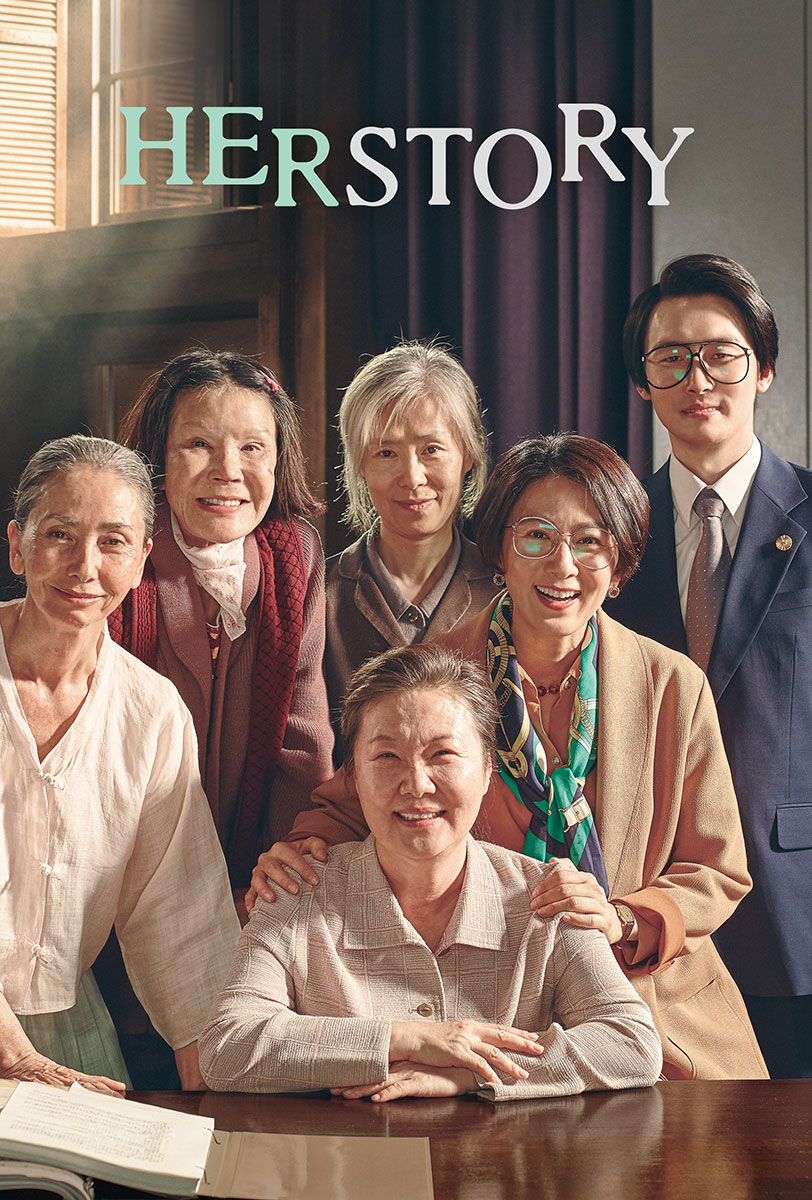
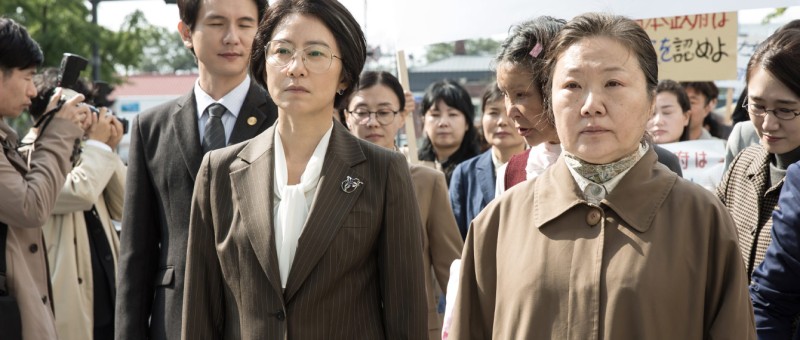
When Kim Hak-sun held a press conference and offered her testimony as a former comfort woman following a statement in the Japanese Diet in which the government rejected any responsibility for wartime sexual slavery, it brought an issue into the public consciousness that many had been unwilling to reckon with. One of many films focussing on the same subject released in the last few years, Min Kyu-dong’s Herstory (허스토리) dramatises the events of the Shimonoseki Trials which took place between 1992 and 1998 and resulted in the first admission from the Japanese authorities that the basic human rights of women had been breached but nevertheless found it not incumbent on the government to offer a direct apology. 

That the trial takes place in Shimonoseki is itself somewhat symbolic, given that this was the harbour from which boats to Korea and China departed and at which the women who were trafficked to Japan would have arrived. The film begins, however, in Busan where successful travel agent Moon Jung-sook (Kim Hee-ae) has ironically been accused of breaking the prevention of prostitution laws when a Japanese man is found dead after visiting a sex worker and it is revealed one of her employees had been running tours specifically geared towards sex tourism. Struck by Kim Hak-sun’s testimony, the association she leads of female business owners wants to do something to help and seeing as her company has been suspended, Jung-sook sets up a call centre on her premises for other victims of wartime sexual slavery and forced labour to come forward. 

Unlike some of the recent dramas dealing with the same issue, Min focusses on the resistance towards the former comfort women coming from within Korea itself. A taxi driver Jun-sook gets a lift from goes off on a rant describing the women as former sex workers out for a paycheque who should be ashamed of their sordid pasts while in any case all of this happened decades ago so why bring it up now? He is far from alone, even the Mayor describes them as “filthy women” when Jung-sook approaches him for help, and it’s obvious that many find the subject so embarrassing that they simply do not want to discuss it and blame the women for breaking the peace by speaking out. 

It’s also true that in the peculiarities of the political landscape of Korea, conservative elements tend to hold a more favourable view of Japan and the colonial era than might be expected. Economically, there are strong ties and Jung-sook, a fluent Japanese speaker, has close business relationships with Japanese clients which are endangered by her involvement with the comfort women cause. Her friend in the women’s association who runs a traditional-style hotel can be seen warmly greeting Japanese guests, at one point as she expresses her admiration for Kim Hak-sun in Korean to the television as they pass behind her. It’s clear that some would rather not rock the boat because this kind of politicking is often incompatible with running a successful business. 

Jung-sook is minded to buck the trend because she sympathises with the women’s suffering and with their rejection by mainstream society. She has the confidence to do this in part because the wealth she has accrued through business success gives her an unusual amount of power in a male-dominated, capitalistic society. Still she too struggles with contemporary notions of proper womanhood in being accused of neglecting her daughter through her workaholic lifestyle especially as she is considering leaving education claiming that studying isn’t for her. Even so, the women’s association seems to have female solidarity at its heart, collecting money to support single mothers even before taking up the cause and trying to help elderly women who have no remaining family members or means to support themselves. 

As she later comes to realise, the trial has meaning outside of winning and losing in allowing the women to express their trauma and regain some of their dignity. Even so, they are subject to further rejection in Japan, not least from a hotel which asks them to leave because other guests are unwilling to share the space with former sex workers. The Korean-Japanese lawyer also relates having faced racism in his life in Japan because of his Korean ethnicity while his mother’s restaurant is later graffitied because of their support of the case. Right-wing nationalists also hold protests outside the court and in Seoul accusing the women of lying, insisting that they are just “sex workers” as if sex workers weren’t worthy of human consideration anyway. In interpreting the testimony, Jung-sook becomes a kind of everywoman speaking for all women in her emotionally charged translation while inwardly conflicted in realising the toll the process is taking on some of the witnesses who are all in advanced age and often poor health. Min depicts their struggle with as much empathy as possible, avoiding the temptation to demonise while instead presenting a more nuanced perspective focussing on the women themselves and the rejection they continue face even within their own society.


Herstory is available digitally in the USA courtesy of Well Go USA.

Jesters: The Game Changers (광대들: 풍문조작단, Kim Joo-ho, 2019)

“Even with swords to our necks we say what we must!” a stage actor insists, though somewhat duplicitously as he wilfully says what he must to survive while simultaneously defending his artistic integrity. Oddly timely, Jesters: The Game Changers (광대들: 풍문조작단, Gwangdaedeul: Pungmunjojakdan) is an ironic exploration of the importance of art in engendering narrative proving once and for all that it really can remake the world. Our hero finds himself less torn than you’d expect him to be, only too keen to parrot the words of a regime he does not respect in return not only for his life but for material gain. 

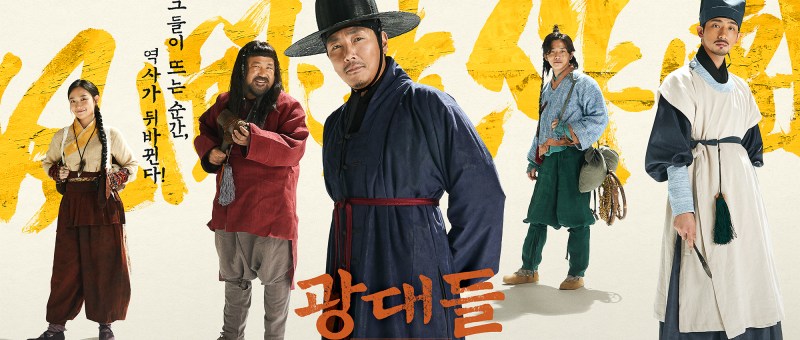
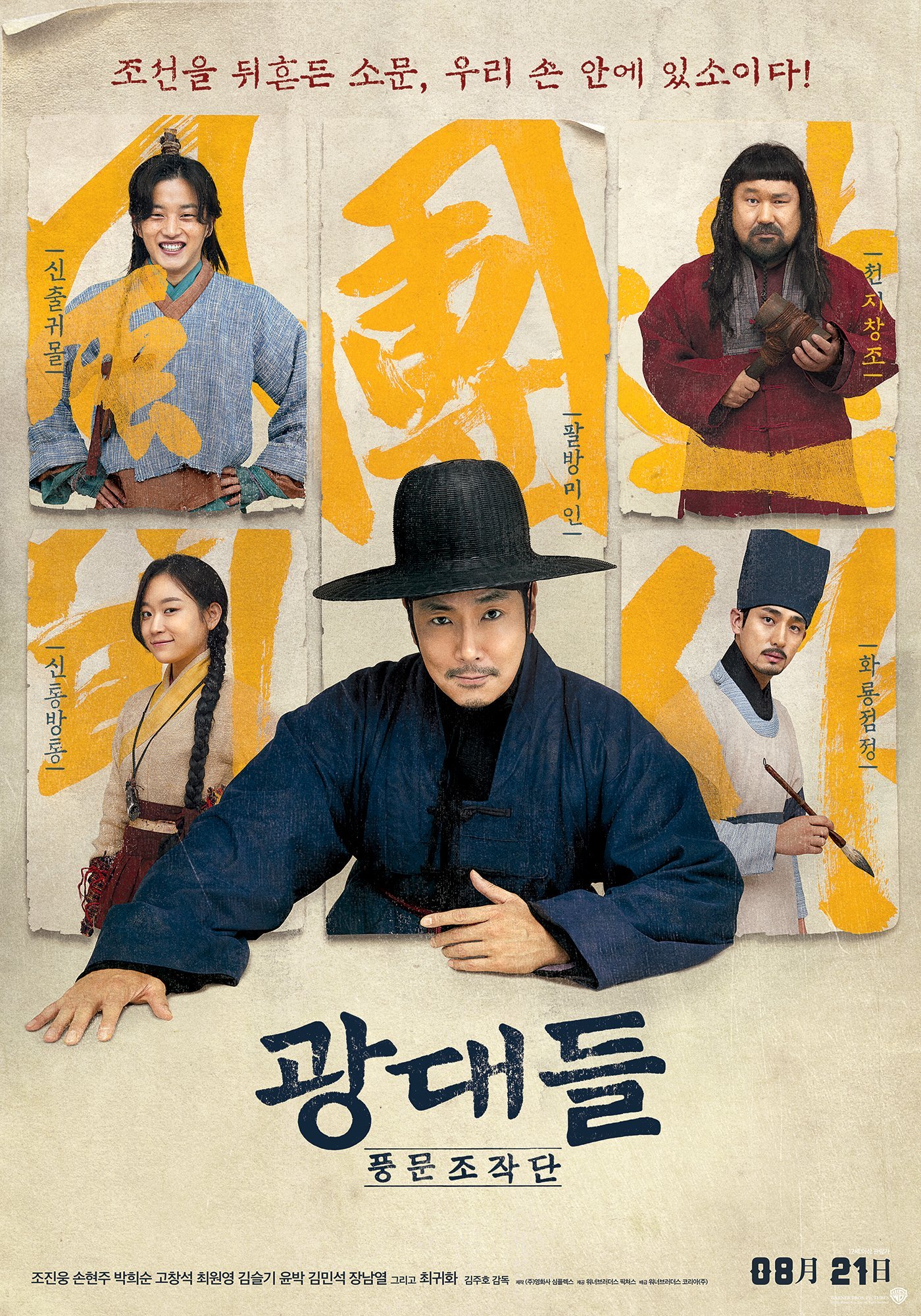
Our heroes are a band of “jesters”, itinerant street entertainers who belong to a kind of underclass and earn their living through their ability to change “reputations”. Petitioned by an ageing wife discarded in favour of a young and beautiful concubine, the gang blacken the other woman’s reputation by literally putting on a show with storyteller Ma Deok-ho (Cho Jin-woong) as the romantic hero sweeping her off her feet. The illusion is broken by a sudden spell of rain, but in any case the gang soon find themselves falling foul of prime minister Han Myeong-hoe (Son Hyun-joo) who makes them an offer they can’t refuse – counter the disadvantageous narrative that the king is a cruel tyrant who usurped the throne through murdering his brothers and nephew with tales of his magnificence, or die. Deok-ho points out that a good way of raising his reputation would be cutting taxes and getting rid of corrupt nobles but unsurprisingly as is rapidly becoming evident, he isn’t being hired to speak the truth. 

On the one hand, Jesters is the tale of Deok-ho’s slow path towards realising his responsibility as an artist to tell the “truth” even when it is inconvenient. His mentor Mal-bo (Choi Gwi-hwa) had come by a banned book, The Six Loyal Subjects, which recounted the real story of how the king came to the throne and was determined to promulgate it, merely changing the name of the king to that of Ming to protect himself against a censorious crack down on street entertainers spreading “fake news”. Deok-ho claims to believe only what he sees, rejecting the evidence of the book, cynically determined to do whatever it takes to escape his poverty. He’d rather not be threatened, but he has no particular objection to Han’s request, only using it to increase his social status by ensuring the gang are re-registered as “middle class” rather than lowly entertainers, later even angling for a position at court. For Han, he engineers miracles from a tree which bends to clear the way for the passing monarch to visitations from the Buddha and floral rain falling from golden skies, tales of which spread quickly through the gossip-hungry nation embellished as they go. 

As Han puts it “history is made by those with power” and to that extent he who controls the past controls the future. Han executes three street performers for spreading “fake news”, men who were literally prepared to die for their artistic integrity in the way Deok-ho was not, while employing Deok-ho to spread “propaganda” that glorifies a weakened king. Enjoying his new status Deok-ho does not really consider the implications of what he’s doing until he realises that Han is playing his own angle, improving his stunts for additional leverage, razing a village so that the nearby temple where one of Deok-ho’s “miracles” occurred might be expanded. Han claimed to be mounting an egalitarian revolution, deposing a “mad” king to hand power back to the people but of course only meant to manipulate regal power for himself. 

Power, as we see, belongs more or less to the storytellers who literally write the narrative. In old Joseon that’s those like Deok-ho, or in other times newspapers, TV shows, or social media feeds. Deok is only just realising he had power all along, if only he had listed to Mal-bo and used it more wisely rather than “rolling his tongue for fame and cheers”. A somewhat flippant satire on fake news/propaganda synchronicity, Jesters makes a passionate plea not only for the power of art to remake the world but for the responsibility of the artist to tell the truth even when it is not popular.


Jesters: The Game Changers screens at the Rio on 31st October as part of this year’s London Korean Film Festival.

International teaser trailer (English subtitles)

Black Money (블랙머니, Chung Ji-young, 2019)

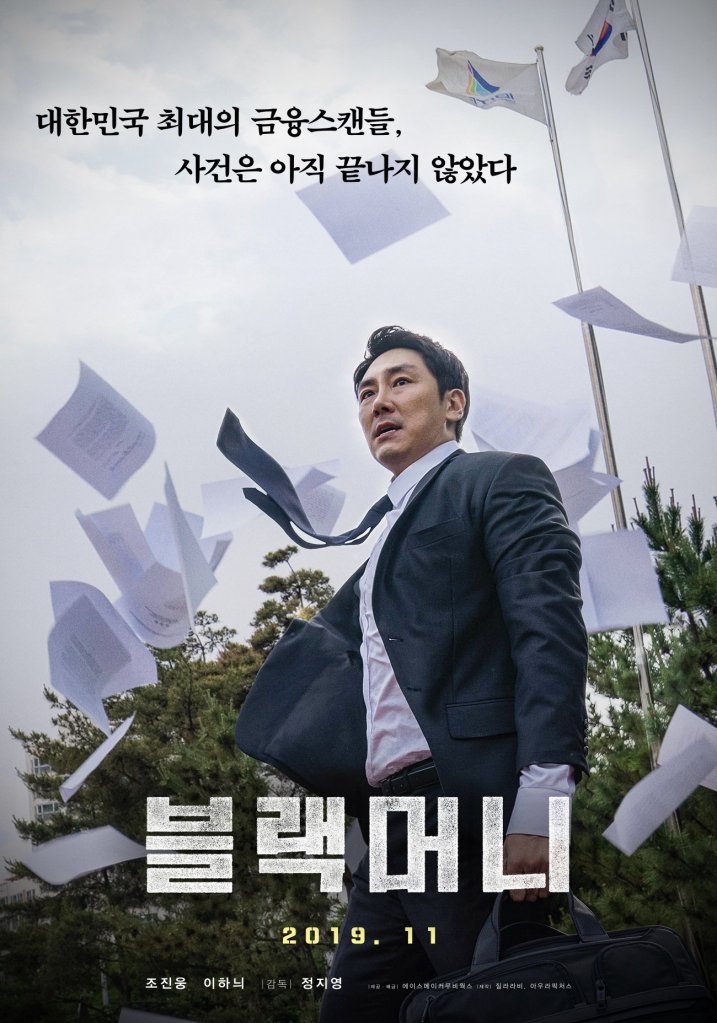
Following hot on the heels of Default, Chung Ji-young’s financial thriller Black Money (블랙머니) once again has some questions to ask about the nature of capitalism in South Korea. Loosely based on a real life incident concerning the sale of the Korea Exchange Bank (KEB) to American private equity firm Lone Star Funds, Chung’s film points the finger at systematised corruption as its collection of greedy financial elites peddle national interest as a reason for keeping the public in the dark when it comes to their dodgy dealings.

The trouble starts in 2011 when an illicit couple, one working for Daehan bank and the other for the Financial Supervisory Service, are bumped off after being called in by the Supreme Prosectors’ Office in connection with an ongoing corruption investigation into the sale of the bank at rock bottom prices. The male bank employee is killed when the couple is run off the road by a truck but the FSS woman, Su-gyeong (Lee Na-ra), manages to escape. Fully aware that her life is at threat, she tries to get herself arrested by the police for protection but fails and is later discovered dead in her car next to a charcoal briquette. A “suicide note” in the form of a text message to her sister suggests that she has chosen to take her own life because of the aggressive tactics of prosecutors one of whom sexually harassed her after which she felt too humiliated to go on living. 

The mention of sexual harassment is intended to act as a tiny bomb by the shady forces in play, fully aware that just mentioning those words makes the entire case toxic ensuring it will be shut down never to be mentioned again. They have, however, picked the wrong man for their patsy in “bulldozer” Yang Min-hyuk (Cho Jin-woong) who is outraged to have been unfairly labelled a sex offender and will stop at nothing to clear his name, eventually uncovering the entire conspiracy after realising that Su-gyeong’s death was almost certainly a murder.

In this, Yang is obviously acting in self interest, which isn’t to say that he doesn’t care about the conspiracy, but it’s not his primary motivation. His opposing number, Kim Na-ri (Lee Honey), is perhaps much the same, a victim of her upbringing but increasingly conflicted. Brought up by a right-wing, ultra-capitalist professor who is good friends with former prime minister Lee Gwang-ju (Lee Kyoung-young) now working on the Daehan bank sale, Na-ri tells herself she’s acting in the national interest in her desire to set up her own international trade law firm to prevent Korea being taken advantage of by bigger foreign economic powers and in particular the Americans. Despite her law background, what Na-ri has mainly found herself doing is more like PR, finding palatable ways forward to make sure the deal goes through on favourable terms despite the already widespread public outcry.

Surprisingly, Na-ri and Yang end up bonding over the course of the investigation, discovering they have more in common than either might have assumed. Given the kind of evidence that Yang is digging up which points to a wide scale conspiracy involving complex fraud and murder, Na-ri finds herself conflicted. Maybe she isn’t quite as committed to ultra-capitalism as her father is, giving Lee’s speech at the Davos conference the heart-warming title of “free trade with a human face” which apparently went down very well with the audience. Whatever else she is, she’s a lawyer, and the kind of lawyer who doesn’t really like it when people break the law, so she’d rather not think that she’s been party to criminality without ever realising. Lee, meanwhile, uses their familial closeness against her, adopting a sleazy kind of sexist paternalism as he brushes off her concerns as if telling her not to worry her pretty little head about it while tacitly admitting what he’s up to isn’t quite right but is justifiable because the economy must be protected at all costs. 

Only, that’s a difficult claim to square when Na-ri’s restructuring plans for Daehan involve hundreds of workers being laid off and some of them are currently on a hunger strike in the public square to protest. Na-ri is used to thinking in big numbers, she’s not usually confronted by the human face of their results and the weight of her responsibility does perhaps shake her. Yang too is used to being equivocal, declaring himself a neutral force because his job is to enforce the law equally, but he got into this after his dad was involved in a traffic accident where the other driver turned out to be a chaebol kid, so he knows all about systemic inequality and entrenched corruption. Nevertheless, self interest continues to play its part. The sympathetic chief prosecutor who put his career on the line to take the case forward is ousted through a trumped up charge while his replacement offers to shelve it in return for a promotion. A combination of bribery and violence conspires to keep the financial elites doing what they’re doing because no one is secure enough to stop them. 

Trying to discourage her from her newfound sense of responsibility, Na-ri’s father reminds her that Lee is like family to them, which is one reason he’s put her forward for a top job as a financial commissioner, explaining that “that’s how we live through capitalism. Just accept it. It’s not something you can change on your own”. Chung ends the film with a sense of triumph as the common man, Yang, makes an impassioned speech in front of an angry mob, but according to the on screen text his was an empty victory because no one was ever brought to justice over the “illegal” bank sale which put a lot of ordinary citizens out of work while already wealthy elites lined their pockets aided by the financial authorities and a rotten judiciary. An attack on rampant capitalism, Black Money is not afraid to announce where its allegiances lie but seemingly has few answers other than indignation towards an inherently corrupt society ruled by greed and indifferent to the suffering of ordinary people.


Original trailer (no subtitles)

House of Hummingbird (벌새, Kim Bora, 2019) [Fantasia 2019]

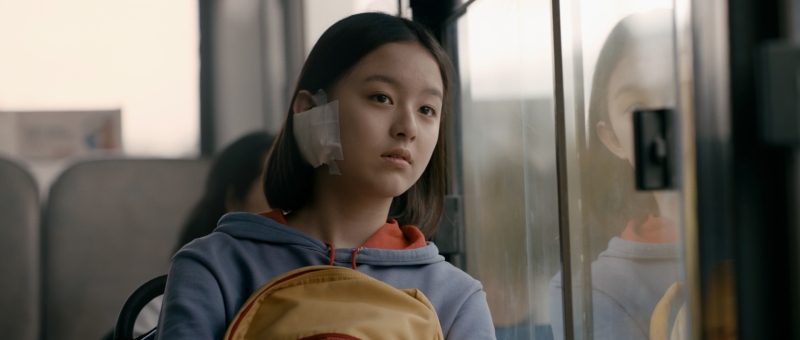
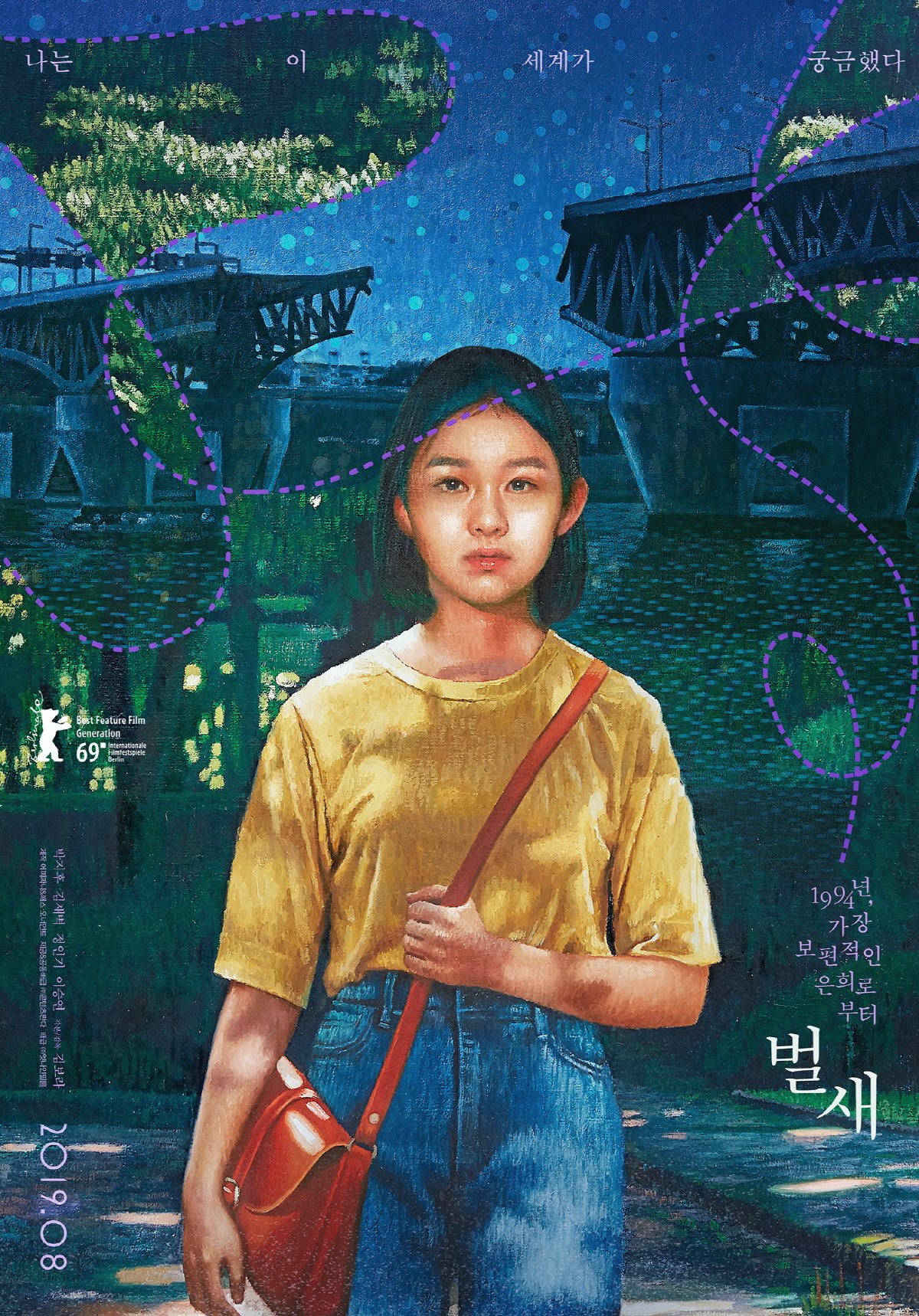
House of hummingbird poster 1“The world is fascinating and beautiful” the teenage protagonist of Kim Bora’s House of Hummingbird (벌새, Beolsae) is told in an especially poignant letter recited in the film’s closing moments. It’s a lesson that she’s longing to learn, but finds few willing to teach her in a society whipping itself up into a frenzy of aspiration perhaps at the cost of true human connection. A chronicle of one surprisingly traumatic summer in the newly democratised Korea of 1994, Kim’s film charts its heroine’s gradual progress towards a kind of self acceptance with a melancholy ease as she begins to find her own way despite the toxicity of the world all around her.

14-year-old Eun-hee (Park Ji-hu) is one of three siblings living in a cramped apartment with her harried, emotionally distant parents who run a small rice cake shop. A mediocre, disinterested student she falls asleep at school where the other kids cruelly exclaim that dozy girls like her never make it to college and are destined only to become housemaids to the “successful” adults they assume they’ll be. Meanwhile, Eun-hee’s hardline dad (Jung In-gi) makes her go to Chinese cram school where she “studies” along with her best friend, Ji-suk (Park Seo-yun), spending most of their lesson time making fun of the teacher in hastily written notes.

Previously purposeless, her world begins to widen when the Chinese teacher abruptly quits and is replaced by the infinitely cool, enigmatic university student Young-ji (Kim Sae-byuk) whom she first glimpsed smoking a melancholy cigarette by an open window on the stairs. Strangely captivated by this “odd” young woman, Eun-hee suddenly has the urge to study, especially as Young-ji turns out to be unique among the adults that she knows in that she seems to genuinely care about her and is interested in hearing all about her troubles, which, as we will find out are many.

In the mid-90s, Korea was a newly democratised and rapidly modernising society keen to claim its place on the economic world stage. Where Eun-hee’s parents are defeated, disappointed figures, they want better for their children in the new society but struggle as to how to get it for them. Eun-hee’s mother (Lee Seung-yeon), as we find out from her dejected brother, was bright but had to leave school to pay for his tuition (a promise he seems to think he has not fulfilled). Consequently, the parents are convinced “education” is the way out but fail to realise that their obsession with academic grades is slowly destroying their family home. While Eun-hee is sullen and withdrawn, pushed out by her rowdy family, her older brother’s exam stress often turns violent and her sister skips school to go clubbing in an attempt to escape adolescent anxiety.

Even when Eun-hee discovers a lump on the side of her neck, her mother sends her off to the doctor’s alone though he can’t actually treat her without parental consent which Eun-hee fears they won’t get round to giving. Though they visit her once, they don’t bother to pick her up from an extended stay in hospital and are not home when she returns. Not even an accusation of shoplifting rouses them from their busyness. Eun-hee’s father rudely tells the shopkeeper to stop bothering him and call the police, causing the shopkeeper to feel so sorry for her that he lets her go.

Meanwhile, Eun-hee looks for intimacy in other places. She tries innocent teenage romance with a feckless but good-looking boy, Ji-wan (Jeong Yun-seo), whom truth be told she perhaps likes more as an abstract idea than in himself. The unexpected gift of a bright red rose from a bashful girl (Seol Hye-in) sends her thoughts in another direction but leaves her more confused than ever when that too betrays. Through it all she idolises the mysterious figure of Young-ji with whom she seems to share some kind of affinity and the sense of connection so painfully absent in her frenetic family home.

Eun-hee’s difficult path towards an acceptance of adulthood mirrors that of her nation, finding itself in one particularly traumatic summer marked by a dangerous sense of anxiety in the end of eras as the North’s Kim Il-sung passes away, provoking fears of a disturbance in carefully won political equilibrium. Meanwhile, a literal bridge collapse threatens to destroy Eun-hee’s new path towards maturity once and for all, taking her only source of solace with it. Yet what she learns is that though bad things happen, good things happen too and there are always new people to share them with. She may feel herself to be alone, lost in a confusing landscape and uniquely indifferent to her nation’s relentless pursuit of consumerist success, but she does finally perhaps have herself and new hope for the future found in the security of her own hands.


House of Hummingbird was screened as part of the 2019 Fantasia International Film Festival.

Festival trailer (English subtitles)

1987: When the Day Comes (1987, Jang Joon-hwan, 2017)

fullsizephoto931939The political history of Korea is long and complex and oftentimes sad. The events depicted in 1987: When the Day Comes (1987), pivotal as they were, occurred just 30 years ago. Yet the recent past has also been one marked by protest, public anger, and political scandal though this time around with far less fear or danger. The protests of 1987 were a different story. The rule of Chun Doo-hwan, a military dictator who had seized power following the assassination of the previous dictator, Park Chung-hee, was one of extreme oppression which had already seen a widespread massacre of peaceful protestors by the state in Gwangju in 1980. Chun’s term, under the constitution, was set at seven years after which many hoped for a path to modern democracy but those hopes were dashed when he announced an intention to appoint his successor rather than call a free and fair election.

In depicting the climactic events of that summer, Jang Joon-hwan begins with chaos as a doctor is summoned to a mysterious room where a young man lies unconscious in a pool of water. The police have gone too far, and boy has died during interrogation. Aware of the potential danger of the public finding out that the state has in effect murdered a suspect in an act of torture, the head of the ACIB, Park (Kim Yun-seok), orders the body to be quickly cremated. This, however, needs a certificate signed by a prosecutor and Prosecutor Choi (Ha Jung-woo) is fed up with the ACIB and unwilling to cooperate especially as he smells a rat with the cause of death for a healthy 22-year-old listed as a “heart attack”. Not wanting to be on the wrong side of it if it does get out, Choi refuses the cremation and orders an autopsy which in itself triggers a series of other events eventually bringing the government to its knees.

The state remains cruel and duplicitous. The death of Park Jong-chul (Yeo Jin-goo) would become a catalyst and a rallying call, not just for the injustice of it but for the injustice of covering it up. Park’s family are denied their basic rights, his mother and sister literally dragged away from the morgue screaming while his traumatised father looks on in silent agony. They say that Park was a communist, that he died of fear because he weak while claiming all along to have done no wrong. Only when the “truth” begins to emerge does the ACIB decide to hang a few of its guys out to dry, urging them to “patriotically” take one for the team and head to prison for a while with a hefty compensation package to help sweeten the deal.

The death in custody becomes just one event in a situation spiralling out of control. Paranoid in the extreme, the Chun regime is also working on bringing down a “North Korean Spy Network” controlled by a democracy activist on the run who, unbeknownst to them, is also working with the Catholic Church who will eventually prove pivotal in delivering the truth to the people. Meanwhile, the press has also decided to jump ship, ignoring the government’s carefully crafted guidelines in favour of running actual news. Chun’s iron grip is slipping.

Jang’s biggest takeaway is that corrupt regimes crumble when enough people find the strength to go on saying no. It begins with Choi refusing to stamp a certificate then travels to the reporter who won’t back down, passes on to the secret revolutionaries bravely carrying messages at great personal costs, the not so secret clergy who perhaps have more protection to speak their minds (up to a point) than most, and of course the students in the streets who risked their lives to build a better future. One of the few completely fictional characters, the niece (Kim Tae-ri) of a prison guard (Yu Hae-jin) charged with conveying messages to an activist in hiding, proves the most illuminating in her inward struggle towards the democratisation movement. Afraid of the consequences and preferring to remain politically apathetic, she is eventually radicalised through witnessing the brutality of the regime first hand and suffering personal loss because of it.

Playing out as a taut thriller, 1987: When the Day Comes has a lived in authenticity from the motif of being constantly deprived of one shoe by a cruel and absurd regime to the deadly serious ridiculousness of men like Park who hate “the enemy” enough to destroy the thing they claim to love in pursuit of it. Timely and filled with melancholy nostalgia, Jang’s depiction of the pivotal events of 30 years ago is also a rallying cry in itself and an important reminder that the fight for justice is never truly won.


Screened at the 20th Udine Far East Film Festival.

International trailer (English subtitles)
Secret Reunion (의형제 / 義兄弟, Jang Hoon, 2010)

secret reunion posterStrangely enough, North Koreans in South Korean films are often marked by a naive nobility, filled with all the “goodness” that is otherwise so absent from the hypocritical egalitarianism of the nation that raised them. Jang Hoon’s Secret Reunion (의형제 / 義兄弟, Uihyeongjae) is a perfect example of the ongoing trend in its direct contrasting of a pure hearted North Korean operative betrayed by his comrades, and the cynical NIS officer who turns to a shady career in the private sector when a botched operation gets him fired. An interesting look at North/South relations, Secret Reunion is equal parts buddy cop comedy and probing thriller but places the heartfelt connection between its perfectly mirrored protagonists firmly at its centre.

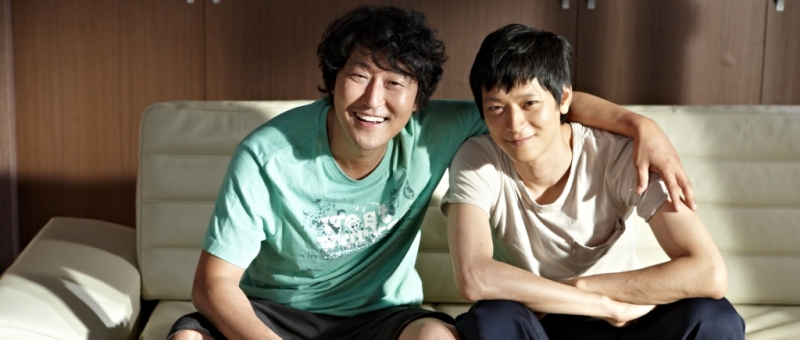
North Korean agent Song (Gang Dong-won) reads a bedtime story to his unborn child over a telephone whilst preparing for an operation south of the border, while NIS officer Lee (Song Kang-ho) bickers with his wife about their daughter’s education. Song, along with another agent, Tae-soo (Yoon Hee-seok), is to meet a top North Korean hitman known as Shadow (Jeon Kuk-Hwan) and assist in his mission to take out a prominent North Korean defector. Horrified by Shadow’s abrupt murder of the target’s wife and mother-in-law, Song draws on Shadow in defence of the man’s young son whom Shadow has also marked for death and places himself in the firing line in the process but is “saved” when Lee and the NIS turn up following a tip-off from Tae-soo who has betrayed them. Lee and Song briefly catch sight of each other but the operation is a bust which allows both Shadow and Song to escape whilst causing mass civilian casualties from stray police bullets and general panic.

Six years later Lee, fired from the NIS and divorced by his wife, spots Song again during his shady line of work as a finder of missing persons which often sees him tracking down runaway mail order brides from Vietnam. Unable to go home after being branded a traitor, Song is living as a casual labourer under a false South Korean identity. Unbeknownst to Lee he recognises the NIS agent but is unaware Lee has recognised him, especially when he offers him a job at his “company”. Song, intrigued, accepts in the hope of getting enough money together to bring his family to the South while Lee is hoping Song will lead him to Shadow and path back into the NIS but despite their best efforts the two men begin to develop a deep and warm understanding of each other even whilst working at cross purposes.

Song and Lee are indeed mirror images. When we first meet Song he’s eagerly embracing his role as a father and lamenting the fact that he cannot be with his pregnant wife while promising to be home soon. Lee, by contrast, argues with his wife over the phone and abruptly hangs up to go back to police business. Neither man is able to have the close and loving relationship with their daughters they would like – Song because he cannot return home and worries for the safety of his family, and Lee because his wife has remarried and moved to England. Lee’s loss of family is a personal failure first and foremost, but also a consequence of the botched operation in which Song escaped – hence Lee’s desire to capture Song is also part payback for ruining his life, but one which is frustrated by his gradual awakening to Song’s uncomplicated pureheartedness and identification with his own separation from his wife and child.

Song’s nobility is used against him by the heartless North Korean hitman, Shadow, who decries the “pathetic Southerners ruled by emotion” and warns Song that the “Great Nation cannot tolerate someone so fragile” when taken to task over his heartless murder of the defector’s South Korean family members. Lee, the NIS agent, resorts to barely legal immorality when stripped of his authority in becoming a finder of missing persons. The work largely involves tracking down trafficked women who’ve been tricked into coming to South Korea to marry rich and handsome men but often find themselves shackled to cruel husbands who regard them as slaves to be beaten and tortured. Yet Lee sends them back, knowing exactly what will happen to them when he does – something which Song refuses to allow. Despite coming from a brutalising regime, Song has retained his innate humanity, battles injustice and (tries to) protect the weak where Lee, a police officer in a (recently) democratic developed nation, quips about the nature of capitalism being learning to find happiness in stealing the wealth of others and is content to make himself complicit in a system he otherwise does not condone.

Despite their differences the two men come to see themselves in the other, discovering the better qualities of an “enemy” and becoming conflicted in anticipating the day when they will eventually have to confront the secrets they’ve been keeping. Jang keeps the tension high as Lee and Song play each other while Shadow dances around in the background, presumably playing a game which is entirely his own. Nevertheless the bonds of brotherhood between North and South are firmly repaired in Lee and Song’s eventual transition to blood brothers, restoring their severed familial connections whilst building and strengthening new ones.


International trailer (English subtitles)
The Scarlet Letter (주홍글씨, Byeon Hyeok, 2004)

The Scarlet Letter posterSouth Korea has long had a reputation for being among the most conservative of East Asian nations, perhaps because of a strong Christianising influence, but even so the fact that adultery was only fully decriminalised in 2015 is something of a surprise. Ironically enough the legislation was enacted in the defence of women who enjoyed few legal rights and would be left destitute if their husbands left them, suffering not only the humiliation and social stigma of divorce but also having no independent income and very little possibility of gaining one. Nevertheless it quickly became another tool of social control, branding “harlots” rather than protecting “wives”. Byeon Hyeok’s The Scarlet Letter (주홍글씨, Juhong Geulshi) was released in 2004, which is a whole decade before adultery was removed from the statue books, and draws inspiration from the book of the same name by Nathaniel Hawthorne in which a young woman becomes a social outcast after giving birth to an illegitimate child.

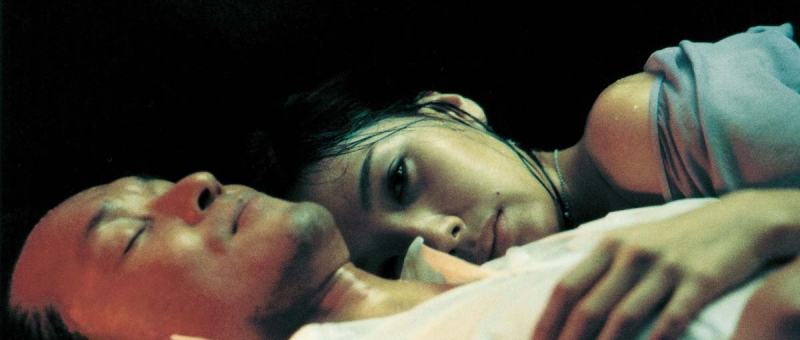
Cocksure policeman Ki-hoon (Han Suk-kyu) lives in a world of his own dominion. Married to the elegant concert cellist Su-hyun (Uhm Ji-won), Ki-hoon is also carrying on an affair with the bohemian nightclub singer Ga-hee (Lee Eun-ju). One fateful day he is called to the scene of a bloody murder. The owner of a photographer’s studio has been found with half his head caved in and the prime suspect is his wife, Kyung-hee (Sung Hyun-ah), who found the body. Once she’s had some time to recover from the shock, Kyung-hee offers up some possible evidence regarding a local photographer who may have been semi-stalking her – something which had caused tension between herself and her husband. The photographer claims Kyung-hee asked him to take the photos, and others besides, but denies he was romantically interested in her or that the couple had been having an affair.

The murder case floats in the background as Ki-hoon’s personal life spirals ever more out of control. Both Su-hyun and Ga-hee are pregnant with his child and it seems inevitable the affair will be exposed. Ki-hoon fears this not out of guilt in causing emotional harm to one or both of his women, but out of a sense that it will be very annoying, inconvenient, and burdensome for him. When his wife does eventually confront him about the affair, Ki-hoon’s response is to ignore it and carry on as normal by acting excited about the baby as if to remind Su-hyun that she is already tied to him and it will be almost impossible for her to leave. Meanwhile, he refuses to give up Ga-hee whose mental state seems to be fracturing under the intense pressure of her need for Ki-hoon and his continuing disregard for the feelings of others.

Ki-hoon is a classic noir hero, wading into a morass of moral ambiguity and hurtling headlong towards an existential reckoning. A late, yet fantastically obvious, twist offers another perspective which the film has no time to expand on so caught up is it in the moral ruining of Ki-hoon in suggesting that oppressive social codes have in some way contributed to this intense situation, forcing three people into an uncomfortable love triangle where everyone has ended up with the wrong partner. Byeon does, however, choose to emphasise “morality” in lending a spiritual slant to Ki-hoon’s fall rather than choosing to attack the social oppression of Korea’s intensely conservative culture in which all the power was in Ki-hoon’s hands (even if he uses it to ruin himself, later left in a state of spiritual emptiness filled only with guilt and shame).

The reckoning comes in a literal evocation of Ki-hoon’s claustrophobic love life in which he finds himself trapped in an inescapable black hole, waiting to find out if he will be released or condemned to suffer an eternity of pain for his various transgressions. Byeon never quite manages to marry his higher purpose to the noir narrative, leaving his avant-garde final set piece out of place in an otherwise straightforward thriller while his final twist falls flat in retreading well worn genre cliches. Frank in terms of its depiction of sex and nudity, The Scarlet Letter takes on an anti-erotic quality, painting its various scenes of actualised sex as passionless acts of compulsion with only those of fantasy somehow imbued with colour and light though its melancholy conclusion suggests even these may carry a heavy price.


Original trailer (no subtitles)

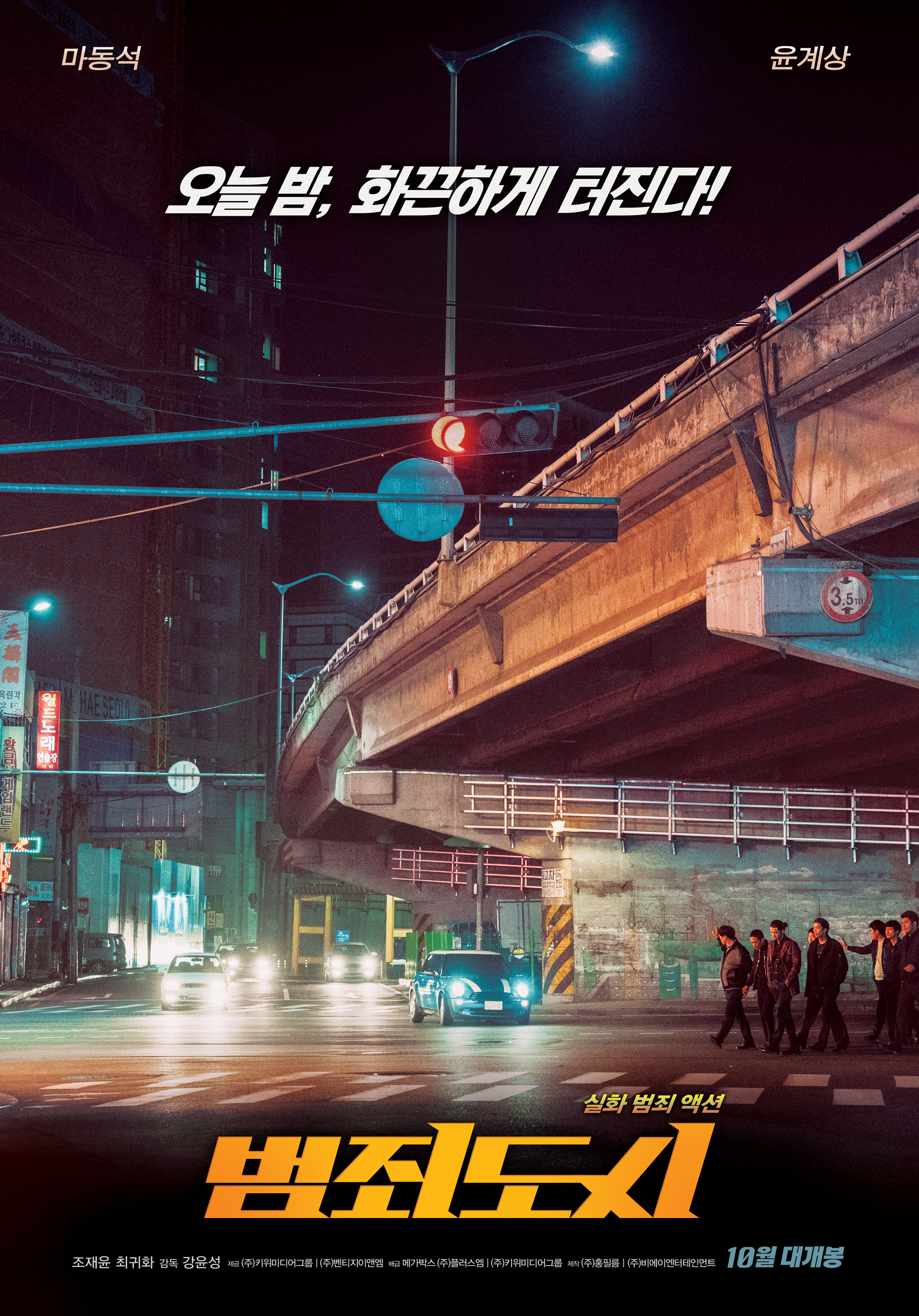
The Outlaws (범죄도시, Kang Yoon-sung, 2017)

The outlaws posterBack in 2004, a hero cop made the headlines by cleaning up Chinatown when he took into custody 32 known gang members in Seoul’s Garibong district. Based on the real life case, The Outlaws (범죄도시, BumJoedoshi, AKA Crime City), is the debut feature from Kang Yoon-sung in which Ma Dong-seok adds goodhearted yet compromised policeman to his list of increasingly impressive leading performances. Truth be told the role does little to stretch his current range but fits comfortably into Ma’s well worn persona of noble bruiser as he plays fatherly commander to his fiercely loyal team and avuncular mentor to a brave boy in the district who wants to help free the area from the dangerous gang violence which leaves not just businesses but lives under threat.

Ma Seok-do (Ma Dong-seok) is the only force stopping Garibong from descending into a hellish war zone of gang violence and destruction. A local resident, Ma is well respected in the area and knows the territory well enough to navigate its various challenges. Rather than take on the gangs wholesale he attempts to placate them, brokering an uneasy equilibrium which keeps the violence contained and helps to protect ordinary people from its effects. All of that goes out the window when a new threat arrives in the form of vicious gangster Jang Chen (Yoon Kye-sang) and his two minions whose methods are unsubtle in the extreme, ending with rival gang bosses chopped up and placed inside suitcases over nothing more than a trifling gambling debt.

Jang is a new and terrifying threat because he sees no need to play by the “rules”. A peace cannot be brokered with him and he cannot be reasoned with. Ma knows the time has come for action but even with police resources behind him is ill equipped to become, in effect, Garibong’s latest gang leader. To this end he makes a surprising decision – asking the residents for help. The residents, however, remain terrified. How can he ask them to inform on gangsters to whom they’re still paying protection money? Ma’s promise is a big one – to do what no one thought could be done in neutralising the organised crime threat by conducting a mass arrest of foot soldiers from across the gangland spectrum.

Ma Dong-seok makes fantastic use of his trademark sarcasm as the regular neighbourhood guy who also happens to be a top cop. Kang mixes a fair amount of humour into an otherwise dark and violent tale such as the recurrent presence of two lowly pamphleteers who are eventually pressed into more serious service for Ma, his trickery and manipulation of a suspect (which is also a way to save him from a death sentence on being sent back to China), and Ma’s love of drunken karaoke and lamb skewers with the boys. Ma thinks nothing of arming a gangster with a stab vest, setting up another in a public bath, or playing gangland politics for all they’re worth, but when it really counts he’s as straight as they come, protecting the residents of Garibong like the lone sheriff of some outpost town, equal parts officer of the law and disappointed dad.

The incongruously comical tone harks back to the ‘70s maverick cop golden age in which the lines between law breaker and law enforcer were always blurred but you knew who the good guys were because they had all the best lines. If Kang is aiming for this branded mix of grit and humour he doesn’t quite find it and the comedy sometimes undercuts his more serious intentions but it is undeniably good fun all the same. Ma Dong-seok’s warmhearted maverick is quite rightly the star of the show, but his rivalry with Yoon Kye-chang’s Jang Chen fails to ignite with Chen never quite seeming as menacing as intended. Nevertheless even if Kang’s gangland action comedy has little to add to an already crowded arena, it does at least provide a fitting showcase for Ma’s talents in its sarcastic, world weary policeman who may have one foot on the wrong side of the law but always acts in the name of justice.


Screened at the London Korean Film Festival 2017.

Original trailer (English subtitles)