Temptation (誘惑, Kozaburo Yoshimura, 1948)

TemptationFeelings can creep up just like that, to quote another movie. Like Wong Kar-Wai’s In the Mood for Love, Temptation (誘惑, Yuwaku) also echoes Lean’s Brief Encounter with its strains of accidental romance between unavailable people even if only one of the pair is already married. However, this time there’s much less deliberate moralising though the environment itself is a fertile breeding ground for the judgemental.

The film begins with Takako (Setsuko Hara) paying her respects at the grave of her recently deceased father only to run into an old pupil of  his arriving for the same reason. Takako and Ryukichi (Shin Saburi) are both making the arduous trip back to the city and decide to travel together. Stopping over in Gifu, they find difficulty in getting a hotel room because of a big horse race due to take place the next day and rather awkwardly end up sharing a bed. After Takako becomes upset and ponders what she’s going to do now her father is gone, Ryukichi offers to let her move in with him and the children. Discussing this with his wife who is an invalid living away from the family, he talks paternally of Takako and of a wish to look after her as a way of honouring the memory of his former teacher. However, it isn’t long before the inevitable happens and the pair begin to fall in love.

Ryukichi first met Takako as a little girl when he was her father’s student but she’s 21 years old now – a grown woman by any standard, and plenty old enough to know what she’s doing. He describes her as still “silly”, like a child, and indeed Setsuko Hara breaks out some of her most radiant (if occasionally pained) smiles and almost mocking laughter to play a complex mix of putting a brave face on grief and genuine happiness at being back in a family home. Though feeling the crippling loss of her only family member has left her feeling devoid of a purpose in life, Takako is an essentially good and kind person who sees the best in people and is only too happy to help Ryukichi with the children while his wife is ill as well as continuing with her medical studies.

After leaving academia, Ryukichi has become left leaning politician committed to creating a better, fairer nation. Like Takako he is also an honest and decent person with a high sense of personal integrity. His motives for bringing Takako into the house were innocent, yet gradually his feelings for her begin to shift from the paternal to the romantic causing him a considerable amount of stress as he battles the need to remain faithful to his wife even in her absence while his attraction to Takako continues to grow.

The impending threat of illicit action stalks the screen almost like the stealthy figure of the killer in a slasher movie. At one point where the feelings threaten to overwhelm the couple despite their best efforts to suppress them, Tokie (Haruko Sugimura) – the sickly wife, unexpectedly turns up in true melodrama fashion as if summoned by the lovers’ guilty consciences and accompanied a chorus of stinging strings.

Tokie herself played by veteran actress Hariko Sugimura, is every inch the wounded wife though her plight is played with a little less vindictiveness than in a similarly themed gothic novel where the bedridden spouse suddenly rises as if from the grave itself to haunt the new lovers while still alive. Originally approving of Ryukichi’s desire to help Takako, Tokie’s fears are awaked when seeing her playing with the children on the beach – all long legs and youthful skin, moving in a way she fears she never will again. “Everything inside my chest is ruined” she tells Ryukichi before returning sadly inside, alone, prematurely exiling herself from her own family.

That said, Temptation refuses to follow the established pattern in that it suddenly reverts to a standard romance with no feeling of judgement inflicted on the couple whose love story has occurred in an illicit fashion. Tokie has a late in the game change of heart and the guilty spectre that haunts the couples of European melodrama fails to arise meaning that neither party is left feeling a need to reject their true feelings out of a desire to atone in some way for their inappropriate emotions and putative (if not actualised) betrayal.

This is surprising in some ways as the films also wants to offer a mildly left wing narrative represented by the poor boy fellow student of Takako who is arrested near the beginning of the film for selling flour masquerading as sweetener. He is of peasant stock and ultimately opts to return to simple and honest country life. Offering to take Takako with him, he gives her an opportunity to escape the temptation which is plaguing her and live quietly and naturally in an honest and humble way. In another film, this would be the solution – an abandonment of bourgeois emotion by giving up on her married, middle class politician who, for all his fine talk of open plan houses and rejection of “feudal” ideas, is still a reactionary and part of the system. However, strangely, emotion wins out and the audience gets a “happy ending” (of sorts) which feels a little bit out of place.

Temptation plays with many forms during its running time most notably romantic melodrama but often feels more like a thriller with its various twists and turns which always threaten to disrupt the narrative in unexpected ways. Consequently the film has something of an uneven tone and begins to drag a little even given its fairly short running time. This becomes a particular problem approaching the finale which lacks weight despite its obvious potential for melodrama. Still, even if Temptation is often more interesting than it is engaging it does offer a series of striking visual motifs as well at the superb performances of its leading players.


No trailer for this one, but here’s a picture of Setsuko Hara on the cover of Shin Eiga magazine in 1949 (which is a publication I can’t seem to find out much about). Btw, this is another one with a Kaneto Shindo script!
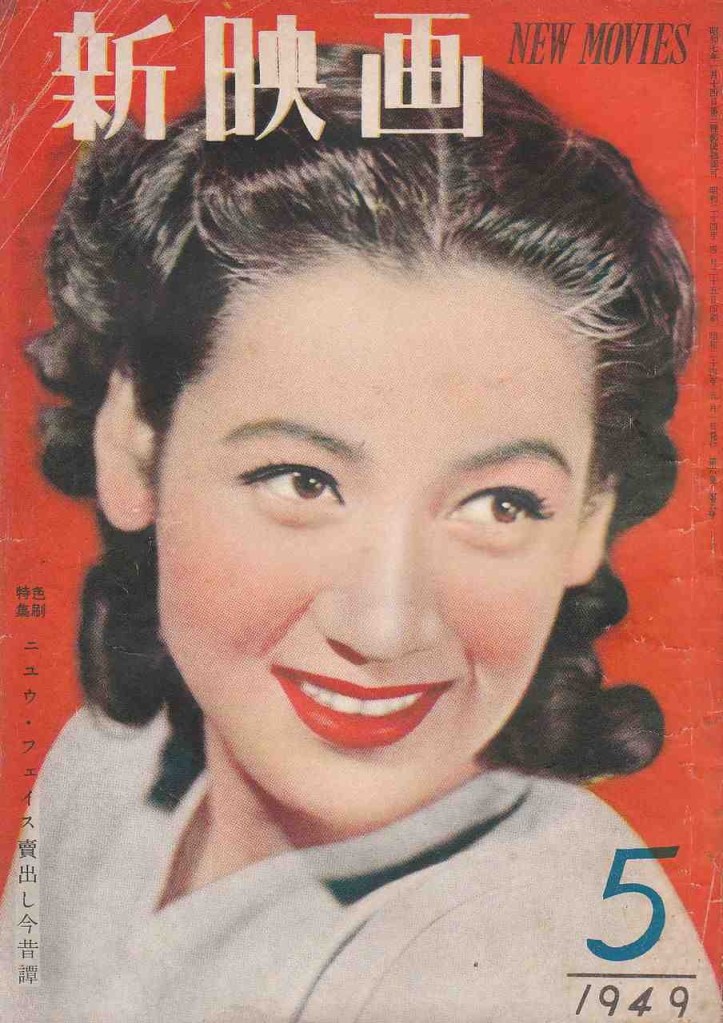
setsuko hara

The Iron Crown (鉄輪, Kaneto Shindo, 1972)

iron crownFemale sexuality often takes centre stage in the work of Kaneto Shindo but in the Iron Crown (鉄輪, Kanawa) it does so quite literally as he refracts a modern tale of marital infidelity through the mirror of ancient Noh theatre. Taking his queue from the Noh play of the same name, Shindo intercuts the story of a contemporary middle aged woman who finds herself betrayed and then abandoned by her selfish husband with the supernaturally tinged tale of a woman going mad in the Heian era.
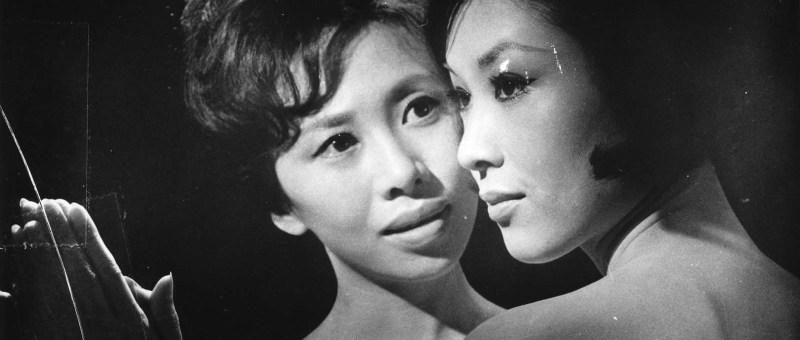
The film begins in a theatrical sequence in which Shindo’s wife and muse Nobuko Otowa appears in traditional dress and declares that she going to pray at a shrine to request vengeance on the lying, cheating husband who’s ruined her life. As part of this, she asks to be turned into a vengeful demon so that she may properly enact her revenge. However, after a while Shindo interrupts the action to return to the contemporary era and a man and woman in bed who keep being disturbed nuisance phone calls which turn out to be from the man’s wife (also played by Otowa) standing in a phone box outside.

The husband and his mistress – a much younger, sexually liberated woman, are given no respite from the unsettling phone calls. Haunted by the unseen figure of the betrayed wife, the couple eventually attempt to move around to avoid her ending up in a strange, otherworldly hotel. They become convinced that the wife has followed them and is telephoning from within the hotel itself despite having been told that they are in fact the hotel’s only guests. In the final sequence of the Noh play, the wife, who is now a demon, finds herself unable to enact her revenge in the way that she would like but vows to await another chance though her demonic powers eventually desert her, leaving her as an invisible ghost with only her voice remaining.

Shindo operates on three interconnected layers each radiating from the original Noh play. First of all there’s the central contemporary story of the adulterous husband, his mistress and the betrayed wife which is intercut with scenes from the Noh play but this is divided too – into a “realistic” depiction as in the wife fleeing through the forest and of outwardly “theatrical” scenes in which the entire stage apparatus is visible with enclosed walls and the musicians seated to the side of the stage area.

In one sense, it’s true that the position of the Heian era wife in this instance in a much harder one to bear than that of her modern counterpart who faces less of the stigma of the divorced woman and probably does have much more possibility of rebuilding her life even if she has made large sacrifices and wasted her youth on an unworthy man. However, just in the Noh play the hurt and resentment born by the unnamed modern woman is enough to develop into a supernatural force in its own right which pursues the new couple not only through the direct means of her phone calls but even begins to haunt them causing a degree of hysterical paranoia in the quite cowardly husband who even starts to see the “ghost” of his wife standing accusingly before him.

The real and the dreamlike theatre of vengeance blur into each other becoming evermore indistinct. By the time the adulterous couple have arrived at the hotel they’ve already entered another realm. Though the real world pokes through occasionally, the hotel itself takes on an ethereal quality with its staff each wearing the white makeup of the Noh theatre and spouting strange, oddly straightforward dialogue. Yet the couple themselves don’t seem to be able to detect the oddness around them or even be able to tell it apart from that which is recognisably part of their world, so caught up are they in the guilt and torment brought about by the unseen presence of the abandoned wife.

Shindo adopts a complicated, experimental structure to explore what is at heart a simple idea – the timeless quality of a woman’s jealousy. Hell hath no fury like a woman scorned and even if not physically present, the spectre of the former wife becomes a disruptive force in the husband’s intentions of leaving her behind to pursue other opportunities with a younger woman. Fascinating yet elusive, The Iron Crown is perhaps best considered with a firm knowledge of the original Noh play in hand, yet its haunting imagery and experimental take on form make it an intriguing entry into Shindo’s diverse filmography.


Unsubtitled trailer:

Manji (卍, Yasuzo Masumura, 1964)

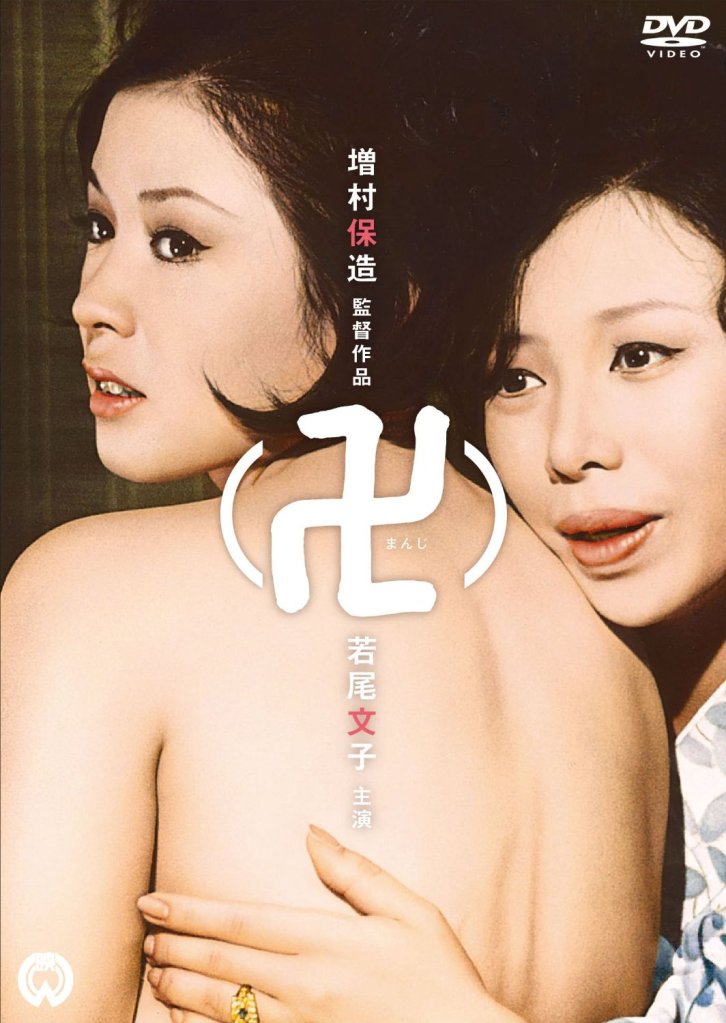
8127Ur2xnXL._SL1500_For arguably his most famous film, 1964’s Manji (卍), Masumura returns to the themes of destructive sexual obsession which recur throughout his career but this time from the slightly more unusual angle of a same sex “romance”. However, this is less a tale of lesbian true love frustrated by social mores than it is a critique of all romantic entanglements which are shown to be intensely selfish and easily manipulated. Based on Tanizaki’s 1930s novel Quicksand, Manji is the tale of four would be lovers who each vie to be sun in this complicated, desire filled galaxy.
The story begins with a framing sequence in which Sonoko sits down with a male mentor to recount her sorry tale from some later vantage point. As she would have it, she was an unfilled, unhappy housewife taking a series of art classes when the principal of the college noticed that the face in her sketch of the Goddess of Mercy doesn’t look much like the model. Her technique is good though so he asks her why she gave her drawing a different face and who it might belong to. She tells him it’s merely an ideal and isn’t based on any real person. However, it does look quite like another, very beautiful, pupil at the school – Mitsuko, and a rumour quickly starts that the two women are lovers. Though barely knowing each other before, the pair laugh it off and decide to become friends anyway. Gradually, something more than friendship begins to grow but not everyone is being honest with each other and the added complication of the men in their lives is set to make the road even harder for Sonoko and Mitsuko’s love affair than it might otherwise be.

Sonoko narrates things from her perspective, though you get the feeling she may not be a completely reliable narrator. She seems shy, innocent, wounded though she speaks of her great tragedy with ease and a surprising frankness considering its sensitivity. The object of her obsession, Mitsuko, by contrast plays the innocent but also seems to know perfectly well what she’s doing. Manipulative in the extreme she plays each of the other three lovers off against each other in an attempt to become the centrifugal force in each of their lives. All things to all people, Mitsuko doesn’t seem to know what she wants, other than to be adored by anyone that’s around to adore her.

At the beginning of the film Mitsuko reveals that she’d been involved in marriage negotiations with a young man from a high profile family and she believes the rumours at the art school were started deliberately to try and disrupt her matrimonial ambitions. Sure enough that liaison falls through but she neglected to mention that she also has another fiancee, the slimy Watanuki, that she longs to be rid of but can’t seem to shake off. After Sonoko finds out about Watanuki, Mitsuko feigns not only a pregnancy but a bloody miscarriage to get her female lover to return to her. However, Watanuki fights back by trying to form a bilateral alliance with Sonoko to ensure Mitsuko doesn’t suddenly take up with a third party – he even gets her to sign a contract saying that she’ll help get Mitsuko to marry him and in return he won’t interfere with the two women’s relationship even once they’re married.

Sonoko’s husband completes the quartet, becoming increasingly frustrated by his wife’s infatuation with another woman, her coldness towards him and her growing boldness. Sonoko labels Kotaro cold and passionless and claims never to have enjoyed any of their married life together. She’s also been taking illegal birth control medication to avoid having children with him. Trying to be an understanding husband, Kotaro ends up tangled in a web of desire after being seduced by Mitsuko. For a time, the three form an unlikely romantic trio (with Watanuki hanging around disdainfully on the edges) though even between the three of them petty jealousies sap their strength and keep them all guessing as to the exact motives of the other pair.

Just like the four pronged arms of the manji itself, our four lovers lie in a tangled and twisted crisscross of desire, each trying to eclipse the other in the eyes of the radiant Mitsuko. Anything but merciful herself, Mitsuko adeptly plays on the insecurities of the others to keep them all dancing along to her tune. This is not a story of true love, but of misused desires, almost of the inverse of love where lust becomes a weapon of control and self satisfaction. Even at the end, Sonoko can’t decide if she’s been saved or betrayed and if what happened to her was love or a kind of madness. Whatever it was, each has paid a high price for their selfish pursuit of romance or dominance or whatever Mitsuko really represents for them (clearly not the reincarnation of the Goddess of Mercy after all). Years ahead of its time and still just as dark and fascinating as it always was, Manji is a sadly universal tale of the destructive power of love that plays almost like a ghost like story and is likely to haunt the memory long after the screen falls dark.


Manji is available with English subtitles on R2 UK DVD from Yume Pictures.

Original trailer (no subtitles)

Irezumi (刺青, Yasuzo Masumura, 1966)

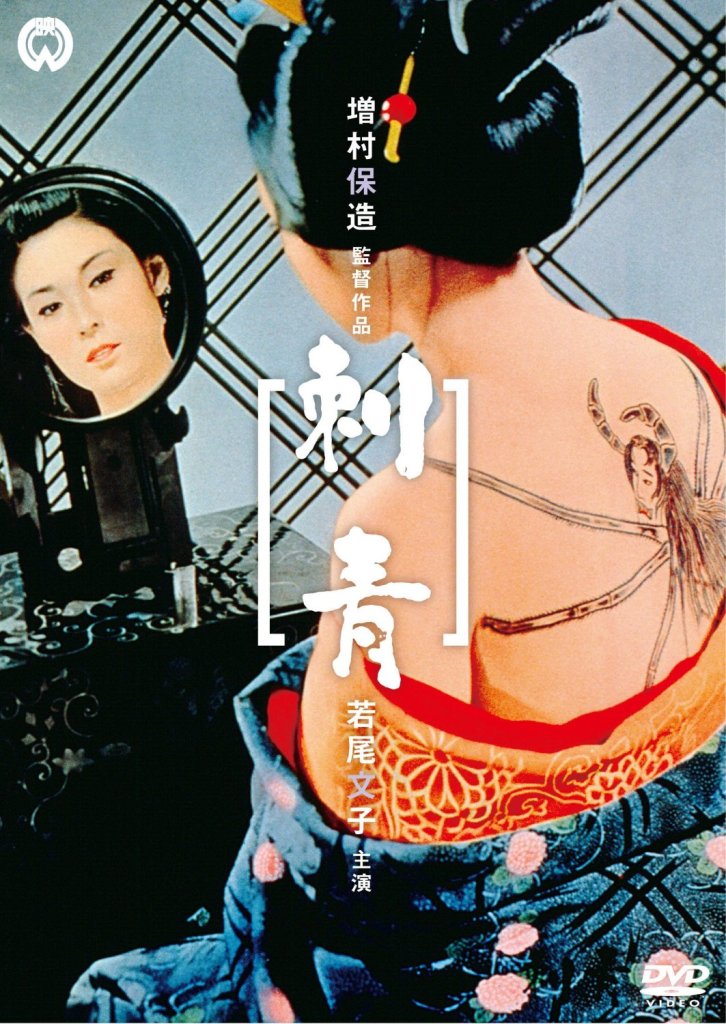
91HAEic7eNL._SL1500_Irezumi (刺青) is one of three films completed by the always prolific Yasuzo Masumura in 1966 alone and, though it stars frequent collaborator Ayako Wakao, couldn’t be more different than the actresses’ other performance for the director that year, the wartime drama Red Angel. Based on a novel by Tanizaki and scripted by Kaneto Shindo (Onibaba, Kuroneko), Irezumi is a supernaturally tinged tale of vengeance and betrayal.

The film begins in the middle as Otsuya, having been abducted and sold to a geisha house, is tied, bound and chloroformed so that a tattooist can mark her skin with the eery portrait of a spider with a human face. Skipping back awhile, it seems this came about as a consequence of Otsuya convincing the mild mannered assistant of her father, Shinsuke, to run away with her. The pair take refuge at the home of a family friend, Gonji, but after his advances towards Otsuya are rebuffed he arranges to have Shinsuke killed and Otsuya sold as a geisha. Shinsuke manages to get away after a bloody fight but he’s a gentle man and the violence of the encounter marks him. Otsuya, by contrast, finds she quite enjoys her new life and gets along OK with her pimp, Tokubei, who urges her to “feed on men”. Otsuya’s lusts become ever more violent with the spectre of the tattoo artist hovering in the background. Is the tattoo itself enacting these scenes of terrifying vitality or merely an excuse for releasing Otsuya’s true nature?

Shot in vibrant colour in contrast to Red Angel and many of Masumura’s other efforts from around the same time, Irezumi makes fantastic use of its lurid atmosphere. Sex and death and violence – hardly unusual themes for Japanese cinema though Irezumi feels like an early precursor to the exploitative pinky violence cycle of the following decade. In keeping with those films, Otsuya is another conflicted avenger, wreaking havoc on venial men who think they can buy and sell a woman’s soul as well as her body. As the violence mounts, Otsuya falls into a kind of mania and at one point exclaims that this isn’t really her at all, it’s all the fault of the spider on her back – trapping men in its silky web only to suck them dry and throw away the husk.

Whether Otsuya is herself an avenging warrior for the female sex or merely a demonic vision of the ultimate male fear is somewhat up for debate. Her transgressions are intentionally destabilising – she breaks with convention by “betraying” her father when she runs of with Shinsuke and not only that, she does so at her own insistence. Shinsuke himself is far too meek and mild mannered to have ever done such a thing entirely of his own will and is largely swept along by Otsuya for the entire course of the film. Only when he fears she may betray him does he decide to take action. Otsuya’s sexuality in itself is also transgressive, actively pursuing Shinsuke before a formal marriage and then even expressing her enjoyment of her new life in the pleasure quarters – neither attitude is one that is expected of the demure daughter of a noble house. Is she an emancipated woman, or fallen one? The film offers no clear judgement here but presents her both in terms of vengeful heroine and of terrifying villainess.

Along with its rather complicated structure beginning in a media res opening followed by a lengthy flashback sequence, Irezumi is never quite as successful as Masumura’s other mid ‘60s offerings. Though boasting a script by maestro Kaneto Shindo, a noted director in his own right and frequent visitor to the realms of horror, something about Irezumi fails to coalesce. That said, it does offer a visually arresting, generally interesting supernaturally tinged tale and yet another fantastic performance from its talented leading lady.


Irezumi is available with English subtitles on UK R2 DVD from Yume Pictures

Tattoo sequence from the film: