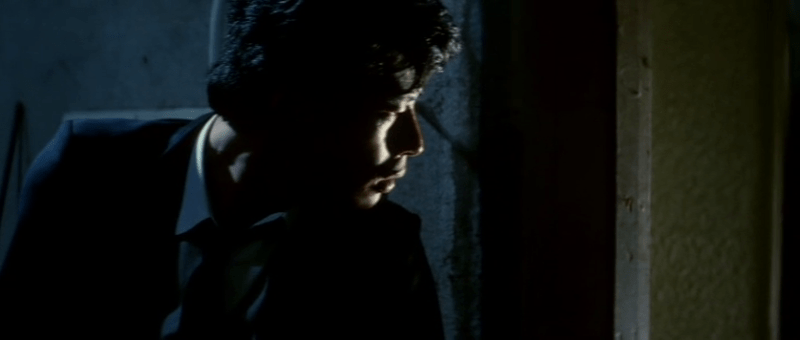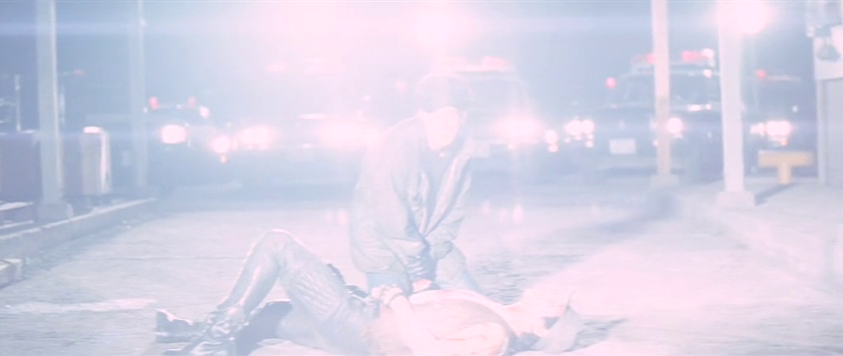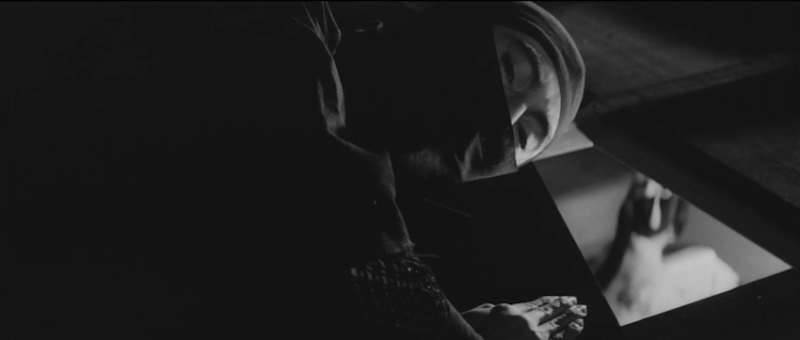
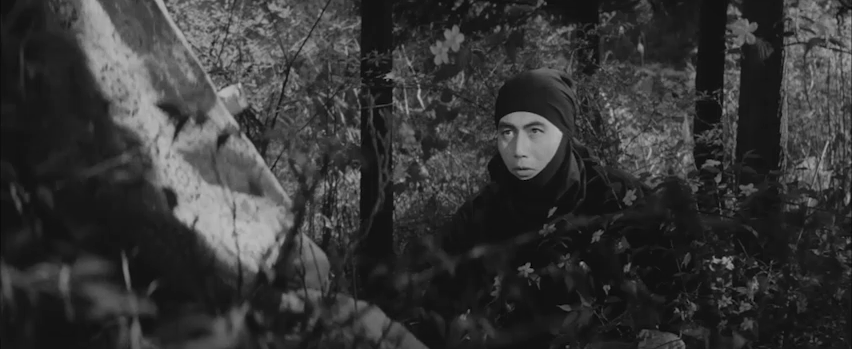
Female Prisoner Scorpion: Death Threat (女囚さそり 殺人予告, Toshiharu Ikeda, 1991)

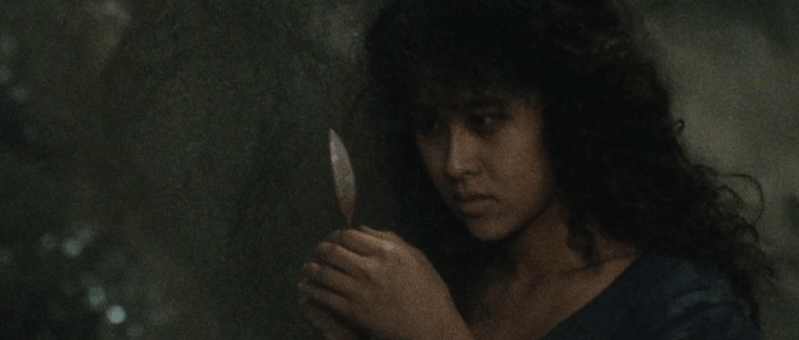
It had been 14 years since the conclusion of the rebooted Female Prisoner Scorpion series and 18 since the iconic Meiko Kaji had stepped away from the role when Toshiharu Ikeda decided to resurrect the iconic Nami Matsushima for Toei’s V-Cinema line. Ikeda was reportedly a fan of the original series and put his name forward to direct with the intention of getting Kaji to return as a now middle-aged Sasori but she turned him down flat so they instead embarked on a quasi sequel in which the original Nami has died and another woman slowly takes her place to become the next incarnation of the legend.

Consequently, Scorpion is not the protagonist of this film that otherwise bears her name. Cast in the lead role of a nameless hit woman, Natsuki Okamoto was then a popular pinup model known as “High Leg Queen”. The film opens with her emerging from a barrel of concrete after being dumped by a group of men who had gang raped and then left her for dead. She’s then rescued by a yakuza, Kaizu (Minori Terada), who teaches her how to kill and is effectively her handler. After posing as a bigger to knock off an obnoxious businessman, he’s recruited by Goda (Kenji Imai), the former warden prison stabbed in the eye (though not by Nami as he claims here) in the original trilogy but now a local councillor with aspirations of being elected to parliament. The prison is about to be redeveloped and Goda claims he’s been keeping Nami a prisoner in the dungeon for the last 20 years so he needs her knocked off before anyone bothers to have a look down there.

Of course, there are a few things that don’t make sense with this scenario and are out of continuity with the events of the original trilogy. In any case, now called 701 the assassin infiltrates the prison and knocks off a woman she’s been led to believe is the original scorpion but may not actually be. It seems Scorpion has already passed into legend and the woman has become less important than the idea or the inspiration she provides to the other inmates who are then minded to rebel against authority. By hiding Scorpion away, the authorities have made a rod for their own back in allowing her apotheosis into a goddess of vengeance of all women kind.

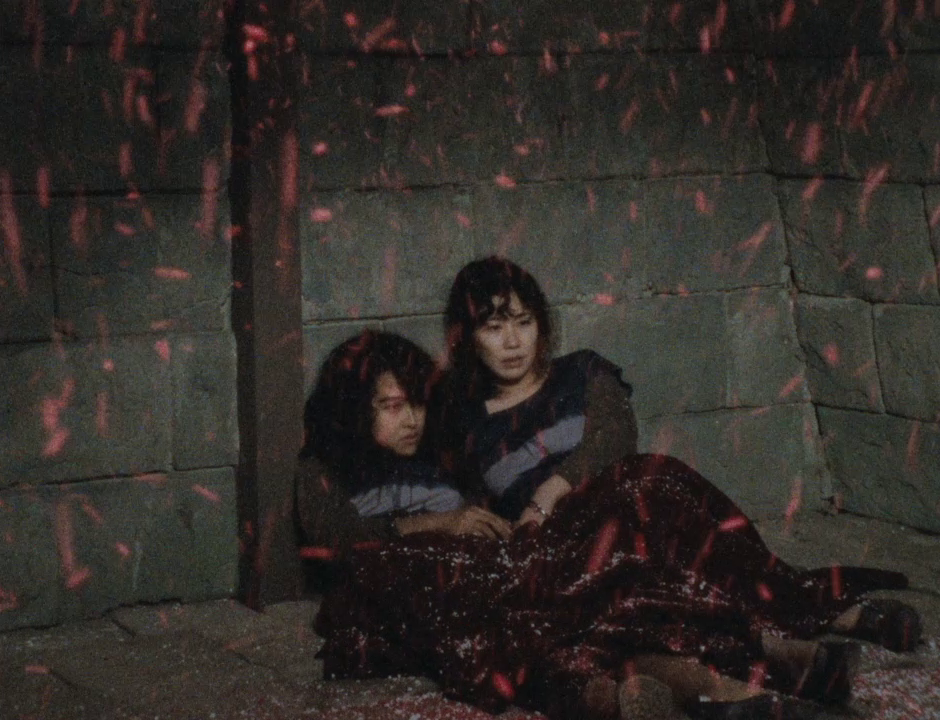
701 is in a way reborn as Sasori. Betrayed by the people who hired her, she’s crucified in the courtyard until rescued by fellow inmate and Sasori fan Shindo (Mineko Nishikawa) who helps her try to escape from the prison in an attempt to find out what happened to the “real” Nami. It’s she who first likens the fire in 701’s eyes to that of the Scorpion and begins to give her permission to take on her name and mission. A line is drawn between the two in Nami’s incasement in concrete and 701’s breaking out of it in the opening sequence. Though it would be wrong to call this horror film, Ikeda makes frequent use of ghostly techniques to imply Nami’s apotheosis such as the sound of her spoon scraping the concrete which she later bequeaths to 701 who then becomes the “new” Scorpion. 

The film was in fact a big hit for Toei video and theatrical sequel was planned as a co-production with Golden Harvest in Hong Kong though the project fell through when Okamoto took a break from show business ostensibly for health reasons though there were rumours she had objected to the requirements for nudity. Contrary to expectations for a straight to video release, there is not actually a lot of sexual content in the film which is mainly restricted to a single sequence in which two prisoners pretend to get it on in order to distract a guard to facilitate an escape attempt. Unlike other instalments in the series, the film doesn’t have a lot of women in prison elements either, though it does make space for Dump Matsumoto, a popular villain character from women’s wrestling, as a sadistic guard with a crush on another warden who is she says the only one who treated her like a woman. Instead, it focuses on 701’s passage towards becoming Scorpion and the fulfilment of her twin missions as an avenger of wronged women breaking free from the concrete dungeon of patriarchal oppression to take bloody revenge on the forces of corruption.


Trailer (English subtitles)

Eight Men to Kill (賞金首 一瞬八人斬り, Shigehiro Ozawa, 1972)

In the first instalment of the Bounty Hunter series, Shikoro Ichibei (Tomisaburo Wakayama) had been a shogunate spy intent on putting down rebellion to their oppression, but by the third, it seems he’s thoroughly fed up with the ills of feudalism and apparently no admirer of the Tokugawa who he feels to have failed in their responsibility to the people along with their personal greed and desire to hold on to their power.

Ichibei’s chief objection is their lack of healthcare provision, seeing as he is a doctor who mainly cares for the poor. That’s one reason he agrees to the job, asking for a large percentage of the gold he’s been asked to retrieve by a worried retainer who explains that the Edo government is relying on it to bridge a gap on their finances. If the gold’s not returned, the entire economy may crash. The government’s heartlessness is further borne out by the retainer’s words that it’s not the time to be concerned about one boy whose importance pales in contrast to that of the Tokugawa Shogunate when a rogue ronin kidnaps the son of the man responsible for the theft of the gold from a local mine. 

In a repeated motif, men attempt to swallow the gold as a means either of stealing or hiding it but it gets stuck in their digestive system and causes them a great deal of pain that could lead to death. The cruel mine owner Kanoke Tatsu (Minoru Oki) forces Ichibei to cut open the man’s stomach to get the gold out, while he insists on sewing him back up again because as a doctor it would be wrong not to. What he’s really performed maybe a kind of gold-ectomy, removing the toxic substance from the men’s stomachs even if he may not be able to save their lives or improve their circumstances.

Ichibei tells the bandit, Yasha the Wolf (Kenji Imai), who is held responsible for the theft of the gold, that he is as bad as him and is only looking for a fast way to make money, yet he wants it to use to build better hospitals for the poor, ironically using the government’s cash to make up for their failing. Meanwhile, he finds himself coming up against a man much like himself only inverted in the form of wandering assassin Yajuro (Shigeru Amachi), a former secret policeman in the rebellious Bishu domain who doubt crosses everyone he comes across in an attempt to get his hands on the gold. Ichibei asks the man who hired him why they don’t want to use government spies but he tells him that it’s because they’d run out. The ones they sent to investigate have all been killed, presumably by the treacherous Yajuro.

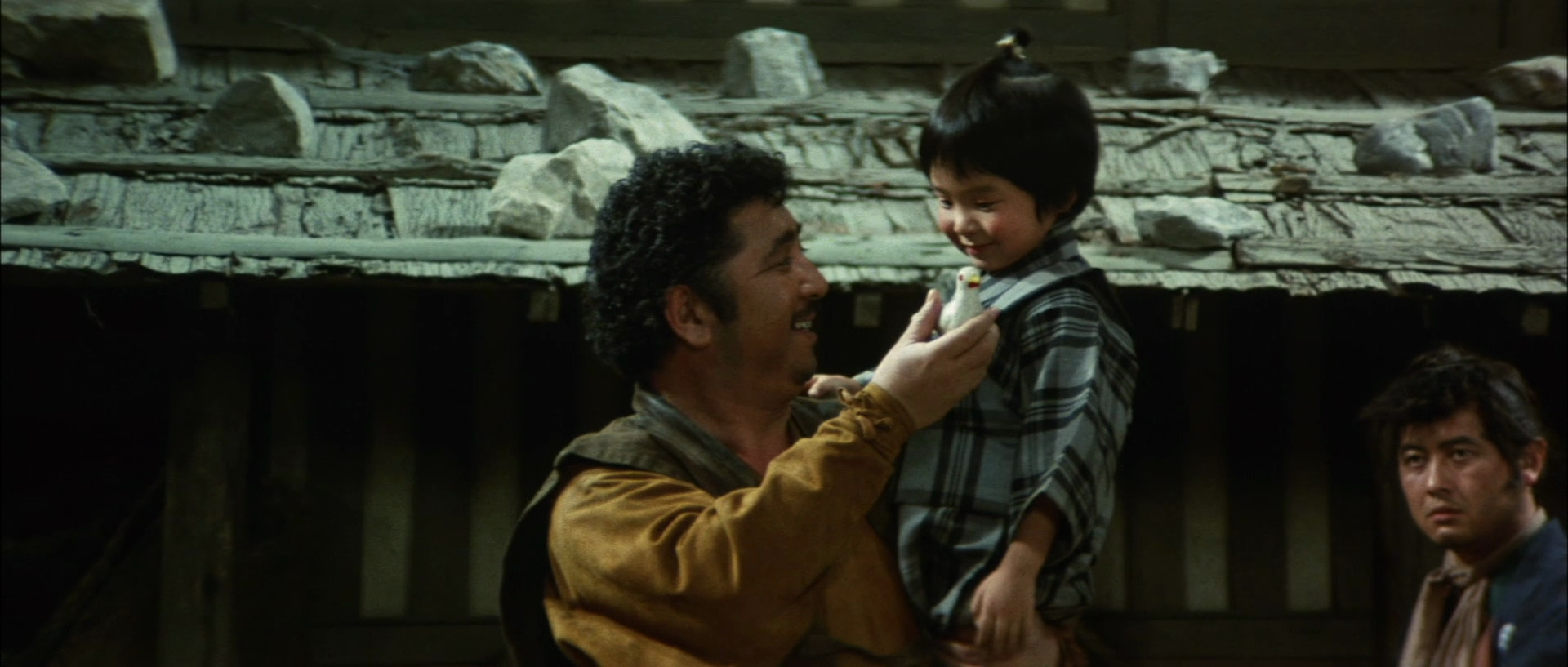
All around him, Ichibei discovers only omnipresent greed. A geisha he comes across is working with the mine owner to steal the cash, but simultaneously seducing Ichibei and the apparently won over by his bedroom prowess though it’s difficult to know which is an act, her fondness for Ichibei or pledges to sell him out to Kanoke. Meanwhile, Kanoke vacillates when presented with a binary choice by Yajuro, his adorable three-year-old son, or the gold. As always, it’s the innocent who suffer while personal greed and governmental indifference leave ordinary people little room to manoeuvre. 

This time around, the righteous Ichibei cuts a solitary figure. He no longer has a posse and is supported only by an older gentleman who is mute. As a result of his mission, he even ends up on a wanted poster himself with the shogunate, presumably unwilling recognise him, yet eventually congratulating him on a job well done, much to his shame and embarrassment having witnessed shogunate soldiers committing an atrocity. Very much in the western vein, Ozawa lends the dusty old mining town a sense of dread and decay as it rots from the inside out thanks to the corrupt authority of a weakened shogunate seeking only ways to cement its own power. The red-tinted final taking place during a solar eclipse seems to emphasise the hellishness of the situation even as Ichibei announces that they can all go to hell but he’s sending the money to heaven where it can be put to better use. 


Four Hours of Terror (高度7000米 恐怖の四時間, Tsuneo Kobayashi, 1959)

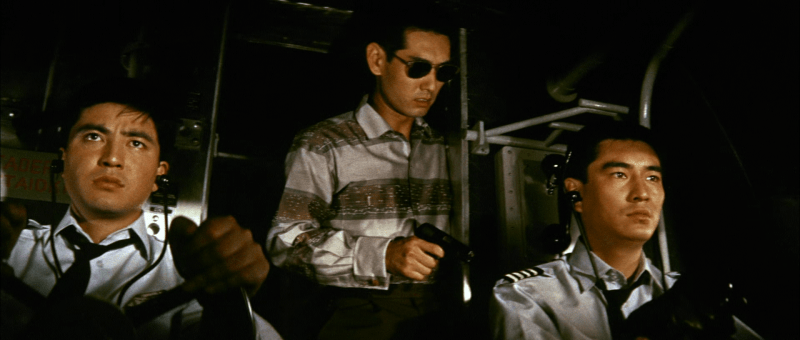
It seems quite strange now to think of a time when air travel was both new and exciting and as easy as catching a bus. It’s this juxtaposition that Tsuneo Kobayashi’s hijacking thriller Four Hours of Terror (高度7000米 恐怖の四時間, Kodo Nanasen Metoru: Kyofu no Yojikan) plays with as an armed fugitive takes a passenger plane hostage in an attempt to escape after committing a murder while those on board struggle to accommodate themselves to this new form of transportation. 

This sense of exoticisation is obvious from the opening voiceover which sings the praises of Haneda airport as the gateway to a newly internationalised Japan though in actuality the flight in question is a domestic service travelling from Tokyo to Sapporo. The voiceover also introduces us to each of the passengers which come from differing strata of society and even includes a middle-aged American couple. There are in fact three generations of couples on board who seem to represent different stages of life from the newly wed students so wrapped up marital bliss that they barely notice anything else, to a long-married reporter and his wife on their first holiday together since their honeymoon, and an elderly couple returning from a trip to the capital who are mystified by this new age of mass media and air travel. The newlyweds apparently won this free trip on an aeroplane after agreeing to have their wedding broadcast on television in an early example of reality TV, reinforcing the sense of irony that they weren’t necessarily supposed to be on this doomed flight after all. 

Neither was car saleswoman Kazuko (Hitomi Nakahara) who has apparently been pulled away to Sapporo by a short notice business opportunity. She gets a standby ticket, as does her boyfriend/rival Fujio (Tatsuo Umemiya) who is also on track to the same opportunity. Weirdly, Kazuko is not overly sympathetic having randomly kicked a basket containing a little dog about to be smuggled on the plane by its doting owner, but does perhaps represent something of a more independent post-war womanhood even as she effortlessly deflects unwanted attentions from a client she may also have been exploiting in order to obtain his business. Having boarded the plane, she ends up sitting next to another man who requested a standby ticket and was using a surname that was the same as hers but evidently turns out to have been assumed. So lax is the security, you don’t necessarily have to travel under your legal name. In any case, she briefly flirts with him as an overture to a business relationship and also to annoy Fujio before overhearing a news report about the escaped fugitive on her portable radio.

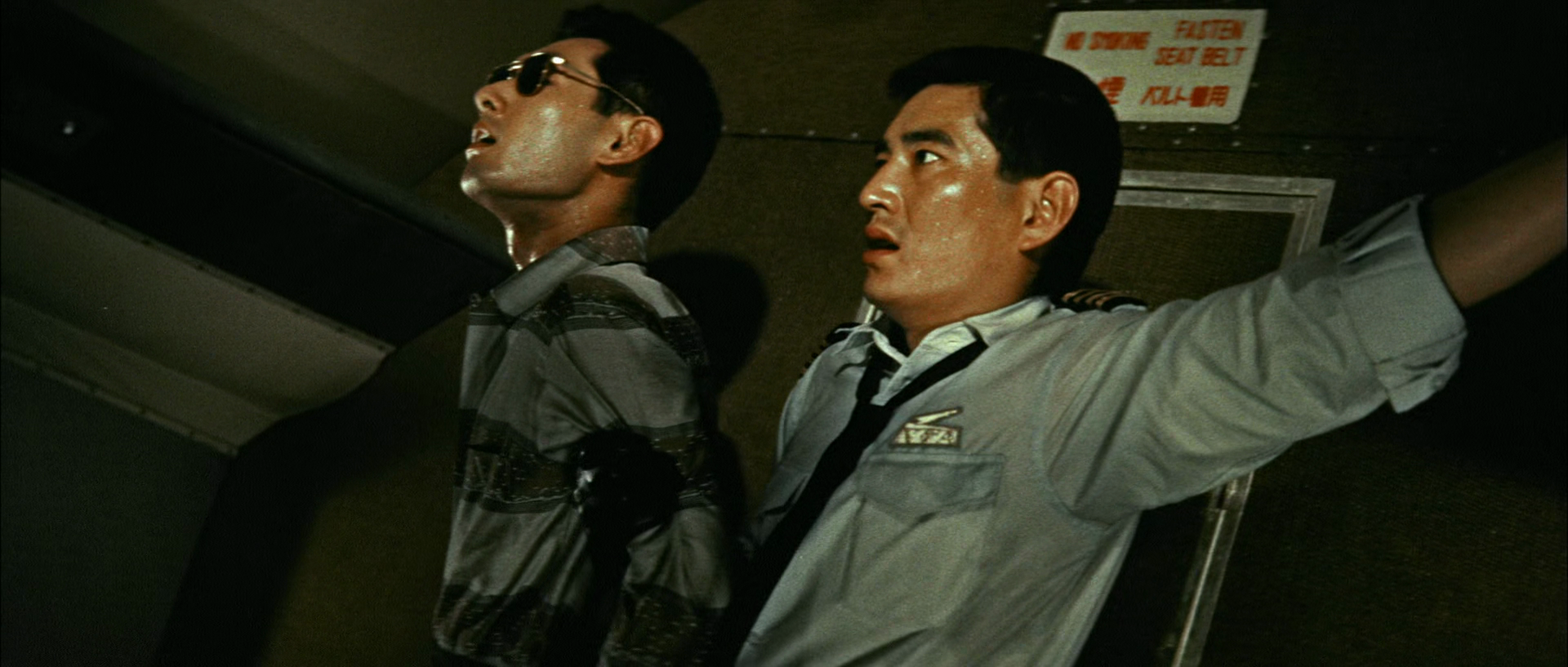
Kida (Fumitake Omura), the fugitive, is dressed like a stereotypical yakuza which makes it odd that no one treats him with suspicion until they spot he’s carrying a gun which he had no trouble at all bringing on board. Though hijackings are not exactly unheard of, they aren’t particularly common either so no one would really suppose anyone had any reason to take a domestic flight to the provinces hostage, and really that was never Kida’s intention merely a last resort after being discovered. Later he gives a partial justification for his life of crime in that his mother beat him and then threw him off a cliff which is why he has a false leg. In any case, there’s a small moment of potential redemption towards the end when the kindly old lady tells him he can’t undo what he’s done, but could still resolve to change assuming they all survive this difficult situation with the plane which now has mechanical problems thanks to the gun going off. 

Even so, it’s the passengers who tie Kida up after the pilot ,Yamamoto (Ken Takakura), manages to disarm him by weaponising the plane. By flying to a high altitude, they knock him out with the air pressure, but are then faced with the mechanical failure of the landing gear which seems to be linked to with Yamamoto’s wartime trauma. A secondary drama revolves around his stoical character with one of the stewardesses apparently in love with him while simultaneously wary of his iciness given that he apparently showed no emotion after receiving the news his wife had passed away but simply flew the plane home as normal. Some see this as his devotion to the aircraft which is in a way a commitment to his duty over his human feelings, the factor that perhaps allows him to save the plane and get the passengers home safely. He is however saved by his love for his late wife with the cigarette case that contains her photo saving him from the worst effects of a bullet. 

The same may go for the co-pilot Hara (Kenji Imai) who is dragging his feet over his marriage to Yamamoto’s sister because he wants to achieve 3000 flight hours before getting married so he can call himself a real pilot. Though the film plants the seeds of these random plot threads and the social commentary that goes with them, it does not particularly engage while the hijacking itself remains fairly low key given that Kida is not a particularly “bad” bad guy. He just wants to go to a random place where the police won’t be waiting for him, but otherwise refrains from harassing the passengers save threatening a little boy travelling on his own to return to his parents after visiting his grandfather in Tokyo. In essence, there’s a kind of innocence and naivety in play which speaks to something of post-war hopefulness and a wonder in the frantic pace of progress in which the day is saved by keeping calm and carrying on even in the face of severe adversity.


Trailer (no subtitles)

The Homeless (無宿 やどなし, Koichi Saito, 1974)

Two men are released from prison on the same day. One, dressed in a 1920s-style white suit and straw hat, tries to befriend the other, in black kimono and geta, but he ignores him. Soon, they arrive at a fork in the road. The man in the kimono walks down a well worn grass path cut between the fields while the man in white, looking back and a little disappointed, continues along the modern roadway making his way towards civilisation.

In some ways, the heroes of Koichi Saito’s The Homeless (無宿 やどなし, Yadonashi) are embodiments of past and future. Jokichi (Ken Takakura), the kimonoed man in black, chooses the path of vengeance. On his release from prison, he learns that his gang leader older brother has been killed while his sister was sold to a brothel. He goes there to find her, but is told that she is already dead. The madam says she died of a chronic illness and that she did for her what she could but treating such a cruel disease is only throwing good money after bad. Sakie (Meiko Kaji), a sex worker who appears to have a childlike quality and possibly impaired mental state, tells a different story claiming the madam had Jokichi’s sister killed for reasons she doesn’t explain but may have more to do with the drama going on with Jokichi’s gang than a desire to cut costs and her losses. 

Gen (Shintaro Katsu), meanwhile, seemingly chooses the path of prosperity. He returns to his wife, Ume (Murasaki Fujima), who is a member of a moribund theatrical troupe, and asks her to return to him what he believes is a treasure map marking the location where his father saw a ship sink during the Russo-Japanese war that may be filled with gold. On finding out Jokichi used to be a diver, Gen becomes determined to bring him onto his mission but Jokichi is set on revenge firstly on a man called Senzo (Noboru Ando) he thinks killed his sister and then on whoever ordered the hit on his brother. This bad news for Gen who realises that if he achieves his vengeance, Jokichi won’t be available to help retrieve the gold because he’ll be in prison so he starts by warning Senzo that his past’s about to catch up with him. 

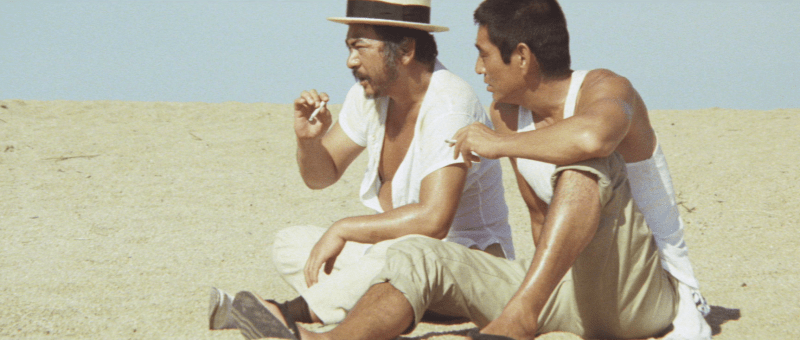
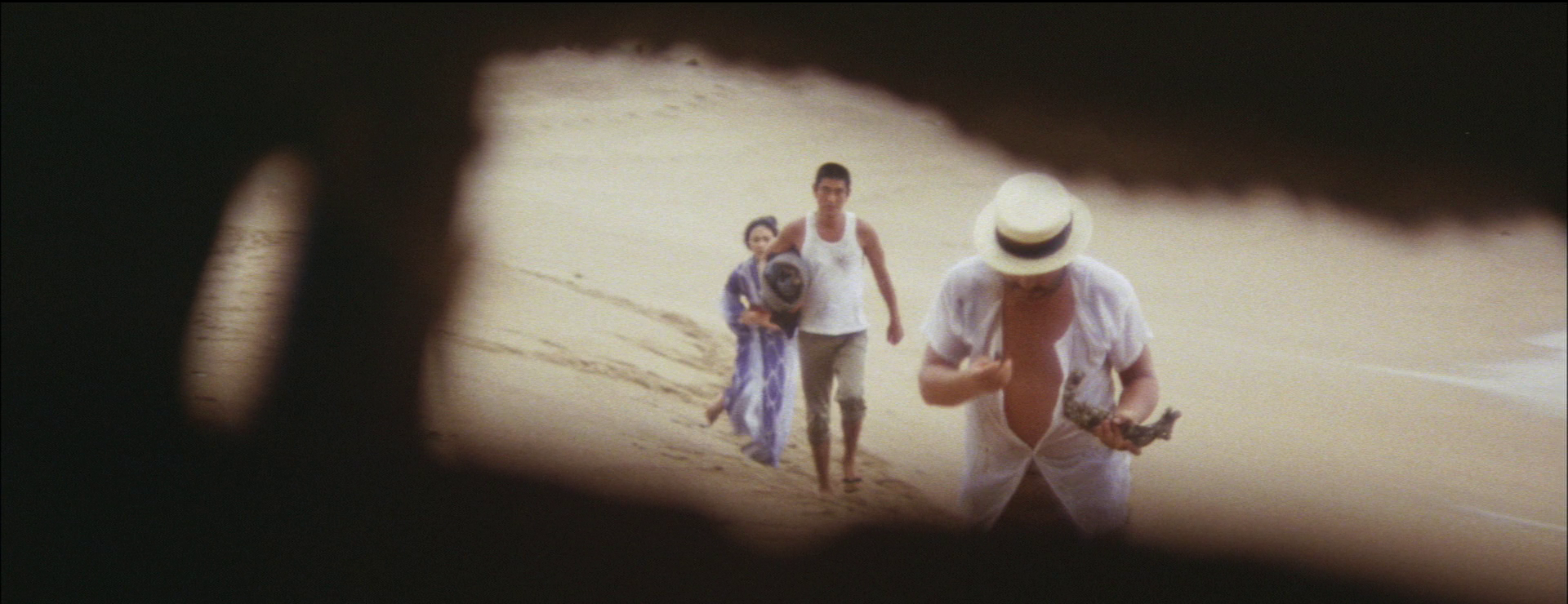
But it’s also Gen that helps Jokichi escape from the rival gang by suggesting he help rescue Sakie from her indentured servitude as sex worker. Childlike and ethereal, Sakie claims not to remember where she was from and has a simple desire to see the sea which represents to her a kind of freedom while for each of the men it may in fact form a kind of border they will eventually be backed up against and unable to escape. Though Sakie develops a fondness for Jokichi, and then begins to love Gen after he ends up taking care of her along the road, the three form a relationship that seems more fraternal or perhaps even forged on the homoerotic tension between the two men who light their cigarettes one from the other and finally find a home on an idyllic beach where they devote themselves to the search for buried treasure.

Sakie may say that the real treasure is her new life of freedom and warmth, but the hint of riches the two men find is itself rooted in warfare and imperialism which are the same forces by which they were each displaced amid the rising militarism of the 1930s. The three of them remain homeless in this environment, unable to fit into the changing society and by degrees exiled from it. An early title of the film was apparently Jingi no Okite (仁義の掟) which means “the law of honour and humanity” and that is in a way what Jokichi is bound by in his desire for vengeance, while Gen is clearly an anarchistic force unable to submit himself to authority and lusting after a more prosperous modernity. Sakie meanwhile is powerless as a woman with few rights, sold into sex work and technically a fugitive from the gang-backed brothel that owned her contract.

As beautiful as the beach is, we have the feeling that in some senses the three of them are already dead and living in their temporary paradise. Indeed, the past eventually catches up with them as if these three homeless fugitives cannot be allowed to survive in resistance to an authoritarian culture. Their existence is elegised by the beautifully composed cinematography along with the childlike rapport between the two men and the sense of domesticity which arises between the trio before reality bites and even their beachside idyll is invaded by the forces of darkness.


Original trailer (no subtitles)

Target (薔薇の標的, Toru Murakawa, 1980)

By 1980 Toru Murakawa was an in-demand director thanks largely to his extremely successful collaborations with late ‘70s icon Yusaku Matsuda. Fresh off the back of the Game series, Toei Central Film hired him to do for their aspiring star Hiroshi Tachi what he’d done for Matsuda with grimy noir Target (薔薇の標的, Bara no Hyoteki). Interestingly enough Target shares its Japanese title with the 1972 drama The Target of Roses, a truly bizarre thriller in which a hitman stumbles on an international nazi conspiracy that was penned by the same screenwriters but is otherwise entirely unconnected with the earlier film and shares no common plot elements whatsoever. 

Set firmly within the contemporary era, the action takes place in Yokohama and is essentially a tale of proto-heroic bloodshed as the hero, Hiroshi (Hiroshi Tachi), seeks vengeance for the death of his best friend, Akira, during a drug deal which is ambushed by a third party who make off with both the drugs and the money killing Akira in the process. Hiroshi goes to prison for four years and then sets about getting some payback on his release by chasing down the Idogaki gang through gunman Yagi who he believes was directly responsible for Akira’s death. 

The plot is perhaps straight out of the Nikkatsu playbook, a little less honour than you’d find in the usual Toei picture though also cynical and nihilistic in keeping with the late ‘70s taste for generalised paranoia. Hiroshi is soon targeted by the Idogaki gang, but is saved by an old prison buddy, Kadota (Ryohei Uchida), who is a little older than he is and to an extent has a noble reason for his life of crime in that he has a son who became disabled after contracting polio and wants to get enough money together to make sure he’ll be alright when he can no longer look after him. Kadota then adds a third a man, Nakao, a former narcotics cop who jokes that he was kicked off the force for rape but according to Kadota was forced out for noble reasons after his attempt to help a friend backfired. The three men team up to turn the tables on Idogaki by ambushing his own drug deal with, in a throwback to ‘60s Sinophobia, gangsters from Shanghai. 

Meanwhile Hiroshi is caught between the life he had before and the contemporary reality in reuniting with his former girlfriend Kyoko (Yutaka Nakajima) who has evidently become the mistress of a wealthy man and is presumably the mysterious benefactor who paid all his legal fees. After a meet cute at a florist he also strikes up a tentative relationship with a wealthy young woman, the daughter of a CEO who plans to move to Mexico. Despite the rising prosperity of Japan in the early ‘80s, pretty much everyone has their sights set on going abroad, Kadota planning to head to Canada after making sure his son is well provided for. Yet Hiroshi is trapped in the Japan of the past, obsessed with vengeance for his friend while torn by his relationship with Kyoko who similarly wants to exit her comfortable yet compromised life to return to a more innocent time at Hiroshi’s side while unbeknownst to him the mistress of high ranking Idogaki boss Hamada. 

What becomes clear is that there is no prospect of escape from contemporary Japan, not even perhaps in death, Hiroshi left alive but dead inside at the film’s conclusion having committed a kind of spiritual suicide born of the dark side of what remained of his honour in seeking vengeance for the death of his friend who had seemingly only participated in the drug deal at Hiroshi’s command in an effort to improve the fortunes of their gang. Once again produced by Toei’s subsidiary Toei Central Film, Target has lower production values than the films Murakawa was making with Matsuda (who has a small yet memorable cameo as a rockstar whose life has been ruined by drugs) with non-synchronised dialogue and a grimy aesthetic which only adds to its sense of fatalistic nihilism otherwise enlivened by Murakawa’s artful composition and atmosphere of moral ruin in which there is no more humanity nor justice. 

The Tattooed Hitman (山口組外伝 九州進攻作戦, Kosaku Yamashita, 1974)

The close brotherhood between two men is disrupted by changing times in a more contemporary gangster drama from Kosaku Yamashita, Tattooed Hitman (山口組外伝 九州進攻作戦, Yamaguchi-gumi gaiden: Kyushu shinko-sakusen). As many are fond of saying, times have changed and the yakuza must try to change with them or else meet a melancholy end. But as the hero admits, change is something he has no intention of doing even as his old school gangsterism leaves him increasingly at odds with the corporatising ways of the contemporary yakuza. 

The change in the times is obvious from the film’s opening sequence set in 1957 in which an attempt is made on the life of petty boss Ishino (Tatsuo Umemiya) by a gunman who shouts “die, for the good of the world” before firing a pistol and running away. Ishino has been targeted in a dispute over construction rights connected with the regeneration of hot springs resort, Beppu. The hit seems to have been ordered by rival gang, Sakaguchi (Eizo Kitamura), the leader of which is also a prominent local politician who is content to abuse his power for his own financial gain. So confident is he in his safety, that Sakaguchi even gets the police involved rather than deal with it himself. 

Ginji (Bunta Sugawara) has been Ishino’s sworn brother since their teenage delinquent days and determines to get revenge by raiding the Sakaguchi offices and killing one of their high ranking officers. Seeing as he’s already wanted by the police for a previous murder, Ishino sends Ginji to Osaka to lay low while working for an associate, Daito, mainly as a debt collector. It’s this act of separation which introduces a rift between the two men. While Ginji waits patiently to be recalled, Ishino climbs the ranks of corporatised gangsterism by learning to play by the new rules. 

To fill the void, Ginji takes on a new “brother” or perhaps surrogate son in the wayward Ken (Tsunehiko Watase) whom he first meets cheating at pachinko at a parlour where his pregnant wife Fusako (Mayumi Nagisa) is working. It’s Ken who first drags him into a brewing turf war as Korean gang Soryu threaten to disrupt the local equilibrium not least by selling drugs of which Ginji does not approve. Ginji “saves” Ken from joining Soryu by essentially making him his one of his guys though he doesn’t really have much of a position in Daito’s gang, offering him a sense of grown-up responsibility by handing him a pistol with the only the instruction to make sure he shoots with two hands. Unfortunately, Ken will follow his advice but otherwise ends up almost causing an incident with another gang by shooting a man who disrespected him in the street. Ginji marches straight down there to sort things out, but on arrival discovers an arrangement has already been made with his boss which further strains his sense of pride and confidence in his position as a yakuza.

Ginji feels something similar on being invited to a party to celebrate Ishino’s promotion only to be seated with the lowly footsoldiers and ignored by Ishino all night. Ishino rejects him still further in agreeing to plan to send him back to Kyushu out of the way hoping that his old school hotheadedness can finally be tempered. Others meanwhile voice concern that Ginji may have forged a relationship with rival Kobe gangs during the 18 months he abruptly disappeared from Osaka and has only come back to cause trouble. Ginji perhaps knows that he has no more future in the contemporary society, others remarking that seems like someone who is in a sense already dead for having accepted that he will die and most likely in Hakata, the town he had wanted to conquer with Ishino who had crushed his dreams in his newfound pragmatism by calmly explaining that they would never have the power to take it. 

Koji Takada’s screenplay positions Ginji’s gradual decline as an allegory for the yakuza himself while citing the new legislation that this particular series of incidents made necessary creating the new offence of assembly with dangerous weapons as a decisive moment in weakening the yakuza as an institution. Ginji remains a man displaced by his times unable to move forward into a new society in the way that Ishino has but stuck in a permanently post-war mentality despite the constant reminders that “times have changed”. Yamashita adopts the trappings of the jisturoku drama with frequent references to real life events and narrative voiceover but otherwise maintains his classicist formalism while ending on a note of ambivalence that tells us a certain kind of justice may have been served but the cycle of violence may not yet be completed.


Original trailer (no subtitles)

Terror in the Streets (悪魔が呼んでいる, Michio Yamamoto, 1970)

How much bad luck can one person have before they start thinking someone’s out to get them? Released as part of double bill with The Vampire Doll and based on a novel by Kikuo Tsunoda, Terror in the Streets (悪魔が呼んでいる, Akuma ga Yondeiru) draws inspiration from contemporary folk horror and the paranoia thriller as one young woman finds herself in the crosshairs of mysterious forces seemingly hellbent on derailing her otherwise very ordinary and aspirational existence. 

Yuri (Wakako Sakai) worries that her status as an orphan has set her back in life, attributing her inability to find permanent employment after managing to put herself through university by working as tutor to a societal stigma against people with no families. Up to now, things had been going pretty well. Though she was only a temp, she had a good gig as office admin staff at big company in the city, lived in a modest but homely flat complete with a small television, and was dating her college sweetheart. But then one day her boss looks at her with an odd expression and then abruptly drops the bombshell that he’s terminating her contract without offering a reason why. When Yuri calls her boyfriend he gives her the same look and says he’s breaking up with her, also refusing to give any kind of explanation aside from not wanting to see her anymore. If all that weren’t enough, her landlady then explains that someone else is very interested in her flat and will pay double for it so she wants Yuri out by the end of the month. 

It’s undoubtedly been quite a bad day, but Yuri tries to stay upbeat reflecting that she didn’t particularly like the job anyway and intends to apply for a position as an editor on literary magazine which would suit her better. But after that nothing quite goes to plan and everything she tries to improve her situation backfires until she finally considers taking her own life at railway crossing only to be rescued by a mysterious man, Fujimura (Takashi Fujiki), who appears as her saviour but then convinces her to take some kind of pill to calm her nerves which predictably leaves her dazed and confused. He then takes her back to her apartment and claims they’re legally married, but when Yuri wakes up the following morning he’s dead with a knife in his chest. 

It’s not the first time that Yuri has experienced an apparent gap in her memory which causes her re-evaluate her sense of reality. She’s beginning to feel as if something or someone is out to get her, realising that Fujimura was the same sinister man she’d caught sight of before staring into her window. Meanwhile, she often hears a strange tune played on an ocarina that sounds like a medieval fugue. The film’s Japanese title is “the Devil calls” and it’s not a huge stretch to assume that Yuri’s been caught up in some kind of dark magic or supernatural curse, yet it’s also the collision of outdated and feudalistic notions of class and patriarchy that have her in their clutches. All of these weird men seemingly want to marry her or at least make her theirs with less than romantic overtures while chief among her aggressors Katagiri (Hideji Otaki) describes himself as an Earl and insists that noble blood is the most valuable thing in the world.

But far as she knows Yuri has no noble blood and is alone and friendless as an orphan with only a “distant relative” she mentions in passing who does not live in Tokyo. She has in effect been made a pawn in a cruel and ironic game played by a distant aristocracy which makes sport of the innocent and powerless by wielding the privileges of wealth and class. The only way she can escape is by renouncing her claim on its legacy, declaring herself uninterested in their games or rewards while ceding the prize to another woman who seems to have been driven out of her mind by a similar series of torments that may have lasted her entire adult life. Yamamoto films the contemporary city in an eerie light, a place of greed and darkness inhabited by sinister and shady forces that prey on the innocent and earnest like Yuri but then there is something to be said for the idea that in the end you can’t con an honest man and Yuri’s pure hearted rejection of unearned wealth just might be her salvation.


Original trailer (no subtitles)

Yakuza Graveyard (やくざの墓場 くちなしの花, Kinji Fukasaku, 1976)

“We don’t resort to violence. We observe the law.’ The hero of Kinji Fukasaku’s Yakuza Graveyard (やくざの墓場 くちなしの花, Yakuza no Hakaba: Kuchinashi no Hana) is berated by a superior officer for excessive use of force, but his criticism is in some senses ironic because it is the police force itself which becomes a symbol of the societal violence visited on those who can find no place to belong in the contemporary society. By this time the yakuza was already in decline and in the process of transforming itself into a corporatised entity while as a police chief explains increasing desperation has led to escalating gang tensions. 

Recently transferred maverick cop Kuroiwa (Tetsuya Watari) finds himself caught between two worlds in attempting to enforce the law through methods more familiar to yakuza. Soon after he’s had his gun taken away for exercising excessive force on a suspect he’d been independently tailing in the street on whom he’d found bullets designed to be used with a remodelled toy gun, Kuroiwa is pulled aside by another senior officer, Akama (Nobuo Kaneko) who takes him to a meeting with local yakuza boss Sugi (Takuya Fujioka). It seems obvious that Akama has cultivated a relationship with the Nishida gang which may not be strictly ethical for a law enforcement officer and hopes to bring Kuroiwa on board as a potential asset. They attempt to bribe him in return for information on the Yamashiro clan, the dominant organised crime association in the area, which has been hassling Nishida in an attempt to take over their territory. But Kuroiwa ironically tells them that they should “act like yakuza” and sort out their own problems rather than relying on the police before dramatically walking out much to to the consternation of everyone else present. 

Nevertheless, he eventually comes to sympathise with them as a symbol of the little guy increasingly crushed by corporate and authoritarian forces outside of their control. He finds out from a briefing that the police’s goal is the disbandment of the Nishida gang but when he asks why they aren’t going after the Yamashiro too he’s told to mind his own business and begins to realise that the police are in cahoots with organised crime. Whether they justify themselves that managing the Yamashiro to prevent a turf war is the best way to protect the public or are simply corrupt and in the pocket of big business, Kuroiwa can’t help but balk at the blatant hypocrisy of the law enforcement authorities. 

Later Kuroiwa reveals that he became a police officer after being bullied as a child in order to exert power over his life, or perhaps becoming an oppressor in order to avoid being oppressed. He was bullied because he had been born in Manchuria and even years later remains a displaced person at least on a psychological level. It’s this sense of displacement which allows him to bond with the Nishida gang’s accountant, Keiko (Meiko Kaji), whose father was Korean. Kuroiwa agrees to accompany Keiko to visit her husband (Kenji Imai) who is serving a lengthy prison term in order to tell him that the gang want to promote someone else to a position he viewed as his by right. The husband explodes in rage and uses a word some would regard as a slur to reference Keiko’s Korean heritage while she later attempts to walk into the sea feeling that there really is no place for her in the contemporary society. 

Just as she claims that she is neither Korean nor Japanese or much of anything at all, Kuroiwa is neither cop nor thug and similarly excluded from society at large. He ends up bonding with old school Nishida footsoldier Iwata (Tatsuo Umemiya), who is also ethnically Korean, for many of the same reasons and attempts to mount a doomed rebellion against their mutual oppression, but is hamstrung by his otherness which is only deepened when he’s taken prisoner by loan shark Teramitsu (Kei Sato) and given a mysterious truth drug developed by the nazis later becoming a user of heroin. Already marginalised, forced into crime by economic necessity and social prejudice, Iwata and Keiko like Kuroiwa himself struggle to escape their displacement while pushed still further out by systemic corruption and the amoral capitalism of an era of high prosperity. Shot with jitsuroku-esque realism and characteristically canted angles, Fukasaku injects a note of futility even within the hero’s tragic victory as he quite literally sticks two fingers up to the corrupted “brotherhood” that has already betrayed him.


Yakuza Graveyard is released on blu-ray on 16th May courtesy of Radiance Films. On disc extras include an in-depth appreciation of the film and the work of screenwriter Kazuo Kasahara from Blood of Wolves director Kazuya Shiraishi, and an informative video essay from Tom Mes on the collaborations of Meiko Kaji and Kinji Fukasaku. The limited edition also comes with a 32-page booklet featuring new writing by Miko Ko plus translations of a contemporary review and writing by Kasahara.

Original trailer (no subtitles)

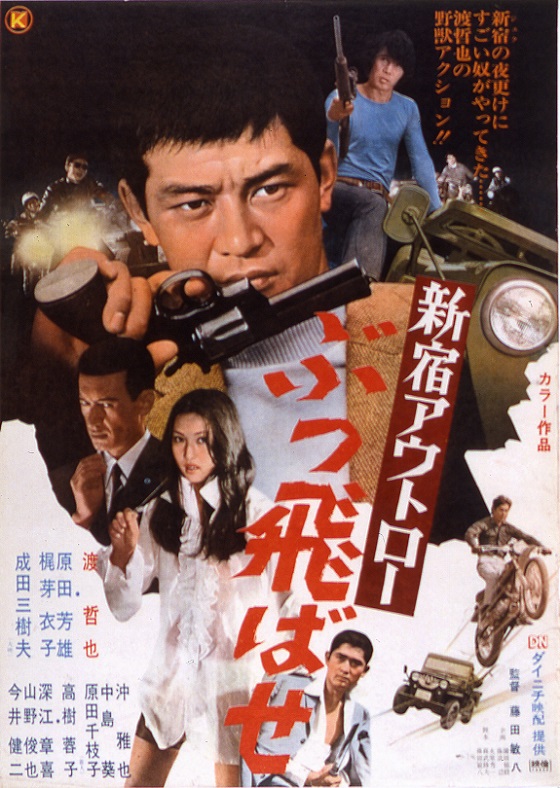
Step on the Gas! (新宿アウトロー ぶっ飛ばせ, Toshiya Fujita, 1970)

A recently released former gangster and the bored son of a CEO look for new directions in early ‘70s Japan in Toshiya Fujita’s Step on the Gas! (新宿アウトロー ぶっ飛ばせ, Shinjuku Outlaw: Buttobase). Released between his two instalments in the Stray Cat Rock series, Fujita’s freewheeling underworld drama is high on irony and shot in a surprisingly warm colour palate replete with pastels seemingly eschewing the seriousness of Nikkatsu’s earlier youth dramas for sense of youthful ennui eventually granting its mismatched heroes if not the direction they seek then at least possibility in their forever floating existence. 

“Angel of Death” Yuji (Tetsuya Watari) waltzes out of prison to be met by no one, only for another man it later transpires he does not know to attempt to flag him down in his military jeep. Ignoring him, Yuji jumps in a taxi and asks to go to Shinjuku, presumably his old stomping ground, before changing his mind and travelling on to Yokohama instead. This would indeed be a fantastically expensive journey, Yuji ironically taking the cabbie for a ride only for the mysterious man to appear and pay his fare for him. Giving his name as Nao (Yoshio Harada), he eventually explains that he’s trying to recruit Yuji for a job hoping to make use of his fearsome reputation to help him recover some missing drugs and get a gang of bikers off his back. 

As we later discover, however, Nao is not some street punk but the son of a wealthy businessman if one obviously at odds with this conservative father. That might be why he seems so hopelessly out of his depth in his relationship with the delinquent bosozoku motorcycle gang led by Rikki (Masaya Oki) who is perhaps equally in over his head in his rather naive approach to criminal enterprise. Nao and his friend Shuhei were supposed to handle a shipment of marijuana for the gang, but the deal went south and the drugs went missing along with Shuhei so now Nao owes them big time. He wants to use Yuji’s “Angel of Death” skills to find out what happened to Shuhei and retrieve the drugs to settle things with Rikki. 

Inevitably, events have a connection to Yuji’s former Shinjuku life Nao employing a woman he used to know, Shoko (Meiko Kaji) who is also Shuhei’s sister, to run his bar, while the icy enforcer working for the big enemy, corporatised yakuza, also turns out to be someone he knew before in the aptly named and distinctly creepy “Scorpion” (Mikio Narita) a former policeman turned amoral gangster. “His power lies not in fearlessness or being a good shooter but in the fact he doesn’t care about anything” Yuji later explains, describing him as the kind of man willing to knock off anyone in his way without a second thought be it a woman or a partner. One might have thought the same of Yuji in his breezy insouciance, but he is at heart noble despite his fearsome nickname displaying compassion and empathy for those around him along with old-fashioned values like loyalty siding with Nao against the twin threats of Scorpion and the biker gang with whom he later proposes a mutually beneficial alliance. 

Skipping between strangely whimsical folk music and a melancholy jazz score, Fujita’s freewheeling crime drama hints at a kind of aimless ennui Yuji and Nao both in differing ways emerging from a obsolescent past into a new and confusing world, Yuji realising the kind of life he lived before is no longer viable while Nao rejects his wealthy upbringing for a life of unglamorous crime engaging in drug use which he at one point hints has left him impotent. Meanwhile, the fading grandeur of old school yakuza is very much apparent in the cowardliness of the gang’s corporatised boss who hires a man like Scorpion to protect him because he cannot defend himself, planning to make off with the stolen money in a helicopter he has waiting rather than honourably facing off against Nao and Yuji in their quest to retrieve what was stolen from them. Constant red and white imagery recalling the Japanese flag clues us in to the sense of futility in their violence, but even so Fujita closes on an ironic note cementing the friendship of the two men but leaving them free floating with no clue how to land floundering for direction above an increasingly confusing society. 


Sympathy for the Underdog (博徒外人部隊, Kinji Fukasaku, 1971)

Toei’s stock in trade through the 1960s had been the ninkyo eiga, chivalrous tales of noble gangsters set before the war and implicitly in a less corrupt Japan in which jingi could still triumph over the giri/ninjo conflict if at great personal cost to the idealistic hero. By the end of the decade, however, audiences were growing tired of yakuza romanticism particularly in the wake of grittier youth dramas produced by Nikkatsu. Originally conceived as a kind of sequel to Japan Organised Crime Boss, Kinji Fukasaku’s Sympathy for the Underdog (博徒外人部隊,  Bakuto Gaijin Butai) marks a shift towards the jitsuroku or “true account” trend of the 1970s which would come to dominate the genre following the success of his Battles Without Honour and Humanity cycle two years later, employing many of the same techniques from onscreen text to shaky handheld photography but doing so within the confines of moody noir as the hero emerges from a 10-year prison sentence into a very different Japan. 

When Gunji (Koji Tsuruta) gets out, he steps into an empty, windswept street his incongruous zori sandals clashing with his smart suit and sunshades and marking him out as a relic of a bygone era. He’s met only two loyal underlings, his gang apparently now disbanded following the death of his boss who refused to take his advice as regards the big name gang from Tokyo attempting to muscle in to their Yokohama territory. Part of the missing post-war generation, Gunji has no illusions about going straight, wandering into their former HQ now a derelict building and calling the guys, who’ve since moved on to more legitimate occupations, back together. He knows he can’t take on Daitokai with his meagre forces and so settles for extracting from them some compensation money to get out of town, later teaming up with Kudo (Noboru Ando) a similarly orphaned former member of a rival Yokohama gang wiped out by Daitokai, and resolving to relocate to Okinawa where he is convinced the post-war gangster paradise is still very much in existence. 

Okinawa was only “returned” to Japanese sovereignty in 1972, having been governed by the Americans since the end of the war, and of course maintains a large American military presence up to the present day. As such to Gunji, and in a yakuza movie trope which persists right into Takeshi Kitano’s Boiling Point, it exists in a permanent post-war present in which the conditions of the occupation are still very much in play. Gunji knows that he and his guys are products of the post-war era, they cannot adapt to the “new” world of corporatising yakuza in which street brawls and petty thuggery have given way to more sophisticated kinds of organised crime, and so they retreat into an Okinawan time warp, determining to steal turf from under two rival gangs who control between them the ports and the red light district mediated by black market booze from the American military.  

Fukasaku was apparently inspired by Pontecorvo’s The Battle of Algiers, intending to make a comment on resistance to American imperialism on the mainland though it has to be said that this is extremely ironic given that Japan is itself a coloniser of the Okinawan islands where there has long been a demand for self-determination and recognition of a distinct identity which has often been subject to oppression in the face of conformist Japanese culture. Nevertheless, the film continues the persistent theme that the chaotic post-war era which has come to a close thanks to rising economic prosperity in the time Gunji was inside is inextricable from the American occupation, implying that Okinawa is in a sense the last frontier and the only viable territory for men like Gunji who, like the melancholy ronin of the Edo era, lack the skills to live in time of peace.  

Nevertheless, modernity is also on its way to Okinawa and where there’s money there are gangsters so as expected Daitokai eventually rear their heads on the island pushing Gunji towards the revenge he didn’t want to take. The Okinawa he inhabits is one of loss and nostalgia, taking up with a sex worker who reminds him of the Okinawan woman who left him when he went to prison and perhaps playing into the slightly complicated political dialogue which positions Gunji as an ironic “migrant worker” salmoning back to Okinawa as many Okinawan youngsters are forced to travel to the mainland for work while the islands themselves remain, it’s implied, mired in poverty and crime economically dependent on the American military. Indeed, the head of the dock gang brokers a deal with Daitokai predicated on the fact that there is plenty of cheap labour available at the harbour. “Good place for a long life” he ironically adds, shortly before all hell breaks loose. Shot with typical Fukasaku immediacy, Sympathy for the Underdog looks forward to jitsuroku nihilism but does so through the prism of film noir cool as its fatalistic hero submits himself to his inexorable destiny.


Original trailer (English subtitles)