The Eleventh Hour (どたんば, Tomu Uchida, 1957)

The problematic working practices of a post-war coal mine are thrown into stark relief when five men are trapped underground during a collapse in Tomu Uchida’s tense rescue drama, The Eleventh Hour (どたんば, Dotanba). Based on a TV play which was itself inspired by real events, the title alone tells us that we can expect a happy ending even if it’s somewhat undercut by the cynical quality of the fanfare with which it is greeted. Nevertheless, it’s clear that the mine itself reflects a dark side of the contemporary society even as it rocketed towards an economic miracle at least on one level fuelled by coal. 

The Towa mine is a small concern run by the owner, Sunaga (Yoshi Kato), who was a miner himself in his younger days, and the chief engineer Kusaka (Shin Tonomura). In the opening scenes it becomes apparent that they are having difficulty running the business effectively while chasing lucrative large-scale contracts. Kusaka pulls Sunaga aside and attempts to warn him that recent attempts to fit a replacement support beam have caused the structure to shift with the effect that it has begun leaking water. The implication is that Sunaga has attempted to cut corners and endangered the miners’ safety. He barely listens to Kusaka’s complaint before barking at him that it’s his responsibility to take care of, and he must be aware of the cost implications involved seeing as he more than anyone knows how hard it is to run this kind of business. 

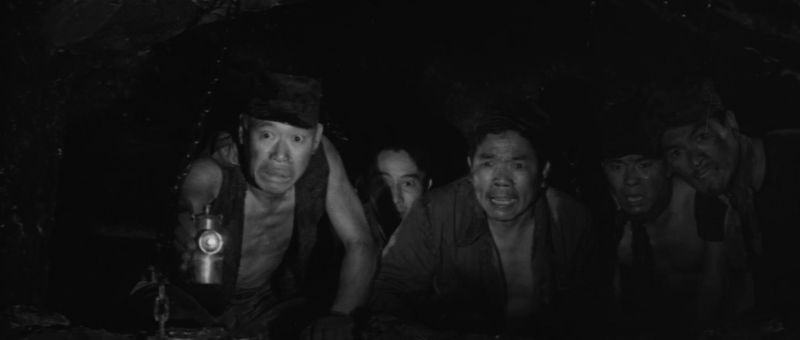
Unfortunately for him, a sudden rainstorm spells disaster when the mine begins to flood. Some workers still underground are able to escape thorough a support tunnel that connects to another mine, but five are trapped at the other end having managed to climb to a higher shelf above the water. In the rain-soaked soil, some of the above ground structure also begins to collapse, while to his credit a distraught Sunaga calls in the police and miners’ union as soon as possible rather than trying to cover up the disaster to hide his mismanagement. 

For all that, Sunaga is not a stereotypically exploitative mine owner so much as a bad businessman possibly in over his head though as a former miner he should have known better. On the one hand, he had only just found out about the unstable support arch and could not have fixed it before the disaster but as he himself agrees he bears the ultimately responsibility for the way the mine was run which includes skimping on repairs and inspections. More than anyone else, he wants the men to be rescued alive and later tearfully tells his wife that he has considered suicide but is now resolved to sell the mine and his own home to compensate the families should the worst happen. Kusaka later does try to take his own life after witnessing the rescue effort flounder, a Buddhist priest later suggesting that his act may have been intended as a kind of human sacrifice as if he could save the men’s lives by offering up his own. 

Then again, the way some of the men put it it seems like some mine owners view the compensation money for workers killed on the job as a kind of fine they’re prepared to pay to maximise profits. The film briefly introduces the circumstances of the some of the men and their families, one a husband and father who asks for an advance on his pay because his wife and daughter are ill with something that could turn out to be measles. The amount of the compensation money isn’t clear, but may not be enough for a widow to raise a five-year-old daughter to adulthood. If these men die, their families may die with them. Other relatives waiting for news include an elderly man anxious for his only son, and a grandmother waiting for her grandson who only went to the mine to have a look around before potentially starting to work there. 

In the case of the young Yamaguchi (Shinjiro Ebara), the film hints at the way the industrialisation presented by the mine has disrupted local communities as farmers’ sons leave the land for the promise of better pay for working underground. Yamaguchi is taking the job because his father is ill with some kind of neurological complaint, possibly caused by industrial pollution, and he has argued with his brother presumably about money and the responsibility of earning his keep. While underground, he runs into a friend of his father’s, Banno (Takashi Shimura), who tells him that mining is not a job you can do for life and he himself seems far too old to be doing such physically strenuous work though he is the only one almost able to stand when the men are eventually lifted from the mine. 

A veteran miner, Banno too is perhaps complacent. He smokes underground and blows the cigarette out after every puff but only to avoid carbon monoxide rather than a potential explosion. Trapped underground twice before, he does his best to comfort the other men while reassuring them that their colleagues are working to rescue them as they speak. Most of the mine workers from the surrounding area have indeed come to help, along with a specialist rescue team from Tokyo, though they make little progress with the tools available to them. As a journalist puts it, small enterprises don’t have access to the same resources as large corporations and cannot simply order in larger pumps or better diggers. Many of the workers want want to give up with the main support coming from the korean miners from a neighbouring town though they get little thanks for the efforts. After overhearing a frustrated member of the rescue team employ a racist stereotype to describe them as lazy drunks only after money, they withdraw their labour. 

Sunaga is later forced to go back to the Koreans cap in hand with a personal apology, but though some of them are personally sympathetic they remark on the level of discrimination they’ve faced for the entirety of their careers and aren’t sure why they should help Sunaga now considering the way they’ve been treated. On a side note, standard workers protections would not apply if they were killed or injured during a rescue attempt meaning they’d be risking their families’ lives as well as their own for men who are almost certainly already dead. It’s not surprising that they overwhelmingly vote not to help leaving a dejected Sunaga devoid of all hope. 

Nevertheless, they eventually reconsider reflecting that if they were trapped underground they’d want to believe someone was coming and if they don’t come now then they won’t have any right to expect them to. It is workers’ solidarity that eventually saves the miners, from winch operator Michi (Masako Nakamura) who refuses to leave her post so that the men won’t feel “abandoned” to those who arrive to rejoin the rescue effort just when it seems the most hopeless. The solution to cracking the mine is found only by listening to a former employee who hints at its dark history in reminding them of a secret support tunnel sealed up after the war once military equipment had removed.

It might be tempting to read an allegorical message into the solution being the need to blast through the buried wartime past to rescue the men trapped on the other side though it may be a bit of a stretch. In any case the action outside is also somewhat ironic. As the mine collapse becomes national news and attracts rubbernecking crowds, a man turns up to sell ice cream, while journalists also report on the event from the close by. They seem broadly hopeful, but are also looking for a good story and all too quick to report on Kusaka’s suicide attempt. When the men are eventually rescued, they order a helicopter to drop confetti over the surrounding area (possibly unhelpful to local farmers) along with a bouquet for each of the men. Uchida had some experience of working in a mine during his time in Manchuria which had permanently ruined his health and had first hand knowledge of how a mine works and what happens when something goes wrong which explains the otherwise naturalistic opening sequence laying out the conveyor belt design of the complex as the coal is picked and transferred into pick up trucks that will take it to its new owners. It is however “dark and wet like hell” underground, a place that ideally no one should have to go and that all should eventually be rescued from. 

The Catch (飼育, Nagisa Oshima, 1961)

The Catch poster1960 was a turbulent year for many, not least among them Nagisa Oshima who dramatically broke his contract with Shochiku after the studio withdrew Night and Fog in Japan on grounds of sensitivity after the leader of Japan’s Socialist Party was murdered by a right-wing assassin live on TV. 1961’s The Catch (飼育, Shiiku), an adaptation of a novel by Kenzaburo Oe, was Oshima’s first post-studio picture and as uncompromising as anything else he’d worked on up to that point. Unlike many other filmmakers of the post-war generation who had been keen to use the corruption of the war as an excuse for a failure of humanity they now thought could be repaired, Oshima suggests that the rot was there long before and all the war did was give it justification.

In the summer of 1945, a small village captures a black American airman (Hugh Hurd) shot down over a nearby forest. They are originally quite jubilant about their act of heroism, believing that they will eventually be rewarded by the authorities, but are then irritated by their new responsibility. They are already low on food, and now they’ll have to feed this full grown man or risk being branded as amoral war criminals. Predictably, nobody wants to be saddled with looking after him until the authorities arrive with further instructions or knows what to do now, so in time-honoured fashion they tie him up in a shed and hope for the best. Only latterly when one of the children points it out do they realise that they should probably remove the bear trap attached to the airman’s foot which may already be infected seeing as he seems to be in a considerable amount of pain and is running a high fever.

It goes without saying that villagers are extremely racist, using quite pointed racial slurs and dehumanising language to describe their captive, even when others stop to remind them that he is after all human too even if he’s an enemy. Just as their sons and husbands are overseas fighting, and dying, bravely for the emperor so was this man valiantly risking his life for his country. Shouldn’t he be accorded some respect just for that? Wouldn’t they want that for their sons too?

Sadly thoughts are thin on the ground, as is food. Jiro (Toshiro Ishido), a young man shortly to enlist, wants a bag of rice off his dad to take into town to buy a woman, but his dad doesn’t have any because he’s already in debt to the immensely corrupt village chief (Rentaro Mikuni). Jiro eventually satisfies himself with a sexually liberated high school girl evacuated from the city and thereafter disappears – the first of many negative events to be randomly blamed on the captive airman. Meanwhile the village chief is responsible for a series of problems because of his out of control need for sexual dominance which sees him apparently abusing his daughter-in-law (Masako Nakamura) and attempting to assault a young widow (Akiko Koyama) with two children evacuated from the city and otherwise undefended in the village.

The rot here is feudalism, the idea that gives free rein to the village chief to misuse his position for his own satisfaction – extracting sexual favours from the women and controlling the men economically. Because he’s the village chief no one really questions his authority or his orders, so when he says all the problems are new and caused by the “black monster” they’ve brought into the village then everyone believes it to be true. The airman, who cannot be responsible for any of these crimes because he is still recovering and locked up in the shed, becomes a scapegoat for every bad thing that has ever happened in the village. More than an embodiment of the war, he is a symbol of all the external pressures that the village would like to pretend are the reasons it has turned in on itself.

Yet the airman is only one kind, the deepest kind, of other. The village hasn’t quite even integrated its evacuees who also constitute a secondary community. The young woman’s two starving children are repeatedly caught with their fingers in other people’s rice jars and receive little sympathy from the villagers, but their crimes only expose the fact that the man who has sheltered them, and also owns the shed where the airman is kept, has been keeping quiet about people thieving his potatoes. He knows it’s not the widow because there are simply too many taken to feed a small family of three, which means that there are probably several “thieves” among the villagers, content to betray their neighbours in thinking that the wealthy farmer won’t miss a measly few root vegetables.

Predictably, rather than deal with the problem, everyone obsesses over the idea that the corruption is born only of the airman and if they could just eliminate him everything would go back to “normal” – i.e. the feudal past in which everyone does what the village chief says and lives in superficial harmony without complaining about their reduced status as lowly peasants forced to live in penury by an unfair and essentially corrupt system. To cure the discord between them, they decide that the airman must be killed, no longer caring about the censure they may face from the authorities. Only two young boys stick up for him, remaining sane amid the madness all around them in insisting that the airman is a person too, is unrelated to the village drama, and deserves his dignity and respect. Sadly, however, the madness has already taken hold.

On learning that the war is over, the villagers refuse to reflect on their behaviour and seek only to bury the past, superficially smoothing over their barbarity with convenient justification. They receive the news that the American authorities do not trust the Japanese with surprise and hurt, despite the fact they are living proof of the reasons why they would be foolish to do so. We gave him white rice while we ate potatoes, he had goats milk, they say, what more could he have wanted? The answer is self evident, but it’s already been forgotten. The villagers start blaming each other, and eventually settle on another scapegoat – a deserter, as if another death could tie all of this into a neat bundle to be burned away on a funeral pyre as if it never existed at all. The evacuees are invited to leave, and the villagers start thinking about the harvest festival, as if the evil has been excised and everything is returning to the way it’s supposed to be, but this “peace” is brokered on the back of secrecy and an abnegation of responsibility. A grim exposé of man’s essential cruelty and selfishness, The Catch rejects the tenets of post-war humanism to suggest that the corruption of feudalism has not and may never be eliminated at least as long as a nation remains content to bury its past along with its shame.


Short clip (English subtitles)

Akitsu Springs (秋津温泉, Kiju Yoshida, 1962)

akitsu springsKiju (Yoshishige) Yoshida is best remembered for his extraordinary run of avant-garde masterpieces in the late 1960s and early 1970s, but even he had to cut his teeth on Shochiku’s speciality genre – the romantic melodrama. Adapted from a best selling novel, Akitsu Springs (秋津温泉, Akitsu Onsen) is hardly an original tale in its doom laden reflection of the hopelessness and inertia of the post-war world as depicted in the frustrated love story of a self sacrificing woman and self destructive man, but Yoshida elevates the material through his characteristically beautiful compositions and full use of the particularly lush colour palate.
At the very end of the war, consumptive student Shusaku (Hiroyuki Nagato) finds his aunt’s house destroyed by aerial bombing. Attempting to find her but proving too ill to go on, Shusaku is taken to a nearby inn by a good samaritan where he first encounters the innkeeper’s daughter, Shinko (Mariko Okada). Despite her mother’s protestations, Shinko takes a shine to Shusaku and is determined to nurse him back to health. Shusaku, however, is a gloomy sort of boy and, ironically, longs only for death. Though the pair fall in love their youthful romance is forever tinged with darkness as Shusaku declares his love not with a ring but with a rope – he asks Shinko for that most classically theatrical of unions in proposing a double suicide.

Shinko agrees, but is not quite ready to die. In another dose of irony, Shinko’s tears of fear and despair on hearing the Emperor’s final wartime broadcast confirming his surrender inspire Shusaku to want to live but the pair are eventually separated. Reuniting and parting over and over again, their complicated love story repeats itself over a period of seventeen years but the painful spectre of the past refuses to allow either of them the freedom to move beyond Akitsu Springs.

Mariko Okada was only 29 in 1962, but she’d already worked with some of the best directors of the age including Ozu whose An Autumn Afternoon was released the same year, and Naruse in Floating Clouds which has something of a narrative similarity to Akitsu Springs. This prestige picture was her 100th screen appearance for which she also took a producer credit. Despite the obvious importance attached to both of these elements, the studio took a chance on a rookie director with only three films under his belt. Two years later Okada would become Yoshida’s wife and go on to star in some of his most important pictures including Eros + Massacre and Heroic Purgatory. At first glance her role here is a conventional one – a love lorn, melancholy woman unable to let the ghost of a failed romance die, but Okada’s work is extraordinary as Shinko travels from flighty teen to rueful middle aged woman, hollowed out and robbed of any sense of hope.

At Akitsu Springs time passes and it doesn’t all at once. Yoshida refuses to give us concrete demarcations, preferring to simply show a child being born and growing older or someone remarking on having been away. The inn becomes a kind of bubble with Shinko trapped inside, but Shusaku comes to regard the place as a temporary haven rather than a permanent home or place to make a life. For her everything real is at the spring, but for him everything at the spring is unreal – an unattainable paradise. She cannot leave, he cannot stay. Only for short periods are they able to indulge their romance, but the time always comes at which they must part again often swearing it will be for the last time, never knowing if it will.

Yoshida neatly bookends the relationship with announcements over loudspeakers as Shinko originally fails to understand the Emperor’s speech in which he remarks on enduring the unendurable, only to be prompted into later action by the banal drone of a train station tannoy. It’s almost as if their lives are being entirely dictated by outside forces, powerless drifters in the post-war world, condemned to a perpetual waiting sustained only by hopelessness.

Shinko may have convinced Shusaku to live but his growing successes only seem to deplete her. Wasting away at an inn she always claimed to hate, Shinko grows old while Shusaku grows bitter yet successful in the city. They move past and through each other, unable to connect or disconnect, yearning for the completion of something which consistently eludes them. Yoshida films the standard melodrama with appropriate theatricality but also with his beautifully composed framing as the lovers are divided by screen doors or captured in mirrors. Okada glows in the light of falling cherry blossoms, acknowledging the tragic and transitory character of love, but her final action is one which echoes the beginning of her suffering and finally declares an ending to an unendurable romance.


Original trailer (no subtitles)

With Song in Her Heart (希望の乙女, Yasushi Sasaki, 1958)

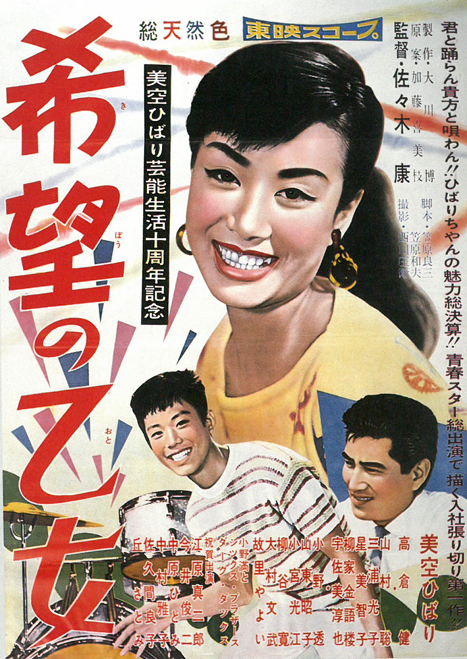
song in her heartAnother vehicle for post-war singing star Hibari Misora, With a Song in her Heart (希望の乙女, Kibo no Otome) was created in celebration of the tenth anniversary of her showbiz debut. As such, it has a much higher song to drama ratio than some of her other efforts and mixes fantasy production numbers with band scenes as Hibari takes centre stage playing a young woman from the country who comes to the city in the hopes of becoming a singing star.

After beginning with a rural, almost cowboy-style number in which Hibari appears as the well dressed lady of the manor, Sayuri, riding her horse across the wide pastureland, the action quickly moves to the city when Sayuri’s mentor finally convinces her uncle that her future lies in showbiz and not an early marriage as he had envisioned. However, once she gets there she finds her potential tutor extremely unwilling to fulfil his promise to take her on. After winning him over, she quickly makes friends with the locals who also want the singing teacher to become the leader of a band they’ve formed in the hopes of raising some money to build a proper children’s playground to stop them playing in dirty ditch land nearby which is a well known health hazard. Soon enough the band takes off but there’s more trouble ahead for Hibari and co. as they are betrayed by those closest to them.

Working as a celebration of Hibari’s career so far With a Song on Her Heart is filled with excuses for Hibari to sing both as a music student and band vocalist as well as fantasy production numbers some of which are even bigger on dance than on song. The plot is quite simple but there is a lot of it, in contrast to other films of this kind, as Hibari sets about healing the grief stricken heart of her bandleader and fulfilling the hopes of the ordinary people turned musicians through the power of song. The romance element is a light one and not the focus of the film but bears mentioning as Hibari’s love interest is played by Ken Takakura – the archetypical star of the yakuza movie who was to marry fellow singing sensation (and frequent Hibari Misora co-star) Chiemi Eri the following year.

Despite its nature as a celebratory project, With a Song in Her Heart doesn’t quite meet the high production standards of other Misora starring films. Shot in colour and in 2.35:1, the majority of the film is studio bound (often very obviously so) with simple sets and a straightforward directing style. Nevertheless, even if it fails to impress on a technical level, With a Song in Her Heart knows what it’s about and so it makes sure to fill its relatively short duration with as many songs as possible, light romance and a cheerful atmosphere of people coming together to try and solve a social problem through spreading love and joy in the form of music. The musical styles are unusually varied embracing Hibari Misora’s regular ballads as well as mixing in world influences from mariachi to african drums with a strong big band jazz undercurrent.The overall feeling is one of goodnatured wholesomeness and even if low on impact With a Song on Her Heart is a decent showcase for Hibari Misora’s talents as she celebrates her tenth year in the business at the age of only 21.