Big Time Gambling Boss (博奕打ち 総長賭博, Kosaku Yamashita, 1968)

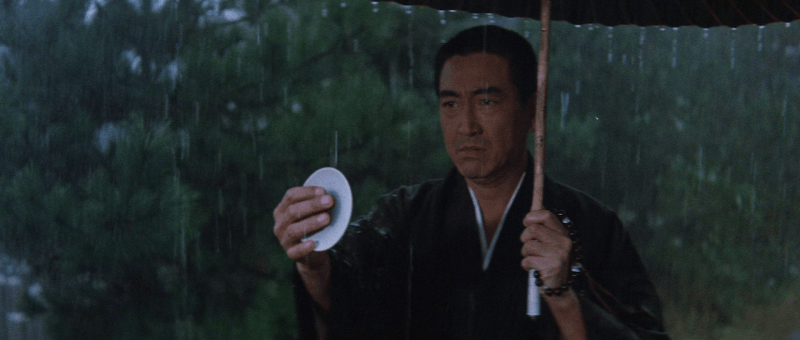
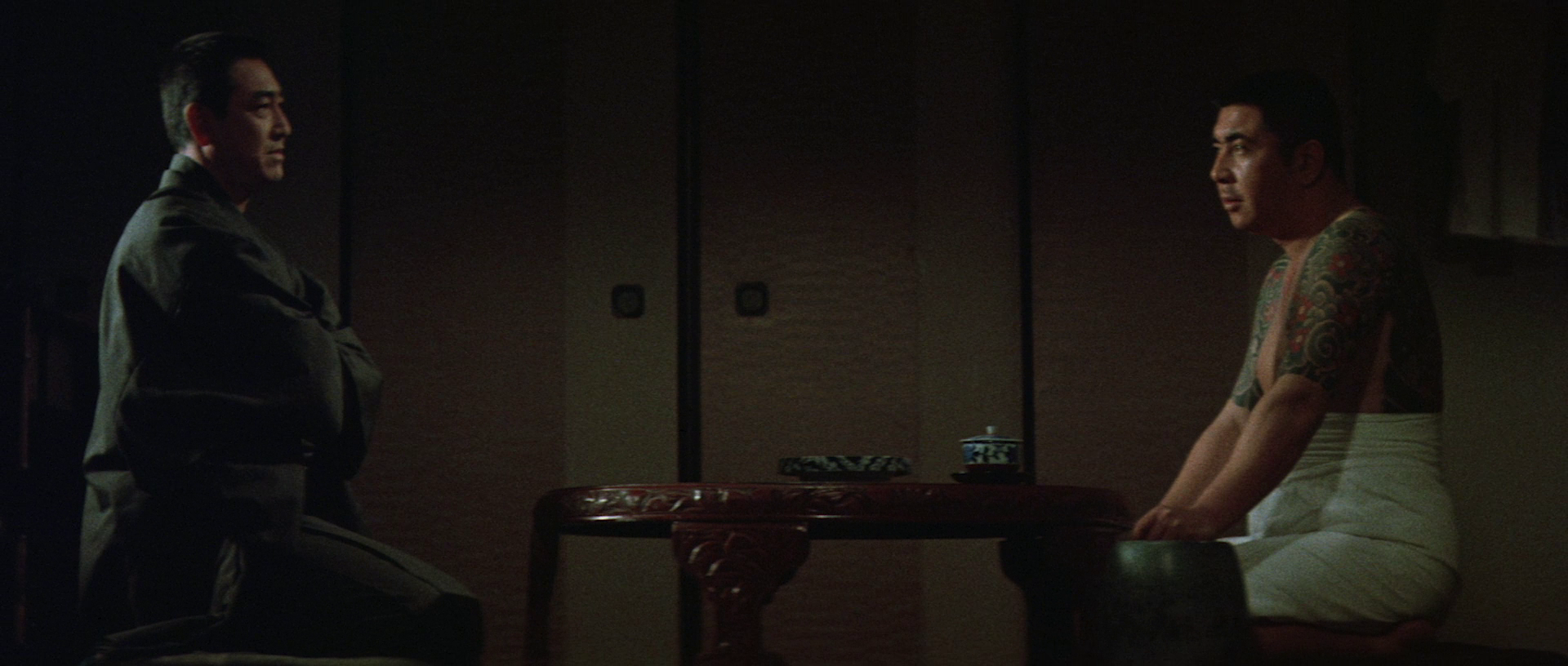
A Shakespearean tragedy of blood and honour, Kosaku Yamashita’s Big Time Gambling Boss (博奕打ち 総長賭博, Bakuchiuci: Socho Tobaku) discovers only fatalism and futility in the nobility of the yakuza code. The tragedy is that at any moment anyone could make a free choice to walk away, to abandon these arbitrary notions that convince them they must kill their friends and let their enemies go free, but they don’t because spiritually they cannot. Abandoning the yakuza code would in its own way a kind of death and mentally unsurvivable. 

There is however a greater tragedy in play. The film opens in the spring of 1934 with a villain remarking that it’s absurd to restrict oneself to one’s home terrified while a sword and the Japanese flag appear behind him. The catalyst for all this drama is Japan’s imperialist expansion. Yakuza fixer Senba (Nobuo Kaneko) and the shady Kawashima have hatched a plan to get all the yakuza clans to unite in a “patriotic” mission to traffic drugs to the frontlines looting as they go. Noble boss of the Tenryu Awakawa refuses, reminding them he’s just a simple gambling man and has no desire to get involved with politics before collapsing with a stroke. With Awakara alive but bedridden and no longer able to communicate effectively, the Tenryu decide to nominate a successor. The ideal candidate, Nakai (Koji Tsuruta), declines the offer on the grounds that he is a transplant from another gang in Osaka and thinks it would be inappropriate for an outsider to lead the clan. He proposes that his sworn brother, Matsuda (Tomisaburo Wakayama), should be appointed, though he is currently surviving a prison sentence so a caretaker should serve in his stead until his release. Most think this sensible though the proposed caretaker, Ishido (Hiroshi Nawa), also declines given the rules of seniority despite the fact that he is Awakawa’s son-in-law and so dynastic succession would also seem permissible. 

It’s during all of this finagling that Senba begins manipulating events to his advantage, gently manoeuvring the other lieutenants towards accepting Ishido as the new boss while he has no idea he’s being used as a pawn in Senba’s nefarious nationalist plotting. When Matsuda is released early, the entire situation kicks into overdrive in his outrage that the codes of rank have not been respected and that a man who is his inferior now sits at the head of the clan in a place he think’s rightfully Nakai’s but in light of his honourable refusal no one’s but his own. Even Matsuda later recognises his hot-headed recklessness in directly challenging Ishido over his decision to accept, insisting that the proper thing to do in his position would have been to persuade Nakai to take the job. Meanwhile, his own righthand man who’d been slumming it as a mere labourer in his absence, is dragged into intrigue in foolishly defending his honour by recklessly attacking Ishido’s men incorrectly believing they had provoked another gang’s attack on Matsuda little knowing it was all part of Senba’s plot. 

Nationalist trappings aside, Senba’s villainy is obvious from the moment he tells Nakai he thinks Matsuda was foolish for going to prison on the clan’s behalf and that he should have just found a scapegoat and put the blame on them, signalling himself a member of the new amoral yakuza who does not believe in giri and has no ninjo. Nakai rather is the opposite, as his old boss confirms in praising him for his correct decision to turn down the succession as it would not be right for him to accept as one who did not originate in their gang. Matsuda meanwhile pays too much attention to the letter of the code and not its spirit, obsessed with Ishido’s transgression and unable to let the matter drop to live a quiet life even as Nakai tries to convince him that the decision has been ratified by the lieutenants and the boss and so he must obey it. In a poignant moment, Nakai brings out the cup they used to seal their friendship and tells him that he will choose the clan, breaking the cup if Matsuda does not agree to accept a minimal degree of humiliation in returning with the intention of lying low and subtly reminding him that if he does not Matsuda will be placing a heavy burden on him that he may be forced to inflict lethal violence on his best friend and in fact brother-in-law. Realising the gravity of the situation, Matsuda immediately backs down, but events are now in motion that neither of them are capable of stopping. 

Of course, they could walk away but they don’t. Nakai offers the opportunity to Matsuda’s remorseful foot soldier Oto, telling him to leave the clan and take the woman he loves far away to live a peaceful life but of course he can’t because of his debt of loyalty to Matsuda. They are all trapped by the code which they follow and the villains ignore, laughing at them all the way. Then again, that’s what men like Nakai are for, born to set things right even if it comes at great personal cost. Even he finally snarls that he’s merely a murderer, rejecting any sense of honour in his actions while throwing a sword at the symbol of the system which has defined his life and submitting himself to the automatic operation of law of the state as a kind of martyr for system in which he may no longer believe. 


Trailer (English subtitles)
Ninja’s Mark (忍びの卍, Norifumi Suzuki, 1968)

Many have tried to end the Tokugawa line. Few have done so by covering a courtesan’s legs in fish scales to put the Shogun off his stride. Based on a book by Futaro Yamada, Norifumi Suzuki’s Ninja’s Mark (忍びの卍, Shinobi no Manji) is at heart a romantic tale in which love is “part of the game” but also apparently the one trick a ninja can’t escape. Perhaps that’s why Shogun Iemitsu at the comparatively late age of 30 has failed to produce an heir with any of the beautiful yet emotionally distant courtesans of the inner palace many of whom also seem to be ninjas, therefore provoking a constitutional crisis.

Aside from that, it seems the ninja plot is a kind of revenge against the Tokugawa carried out by the last remnants of a house that was dissolved by the Toyotomi. There are in fact three ninja clans all clustering around the palace, Iga, Koga, and Negoro, each of whom have different kinds of skills. Technically, some of them are in the employ of the Shogun’s disinherited younger brother Tadanaga (Shingo Yamashiro), but others of them are working strictly for themselves and their revenge. In any case, their plan is to prevent Iemitsu from fathering an heir by putting him off sex essentially by making it freaky (in a bad way). Thus one of the ninjas uses his ability to transform objects so that the courtesan’s legs are covered in fish scales. Another plan sees a ninja body swap with one of the women so that Iemitsu’s sperm ends up inside him where it obviously has nowhere to go. Meanwhile others hatch a plan to steal some of Tadanaga’s seed to use on the women in the inner palace to cover up Iemitsu’s potential infertility seeing as it is after just as good being of the Tokugawa line. 

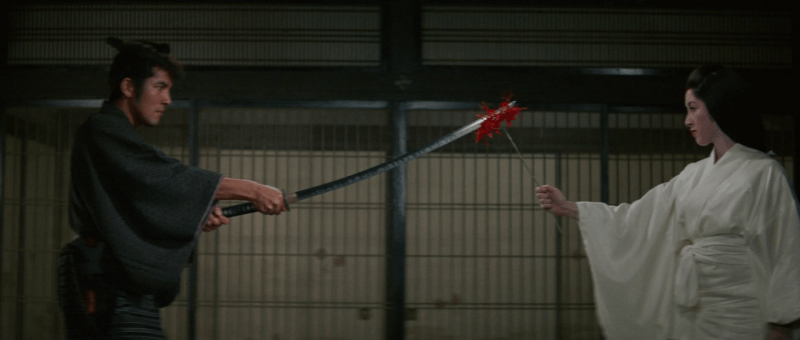
This particular ruse is suggested by Toma (Isao Natsuyagi), the disenfranchised former member of the Yagyu school turned ninja ronin they bring in to solve the problem. He quickly homes in on Kageroi (Hiroko Sakuramachi), a female ninja, as the villainess whose special power is poisoning men with love and desire by means of the spider lily plant. But as Toma points out to her, she is also a prisoner of her skill in that if she were to fall in love she would inevitably kill her lover. Of course, he survives her first attempt to kill him, leading her to fall in love with Toma and become conflicted in her mission while he plays on her emotions to escape but eventually realises they may be more genuine than he first realised. 

In this, Suzuki brings some of his trademark romanticism particularly in the colourful art nouveau aesthetics and frequent use of rose imagery. Though the film is clearly designed to lean into the erotic with frequent use of nudity and salacious scenes including a brief moment of lesbian seduction, it eventually heads towards romantic tragedy in which the debauched and nihilistic Toma and the wronged Kageroi discover a love made impossible by their ninja code and the times in which they live. Having been ordered to kill her, Toma declares that he will marry Kageroi in the next life and returns to her the Buddhist Manji that is the “ninja mark” of the title. 

Nevertheless, the dialogue is often suggestive as in Kageroi’s curse that Toma’s “sword” will rot, while it’s also Toma’s “sword” that alerts him to the danger she presents. Toma too claims to derive his ninja powers from his “sword” having apparently concentrated them by repressing his sexual desire and swearing off women. He says that he seals all his “distracting” thoughts into a virgin, closing off all her senses and placing her into a coma until he breaks the spell. Even so, he admits that without his “sword” he is just a man, and as a man claims to love Kageroi, but as long as he has his “sword”, and she her “lily”, their love is impossible. 

But this repressed love seems to pose less threat to the social order than the lack of it in Iemitsu who is bored with his courtesans and cannot conceive an heir. Constitutional crisis is averted only through a little ninja trickery and a convenient ruse to overcome Iemitsu’s infertility so that in time he produces five sons and a daughter, which honestly seems like it might just present another set of problems in about 30 years’ time. Like similarly themed ninja pictures, Suzuki makes good use of surrealist imagery and colour play alongside the kind of onscreen text later used in jitsuroku yakuza films to name each of the ninja’s key skills and which clan they belong to. What he always returns to, however, is the sense of romantic tragedy in a world seemingly poisoned by ambition in which love itself is rendered an impossibility. 


*Norifumi Suzuki’s name is actually “Noribumi” but he has become known as “Norifumi” to English-speaking audiences.

Cantankerous Edo (大江戸喧嘩纏, Kiyoshi Saeki, 1957)

A noble-hearted samurai on the run falls for a fireman’s sister in Kiyoshi Saeki’s hugely enjoyable jidaigeki musical adventure Cantankerous Edo (大江戸喧嘩纏, Oedo Kenka Matoi). Another vehicle for Hibari Misora and samurai movie star Hashizo Okawa, Saeki’s wholesome drama finds its heroes not only standing up to the oppressions of a rigid class system but also taking on a bunch of entitled sumo wrestlers intent on throwing their weight around having apparently lost sight of the tenets of traditional sumo wrestling such as fighting for justice and having a kind heart. 

To begin at the beginning, however, young samurai Shinzaburo (Hashizo Okawa) is on the run believing that he has accidentally killed another man who attacked him in order to clear the path towards his fiancée, Otae (Hiroko Sakuramachi), whom he wasn’t going to marry anyway because he realised she was in love with someone else and wanted to help marry him instead. Having escaped to Edo, he takes refuge inside a parade of firemen lead by Tatsugoro (Ryutaro Otomo) and his feisty sister Oyuki (Hibari Misora) who decide to take him in after hearing his story. Adopting the simpler, common name of “Shinza” he begins life as a fireman and gradually falls for Oyuki but remains a wanted man constantly dodging the attentions of his uncle, the local inquisitor, and the magistrates. 

More a vehicle for Okawa than Misora who plays a relatively subdued role save for boldly stealing the standard and climbing a roof herself when the others are delayed, Cantankerous Edo takes aim not particularly at a corrupt social order but of the oppressive nature of class divisions as Shinza discovers a sense of freedom and possibility he was previously denied as a samurai while living as a common man. It’s this desire for personal autonomy and the freedom to follow one’s heart that led to his exile from his clan, unwilling to marry a woman he knew not only did not love him but in fact loved someone else and would have been forever miserable if forced to marry him out of duty alone. “The life of a samurai who has to be somebody or not to suit another’s convenience is utterly stupid” he bluntly tells his uncle and Otae’s father, “how you cling onto family status, heritage, and honour. All that fuss, I hate it.” he adds before turning to Otae and encouraging her too to stand up to her father and insist on marrying the man she loves rather than be traded to another. 

Meanwhile, the two women exchange some contradictory messages about the nature of class and womanhood, the samurai lady Otae confessing that she isn’t sure she’s strong enough to fight for love in the face of tradition and filial duty in contrast to Oyuki’s spirited defence of Shinza the fireman insisting that firemen don’t think about such trivial things as name or family status before throwing themselves into harm’s way for the public good. “All women are weak” Otae sighs, Oyuki replying that they need to be strong for the men they love, “that’s what it means to be a woman”. Love may be in this sense a force of liberation, destabilising the social order but also a means of improving it, yet it still reduces women to a supporting role ironically as perhaps the film does to Misora who in contrast to some of her feistier performances takes something of a back seat. 

Romance aside, the main drama revolves around a conflict between the local sumo wrestlers who have turned into thuggish louts under their boorish leader Yotsuguruma (Nakajiro Tomita), taking against the fireman and forever spoiling for a fight. The samurai proving unexpectedly understanding, the sumo wrestlers become the main source of oppression in usurping a class status they don’t really have. The noble Tatusgoro tries to stave off the fight insisting that they aren’t brawling yakuza but responsible firemen here to serve the public good and should save their energy for fighting fires rather than their obnoxious neighbours. Nevertheless the fight cannot be held off forever. Tatsugoro is forced to redefine the nature of “fire” after hearing a warning bell informing him one of his men is in grave danger unable to manage their anger anymore.  

Saeki’s jidaigeki musical has surprisingly good production values for a Toei programmer, making space for a few songs along the way celebrating the valour of the firemen while Oyuki meditates on her potentially impossible romance and the perils of love across the class divide. While the conclusion may end up ironically reinforcing the hierarchical society, it does however make the case for the right to romantic freedom along with the necessity of human compassion in the face of inconsiderate arrogance and intimidation.


Note: This film is sometimes titled “Fight Festival in Edo” but according to Eirin’s database, the official English-language title is “Cantankerous Edo”. Rather confusingly, a very similar film with a very similar title (大江戸喧嘩まつり) was produced in colour at Toei in 1961 and is known as “Fight Festival in Edo” in English. Meanwhile, Hibari Misora also starred in another colour film with a very similar storyline in 1958 (唄祭りかんざし纏) which is known as “Girl with the Fire Banner” in English but listed as “Festival of Song” on Eirin’s database.

The Young Boss (花笠若衆, Kiyoshi Saeki, 1958)

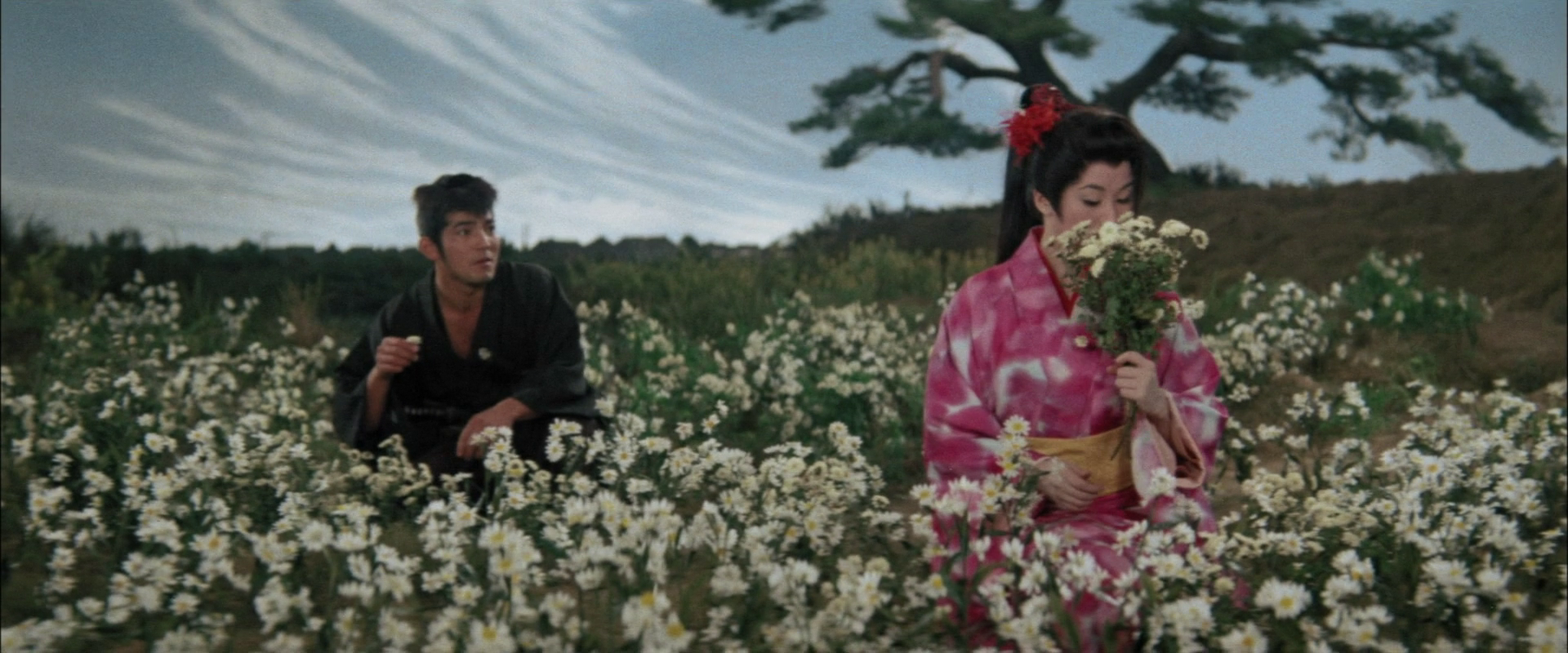
Hibari Misora takes on yet more Edo-era corruption in Kiyoshi Saeki’s musical adventure, The Young Boss (花笠若衆, Hanagasa Wakashu, AKA A Martial Crowd, Twin Princesses). A program picture director at Toei, Saeki mainly worked on jidaigeki and ninkyo eiga launching the Brutal Tales of Chivalry series, though he also became a frequent collaborator with Misora ironically enough mostly working on her contemporary films in which she often starred opposite Ken Takakura, representative actor in the noble gangster genre. Young Boss, however, is a jidaigeki musical adventure very much typical of those Misora was making at Toei at the time and once again finds her playing dual roles as a pair of twins separated at birth because of superstition and social stigma.

Opening and closing at a local Edo festival, the film introduces us to the second generation of Edoya Kichibei, Kichisaburo (Hibari Misora), as he steps in to protect a young woman who has accidentally annoyed a bunch of yakuza fulfilling his sidekick’s introduction that he “helps the weak and crushes the strong”. Kinpachi (Juro Hoshi) also describes him as a “man’s man”, though as we discover Kichisaburo is not a man at all but the niece/adopted daughter of a prominent merchant apparently raised as a boy. Kichisaburo, however, only learns this when a pair of samurai turn up to badger Kichibei about the whereabouts of his younger sister, Sano, who apparently served as a maid to the Ogiyama clan 18 years previously but was cast out with her younger daughter Yuki after giving birth to twin girls fathered by the lord. The other twin, Chiyo (also Hibari Misora), was raised in luxury in the palace and in the absence of a male heir and the lord’s failing health is in line to inherit the clan. As usual, however, courtly intrigue has led some to conclude that Yuki’s is the proper the claim. Kichibei attempts to convince them that Yuki passed away in infancy shortly after her mother and that he burnt her birth certificate, but the resemblance between the effete Kichisaburo and the lady Chiyo has not gone unnoticed both by the visiting samurai and the handsome Matanojo (Hashizo Okawa) who joins in with Kichisaburo’s battle against the yakuza and is in fact the betrothed husband of Chiyo. 

Lady Chiyo appears only briefly but is the soul of courtly kindness, hugely regretting what has befallen her absent sister and affirming that should she return she would instantly surrender her claim to the clan in guilt that she has been raised in such luxury when Yuki was cast out to live with strangers. The dual roles in a sense reflect a perfect whole, Lady Chiyo’s feminine elegance contrasted with the rough Kichisaburo who has not been raised as a samurai but a merchant’s son like his sister set to inherit the family business. He is very attached to his adopted father, but also possesses a strong sense of justice often ignoring his pleas to stop getting into fights. Other than perhaps to disguise her true identity, there is no real explanation for why Kichisaburo has been raised as a boy though it seems that there would have been a time the ruse came to an end, Kichibei sadly lamenting that perhaps he has been jealously attempting to keep the child he loved so much with him against her better interests but explaining that he would have found her a nice husband in time, perhaps like that gallant samurai Matanojo.

Teaming up with him for purposes of revenge and justice, Kichisaburo begins to develop feelings for Matanojo though Kichibei reminds him that a townsperson would be “unfit to be a samurai’s wife”. Most of Misora’s films in which she stars as a feisty young woman see her undergoing a softening, drawing closer to conventional femininity often with marriage or at least a romance with a manly man on the horizon. The Young Boss meanwhile flirts with just this conclusion as Kichisaburo becomes Yuki while out on the road with Matanojo, dressing as an elegant princess and experiencing a vivid dream sequence in which she becomes his wife, but ultimately highlights the class rather than gender barriers between them in allowing to Yuki to return to her previous life as Kichisaburo while Chiyo remains a samurai noblewoman in a seemingly perfect mirroring which also represents a return to order. 

Nevertheless, Misora finds numerous occasions for a cheerful song even in her manly guise finally even beating a taiko drum at the closing festival while joining in with several elaborately choreographed sword fights along the way with her customary gusto. A bittersweet ending, perhaps, but one in which Misora makes division of herself and unusually is allowed to remain feisty, defiant, and independent helping the weak and crushing the strong in an ever duplicitous Edo.


Musical number (no subtitles)

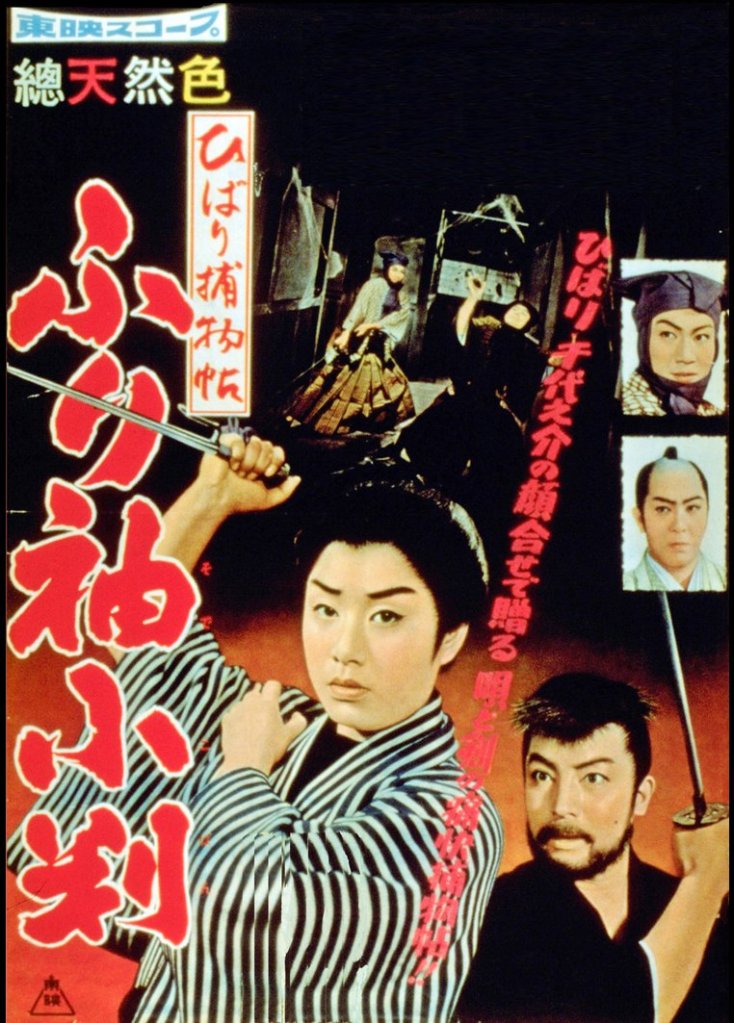
Detective Hibari 3: Hidden Coin (ひばり捕物帖 ふり袖小判, Kokichi Uchide, 1959)

Hibari Misora returns as Oshichi in another adventure for the Edo detective, this time becoming embroiled in a conspiracy against the Shogunate which she continues to serve. By this third instalment in the Detective Hibari series, Hidden Coin (ひばり捕物帖 ふり袖小判, Hibari Torimonocho: Furisode Koban), Oshichi is no longer hiding her noble birth as an esteemed princess, but is living as a singer/law enforcement officer under her “common” name, and upholding the interests of “common” people suffering under “corrupt” samurai oppression but, paradoxically, very much upholding the system which enables it.

The conspiracy in which Oshichi becomes involved this time around is concerned with the plot to overthrow the Shogunate. Rebel forces manage to ambush a convoy carrying tax money to the government, hoping to use the money to buy guns from the Dutch to aid their revolution. As only one of the retainers survives, he will be held responsible for the loss of the money and almost certainly asked to commit ritual suicide, but the Ota clan and most particularly retainer Kennoshin (Kotaro Satomi), are worried about the man’s daughter, Misuzu (Atsuko Nakazato), to whom he was very close. Oshichi becomes involved when she hears of an entire household being murdered and their funds stolen, while a lone pickpocket is found dead with a precious gold coin lying nearby. 

Before discovering the crime, Oshichi and her trusty sidekick Gorohachi (Takehiko Kayama) are talking to a kabuki actor who is about to undergo a succession ceremony which will cost a significant amount of money – 1000 Ryo. Gorohachi is mystified, wondering how many years he’d have to work in order to find that kind of money, while the two pickpockets outside wonder something much the same. The older of the two, Oshima (Keiko Yukishiro), wants to make sure the actor gets his money and has been desperately trying to get in touch with him but he is too snooty to see her. Oshichi starts connecting the dots between the pickpockets and the conspiracy to find a vital clue, but once again is keen to stress that “the law can be merciful too” as she both ensures that Oshima faces justice and allows her to find emotional fulfilment in revealing her true identity and finally seeing the show. 

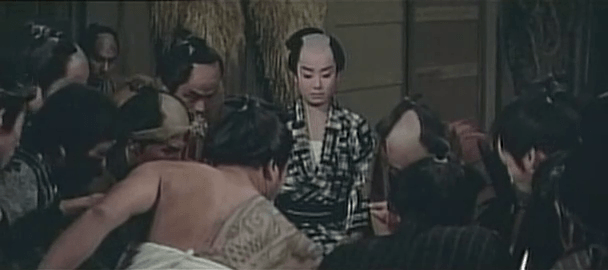
Meanwhile, despite outwardly dressing in manly, action friendly outfits, this Oshichi is one more romantically inclined, fretting over the fate of her brother’s retainer Hyoma (Chiyonosuke Azuma) who, she thinks, has left his employ and become a drunkard. The drunken downward spiral of his life turns out to be a kind of undercover assignment, but provokes a little jealousy in Oshichi as she sees him “protecting” other women at a nearby restaurant, one of whom turns out to be Misuzu who holds a few more pieces of the puzzle. Vowing to save Misuzu and stop the conspiracy, Oshichi adopts a male persona complete with top knotted wig and takes on an entire boatload of sailors who stupidly tell her that they’re shipping out that very night. 

Oshichi rescues Misuzu and gets the money back, saving her father and “restoring” the status quo, but it’s difficult to see which side she should be on in this fight. As Gorohachi perhaps implies, it’s not exactly fair or responsible for the samurai class to be hoarding all these vast amounts of money, or for it to be necessary to spend the annual salaries of several ordinary people on an extravagant celebration for an actor’s promotion. We’re told that the rebels are “evil” and villainous, and they do indeed seem to be cruel and self-interested, willing to sacrifice anyone and everyone to achieve their goal, but it’s difficult to argue with the desire to stand up to this inherently oppressive system in which samurai corruption is the expected norm. 

Insisting that “the law can be merciful”, Oshichi serves a kind of moral justice, rescuing the innocent Misuzu and saving her wrongfully abused father while unmasking samurai corruption, but she remains a loyal servant of the Shogunate and a part of the system into which she was born. Oshichi has been permitted escape from her own oppression thanks to her “compassionate” brother who has allowed her to live freely in the city rather than pressuring her to marry and conform to the feminine norm, but living outside it herself seemingly has no sympathy for those who wish to reform the system and seeks only to preserve it. Having successfully solved the mystery, she reassumes her femininity and retreats into the cheerful festival atmosphere arm in arm with a clean shaven Hyoma finally embracing her romantic dream in an Edo freed from immediate strife. 


Short clip (no subtitles)

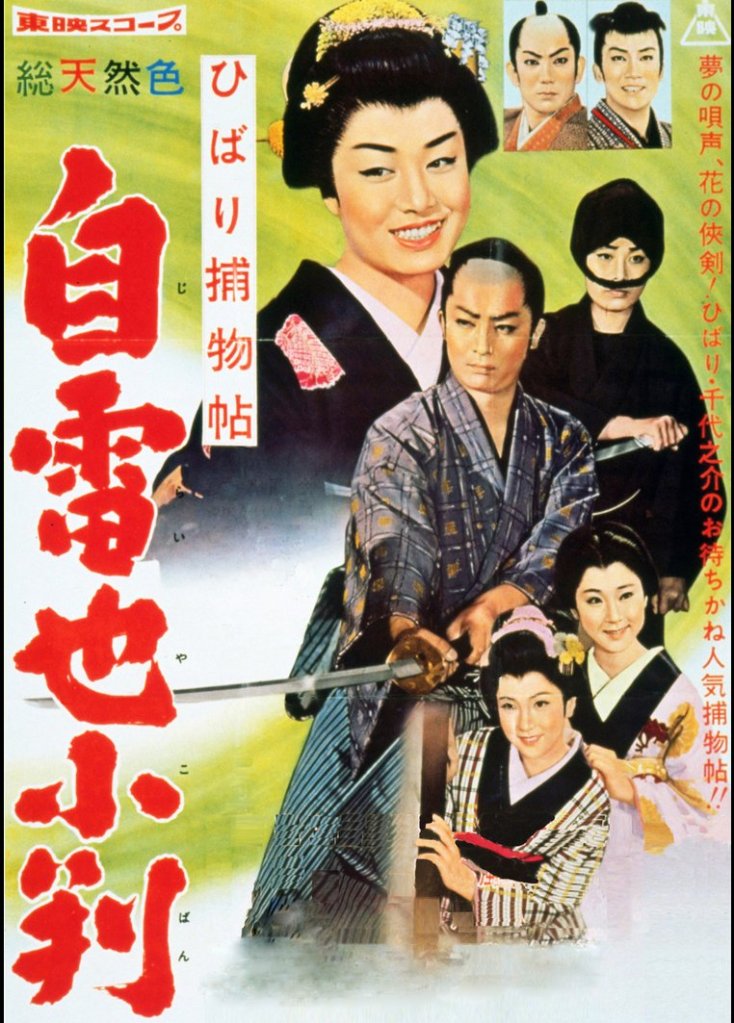
Detective Hibari 2: Secret of the Golden Coin (ひばり捕物帖 自雷也小判, Kinnosuke Fukada, 1958)

Oshichi returns! Two years after her first adventure, the princess in hiding has moved on, still living in the city hiding from the burdens of privilege but fiercely opposing injustice wherever she finds it as a detective in her own right. Unlike Mysteries of Edo and in keeping with Case of the Golden Hairpins, this Oshichi undergoes much less of a softening, remaining largely disinterested in the idea of romance, and cooly rebellious in her refusal to be cowed while strangely OK with Shogunate oppression as a quasi-agent of the state. 

As the film opens, a young woman impersonates Oshichi in order to gain entrance to a prison where her boyfriend is in jail for rebelling against the Shogunate. Meanwhile, Oshichi (Hibari Misora) is teaching a singing class as a favour to her boss who had to go out on an errand, after which she discovers that Hyoma (Chiyonosuke Azuma), currently a retainer of her brother’s, has been sent to bring her home. Once again she refuses because she likes her “ordinary” life. Shortly thereafter, a fire breaks out in the prison and the rebels escape. Oshichi becomes a prime suspect in the jailbreak, not only because the accomplice borrowed her name but because it’s advantageous to the plotters to blame her because they can use her guilt to tarnish her brother’s reputation and get him fired, usurping his position in the process. 

Oshichi, now working as a detective, is technically an agent of the Shogunate against which the rebels are rebelling for reasons which aren’t stated here but are probably easy to guess. They are, in many ways, the same sorts of reasons that Oshichi chose to become a detective, even if she’s coming at them from the other side. She doesn’t like bullies, or corruption, injustice or unfairness. Oshichi won’t stand for unkindness either, which is perhaps why she aligns so strongly behind the woman who blackened her name by impersonating her, knowing that she did it all for love and a little bit for justice, while also forgiving the rebel Seinosuke (Kotaro Satomi) who was preparing to kill the woman he loved because the corrupt samurai had kidnapped his dad and threatened to kill him if he didn’t. 

Despite all that however, Oshichi still insists that “the Shogunate can be compassionate too”, encouraging Seinosuke and his girlfriend Namiji (Hiromi Hanazono) to tell all so she can help them safe in the knowledge that they will be forgiven. It’s a slightly strange position for to her take, essentially authoritarian but arguing for a benevolent paternalism that is just and fair and kind, insisting that the corrupt samurai are bad apples which must be expelled rather than a product of an inherently oppressive social system as they are generally depicted in post-war jidaigeki. 

This insistence on the “compassion” of the Shogunate is perhaps the concession to Oshichi’s femininity which she has otherwise rejected in rejecting her life as a cosseted princess. As Kawashima had in Mysteries of Edo, Oshichi’s “protector” Hyoma asks her how she can take on all those men before challenging her to a contest of masculinity as mediated through a drinking competition which she does not exactly “win” but makes a minor victory all the same. Rather than rely on her brother or Hyoma, Oshichi vows to clear her name herself and starts investigating on her own dressing as a man and fighting bad guys while insisting on her independence. 

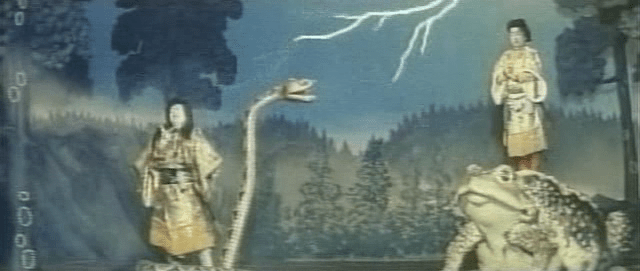
Nevertheless, she is but a pawn in a game of courtly intrigue, manipulated as a means of getting to her brother. The corrupt samurai think nothing of killing anyone who gets in their way, be they princesses or peasants, even going far as to mount an attack on the stage of a theatre mid-performance in front of a room full of spectators, many of whom join Oshichi by throwing projectiles as she tries to fend them off. Once again, she isn’t quite permitted to save herself but is “rescued” by the patriarchal forces representing the greater Shogunate including her protector Hyoma, and her brother, the embodiment of state authority. She is, however, the primary motivator in unmasking the corruption as she both clears her own name, and creates a better future for Namiji in which she can be with the man she loves, reminding her to always remember the compassion the Shogunate has shown her (in case she was minded to mount any more rebellions). As for herself, she manages to slip the loop once again, running off into the wild to claim her independence rather than be forced back into the golden cage of her princesshood while the loyal Hyoma contents himself with following her lead. 


Short clip (no subtitles)