Bonds of Love (愛のきずな, Takashi Tsuboshima, 1969)

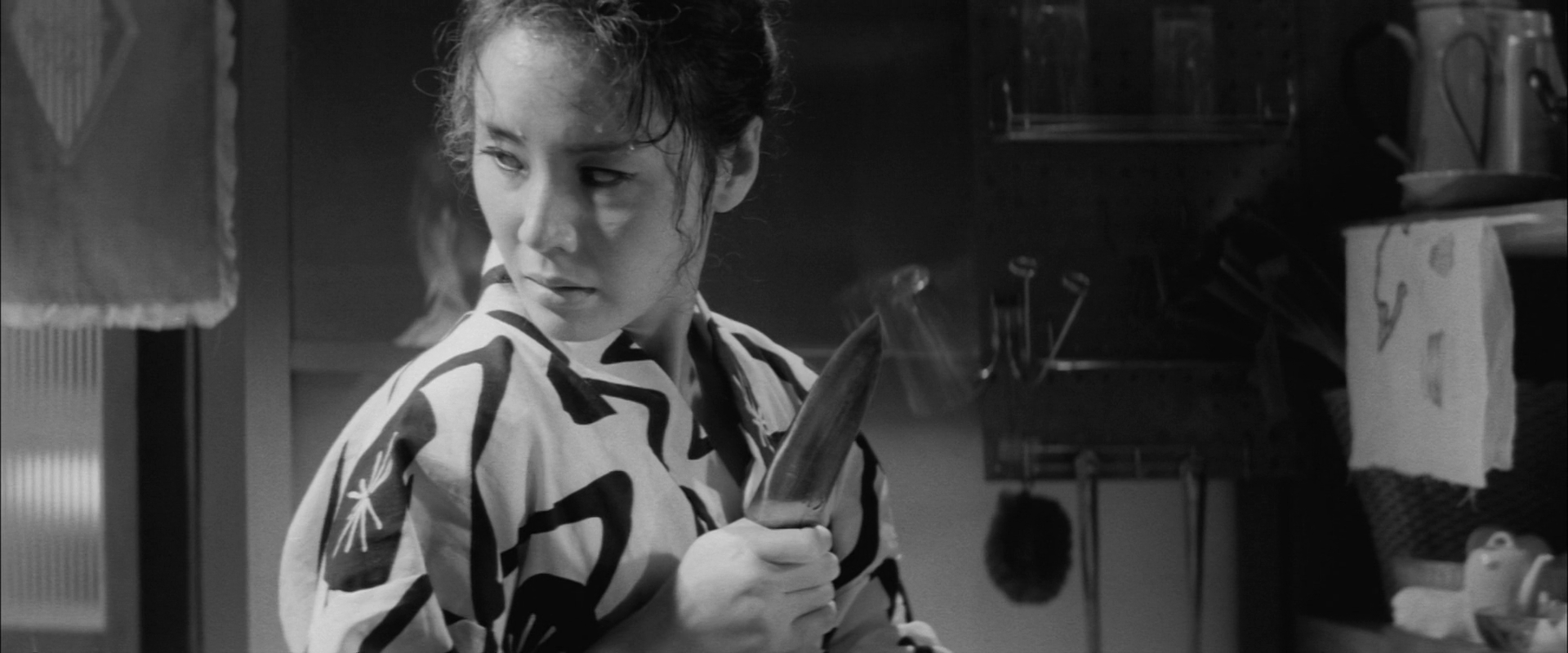
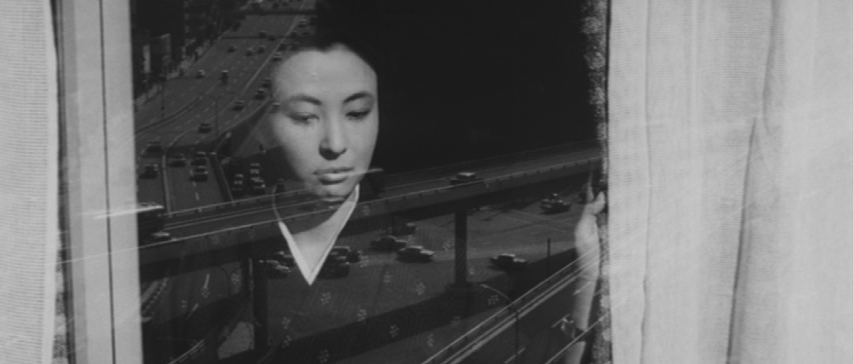
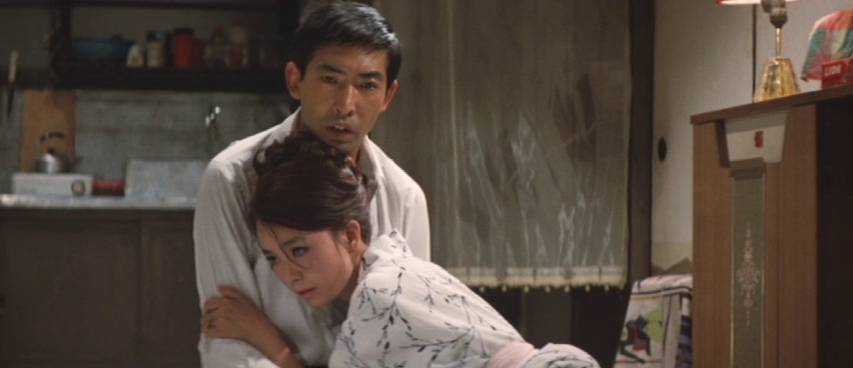
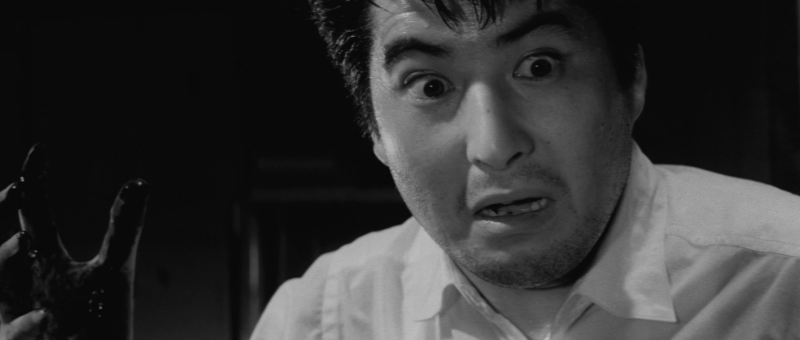
On a rainy night, a salaryman trapped in a loveless marriage and unsatisfying career chances on a beautiful woman dressed in kimono waiting by the side of the road. He decides to double back and offer her a lift, which she ill-advisedly accepts, but as it turns out he is actually the one in danger. Adapted from the Seicho Matsumoto short story Tazutazushi, The Bonds of Love (愛のきずな, Ai no Kizuna) has underlying misogyny that paints the woman at its centre as a sort of elemental spirit who bewitches men and leads them to their doom even while the hero himself is selfish and insecure, mired in an inferiority complex and incapacitated by wounded male pride.

The fact that Ryohei (Makoto Fujita) is already married comes as a bit of a shock, abruptly revealed as it is by the nameplate on the suburban home he returns to after a date with Yukiko (singer Mari Sono) having told her that he lives alone at the company dorm. It seems obvious that he’s dissatisfied with his domestic life and fed up with his overly materialist wife Sanae (Chisako Hara) whose constant gripes only seem to needle at his sense of inadequacy. Today, she’s misplaced an expensive ring he’d used his annual bonus to buy her and when he notices it simply sitting next to the sink, she remarks that it’s not all that nice anyway. Ryohei at least feels that she resents him for not being more successful and having the financial power to buy her the frivolous gifts and status symbols she clearly desires. The power dynamic is in any case unbalanced because Sanae is the daughter of his boss which means she in effect has total control over his career. One word to her father, and he’s toast, but at the same time she can only help him so far with his advancement despite nagging him constantly about his future prospects. Meanwhile, the other men at the office make fun of him. They describe Ryohei as an idiot who’s only in his position by virtue of being the boss’ son-in-law. 

This of course further needles at his wounded male pride, but dating Yukiko, who adores him completely, on the side restores his sense of masculinity. After he claims to have been staying out late playing mahjong, Sanae cautions him that one of his colleagues is being transferred because of his gambling and womanising habits. At his leaving do, Miyata (Sachio Sakai) lays into Ryohei and says he’s the one who taught him how to pick up women and pretend to be single as if this is the way they overcome their sense of impotence while under the company’s thumb. Ryohei appears not to like him, perhaps because he reflects the qualities in himself he is least proud of. The news of his transfer therefore spooks Ryohei knowing that the same fate may befall him if his affair with Yukiko is exposed. 

But when Sanae does eventually suspect he’s cheating on her and complains to her mother, the boss rings Ryohei and basically tells him not to worry about it because a man’s not a man if he doesn’t play around. The conflict that Ryohei has is essentially one of conflicting masculinities, the one in which he is effectively emasculated but defines his status through a hierarchical relationship with other men within the corporate structure, and the other in which he defines it through romantic conquest which also represents a kind of freedom. But being a fairly conventional man, in the end Ryohei cannot bear to have his salaryman persona ripped away from him and will do whatever it takes to maintain his relationship with his wife and by proxy his boss to preserve his career.

Realising Yukiko poses a threat to that, he decides the only solution is to kill her but it’s also true that he’s confronted by a much more robust vision of masculinity in the form of her estranged husband Kenji (Makoto Sato) who went to prison after stabbing another man in a jealous rage. It’s clear that Ryohei is afraid of Kenji and definitely doesn’t want to end up getting stabbed. His “love” for Yukiko does not stand up to that kind of scrutiny and it’s her assertion that she’s going to tell Kenji all about their affair and ask for a divorce that shifts him into crisis mode. After all, he’s in flight from domesticity. Leaving Sanae, and with it destroying his career might not solve his problems even if what he eventually chooses is just that, to be free of the burden of the salaryman dream and move to a small town to open a shop with a woman who is in thrall to him and therefore continually submissive and loving in contrast to Sanae who only ever makes him feel small.

Yet, we can’t actually be sure how much of what happens later is actually real or just Ryohei imagining things because of his guilty conscience and continuing sense of inadequacy. Essentially, he gets a second chance to make better choices and finally gains the courage to abandon his salaryman persona only to be immediately confronted by both his transgressions and violent masculinity. Tsuboshima crafts an atmosphere of malevolence and noirish dread coupled with a spiritual sense of retribution born of the constant rains and gothic thunderstorm that heralds the final confrontation in which Yukiko is herself a harbinger of death leading weak willed men towards their doom to which they go all too willingly. 

Jungle Block (地図のない町, Ko Nakahira, 1960)

The contradictions of the post-war era are thrown into stark relief in the forced redevelopment of slum area on the edge of an increasingly prosperous city in Ko Nakahira’s intense noir, Jungle Block (地図のない町, Chizu no nai Machi). The slightly unfortunate English title may hark back to that chosen for a US screening of Nakahira’s landmark film Crazed Fruit, Juvenile Jungle, or just echo the titles of classic Hollywood noir movies such as Asphalt Jungle and Blackboard Jungle, but otherwise has little to do with the content of the film. The Japanese title, meanwhile, means something like “a town not marked on the map” and hints at the invisibility of those who live in this slum, a self-built post-war shantytown inhabited by those largely left behind by the nation’s rising prosperity. 

Then again, Shinsuke (Ryoji Hayama) seems to have fallen behind on his own account. We’re later told that he resigned from his position at the hospital because of some kind of medical mistake for which he blames himself and has since taken to drink and gambling while working at the poor clinic run by his former mentor Kasama. The most immediate effect of his, perhaps unnecessary, decision to resign was that it prevented the marriage of his younger sister, Sakiko (Kazuko Yoshiyuki), as he was then financially dependent on her. Having delayed the wedding for two years waiting for Shinsuke to pull himself together, Sakiko and her fiancé are set upon by local gangsters working for yakuza turned politician and legitimate businessman Azusa (Osamu Takizawa). Sakiko attempts to take her own life and the relationship does not survive this crisis thanks to her fiancé’s wounded masculinity in having been unable to save her or stand up to the goons afterwards. 

As repeated flashbacks reveal, Azusa is the root of the disease spreading across the city. It’s he that’s intent on clearing the slum, as he says just doing what the government has asked him to do, planning to build luxury apartments on its site along with supermarkets and entertainment facilities. Perhaps it’s not an entirely bad thing to clear a slum, the living conditions are in themselves a health hazard, but Azusa has drastically cut the amount of compensation on offer preventing the residents from securing new places to live and essentially rendering them homeless which defeats the humanitarian justification for forcing them out when most of them don’t want to go. 

Kayoko (Yoko Minamida), an old flame of Shinsuke’s who’s since become a sex worker to pay off her father’s debts to loan sharks and ends up as Azusa’s mistress, has a cat that she confesses to mistreating which makes her feel better only to feel terrible afterwards. The film seems to align the cat with the people of the slums who are bullied by men like Azusa who have untold influence buying off police and politicians while he himself later holds public office. The cat eventually fights back by scratching Kayoko who acknowledges it’s her own fault for her treatment of it, while it’s clear that the anger of the slum dwellers will eventually boil over and they too will strike back against the corruptions of this post-war era which otherwise sees fit to leave them behind. 

Meanwhile, Shinsuke plots a revenge he may not have the courage to take explaining to Kasama (Jukichi Uno), otherwise the voice of moral reason, that it’s the city that sick and the only way to save it is an operation to remove the Azusa-shaped tumour that’s currently killing it. It’s not for mere convenience that his weapon of choice is a scalpel. Kasama, however, tells him that he’s got the wrong idea and it’s their responsibility as doctors to take the long-term view and patiently run their clinic to produce results in the far off future. But Kasama’s eventual decision would seem to walk that back, suggesting that perhaps a radical solution really is necessary to save the patient from the ravages of amoral capitalism. 

Then again, like Kayoko’s father Yoshichi (Jun Hamamura) who is branded a “cripple” and “only half a man” by Azusa, Shinsuke begins to realise that perhaps you can’t create lasting change on your own and taking out Azusa won’t solve the problem as someone else will simply rise to take his place. There is a pervasive sense of hopelessness, Shinsuke caught and frantic amid the dim backstreets of this rundown town desperate for revenge when the police are in league with Azusa and no one really cares about the residents of the slum who are beginning to lose the will to resist. Nevertheless, eventually rediscovering himself Shinsuke opts to follow Kasama’s path insisting that will join the ranks of “good, honest, people” who, like the cat, will eventually scratch back until then resisting by “doing the right thing” even in the face of violence and intimidation while staunching the flow of corruption and cruelty from the seeping wounds of the post-war society.


DVD release trailer (no subtitles)

Wolves of the Night (夜の狼, Yoichi Ushihara, 1958)

A cold-hearted yakuza starts to get second thoughts when confronted with the misery his actions create in Yoichi Ushihara’s slice of Nikkatsu Noir, Wolves of the Night (夜の狼, Yoru no Okami). Though the hero is ostensibly Tsukida (Ryoji Hayama), the conflicted gangster unable to reconcile himself with the fact that he has fallen in love with a women he himself destroyed, it’s equally about the women who get caught in the crossfire of a burgeoning gang war and are each victims of male greed and indifference.

In any case, gang boss Tachibana (Somesho Matsumoto) brings a lot of this on himself. The secondary narrative revolves around a woman, Takako (Mari Shiraki), who borrowed money from the Manji gang to build her bar, but now that it’s complete Tachibana swindles her by calling in the debt and foreclosing on the property, passing ownership to Tsukida with instructions to kick Takako out. She, however, doesn’t take well to this and is resentful of Tachibana for screwing her over so she vows revenge. Her original attempt to get it by seducing Tsukida doesn’t work out, so she recruits a yakuza from a rival gang to extort them claiming that they have mole and he’ll only reveal their identity when they hand over the cash. This plan has some pretty tragic consequences and not least for Tachibana himself, but none of this would have happened if he hadn’t behaved so badly in cheating Takako out of the bar she worked so hard to build. He’d also told Tsukida that the bar owner was a beauty and it was understandable if wanted to try seducing her. 

But by this point Tsukida has developed a fondness for Katsumi (Izumi Ashikawa), a young woman he first meets when she’s caught by some of his guys offering herself for sex work in their territory. The other ladies describe Katsumi as “odd” and “an outsider”. It’s clear from her behaviour and the way she’s dressed, not to mention a lack of awareness of the rules of the gang, that she’s never done this before and is terrified. Tsukida calls his men off and tells her to go home, but later realises that it’s his own fault she was put in this situation because he was responsible for collecting the debt her parents owed to Tachibana taken out because her father is bedridden. Tsukida seems shaken by the old lady’s intense resentment, but still takes their money if attempting to convince Tachibana not to pursue them any further because they have nothing left to give, correctly assuming that Katsumi resorted to sex work to get the money. 

It maybe the sense of guilt that proved the last straw as the old couple then take their own lives but rather than freeing her lead Katsumi on a lonely path of self-destruction driven only by her hated for Tachibana and Tsukida. The fact that she later becomes ill further emphasises her positioning as a symbol of a despoiled nation poisoned by the ruthless inhumanity of the post-war society, along with literal a embodiment of Tsukida’s guilty conscience. Tsukida rejects Takako as a person more like himself, an example of corrupted femininity using her body to manipulate men in a world in which a woman has little other power, and instead is drawn to Katsumi who was once innocent, demure, and cheerful but who he himself has destroyed through his own greed and heartlessness.

Spending some time in hospital following a failed suicide attempt seems to heal her in body body and soul, though the total about face in Katsumi’s feelings for Tsukida seems somewhat bewildering even if he did visit her every day and presumably win her over despite her resentment towards him for contributing to her parents’ deaths. Nevertheless, it’s his feelings for Katsumi that see Tsukida longing to quit the yakuza and retreat to the country to live a small, honest life with her free of the city’s corruption. But as so often in the movies, it’s not that simple and this time it’s a tragic consequence born of male failure and insecurity that eventually costs him his shot at a normal life even as his frenemy, a local policeman he often sees in the same bar and gives him unsolicited advice about how he should quit the yakuza, remains surprisingly supportive suggesting that his redemption may merely be on hold rather than cancelled. In any case, though shooting almost entirely on stage sets, Ushihara makes good use of stock footage of contemporary Ginza as a place of bright lights and equally dark shadows where gangsters lurk on every corner and mercy is in desperately short supply.

Beast Alley (けものみち, Eizo Sugawa, 1965)

In the opening title sequence of Eizo Sugawa’s Beast Alley (けものみち, Kemonomichi), a thick blob of inky blackness gradually expands over an aerial view of the city until it obscures it entirely. The title card which then appears is written in plain white, but will reappear at the film’s conclusion this time ashen as if it too had been singed by the deeply ironic flames with which the film ends. Based on a novel Seicho Matsumoto and scripted by The Beast Shall Die’s Yoshio Shirasaka, the film similarly takes an incredibly cynical view of the modern post-war society in which it is revealed the militarists are still basically in charge and presiding over a deeply corrupt social order. 

The big bad, Kito (Eitaro Ozawa), says as much when he states the need for reforming the nation’s “rotten political system” by which he means post-war democracy. Kito made his made his money doing deeply dodgy things in Manchuria in addition to running an exploitative coal mine in Japan. Now mainly bedridden, he basically runs the country as a far-right political fixer working in tandem with big business and the yakuza who have traditionally been big supporters of conservative and nationalist forces. Early on we see one of his underlings negotiating with politicians to ensure that Taiyo Roads will be hired be hired for a large scale construction project planning to put highways all the way through Tokyo. As we later discover, he’s prepared to go to great lengths in order to achieve his goal, going so far as to have a sex worker murdered to implicate the uncooperative CEO of a rival construction film into resigning by threatening to frame him for the crime so they can install their stooge in his position. 

It’s into this world that everywoman Tamiko (Junko Ikeuchi) is drawn while working as a hotel maid at a traditional Japanese inn. Trapped in a bad marriage to a man who is also bedridden yet still attempts to rape her when she returns home to find him in bed with the housekeeper, Tamiko longs for escape and is therefore ripe for the picking when approached by Kotaki (Ryo Ikebe), the manager of an upscale Western hotel, to join him in an unspecified enterprise which will apparently make her very rich. The only catch is that she will have to “get rid” of her “dependent”, which she probably wanted to do anyway, by burning down her house with him inside it. Once she’s done this, there is no turning back for her even if she had not developed complicated feelings for Kotaki who is both her salvation and damnation. 

Tamiko’s husband had failed to give her the comfortable life that he had promised, something which she thinks Kotaki can deliver even if it requires her to become the plaything of Kito whom does she actually seem to like even if aware of the precarity of her position and still in thrall to Kotaki. Leaving the hotel so abruptly was however a strategic error as it arouses the suspicious of (originally) earnest cop Hisatsune (Keiju Kobayashi) who quickly realises that Tamiko set the fire to kill her husband. Though he seemed to be motivated by justice, Hisatsune too is soon corrupted explaining to Tamiko that he has become cynical and jaded. Years of police work have shown him that true criminals know how to break the law and get away with it so he can’t do anything about them, but “good” people, like he implies Tamiko, are pushed into crime by desperation and are easily caught. Tamiko wields her sexuality against him by agreeing to a tryst, though when it doesn’t go to plan he tries blackmail and then rape before she, ironically, manages to escape from his bungled crime. 

Hisatsune’s corruption is gradual and self serving. He starts with suspicion, tailing Tamiko in the interests of justice but also because he desires her, before stumbling on the conspiracy, putting the pieces together, attempting to use them for his own gain and trying to blow a whistle mostly out of resentment. Kito’s reach is all encompassing. Hisatsune is warned off investigating certain aspects of the crime by his senior officers and is then fired on Kito’s instructions for fiddling his expenses after harassing Tamiko. He tries to give his findings to his boss but it goes nowhere and then tries the press but is given the brush off, the editor his reporter friend refers him to gently implying he’s just a crank with an axe to grind. Of course, it turns out that the reporter is already in league with dodgy lawyer Hatano (Yunosuke Ito) who is Kito’s right-hand man. 

The connections between the three men, Kotaki who was once a communist, Hatano, and Kito go back to Manchuria and the corruptions of militarist era which it becomes clear has never really ended. Kito has only one rival and it’s another faction of the conservative ruling party who are probably just waiting for him die. Attempts are made on his life and they don’t go well for those who make them. Even if Hatano hoped to simply inherit an empire he, as he points out, put in much of the work to build he is sorely mistaken while Tamiko may intellectually understand that Kito’s death would place her in a precarious position but carries on regardless. “You never know who will betray you in this world” Kotaki laments, echoing Kito’s later claim that his Buddhist statues are the only ones will never betray him even as sleeps next to a statue of Aizen Myo whom he ironically claims protects mankind from their lust and desire. 

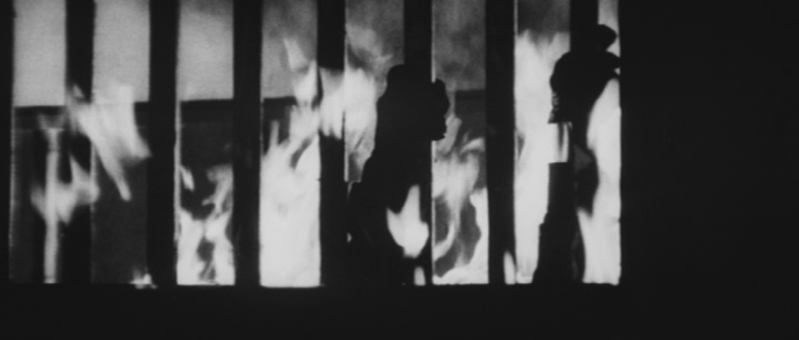
It could be said that desire is Tamiko’s undoing, but as Hisatsune had suggested perhaps you couldn’t blame her for longing to be free of the bedridden husband who had not delivered what he promised her. As she said, she was doing what could to survive even if you’d think she’d know putting on a ring taken from the finger of a murdered woman is akin sealing your own fate. Sugawa shoots with a noirish sense of dread, tracking Tamiko with her coat drawn up around her face as she tries to leave the scene of her crime, and makes the most of his fiery imagery before ending on a note of cynical laughter amid the inescapable hell the of post-war society. 


Original trailer (English subtitles)

Woman of Design (その場所に女ありて, Hideo Suzuki, 1962)

“This job poisons you and deprives you of your youth” according to conflicted ad-exec Ritsuko (Yoko Tsukasa) trying her best to make it in the still very male world of adverting. A snapshot of the city in the early ‘60s, Hideo Suzuki’s workplace melodrama Woman of Design (その場所に女ありて, Sono Basho ni Onna Arite) considers the changing position of women through the eyes of four friends working at the same company, each facing challenges mainly at the hands of useless men while trying to claim a space for themselves as individuals but discovering that they are still subject to a binary choice when it comes to deciding their romantic futures. 

A woman of around 30, Ritsuko has worked her way up to a fairly senior position at Nishigin Advertising which at least appears to be a fairly progressive company run by a compassionate boss who treats his employees equally with respect for all. Nevertheless, Nishigin is very interested in its bottom line especially as the company is apparently not doing so well to the extent that they’ve unfortunately had to cut back on their “entertainment” budget which is apparently how they win and keep clients. A new opportunity has presented itself in the chance to win a contract with a pharmaceuticals company to market their brand new drug aimed at “revitalising” the lives of the over 40s. Unfortunately, they have a rival in the form of Daitsu and suave adman Sakai (Akira Takarada) who appears to have pipped Ritsuko to the post in “seducing” their sleazy PR guy.

Though focussed on her career and somewhat resistant to romance, Ritsuko finds herself attracted to Sakai if eventually wondering if he’s only using her for inside info on Nishigin which she doesn’t directly give him but their relationship does perhaps soften her attitude. Sakai’s minor betrayal in poaching the head of their art department will eventually destroy any genuine feelings they may have had for each other while leaving Ritusko painfully aware of her vulnerabilities as a female employee and of the costs of her momentary decision to break with her long-held determination to keep her professional and private lives entirely separate, admitting that her relationship with Sakai may have been a mistake but refusing to resign because of it. Meanwhile, the boss of the pharmaceuticals company with whom she seems to be on good terms tries to blackmail her into attending an omiai meeting implying he’ll be much more likely to give them the contract if she goes. Not that they necessarily mean she should give up her career, but even Ritsuko’s colleagues seem to be keen that she get married, shocked that she might determine to remain single for the rest of her life. 

That’s exactly the decision her friend Yuko (Akemi Kita) has made, dedicating herself to her career but also moody and embittered. In fact though it is no way explicit, Yuko is strongly coded as a lesbian with a possible crush on friend and colleague Mitsuko (Kumi Mizuno), herself in a difficult position apparently pushed into debt because of an attachment to a no good man whose hospitals bill she has been paying. Ritsuko’s deskmate Hisae (Chisako Hara), meanwhile, is a divorcee wondering what she’s going to do when her ex, whom she’s still hung up on, stops paying alimony, and her sister is forever badgering her for money because her brother-in-law is an irresponsible layabout who can’t hold down a steady job and has no real intention of doing so. “Men who live off women are the worst” Yuko exasperatedly exclaims thoroughly fed up with the bunch of two bit louses who seem to have ruined the lives of all her friends. 

It’s not difficult to understand why Ritsuko may be ambivalent about marriage, but even at work she’s not free of selfish, entitled men who routinely take credit for her work. Sleazy college Kura (Tsutomu Yamazaki) from the art department is forever sucking up to her only to attempt rape while discussing work at her apartment, later brushing the affair off while talking to a female colleague by affirming that older women aren’t his thing anyway. He also undercuts her by visiting the client himself to discuss ideas and changes. Kura later wins a big design prize in part thanks to the slogan Ritsuko came up with only to annoy his colleagues by implying he handled the whole campaign single-handedly. Meanwhile, though in some ways progressive her bosses are conservative when it comes to the business, shutting down the art director’s suggestion of running with an out of the box campaign (the sexier ad featuring a muscular man in his briefs which he later sells to Sakai is the one which ends up winning). Tsuboichi (Jun Hamamura) and Kura perhaps too feel constrained by a top down hierarchal structure which frustrates innovation and in their own ways rebel, but as Ritsuko later makes plain in her speech to the boss if she wants to keep her position she has to play by the rules. “Life’s short. Especially for a woman. We have no room for mistakes” as Yuko cheerfully agrees.

Yet even within that, Ritsuko manages to redefine her boundaries, making it clear that she won’t be doing the omiai. She does not, however, reject marriage entirely only state that “I will get married only when I feel the time is right”, for the moment at least entirely focused on her career. Though the future may have looked gloomy, the crisis passes and the mood brightens significantly with the news that another company is about to officially announce the launch of a long-rumoured anti-ageing cream which provides another potentially lucrative campaign opportunity for Nishigin and of course for Ritsuko should she win it. Having opened with a series of still frames followed by hazy footage of a sea of workers wandering towards their offices on an overcast morning, Suzuki closes in the twilight with the three ladies leaving the office, their friendship solidified as they head off to celebrate renewed hope for the future bolstered by a sense of female solidarity.


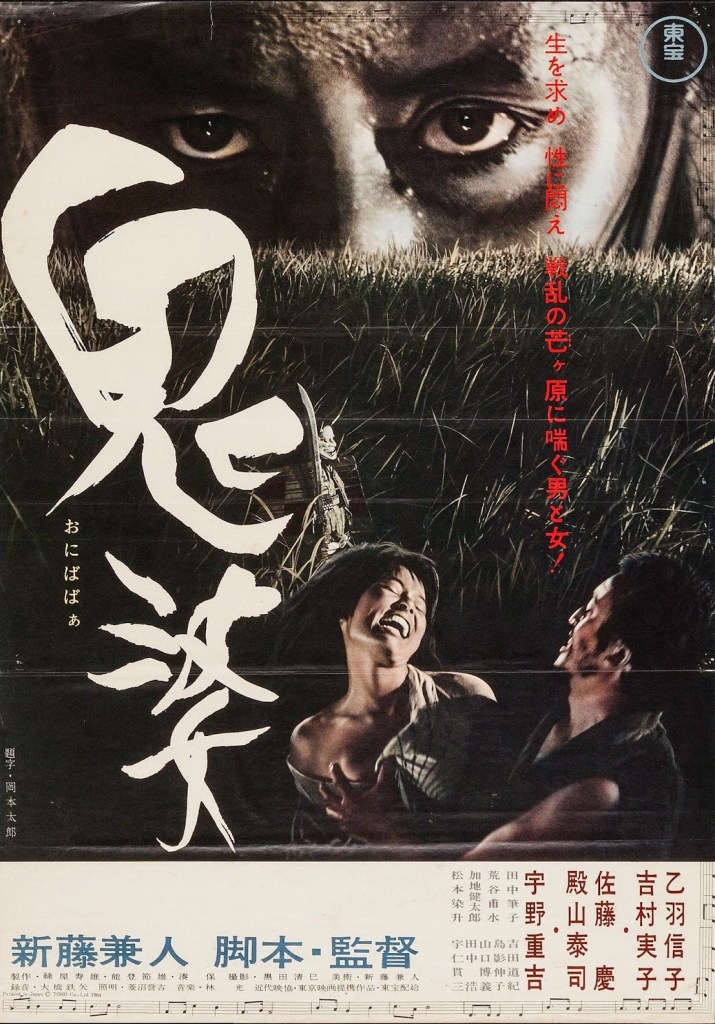
Onibaba (鬼婆, Kaneto Shindo, 1964)

How do you go on living in a world turned upside-down? It may be the central theme of post-war cinema, but few have tackled it in such a direct if allegorical way as Kaneto Shindo, repurposing a Buddhist parable about the perils of duplicity as a lesson in the dangers of the age, defined by a cruel hunger which could not be satisfied by bread alone even if there were bread to satisfy it. Onibaba (鬼婆), as the title implies, makes a villainess of an old woman driven to extremes by her chaotic times, but perhaps suggests that the times make villains of us all.

Deep in the war-torn country of 14th century Japan the imperial capital of Kyoto has been razed, a horse is said to have given birth to a cow, and the sun rose black in the sky leaving day as dark as night. With farmers dragged away from their fields to fight in a war they barely understand on behalf of distant lords, the grain basket of the nation is close to empty. An old woman (Nobuko Otowa) and her daughter-in-law (Jitsuko Yoshimura) have learned to make ends meet by hunting battle-weary samurai, stripping them of their armour, and throwing their bodies into a gigantic pit sitting right in the middle of the tall grass like a gravitational black hole of human compassion. The old woman has been patiently waiting for the return of her son, Kichi, who was taken away by the samurai, certain that everything is going back to normal when the war is over. Kichi, however, will not be returning. Hachi (Kei Sato), another young man from the village taken along with him, brings the sad news that the old woman’s son was beaten to death by a mob of farmers much like herself resentful of the war’s intrusion onto their land. 

Everything becomes food, Hachi explains, a sentiment extremely familiar to those who lived through the chaos of the immediate post-war era. Pointing at a baseline problem in the feudal economy, the war starves the poor and makes the wealthy hungry. The fields run wild with no men to tend them, as if symbolising the madness of the times. Lost in the tall grass, samurai and peasant alike search for an exit but are drawn only towards that black pit of human cruelty, more beasts than men driven by the need to survive alone. 

Without her son, the old woman is unable to farm, and without her daughter-in-law she is unable to survive through killing. She knows that these are times without feeling and that if Kichi will not return there is no reason for her daughter-in-law to stay. Ushi (Taiji Tonoyama), the broker for the looted samurai armour, makes an indecent proposal of extra millet for sexual favours but the old woman defiantly turns him down, perhaps not quite realising the offer was likely not intended for her. Which is to say that Hachi is not the only man in town, but is perhaps the only “desirable” one. Such desires that there are apparently cannot be satisfied by a crusty old man like Ushi, but are there all the same. Hachi presents a triple threat. The old woman knows her survival depends on the younger one, but also that she has no means to keep her now that her son is dead. She offers Hachi her body instead but he, as she did Ushi, baulks at the idea of slaking his lust on such an old woman. 

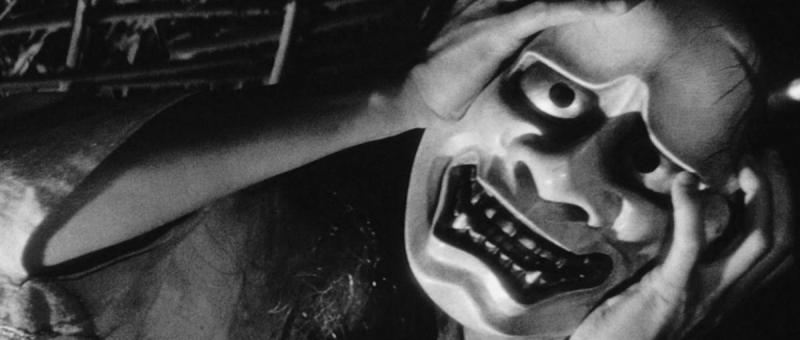
When a strange samurai wanders into her hut and orders her at the point of his sword to lead him out of the tall grass a solution presents itself. The old woman lures him to the black pit and prises away the ornate oni mask which he claimed he wore to protect his beautiful face from the ravages of war. Despite the fact that the samurai appears to have suffered from some kind of aggressive skin disease, the old woman unwisely decides to put the mask on her own face, convincing her daughter-in-law that her relationship with Hachi is sinful and appearing out of nowhere dressed as a demon to remind her that she’s going to hell. The mask’s crazed expression becomes fused with her own face, cementing her transformation into a “demoness” which it seems had already begun with stretch of white disrupting the uniformity of her hair and the kabuki-esque exaggeration of her eyebrows. Running desperately through the tall grass she cries out that she’s human, but this world has made demons of them all. The black pit of hunger knows no fill, and there can be no satisfaction in a world so devoid of human feeling.


Onibaba is currently streaming on BFI Player as part of the BFI’s Japan season.

Original trailer (dialogue free)

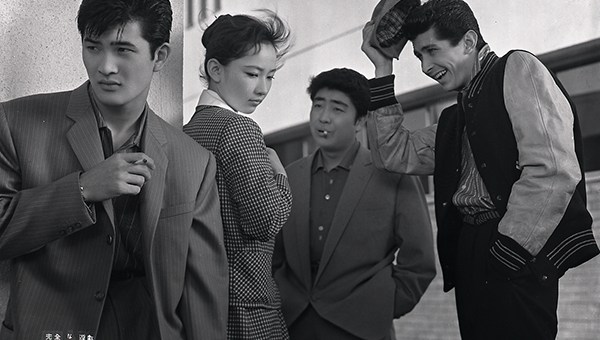
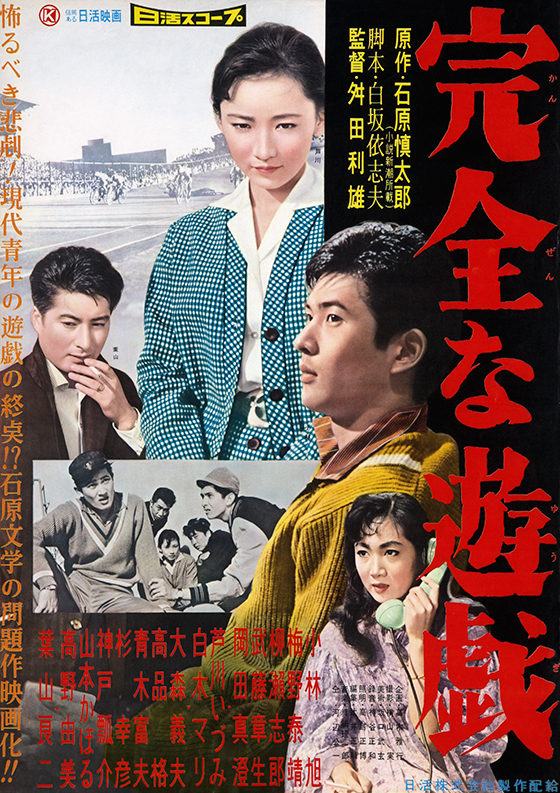
The Perfect Game (完全な遊戯, Toshio Masuda, 1958)

In the mid-1950s, Nikkatsu had courted controversy with a series of films depicting the amoral excesses of the immediate post-war generation. The “Sun Tribe” movies embedded themselves in a world of new bright young things who were largely independently wealthy and thoroughly bored by the ease of their lives. Nikkatsu was forced to halt production on the Sun Tribe films after only three (Toho and Daiei added one each of their own), but they did precipitate a wholesale shift towards youth movies which became the studio’s signature theme. 

Best remembered for his contributions to Nikkatsu’s action noir, Toshio Masuda’s The Perfect Game (完全な遊戯, Kanzenna Yugi, AKA The Tragedy of Today) arrived two years after the Sun Tribe craze but neatly picked up the baton dropped by Kon Ichikawa’s Punishment Room in its tale of nihilistic college boy amorality. As the film opens, our four heroes are playing mahjong and lamenting their lack of funds. They are all, it goes without saying, middle class boys largely supported by their parents who, as far as we know, are high ranking salarymen. They are not hungry, or worrying about how to pay rent or tuition, they are just bored and want extra money to go out having fun before they they are forced into the corporate straightjacket with the regular salaryman jobs many of them already have in the bag thanks to the tremendous power of nepotism. 

As the the opening text implied, they viewed their money making exploits as a game, proving how clever they think they are in getting one over on the universe, but all too quickly it spirals out of control. Toda (Yasukiyo Umeno), the ring leader, has come up with an ingenious money making scheme. It turns out that there’s an illegal betting office some distance away from the bicycle racing stadium that keeps taking bets until someone rings from the track and tells them who won, which means there’s about a five minute delay between the winner being declared and bets being called. The boys figure that if they can somehow beat the lag they can win big. To make it work, they ask their “friend” Kazu (Masumi Okada), who they seem to regard as a bit dim, to join them as well as recruiting an old codger to call the race before the boards go up. Surprisingly it works out, but unfortunately the yakuza-backed bookmaker, Matsui (Ryoji Hayama), wasn’t banking on such a big win and doesn’t have the funds to pay out in one go. 

Toda in particular is pissed off. The wind taken out of his sails, he’s not sure what to do which is when So (Akira Kobayashi), the pretty boy of the group, suggests an ironic punishment. Matsui had joked that he’d put up his adorable kid sister Kyoko (Izumi Ashikawa) as collateral if he couldn’t pay out, so why don’t the boys take him at his word and kidnap her. Rewinding a little, these snotty college boys are about to become kidnappers, adding a little blackmail on the side. This isn’t a fun game anymore, someone is going to get hurt whatever happens even if they can’t know the extent to which their plan to earn a few bucks to blow on jazz bars and pool rooms is going to incur collateral damage. 

Unlike the boys, Kyoko is a working class girl. She wants to keep her head down and work hard, not quite approving of her brother’s involvement with the yakuza and wishing he’d find an honest job but also acknowledging that he had few options and it’s his job at the bookies that’s been keeping them all this time. Their father died in the war, and their mother (Yumi Takano) is very ill, bedridden with heart trouble. Kyoko is no innocent, she brushes off So’s attempts to court her by revealing that dozens of creepy guys try the same thing every day, and most of them don’t stop at passing notes. For whatever reason she ends up warming to him, making him take her to a theme park while her mother worries at home, while he also begins to feel conflicted about the plan in falling for her for real. 

So’s mistake is the childish belief that they’re still playing a game and everything will be alright in the end. He foolishly trusts that his friend’s are men of honour and that Matsui will come up with the money and redeem his sister in no time at all. But money’s not easy to come by even if you’re a yakuza, and the boys might not want it anyway if it comes with additional complications. Visiting with Kyoko’s sickly mother, he perhaps begins to see the gap between his comfortable existence and theirs of constant struggle. He’d been so proud to tell Kyoko that he had an interview lined up at a big company because of family connections, but when he arrives there he feels irrelevant. The interview board only ask him questions about his dad, as if he didn’t really exist. Finally they ask him to talk about what he did at uni, what his “passions” are, if he did anything of note in the past few years, perhaps even fall in love? They’ve unwittingly touched a nerve, but So is in any case forced to reflect on the meaninglessness not only of his adolescence, but of his future. This interview has been a farce, but they’re giving him the job anyway because he’s his father’s son. What more is there to say?

The other boys are also worried about their job prospects, concerned that someone might talk and they’ll be forever tarnished by “youthful exuberance”, refusing to take any personal responsibility for the consequences of their “perfect game”. Unlike So they still want to live in that inherently unfair world which exists for upperclass men to do as they please. Toda and So weren’t quite like their friends. They felt conflicted. Toda embarrassed to be borrowing money from his girlfriend but rejecting the others’ belief that you don’t have to pay women back, only to angrily bark at her that there’s “no way a woman can understand” the intensely masculine debate he’s just had with So about responsibility, which he accepted by deflecting in pushing So’s complicity back on him in an attempt to share his guilt. Unlike the Sun Tribe films, youth takes responsibility for itself and its friends, but can find no way to atone for its moral abnegation. 


Original trailer (no subtitles)

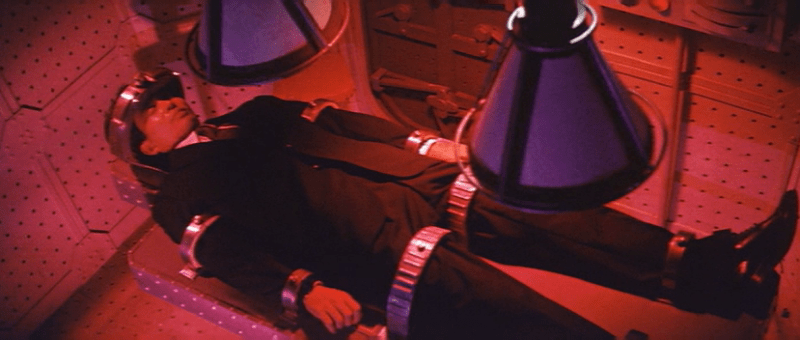
The Human Vapor (ガス人間第一号, Ishiro Honda, 1960)

The Human Vapour poster“The world is full of hysteria towards things they don’t understand” admits the strangely chatty “villain” at the centre of Ishiro Honda’s The Human Vapor (ガス人間第一号, Gas Ningen dai Ichi-go). Third in a loose trilogy of “mutant” films put out by Toho beginning with The H-Man and followed by The Secret of the Telegian, The Human Vapor is at once the most futuristic and the most traditional in that it’s no longer wartime guilt or nuclear anxiety which has corrupted our increasingly amoral hero but unwise ambition in which desperation to win the space race has produced a new and dangerous threat we may not be able to contain.

Honda opens with an exciting bank heist which on later consideration might not make much sense, filled as it is with shots of a faceless man pointing a gun at terrified staff while the vault doors open seemingly on their own. Earnest policeman Okamoto (Tatsuya Mihashi) is on the case, chasing a suspect car down a narrow country road only for it to crash and be discovered empty with no trace of the driver to be found. Okamoto’s feisty reporter girlfriend Kyoko (Keiko Sata) is dismayed to find out he has no leads, but later picks up on his mention of a buyo dancer, Fujichiyo (Kaoru Yachigusa), who lives near the scene and might have something to do with the case. 

Chasing Fujichiyo takes Okamoto to a library, where he becomes further convinced she is in contact with the mysterious bank robber. A strange and isolated woman, Fujichiyo is apparently from a noble, wealthy family but lives alone in a small cottage with only a single male servant where she devotes herself entirely to perfecting the art of traditional Japanese dance. We discover that Fujichiyo has been in poor health, which is why she hasn’t given a public performance in some time. Okamoto posits that the bank robber is bankrolling her comeback, though he never seems to have much of an explanation why she would need him when she has access to her own resources.

He is however correct, though it seems Fujichiyo was not aware that the money was stolen otherwise she might have been more careful in using it. In a contrast with genre norms, honest cop Okamoto never falls for Fujichiyo but does become oddly invested in her sad love story while sparking with his cheerful reporter girlfriend who ends up doing much the same. In fact, Kyoko is the only one doing much investigating but largely finds herself having to do it in spite of the (generally useless) men around her, including an unpleasant younger colleague who mocks all her ideas but does nothing much of anything on his own.

In any case, smirking villain Mizuno (Yoshio Tsuchiya) later makes himself known to the police in a selfless gesture of love in order to clear Fujichiyo’s name and get her released from police custody. He does this by taking the police to a bank and demonstrating how he was able to get in the vault without a key which involves his curious ability to turn himself into a gas. When Fujichiyo is not released, he takes matters into his own hands and frees all the prisoners in the cells, but Fujichiyo refuses to leave, insisting that she has no intention of running away and prefers to stay until the police affirm her innocence by releasing her.

Mizuno’s intention to bypass the law is one of the many signifiers of his increasing danger, that now believes himself “above” the rest of humanity and therefore no longer subject to their laws. He later tells the police exactly that, sitting them down for a mini audience to explain himself during which he recounts his history as an SDF pilot discharged on a diagnosis of lung cancer after which he took the boring job in the library and fell in love with Fujichiyo. A shady doctor, Sano (Fuyuki Murakami), later approached him claiming to be working for Japan’s space programme and suggested that his fighter pilot background made him a perfect fit for becoming an astronaut. Mizuno agreed to participate in his research to “change the existence of the human body” in preparation for life in space, but when Sano’s weird experiments turned him into a “gas man”, the doctor committed suicide in horror leaving Mizuno just another lonely victim of a mad scientist.

Like many other “mutant” heroes, the change in Mizuno’s body has also changed his soul though his love for Fujichiyo remains unchanged. It seems he’s only committing these crimes to fund her ambition of performing traditional buyo dance on the contemporary stage, while she though obviously devoted to her art finds it difficult to accept the man that he’s become. He promises to give her the world, sacrificing anyone that gets in his way. She remains conflicted, not wanting to accept his offer if it involves that kind of cost, and defending him to her colleagues only with the rationale that he is “different from what they are accustomed to”. While some advise caution, that perhaps Mizuno is not as dangerous as they think despite already having killed and should be given the chance to reform, others take a harder line eventually opting to use a different kind of gas to counter him.

Kyoko pleads with Fujichiyo as one woman in love to another, trying to protect Okamoto while advising her to pull Mizuno back from the brink by cancelling her performance, but precisely because of the understanding that exists between them she cannot. Sadly, as many point out, no one is really interested in buyo dance – the only audience members in attendance are there for the drama and the possibility of seeing the gas man in action. “You and I have finally won” Mizuno tells Fujichiyo on completion of her dance, as if this performance was all that ever mattered to either of them. But their victory leaves them with nowhere else to go, and the world unready to accept the latent threat a gas man represents. Fujichiyo makes her choice, one perhaps informed by her art and her love, while the authorities can only wait outside for the vapours to disperse.


Original trailer (No subtitles)

The Bad Sleep Well (悪い奴ほどよく眠る, Akira Kurosawa, 1960)

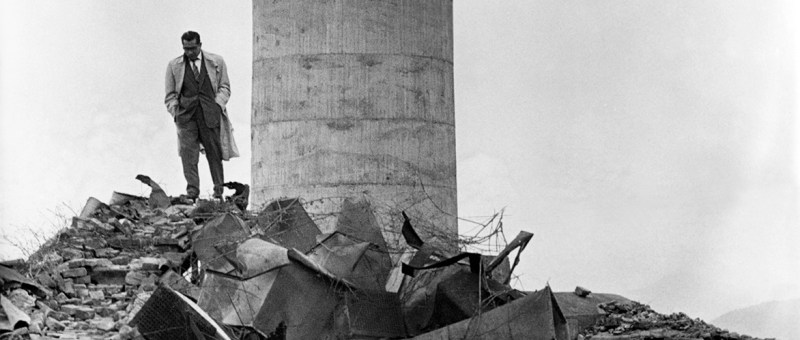
Bad Sleep Well posterThere’s something rotten in the state of Japan – The Bad Sleep Well (悪い奴ほどよく眠る, Warui Yatsu Hodo Yoku Nemuru), Akira Kurosawa’s take on Hamlet, unlike his previous two Shakespearean adaptations, is set firmly in the murky post-war society which, it becomes clear, is so mired in systems of corruption as to be entirely built on top of them. Our hero, like Hamlet himself, is a conflicted revenger. He intends to hold a mirror up to society, reflecting the ugly picture back to the yet unknowing world in the hope that something will really change. Change, however, comes slow – especially when it comes at the disadvantage of those who currently hold all the cards.

We open at a wedding. A small number of attendants lineup around a lift waiting for the arrival of the married couple only for a carriage full of reporters to pour out, apparently in hope of scandal though this is no gossip worthy society function but the wedding of a CEO’s daughter to his secretary. The press is in attendance because the police are – they believe there will be arrests today in connection with the ongoing corruption scandal engulfing the company in which a number of employees are suspected of engaging in kickbacks on government funded projects.

The rather strange wedding proceeds with the top brass sweating buckets while the bride’s brother (Tatsuya Mihashi), already drunk on champagne, takes to the mic with a bizarre speech “refuting” the claims that the groom, Nishi (Toshiro Mifune), has only married the bride, Yoshiko (Kyoko Kagawa), for financial gain before avowing that he will kill his new brother-in-law if he makes his little sister sad. Nishi, as we later discover, has indeed married with an ulterior motive which is anticipated by the arrival of a second wedding cake in the shape of a building at the centre of a previous corruption scandal with one black rose sticking out of the seventh floor window from which an employee, Furuya, committed suicide five years previously.

The police are keen to interview their suspects, the press are keen to report on scandal, but somehow or other the system of corruption perpetuates itself. The top guys cover for each other, and when they can’t they “commit suicide” rather than embarrass their “superiors” by submitting themselves to justice. The system of loyalty and reward, of misplaced “honour” mixed with personal greed, ensures its own survival through homosocial bonding with backroom deals done in hostess bars and the lingering threat of scandal and personal ruin for all should one rogue whistleblower dare to threaten the governing principle of an entire economy.

Nishi chooses to threaten it, partly as an act of revolution but mainly as an act of filial piety in avenging the wrongful death of his father who had, in a sense, cast him aside for financial gain and societal success. Wanting to get on, Nishi’s father refused to marry his mother and instead married the woman his “superiors” told him to. Later, his father threw himself out of a seventh floor window because his “superiors” made him understand this was what was expected of him. Furuya wasn’t the last, each time a man’s transgressions progress too far his “superiors” sacrifice him to ensure the survival of the system. Strangely no one seems to rebel, the men go to their deaths willingly, accepting their fate without question rather than submitting themselves to the law and taking their co-conspirators down with them though should someone refuse to do the “decent” thing, there are other ways to ensure their continuing silence.

Reinforcing the post-war message, Nishi chooses a disused munitions factory for his secret base. Both he and his co-conspirator, a war orphan, had been high school conscripts until the factory was destroyed by firebombing and thereafter were forced to live by their wits alone on the streets. Nishi swears that he wants to take revenge on those who manipulate the vulnerable, but finds himself becoming ever more like his prey and worse, hardly caring, wanting only to steel himself for the difficult task ahead.

In any revolution there will be casualties, but these casualties will often be those whom Nishi claims to represent. Chief among them his new wife, Yoshiko, who has been largely cushioned from the harshness of the outside world thanks to her father’s wealth and seeming care. She loves her husband and wants to believe in her father or more particularly that the moral arc of her society points towards goodness. Nishi, tragically falling for his mark, married his wife to destroy her family but ironically finds himself torn between genuine love for Yoshiko, a desire for revenge, and a mission of social justice. Can he, and should he, be prepared to “sacrifice” an innocent in the same way the “superiors” of the world sacrifice their underlings in order to end a system of oppression or should he abandon his plan and save his wife the pain of learning the truth about her husband, her father, and the world in which she lives?

In the end, Nishi will waver. Yoshiko’s father, Iwabuchi (Masayuki Mori), will not. Goodness becomes a weakness – Iwabuchi turns his daughter’s love and faith against her, subverting her innocence for his own evil. He makes a sacrifice of her in service of his own “superiors” who may be about to declare that they “have complete faith” in him at any given moment. The only thing that remains clear is that Iwabuchi will not be forgiven, the wronged children of the post-war era will not be so quick to bow to injustice. Let the great axe fall? One can only hope.


Original trailer (English subtitles)

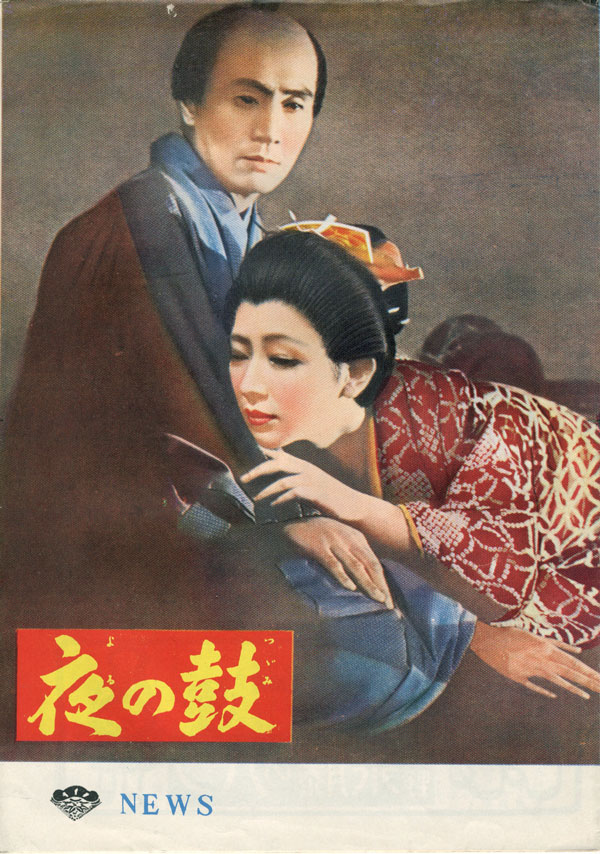
Night Drum (夜の鼓, Tadashi Imai, 1958)

night-drum

The works of Chikamatsu Monzaemon continue to have a large influence over Japanese drama even if not as frequently and directly adapted as they were in the immediate post-war period. Famous for tales of tragic love suicides and romantic heroes who risk all in the service of deep emotion, Chikamatsu’s works perhaps found even greater resonance in the turbulent years in which individual freedom and adherence to tradition found themselves in even greater conflict than ever before. Tadashi Imai makes the most of Chikamatsu’s melancholy fatalism to take a sword to the samurai order itself with all of its arcane rules and the essential hypocrisy which underlines its cruelty.

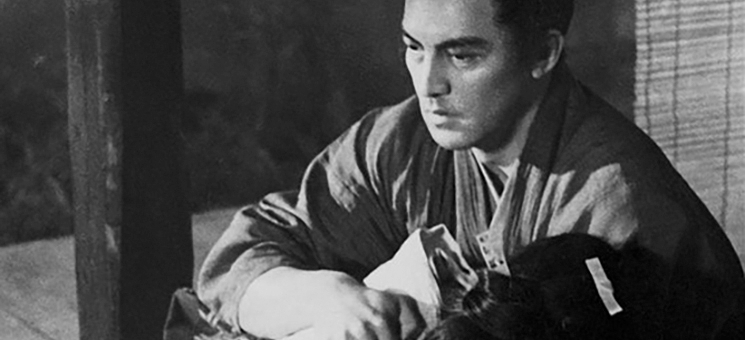
Hikokuro Ogura (Rentaro Mikuni) has been in Edo for a year with the shogun and is now on his way home. Stopping at an inn, he has a low level argument with his brother-in-law who warns him the men are getting restless and need to blow off some steam preferably with some sake. Hikokuro is in charge of the purse strings and knows all of this pageantry costs money the clan do not quite have hence he’s reluctant to fritter it away on alcohol no matter how much the men might resent him for it.

That’s not to say Hikokuro is a particularly officious person, he’s kind and cheerful by nature but also tired and eager to get home after such a long time away. His wife, Otane (Ineko Arima), is very happy to see him but something seems different about her and there’s a tension in the air among some of the other women. It seems, there are rumours about Otane and a travelling musician (Masayuki Mori) who frequented the house during the summer while Hikokuro was away. Rumours are often just that, especially in these petty circles of nobility, but female adultery is punishable by death and so is not something to be gossiped about idly.

Night Drum (夜の鼓, Yoru no Tsuzumi) begins with the ominous sound of the drum itself, beating out the inevitably tragic fate of all concerned with a melancholy fatality. The tale proceeds in a procedural fashion as the authorities become involved, hearing witness testimonies and trying to discover if there could be any truth at all in these unpleasant rumours. Matters are further complicated by the pecuniary difficulties the clan currently finds itself in – the elders are half hoping it is true because it would be a good excuse to expel the Ogura household and thereby save the money which goes on its upkeep. They are aware, however, that they’re talking about the life of a previously unblemished woman as well as the ruin of her extended family.

The life of a retainer is not as easy as it sounds and we’re constantly reminded of just how much money is necessary to keep up appearances. The clan authorities are dismayed when they hear of Otane earning money on the side through needlework though other retainers are quick to confess their wives also help out, they just can’t survive on such meagre stipends. Each lord is required to hire servants as befits their status but they aren’t given the money to do so. Hikokuro is also required to serve the shogun in Edo every other year for at least twelve months meaning Otane is left alone at home with almost nothing other than her needlework to do except wait patiently for her husband’s return.

Given these circumstances, it’s easy to understand how such pernicious rumours might begin. The sole basis of the evidence seems to rest on a tip off that Otane is thought to have been alone in a room with a man who is not her husband. That she may be put to death solely for the crime of sharing the same space as someone of the opposite sex seems extreme, but this is the feudal world where rules and propriety are all. The men can cavort with geishas to their heart’s content, but Caesar’s wife must be above suspicion.

The action unfolds piecemeal as each of the various witnesses offers their testimony of events. Given the gravity of the situation, few are eager to recount their suspicions – especially the other women who fear the rumour may be true but are also unwilling to believe it. Hikokuro does not want to believe it either but faced with such convincing, if circumstantial, evidence doubt creeps into his mind and finds an anchor in Otane’s guilt ridden behaviour. Ironically, this entire situation developed only because of Otane’s attempts to avoid it – remaining at an inn rather than travelling with a man on the road only for one of her husband’s friends to attempt to rape and blackmail her. Having had far too much to drink in an attempt to steel her nerves and cover up the embarrassing assault, Otane finds herself at the mercy of man who should have known better than to take advantage of another man’s wife in such a moment of weakness.

One stupid mistake born of alcohol, loneliness, and a series of male betrayals is enough to bring down the social order all on its own. Rentaro Mikuni plays the part of the previously affable wounded spouse with an exceptional level of nuance as he accepts his part in his wife’s downfall thanks to the the circumstances of their lives which have kept them apart and left her at the mercy of untrustworthy lords. There is anger here, and shame, but there is still love too which only makes the inevitable outcome all the more painful for everyone concerned. Hikokuro plays the part he’s expected to play, but it pains him and you can’t wipe a slate clean with blood. Imai has his eyes firmly on the civilised society with all of its rigid yet often cruel and unfair rules for living. Shot with a kind of hypnotic dreaminess in which each of our unfortunate players is swept along by events they are powerless to influence, Night Drum beats out the death knell of those who allow their individual desires to overwhelm their “civilised” conformity but it does so with a rhythm that is filled with anger rather than sorrow, for those who are forced to leave half their lives unlived in maintenance of the very system which oppresses them.