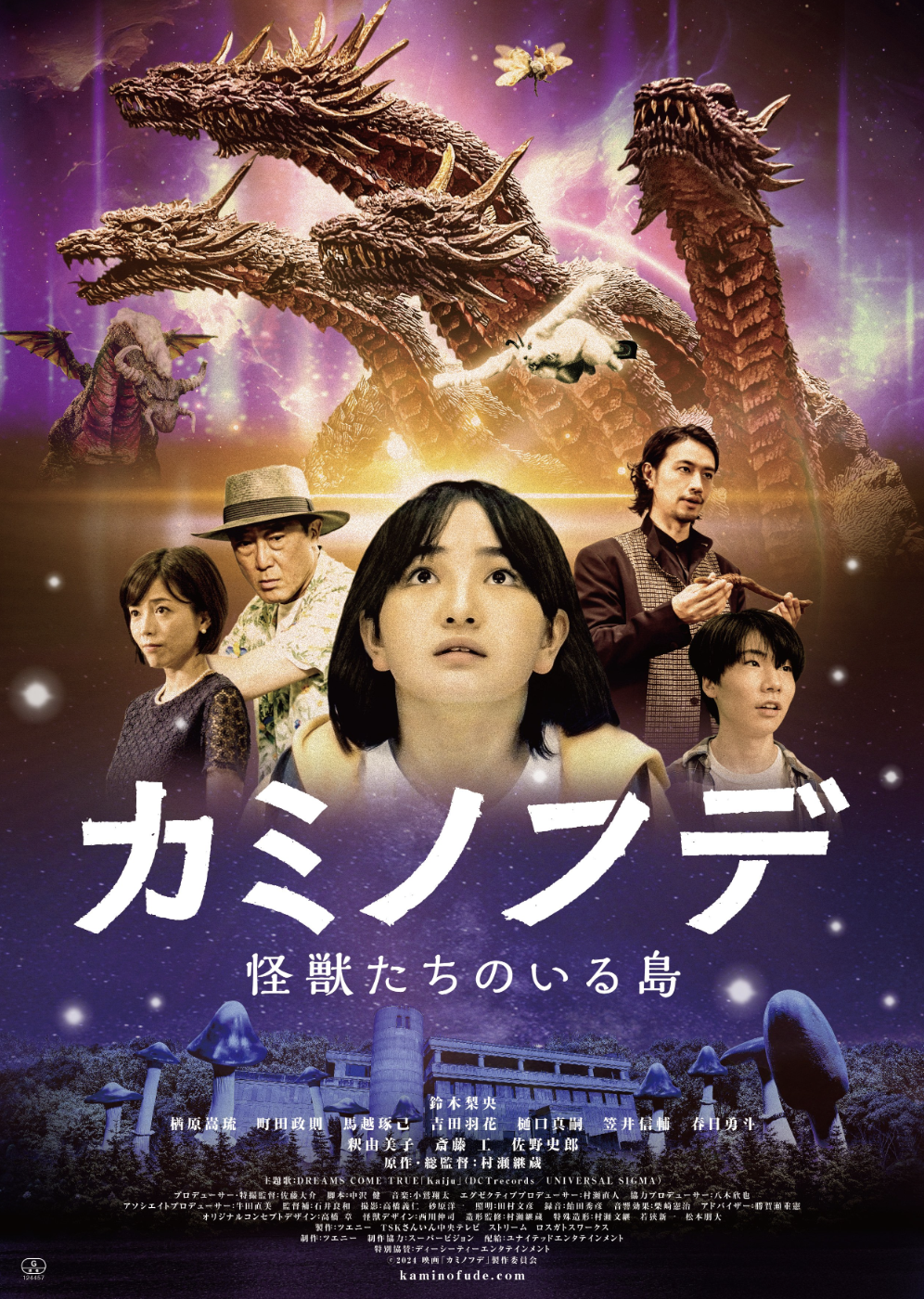
Brush of the God (カミノフデ ~怪獣たちのいる島~, Keizo Murase, 2024)

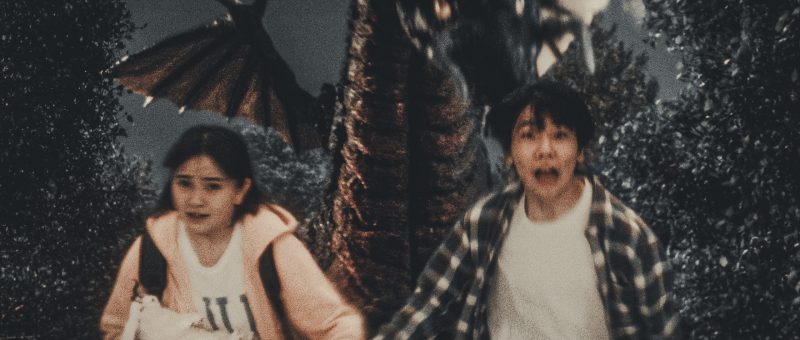
High schooler Akari (Rio Suzuki) couldn’t care less about something as “uncool” as tokusatsu movies and the fact her recently deceased grandfather once made them makes it even worse. Though they had once been close, Akari harbours a degree of resentment towards her grandfather, Kenzo (Shiro Sano), whose behaviour even in earlier years could be somewhat intimidating. Holding Kenzo responsible for the scar on her mother’s arm, Akari wonders out loud why a public memorial event is even necessary when they’ve already had a funeral, and why her mother isn’t just throwing all this useless rubbish out rather than hold an exhibition honouring a man she believes harmed her.

“Useless rubbish” is largely what Akari thinks of Kenzo’s legacy, embarrassed by his connection to otaku culture which has a social stigma attached to it that a teenage girl in particular would find embarrassing. Sullen and grumpy, she looks on with sadness mixed with irritation when some of her classmates charge off without her to go look at make-up and is rude to a young man from her class who’s come to attend her grandfather’s memorial event because she wouldn’t be caught dead talking to a nerd. In a way, it’s some of these social attitudes that Keizo Murase’s Brush of the God (カミノフデ ~怪獣たちのいる島~, Kami no Fude ~Kaijutachi no iru Shima) wants to deconstruct, recovering a memory of the classics of the genre as a world of boundless creativity and goodness that was as much about overcoming obstacles as it was creating visions of marauding dragons wreaking havoc on the modern world. 

This is Murase’s first, and sadly only film as he passed away at the age of 89 in 2024 and was already in his late 80s when the film was made. Prior to that, he’d been a legendary figure in the tokusatsu industry working as a suit sculptor, prop maker, and stunt man. His self-cameo laying flowers at his own stand-in’s memorial service echoes the meta-quality of the film which he’d first come up with while working on Mighty Peking Man (in the movie Revenge of the Might Primate) in Hong Kong and subsequently reworked to take place in Japan just as Kenzo does in the film. At heart, it’s a tribute to classic kids special effects adventure movies in which Akari must reclaim the fond memories of her grandfather in order to save his interior universe and legacy which is now in danger of being forgotten while even she herself wanted to junk the whole thing. 

She does so in the company of Takuya (Takeru Narahara), the classmate she’d hardly even noticed because of his nerdiness but is also primed to be another kind of inheritor of Kenzo’s mantle as represented by the Brush of the God, a magical paintbrush that allows the wielder to create in reality anything that they can imagine much as Kenzo and Murase had done when they created their monsters and the means to beat them. Reminiscent of that of Nobuhiko Obayashi, Keizo’s world has a retro aesthetic that is at once both artificial and fantastical making it clear that the children have been sucked into a world of imagination on the invitation of the mysterious Mr Hozumi (Takumi Saito) who offers them a copy of Keizo’s unproduced script and asks them to save his universe from destruction at the jaws of a mystical dragon. 

There is real love and affection for this era which has now all but passed that valued practical effects and rejoiced in finding unexpected solutions to practical problems and creating a world which was often simpler than expected in which there were monsters who were bad but could be beaten or otherwise were good and could never be vanquished. Along with recovering more positive memories of her grandfather whom she realises to have misunderstood, a tortured artist who loved them in his own way, she regains a sense joy and creativity that had otherwise been lost to her with Takuya remarking that she seems much more lively in the midst of their adventure than she ever had at school. He meanwhile is very much in his element, but though he’d dreamed of becoming a tokusatu hero is effectively reduced to a damsel in distress whom Akari must then save by reawakening her imagination. Warmhearted and wholesome, the film is an advocation for this world of lost charm and childhood adventures powered by egg boxes, garden hoses, and the boundless potential of creativity. 


Brush of the God screens in Chicago 13th April as part of the 19th edition of Asian Pop-Up Cinema.

Trailer (English subtitles)

The Legend & Butterfly (レジェンド&バタフライ, Keishi Otomo, 2023)

“What was everything for?” an ageing Nobunaga (Takuya Kimura) asks his attendant Ranmaru (Somegoro Ichikawa) towards the conclusion of Keishi Otomo’s historical epic, The Legend & Butterfly (レジェンド&バタフライ, Legend & Butterfly) produced in celebration of Toei’s 70th anniversary. Oda Nobunaga is such a prominent historical figure that his story has been told countless times to the extent that his legend eclipses the reality, but rarely has been he depicted so sympathetically as in Otomo’s history retold as romantic melodrama in which he and his wife, Lady No (Haruka Ayase), are mere puppets of the times in which they live dreaming only of a place beyond the waves where they might be free of name or family. 

Tellingly, Otomo opens in the spring of 1549 in which the dynastic marriage was arranged to broker peace between unstable neighbouring nations Owari and Mino. Nobunaga’s father’s health is failing and he fears in the chaos of his death Mino may attack, while No’s father fears that her brother will soon revolt against him plunging the fiefdom into disarray and therefore vulnerable to an attack by Owari. At this point, Nobunaga is known as “the biggest idiot in Owari,” a foppish dandy who cares only about appearances. As he prepares to meet No, his courtiers apply his makeup and do his hair while dressing him in a rather outlandish outfit No immediately insults as “foolish”. He treats her with chauvinistic disdain, barely speaking save to order her to pour the drinks and give him a massage only for her to point out that she’s been travelling all day and a “thoughtful” considerate husband would be giving her a massage instead. “I detest women who do not know their place,” he snaps. “I detest men who are ignorant,” she counters. The wedding night ends in humiliating failure as No demonstrates her martial arts skills and Nobunaga is forced to call his guards to rescue him. 

Little is known of Lady No in historical record, but here she is bold and defiant, as her father had said too free with her opinions for a woman of the feudal era. She claims to have been married twice before and assassinated both husbands on her father’s orders, implying that she is essentially sleeper agent more than hostage and will kill Nobunaga without a moment’s thought as soon as the word is given. Yet she also begins to guide her husband towards his destiny, mocking him as a fool but giving him useful strategic advice that wins him glory on the battlefield along with the political advancement that led him to become the first great unifier of Japan. For all that they “hate” each other, they are well matched and have a similar sensibility that allows them first to become allies and then friends before frustrated lovers.

But their love is enabled only when they escape the feudal world, shaking off their retainers to go on a “normal” date in Kyoto where they dance to Western musicians and taste foreign candy only to end up accidentally massacring some peasants when No’s martial arts training kicks in trying to stop a man beating his son. Even so, they are forever linked by their time in Kyoto in the romantic talisman’s of a carved wooden frog and a European lute even if the blood-spattered jizo and buddhist statue watching their eventual connection imply there will be a reckoning for all the blood that is spent. Jumping on a few years, the film does not elaborate on what caused Nobunaga to become a man without a heart and lose the love of his most trusted ally but positions his transformation into the “Demon King” as the kernel of his undoing just as his dream of unifying Japan and bringing about an age of peace (if one ruled by fear) is about to become a reality. 

In any case, the one thing that everybody knows about Nobunaga is how he died though then again his remains were never recovered giving rise to a happier ending in which he and Lady No were finally able to escape the feudal world to chase a freer future beyond the sea which is perhaps what they do in the film’s poetic final sequence in which they might in a sense share a dream connected by frog and lute. It might not be very historically accurate, but that is perhaps the point in hinting at the lives they might have led if the world had been different. Otomo films with a painterly eye that lends an air of poignant gravitas to a tale of romantic tragedy in which love is both salvation and destruction amid the flames of a collapsing temple. 


The Legend & Butterfly screened as part of this year’s JAPAN CUTS.

Original trailer (English subtitles)

Fukushima 50 (フクシマ50, Setsuro Wakamatsu, 2020)

The “Fukushima 50” (フクシマ50), as the film points out, was a term coined by the international media to refer to the men and women who stayed behind to deal with the unfolding nuclear crisis at the Fukushima Daiichi Nuclear Power Plant. Loosely inspired by Ryusho Kadota’s non-fiction book On the Brink: The Inside Story of Fukushima Daiichi which featured extensive interviews with those connected to the incident, Setsuro Wakamatsu’s high production value film adaptation arrived to mark the ninth anniversary of the devastating earthquake and tsunami which occurred on 11th March, 2011 and closes with a poignant callback to the plant’s role in Japan’s post-war reconstruction as the nation once again prepares to host the (now postponed) Olympics with a torch relay beginning at Fukushima as a beacon of hope as the country continues to rebuild in the wake of the disaster. 

Though inspired by real events Wakamatsu’s dramatisation is heavily fictionalised and while surprisingly frank for a mainstream film in its criticism of the official reaction to the disaster, is also quietly nationalistic while doing its best to pay tribute to the selfless sacrifice of the plant workers who stayed behind to do what they could many of whom had little expectation of surviving. Chief among them would be Izaki (Koichi Sato), an imperfect family man and veteran section chief, and the plant’s superintendent Yoshida (Ken Watanabe) who are both local men and old friends. Local, it seems, is later key with multiple appeals to the furusato spirit as each is at pains to point out that they stay not only to prevent a catastrophic meltdown that would leave most of central Honshu including Tokyo uninhabitable, but because they feel a greater duty to protect their hometown and the people in it. 

Meanwhile, they find themselves burdened rather than assisted by official support as government bodies’ political decision making undermines their attempts to avert disaster while the boardroom of TEPCO who operate the plant reacts with business concerns in mind. A few hours in the prime minister (Shiro Sano) decides to make a visit, in political terms he can’t not national leaders who don’t visit sites of crisis are never forgiven, but his presence actively hinders the recovery efforts. Referred to only as the PM, Wakamatsu’s film presents the man leading the nation as an ignorant bully overly obsessed with his personal image. He has little understanding of nuclear matters or the implications of the disaster, refuses to abide by the regular safety procedures required at the plant, and mostly governs through shouting. Beginning to lose his temper, Yoshida does his best to remain calm but resents the constant interference from those sitting in their offices far away from immediate danger while he does his best to contend with the increasingly adverse conditions on the ground, mindful of his responsibilities firstly to his employees and secondly to those living in the immediate vicinity of the plant who will be most at risk when measures taken to prevent meltdown will lead to an inevitable radiation leak. 

Yoshida’s hero moment comes when he ignores a direct order from the government to stop using seawater to cool the reactors, knowing that he has no other remaining options. Meanwhile, the government refuse offers of help from the Americans, who eventually make a strangely heroic arrival with Operation Tomodachi, discussing plans to move their families to safety while their commander reflects on his post-war childhood on a military base near the site of the nuclear plant. Japan’s SDF also gets an especial nod, granted permission to leave by Yoshida who is beginning to think he’s running out of time but vowing to stay and do their duty in protecting civilians in need. 

In essence, the drama lies in how they coped rather than the various ways in which they didn’t. The conclusion is that the existence of the plant was in itself hubristic, they are paying the price for “underestimating the power of nature” in failing to calculate that such a devastating tsunami was possible. They thought they were safe, but they weren’t. Perhaps uncomfortably, Wakamatsu mimics the imagery of the atomic bomb to imagine a nuclear fallout in Tokyo, harking back to ironic signage which simultaneously declares that the energy of the future is atomic while the plant workers reflect on the sense of wonder they felt as young people blinded by science back in the more hopeful ‘70s as the nation pushed its way towards economic prosperity. Frank for a mainstream film but then again perhaps not frank enough, Fukushima 50 is both an urgent anti-nuclear plea and an earnest thank you letter to those who stayed when all looked hopeless, suggesting that if the sakura still bloom in Fukushima it is because of the sacrifices they made.


Fukushima 50 is available to stream in the US until July 30 as part of this year’s Japan Cuts.

International trailer (English subtitles)

Last Winter, We Parted (去年の冬、きみと別れ, Tomoyuki Takimoto, 2018)

Last Winter we Parted posterAmong the most promising young writers of Japan, the work of Fuminori Nakamura is, it has to be said, extremely dark. Adapted by Grasshopper’s Tomoyuki Takimoto, Last Winter We, We Parted (去年の冬、きみと別れ, Kyonen no Fuyu, Kimi to Wakare) is as poetic an exploration of the dark side of desire as its title implies. Parting is, it turns out, not so much sweet sorrow as a wrenching act of existential dissonance that requires an absenting of the self and the creation of a new dark entity rising from the ashes of a once pure soul.

The tale begins in flames as a blind model, Akiko (Kaho Tsuchimura), burns to death in the studio of a respected photographer, Kiharazaka (Takumi Saito). Kiharazaka claims the fire was an accident and that he tried to save the victim but was not able to. Others claim that Kiharazaka had kidnapped Akiko and held her prisoner before deliberately setting fire to her in order to photograph a body burning alive. Released on a suspended sentence, Kiharazaka remains the focus of media attention which is where freelance writer Yakumo (Takanori Iwata) enters the picture. He is convinced Akiko’s death was not an accident and fascinated by an eerily oppressive photograph taken by Kiharazaka has approached a mainstream news organisation with a pitch for a book profiling the famously enigmatic figure with the ulterior motive of exposing the darkness of his soul.

The exposure of the authentic is the concern that binds Yakumo and Kiharazaka in a mutually destructive act of artistic inquiry. Kiharazaka’s most famous and only real success of a photograph features a whirl of butterflies that feels oddly like drowning as if pulled towards something dark and oppressive. Like the butterflies he observed, Kiharazaka instils fear while beguiling, a good looking man who seems to make a habit of luring vulnerable women into his web of destruction with a promise of intimate recognition, that he alone is able to truly see them and bring their true selves to the surface in act of artistic connection. Inspired by Akutagawa’s Hell Screen, he photographs only what he sees but craves darkness and violence, eventually, as Yakumo fears, allowing his need for fiery visions of hellish brutality to push him into heinous acts of human cruelty.

Meanwhile, Yakumo searches for an explanation behind Kiharazaka’s unsettling nature, trying to expose his own true face through (ostensibly) less violent means. He discovers that Kiharazaka and his sister Akari (Reina Asami) were orphaned after a violent attack in their home during which they were also injured. He hears that they may have endured years of abuse and cruelty at the hands of their father and that both are in some way warped, locked into an incestuous world of pain and suffering. A high school friend warns him that Kiharazaka has a magpie-like tendency to steal the things of others and that Akiko probably had a boyfriend which is what made her sparkle to Kiharazaka’s monstrous eyes. Still, Yakumo dangles his own fiancée, Yuriko (Mizuki Yamamoto), in front of the dangerous man as if daring him to take her while Kiharazaka declares himself captivated by her failure to know her “true self” which only he can expose.

Of course, not all is as it seems and there are several layers of “truth” in play as Yakumo continues his investigation and becomes further entangled in the spiderweb of Kiharazaka’s warped existence. Later, hearing from Akiko, she reminds us that there are other ways of “seeing” and that in the end she was not the one who was “blind” to the reality. Akiko’s boyfriend lost her precisely because he feared doing so, became over protective and patronising, and ruined their true connection through an over anxious preoccupation with unseen threat. Love can constrain as well as liberate, it makes people do dark things in its name and provokes chaos and confusion in place of happiness and harmony. Like the butterflies it can beguile while instilling fear.

Yet that same darkness also fuels art as in Kiharazaka’s distressing photographs and Yakumo’s all encompassing need to fulfil his “dream” of becoming an author. Vengeance takes many forms but all of them are destructive and in order to achieve it, one must enact a murder of the self leaving nothing behind other than a burnt out husk once the bloody business is done. A wretched tale of inescapable torments, the legacy of violence, frustrated loves, and the dark side of desire, Last Winter, We Parted is a suitably poetic exploration of the nihilistic despair in the hearts of its corrupted heroes living for love but only through a spiritual death.


Original trailer (no subtitles)

Manhunt (追捕, John Woo, 2017)

Manhunt30 years ago John Woo was one of Hong Kong’s most bankable directors. The father of heroic bloodshed, Woo’s bullet ballet sent shockwaves through action cinema not only in his home country but around the world. Unsurprisingly Hollywood came calling and Woo was one of the first Asian directors to enjoy mainstream US success with ‘90s hits Broken Arrow and Face/Off before his overseas career began to stall and he eventually returned to Hong Kong directing period epics Red Cliff and The Crossing. Manhunt (追捕, Zhuībǔ) is intended as a kind return to source as Woo gets back into the groove of his beautifully choreographed ‘80s action hits but intentionally or otherwise he sails dangerously close to self parody with a mix of Big Pharma conspiracy and wrong man thriller.

Chinese corporate lawyer Du Qiu (Zhang Hanyu) is a trusted employee of a Japanese pharmaceuticals company but is shortly to be transferred overseas, much to CEO Sakai’s (Jun Kunimura) displeasure – Du knows too much about the company’s less than transparent operations. Sakai sets up a honey trap to convince Du to stay but before it can spring Du is accosted by another woman, Mayumi (Qi Wei), who wants to talk to him about a difficult case three years previously in which an employee ended up committing suicide. After talking with Mayumi, Du goes home but the next thing he remembers is waking up in bed next to a dead woman. Du does the right thing and calls the cops, but the cops are working for Big Pharma and soon he finds himself on the run while maverick police chief Yamura (Masaharu Fukuyama) and two female assassins (Ha Ji-won & Angeles Woo) try to track him down.

Manhunt is inspired by the 1976 film starring Ken Takakura which was one of the first non-native movies to open in China following the Cultural Revolution. Woo apparently made the film as a kind of tribute to the actor after he passed away in 2014, but he takes his cues from the source novel by Juko Nishimura rather than the Takakura film and the 2017 Manhunt shares little in common with the 1976 version other than a general plot outline involving a man on the run and unethical practices in the pharmaceuticals trade. Du Qiu is not a stuffy, by the book, prosecutor but a compromised employee of a shady organisation who is oblivious to his own complicity in its extremely unpalatable way of doing business.

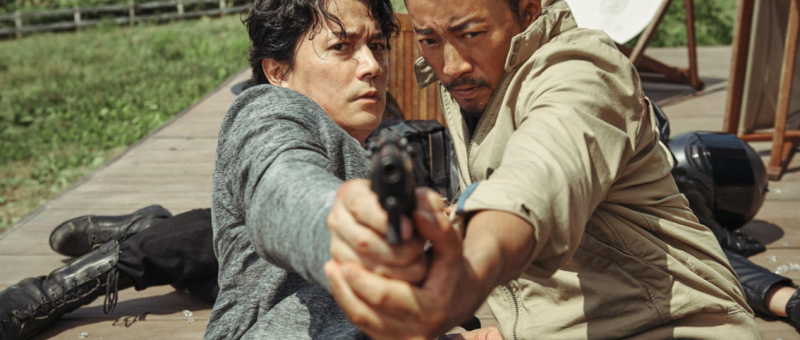
Despite this, Du Qiu is just as lucky as Takakura’s Morioka in that everyone he meets immediately wants to help him. Even sworn enemies with their hearts set on revenge eventually wind up joining team Du as they each descend on the pharmaceuticals research laboratory where the deadly secrets will be revealed. Woo returns to his heroic bloodshed roots in allowing dogged policeman Yamura and the increasingly confused Du to form an odd couple buddy duo which begins with spiky one liners and ends with becoming one as each places his uncuffed hand on the same pistol to take down a few bad guys through the power of togetherness.

Woo’s action credentials remain unchanged as he races from set piece to set piece from the opening surprise massacre to Du’s subway chase escape, jet ski race, and mansion showdown before getting anywhere near the endgame of the research lab. Perfectly choreographed, the sequences bear out Woo’s distinctive sense of humour while also poking fun at his back catalogue through a series of homages including an entire coop full of white doves just waiting for their chance to fly.

Set entirely in Japan, Manhunt shifts between Japanese and Mandarin though it has to be said that the film suffers from its reliance on English which is often poorly delivered and deliberately stylised to ape classic action movie one liners the like of which have been out of fashion for two decades. Woo neatly sends himself up with an opening discussion of “old movies” allowing one of the film’s two female assassins to develop an odd fascination with Du which leads to her eventual awakening from company brainwashing, but he also pays his dues with the theme music to Sato’s 1976 version playing over the first scene of mass bloodshed. Woo may have slipped into self parody with his deliberately over the top theatrics, but he has fun doing it and his gleeful self skewering proves extremely hard to resist.


Screened at the BFI London Film Festival 2017.

International trailer (dialogue free, English captions)

Haruko’s Paranormal Laboratory (春子超常現象研究所, Lisa Takeba, 2015)

haruko's paranormal laboratory posterIn the brave new Netflix era, perhaps it’s not unusual to hear someone exclaim that their most significant relationship is with their television, but most people do not mean it as literally as Haruko, the heroine of the self titled Haruko’s Paranormal Laboratory (春子超常現象研究所, Haruko Chojogensho Kenkyujo). Lisa Takeba returns with her second film which proves to be just as strange and quirky as the first and all the better for it. Haruko’s world is a surreal one in which a TV coming to life is perfectly natural, as is the widespread plague of “artistic” behaviour which involves robbing the local 100 yen store for loose change and randomly setting fire to things. Yet Haruko’s problems are the normal ones at heart – namely, loneliness and disconnection. Takeba’s setting may be a strange fever dream filled with fiendishly clever, zany humour but the fear and anxiety are all too real.
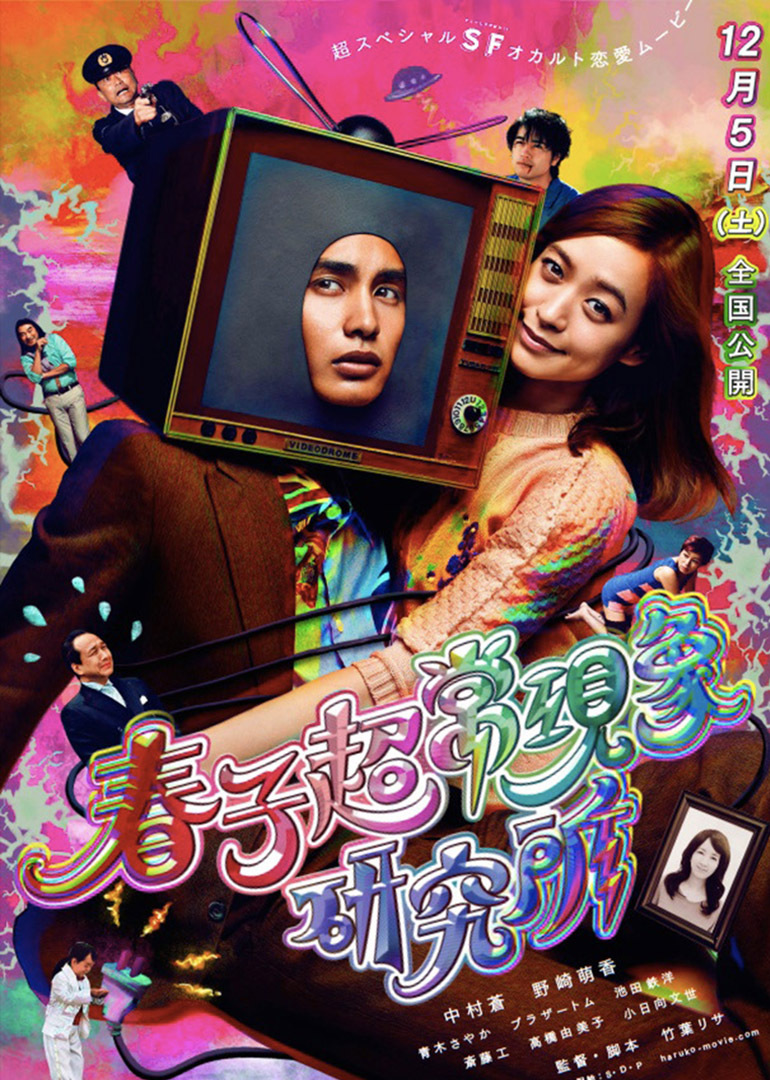
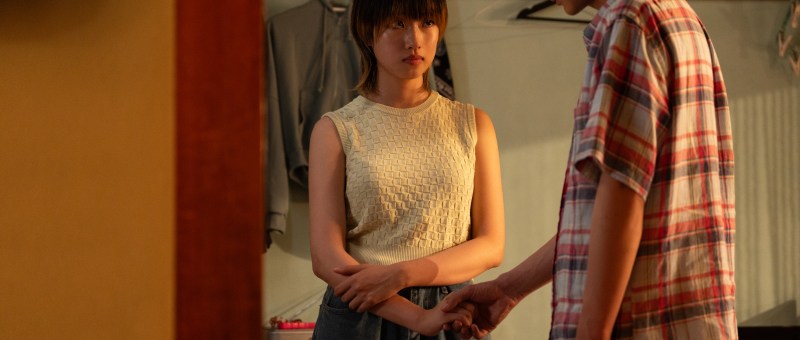
As a teenager, Haruko (Moeka Nozaki) was something of a loner. Being the daughter of a teacher and having a strong interest in UFOs and other supernatural entities, she had few friends and longed for something “exciting” to happen. Sadly, something quite exciting did happen, but it involved a suicide and her brother apparently being abducted by aliens. Ten or fifteen years later, Haruko still maintains her “Paranormal Laboratory” and intense interest in aliens with a view to maybe finding out what happened to her brother, but her external life is less satisfying. Her main hobby is lying around watching her 1950s black and white CRT TV and swearing loudly at the ridiculous images it projects. Her TV, however, has finally had enough and upon hearing 1000 dirty words from Haruko, springs into life as a handsome young man with telebox for a head.

An usual genesis for a relationship, but then when you spend all of your spare time googling paranormal events and harping on your teenage failures, beggars can’t be choosers. Haruko’s growing relationship with TV (Aoi Nakamura) follows the classic amnesiac mould as the two begin living together and eventually become an odd kind of couple. TV’s central operating system is pulled together from what he’s observed over the airwaves which means he has a slightly less realistic view point than your average guy. Though originally content to fall into the stereotypically “female” role, staying home cooking meals and tidying up while Haruko goes to work, he soon becomes depressed out of boredom and loneliness before eventually being made to feel inadequate when someone refers to him as a “freeloader”. Like many a spouse whose decision to stay home has not been entirely their own, TV has a lot of skills including the ability to speak 12 languages fluently, but what finally gets him a job as a TV star (yes, a TV on TV!), is his sex appeal and exotic appearance.

TV also thinks he can remember his “family” which lends a bittersweet dimension to his relationship with Haruko as she helps him look for the wife and child that might be waiting for him. Haruko’s relationship with her own family is strained. Complaining that her family are “annoying” she leaves her well meaning father standing on the doorstep when he’s come out of his way to deliver some of her favourite cup cakes which he’s baked for her himself. Haruko’s mother has since passed on but her feeling of familial disconnection stems right back into her childhood and one strange UFO hunting night during which she discovered something about her brother which may explain his long term absence. This potentially rich seam is merely background to Haruko’s life (something which she later realises as she figures out that her brother may have been watching over her in disguise all these years), but that her brother has felt the need to hide himself away following a traumatic childhood incident is certainly a sad mirror for Haruko’s own ongoing psychological isolation.

Takeba piles jokes on top of jokes in this strange world where ‘50s “Videodrome” TVs with Yubari Film Festival tags still work and play adverts in which cheap whiskey “for the needy” is advanced as a good father’s day present, and an idol retires from the top band KKK48 live on air. Freak shows, extreme cosplay, marital disconnect, “artistic” robbery and arson, and a very dedicated NHK man, pepper the scene but the outcome is a young woman stepping away from her romantic fantasies towards something more real, realising she doesn’t really need to meet aliens so much as she needs to pay more attention to the “normal” world. Quirky to the max and riffing off just about every aspect of Japanese pop culture from Sailor Moon to J-horror, Haruko’s Paranormal Laboratory is a charming, if surreal, take on an early life crisis which must be seen to be believed.


Currently available to stream in the UK from Filmdoo.

Original teaser trailer (dialogue free)

The Kodai Family (高台家の人々, Masato Hijikata, 2016)

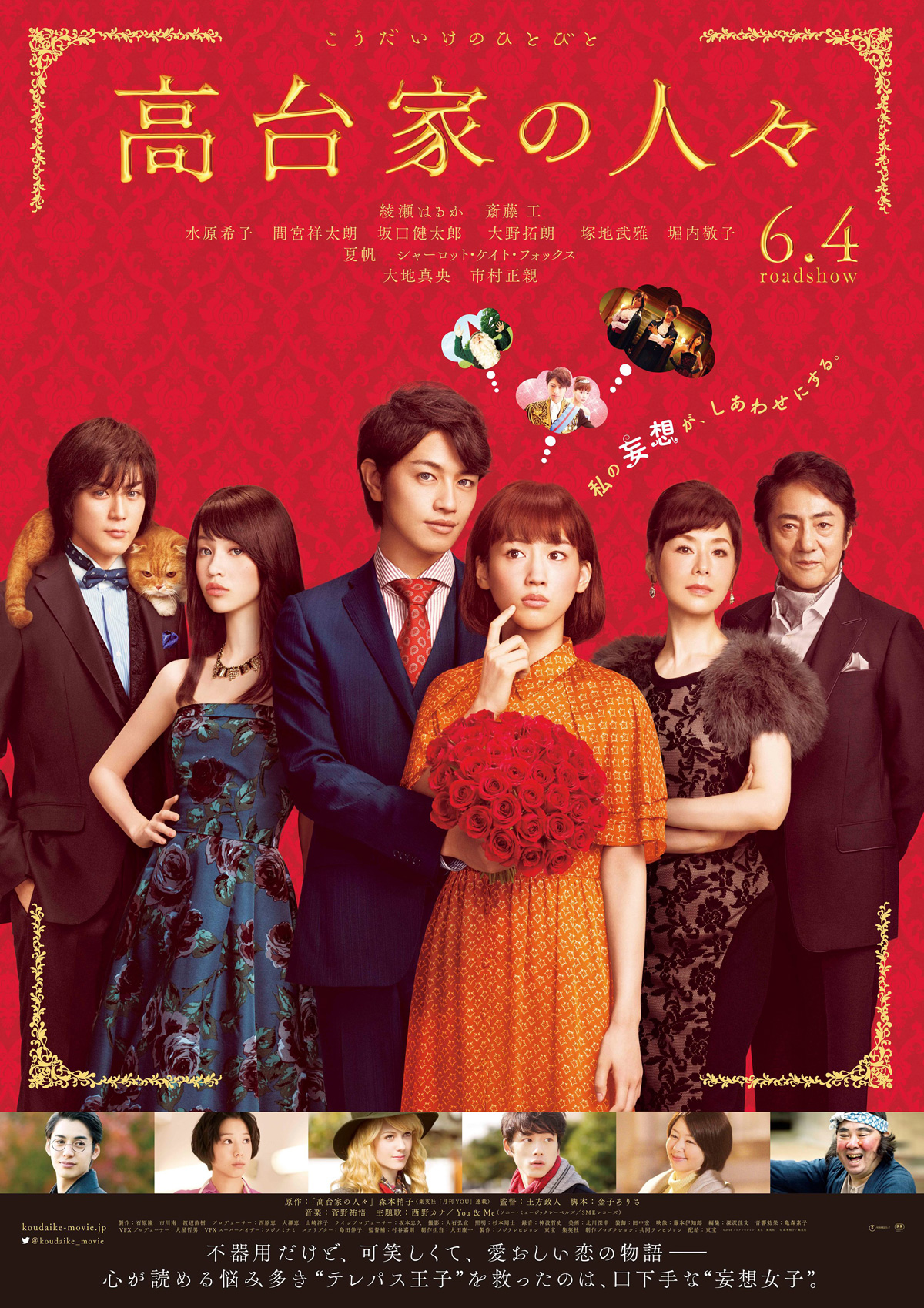
kodai family posterFear of “broadcasting” is a classic symptom of psychosis, but supposing there really was someone who could hear all your thoughts as clearly as if you’d spoken them aloud, how would that make you feel? The shy daydreamer at the centre of The Kodai Family (高台家の人々, Kodaike no Hitobito) is about to find out as she becomes embroiled in a very real fairytale with a handsome prince whose lifelong ability to read minds has made him wary of trying to form genuine connections with ordinary people. Walls come down only to jump back up again when the full implications become apparent but there are taller walls to climb than that of discomfort with intimacy including snobby mothers and class based insecurities.

29-year-old Kie (Haruka Ayase) has a dull job as a regular OL in the successful Kodai company. A self-confessed shy person who finds it difficult to talk, Kei spends most of her time alone though she does have a few friends at work. Though Kei’s exterior life may appear dull she has a rich, even overactive imagination which she uses to entertain herself by heading off into wild flights of fancy guided only by a friendly (?) gnome.

Kei’s life begins to change when the oldest son of the Kodai family returns to the office after studying abroad. Mitsumasa (Takumi Saito) is a handsome, if sad-looking man who quickly has all of the office in a flurry of excitement thanks to his dashing good looks and confident stride. Mitsumasa, however, has a secret – the ability to read other people’s thoughts inherited from his British grandmother, Anne. Whilst walking down the corridor and trying to ignore the lewd and avaricious thoughts of some of the ladies (and the worried ones of some of the men now fearing more than one kind of competition), Mitsumasa is treated to one of Kei’s amusing fantasies and is quickly smitten.

For Kei who finds voicing her true feelings difficult, Mitsumasa’s ability seems like the perfect solution. Finally, someone who will just understand her without the need for conversation. However, what Kei hasn’t considered is that a deeper level of intimacy is being asked of her than she’d previously anticipated. From the merely embarrassing to the tactless and tasteless, it is no longer possible to withhold any part of herself other than by an exhausting process of trying to close her mind down completely. Mitsumasa is used to this particular phenomenon in which his enhanced powers of communication only result in additional barriers to connection. Somewhat closed off himself, resigned to the fact he’s going to “overhear” things he’d rather not know, Mitsumasa has made a point of keeping himself aloof from ordinary people who, once they know about his abilities, find him suspicious and threatening.

Yet Mitsumasa’s telepathic powers are not the only obstruction in this fairytale love story. Kei already can’t quite believe what’s happening is real and struggles with the idea someone like Mitsumasa might seriously be interested in her. Though Mitsumasa’s brother (Shotaro Mamiya) and sister (Kiko Mizuhara), who share his ability, are broadly supportive (and equally entertained by Kei’s innocent and quirky flights of fancy), his mother (Mao Daichi) is anything but. Kei’s prospective mother-in-law starts as she means to go on by mistaking Kei for a new maid and then proceeding to further erode her confidence by pointing out that she knows nothing about this upper class world of balls and tennis and horse riding.

When it all becomes too much, Kei does what she always does – retreats to safer ground. Papering over her cowardice with the weak justification that she thinks she’ll only make Mitsumasa miserable, Kei backs away from the idea of baring her whole, unfiltered soul even if she knows it will cost her the man she loves and the ending to her real life fairytale.

Though charming enough and filled with interesting manga-inspired effects, Kodai Family never makes the most of its interesting premise, falling back on standard romantic comedy tropes from parental disapproval to predictable misunderstandings. The irony is that Mitsumasa and his siblings are so busy listening to the thoughts of others that they often can’t hear their own and are so deep in denial that they need a third-party (telepathic or not) to push them into realising how it is they really feel. This is a world of double insulation, in which the walls are both thick and thin, but there is a way a through for those brave enough to kick them down by baring all for love, snobby mothers be damned.


Original trailer (English subtitles)

The Projects (団地, AKA Danchi, Junji Sakamoto, 2016)

danchi posterTimes change so quickly. The “danchi” was a symbol of post-war aspiration and rising economic prosperity as it sought to give young professionals an affordable yet modern, convenient way of life. The term itself is a little hard to translate though loosely enough just means a housing estate but unlike “The Projects” (団地, Danchi) of the title, these are generally not areas of social housing or lower class neighbourhoods but a kind of vertical village which one should never need to leave (except to go to work) as they also include all the necessary amenities for everyday life from shops and supermarkets to bars and restaurants. Nevertheless, aspirations change across generations and what was once considered a dreamlike promise of futuristic convenience now seems run down and squalid. Cramped apartments with tiny rooms, washing machines on the balconies, no lifts – young people do not see these things as convenient and so the danchi is mostly home to the older generation, downsizers, or the down on their luck.

The Yamashitas – Hinako (Naomi Fujiyama) and her husband Seiji (Ittoku Kishibe), moved into the danchi just a few months ago after abruptly closing their herbal medicine business. The couple have integrated into the mini community fairly well, but as newcomers their neighbours remain a little suspicious and stand offish while Hinako and Seiji have their own reasons for moving and mostly want to be left alone. To make ends meet, Hinako is working part-time at the local supermarket but Seiji is mostly left alone in his thoughts and likes to wander through the nearby woodland behind the estate, eventually earning a nomination for head of the housing committee thanks to his calm and reliable character.

Despite being the last thing he wanted Seiji warms to the idea and has quite a few suggestions for improvements to the estate if he gets elected. Sadly, he loses out at the last second when the incumbent decides to stand again. Depressed and humiliated, Seiji decides to hide inside the mini storage compartment under the couple’s kitchen floor, only emerging for meals and to use the bathroom. Seeing as no one has seen Seiji in weeks, the danchi is ripe with gossip. What can have happened to him? Has he run away with his tail between his legs? Found another woman? Disappeared? Another new resident whose husband is a TV reporter has different idea – Hinako must have killed him!

The village mentality is very much alive in the danchi where the dwindling population and host of empty apartments mean that everyone is very invested in everyone else’s business. Thus the gaggle of women who make up the chief gossip society are suddenly convinced they have a murderer in their midst! Hinako, disinterested in her neighbours’ petty chitchat, ignores them and tries to go on with her business whilst putting up with Seiji’s odd antics as best she can. The neighbours’ suspicions are further aroused by the couple’s mysterious visitor, Shinjo (Takumi Saito), who speaks extremely strange Japanese with oddly robotic delivery.

However much the residents like to tell tales about each other, they are still reluctant to get involved in each other’s affairs. Everyone seems to know that the bossy man from across the way is abusive towards his wife and step-son but no one wants to do anything about it. The boy wanders the same woodland as Seiji, loudly singing the Gatchaman theme song with its cheerful chorus of the world being as one, and trying to keep out of his stepfather’s way. Only Hinako, witnessing the man about to inflict some harsh discipline on his step-son is brave enough to say something but her intervention only provides a momentary reprieve.

Though largely played for laughs there are some darker sides to the world of the danchi – the covert affairs, the gossip, the boredom, and the wilful ignoring of other people’s distress, to name but a few. In true Osakan style there is however a warmth to the comedy coupled with an endearing silliness which contrasts nicely with the more melancholy aspects hanging around the edges. Taking in everything from petty local politics to murder accusations and over zealous TV reporting, not to mention aliens, The Projects’ ambitions are wild and the tone oddly surreal but then again, nothing’s impossible in the danchi!


The Projects was screened as part of the 17th Nippon Connection Japanese Film Festival.

Original trailer (English subtitles)

Hirugao – Love Affairs In The Afternoon – (昼顔, Hiroshi Nishitani, 2017)

hirugao posterHiroshi Nishitani has spent the bulk of his career working in television. Best known for the phenomenally popular Galileo starring Masaharu Fukuyama which spawned a number of big screen spin-offs including an adaptation of the series’ inspiration The Devotion of Suspect X and Midsummer’s Equation, Nishitani has also brought his admittedly cinematic eye to other big screen transfers of small screen hits from Beautiful World to the European set Amalfi: Rewards of the Goddess and Andalucia: Revenge of the Goddess. Hirugao – Love Affairs in the Afternoon – (昼顔, Hirugao), is no exception to this trend and acts as a kind of sequel to a TV drama in which an unhappy housewife indulged in an intense yet doomed affair with a married schoolteacher. An old-fashioned romantic melodrama, Hirugao knows where it stands when it comes to conventional morality but is content to put its unhappy lovers through the ringer before meting out its judgement.

Three years after a passionate affair with her beloved professor Kitano (Takumi Saito), Sawa (Aya Ueto) has lost everything. She got a divorce, but Kitano went back to his wife and the terms of the settlement state that she is never to see, talk to, or in any way communicate with him ever again. Hoping to move on with her life, Sawa has done what many in her situation do and moved to a remote seaside town where no one knows her name, her history, or just why it is she looks so sad.

Eventually getting a job in a small cafe despite the obvious hostility of the long-standing staff, Sawa is making a go of things but no matter how hard she tries, she can’t get Kitano out of her mind. Only half alive Sawa lives out her days until one fateful afternoon she spots an advert for a lecture on fireflies – Kitano is coming to town. Sitting in the back, hunched down trying not to be seen Sawa listens to her lost love speak but accidentally catches his eye, once again sparking their long paused romance. Chasing, missing each other, retreating and advancing the pair eventually meet and go about the business of observing the local fireflies independently yet in the same space – obeying the terms of the settlement, at least in spirit. Gradually their old feelings resurface but Kitano stills goes home to his wife every day and a second chance for love after such a final judgement may require more than a simple act of faith.

Told more or less from the point of view of the unhappy Sawa, Hirugao’s main purpose is an exploration of her ongoing pain and inability to put the past behind her despite having moved to an unfamiliar place filled with unfamiliar faces. Not universally well liked by all on arrival, the cafe staff including a grumpy older woman and a cheerful if gossipy younger one eventually get used to Sawa though they both seem to resent the cafe owner’s affection for her. Later on, Sawa makes a critical mistake. She tells someone she thinks she can trust about her past – the affair, the divorce, her broken heart, and the frustrating possibility of starting a new life with a man who only ever half leaves his wife. Soon, the rumour gets out and Sawa might as well have painted a large red A on her forehead. Now she’s a hussy and a home wrecker, the women in the cafe want her out, the people in the market won’t serve her, and the cafe owner who was chasing her before suddenly turns cold.

This may not be the era of crucified lovers in which adultery is punishable by death, but it might as well be for all the unpleasantness Sawa must endure after being unmasked as someone who’s broken all the rules of social convention. Against the odds, the fuss dies down, her friends start to get over it and perhaps even like her a bit more now they know what it was that made her so closed off and mysterious – one even admits her anger was largely driven by personal regret over not pursuing the man she loved in her youth because he was already married and so she resented Sawa for having the courage to do what she never could. Sawa only wants one thing – to be with Kitano, and she’s willing to endure anything to stay by his side.

Kitano, however, is the nice kind of coward. Not wanting to hurt anyone he hurts everyone by keeping one foot with his wife and the other with Sawa. Though Sawa’s husband is well out of the picture, Kitano’s wife Noriko (Ayumi Ito) is descending into madness through jealousy and paranoia, unwilling to let her husband go. Having been one half of an adulterous couple, Sawa knows she can’t trust Kitano even if she loves him and soon enough jealousy, fear, and doubt begin to pollute their otherwise happy romance.

Illicit love cannot be allowed to succeed, there is always a price. Like the cruel flip side of jun-ai where fate cuts true love short before it’s allowed to turn sour, the furies are en route to deliver retribution to those who try to steal happiness by pursuing personal desires rather than adhering to social convention. Nishitani films with picturesque grandeur, capturing the sun-baked seaside town of Mihama in all its summery warmth and frosty hostility. An old-fashioned melodrama filled with grand emotions and overwrought symbolism, Hirugao is guilty of nothing so much as taking itself too seriously but nevertheless there is poetry in its pain even if the bitterly ironic closing coda seems to imply that love is a never-ending cycle of inescapable suffering.


Hirugao – Love Affairs in the Afternoon – was screened at the 19th Udine Far East Film Festival.

Original trailer (no subtitles)

Scoop! (Hitoshi One, 2016)

scoop!Hitoshi One has a history of trying to find the humour in an old fashioned sleazy guy but the hero of his latest film, Scoop!, is an appropriately ‘80s throwback complete with loud shirt, leather jacket, and a mop of curly hair. Inspired by a 1985 TV movie written and directed by Masato Harada, Scoop! is equal parts satire, exposé and tragic character study as it attempts to capture the image of a photographer desperately trying to pretend he cares about nothing whilst caring too much about everything.

Shizuka (Masaharu Fukuyama) is a man out of time. Once the best photojournalist on his paper, he’s ridden the waves of a changing industry and become a high earning freelance paparazzo. Shizuka’s nights are spent in all of the fashionable if occasionally squalid drinking holes of the city in which the elites of the entertainment world attempt to disappear. Sadako (Yo Yoshida), the editor of Scoop! – a once proud publication now a seedy scandal rag, worries about her old friend, his debts, and his legacy. Offering to pay him well above the going rate for anything useable, she saddles him with the latest new recruit – Nobi (Fumi Nikaido), a naive young woman dressing in the bold childhood nostalgia inspired fashion trends of Harajuku. As might be assumed the pair do not hit it off but gradually a kind of closeness develops as Nobi gets into the thrill of the paparazzo chase.

In keeping with his inspiration, One shoots with a very ‘80s aesthetic of a city bathed in neon and moving to the beat of electropop and synth strings. Grainy and grungy, the images are seedy as is the world they capture though this is the Tokyo of the present day, not the bubble era underground. Shizuka claims his major inspiration came from the famous war photographer Robert Capa though now he can’t even remember if he really meant to become a photographer at all. Chasing cheating celebrities and exposing the odd politician for the kind of scandal that sells newspapers is all Shizuka thinks he’s good for, any pretence of journalistic integrity or the “people have a right to know” justification was dropped long ago.

Sadako, however, has more of a business head than her colleagues and is starting to think that Scoop! could be both a serious news outlet and nasty tabloid full of gravure shots and shocking tales of the rich and famous. Getting Shizuka to mentor Nobi is an attempt at killing to two birds with one stone – unite the plucky rookie with the down on his luck veteran for a new kind of reporting, and help Shizuka return to his better days by paying off those massive debts and getting his self esteem back.

Unfortunately Shizuka is his own worst enemy, hanging around with his strange friend Chara-Gen (Lily Franky) who is intermittently helpful but a definite liability. The world of the newspaper is certainly a sexist one – Sadako and Nobi seem to be the only two women around and the banter is distinctly laddish. An ongoing newsroom war leaves Sadako lamenting that the men only think about their careers and promotions rather than the bigger picture while the suggestion that she may win the position of editor has other colleagues bemusedly asking if a woman has ever helmed such a high office. The men ask each other for brothel recommendations and pass sexist comments back and fore amongst themselves with Shizuka trying to out do them all even going so far as to put down the new girl by describing her as “probably a virgin”.

Sadako’s plan begins to work as Shizuka and Nobi become closer, she becoming the kind of reporter who files the story no matter what and he finally agreeing to work on a more serious case. Having spent so long believing everything’s pointless, Shizuka’s reawakening maybe his undoing as a noble desire to help a friend who is so obviously beyond help leads to unexpected tragedy. Nevertheless, the presses keep rolling. A throwback in more ways than one, One’s 80s inspired tale of disillusioned reporters and mass media’s circulation numbers obsessed race to the bottom is all too modern. Unexpectedly melancholy yet often raucously funny, Scoop! is an old fashioned media satire but one with genuine affection for the embattled newsroom as it tries to clean up its act.


Scoop! was screened as part of the Udine Far East Film Festival 2017

Original trailer (no subtitles)