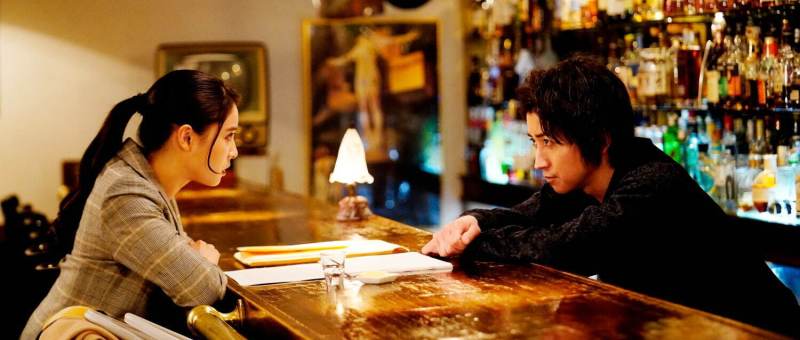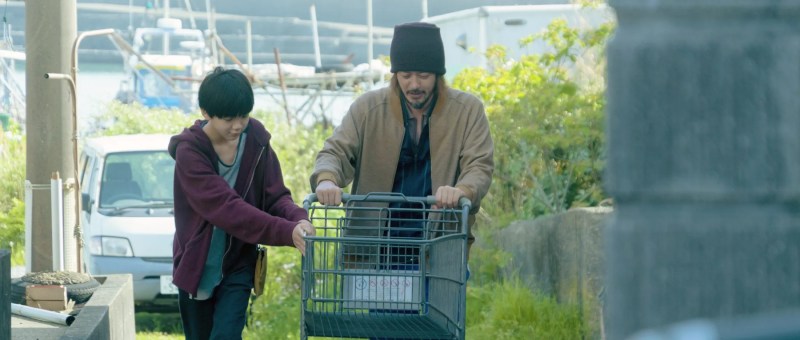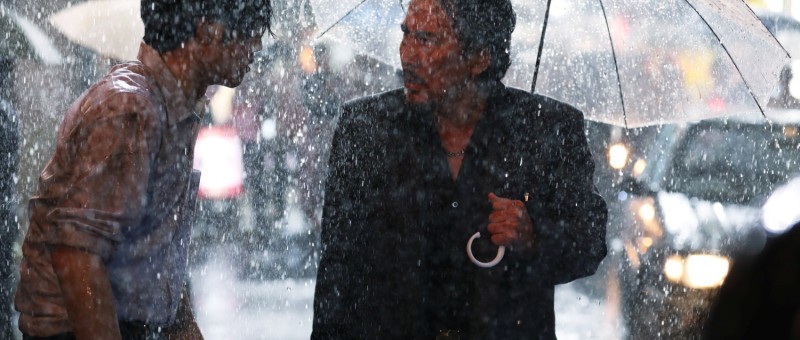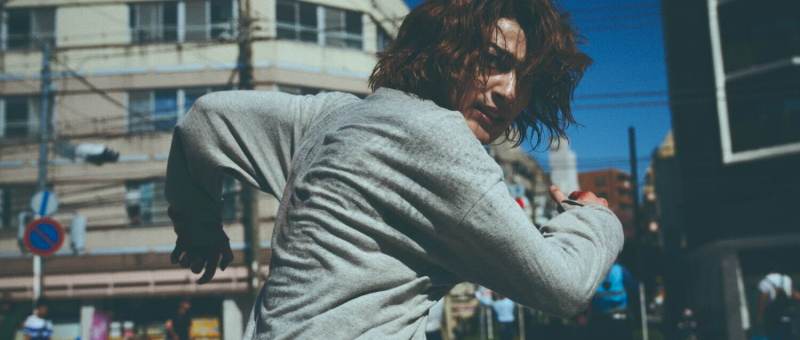
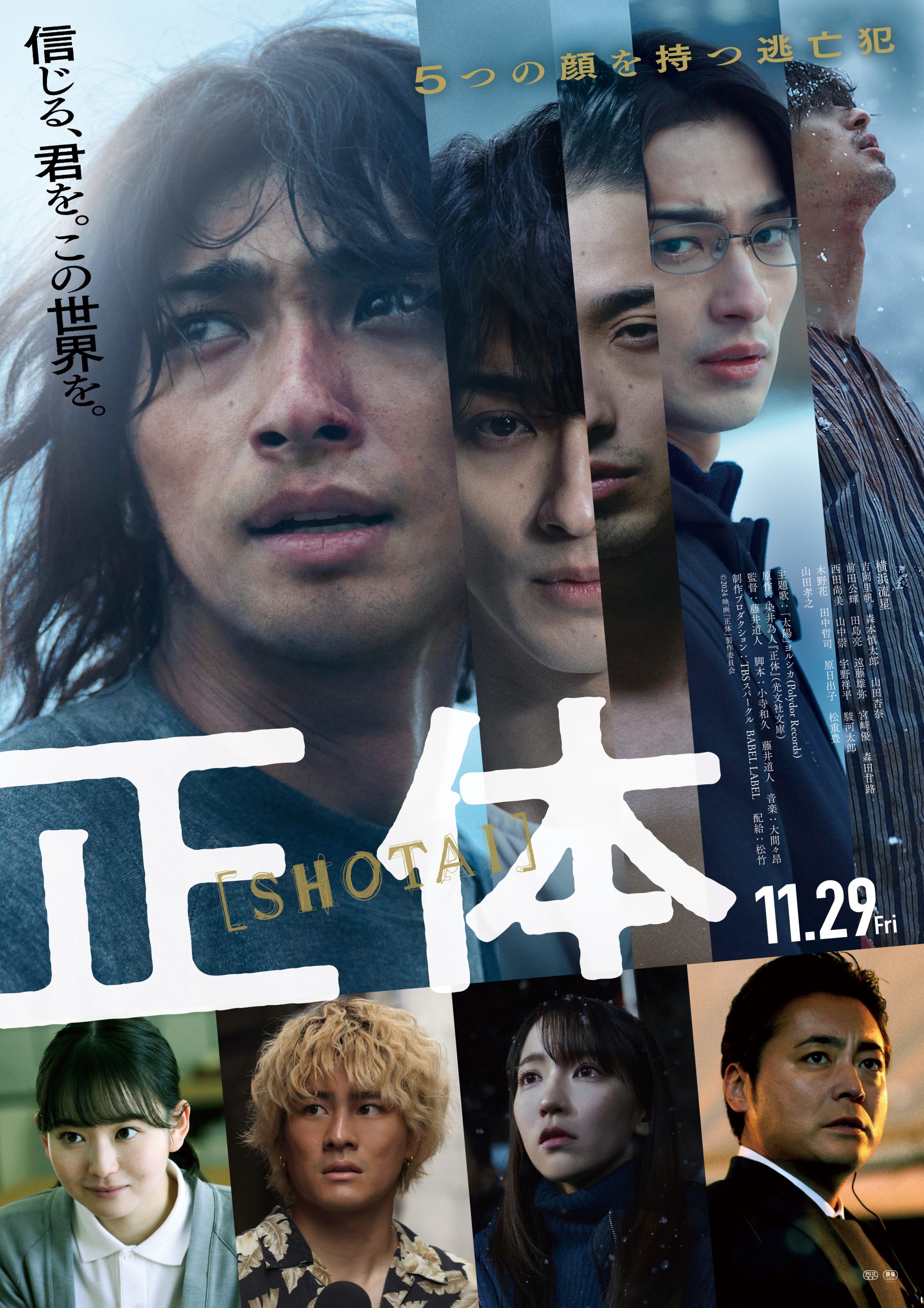
SAKURA (朽ちないサクラ, Hiroto Hara, 2024)

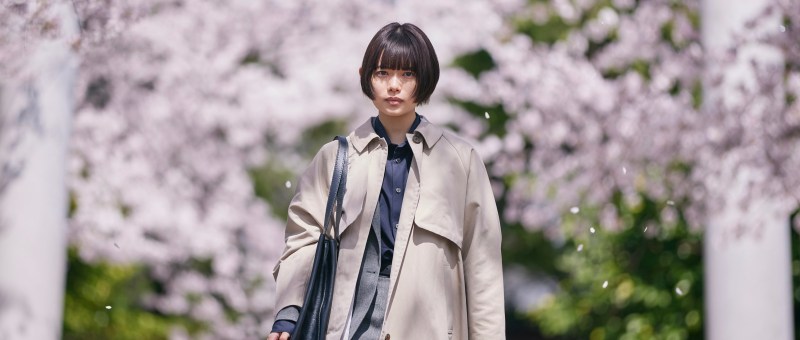
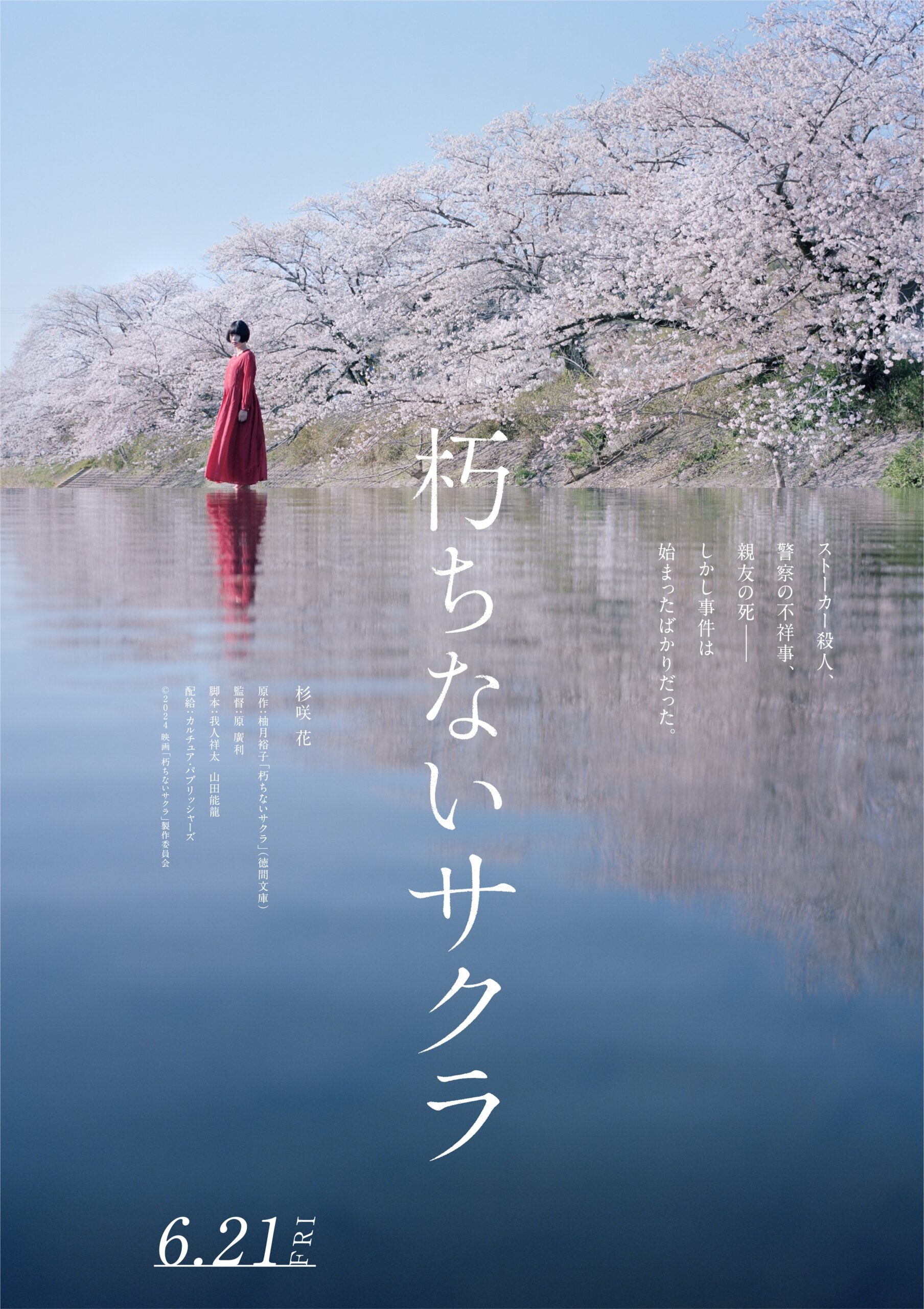
Sakura, or cherry blossoms, are often seen as emblematic of “Japan”. A potent poetic symbol, they blossom only for a short time and then slowly fade away. In the case of Hiroto Hara’s conspiracy drama SAKURA (朽ちないサクラ, Kuchinai Sakura), however, the title refers to a nickname for the security services. In fact, the title could be read either as the “sakura never decays,” or perhaps “will never be tarnished”, “will never die,” echoing the frequent messages that you can never really escape your past for like sakura it will always blossom again while the security services themselves will never fall.

In this case, the event that reverberates is a nerve gas attack on a station that is clearly an allegory for that conducted by Aum Shinrikyo in 1995. Like Aum which is now known as Aleph, the cult in the movie simply changed its name and carried on. Now the head of the police PR department for which the heroine works, former security agent Togashi (Ken Yasuda), is haunted by a mistake he made as a rookie cop and blames himself for not being able to stop the disaster. As fate would have it, the case they’re currently investigating ties back to the cult suggesting a much wider conspiracy in play than the simple intention to cover up a murder.

But there are also two killings here that are likely connected, the first being that of a woman whose allegation of stalking was ignored by the police who, rather than investigate, went off to enjoy themselves on some kind of outing The press is having a field day with the implication the police are both lacking in compassion and negligent in their work. Predictably, the PR division’s main intention is to uncover the source of the leak with Togashi seemingly already suspecting a woman in his department, Izumi (Hana Sugisaki), whose boyfriend, Isokawa (Riku Hagiwara), was himself on that outing. Izumi had accidentally let slip about the police’s activities to her best friend Chika (Kokoro Morita), a reporter who works at the local paper that broke the story. Chika insisted it wasn’t her who wrote the article, but Izumi didn’t believe her. Chika is then found dead after vowing to investigate more fully and prove Izumi wrong with an original hypothesis that she took her own life in guilt over betraying her friend.

Obviously, there’s more to it than that and it soon becomes clear she was murdered probably because she got too close to the truth. Izumi isn’t a detective, but finds herself trying to investigate out of a sense that she contributed to Chika’s death by not believing her when she said she never broke the promise she made not to tell anyone else about the police outing. One might legitimately ask why she is allowed to do this, and the lead detective is not originally happy about it, but as they’re grateful for the leads she turns up, Izumi effectively gets a sort of promotion to investigator. Later events might lead us to wonder if she isn’t being manipulated as part of a wider conspiracy, but then the central intention remains unclear as does the reason the shady forces in play would allow her to investigate Chika’s death knowing the possibility that she may stumble on the “real” truth in the process.

It could be that they simply don’t need to stop her because they know there’s nothing she can do. She has no evidence for her final conclusions and no one would believe her if she spoke out, but it seems odd that conspiracists who’ve already bumped off several other people would allow her to simply walk away knowing what she knows if there were not some grander plan in motion. The question is, is it justified to cause the deaths of a small number of people in order to save the lives of hundreds more who might otherwise die if the cult carries out another terrorist attack before they can be stopped? Sakura apparently have spies and informants everywhere and will do everything they can to protect them in order to facilitate their goal of protecting the nation. Thus the famed cherry blossoms now become another symbol of constant threat and oppression in the spectre of the security services who watch and oversee everything but remain in the shadows themselves. Hara homes in on this sense of paranoia and injustice but in the end cannot resist indulging Izumi’s plucky rookie investigator spirit. Her final decision may not make an awful lot of sense while essentially pitting one authority figure against another. Nevertheless, the tension remains high as Izumi presses forward towards the truth no matter what the danger while like her policeman boyfriend determined to pursue justice wherever it may lie.


SAKURA screens as part of this year’s Japan Foundation Touring Film Programme.

Trailer (English subtitles)

Images: ©2024 SAKURA Film Partners

A Family (ヤクザと家族 The Family, Michihito Fujii, 2020)

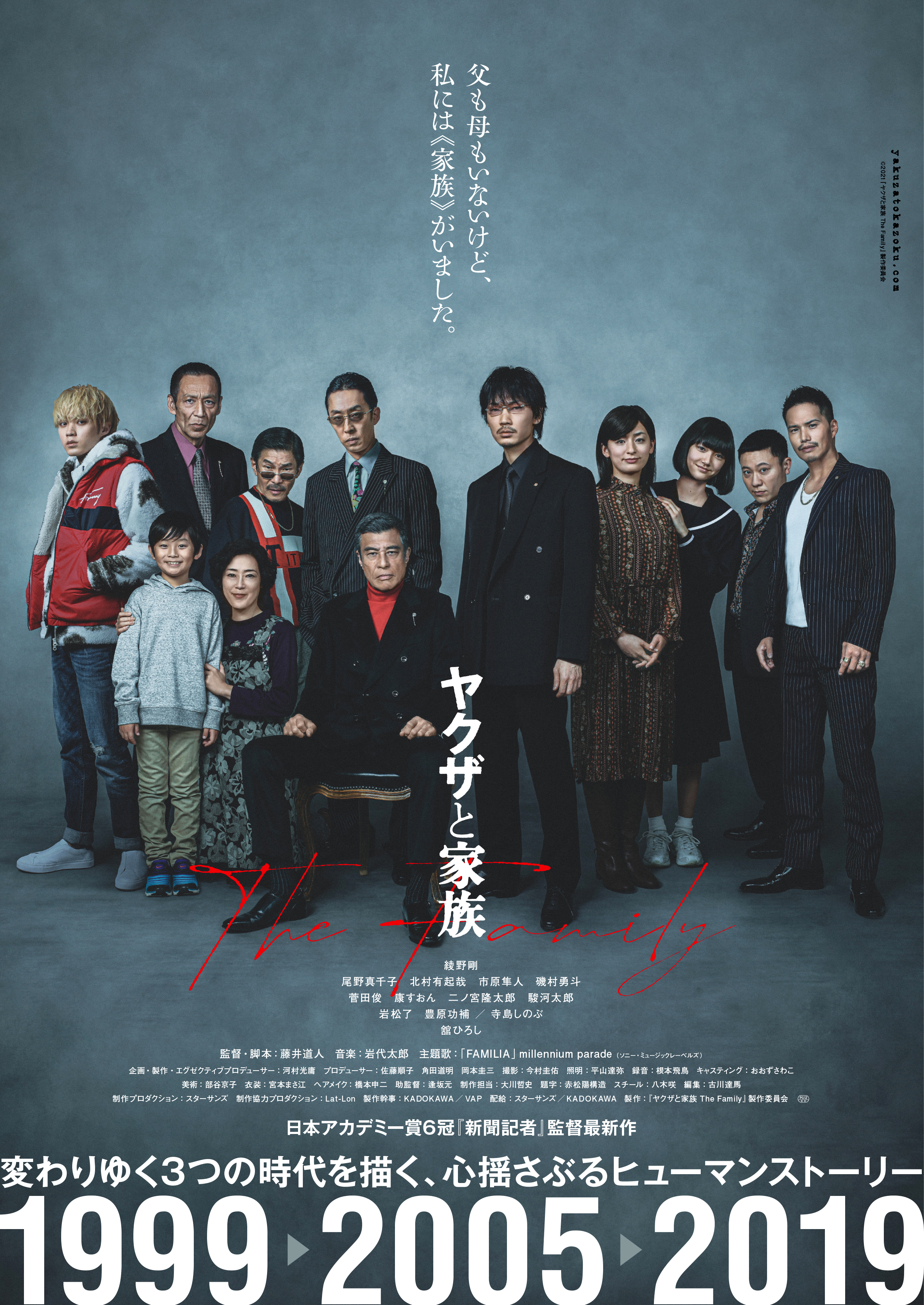
“No one can survive as a yakuza in this world” according to another orphaned son playing the long game of a crime adjacent existence in Michihito Fujii’s melancholy gangster drama, A Family (ヤクザと家族 The Family, Yakuza to Kazoku The Family). The yakuza, or at least yakuza in the movies, has long been a relic of the Showa era rendered increasingly irrelevant in a society no longer in need of its dubious claims of protection. In truth, it’s hard to mourn the passing of organised crime, but Fujii at least finds a kind of pathos and infinite sympathy for these men for whom the gangster brotherhood took the place of a family even if one with a self-destructive legacy. 

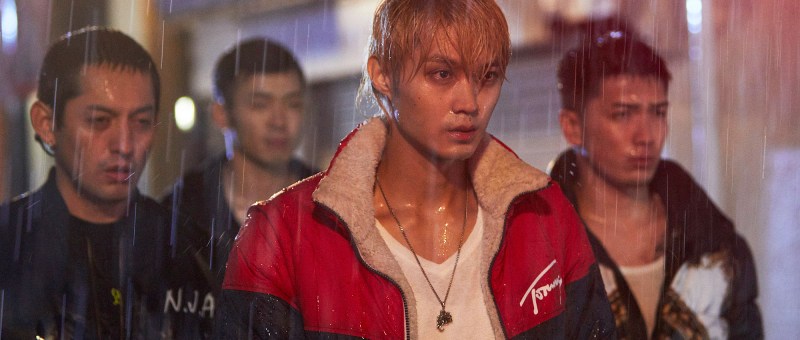
To begin with, petty street punk “Li’l Ken” (Go Ayano) wants nothing to do with the yakuza, seemingly the only guest at the funeral of the drug dealer father he resented other than a corrupt cop from the organised crime squad, Osako (Ryo Iwamatsu), who expresses regret that had he simply arrested him perhaps Ken’s father would be still be alive. Visiting another “familial” environment, a Korean barbecue run by the maternal Aiko (Shinobu Terajima) herself the widow of a gangster currently with a baby on her back, Ken gets himself noticed by local mobster Shibasaki (Hiroshi Tachi) by taking on some punks who stormed into the restaurant and attacked his guys. Explaining that his guys don’t associate with drugs, Shibasaki offers him a job which he refuses but having his card in his pocket literally saves his life when he’s pickup by rival gang leader Kato (Kosuke Toyohara) after having stolen and then destroyed some of their stash after stumbling across a drug deal. The course of Ken’s life is set, he joins the Shibasaki gang along with his two delinquent friends and accepts Shibasaki as his “oyabun” or “father”. 

In Shibasaki, Ken finds a father figure more palatable than the one he lost. As in many a yakuza movie, the Shibasaki clan is positioned as “good yakuza” of the old school kind who believe in things like duty and honour and are apparently pursuing the path towards becoming “true men”. The rival Kyoyo, by contrast, are “bad” new yakuza who no longer play by the old rules and make their money through destructive vices such as drugs. The expected turf war does exactly materialise though the uneasy truce between the rival gangs becomes increasingly strained as the economic situation of millennial Japan begins to shift, the local town council apparently set on demolishing the red light district as part of their plans for redeveloping the city. Kyoyo would rather take over its entirety, pushing Shibasaki to retreat in exchange for a small amount of monetary compensation while shady cop Osako tries to play the situation to his own advantage. 

Yet it’s also clear that the yakuza as an institution is on its way out. After a 14-year prison term, Ken emerges into a very different world in which organised crime has been hounded further into the margins thanks to effective, though the film would also argue inherently vindictive, legislation. No one can make any money anymore, and the slightest slip up can lead to arrest. The Shibasaki gang is now a handful of old men, most of the guys having moved on only moving on from the yakuza life is not easy as Ken’s old friend Hosono (Hayato Ichihara) explains. In order to rejoin regular society, a former yakuza must endure five years in the wilderness unable to open a bank account or get a regular job leaving them with few possibilities for basic survival that enable them to leave a life of crime. Now with a young daughter and job in waste disposal, Hosono is nervous and reticent, reluctant to be seen in public with Ken lest he be tarred with the criminal brush and lose access to the new life he’s managed to build for himself as a responsible husband and father. 

Urged by Shibasaki, Ken eventually leaves one family for another in reuniting with a woman he loved before prison who has since made a respectable life for herself as a low level civil servant but once his life of crime is exposed by a thoughtless colleague at his new job in deconstruction, he discovers that there is no place for a “reformed” yakuza in the contemporary society because in a sense there can be no such thing. Once gangster always a gangster, there is no path forward. Complaining that Osako has stolen his right to life, Ken is told only that the yakuza lost human rights long ago. 

“They’re my family. No reasons are needed” Ken replied when asked why he became a yakuza, but he continues to find himself torn between the various concepts of family and the inheritances of his two very different father figures. “Your time is over old man”, Aiko’s fatherless son Tsubasa (Hayato Isomura) tells an unrepentant Kato attempting to hang on to his territory in the face of a younger generation operating on an entirely different level, rejecting the codification of gangsterdom but seemingly embracing its romance. Tsubasa too is later sucked in by the hyper masculine revenge drama of the yakuza way, seeking vengeance for the death of his father and apparently prepared to ruin his life in order to gain it. It’s for this surrogate son, now a kind of father figure himself, that Ken will eventually make a sacrifice. A sad tale of dubious paternal legacies, frustrated fatherhood, life’s persistent unfairness, and a perhaps uncomfortable lament for a bygone Japan defined by giri/ninjo conflict ruled by manly men, the ironically titled A Family has only sympathy for those trapped by an inescapable spiral of manly violence but also reserves its respect for those who know their time has passed and elect to end the cycle in order to set their “sons” free. 


Original trailer (no subtitles)

Every Trick In The Book (鳩の撃退法, Hideta Takahata, 2021)

A down on his luck writer finds himself at the centre of a mystery only how much is truth and how much “fiction”? Based on the novel by Shogo Sato, Hideta Takahata’s Every Trick in the Book (鳩の撃退法, Hato no gekitai-ho) ponders the possibilities of literature as the hero seems to create a fictional world around him in which it is largely unclear whether he is solving a real world mystery or simply imagining one based on his impressions of the strange characters he encounters through the course of his everyday life.

That everyday life is however eventful just in itself. Tsuda (Tatsuya Fujiwara) once won a prestigious literary prize and was destined to become a popular author but hasn’t written anything of note for some time and in fact now largely works as a driver ferrying sex workers around on behalf of his shady boss. The mystery begins when he approaches a man, a rare solo reader in an overnight cafe, and promises to lend him a copy of Peter and Wendy by JM Barrie only to later discover that the man went missing along with his wife and the daughter he had explained was fathered by another man. 

Like many of his subsequent encounters it isn’t entirely clear if this meeting really took place or at least as Tsuda said it did or is only part of the novel he is beginning to write. The man, Hideyoshi (Shunsuke Kazama), asks him if it’s a novelist’s habit to begin imagining backstories for everyone he sets eyes on and there may well be some of that even as Tsuda is fond of claiming that amazing things happen around us every day to which we are mostly oblivious. Still, Tsuda probably didn’t expect to be pulled into the orbit of local gangster Kurata (Etsushi Toyokawa) after accidentally passing on counterfeit currency he found by chance. It’s true that most of what’s happening to him is the result of a series of bizarre coincidences or cosmic confluence which has accidentally united this collection of people in an unintended mystery which Tsuda intends to solve in either literal or literary terms. 

“It’s all a novelist can do” he later claims in trying to write a better ending for “characters” he has come to like than the one he assumes they “actually” met. But then his editor Nahomi (Tao Tsuchiya) chief worry is that, like his previous novel, Tsuda’s story will contain too much of the “literal” truth which could cause his publishers some legal problems. Part of the reason Tsuda left the industry is apparently because his last book was inspired by a real life affair which was then considered somewhat hurtful and defamatory. For that reason it comes as quite a blow to Nahomi as she begins to investigate and discovers that much of Tsuda’s story lines up with “real” places and events, but then again as he says if you can draw connections between known facts then you begin to see a “hidden” truth which may in its own way be merely his invention. 

The film’s Japanese title translates more literally as something like “how to fend off a dove” which does indeed have its share of irony especially considering the meaning the dove symbolism turns out to have in the film but perhaps also hints at the essential absurdity of trying to fight back against something that is otherwise harmless and in fact represents peace. Tsuda may be onto something and nothing, embracing the bizarre serendipity of a writer’s life while trying to recover his creative mojo but embellishing it with more danger and strangeness than it actually has to offer. Then again as his editor discovers, there really is an incinerator it seems anyone can just walk up and use to burn whatever they want including dead bodies, while people in general are full of duplicities all of which keeps the “fake” money circulating as people use it to try to buy things that can’t really be bought. Hideyoshi calls them “miracles”, embracing the strange serendipity of his life as an orphan longing for a family to call his own and unexpectedly finding one which is “real” in someways and “fiction” and in others. Then again, if you believe in something does it really matter if it’s “real” or not? Hideyoshi and Tsuda might say it doesn’t, the publishing company’s lawyers might feel differently, but it seems there really are amazing things going on around us every day if only you stop to look. 


Original trailer (English subtitles)

It’s All My Fault (ぜんぶ、ボクのせい, Yusaku Matsumoto, 2022)

A young boy and a homeless drifter attempt to overcome the legacy of parental rejection in Yusaku Matsumoto’s sensitive coming-of-age drama, It’s all My Fault (ぜんぶ、ボクのせい, Zenbu, Boku no Sei). “It’s all my fault” is something many children think about circumstances which are well beyond their control, but it’s also something they’re encouraged to believe by an abusive or neglectful parent who tells them that they are to blame for the treatment they receive. Nevertheless, Yuta (Haruto Shiratori) comes to think that all the bad things happening in the world are in some way his fault, which might on one level be easier to believe than trying to accept that the world is sometimes a relentlessly unkind place. 

A sad and sullen boy, Yuta is viewed with some suspicion by the staff at the care home where lives due to his brooding nature and refusal to speak. The cause of his anger is that he was told by a previous caretaker that he’d be able to see his estranged mother, Rika (Marika Matsumoto), when he entered middle school and is resentful that he has still had no contact with her. The sad fact is, however, that Rika stopped taking their calls a long time ago and seemingly has no further intention of maintaining contact with her son. 

After the orphanage is rocked by a literal earthquake, Yuta sets off to find his mother but though she is moved to see him it quickly becomes clear that she is not really prepared to play a maternal role. When her drunken boyfriend returns home, she tells him that Yuta is a relative’s child she agreed to watch for a short time and appears otherwise conflicted, solicitously making sure he has enough to eat but more or less forgetting he’s even there whenever the boyfriend is around. Eventually she rings the care home to come and take him back, forever ruining Yuta’s faith in genuine human connection. 

Managing to run away, Yuta is later taken in by eccentric drifter Sakamoto (Joe Odagiri) who strongly identifies with the boy in having grown up with an abusive mother whose legacy he has been unable to escape. Shiori (Ririka Kawashima), a teenage girl with issues of her own who also befriends Sakamoto, is envious of his untethered lifestyle viewing him as free and bound by no one. But in truth he too is trapped as symbolised by the broken van which prevents him from leaving to travel to Nagoya and confront his mother as he often says he intends to do. Sakamoto describes his trauma as a like a rock in the heart that tortures him as he continues to resent his mother for the abuse she dealt him while simultaneously suggesting that she has dementia and may not even remember that she has a son. Yuta by contrast insists that his mother is not a bad woman and continues to yearn for her, treasuring the friendship bracelet she made for him only for it to be broken by thuggish teens who get their kicks bullying those they perceive to be weaker than themselves.

Sakamoto becomes an awkward paternal figure, teaching Yuta how to survive in his way of life by hatching scams on wealthy passers by and fetching junk to sell to a local scrap merchant but is equally arrested, unable to come to terms with the traumatic past and therefore unable to move on. Shiori envies what she sees as his freedom in part because she has little of her own. Secretly blaming her authoritarian father for her mother’s death which she has come to doubt was really from an illness as she was told, Shiori has an internalised sense of shame and inadequacy knowing that she cannot be the person her father wants her to be and longs to escape him. Yuta continues to dream of a family, inviting Shiori to come with them to Nagoya when the truck is fixed, but is met only with despair as the world conspires against his happiness and encourages him to blame himself for his all his misfortune. Shot with an unsentimental if empathetic eye, Matsumoto’s hard-hitting drama examines the legacies of parental abuse, neglect, or absence persisting long into adulthood while his young hero struggles with himself in his conflicting emotions towards the woman who abandoned him with only an impossible future. 


It’s All My Fault screened as part of this year’s Camera Japan.

Original trailer (no subtitles)

Follow the Light (光を追いかけて, Yoichi Narita, 2021) [Fantasia 2021]

“We all want to run, but still we’re holding on” insists the hero of Yoichi Narita’s rural coming-of-age tale, Follow the Light (光を追いかけて, Hikari wo Oikakete). Not perhaps as its title implies a religious treatise, Narita’s gentle drama nevertheless chases faith in the future while exploring the effects of rural depopulation, economic stagnation, and familial fragmentation on the lives of the young but eventually rediscovers a sense of security, not to mention wonder, in the natural world along with the importance of community in creating a feeling of emotional rootedness. 

Teenager Akira (Tsubasa Nakagawa) has just moved back to his dad’s hometown following the divorce of his parents, his mother presumably having left the family. As one might expect he is sullen and resentful, wishing a meteor storm would destroy his new home and drawing violent comic books to that effect. He ignores everyone at school and is uninterested in making friends, continuing to view himself as an outsider who is not destined to stay. This feeling is compounded by the fact that the school itself is about to close down due to the declining numbers of children in the local area as a result of rural depopulation. 

Akira’s interest is piqued, however, on witnessing a mysterious girl standing atop the roof of a farm house and surveying all below. Accidentally making friends with a bullied boy, Shota, Akira discovers the girl’s name is Maki (Itsuki Nagasawa) but is warned off her on the grounds that she is “crazy” and potentially violent. Akira ignores the warning, but is in any case guided towards the ostracised young woman by a mysterious light said to be caused by a UFO which leads him towards a crop circle in a rice paddy in the middle of which Maki is currently lying.

As Akira discovers, Maki has problems of her own in that her parents are in the middle of a debt crisis and about to lose the small petrol station they’ve been running as a family business. They are in fact just one of many casualties in the faltering local economy which is in a constant state of recession given that the young people all leave for the cities and there’s precious little money to be made in farming anymore. Akira’s father Ryota (Taro Suruga) went to Tokyo to be a musician, an ambition which obviously did not work out, and now he’s come back works for an organisation attempting to find solutions for the future of agriculture in an effort to bring prosperity back to the countryside. Akira’s teacher, Michiru (Rina Ikoma), by contrast who will soon be out of a job is disinterested in her work partly because she left to go to uni in Tokyo but was dragged back by parental pressure and remains intensely resentful trapped in a backwater provincial life quite clearly not of her choosing. 

It wasn’t of Akira’s choosing either and on top of dealing with the disruption of his parents’ separation he feels himself displaced as a city kid unused to the gentle rhythms of country life while struggling to understand the impenetrable local dialect. He originally does nothing on witnessing Shota’s bullying but later befriends him only for their friendship to be derailed by petty jealously in Shota’s resentment towards his growing interest in Maki. Maki, meanwhile, is also struggling with a sense of abandonment largely cared for by her down-to-earth farmer uncle in the wake of parental failure. Akira may originally feel the same way about his boomerang dad, returning home to live with grandma having failed in the city, but later perhaps comes to understand that return is not necessarily defeat while gradually warming to the joys of the country life with its wide-open vistas and kindhearted locals. 

Even so there’s a sense of desperation in these young lives as they watch their world dismantled in front of them as symbolised in the imminent closure of their school. Guided by lights they decide to look towards the future, positing a new sense of community open to anyone willing to be a part of it. As if echoing the sound of the Earth, Maki accepts her parental legacy in continuing to sing a traditional rural folksong once sung by her mother while Akira discovers a new sense of belonging in his father’s latent love for his old hometown. A hymn to a disappearing small-town Japan, Follow the Light is less lament than resurgent hope that something can be saved if only in change.


Follow the Light streamed as part of the 2021 Fantasia International Film Festival

Original trailer (English subtitles)

The Blood of Wolves (孤狼の血, Kazuya Shiraishi, 2018)

korou_honpos_0220_fin.aiJapanese cinema, like American cinema, is one of the few in which the hero cop is a recognisable trope. Though they may be bumbling, inefficient, obsessed with bureaucracy, or perhaps just lazy, police in Japanese cinema are rarely corrupt or actively engaged in criminality. Even within the realms of the “jitsuroku” gangster movie, the police maintain a fringe presence, permitting the existence of the underground crime world in order to contain it. “Jitsuroku” is, in a fashion, where we find ourselves with Kazuya Shiraishi’s throwback underworld police story, The Blood of Wolves (孤狼の血, Koro no Chi). Set in 1988, the end of the Showa Era which had seen the rebirth of post-war Japan and the ascendency of yakuza thuggery, The Blood of Wolves is based on a novel by Yuko Yuzuki rather than a “true account” of life on the frontlines of gangsterdom, but otherwise draws inspiration from the Battles Without Honour series in updating the story of nihilistic yakuza violence to the bubble era.

In 1988, a young accountant “goes missing” sending his sister to ask the police for help in locating him. The case gets passed to sleazy detective Ogami (Koji Yakusho) and his new rookie partner, Hioka (Tori Matsuzaka). Ogami leers disturbingly at the dame who just walked into his office before dismissing the newbie and extracting a sexual favour from the distressed relative of the missing man. Unfortunately, the accountant turns up dead and the bank he worked for turns out to be a yakuza front caught up in a burgeoning gang war between the Odani with whom Ogami has long standing connections and the gang from the next town over who are looking to increase their territory.

Ogami, a chain smoking, hard drinking, womanising detective of the old school, has one foot in the yakuza world and the other on the side of law enforcement. Hioka, a recent graduate from the local but also elite Hiroshima University (something of a rarity in his current occupation), is not quite sure what to make of his new boss and his decidedly “unorthodox” methods, becoming increasingly concerned about the way the police force operates in a town defined by organised crime. Deciding that Ogami has gone too far, he eventually makes the decision to go to IA with a list of complaints but there’s still so much he doesn’t know about Hiroshima and it is possible he may have picked the wrong side.

What he discovers is that the police force is so intrinsically rotten as to have become little more than a yakuza gang itself, only one with the legal right to carry guns and a more impressive uniform. Ogami, for all his faults, apparently has his heart in the right place. His “friendships” with gangsters are more means to an end than they are spiritual corruption, gaining leverage that will help him keep a lid on gang war – after all, no one wants a return to the turbulent days of the 1970s when the streets ran red with the blood of unlucky foot soldiers and that of the civilians who got in their way. Meanwhile Hioka, starting out as the straight-laced rookie, is himself “corrupted” by the corruption he uncovers, developing a complex mix of disgust and admiration for Ogami’s practiced methods of manipulation which, apparently, place public safety above all else.

Ogami, as he tells the conflicted Hioka, knows he walks a tightrope every day, neatly straddling the line between cop and yakuza, and the only way to stay alive is to keep on walking knowing one slip may lead to his doom. He may say cops can do whatever they like in pursuit of “justice” (and he does), but Ogami has his lines that cannot be crossed, unlike others in his organisation who care only for themselves and have long since given up any pretence of working for the public good.

Shiraishi channels classic Fukasaku from the noticeably retro Toei logo at the film’s opening to the voice over narration, garish red on screen text, and frequent use of freeze frames familiar from the Battles Without Honour series and associated “jitsuroku” gangster fare that followed in its wake. Moving the action up to 1988, the gangster world is once again in flux as it tries to corporatise itself to get in on the profits of bubble era prosperity which largely has no need for the thuggish gangster antics of the chaotic post-war years in which the yakuza could paint itself as a defender of the poor and oppressed no matter how ridiculous it might have been in reality. Ogami is a dying breed, a relic of the Showa era meeting its natural end, but perhaps you need to be a wolf to catch a wolf and guardian spirits can come in unexpected forms.


Screened at the 20th Udine Far East Film Festival.

Original trailer (English subtitles)

Girl in the Sunny Place (陽だまりの彼女, Takahiro Miki, 2013)

girl in the sunny placeThe “jun-ai” boom might have been well and truly over by the time Takahiro Miki’s Girl in the Sunny Place (陽だまりの彼女, Hidamari no Kanojo) hit the screen, but tales of true love doomed are unlikely to go out of fashion any time soon. Based on a novel by Osamu Koshigaya, Girl in the Sunny Place is another genial romance in which teenage friends are separated, find each other again, become happy and then have that happiness threatened, but it’s also one that hinges on a strange magical realism born of the affinity between humans and cats.
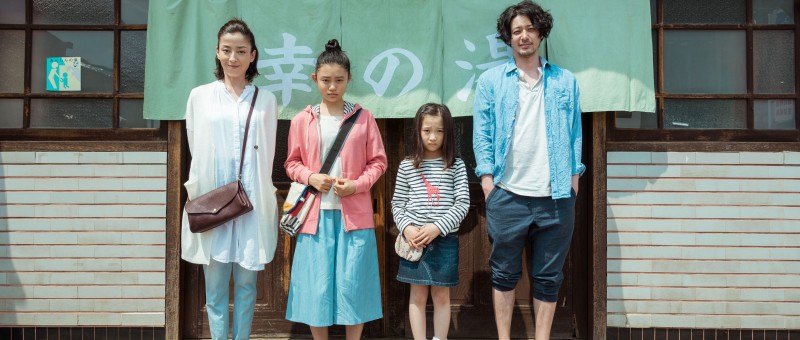

25 year old Kosuke (Jun Matsumoto) is a diffident advertising executive living a dull if not unhappy life. Discovering he’s left it too late to ask out a colleague, Kousuke is feeling depressed but an unexpected meeting with a client brightens his day. The pretty woman standing in the doorway with the afternoon sun neatly lighting her from behind is an old middle school classmate – Mao (Juri Ueno), whom Kosuke has not seen in over ten years since he moved away from his from town and the pair were separated. Eventually the two get to know each other again, fall in love, and get married but Mao is hiding an unusual secret which may bring an end to their fairytale romance.

Filmed with a breezy sunniness, Girl in the Sunny Place straddles the line between quirky romance and the heartrending tragedy which defines jun-ai, though, more fairytale than melodrama, there is still room for bittersweet happy endings even in the inevitability of tragedy. Following the pattern of many a tragic love story, Miki moves between the present day and the middle school past in which Kosuke became Mao’s only protector when she was mercilessly bullied for being “weird”. Mao’s past is necessarily mysterious – adopted by a policeman (Sansei Shiomi) who found her wandering alone at night, Mao has no memory of her life before the age of 13 and lacks the self awareness of many of the other girls, turning up with messy hair and dressed idiosyncratically. When Kousuke stands up to the popular/delinquent kids making her life a misery, the pair become inseparable and embark on their first romance only to be separated when Kosuke’s family moves away from their hometown of Enoshima.

“Miraculously” meeting again they enjoy a typically cute love story as they work on the ad campaign for a new brassiere collection which everyone else seems to find quite embarrassing. As time moves on it becomes apparent that there’s something more than kookiness in Mao’s strange energy and sure enough, the signs become clear as Mao’s energy fades and her behaviour becomes less and less normal.

The final twist, well signposted as it is, may leave some baffled but is in the best fairytale tradition. Maki films with a well placed warmth, finding the sun wherever it hides and bathing everything in the fuzzy glow of a late summer evening in which all is destined go on pleasantly just as before. Though the (first) ending may seem cruel, the tone is one of happiness and possibility, of partings and reunions, and of the transformative powers of love which endure even if everything else has been forgotten. Beautifully shot and anchored by strong performances from Juri Ueno and Jun Matsumoto, Girl in the Sunny Place neatly sidesteps its melodramatic premise for a cheerfully affecting love story even if it’s the kind that may float away on the breeze.


Original trailer (no subtitles)

Her Love Boils Bathwater (湯を沸かすほどの熱い愛, Ryota Nakano, 2016)

her love boils bathwater

The “hahamono” or mother movie has gone out fashion in recent years. Yoji Yamada’s World War II melodrama Kabei or Keisuke Yoshida’s more contemplative examination of modern motherhood My Little Sweet Pea might be the best recent examples of this classic genre which arguably reached its golden age in the immediate post-war period with its tales of self-sacrificing mothers willing to do whatever it took to ensure the survival or prosperity of their often cold or ungrateful children. After “Capturing Dad” Ryota Nakano turns his attention to mum, or more precisely the nature of motherhood itself in a drama about family if not quite a “family drama” as a recently single mother is busy contending with financial hardship and a sullen teenage daughter when she’s suddenly caught off guard by a stage four cancer diagnosis.

Futaba (Rie Miyazawa) is an outwardly cheerful woman, the sort who’s always putting a brave face on things and faces her challenges head on, proactively and without the fear of failure. Her husband, Kazuhiro (Joe Odagiri), ran off a year ago and no one’s heard from him since. Having closed the family bathhouse Futaba works part-time at a local bakery and cares for her daughter Azumi (Hana Sugisaki) alone but when she collapses at work one day Futaba is forced to confront all those tell signs that something’s wrong she’s been too busy to pay attention to. Inevitably it’s already too late. Futaba has stage four cancer and there’s nothing to be done but Futaba is Futaba and so she has things to do while there’s still time.

Some people colour the air around them, instantly knowing how to make the world a better place for others if not quite for themselves, except by extension. Futaba is one such person – the personification of idealised maternity whose instinctual, altruistic talent for love and kindness knows no bounds or boundaries. Yet at times her love can be a necessarily tough one as she negotiates the difficult process of trying to get her shy teenage daughter to stand up to the vicious group of bullies who’ve been making her school life a misery. Faced with an accelerated timeframe, Futaba needs to teach her little girl to be an independent woman a little ahead of schedule, knowing that she won’t be around to offer the kind of love and support she’ll be needing during those difficult years of adolescence.

Not wanting to leave her entirely alone, Futaba tracks down Kazuhiro only to find he’s now the sole carer for the nine-year old daughter of the woman he left her for who may or may not be his. Futaba decides to take the pair of them in but little Ayuko is just as sullen and distanced as her older half-sister as she struggles with ambivalent emotions towards the mother who abandoned her with a “father” she hardly knew. Futaba’s big idea is to reopen the family bathhouse to be run as a family where everyone has their place and personal responsibility, working together towards a common goal and supporting each other as they inevitably grow closer.

Unlike the majority of hahamono mothers, Futaba’s love is truly boundless as she tries not only to provide for her own children but for all the neglected, lonely, and abandoned people of the world. Bonding with the little girl of the private investigator she hires to find Kazuhiko, trying to comfort Ayuko as she deals with the fact that her mother is probably never coming back, even taking in a melancholy hitchhiker whose made up backstory she instantly sees through – Futaba is the kind of woman with the instant ability to figure out where it hurts and knows what to do to make it better even if it may be harder in the short-term.

Like the majority of hahamono, however, Her Love Boils Bathwater (湯を沸かすほどの熱い愛, Yu wo Wakasu Hodo no Atsui Ai) can’t escape its inevitable tragedy as someone who’s given so much of themselves is cruelly robbed of the chance to see her labours bear fruit. Nakano reins in the sentimentality as much as possible, but it’s impossible not to be moved by Miyazawa’s nuanced performance which never allows Futaba to slip into the trap of saintliness despite her inherent goodness. She is evenly matched by relative newcomer Sugisaki in the difficult role of the teenage daughter saddled with finding herself and losing her mother at the same time while Aoi Ito does much the same with an equally demanding role for a young actress moving from sullen silence to cheerful acceptance mixed with impending grief. Yet what lingers is the light someone like Futaba casts into the world, teaching others to be the best version of themselves and then helping them pass that on in an infinite cycle of interdependence. Hers is a love of all mankind as unconditional as any mother’s, sometimes tough but always forgiving.


Her Love Boils Bathwater was screened at the 17th Nippon Connection Film Festival.

Original trailer (turn on captions for English subtitles)

Flowers (フラワーズ, Norihiro Koizumi, 2010)

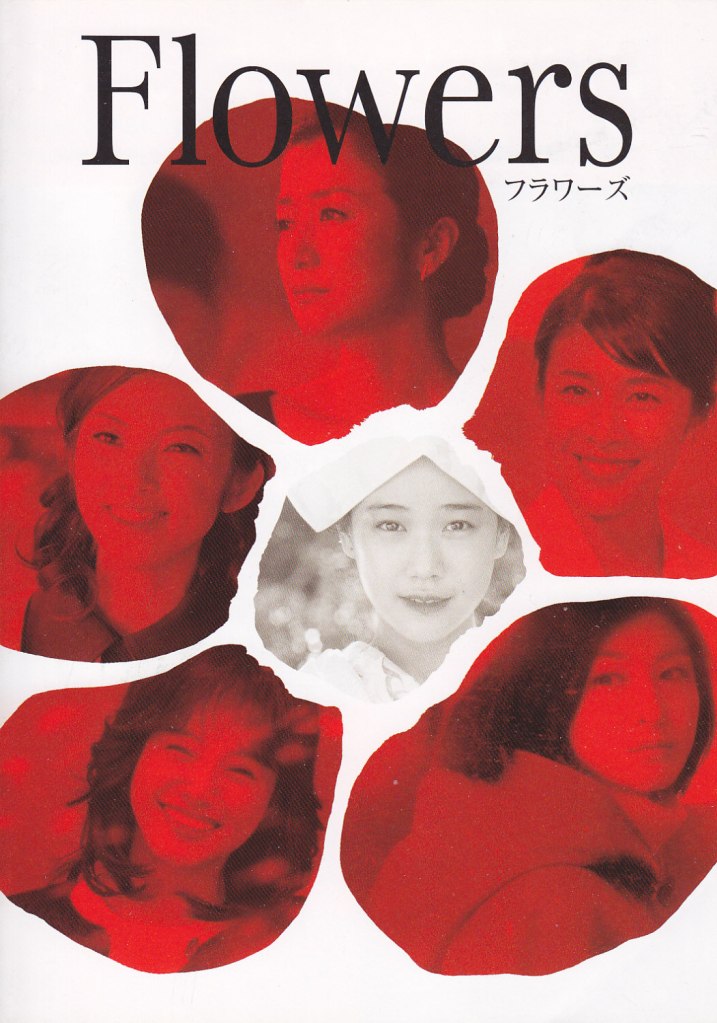
flowersThe rate of social change in the second half of the twentieth century was extreme throughout much of the world, but given that Japan had only emerged from centuries of isolation a hundred years before it’s almost as if they were riding their own bullet train into the future. Norihiro Koizumi’s Flowers (フラワーズ) attempts to chart these momentous times through examining the lives of three generations of women, from 1936 to 2009, or through Showa to Heisei, as the choices and responsibilities open to each of them grow and change with new freedoms offered in the post-war world. Or, at least, up to a point.

In 1936, oldest sister Rin (Yu Aoi) is to be married off against her will to a man picked by her father and whom she has never actually met. Bold and wilful, Rin finds herself more than usually torn between her intense resentment at being forced into a one time only life changing event simply on her father’s say so, and the guilt of rejecting centuries of tradition in rejecting her father’s authority. Minutes before the ceremony Rin makes a break for it fully done up in her wedding dress and makeup.

Flashing forward to her funeral in 2009, we learn that Rin did marry (someone, at least) and had three daughters. It’s her granddaughters we’re interested in now – happy mother Kei (Ryoko Hirosue), cheerful even at a wake, and the depressed Kanna (Kyoka Suzuki) – an unmarried former concert pianist who’s recently discovered she’s pregnant and is unsure what to do. In order to understand them we have to flashback a little again – to 1969, 1964, and 1977 to find out what happened to Rin’s three daughters – Kaoru (Yuko Takeuchi), Midori (Rena Tanaka), and Sato (Yukie Nakama).

Koizumi makes the most of his shifts in time periods to experiment with technical effects recreating the look of classic films of the era. Hence, 1936 is a desaturated monotone filled with classic silent movie compositions, seemingly owing a large debt to Ozu, Shimizu, and Mizoguchi. The difference between 1964 and 1969 might be thought slight but partly down to the different genre elements in the two vignettes, the contrast is marked with 1964 taking on the classic romantic melodramas of the period, and 1969 embracing bright and colourful salaryman comedy – only this time it’s a salary woman embarking on the era of having it all (though perhaps, tragically, ten too years to early to make the most of it). 1977 brings us back down with bump of realism as Sato lives an ordinary suburban life as a housewife and mother. Imbuing each of his eras with the warmth of nostalgia backed up with rich period detail, Koizumi has indeed framed his passage of womanhood narrative with an impressive degree of grounding.

This has been a period of intense social change, entirely for the better even if there is still a long way to go. Though marriages of 1936 were referred to as semi-arranged, families could and did place intense pressure on their children to consent or refuse to accept their refusal to do so (perhaps as true for sons as daughters, though sons were unlikely to find themselves in such a difficult position when things went wrong). Thus the course of Rin’s life is decided by her rigid, austere father leaving her with no possibility of choice in a world entirely controlled by men. Her daughters have more freedom and opportunities, marrying for love and choosing careers and/or motherhood as they see fit.

Midori, the most headstrong of the three sisters takes a job at a publishing house where she is the only female employee. Receiving a marriage proposal leads her to question her choices once again, wondering if accepting means jumping off the career ladder altogether. Wanting to get ahead, Midori has been behaving like her male colleagues – dressing in less feminine clothes and in subdued colours, heading off the inevitable sexist comments with aggression and violence but, eventually emboldened, she she finds herself blossoming when embracing her femininity within the workplace.

The world has moved on – women cannot be pushed in the same way Rin was pushed even if social mores can still be used to cajole them into conformity. The one big recent social change is in Kanna’s decision to proceed as a single mother. Though the question is still raised, there is broad approval for the idea which is met with no obvious stigma and only love and support from her immediate family. However, some things apparently don’t change as even if not all roads lead to marriage they all point towards motherhood which is still presented as the only marker of success as a woman. In this respect the closing montage accompanied by the odd choice of Olivia Newton John’s Have You Even Felt Mellow feels ill judged as the sister who’s experienced the ultimate heartbreak bounces around recreating the opening of Georgy Girl (only more successfully) with a new haircut and indulging in an ice-cream as a sort of antidote to eternal widowhood.

Nevertheless, Flowers does present a warm and broadly inspirational ode to the healing power of family and unbreakable female resilience even in the midst of such extreme social change. Painted with a keen eye for period detail and a deeply nostalgic longing for comforts long since passed, Koizumi’s exploration of womanhood through the ages is quick to acknowledge the pain and sacrifice experienced by women of all generations but is, in the end, too ready to accept it.


Original trailer (no subtitles)