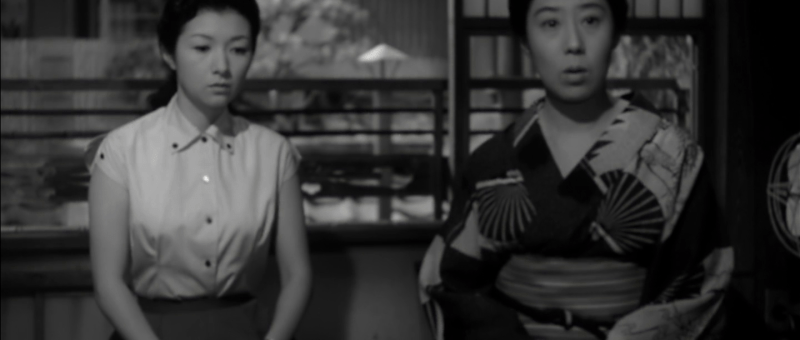
Flowing (流れる, Mikio Naruse, 1956)

The denizens of a moribund geisha house contemplate visions of independence in post-war Japan Mikio Naruse’s thriving ensemble drama, Flowing (流れる, Nagareru). There is indeed a flowing through the geisha house, a tumble of comings and goings though mostly connected to money which is itself constantly flowing though the for geisha mainly in the wrong direction. Released in the year of Prostitution Prevention Law, the film casts a shadow over the lives of these women who are unwittingly living in their industry’s twilight but asks if it’s really possible for a woman to survive without a man while each of them is in one way or another badly let down by an inconstant lover. 

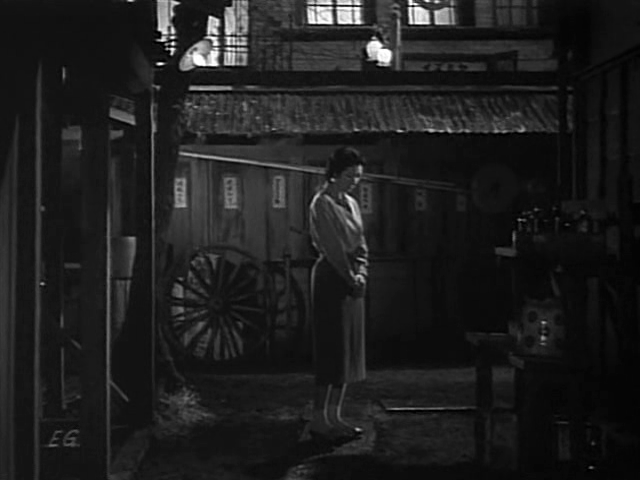
We’re constantly told that Tsutanoya is the most respectable geisha house in town yet despite its well appointed interiors, it’s clear that business is not good. As the film opens, a young geisha, Namie, is accusing the owner’s daughter Katsuyo (Hideko Takamine) of diddling her on her pay. Katsuyo acts indignant and tries to shift the blame back onto Namie but later admits that the house has indeed been skimming a little more off their wages than was agreed claiming all the geisha houses do it which is probably true but doesn’t make it right. In any case Namie will eventually quit and end up working at “some third rate place” while her uncle (Seiji Miyaguchi) causes problems for proprietress Tsuta (Isuzu Yamada) complaining that Namie was exploited and wanting both the backpay he feels she’s owed and compensation though it seems unlikely any of that money is finding its way back to Namie. Meanwhile the house is a geisha down with only former office worker Nanako (Mariko Okada) and 50-year-old veteran Someka (Haruko Sugimura) on the books.

Despite their financial situation, Tsuta hires a new maid, Rika (Kinuyo Tanaka) who is immediately renamed “Oharu” on her arrival. Oharu is a salt of the Earth type, infinitely capable, maternal, kind and loyal bringing a much needed sense of stability to the ever flowing geisha house while also fascinated by this exotic and arcane world. But then as Tsuta cautions her geisha houses may look glamorous from the outside but the life inside them isn’t always fun. Oharu runs into trouble on her first trip to the grocers when they inform her Tsuta hasn’t paid her tab and they can’t let her add to it until she does. A 45-year-old widow whose only child died a year previously, Oharu is also trying to live an independent life, a conflicted Tsuta struck with wonder at her ability to survive without a man, but may also have struggled, grateful to have been offered the job which others might have declined because of the stigma towards the sex trade as finding employment as a middle-aged woman is near impossible. 

At the film’s conclusion even she may imply it isn’t really possible to live as a woman without some kind of support or losing one’s humanity suggesting that she may return to her husband’s hometown and the family she claims not have gotten along with after learning of Tsuta’s betrayal at the hands of an old friend and former geisha, Ohama (Sumiko Kurishima), who at any rate seems to be living quite well as the proprietress of a restaurant. Traditionally, the profession of geisha was seen as a kind of independence in itself but it’s also one that by its nature is reliant on men. Tsuta is often described as someone who is not able to do anything else yet is highly skilled at music and dance having spent a lifetime in training. Without a patron she is stuck and as we learn she threw hers over to pursue a man she loved but he left her in the lurch having mortgaged the geisha house to invest in his business by taking a loan from her older sister who seems to have a nice sideline as a polite loan shark also having loaned money to Someka. 

The most outwardly cheerful, Someka is in other ways a dark vision of a geisha’s future surviving on nothing but nihilistic hedonism while apparently living with a much younger man who eventually leaves her to marry into another woman’s family. Katsuyo has rejected the geisha life explaining that she is unable to, as Nanaka puts it, say silly things to men in order to earn her keep and is essentially incapable of ingratiating herself with men she doesn’t like. She claims she has no desire to marry, unconvinced that any man would be interested in a geisha’s daughter while certain that for a man marrying into a woman’s family is humiliating while suggesting the same would be true for her. Putting her faith in industry, she buys a sewing machine and sets about figuring out how to use it less because she envisages being able to support herself and her mother through taking in needlework than she just wants to feel as if she’s doing something. 

Meanwhile, Tsuta’s niece Fujiko observes all the comings and goings of the geisha house learning the traditional arts in preparation for a future which will soon be obsolete. In a typically Narusean touch, Tsuta comes to a resolution about her future and envisages a new beginning for herself but is unaware the rug is soon to be pulled from under her by the underhanded capitalist Ohama who plans to turf her out to turn the geisha house into another restaurant. “My days of seeking favours from men are over,” Tsuta admits, not of her own volition but simply understanding that she no longer has access to that kind of independence though in essence surrendering her autonomy in leaving herself to the mercy of Ohama in order to escape her older sister’s control. Someka had laughed raucously at Katsuyo’s insistence that she need not be dependent on a man (and after everything she’s seen why would she want to be?) but the younger woman is undeterred even as we see her struggling, doubting that her efforts will in the end be enough to win her her freedom. Ever the optimist, Tsuta is perhaps doing something similar but even Oharu is considering giving up and going home, too good to survive in the dog eat dog world of the contemporary capital where the flow of currency is the lifeblood of the city implying that perhaps the answer to her question is no, a woman can’t survive alone, nor can she rely on female solidarity, but she’ll have to try anyway because there is no other choice. 


A Wife’s Heart (妻の心, Mikio Naruse, 1956)

“We’re too late for everything these days,” mutters an overly cheerful geisha whose behaviour is becoming ever more erratic. A sense of fatalism, that everything has already been decided and there is no real escape from the misery of life, hangs over much of Naruse’s filmmaking even if his heroines often do their best to rail against it and on occasion succeed. Kiyoko (Hideko Takamine), the heroine of A Wife’s Heart (妻の心, Tsuma no Kokoro), finds herself faced with just this dilemma while considering which side of a generational divide she might be on and whether she has the power to escape from her disappointing life to chase emotional fulfilment. 

We can see the literal distance between herself and her husband Shinji (Keiju Kobayashi) in the opening sequence as he stands in a vacant lot at the back of their property and she firmly within the domestic space hanging washing. Yet for all that she seems excited, perhaps even a little giddy as they plot their escape together through planning to turn that vacant space into a cafe in an attempt to fend off the economic changes ravaging their town and wider society of Japan in the mid-1950s. Out and about on his bike, Shinji looks anxiously at the construction of a new pharmacy much larger than his own and with flashy modern signage. Their business is failing and they don’t know how to save it so the cafe is their way out and also a break with the depressing past represented by Shinji’s grumpy mother, Ko (Eiko Miyoshi), who is predictably dead against the cafe idea. 

The new business, in its way, is also a stand-in for the child they don’t have and a means for Kiyoko to find domestic fulfilment in a society ruled by motherhood. This one reason that the sudden arrival of her sister-in-law Kaoru (Chieko Nakakita) with her small daughter Rumiko causes so much disruption. Kaoru has fulfilled the social obligations which Kiyoko has not and quickly insinuates herself within the house, taking over the domestic space as symbolised by her otherwise trivial action of putting back a pair of nail clippers in the place she sees fit rather than their usual home. Yet she does this in part because her husband, Zenichi (Minoru Chiaki) who left the family to become a salaryman in Tokyo, is so obviously unreliable and appears to have not for the first time lost his job while employed at a company possibly involved in something untoward. On getting wind of Shinji’s plans to open a cafe, Zenichi announces he’s thinking of opening one himself and gets his mother to put pressure on the couple to give him the money they borrowed for their dream project.

It’s the loan that in part allowed Kiyoko to consider life beyond her marriage in reuniting with the still unmarried brother of her best friend Yumiko (Yoko Sugi). Kenkichi (Toshiro Mifune) is everything Shinji is not, handsome, well dressed, and with a good, middle-class job working at a bank. On a visit to her relatives, Kiyoko’s aunt remarks that everyone wanted to marry her provoking a slight twinge of pain in Kiyoko’s face. Mother-in-law Ko arranges marriages and it’s likely she arranged the one between Kiyoko and her son and that Kiyoko likely agreed out to of social obligation under the rationale that Shinji was a good catch as the proprietor of a successful business. The implication is that if, like Yumiko, she had held out a little longer she probably would have fallen in love and married Kenkichi. As the atmosphere in the family home grows ever more toxic, she grows closer to him yet at least in part as a symbol of the path not taken, what her life may have been like if only she had resisted and claimed a little more freedom for herself. 

Ko has also arranged a marriage for youngest daughter Sumiko (Akemi Negishi) who asks her if all of her matches were happy. An indignant Ko replies that only one or two have split up, but as Sumiko points out just because a couple stays together does not mean they are happy. “Women don’t have the courage, they just give up,” she remarks implying that she, as a representative of the younger generation, might be less minded to simply accept a disappointing situation in the same way as someone of Kiyoko’s age may feel she had to. For these reasons Kiyoko is torn. Yumiko remarks that she and Shinji didn’t even particularly like each other when they married and perhaps remain indifferent to each other now. The cafe may have brought them closer as a couple, but now it’s causing a rift in the wider family while also offering Kiyoko the faintest glimmer of an escape route. When she returns to the cafe where she was learning the ropes as a part-time employee, much to Ko’s chagrin at losing a domestic helper, it’s clear that she’s doing so in part to have a means of supporting herself as she leans closer to the idea of leaving Shinji. 

But for all that it seems unlikely that she has the courage, as Sumiko put it, to break with the traditional social codes of feminity by leaving a husband who was not really bad but that she did not love and made her unhappy. In rebellion, Shinji has an indiscretion with a local geisha who goes missing on the way home from a hot springs and is later found dead having taken her own life because she was trapped in a bad relationship with her husband. The implication is that this is the only way many women find to escape from their dismal circumstances and may soon present itself to Kiyoko if she cannot find a way to reconcile herself to her life with Shinji or find the confidence to leave it. The enemy is the increasingly outdated institution of arranged marriages as advocated by the austere Ko who refuses to hire maids while believing herself entitled to the free labour of her daughters-in-law, and the patriarchal social codes of a modernising nation in which Shinji can have his dalliance with a geisha and his wife is expected to put up with it, but merely being seen walking with a man not one’s husband provokes gossip and jealousy. 

When Shinji implies he suspects her of having an affair with Kenkichi, he tells her that she’s free to follow her heart and he understands if she chooses to leave him but of course by telling her this he seals her fate by making it almost impossible for her to do so. The couple repairs itself, but the resolution is far from comfortable as it becomes clear that each is essentially resigning themselves to misery because of social convention vowing that they’ll build their cafe in the next season though it seems like a dream destined to go unfulfilled while the institution of Rumiko left behind in the family superficially fills the void it was designed to fill. The fades to black between scenes seem to echo an exhalation of bleakness as the interrupted thought of Kenkichi’s dangerous “Kiyoko…” as an admission that the prospect of escape is only ever a torturous fantasy and a heart is something that must be sacrificed in the name of conventional success. 


The Lost World of Sinbad: Samurai Pirate (大盗賊, Senkichi Taniguchi, 1963)

Seemingly drawing influence from the series of Arabian fantasy films from Hollywood, Senkichi Taniguchi’s Lost World of Sinbad: Samurai Pirate (大盗賊, Dai Tozoku), sees the director reunite with Toshiro Mifune who had made his debut in the director’s Snow Trail which could not be more different from this crowd-pleasing adventure movie. The film is loosely based on the life of 16th century merchant Luzon Sukezaemon who eventually fled to Cambodia after all his possessions were seized by Hideyoshi Toyotomi and he was condemned on some trumped up charges.

The film’s opening scenes perhaps reflect this incident as Luzon (Toshiro Mifune) is branded a pirate and set to be burned at the stake, narrowly escaping after bribing an official with drugs. Resentful, Luzon decides he might as well become a pirate after all as he’s pretty sick of Japan and fancies seeking his fortune on the open seas only his ship is quickly destroyed in a storm and all his crew killed while the treasure he was carrying is seized by the fearsome Black Pirate (Makoto Sato). Washing up in a mysterious place aesthetically a mashup between South East Asia and the Middle East, Luzon is cared for by a hermit and then becomes embroiled in intrigue on finding out that the tyrannical king has been seizing local women in exchange for unpaid taxes and imprisoning them within his harem.

Luzon’s dreams are for riches and status so his sudden discovery of a love of justice is a bit of a surprise, but then he’s also most interested in the princess Yaya (Mie Hama) because he spotted one the necklaces from his treasure chest around her neck which suggests she might have a lead on the Black Pirate. Princess Yaya is engaged to a prince from the Ming kingdom which threatens a wider kind of geopolitical destabilisation should anything go wrong with this marriage which is a distinct possibility seeing as the corrupt Chancellor (Tadao Nakamaru) has been colluding with an evil witch to kill the king and seize the kingdom.

Rather than a pure pirate movie the film contains fantasy elements such as the presence of a Western-style castle which is clearly modelled on the one from Disney’s Snow White along with a weird hermit whose powers are weakened every time he sees an attractive woman. It is not, however, the kind of tokusatsu the English title bestowed by the US release implies as it contains no real monsters instead focussing its special effects on the magic used by the witch, who can turn people to stone with her eyes, and the hermit who can turn himself into a fly or disappear in a puff of blue smoke. Despite the prominent inclusion of SFX master Eiji Tsuburaya these effects are repeated several times are really the only ones featured in the film. 

In any case, what’s in play is famous merchant Luzon’s redemption arc in which he recovers the treasure but gives it back to the people, symbolically abandoning his dreams of wealth and status for something a little more community minded in vowing to sail the seven seas pursuing justice throughout the world. Having been a victim of authoritarianism in Japan, he rises up against tyranny abroad while teaming up with a group of local bandits and several times proudly proclaiming himself as Japanese though in a movie conceit everyone speaks his language including the Black Pirate who is later exposed as a snivelling fool tricked by the Chancellor on the promise of a chance to marry the Princess Yaya. Most of the derring do is reserved for the final sequence in which Luzon and the bandits storm the castle to defeat the evil chancellor but the screenplay also packs in genre elements such as trap doors and secret dungeons which keep Luzon busy as he does his best to overthrow an oppressive regime if only to put the rightful king back on the throne in the hope that might be better. Taniguchi certainly makes the most of his elaborate sets and costumes, creating a sense of tempered opulence along Middle-Eastern themes while adding a touch of the mythic in the attempt to weave a legend around the real life figure of Luzon Sukezaemon as a bandit revolutionary selling dreams of freedom on the sea as a pirate more interested in justice than money in otherwise corrupt society.


Beast Alley (けものみち, Eizo Sugawa, 1965)

In the opening title sequence of Eizo Sugawa’s Beast Alley (けものみち, Kemonomichi), a thick blob of inky blackness gradually expands over an aerial view of the city until it obscures it entirely. The title card which then appears is written in plain white, but will reappear at the film’s conclusion this time ashen as if it too had been singed by the deeply ironic flames with which the film ends. Based on a novel Seicho Matsumoto and scripted by The Beast Shall Die’s Yoshio Shirasaka, the film similarly takes an incredibly cynical view of the modern post-war society in which it is revealed the militarists are still basically in charge and presiding over a deeply corrupt social order. 

The big bad, Kito (Eitaro Ozawa), says as much when he states the need for reforming the nation’s “rotten political system” by which he means post-war democracy. Kito made his made his money doing deeply dodgy things in Manchuria in addition to running an exploitative coal mine in Japan. Now mainly bedridden, he basically runs the country as a far-right political fixer working in tandem with big business and the yakuza who have traditionally been big supporters of conservative and nationalist forces. Early on we see one of his underlings negotiating with politicians to ensure that Taiyo Roads will be hired be hired for a large scale construction project planning to put highways all the way through Tokyo. As we later discover, he’s prepared to go to great lengths in order to achieve his goal, going so far as to have a sex worker murdered to implicate the uncooperative CEO of a rival construction film into resigning by threatening to frame him for the crime so they can install their stooge in his position. 

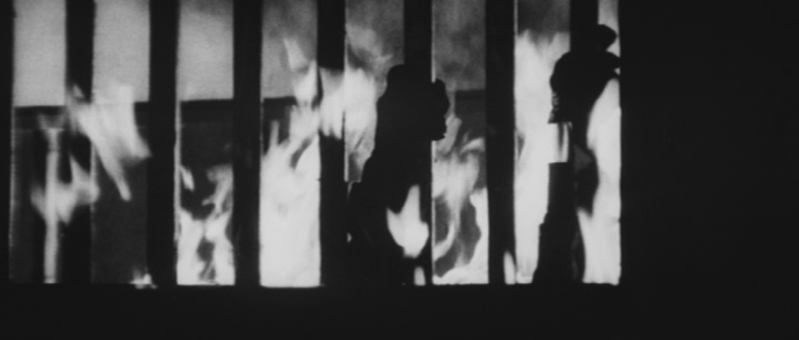
It’s into this world that everywoman Tamiko (Junko Ikeuchi) is drawn while working as a hotel maid at a traditional Japanese inn. Trapped in a bad marriage to a man who is also bedridden yet still attempts to rape her when she returns home to find him in bed with the housekeeper, Tamiko longs for escape and is therefore ripe for the picking when approached by Kotaki (Ryo Ikebe), the manager of an upscale Western hotel, to join him in an unspecified enterprise which will apparently make her very rich. The only catch is that she will have to “get rid” of her “dependent”, which she probably wanted to do anyway, by burning down her house with him inside it. Once she’s done this, there is no turning back for her even if she had not developed complicated feelings for Kotaki who is both her salvation and damnation. 

Tamiko’s husband had failed to give her the comfortable life that he had promised, something which she thinks Kotaki can deliver even if it requires her to become the plaything of Kito whom does she actually seem to like even if aware of the precarity of her position and still in thrall to Kotaki. Leaving the hotel so abruptly was however a strategic error as it arouses the suspicious of (originally) earnest cop Hisatsune (Keiju Kobayashi) who quickly realises that Tamiko set the fire to kill her husband. Though he seemed to be motivated by justice, Hisatsune too is soon corrupted explaining to Tamiko that he has become cynical and jaded. Years of police work have shown him that true criminals know how to break the law and get away with it so he can’t do anything about them, but “good” people, like he implies Tamiko, are pushed into crime by desperation and are easily caught. Tamiko wields her sexuality against him by agreeing to a tryst, though when it doesn’t go to plan he tries blackmail and then rape before she, ironically, manages to escape from his bungled crime. 

Hisatsune’s corruption is gradual and self serving. He starts with suspicion, tailing Tamiko in the interests of justice but also because he desires her, before stumbling on the conspiracy, putting the pieces together, attempting to use them for his own gain and trying to blow a whistle mostly out of resentment. Kito’s reach is all encompassing. Hisatsune is warned off investigating certain aspects of the crime by his senior officers and is then fired on Kito’s instructions for fiddling his expenses after harassing Tamiko. He tries to give his findings to his boss but it goes nowhere and then tries the press but is given the brush off, the editor his reporter friend refers him to gently implying he’s just a crank with an axe to grind. Of course, it turns out that the reporter is already in league with dodgy lawyer Hatano (Yunosuke Ito) who is Kito’s right-hand man. 

The connections between the three men, Kotaki who was once a communist, Hatano, and Kito go back to Manchuria and the corruptions of militarist era which it becomes clear has never really ended. Kito has only one rival and it’s another faction of the conservative ruling party who are probably just waiting for him die. Attempts are made on his life and they don’t go well for those who make them. Even if Hatano hoped to simply inherit an empire he, as he points out, put in much of the work to build he is sorely mistaken while Tamiko may intellectually understand that Kito’s death would place her in a precarious position but carries on regardless. “You never know who will betray you in this world” Kotaki laments, echoing Kito’s later claim that his Buddhist statues are the only ones will never betray him even as sleeps next to a statue of Aizen Myo whom he ironically claims protects mankind from their lust and desire. 

It could be said that desire is Tamiko’s undoing, but as Hisatsune had suggested perhaps you couldn’t blame her for longing to be free of the bedridden husband who had not delivered what he promised her. As she said, she was doing what could to survive even if you’d think she’d know putting on a ring taken from the finger of a murdered woman is akin sealing your own fate. Sugawa shoots with a noirish sense of dread, tracking Tamiko with her coat drawn up around her face as she tries to leave the scene of her crime, and makes the most of his fiery imagery before ending on a note of cynical laughter amid the inescapable hell the of post-war society. 


Original trailer (English subtitles)

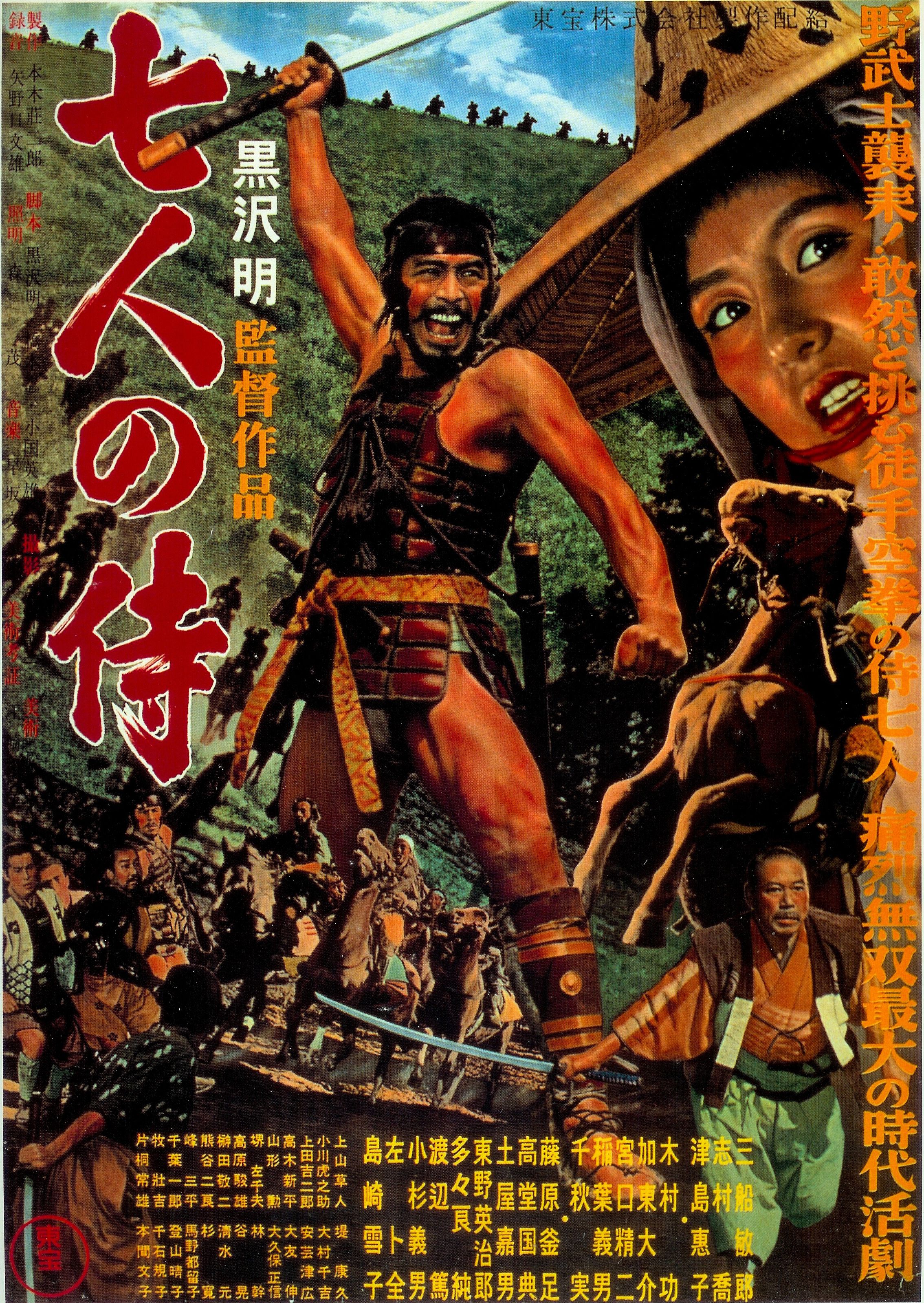
Seven Samurai (七人の侍, Akira Kurosawa, 1954)

An eclipse of the accepted order allows a temporary truce in the ongoing class conflict that defines feudal society in Akira Kurosawa’s seminal post-war historical epic, Seven Samurai (七人の侍, Shichinin no Samurai). Set in the late 16th century, the action takes place in a world on the brink of collapse. The Sengoku era is drawing to a close but is also in a moment of intense crisis which has left large numbers of highly skilled warriors essentially orphaned, wandering the land torn between their basic needs for food and shelter and their dignity as members of a theoretic aristocracy. 

Plagued by bandits, many of whom may be these orphaned swordsmen, a small village contemplates the unthinkable in hiring samurai, otherwise their oppressors and uniquely responsible for the chaos which surrounds them, for protection. “Land tax, forced labour, drought…and now bandits!” one woman exclaims shortly before suggesting they simply surrender all their grain and then hang themselves. As they can offer only expenses in the form of rice, the only samurai they can hope to recruit are already desperate, so hungry that they may be willing to deign to defending their social inferiors with whom they would not usually mix unwilling to accept that they are both victims of the inherently corrupt social order. This explains why the villagers’ early entreaties are met with such scorn and cynicism, either rudely rejected out of hand or ending only in deception. 

In this there is an echo of the world of 1954 which was beginning edge away from the chaos and privation of the immediate post-war society, bandits standing in for thieves and profiteers themselves a product of intense food insecurity. Yet here it’s desperation that allows a temporary merging of the world of lord and peasant, brokered finally by unexpected compassion on the part of a noble samurai who, in an act of extreme transgression, symbolically erases his elite status by shaving his head in order to save a child taken as a hostage by another desperate man. Kambei (Takashi Shimura) may be somewhat reduced in circumstances but refuses to give in to the immorality of the world around him, finally agreeing to help the villagers essentially out of a sense of pity willing to accept only the gift of sustenance moved by the villagers’ sacrifice in discovering that they give him the last of their white rice while subsisting only on millet. 

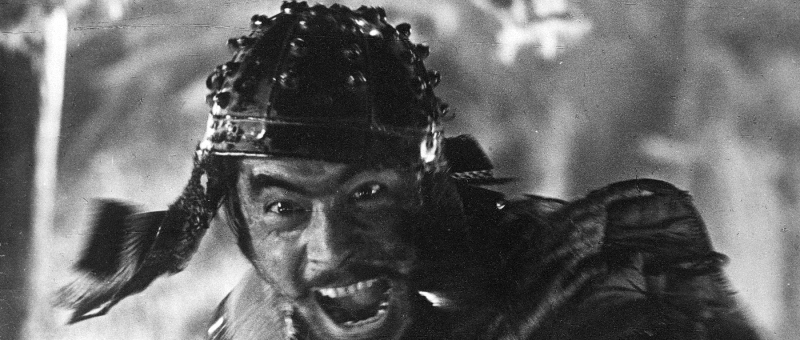
Yet having taken this step, the villagers remain uncertain they can really trust the men they’ve hired to protect them who are after all each trained in death. Later we discover that they have, like many of the time, occasionally finished off the odd lone samurai fleeing the battlefield in order to loot the bodies as a large stockpile of samurai armour later discovered by the samurai-pretender Kikuchiyo (Toshiro Mifune) testifies. On being confronted with this uncomfortable reality, the samurai fall silent knowing this armour was stripped from men much like themselves, but can ultimately offer little by way of defence when presented with an angry rant from Kikuchiyo who points out that they are themselves responsible in having created this world of chaos through their internecine quests for power. “In war you burn their villages, trample their fields, steal their food, work them like slaves, rape their women, and kill ‘em if they resist. What to you expect ‘em to do?”

When Kambei and the others first arrive in the village, there is no welcoming committee. The villagers all hide, frightened to leave their homes partly because of paranoia spread by widowed father Manzo (Kamatari Fujiwara) convinced that randy samurai are going ravish all of their daughters who will, doubtless, be overcome with awe by these sophisticated men of the elite. In an echo of Kambei’s transgression, Manzo forces something similar on his teenage daughter Shino (Keiko Tsushima), roughly cutting her hair while she cries and resists before dressing her up as a boy so that she’ll be safe from lusty samurai. The plan, however, backfires in that she later engages in a doomed romance with the young Katsuhiro (Isao Kimura). Their eventual union is the symbolic merging of the two worlds, a moment of eclipse in the usual hierarchy, but it’s born of the same impulses than brought Kambei and the others to the village. In fear and desperation, they behave as if there’s no tomorrow, only tomorrow must come and just as sun and moon must eventually move apart and resume their regular orbits so the relationship between Katsuhiro and Shino is an impossibility. 

Like Kambei, Katsuhiro had occupied a slightly liminal position because of his relative youth, neither boy nor man. He first encounters Shino while marvelling at the natural beauty of the forest, only to berate her for doing the same. “Is this any time for an able-bodied man to be picking flowers?”, he ironically asks her, yet he is repeatedly forced back towards conventional masculinity as marker of adulthood virtually ignoring her when tasked with carrying a dummy to the ridge, while she later returns the same gesture reassuming her femininity in joining the rice planting, a peasant woman once again. “What’s wrong with two people in love?” the wounded Rikichi (Yoshio Tsuchiya) asks Manzo, trying to smooth over this moment of cross-class crisis, only for Monzo to ask what he’s supposed to now his only daughter has become “damaged goods”, unfit for marriage in a fiercely patriarchal society in which it is impossible to survive without a husband. 

Katsuhiro cannot marry her, this sense of solidarity if not quite equality can be only temporary. Kambei himself admits as much as he reflects that the battle has been won but the victory belongs not to them but to the peasants, anticipating his a sense his own obsolescence the end of the Sengoku era bringing about a change in the nature of the samurai that two centuries later will lead to its abolition. Our sympathies might shift, witnessing Kambei’s obvious disapproval of the peasants’ relish in taking revenge on the bandits who have caused them so much misery in their own way perhaps perpetuating the cycle of violence and resentment that drives the feudal engine. One cannot help but pity him, displaced once again returning to a life of ceaseless wandering, his presence in the village now no longer necessary and in fact inappropriate. 

Returning to the world of 1954, there might be something a little uncomfortable in this lament for the death of the samurai who can have no place either in the modern society or in a peasant village in 1587, as there may be in the implication that the peasants are savage and vindictive while Kambei alone is good and kind even if the roots of his compassion lie in his willingness to literally sever himself from his elite status. The roles had in a sense been reversed, the samurai hired hands to peasant bosses, but the inversion can be only temporary. In insisting that only by protecting others can one hope to protect oneself, Kambei may be advocating for a more compassionate society but as much as he has attempted to remove himself from the class system he can not in the end overcome it. Nevertheless, in the gruelling battle scene that closes the film, all rain, mud, death and misery, Kurosawa himself deals the final blow to the samurai in the nihilistic futility of violence manifesting itself once again in the lingering feudalism of the mid-century society. 


Seven Samurai is re-released in UK cinemas in its recent 4K restoration as part of BFI Japan on 29th October.

BFI re-release trailer (English subtitles)

Snow Country (雪国, Shiro Toyoda, 1957)

Closely associated with literary adaptation, Shiro Toyoda had been wanting to adapt Yasunari Kawabata’s Snow Country (雪国) since its serialisation and apparently spent four years preparing his treatment ahead of the 1957 film starring Ryo Ikebe as the solipsistic aesthete at the novel’s centre. Characteristically, however, he takes several liberties with the source material, notably introducing an entirely different conclusion which perhaps helps in re-centring the tale away from the hero Shimamura to the melancholy geisha who apparently falls for him because of his intense loneliness. 

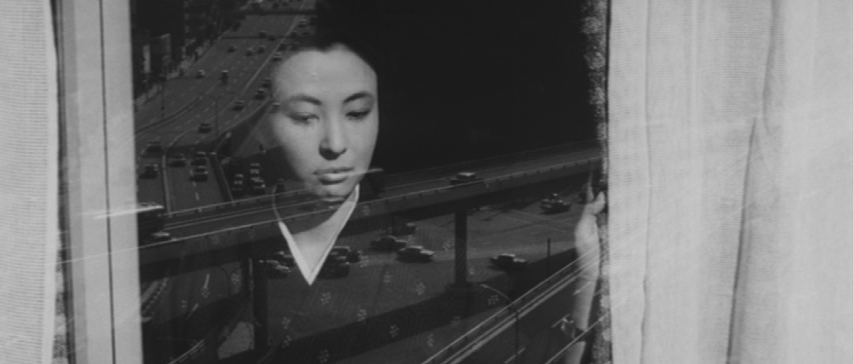
A brief reference to a failed military insurrection in Manchuria sets us firmly in the mid-1930s as do repeated mentions of the ongoing depression which causes additional anxiety to local business owners in a small holiday resort town. Mimicking the novel’s famous opening, Toyoda opens with a POV shot of a train exiting a tunnel into the snow-covered landscape, the hero Shimamura (Ryo Ikebe) sitting sadly gazing out of a window and eventually captivated by the reflection of a young woman devotedly caring for a young man who appears to be in poor health. Meanwhile, another young woman, Komako (Keiko Kishi), gazes at her own reflection in a train station window, waiting once again as if unable to depart. As we discover, Shimamura has returned with the intention of seeing Komako with whom he’d struck up a relationship during a summer trip but is somewhat disappointed to learn that she has since become a geisha.

In a flashback to their first meeting, Komako asks Shimamura if he has come for “escape”, a question he doesn’t exactly answer while petulantly complaining about his lack of artistic success as someone who paints pictures apparently out of step with his times. When the head of the local commerce association tries to involve him in conversation about the failed insurrection, he bluntly tells him that he’s an artist and as such has no interest in such things, but it does indeed seem that he is looking for some kind of escape from the turbulent times, expressing that here the war seems very far away as does “the depression”. Komako, a more modern and perhaps prophetic figure than it might at first seem, is the only one to bring up the war directly speculating that it may be about to intensify while the frustrated affair between the two seems to be informed by the mounting tensions against which they are attempting to live their lives. 

Rather self-absorbed, Shimamura in a sense may even identify with Komako explaining that he too has a “patron” and implying that his flight is perhaps a response to his sense of powerlessness, that he feels constrained by his financial dependency presumably on his father-in-law though his relative economic superiority which leads Komako to frequently remark on his “extravagance” obviously affords him the freedom to make these random solo trips to ski resorts and indulge his career as a painter regardless of its capacity to support himself and his family. Komako must know on some level that the relationship is a fantasy, yet she believes in it enough to end her connection with an elderly patron on suspecting that she is carrying Shimamura’s child only to have her hopes dashed when he does not turn up for a local festival as promised with the consequence that all of her dependents are turfed out of the home he had provided for her. 

Komako is not “free” in the same way that Shimamura evidently is, her entire life dictated by the fact that she is poor and female. Fostered by a shamisen teacher, she may have been technically engaged to the young man, Yukio (Akira Nakamura), Shimamura saw on the train being cared for by Yoko (Kaoru Yachigusa), Komako’s foster sister in love with him herself, but intensely resents the burdens she is expected to bear quite literally with her body. She later tells Shimamura that she didn’t become a geisha for Yukio in order to pay his medical bills but out of a sense of obligation, while she is also responsible for her birth family, the now bedridden shamisen teacher, and Yoko who intensely resents her for her callous treatment of Yukio and generally “dissolute”, selfish way of living. During the famous fire in a cinema that closes the novel (but not the film), Komako even exclaims that her life would be easier if Yoko burned to death, but on witnessing her either fall or jump from the burning building she can do nothing other than run to her side. 

Indeed, the novel’s climax finds Shimaura standing alone indifferent to the fate of Yoko, a young woman he had come to admire if only for her contrary qualities, admiring instead the beauty of the night sky. In Toyoda’s characterisation, Yoko is in one sense the conventionally good woman whose selfless devotion to the sickly Yukio so captivates Shimamura, but her goodness is nevertheless undercut by the degree of her animosity towards Komako even as the two women remain trapped in a complex web of frustrated affection and intense resentment, each perhaps knowing they neither can have the man they want and are condemned to an eternal unhappiness as the snow mounts all around them in this perpetually cold and depressing moribund resort town. Switching between studio matte paintings ironically mimicking Shimamura’s art and on-location footage of the deepening snows, Toyoda’s sense of near nihilistic melancholy evoking the atmosphere of Japan in the mid-1930s hints at grand tragedy but finds resolution only in stoicism as the heroine picks up her shamisen and trudges onward amid the quickening blizzard.  


The Last Gunfight (暗黒街の対決, Kihachi Okamoto, 1960)

“Times may change but there’s always a bunch of greed-blinded old men to rip you off” according to the sidelined noble yakuza pushed into the shadows of Kihachi Okamoto’s anarchic gangster romp The Last Gunfight (暗黒街の対決, Ankokugai no Taiketsu). Another of Okamoto’s early crime movies, Last Gunfight, adapted from the novel by hardboiled king Haruhiko Oyabu, as its name implies finds a stranger in town arriving at the tail end of a gang war in which the wrong side seems to have won hoping to offer a course correction for the post-war future. 

Branded a “dirty cop” and demoted to small-town Kojin, Fujioka (Toshiro Mifune) is a maverick officer exploring the local landscape by getting into fights with foot solders from differing outfits, quickly finding out that the Ooka gang are currently in the ascendent while old school Kozuka flounders. Improbably enough, the local flashpoint is over control of the gravel dredging business currently operated by Kozuka but contested by Ooka. Fujioka meanwhile is caught in a complex web at the nexus of which is Tetsu (Koji Tsuruta), a former Kozuka man who now runs a bar while he plots revenge for the death of his wife in a traffic accident he suspects may have been foul play possibly at the hands of Ooka man Niki, brother of brassy bar girl Sally (Yoko Tsukasa). 

Arriving on the same train as dodgy lawyer Tendo (Akihiko Hirata) and an exotic dancer destined for the club, Fujioka keeps his cards close to his chest leaving his loyalties all but clear. The station are less than thrilled to have him, especially as he spends his first night in town in one of their cells after starting a bar fight, waking up right under a sign which reads “stop violent crime”, while another earnest young officer reminds him that “policemen should never be involved in violence”. Fujioka continues to play both sides, cosying up to both Ooka and Tetsu, walking the line between cop and thug while seemingly scoping out the terrain on either side of the tracks. 

Meanwhile, the town is mired in a battle for its soul as the amoral Ooka gang slowly take over. As Kozuka foot soldier Yata (Makoto Sato) puts it, his boss is the sort who won’t have anything to do with yakuza who don’t obey the code which is why he won’t simply cut a deal with Ooka. According to Kozuka (Jun Tazaki), others might lump him in with “fools and trash” but he’s the old school kind of yakuza providing a genuine service to the community. He dredged the river to stop it flooding and was given the gravel business as a thank you so he resents having it stolen out from under him by the likes of Ooka who makes his money primarily through the drugs trade trafficking “China White” and has seemingly corrupted the entire city council. 

Then again, as Kozuka points out ties based on greed are the most fragile of all and it appears Ooka has secrets he’d rather weren’t exposed. Living in a Western-style mansion complete with open fireplaces and hunting trophies on the walls Ooka is laying claim to a fiefdom as the new inheritor of the feudal legacy. Tetsu’s bar, meanwhile, seems to have a Wild West theme which perhaps speaks of his love of freedom and independence as opposed to Ooka’s elitist authoritarianism. As a representative of legitimate authority Fujioka walks a tightrope between the two but eventually shuns a potential love interest in bargirl Sally, currently Ooka’s squeeze but playing her own game hoping to find out what happened to her brother, in favour of a bromance with the wounded Tetsu.  

Like Okamoto’s other gangster movies from this era however and in contrast to the heaviness of the title, Last Gunfight is imbued with a strong sense of irony and the director’s characteristically cartoonish sense of humour with its ridiculous fight scenes, elaborate production design, and playful subversion of gangster movie tropes right down to the frequent musical numbers starring a trio of minions clad in black suits and lip-syncing to songs about killing the moon. Ending as it began, Okamoto’s elliptical narrative sees the strangers leaving town, job done, but laying themselves bare as they go now shorn of their cover identities and headed back into the heart of corruption in search of new destinations.


Original trailer (no subtitles)

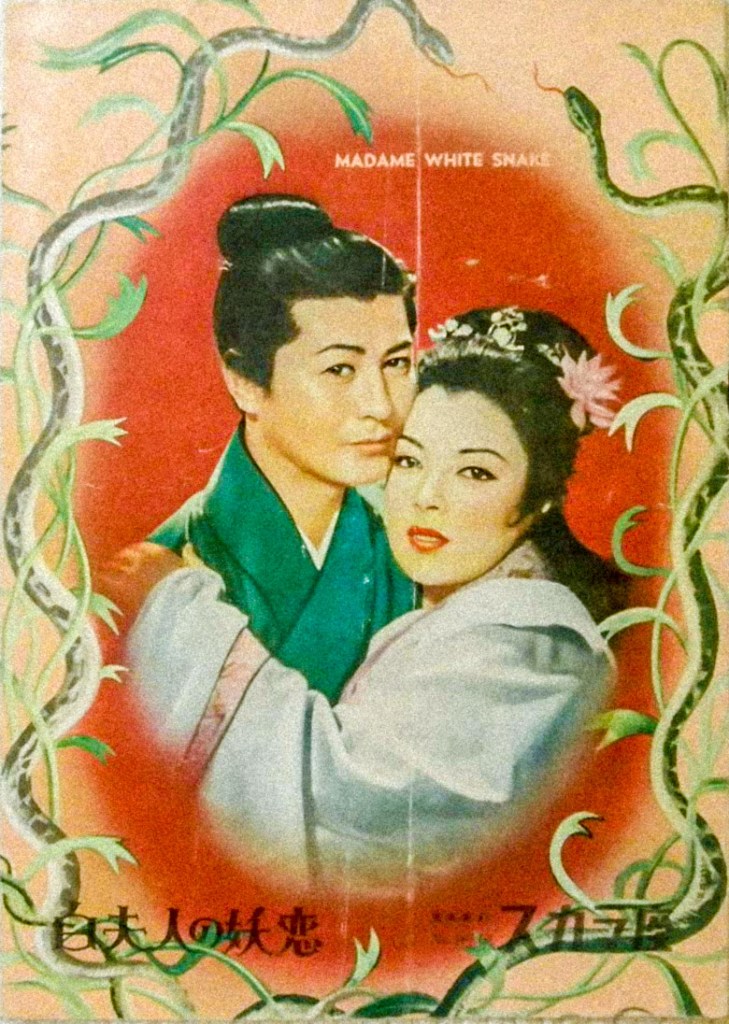
Madame White Snake (白夫人の妖恋, Shiro Toyoda, 1956)

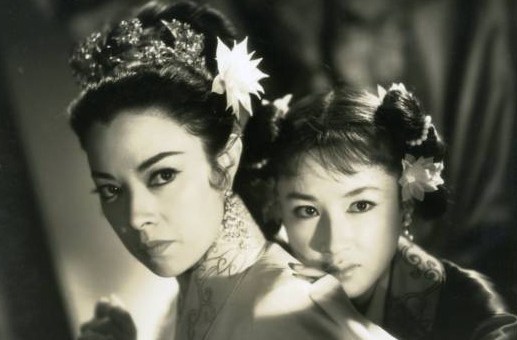
A studio director at Toho, Shiro Toyoda was most closely associated with adaptations of well respected works of literature, often with an earthy, humanist touch. He might then be an odd fit for a tale of high romance co-produced with Hong Kong’s Shaw Brothers and inspired by a classic Chinese legend. Madame White Snake (白夫人の妖恋, Byaku Fujin no Yoren) effectively drops some of Toho’s top talent, including “pan-Asian” star Shirley (Yoshiko) Yamaguchi (AKA Li Xianglan / Ri Koran), into a contemporary Hong Kong ghost movie with Toyoda doing his best to mimic the house style. 

As in the classic legend, fate is set in motion when herbalist Xu-xian (Ryo Ikebe) allows “noblewoman” Bai-niang (Shirley Yamaguchi) and her maid Xiao-qing (Kaoru Yachigusa) to board a boat he is riding to escape a storm. The pair bond because they are both orphans out in the rain to pay their filial respects to their late parents on tomb sweeping day. Disembarking, Xu-xian lends the ladies his umbrella, vowing to visit their house the next day after his rounds to reclaim it. When he arrives, Xu-xian is greeted by a near hysterical and extremely romantic Bai-niang who has apparently fallen deeply in love with him because of his pure heart. She proposes marriage, but Xu-xian is wary. He is after all just a poor boy, a herbalist living with his older sister and her husband. He has no money to get married and Bai-niang is a noble woman from a good family, society simply wouldn’t allow it. Xu-xian tries to escape, but his gentle words of refusal only wound Bia-niang’s heart. 

Hoping to smooth the situation, Xiao-qing decides to give Xu-xian a small fortune in silver taels so the money issue will be solved. Strangely, the plan appears to work. Xu-xian quickly gets over his reluctance to accept money from a wealthy woman who wants to marry him and returns to being in love and excited, selling his newfound hope for the future to his sister by showing her the taels. It is, however, not quite that simple. The silver turns out to be stolen as evidenced by a mark of fire on its surface. Xu-xian falls under suspicion as a thief and comes to resent Bai-niang for placing him in such a difficult and embarrassing position. 

Nevertheless, despite all the strange goings on such as the suddenly “abandoned” house, the green smoke, and vanishing women, Xu-xian does not seem to suspect that Bai-niang is not fully human, and is only angry with her for misusing him. In a motif which will be repeated, however, he is eventually won over. After taking a job in his sleazy uncle’s inn, he re-encounters Bai-niang and realises she really is the one for him. But as they begin to build their life together, launched with an unwise loan from the sleazy uncle who can’t seem to keep his eyes (and occasionally hands) off Bai-niang, doubt begins to creep in. Those small cracks are deepened when Xu-xian is accosted by a man who announces himself as a Taoist from Mount Ji and tells him that he has an evil aura over his head, encouraging him to believe that an evil spirit is slowly capturing his heart which why he’s a little bit afraid to go home. The priest gives him some useful talismans, which are of course quite bad news for Bai-niang who now knows that her husband secretly doubts her. 

Meanwhile, prepared to do “anything” to make the man she loves happy, Bai-niang has come to the strange conclusion that Xu-xian’s moodiness is down to the fact that their medicine shop isn’t doing so well. Unfortunately, her big idea is poisoning the local well to make everyone think there’s a plague so they’ll have to buy more of her potions. It’s a fairly nefarious plan, but apparently all for love. As in the original tale, however, the real crisis once again comes with the randy uncle who uses the pretext of a local festival to try and get Bai-niang drunk on special wine that is known to unmask spirits. Realising that his wife is a little bit otherworldly sends Xu-xian into a coma, while Bai-niang goes to ask the gods for help, only to be undercut by the annoying Taoist priest who wakes Xu-xian up by convincing him his wife’s “evil”. 

If you don’t want people to think you’re “evil”, trying to drown the entire town might not be the best move. Bai-niang’s refusal to give up on Xu-xian even when he constantly tries to reject her places her at odds with loyal servant Xiao-qing who is equal parts enraged on her behalf and exasperated that she can’t see sense. Bai-niang tells the gods that the only witchcraft she used was the witchcraft of love even if that love caused her to try and poison the entire town, but now regards herself as nothing more than Xu-xian’s wife and is willing to renounce her powers in order to save him. Once again, Xu-xian has a sudden change of heart, avowing that there are human women with the heart of a snake, and Bai-niang is a woman to him even if she’s a snake spirit which is, apparently, the only thing that matters. Still, theirs is a love this world doesn’t understand, and so only in a better one can they ever be together.


Original trailer (no subtitles)

The Human Vapor (ガス人間第一号, Ishiro Honda, 1960)

The Human Vapour poster“The world is full of hysteria towards things they don’t understand” admits the strangely chatty “villain” at the centre of Ishiro Honda’s The Human Vapor (ガス人間第一号, Gas Ningen dai Ichi-go). Third in a loose trilogy of “mutant” films put out by Toho beginning with The H-Man and followed by The Secret of the Telegian, The Human Vapor is at once the most futuristic and the most traditional in that it’s no longer wartime guilt or nuclear anxiety which has corrupted our increasingly amoral hero but unwise ambition in which desperation to win the space race has produced a new and dangerous threat we may not be able to contain.

Honda opens with an exciting bank heist which on later consideration might not make much sense, filled as it is with shots of a faceless man pointing a gun at terrified staff while the vault doors open seemingly on their own. Earnest policeman Okamoto (Tatsuya Mihashi) is on the case, chasing a suspect car down a narrow country road only for it to crash and be discovered empty with no trace of the driver to be found. Okamoto’s feisty reporter girlfriend Kyoko (Keiko Sata) is dismayed to find out he has no leads, but later picks up on his mention of a buyo dancer, Fujichiyo (Kaoru Yachigusa), who lives near the scene and might have something to do with the case. 

Chasing Fujichiyo takes Okamoto to a library, where he becomes further convinced she is in contact with the mysterious bank robber. A strange and isolated woman, Fujichiyo is apparently from a noble, wealthy family but lives alone in a small cottage with only a single male servant where she devotes herself entirely to perfecting the art of traditional Japanese dance. We discover that Fujichiyo has been in poor health, which is why she hasn’t given a public performance in some time. Okamoto posits that the bank robber is bankrolling her comeback, though he never seems to have much of an explanation why she would need him when she has access to her own resources.

He is however correct, though it seems Fujichiyo was not aware that the money was stolen otherwise she might have been more careful in using it. In a contrast with genre norms, honest cop Okamoto never falls for Fujichiyo but does become oddly invested in her sad love story while sparking with his cheerful reporter girlfriend who ends up doing much the same. In fact, Kyoko is the only one doing much investigating but largely finds herself having to do it in spite of the (generally useless) men around her, including an unpleasant younger colleague who mocks all her ideas but does nothing much of anything on his own.

In any case, smirking villain Mizuno (Yoshio Tsuchiya) later makes himself known to the police in a selfless gesture of love in order to clear Fujichiyo’s name and get her released from police custody. He does this by taking the police to a bank and demonstrating how he was able to get in the vault without a key which involves his curious ability to turn himself into a gas. When Fujichiyo is not released, he takes matters into his own hands and frees all the prisoners in the cells, but Fujichiyo refuses to leave, insisting that she has no intention of running away and prefers to stay until the police affirm her innocence by releasing her.

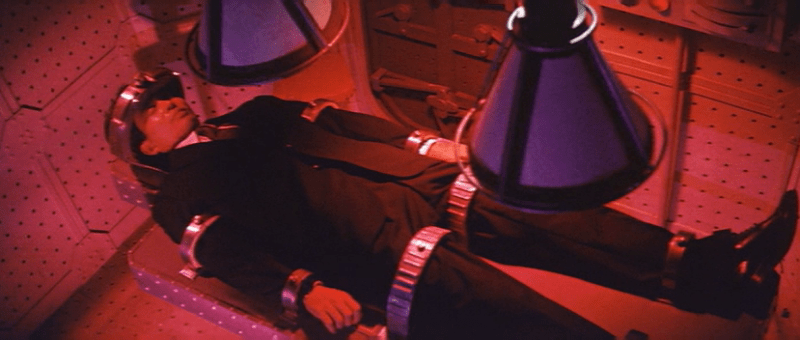
Mizuno’s intention to bypass the law is one of the many signifiers of his increasing danger, that now believes himself “above” the rest of humanity and therefore no longer subject to their laws. He later tells the police exactly that, sitting them down for a mini audience to explain himself during which he recounts his history as an SDF pilot discharged on a diagnosis of lung cancer after which he took the boring job in the library and fell in love with Fujichiyo. A shady doctor, Sano (Fuyuki Murakami), later approached him claiming to be working for Japan’s space programme and suggested that his fighter pilot background made him a perfect fit for becoming an astronaut. Mizuno agreed to participate in his research to “change the existence of the human body” in preparation for life in space, but when Sano’s weird experiments turned him into a “gas man”, the doctor committed suicide in horror leaving Mizuno just another lonely victim of a mad scientist.

Like many other “mutant” heroes, the change in Mizuno’s body has also changed his soul though his love for Fujichiyo remains unchanged. It seems he’s only committing these crimes to fund her ambition of performing traditional buyo dance on the contemporary stage, while she though obviously devoted to her art finds it difficult to accept the man that he’s become. He promises to give her the world, sacrificing anyone that gets in his way. She remains conflicted, not wanting to accept his offer if it involves that kind of cost, and defending him to her colleagues only with the rationale that he is “different from what they are accustomed to”. While some advise caution, that perhaps Mizuno is not as dangerous as they think despite already having killed and should be given the chance to reform, others take a harder line eventually opting to use a different kind of gas to counter him.

Kyoko pleads with Fujichiyo as one woman in love to another, trying to protect Okamoto while advising her to pull Mizuno back from the brink by cancelling her performance, but precisely because of the understanding that exists between them she cannot. Sadly, as many point out, no one is really interested in buyo dance – the only audience members in attendance are there for the drama and the possibility of seeing the gas man in action. “You and I have finally won” Mizuno tells Fujichiyo on completion of her dance, as if this performance was all that ever mattered to either of them. But their victory leaves them with nowhere else to go, and the world unready to accept the latent threat a gas man represents. Fujichiyo makes her choice, one perhaps informed by her art and her love, while the authorities can only wait outside for the vapours to disperse.


Original trailer (No subtitles)

Floating Clouds (浮雲, Mikio Naruse, 1955)

(C) 1955 Toho

floating clouds poster“The past is our only reality” the melancholy Yukiko (Hideko Takamine) intones, only to be told that her past was but a dream and now she is awake. Adapted from a novel by Fumiko Hayashi – a writer whose work proved a frequent inspiration for director Mikio Naruse, Floating Clouds (浮雲, Ukigumo) is a story of the post-war era as its central pair of lovers find themselves caught in a moment of cultural confusion, unsure of how to move forward and unable to leave the traumatic past behind.

We begin with defeat. Shifting from stock footage featuring returnees from Indochina, Naruse’s camera picks out the weary figure of a young woman, Yukiko, drawing her government issue jacket around her. She eventually arrives in the city and at the home of an older man, Kengo (Masayuki Mori), whom we later find out had been her lover when they were both stationed overseas working for the forestry commission but has now returned “home” to his family. Kengo had promised to divorce his wife, Kuniko (Chieko Nakakita), in order to marry Yukiko but now declares their romance one of many casualties of war. With only the brother-in-law who once raped her left of her family, Yukiko has nowhere left to turn, eventually becoming the mistress of an American soldier but despite his earlier declarations the increasingly desperate Kengo cannot bear to let her go and their on again off again affair continues much to Yukiko’s constant suffering.

Floating Clouds is as much about the post-war world as it is about a doomed love affair (if indeed love is really what it is). Kengo and Yukiko are the floating clouds of the title, unable to settle in the chaos of defeat where there is no clear foothold to forge a path into the future, no clear direction in which to head, and no clear sign that the future itself is even a possibility. Naruse begins with the painful present marked by crushing defeat and hopelessness, flashing back to the brighter, warmer forests of Indochina to show us the lovers as they had been in a more “innocent” world. At 22, Yukiko smiles brightly and walks tall with a lightness in her step. She went to Indochina in the middle of a war to escape violence at home and, working in the peaceful environment of the forestry commission, begins to find a kind of serenity even whilst dragged into an ill-advised affair with a moody older man more out of loneliness than lust.

Yet, Yukiko’s troubles started long before the war. Assaulted by her brother-in-law she escapes Japan but falls straight into the arms of Kengo who is thought a good, trustworthy man but proves to be anything but. Kengo, frustrated and broken, attempts to lose himself through intense yet temporary relationships with younger women. Every woman he becomes involved with throughout the course of the film comes to a bad end – his wife, Kuniko, dies of tuberculosis while Kengo was unable to pay for treatment which might perhaps have saved her, an inn keeper’s wife he has a brief fling with is eventually murdered by a jealous husband (a guilty Kengo later attempts to raise money for a better lawyer to defend him), Yukiko’s life is more or less destroyed, and goodness only knows what will happen to a very young errand runner for the local bar whom he apparently kissed in a drunken moment of passion.

The lovers remain trapped by the past, even if Kengo repeatedly insists that one cannot live on memory and that their love died in Dalat where perhaps they should have remained. Yukiko’s tragedy is that she had nothing else than her love for Kengo to cling to, while Kengo’s is that he consistently tries to negate the past rather than accept it, craving the purity of memory over an attainable reality, chasing that same sense of possibility in new and younger lovers but once again squandering each opportunity for happiness through intense self obsession. “Things can’t be the same after a war”, intones Kengo as an excuse for his continued callousness, but they find themselves retreating into the past anyway, taking off for tropical, rainy Yakushima which might not be so different from the Indochina of their memories but the past is not somewhere one can easily return and there can be only tragedy for those who cannot let go of an idealised history in order to move forward into a new and uncertain world.