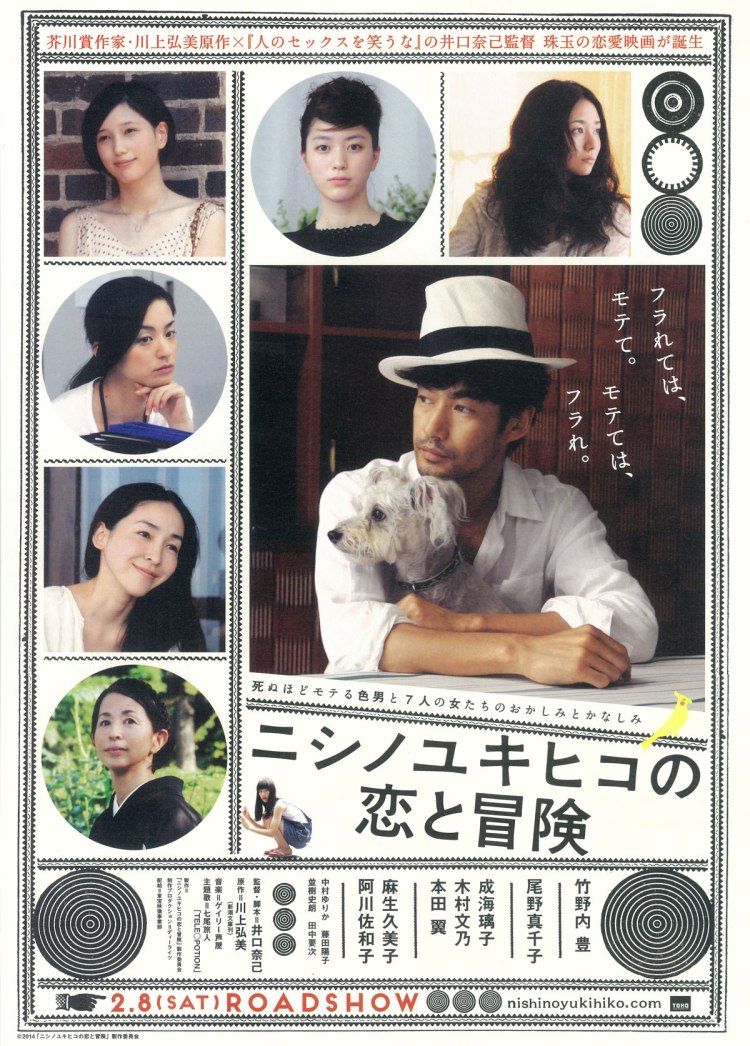
The Tale of Nishino (ニシノユキヒコの恋と冒険, Nami Iguchi, 2014)

tale of nishinoEvery love story is a ghost story, as the aphorism made popular (though not perhaps coined) by David Foster Wallace goes. For The Tale of Nishio (ニシノユキヒコの恋と冒険, Nishino Yukihiko no Koi to Boken), adapted from the novel by Hiromi Kawakami, this is a literal truth as the hero dies not long after the film begins and then returns to visit an old lover, only to find her gone, having ghosted her own family including a now teenage daughter. The Japanese title, which is identical to Kawakami’s novel, means something more like Yukihiko Nishino’s Adventures in Love which might give more of an indication into his repeated failures to find the “normal” family life he apparently sought, but then his life is a kind of cautionary tale offered up as a fable. What looks like kindness sometimes isn’t, and things done for others can in fact be for the most selfish of reasons.
Ten years prior to his death in a traffic accident, Yukihiko Nishino (Yutaka Takenouchi) has taken a (former?) lover and her little girl out for drinks and parfait at a lovely seaside cafe. The woman, Natsumi (Kumiko Aso), declines the offer of dessert but Nishino orders two anyway – one for himself and one for the little girl, Minami, though it seems neither of them really wanted one anyway. An odd flirtation exists between the adults but Nishino laments his ability to gain exactly what this situation might look like from the outside – a “normal” family. He wants to get married, have a daughter of his own, but his relationships always end in failure. Natsumi tells him why – he always gives women exactly what they want, which sounds good, but really isn’t.

Nishino’s problem is that he’s almost irresistible to women, but sooner or later they all leave him. He believes he has an almost telepathic ability to figure out what it is women want from him coupled with an intense need to satisfy their innermost desires. Ironically enough, it’s this strange kindness that eventually leads to his death when he runs into an old friend at a crowded marketplace. Excited to see him she calls and waves, dropping her shopping and losing one of her crutches in the process. Rushing to help, Nishino does not see an oncoming van and is run over. Quite literally the story of his life.

Reappearing as a ghost he attempts to pay a visit to Natsumi, having jokingly promised to do so while they were dating. Natsumi, however, is nowhere to be found and so Nishino is left to exorcise his demons with the now teenage Minami (Yurika Nakamura) who decides to attend his funeral in case her long absent mother decides to pay her respects. It’s here that she begins to learn a little of Nishino’s sad romantic history courtesy of an older woman who became a friend and confident rather than a lover (and consequently remained in his life a little longer).

The problem is, Nishino’s desire to be eternally helpful means that he’s always pulled in more than one direction. A slow burn affair with shy and retiring superior Manami (Machiko Ono) looks as if it could be the one, but she eventually points out to him that he’s not the sort of man who can have the life he craves because he never fully commits to any one person and never truly loves anyone. His irresistibility apparently even extends to one half of the lesbian couple from next door though, notably, not the half you’d expect.

Nishino first gets to know Tama (Fumino Kimura) and Subaru (Riko Narumi) when their cat, Nau, invites himself over, after which the feline Subaru decides to do the same, flirting away with her uptight girlfriend presumably going crazy in an adjacent room. Subaru is Nishino’s opposing number, the kind of girl that gets everything done for her, but there are obvious cracks in the strained relationship between the two women and it’s the neurotic Tama he finally bonds with after an unusually perceptive conversation over convenience store ice cream. Nishino, as he later puts it, is faithful in mind if not in body but satisfying immediate desires is not always the best idea. Trying to provide comfort, Nishino adds even more confusion to a messy situation and, even if it perhaps works out for the best, Nishino is left alone once again.

A botched proposal leads Nishino to let slip the real reason for his boundless desire to please – it’s because he’s lonely. Desiring to keep these women around him, he gives them whatever it is they want to stay. Just like Tama has effectively relegated Subaru to the same level as their cat – giving in to her every demand in the terror that she will leave, Nishino loses the women he loves by embracing his selfish desire to keep them rather than acting in their best interests and recognising the true depth of love which may not always work out in his favour. The interfering spectre of old girlfriend Kanoko (Tsubasa Honda) who can’t let go even though the relationship is over is a lingering hangover of this tendency as she too cannot seem to commit and wants to keep Nishino as a backup plan, resenting his interest in other women yet not willing to make a permanent decision to stay with him.

A whimsical fable of a man looking for love in all the wrong places, The Tale of Nishino is a long, melancholy journey through modern relationships in which not just romantic but platonic and familial love find themselves under the microscope. As Manami points out, you can’t share loneliness – Nishino’s need to be needed eventually drives a wedge between himself and everything he wanted. Natsumi’s words of wisdom for her injured daughter offer only that romantic love necessarily ends, whereas a mother’s love for her child is ever lasting even if it does not necessarily look that way. Iguchi’s style is typical of the “quirkier” end of Japanese indie, shooting with a deadpan abstraction, but the slight feeling of alienation works well with Nishino’s ultimate refusal to bare his heart in a more “straightforward” manner. A bittersweet story of love lost and found, Nishino may have given up the ghost but perhaps he did find that family after all, in a way, even if it was not his own.


Original trailer (no subtitles)

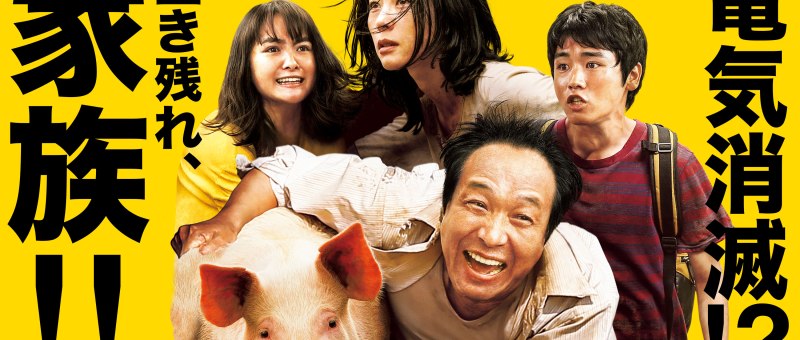
Survival Family (サバイバルファミリー, Shinobu Yaguchi, 2017)

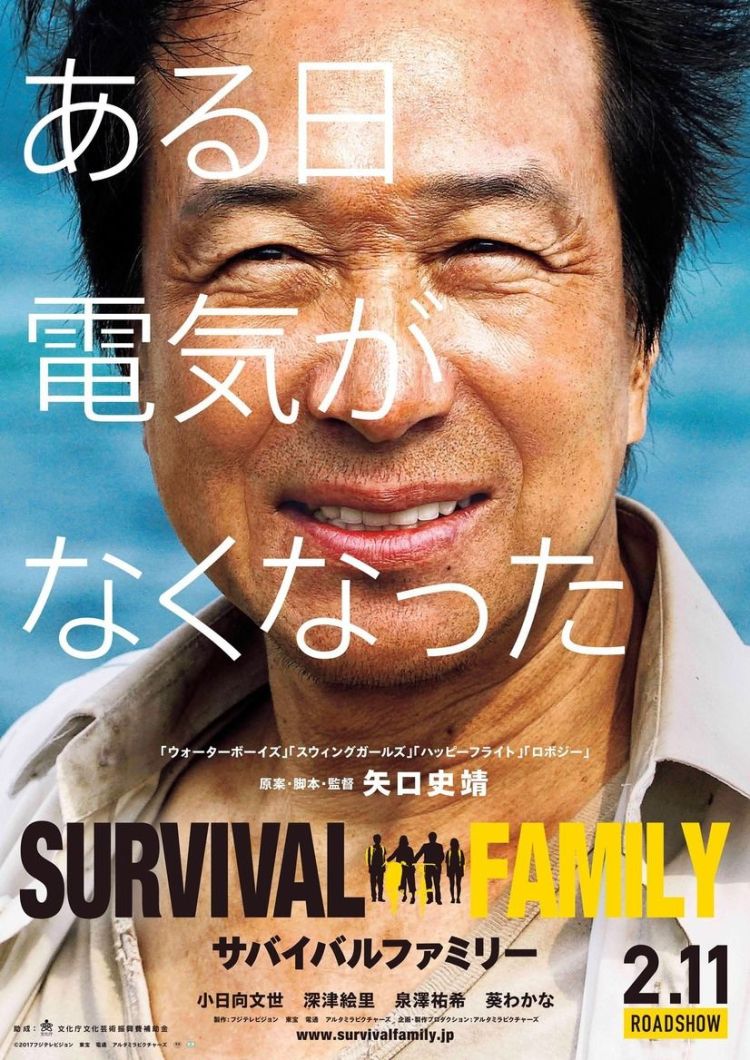
survival family posterModern life is full of conveniences, but perhaps they come at a price. Shinobu Yaguchi has made something of a career out of showing the various ways nice people can come together to overcome their problems, but as the problem in Survival Family (サバイバルファミリー) is post-apocalyptic dystopia, being nice might not be the best way to solve it. Nevertheless, the Suzukis can’t help trying as they deal with the cracks already present in their relationships whilst trying to figure out a way to survive in the new, post-electric world.

Receiving a package from grandpa fills the Suzukis with horror more than gratitude. Mum Mitsue (Eri Fukatsu) can’t bring herself to cut the head off a fish and the sight of the giant bug that crawls out of the lettuce is just too much to bear. Her teenage daughter, Yui (Wakana Aoi), is not very excited either, tapping her smartphone with her fake nails, while her son Kenji (Yuki Izumisawa) spends all his time alone in his room with headphones permanently attached. Mr. Suzuki, Yoshiyuki (Fumiyo Kohinata) – the family patriarch, is a typical salaryman, obsessed with work and often in bed early.

All that changes one day when Yoshiyuki’s alarm clock does not go off. There’s been a power outage – nothing works, not the TV, not the phone, not even the tower block’s elevator. Being the salaryman champ he is, Yoshiyuki tries to make it into to work in other ways but the power’s out across the city and there’s nothing to be done. Everyone is sure the power will come back on soon, but days pass with the consequences only increasing as supermarket shelves become bare and water frighteningly scarce. After his boss decides to take his chances in the mountains and a neighbour dies as a direct result of the ongoing power shortage, Yoshihyuki decides to take the family on the road to find Mitsue’s country bumpkin father in the hope that he will have a better idea of how to survive this brave new world.

Yaguchi is quick to remind us all of the ways electricity defines our lives, even if we’ve begun to forget them. Not only is it a question of mobile phones being out and lifts being out of order, but gas appliances are also electric ignition as are the pumps which drive the water system. So used to the constant stream of electricity, no one quite realises what its absence means hence Yoshiyuki’s big idea is to get a plane from Haneda airport. Ridiculous as it may seem, he’s not the only one to have underestimated the part electricity plays in flight and the aviation industry as the airport is swamped by people trying to escape the rapidly disintegrating city. Credit cards no longer work leading to long checkout lines as the old ladies with their abacuses make a startling return to checkouts while bemused shoppers attempt to use the ATM machine to get more cash.

Cash itself still has worth, at least for a time. Eventually the barter system takes over as food and water become top price commodities. A very flash looking man tries to trade genuine Rolex gold watch and later the keys to his Maserati for food but is roundly informed that none of his hard won prizes is worth anything in this new back to basics era. Thanks to Mitsue’s housewife skills of frugality and haggling, the family are able to get themselves a small stockplie of resources but find themselves tested when the less fortunate ask them for help.

The crisis brings out both the best and the worst in humanity. As the family make their escape from the city on a series of bicycles, they pass a succession of salesmen all upping the price of bottled water by 100% each time. Profiteering is rife as the unscrupulous procure ordinary foodstuffs to be sold for vast amounts of money. Yet the Suzukis rarely find themselves on the wrong side of trickery and even encounter a few kindly souls willing to help them on their journey such as a gang of cycle wear clad survival experts and a very forgiving farmer who takes the family in when they help themselves to one of his escaped pigs (a sequence which allows Yaguchi to go on another Swing Girls-style pig chase only without the slo-mo and classical music).

Forced to reconnect, the family become closer, gradually coming to know and accept each other whilst finding new and unknown talents. Living simply and harmoniously has its charms, ones that don’t necessarily need to disappear if the power ever comes back on. The only certainty is that you can’t survive alone, and who can you count on if you can’t count on family?


Screened as the opening night movie of the Udine Far East Film Festival 2017.

Original trailer (English subtitles)

Swing Girls (スウィングガールズ, Shinobu Yaguchi, 2004)

There are two kinds of people in the world, those who swing and those who…don’t – a metaphor which works just as well for baseball and, by implication, facing life’s challenges as it does for music. Shinobu Yaguchi returns after 2001’s Waterboys with a film that’s…almost exactly the same only with girls instead of boys and concert halls instead of swimming pools, but it’s all so warm and charming that it hardly matters. Taking the classic sports movie formula of eager underdogs triumphing against the odds but giving it a teen comedy drama spin, Yaguchi’s Swing Girls (スウィングガールズ) is a fitting addition to the small but much loved high school girls vs music genre which manages to bring warmth and humour to its admittedly familiar narrative.

It’s summer and it’s hot and sunny but the school is filled with yankis and dreamers, forced to spend this lovely day indoors. While one group is busy ignoring their maths teacher, the school band is getting ready to accompany the baseball team on an important match. Unfortunately, the bus leaves before the bento boxes they’ve ordered are delivered so enterprising high school girl Tomoko (Juri Ueno) suggests they blow off the maths class and show solidarity with those representing the school by making sure their fellow students are well fed. Unfortunately, they fall asleep and miss their stop on the train meaning by the time they get there it’s a very late lunch and these bento boxes containing fish and eggs etc have all been in the hot sun for a fair few hours. After nearly killing all their friends, the girls are forced to join the band in their stead, despite having almost no musical experience between them.

As might be expected, the girls start to get into their new activity even if they originally dismiss sole boy Takuo’s (Yuta Hiraoka) interest in big band jazz as the uncool hobby of pretentious old men. However, this is where Yaguchi throws in his first spanner to the works as the original band recover far sooner than expected leaving our girls oddly heartbroken. This allows us to go off on a tangent as the girls decide they want to carry on with their musical endeavours and form their own band but lack the necessary funds to do so. Being a madcap gang of wilful, if strange, people the schemes they come up with do not go well for them including their stint as supermarket assistants which they get fired from after nearly setting the place on fire, and a mushroom picking trip which leads to an encounter with a wild boar but eventually holds its own rewards.

The girls’ embittered maths teacher, Ozawa (Naoto Takenaka), who just happens to be a jazz aficionado offers some key advice in that it’s not so much hitting the notes that matters as getting into the swing of things. It might take a while for the Swing Girls (and a boy) to master their instruments, but the important thing is learning to find their common rhythm and ride the waves of communal connection. Tomoko quickly takes centre stage with her largely self centred tricks which involve pinching her little sister’s games system to pawn to buy a saxophone, and almost messing up the all important finale through absentmindedness and cowardice. Other characters have a tendency to fade into the background with only single characteristics such as “worried about her weight”, or “hopelessly awkward”, or even with “folk duo in love with punk rockers”. Other than the one girl lusting after the baseball star and the two punk rockers annoyed by their earnest suitors, Yaguchi avoids the usual high school plot devices of romantic drama, fallings out, and misunderstandings whilst cleverly making use of our expectation for them to provide additional comedy.

What Swing Girls lacks in originality it makes up for with warmth and good humour as the band bond through their recently acquired love of music, coming together to create a unified sound in perfect harmony. Ending somewhat abruptly as the gang win over their fellow musicians after having overcome several obstacles to be allowed to play, the finale does not prove quite as satisfying as might be hoped but is certainly impressive especially considering the music really is being provided by the cast who have each learned to play their intstruments throughout the course of the film just as their characters have been doing. Warm, funny and never less than entertaining, Swing Girls lacks the necessary depth for a truly moving experience but does provide enough lighthearted fun to linger in the memory.


Original trailer (English subtitles)

https://www.youtube.com/watch?v=9yAJbIdoVcU

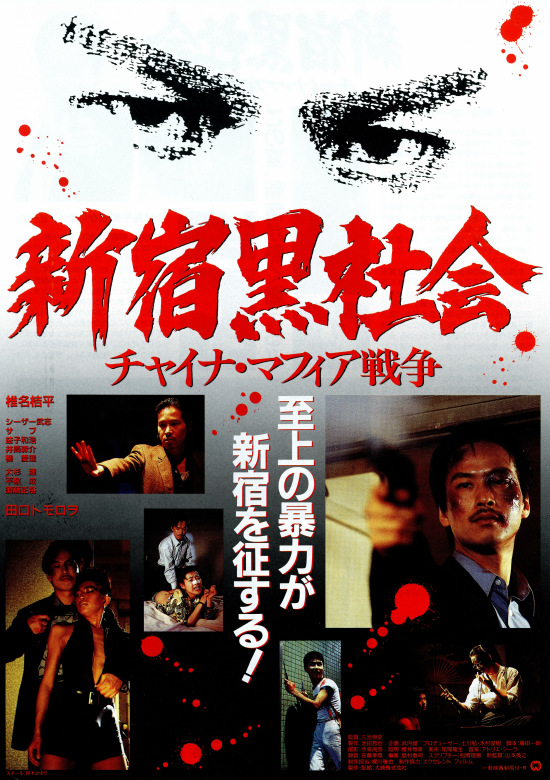
Shinjuku Triad Society (新宿黒社会 チャイナ・マフィア戦争, Takashi Miike, 1995)

shinjuku-triad-societyThese days Takashi Miike is known as something of an enfant terrible whose rate of production is almost impossible to keep up with and regularly defies classification. Pressed to offer some kind of explanation to the uninitiated, most will point to the unsettling horror of Audition or the audacity of the controversial Ichi the Killer whilst looking askance at the totally unexpected craziness of Yatterman or the child friendly Ninja Kids!!!. Before he was the gleefully unpredictable festival favourite, Miike, like many of his contemporaries, had made a name for himself in V-cinema, often with violent tales of modern day yakuza. Shinjuku Triad Society (新宿黒社会 チャイナ・マフィア戦争, Shinjuku Kuroshakai: China Mafia Senso) was Miike’s first venture into the mainstream theatrical world but retains his V-cinema focus with additional intent.
Set in the shady, sleazy, noir-tinted world of ‘90s Shinjuku, Shinjuku Triad Society opens with a voice-over from one of its central players telling us that this is a love story – sickening and sweet, as real love is. The action kicks off with this same character, a rent boy, Zhou, attempting to evade a police raid, slitting the throat of a regular street cop on his way out. Zhou is the lover of an unpredictable member of the Taiwanese mafia, Wang (Tomorowo Taguchi), who is creating several problems in the underground crime world both within Triad circles and with the local yakuza. Half Chinese policeman, Tatsuhito Kiriya (Kippei Shina), has been landed with the case but things begin to get personal when he discovers that his younger brother, Yoshihito, has been hired as a junior lawyer working directly for Wang’s gang.

Yakuza films often have a very strong homosocial atmosphere, emphasising the fraternal bonds between men but Shinjuku Triad Society is especially notable for its inclusion of explicit male homosexuality within the gangster underworld. If yakuza films are family dramas with funerals instead of weddings, Miike uses this intense male bonding as a comment on the wider nature of the family with an added focus on the place of the foreign in Japanese society. Wang and Tatsuhito are not so far removed in their desire to rebuild their own family unit, partly as a kind of protective measure against the world around them in which their Chinese heritage becomes a perpetual barrier. Wang has done this as the head of his own clan and with his lover Zhou at his side whereas Tatsuhito is intent on restoring his birth family by “rescuing” his brother from the clutches of the “Dragon’s Claw”.

Tatsuhito’s brother is, of course, a grown man who has the right to become a member of the underworld family, rejecting the blood ties to his policeman brother and doting parents if that is what he wants no matter what his brother might feel about it. Tatsuhito is disturbed to discover that Yoshihito has become Wang’s lover, even if he claims to be using him in order to progress his career. Both brothers threaten each other at gun point with Yoshihito exclaiming “if you don’t like the way I am, just kill me” which Tatsuhito refuses to do though it remains unclear if his brother’s sexuality is objectionable to him or merely a facet of his rejection of the values Tatsuhito holds dear.

Sexuality becomes a weapon as Zhou manoeuvres and manipulates through provoking and satisfying sexual desire. These are, however, consensual relationships even if a part of a wider, transactional game whereas anal rape is actively being employed as a police interrogation tactic (with a somewhat surprising spin). Even Tatsuhito, whose partner mocks him for a supposed dedication to being a “regular” cop, unwilling to take bribes or give in to corruption, himself engages in this behaviour anally raping a female prostitute from whom he wishes to extract information. Playing into the film’s darker themes of the interplay between sex, violence, and transaction, the prostitute instantly falls in love with him. Tatsuhito is clearly no saint even at the film’s beginning, but even so he continues to fall still further, seemingly outraged on discovering the true purpose of Wang’s “philanthropy” in his Taiwanese homeland, but doing relatively little about it other than adding it to the growing list of reasons why Wang must die. Eventually crossing the line from law enforcer to law breaker in the most taboo of ways, Tatsuhito finds himself rewarded even if his boss seems to be aware and in approval of what he’s done.

Tatsuhito may succeed in some of his aims, even if he has to exile himself from the family he was trying repair in the process though the closing voice over makes clear that he gains little in the long run and becomes nothing more than marginalia in the long, sad history of Shinjuku’s violent backstreets. Starting as he means to go on, Miike is entirely unafraid to step into some very uncomfortable areas, not least the way non-Japanese and those with partial Japanese heritage are regarded in the society of the time as well as the way these attitudes are filtered through recent Japanese history. Tatsuhito finds himself conflicted, choosing Japan in choosing the police but finding that it often fails to recognise him as its own son, whereas Yoshihito, in a sense, chooses China in associating himself with the Taiwanese gangsters. This central opposition of order and criminality is itself uncomfortable, but then undermined by the unorthodox nature of the local yakuza. Often strange and eerie, Shinjuku Triad Society takes place in a noirish world where there is no guiding morality – one to which Miike would often return though perhaps never with so much biting irony, where the absence of hope continues to imply its possibility.


Original trailer (English subtitles)

https://www.youtube.com/watch?v=wXzk9oOa8xU

All Around Us (ぐるりのこと。, Ryosuke Hashiguchi, 2008)

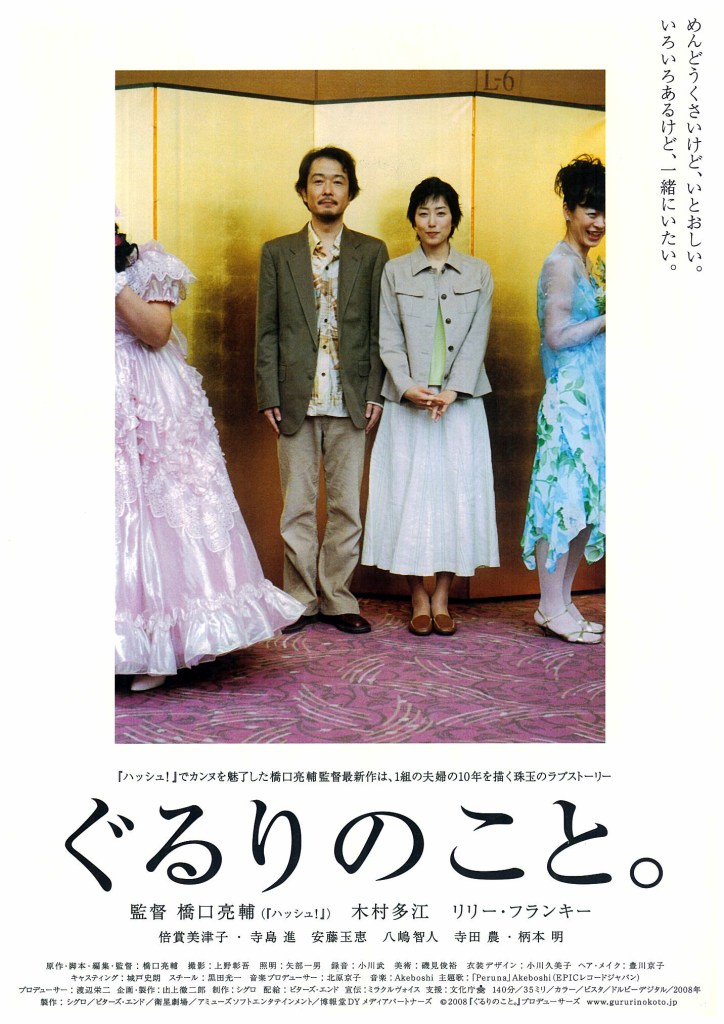
all around usRyosuke Hashiguchi returns after an eight year absence with All Around Us (ぐるりのこと。Gururi no Koto) and eschews most of his pressing themes up this by point by opting to depict a few “scenes from a marriage” in post-bubble era Japan. Set against the backdrop of an extremely turbulent decade which was plagued by natural disasters, terrorism, and shocking criminal activity Hashiguchi shows us the enduring love of one ordinary couple who, finding themselves pulled apart by tragedy, gradually grow closer through their shared grief and disappointment.
Tokyo, 1993. Kanao (Lily Franky) and Shoko (Tae Kimura) have had an “on and off” (but seemingly solid) relationship since their art school days. She works at a publishing house and he’s kind of a slacker with a job in a shoe repair booth. Shoko worries that Kanao plays around too much (but actually doesn’t seem that bothered about it) whilst continuing to attempt to micromanage their entire existence with her clearly marked calendar planning out the most intimate of actions. When Shoko discovers she’s expecting a child, the pair decide to finally get married and begin their lives as a family. Kanao also gets an opportunity on the work side when an old college friend helps him get a job as a courtroom artist for a news agency.

However, their joy is short-lived as an abrupt jump forward in time shows us a tiny shrine underneath the calendar (shorn of its red crosses) dedicated to the memory of their infant daughter. Kanao is the keep calm and carry on sort so he just tries to bluster through but Shoko is distraught and slowly descending into a mental breakdown. If that weren’t enough to contend with, Shoko’s estranged father has been tracked down and is apparently very ill dredging up even more pain an uncertainty from the long buried past.

We follow Shoko and Kanao over a period of nine years. As well as the ever present motif of the calendar, we feel the passage of time through Kanao’s work at the court house which sees him become the artistic recorder of some of the most traumatic moments of the age. Having entered into an era of economic turmoil following the end of the bubble economy, the 1990s saw not only the devastating Kobe Earthquake but also the sarin gas attack on the Tokyo underground perpetrated by a dangerous religious cult, members of which wind up in court in front of Kanao, tasked with the thankless task of bearing witness to their testimony.

Kanao evidently decided not to discuss his personal tragedy with his work colleagues or, one would assume, his boss would not have reacted so harshly when he made the reasonable request to turn down the opportunity to sit in on yet another child murder trial – either by accident or design, the trials which present themselves to Kanao (and are all real, sensationalised media events of the time) involve the horrific murders of small children with only one of the defendants voicing any kind of regret or remorse.

Meanwhile, Shoko has been trying to get on with life as best she can but finds herself sinking ever deeper into depression. Her uptight, controlling personality cannot cope with this perceived “failure” on her part or of the destruction of all her plans by a truly unforeseen tragedy. Having had her doubts before regarding Kanao’s commitment to her, she finds his lack of reaction puzzling. Mistaking Kanao’s lack of outward emotion for indifference, Shoko finds it hard to continue believing in their shared destiny and wonders if her husband ever really cared for her at all. Kanao is a laid-back soul, someone who’s learned to become used to disappointment by accepting it quickly and then trying to move on. His more grounded approach might be just the one Shoko needs in order to come to terms with what’s happened – never pushing or complaining Kanao is contented simply by her presence and is prepared to give her the space she needs whilst always being around to offer support.

Hashiguchi relies on visual cues to help navigate the shifting dynamics including the repeated use of the calendar as a symbol of Shoko and Kanao’s marital status, the now unneeded pregnancy books bundled to be thrown out, or rice discarded in the sink as a marker of a house proud woman’s slide into crippling depression. Small moments make all the difference from a mother’s bandaged wrists and a cutback to the only person who’s noticed them, to the repeated joke of all the veteran journalists suddenly falling over themselves in an attempt to escape the courtroom and be the first to file their copy. A necessarily sad story, but an oddly warm one as two people worried they may be mismatched grow into each other in the face of their shared tragedy. Anchored by the strong performances of its two leads (particularly Tae Kimura who manages some convincing on screen crying in a difficult role) All Around Us is another beautifully pitched human drama from Hashiguchi who proves himself an adept chronicler of the human condition even whilst stepping away from his trademark themes.


Original trailer (English subtitles)

Kikujiro (菊次郎の夏, Takeshi Kitano, 1999)

b97b89932bReview of Takeshi Kitano’s 1999 masterpiece Kikujiro AKA Kikujiro’s Summer (菊次郎の夏, Kikujiro no Natsu) first published by UK Anime Network.


When thinking about the career of iconoclastic Japanese director Takeshi Kitano, “cute” is not a word which immediately springs to mind. Nevertheless, it’s a fairly apt one for describing the bittersweet tale of one summer in the life of a lonely little boy and the roughhousing ex-yakuza who becomes his reluctant guardian.

Masao is a mournful looking schoolboy who lives alone with his grandmother. It’s almost the school summer holidays and all the other kids are excited about family trips and activities but Masao’s grandmother still has to work so they won’t be doing anything and he’ll have to entertain himself throughout all of the long, hot break. Seeing as all of his friends have gone away, and after finding a photograph of his parents and another of his mother and grandmother with him as an infant, Masao decides to take off for an adventure of his own to track down his long absent mum. However, he doesn’t get very far before some bigger boys have taken all his money and actually seem annoyed he doesn’t have more. Luckily, a former neighbour and her husband turn up and get the money back for him but they explain the town where Masao’s mother lives is too far for a little boy to travel all on his lonesome. The wife makes her husband, Kikujiro (Kitano) take the boy on summer trip of their own but what they find there isn’t exactly what either of them had been expecting.

In many ways, Kikujiro is in the best tradition of odd couple road trips. Kikujiro didn’t really want to escort this sad little boy on a strange family holiday but his wife insisted (and she gave him quite a lot of spending money) so he reluctantly takes Masao on a journey but introduces him to some of his favourite pursuits such as gambling on bicycle races and hanging out in hostess bars. Little by little he starts to warm to the boy and the pair go on to have several strange encounters throughout their trip, largely down to Kikujiro now being broke after losing all the money gambling at the beginning.

Sending a little boy off with a total stranger doesn’t seem like the best idea in retrospect, even if it’s preferable to letting Masao head off alone. Kikujiro is very much not an appropriate baby sitter which makes for a lot of comedic scenes from an outsider’s view though perhaps Masao’s grandmother might not find it so funny if anyone ever decides to tell her about any of this. There is only one scene in the film where something very untoward threatens to befall Masao involving a “scary man” in a park but luckily Kikujiro turns up just in the nick of time. This episode is, in truth, a little hard to take alongside the otherwise fun encounters which showcase Kikujiro’s own clownish, immature qualities.

The film is seen more or less through the innocent viewpoint of Masao and broken up into chapters seemingly taken from his “what I did on my holidays” scrapbook project. Perhaps not having the material to complete this inevitable post-summer assignment was one of the motives for Masao finally taking off on his own to solve the mystery of his absent mother but what his teacher’s going to make of this strange collection adventures is anyone’s guess (perhaps if he’s lucky no one will believe it anyway).

The story doesn’t finish once Masao and Kikujiro have reached the furthest point of the journey but carries on through their way back too as Kikujiro tries to cheer the boy up and begins to reflect on his troubled relationship with his own mother. The true reason for film’s name becomes apparent towards the end as Kikujiro mournfully watches Masao run off back home perhaps feeling sorry for him but also a little wistful that his own summer adventure is over and he might never have such a fun trip again.

Warm and funny, Kikujiro employs a hearty dose of sardonic black humour for its tale of a childlike gangster’s growth process as he morphs into the figure of a guardian angel for a sad little boy. Aided by Joe Hisaishi’s wistful score and the beautiful landscape of a Japanese summer by the sea, Kikujiro proves a slightly unusual entry in Kitano’s filmography (though only up to a point) and an often underrated one though it ranks among his highest achievements for its sheer poetic power alone.


Kikujiro is re-released on blu-ray today in the UK courtesy of Third Window Films who will shortly also be re-releasing Dolls and, it’s recently been announced, Kids Return and A Scene at the Sea.

This is the only trailer I could find and it’s from the original US VHS release so it’s extremely irritating (sorry), film is not this annoying (promise).

The Letter (手紙, Jiro Shono, 2006)

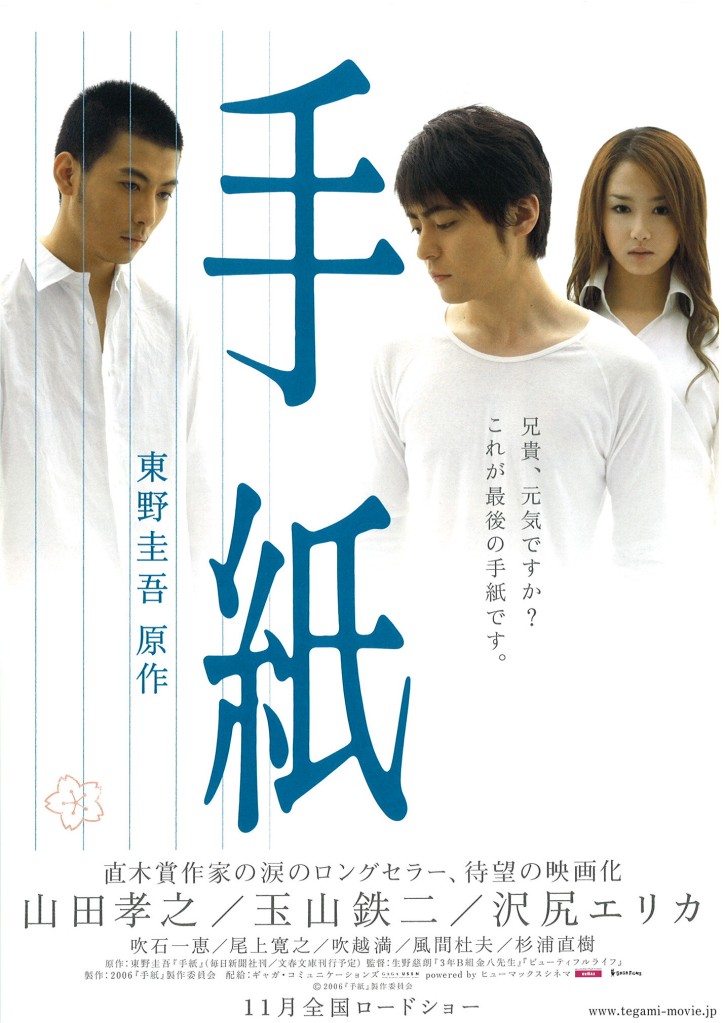
The Letter PosterWhen it comes to cinematic adaptations of popular novelists, Keigo Higashino seems to have received more attention than most. Perhaps this is because he works in so many different genres from detective fiction (including his all powerful Galileo franchise) to family melodrama but it has to be said that his work manages to home in on the kind of films which have the potential to become a box office smash. The Letter (手紙, Tegami) finds him in the familiar territory of sentimental drama as its put upon protagonist battles unfairness and discrimination based on a set of rigid social codes.
Nao (Takayuki Yamada) is a bright young man who had the chance to go to university and progress into a normal middle class life but is now slumming it as a blue collar worker at a factory. It transpires that his dismal circumstances began when he and his brother were orphaned meaning that his older brother Takashi (Tetsuji Tamayama) left school to get the money for Nao’s education. Working himself to the bone, Takashi was injured in a workplace accident and subsequently laid off. Desperate to provide for his brother, he turned to crime and unfortunately ended up killing an elderly woman during a burglary gone wrong and will spend the rest of his life in prison. The once close brothers now communicate through letters alone. With his university dreams shattered, Nao moves from place to place, forced out of employment and friendship groups each time someone finds out about his brother. Increasingly he comes to resent Takashi for the shadow his foolish actions continue cast over his life.

It is sadly true that this kind of social stigma towards the relatives of criminals is more prevalent in a society like Japan’s which prizes the overall harmony of the group (though I wouldn’t say it’s entirely absent here either). Every time Nao thinks he’s about to get somewhere, a background check throws up his imprisoned brother and it’s all over. Especially considering that his brother’s crime is a violent one perpetrated against an elderly lady, nobody is prepared to extend an understanding hand to Nao even though the crime itself has nothing to do with him (save being committed in his name) and its price should not be hanging on his shoulders.

It’s unsurprising then that Nao tries to conceal his brother’s existence, often claiming to be an only child with no living family. Though originally communicating warmly with Takashi in the letters, his growing resentment leads to a decline in their frequency and he rarely visits in person. The desire to hide his problematic past becomes a trigger in itself which leads to his having to give up on a dream of becoming a TV comedian just when it looked like his career was about to take off, and failure to tell a fiancée that he lied about being an only child also presents a serious crack in the couple’s relationship. Had he been more upfront and faced out the resulting reaction, he might have been able to work through it but once you’ve tried to lie sympathy dissipates entirely.

At the end of the day Nao is a young man with no one to guide him. He’s angry and he’s ambitious so he’s filled with resentment that he can’t have everything he thinks he deserves simply because of a series of things which happened to him none of which were his fault. Because of this, he makes a series of poor choices failing to see the things that are right in front of him. The dowdy girl next-door type from the factory is clearly in love with Nao but he isn’t interested – she doesn’t fit his slightly arrogant view of himself with her plainness and straightforward goodness. On the other hand, he’s immediately captivated by a beautiful and wealthy socialite who’s way out of his league. Of course, this is likely to end in tears – even if Nao didn’t already have skeletons in the closet the girl’s father has other plans for her which don’t include a marriage to a jumped up poor boy comedian.

The Letter suffers slightly in its focus on Nao and his troubles rather than being evenly split between the brothers. Takashi has paid a heavy price for his crime – he’ll be in prison for the rest of his life and the bright future he tried to buy for his brother has been ruined forever precisely because of the actions he was taking to ensure it. His only lifeline is the letters and the news he gets of Nao’s prospering in the outside world. Nao’s final decision to stop writing and not even tell his brother his new address so that the letters will no longer reach him is therefore a doubly cruel and selfish one. However, Takashi is only presented in relationship to his brother and his own pain and struggle becomes an undeveloped facet of the film.

As in all of Keigo Higashino’s work, secrets are the great enemy. The film only partially addresses the extreme unfairness of Nao’s plight as he’s continually persecuted for something that’s nothing to do with him. Guilty by association only, he is also in prison with no parole board to consider his case. The film even states that this kind of stigma is a perfectly natural thing which just has to be accepted – accept the truth, it says, and the world will open up to you. On balance this is a good message, but the idea that prejudice and social discrimination are things which just have to be endured is an uncomfortable one which sits at odds with the film’s otherwise positive messages of personal redemption and the importance of familial bonds. Uneven and occasionally tipping over into sentimentality, The Letter is something of a missed opportunity but nevertheless offers a thought provoking and emotionally satisfying melodrama in the best traditions of the genre.


Reviewed as part of the Japan Foundation Touring Film Programme 2016.

http://www.youtube.com/watch?v=6Ibsv_ZJ0d4

Parco Fiction (パルコ フィクション, Takuji Suzuki & Shinobu Yaguchi, 2002)

1000x1500sr

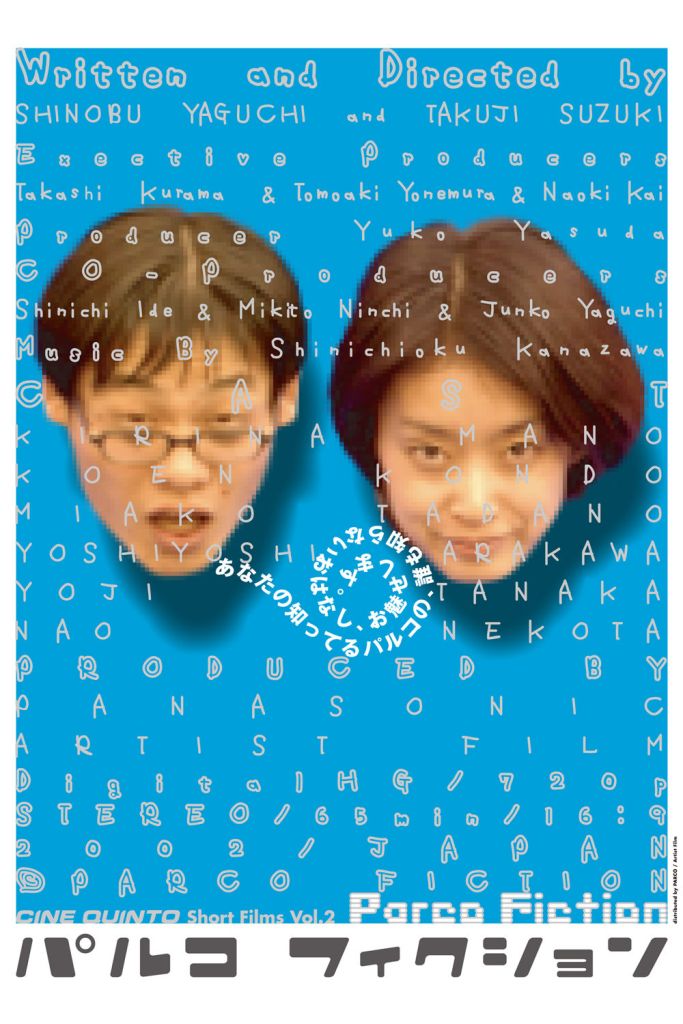
Since making 2002’s Parco Fiction, directors Shinobu Yaguchi and Takuji Suzuki have both gone on to bigger and better things but for this under seen portmanteau movie, they found themselves uniting to create something which seems to be a strange advert for the Parco department store in Tokyo’s trendy Shibuya district. The film is divided into five different short episodes loosely connected to the department store plus opening, closing and linking segments each filled with the kind of whimsical, absurd humour usually found in these kinds of films.

Opening with a planning meeting for the building of the department store in which its unusual name is decided after the chain smoking consultant finds it written on his scarred lungs after a medical emergency, the story moves on to a young lady who is undergoing an interview for a job at the store. Unfortunately, the young man being interviewed alongside her is an ideal candidate – a Tokyo university graduate who seems to have completely charmed the panel. However, the girl is given a job with the instruction not to open the envelope she’s been given but she can’t resist and finds herself setting off on a strange quest.

This only continues in part two as we come into contact with a soon to be middle school girl who has the misfortune of having a slightly dotty grandma by the name of “Harco”. Every time the Parco ad comes on, grandma gets very excited because she thinks someone’s calling her name even though the last person to call her “Harco” died, years ago. The little girl sets off to solve this problem by stopping grandma seeing the ads, but then something even stranger happens.

Tale three is set during a sale in which a young woman has her heart set on a particular dress and will stop at nothing to get it. This introduces us to the security guard at the Parco who takes us into story five as a shop worker has an unusual medical problem which prevents her from looking up. The security guard has a crush on the shopgirl, but he’s on the taller side so all he can do is stay close by and prepare to catch her every time she’s about to swoon after slightly raising her head. The film then closes with another mini sequence featuring the “standing room only” screening of Parco Fiction at a public cinema.

As is common with these kinds of films, some of the segments are more successful than others. The first perhaps goes on too long and the episode with the little girl and her grandma gets a little too surreal for its own good but the overall tone is zany, quirky humour. Sometimes very off the wall and filled with a good deal of slapstick too, Parco Fiction feels like a fairly low-key, frivolous effort but none the less enjoyable for it. Having said that, the entire duration of the film lasts only 65 minutes, and, truthfully, feels a little long despite the variation of stories involved.

Not a landmark film by any means, Parco Fiction still has plenty to offer particularly as a fairly early effort from these two directors who’ve since gone on to carve out fairly interesting careers. Sure to interest fans of quirky comedies, each of the segments has a zany, studenty humour vibe that often proves extremely funny. The film is undoubtedly low budget (and obviously filled with references to the Parco department store) but earnest enough and filmed in an accomplished and interesting manner.


This is another one you can randomly buy on UK iTunes with English subtitles.

Unsubbed trailer:

Obon Brothers (お盆の弟, Akira Osaki, 2015)

Obon BrothersReview of quirky comedy Obon Brothers (お盆の弟 Obon no Ototo) from this year’s Raindance up at UK Anime Network. I was also lucky enough to interview the director, Akira Osaki, while he was at Raindance to introduce the film which you can also read over at UK Anime Network.


Sometimes you think everything is going to be alright, but then several calamities arrive all at once. Down on his luck film director and stay at home dad Takashi has only been able to get one film made so far and it doesn’t look good for another any time soon. Right now he’s spending sometime apart from his wife and daughter as his elder brother Wataru is ill with colon cancer and as his brother never married, both their parents are dead and they have no other family Takashi has gone to look after him. However, Wataru is anything but grateful and proceeds to mope about the house repeatedly asking when Takashi plans to go home.

When he finally does go home, Takashi’s wife realises she liked it better when he wasn’t there and asks for a divorce. With nowhere else to go except back to Wataru’s, a confused and heartbroken Takashi goes home to Gunma where he reconnects with his screenwriting partner who’s finally met a girl through internet dating. Persuaded to come on a double date, Takashi strikes up a friendship with Ryoko despite still harbouring hopes for a reconciliation with his wife. No job, no home, no wife – what does the future hold for a mild mannered man like Takashi?

Like last year’s Raindance highlight And the Mudship sails away, Obon Brothers stars Kiyohiko Shibukawa though this “Takashi” is a little more sympathetic than the completely apathetic character from Watanabe’s film. With a sort of gentleness of spirit, Takashi is the sort of person who enjoys taking care of others like his ailing brother and cute little daughter and is just as happy keeping house as anything else. For his wife, his passivity becomes a major issue as she finds herself taking on a more independent role and comes to feel she needs someone with more drive at her side rather than the meek Takashi who’s content just muddling through.

Indeed, just muddling through ends up becoming an accidental theme of the film. Every morning, Takashi stops at the local shrine, throws a coin in the donation box and prays for everything to work out…and then goes home and waits for things to happen. However, things don’t just happen no matter how much you want and pray for them – at the end of the day you have to put the effort in which goes for all things in life from marriages to friendships and careers. If anybody gets anything at all out of Takashi’s religious practices, it’s ironically the older brother Wataru who thinks all this religious stuff is hokum – even going so far as to urinate into a sacred pond!

Also like Watanabe’s And the Mudship Sails Away, Obon Brothers is shot in black and white with a preference for long takes and static camera. Consequently it has an innately sophisticated indie comedy feeling which, coupled with its naturalistic tone, bring a kind of warmth and familiarity that it’s hard to resist. Though the film touches on some heavy themes – cancer, the breakdown of a marriage, it treats them all with a degree of matter of factness that never lets them overshadow the main narrative. After all, these things happen and life carries on while they do.

A loving tribute to the prefecture of Gunma from which many of the cast and crew originate including the director Akira Osaki, scriptwriter Shin Adachi and leading actor Kiyohiko Shibukawa, Obon Brothers has more than a little autobiographical content though it doesn’t reflect the actual circumstances of any of the creative team’s lives. It’s a gentle comedy, though one with shades of darkness creeping in around the edges, and moves at an equally gentle pace which gives you ample time to see into these characters and their lives. Osaki’s camera is unjudgemental, it gives equal sympathy and understanding to everyone and even the eventual end of Takashi’s marriage is accomplished with the utmost amicability. Whether or not Takashi has actually changed very much by the end of the film or has just gained a little more knowledge about who he is as a person, Obon Brothers gives you the feeling that it’s alright to start all over again – even if you’re just muddling though!


Obon Brothers is getting a UK release from Third Window Films next year(?) – highly recommended, especially if you like gentle, indie comedies!