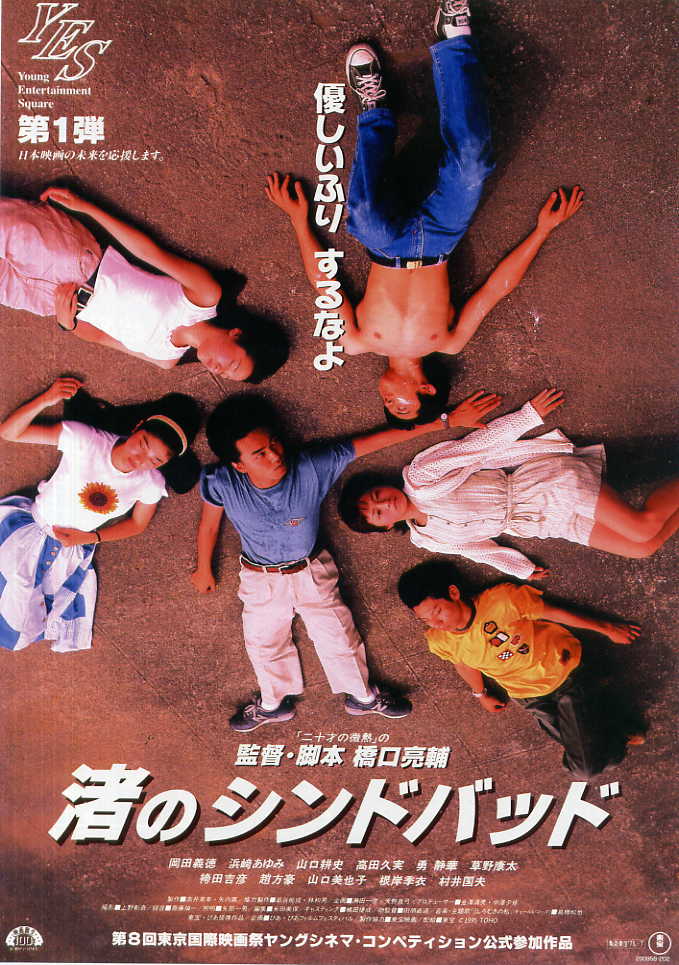
Like Grains of Sand (渚のシンドバッド, Ryosuke Hashiguchi, 1995)

Like grains of sand posterAdolescent romance is complicated enough at the best of times but the barriers are ever higher if you happen to be gay in a less than tolerant society. Ryosuke Hashiguchi’s second feature Like Grains of Sand (渚のシンドバッド, Nagisa no Sinbad) takes a slight step back in time from A Touch of Fever but retains its very ordinary world as a collection of boys and girls embark on a process of self discovery whilst also locked into the unbreakable straightjacket of the high school world.
Ito (Yoshinori Okada) is an ordinary high school boy with a crush on his oblivious best friend, Yoshida (Kouta Kusano). Though Yoshida defends him from the homophobic bullies in his class, he seems confused about his true feelings, at once stating that what he feels for Ito is more that friendship but also unwilling to address what that “more” may mean. After Ito’s father intercepts a reply to a personal ad he placed hoping to meet older men, Ito ends up at a psychiatrist’s office where his father hopes he might be “cured” though the doctor is quick to point out that they no longer view homosexuality as a medical matter.

Whilst at the clinic, Ito strikes a up a friendship with another girl from his class, Aihara (Ayumi Hamasaki) – a recent transfer student, who, we learn, has experienced a traumatic event which is also the reason she had to leave her previous place of education. Aihara is the only person with whom Ito can discuss his sexuality honestly though he’s also sure to “protect” Yoshida by claiming he rejected his advances outright rather than explaining the confusing series of events as they actually occurred. When Aihara and Ito accidentally end up on an awkward double date with Yoshida and his girlfriend Shimizu (Kumi Takada), Yoshida also begins to develop an (unreturned) attraction to Aihara which only further complicates the delicate nature of the growing emotional ties among this small group of young people.

A real step up from the promising yet flawed A Touch of Fever, Like Grains of Sand proves Hashiguchi’s skill in building an extremely natural environment filled with believable well rounded characters. The high school world is a cruel one populated by unsteady teenagers, each by times rebellious and insecure. Aihara, as a recent transfer student, is already an outsider but finds herself excluded even further thanks to her direct and aloof character. Early on in the film two of the other girls, evidently the popular set, begin running a bizarre extortion scam in which they claim a friend of theirs has fallen pregnant and needs to get an abortion right away so they’re collecting money to help her. Shimizu doesn’t seem to buy their explanation but is bamboozled into paying up to not cause offence. Aihara, however, brands the pair “sympathy fascists” and abruptly walks away.

Ito is also an outsider, though partially a self-exile, longing yet fearful. At the beginning of the film he’s overwhelmed watching the unexpectedly sensual action of Yoshida pouring a bag of sand into a container destined for the sports field. After they’ve finished, Ito faints right in front of his fellow schoolmates, though at least the convenient hot weather might prove his ally. When the other boys draw a lewd drawing on the blackboard and start teasing Ito, Yoshida comes to his rescue even though he knows that’s likely to cause trouble for himself. Reassuring his friend that it would be OK even if it was true, Yoshida continues to act in a non committal manner. Ito confesses, Yoshida accepts the confession but at the same time is uncertain permitting both a kiss and an embrace before pushing his friend away and leaving as if nothing out of the ordinary had happened.

After an impromptu hug on a rooftop, Shimizu makes attempt to ask Aihara is she’s gay with no particular judgement attached except a slight reticence in terms of language. Aihara seems slightly confused, replying only that Shimizu is preoccupied with the wrong questions. Later, Ito ends up escorting the smitten Yoshida to Aihara’s childhood home where things come to a climax during an intense finale on a secluded beach. Night is falling and Ito has put on Aihara’s white dress and hat while she goes for a swim just as Yoshida returns for a second stab at confessions. Hiding behind a rock while Yoshida thinks Ito is her, Aihara continues to conduct a philosophically based dissection of Yoshida’s approach to sexuality. She asks him, would you still love me if I were a man, and if not, is it more that what you want is a woman and not really “me” at all, along with other questions designed to prompt a response as to the importance of gender when it comes to love. That all this happens as a kind of Cyrano de Bergerac-like three way sequence with Ito dressed as Aihara, and Yoshida talking to Aihara through someone else only lends to the surreal, increasingly symbolic atmosphere.

Gentle and softly nuanced, Like Grains of Sand is a delicate exploration of ordinary young people caught in a confusing storm of emotions as they each address their burgeoning sexuality. Rich with complexity yet also effortlessly straightforward, Hashiguchi has created a beautifully naturalistic portrait of adolescence in flux which is filled with empathy and acceptance for each of its angst ridden teens and even for their less forgiving friends and relatives. A noticeable progression from Touch of Fever, Like Grains of Sand further proves Hashiguchi’s skill for character drama and marks him as one of the most incisive writer/directors working today.


Original trailer (no subtitles)

The Japanese title of the film, Nagisa no Sinbad, is also the title of a hit single by 1970s super duo Pink Lady! (Beware – extremely catchy)

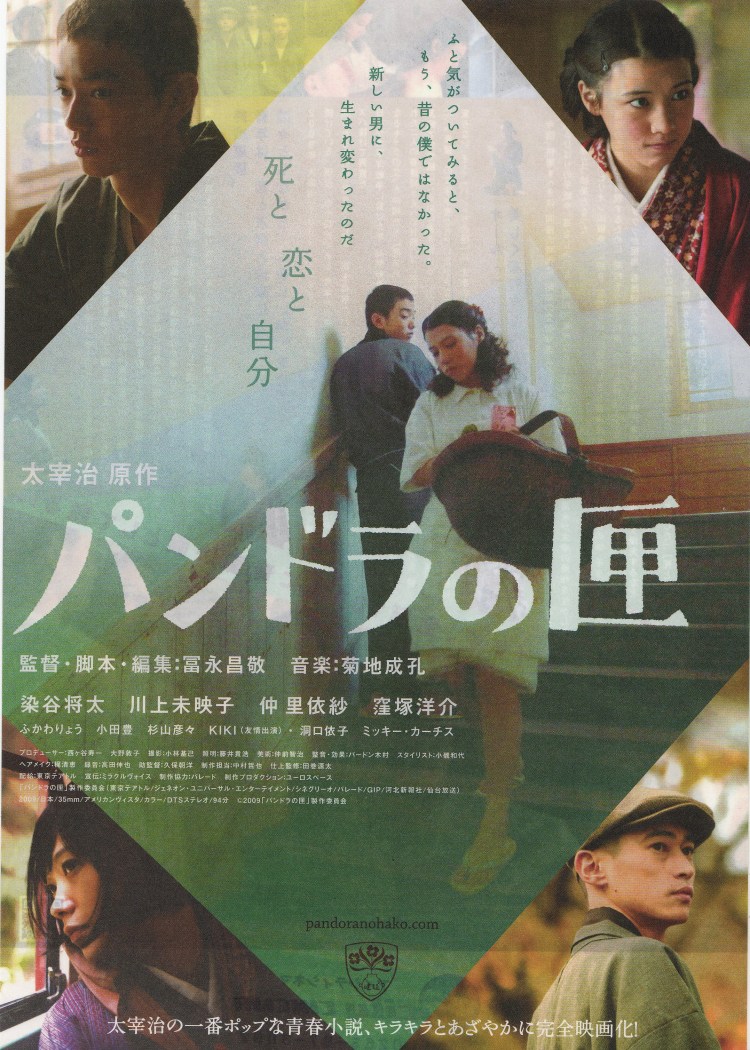
Pandora’s Box (パンドラの匣, Masanori Tominaga, 2009)

Pandora's BoxOsamu Dazai is one of the twentieth century’s literary giants. Beginning his career as a student before the war, Dazai found himself at a loss after the suicide of his idol Ryunosuke Akutagawa and descended into a spiral of hedonistic depression that was to mark the rest of his life culminating in his eventual drowning alongside his mistress Tomie in a shallow river in 1948. 2009 marked the centenary of his birth and so there were the usual tributes including a series of films inspired by his works. In this respect, Pandora’s Box (パンドラの匣, Pandora no Hako) is a slightly odd choice as it ranks among his minor, lesser known pieces but it is certainly much more upbeat than the nihilistic Fallen Angel or the fatalistic Villon’s Wife. Masanori Tominaga had made an impact with his debut film The Pavillion Salamandre and seemed to be a perfect fit for the quirkier, darkly comic Pandora’s Box but perhaps in the end it was too perfect a fit.
Inspired by events from Dazai’s own life, the story centres around a young man at the end of the second world war who has been suffering from tuberculosis for some time but kept quiet about it expecting to die soon and remove the burden on his family. However, when the war finally ends Risuke (Shota Sometani) inherits a new will to live and commits himself to a sanatorium to treat his lung condition. Whilst in the hospital he comes into contact with writers and poets as well as pretty nurses all the while proceeding with his plan to become a “new man” for this “new era”.

At once both hopeful and nihilistic, Pandora’s Box mixes gallows humour and denial in equal measure as the motley collection of inpatients waste their days away in this eccentric establishment which looks after them well enough but promises no real progress in terms of their health. Each of the patients receives a nickname when they enter the sanatorium so Risuke quickly becomes Hibari (sky lark). Tellingly, these nicknames overwrite real world personas – original names are recalled only at the time of death. Deaths do indeed occur but aside from these unhappy events, no one acknowledges the seriousness of their condition or the possibility that they may die from it, never leaving the hospital again. Physical pain and suffering is almost entirely absent though Risuke gives ample vent to his mental anguish through his letters to a fellow patient who has now been discharged back into the unseen chaos of the post-war world.

Indeed, the sanatorium might be a kind of idyll in this era of instability. Well fed and well cared for, the patients are far better off than many left adrift in the starving cities but the outside world rarely impinges on the isolated atmosphere of the sanatorium. Events change slightly when a friend of Risuke’s, Tsukushi (Yosuke Kubozuka), is discharged and a new nurse, Take (Mieko Kawakami), arrives stirring up various different emotions amongst the male patients in Risuke’s ward. Striking up a friendship with the younger nurse, Mabo (Riisa Naka), Risuke finds himself torn between two very different women.

Although its tone is necessarily one of depression and numbness, Pandora’s Box ends on an improbably upbeat note in which Risuke remarks that just like a climbing plant he may not know where he’s going, but it will certainly be a place of bright sunlight. A minor work filled with dark, ironic humour it’s perhaps unfair to expect the same kind of impact as Dazai’s more weighty efforts but Pandora’s Box is a lower budget affair which, although interesting enough in terms of direction, fails to make much of an impression outside of its obvious pedigree. The light jazzy score and deadbeat voice over add to the period feel whilst also lending an air of hopeless yet buoyant resignation to Risuke’s ongoing journey into the post-war world. This, in many ways, is what we’re here for – Risuke, unlike Dazai, has made a commitment to forge a way forward in which he plans to fight for the sun rather sink below the waves.


Original trailer (no subtitles)

Whistling in Kotan (コタンの口笛, Mikio Naruse, 1959)

vlcsnap-2016-08-03-02h37m50s119The Ainu have not been a frequent feature of Japanese filmmaking though they have made sporadic appearances. Adapted from a novel by Nobuo Ishimori, Whistling in Kotan (コタンの口笛, Kotan no Kuchibue, AKA Whistle in My Heart) provides ample material for the generally bleak Naruse who manages to mine its melodramatic set up for all of its heartrending tragedy. Rather than his usual female focus, Naruse tells the story of two resilient Ainu siblings facing not only social discrimination and mistreatment but also a series of personal misfortunes.

Masa and Yutaka are a teenage brother and sister living with their alcoholic father who has been unable to get things together since their mother passed away. They also have their grandmother and cousin, but otherwise they’re pretty much fending for themselves. At school, both children are shunned and picked on by some of their classmates solely for being Ainu. When one girl reports that her purse has gone missing, she immediately points to Masa and though another girl defends her, the obvious racial overtones continue to get to her. Similarly, Yutaka finds himself getting into trouble with one of the other boys after he beats him on a test. Yutaka pays a heavier price (at least physically) but both children are left wondering about their place in the world and what the future might hold for them.

Masa’s bright hope revolves around her art teacher who draws a picture of her at a local watering hole which he intends to enter into a competition. The teacher has his sights firmly set on a career as an artist in Tokyo but like everyone else’s dreams, it proves harder to realise than he might have hoped. Perpetually left behind, Masa’s dreams crumble too as do those of her friend who has her romantic hopes crushed firstly by her well meaning grandmother and then secondly by an unexpectedly racist action by someone who had always been seen as a friend. If all of these difficulties weren’t enough, fate is about to deal Masa and Yutaka a very cruel blow indeed which leaves them at the mercy of an evil uncle worthy of any Dickens novel.

Like much of Naruse’s work, the outlook is extremely bleak. The children face such a hopeless future that the most they can do is affect a kind of false cheerfulness to try and raise their spirits. Masa and Yutaka are both mistreated by the general population, leaving them with a lingering sense of anger and resentment towards those that seem incapable of treating them like regular human beings. Their cousin, Koji, has apparently come to the conclusion that he has to stand up against such mistreatment, however, the ultimate harm that is done to the pair is done by a member of their own family acting with total disregard their feelings and wellbeing. At this point Koji reconsiders and says he understands now that it isn’t about Ainu or Japanese, there are just awful people everywhere. An odd, if depressingly stoic, late in the game plea for empathy and tolerance, this ironically positive statement sits very well with Naruse’s general feelings on human nature.

Whistling in Kotan is not one of Naruse’s more subtle efforts. The tone is relentlessly bleak as the children experience ever more degrading treatment solely because of their ethnic group. Even their supposed ally eventually turns on them exposing the last lingering threads of prejudice among even those who portray themselves as forthright liberals. The message is one of forbearance and patience, that times have changed and will change more but that one has to grin and bear it while they do. Pragmatic as that is, it does let society of the hook when it comes to the refusal to acknowledge and deal with consistent prejudice. Filled with Naruse’s sense of despair, Whistling in Kotan is an uneven yet interesting exploration of this sensitive subject though perhaps undoes much of its good work with its ambiguous and often blunt approach to the material.


Summer of Ubume (姑獲鳥の夏, Akio Jissoji, 2005)

Summer of the UbumeAkio Jissoji has one of the most diverse filmographies of any director to date. In a career that also encompasses the landmark tokusatsu franchise Ultraman and a large selection of children’s TV, Jissoji made his mark as an avant-garde director through his three Buddhist themed art films for ATG. Summer of Ubume (姑獲鳥の夏, Ubume no Natsu) is a relatively late effort and finds Jissoji adapting a supernatural mystery novel penned by Natsuhiko Kyogoku neatly marrying most of his central concerns into one complex detective story.
Freelance writer Tatsumi Sekiguchi (Masatoshi Nagase) and occult expert Kyogokudo (Shinichi Tsutsumi) become intrigued by the bizarre story of a woman who has apparently been pregnant for twenty months. If that weren’t enough weirdness, the woman’s husband also went missing a year ago and now her sister has approached the pair hoping they can investigate and figure out what’s really going on. Unbeknownst to him, Sekiguchi has a longstanding connection with several of the people involved and himself plays a role in the central mystery. Demons foreign and domestic, past trauma, infanticide and multiple personality disorder are just some of the possible solutions but as Kyogokudo is keen to remind us, there is nothing in this world that is truly strange.

The mystery conceit takes the form of a classic European style detective story complete witha drawing room based finale in which each of our potential suspects is assembled for Kyogokudo so that he can deliver his final lecture and tick them all off the list as he goes along. The tale takes place in the summer of 1952 and so the spectre of Japan’s wartime past, as well as its growing future, both have a part to play in solving this extremely complex crime. The original supernatural question concerns two otherworldly entities which have become conflated – the Chinese Kokakucho which abducts children, and the Japanese Ubume which offers its child to passersby. Needless to say, the answer to all of our questions lies firmly within our own world and is in no small part the result of relentless cruelty masked as tradition.

The opening scene includes a lengthy discussion between Kyogokudo an Sekiguchi debating the nature of reality. We only experience the world as we perceive it, seeing and unseeing at will. Everybody, to an extent, sees what they need to see, therefore, memory proves an unreliable narrator when it comes to recalling facts which may run contrary to the already prepared narrative.

Jissoji brings his trademark surrealist approach to the material which largely consists of interconnecting flashbacks often intercut with other dreamlike imagery. Filming with odd angles and unusual camera movements, Jissoji makes the the regular world a destabilising place as the strange mystery takes hold. The canted angles and direct to camera approach also add to a slight hardboiled theme which creeps in around the otherwise European detective drama though this mystery is much more about solving a series of puzzles than navigating the dangerously dark world of the noir. That said this is a very bleak tale which, for all its frog faced children weirdness, has some extremely unpleasant human behaviour at its roots.

Supernatural investigator Kyogokudo quickly dispenses with the demonic in favour of the natural but the solutions to this extremely complicated set of mysteries are anything but simple. Making space for the original novel’s author to show up as a travelling picture storyteller with some Shigeru Mizuki inspired illustrations on his easel, Summer of Ubume is not entirely devoid of whimsy but its deliberately arch tone is one which it manages to make work with its already bizarre set up. The enemy is the unburied past, or more precisely the unacknowledged past which generates its own series of ghosts and phantasms, always lurking in the background and creating havoc wherever they go. Occasionally confusing, Summer of Ubume is a fascinating supernatural mystery which takes its cues much more from European detective stories and gothic adventure than from supernatural horror or fantastical ghost story.


Natsuhiko Kyogoku’s source novel is available in an English translation by Alexander O. Smith (published by Vertical in the US).

Original trailer (no subs):

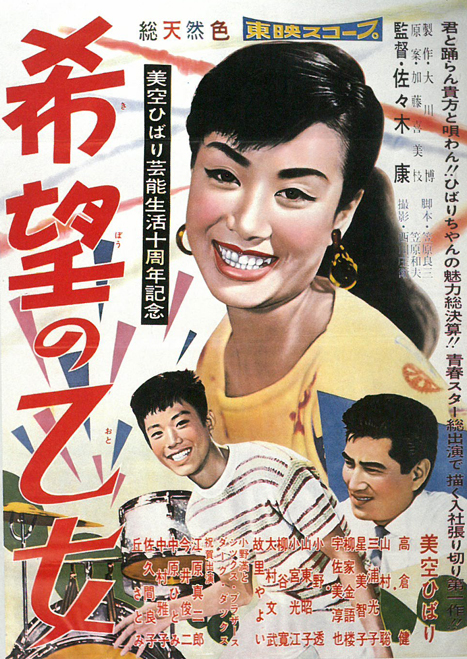
With Song in Her Heart (希望の乙女, Yasushi Sasaki, 1958)

song in her heartAnother vehicle for post-war singing star Hibari Misora, With a Song in her Heart (希望の乙女, Kibo no Otome) was created in celebration of the tenth anniversary of her showbiz debut. As such, it has a much higher song to drama ratio than some of her other efforts and mixes fantasy production numbers with band scenes as Hibari takes centre stage playing a young woman from the country who comes to the city in the hopes of becoming a singing star.

After beginning with a rural, almost cowboy-style number in which Hibari appears as the well dressed lady of the manor, Sayuri, riding her horse across the wide pastureland, the action quickly moves to the city when Sayuri’s mentor finally convinces her uncle that her future lies in showbiz and not an early marriage as he had envisioned. However, once she gets there she finds her potential tutor extremely unwilling to fulfil his promise to take her on. After winning him over, she quickly makes friends with the locals who also want the singing teacher to become the leader of a band they’ve formed in the hopes of raising some money to build a proper children’s playground to stop them playing in dirty ditch land nearby which is a well known health hazard. Soon enough the band takes off but there’s more trouble ahead for Hibari and co. as they are betrayed by those closest to them.

Working as a celebration of Hibari’s career so far With a Song on Her Heart is filled with excuses for Hibari to sing both as a music student and band vocalist as well as fantasy production numbers some of which are even bigger on dance than on song. The plot is quite simple but there is a lot of it, in contrast to other films of this kind, as Hibari sets about healing the grief stricken heart of her bandleader and fulfilling the hopes of the ordinary people turned musicians through the power of song. The romance element is a light one and not the focus of the film but bears mentioning as Hibari’s love interest is played by Ken Takakura – the archetypical star of the yakuza movie who was to marry fellow singing sensation (and frequent Hibari Misora co-star) Chiemi Eri the following year.

Despite its nature as a celebratory project, With a Song in Her Heart doesn’t quite meet the high production standards of other Misora starring films. Shot in colour and in 2.35:1, the majority of the film is studio bound (often very obviously so) with simple sets and a straightforward directing style. Nevertheless, even if it fails to impress on a technical level, With a Song in Her Heart knows what it’s about and so it makes sure to fill its relatively short duration with as many songs as possible, light romance and a cheerful atmosphere of people coming together to try and solve a social problem through spreading love and joy in the form of music. The musical styles are unusually varied embracing Hibari Misora’s regular ballads as well as mixing in world influences from mariachi to african drums with a strong big band jazz undercurrent.The overall feeling is one of goodnatured wholesomeness and even if low on impact With a Song on Her Heart is a decent showcase for Hibari Misora’s talents as she celebrates her tenth year in the business at the age of only 21.


Shark Skin Man and Peach Hip Girl (鮫肌男と桃尻女, Katsuhito Ishii, 1999)

Shark_Skin_Man_And_Peach_Hip_Girl_(1998)If you’re going on the run you might as well do it in style. Wait, that’s terrible advice isn’t it? Perhaps there’s something to be said for planning a cunning double bluff by becoming so flamboyant that everyone starts ignoring you out of a mild sense of embarrassment but that’s quite a risk for someone whose original gamble has so obviously gone massively wrong. An adaptation of a manga, Katsuhito Ishii’s debut feature Sharkskin Man and Peach Hip Girl (鮫肌男と桃尻女,  Samehada Otoko to Momojiri Onna) follows a mysterious criminal trying to head off the gang he just stole a bunch of money from whilst also accompanying a strange young girl, also on the run but from her perverted, hotel owning “uncle” who has also sent an equally eccentric hitman after the absconding pair with instructions to bring her back.
Like Ishii’s subsequent efforts, Shark Skin Man and Peach Hip Girl is a riot of full on craziness from the get go, though he largely manages to avoid manga adaptation cliches. The gangster, Samehada (Tadanobu Asano), is pursued by an eccentric set of former gang members – the sanest amongst them being Sawada (Susumu Terajima), his former partner who wants to track him down first to prevent the bloody retribution his guys have in store for him. The gang’s boss (Ittoku Kishibe), lovingly caresses a harpoon, dresses in a gestapo style shiny black leather overcoat, wears one glove, and is on a quest to track down rare vintage posters of much loved Japanese comedian Kon Omura. One of his henchmen is a guy with bleach blond hair who dresses all in white and has an extremely sensitive sense of smell but an intense aversion to water.

The heat coming from the other side is equally strange as the leacherous uncle is apparently friends with Japan’s weirdest hitman, Yamada, who dresses in a retro style and has a unibrow and a high pitched voice. In fact, he’s basically Ken Omura himself, creeping about, being odd in a ridiculous cartoon character way. Unfortunately, Yamada has a weakness and just as he’s about to complete his mission he falls in love with his target! Apparently this is something that happens to him often though you’d think it would be quite a liability given his line of work. In this instance who could really blame him, but his new found romance means he won’t be able to pull the trigger  – and not only that, he can’t bring the girl back either because he doesn’t want to break the beautiful gangster’s heart! Ah, true love!

There is quite a lot going on. Too much, really. For all the craziness which ensues, it’s hard to build up an attachment to any of our strange little gangsters and their petty plots or bids for freedom. Things build to a whirlwind of chaos in the final stretch but when it’s all supposed to calm down for a little spiritual contemplation at the end, the effect begins to fall apart.

There are however a few quieter sections such as a surprisingly maudlin one in which yakuza sons of yakuza fathers lament their unhappy childhoods which saw them bullied and excluded by their law abiding peers. One even says that he thought the tattoos were something which just appeared on everyone when they grew up. Ishii employs some strange jump cuts, moving us ahead a little jerkily as the time passes slowly for this motley crew of veteran bad guys. He later employs a similar technique where he shifts some of his violence into the expressionist realm by cutting on the sound of landing punches.

As the title suggests, Shark Shin Man and Peach Hip Girl is the story of two crazy kids on the run, and the bizarre collection of people who end up chasing them. Ishii could never be accused of subtlety but the punk infused, anarchic and ironic tone are difficult to resist even if the end result is a necessarily slight one. An imperfect, though impressive debut, Shark Skin Man and Peach Hipped Girl is an interesting genre infused tale that uses absurd humour as a foil for the darkness and violence which underpins it.


Original trailer (no English subs – French subs available via settings menu)

Midway through this film someone starts singing a Japanese language cover of Donna Donna which was a surprise! Can’t find a clip so here’s Joan Baez’s version live in Japan in 1967!

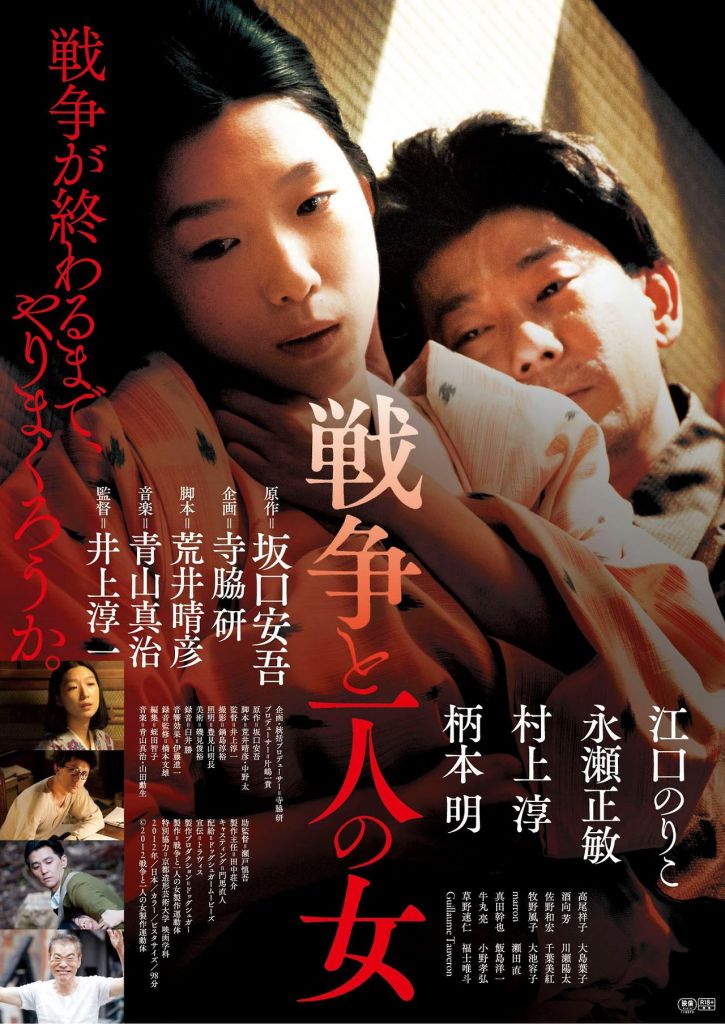
A Woman and a War (戦争と一人の女, Junichi Inoue, 2013)

a-woman-and-warJunichi Inoue is better known as a screenwriter and frequent collaborator of avant-garde/pink film provocateur Koji Wakamatsu. A Woman and a War (戦争と一人の女, Senso to Hitori no Onna) marks his first time in the director’s chair and finds him working with someone else’s script but staying firmly within the pink genre. Adapted from a contemporary novel by Ango Sakaguchi published in 1946, A Woman and a War is an intense look at domestic female suffering during a time generalised chaos.
The unnamed “Woman” (Noriko Eguchi) is a former prostitute, sold to a brothel by her father as a child, now working as a bar hostess. Times being what they are, she decides there’s no future in bar work and wants to get married. Accordingly, she finds herself moving in with a moody novelist who frequents the bar, Nomura (Masatoshi Nagase). The woman becomes Nomura’s “wife”, but the relationship is strained as she finds it difficult to derive pleasure from sex and he is of a nihilistic mindset, convinced that Japan is about to lose the war. Nomura promises to live with her until the war’s end, at which time he assumes the country will cease to exist taking him with it.

Running parallel to this is the story of recently demobbed soldier and drinker at Woman’s bar, Ohira (Jun Murakami). Having lost an arm in the war, Ohira has been “lucky”, in a sense, and been sent home early. However, he has a wife and young son he’s been away from so long that they’re virtual strangers from each other. Ohira is not the man who went away to fight, he’s embittered and angry. Unable to enjoy normal relations with his wife, he finds himself aroused after failing to rescue a woman being gang raped by thugs which he then watches after being tied up while the men finish their business. After this, he despatches his family to the comparative safety of his wife’s parents and embarks on a career of violence, rape and murder.

Despite nominally being the story of the Woman, A Woman and a War has an unbalanced tripartite structure split between the three central characters. Of the three, Nomura’s story is the least explored but then is also the most clichéd in its familiar over sensitive novelist takes hack jobs and abuses all available substances to block out his crushing depression trope. Though the story ought to belong to Woman, she is often eclipsed by Ohira’s extreme descent into violent misogyny though in actuality these two strands dovetail into each other as Woman’s story is also one of continued exploitation.

This stems back well before the war as she was, in a sense, betrayed by her father when he sold her supposedly in desperation but apparently drank the money he got for her rather than using it to feed the rest of the family. Having spent so long in the brothel her body has become nothing more than a tool to her – something to be well maintained and then traded as a commodity. After her relationship with Nomura ends, Woman finds herself once again working as a prostitute – first at a facility set up for the American military, and then as a streetwalker targeting foreign servicemen. Eventually her path crosses with that of Ohira which results in the uncomfortable realisation that she too can only reach climax through violence.

Ohira is so deeply scarred by his wartime experiences that he has a compulsion to reenact them through random acts of sexual violence on unsuspecting women. The events he recounts from Manchuria are truly horrifying but he has an uncomfortable point when he repeats that the difference between what he did in the war and what he’s doing now is that between a medal and a death sentence. The people he killed in China weren’t soldiers or those who threatened his life, they were innocent civilians no different from the women he lured into the forests of Japan, so how was it right then and wrong now? The other uncomfortable fact is that Ohira is both perpetrator and victim of the wider war, a symbol of its cannibalistic whirlwind of destruction, the effects of which continue in perpetuity.

Coming as he does from the pink film world, Inoue adopts a detached frankness when it comes to sex. However, in keeping with the film’s themes there is an abundance of sexualised violence against women which, though every bit as unpleasant as it’s intended to be, does at times feel gratuitous. It’s also an unfortunate fact that there is a lot of gratuitous female nudity in the film but absolutely no male – at one point Woman bares her genitals to the open air and urges Nomura to do the same but the camera cuts to a rear shot as though embarrassed. In an interview with Diva Review Inoue admits he regrets the way this was handled and states it’s largely down to having bigger name actors in the two central roles, but in addition to deviating from the otherwise naturalistic intentions of the film, it also presents him with a set of thematic problems which undercut his central intentions.

However, A Woman and a War is one of the few (recent) films to seriously look at the traumatic afterlife of the war both on those who served and those who stayed at home using sexuality as a curiously reflective prism. A Woman and a War is a super low budget film and, in truth, looks it, though does make an attempt to do the best it can with what it has. The performances of the three leads are also each strong though something of the film’s tone never quite coalesces beyond the persistent unpleasantness into something more deeply probing. Troubling, concerning, and disturbing, A Woman and a War is a much needed look at this murky and often avoided area but one that finds it impossible to escape its own exploitative nature.


Original trailer (English subtitles):

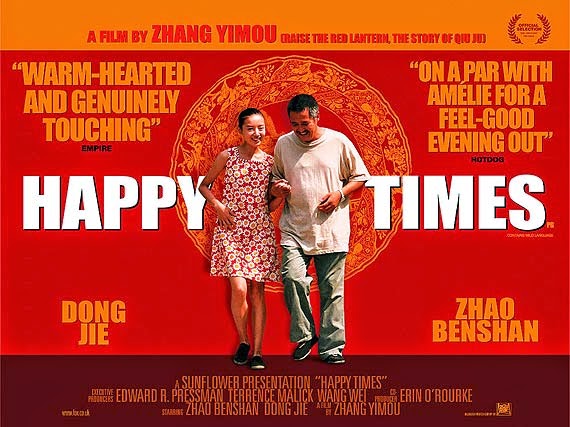
Happy Times (幸福时光, Zhang Yimou, 2000)

Happy TimesPossibly the most successful of China’s Fifth Generation filmmakers, Zhang Yimou is not particularly known for his sense of humour though Happy Times (幸福时光, Xìngfú Shíguāng) is nothing is not drenched in irony. Less directly aimed at social criticism, Happy Times takes a sideswipe at modern culture with its increasing consumerism, lack of empathy, and relentless progress yet it also finds good hearted people coming together to help each other through even if they do it in slightly less than ideal ways.

An older man in his 50s, Zhao is a bachelor afraid that life has already passed him by. Desperate to get married for reasons of companionship, he’s settled on the idea of finding himself a larger lady who, he assumes, will be filled with warmth (both literally and figuratively), have a lovely flat he can move into and will also be able to delight him with delicious food. Not much to ask for really, is it? Unfortunately, he ends up with a woman nicknamed “Chunky Mama” who is pretty much devoid of all of these qualities beyond the physical. She has an overweight son whom she spoils ridiculously and a blind stepdaughter she treats with cruelty and disdain.

Zhao is eager to please his new lady love and has told her a mini fib about being a hotel manager. He and his friend Li had been planning to open a “love hut” in an abandoned trailer in the forest but this plan doesn’t quite work out so when Chunky Mama asks him to give the blind girl, Little Wu, a job in the hotel Zhao is in a fix. Together with some of his friends, he hatches a plan to create a fake massage room in an abandoned warehouse where they can take turns getting massages from the girl in the hope that she really believes she’s working and making money for herself. However, though Little Wu comes to truly love her mini band of would be saviours she also has a yearning to find her long absent father who has promised to get her treatment to restore her sight, as well as a growing sense of guilt as she feels she’s becoming a burden to them.

Zhao decided to name his “love hut” the Happy Times Hotel – to him there’s really no difference between a “hut” and a “hotel”. In some ways he’s quite correct but the expectation differential isn’t something that would really occur to him, straightforward fantasist as he is. In fact, Zhao is a master of the half-truth, constantly in a state of mild self delusion and self directed PR spin as he tries to win himself the brand new life he dreams of through sheer power of imagination. His friends seem to know this about him and find it quite an amusing, endearing quality rather than a serious personality flaw.

Unfortunately this same directness sometimes prevents him from noticing he’s also being played in return. The ghastly stepmother Chunky Mama is in many ways a clear symbol of everything that’s wrong with modern society – brash, forceful, and materially obsessed. For unclear reasons, she’s hung on to Little Wu after the breakdown of the marriage to her father but keeps her in a backroom and forces her do chores while her own son lounges about playing video games and eating ice-cream. Ice-cream itself becomes a symbol of the simple luxuries that are out of reach for people like Little Wu and Zhao but quickly gulped down by Chunky Mama’s son with an unpleasant degree of thoughtless entitlement. The son is a complete incarnation of the Little Emperor syndrome that has accompanied the One Child Policy as his mother indulges his every whim, teaching him to be just as selfish and materially obsessed as she is.

For much of its running time, Happy Times is a fairly typical low comedy with a slightly surreal set up filled with simple but good natured people rallying round to try and help each other through a series of awkward situations but begins to change tone markedly when reaching its final stretch. Zhao and Little Wu begin to develop a paternal relationship particularly as it becomes clear that the father she longs for has abandoned her and will probably never return but circumstances move them away from a happy ending and into an uncertain future. The film ends on a bittersweet note that is both melancholy but also uplifting as both characters send undeliverable messages to each other which are intended to spur them on with hope for the future. “Happy Times Hotel” then takes on its most ironic meaning as happiness becomes a temporary destination proceeded by a long and arduous journey which must then be abandoned as the traveller returns to the road.


Retitled “Happy Times Hotel” for the UK home video release.

US release trailer (complete with dreadful voice over and comic sans):

The Room (部屋, Sion Sono, 1993)

The roomThough the later work of Sion Sono is often noted for its cinematic excess, his earlier career saw him embracing the art of minimalism. The Room (部屋, Heya) finds him in the realms of existentialist noir as a grumpy hitman whiles away his remaining time in the search for the perfect apartment guided only by a detached estate agent.

Sono begins the film with an uncomfortably long static camera shot of a warehouse area where nothing moves until a man suddenly turns a corner and sits down on a bench. We then cut to a rear shot of the same man who’s now sitting facing a harbour filled with boats coming and going as the sun bounces of the rippling sea. We don’t know very much about him but he’s dressed in the crumpled mac and fedora familiar to every fan of hardboiled fiction and walks with the steady invisibility of the typical genre anti-hero.

Before we head into the main “narrative” such as it is, Sono presents us with another uncomfortably long shot of the title card which takes the form of a street sign simply reading The Room, over which someone is whistling a traditional Japanese tune. Eventually we catch up with the hitman as he meets a young female estate agent identified only by the extremely long number she wears on the jacket of her official looking business suit. The hitman gruffly lists his poetical demands for his new home – must be quiet, have the gentle smell of spring flowers wafting through it, and above all it must have an open, unoverlooked view from a well lit window. The estate agent reacts with dispassionate efficiency, her gaze vacantly directed at the floor or around the rundown apartments which she recommends to her client. Together, the pair travel the city looking for the elusive “Room” though perhaps that isn’t quite what they’re seeking after all.

Sono shoots the entire film in grainy black and white and in academy ratio. He largely avoids dialogue in favour of visual storytelling though what dialogue there is is direct, if poetic, almost symbolic in terms of tone and delivery. The occasional intrusion of the jazzy score coupled with the deserted streets and stark black and white photography underlines the noir atmosphere though like the best hardboiled tales this is one filled emptiness led by a man seeking the end of the world, even if he doesn’t quite know it.

In fact, the relationship between our hitman and the passive figure of the estate agent can’t help but recall Lemmy Caution and the unemotional Natasha from Godard’s Alphaville – also set in an eerily cold city. If Sono is channelling Godard for much of the film, he also brings in a little of Tarkovsky as the hitman and estate agent make an oddly arduous train journey around the city looking for this magical space much like the explorers of the Zone in Stalker. Yet for all that there’s a touch of early Fassbinder too in Sono’s deliberately theatrical staging which attempts both to alienate and to engage at the same time.

The Room’s central conceit is its use of extremely long shots filled with minimal action or movement. In a 90 minute film, Sono has given us only 44 takes, lingering on empty streets and abandoned buildings long enough to test the patience of even the most forgiving viewer. Deliberately tedious, The Room won’t counter arguments of indulgence but its increasing minimalism eventually takes on a hypnotic quality, lending to its dreamlike, etherial atmosphere.

Here the city seems strange, a half formed place made up of half remembered images and crumbling buildings. Empty trains, scattered papers, and lonely bars are its mainstays yet it’s still somehow recognisable. Leaning more towards Sono’s poetic ambitions than the anarchism of his more aggressive work, The Room is a beautifully oblique exploration of the landscape of a tired mind as it prepares to meet the end of its journey.


Original trailer (no subtitles):

Kabei: Our Mother (母べえ, Yoji Yamada, 2008)

KabeiYoji Yamada’s films have an almost Pavlovian effect in that they send even the most hard hearted of viewers out for tissues even before the title screen has landed. Kabei (母べえ), based on the real life memoirs of script supervisor and frequent Kurosawa collaborator Teruyo Nogami, is a scathing indictment of war, militarism and the madness of nationalist fervour masquerading as a “hahamono”. As such it is engineered to break the hearts of the world, both in its tale of a self sacrificing mother slowly losing everything through no fault of her own but still doing her best for her daughters, and in the crushing inevitably of its ever increasing tragedy.

Summer, 1940. The Nogamis are a happy family who each refer to each other by adding the cute suffix of “bei” to their names. The father, Tobei (Bando Mitsugoro X), is a writer and an intellectual opposed to Japan’s increasing militarism and consequently has found himself in both political and financial difficulties as his writing is continually rejected by the censors. Eventually, the secret police come for him, dragging him away from his home in front of his terrified wife and daughters. After Tobei is thrown into jail for his “thought crimes”, the mother, Kabei (Sayuri Yoshinaga), is left alone with her two young girls Hatsuko and Teruyo (Hatsubei and Terubei in family parlance).

Though devastated, Kabei does not give up and continues to try and visit her husband, urging his release and defending his reputation but all to no avail. Thankfully, she does receive assistance from some of her neighbours who, at this point at least, are sympathetic to her plight and even help her get a teaching job to support herself and the children in the absence of her husband. She also finds an ally in the bumbling former student, Yamazaki (Tadanobu Asano), as well as her husband’s sister Hisako (Rei Dan), and her brother (Tsurube Shofukutei) who joins them for a brief spell but ultimately proves a little too earthy for the two young middle class daughters of a dissident professor.

The time passes and life goes on. The war intensifies as do the attitudes of Kabei’s friends and neighbours though the family continues its individual struggle, sticking to their principles but also keeping their heads down. By the war’s end, Kabei has lost almost everything but managed to survive whilst also ensuring her children are fed and healthy. A voice over from the older Teryuo calmly announces the end of the conflict to us in such a matter of fact way that it’s impossible not wonder what all of this was for? All of this suffering, death and loss and what has it led to – even more suffering, death and loss. A senseless waste of lives young and old, futures ruined and families broken.

Yet for all that, and to return to the hahamono, the Nogami girls turned out OK. Successful lives built in the precarious post-war world with careers, husbands and families. Unlike many of the children in the typical mother centric movie, Hatsuko and Teruyo are perfectly aware of the degree to which their mother suffered on their behalf and they are both humbled and grateful for it. Kabei was careful and she kept moving to protect her children in uncertain times. Seen through the eyes of a child, the wartime years are ones of mounting terror as fanatical nationalism takes hold. Bowler hatted men seem to rule everything from the shadows and former friends and neighbours are primed to denounce each other for such crimes as having the audacity to wear lipstick in such austere times. In one notable scene, the neighbourhood committee begins its meeting by bowing at the Imperial Palace, until someone remembers the paper said the Emperor was in a different palace entirely and they all have to bow the other way just in case.

Though the tale is unabashedly sentimental, Yamada mitigates much of the melodrama with his firmly domestic setting. We see the soldiers massing in the background and feel the inevitable march of history but the sense of tragedies both personal and national, overwhelming as it is, is only background to a testament to the strength of ordinary people in trying times. An intense condemnation of the folly of war and the collective madness that is nationalism, Kabei is the story of three women but it’s also the story of a nation which suffered and survived. Now more than ever, the lessons of the past and the sorrow which can only be voiced on the deathbed are the ones which must be heeded, lest more death and loss and suffering will surely follow.


Original trailer (English subtitles)