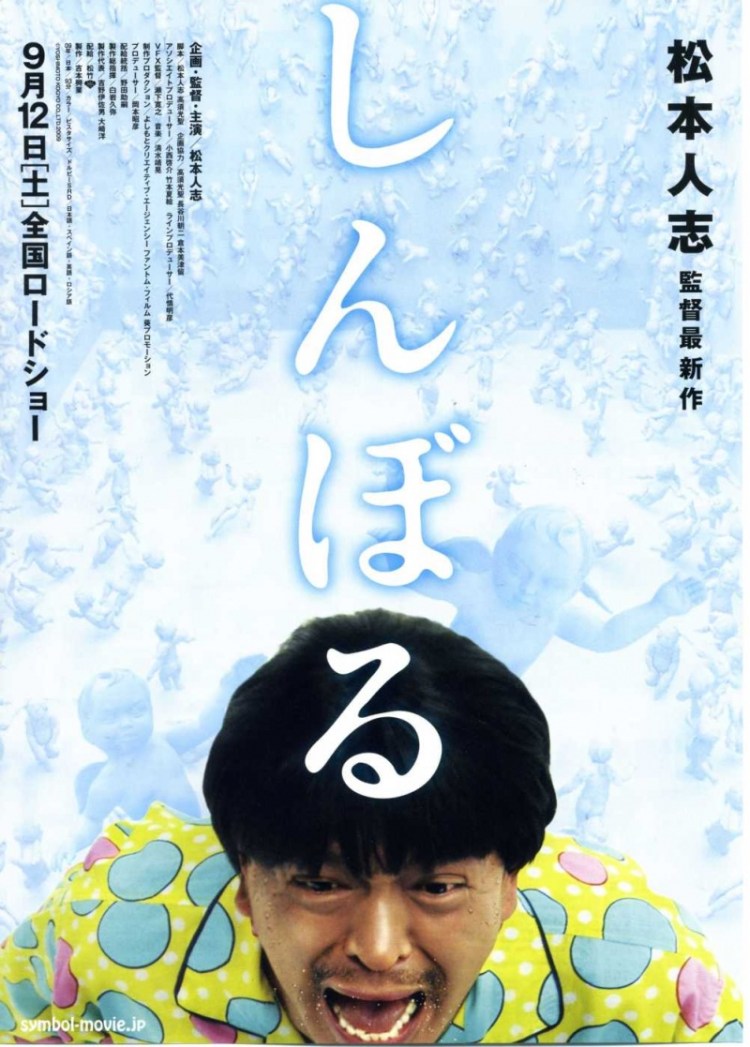
 Symbol (しんぼる) – one thing which stands for another, sacrificing its own nature in service of something else. Hitoshi Matsumoto waxes philosophical in his follow up to Big Man Japan. Life, the universe, and everything converge in the seemingly unrelated tales of an unsuccessful Mexican luchador, and a confused Japanese man trapped in a surrealist nightmare. As expected, these two strands eventually meet, though not quite as one might expect.
The Mexican desert, a chain-smoking nun drives erratically towards a small house in which there lives a lucha libre wrestler by the name of Escargot Man (David Quintero) who has a big fight coming up but is worried because his opponent is much younger and stronger than he is.
Meanwhile, at an undisclosed location, a Japanese man wakes up in a pair of colourful polka dotted pyjamas inside an entirely white room. The man screams and rails but gets no reply. Eventually he notices a strangely shaped protrusion on the wall and taps it, at which point a host of tiny cherubs swarms around him before returning to the wall leaving only their tiny penises poking through. The man taps more penises and a host of objects begins to flood the room, each more useless than the last until the man begins to concoct a plan of escape.
Matsumoto lets his Mexican opening drift on indefinitely before abruptly cutting to the bright white walls of the mysterious room. The Mexican vistas are warm, wide, and open as the three generation family fret over the masked father’s destiny as a luchador with grandpa comforting the youngest who finds himself bullied over his dad’s profession while the mother is concerned by her husband’s nervous mood.
The mysterious room, by contrast, contains only a lone Japanese man even if just as strangely dressed. Matsumoto does not skimp on the surrealism as the man is bombarded with a series of totally useless accessories each time he presses one of the penis switches attached to the wall. Beginning with a toothbrush, the man is gifted a bonsai tree, hundreds of chopsticks, a sun lounger, toaster, and so on, each lacking any concrete purpose for his new life in the room save making him both more comfortable and also more frustrated. Irony rules as he receives a sushi lunch with no soy sauce only for a bottle to appear as soon as he’s finished, or he’s presented with the next-but-one volume of a manga he’s been reading but remains eternally unable to acquire the missing book. Eventually he finds a method of possible escape, conducts various trial and error attempts to make it work and then discovers it only leads to a second round gamesmanship with his invisible tormentor.
Unbeknownst to the man, his actions have consequences which begin with the improbable story of the Mexican wrestler and then flood around the world as he keeps tapping switches before literally ascending to a higher plane of existence. Random events are, perhaps, the result of a random button pusher in a far off land, trying and failing to escape his own captivity. Or then again, maybe he is us, endlessly tormented by unseen forces, desperately looking for a way out but left with no other mechanism than trial and error. We follow him through “learning” to “practice” and eventually to “future”, though what he learns through his strange evolution in an Escher-like world of inescapable repetition is debatable.
Strange, absurdist and defying interpretation, Symbol is a surreal escape game played on a universal scale. Matsumoto’s message is permanently unclear and possibly a long form joke, but its playfulness and somehow goodnatured attempt at cosmological exegesis is one which evokes a puzzled smile or exasperated laughter more than irritation at its appropriately obilque coda.
Currently streaming on Mubi.
Original trailer (dialogue free)

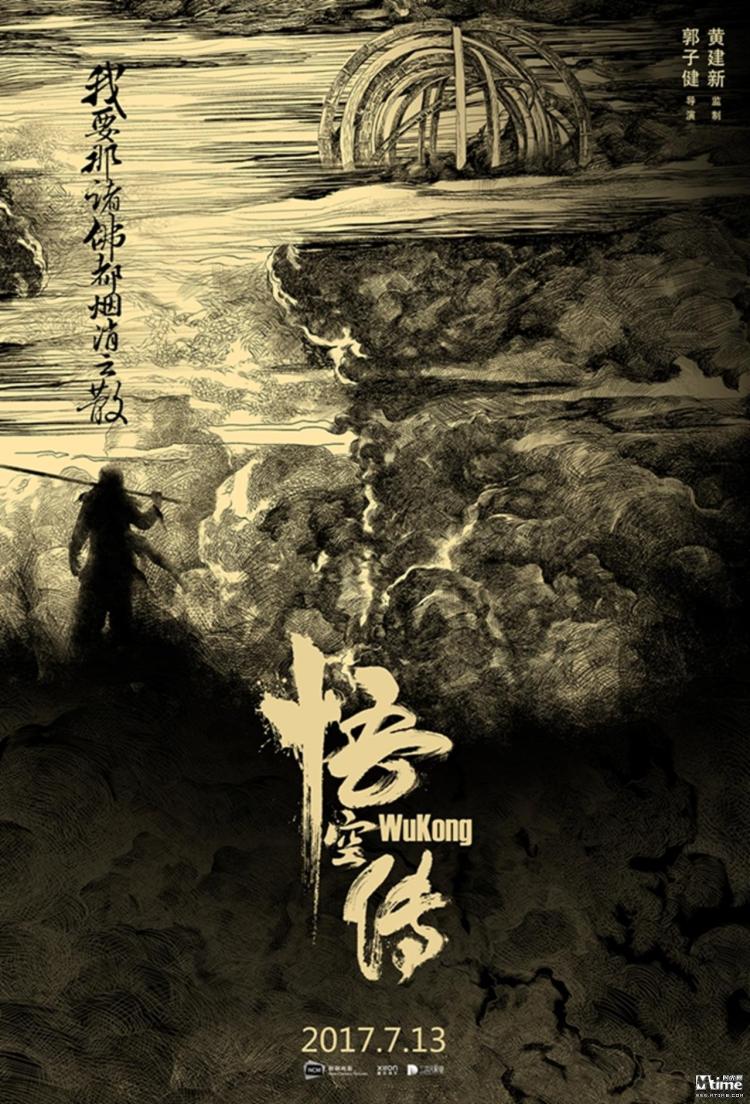 As it stands, contemporary Chinese cinema is veering dangerously close to Monkey King fatigue. Stephen Chow brought his particular sensibilities to the classic Journey to the West before Donnie Yen put on a monkey suit for
  “It’s not all about tofu!” screams the heroine of Akanezora: Beyond the Crimson Sky (あかね空), a film which is all about tofu. Like tofu though, it has its own subtle flavour, gradually becoming richer by absorbing the spice of life. Based on a novel by Ichiriki Yamamoto, Akanezora is co-scripted by veteran of the Japanese New Wave, Masahiro Shinoda and directed by Masaki Hamamoto who had worked with Shinoda on Owl’s Castle and Spy Sorge prior to the director’s retirement in 2003. Like the majority of Shinoda’s work, Akanezora takes place in the past but echoes the future as it takes a sideways look at the nation’s most representative genre – the family drama. Fathers, sons, legacy and innovation come together in the story of a young man travelling from an old capital to a new one with a traditional craft he will have to make his own in order to succeed.
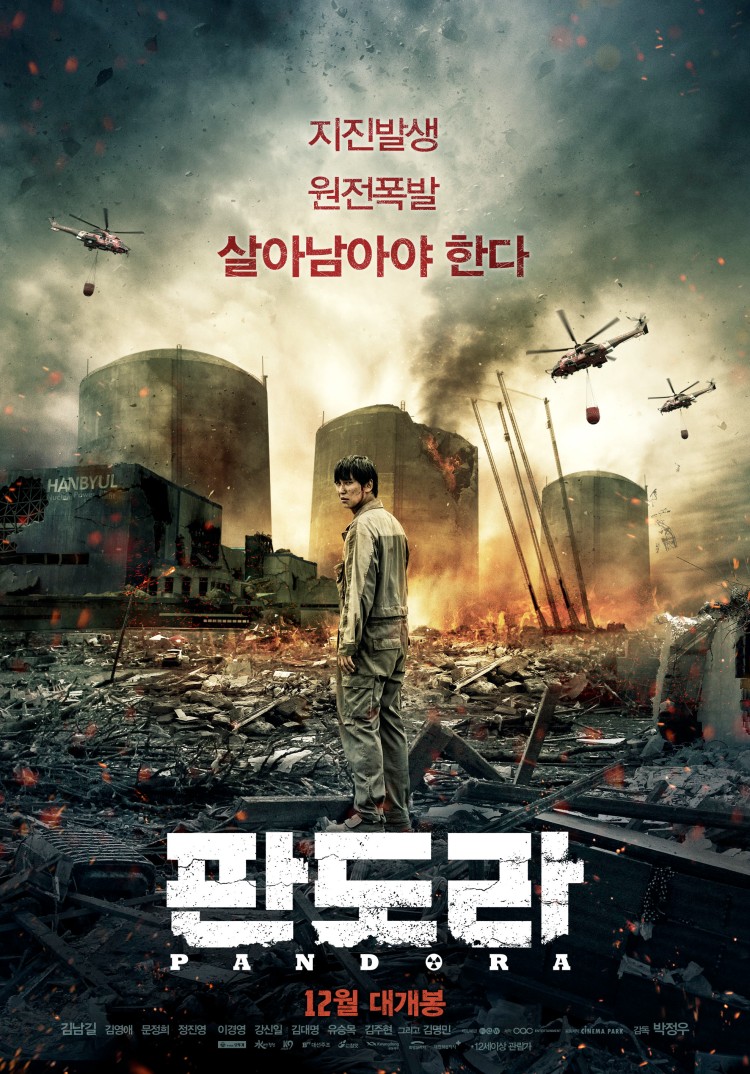 In a time of crisis, the populace looks to the government to take action and save the innocent from danger. A government, however, is often forced to consider the problem from a different angle – not simply saving lives but how their success or failure, decision-making process, and ability to handle the situation will be viewed by the electorate the next time they are asked who best deserves their faith and respect. Pandora (판도라) arrives at a time of particularly strained relations between the state and its people during which faith in the ruling elite is at an all time low following a tragic disaster badly mishandled and seemingly aided by the government’s failure to ensure public safety. Faced with an encroaching nuclear disaster to which their own failure to heed the warnings has played no small part, Pandora’s officials are left in a difficult position tasked with the dilemma of sacrificing a small town to save a nation or accepting their responsibility to their citizens as named individuals. Unsurprisingly, they are far from united in their final decision.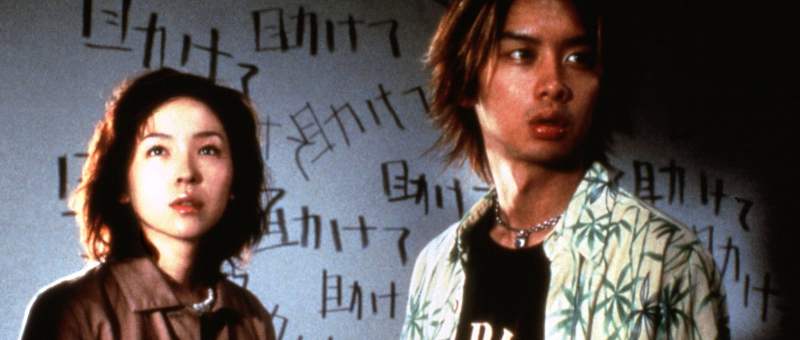
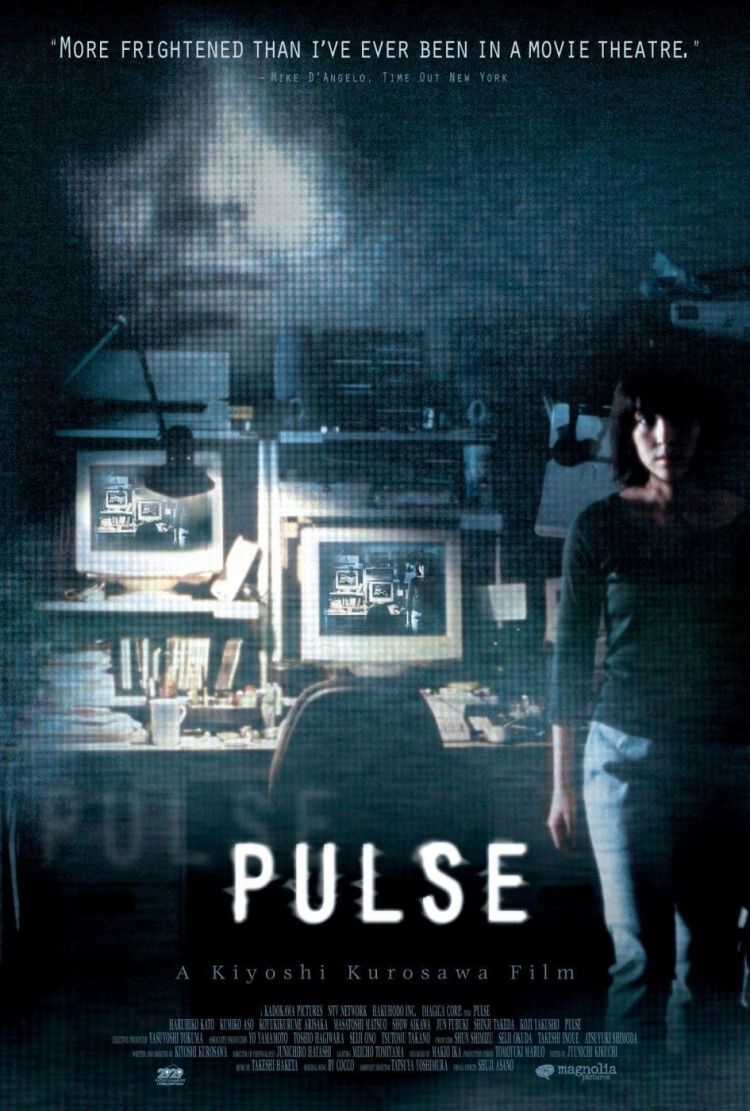 Times change and then they don’t. 2001 was a strange year, once a byword for the future it soon became the past but rather than ushering us into a new era of space exploration and a utopia born of technological advance, it brought us only new anxieties forged by ongoing political instabilities, changes in the world order, and a discomfort in those same advances we were assured would make us free. Japanese cinema, by this time, had become synonymous with horror defined by dripping wet, longhaired ghosts wreaking vengeance against an uncaring world. The genre was almost played out by the time Kiyoshi Kurosawa’s Pulse (回路, Kairo) rolled around, but rather than submitting himself to the inevitability of its demise, Kurosawa took the moribund form and pushed it as far as it could possibility go. Much like the film’s protagonists, Kurosawa determines to go as far as he can in the knowledge that standing still or turning back is consenting to your own obsolescence.
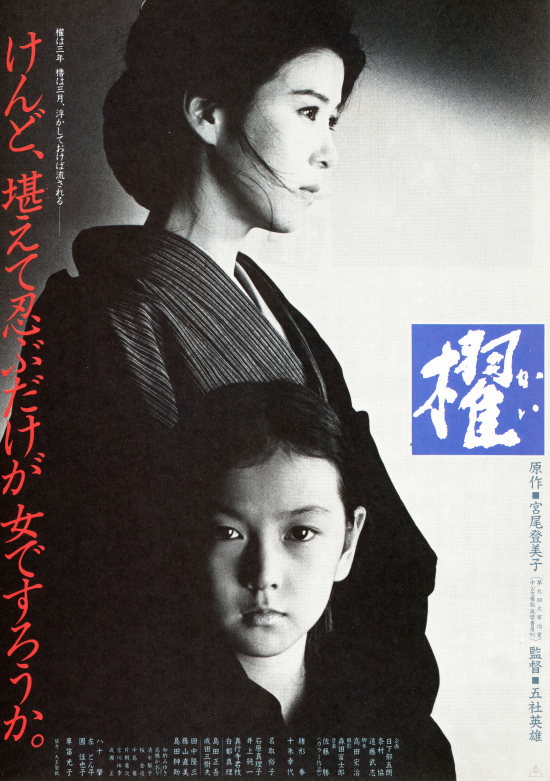 Until the later part of his career, Hideo Gosha had mostly been known for his violent action films centring on self destructive men who bore their sadnesses with macho restraint. During the 1980s, however, he began to explore a new side to his filmmaking with a string of female centred dramas focussing on the suffering of women which is largely caused by men walking the “manly way” of his earlier movies. Partly a response to his regular troupe of action stars ageing, Gosha’s new focus was also inspired by his failed marriage and difficult relationship with his daughter which convinced him that women can be just as devious and calculating as men. 1985’s Oar (櫂, Kai) is adapted from the novel by Tomiko Miyao – a writer Gosha particularly liked and identified with whose books also inspired
 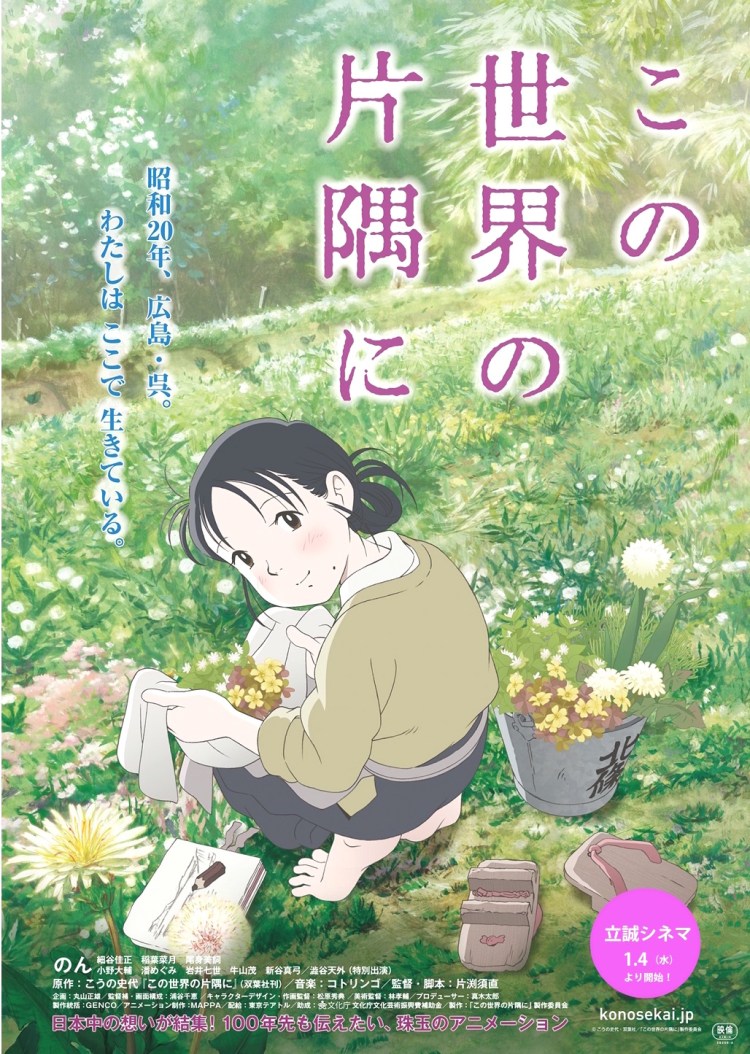 Depictions of wartime and the privation of the immediate post-war period in Japanese cinema run the gamut from kind hearted people helping each other through straitened times, to tales of amorality and despair as black-marketeers and unscrupulous crooks take advantage of the vulnerable and the desperate. In This Corner of the World (この世界の片隅に, Kono Sekai no Katasumi ni), adapted from the manga by Hiroshima native Fumiyo Kouno, is very much of the former variety as its dreamy, fantasy-prone heroine is dragged into a very real nightmare with the frontier drawing ever closer and the threat of death from the skies ever more present but manages to preserve something of herself even in such difficult times.
 Now in its 21st year, Montreal’s
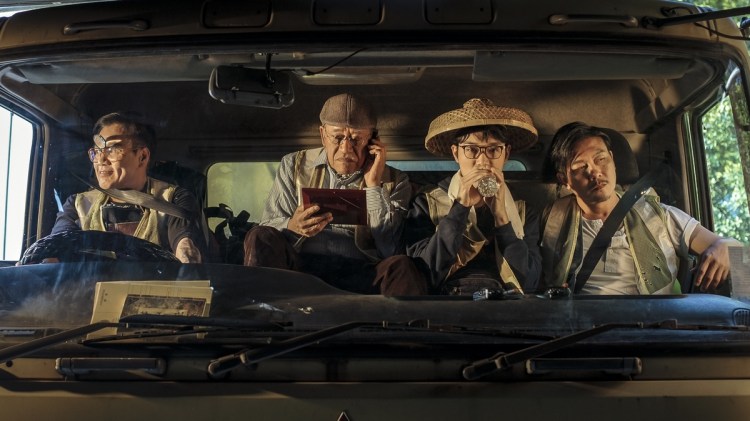
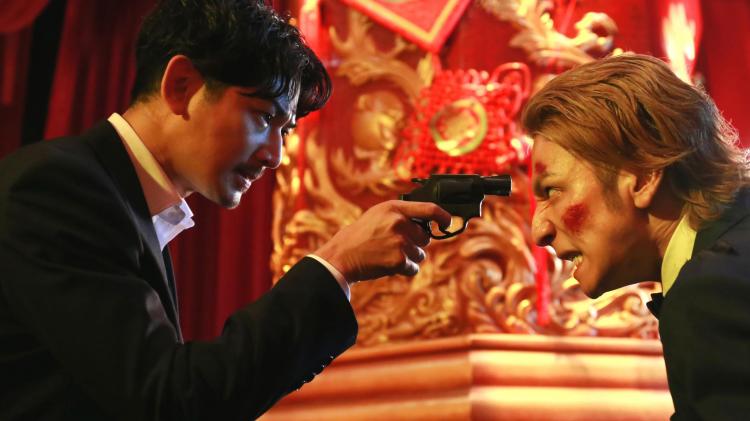
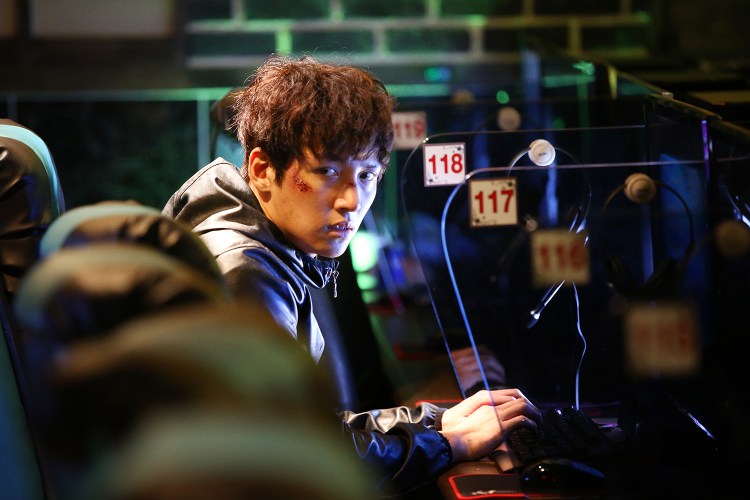

 The criticism levelled most often against Japanese cinema is its readiness to send established franchises to the big screen. Manga adaptations make up a significant proportion of mainstream films, but most adaptations are constructed from scratch for maximum accessibility to a general audience – sometimes to the irritation of the franchise’s fans. When it comes to the cinematic instalments of popular TV shows the question is more difficult but most attempt to make some concession to those who are not familiar with the already established universe. Mozu (劇場版MOZU) does not do this. It makes no attempt to recap or explain itself, it simply continues from the end of the second series of the TV drama in which the “Mozu” or shrike of the title was resolved leaving the shady spectre of “Daruma” hanging for the inevitable conclusion.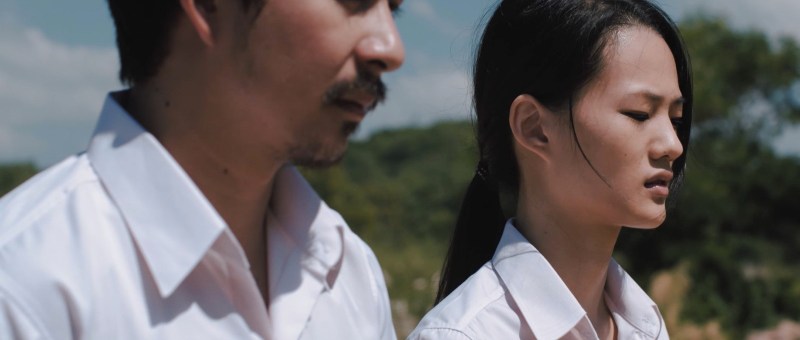
 Anocha Suwichakornpong’s second feature, By the Time it Gets Dark (ดาวคะนอง.Dao Khanong), bills itself as an exploration of a traumatic moment from the recent past but quickly subverts this conceit for a wider meditation on the veracity of cinema. Beginning in a manner typical of indie-leaning Thai films, Anocha gently undercuts herself as her images prism into their separate “realities”, informing and commenting on each other but perhaps not fully interacting. The Thammasat University student massacre of 1976 is the dark genesis of this fracturing future, but it’s also in the process of becoming a collective legend, cementing a “historical truth” as cultural currency even whilst expunged from the history books, leaving its young lost in a black hole of memory from which they are powerless to emerge.
 Windows on Worlds