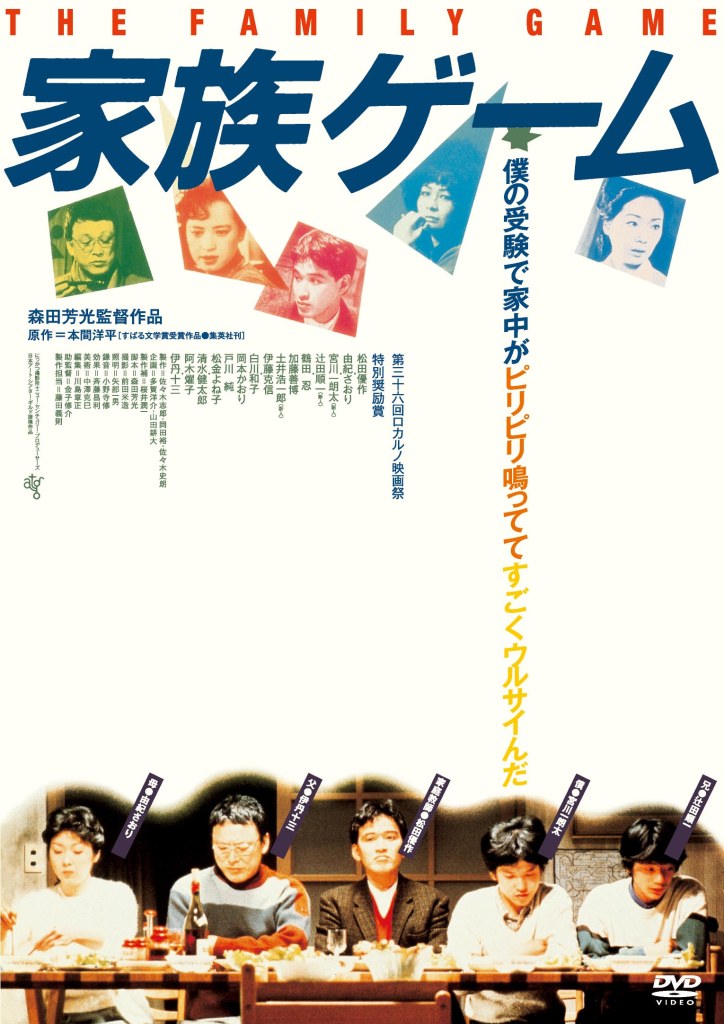
The Family Game (家族ゲーム, Yoshimitsu Morita, 1983)

TFG_DVD_jk_ol“Why do we have to make such sacrifices for our children?”. It sounds a little cold, doesn’t it, but none the less true. Yoshimitsu Morita’s 1983 social satire The Family Game (家族ゲーム, Kazoku Game) takes that most Japanese of genres, the family drama, and turns it inside out whilst vigorously shaking it to see what else falls from the pockets.

The “ordinary” middle class Numata family consists of the salaryman father Kosuke, the regular housewife mother Chikako and their two sons – older brother Shinichi and younger brother Shigeyuki. Right now the focus of attention is very much on Shigeyuki as he approaches the difficult period of sitting entrance exams for high school. To be frank, Shigeyuki’s prospects are dismal. He ranks near the bottom of the class and though certainly bright has little interest in studying. Therefore, the family have decided to bring in a home tutor to help boost his grades. They’ve already tried several to no avail but have high hopes for Mr. Yoshimoto, a local university student, but little do they know that he’s going to end up teaching each of them a little more than they cared to learn.

Morita breaks down the modern family into its component parts and finds only archetypes representing the kinds of roles which are rigidly enforced by Japan’s conformist society. Let’s start with the “father” who is supposedly the head of the household yet barely has anything at all to do with it. He believes his role is simply to go to work and shout commands which his “family” are supposed to follow unquestioningly. His realm is everything outside the house, everything inside is the responsibility of his wife and he won’t in any way get involved with that. When he has a problem with the kids (and this problem will only be that they aren’t performing to expectation), he will tell his wife and she is expected to take care of it on her own. Of course, his authority is hollow and dependent on his family falling in with his preconceived ideas of their “individual” roles.

The wife, then, is more or less a glorified housekeeper in charge of domestic arrangements and expected to remain within the home. Barked at by her husband and treated like a servant by her own children, her existence is often a fairly miserable one. She remarks that she wishes she’d had her children later – there were so many things so wanted to do that now are denied her because she’s forced to “play the role” that’s expected of her as a wife and mother.

Of the two kids, the older brother, Shinichi, starts the film as the one who plays his pre-ordained role to the level that’s expected of him. He’s a bright boy who studies hard and got into the top high school no problem. As the film goes on and everyone’s obsessed with Shigeyuki, Shinichi’s mask begins to drop as he encounters various typically teenage phenomenons which interfere with his role as over achieving big brother.

Shigeyuki, however, refuses to play the game at all. He just does not care. He loves to get under people’s skin and takes pleasure in annoying or outsmarting them such as when he cons his mother into letting him skip school (his pancreas hurts!) which she lets him do probably knowingly because she’s still playing her role as the worried mother. Finally he only begins to study when he realises it annoys a fellow pupil when his grades improve.

When tutor Yoshimoto enters the picture he tears a great big hole through the centre of this perfect family photo. He starts by behaving very strangely with Mr. Numata by grabbing his hand and calling him “father” whilst leaning in far too close for a casual acquaintance. Similarly when he first meets Shigeyuki he leans right in and then remarks that he has “a cute face”. He proceeds to invade Shigeyuki’s physical space by regularly touching him to a degree which is odd for a teacher/pupil relationship and is almost a prelude to molestation. When Shigeyuki tries to troll him by filling pages of his notebook with the same word over and over again, Yoshimoto reacts coolly before punching him in the face. From now on, when Shigeyuki isn’t pulling his weight, he’ll get a bloody nose.

Gradually Yoshimoto begins to take over the parental roles of the household firstly by instigating the masculine discipline through violence that Mr Numata is never there to deal out as well as offering the original role of teacher/mentor which might ordinarily be found in a grandfather or uncle. Later he usurps the big brother’s place by trying to talk frankly about sex and teaching Shigeyuki how to defend himself against playground bullies which also helps the boy cement a friendship with a sometime rival. Finally, he takes on the maternal mantle too when Mrs Numata asks him to go down to the school and talk to Shigeyuki’s teachers on her behalf. By the time that his original mission is completed he’s well and truly infiltrated the household allowing him to, literally, overturn its sense of stability.

Morita’s screenplay is witty affair full of one liners and humour born of unusual frankness. Family is a fake concept which forces each of its members into predefined roles and is largely divorced from genuine feeling. What matters is the appearance of normality and the acquisition of status – i.e getting into the better university, not so much as a path to success but as a way of avoiding the embarrassment of not getting there. An absurdist social satire, The Family Game is a biting critique of the social mores of the early 1980s which punches a gaping hole through the foundation of traditional Japanese society.


 

Garm Wars: The Last Druid (Mamoru Oshii, 2014)

Snapshot-2016-03-02 at 02_43_18 PM-1532593162
Could get behind a god who looked like this.

Review of Mamoru Oshii’s latest attempt at live action filmmaking, Garm Wars: The Last Druid – First Published by UK Anime Network.


Mamoru Oshii is a giant of anime history – this is not in dispute. His work on the original Ghost in the Shell alone has made him something of a legend in the world of animation, however, his adventures in the live action realm have fared nowhere near as well. Garm Wars: The Last Druid attempts to mitigate this by blending the extremely beautiful animation techniques of Production I.G with a more conventional live action setting.

A sort of fantasy/cyber punk hybrid, Garm Wars takes place on a planet much like our own which was once cared for by a now departed god and has since descended into internecine warfare between the three remaining tribes of its original eight. We follow fighter pilot Khara who actually dies right away but is quickly “reborn” through downloading into a new clone body to become Khara 23. She links up with some kind of priest, Wydd (played by Lance Henrikson), who is travelling with a Druid (long thought to be extinct) and a holy deity, the Gula, who is (you guessed it) a basset hound. Later, this slightly less than merry band picks up the mercenary Stellig who ends up warming to Khara’s rebellious charms.

To be honest, you’ll get the most out of Garm Wars if you just ignore the entirety of the dialogue and listen to the visuals alone. Full of the most generic full on fantasy jargon, it’s extremely difficult to follow all of the different ideas and symbolic layers which attempt to construct Garm Wars’ post-apocalyptic landscape and all but those who particularly love over the top fantasy language will find themselves cringing at its lack of finesse. Oshii has been developing Garm Wars since the ‘90s and it may be the case that The Last Druid is simply one of its many chapters, just not the first, but the viewer is perpetually left feeling slightly lost with the wealth of disjointed information which is imparted mostly via straightforward exposition.

In essence, what Oshii has tried to do is to create a live action anime. It does beg the question as to why he thought this was necessary at all if he could have just made this more satisfactorily in animated form, but almost everything in the film that is not actually alive or attached to something alive is constructed through CG animation. Production I.G’s work here is often impressive even given their generally high level of quality but sits uncomfortably with the presence of the real live actors.

Oshii also opts for a highly stylised approach in which the actors are reciting their lines in a very deliberate manner. It would be easy to criticise their performances in this regard but, as all are adhering to the same style, it seems to be a deliberate choice perhaps meant to evoke a more classical, theatrical feeling. Unfortunately, this acts as another alienating technique which, along with the heavy CGI intrusion, makes it difficult to key in to either the characters or the story.

Garm Wars’ biggest weakness is that it plays like a string of video game cut scenes in which someone has inexplicably decided to skip the actual gameplay. Undoubtedly full of often beautiful and striking imagery, the central narrative never really kicks in offering a feast for the eyes but an unsatisfying smorgasbord of ideas for the mind. Garm Wars will most likely play best to longtime fans of Oshii who will be best placed to recognise his recurrent themes and the concerns which run through the entirety of his work, but for those less well versed in the director’s oeuvre, Garm Wars will most likely prove a frustrating, if intermittently entertaining, experience.


Garm Wars: The Last Druid is released on blu-ray and DVD in the UK by Manga Entertainment on 14th March 2016 and is available on DVD in the US from Arc Entertainment.

Phoenix (Christian Petzold, 2014)

phoenixIn late June of 1945, one woman is escorting another through a US checkpoint in Berlin. The young American soldier is somewhat cocky and feigns an officious sort of suspicion that causes him to demand the bandaged woman reveal her face – just to be sure. The obvious agony she feels just beginning to unwind the various layers which hide her identity is enough to convince him that he’s made a cruel mistake and he lets the pair pass.

Finally Lene (Nina Kunzendorf) delivers the wounded Nelly (Nina Hoss) to a specialist hospital. A survivor of Auschwitz, Nelly was at some point shot in the head and left for dead. Though she miraculously survived, her face is ruined – missing nose, shattered cheekbones etc. She will need extensive reconstructive surgery. “Who would you like to be?” her doctor asks her, but Nelly only wants to be herself – exactly as she was. The doctor advises against it – it can never be exactly the same and the uncanniness is something not everyone can get over plus it can be an advantage to be given the opportunity to start all over again with a new face, a new identity newly shed of all the scars of a traumatic past. Nelly, however, is insistent.

Returning to the city with Lene, she learns that her entire family and many of their mutual friends have been killed though others turned out to have been nazi sympathisers. Nelly repeatedly asks about her husband, Johnny (Ronald Zehrfeld), but Lene is reluctant to talk about him. Roaming the streets alone at night she tracks him down to a seedy cabaret club, Pheonix, in the American sector where he now clears tables rather than playing the piano. When she calls him by his former name he barely reacts and fails to recognise her. Later he tracks Nelly down and makes her a very odd proposition – pretend to be his deceased wife to claim the inheritance then split the proceeds.

“I no longer exist” exclaims Nelly at one point. Robbed of everything apart from her breath, Nelly has been erased and replaced by something with no clear history. She wants to go back, to reclaim the life she led before exactly how it was but her home no longer exists – her city is in rubble, most of her friends are dead and the husband that she’s made the anchor of her survival may have been the very one who betrayed her.

Meeting Johnny (now “Johannes”) again and moving into his back room she studies for the role of a lifetime – once again inhabiting her former self, stepping into the shoes of a soulless ghost. Nelly pleads with him silently to remember – recall her from the abyss, recognise her living form as the woman who was taken away in October 1944. Johnny, however, cannot bear to think about the past. He’s convinced himself his wife is dead and is only interested in claiming her money to make a new life in the post-war world. No matter how the coincidences mount up as “Esther” not only looks like “Nelly” but also has her handwriting, voice and movement, Johnny refuses to recognise her or acknowledge their shared tragedy.

Operating like an inverted Vertigo, Phoenix is an extremely rich character drama which not only deals with one woman rebuilding herself from the ashes but also with her nation’s sense of guilt as it resolutely refuses to look the victims of its crime in the eye. Nelly needs to remember and have her existence acknowledged in order to reclaim her identity, but Johnny cannot bear to look, his guilt is so great that it would shatter his sense of self irrevocably. They dance around each other caught between past and future but both trapped, their passage blocked by the symbolic checkpoints that exist all around them in their now ruined city.

Just as the doctor told her, it can never be exactly the same. At the end of the film, Nelly’s transformation is complete, her selfhood restored though somehow different from before. Lene wanted to run away to Palestine, create a new world for her people free from fear and persecution, Johnny wanted to forget and Nelly needed to remember (and be remembered) in order to become herself again but in the end nobody gets quite what they wanted. Only Nelly by meeting her former self head on is able to evolve, finally pulling away from us, out of focus.

Petzold serves us ghosts of several varieties including those of our cinematic pasts by imbuing his melodrama with the gloomy allure of the film noir mixed with the uncomfortable psychology of the Hitchcockian thriller and the uncanny horror of Eyes Without a Face. Probing questions of identity which extend from the individual to the national it asks us to consider a post-war world of guilt and recrimination in which everyone is engaged in rebuilding an idea of selfhood which can take account of wounds suffered or inflicted. Difficult and complex yet beautiful too, Phoenix is anchored by the extremely accomplished performance of its star Nina Hoss and proves a hauntingly melancholy exploration of all it means to be alive.


Phoenix is currently available in the UK on blu-ray, DVD and VOD courtesy of SODA Pictures and is available in the US as part of the Criterion Collection.

Audition (オーディション, Takashi Miike, 1999)

audition-posterReview of Takashi Miike’s Audition (オーディション) – first published by UK Anime Network.


The world was a much more innocent place back in 1999. Takashi Miike already had 34 films to his name before Audition became his breakout hit even whilst seeing him branded “sick” by a disgusted audience member at the film’s otherwise successful screening at the Rotterdam film festival. Based on the book of the same name by Japan’s master of the nasty psychological thriller Ryu Murakami, Audition is the twisted romantic nightmare to end all twisted romantic nightmares.

Aoyama is a widower with an almost grown-up child. Now that his parental responsibilities are changing, and spurred on by his encouraging son, Aoyama perhaps feels ready to move into another phase of his life by considering the idea of getting married again. However, Aoyama is a sensitive and romantic man who’s actually a little naive when it comes to matters of the heart and obviously hasn’t had much experience in the dating world in the last twenty years. He turns to an old friend who happens to be a casting director and comes up with the novel (if somewhat inappropriate) idea of letting Aoyama sit in on an audition to look for a new wife.

In glancing over the headshot resumés, one catches his eye – that of a former ballet dancer who equates having had to abandon her dream of becoming a professional dancer because of an injury with a sort of spiritual death. This deep sense of loss strikes a chord in the widowed Aoyama and despite his friend’s warnings that she gives him the creeps, Asami is the one he’s set his heart on. However, Asami is not the sweet and innocent girl she first appears to be…

In the intervening 15 years since its original release, Audition has amassed something of a reputation which is to say that viewers will almost certainly be aware of its “extreme” nature. However, Audition arguably works best when seen blind as it begins as a fairly straightforward romantic drama in which a broken hearted widower begins to live again thanks to the attentions of a shy young woman. Of course, Miike is peppering the otherwise anodyne love story with subtle (and not so subtle) clues all the way through, planting doubts in our minds right away. Is Aoyama just an old fool who’s lost his head over a young beauty or is he right to grow suspicious in the face of the ever increasing, yet circumstantial, evidence of Asami’s strangeness?

Is Asami hiding a dark secret, or is Aoyama projecting his fears of romantic entanglements onto her  silhouette and therefore creating, in some sense, a villainess worthy of his anxieties? According to Miike himself, Audition is not a horror movie (Japanese horror movies are linked with the supernatural and Audition’s terrors are very much of the real world) – Murakami in fact wrote the book as a strange kind of “love letter” to a woman he had wronged. Miike sought to envisage her reply and gives her an opportunity to offer a series of extremely dark explanations of her own. Neither Aoyama or Asami have been honest with themselves or each other. Aoyama is looking for a cookie cutter ideal to fit into the pre-made box marked “wife”, and well, it would be better not to go into all the various ways Asami has misrepresented herself but she does have a point when she calls Aoyama on how easy it was to make him fall for her meek and feeble innocent act.

Asami and Aoyama are always working at cross purposes to each other, engaged in a macabre dance where Asami leads by stealth, waltzing Aoyama into her spider’s web of vengeance by neatly subverting his ideas of femininity. However, this is not to cast Asami as a vile temptress or the predatory female born of male fears of emasculation (though these ideas are definitely in play), nor is she an avenging feminist warrior so much as a lonely, damaged woman. At the very end of the film the pair have perhaps reached a kind of understanding as, according to Asami, only in extreme pain does one understand one’s own mind. Left maimed and helpless, each is scarred and broken but alive and, perhaps, at peace at last.


Audition is now re-released on blu-ray in the UK from Arrow Films in a significantly better transfer than the previous US blu-ray from Shout Factory.


Panic High School (高校大パニック, Sogo Ishii, 1978)

Panic High SchoolSogo (now Gakyruu) Ishii was only 20 years old when Nikkatsu commissioned him to turn his smash hit 8mm short into a full scale studio picture. Perhaps that’s why they partnered him with one of their steadiest hands in Yukihiro Sawada as a co-director though the youthful punk attitude that would become Ishii’s signature is very much in evidence here despite the otherwise mainstream studio production. That said, Nikkatsu in this period was a far less sophisticated operation than it had been a decade before and, surprisingly, Panic High School (高校大パニック, Koukou Dai Panic) neatly avoids the kind of exploitative schlock that its title might suggest.
Back in 1977, though sadly little has changed in the intervening 40 years, schools are little more than pressure cookers slowly squeezing out every inch of individuality from the young people trapped within them as they cram for tests in subjects they might not actually understand. When a pupil commits suicide, the head master offers a few words of condolence over the tannoy system which the form tutor later backs up by emphasising that no one knows why the boy did this and that it probably has nothing at all to do with the school, exam pressure, or his performance in the recent mock exams. The school expect a line to be drawn here and for everyone to forget about it and get back to work.

However, when the teacher, Ihara, starts going on about the league tables suffering if the kids don’t buckle down some of them have had enough. One young man, Jono, looses it completely and takes a swing at the teacher only to miss and run out of the school in a panic. Whilst wandering around town he passes a gun shop and swipes a rifle before returning to the classroom and assassinating the maths tyrant. Not knowing what to do next, Jono hides out in the school building taking some of his friends hostage and then all hell breaks loose.

At its core, Panic High School is satire laying bare the crisis in Japan’s educational system which places undue emphasis on one particular set of exams which will determine the entirety of a person’s life. The teachers are cruel and heartless, little more than cogs in a machine. They don’t care about the kids, they only care about the statistics and the prestige associated with being the top high school in the area. All of these kids are bright, they already passed the stressful middle school entrance exams to get here, and the school just expects them to succeed but offers no support if they can’t.

Indeed, Ihara isn’t even teaching them anything. At the beginning of the film he asks a female student to solve an equation on the board. When she can’t, not only does he not explain the solution to her, he sends her outside adding to her original humiliation in front of the entire class and preventing her from actually learning how to solve the problem. When the next boy can’t solve it either he simply berates him for not studying, saying a “student at this high school should be able to solve this problem”. When the boy points out he did study but just doesn’t understand all he gets is abuse, no actual teaching at all.

Even when the police have been called, all anyone cares about is the reputation of the school. The headmaster keeps harping on about their status as the top school in the area and how “unfortunate” it would be if a student is killed inside the school – which is completely ignoring the fact that a teacher has already been murdered by a shotgun toting teenager right in the classroom. The police bungle the entire affair, starting by tearing apart Jono’s desk for clues including going right through his lunchbox and pointlessly cutting a hole in the bottom of his schoolbag. Bringing even more guns and riot police into the school to deal with one frightened boy who doesn’t want to shoot anyone else but is only trying to effect his escape (so he can take his entrance exams next year) is far from a good idea.

The kids are mad as hell and they aren’t going to take this anymore. The pressure is extreme and in the face of adult hypocrisy, it’s unsurprising that Jono and the other young people like him find themselves lashing out in extreme ways. Their teachers see them only as products, or even as components in the building of a “future” but never as people. Even if some of them start out wanting to help Jono, by the end even a teacher is trying to grab a gun screaming “That kid! I hate him now – I’ll kill him, he’s abandoned the most important thing – his education! He should never have come here in the first place!” putting the blame firmly on the boy and not on the system. In fact, the other teachers are busy in a huddle talking about how this is going to raise questions about the educational establishment and how they intend to mitigate that (they do not intend to address the “problems” in themselves).

While not as loud or as dynamic as some of Ishii’s later work, Panic High School displays much of his punkish sensibility even if it takes a form closer to ‘70s youth drama complete with all the zooms, whips and pans associated with the exploitation era. However, perhaps because Ishii’s own age is so close that of his protagonists the film is firmly on the side of youth. Far from a “youth in crisis” film, Panic High School places the blame firmly at the feet of the system which forces its young people into extreme and absurd situations. Notably different from Ishii’s later work in terms of tone and style, Panic High School is nevertheless an impressive studio debut feature and a strong indicator of the director’s continuing preoccupations.


Climatic scene from towards the beginning of the film (unsubtitled)


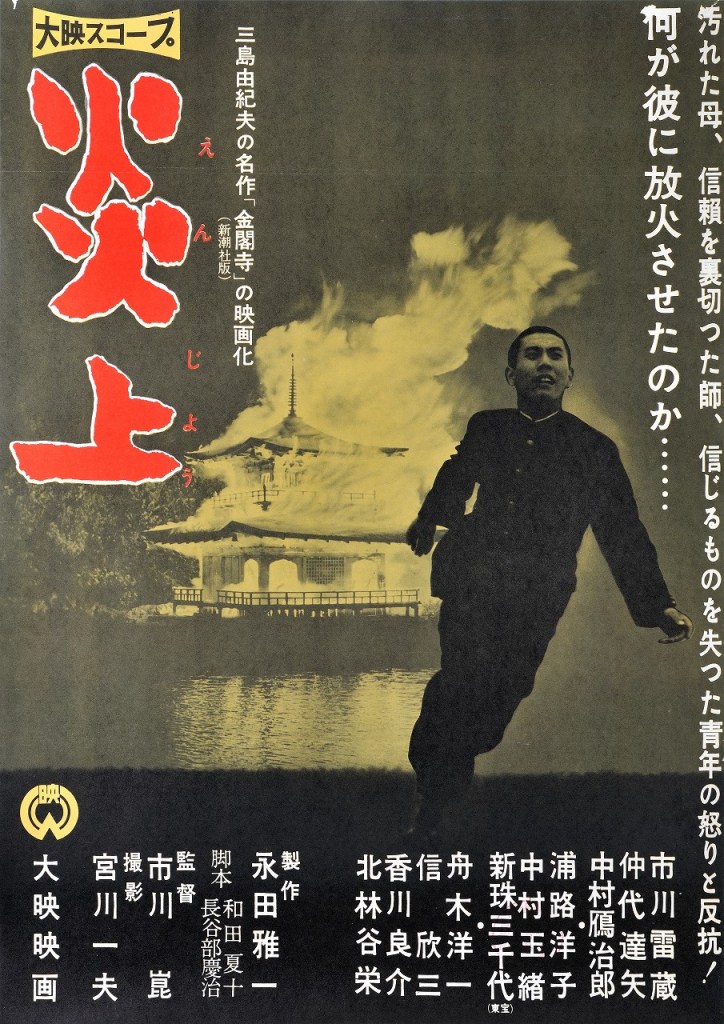
Enjo (炎上, Kon Ichikawa, 1958)

a0212807_23483150Kon Ichikawa turns his unflinching eyes to the hypocrisy of the post-war world and its tormented youth in adapting one of Yukio Mishima’s most acclaimed works, The Temple of the Golden Pavilion. Inspired by the real life burning of the Kinkaku-ji temple in 1950 by a “disturbed” monk, Enjo (炎上, AKA Conflagration / Flame of Torment) examines the spiritual and moral disintegration of a young man obsessed with beauty but shunned by society because of a disability.
The film begins near its ending as a young boy with a monk’s haircut sits in a police interrogation room. He was found passed out in the woods behind a burning temple with two knife wounds on his chest plus the knife and a packet of matches lying next to him. The police would quite like to know why he, obviously, set fire to one of Japan’s most popular historical monuments, but the boy refuses to speak.

At this point we enter a series of extended flashbacks as the boy, Goichi (Raizo Ichikawa), enters the Soen Temple after his father’s death as an apprentice to the head monk there, Tayama, who was a friend of his father’s. The assistant chief monk is unhappy about this as he’s long wanted his own son to be accepted as a novice with an eye to one day inheriting the temple as the current head monk is not married and has no son of his own. When the other monks find out that the reason Goichi rarely speaks is his stammer, they begin to doubt his suitability to become a representative of their organisation.

Having grown up in a temple, Goichi idolised his father and wants nothing other than to become a monk himself. His father also loved the golden temple, “Shukaku-ji” more than anything else in the world and so it has come to symbolise a shining pillar of purity for the young Goichi who will stop at nothing to protect it. Simply being allowed to be near it is enough for him. That the temple survived the wartime air raids and subsequent chaos is nothing short of a miracle, if not proof of the gods’ love for it.

Yet, Goichi burns it down. He destroys this thing that he loved above all else, so why did he do it? The temple is too good for the world, too pure to be permitted to exist. Simply put, we don’t deserve it. One of Goichi’s earliest attempts to protect the sacred environs of the monument sees him physically push a woman away from its doors. The woman, dressed in a very modern style, had been having an argument with a GI and though it originally looks as if Goichi may come to her rescue it’s the temple he runs for. After the woman lands flat on her back, the GI thanks him for saving them “a lot of trouble with the baby”.

After having committed an unintended sin in defending his beloved temple from being defiled by an impure woman, Goichi has the urge to confess but never quite brings himself to do it. This begins to create a rift between himself and his mentor the head priest. Though the priest had been his champion, Goichi always doubted that he really saw him as a possible successor because of his stammer and only now realises that the priest has lost faith in him because of his cowardliness in not informing him of the incident with woman outside Shukaku-ji. After this slight the priest goes on supporting Goichi but not with the same warmth as before and Goichi eventually comes to resent him.

The priest has feet of clay – though it’s not unusual for priests to marry and have families, Tayama has nominally dedicated himself to the temple only, leaving himself with a problem as to its succession. However, Goichi discovers that the priest has a mistress in one of the most popular geisha houses in Kyoto. The monks are some of the wealthiest people around thanks to pimping out Shukaku-ji as a major tourist attraction and Tayama has already forgotten himself, becoming lost in the “worldliness” necessary to manage a religious establishment which is actually a lucrative business enterprise. The temple is itself defiled, prostituted, by the very people who are supposed to be protecting it and the proceeds fed back into funding an “immoral” lifestyle for its “CEO”.

This hypocrisy adds to the injustice dealt Goichi by the uncharitable nature of the monks who also, like just about everyone else, shun him because of his stammer. Though he never stammers reading the sutras and can even speak English plainly, his lifelong stutter has left him reluctant to speak and he finds only one friend at the temple. Later he meets another bad tempered man with a lame leg and the two develop an odd bond based on their shared “deformities”. Kashiwagi (Tatsuya Nakadai) is at odds with the world and encourages Goichi further onto the course of mistaken anger born of insecurity. He urges Goichi to test Tayama’s true virtue by constantly provoking him which only leads to a further fall in Goichi’s fortunes. However, Kashiwagi is also shown up for a hypocrite who exploits other people’s reactions to his disability for his own advantage.

All of Goichi’s idols fall. His parents – his mother an adulteress and his father a sickly heartbroken monk, his mentor a lecherous hypocrite and his friend a self hating coward. The world he saw in Shukaku-ji can never exist, humans are fallible and always will be including Goichi himself who is tormented by dark thoughts. An idealistic absolutist, the existence of Shukaku-ji in this imperfect world becomes to much for him to bear.

Ichikawa tells his story in a fractured, dreamlike way full of gentle dissolves as one period segues into another without warning. Goichi’s memories become more disparate and keenly focussed at the same time as his spiritual health deteriorates. Ichikawa tries to capture some of Goichi’s inner claustrophobia through the oppressive architecture of the temple environment but can’t get close to the pervading sense of dread in Mishima’s novel. Enjo is the dissection of one man’s self immolation in the fire of his own spiritual disintegration but is also a condemnation of the corrupting modern world which enables such pollution to take place and its tale of the doomed innocence of the idealist is one which is retold throughout history.


I can’t seem to find any video clips of this film, but as a side note 炎上 is current Japanese netslang for a flamewar so I did find a bunch of other “interesting” stuff.

Here’s a short video featuring clips from several of Ichikawa’s films including Enjo which you’ll be able to spot what with the temple on fire and everything…

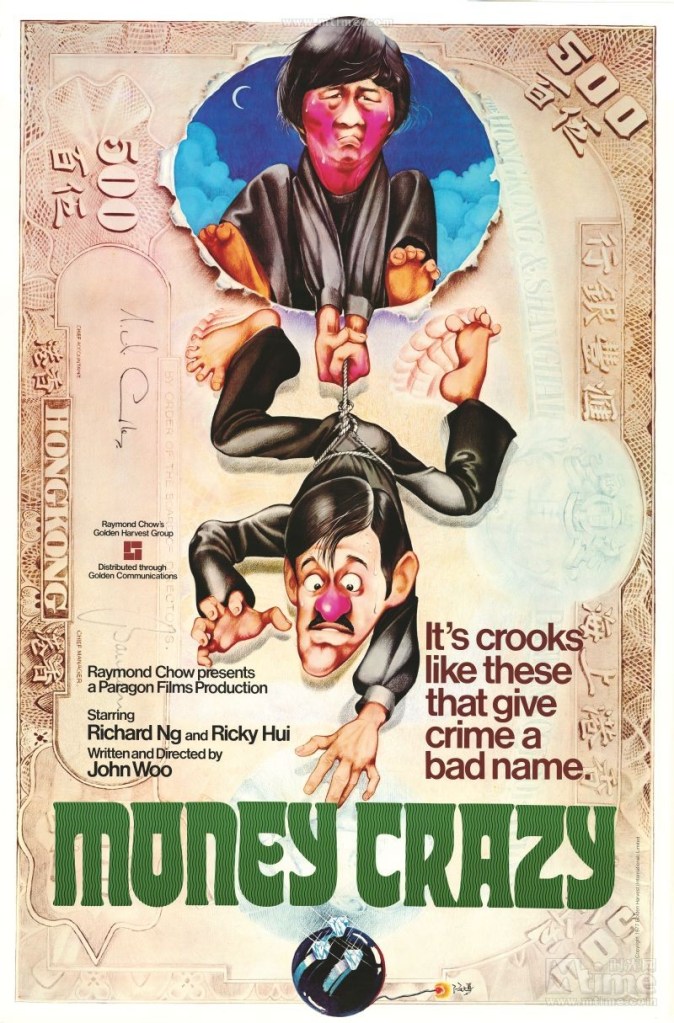
The Pilferer’s Progress (发钱寒, John Woo, 1977)

Money CrazyJohn Woo is best known in the West for his “heroic bloodshed” movies from the ‘80s in which melancholy tough guys shoot bullets at each other in beautiful ways. However, he had a long and varied career even before which began with Shaw Brothers and a stint in traditional martial arts movies. What often gets over looked outside of Woo’s native Hong Kong is his many comedies, of which The Pilferer’s Progress (AKA Money Crazy, 发钱寒, Fa Qian Han) is one of his most successful.

The plot follows the comic adventures of two down on their luck hoodlums – would be bodyguard Poison (Ricky Hui) and “private detective” Dragon (Richard Ng Yiu hon), who keep running into each other so many times that they eventually end up having to become a team. After each becoming involved with the greedy business man Rich Chan (Cheung Ying), the two find themselves lusting after a set of three diamonds which he has in his possession. Their desire only grows after meeting Mary (Angie Chiu) and her godfather to whom the diamonds originally belonged before Chan cheated him out of them.

Love trumps money, at least for a while, as Poison and Dragon team up to get revenge on Chan and get the diamonds back for Mary. Of course, more personal concerns end up raising their heads towards the end as the duo realise that if they just give the diamonds back to Mary it might buy them some brownie points but they’ll be quite massively out of pocket. They come up with a suitably anarchic solution that involves dummies holding guns and a motorbike cleverly concealed inside a haystack not to mention a fake broken arm (unsurprisingly it doesn’t go quite as smoothly as they’d hoped).

Much more slapstick buddy comedy than crime thriller, The Pilferer’s Progress is full of innovative sight gags and the fast paced Cantonese wordplay that has become a hallmark of the genre. Neither Poison nor Dragon are born criminal masterminds, they’re both just muddling through with a kind of anarchic insouciance that lends their exploits a gleefully childish quality even when Dragon is doing something as shady as indulging in a bit of analogue photoshop to fabricate a picture of Chan with a mistress so he can blackmail him. Poison’s number one manoeuvre is to get a gang together to pretend to attack his target so he can pretend to fight them all off in the hope that the “victim” will be so grateful and impressed with his martial arts skills that he’ll take him on as a bodyguard.

Dragon seems to be an avid watcher of modern spy movies and has a host of fairly useless gadgets he can use to try and get the drop on Chan such as bugging his car (Poison puts the bug on the exhaust pipe), or drilling a hole from the kitchen below right into Chan’s toilet and sticking a periscope up there to scout out the room. Chan also has a fairly elaborate security system that he mostly uses to annoy his wife but Poison and Dragon get round it by drilling another, bigger hole in the ceiling and pulling a Mission Impossible style rope manoeuvre to try and grab the diamonds from around Chan’s neck while he’s asleep. Because he’s thought of everything, Dragon even pulls out a tiny umbrella and hangs it from his nose to catch the increasing stream of sweat falling from his brow in one of the film’s funniest moments.

Woo also mixes quite a lot of exciting kung-fu action with the pure comedy as Chan’s second bodyguard is a recently graduated shaolin monk who’s pretty much invincible – to normal people, but somehow Dragon and Poison manage to outsmart him every time. There’s also a fair amount of the gunplay that was to become Woo’s signature but there are no balletic sequences here – the guns look ridiculously fake, almost like children’s toys, and are always the “butt” of the joke, literally.

The Pilferer’s Progress may not be a great lost classic but it is heaps of period specific fun with an extremely catchy soundtrack including the title song sung by star Ricky Hui. Extraordinarily successful on its original release, The Pilferer’s Progress is undoubtedly very much of its time, as perhaps it was intended to be, but its fast paced, silly slapstick humour has a universal quality that proves that true comedy has no sell by date.


Seen as part of HOME’s CRIME: Hong Kong Style touring season.


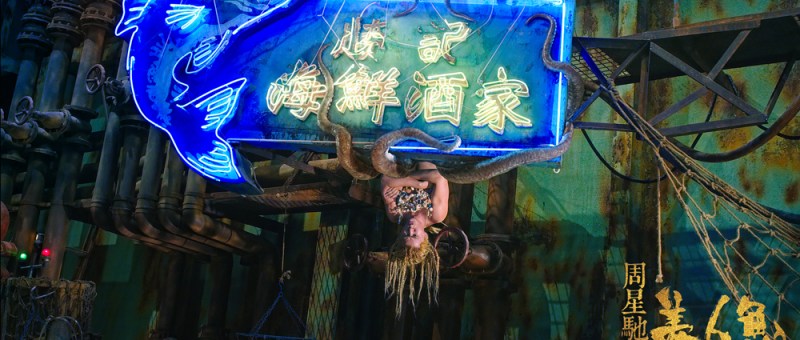
The Mermaid (美人鱼, Stephen Chow, 2016)

Mermaid

Stephen Chow unexpectedly became a mini phenomenon with that rarest of beasts – a foreign language comedy that proved a mainstream crossover hit, in the form of the double punch that was Kung Fu Hustle and Shaolin Soccer. However, his once ascendant star has been in retrograde ever since when it comes to screens outside of Asia. The surprise worldwide theatrical release of this latest film, The Mermaid (美人鱼, Mei Ren Yu), might be about to change all that.

Loosely inspired by The Little Mermaid, Chow paints a world of consumerism in overdrive as heartless capitalists fall over themselves to destroy the beauty of the natural world to buy even more flashy status symbols even though they only make them even more miserable. After opening with some newsreel footage of mass deforestation and a bloody dolphin massacre, Chow shows us the natural world exploited in a different way as a group of visitors visit an “exotic animal show” which includes such wonders as a live tiger (actually a pet dog with stripes painted on its fur), a “Batman” (with fried chicken for ears), and, crucially a “Mermaid” (a fried fish with a doll’s head on the top).

We’re then introduced to rich playboy businessman Liu Xuan (Deng Chao) who lives life large in a giant western style estate surrounded by gold digging dollybirds. He’s bought some “surprisingly well priced land” to use in a reclamation project, only the problem is it’s technically a nature reserve. His underlings have come up with a scheme to frighten away the wildlife with sonar devices so they can destroy the area of outstanding natural beauty in peace. However, they didn’t know about the colony of Merpeople hiding out there who have a serious problem with Liu and have dispatched one of their number, Shan (Jelly Lin), to assassinate him!

Predictably, the assassination plot does not all go to plan with often hilarious results. Like Chow’s other movies, the main spine of the narrative is a romantic comedy in which a foolish and arrogant man is made to realise his own weaknesses through finally noticing a woman he previously had no interest in. This time Shan turns up looking like a crazy lady with her bizarre makeup and fake mermaid outfit which gets her instantly thrown out of Liu’s place though she does succeed in giving him her phone number. Usually, Liu isn’t the type to call back but he gets goaded into it by mistake and then his henchman actually brings Shan to his office where she fails at assassinating him first with poison and then with sea urchins. By this time the course is set as the pair bond during their macabre meet-cute with Liu becoming attracted to Shan’s otherworldliness and she to the goodness that might be buried inside him.

Liu, it seems, experienced extreme poverty in his childhood and so now cares only about making money. Or says he does, his depressing solo karaoke dances to a hit pop song with the chorus “no one understands my loneliness” might tell a different story. Being super rich is actually kind of boring and everyone he meets only cares about his money so meeting Shan (who is predominantly interested in killing him) proves refreshing. Nevertheless, money also becomes an anchor dragging you down, even if Liu starts to come over to the Merpeople’s point of view (particularly after testing out those sonar devices on his own ears) his associates aren’t likely to agree.

It all goes a bit dark towards the end – wildlife massacres and kidnappings for “scientific research” which seems to include things like vivisection and live experimentation not to mention the intentional eradication of the entire living environment of these hitherto hidden creatures all the while preaching about scientific progress and a desire for understanding. Chow is many things but subtle has never been one of them so he lays his environmental message on with a trowel but the rest of the movie is so big anyway that he gets away with it (and in style).

Light and bright and colourful, The Mermaid is another characteristically madcap effort from Chow who packs in all the absurdist humour one could wish for plus a decent dose of sight gags and good old fashioned slapstick. It has to be said that the quality of the CGI (of which there is an awful lot in the film) is, on the whole, woeful, though somehow this just ends up adding to its charms as another facet of its self-effacing wackiness. A hilarious return to form from Chow who has been away for far too long, The Mermaid looks set to continue its enormous box office success by becoming one of the director’s most fondly remembered efforts.


The Mermaid is currently in UK cinemas but the distributors have gone down the Bollywood route of chasing the diaspora audience only (as RogerEbert.com discovered during the US release) and not engaging with the regular film press in any way, shape, or form. Therefore there has been almost no coverage of the cinema screenings in the non-Chinese media. Here’s a list of the surprisingly high number of UK cinemas screening the film courtesy of my friends at Eastern Kicks so check it out because it very likely could be playing at a cinema near you!

Attack! Hakata Street Gang (突撃!博多愚連隊, Sogo Ishii, 1978)

hakataSogo Ishii (now Gakuryu Ishii) was one of the foremost filmmakers in Japan’s punk movement of the late ‘70s and ‘80s though his later work drifted further away from his youthful subculture roots. Perhaps best known for his absurdist look at modern middle class society in The Crazy Family or his noisy musical epics Crazy Thunder Road and Burst City, Ishii’s first feature length film is a quieter, if no less energetic, effort.
Like his other films from the period, Attack! Hakata Street Gang (突撃!博多愚連隊, Totsugeki! Hakata Gurentai) is fairly light on actual plot but broadly follows a group of low level street punks who get themselves into trouble after accidentally shooting the son of a yakuza boss in the leg and leaving him to bleed to death. In trouble with both the law and the gangs the guys find themselves in the midst of a turf war they are ill equipped to handle.

Very clearly an early effort, Attack! Hakata Street Gang is an ultra low budget production filmed on the real streets starring Ishii’s friends rather than professional actors. It can’t claim to any level of aesthetic beauty and, in truth, is not particularly interesting in terms of look or style but is filled with Ishii’s characteristic energy and runs fast even given its brief 67 minute run time.

Generally, Ishii sticks to a naturalistic representation of the street punk world. Taking his cue from the realistic action genre pioneered by Fukasaku et al not long before the film’s release, Ishii employs a similar approach to the fight scenes shooting from the middle of the action and often from low angles. Full of handheld camera and shakey, unfocused shots Attack! Hakata Street Gang is filled with the kind of youthful freshness that was very in vogue at the time.

Ishii does not appear to want to offer any kind of critique of this extremely masculine, violent world but solely to capture it on film. The street punks themselves are not particularly well drawn but there is a notably strange set of characters including an ultranationalist and his younger brother with learning difficulties who wears an SS helmet and rides around on a pushbike with a large nazi flag flying on the back. Nicknamed “manji” (the word for the Japanese “swastika”) the boy is obsessed with warfare and dangerously gets hold of one of the guns his older brother has adapted from a toy to be able to fire real bullets. He’s more of a plot point than anything else but still offers a convincingly weird sample of modern street life.

Also in keeping with the recent brand of cool action dramas, the film has an energetic score which is perhaps more jazz fusion or blues rock than outright punk which gives it more of a nihilistic, sophisticated tone than the full on noise explosion of some of Ishii’s later efforts. By the time the guys have taken their final stand by capturing hostages and occupying the local kindergarten (literally kids with guns) it’s pretty clear that there is no way back for this collection of down and out street rats.

Perhaps more interesting as an early work of a master than in its own right, Attack! Hakata Street Gang is an energetic and youthful exploration of a little seen late 1970s subculture. Literally playing fast and loose, Ishii’s debut is in many ways a statement of intent and none the worse for it.


Trailer for the Sogo Ishii The Punk Years 1976 – 1983 box which includes this film (though unfortunatly does not include any subtitles).


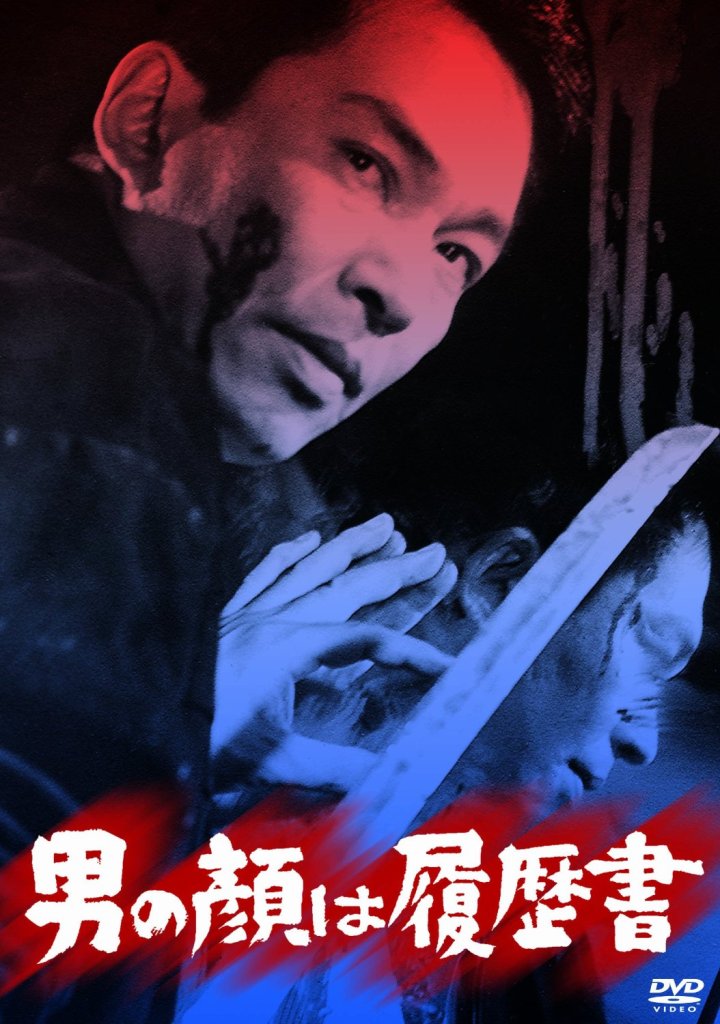
By a Man’s Face Shall You Know Him (男の顔は履歴書, Tai Kato, 1966)

by a man's faceJapanese cinema has not been as shy as might be supposed in examining uncomfortable topics concerning the nation’s mid 20th century history but perhaps prefers to tackle them from a subtle, sideways viewpoint. By a Man’s Face Shall You Know Him (男の顔は履歴書, Otokonokao wa Rirekisho) is, in essence, a fairly straightforward gangster pic – save that the rampaging gangsters are a mob of “zainichi” Koreans rather than post-war yakuza or petty hoodlums. Less about what it is to be an outsider or the quest for identity in second generation immigrants, Kato’s film is about what it says it is about – a man’s face.

The film begins in the contemporary era when morose doctor Amamiya is contemplating a transfer to an island posting which proves unappealing to him. Shortly after, a badly injured man is brought in following a car accident and, though Amamiya originally suggests the man be taken to a hospital as his chances of survival are slim, he changes his mind after lifting the sheet and recognising the man on the stretcher. The two men go back a long way – firstly to the battlefield where “Shibata” was a private in the army serving alongside Amamiya and secondly to an incident which dictated the rest of Amamiya’s life when he ran the local GP’s office and also happened to own the deeds to some land a bunch of Korean gangsters wanted to get their hands on. Thanks to their earlier association, “Shibata” now returning to his Korean name “Choi” was able to assist Amamiya in mitigating the gangster onslaught as he himself was a member of the gang.

Perhaps more to do with the production styles of the time, all of the “Korean” gangsters are played by Japanese actors and only ever speak Japanese even to each other. Nevertheless, they all want “revenge” for Japan’s treatment of Korea and Koreans during the years of occupation and warfare. In 1949 Japan is still in ruins and the gangsters see this as a prime opportunity to finally take Japan apart and presumably also profit in the process. The leader of this particular gang has set his sights on taking over the “New Life Marketplace” (a pregnant title if ever there was one) with the intention of turning it into an “entertainment district”. His guys, including one totally crazy foot soldier played by a particularly manic Bunta Sugawara, run roughshod over the town until finally raping and murdering Japanese women which they dismiss as par for the course given Japan’s treatment of Korean women over the past thirty years.

This is not a subtle examination of Korean Japanese relations in the post-war environment, these are gangsters and movie gangsters are generally all the same. They say they want to destroy Japan but ultimately they want what all gangs want – to control the area and extort maximum profit. Choi, and the young female Korean Gye, were born in Japan, have never even been to Korea and can’t really claim to have a great deal of Korean cultural knowledge. All they have are their names, now reclaimed after Japan’s wartime defeat. Throughout the war years, Choi used the Japanese version of his name “Shibata” and tried to pass himself off as Japanese (apparently successfully) but is now committed to embracing his Korean heritage even if it once again sees him placed in a subjugated position.

Amamiya returned from the war and took over his father’s medical clinic in his home town. He’s cynical and apathetic. He treats the people who come in to his clinic without discrimination but he doesn’t care very much about the area either. The only thing he really cares about is his nurse, Maki, with whom he’s been having a passionate affair and seems to be deeply in love. Amamiya makes an enemy of the Koreans early on when he fights off some guys who are hassling his nurse proving that he’s no pushover. The title deeds for the land the market is built on also belong to Amamiya who is unlikely to surrender them. The townspeople first turn to the regular Japanese yakuza who are unable to help with their currently depleted manpower leaving Amamiya as their only form of salvation.

When Amamiya’s hotheaded brother turns up and starts causing all sorts of trouble with the Koreans as a way of avenging Japan’s wartime defeat, Amamiya is dragged into a battle he had no desire to fight. Shunji was too young to fight in the war but is a representative of the younger generation who can’t accept the new post-war society and what they see as their older siblings failure to support the nation. Though a strong attraction develops between Shunji and Gye, their love story becomes another casualty of the harsh post-war world. Reluctantly, Amamiya becomes the last defender of these put upon people leading to a High Noon style solo stand against the Koreans whilst the terrified populace look on in fear and hope.

Kato creates a colourful world rich in symbolism such as the early scene in which Choi’s red blood drips down the white sheet accidentally recreating the Japanese flag. Amamiya’s prominent scar becomes both a plot point and a symbolic motif as it echoes the film’s title in bearing out his “history”. A man’s life is indeed written on his face, and Choi’s wife’s urging to her daughter that they watch Choi’s face as he fights for his life is another indication that one’s true nature is seen most clearly in times of duress. The film closes on an ambiguous note, in one sense, but closes its thematic line neatly. Amamiya faces a choice and no choice at the same time but through his face we know him and so we understand.